

The Mind Lab by Unitec | 2016
Makerspaces and Computational
Thinking at The Mind Lab by Unitec
David Parsons
Milla Inkila
The Mind Lab by Unitec | 2016The Mind Lab by Unitec | 2016
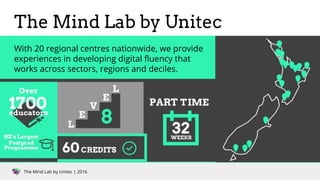
With 20 regional centres nationwide, we provide
experiences in developing digital fluency that
works across sectors, regions and deciles.
The Mind Lab by Unitec
The Mind Lab by Unitec | 2016The Mind Lab by Unitec | 2016
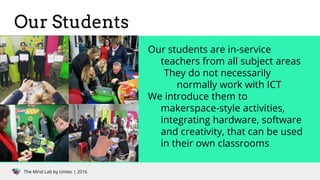
Our students are in-service
teachers from all subject areas
They do not necessarily
normally work with ICT
We introduce them to
makerspace-style activities,
integrating hardware, software
and creativity, that can be used
in their own classrooms
Our Students
The Mind Lab by Unitec | 2016The Mind Lab by Unitec | 2016
There is a distinction between making (as activities),
makerspaces (as communities of practice within a physical
space) and makers (as the identities of those who
participate). Thought needs to be given to all three of
these dimensions when designing makerspace activities
for the tertiary learner.
Makerspace Dimensions
Halverson, E.R.& Sheridan, K.M. The Maker Movement in Education. Harvard Educational Review, 84(4), 495-504.
The Mind Lab by Unitec | 2016The Mind Lab by Unitec | 2016
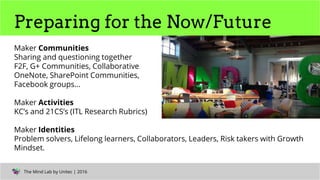
Maker Communities
Sharing and questioning together
F2F, G+ Communities, Collaborative
OneNote, SharePoint Communities,
Facebook groups...
Maker Activities
KC’s and 21CS’s (ITL Research Rubrics)
Maker Identities
Problem solvers, Lifelong learners, Collaborators, Leaders, Risk takers with Growth
Mindset.
Preparing for the Now/Future
The Mind Lab by Unitec | Computational Thinking | 2016The Mind Lab by Unitec | 2016
Some Things That We Do
● Stop motion movies with creative materials
● 3D design and printing
● Customised design thinking process
● Programming Makey Makey with Scratch
● Using Scratch for computational thinking
● Creating MeArm robotic arm kits for students
to assemble
● Programming MeArms with mBlock
The Mind Lab by Unitec | 2016The Mind Lab by Unitec | 2016
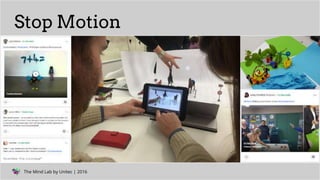
Stop Motion
The Mind Lab by Unitec | 2016The Mind Lab by Unitec | 2016
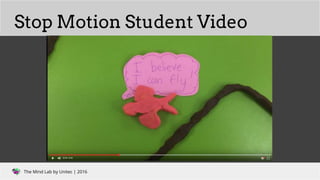
Stop Motion Student Video
The Mind Lab by Unitec | 2016The Mind Lab by Unitec | 2016
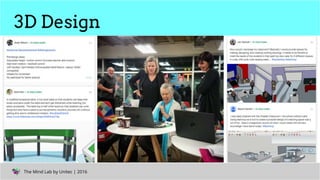
3D Design
The Mind Lab by Unitec | 2016The Mind Lab by Unitec | Teaching and Learning | 2016The Mind Lab by Unitec | 2016
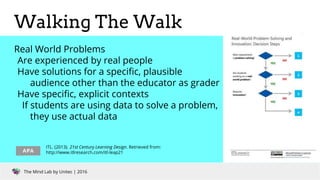
Real World Problems
Are experienced by real people
Have solutions for a specific, plausible
audience other than the educator as grader
Have specific, explicit contexts
If students are using data to solve a problem,
they use actual data
ITL. (2013). 21st Century Learning Design. Retrieved from:
http://www.itlresearch.com/itl-leap21
Walking The Walk
The Mind Lab by Unitec | 2016
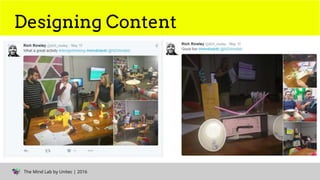
Designing Content
The Mind Lab by Unitec | 2016
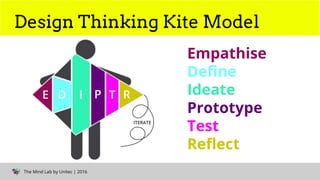
Design Thinking Kite Model
Empathise
Define
Ideate
Prototype
Test
Reflect
The Mind Lab by Unitec | 2016
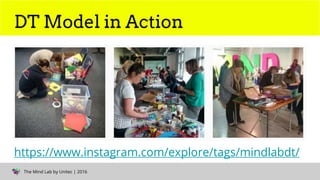
DT Model in Action
https://www.instagram.com/explore/tags/mindlabdt/
The Mind Lab by Unitec | Computational Thinking | 2016The Mind Lab by Unitec | Computational Thinking | 2016
Computational Thinking Means...
Solving problems
Applying abstraction and decomposition
Thinking algorithmically - what’s the process?
Thinking conceptually - what’s the model?
Understanding how things repeat and scale
Dealing with errors
...among other things (depends who you read)
14
The Mind Lab by Unitec | 2016The Mind Lab by Unitec | 2016
Computational Thinking
The Mind Lab by Unitec | 2016The Mind Lab by Unitec | 2016
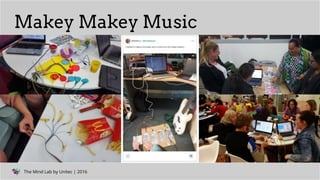
Makey Makey Music
The Mind Lab by Unitec | 2016The Mind Lab by Unitec | 2016
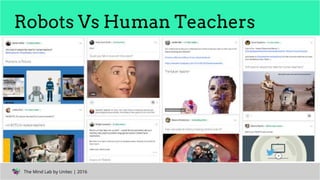
Robots Vs Human Teachers
The Mind Lab by Unitec | 2016The Mind Lab by Unitec | 2016
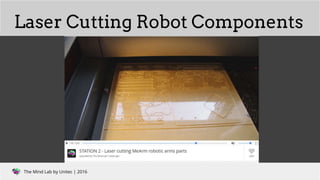
Laser Cutting Robot Components
The Mind Lab by Unitec | 2016The Mind Lab by Unitec | 2016
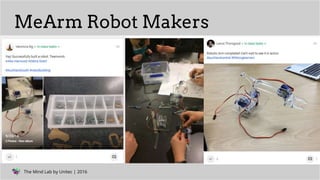
MeArm Robot Makers
The Mind Lab by Unitec | 2016The Mind Lab by Unitec | 2016
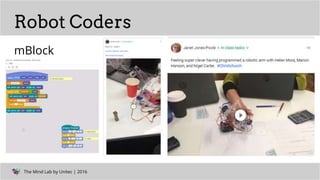
mBlock
Robot Coders
The Mind Lab by Unitec | 2016The Mind Lab by Unitec | Teaching and Learning | 2016The Mind Lab by Unitec | 2016
● Maker Communities
○ Safe environment to fail
○ Collaborative environment to share
● Maker Activities
○ Practical takeaways for the classroom
● Maker Identities
○ New experiences
○ New skills
○ Growth mindset
Making a Difference
➔ What else could we do?
The Mind Lab by Unitec | 2016The Mind Lab by Unitec | 2016
Would you like to raise your
voice?
We are crowdsourcing ideas
for NZ’s education future at
http://hackeducation.co.nz
Thank you!
Hacking NZ Education

Makerspaces and Computational Thinking at The Mind Lab by Unitec

  • 1.
    The Mind Labby Unitec | 2016 Makerspaces and Computational Thinking at The Mind Lab by Unitec David Parsons Milla Inkila
  • 2.
    The Mind Labby Unitec | 2016The Mind Lab by Unitec | 2016 With 20 regional centres nationwide, we provide experiences in developing digital fluency that works across sectors, regions and deciles. The Mind Lab by Unitec
  • 3.
    The Mind Labby Unitec | 2016The Mind Lab by Unitec | 2016 Our students are in-service teachers from all subject areas They do not necessarily normally work with ICT We introduce them to makerspace-style activities, integrating hardware, software and creativity, that can be used in their own classrooms Our Students
  • 4.
    The Mind Labby Unitec | 2016The Mind Lab by Unitec | 2016 There is a distinction between making (as activities), makerspaces (as communities of practice within a physical space) and makers (as the identities of those who participate). Thought needs to be given to all three of these dimensions when designing makerspace activities for the tertiary learner. Makerspace Dimensions Halverson, E.R.& Sheridan, K.M. The Maker Movement in Education. Harvard Educational Review, 84(4), 495-504.
  • 5.
    The Mind Labby Unitec | 2016The Mind Lab by Unitec | 2016 Maker Communities Sharing and questioning together F2F, G+ Communities, Collaborative OneNote, SharePoint Communities, Facebook groups... Maker Activities KC’s and 21CS’s (ITL Research Rubrics) Maker Identities Problem solvers, Lifelong learners, Collaborators, Leaders, Risk takers with Growth Mindset. Preparing for the Now/Future
  • 6.
    The Mind Labby Unitec | Computational Thinking | 2016The Mind Lab by Unitec | 2016 Some Things That We Do ● Stop motion movies with creative materials ● 3D design and printing ● Customised design thinking process ● Programming Makey Makey with Scratch ● Using Scratch for computational thinking ● Creating MeArm robotic arm kits for students to assemble ● Programming MeArms with mBlock
  • 7.
    The Mind Labby Unitec | 2016The Mind Lab by Unitec | 2016 Stop Motion
  • 8.
    The Mind Labby Unitec | 2016The Mind Lab by Unitec | 2016 Stop Motion Student Video
  • 9.
    The Mind Labby Unitec | 2016The Mind Lab by Unitec | 2016 3D Design
  • 10.
    The Mind Labby Unitec | 2016The Mind Lab by Unitec | Teaching and Learning | 2016The Mind Lab by Unitec | 2016 Real World Problems Are experienced by real people Have solutions for a specific, plausible audience other than the educator as grader Have specific, explicit contexts If students are using data to solve a problem, they use actual data ITL. (2013). 21st Century Learning Design. Retrieved from: http://www.itlresearch.com/itl-leap21 Walking The Walk
  • 11.
    The Mind Labby Unitec | 2016 Designing Content
  • 12.
    The Mind Labby Unitec | 2016 Design Thinking Kite Model Empathise Define Ideate Prototype Test Reflect
  • 13.
    The Mind Labby Unitec | 2016 DT Model in Action https://www.instagram.com/explore/tags/mindlabdt/
  • 14.
    The Mind Labby Unitec | Computational Thinking | 2016The Mind Lab by Unitec | Computational Thinking | 2016 Computational Thinking Means... Solving problems Applying abstraction and decomposition Thinking algorithmically - what’s the process? Thinking conceptually - what’s the model? Understanding how things repeat and scale Dealing with errors ...among other things (depends who you read) 14
  • 15.
    The Mind Labby Unitec | 2016The Mind Lab by Unitec | 2016 Computational Thinking
  • 16.
    The Mind Labby Unitec | 2016The Mind Lab by Unitec | 2016 Makey Makey Music
  • 17.
    The Mind Labby Unitec | 2016The Mind Lab by Unitec | 2016 Robots Vs Human Teachers
  • 18.
    The Mind Labby Unitec | 2016The Mind Lab by Unitec | 2016 Laser Cutting Robot Components
  • 19.
    The Mind Labby Unitec | 2016The Mind Lab by Unitec | 2016 MeArm Robot Makers
  • 20.
    The Mind Labby Unitec | 2016The Mind Lab by Unitec | 2016 mBlock Robot Coders
  • 21.
    The Mind Labby Unitec | 2016The Mind Lab by Unitec | Teaching and Learning | 2016The Mind Lab by Unitec | 2016 ● Maker Communities ○ Safe environment to fail ○ Collaborative environment to share ● Maker Activities ○ Practical takeaways for the classroom ● Maker Identities ○ New experiences ○ New skills ○ Growth mindset Making a Difference ➔ What else could we do?
  • 22.
    The Mind Labby Unitec | 2016The Mind Lab by Unitec | 2016 Would you like to raise your voice? We are crowdsourcing ideas for NZ’s education future at http://hackeducation.co.nz Thank you! Hacking NZ Education

Editor's Notes

  • #2 Dave can start :)
  • #3 Dave explains
  • #4 Milla Some of them are using 0365, some Google services, some love Linux and others are excited about Rasberry pies. Some don’t own a smartphone, yet. We bring them all together, to work and problem solve together using all of their strengths. Collaboration is power. We provide the makerspace… and by that we mean… → .
  • #5 Dave
  • #6 Milla Letting go and giving it a go - together!
  • #7 Dave
  • #8 Dave We do a lot of videos - and we do recommend Movie Maker. We use that ourselves a lot. Our portal is video based.
  • #9 Dave
  • #10 Milla We ask the students to design objects that they are missing from their classrooms, using Tinkercad. We are asking them to redesign their classroom, using Sketchup. Some of them are designing Makerspaces for their schools, many of them give the design challenge for their students, they even let them lead.- Sculptrus. .
  • #11 Milla When we design the activities, we try to walk the walk. ITL rubrics are helpful. They can gather the data, or use open real data. We also develop our own content forward, every time. Are experienced by real people. For example, if students are asked to diagnose an ecological imbalance in a rainforest in Costa Rica, they are working with a situation that affects the real people who live there. Have solutions for a specific, plausible audience other than the educator as grader. For example, designing equipment to fit a small city playground could benefit the children of the community. Have specific, explicit contexts. For example, developing a plan for a community garden in a public park in their town has a specific context; learning which vegetables grow best in which parts of one’s country does not. If students are using data to solve a problem, they use actual data. For example, real scientific records of earthquakes, results of their own experiments, or first-person accounts of an historical event, not data developed by an educator or publisher for a lesson
  • #12 Milla We do the same thing ourselves. Every time it is different. That what learning is about. Iterative nature of the content. We are a bit bored with Aurasma already… Next Week it’ll be Seppo (same finnish tool some of you chatted about yesterday) / our students are teachers, so we have to design something where they are the designers and innovators. We get to teach the teachers that are tehaching teachers to help their studens to innovate. To be creative.
  • #13 Milla This is our Design Thinking Model. This week the students are problem solving online learning related issues that they have, for each other. Being the customer and the designer. This is what we do in 14 locations this week. (NEXT SKIDE INSTAGRAM)
  • #14 Milla Show 2 videos https://www.instagram.com/p/BGJe0EYFuBF/?tagged=mindlabdt They are engaged, they are solving real problems. We are opening their eyes to see Computational thinking also as PROBLEM SOLVING (NEXT SLIDE)
  • #15 Dave
  • #16 Dave
  • #17 Dave
  • #18 Milla
  • #19 Dave
  • #20 Dave MeArm Robotics share the design of their robotic arm so anyone can cut their own components Photo-illustrated build instructions for version 0.4 are on the Instructables web site
  • #21 Dave
  • #22 Milla Questions? Yesterday there was a discussion on Aurasma and Seppo