 Pump is a mechanical device which conveys liquid from 
one place to another. 
 It can be also define as a machine that transfer the 
mechanical energy of a motor or engine into potential 
kinetic and thermal energy pump belongs to the category 
of power absorbing machines.
 A pump is also defined as a device, which raises or transfer 
liquids at the expense of power input. 
 Application area of pump the municipal water works, 
power plants, agriculture, transport and many other utility 
services and industries.
 The pump can be classified according to principle by 
which the energy is added to the fluid and their design 
feature as shown below: 
 (A) positive displacement pumps 
 (B) roto-dynamic pump 
 (C) other pumps
 These pump operate on the principle of a definite quantity 
of liquid is discharged or displaced due to the positive or 
real displacement of working elements. 
1) Reciprocating pump 
[i] piston pumps [ii] plunger pump [iii] bucket 
pump(hand-pump) 
2) Rotary pump 
[i] gear pump [ii] vane pump [iii] screw pump
These pumps operate on the principle of the rise in 
pressure energy of liquid by dynamic action of liquid. The 
dynamic action of liquid is carried out by revolving wheel 
which has curved vanes on it. This wheel is known as 
impeller. 
(1) Centrifugal pump 
(2) Propeller pump 
(3) Mixed flow pump
 This pump does not belong to the category of roto-dynamic 
pump or positive displacement pump. 
(1) jet pump 
(2) air lift pump etc.
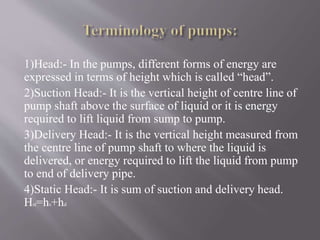
1)Head:- In the pumps, different forms of energy are 
expressed in terms of height which is called “head”. 
2)Suction Head:- It is the vertical height of centre line of 
pump shaft above the surface of liquid or it is energy 
required to lift liquid from sump to pump. 
3)Delivery Head:- It is the vertical height measured from 
the centre line of pump shaft to where the liquid is 
delivered, or energy required to lift the liquid from pump 
to end of delivery pipe. 
4)Static Head:- It is sum of suction and delivery head. 
Hst=hs+hd
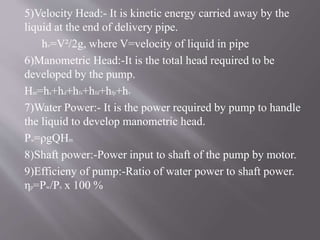
5)Velocity Head:- It is kinetic energy carried away by the 
liquid at the end of delivery pipe. 
hv=V²/2g, where V=velocity of liquid in pipe 
6)Manometric Head:-It is the total head required to be 
developed by the pump. 
Hm=hs+hd+hfs+hfd+hfp+hv 
7)Water Power:- It is the power required by pump to handle 
the liquid to develop manometric head. 
Pw=ρgQHm 
8)Shaft power:-Power input to shaft of the pump by motor. 
9)Efficieny of pump:-Ratio of water power to shaft power. 
ηp=Pw/Ps x 100 %
Reciprocating pump is a positive displacement pump. In this 
pump , the liquid is discharged due to the simple to and fro 
motion or reciprocating motion of the piston working in the 
cylinder of the pump. Hence it is called as a reciprocating 
pump.
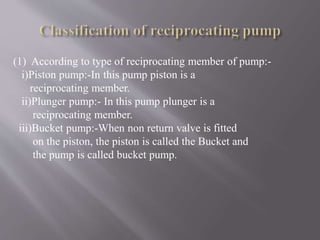
(1) According to type of reciprocating member of pump:- 
i)Piston pump:-In this pump piston is a 
reciprocating member. 
ii)Plunger pump:- In this pump plunger is a 
reciprocating member. 
iii)Bucket pump:-When non return valve is fitted 
on the piston, the piston is called the Bucket and 
the pump is called bucket pump.
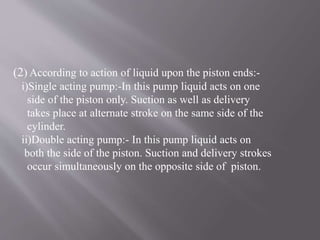
(2) According to action of liquid upon the piston ends:- 
i)Single acting pump:-In this pump liquid acts on one 
side of the piston only. Suction as well as delivery 
takes place at alternate stroke on the same side of the 
cylinder. 
ii)Double acting pump:- In this pump liquid acts on 
both the side of the piston. Suction and delivery strokes 
occur simultaneously on the opposite side of piston.
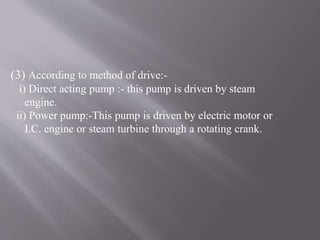
(3) According to method of drive:- 
i) Direct acting pump :- this pump is driven by steam 
engine. 
ii) Power pump:-This pump is driven by electric motor or 
I.C. engine or steam turbine through a rotating crank.
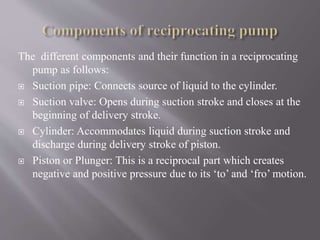
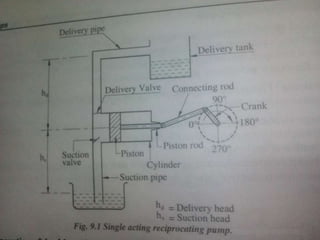
The different components and their function in a reciprocating 
pump as follows: 
 Suction pipe: Connects source of liquid to the cylinder. 
 Suction valve: Opens during suction stroke and closes at the 
beginning of delivery stroke. 
 Cylinder: Accommodates liquid during suction stroke and 
discharge during delivery stroke of piston. 
 Piston or Plunger: This is a reciprocal part which creates 
negative and positive pressure due to its ‘to’ and ‘fro’ motion.
 Delivery valve: Closes during suction stroke and opens at 
the beginning of delivery stroke. 
 Crank and connecting rod: Converts the rotary motion of 
the prime movers into the reciprocating motion of the 
piston. 
 Delivery pipe: Connects pump cylinder to the storage 
tank. 
 Prime movers: To drive the pump.
This pump consist of piston or piston or plunger, cylinder, 
suction pipe with suction valve, deliver pipe with delivery 
valve and prime mover which drives the pump. 
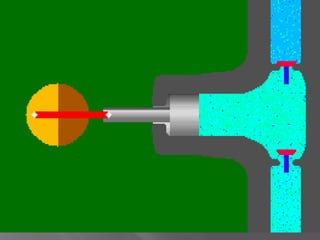
1)FORWARD STROKE (SUCTION STROKE) : the piston 
moves towards right, crank moves from 0° to 180 °. This 
creates vacuum in cylinder on the left side of piston 
causing the suction valve to open. The liquid enters the 
cylinder and fills it.
2)REVERSE STROKE (DELIVERY STROKE) : The piston 
moves towards left, crank moves from 180 ° to 360 ° . 
This causes increase of pressure in the left side of 
cylinder. The delivery valve open and the liquid is forced 
to delivery pipe 
- The suction and delivery valves are non-return valve, they 
opens or closes automatically according to pressure 
difference across theme.
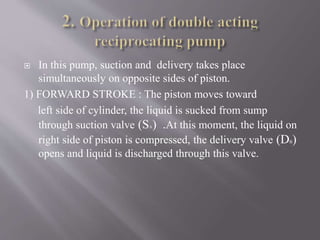
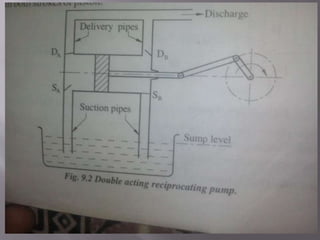
 In this pump, suction and delivery takes place 
simultaneously on opposite sides of piston. 
1) FORWARD STROKE : The piston moves toward 
left side of cylinder, the liquid is sucked from sump 
through suction valve (SA) .At this moment, the liquid on 
right side of piston is compressed, the delivery valve (DB) 
opens and liquid is discharged through this valve.
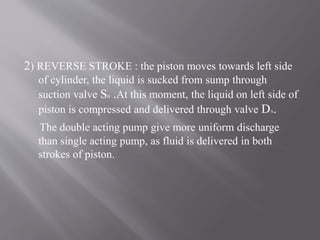
2) REVERSE STROKE : the piston moves towards left side 
of cylinder, the liquid is sucked from sump through 
suction valve SB .At this moment, the liquid on left side of 
piston is compressed and delivered through valve DA. 
The double acting pump give more uniform discharge 
than single acting pump, as fluid is delivered in both 
strokes of piston.
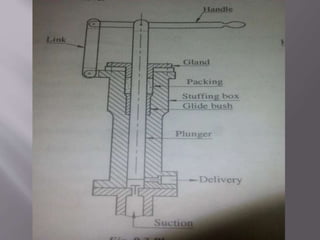
A hand operated plunger pump consists of plunger, 
stuffing box, suction valve, delivery valve and handle. The 
pump is operated by handle. In order to prevent the leakage 
of the liquid, the stuffing box, gland and packings are used. 
Non-return valves are fitted at the suction and delivery 
pipes preventing back flows. 
1)Intake stroke: Plunger moves up, vacuum is created in the 
cylinder, suction valve opens and liquid enters into cylinder. 
2)Discharge stroke: Plunger moves down, suction valve 
closes and delivery valve opens through which high pressure 
liquid is delivered to the delivery pipe.
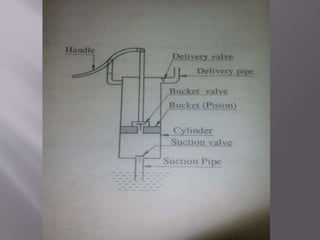
A bucket pump is single acting vertical reciprocating 
pump. It consists of an open cylinder and a piston with 
bucket type valve. A bucket type valve works as a non-return 
valve. 
1)Intake stroke: Piston moves up the bucket valve 
remains closed. During this stroke liquid enters into the 
cylinder through suction valve. Simultaneously, the liquid 
above the bucket is forces into delivery pipe through 
delivery valve. 
2)Discharge stroke: Piston moves down, the bucket valve 
open. In this stroke neither suction nor delivery of liquid 
takes place, but the liquid which previously sucked in 
cylinder moves on upper side of piston.
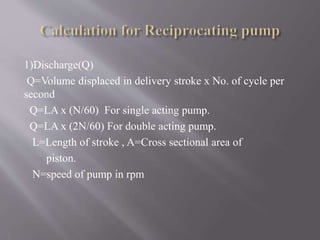
1)Discharge(Q) 
Q=Volume displaced in delivery stroke x No. of cycle per 
second 
Q=LA x (N/60) For single acting pump. 
Q=LA x (2N/60) For double acting pump. 
L=Length of stroke , A=Cross sectional area of 
piston. 
N=speed of pump in rpm
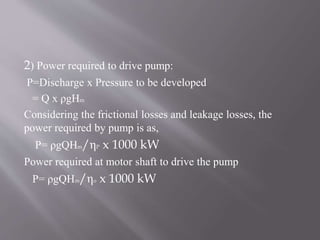
2) Power required to drive pump: 
P=Discharge x Pressure to be developed 
= Q x ρgHm 
Considering the frictional losses and leakage losses, the 
power required by pump is as, 
P= ρgQHm/ηP x 1000 kW 
Power required at motor shaft to drive the pump 
P= ρgQHm/ηo x 1000 kW
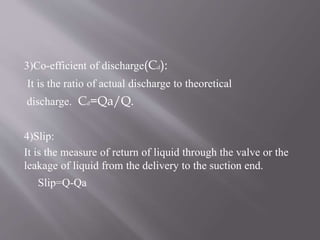
3)Co-efficient of discharge(Cd): 
It is the ratio of actual discharge to theoretical 
discharge. Cd=Qa/Q. 
4)Slip: 
It is the measure of return of liquid through the valve or the 
leakage of liquid from the delivery to the suction end. 
Slip=Q-Qa
In case of single acting pump, the flow in delivery pipe as 
well as in suction pipe is not continuous. In double acting or 
multi cylinder pump, the flow is continuous but velocity vary 
in suction as well as delivery pipe. 
The main objectives to use air chamber in single acting 
reciprocating pumps are as follows:-
i) To obtain a continuous supply of liquid at a uniform rate. 
ii) To save a considerable amount of work in overcoming 
the frictional resistance in the suction and delivery pipe. 
iii) To run the pump at a high speed without cavitation or 
separation. 
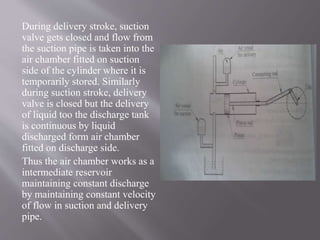
Air chamber is fitted to the suction pipe and to the delivery 
pipe at a point close to the cylinder of a single acting 
reciprocating pump. The top of the air chamber contains 
compressed air which can contract or expand. 
The chamber has an opening at its base through which the 
liquid may flow in to or out of it.
During delivery stroke, suction 
valve gets closed and flow from 
the suction pipe is taken into the 
air chamber fitted on suction 
side of the cylinder where it is 
temporarily stored. Similarly 
during suction stroke, delivery 
valve is closed but the delivery 
of liquid too the discharge tank 
is continuous by liquid 
discharged form air chamber 
fitted on discharge side. 
Thus the air chamber works as a 
intermediate reservoir 
maintaining constant discharge 
by maintaining constant velocity 
of flow in suction and delivery 
pipe.
If mechanical energy is converted into pressure energy by 
means of centrifugal force acting on fluid, for conveying 
liquid from one place to other such device is called a 
centrifugal pump. 
Main Parts of Centrifugal pump: 
1)Impeller 2)Casing 
3)Suction Pipe 4)Delivery Pipe
1)Impeller:-It is rotating part of a centrifugal pump and 
increases kinetic energy of liquid . It is mounted on a shaft 
which is coupled to shaft of a electric motor. 
2)Casing:-It is an air tight passage surrounding the impeller 
and is designed in such a way that the kinetic energy of the 
liquid discharged at the outlet of impeller is converted into 
pressure energy before the delivery pipe. Types of casing: 
i)Volute ii)Vortex iii)Casing with guide blades. 
3)Suction pipe:-It is a pipe whose one end is connected to the 
inlet of the pump and other end dips into liquid in a sump. 
4)Delivery pipe:-A pipe whose one end is connected to the 
outlet of the pump and other end is extended to deliver the 
liquid at a required height is known as delivery pipe.
• According to types of Casing:- 
1)Volute 2)Vortex 3)Diffuser 
• According to number of stages:- 
1)Single stage 2)Multi stage
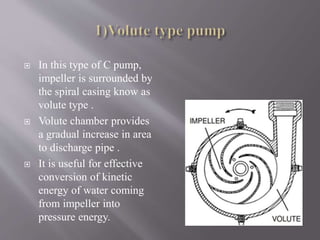
 In this type of C pump, 
impeller is surrounded by 
the spiral casing know as 
volute type . 
 Volute chamber provides 
a gradual increase in area 
to discharge pipe . 
 It is useful for effective 
conversion of kinetic 
energy of water coming 
from impeller into 
pressure energy.
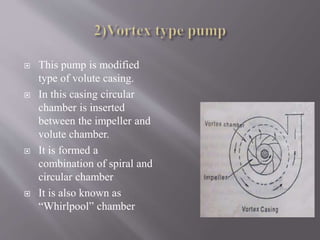
 This pump is modified 
type of volute casing. 
 In this casing circular 
chamber is inserted 
between the impeller and 
volute chamber. 
 It is formed a 
combination of spiral and 
circular chamber 
 It is also known as 
“Whirlpool” chamber
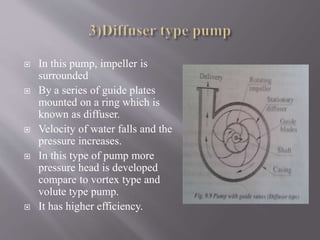
 In this pump, impeller is 
surrounded 
 By a series of guide plates 
mounted on a ring which is 
known as diffuser. 
 Velocity of water falls and the 
pressure increases. 
 In this type of pump more 
pressure head is developed 
compare to vortex type and 
volute type pump. 
 It has higher efficiency.
 If the pump has only one impeller then the pump is called 
Single Stage Pump. 
 It can not produce sufficient high pressure head efficiently. 
 It is mostly used for lower head and lower discharge.
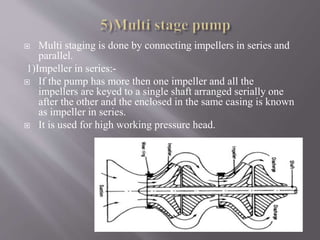
 Multi staging is done by connecting impellers in series and 
parallel. 
1)Impeller in series:- 
 If the pump has more then one impeller and all the 
impellers are keyed to a single shaft arranged serially one 
after the other and the enclosed in the same casing is known 
as impeller in series. 
 It is used for high working pressure head.
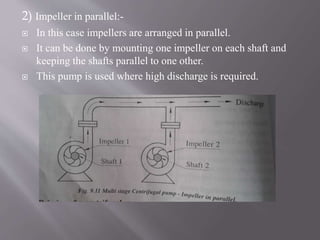
2) Impeller in parallel:- 
 In this case impellers are arranged in parallel. 
 It can be done by mounting one impeller on each shaft and 
keeping the shafts parallel to one other. 
 This pump is used where high discharge is required.
 The priming is an operation of filling passage ways (suction 
pipe, casing and delivery pipe upto delivery valve) from 
outside source with the liquid to be raised before starting the 
pump. 
Method of priming : 
 Manually 
 Priming with vacuum pump 
 Priming with jet pump 
 Priming with separator
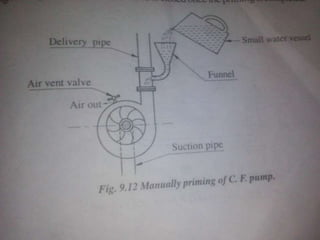
 In this method of priming water is poured in the pump 
through priming funnel as fig. 
 When priming is being done, an escapes through air vent 
valve. 
 When all air is exhausted from the casing, suction pipe 
and portion of delivery pipe, the water will flow out 
through vent valve, indicating that priming is completed. 
The air vent valve is closed once the priming is 
completed.
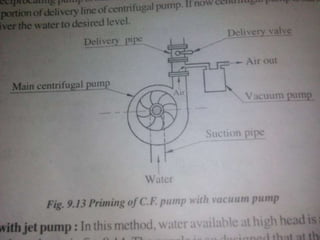
 In this method, the small size reciprocating pump is used 
to priming the main centrifugal pump. The suction line of 
reciprocating pump is connected to the delivery line of 
main centrifugal pump. 
 When manually operated reciprocating pump is started, 
this pump lifts the water from sump to suction line , casing 
and portion of delivery line of centrifugal pump. If now 
centrifugal pump is started , it will able to deliver the 
water to desired level.
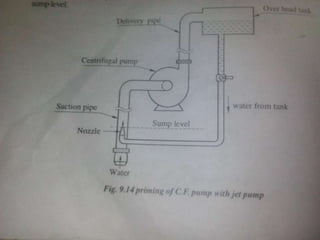
 In this method , water available at high head is allowed to 
flow through a nozzle. 
 The nozzle is so designed that at the jet outside the nozzle 
the pressure is less than the atmospheric pressure so it is 
possible to suck water from the sump. 
 The jet pump is generally fixed in suction pipe of 
centrifugal pump near the sump level.
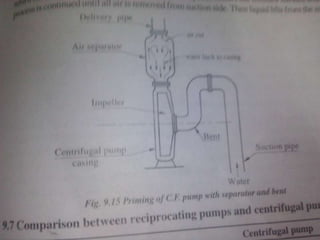
 In this method, air separator is provided on the delivery of 
pump and bent suction pipe portion is provided on the 
delivery side of pump and bent suction pipe portion is 
provided at the inlet of the pump. 
 When the pump is started, the liquid in bent suction pipe 
along with the air from rest of suction pipe is sucked into 
impeller and is delivered to separator. 
 Since head developed initially is not sufficient, no liquid is 
delivered at delivery end.
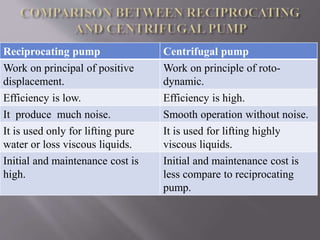
Reciprocating pump Centrifugal pump 
Work on principal of positive 
displacement. 
Work on principle of roto-dynamic. 
Efficiency is low. Efficiency is high. 
It produce much noise. Smooth operation without noise. 
It is used only for lifting pure 
It is used for lifting highly 
water or loss viscous liquids. 
viscous liquids. 
Initial and maintenance cost is 
high. 
Initial and maintenance cost is 
less compare to reciprocating 
pump.
 It is a positive displacement pumps. It consists of gears, 
vanes, lobes, screws, cams etc. 
 CLASSIFICATION OF ROTARY PUMPS : 
 Gear pump 
 Vane pump 
 Screw pump
 It consists of two or more gears which mesh each other. 
The rotation of these gears provides pumping action. 
 As shown fig two spur gears in mesh with each other and 
one of the gear is driving gear and other driven gear. The 
mechanical contact between the gear teethes and crasing 
seal space between the teeths. The fluid fills the gear 
space, forming closed chambers with the casing.
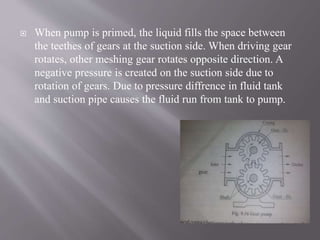
 When pump is primed, the liquid fills the space between 
the teethes of gears at the suction side. When driving gear 
rotates, other meshing gear rotates opposite direction. A 
negative pressure is created on the suction side due to 
rotation of gears. Due to pressure diffrence in fluid tank 
and suction pipe causes the fluid run from tank to pump.
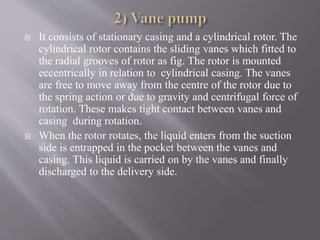
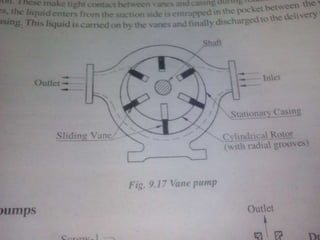
 It consists of stationary casing and a cylindrical rotor. The 
cylindrical rotor contains the sliding vanes which fitted to 
the radial grooves of rotor as fig. The rotor is mounted 
eccentrically in relation to cylindrical casing. The vanes 
are free to move away from the centre of the rotor due to 
the spring action or due to gravity and centrifugal force of 
rotation. These makes tight contact between vanes and 
casing during rotation. 
 When the rotor rotates, the liquid enters from the suction 
side is entrapped in the pocket between the vanes and 
casing. This liquid is carried on by the vanes and finally 
discharged to the delivery side.
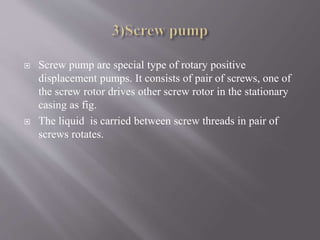
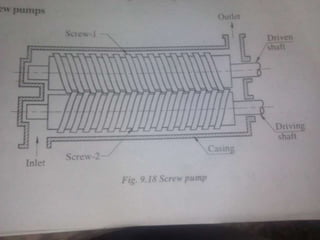
 Screw pump are special type of rotary positive 
displacement pumps. It consists of pair of screws, one of 
the screw rotor drives other screw rotor in the stationary 
casing as fig. 
 The liquid is carried between screw threads in pair of 
screws rotates.
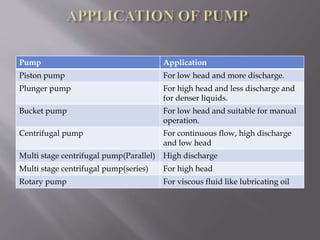
Pump Application 
Piston pump For low head and more discharge. 
Plunger pump For high head and less discharge and 
for denser liquids. 
Bucket pump For low head and suitable for manual 
operation. 
Centrifugal pump For continuous flow, high discharge 
and low head 
Multi stage centrifugal pump(Parallel) High discharge 
Multi stage centrifugal pump(series) For high head 
Rotary pump For viscous fluid like lubricating oil
THANK YOU

Pump eme

  • 3.
     Pump isa mechanical device which conveys liquid from one place to another.  It can be also define as a machine that transfer the mechanical energy of a motor or engine into potential kinetic and thermal energy pump belongs to the category of power absorbing machines.
  • 4.
     A pumpis also defined as a device, which raises or transfer liquids at the expense of power input.  Application area of pump the municipal water works, power plants, agriculture, transport and many other utility services and industries.
  • 5.
     The pumpcan be classified according to principle by which the energy is added to the fluid and their design feature as shown below:  (A) positive displacement pumps  (B) roto-dynamic pump  (C) other pumps
  • 6.
     These pumpoperate on the principle of a definite quantity of liquid is discharged or displaced due to the positive or real displacement of working elements. 1) Reciprocating pump [i] piston pumps [ii] plunger pump [iii] bucket pump(hand-pump) 2) Rotary pump [i] gear pump [ii] vane pump [iii] screw pump
  • 7.
    These pumps operateon the principle of the rise in pressure energy of liquid by dynamic action of liquid. The dynamic action of liquid is carried out by revolving wheel which has curved vanes on it. This wheel is known as impeller. (1) Centrifugal pump (2) Propeller pump (3) Mixed flow pump
  • 8.
     This pumpdoes not belong to the category of roto-dynamic pump or positive displacement pump. (1) jet pump (2) air lift pump etc.
  • 9.
    1)Head:- In thepumps, different forms of energy are expressed in terms of height which is called “head”. 2)Suction Head:- It is the vertical height of centre line of pump shaft above the surface of liquid or it is energy required to lift liquid from sump to pump. 3)Delivery Head:- It is the vertical height measured from the centre line of pump shaft to where the liquid is delivered, or energy required to lift the liquid from pump to end of delivery pipe. 4)Static Head:- It is sum of suction and delivery head. Hst=hs+hd
  • 10.
    5)Velocity Head:- Itis kinetic energy carried away by the liquid at the end of delivery pipe. hv=V²/2g, where V=velocity of liquid in pipe 6)Manometric Head:-It is the total head required to be developed by the pump. Hm=hs+hd+hfs+hfd+hfp+hv 7)Water Power:- It is the power required by pump to handle the liquid to develop manometric head. Pw=ρgQHm 8)Shaft power:-Power input to shaft of the pump by motor. 9)Efficieny of pump:-Ratio of water power to shaft power. ηp=Pw/Ps x 100 %
  • 11.
    Reciprocating pump isa positive displacement pump. In this pump , the liquid is discharged due to the simple to and fro motion or reciprocating motion of the piston working in the cylinder of the pump. Hence it is called as a reciprocating pump.
  • 12.
    (1) According totype of reciprocating member of pump:- i)Piston pump:-In this pump piston is a reciprocating member. ii)Plunger pump:- In this pump plunger is a reciprocating member. iii)Bucket pump:-When non return valve is fitted on the piston, the piston is called the Bucket and the pump is called bucket pump.
  • 13.
    (2) According toaction of liquid upon the piston ends:- i)Single acting pump:-In this pump liquid acts on one side of the piston only. Suction as well as delivery takes place at alternate stroke on the same side of the cylinder. ii)Double acting pump:- In this pump liquid acts on both the side of the piston. Suction and delivery strokes occur simultaneously on the opposite side of piston.
  • 14.
    (3) According tomethod of drive:- i) Direct acting pump :- this pump is driven by steam engine. ii) Power pump:-This pump is driven by electric motor or I.C. engine or steam turbine through a rotating crank.
  • 15.
    The different componentsand their function in a reciprocating pump as follows:  Suction pipe: Connects source of liquid to the cylinder.  Suction valve: Opens during suction stroke and closes at the beginning of delivery stroke.  Cylinder: Accommodates liquid during suction stroke and discharge during delivery stroke of piston.  Piston or Plunger: This is a reciprocal part which creates negative and positive pressure due to its ‘to’ and ‘fro’ motion.
  • 16.
     Delivery valve:Closes during suction stroke and opens at the beginning of delivery stroke.  Crank and connecting rod: Converts the rotary motion of the prime movers into the reciprocating motion of the piston.  Delivery pipe: Connects pump cylinder to the storage tank.  Prime movers: To drive the pump.
  • 18.
    This pump consistof piston or piston or plunger, cylinder, suction pipe with suction valve, deliver pipe with delivery valve and prime mover which drives the pump. 1)FORWARD STROKE (SUCTION STROKE) : the piston moves towards right, crank moves from 0° to 180 °. This creates vacuum in cylinder on the left side of piston causing the suction valve to open. The liquid enters the cylinder and fills it.
  • 19.
    2)REVERSE STROKE (DELIVERYSTROKE) : The piston moves towards left, crank moves from 180 ° to 360 ° . This causes increase of pressure in the left side of cylinder. The delivery valve open and the liquid is forced to delivery pipe - The suction and delivery valves are non-return valve, they opens or closes automatically according to pressure difference across theme.
  • 22.
     In thispump, suction and delivery takes place simultaneously on opposite sides of piston. 1) FORWARD STROKE : The piston moves toward left side of cylinder, the liquid is sucked from sump through suction valve (SA) .At this moment, the liquid on right side of piston is compressed, the delivery valve (DB) opens and liquid is discharged through this valve.
  • 23.
    2) REVERSE STROKE: the piston moves towards left side of cylinder, the liquid is sucked from sump through suction valve SB .At this moment, the liquid on left side of piston is compressed and delivered through valve DA. The double acting pump give more uniform discharge than single acting pump, as fluid is delivered in both strokes of piston.
  • 25.
    A hand operatedplunger pump consists of plunger, stuffing box, suction valve, delivery valve and handle. The pump is operated by handle. In order to prevent the leakage of the liquid, the stuffing box, gland and packings are used. Non-return valves are fitted at the suction and delivery pipes preventing back flows. 1)Intake stroke: Plunger moves up, vacuum is created in the cylinder, suction valve opens and liquid enters into cylinder. 2)Discharge stroke: Plunger moves down, suction valve closes and delivery valve opens through which high pressure liquid is delivered to the delivery pipe.
  • 27.
    A bucket pumpis single acting vertical reciprocating pump. It consists of an open cylinder and a piston with bucket type valve. A bucket type valve works as a non-return valve. 1)Intake stroke: Piston moves up the bucket valve remains closed. During this stroke liquid enters into the cylinder through suction valve. Simultaneously, the liquid above the bucket is forces into delivery pipe through delivery valve. 2)Discharge stroke: Piston moves down, the bucket valve open. In this stroke neither suction nor delivery of liquid takes place, but the liquid which previously sucked in cylinder moves on upper side of piston.
  • 29.
    1)Discharge(Q) Q=Volume displacedin delivery stroke x No. of cycle per second Q=LA x (N/60) For single acting pump. Q=LA x (2N/60) For double acting pump. L=Length of stroke , A=Cross sectional area of piston. N=speed of pump in rpm
  • 30.
    2) Power requiredto drive pump: P=Discharge x Pressure to be developed = Q x ρgHm Considering the frictional losses and leakage losses, the power required by pump is as, P= ρgQHm/ηP x 1000 kW Power required at motor shaft to drive the pump P= ρgQHm/ηo x 1000 kW
  • 31.
    3)Co-efficient of discharge(Cd): It is the ratio of actual discharge to theoretical discharge. Cd=Qa/Q. 4)Slip: It is the measure of return of liquid through the valve or the leakage of liquid from the delivery to the suction end. Slip=Q-Qa
  • 32.
    In case ofsingle acting pump, the flow in delivery pipe as well as in suction pipe is not continuous. In double acting or multi cylinder pump, the flow is continuous but velocity vary in suction as well as delivery pipe. The main objectives to use air chamber in single acting reciprocating pumps are as follows:-
  • 33.
    i) To obtaina continuous supply of liquid at a uniform rate. ii) To save a considerable amount of work in overcoming the frictional resistance in the suction and delivery pipe. iii) To run the pump at a high speed without cavitation or separation. Air chamber is fitted to the suction pipe and to the delivery pipe at a point close to the cylinder of a single acting reciprocating pump. The top of the air chamber contains compressed air which can contract or expand. The chamber has an opening at its base through which the liquid may flow in to or out of it.
  • 34.
    During delivery stroke,suction valve gets closed and flow from the suction pipe is taken into the air chamber fitted on suction side of the cylinder where it is temporarily stored. Similarly during suction stroke, delivery valve is closed but the delivery of liquid too the discharge tank is continuous by liquid discharged form air chamber fitted on discharge side. Thus the air chamber works as a intermediate reservoir maintaining constant discharge by maintaining constant velocity of flow in suction and delivery pipe.
  • 35.
    If mechanical energyis converted into pressure energy by means of centrifugal force acting on fluid, for conveying liquid from one place to other such device is called a centrifugal pump. Main Parts of Centrifugal pump: 1)Impeller 2)Casing 3)Suction Pipe 4)Delivery Pipe
  • 36.
    1)Impeller:-It is rotatingpart of a centrifugal pump and increases kinetic energy of liquid . It is mounted on a shaft which is coupled to shaft of a electric motor. 2)Casing:-It is an air tight passage surrounding the impeller and is designed in such a way that the kinetic energy of the liquid discharged at the outlet of impeller is converted into pressure energy before the delivery pipe. Types of casing: i)Volute ii)Vortex iii)Casing with guide blades. 3)Suction pipe:-It is a pipe whose one end is connected to the inlet of the pump and other end dips into liquid in a sump. 4)Delivery pipe:-A pipe whose one end is connected to the outlet of the pump and other end is extended to deliver the liquid at a required height is known as delivery pipe.
  • 37.
    • According totypes of Casing:- 1)Volute 2)Vortex 3)Diffuser • According to number of stages:- 1)Single stage 2)Multi stage
  • 38.
     In thistype of C pump, impeller is surrounded by the spiral casing know as volute type .  Volute chamber provides a gradual increase in area to discharge pipe .  It is useful for effective conversion of kinetic energy of water coming from impeller into pressure energy.
  • 39.
     This pumpis modified type of volute casing.  In this casing circular chamber is inserted between the impeller and volute chamber.  It is formed a combination of spiral and circular chamber  It is also known as “Whirlpool” chamber
  • 40.
     In thispump, impeller is surrounded  By a series of guide plates mounted on a ring which is known as diffuser.  Velocity of water falls and the pressure increases.  In this type of pump more pressure head is developed compare to vortex type and volute type pump.  It has higher efficiency.
  • 41.
     If thepump has only one impeller then the pump is called Single Stage Pump.  It can not produce sufficient high pressure head efficiently.  It is mostly used for lower head and lower discharge.
  • 42.
     Multi stagingis done by connecting impellers in series and parallel. 1)Impeller in series:-  If the pump has more then one impeller and all the impellers are keyed to a single shaft arranged serially one after the other and the enclosed in the same casing is known as impeller in series.  It is used for high working pressure head.
  • 43.
    2) Impeller inparallel:-  In this case impellers are arranged in parallel.  It can be done by mounting one impeller on each shaft and keeping the shafts parallel to one other.  This pump is used where high discharge is required.
  • 44.
     The primingis an operation of filling passage ways (suction pipe, casing and delivery pipe upto delivery valve) from outside source with the liquid to be raised before starting the pump. Method of priming :  Manually  Priming with vacuum pump  Priming with jet pump  Priming with separator
  • 45.
     In thismethod of priming water is poured in the pump through priming funnel as fig.  When priming is being done, an escapes through air vent valve.  When all air is exhausted from the casing, suction pipe and portion of delivery pipe, the water will flow out through vent valve, indicating that priming is completed. The air vent valve is closed once the priming is completed.
  • 47.
     In thismethod, the small size reciprocating pump is used to priming the main centrifugal pump. The suction line of reciprocating pump is connected to the delivery line of main centrifugal pump.  When manually operated reciprocating pump is started, this pump lifts the water from sump to suction line , casing and portion of delivery line of centrifugal pump. If now centrifugal pump is started , it will able to deliver the water to desired level.
  • 49.
     In thismethod , water available at high head is allowed to flow through a nozzle.  The nozzle is so designed that at the jet outside the nozzle the pressure is less than the atmospheric pressure so it is possible to suck water from the sump.  The jet pump is generally fixed in suction pipe of centrifugal pump near the sump level.
  • 51.
     In thismethod, air separator is provided on the delivery of pump and bent suction pipe portion is provided on the delivery side of pump and bent suction pipe portion is provided at the inlet of the pump.  When the pump is started, the liquid in bent suction pipe along with the air from rest of suction pipe is sucked into impeller and is delivered to separator.  Since head developed initially is not sufficient, no liquid is delivered at delivery end.
  • 53.
    Reciprocating pump Centrifugalpump Work on principal of positive displacement. Work on principle of roto-dynamic. Efficiency is low. Efficiency is high. It produce much noise. Smooth operation without noise. It is used only for lifting pure It is used for lifting highly water or loss viscous liquids. viscous liquids. Initial and maintenance cost is high. Initial and maintenance cost is less compare to reciprocating pump.
  • 54.
     It isa positive displacement pumps. It consists of gears, vanes, lobes, screws, cams etc.  CLASSIFICATION OF ROTARY PUMPS :  Gear pump  Vane pump  Screw pump
  • 55.
     It consistsof two or more gears which mesh each other. The rotation of these gears provides pumping action.  As shown fig two spur gears in mesh with each other and one of the gear is driving gear and other driven gear. The mechanical contact between the gear teethes and crasing seal space between the teeths. The fluid fills the gear space, forming closed chambers with the casing.
  • 56.
     When pumpis primed, the liquid fills the space between the teethes of gears at the suction side. When driving gear rotates, other meshing gear rotates opposite direction. A negative pressure is created on the suction side due to rotation of gears. Due to pressure diffrence in fluid tank and suction pipe causes the fluid run from tank to pump.
  • 57.
     It consistsof stationary casing and a cylindrical rotor. The cylindrical rotor contains the sliding vanes which fitted to the radial grooves of rotor as fig. The rotor is mounted eccentrically in relation to cylindrical casing. The vanes are free to move away from the centre of the rotor due to the spring action or due to gravity and centrifugal force of rotation. These makes tight contact between vanes and casing during rotation.  When the rotor rotates, the liquid enters from the suction side is entrapped in the pocket between the vanes and casing. This liquid is carried on by the vanes and finally discharged to the delivery side.
  • 59.
     Screw pumpare special type of rotary positive displacement pumps. It consists of pair of screws, one of the screw rotor drives other screw rotor in the stationary casing as fig.  The liquid is carried between screw threads in pair of screws rotates.
  • 61.
    Pump Application Pistonpump For low head and more discharge. Plunger pump For high head and less discharge and for denser liquids. Bucket pump For low head and suitable for manual operation. Centrifugal pump For continuous flow, high discharge and low head Multi stage centrifugal pump(Parallel) High discharge Multi stage centrifugal pump(series) For high head Rotary pump For viscous fluid like lubricating oil
  • 62.