SUBMITTED BY :
 ANKIT GUPTA
 MOHAMMAD ASAD
 NITIN PAL
 ROSHAN KUMAR
TOPICS
 INTRODUCTION
PUMP AND ITS TYPE.
 CENTRIFUGAL VS RECIPROCATING PUMP.
WORKING PRINCIPLE OF RECIPROCATING PUMP.
MAJOR COMPONENTS USED IN THE PROJECT.
FEATURES.
APPLICATIONS.
ACTUAL PROJECT IMAGE.
 A Water system includes a reciprocating pump operated by
pedaling power.
 Pumps are a common means of lifting water from a clean
ground water source to a useful point of access, but all pumps
have moving parts and are therefore destined to break proper
selection of a pump will reduce undesirable downtime and will
empower the local community to manage their water source.
 Here we use the foot pedal pump, powered by our legs
instead of arms to lift the water from a depth range of seven
meters.
 A person can generate four times more (1/4 horse power
(hp)) by pedaling than by hand –cranking. At the rate of 1/4hp,
continuous pedaling can be done for only short periods, about
10 minutes. However, pedaling at half this power (1/8 hp) can
be sustained for around 60 minutes.
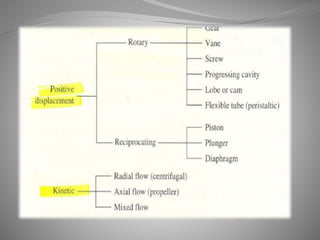
Pumps – convert mechanical energy into fluid
energy.
Pumps come in a variety of sizes for a wide range of
applications. They can be classified according to their
basic operating principle as dynamic or displacement
pumps. Dynamic pumps can be sub-classified as
centrifugal and special effect pumps. Displacement
pumps can be sub-classified as rotary or reciprocating
pumps.
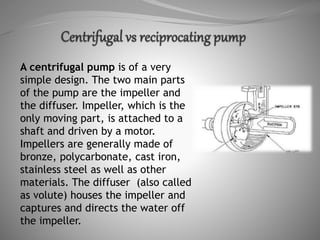
A centrifugal pump is of a very
simple design. The two main parts
of the pump are the impeller and
the diffuser. Impeller, which is the
only moving part, is attached to a
shaft and driven by a motor.
Impellers are generally made of
bronze, polycarbonate, cast iron,
stainless steel as well as other
materials. The diffuser (also called
as volute) houses the impeller and
captures and directs the water off
the impeller.
Reciprocating pumps are those which cause the fluid to
move using one or more oscillating pistons, plungers or
membranes (diaphragms).
To 'Reciprocate' means 'To Move Backwards and Forwards'.
A 'RECIPROCATING' pump therefore, is one with a forward
and backward operating action. The simplest reciprocating
pump is the 'Bicycle Pump', which everyone at some time or
other will have used to re-inflate their bike tyres.
Reciprocating-type pumps require a system of suction and
discharge valves to ensure that the fluid moves in a positive
direction. Pumps in this category range from having
"simplex" one cylinder, to in some cases "quad" four
cylinders or more. Most reciprocating-type pumps
are"duplex" (two) or "triplex" (three) cylinder.
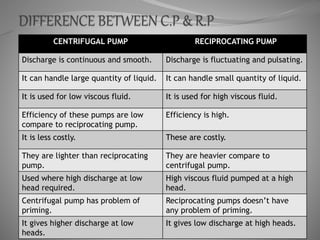
CENTRIFUGAL PUMP RECIPROCATING PUMP
Discharge is continuous and smooth. Discharge is fluctuating and pulsating.
It can handle large quantity of liquid. It can handle small quantity of liquid.
It is used for low viscous fluid. It is used for high viscous fluid.
Efficiency of these pumps are low
compare to reciprocating pump.
Efficiency is high.
It is less costly. These are costly.
They are lighter than reciprocating
pump.
They are heavier compare to
centrifugal pump.
Used where high discharge at low
head required.
High viscous fluid pumped at a high
head.
Centrifugal pump has problem of
priming.
Reciprocating pumps doesn’t have
any problem of priming.
It gives higher discharge at low
heads.
It gives low discharge at high heads.
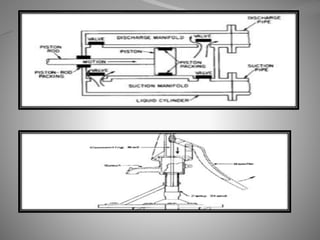
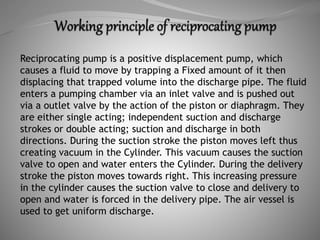
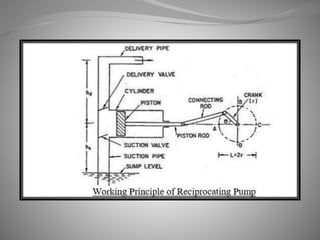
Reciprocating pump is a positive displacement pump, which
causes a fluid to move by trapping a Fixed amount of it then
displacing that trapped volume into the discharge pipe. The fluid
enters a pumping chamber via an inlet valve and is pushed out
via a outlet valve by the action of the piston or diaphragm. They
are either single acting; independent suction and discharge
strokes or double acting; suction and discharge in both
directions. During the suction stroke the piston moves left thus
creating vacuum in the Cylinder. This vacuum causes the suction
valve to open and water enters the Cylinder. During the delivery
stroke the piston moves towards right. This increasing pressure
in the cylinder causes the suction valve to close and delivery to
open and water is forced in the delivery pipe. The air vessel is
used to get uniform discharge.
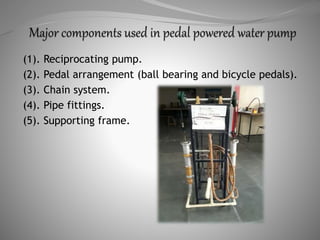
(1). Reciprocating pump.
(2). Pedal arrangement (ball bearing and bicycle pedals).
(3). Chain system.
(4). Pipe fittings.
(5). Supporting frame.
(1). It is compact in size
(2). Portable.
(3). No electrical power consumption.
(4). It is simple in construction.
(5). Low cost.
(6). Less weight and easy to handle.
(7). It is simple in operation and required less skilled
operators.
During summer season , due to water scarcity problem
the people purchasing the water from lorry by
collecting the water through their pots.
These pots are carried by the men or women and getting
tired when carrying water through staircase step those
who are living in flat system.
When this unit is installed in first floor of the building ,
the suction pipe is put in to the water delivery pipe of
lorry and water is delivered through the flexible pipe to
the required collecting point by pedaling this unit.
(1).The outstanding advantage of water discharging
system from the ground floor to first floor or discharging
the water from the lorry to the collecting point by
simply pedaling this unit .
(2).The water is carried by the flexible tube relieves the
stress free painstaking water carrying through the pot
while in staircase walking.
(3). Simple construction and less effort and costless
maintenance and anybody can work this unit.
(4). Operation is very smooth and in this system we can
get more output by applying less effort.

Pedal operated reciprocating pump

  • 1.
    SUBMITTED BY : ANKIT GUPTA  MOHAMMAD ASAD  NITIN PAL  ROSHAN KUMAR
  • 2.
    TOPICS  INTRODUCTION PUMP ANDITS TYPE.  CENTRIFUGAL VS RECIPROCATING PUMP. WORKING PRINCIPLE OF RECIPROCATING PUMP. MAJOR COMPONENTS USED IN THE PROJECT. FEATURES. APPLICATIONS. ACTUAL PROJECT IMAGE.
  • 3.
     A Watersystem includes a reciprocating pump operated by pedaling power.  Pumps are a common means of lifting water from a clean ground water source to a useful point of access, but all pumps have moving parts and are therefore destined to break proper selection of a pump will reduce undesirable downtime and will empower the local community to manage their water source.  Here we use the foot pedal pump, powered by our legs instead of arms to lift the water from a depth range of seven meters.  A person can generate four times more (1/4 horse power (hp)) by pedaling than by hand –cranking. At the rate of 1/4hp, continuous pedaling can be done for only short periods, about 10 minutes. However, pedaling at half this power (1/8 hp) can be sustained for around 60 minutes.
  • 4.
    Pumps – convertmechanical energy into fluid energy. Pumps come in a variety of sizes for a wide range of applications. They can be classified according to their basic operating principle as dynamic or displacement pumps. Dynamic pumps can be sub-classified as centrifugal and special effect pumps. Displacement pumps can be sub-classified as rotary or reciprocating pumps.
  • 6.
    A centrifugal pumpis of a very simple design. The two main parts of the pump are the impeller and the diffuser. Impeller, which is the only moving part, is attached to a shaft and driven by a motor. Impellers are generally made of bronze, polycarbonate, cast iron, stainless steel as well as other materials. The diffuser (also called as volute) houses the impeller and captures and directs the water off the impeller.
  • 7.
    Reciprocating pumps arethose which cause the fluid to move using one or more oscillating pistons, plungers or membranes (diaphragms). To 'Reciprocate' means 'To Move Backwards and Forwards'. A 'RECIPROCATING' pump therefore, is one with a forward and backward operating action. The simplest reciprocating pump is the 'Bicycle Pump', which everyone at some time or other will have used to re-inflate their bike tyres. Reciprocating-type pumps require a system of suction and discharge valves to ensure that the fluid moves in a positive direction. Pumps in this category range from having "simplex" one cylinder, to in some cases "quad" four cylinders or more. Most reciprocating-type pumps are"duplex" (two) or "triplex" (three) cylinder.
  • 9.
    CENTRIFUGAL PUMP RECIPROCATINGPUMP Discharge is continuous and smooth. Discharge is fluctuating and pulsating. It can handle large quantity of liquid. It can handle small quantity of liquid. It is used for low viscous fluid. It is used for high viscous fluid. Efficiency of these pumps are low compare to reciprocating pump. Efficiency is high. It is less costly. These are costly. They are lighter than reciprocating pump. They are heavier compare to centrifugal pump. Used where high discharge at low head required. High viscous fluid pumped at a high head. Centrifugal pump has problem of priming. Reciprocating pumps doesn’t have any problem of priming. It gives higher discharge at low heads. It gives low discharge at high heads.
  • 10.
    Reciprocating pump isa positive displacement pump, which causes a fluid to move by trapping a Fixed amount of it then displacing that trapped volume into the discharge pipe. The fluid enters a pumping chamber via an inlet valve and is pushed out via a outlet valve by the action of the piston or diaphragm. They are either single acting; independent suction and discharge strokes or double acting; suction and discharge in both directions. During the suction stroke the piston moves left thus creating vacuum in the Cylinder. This vacuum causes the suction valve to open and water enters the Cylinder. During the delivery stroke the piston moves towards right. This increasing pressure in the cylinder causes the suction valve to close and delivery to open and water is forced in the delivery pipe. The air vessel is used to get uniform discharge.
  • 12.
    (1). Reciprocating pump. (2).Pedal arrangement (ball bearing and bicycle pedals). (3). Chain system. (4). Pipe fittings. (5). Supporting frame.
  • 13.
    (1). It iscompact in size (2). Portable. (3). No electrical power consumption. (4). It is simple in construction. (5). Low cost. (6). Less weight and easy to handle. (7). It is simple in operation and required less skilled operators.
  • 14.
    During summer season, due to water scarcity problem the people purchasing the water from lorry by collecting the water through their pots. These pots are carried by the men or women and getting tired when carrying water through staircase step those who are living in flat system. When this unit is installed in first floor of the building , the suction pipe is put in to the water delivery pipe of lorry and water is delivered through the flexible pipe to the required collecting point by pedaling this unit.
  • 15.
    (1).The outstanding advantageof water discharging system from the ground floor to first floor or discharging the water from the lorry to the collecting point by simply pedaling this unit . (2).The water is carried by the flexible tube relieves the stress free painstaking water carrying through the pot while in staircase walking. (3). Simple construction and less effort and costless maintenance and anybody can work this unit. (4). Operation is very smooth and in this system we can get more output by applying less effort.