
Tanuj Parikh
 Introduction 
 Involutes 
 Evolutes 
 Involute vs. Evolute
If the normals at points Q and q of a curve meet at C, then the limiting position of C, as q 
approaches Q, is called the center of curvature of the curve at Q. 
The locus of the center of curvature, as Q varies on the curve, is called the evolute of the curve. 
The original curve is called an involute of the new one. 
The evolute may alternatively be defined as the envelope of the normal to the curve; for C lies on 
2 tangents to this envelop and, as they approach coincidence, the limiting position of C is a point 
on the envelope. 
Evolute Examples 
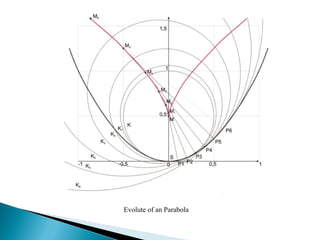
Many examples have already been given, such as the evolute of the parabola and that of the 
cycloid. It has been shown that the evolute of an equiangular spiral is an equal spiral; and the 
evolute of any hypocycloid or epicycloid is a curve similar to the original.
In the drawing of evolutes it is a help to know that the evolute passes through any ordinary cusp-point 
of the original curve; that points of inflexion on the original curve correspond to points at 
infinity on the evolute; and that points of maximum or minimum curvature correspond to cusps of 
the evolute. 
To draw an evolute it is necessary to have some means of drawing accurately a number of normals 
to the original curve. Sometimes this can be done by a knowledge of the geometry of the curve as, 
for example, for the parabola, and the cycloidal curves. 
The evolutes of roulettes and glissettes can usually be drawn, because the position of the 
instantaneous center is known and the normal can therefore be drawn. This applies to such curves 
as the right strophoid and all conchoids and negative pedals.
The following curves are suggested among those whose evolutes can be drawn: 
 The ellipse. With any point on the minor axis as center draw a circle passing through the loci, 
cutting the curve at P and the further part of the minor axis at G. Then PG is a normal to the 
ellipse at P. 
 The limacon. With the notation of P.45 of Book of Curves the instantaneous center of PP’, 
regarded as a moving rod, is on the base-circle, at the point I opposite to Q. Hence IP and IP’ 
are normals. 
 The lemniscate. If the curve is drawn by the method of P.115 of Book of Curves, the 
instantaneous center of MM’ is at the intersection of CM and C’M’. The line drawn from this 
point to P is a normal to the curve 
 The right strophoid. The following method is suggested: Let OA and AD be 2 lines at right 
angles, O being a fixed point about 2 inches from A. With center at any point W on OA 
produced, and radius WO, draw an arc cutting AD at Q. With the same radius, and centers at 
O and Q, draw arcs intersecting at T (so that OWQT is a rhombus). Join WQ and mark off WP 
on it equal to WA. Join PT. Then the locus of T is a parabola; that of P is a strophoid; and PT 
is a normal to the strophoid. (Note: The position of W should be moved towards A and past A, 
until it is half-way between A and O; but, after it has passed A, WP must be marked off along 
QW produced.) (Hint for proof: In Figure 66, P.93 of the Book of Curves, T is the 
instantaneous center of the moving set square.
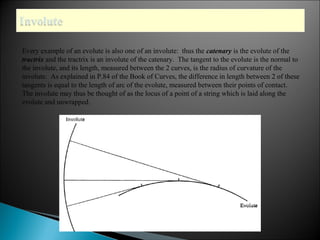
Every example of an evolute is also one of an involute: thus the catenary is the evolute of the 
tractrix and the tractrix is an involute of the catenary. The tangent to the evolute is the normal to 
the involute, and its length, measured between the 2 curves, is the radius of curvature of the 
involute. As explained in P.84 of the Book of Curves, the difference in length between 2 of these 
tangents is equal to the length of arc of the evolute, measured between their points of contact. 
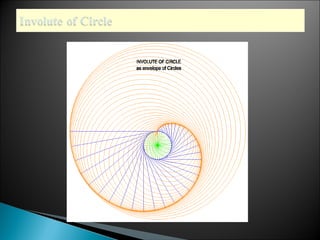
The involute may thus be thought of as the locus of a point of a string which is laid along the 
evolute and unwrapped.
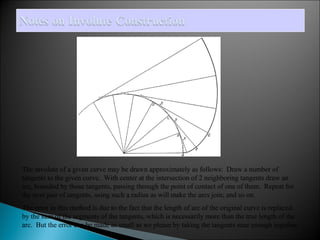
The involute of a given curve may be drawn approximately as follows: Draw a number of 
tangents to the given curve. With center at the intersection of 2 neighboring tangents draw an 
arc, bounded by those tangents, passing through the point of contact of one of them. Repeat for 
the next pair of tangents, using such a radius as will make the arcs join; and so on. 
The error in this method is due to the fact that the length of arc of the original curve is replaced 
by the sum of the segments of the tangents, which is necessarily more than the true length of the 
arc. But the error can be made as small as we please by taking the tangents near enough together.
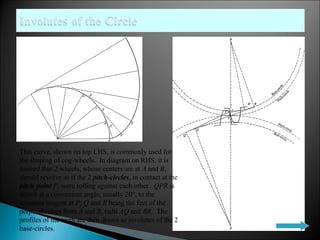
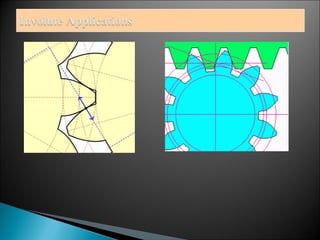
This curve, shown on top LHS, is commonly used for 
the shaping of cog-wheels. In diagram on RHS, it is 
desired that 2 wheels, whose centers are at A and B, 
should revolve as if the 2 pitch-circles, in contact at the 
pitch-point P, were rolling against each other. QPR is 
drawn at a convenient angle, usually 20°, to the 
common tangent at P; Q and R being the feet of the 
perpendiculars from A and B, radii AQ and BR. The 
profiles of the teeth are then drawn as involutes of the 2 
base-circles.
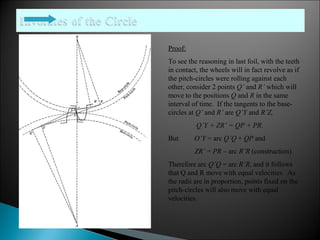
Proof: 
To see the reasoning in last foil, with the teeth 
in contact, the wheels will in fact revolve as if 
the pitch-circles were rolling against each 
other, consider 2 points Q’ and R’ which will 
move to the positions Q and R in the same 
interval of time. If the tangents to the base-circles 
at Q’ and R’ are Q’Y and R’Z, 
Q’Y + ZR’ = QP + PR. 
But O’Y = arc Q’Q + QP and 
ZR’ = PR – arc R’R (construction). 
Therefore arc Q’Q = arc R’R, and it follows 
that Q and R move with equal velocities. As 
the radii are in proportion, points fixed on the 
pitch-circles will also move with equal 
velocities.
While every curve has but one evolute, it has many involutes; for the initial point, where the 
involute cuts the original curve, may be chosen arbitrarily. The various curves so obtained are 
called parallel curves. Any 2 of them are a constant distance apart, the distance being measured 
along the common normal. The involutes of a circle are all identical, but in other cases varying 
shapes are produced. To draw curves parallel to a given curve it is only necessary to draw a 
number of normals and to mark off equal distances along each of them.
It may be noted, in drawing involutes, a cusp may occur either at the initial point (i.e. the point 
where the involute meets the original curve) or at a point corresponding to a point of inflexion of 
the original curve. In drawing a curve parallel to a given curve, a cusp may be found at a point 
where the radius of curvature of the original curve is equal to the constant distances between the 
curves. 
The following are suggested for drawing: 
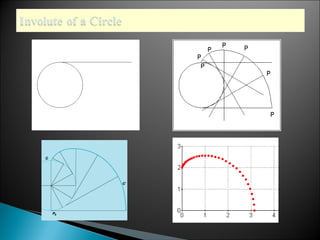
1. An involute of the circle. 
2. Involutes of the nephroid (i) with the initial point mid-way between 2 cusps, (ii) with the 
initial point at a cusp-point. 
3. An involute of the lemniscate, with the initial point at one end of the transverse axis. 
4. Curves parallel to the parabola, with the constant distance measured along the inward 
normal and (i) equal to 2a (a being the distance from the focus to the vertex), (ii) greater 
than 2a. 
5. Curves parallel to the ellipse, with the constant distance measured along the inward normal 
and (i) between b2 / a and a2 / b, (ii) great than a2 / b. 
6. Curves parallel to the astroid, at varying distances.
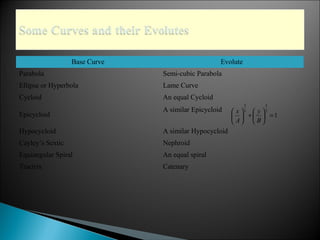
Base Curve Evolute 
Parabola Semi-cubic Parabola 
Ellipse or Hyperbola Lame Curve 
Cycloid An equal Cycloid 
Epicycloid 
A similar Epicycloid 
Hypocycloid A similar Hypocycloid 
Cayley’s Sextic Nephroid 
Equiangular Spiral An equal spiral 
Tractrix Catenary 
2 
1 3 
2 
3 
y 
ö çè 
= ÷ø 
x 
ö çè 
æ + ÷ø 
æ 
B 
A
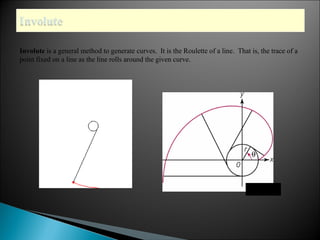
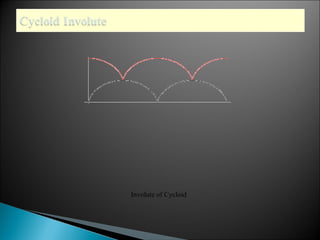
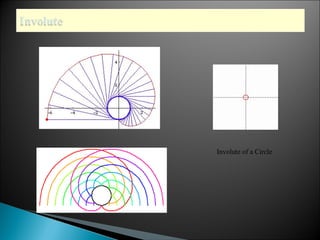
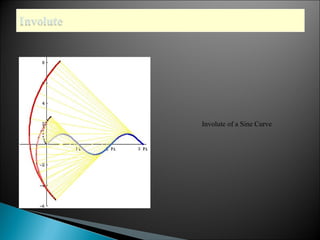
Involute is a general method to generate curves. It is the Roulette of a line. That is, the trace of a 
point fixed on a line as the line rolls around the given curve.
Involute of Cycloid
Involute of a Circle
Involute of a Sine Curve
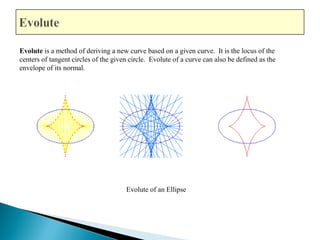
Evolute is a method of deriving a new curve based on a given curve. It is the locus of the 
centers of tangent circles of the given circle. Evolute of a curve can also be defined as the 
envelope of its normal. 
Evolute of an Ellipse
Evolute of an Parabola
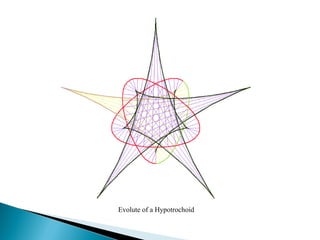
Evolute of a Hypotrochoid
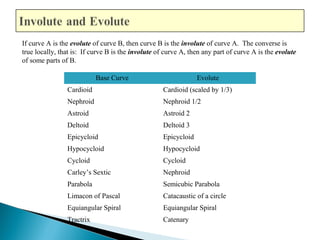
If curve A is the evolute of curve B, then curve B is the involute of curve A. The converse is 
true locally, that is: If curve B is the involute of curve A, then any part of curve A is the evolute 
of some parts of B. 
Base Curve Evolute 
Cardioid Cardioid (scaled by 1/3) 
Nephroid Nephroid 1/2 
Astroid Astroid 2 
Deltoid Deltoid 3 
Epicycloid Epicycloid 
Hypocycloid Hypocycloid 
Cycloid Cycloid 
Carley’s Sextic Nephroid 
Parabola Semicubic Parabola 
Limacon of Pascal Catacaustic of a circle 
Equiangular Spiral Equiangular Spiral 
Tractrix Catenary
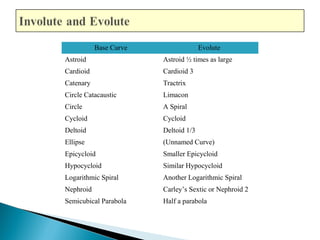
Base Curve Evolute 
Astroid Astroid ½ times as large 
Cardioid Cardioid 3 
Catenary Tractrix 
Circle Catacaustic Limacon 
Circle A Spiral 
Cycloid Cycloid 
Deltoid Deltoid 1/3 
Ellipse (Unnamed Curve) 
Epicycloid Smaller Epicycloid 
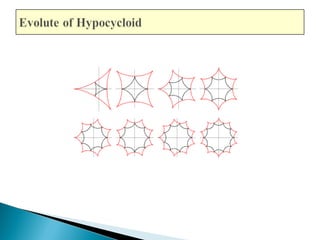
Hypocycloid Similar Hypocycloid 
Logarithmic Spiral Another Logarithmic Spiral 
Nephroid Carley’s Sextic or Nephroid 2 
Semicubical Parabola Half a parabola
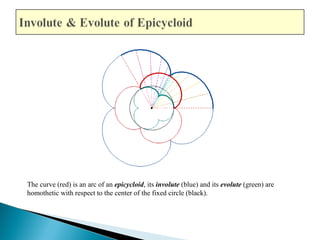
The curve (red) is an arc of an epicycloid, its involute (blue) and its evolute (green) are 
homothetic with respect to the center of the fixed circle (black).
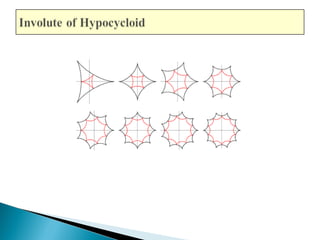
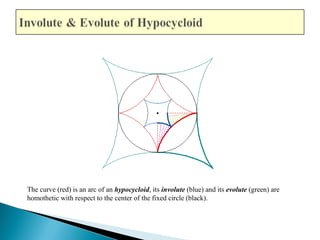
The curve (red) is an arc of an hypocycloid, its involute (blue) and its evolute (green) are 
homothetic with respect to the center of the fixed circle (black).

Curve generation %a1 v involute and evolute

  • 1.
  • 3.
     Introduction Involutes  Evolutes  Involute vs. Evolute
  • 5.
    If the normalsat points Q and q of a curve meet at C, then the limiting position of C, as q approaches Q, is called the center of curvature of the curve at Q. The locus of the center of curvature, as Q varies on the curve, is called the evolute of the curve. The original curve is called an involute of the new one. The evolute may alternatively be defined as the envelope of the normal to the curve; for C lies on 2 tangents to this envelop and, as they approach coincidence, the limiting position of C is a point on the envelope. Evolute Examples Many examples have already been given, such as the evolute of the parabola and that of the cycloid. It has been shown that the evolute of an equiangular spiral is an equal spiral; and the evolute of any hypocycloid or epicycloid is a curve similar to the original.
  • 6.
    In the drawingof evolutes it is a help to know that the evolute passes through any ordinary cusp-point of the original curve; that points of inflexion on the original curve correspond to points at infinity on the evolute; and that points of maximum or minimum curvature correspond to cusps of the evolute. To draw an evolute it is necessary to have some means of drawing accurately a number of normals to the original curve. Sometimes this can be done by a knowledge of the geometry of the curve as, for example, for the parabola, and the cycloidal curves. The evolutes of roulettes and glissettes can usually be drawn, because the position of the instantaneous center is known and the normal can therefore be drawn. This applies to such curves as the right strophoid and all conchoids and negative pedals.
  • 7.
    The following curvesare suggested among those whose evolutes can be drawn:  The ellipse. With any point on the minor axis as center draw a circle passing through the loci, cutting the curve at P and the further part of the minor axis at G. Then PG is a normal to the ellipse at P.  The limacon. With the notation of P.45 of Book of Curves the instantaneous center of PP’, regarded as a moving rod, is on the base-circle, at the point I opposite to Q. Hence IP and IP’ are normals.  The lemniscate. If the curve is drawn by the method of P.115 of Book of Curves, the instantaneous center of MM’ is at the intersection of CM and C’M’. The line drawn from this point to P is a normal to the curve  The right strophoid. The following method is suggested: Let OA and AD be 2 lines at right angles, O being a fixed point about 2 inches from A. With center at any point W on OA produced, and radius WO, draw an arc cutting AD at Q. With the same radius, and centers at O and Q, draw arcs intersecting at T (so that OWQT is a rhombus). Join WQ and mark off WP on it equal to WA. Join PT. Then the locus of T is a parabola; that of P is a strophoid; and PT is a normal to the strophoid. (Note: The position of W should be moved towards A and past A, until it is half-way between A and O; but, after it has passed A, WP must be marked off along QW produced.) (Hint for proof: In Figure 66, P.93 of the Book of Curves, T is the instantaneous center of the moving set square.
  • 8.
    Every example ofan evolute is also one of an involute: thus the catenary is the evolute of the tractrix and the tractrix is an involute of the catenary. The tangent to the evolute is the normal to the involute, and its length, measured between the 2 curves, is the radius of curvature of the involute. As explained in P.84 of the Book of Curves, the difference in length between 2 of these tangents is equal to the length of arc of the evolute, measured between their points of contact. The involute may thus be thought of as the locus of a point of a string which is laid along the evolute and unwrapped.
  • 9.
    The involute ofa given curve may be drawn approximately as follows: Draw a number of tangents to the given curve. With center at the intersection of 2 neighboring tangents draw an arc, bounded by those tangents, passing through the point of contact of one of them. Repeat for the next pair of tangents, using such a radius as will make the arcs join; and so on. The error in this method is due to the fact that the length of arc of the original curve is replaced by the sum of the segments of the tangents, which is necessarily more than the true length of the arc. But the error can be made as small as we please by taking the tangents near enough together.
  • 10.
    This curve, shownon top LHS, is commonly used for the shaping of cog-wheels. In diagram on RHS, it is desired that 2 wheels, whose centers are at A and B, should revolve as if the 2 pitch-circles, in contact at the pitch-point P, were rolling against each other. QPR is drawn at a convenient angle, usually 20°, to the common tangent at P; Q and R being the feet of the perpendiculars from A and B, radii AQ and BR. The profiles of the teeth are then drawn as involutes of the 2 base-circles.
  • 11.
    Proof: To seethe reasoning in last foil, with the teeth in contact, the wheels will in fact revolve as if the pitch-circles were rolling against each other, consider 2 points Q’ and R’ which will move to the positions Q and R in the same interval of time. If the tangents to the base-circles at Q’ and R’ are Q’Y and R’Z, Q’Y + ZR’ = QP + PR. But O’Y = arc Q’Q + QP and ZR’ = PR – arc R’R (construction). Therefore arc Q’Q = arc R’R, and it follows that Q and R move with equal velocities. As the radii are in proportion, points fixed on the pitch-circles will also move with equal velocities.
  • 12.
    While every curvehas but one evolute, it has many involutes; for the initial point, where the involute cuts the original curve, may be chosen arbitrarily. The various curves so obtained are called parallel curves. Any 2 of them are a constant distance apart, the distance being measured along the common normal. The involutes of a circle are all identical, but in other cases varying shapes are produced. To draw curves parallel to a given curve it is only necessary to draw a number of normals and to mark off equal distances along each of them.
  • 13.
    It may benoted, in drawing involutes, a cusp may occur either at the initial point (i.e. the point where the involute meets the original curve) or at a point corresponding to a point of inflexion of the original curve. In drawing a curve parallel to a given curve, a cusp may be found at a point where the radius of curvature of the original curve is equal to the constant distances between the curves. The following are suggested for drawing: 1. An involute of the circle. 2. Involutes of the nephroid (i) with the initial point mid-way between 2 cusps, (ii) with the initial point at a cusp-point. 3. An involute of the lemniscate, with the initial point at one end of the transverse axis. 4. Curves parallel to the parabola, with the constant distance measured along the inward normal and (i) equal to 2a (a being the distance from the focus to the vertex), (ii) greater than 2a. 5. Curves parallel to the ellipse, with the constant distance measured along the inward normal and (i) between b2 / a and a2 / b, (ii) great than a2 / b. 6. Curves parallel to the astroid, at varying distances.
  • 14.
    Base Curve Evolute Parabola Semi-cubic Parabola Ellipse or Hyperbola Lame Curve Cycloid An equal Cycloid Epicycloid A similar Epicycloid Hypocycloid A similar Hypocycloid Cayley’s Sextic Nephroid Equiangular Spiral An equal spiral Tractrix Catenary 2 1 3 2 3 y ö çè = ÷ø x ö çè æ + ÷ø æ B A
  • 16.
    Involute is ageneral method to generate curves. It is the Roulette of a line. That is, the trace of a point fixed on a line as the line rolls around the given curve.
  • 18.
  • 19.
  • 22.
    Involute of aSine Curve
  • 26.
    Evolute is amethod of deriving a new curve based on a given curve. It is the locus of the centers of tangent circles of the given circle. Evolute of a curve can also be defined as the envelope of its normal. Evolute of an Ellipse
  • 28.
    Evolute of anParabola
  • 29.
    Evolute of aHypotrochoid
  • 31.
    If curve Ais the evolute of curve B, then curve B is the involute of curve A. The converse is true locally, that is: If curve B is the involute of curve A, then any part of curve A is the evolute of some parts of B. Base Curve Evolute Cardioid Cardioid (scaled by 1/3) Nephroid Nephroid 1/2 Astroid Astroid 2 Deltoid Deltoid 3 Epicycloid Epicycloid Hypocycloid Hypocycloid Cycloid Cycloid Carley’s Sextic Nephroid Parabola Semicubic Parabola Limacon of Pascal Catacaustic of a circle Equiangular Spiral Equiangular Spiral Tractrix Catenary
  • 32.
    Base Curve Evolute Astroid Astroid ½ times as large Cardioid Cardioid 3 Catenary Tractrix Circle Catacaustic Limacon Circle A Spiral Cycloid Cycloid Deltoid Deltoid 1/3 Ellipse (Unnamed Curve) Epicycloid Smaller Epicycloid Hypocycloid Similar Hypocycloid Logarithmic Spiral Another Logarithmic Spiral Nephroid Carley’s Sextic or Nephroid 2 Semicubical Parabola Half a parabola
  • 33.
    The curve (red)is an arc of an epicycloid, its involute (blue) and its evolute (green) are homothetic with respect to the center of the fixed circle (black).
  • 34.
    The curve (red)is an arc of an hypocycloid, its involute (blue) and its evolute (green) are homothetic with respect to the center of the fixed circle (black).

Editor's Notes

  • #6 E. H. Lockwood, A Book of Curves, P.167.
  • #7 E. H. Lockwood, A Book of Curves, P.167.
  • #8 E. H. Lockwood, A Book of Curves, P.167 – P.168.
  • #9 E. H. Lockwood, A Book of Curves, P.167 – P.168.
  • #10 E. H. Lockwood, A Book of Curves, P.167 – P.168.
  • #11 E. H. Lockwood, A Book of Curves, P.170.
  • #12 E. H. Lockwood, A Book of Curves, P.170.
  • #13 E. H. Lockwood, A Book of Curves, P.170.
  • #14 E. H. Lockwood, A Book of Curves, P.170 – P.171.
  • #15 http://xahlee.org/SpecialPlaneCurves_dir/Involute_dir/involute.html
  • #17 http://xahlee.org/SpecialPlaneCurvs_dir/Involute_dir/involute.html http://en.wikipedia.org/wiki/Involute
  • #18 http://xahlee.org/SpecialPlaneCurvs_dir/Involute_dir/involute.html http://www.answers.com/topic/involute http://en.wikipedia.org/wiki/Involute
  • #19 http://mathworld.wolfram.com/CycloidInvolute.html
  • #20 http://mathworld.wolfram.com/Involute.htmlhttp://en.wikipedia.org/wiki/Involute
  • #21 http://mathworld.wolfram.com/Involute.htmlhttp://en.wikipedia.org/wiki/Involute
  • #22 http://www.stiltman.com/assets/images/autogen/a_Involute_as_envelope_of_circles.gif
  • #24 http://mathworld.wolfram.com/HypocycloidInvolute.html
  • #26 http://xahlee.org/SpecialPlaneCurves_dir/Involute_dir/involute.html
  • #28 http://xahlee.org/SpecialPlaneCurves_dir/Involute_dir/involute.html
  • #29 http://mathworld.wolfram.com/HypocycloidEvolute.html
  • #30 http://xahlee.org/SpecialPlaneCurves_dir/Involute_dir/involute.html
  • #31 http://xahlee.org/SpecialPlaneCurves_dir/Involute_dir/involute.html
  • #33 http://xahlee.org/SpecialPlaneCurves_dir/Involute_dir/involute.html
  • #34 http://mathworld.wolfram.com/Involute.html
  • #35 http://www.tfh-berlin.de/~schwenk/Veroeffentlichungen/evolutes-involutes/Welcome.html
  • #36 http://www.tfh-berlin.de/~schwenk/Veroeffentlichungen/evolutes-involutes/Welcome.html