



By: Bong, Tess & Albert
Pulseless Arrest (Cardiac Arrest)
Algorithm
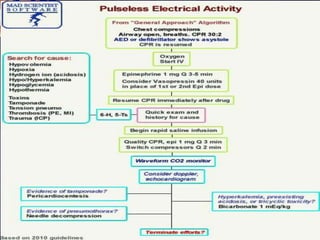
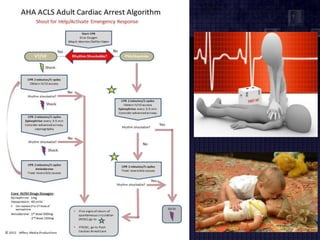
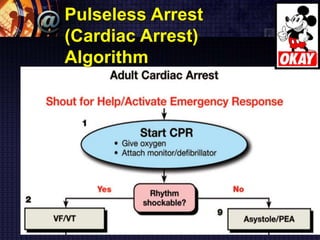
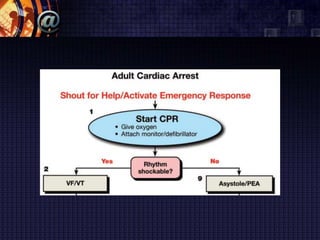
The Pulseless Arrest Algorithm which is
now known as the Cardiac Arrest Algorithm
takes its place as the most important
algorithm in the ACLS Protocol. There are 4
rhythms that are seen with pulseless
cardiac arrest. These four rhythms are
pulseless ventricular tachycardia (VT),
ventricular fibrillation (VF), asystole, and
pulseless electrical activity (PEA).
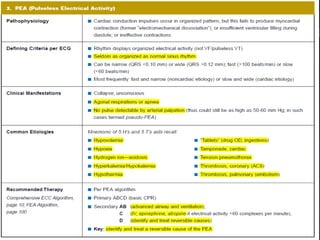
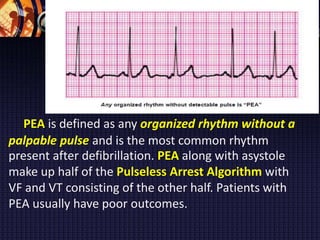
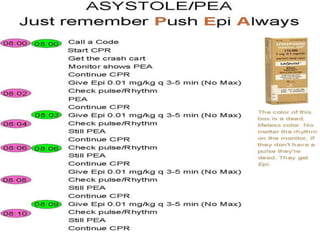
PEA is defined as any organized rhythm without a
palpable pulse and is the most common rhythm
present after defibrillation. PEA along with asystole
make up half of the Pulseless Arrest Algorithm with
VF and VT consisting of the other half. Patients with
PEA usually have poor outcomes.
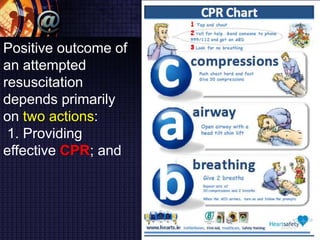
Positive outcome of
an attempted
resuscitation
depends primarily
on two actions:
1. Providing
effective CPR; and
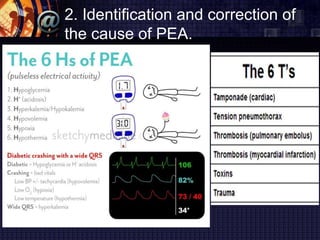
2. Identification and correction of
the cause of PEA.
 Understanding the importance of diagnosing
and treating the underlying cause is
fundamental to management of all cardiac
arrest rhythms.
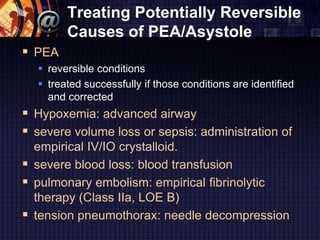
Treating Potentially Reversible
Causes of PEA/Asystole
 PEA
 reversible conditions
 treated successfully if those conditions are identified
and corrected
 Hypoxemia: advanced airway
 severe volume loss or sepsis: administration of
empirical IV/IO crystalloid.
 severe blood loss: blood transfusion
 pulmonary embolism: empirical fibrinolytic
therapy (Class IIa, LOE B)
 tension pneumothorax: needle decompression
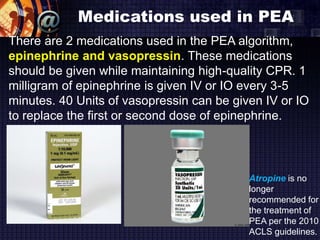
Medications used in PEA
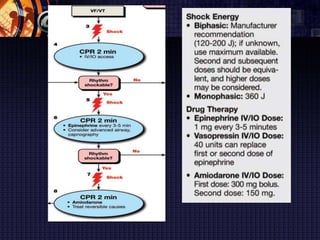
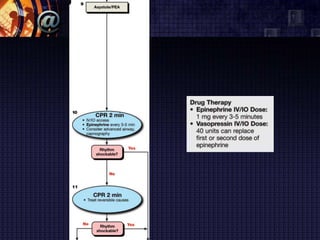
There are 2 medications used in the PEA algorithm,
epinephrine and vasopressin. These medications
should be given while maintaining high-quality CPR. 1
milligram of epinephrine is given IV or IO every 3-5
minutes. 40 Units of vasopressin can be given IV or IO
to replace the first or second dose of epinephrine.
Atropine is no
longer
recommended for
the treatment of
PEA per the 2010
ACLS guidelines.
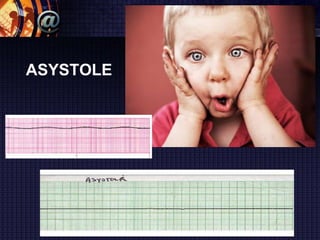
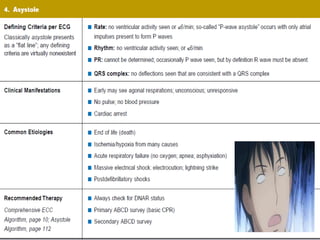
ASYSTOLE
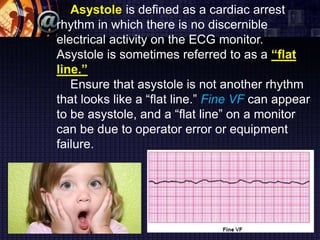
Asystole is defined as a cardiac arrest
rhythm in which there is no discernible
electrical activity on the ECG monitor.
Asystole is sometimes referred to as a “flat
line.”
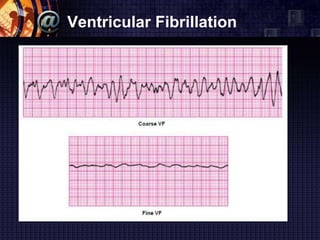
Ensure that asystole is not another rhythm
that looks like a “flat line.” Fine VF can appear
to be asystole, and a “flat line” on a monitor
can be due to operator error or equipment
failure.
Asystole for many patients is the result
of a prolonged illness or cardiac arrest, and
prognosis is very poor.
The H’s and T’s of ACLS should be
reviewed to identify any underlying cause
that could have precipitated the asystole.
Some of the most common reasons to stop or
withhold resuscitative efforts are:
• DNR status
• Threat to the safety of rescuers
• Family or personal information such as a living
will or advanced directive
• Rigor mortis
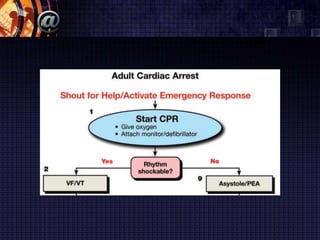
Asystole is treated using the right branch of the
pulseless arrest algorithm.
Ventricular Fibrillation
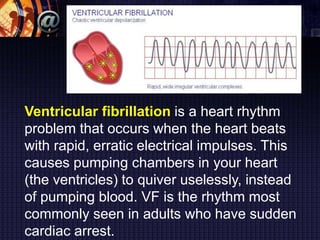
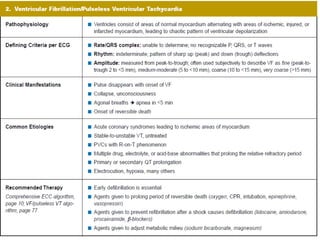
Ventricular fibrillation is a heart rhythm
problem that occurs when the heart beats
with rapid, erratic electrical impulses. This
causes pumping chambers in your heart
(the ventricles) to quiver uselessly, instead
of pumping blood. VF is the rhythm most
commonly seen in adults who have sudden
cardiac arrest.
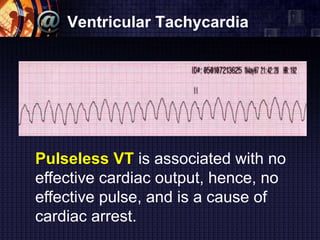
Ventricular Tachycardia
Pulseless VT is associated with no
effective cardiac output, hence, no
effective pulse, and is a cause of
cardiac arrest.
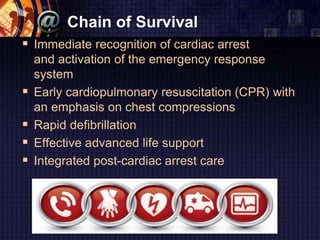
Chain of Survival
 Immediate recognition of cardiac arrest
and activation of the emergency response
system
 Early cardiopulmonary resuscitation (CPR) with
an emphasis on chest compressions
 Rapid defibrillation
 Effective advanced life support
 Integrated post-cardiac arrest care
 Survival from these cardiac arrest rhythms
requires
 basic life support (BLS)
 system of advanced cardiovascular life support
(ACLS)
 integrated post– cardiac arrest care
 Periodic pauses in CPR
 brief as possible
 assess rhythm, shock VF/VT, perform a pulse check
when an organized rhythm is detected, or place an
advanced airway
 absence of an advanced airway
 synchronized compression–ventilation ratio of 30:2
 compression rate of at least 100 per minute.
 After placement of a supraglottic airway or an
endotracheal tube
 chest compressions should deliver at least 100
compressions per minute continuously without
pauses for ventilation
 delivering ventilations should give 1 breath every 6-8
seconds (8-10 breaths per minute)
 avoid delivering an excessive number of ventilations
Pulseless Arrest
(Cardiac Arrest)
Algorithm
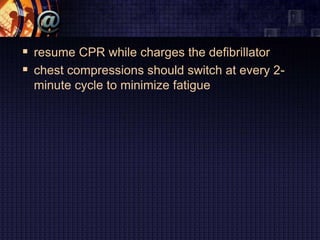
 resume CPR while charges the defibrillator
 chest compressions should switch at every 2-
minute cycle to minimize fatigue
CPR Before Defibrillation
 Performing CPR while a defibrillator is readied
for use is strongly recommended for all patients
in cardiac arrest.
 Defibrillation after minimally interrupted CPR
gives the best chance of success.
 If ventricular fibrillation recurs, reinitiate
defibrillation at the energy level that previously
resulted in successful defibrillation.
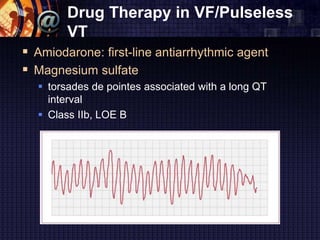
Drug Therapy in VF/Pulseless
VT
 Amiodarone: first-line antiarrhythmic agent
 Magnesium sulfate
 torsades de pointes associated with a long QT
interval
 Class IIb, LOE B
Physiologic Parameters
 Pulse
 End-Tidal CO2
 Coronary Perfusion Pressure and Arterial
Relaxation Pressure
 Central Venous Oxygen Saturation
 Pulse Oximetry
 Arterial Blood Gases
 Echocardiography
Pulse
 No studies have shown the validity or clinical
utility of checking pulses during ongoing CPR.
 Because there are no valves in the inferior vena
cava, retrograde blood flow into the venous
system may produce femoral vein pulsations.
Pulse
 Carotid pulsations during CPR do not indicate
the efficacy of myocardial or cerebral perfusion
during CPR.
 no more than 10 seconds to check for a pulse
 If it is not felt within that time period chest
compressions should be started
End-Tidal CO2
 During untreated cardiac arrest CO2 continues
to be produced in the body, but there is no CO2
delivery to the lungs.
 Under these conditions PETCO2 will approach
zero with continued ventilation. With initiation of
CPR, cardiac output is the major determinant of
CO2 delivery to the lungs.
 If ventilation is relatively constant, PETCO2
correlates well with cardiac output during CPR.
End-Tidal CO2
 If PETCO2 is <10 mm Hg, it is reasonable to
consider trying to improve CPR quality by
optimizing chest compression parameters
(Class IIb, LOE C).
 If PETCO2 abruptly increases to a normal value
(35-40 mm Hg), it is reasonable to consider that
this is an indicator of ROSC (Class IIa, LOE B).
Coronary Perfusion Pressure and Arterial
Relaxation Pressure
 Increased CPP correlates with improved 24-
hour survival rates and is associated with
improved myocardial blood flow and ROSC
 If the arterial relaxation “diastolic” pressure is
<20 mm Hg, it is reasonable to consider trying
to improve quality of CPR by optimizing chest
compression parameters or giving a
vasopressor or both (Class IIb, LOE C).
Pulse Oximetry
 typically does not provide a reliable signal
because pulsatile blood flow is inadequate in
peripheral tissue beds
Arterial Blood Gases
 Arterial blood gas monitoring during CPR is not
a reliable indicator of the severity of tissue
hypoxemia, hypercarbia, or tissue acidosis.
 Routine measurement of arterial blood gases
during CPR has uncertain value (Class IIb, LOE
C).
ACCESS FOR PARENTERAL
MEDICATIONS DURING
CARDIAC ARREST
 worsened survival for every minute that
antiarrhythmic drug delivery was delayed
 Time to drug administration was also a predictor
of ROSC
 insufficient evidence to specify exact time
parameters or the precise sequence with which
drugs
Peripheral IV Drug Delivery
 bolus injection and followed with a 20-mL bolus
of IV fluid
IO Drug Delivery
 all age groups
Central IV Drug Delivery
 peak drug concentrations are higher and drug
circulation times shorter
 interrupt CPR
Endotracheal Drug Delivery
 lidocaine, epinephrine, atropine, naloxone, and
vasopressin
 2-21⁄2 times the recommended IV dose
 dilute the recommended dose in 5-10 mL of
sterile water or normal saline and inject the drug
directly into the endotracheal tube
ADVANCED AIRWAY
 delayed endotracheal intubation combined with
passive oxygen delivery and minimally
interrupted chest compressions was associated
with improved neurologically intact survival after
out-of-hospital cardiac arrest in patients with
witnessed VF/VT
 When an advanced airway (eg, endotracheal
tube or supraglottic airway) is placed, 2
providers no longer deliver cycles of
compressions interrupted with pauses for
ventilation.
 1 breath every 6-8 seconds (8-10 breaths per
minute)
MEDICATIONS FOR ARREST
RHYTHMS
Epinephrine
 It is reasonable to consider administering a 1
mg dose of IV/IO epinephrine every 3-5 minutes
during adult cardiac arrest (Class IIb, LOE A).
 If IV/IO access is delayed or cannot be
established, epinephrine may be given
endotracheally at a dose of 2-2.5 mg.
Vasopressin
 nonadrenergic peripheral vasoconstrictor
 1 dose of vasopressin 40 units IV/IO may
replace either the first or second dose of
epinephrine in the treatment of cardiac arrest
(Class IIb, LOE A)
Amiodarone
 An initial dose of 300 mg IV/IO can be followed
by 1 dose of 150 mg IV/IO.
Lidocaine
 considered if amiodarone is not available (Class
IIb, LOE B)
 The initial dose is 1-1.5 mg/kg IV.
 If VF/pulseless VT persists, additional doses of
0.5-0.75 mg/kg IV push may be administered at
5- to 10-minute intervals to a maximum dose of
3 mg/kg.
Magnesium Sulfate
 torsades de pointes
 IV/IO bolus of magnesium sulfate at a dose of 1-
2 g diluted in 10 mL D5W (Class IIb, LOE C)
ANY QUESTIONS?

Pulseless algorithm

  • 1.
  • 2.
    Pulseless Arrest (CardiacArrest) Algorithm The Pulseless Arrest Algorithm which is now known as the Cardiac Arrest Algorithm takes its place as the most important algorithm in the ACLS Protocol. There are 4 rhythms that are seen with pulseless cardiac arrest. These four rhythms are pulseless ventricular tachycardia (VT), ventricular fibrillation (VF), asystole, and pulseless electrical activity (PEA).
  • 4.
    PEA is definedas any organized rhythm without a palpable pulse and is the most common rhythm present after defibrillation. PEA along with asystole make up half of the Pulseless Arrest Algorithm with VF and VT consisting of the other half. Patients with PEA usually have poor outcomes.
  • 5.
    Positive outcome of anattempted resuscitation depends primarily on two actions: 1. Providing effective CPR; and
  • 7.
    2. Identification andcorrection of the cause of PEA.
  • 8.
     Understanding theimportance of diagnosing and treating the underlying cause is fundamental to management of all cardiac arrest rhythms.
  • 9.
    Treating Potentially Reversible Causesof PEA/Asystole  PEA  reversible conditions  treated successfully if those conditions are identified and corrected  Hypoxemia: advanced airway  severe volume loss or sepsis: administration of empirical IV/IO crystalloid.  severe blood loss: blood transfusion  pulmonary embolism: empirical fibrinolytic therapy (Class IIa, LOE B)  tension pneumothorax: needle decompression
  • 11.
    Medications used inPEA There are 2 medications used in the PEA algorithm, epinephrine and vasopressin. These medications should be given while maintaining high-quality CPR. 1 milligram of epinephrine is given IV or IO every 3-5 minutes. 40 Units of vasopressin can be given IV or IO to replace the first or second dose of epinephrine. Atropine is no longer recommended for the treatment of PEA per the 2010 ACLS guidelines.
  • 12.
  • 14.
    Asystole is definedas a cardiac arrest rhythm in which there is no discernible electrical activity on the ECG monitor. Asystole is sometimes referred to as a “flat line.” Ensure that asystole is not another rhythm that looks like a “flat line.” Fine VF can appear to be asystole, and a “flat line” on a monitor can be due to operator error or equipment failure.
  • 15.
    Asystole for manypatients is the result of a prolonged illness or cardiac arrest, and prognosis is very poor. The H’s and T’s of ACLS should be reviewed to identify any underlying cause that could have precipitated the asystole. Some of the most common reasons to stop or withhold resuscitative efforts are: • DNR status • Threat to the safety of rescuers • Family or personal information such as a living will or advanced directive • Rigor mortis Asystole is treated using the right branch of the pulseless arrest algorithm.
  • 19.
  • 20.
    Ventricular fibrillation isa heart rhythm problem that occurs when the heart beats with rapid, erratic electrical impulses. This causes pumping chambers in your heart (the ventricles) to quiver uselessly, instead of pumping blood. VF is the rhythm most commonly seen in adults who have sudden cardiac arrest.
  • 21.
    Ventricular Tachycardia Pulseless VTis associated with no effective cardiac output, hence, no effective pulse, and is a cause of cardiac arrest.
  • 23.
    Chain of Survival Immediate recognition of cardiac arrest and activation of the emergency response system  Early cardiopulmonary resuscitation (CPR) with an emphasis on chest compressions  Rapid defibrillation  Effective advanced life support  Integrated post-cardiac arrest care
  • 24.
     Survival fromthese cardiac arrest rhythms requires  basic life support (BLS)  system of advanced cardiovascular life support (ACLS)  integrated post– cardiac arrest care  Periodic pauses in CPR  brief as possible  assess rhythm, shock VF/VT, perform a pulse check when an organized rhythm is detected, or place an advanced airway
  • 25.
     absence ofan advanced airway  synchronized compression–ventilation ratio of 30:2  compression rate of at least 100 per minute.  After placement of a supraglottic airway or an endotracheal tube  chest compressions should deliver at least 100 compressions per minute continuously without pauses for ventilation  delivering ventilations should give 1 breath every 6-8 seconds (8-10 breaths per minute)  avoid delivering an excessive number of ventilations
  • 26.
  • 30.
     resume CPRwhile charges the defibrillator  chest compressions should switch at every 2- minute cycle to minimize fatigue
  • 31.
    CPR Before Defibrillation Performing CPR while a defibrillator is readied for use is strongly recommended for all patients in cardiac arrest.  Defibrillation after minimally interrupted CPR gives the best chance of success.  If ventricular fibrillation recurs, reinitiate defibrillation at the energy level that previously resulted in successful defibrillation.
  • 32.
    Drug Therapy inVF/Pulseless VT  Amiodarone: first-line antiarrhythmic agent  Magnesium sulfate  torsades de pointes associated with a long QT interval  Class IIb, LOE B
  • 33.
    Physiologic Parameters  Pulse End-Tidal CO2  Coronary Perfusion Pressure and Arterial Relaxation Pressure  Central Venous Oxygen Saturation  Pulse Oximetry  Arterial Blood Gases  Echocardiography
  • 34.
    Pulse  No studieshave shown the validity or clinical utility of checking pulses during ongoing CPR.  Because there are no valves in the inferior vena cava, retrograde blood flow into the venous system may produce femoral vein pulsations.
  • 35.
    Pulse  Carotid pulsationsduring CPR do not indicate the efficacy of myocardial or cerebral perfusion during CPR.  no more than 10 seconds to check for a pulse  If it is not felt within that time period chest compressions should be started
  • 36.
    End-Tidal CO2  Duringuntreated cardiac arrest CO2 continues to be produced in the body, but there is no CO2 delivery to the lungs.  Under these conditions PETCO2 will approach zero with continued ventilation. With initiation of CPR, cardiac output is the major determinant of CO2 delivery to the lungs.  If ventilation is relatively constant, PETCO2 correlates well with cardiac output during CPR.
  • 37.
    End-Tidal CO2  IfPETCO2 is <10 mm Hg, it is reasonable to consider trying to improve CPR quality by optimizing chest compression parameters (Class IIb, LOE C).  If PETCO2 abruptly increases to a normal value (35-40 mm Hg), it is reasonable to consider that this is an indicator of ROSC (Class IIa, LOE B).
  • 38.
    Coronary Perfusion Pressureand Arterial Relaxation Pressure  Increased CPP correlates with improved 24- hour survival rates and is associated with improved myocardial blood flow and ROSC  If the arterial relaxation “diastolic” pressure is <20 mm Hg, it is reasonable to consider trying to improve quality of CPR by optimizing chest compression parameters or giving a vasopressor or both (Class IIb, LOE C).
  • 39.
    Pulse Oximetry  typicallydoes not provide a reliable signal because pulsatile blood flow is inadequate in peripheral tissue beds
  • 40.
    Arterial Blood Gases Arterial blood gas monitoring during CPR is not a reliable indicator of the severity of tissue hypoxemia, hypercarbia, or tissue acidosis.  Routine measurement of arterial blood gases during CPR has uncertain value (Class IIb, LOE C).
  • 41.
    ACCESS FOR PARENTERAL MEDICATIONSDURING CARDIAC ARREST
  • 42.
     worsened survivalfor every minute that antiarrhythmic drug delivery was delayed  Time to drug administration was also a predictor of ROSC  insufficient evidence to specify exact time parameters or the precise sequence with which drugs
  • 43.
    Peripheral IV DrugDelivery  bolus injection and followed with a 20-mL bolus of IV fluid
  • 44.
    IO Drug Delivery all age groups
  • 45.
    Central IV DrugDelivery  peak drug concentrations are higher and drug circulation times shorter  interrupt CPR
  • 46.
    Endotracheal Drug Delivery lidocaine, epinephrine, atropine, naloxone, and vasopressin  2-21⁄2 times the recommended IV dose  dilute the recommended dose in 5-10 mL of sterile water or normal saline and inject the drug directly into the endotracheal tube
  • 47.
  • 48.
     delayed endotrachealintubation combined with passive oxygen delivery and minimally interrupted chest compressions was associated with improved neurologically intact survival after out-of-hospital cardiac arrest in patients with witnessed VF/VT  When an advanced airway (eg, endotracheal tube or supraglottic airway) is placed, 2 providers no longer deliver cycles of compressions interrupted with pauses for ventilation.
  • 49.
     1 breathevery 6-8 seconds (8-10 breaths per minute)
  • 50.
  • 51.
    Epinephrine  It isreasonable to consider administering a 1 mg dose of IV/IO epinephrine every 3-5 minutes during adult cardiac arrest (Class IIb, LOE A).  If IV/IO access is delayed or cannot be established, epinephrine may be given endotracheally at a dose of 2-2.5 mg.
  • 52.
    Vasopressin  nonadrenergic peripheralvasoconstrictor  1 dose of vasopressin 40 units IV/IO may replace either the first or second dose of epinephrine in the treatment of cardiac arrest (Class IIb, LOE A)
  • 53.
    Amiodarone  An initialdose of 300 mg IV/IO can be followed by 1 dose of 150 mg IV/IO.
  • 54.
    Lidocaine  considered ifamiodarone is not available (Class IIb, LOE B)  The initial dose is 1-1.5 mg/kg IV.  If VF/pulseless VT persists, additional doses of 0.5-0.75 mg/kg IV push may be administered at 5- to 10-minute intervals to a maximum dose of 3 mg/kg.
  • 55.
    Magnesium Sulfate  torsadesde pointes  IV/IO bolus of magnesium sulfate at a dose of 1- 2 g diluted in 10 mL D5W (Class IIb, LOE C)
  • 56.

Editor's Notes

  • #33 At this time the benefit of delaying defibrillation to perform CPR before defibrillation is unclear (Class IIb, LOE B).
  • #61 Although anecdotally administered IO without known adverse effects, there is limited experience with amiodarone given by this route.