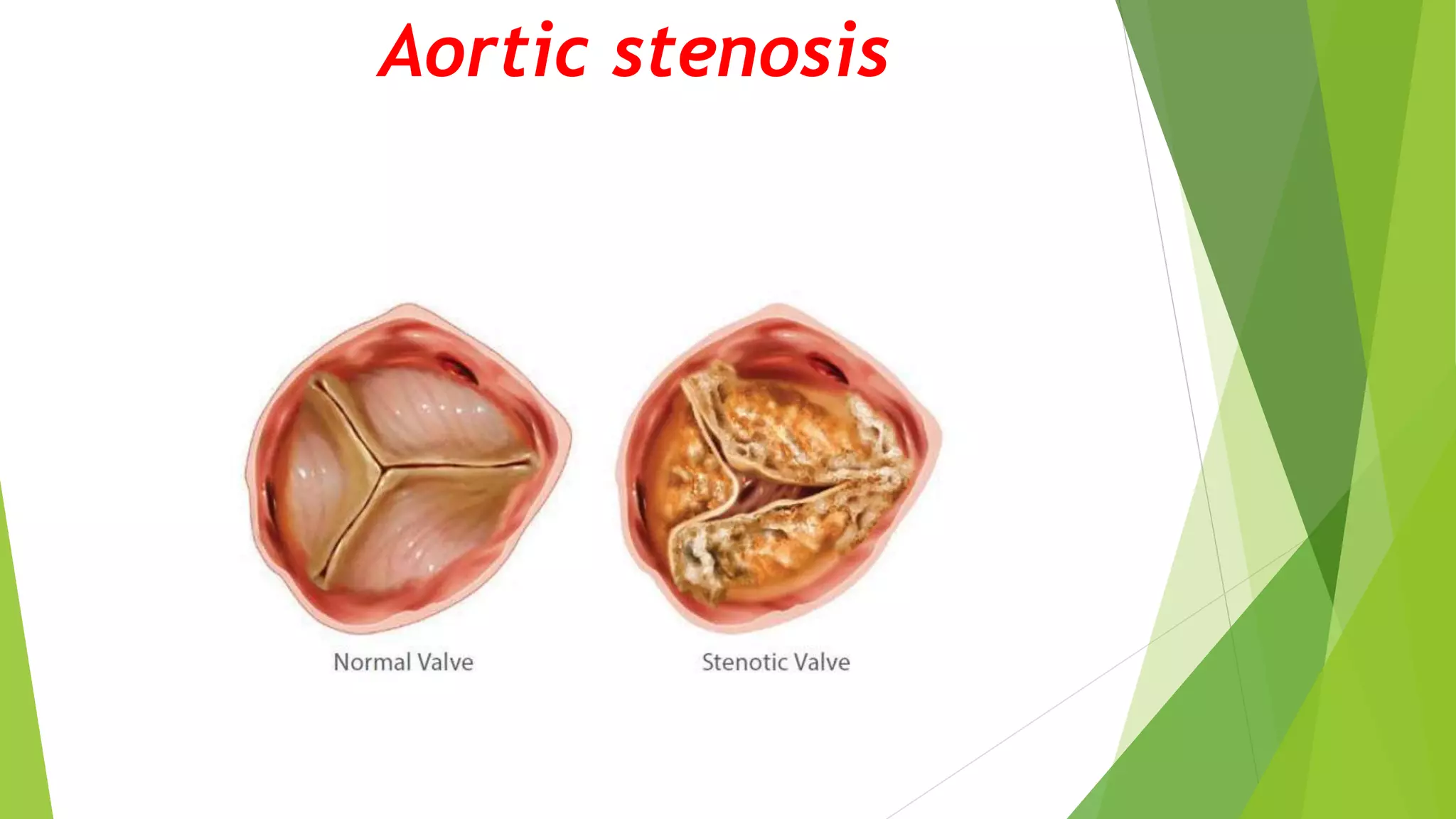
Aortic stenosis
OVERVIEW
• General Considerations
• Approach to the patient
• Diagnostic Studies
• Prognosis
• Treatment
• Case Study
General consideration
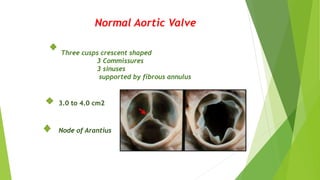
Normal Aortic Valve
Three cusps crescent shaped
3 Commissures
3 sinuses
supported by fibrous annulus
3.0 to 4.0 cm2
Node of Arantius
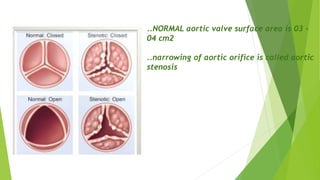
..NORMAL aortic valve surface area is 03 –
04 cm2
..narrowing of aortic orifice is called aortic
stenosis
ETIOLOGY
.Congenitally abnormal Bicuspid
Aortic Valve
.Senile Degenerated or Calcified
Aortic Valve
.Rheumatic heart disease
Bicuspid aortic Valve
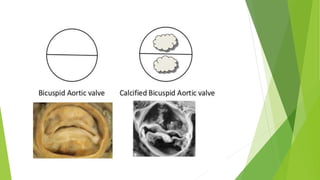
.congenital abnormality.
.commonly emerge at the age of 50
to 65yrs.
Associated with Coarctation of
Aorta and Dilated ascending Aorta
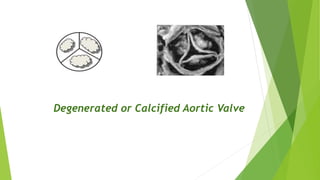
Degenerated or Calcified Aortic valve
25% of patients over age 65yrs have
echocardiographic evidence of AS
10 to 20% of them will develop
haemodynamically significant Aortic
stenosis.
Related with atherosclerotic vascular
disease.
Degenerated or Calcified Aortic Valve
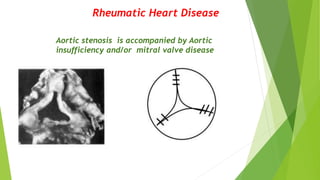
Rheumatic Heart Disease
Aortic stenosis is accompanied by Aortic
insufficiency and/or mitral valve disease
Aortic Stenosis Mimickers
..Subvalvular Stenosis
+Hypertrophic Cardiomyopathy
+Subvalvular Membrane
..Supravalvular Stenosis
+William syndrome (hypercalcemia
,growth failure and mental retardation)
Risk Factors
..Hyperlipidaemia
..Hypertension
..Smoking
Family history for
bicuspid aortic valve
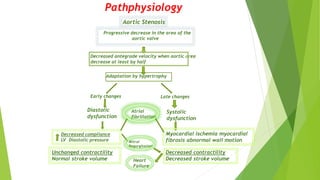
Pathphysiology
Aortic Stenosis
Progressive decrease in the area of the
aortic valve
Decreased antegrade velocity when aortic area
decrease at least by half
Adaptation by hypertrophy
Early changes Late changes
Diastolic
dysfunction
Systolic
dysfunction
Decreased compliance
LV Diastolic pressure
Myocardial ischemia myocardial
fibrosis abnormal wall motion
Unchanged contractility
Normal stroke volume
Decreased contractility
Decreased stroke volume
Atrial
fibrillation
Mitral
Regurgitation
Heart
Failure
APPROACH
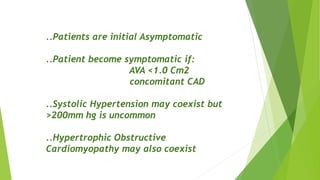
..Patients are initial Asymptomatic
..Patient become symptomatic if:
AVA <1.0 Cm2
concomitant CAD
..Systolic Hypertension may coexist but
>200mm hg is uncommon
..Hypertrophic Obstructive
Cardiomyopathy may also coexist
History
Exertional Angina
Exertional Syncope
Heart Failure
Arrhythmia
Angina Syncope.
..It may occur due to exertion and relieve by rest .. It occurs due to peripheral
vasodilatation but
unchanged
cardiac output.
Sometimes Coronary artery disease may coexist ..It occurs due to exertion
Left sided heart failure
Symptoms Signs
.Exertional dyspnea
.Fatigue
.Orthopnea
.Paroxymal Nocturnal
Dyspnea
.Wheeze(Cardiac Asthma
)
.Non productive chronic
cough
.Tachypnea & Tachycardia
.Pulsus Alternans
.Cardiomegaly
.Ventricular Gallop S3
.Basal Crepitations
Pleural Effusion
Physical Examination
..Pulse:Plateau Pulse
..Narrow pulse pressure
..Apex beat may shift to left
..Well- sustained heave
..A2 component of S2 might be
absent/soft/normal.
..Prominent S4
Murmur
..Site---Aortic area (Right sec ICS)
..Radiation---To neck through carotid arteries
..Ejection---Systolic murmur
..Character—Harsh
..Position---Leaning forward held in expiration
Severe stenosis is indicated by
..Slow rising pulse
..Narrow pulse pressure
..Longer duration of murmur
..LV heave and S4(LVH)
Diagnostic Studies
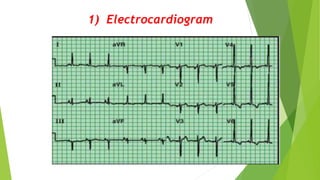
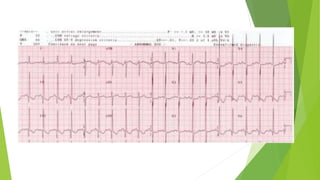
1) Electrocardiogram
Chest X ray
..In Early Stage
CXR may be normal or
Ascending aorta dilatation w/normal
heart size
..In Late Stage ,
Cardiac enlargement
Pulmonary Congestion
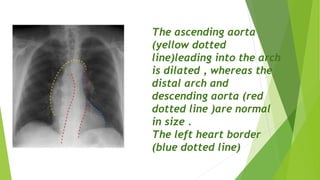
The ascending aorta
(yellow dotted
line)leading into the arch
is dilated , whereas the
distal arch and
descending aorta (red
dotted line )are normal
in size .
The left heart border
(blue dotted line)
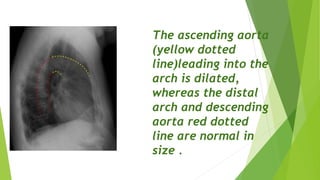
The ascending aorta
(yellow dotted
line)leading into the
arch is dilated,
whereas the distal
arch and descending
aorta red dotted
line are normal in
size .
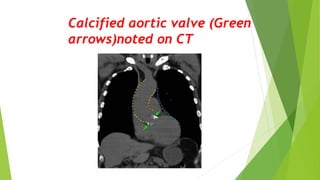
Calcified aortic valve (Green
arrows)noted on CT
3) Two Dimensional Echocardiography w/Doppler
Diagnostic of AS
Perform the following purposes
..Evaluate Aortic Valve morphology
..Calculate Aortic Valve area
..Evaluate Left ventricular walls thickness
..Calculate Ejection Fraction
..Estimate Aortic Valve gradient
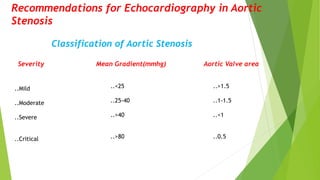
Recommendations for Echocardiography in Aortic
Stenosis
Classification of Aortic Stenosis
Severity Mean Gradient(mmhg) Aortic Valve area
..Mild
..Moderate
..Severe
..Critical
..<25
..25-40
..>40
..>80
..>1.5
..1-1.5
..<1
..0.5
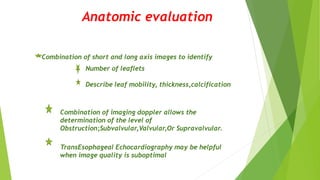
Anatomic evaluation
Combination of short and long axis images to identify
Number of leaflets
Describe leaf mobility, thickness,calcification
Combination of imaging doppler allows the
determination of the level of
Obstruction;Subvalvular,Valvular,Or Supravalvular.
TransEsophageal Echocardiography may be helpful
when image quality is suboptimal
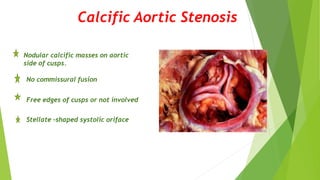
Calcific Aortic Stenosis
Nodular calcific masses on aortic
side of cusps.
No commissural fusion
Free edges of cusps or not involved
Stellate –shaped systolic oriface
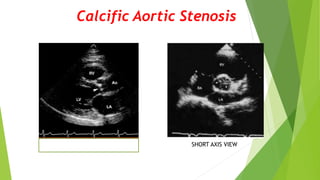
Calcific Aortic Stenosis
LONG AXIS VIEW SHORT AXIS VIEW
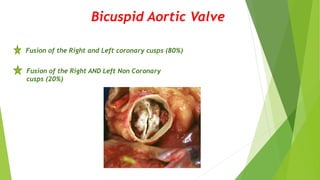
Bicuspid Aortic Valve
Fusion of the Right and Left coronary cusps (80%)
Fusion of the Right AND Left Non Coronary
cusps (20%)
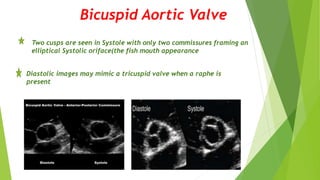
Bicuspid Aortic Valve
Two cusps are seen in Systole with only two commissures framing an
elliptical Systolic oriface(the fish mouth appearance
Diastolic images may mimic a tricuspid valve when a raphe is
present
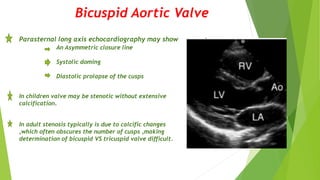
Bicuspid Aortic Valve
Parasternal long axis echocardiography may show
An Asymmetric closure line
Systolic doming
Diastolic prolapse of the cusps
In children valve may be stenotic without extensive
calcification.
In adult stenosis typically is due to calcific changes
,which often obscures the number of cusps ,making
determination of bicuspid VS tricuspid valve difficult.
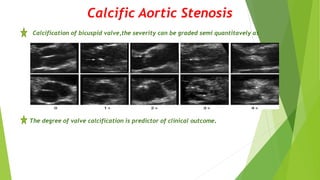
Calcific Aortic Stenosis
Calcification of bicuspid valve,the severity can be graded semi quantitavely as
The degree of valve calcification is predictor of clinical outcome.
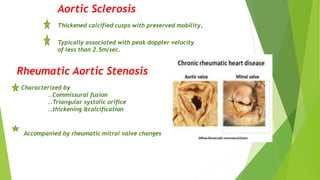
Aortic Sclerosis
Thickened calcified cusps with preserved mobility.
Typically associated with peak doppler velocity
of less than 2.5m/sec.
Rheumatic Aortic Stenosis
Characterized by
..Commissural fusion
..Triangular systolic orifice
..thickening &calcification
Accompanied by rheumatic mitral valve changes
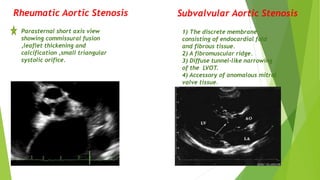
Rheumatic Aortic Stenosis
Parasternal short axis view
showing commissural fusion
,leaflet thickening and
calcification ,small triangular
systolic orifice.
Subvalvular Aortic Stenosis
1) The discrete membrane
consisting of endocardial fold
and fibrous tissue.
2) A fibromuscular ridge.
3) Diffuse tunnel-like narrowing
of the LVOT.
4) Accessory of anomalous mitral
valve tissue.
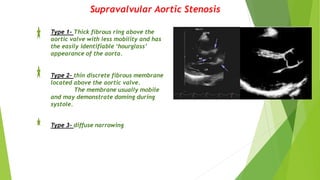
Supravalvular Aortic Stenosis
Type 1- Thick fibrous ring above the
aortic valve with less mobility and has
the easily identifiable ‘hourglass’
appearance of the aorta.
Type 2- thin discrete fibrous membrane
located above the aortic valve.
The membrane usually mobile
and may demonstrate doming during
systole.
Type 3- diffuse narrowing
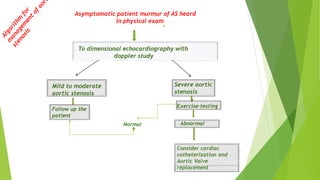
Asymptomatic patient murmur of AS heard
in physical exam
To dimensional echocardiography with
doppler study
Mild to moderate
aortic stenosis
Severe aortic
stenosis
Follow up the
patient
Exercise-testing
Normal Abnormal
Consider cardiac
catheterization and
Aortic Valve
replacement
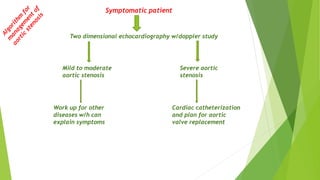
Symptomatic patient
Two dimensional echocardiography w/doppler study
Mild to moderate
aortic stenosis
Severe aortic
stenosis
Cardiac catheterization
and plan for aortic
valve replacement
Work up for other
diseases w/h can
explain symptoms
4) Cardiac catheterization
..Recommended for assessing concomitant CAD
..Recommended prior to aortic valve replacement
..If indications for Dobutamine test have been
met
5) Emerging Role of BNP
..Recognized as a marker of EARLY LV failure
..Levels of >550pg/ml are associated with
poor outcomes
Prognosis
..Following the onset of symptoms ,prognosis
without surgery is poor .
50% 03 years mortality rate
..Mean survival based on Symptoms :
1..Angina ->05 years.
2..Syncope ->03 years.
3..Heart failure ->02 years
..Sudden Cardiac death may occur in
asymptomatic individuals ~04%
Treatment
Initial Treatment
..Depend upon the presenting complaints.
..If LV failure,
Symptom-improving drugs
Prognosis-improving drugs
..Treating hypertension normalizing lipid
profile and smoking cessation have the role .
Definitive treatment
Mechanical solution for mechanical problem
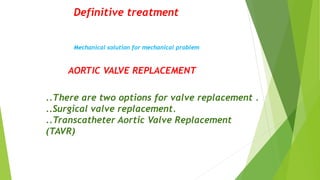
AORTIC VALVE REPLACEMENT
..There are two options for valve replacement .
..Surgical valve replacement.
..Transcatheter Aortic Valve Replacement
(TAVR)
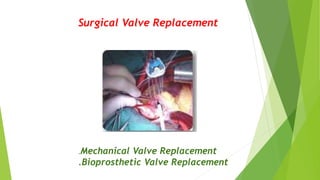
Surgical Valve Replacement
.Mechanical Valve Replacement
.Bioprosthetic Valve Replacement
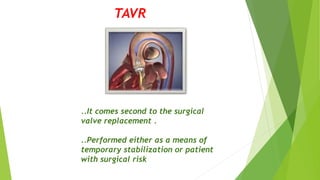
TAVR
..It comes second to the surgical
valve replacement .
..Performed either as a means of
temporary stabilization or patient
with surgical risk
Thank you
DR.RAVI KUMAR CTVS
KG HOSPITAL
COIMBATORE
TAMIL NADU

Aortic stenosis

  • 1.
  • 2.
    OVERVIEW • General Considerations •Approach to the patient • Diagnostic Studies • Prognosis • Treatment • Case Study
  • 3.
  • 4.
    Normal Aortic Valve Threecusps crescent shaped 3 Commissures 3 sinuses supported by fibrous annulus 3.0 to 4.0 cm2 Node of Arantius
  • 5.
    ..NORMAL aortic valvesurface area is 03 – 04 cm2 ..narrowing of aortic orifice is called aortic stenosis
  • 6.
    ETIOLOGY .Congenitally abnormal Bicuspid AorticValve .Senile Degenerated or Calcified Aortic Valve .Rheumatic heart disease
  • 7.
    Bicuspid aortic Valve .congenitalabnormality. .commonly emerge at the age of 50 to 65yrs. Associated with Coarctation of Aorta and Dilated ascending Aorta
  • 9.
    Degenerated or CalcifiedAortic valve 25% of patients over age 65yrs have echocardiographic evidence of AS 10 to 20% of them will develop haemodynamically significant Aortic stenosis. Related with atherosclerotic vascular disease.
  • 10.
  • 11.
    Rheumatic Heart Disease Aorticstenosis is accompanied by Aortic insufficiency and/or mitral valve disease
  • 12.
    Aortic Stenosis Mimickers ..SubvalvularStenosis +Hypertrophic Cardiomyopathy +Subvalvular Membrane ..Supravalvular Stenosis +William syndrome (hypercalcemia ,growth failure and mental retardation)
  • 13.
  • 14.
    Pathphysiology Aortic Stenosis Progressive decreasein the area of the aortic valve Decreased antegrade velocity when aortic area decrease at least by half Adaptation by hypertrophy Early changes Late changes Diastolic dysfunction Systolic dysfunction Decreased compliance LV Diastolic pressure Myocardial ischemia myocardial fibrosis abnormal wall motion Unchanged contractility Normal stroke volume Decreased contractility Decreased stroke volume Atrial fibrillation Mitral Regurgitation Heart Failure
  • 15.
  • 16.
    ..Patients are initialAsymptomatic ..Patient become symptomatic if: AVA <1.0 Cm2 concomitant CAD ..Systolic Hypertension may coexist but >200mm hg is uncommon ..Hypertrophic Obstructive Cardiomyopathy may also coexist
  • 17.
  • 18.
    Angina Syncope. ..It mayoccur due to exertion and relieve by rest .. It occurs due to peripheral vasodilatation but unchanged cardiac output. Sometimes Coronary artery disease may coexist ..It occurs due to exertion
  • 19.
    Left sided heartfailure Symptoms Signs .Exertional dyspnea .Fatigue .Orthopnea .Paroxymal Nocturnal Dyspnea .Wheeze(Cardiac Asthma ) .Non productive chronic cough .Tachypnea & Tachycardia .Pulsus Alternans .Cardiomegaly .Ventricular Gallop S3 .Basal Crepitations Pleural Effusion
  • 20.
    Physical Examination ..Pulse:Plateau Pulse ..Narrowpulse pressure ..Apex beat may shift to left ..Well- sustained heave ..A2 component of S2 might be absent/soft/normal. ..Prominent S4
  • 21.
    Murmur ..Site---Aortic area (Rightsec ICS) ..Radiation---To neck through carotid arteries ..Ejection---Systolic murmur ..Character—Harsh ..Position---Leaning forward held in expiration
  • 22.
    Severe stenosis isindicated by ..Slow rising pulse ..Narrow pulse pressure ..Longer duration of murmur ..LV heave and S4(LVH)
  • 23.
  • 24.
  • 26.
    Chest X ray ..InEarly Stage CXR may be normal or Ascending aorta dilatation w/normal heart size ..In Late Stage , Cardiac enlargement Pulmonary Congestion
  • 27.
    The ascending aorta (yellowdotted line)leading into the arch is dilated , whereas the distal arch and descending aorta (red dotted line )are normal in size . The left heart border (blue dotted line)
  • 28.
    The ascending aorta (yellowdotted line)leading into the arch is dilated, whereas the distal arch and descending aorta red dotted line are normal in size .
  • 29.
    Calcified aortic valve(Green arrows)noted on CT
  • 30.
    3) Two DimensionalEchocardiography w/Doppler Diagnostic of AS Perform the following purposes ..Evaluate Aortic Valve morphology ..Calculate Aortic Valve area ..Evaluate Left ventricular walls thickness ..Calculate Ejection Fraction ..Estimate Aortic Valve gradient
  • 31.
    Recommendations for Echocardiographyin Aortic Stenosis Classification of Aortic Stenosis Severity Mean Gradient(mmhg) Aortic Valve area ..Mild ..Moderate ..Severe ..Critical ..<25 ..25-40 ..>40 ..>80 ..>1.5 ..1-1.5 ..<1 ..0.5
  • 32.
    Anatomic evaluation Combination ofshort and long axis images to identify Number of leaflets Describe leaf mobility, thickness,calcification Combination of imaging doppler allows the determination of the level of Obstruction;Subvalvular,Valvular,Or Supravalvular. TransEsophageal Echocardiography may be helpful when image quality is suboptimal
  • 33.
    Calcific Aortic Stenosis Nodularcalcific masses on aortic side of cusps. No commissural fusion Free edges of cusps or not involved Stellate –shaped systolic oriface
  • 34.
    Calcific Aortic Stenosis LONGAXIS VIEW SHORT AXIS VIEW
  • 35.
    Bicuspid Aortic Valve Fusionof the Right and Left coronary cusps (80%) Fusion of the Right AND Left Non Coronary cusps (20%)
  • 36.
    Bicuspid Aortic Valve Twocusps are seen in Systole with only two commissures framing an elliptical Systolic oriface(the fish mouth appearance Diastolic images may mimic a tricuspid valve when a raphe is present
  • 37.
    Bicuspid Aortic Valve Parasternallong axis echocardiography may show An Asymmetric closure line Systolic doming Diastolic prolapse of the cusps In children valve may be stenotic without extensive calcification. In adult stenosis typically is due to calcific changes ,which often obscures the number of cusps ,making determination of bicuspid VS tricuspid valve difficult.
  • 38.
    Calcific Aortic Stenosis Calcificationof bicuspid valve,the severity can be graded semi quantitavely as The degree of valve calcification is predictor of clinical outcome.
  • 39.
    Aortic Sclerosis Thickened calcifiedcusps with preserved mobility. Typically associated with peak doppler velocity of less than 2.5m/sec. Rheumatic Aortic Stenosis Characterized by ..Commissural fusion ..Triangular systolic orifice ..thickening &calcification Accompanied by rheumatic mitral valve changes
  • 40.
    Rheumatic Aortic Stenosis Parasternalshort axis view showing commissural fusion ,leaflet thickening and calcification ,small triangular systolic orifice. Subvalvular Aortic Stenosis 1) The discrete membrane consisting of endocardial fold and fibrous tissue. 2) A fibromuscular ridge. 3) Diffuse tunnel-like narrowing of the LVOT. 4) Accessory of anomalous mitral valve tissue.
  • 41.
    Supravalvular Aortic Stenosis Type1- Thick fibrous ring above the aortic valve with less mobility and has the easily identifiable ‘hourglass’ appearance of the aorta. Type 2- thin discrete fibrous membrane located above the aortic valve. The membrane usually mobile and may demonstrate doming during systole. Type 3- diffuse narrowing
  • 42.
    Asymptomatic patient murmurof AS heard in physical exam To dimensional echocardiography with doppler study Mild to moderate aortic stenosis Severe aortic stenosis Follow up the patient Exercise-testing Normal Abnormal Consider cardiac catheterization and Aortic Valve replacement
  • 43.
    Symptomatic patient Two dimensionalechocardiography w/doppler study Mild to moderate aortic stenosis Severe aortic stenosis Cardiac catheterization and plan for aortic valve replacement Work up for other diseases w/h can explain symptoms
  • 44.
    4) Cardiac catheterization ..Recommendedfor assessing concomitant CAD ..Recommended prior to aortic valve replacement ..If indications for Dobutamine test have been met
  • 45.
    5) Emerging Roleof BNP ..Recognized as a marker of EARLY LV failure ..Levels of >550pg/ml are associated with poor outcomes
  • 46.
  • 47.
    ..Following the onsetof symptoms ,prognosis without surgery is poor . 50% 03 years mortality rate ..Mean survival based on Symptoms : 1..Angina ->05 years. 2..Syncope ->03 years. 3..Heart failure ->02 years ..Sudden Cardiac death may occur in asymptomatic individuals ~04%
  • 48.
  • 49.
    Initial Treatment ..Depend uponthe presenting complaints. ..If LV failure, Symptom-improving drugs Prognosis-improving drugs ..Treating hypertension normalizing lipid profile and smoking cessation have the role .
  • 50.
    Definitive treatment Mechanical solutionfor mechanical problem AORTIC VALVE REPLACEMENT ..There are two options for valve replacement . ..Surgical valve replacement. ..Transcatheter Aortic Valve Replacement (TAVR)
  • 51.
    Surgical Valve Replacement .MechanicalValve Replacement .Bioprosthetic Valve Replacement
  • 52.
    TAVR ..It comes secondto the surgical valve replacement . ..Performed either as a means of temporary stabilization or patient with surgical risk
  • 53.
    Thank you DR.RAVI KUMARCTVS KG HOSPITAL COIMBATORE TAMIL NADU