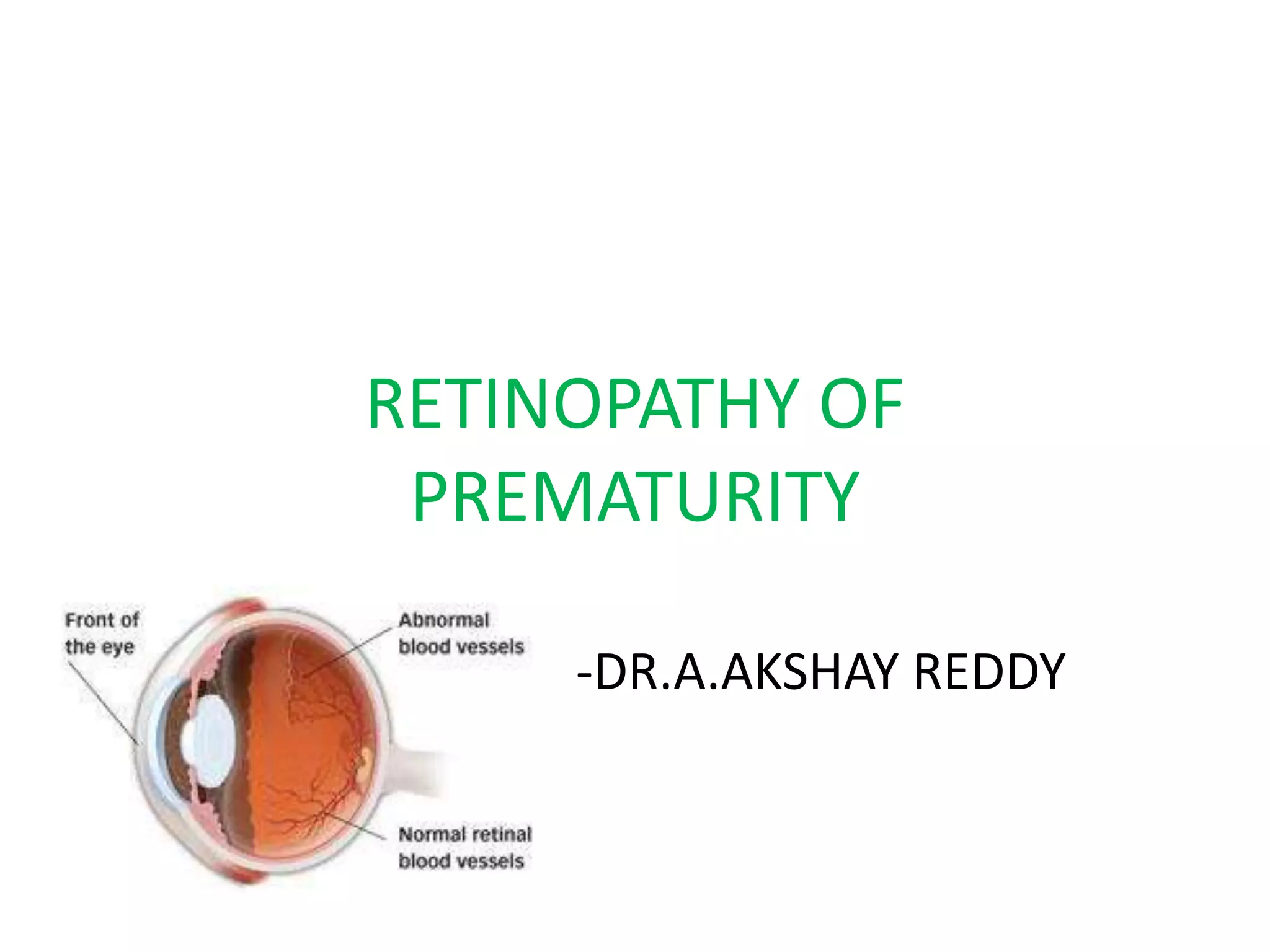
RETINOPATHY OF
PREMATURITY
-DR.A.AKSHAY REDDY
DEFINITION :
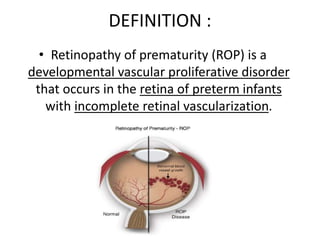
• Retinopathy of prematurity (ROP) is a
developmental vascular proliferative disorder
that occurs in the retina of preterm infants
with incomplete retinal vascularization.
Normal vascularization
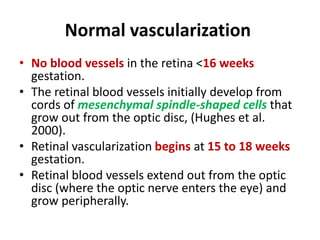
• No blood vessels in the retina <16 weeks
gestation.
• The retinal blood vessels initially develop from
cords of mesenchymal spindle-shaped cells that
grow out from the optic disc, (Hughes et al.
2000).
• Retinal vascularization begins at 15 to 18 weeks
gestation.
• Retinal blood vessels extend out from the optic
disc (where the optic nerve enters the eye) and
grow peripherally.
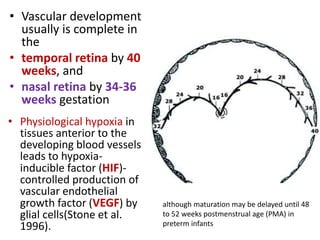
• Vascular development
usually is complete in
the
• temporal retina by 40
weeks, and
• nasal retina by 34-36
weeks gestation
although maturation may be delayed until 48
to 52 weeks postmenstrual age (PMA) in
preterm infants
• Physiological hypoxia in
tissues anterior to the
developing blood vessels
leads to hypoxia-
inducible factor (HIF)-
controlled production of
vascular endothelial
growth factor (VEGF) by
glial cells(Stone et al.
1996).
Pathogenesis
• Premature birth interrupts normal retinal blood
vessel development.
• The physiological environment of the retina of a
premature infant is very different from that found
in utero.
• Oxygen therapy reduces the physiological
hypoxia drive of normal retinal angiogenesis.
• Reduced HIF-controlled production of VEGF
leads to reduced endothelial cell proliferation and
migration
Possible mechanisms of injury
• The First Stage involves an initial insult or insults,
such as hyperoxia, hypoxia, or hypotension, at a
critical point in retinal vascularization that results
in vasoconstriction and decreased blood flow to
the developing retina, with a subsequent arrest
in vascular development.
• The relative hyperoxia after birth downregulates
the production of growth factors, such as VEGF,
that are essential for the normal development of
the retinal vessels.
2. During the Second Stage, neovascularization occurs.
• This aberrant retinal vessel growth is thought to be driven
by excess angiogenic factors such as VEGF upregulated by
the hypoxic avascular retina.
• New vessels grow within the retina and into the vitreous.
• These vessels are permeable; therefore, hemorrhage and
edema can occur.
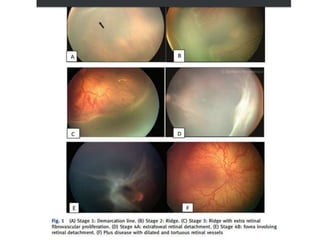
• Extensive and severe extraretinal fibrovascular
proliferation can lead to retinal detachment and
abnormal retinal function.
• In most affected infants, however, the disease process is
mild and regresses spontaneously.
• In addition, reduced postnatal insulin-like
growth factor 1 (IGF-1)appears to result in
reduced retinal endothelial cell growth.
Photoreceptor development
• ROP appears to affect photoreceptor
development.
• An observational study in which retinal
sensitivity and retinal responsivity were
assessed by electroretinography between 30
and 72 weeks PMA suggests that
photoreceptor development is altered in
prematurity (with or without ROP).
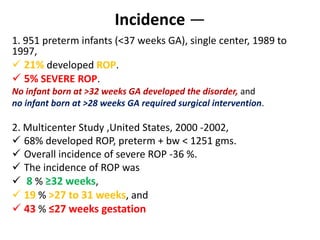
Incidence —
1. 951 preterm infants (<37 weeks GA), single center, 1989 to
1997,
 21% developed ROP.
 5% SEVERE ROP.
No infant born at >32 weeks GA developed the disorder, and
no infant born at >28 weeks GA required surgical intervention.
2. Multicenter Study ,United States, 2000 -2002,
 68% developed ROP, preterm + bw < 1251 gms.
 Overall incidence of severe ROP -36 %.
 The incidence of ROP was
 8 % ≥32 weeks,
 19 % >27 to 31 weeks, and
 43 % ≤27 weeks gestation
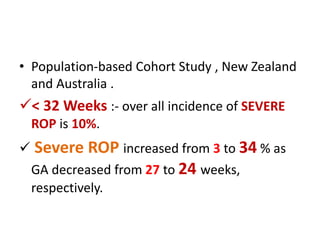
• Population-based Cohort Study , New Zealand
and Australia .
< 32 Weeks :- over all incidence of SEVERE
ROP is 10%.
 Severe ROP increased from 3 to 34 % as
GA decreased from 27 to 24 weeks,
respectively.
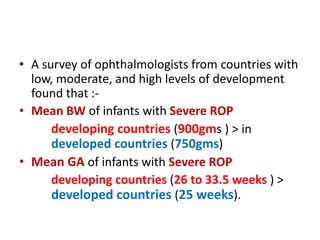
• A survey of ophthalmologists from countries with
low, moderate, and high levels of development
found that :-
• Mean BW of infants with Severe ROP
developing countries (900gms ) > in
developed countries (750gms)
• Mean GA of infants with Severe ROP
developing countries (26 to 33.5 weeks ) >
developed countries (25 weeks).
• Large natural history studies have shown that, in most
cases, ROP begins at 31 to 32 weeks postmenstrual age
with progression over the next 2 to 5 weeks.
• Spontaneous regression commonly occurs in eyes
with stages 1 and 2 and early stage 3
Blindness or severe visual impairment commonly
results from progression of the retinopathy to retinal
detachment or severe distortion of the posterior
retina.
Incidence of ROP is (<750 gm) > (<1000 gm) >
(<1500 gms)
Risk factors —
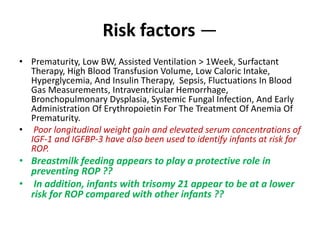
• Prematurity, Low BW, Assisted Ventilation > 1Week, Surfactant
Therapy, High Blood Transfusion Volume, Low Caloric Intake,
Hyperglycemia, And Insulin Therapy, Sepsis, Fluctuations In Blood
Gas Measurements, Intraventricular Hemorrhage,
Bronchopulmonary Dysplasia, Systemic Fungal Infection, And Early
Administration Of Erythropoietin For The Treatment Of Anemia Of
Prematurity.
• Poor longitudinal weight gain and elevated serum concentrations of
IGF-1 and IGFBP-3 have also been used to identify infants at risk for
ROP.
• Breastmilk feeding appears to play a protective role in
preventing ROP ??
• In addition, infants with trisomy 21 appear to be at a lower
risk for ROP compared with other infants ??
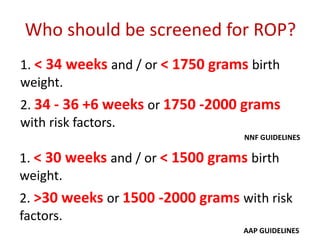
Who should be screened for ROP?
1. < 34 weeks and / or < 1750 grams birth
weight.
2. 34 - 36 +6 weeks or 1750 -2000 grams
with risk factors.
NNF GUIDELINES
1. < 30 weeks and / or < 1500 grams birth
weight.
2. >30 weeks or 1500 -2000 grams with risk
factors.
AAP GUIDELINES
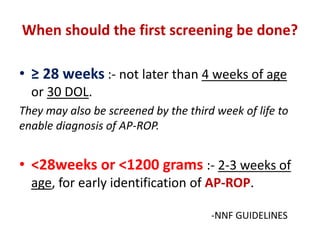
When should the first screening be done?
• ≥ 28 weeks :- not later than 4 weeks of age
or 30 DOL.
They may also be screened by the third week of life to
enable diagnosis of AP-ROP.
• <28weeks or <1200 grams :- 2-3 weeks of
age, for early identification of AP-ROP.
-NNF GUIDELINES
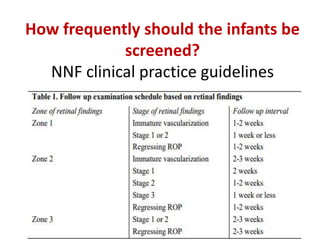
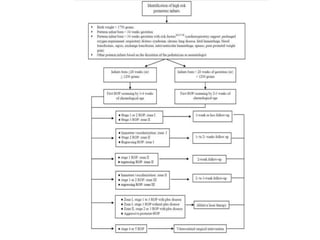
How frequently should the infants be
screened?
NNF clinical practice guidelines
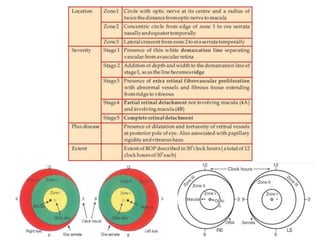
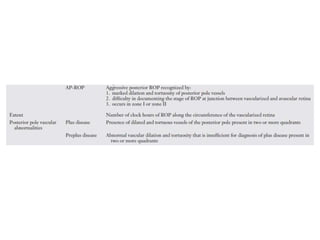
• Threshold ROP is present if 5 or more contiguous
or 8 cumulative clock hours (30-degree sectors)
of stage 3 with plus disease in either zone 1 or 2
are present.
• This is the level of ROP at which the risk of
blindness is predicted to be at least 50% and at
which the CRYO-ROP study showed that the risk
of blindness could be reduced to approximately
25% with appropriate treatment.
• 3. Prethreshold ROP
a. Type 1 prethreshold ROP includes the following:
i. In zone 1, any ROP and plus disease or stage 3
with or without plus disease
ii. In zone 2, stage 2 or 3 ROP with plus disease
b. Type 2 prethreshold ROP includes the following:
i. In zone 1, stage 1 or 2 ROP, without plus disease
ii. In zone 2, stage 3 ROP without plus disease
When should the screening be terminated?
• Evidence & Recommendation:
Retinal examinations may be terminated based on
postmenstrual age or retinal findings.
a) Full retinal vascularization; this usually occurs
at about the 40th week of postmenstrual age and
mostly completes by the 45th week
b) Regression of ROP noted.
It is advisable to screen the baby every 1-2 weeks
at least until the infant is 38-40 weeks PMA.
Where and how should the examinations be
done?
• The ideal setting for screening is under a radiant
warmer in the NICU, under the guidance of the
neonatologist.
• Pupillary dilatation should be performed about
an hour prior to screening. A combination of
cyclopentolate 0.5% and phenylephrine (2.5%)
drops is used two to three times about 10-15
minutes apart. Tropicamide 0.5-1% is an
alternative to cyclopentolate.
When is treatment of ROP indicated?
• Prior to December 2003, the CRYO-ROP15
treatment guidelines were followed. Only a
more advanced proliferative stage termed as
‘threshold disease’ was treated.
• This was defined as “at least 5 contiguous or 8
cumulative clock hours of stage 3 ROP in zone
I or II in the presence of plus disease.”
• The Early Treatment for Retinopathy of
Prematurity study (ETROP) study showed that
early treatment of high-risk pre threshold ROP
significantly reduced unfavorable outcomes to
a clinically important degree.
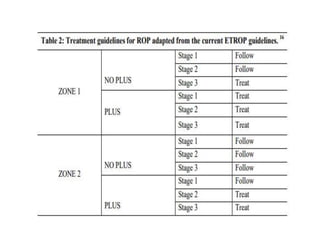
• Ablative therapy is indicated for high risk ROP
or type 1 ROP, defined as any of the following:
a) Zone I, stage 1 to 3 ROP with plus disease,
b) Zone I, stage 3 ROP without plus disease
and c) Zone II, stage 2 or 3 ROP with plus
disease.
How should ROP be treated ?
• The aim of the treatment is to ablate the
entire avascular retina up to the ora serrata in
a near confluent burn pattern getting as close
to the edge of the ridge as possible.
• Treatment should be carried out in the NICU
or in a setting where monitoring and
resuscitation facilities and trained personnel
are readily available.
• Laser Photocoagulation delivered by the
indirect ophthalmoscopic device is the
mainstay of ROP treatment.
• Laser has supplanted cryotherapy due to
better structural and functional outcomes. It is
a safer and a more controlled procedure.
• Laser therapy can be done under topical
anesthesia (0.5% proparacaine HCl, 4%
xylocaine), general anesthesia or sedation.
Laser treatment, using the ETROP guidelines,
has a greater than 90% successful outcome.
TECHNIQUE
• Laser treatment is delivered through an indirect
ophthalmoscope and is applied to the avascular retina anterior
to the ridge of extraretinal fibrovascular proliferation for 360
degrees.
• An average of 1,000 spots are placed in each eye, but the
number may range from a few hundred to approximately
2,000.
• Both argon and diode laser photocoagulation have been
successfully used in infants with severe ROP.
• The procedure can be performed in the NICU and usually can
be performed with local anesthesia and sedation, avoiding the
possible adverse effects of general anesthesia.
• The development of cataracts, glaucoma, or anterior segment
ischemia following laser surgery or cryotherapy have been
reported.
Anti-vascular Endothelial Growth Factor (VEGF)
• In recent times, anti-VEGF has also been used in
severe forms of ROP, especially those not
responding to laser photocoagulation. Its role,
however, is very controversial.
• VEGF is needed in premature babies for the
normal organogenesis and vasculogenesis.
• Also systemic absorption may cause vascular
development delay in other organs in these
premature babies.
• Therefore, it is not recommended by many as the
first-line therapy.
• The ocular safety profile is reasonably good,
although endophthalmitis is a rare but potentially
devastating complication.
• Some benefits of intravitreal injection include
potentially less stress for the infant (because the
procedure time is short and only requires topical
anesthesia); less destruction of the retina
(because laser and cryotherapy are ablative
procedures); and longterm, lower rates of very
severe myopia.
• In Zone 1 ROP, the Laser treatment outcomes are
poorer.
• Treatment with anti-VEGF followed by a 4–5 days
later with laser treatment in these cases has
improved the efficacy of laser along with a
reduced need for extensive laser especially at the
posterior pole.
• In a study by Chen et al. both bevacizumab and
ranibizumab had similar efficacy at the end of 1
year in terms of ROP regression and visual acuity.
• On the basis of available literature indication for
anti-VEGF therapy can be enumerated as:
1 Primary therapy for aggressive posterior zone 1
disease (APROP).
2 Aggressive anterior ROP or media haze due to
aggressive posterior disease to improve
visualization for laser treatment.
• Failed laser treatment leading to persistent
neovascularization, tractional elements or
tractional retinal detachment prior to surgery
• Post-treatment recommendation: The child can
be fed after about 30 minutes following
completion of the procedure. Vital signs must be
monitored.
• It is preferable that the child be under the
supervision of the neonatologist or an
anesthesiologist for at least 2-3 hours following
the procedure.
• Post-treatment hypothermia and hypoglycemia
are common and must be prevented. Mild
conjunctival chemosis and hyperemia following
the procedure may last for a few days and the
parents must be counseled regarding this.
• Follow-up visits recommendation: This may be
typically scheduled after week 1, 2, 4 and 12
following treatment based on the findings
recorded by the treating ophthalmologist.
Long-term follow up for development of visual
problems is also essential.
• Stage 4 or 5 ROP requires vitreo-retinal surgical
intervention; retinal detachment carries a high
risk of irreversible blindness.
• Lens sparing vitrectomy is the procedure of
choice in stage 4A and subtypes of 4B.
• Timely lens sparing surgery may in fact result in
reasonable to fairly good visual outcomes. A
lensectomy–vitrectomy may be performed in
stage 5.
• The prognosis is guarded and results continue to
be poor.Visual rehabilitation must be offered to
all visually challenged ROP babies.
• B. Cryotherapy. A cryoprobe is applied to the external
surface of the sclera, and areas peripheral to the ridge of
the ROP are frozen until the entire anterior avascular retina
has been treated.
• Approximately 35 to 75 applications are made in each eye.
• The procedure is usually done under general anesthesia.
• Cryotherapy causes more inflammation and requires more
analgesia than laser therapy but may be necessary in
special cases, such as when there is poor pupillary dilation
or vitreous hemorrhage, both of which prevent adequate
delivery of laser therapy.
• D. Retinal reattachment. Once the macula detaches in stage 4B or 5 ROP,
retinal surgery may be performed in an attempt to reattach the retina.
• Vitrectomy with or without lensectomy, and membrane peeling if
necessary, is performed to remove tractional forces causing the retinal
detachment.
• A scleral buckling procedure may be useful for more peripheral
detachments, with drainage of subretinal fluid for effusional detachments.
• Repeat operations for redetachment of the retina are common.
• Even if the retina can be successfully attached, with rare exception, the
visual outcome is in the range of legal blindness.
• Despite the measurement of low visual acuity, children find any amount of
vision useful, and untreated stage 5 ROP eventually leads to no light
perception vision.
• The achievement of even minimal vision can result in a large difference in
a child's overall quality of life.
Long term follow up
• Following development of ROP, babies need
to be under more intensive follow up for the
first 6 months followed by a less intensive
follow up schedule until young adulthood
period to identify long term complications
promptly.
REFERENCES
• AVERY’S DISEASE OF NEWBORN
• RENNIE AND ROBERTONS TEXTBOOK OF
NEONATOLOGY
• NNF GUIDELINES
• CLOHERTY AND STARKS MANUAL OF NEONATAL
CARE
• AAP GUIDELINES
HEARING ASSESSMENT IN NEWBORN
DR.A.AKSHAY REDDY
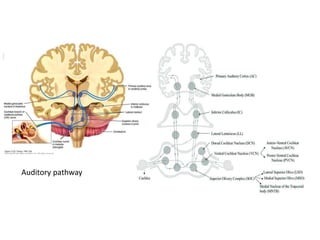
Auditory pathway
INTRODUCTION :-
• Hearing impairment is one of the most critical sensory
impairments with significant social and psychological
consequences.
• Significant permanent hearing loss is a common disorder at birth
and can lead to :-
 Delayed Language Development,
 Difficulties With Behavior And Psychosocial Interactions, And
 Poor Academic Achievement.
• Detection of hearing loss during infancy can initiate intervention
resulting in improved language, cognitive, behavioral, and
academic outcomes.
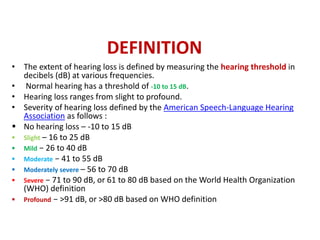
DEFINITION
• The extent of hearing loss is defined by measuring the hearing threshold in
decibels (dB) at various frequencies.
• Normal hearing has a threshold of -10 to 15 dB.
• Hearing loss ranges from slight to profound.
• Severity of hearing loss defined by the American Speech-Language Hearing
Association as follows :
 No hearing loss – -10 to 15 dB
 Slight – 16 to 25 dB
 Mild − 26 to 40 dB
 Moderate − 41 to 55 dB
 Moderately severe – 56 to 70 dB
 Severe − 71 to 90 dB, or 61 to 80 dB based on the World Health Organization
(WHO) definition
 Profound − >91 dB, or >80 dB based on WHO definition
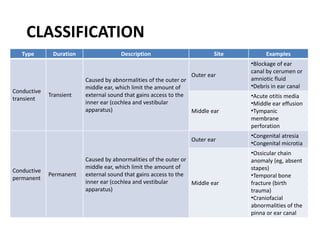
CLASSIFICATION
:
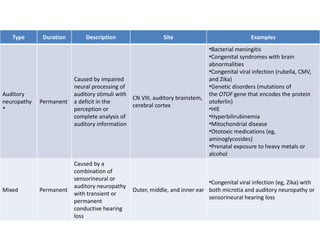
Type Duration Description Site Examples
Conductive
transient
Transient
Caused by abnormalities of the outer or
middle ear, which limit the amount of
external sound that gains access to the
inner ear (cochlea and vestibular
apparatus)
Outer ear
•Blockage of ear
canal by cerumen or
amniotic fluid
•Debris in ear canal
Middle ear
•Acute otitis media
•Middle ear effusion
•Tympanic
membrane
perforation
Conductive
permanent
Permanent
Caused by abnormalities of the outer or
middle ear, which limit the amount of
external sound that gains access to the
inner ear (cochlea and vestibular
apparatus)
Outer ear
•Congenital atresia
•Congenital microtia
Middle ear
•Ossicular chain
anomaly (eg, absent
stapes)
•Temporal bone
fracture (birth
trauma)
•Craniofacial
abnormalities of the
pinna or ear canal
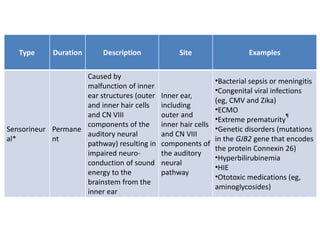
Type Duration Description Site Examples
Sensorineur
al*
Permane
nt
Caused by
malfunction of inner
ear structures (outer
and inner hair cells
and CN VIII
components of the
auditory neural
pathway) resulting in
impaired neuro-
conduction of sound
energy to the
brainstem from the
inner ear
Inner ear,
including
outer and
inner hair cells
and CN VIII
components of
the auditory
neural
pathway
•Bacterial sepsis or meningitis
•Congenital viral infections
(eg, CMV and Zika)
•ECMO
•Extreme prematurity

•Genetic disorders (mutations
in the GJB2 gene that encodes
the protein Connexin 26)
•Hyperbilirubinemia
•HIE
•Ototoxic medications (eg,
aminoglycosides)
Type Duration Description Site Examples
Auditory
neuropathy
*
Permanent
Caused by impaired
neural processing of
auditory stimuli with
a deficit in the
perception or
complete analysis of
auditory information
CN VIII, auditory brainstem,
cerebral cortex
•Bacterial meningitis
•Congenital syndromes with brain
abnormalities
•Congenital viral infection (rubella, CMV,
and Zika)
•Genetic disorders (mutations of
the OTOF gene that encodes the protein
otoferlin)
•HIE
•Hyperbilirubinemia
•Mitochondrial disease
•Ototoxic medications (eg,
aminoglycosides)
•Prenatal exposure to heavy metals or
alcohol
Mixed Permanent
Caused by a
combination of
sensorineural or
auditory neuropathy
with transient or
permanent
conductive hearing
loss
Outer, middle, and inner ear
•Congenital viral infection (eg, Zika) with
both microtia and auditory neuropathy or
sensorineural hearing loss
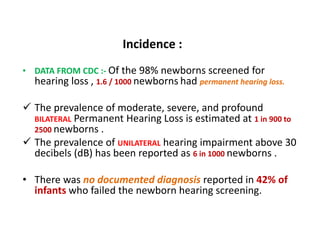
• DATA FROM CDC :- Of the 98% newborns screened for
hearing loss , 1.6 / 1000 newborns had permanent hearing loss.
 The prevalence of moderate, severe, and profound
BILATERAL Permanent Hearing Loss is estimated at 1 in 900 to
2500 newborns .
 The prevalence of UNILATERAL hearing impairment above 30
decibels (dB) has been reported as 6 in 1000 newborns .
• There was no documented diagnosis reported in 42% of
infants who failed the newborn hearing screening.
Incidence :
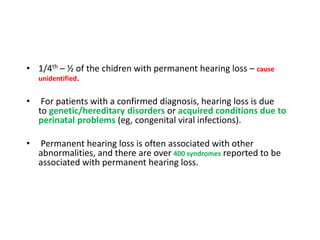
• 1/4th – ½ of the chidren with permanent hearing loss – cause
unidentified.
• For patients with a confirmed diagnosis, hearing loss is due
to genetic/hereditary disorders or acquired conditions due to
perinatal problems (eg, congenital viral infections).
• Permanent hearing loss is often associated with other
abnormalities, and there are over 400 syndromes reported to be
associated with permanent hearing loss.
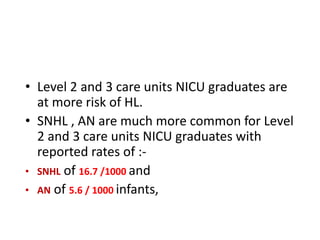
• Level 2 and 3 care units NICU graduates are
at more risk of HL.
• SNHL , AN are much more common for Level
2 and 3 care units NICU graduates with
reported rates of :-
• SNHL of 16.7 /1000 and
• AN of 5.6 / 1000 infants,
Who are at risk ??
 Admission to a neonatal intensive care unit (NICU) for at least five days
(eg, prematurity).
 Syndromes associated with hearing loss.
 Family history of hereditary childhood hearing loss.
 Craniofacial anomalies (eg, anomalies of the pinna or ear canal, cleft lip,
and palate).
 Congenital infection (eg, cytomegalovirus, toxoplasmosis, rubella, syphilis,
herpes, Zika) or bacterial meningitis.
 Severe hyperbilirubinemia defined as serum bilirubin
>35 mg/dL (599 micro/L) or requiring exchange transfusion in a preterm
infant .
 History of perinatal asphyxia or problems during delivery (eg, five-minute
Apgar score <6).
 Multiple courses of ototoxic mediation (ie, ampicillin,
gentamycin, oxacillin, tobramycin)
Syndromes associated with hearing
loss
• Congenital Rubella
syndrome
• Usher syndrome
• Jervell and Lange-Nielsen
(JLN) syndrome
• Treacher-Collins syndrome
• Apert syndrome
• Alport syndrome
INDIAN PEDIATRICS 2 JUNE 04, 2017 [E-PUB AHEAD OF PRINT]CONSENSUS STATEMENT ON NEWBORN HEARING
SCREENING
• Neurofibromatosis syndrome
• Achondroplasia
• CHARGE syndrome
• Brachio Oto Renal syndrome
• Chudley McCullough syndrome
• Goldenhar syndrome.
INDIAN PEDIATRICS 2 JUNE 04, 2017 [E-PUB AHEAD OF PRINT]CONSENSUS
STATEMENT ON NEWBORN HEARING SCREENING
• Screening newborns for hearing loss leads to Earlier Detection and
Intervention in patients with congenital hearing impairment.
• Early intervention can improve language acquisition and educational
achievement in affected patients.
• Vocabulary of a 3-year-old child with typical hearing which is 500-
900 words.
• Vocabulary of a 3-year-old child with hearing impairment if :-
 If remediated at birth is 300-700 words
 If re-mediated at 6 months is 150-300 words
 If remediated at 2 years is 0-50 words, respectively
INDIAN PEDIATRICS 2 JUNE 04, 2017 [E-PUB AHEAD OF PRINT]CONSENSUS STATEMENT ON NEWBORN HEARING SCREENING
Screening guidelines
What tests are used ??
• American Academy of Pediatrics (AAP) Task Force on Newborn and Infant
Hearing defined an effective neonatal hearing screening test as
one that detects hearing loss of ≥35 decibels (dB) in the better ear
and is reliable in infants ≤3 months of age.
• Two electrophysiologic techniques meet these criteria:
 Automated auditory brainstem responses (AABR)
 Otoacoustic emissions (OAE)
• These physiological, non-invasive, automated screening tests can
be performed at the bedside in term and preterm infants.
Paediatr Child Health Vol 16 No 5 May 2011, ©2011 Canadian Paediatric Society.
• They evaluate the peripheral auditory system
and the cochlea, but cannot assess activity in
the highest levels of the central auditory
system.
• These tests alone are not sufficient to
diagnose hearing loss; thus, any child who fails
one of these screening tests requires further
audiologic evaluation.
OAE :-
• OAE testing measures the presence or
absence of sound waves (ie, OAEs) generated
by the cochlear outer hair cells of the inner
ear in response to sound stimuli.
• A microphone at the external ear canal
detects these low-intensity OAEs.
• Since OAE evaluates hearing from the middle
ear to the outer hair cells of the inner ear, it is
used to screen for SNHL but cannot detect AN.
Technique —
• The apparatus for OAE screening consists of a
miniature microphone placed into the infant's
outer ear canal.
• The microphone produces a stimulus (clicks or
tones) and detects sound waves as they arise
from the cochlea.
• The device also measures the signal-to-noise
ratio to ensure accuracy.
• OAE screening generally requires approximately
1-2 minutes per ear in ideal testing conditions.
• performed in infants > 24 h & > 34weeks PMA
• Tests most commonly used for clinical purposes are transient OAEs (TOAEs) and
distortion product OAEs (DPOAEs).
• They are classified by the stimuli used to produce the cochlear basal membrane
vibrations.
a)Transient OAE's(TEOAEs): Evoked by clicks, a series of click stimuli are
presented at 80-85 db and response recorded.
b)Distorted product OAE's(DPOAEs): Two tones are simultaneously
presented to the cochlea to produce distorted products they have
been used to test hearing in the range of 1000-8000Hz.
• Results may be affected by the
Infant’s movements
Environmental noise
Dysfunction in the middle or external ear (eg, debris in the external ear
canal)
Automated auditory brainstem
response ; AABR
• AABR measures the summation of action potentials from
the eighth cranial nerve (cochlear nerve) to the inferior
colliculus of the midbrain in response to a click stimulus.
• It can detect both sensorineural hearing loss (SNHL) and
auditory neuropathy (AN).
• Also called as screening ABR (SABR), and screening
brainstem auditory evoked response ( S BERA ).
• Approximately 4 percent of infants screened with AABR are
referred for further audiologic evaluation, which uses a
diagnostic ABR including an evaluation by an audiologist
skilled in assessing infants and young children.
• It is important to note the difference between AABR
and ABR, as AABR is a screening tool with an
automated pass/fail response whereas an ABR
diagnostic test provides quantitative data (eg,
waveforms) that must be interpreted by a trained
audiologist, thereby determining the degree and the
site of the hearing loss.
• As an example, delayed or absent waves suggest a
neurologic or cochlear deficit.
• Many neonatal intensive care units (NICUs) now
complete the diagnostic ABR prior to discharge for
infants who fail the screening AABR.
TECHNIQUE :-
• The AABR utilizes click or chirp stimuli presented at 35 dB.
• 3 surface electrodes placed on the forehead, nape, and
mastoid or shoulder detect waveform recordings generated by
the ABR to the stimuli.
• In the screening AABR, the morphology and latency of the waveforms
are compared with normal neonatal templates, and a pass or fail
reading is generated, and the examiner does not need to
interpret the waveforms if visibly accessible.
• AABR screening typically requires 4 to 15 minutes for testing,
although newer AABR screening equipment can complete
testing in an infant in 4 to 8 minutes in ideal conditions.
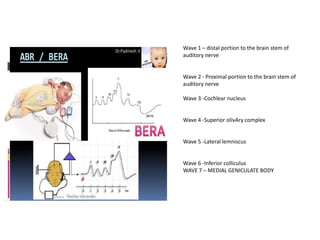
Wave 1 – distal portion to the brain stem of
auditory nerve
Wave 2 - Proximal portion to the brain stem of
auditory nerve
Wave 3 -Cochlear nucleus
Wave 4 -Superior olivAry complex
Wave 5 -Lateral lemniscus
Wave 6 -Inferior colliculus
WAVE 7 – MEDIAL GENICULATE BODY
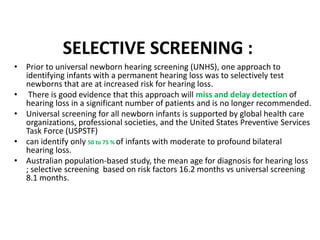
SELECTIVE SCREENING :
• Prior to universal newborn hearing screening (UNHS), one approach to
identifying infants with a permanent hearing loss was to selectively test
newborns that are at increased risk for hearing loss.
• There is good evidence that this approach will miss and delay detection of
hearing loss in a significant number of patients and is no longer recommended.
• Universal screening for all newborn infants is supported by global health care
organizations, professional societies, and the United States Preventive Services
Task Force (USPSTF)
• can identify only 50 to 75 % of infants with moderate to profound bilateral
hearing loss.
• Australian population-based study, the mean age for diagnosis for hearing loss
; selective screening based on risk factors 16.2 months vs universal screening
8.1 months.
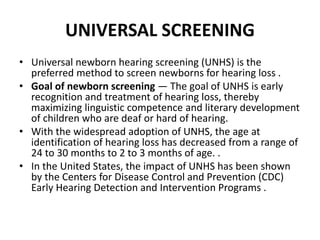
UNIVERSAL SCREENING
• Universal newborn hearing screening (UNHS) is the
preferred method to screen newborns for hearing loss .
• Goal of newborn screening — The goal of UNHS is early
recognition and treatment of hearing loss, thereby
maximizing linguistic competence and literary development
of children who are deaf or hard of hearing.
• With the widespread adoption of UNHS, the age at
identification of hearing loss has decreased from a range of
24 to 30 months to 2 to 3 months of age. .
• In the United States, the impact of UNHS has been shown
by the Centers for Disease Control and Prevention (CDC)
Early Hearing Detection and Intervention Programs .
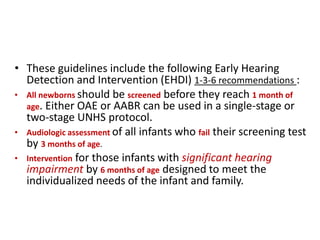
• These guidelines include the following Early Hearing
Detection and Intervention (EHDI) 1-3-6 recommendations :
• All newborns should be screened before they reach 1 month of
age. Either OAE or AABR can be used in a single-stage or
two-stage UNHS protocol.
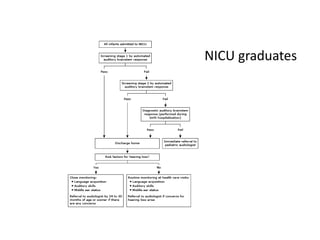
• Audiologic assessment of all infants who fail their screening test
by 3 months of age.
• Intervention for those infants with significant hearing
impairment by 6 months of age designed to meet the
individualized needs of the infant and family.
Protocols —
2 types of universal screening protocol :
Single STAGE — utilizes 1 screening test, either OAE or AABR
• detects 80 to 95 % of ears with hearing impairment
• Disadvantages :
1. High false-positive rate resulting in a substantial number of infants
with normal hearing referred for audiologic assessment, thereby
increasing the overall cost of UNHS.
2. For 1 case of significant hearing loss, the number of infants with
normal hearing referred for audiologic evaluation would range from 40 to
500 patients.
3. As a result, the majority of United States hospitals now have a two-
stage neonatal hearing screen protocol.
Two stage
• In a two-stage screening protocol, a second screen is given to
patients who fail the initial study, and only patients who fail both
screens are referred for audiologic assessment.
• The two-stage protocol preferred as it reduces the rate of false-
positive tests and reduces the referral rate for audiologic
assessment.
• Data from studies utilizing a two-stage UNHS reported that
approximately 900 to 1400 infants would need to be screened to
identify one case of bilateral hearing loss.
• It is estimated that one of every 45 infants from the well-baby
nursery referred for audiologic evaluation by a two-stage UNHS
would have moderate to profound bilateral permanent hearing
loss.
• However, the two-stage screening may miss infants
with hearing loss, because it inaccurately assumes that
all infants who fail the initial screen but pass the
second have normal hearing.
• In addition, the screening devices currently available
have thresholds of approximately 35 decibels (dB) and
will miss mild hearing loss. Because of this finding,
continued surveillance of hearing skills and language
development as described in the AAP periodicity
schedule is recommended by the JCIH (Joint
Committee on Infant Hearing) and AAP.
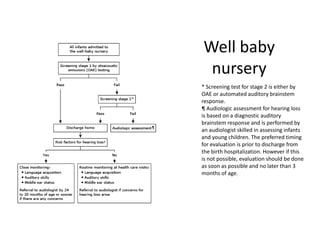
Well baby
nursery
* Screening test for stage 2 is either by
OAE or automated auditory brainstem
response.
¶ Audiologic assessment for hearing loss
is based on a diagnostic auditory
brainstem response and is performed by
an audiologist skilled in assessing infants
and young children. The preferred timing
for evaluation is prior to discharge from
the birth hospitalization. However if this
is not possible, evaluation should be done
as soon as possible and no later than 3
months of age.
NICU graduates
How frequently should children with risk factors
be screened?
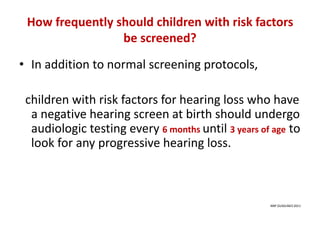
• In addition to normal screening protocols,
children with risk factors for hearing loss who have
a negative hearing screen at birth should undergo
audiologic testing every 6 months until 3 years of age to
look for any progressive hearing loss.
NNF GUIDLINES 2011
What are the limitations of hearing
screening?
• Both AABR and TEOAE can be influenced by motion artifact and
therefore are more specific if performed on a sleeping child in a
quiet
room.
• The rate of false positives ranges from
 30 % for one- step process
 1 % with a two-step process
NNF GUIDLINES
TREATMENT
• Children with hearing loss are best managed
by a coordinated team including
Family physicians
Paediatricians
Audiologists
Otolaryngologists
and speech pathologists/educational
specialists.
• Management of hearing loss is dependent on the etiology.
• Early intervention strategies may be placed into the
following broad
categories: Audiological
Medical/surgical management
Educational and rehabilitation methods
Child and family support.
• Medical and surgical interventions focused on establishing
functional access to sound have improved significantly as
a result of technological advances during the past two
decades.
• Depending the etiology and severity of hearing loss, this may
involve
Hearing aids
Cochlear implants
Bone-anchored hearing aids
Rarely,brainstem- implanted auditory devices may
be used.
• Surgical options exist for many conductive disorders including
Ear malformations
Ossicular chain abnormalities
Tumours and cholesteatomas.
• Hearing aids, which offer sound amplification,
are now widely available using advanced
digital technology, and may be worn by very
young infants.
• Environmental sound amplification devices,
including wireless devices, are also available
for individuals of all ages.
• Cochlear implants, used in children for the past 20 years, are
electronic
devices surgically placed in the cochlea to provide stimulation to the
auditory nerve.
• Cochlear implants, along with oral language habilitation, have
transformed
the hearing and language potentials of severely and profoundly deaf
individuals, enabling highly functional language development.
• Current recommendations for eligible children are bilateral
implantation between eight and 12 months of age, coupled with
auditory oral therapy
• THANK YOU

Rop hearing

  • 1.
  • 2.
    DEFINITION : • Retinopathyof prematurity (ROP) is a developmental vascular proliferative disorder that occurs in the retina of preterm infants with incomplete retinal vascularization.
  • 3.
    Normal vascularization • Noblood vessels in the retina <16 weeks gestation. • The retinal blood vessels initially develop from cords of mesenchymal spindle-shaped cells that grow out from the optic disc, (Hughes et al. 2000). • Retinal vascularization begins at 15 to 18 weeks gestation. • Retinal blood vessels extend out from the optic disc (where the optic nerve enters the eye) and grow peripherally.
  • 4.
    • Vascular development usuallyis complete in the • temporal retina by 40 weeks, and • nasal retina by 34-36 weeks gestation although maturation may be delayed until 48 to 52 weeks postmenstrual age (PMA) in preterm infants • Physiological hypoxia in tissues anterior to the developing blood vessels leads to hypoxia- inducible factor (HIF)- controlled production of vascular endothelial growth factor (VEGF) by glial cells(Stone et al. 1996).
  • 5.
    Pathogenesis • Premature birthinterrupts normal retinal blood vessel development. • The physiological environment of the retina of a premature infant is very different from that found in utero. • Oxygen therapy reduces the physiological hypoxia drive of normal retinal angiogenesis. • Reduced HIF-controlled production of VEGF leads to reduced endothelial cell proliferation and migration
  • 6.
    Possible mechanisms ofinjury • The First Stage involves an initial insult or insults, such as hyperoxia, hypoxia, or hypotension, at a critical point in retinal vascularization that results in vasoconstriction and decreased blood flow to the developing retina, with a subsequent arrest in vascular development. • The relative hyperoxia after birth downregulates the production of growth factors, such as VEGF, that are essential for the normal development of the retinal vessels.
  • 7.
    2. During theSecond Stage, neovascularization occurs. • This aberrant retinal vessel growth is thought to be driven by excess angiogenic factors such as VEGF upregulated by the hypoxic avascular retina. • New vessels grow within the retina and into the vitreous. • These vessels are permeable; therefore, hemorrhage and edema can occur. • Extensive and severe extraretinal fibrovascular proliferation can lead to retinal detachment and abnormal retinal function. • In most affected infants, however, the disease process is mild and regresses spontaneously.
  • 8.
    • In addition,reduced postnatal insulin-like growth factor 1 (IGF-1)appears to result in reduced retinal endothelial cell growth.
  • 9.
    Photoreceptor development • ROPappears to affect photoreceptor development. • An observational study in which retinal sensitivity and retinal responsivity were assessed by electroretinography between 30 and 72 weeks PMA suggests that photoreceptor development is altered in prematurity (with or without ROP).
  • 10.
    Incidence — 1. 951preterm infants (<37 weeks GA), single center, 1989 to 1997,  21% developed ROP.  5% SEVERE ROP. No infant born at >32 weeks GA developed the disorder, and no infant born at >28 weeks GA required surgical intervention. 2. Multicenter Study ,United States, 2000 -2002,  68% developed ROP, preterm + bw < 1251 gms.  Overall incidence of severe ROP -36 %.  The incidence of ROP was  8 % ≥32 weeks,  19 % >27 to 31 weeks, and  43 % ≤27 weeks gestation
  • 11.
    • Population-based CohortStudy , New Zealand and Australia . < 32 Weeks :- over all incidence of SEVERE ROP is 10%.  Severe ROP increased from 3 to 34 % as GA decreased from 27 to 24 weeks, respectively.
  • 12.
    • A surveyof ophthalmologists from countries with low, moderate, and high levels of development found that :- • Mean BW of infants with Severe ROP developing countries (900gms ) > in developed countries (750gms) • Mean GA of infants with Severe ROP developing countries (26 to 33.5 weeks ) > developed countries (25 weeks).
  • 13.
    • Large naturalhistory studies have shown that, in most cases, ROP begins at 31 to 32 weeks postmenstrual age with progression over the next 2 to 5 weeks. • Spontaneous regression commonly occurs in eyes with stages 1 and 2 and early stage 3 Blindness or severe visual impairment commonly results from progression of the retinopathy to retinal detachment or severe distortion of the posterior retina. Incidence of ROP is (<750 gm) > (<1000 gm) > (<1500 gms)
  • 14.
    Risk factors — •Prematurity, Low BW, Assisted Ventilation > 1Week, Surfactant Therapy, High Blood Transfusion Volume, Low Caloric Intake, Hyperglycemia, And Insulin Therapy, Sepsis, Fluctuations In Blood Gas Measurements, Intraventricular Hemorrhage, Bronchopulmonary Dysplasia, Systemic Fungal Infection, And Early Administration Of Erythropoietin For The Treatment Of Anemia Of Prematurity. • Poor longitudinal weight gain and elevated serum concentrations of IGF-1 and IGFBP-3 have also been used to identify infants at risk for ROP. • Breastmilk feeding appears to play a protective role in preventing ROP ?? • In addition, infants with trisomy 21 appear to be at a lower risk for ROP compared with other infants ??
  • 18.
    Who should bescreened for ROP? 1. < 34 weeks and / or < 1750 grams birth weight. 2. 34 - 36 +6 weeks or 1750 -2000 grams with risk factors. NNF GUIDELINES 1. < 30 weeks and / or < 1500 grams birth weight. 2. >30 weeks or 1500 -2000 grams with risk factors. AAP GUIDELINES
  • 19.
    When should thefirst screening be done? • ≥ 28 weeks :- not later than 4 weeks of age or 30 DOL. They may also be screened by the third week of life to enable diagnosis of AP-ROP. • <28weeks or <1200 grams :- 2-3 weeks of age, for early identification of AP-ROP. -NNF GUIDELINES
  • 20.
    How frequently shouldthe infants be screened? NNF clinical practice guidelines
  • 21.
    • Threshold ROPis present if 5 or more contiguous or 8 cumulative clock hours (30-degree sectors) of stage 3 with plus disease in either zone 1 or 2 are present. • This is the level of ROP at which the risk of blindness is predicted to be at least 50% and at which the CRYO-ROP study showed that the risk of blindness could be reduced to approximately 25% with appropriate treatment.
  • 22.
    • 3. PrethresholdROP a. Type 1 prethreshold ROP includes the following: i. In zone 1, any ROP and plus disease or stage 3 with or without plus disease ii. In zone 2, stage 2 or 3 ROP with plus disease b. Type 2 prethreshold ROP includes the following: i. In zone 1, stage 1 or 2 ROP, without plus disease ii. In zone 2, stage 3 ROP without plus disease
  • 23.
    When should thescreening be terminated? • Evidence & Recommendation: Retinal examinations may be terminated based on postmenstrual age or retinal findings. a) Full retinal vascularization; this usually occurs at about the 40th week of postmenstrual age and mostly completes by the 45th week b) Regression of ROP noted. It is advisable to screen the baby every 1-2 weeks at least until the infant is 38-40 weeks PMA.
  • 24.
    Where and howshould the examinations be done? • The ideal setting for screening is under a radiant warmer in the NICU, under the guidance of the neonatologist. • Pupillary dilatation should be performed about an hour prior to screening. A combination of cyclopentolate 0.5% and phenylephrine (2.5%) drops is used two to three times about 10-15 minutes apart. Tropicamide 0.5-1% is an alternative to cyclopentolate.
  • 25.
    When is treatmentof ROP indicated? • Prior to December 2003, the CRYO-ROP15 treatment guidelines were followed. Only a more advanced proliferative stage termed as ‘threshold disease’ was treated. • This was defined as “at least 5 contiguous or 8 cumulative clock hours of stage 3 ROP in zone I or II in the presence of plus disease.”
  • 26.
    • The EarlyTreatment for Retinopathy of Prematurity study (ETROP) study showed that early treatment of high-risk pre threshold ROP significantly reduced unfavorable outcomes to a clinically important degree. • Ablative therapy is indicated for high risk ROP or type 1 ROP, defined as any of the following: a) Zone I, stage 1 to 3 ROP with plus disease, b) Zone I, stage 3 ROP without plus disease and c) Zone II, stage 2 or 3 ROP with plus disease.
  • 28.
    How should ROPbe treated ? • The aim of the treatment is to ablate the entire avascular retina up to the ora serrata in a near confluent burn pattern getting as close to the edge of the ridge as possible. • Treatment should be carried out in the NICU or in a setting where monitoring and resuscitation facilities and trained personnel are readily available.
  • 29.
    • Laser Photocoagulationdelivered by the indirect ophthalmoscopic device is the mainstay of ROP treatment. • Laser has supplanted cryotherapy due to better structural and functional outcomes. It is a safer and a more controlled procedure. • Laser therapy can be done under topical anesthesia (0.5% proparacaine HCl, 4% xylocaine), general anesthesia or sedation. Laser treatment, using the ETROP guidelines, has a greater than 90% successful outcome.
  • 30.
    TECHNIQUE • Laser treatmentis delivered through an indirect ophthalmoscope and is applied to the avascular retina anterior to the ridge of extraretinal fibrovascular proliferation for 360 degrees. • An average of 1,000 spots are placed in each eye, but the number may range from a few hundred to approximately 2,000. • Both argon and diode laser photocoagulation have been successfully used in infants with severe ROP. • The procedure can be performed in the NICU and usually can be performed with local anesthesia and sedation, avoiding the possible adverse effects of general anesthesia. • The development of cataracts, glaucoma, or anterior segment ischemia following laser surgery or cryotherapy have been reported.
  • 31.
    Anti-vascular Endothelial GrowthFactor (VEGF) • In recent times, anti-VEGF has also been used in severe forms of ROP, especially those not responding to laser photocoagulation. Its role, however, is very controversial. • VEGF is needed in premature babies for the normal organogenesis and vasculogenesis. • Also systemic absorption may cause vascular development delay in other organs in these premature babies. • Therefore, it is not recommended by many as the first-line therapy.
  • 32.
    • The ocularsafety profile is reasonably good, although endophthalmitis is a rare but potentially devastating complication. • Some benefits of intravitreal injection include potentially less stress for the infant (because the procedure time is short and only requires topical anesthesia); less destruction of the retina (because laser and cryotherapy are ablative procedures); and longterm, lower rates of very severe myopia.
  • 33.
    • In Zone1 ROP, the Laser treatment outcomes are poorer. • Treatment with anti-VEGF followed by a 4–5 days later with laser treatment in these cases has improved the efficacy of laser along with a reduced need for extensive laser especially at the posterior pole. • In a study by Chen et al. both bevacizumab and ranibizumab had similar efficacy at the end of 1 year in terms of ROP regression and visual acuity.
  • 34.
    • On thebasis of available literature indication for anti-VEGF therapy can be enumerated as: 1 Primary therapy for aggressive posterior zone 1 disease (APROP). 2 Aggressive anterior ROP or media haze due to aggressive posterior disease to improve visualization for laser treatment. • Failed laser treatment leading to persistent neovascularization, tractional elements or tractional retinal detachment prior to surgery
  • 35.
    • Post-treatment recommendation:The child can be fed after about 30 minutes following completion of the procedure. Vital signs must be monitored. • It is preferable that the child be under the supervision of the neonatologist or an anesthesiologist for at least 2-3 hours following the procedure. • Post-treatment hypothermia and hypoglycemia are common and must be prevented. Mild conjunctival chemosis and hyperemia following the procedure may last for a few days and the parents must be counseled regarding this.
  • 36.
    • Follow-up visitsrecommendation: This may be typically scheduled after week 1, 2, 4 and 12 following treatment based on the findings recorded by the treating ophthalmologist. Long-term follow up for development of visual problems is also essential.
  • 37.
    • Stage 4or 5 ROP requires vitreo-retinal surgical intervention; retinal detachment carries a high risk of irreversible blindness. • Lens sparing vitrectomy is the procedure of choice in stage 4A and subtypes of 4B. • Timely lens sparing surgery may in fact result in reasonable to fairly good visual outcomes. A lensectomy–vitrectomy may be performed in stage 5. • The prognosis is guarded and results continue to be poor.Visual rehabilitation must be offered to all visually challenged ROP babies.
  • 38.
    • B. Cryotherapy.A cryoprobe is applied to the external surface of the sclera, and areas peripheral to the ridge of the ROP are frozen until the entire anterior avascular retina has been treated. • Approximately 35 to 75 applications are made in each eye. • The procedure is usually done under general anesthesia. • Cryotherapy causes more inflammation and requires more analgesia than laser therapy but may be necessary in special cases, such as when there is poor pupillary dilation or vitreous hemorrhage, both of which prevent adequate delivery of laser therapy.
  • 39.
    • D. Retinalreattachment. Once the macula detaches in stage 4B or 5 ROP, retinal surgery may be performed in an attempt to reattach the retina. • Vitrectomy with or without lensectomy, and membrane peeling if necessary, is performed to remove tractional forces causing the retinal detachment. • A scleral buckling procedure may be useful for more peripheral detachments, with drainage of subretinal fluid for effusional detachments. • Repeat operations for redetachment of the retina are common. • Even if the retina can be successfully attached, with rare exception, the visual outcome is in the range of legal blindness. • Despite the measurement of low visual acuity, children find any amount of vision useful, and untreated stage 5 ROP eventually leads to no light perception vision. • The achievement of even minimal vision can result in a large difference in a child's overall quality of life.
  • 40.
    Long term followup • Following development of ROP, babies need to be under more intensive follow up for the first 6 months followed by a less intensive follow up schedule until young adulthood period to identify long term complications promptly.
  • 42.
    REFERENCES • AVERY’S DISEASEOF NEWBORN • RENNIE AND ROBERTONS TEXTBOOK OF NEONATOLOGY • NNF GUIDELINES • CLOHERTY AND STARKS MANUAL OF NEONATAL CARE • AAP GUIDELINES
  • 43.
    HEARING ASSESSMENT INNEWBORN DR.A.AKSHAY REDDY
  • 44.
  • 45.
    INTRODUCTION :- • Hearingimpairment is one of the most critical sensory impairments with significant social and psychological consequences. • Significant permanent hearing loss is a common disorder at birth and can lead to :-  Delayed Language Development,  Difficulties With Behavior And Psychosocial Interactions, And  Poor Academic Achievement. • Detection of hearing loss during infancy can initiate intervention resulting in improved language, cognitive, behavioral, and academic outcomes.
  • 46.
    DEFINITION • The extentof hearing loss is defined by measuring the hearing threshold in decibels (dB) at various frequencies. • Normal hearing has a threshold of -10 to 15 dB. • Hearing loss ranges from slight to profound. • Severity of hearing loss defined by the American Speech-Language Hearing Association as follows :  No hearing loss – -10 to 15 dB  Slight – 16 to 25 dB  Mild − 26 to 40 dB  Moderate − 41 to 55 dB  Moderately severe – 56 to 70 dB  Severe − 71 to 90 dB, or 61 to 80 dB based on the World Health Organization (WHO) definition  Profound − >91 dB, or >80 dB based on WHO definition
  • 47.
    CLASSIFICATION : Type Duration DescriptionSite Examples Conductive transient Transient Caused by abnormalities of the outer or middle ear, which limit the amount of external sound that gains access to the inner ear (cochlea and vestibular apparatus) Outer ear •Blockage of ear canal by cerumen or amniotic fluid •Debris in ear canal Middle ear •Acute otitis media •Middle ear effusion •Tympanic membrane perforation Conductive permanent Permanent Caused by abnormalities of the outer or middle ear, which limit the amount of external sound that gains access to the inner ear (cochlea and vestibular apparatus) Outer ear •Congenital atresia •Congenital microtia Middle ear •Ossicular chain anomaly (eg, absent stapes) •Temporal bone fracture (birth trauma) •Craniofacial abnormalities of the pinna or ear canal
  • 48.
    Type Duration DescriptionSite Examples Sensorineur al* Permane nt Caused by malfunction of inner ear structures (outer and inner hair cells and CN VIII components of the auditory neural pathway) resulting in impaired neuro- conduction of sound energy to the brainstem from the inner ear Inner ear, including outer and inner hair cells and CN VIII components of the auditory neural pathway •Bacterial sepsis or meningitis •Congenital viral infections (eg, CMV and Zika) •ECMO •Extreme prematurity ¶ •Genetic disorders (mutations in the GJB2 gene that encodes the protein Connexin 26) •Hyperbilirubinemia •HIE •Ototoxic medications (eg, aminoglycosides)
  • 49.
    Type Duration DescriptionSite Examples Auditory neuropathy * Permanent Caused by impaired neural processing of auditory stimuli with a deficit in the perception or complete analysis of auditory information CN VIII, auditory brainstem, cerebral cortex •Bacterial meningitis •Congenital syndromes with brain abnormalities •Congenital viral infection (rubella, CMV, and Zika) •Genetic disorders (mutations of the OTOF gene that encodes the protein otoferlin) •HIE •Hyperbilirubinemia •Mitochondrial disease •Ototoxic medications (eg, aminoglycosides) •Prenatal exposure to heavy metals or alcohol Mixed Permanent Caused by a combination of sensorineural or auditory neuropathy with transient or permanent conductive hearing loss Outer, middle, and inner ear •Congenital viral infection (eg, Zika) with both microtia and auditory neuropathy or sensorineural hearing loss
  • 50.
    • DATA FROMCDC :- Of the 98% newborns screened for hearing loss , 1.6 / 1000 newborns had permanent hearing loss.  The prevalence of moderate, severe, and profound BILATERAL Permanent Hearing Loss is estimated at 1 in 900 to 2500 newborns .  The prevalence of UNILATERAL hearing impairment above 30 decibels (dB) has been reported as 6 in 1000 newborns . • There was no documented diagnosis reported in 42% of infants who failed the newborn hearing screening. Incidence :
  • 51.
    • 1/4th –½ of the chidren with permanent hearing loss – cause unidentified. • For patients with a confirmed diagnosis, hearing loss is due to genetic/hereditary disorders or acquired conditions due to perinatal problems (eg, congenital viral infections). • Permanent hearing loss is often associated with other abnormalities, and there are over 400 syndromes reported to be associated with permanent hearing loss.
  • 52.
    • Level 2and 3 care units NICU graduates are at more risk of HL. • SNHL , AN are much more common for Level 2 and 3 care units NICU graduates with reported rates of :- • SNHL of 16.7 /1000 and • AN of 5.6 / 1000 infants,
  • 53.
    Who are atrisk ??  Admission to a neonatal intensive care unit (NICU) for at least five days (eg, prematurity).  Syndromes associated with hearing loss.  Family history of hereditary childhood hearing loss.  Craniofacial anomalies (eg, anomalies of the pinna or ear canal, cleft lip, and palate).  Congenital infection (eg, cytomegalovirus, toxoplasmosis, rubella, syphilis, herpes, Zika) or bacterial meningitis.  Severe hyperbilirubinemia defined as serum bilirubin >35 mg/dL (599 micro/L) or requiring exchange transfusion in a preterm infant .  History of perinatal asphyxia or problems during delivery (eg, five-minute Apgar score <6).  Multiple courses of ototoxic mediation (ie, ampicillin, gentamycin, oxacillin, tobramycin)
  • 54.
    Syndromes associated withhearing loss • Congenital Rubella syndrome • Usher syndrome • Jervell and Lange-Nielsen (JLN) syndrome • Treacher-Collins syndrome • Apert syndrome • Alport syndrome INDIAN PEDIATRICS 2 JUNE 04, 2017 [E-PUB AHEAD OF PRINT]CONSENSUS STATEMENT ON NEWBORN HEARING SCREENING • Neurofibromatosis syndrome • Achondroplasia • CHARGE syndrome • Brachio Oto Renal syndrome • Chudley McCullough syndrome • Goldenhar syndrome. INDIAN PEDIATRICS 2 JUNE 04, 2017 [E-PUB AHEAD OF PRINT]CONSENSUS STATEMENT ON NEWBORN HEARING SCREENING
  • 55.
    • Screening newbornsfor hearing loss leads to Earlier Detection and Intervention in patients with congenital hearing impairment. • Early intervention can improve language acquisition and educational achievement in affected patients. • Vocabulary of a 3-year-old child with typical hearing which is 500- 900 words. • Vocabulary of a 3-year-old child with hearing impairment if :-  If remediated at birth is 300-700 words  If re-mediated at 6 months is 150-300 words  If remediated at 2 years is 0-50 words, respectively INDIAN PEDIATRICS 2 JUNE 04, 2017 [E-PUB AHEAD OF PRINT]CONSENSUS STATEMENT ON NEWBORN HEARING SCREENING Screening guidelines
  • 56.
    What tests areused ?? • American Academy of Pediatrics (AAP) Task Force on Newborn and Infant Hearing defined an effective neonatal hearing screening test as one that detects hearing loss of ≥35 decibels (dB) in the better ear and is reliable in infants ≤3 months of age. • Two electrophysiologic techniques meet these criteria:  Automated auditory brainstem responses (AABR)  Otoacoustic emissions (OAE) • These physiological, non-invasive, automated screening tests can be performed at the bedside in term and preterm infants. Paediatr Child Health Vol 16 No 5 May 2011, ©2011 Canadian Paediatric Society.
  • 57.
    • They evaluatethe peripheral auditory system and the cochlea, but cannot assess activity in the highest levels of the central auditory system. • These tests alone are not sufficient to diagnose hearing loss; thus, any child who fails one of these screening tests requires further audiologic evaluation.
  • 58.
    OAE :- • OAEtesting measures the presence or absence of sound waves (ie, OAEs) generated by the cochlear outer hair cells of the inner ear in response to sound stimuli. • A microphone at the external ear canal detects these low-intensity OAEs. • Since OAE evaluates hearing from the middle ear to the outer hair cells of the inner ear, it is used to screen for SNHL but cannot detect AN.
  • 59.
    Technique — • Theapparatus for OAE screening consists of a miniature microphone placed into the infant's outer ear canal. • The microphone produces a stimulus (clicks or tones) and detects sound waves as they arise from the cochlea. • The device also measures the signal-to-noise ratio to ensure accuracy. • OAE screening generally requires approximately 1-2 minutes per ear in ideal testing conditions. • performed in infants > 24 h & > 34weeks PMA
  • 60.
    • Tests mostcommonly used for clinical purposes are transient OAEs (TOAEs) and distortion product OAEs (DPOAEs). • They are classified by the stimuli used to produce the cochlear basal membrane vibrations. a)Transient OAE's(TEOAEs): Evoked by clicks, a series of click stimuli are presented at 80-85 db and response recorded. b)Distorted product OAE's(DPOAEs): Two tones are simultaneously presented to the cochlea to produce distorted products they have been used to test hearing in the range of 1000-8000Hz. • Results may be affected by the Infant’s movements Environmental noise Dysfunction in the middle or external ear (eg, debris in the external ear canal)
  • 61.
    Automated auditory brainstem response; AABR • AABR measures the summation of action potentials from the eighth cranial nerve (cochlear nerve) to the inferior colliculus of the midbrain in response to a click stimulus. • It can detect both sensorineural hearing loss (SNHL) and auditory neuropathy (AN). • Also called as screening ABR (SABR), and screening brainstem auditory evoked response ( S BERA ). • Approximately 4 percent of infants screened with AABR are referred for further audiologic evaluation, which uses a diagnostic ABR including an evaluation by an audiologist skilled in assessing infants and young children.
  • 62.
    • It isimportant to note the difference between AABR and ABR, as AABR is a screening tool with an automated pass/fail response whereas an ABR diagnostic test provides quantitative data (eg, waveforms) that must be interpreted by a trained audiologist, thereby determining the degree and the site of the hearing loss. • As an example, delayed or absent waves suggest a neurologic or cochlear deficit. • Many neonatal intensive care units (NICUs) now complete the diagnostic ABR prior to discharge for infants who fail the screening AABR.
  • 63.
    TECHNIQUE :- • TheAABR utilizes click or chirp stimuli presented at 35 dB. • 3 surface electrodes placed on the forehead, nape, and mastoid or shoulder detect waveform recordings generated by the ABR to the stimuli. • In the screening AABR, the morphology and latency of the waveforms are compared with normal neonatal templates, and a pass or fail reading is generated, and the examiner does not need to interpret the waveforms if visibly accessible. • AABR screening typically requires 4 to 15 minutes for testing, although newer AABR screening equipment can complete testing in an infant in 4 to 8 minutes in ideal conditions.
  • 64.
    Wave 1 –distal portion to the brain stem of auditory nerve Wave 2 - Proximal portion to the brain stem of auditory nerve Wave 3 -Cochlear nucleus Wave 4 -Superior olivAry complex Wave 5 -Lateral lemniscus Wave 6 -Inferior colliculus WAVE 7 – MEDIAL GENICULATE BODY
  • 65.
    SELECTIVE SCREENING : •Prior to universal newborn hearing screening (UNHS), one approach to identifying infants with a permanent hearing loss was to selectively test newborns that are at increased risk for hearing loss. • There is good evidence that this approach will miss and delay detection of hearing loss in a significant number of patients and is no longer recommended. • Universal screening for all newborn infants is supported by global health care organizations, professional societies, and the United States Preventive Services Task Force (USPSTF) • can identify only 50 to 75 % of infants with moderate to profound bilateral hearing loss. • Australian population-based study, the mean age for diagnosis for hearing loss ; selective screening based on risk factors 16.2 months vs universal screening 8.1 months.
  • 66.
    UNIVERSAL SCREENING • Universalnewborn hearing screening (UNHS) is the preferred method to screen newborns for hearing loss . • Goal of newborn screening — The goal of UNHS is early recognition and treatment of hearing loss, thereby maximizing linguistic competence and literary development of children who are deaf or hard of hearing. • With the widespread adoption of UNHS, the age at identification of hearing loss has decreased from a range of 24 to 30 months to 2 to 3 months of age. . • In the United States, the impact of UNHS has been shown by the Centers for Disease Control and Prevention (CDC) Early Hearing Detection and Intervention Programs .
  • 67.
    • These guidelinesinclude the following Early Hearing Detection and Intervention (EHDI) 1-3-6 recommendations : • All newborns should be screened before they reach 1 month of age. Either OAE or AABR can be used in a single-stage or two-stage UNHS protocol. • Audiologic assessment of all infants who fail their screening test by 3 months of age. • Intervention for those infants with significant hearing impairment by 6 months of age designed to meet the individualized needs of the infant and family.
  • 68.
    Protocols — 2 typesof universal screening protocol : Single STAGE — utilizes 1 screening test, either OAE or AABR • detects 80 to 95 % of ears with hearing impairment • Disadvantages : 1. High false-positive rate resulting in a substantial number of infants with normal hearing referred for audiologic assessment, thereby increasing the overall cost of UNHS. 2. For 1 case of significant hearing loss, the number of infants with normal hearing referred for audiologic evaluation would range from 40 to 500 patients. 3. As a result, the majority of United States hospitals now have a two- stage neonatal hearing screen protocol.
  • 69.
    Two stage • Ina two-stage screening protocol, a second screen is given to patients who fail the initial study, and only patients who fail both screens are referred for audiologic assessment. • The two-stage protocol preferred as it reduces the rate of false- positive tests and reduces the referral rate for audiologic assessment. • Data from studies utilizing a two-stage UNHS reported that approximately 900 to 1400 infants would need to be screened to identify one case of bilateral hearing loss. • It is estimated that one of every 45 infants from the well-baby nursery referred for audiologic evaluation by a two-stage UNHS would have moderate to profound bilateral permanent hearing loss.
  • 70.
    • However, thetwo-stage screening may miss infants with hearing loss, because it inaccurately assumes that all infants who fail the initial screen but pass the second have normal hearing. • In addition, the screening devices currently available have thresholds of approximately 35 decibels (dB) and will miss mild hearing loss. Because of this finding, continued surveillance of hearing skills and language development as described in the AAP periodicity schedule is recommended by the JCIH (Joint Committee on Infant Hearing) and AAP.
  • 71.
    Well baby nursery * Screeningtest for stage 2 is either by OAE or automated auditory brainstem response. ¶ Audiologic assessment for hearing loss is based on a diagnostic auditory brainstem response and is performed by an audiologist skilled in assessing infants and young children. The preferred timing for evaluation is prior to discharge from the birth hospitalization. However if this is not possible, evaluation should be done as soon as possible and no later than 3 months of age.
  • 72.
  • 73.
    How frequently shouldchildren with risk factors be screened? • In addition to normal screening protocols, children with risk factors for hearing loss who have a negative hearing screen at birth should undergo audiologic testing every 6 months until 3 years of age to look for any progressive hearing loss. NNF GUIDLINES 2011
  • 74.
    What are thelimitations of hearing screening? • Both AABR and TEOAE can be influenced by motion artifact and therefore are more specific if performed on a sleeping child in a quiet room. • The rate of false positives ranges from  30 % for one- step process  1 % with a two-step process NNF GUIDLINES
  • 75.
    TREATMENT • Children withhearing loss are best managed by a coordinated team including Family physicians Paediatricians Audiologists Otolaryngologists and speech pathologists/educational specialists.
  • 76.
    • Management ofhearing loss is dependent on the etiology. • Early intervention strategies may be placed into the following broad categories: Audiological Medical/surgical management Educational and rehabilitation methods Child and family support. • Medical and surgical interventions focused on establishing functional access to sound have improved significantly as a result of technological advances during the past two decades.
  • 77.
    • Depending theetiology and severity of hearing loss, this may involve Hearing aids Cochlear implants Bone-anchored hearing aids Rarely,brainstem- implanted auditory devices may be used. • Surgical options exist for many conductive disorders including Ear malformations Ossicular chain abnormalities Tumours and cholesteatomas.
  • 78.
    • Hearing aids,which offer sound amplification, are now widely available using advanced digital technology, and may be worn by very young infants. • Environmental sound amplification devices, including wireless devices, are also available for individuals of all ages.
  • 79.
    • Cochlear implants,used in children for the past 20 years, are electronic devices surgically placed in the cochlea to provide stimulation to the auditory nerve. • Cochlear implants, along with oral language habilitation, have transformed the hearing and language potentials of severely and profoundly deaf individuals, enabling highly functional language development. • Current recommendations for eligible children are bilateral implantation between eight and 12 months of age, coupled with auditory oral therapy
  • 80.