Non invasive ventilation
Neonates -2
Dr. ADHI ARYA
SENIOR RESIDENT –GMCH -32 CHANDIGARH
nIPPV
• intermittent positive pressure ventilation via nasal devices
positivepressurecycledeliveredontopofcontinuousdistending
pressurebynasalroute
Similar to CPAP, unassisted spontaneous breathing occurs at a
pre-set PEEP level, but mandatory pressure control breaths
are either patient-triggered (synchronized) or machine-
triggered (non-synchronized).
How is synchronization done
• Infant star—)
• Phased out
• Servo –I ventilators ( for NAVA)
• Infant Flow SiPAP Comprehensive by pneumatic capsule grasby(
detecting abd movements
Is synchronization required
• In theory, patient-triggered nasal IMV is preferred because the
inflations are timed with the respiratory effort, and when the glottis is
open, the inflations are more likely to be transmitted effectively to
the lungs.
Non invasive ventilation: Physiological effects
of NIV
1. Apnea: Nasal IPPV may improve patency of the upper airway by creating
intermittently elevated pharyngeal pressures. This intermittent inflation of the
pharynx may activate respiratory drive, by Head’s paradoxical reflex, where lung
inflation provokes an augmented inspiratory reflex. This results in resumption of
breathing in infants with apnea following cycling of the ventilator.
2. Work of breathing has also been shown to be decreased with the use of SNIPPV
compared to nasal CPAP (Kiciman NM Pediatr Pulmonol 1998; 25: 175–81)
6
Non invasive ventilation: Primary Mode VS
Secondary Mode
• NIPPV in the primary mode refers to its use soon after birth with or
without a short period ( 2 hours) of intubation for surfactant delivery,
followed by extubation.
• The secondary mode refers to its use after a longer period
(>2 hours to days to weeks) of intubation.
7
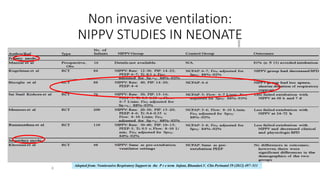
Non invasive ventilation:
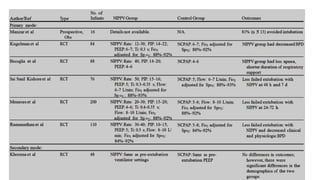
NIPPV STUDIES IN NEONATE
8
Adopted from: Noninvasive Respiratory Support in the P r e term Infant, Bhandari.V. Clin Perinatol 39 (2012) 497–511
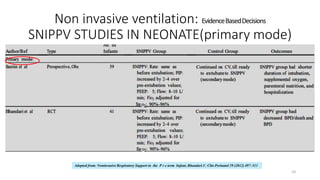
Non invasive ventilation: EvidenceBasedDecisions
SNIPPV STUDIES IN NEONATE(primary mode)
10
Adopted from: Noninvasive Respiratory Support in the P r e term Infant, Bhandari.V. Clin Perinatol 39 (2012) 497–511
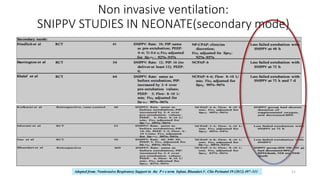
Non invasive ventilation:
SNIPPV STUDIES IN NEONATE(secondary mode)
11Adopted from: Noninvasive Respiratory Support in the P r e term Infant, Bhandari.V. Clin Perinatol 39 (2012) 497–511
Non invasive ventilation: Evidence Based
Decisions : NIPPV VS NCPAP
12
EXTUBATION FAILURE RATE:NIPPV VS NCPAP
Nasal Intermittent Positive Pressure Ventilation versus Nasal Continuos Positive Airway Pressure in Neonates: A
Systematic Review and Meta-analysis: Tang et al, Indian pediatrics,2012
Five papers reported the rate of extubation failure of NIPPV
versus nCPAP following ETT and mechanical ventilation.
Meta-analysis showed that the rate of extubation
failure of NIPPV was significantly lower than that of
nCPAP [OR=0.15 (95% CI: 0.08 0.31)]; P<0.001.
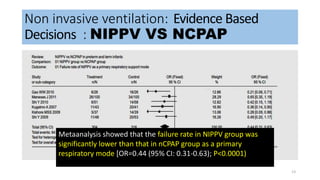
Non invasive ventilation: Evidence Based
Decisions : NIPPV VS NCPAP
13
FAILURE RATE as a primary mode in RDS :NIPPV VS NCPAP
Nasal Intermittent Positive Pressure Ventilation versus Nasal Continuos Positive Airway Pressure in Neonates: A
Systematic Review and Meta-analysis: Tang et al, Indian pediatrics,2012
Six papers reported the failure rate of NIPPV versus nCPAP as a primary
respiratory mode, which was indicated by whether or not requiring ETT and
mechanical ventilation.
Metaanalysis showed that the failure rate in NIPPV group was
significantly lower than that in nCPAP group as a primary
respiratory mode [OR=0.44 (95% CI: 0.31-0.63); P<0.0001)
Non invasive ventilation: Evidence Based
Decisions : NIPPV VS NCPAP
14
META-ANALYSIS OF SECONDARY OUTCOMES BETWEEN NIPPV AND NCPAP GROUPS
Nasal Intermittent Positive Pressure Ventilation versus Nasal Continuos Positive Airway Pressure in Neonates: A
Systematic Review and Meta-analysis: Tang et al, Indian pediatrics,2012
• FINAL OUTCOME (DEATH AND/OR BPD): NIPPV was significantly better than that of nCPAP as a primary
respiratory mode [OR=0.57 (95% CI: 0.37-0.88); P=0.01]
• APNEA OF PREMATURITY: NIPPV showed a statistically lower rate of apnea (episodes per hour) as compared
with nCPAP group [WMD=-0.48 (95%CI:-0.58-0.37; P<0.001]
• DURATION OF HOSPITALIZATION : (primary respiratory mode /extubation mode) : No significant difference in
duration of hospitalization between NIPPV and nCPAP group [WMD=-0.51 (95%CI:-5.62-4.61;
• INCIDENCE OF BPD : NIPPV led to a marginally significant reduction in the incidence of BPD as compared
with nCPAP. [OR(95%CI)=0.39-1.00,P=0.05]
• incidence of IVH, PVL, ROP, PDA, Pneumothorax or air leak, abdominal distention, necrotizing enterocolitis :
no significant differences
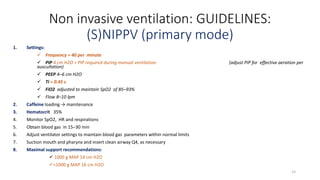
Non invasive ventilation: GUIDELINES:
(S)NIPPV (primary mode)
1. Settings:
 Frequency = 40 per minute
 PIP 4 cm H2O > PIP required during manual ventilation (adjust PIP for effective aeration per
auscultation)
 PEEP 4–6 cm H2O
 Ti = 0.45 s
 FiO2 adjusted to maintain SpO2 of 85–93%
 Flow 8–10 lpm
2. Caffeine loading → maintenance
3. Hematocrit 35%
4. Monitor SpO2, HR and respirations
5. Obtain blood gas in 15–30 min
6. Adjust ventilator settings to maintain blood gas parameters within normal limits
7. Suction mouth and pharynx and insert clean airway Q4, as necessary
8. Maximal support recommendations:
 1000 g MAP 14 cm H2O
>1000 g MAP 16 cm H2O
15
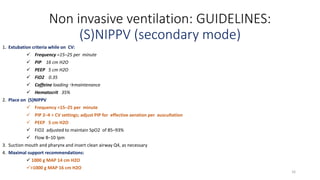
Non invasive ventilation: GUIDELINES:
(S)NIPPV (secondary mode)
1. Extubation criteria while on CV:
 Frequency =15–25 per minute
 PIP 16 cm H2O
 PEEP 5 cm H2O
 FiO2 0.35
 Caffeine loading →maintenance
 Hematocrit 35%
2. Place on (S)NIPPV
 Frequency =15–25 per minute
 PIP 2–4 > CV settings; adjust PIP for effective aeration per auscultation
 PEEP 5 cm H2O
 FiO2 adjusted to maintain SpO2 of 85–93%
 Flow 8–10 lpm
3. Suction mouth and pharynx and insert clean airway Q4, as necessary
4. Maximal support recommendations:
 1000 g MAP 14 cm H2O
>1000 g MAP 16 cm H2O
16
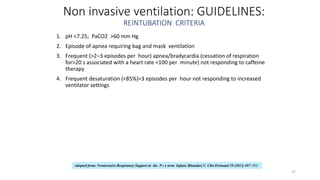
Non invasive ventilation: GUIDELINES:
REINTUBATION CRITERIA
1. pH <7.25; PaCO2 >60 mm Hg
2. Episode of apnea requiring bag and mask ventilation
3. Frequent (>2–3 episodes per hour) apnea/bradycardia (cessation of respiration
for>20 s associated with a heart rate <100 per minute) not responding to caffeine
therapy
4. Frequent desaturation (<85%)=3 episodes per hour not responding to increased
ventilator settings
17
Adopted from: Noninvasive Respiratory Support in the P r e term Infant, Bhandari.V. Clin Perinatol 39 (2012) 497–511
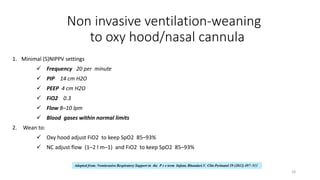
Non invasive ventilation-weaning
to oxy hood/nasal cannula
1. Minimal (S)NIPPV settings
 Frequency 20 per minute
 PIP 14 cm H2O
 PEEP 4 cm H2O
 FiO2 0.3
 Flow 8–10 lpm
 Blood gases within normal limits
2. Wean to:
 Oxy hood adjust FiO2 to keep SpO2 85–93%
 NC adjust flow (1–2 l m–1) and FiO2 to keep SpO2 85–93%
18
Adopted from: Noninvasive Respiratory Support in the P r e term Infant, Bhandari.V. Clin Perinatol 39 (2012) 497–511
Bipap /Sipap
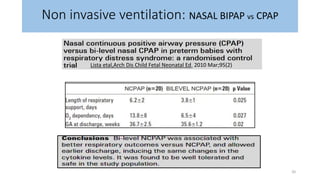
Non invasive ventilation: NASAL BIPAP vs CPAP
20
Lista etal,Arch Dis Child Fetal Neonatal Ed. 2010 Mar;95(2)
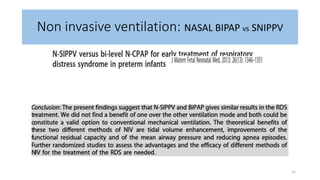
Non invasive ventilation: NASAL BIPAP vs SNIPPV
21
HHFNC
LOW FLOW V/S HIGH FLOW
• HIGH FLOW--MORE THAN INPIRATORY FLOW
• NO CONSENSUS
• BUT IN NEONATES FLOWS >2L/MIN
MOA
• warmed and humidified flow of air and/or air-oxygen.—DEC WOB
• some degree of end distending pressure – COMPARABLE TO nCPAP
• Reduced dead space- reduced co2 rebreathing
ADVANTAGES OVER CPAP
• HHF may be better tolerated by infants becoming unsettled with
HCPAP.
• Less nasal injuries
• Sucking feeds and Kangaroo care are more easily attempted with HHF
than HCPAP.
COMPARISON WITH CPAP
• Yoder et al 2013
• Similar in efficacy in post extubation and as initial respiratory support
• No increased risk of air leaks
• No difference in different machines
COMPARISON WITH CPAP AND OTHER NIV
MODES
High flow nasal cannula for
respiratory support in preterm infants
Cochrane Neonatal Group FEB 2016
DOI: 10.1002/14651858.CD006405
CONCLUSION
• similar rates of efficacy to other forms of non-invasive respiratory
support in preterm infants for preventing treatment failure, death
and CLD.
• Most evidence is available for the use of HFNC as post-extubation
support. Following extubation, HFNC is associated with less nasal
trauma, and may be associated with reduced pneumothorax
compared with nasal CPAP.
• Further RCTs needed for comparing HFNC with other forms of
primary non- invasive support after birth and for weaning from non-
invasive support.
• also for evaluating the safety and efficacy of HFNC in extremely
preterm and mildly preterm subgroups, and for comparing different
HFNC devices.
DEVICES AVAILABLE
• Optiflow System ( AIRVO- Fisher and Paykel,
• Precision Flow (VAPOTHERM), and
• Comfort-Flo®(Teleflex)
General considerations
• Nasal cannula size is important
• Outer diameter of cannula should not be > 50% of internal diameter of
nares
Flow rate is size dependent
• 1000-1999 -- 3 –lpm
• 2000-2999—4
• >3000—5
Flow rate can increase in any slab by max of 3 Lpm
Non invasive ventilation: NAVA
32
NAVA/Neurally adjusted
ventilator assist is a mode of
synchronisation which uses
diaphragmatic
electromyography to
synchronise not only the time
of breath according to
patients initiation of
inspiration ,but also it gives
breath proportionate to
electrical activity of
diaphragm.

NON INVASIVE VENTILATION IN NEONATES-PART 2

  • 1.
    Non invasive ventilation Neonates-2 Dr. ADHI ARYA SENIOR RESIDENT –GMCH -32 CHANDIGARH
  • 3.
    nIPPV • intermittent positivepressure ventilation via nasal devices positivepressurecycledeliveredontopofcontinuousdistending pressurebynasalroute Similar to CPAP, unassisted spontaneous breathing occurs at a pre-set PEEP level, but mandatory pressure control breaths are either patient-triggered (synchronized) or machine- triggered (non-synchronized).
  • 4.
    How is synchronizationdone • Infant star—) • Phased out • Servo –I ventilators ( for NAVA) • Infant Flow SiPAP Comprehensive by pneumatic capsule grasby( detecting abd movements
  • 5.
    Is synchronization required •In theory, patient-triggered nasal IMV is preferred because the inflations are timed with the respiratory effort, and when the glottis is open, the inflations are more likely to be transmitted effectively to the lungs.
  • 6.
    Non invasive ventilation:Physiological effects of NIV 1. Apnea: Nasal IPPV may improve patency of the upper airway by creating intermittently elevated pharyngeal pressures. This intermittent inflation of the pharynx may activate respiratory drive, by Head’s paradoxical reflex, where lung inflation provokes an augmented inspiratory reflex. This results in resumption of breathing in infants with apnea following cycling of the ventilator. 2. Work of breathing has also been shown to be decreased with the use of SNIPPV compared to nasal CPAP (Kiciman NM Pediatr Pulmonol 1998; 25: 175–81) 6
  • 7.
    Non invasive ventilation:Primary Mode VS Secondary Mode • NIPPV in the primary mode refers to its use soon after birth with or without a short period ( 2 hours) of intubation for surfactant delivery, followed by extubation. • The secondary mode refers to its use after a longer period (>2 hours to days to weeks) of intubation. 7
  • 8.
    Non invasive ventilation: NIPPVSTUDIES IN NEONATE 8 Adopted from: Noninvasive Respiratory Support in the P r e term Infant, Bhandari.V. Clin Perinatol 39 (2012) 497–511
  • 10.
    Non invasive ventilation:EvidenceBasedDecisions SNIPPV STUDIES IN NEONATE(primary mode) 10 Adopted from: Noninvasive Respiratory Support in the P r e term Infant, Bhandari.V. Clin Perinatol 39 (2012) 497–511
  • 11.
    Non invasive ventilation: SNIPPVSTUDIES IN NEONATE(secondary mode) 11Adopted from: Noninvasive Respiratory Support in the P r e term Infant, Bhandari.V. Clin Perinatol 39 (2012) 497–511
  • 12.
    Non invasive ventilation:Evidence Based Decisions : NIPPV VS NCPAP 12 EXTUBATION FAILURE RATE:NIPPV VS NCPAP Nasal Intermittent Positive Pressure Ventilation versus Nasal Continuos Positive Airway Pressure in Neonates: A Systematic Review and Meta-analysis: Tang et al, Indian pediatrics,2012 Five papers reported the rate of extubation failure of NIPPV versus nCPAP following ETT and mechanical ventilation. Meta-analysis showed that the rate of extubation failure of NIPPV was significantly lower than that of nCPAP [OR=0.15 (95% CI: 0.08 0.31)]; P<0.001.
  • 13.
    Non invasive ventilation:Evidence Based Decisions : NIPPV VS NCPAP 13 FAILURE RATE as a primary mode in RDS :NIPPV VS NCPAP Nasal Intermittent Positive Pressure Ventilation versus Nasal Continuos Positive Airway Pressure in Neonates: A Systematic Review and Meta-analysis: Tang et al, Indian pediatrics,2012 Six papers reported the failure rate of NIPPV versus nCPAP as a primary respiratory mode, which was indicated by whether or not requiring ETT and mechanical ventilation. Metaanalysis showed that the failure rate in NIPPV group was significantly lower than that in nCPAP group as a primary respiratory mode [OR=0.44 (95% CI: 0.31-0.63); P<0.0001)
  • 14.
    Non invasive ventilation:Evidence Based Decisions : NIPPV VS NCPAP 14 META-ANALYSIS OF SECONDARY OUTCOMES BETWEEN NIPPV AND NCPAP GROUPS Nasal Intermittent Positive Pressure Ventilation versus Nasal Continuos Positive Airway Pressure in Neonates: A Systematic Review and Meta-analysis: Tang et al, Indian pediatrics,2012 • FINAL OUTCOME (DEATH AND/OR BPD): NIPPV was significantly better than that of nCPAP as a primary respiratory mode [OR=0.57 (95% CI: 0.37-0.88); P=0.01] • APNEA OF PREMATURITY: NIPPV showed a statistically lower rate of apnea (episodes per hour) as compared with nCPAP group [WMD=-0.48 (95%CI:-0.58-0.37; P<0.001] • DURATION OF HOSPITALIZATION : (primary respiratory mode /extubation mode) : No significant difference in duration of hospitalization between NIPPV and nCPAP group [WMD=-0.51 (95%CI:-5.62-4.61; • INCIDENCE OF BPD : NIPPV led to a marginally significant reduction in the incidence of BPD as compared with nCPAP. [OR(95%CI)=0.39-1.00,P=0.05] • incidence of IVH, PVL, ROP, PDA, Pneumothorax or air leak, abdominal distention, necrotizing enterocolitis : no significant differences
  • 15.
    Non invasive ventilation:GUIDELINES: (S)NIPPV (primary mode) 1. Settings:  Frequency = 40 per minute  PIP 4 cm H2O > PIP required during manual ventilation (adjust PIP for effective aeration per auscultation)  PEEP 4–6 cm H2O  Ti = 0.45 s  FiO2 adjusted to maintain SpO2 of 85–93%  Flow 8–10 lpm 2. Caffeine loading → maintenance 3. Hematocrit 35% 4. Monitor SpO2, HR and respirations 5. Obtain blood gas in 15–30 min 6. Adjust ventilator settings to maintain blood gas parameters within normal limits 7. Suction mouth and pharynx and insert clean airway Q4, as necessary 8. Maximal support recommendations:  1000 g MAP 14 cm H2O >1000 g MAP 16 cm H2O 15
  • 16.
    Non invasive ventilation:GUIDELINES: (S)NIPPV (secondary mode) 1. Extubation criteria while on CV:  Frequency =15–25 per minute  PIP 16 cm H2O  PEEP 5 cm H2O  FiO2 0.35  Caffeine loading →maintenance  Hematocrit 35% 2. Place on (S)NIPPV  Frequency =15–25 per minute  PIP 2–4 > CV settings; adjust PIP for effective aeration per auscultation  PEEP 5 cm H2O  FiO2 adjusted to maintain SpO2 of 85–93%  Flow 8–10 lpm 3. Suction mouth and pharynx and insert clean airway Q4, as necessary 4. Maximal support recommendations:  1000 g MAP 14 cm H2O >1000 g MAP 16 cm H2O 16
  • 17.
    Non invasive ventilation:GUIDELINES: REINTUBATION CRITERIA 1. pH <7.25; PaCO2 >60 mm Hg 2. Episode of apnea requiring bag and mask ventilation 3. Frequent (>2–3 episodes per hour) apnea/bradycardia (cessation of respiration for>20 s associated with a heart rate <100 per minute) not responding to caffeine therapy 4. Frequent desaturation (<85%)=3 episodes per hour not responding to increased ventilator settings 17 Adopted from: Noninvasive Respiratory Support in the P r e term Infant, Bhandari.V. Clin Perinatol 39 (2012) 497–511
  • 18.
    Non invasive ventilation-weaning tooxy hood/nasal cannula 1. Minimal (S)NIPPV settings  Frequency 20 per minute  PIP 14 cm H2O  PEEP 4 cm H2O  FiO2 0.3  Flow 8–10 lpm  Blood gases within normal limits 2. Wean to:  Oxy hood adjust FiO2 to keep SpO2 85–93%  NC adjust flow (1–2 l m–1) and FiO2 to keep SpO2 85–93% 18 Adopted from: Noninvasive Respiratory Support in the P r e term Infant, Bhandari.V. Clin Perinatol 39 (2012) 497–511
  • 19.
  • 20.
    Non invasive ventilation:NASAL BIPAP vs CPAP 20 Lista etal,Arch Dis Child Fetal Neonatal Ed. 2010 Mar;95(2)
  • 21.
    Non invasive ventilation:NASAL BIPAP vs SNIPPV 21
  • 22.
  • 23.
    LOW FLOW V/SHIGH FLOW • HIGH FLOW--MORE THAN INPIRATORY FLOW • NO CONSENSUS • BUT IN NEONATES FLOWS >2L/MIN
  • 24.
    MOA • warmed andhumidified flow of air and/or air-oxygen.—DEC WOB • some degree of end distending pressure – COMPARABLE TO nCPAP • Reduced dead space- reduced co2 rebreathing
  • 25.
    ADVANTAGES OVER CPAP •HHF may be better tolerated by infants becoming unsettled with HCPAP. • Less nasal injuries • Sucking feeds and Kangaroo care are more easily attempted with HHF than HCPAP.
  • 26.
    COMPARISON WITH CPAP •Yoder et al 2013 • Similar in efficacy in post extubation and as initial respiratory support • No increased risk of air leaks • No difference in different machines
  • 27.
    COMPARISON WITH CPAPAND OTHER NIV MODES High flow nasal cannula for respiratory support in preterm infants Cochrane Neonatal Group FEB 2016 DOI: 10.1002/14651858.CD006405
  • 28.
    CONCLUSION • similar ratesof efficacy to other forms of non-invasive respiratory support in preterm infants for preventing treatment failure, death and CLD. • Most evidence is available for the use of HFNC as post-extubation support. Following extubation, HFNC is associated with less nasal trauma, and may be associated with reduced pneumothorax compared with nasal CPAP.
  • 29.
    • Further RCTsneeded for comparing HFNC with other forms of primary non- invasive support after birth and for weaning from non- invasive support. • also for evaluating the safety and efficacy of HFNC in extremely preterm and mildly preterm subgroups, and for comparing different HFNC devices.
  • 30.
    DEVICES AVAILABLE • OptiflowSystem ( AIRVO- Fisher and Paykel, • Precision Flow (VAPOTHERM), and • Comfort-Flo®(Teleflex)
  • 31.
    General considerations • Nasalcannula size is important • Outer diameter of cannula should not be > 50% of internal diameter of nares Flow rate is size dependent • 1000-1999 -- 3 –lpm • 2000-2999—4 • >3000—5 Flow rate can increase in any slab by max of 3 Lpm
  • 32.
    Non invasive ventilation:NAVA 32 NAVA/Neurally adjusted ventilator assist is a mode of synchronisation which uses diaphragmatic electromyography to synchronise not only the time of breath according to patients initiation of inspiration ,but also it gives breath proportionate to electrical activity of diaphragm.

Editor's Notes

  • #6 Yale et al SNIPPV vs NIPPV: does synchronization matter? J Perinatol 2012;32(6):438–42). At Yale, before 2007, NIPPV was delivered through a ventilator, which synchronized breaths with infant’s respiratory efforts (SNIPPV), using the Infant Star ventilator with StarSync and synchronization with infant’s respiratory efforts was achieved utilizing the Graseby capsule. NIPPV replaced SNIPPV, as the Infant Star ventilator was phased out of production in the United States. From 2007, NIPPV has been utilized using the Bear Cub 750 psv ventilator. Retrospectively they compared the clinical outcomes of the two eras (SNIPPV=2004-2006) and (NIPPV=2007-2009).
  • #25 Pediatr Pulmonol. 2011 January ; 46(1): 67–74. High-Flow Nasal Cannula: Impact on Oxygenation and Ventilation in an Acute Lung Model
  • #31 https://www.fphcare.co.nz/files/media/rac/arivo/airvo-2-video-guide-part-1-introduction/ ( LINK TO AIRVO SET UP )
  • #33 3