
PULMONARY EMBOLISM
ASRAF HUSSAIN
MBBS MD
DM CARDIOLOGY RESIDENT
Definition
• Pulmonary thromboembolism :
• Thrombosis originating in venous system and embolizing to pulmonary arterial
circulation.
INTRODUCTION
• PE contributes to 5 to 10% of deaths in hospitalized cases
• Also accounts for 20-30% of deaths associated with pregnancy and delivery
• Incidence increased to between 2 to 7 per 1000 population of age above 70 years.
• About 70% of cases of Acute PE are caused by pelvic or leg thromboses.
• DVT and PE are different presentations of the same underlying pathophysiological
event i.e venous thromboembolism (VTE).
• One of the big three cardiovascular killer along with MI and stroke.
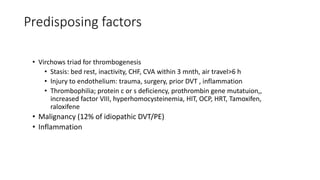
Predisposing factors
• Virchows triad for thrombogenesis
• Stasis: bed rest, inactivity, CHF, CVA within 3 mnth, air travel>6 h
• Injury to endothelium: trauma, surgery, prior DVT , inflammation
• Thrombophilia; protein c or s deficiency, prothrombin gene mutatuion,,
increased factor VIII, hyperhomocysteinemia, HIT, OCP, HRT, Tamoxifen,
raloxifene
• Malignancy (12% of idiopathic DVT/PE)
• Inflammation
• Obesity
• Hypertension
• Smoking
• Hypercholesterolemia
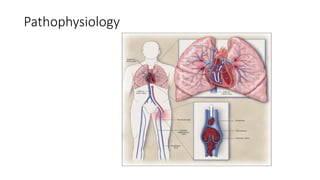
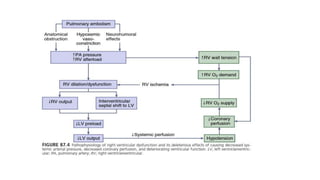
Pathophysiology
Symptoms
• Dyspnea(sudden onset) most common
• Chest pain(pleuritic or atypical)
• Anxiety
• Cough and hemoptysis
• Dizziness or syncope (due to right heart failure)
• Calf pain, swelling (>3cm compared with unaffected side)- DVT
Signs
• Tachypnea/tachycardia
• Hypoxia/cyanosis
• Low grade fever
• Cardiac :Gallop rhythm, Jugular venous distension, loud P2, RV heave,
widely split S2., TR.
• Hemoptysis
• Systemic hypotension and cardiogenic shock.
Signs of DVT
• Venous distension
• Erythema, warmth, tenderness
• Palpable cord
• Homan’s sign (calf pain on dorsiflexion, seen in <5%)
• Phlegmasia cerulea dolens
• Popliteal cyst may manifest as DVT
Long term complications
• Recurrent VTE
• Post PE syndrome
• Chronic thromboembolic pulmonary hypertension
• Post thrombotic syndrome (venous insufficiency)
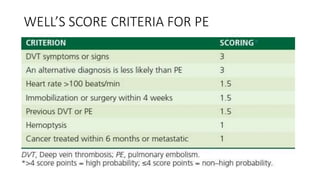
Assessment of clinical probability
• Clinical judgement lacks standardization , therefore clinical prediction rules have
been developed
• Commonly used is the one offered by Wells et al.
WELL’S SCORE CRITERIA FOR PE
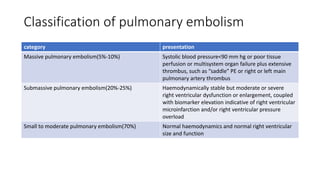
Classification of pulmonary embolism
category presentation
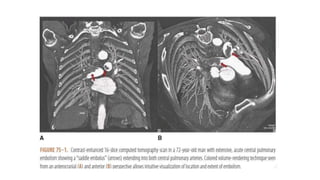
Massive pulmonary embolism(5%-10%) Systolic blood pressure<90 mm hg or poor tissue
perfusion or multisystem organ failure plus extensive
thrombus, such as “saddle” PE or right or left main
pulmonary artery thrombus
Submassive pulmonary embolism(20%-25%) Haemodynamically stable but moderate or severe
right ventricular dysfunction or enlargement, coupled
with biomarker elevation indicative of right ventricular
microinfarction and/or right ventricular pressure
overload
Small to moderate pulmonary embolism(70%) Normal haemodynamics and normal right ventricular
size and function
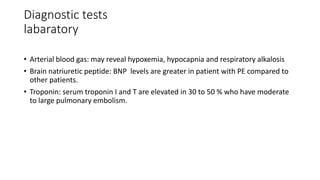
Diagnostic tests
labaratory
• Arterial blood gas: may reveal hypoxemia, hypocapnia and respiratory alkalosis
• Brain natriuretic peptide: BNP levels are greater in patient with PE compared to
other patients.
• Troponin: serum troponin I and T are elevated in 30 to 50 % who have moderate
to large pulmonary embolism.
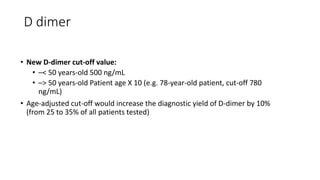
D dimer
• New D-dimer cut-off value:
• –< 50 years-old 500 ng/mL
• –> 50 years-old Patient age X 10 (e.g. 78-year-old patient, cut-off 780
ng/mL)
• Age-adjusted cut-off would increase the diagnostic yield of D-dimer by 10%
(from 25 to 35% of all patients tested)
ECG
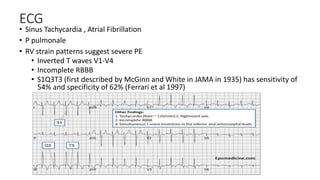
• Sinus Tachycardia , Atrial Fibrillation
• P pulmonale
• RV strain patterns suggest severe PE
• Inverted T waves V1-V4
• Incomplete RBBB
• S1Q3T3 (first described by McGinn and White in JAMA in 1935) has sensitivity of
54% and specificity of 62% (Ferrari et al 1997)
Diagnostic Tests
CXR
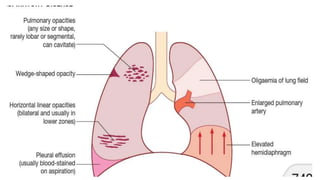
Chest radiograph findings in patient with pulmonary embolism
Result
Cardiomegaly
Normal study
Atelectasis
Elevated Hemidiaphragm
Pulmonary Artery Enlargement
Pleural Effusion
Parenchymal Pulmonary Infiltrate
• Echo
• Lung ultrasound
• CT Pulmonary Angiography
• V/Q Scan
• MR angiography
• Lower limb ultrasound
Treatment
• Respiratory support: supplemental oxygen if hypoxemia exists
• Hemodynamic support: patient with PE and hypotension, hemodynamic support
should be instituted
• Intravenous fluid administration
• Intravenous vasopressors: norepinephrine, dopamine or epinephrine may be
effective
• Dobutamine increases myocardial contractility and causes vasodilatation and
is ideal for cardiogenic shock
Treatment
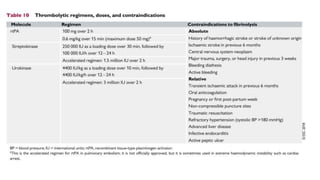
Thrombolytic treatment
• Thrombolysis
Treatment
Initiation of anticoagulation therapy
• Anticoagulation - parenteral anticoagulation [unfractionated heparin (UFH), low molecular
weight heparin (LMWH), or fondaparinux] over the first 5–10 days
• Parenteral heparin should overlap with the initiation of a vitamin K antagonist (VKA);
alternatively, it can be followed by administration of one of the new oral anticoagulants:
dabigatran or edoxaban. rivaroxaban or apixaban
• Oral treatment with one of these agents should be started directly or after a 1–2 day
administration of UFH, LMWH or fondaparinux
• In this latter case, acute-phase treatment consists of an increased dose of the oral
anticoagulant over the first 3 weeks (for rivaroxaban), or over the first 7 days (for apixaban)
Treatment
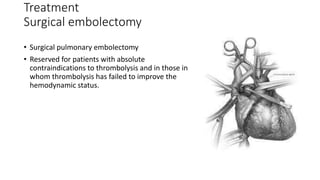
Surgical embolectomy
• Surgical pulmonary embolectomy
• Reserved for patients with absolute
contraindications to thrombolysis and in those in
whom thrombolysis has failed to improve the
hemodynamic status.
Treatment
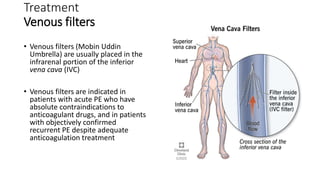
Venous filters
• Venous filters (Mobin Uddin
Umbrella) are usually placed in the
infrarenal portion of the inferior
vena cava (IVC)
• Venous filters are indicated in
patients with acute PE who have
absolute contraindications to
anticoagulant drugs, and in patients
with objectively confirmed
recurrent PE despite adequate
anticoagulation treatment
Mechanical VTE Prophylaxis
• Intermittent pneumatic compression
• Graduated compression stockings
Role in doubt
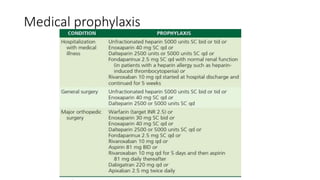
Medical prophylaxis
THANK YOU

Pulmonary Embolism for Nurses.pptx

  • 1.
    PULMONARY EMBOLISM ASRAF HUSSAIN MBBSMD DM CARDIOLOGY RESIDENT
  • 2.
    Definition • Pulmonary thromboembolism: • Thrombosis originating in venous system and embolizing to pulmonary arterial circulation.
  • 3.
    INTRODUCTION • PE contributesto 5 to 10% of deaths in hospitalized cases • Also accounts for 20-30% of deaths associated with pregnancy and delivery • Incidence increased to between 2 to 7 per 1000 population of age above 70 years.
  • 4.
    • About 70%of cases of Acute PE are caused by pelvic or leg thromboses. • DVT and PE are different presentations of the same underlying pathophysiological event i.e venous thromboembolism (VTE). • One of the big three cardiovascular killer along with MI and stroke.
  • 5.
    Predisposing factors • Virchowstriad for thrombogenesis • Stasis: bed rest, inactivity, CHF, CVA within 3 mnth, air travel>6 h • Injury to endothelium: trauma, surgery, prior DVT , inflammation • Thrombophilia; protein c or s deficiency, prothrombin gene mutatuion,, increased factor VIII, hyperhomocysteinemia, HIT, OCP, HRT, Tamoxifen, raloxifene • Malignancy (12% of idiopathic DVT/PE) • Inflammation
  • 6.
    • Obesity • Hypertension •Smoking • Hypercholesterolemia
  • 7.
  • 9.
    Symptoms • Dyspnea(sudden onset)most common • Chest pain(pleuritic or atypical) • Anxiety • Cough and hemoptysis • Dizziness or syncope (due to right heart failure) • Calf pain, swelling (>3cm compared with unaffected side)- DVT
  • 10.
    Signs • Tachypnea/tachycardia • Hypoxia/cyanosis •Low grade fever • Cardiac :Gallop rhythm, Jugular venous distension, loud P2, RV heave, widely split S2., TR. • Hemoptysis • Systemic hypotension and cardiogenic shock.
  • 11.
    Signs of DVT •Venous distension • Erythema, warmth, tenderness • Palpable cord • Homan’s sign (calf pain on dorsiflexion, seen in <5%) • Phlegmasia cerulea dolens • Popliteal cyst may manifest as DVT
  • 12.
    Long term complications •Recurrent VTE • Post PE syndrome • Chronic thromboembolic pulmonary hypertension • Post thrombotic syndrome (venous insufficiency)
  • 13.
    Assessment of clinicalprobability • Clinical judgement lacks standardization , therefore clinical prediction rules have been developed • Commonly used is the one offered by Wells et al.
  • 14.
  • 15.
    Classification of pulmonaryembolism category presentation Massive pulmonary embolism(5%-10%) Systolic blood pressure<90 mm hg or poor tissue perfusion or multisystem organ failure plus extensive thrombus, such as “saddle” PE or right or left main pulmonary artery thrombus Submassive pulmonary embolism(20%-25%) Haemodynamically stable but moderate or severe right ventricular dysfunction or enlargement, coupled with biomarker elevation indicative of right ventricular microinfarction and/or right ventricular pressure overload Small to moderate pulmonary embolism(70%) Normal haemodynamics and normal right ventricular size and function
  • 16.
    Diagnostic tests labaratory • Arterialblood gas: may reveal hypoxemia, hypocapnia and respiratory alkalosis • Brain natriuretic peptide: BNP levels are greater in patient with PE compared to other patients. • Troponin: serum troponin I and T are elevated in 30 to 50 % who have moderate to large pulmonary embolism.
  • 17.
    D dimer • NewD-dimer cut-off value: • –< 50 years-old 500 ng/mL • –> 50 years-old Patient age X 10 (e.g. 78-year-old patient, cut-off 780 ng/mL) • Age-adjusted cut-off would increase the diagnostic yield of D-dimer by 10% (from 25 to 35% of all patients tested)
  • 18.
    ECG • Sinus Tachycardia, Atrial Fibrillation • P pulmonale • RV strain patterns suggest severe PE • Inverted T waves V1-V4 • Incomplete RBBB • S1Q3T3 (first described by McGinn and White in JAMA in 1935) has sensitivity of 54% and specificity of 62% (Ferrari et al 1997)
  • 19.
    Diagnostic Tests CXR Chest radiographfindings in patient with pulmonary embolism Result Cardiomegaly Normal study Atelectasis Elevated Hemidiaphragm Pulmonary Artery Enlargement Pleural Effusion Parenchymal Pulmonary Infiltrate
  • 21.
    • Echo • Lungultrasound • CT Pulmonary Angiography • V/Q Scan • MR angiography • Lower limb ultrasound
  • 23.
    Treatment • Respiratory support:supplemental oxygen if hypoxemia exists • Hemodynamic support: patient with PE and hypotension, hemodynamic support should be instituted • Intravenous fluid administration • Intravenous vasopressors: norepinephrine, dopamine or epinephrine may be effective • Dobutamine increases myocardial contractility and causes vasodilatation and is ideal for cardiogenic shock
  • 24.
  • 26.
    Treatment Initiation of anticoagulationtherapy • Anticoagulation - parenteral anticoagulation [unfractionated heparin (UFH), low molecular weight heparin (LMWH), or fondaparinux] over the first 5–10 days • Parenteral heparin should overlap with the initiation of a vitamin K antagonist (VKA); alternatively, it can be followed by administration of one of the new oral anticoagulants: dabigatran or edoxaban. rivaroxaban or apixaban • Oral treatment with one of these agents should be started directly or after a 1–2 day administration of UFH, LMWH or fondaparinux • In this latter case, acute-phase treatment consists of an increased dose of the oral anticoagulant over the first 3 weeks (for rivaroxaban), or over the first 7 days (for apixaban)
  • 27.
    Treatment Surgical embolectomy • Surgicalpulmonary embolectomy • Reserved for patients with absolute contraindications to thrombolysis and in those in whom thrombolysis has failed to improve the hemodynamic status.
  • 28.
    Treatment Venous filters • Venousfilters (Mobin Uddin Umbrella) are usually placed in the infrarenal portion of the inferior vena cava (IVC) • Venous filters are indicated in patients with acute PE who have absolute contraindications to anticoagulant drugs, and in patients with objectively confirmed recurrent PE despite adequate anticoagulation treatment
  • 29.
    Mechanical VTE Prophylaxis •Intermittent pneumatic compression • Graduated compression stockings Role in doubt
  • 30.
  • 31.