CHRONIC DIARRHEA
Preceptor : Dr Nishav Raj Shahi
Presenter : Dr Parash mani Bhatta
Duration : 30 minutes
Objectives : At the end of session , participants will be able to
know how to approach the case of chronic diarrhea
CONTENT
1. DEFINITION
2. ETIOLOGY
3. APPROACH
4. MANAGEMENT
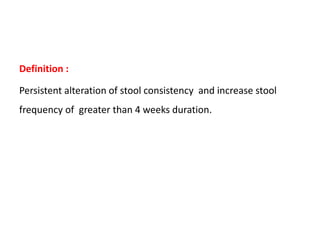
Definition :
Persistent alteration of stool consistency and increase stool
frequency of greater than 4 weeks duration.
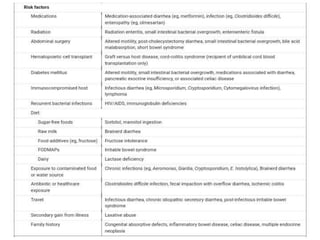
Causes of Chronic diarrhea
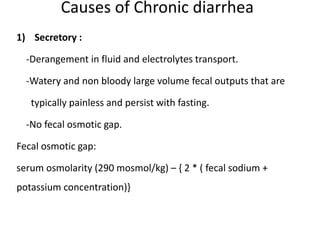
1) Secretory :
-Derangement in fluid and electrolytes transport.
-Watery and non bloody large volume fecal outputs that are
typically painless and persist with fasting.
-No fecal osmotic gap.
Fecal osmotic gap:
serum osmolarity (290 mosmol/kg) – { 2 * ( fecal sodium +
potassium concentration)}
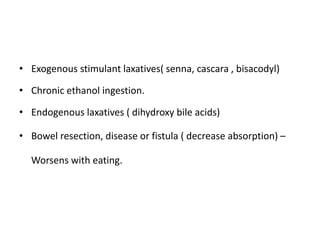
• Exogenous stimulant laxatives( senna, cascara , bisacodyl)
• Chronic ethanol ingestion.
• Endogenous laxatives ( dihydroxy bile acids)
• Bowel resection, disease or fistula ( decrease absorption) –
Worsens with eating.
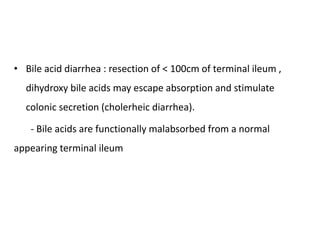
• Bile acid diarrhea : resection of < 100cm of terminal ileum ,
dihydroxy bile acids may escape absorption and stimulate
colonic secretion (cholerheic diarrhea).
- Bile acids are functionally malabsorbed from a normal
appearing terminal ileum
• Hormone producing tumor ( carcinoid, VIPoma, Medullary
cancer thyroid , mastocytosis, gastrinoma, colorectal villous
adenoma)
• Addison disease
• Oral angiotensin receptor blocker , olmesartan.
2 ) Osmotic:
-Poorly absorbable osmotically active solutes draw enough fluid into lumen
to exceed reabsorptive capacity of colon.
-Fecal osmotic gap ( >50 mosmol/L)
-Fecal water output increases .
-Less voluminous .
-Caeses with fasting/discontinuation of causitive agent.
• Osmotic laxatives( Magnesium, phosphate and sulfate)
• Lactase deficiency
• Gluten and FODMAP intolerance
• Nonabsorbable carbohydrates ( sorbitol, lactulose, polyethylene glycol)
3) Steatorrheal:
-Steatorrhea is defined as stool fat exceeding normal
7g/day
• Intraluminal maldigestion( pancreatic exocrine insufficiency-
chronic pancreatitis, bacterial overgrowth, bariartic surgery,
liver disease)
• Mucosal malabsorption ( celiac sprue, whipple’s disease,
infections, abetalipoprotenemia, drug induced enteropathy,
ischemia)
• Post mucosal lymphatic obstruction
4) Inflammatory:
-Characterized by pain , fever and bleeding.
• Idiopathic inflammatory bowel disease ( crohn’s disease,
ulcerative colitis)
• Infection ( Selective IgA deficiency or common variable
hypogammaglobulinemia, eosinophilic gastroenteritis, history
of clostridiodes infection, invasive bacteria , viruses and
parasites, Brainerd diarrhea)
• Gastrointestinal malignancies
• Radiation injury
5) Dysmotility
• Irritable bowel syndrome.
• Carcinoid syndrome.
• Hyperthyroidism.
• Drugs ( prokinetic agents).
• Postvagotomy.
6)Factitial:
• Munchausen ( self injury for secondary gain)
• Eating disorders
7) Iatrogenic:
• Cholecyctectomy
• Ileal resection
• Bariartic surgery
• Vagotomy, fundoplication
Approach to the patient
History
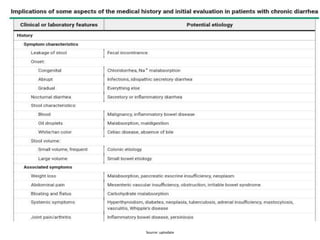
Characterstic symptoms:
Stool characterstics-
Fat malabsorption -Greasy stools that float and malodorous.
Inflammatory cause : presence of visible blood.
Carbohydrate malabsorption (lactose):
watery diarrhea , excess flatus and bloating .
• Duration of symptoms , nature of onset ( sudden or gradual )
• Diarrhea during fasting or at night suggests secretory or
inflammatory diarrhea .
• Voluminous watery diarrhea- disorder in small bowel.
• small volume frequent diarrhea - disorders of colon.
• Presence of bloody diarrhea favors colonic versus small bowel
disorder.
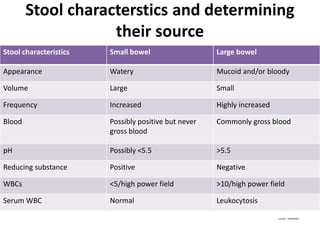
Stool characterstics and determining
their source
source : medscape
Stool characteristics Small bowel Large bowel
Appearance Watery Mucoid and/or bloody
Volume Large Small
Frequency Increased Highly increased
Blood Possibly positive but never
gross blood
Commonly gross blood
pH Possibly <5.5 >5.5
Reducing substance Positive Negative
WBCs <5/high power field >10/high power field
Serum WBC Normal Leukocytosis
• Weight loss and fever, joint pain , mouth ulcers , eye redness
indicate IBD
• Association of stress and depression : Irritable bowel
syndrome(IBS)
IBS – chronic abdominal pain and diarrhea , constipation or
normal bowel habits alternating with either diarrhea or
constipation
Physical examination
• Features to suggest malabsorption or inflammatory bowel
disease such as anemia , dermatitis herpetiformis , edema or
clubbing.
• Look for autonomic neuropathy, collagen vascular disease in
pupils , orthostasis, skin, hands or joints?
• Abdominal mass or tenderness
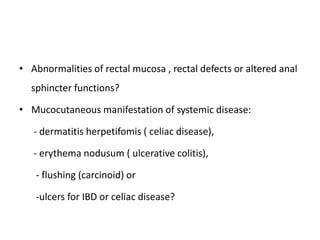
• Abnormalities of rectal mucosa , rectal defects or altered anal
sphincter functions?
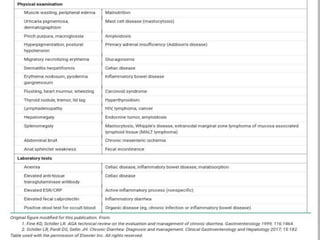
• Mucocutaneous manifestation of systemic disease:
- dermatitis herpetifomis ( celiac disease),
- erythema nodusum ( ulcerative colitis),
- flushing (carcinoid) or
-ulcers for IBD or celiac disease?
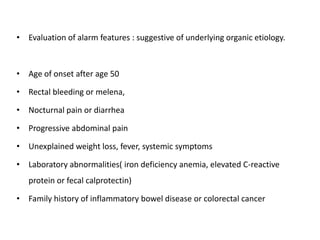
• Evaluation of alarm features : suggestive of underlying organic etiology.
• Age of onset after age 50
• Rectal bleeding or melena,
• Nocturnal pain or diarrhea
• Progressive abdominal pain
• Unexplained weight loss, fever, systemic symptoms
• Laboratory abnormalities( iron deficiency anemia, elevated C-reactive
protein or fecal calprotectin)
• Family history of inflammatory bowel disease or colorectal cancer
Source: uptodate
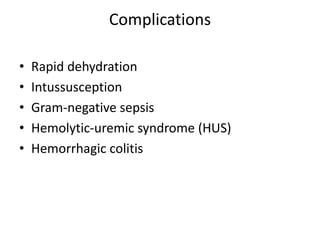
Complications
• Rapid dehydration
• Intussusception
• Gram-negative sepsis
• Hemolytic-uremic syndrome (HUS)
• Hemorrhagic colitis
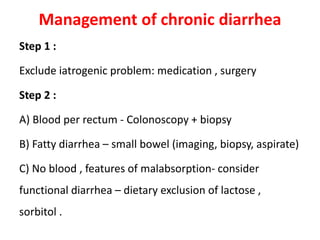
Management of chronic diarrhea
Step 1 :
Exclude iatrogenic problem: medication , surgery
Step 2 :
A) Blood per rectum - Colonoscopy + biopsy
B) Fatty diarrhea – small bowel (imaging, biopsy, aspirate)
C) No blood , features of malabsorption- consider
functional diarrhea – dietary exclusion of lactose ,
sorbitol .
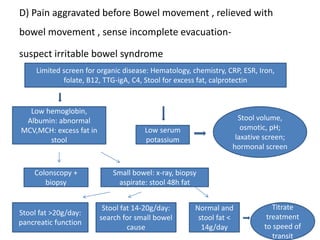
D) Pain aggravated before Bowel movement , relieved with
bowel movement , sense incomplete evacuation-
suspect irritable bowel syndrome
Limited screen for organic disease: Hematology, chemistry, CRP, ESR, Iron,
folate, B12, TTG-igA, C4, Stool for excess fat, calprotectin
Low hemoglobin,
Albumin: abnormal
MCV,MCH: excess fat in
stool
Low serum
potassium
Stool volume,
osmotic, pH;
laxative screen;
hormonal screen
Colonscopy +
biopsy
Small bowel: x-ray, biopsy
aspirate: stool 48h fat
Stool fat >20g/day:
pancreatic function
Stool fat 14-20g/day:
search for small bowel
cause
Normal and
stool fat <
14g/day
Titrate
treatment
to speed of
transit
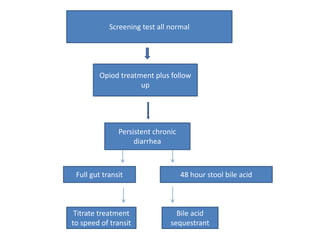
Screening test all normal
Opiod treatment plus follow
up
Persistent chronic
diarrhea
Full gut transit 48 hour stool bile acid
Titrate treatment
to speed of transit
Bile acid
sequestrant
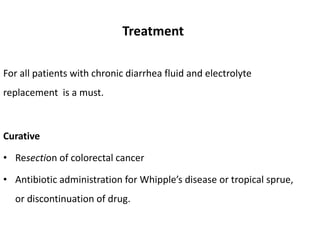
Treatment
For all patients with chronic diarrhea fluid and electrolyte
replacement is a must.
Curative
• Resection of colorectal cancer
• Antibiotic administration for Whipple’s disease or tropical sprue,
or discontinuation of drug.
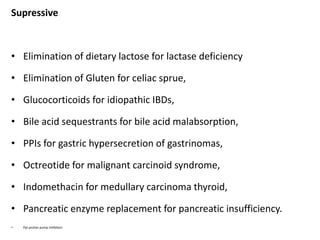
Supressive
• Elimination of dietary lactose for lactase deficiency
• Elimination of Gluten for celiac sprue,
• Glucocorticoids for idiopathic IBDs,
• Bile acid sequestrants for bile acid malabsorption,
• PPIs for gastric hypersecretion of gastrinomas,
• Octreotide for malignant carcinoid syndrome,
• Indomethacin for medullary carcinoma thyroid,
• Pancreatic enzyme replacement for pancreatic insufficiency.
• Ppi-proton pump inhibitors
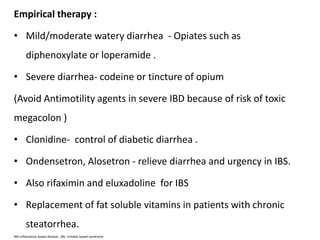
Empirical therapy :
• Mild/moderate watery diarrhea - Opiates such as
diphenoxylate or loperamide .
• Severe diarrhea- codeine or tincture of opium
(Avoid Antimotility agents in severe IBD because of risk of toxic
megacolon )
• Clonidine- control of diabetic diarrhea .
• Ondensetron, Alosetron - relieve diarrhea and urgency in IBS.
• Also rifaximin and eluxadoline for IBS
• Replacement of fat soluble vitamins in patients with chronic
steatorrhea.
IBD-inflamatory bowel disease , IBS- irritable bowel syndrome
SOURCE
• Harrison’s Principles Of Internal Medicine,
-20th edition.
• UpToDate.
• Medscape.
Chronic diarrhea

Chronic diarrhea

  • 1.
    CHRONIC DIARRHEA Preceptor :Dr Nishav Raj Shahi Presenter : Dr Parash mani Bhatta
  • 2.
    Duration : 30minutes Objectives : At the end of session , participants will be able to know how to approach the case of chronic diarrhea
  • 3.
  • 4.
    Definition : Persistent alterationof stool consistency and increase stool frequency of greater than 4 weeks duration.
  • 5.
    Causes of Chronicdiarrhea 1) Secretory : -Derangement in fluid and electrolytes transport. -Watery and non bloody large volume fecal outputs that are typically painless and persist with fasting. -No fecal osmotic gap. Fecal osmotic gap: serum osmolarity (290 mosmol/kg) – { 2 * ( fecal sodium + potassium concentration)}
  • 6.
    • Exogenous stimulantlaxatives( senna, cascara , bisacodyl) • Chronic ethanol ingestion. • Endogenous laxatives ( dihydroxy bile acids) • Bowel resection, disease or fistula ( decrease absorption) – Worsens with eating.
  • 7.
    • Bile aciddiarrhea : resection of < 100cm of terminal ileum , dihydroxy bile acids may escape absorption and stimulate colonic secretion (cholerheic diarrhea). - Bile acids are functionally malabsorbed from a normal appearing terminal ileum
  • 8.
    • Hormone producingtumor ( carcinoid, VIPoma, Medullary cancer thyroid , mastocytosis, gastrinoma, colorectal villous adenoma) • Addison disease • Oral angiotensin receptor blocker , olmesartan.
  • 9.
    2 ) Osmotic: -Poorlyabsorbable osmotically active solutes draw enough fluid into lumen to exceed reabsorptive capacity of colon. -Fecal osmotic gap ( >50 mosmol/L) -Fecal water output increases . -Less voluminous . -Caeses with fasting/discontinuation of causitive agent. • Osmotic laxatives( Magnesium, phosphate and sulfate) • Lactase deficiency • Gluten and FODMAP intolerance • Nonabsorbable carbohydrates ( sorbitol, lactulose, polyethylene glycol)
  • 10.
    3) Steatorrheal: -Steatorrhea isdefined as stool fat exceeding normal 7g/day • Intraluminal maldigestion( pancreatic exocrine insufficiency- chronic pancreatitis, bacterial overgrowth, bariartic surgery, liver disease) • Mucosal malabsorption ( celiac sprue, whipple’s disease, infections, abetalipoprotenemia, drug induced enteropathy, ischemia) • Post mucosal lymphatic obstruction
  • 11.
    4) Inflammatory: -Characterized bypain , fever and bleeding. • Idiopathic inflammatory bowel disease ( crohn’s disease, ulcerative colitis) • Infection ( Selective IgA deficiency or common variable hypogammaglobulinemia, eosinophilic gastroenteritis, history of clostridiodes infection, invasive bacteria , viruses and parasites, Brainerd diarrhea) • Gastrointestinal malignancies • Radiation injury
  • 12.
    5) Dysmotility • Irritablebowel syndrome. • Carcinoid syndrome. • Hyperthyroidism. • Drugs ( prokinetic agents). • Postvagotomy.
  • 13.
    6)Factitial: • Munchausen (self injury for secondary gain) • Eating disorders
  • 14.
    7) Iatrogenic: • Cholecyctectomy •Ileal resection • Bariartic surgery • Vagotomy, fundoplication
  • 15.
    Approach to thepatient History Characterstic symptoms: Stool characterstics- Fat malabsorption -Greasy stools that float and malodorous. Inflammatory cause : presence of visible blood. Carbohydrate malabsorption (lactose): watery diarrhea , excess flatus and bloating .
  • 16.
    • Duration ofsymptoms , nature of onset ( sudden or gradual ) • Diarrhea during fasting or at night suggests secretory or inflammatory diarrhea . • Voluminous watery diarrhea- disorder in small bowel. • small volume frequent diarrhea - disorders of colon. • Presence of bloody diarrhea favors colonic versus small bowel disorder.
  • 17.
    Stool characterstics anddetermining their source source : medscape Stool characteristics Small bowel Large bowel Appearance Watery Mucoid and/or bloody Volume Large Small Frequency Increased Highly increased Blood Possibly positive but never gross blood Commonly gross blood pH Possibly <5.5 >5.5 Reducing substance Positive Negative WBCs <5/high power field >10/high power field Serum WBC Normal Leukocytosis
  • 18.
    • Weight lossand fever, joint pain , mouth ulcers , eye redness indicate IBD • Association of stress and depression : Irritable bowel syndrome(IBS) IBS – chronic abdominal pain and diarrhea , constipation or normal bowel habits alternating with either diarrhea or constipation
  • 19.
    Physical examination • Featuresto suggest malabsorption or inflammatory bowel disease such as anemia , dermatitis herpetiformis , edema or clubbing. • Look for autonomic neuropathy, collagen vascular disease in pupils , orthostasis, skin, hands or joints? • Abdominal mass or tenderness
  • 20.
    • Abnormalities ofrectal mucosa , rectal defects or altered anal sphincter functions? • Mucocutaneous manifestation of systemic disease: - dermatitis herpetifomis ( celiac disease), - erythema nodusum ( ulcerative colitis), - flushing (carcinoid) or -ulcers for IBD or celiac disease?
  • 21.
    • Evaluation ofalarm features : suggestive of underlying organic etiology. • Age of onset after age 50 • Rectal bleeding or melena, • Nocturnal pain or diarrhea • Progressive abdominal pain • Unexplained weight loss, fever, systemic symptoms • Laboratory abnormalities( iron deficiency anemia, elevated C-reactive protein or fecal calprotectin) • Family history of inflammatory bowel disease or colorectal cancer
  • 22.
  • 25.
    Complications • Rapid dehydration •Intussusception • Gram-negative sepsis • Hemolytic-uremic syndrome (HUS) • Hemorrhagic colitis
  • 26.
    Management of chronicdiarrhea Step 1 : Exclude iatrogenic problem: medication , surgery Step 2 : A) Blood per rectum - Colonoscopy + biopsy B) Fatty diarrhea – small bowel (imaging, biopsy, aspirate) C) No blood , features of malabsorption- consider functional diarrhea – dietary exclusion of lactose , sorbitol .
  • 27.
    D) Pain aggravatedbefore Bowel movement , relieved with bowel movement , sense incomplete evacuation- suspect irritable bowel syndrome Limited screen for organic disease: Hematology, chemistry, CRP, ESR, Iron, folate, B12, TTG-igA, C4, Stool for excess fat, calprotectin Low hemoglobin, Albumin: abnormal MCV,MCH: excess fat in stool Low serum potassium Stool volume, osmotic, pH; laxative screen; hormonal screen Colonscopy + biopsy Small bowel: x-ray, biopsy aspirate: stool 48h fat Stool fat >20g/day: pancreatic function Stool fat 14-20g/day: search for small bowel cause Normal and stool fat < 14g/day Titrate treatment to speed of transit
  • 28.
    Screening test allnormal Opiod treatment plus follow up Persistent chronic diarrhea Full gut transit 48 hour stool bile acid Titrate treatment to speed of transit Bile acid sequestrant
  • 29.
    Treatment For all patientswith chronic diarrhea fluid and electrolyte replacement is a must. Curative • Resection of colorectal cancer • Antibiotic administration for Whipple’s disease or tropical sprue, or discontinuation of drug.
  • 30.
    Supressive • Elimination ofdietary lactose for lactase deficiency • Elimination of Gluten for celiac sprue, • Glucocorticoids for idiopathic IBDs, • Bile acid sequestrants for bile acid malabsorption, • PPIs for gastric hypersecretion of gastrinomas, • Octreotide for malignant carcinoid syndrome, • Indomethacin for medullary carcinoma thyroid, • Pancreatic enzyme replacement for pancreatic insufficiency. • Ppi-proton pump inhibitors
  • 31.
    Empirical therapy : •Mild/moderate watery diarrhea - Opiates such as diphenoxylate or loperamide . • Severe diarrhea- codeine or tincture of opium (Avoid Antimotility agents in severe IBD because of risk of toxic megacolon ) • Clonidine- control of diabetic diarrhea . • Ondensetron, Alosetron - relieve diarrhea and urgency in IBS. • Also rifaximin and eluxadoline for IBS • Replacement of fat soluble vitamins in patients with chronic steatorrhea. IBD-inflamatory bowel disease , IBS- irritable bowel syndrome
  • 32.
    SOURCE • Harrison’s PrinciplesOf Internal Medicine, -20th edition. • UpToDate. • Medscape.

Editor's Notes

  • #6 Inadequate surface for reabsorption of secreted fluids and electrolytes.
  • #11 Daily fecal fat averages 15-25 g/day, steatorrhea is greasy foul smeliing difficult to flush diarrhea associated with weight loss and nutritional deficiencies due to concomitant malabsorption of amino acids and vitamins/.
  • #12 Elevated fetal calprotectin protein found in neutrophil granulocytes.
  • #22 All patient with alarm features requires endoscopic evaluation for organic disorders
  • #28 Fecal calprotectin level are increased in intestinal inflammation and may be useful for distinguishing inflammatory and non inflm cause . Calprotectin is zinc and calcium binding protein derived from neutrophil and monocyte
  • #32 a mixed mew opiod receptor and kappa receptor agonist and delta antagonist