NAME         : ADNAN ABDULLAH
REG NO       : 12856
COURSE       : PSYCHOLOGY
DATE         : 30-09-2010
DAY         : Thursday 12-03
PROFESSOR   : Dr. R.A Shah


                                1
 NEO-FREUDIAN PYSCHOANALYST

 TRAIT APPROACHES

 LEARNING THEORIES


                               2
 The Neo-Freudian psychologists were a group
  of loosely linked American theorists of the mid-
  twentieth century thinkers who agreed with the
  basis of Freud's psychoanalytic theory, but
  changed and adapted the theory to incorporate
  their own beliefs, ideas and theories.

 Psychologist Sigmund Freud proposed a
  number of ideas that were highly controversial,
  but also attracted a number of followers.

                                                     3
 Many of these thinkers agreed with Freud's
  concept of the unconscious mind and the
  importance of early childhood. However, there
  were also a number of points that other thinkers
  disagreed with or directly rejected.

The neo-freudian placed great emphasis on
 EGO suggesting that it has more control on our
 day to day activities than ID has.

Also paid greater attention on Social factors that
 effects the personality development.

                                                     4
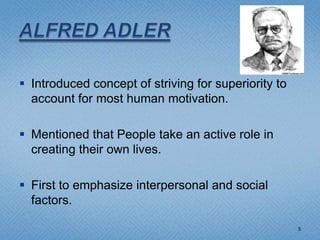
 Introduced concept of striving for superiority to
  account for most human motivation.

 Mentioned that People take an active role in
  creating their own lives.

 First to emphasize interpersonal and social
  factors.

                                                      5
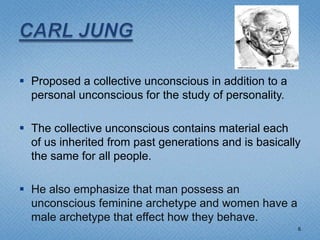
 Proposed a collective unconscious in addition to a
  personal unconscious for the study of personality.

 The collective unconscious contains material each
  of us inherited from past generations and is basically
  the same for all people.

 He also emphasize that man possess an
  unconscious feminine archetype and women have a
  male archetype that effect how they behave.
                                                       6
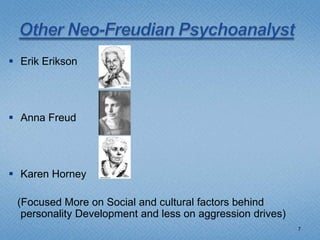
 Erik Erikson


 Anna Freud


 Karen Horney

 (Focused More on Social and cultural factors behind
  personality Development and less on aggression drives)
                                                           7
 The trait approach to personality is one of the major
  theoretical areas in the study of personality. The trait theory
  suggests that individual personalities are composed broad
  dispositions. Consider how you would describe the personality
  of a close friend. Chances are that you would list a number of
  traits, such as outgoing, kind and even-tempered. A trait can
  be thought of as a relatively stable characteristic that causes
  individuals to behave in certain ways.

 Gordon Allport’s Trait Theory
   In 1936, psychologist Gordon Allports found that one English-
  language dictionary alone contained more than 4,000 words
  describing different personality traits. He categorized these
  traits into three levels:


                                                                8
i.   Cardinal traits :Traits that dominate an
     individual’s whole life, often to the point that the
     person becomes known specifically for these traits.
ii. Central Traits: These are the general
     characteristics that form the basic foundations of
     personality. These central traits, while not as
     dominating as cardinal traits, are the major
     characteristics you might use to describe another
     person.
iii. Secondary Traits: These are the traits that are
     sometimes related to attitudes or preferences and
     often appear only in certain situations or under
     specific circumstances.

                                                        9
 Raymond Cattell’s Sixteen Personality Factor
  Questionnaire:-

 Trait theorist Raymond cattell reduced the number of
  main personality traits from Allport’s initial list of over
  4,000 down to 16 key personality traits.

 According to Cattell’s, these 16 traits are the source of
  all human personality. He also developed one of the
  most widely used personality assessments known as
  the Sixteen Personality Factor Questionnaire (16PF).


                                                          10
Eysenck’s Three Dimensions of Personality:

British psychologist Hans Eysenck developed a model of personality based upon
on three universal traits:

1) Introversion/Extraversion:
   Introversion involves directing attention on inner experiences, while
   extraversion relates to focusing attention outward on other people and the
   environment.

2) Neuroticism/Emotional Stability:
   This dimension of Eysenck’s trait theory is related to moodiness versus even-
   temperedness.

3) Psychoticism:
   Later, after studying individuals suffering from mental illness, Eysenck added a
   personality dimension he called psychoticism to his trait theory.


                                                                                 11
Hold that people behaviour is guided by thought,
   expectancies, learning, and the environment.
Expectancies
• What a person anticipates in a situation or as a
   result of behaving in certain ways.
Performance standards
• Individually determined standards by which to
   judge one’s own behaviour.

                                                 12

Psychology theories

  • 1.
    NAME : ADNAN ABDULLAH REG NO : 12856 COURSE : PSYCHOLOGY DATE : 30-09-2010 DAY : Thursday 12-03 PROFESSOR : Dr. R.A Shah 1
  • 2.
     NEO-FREUDIAN PYSCHOANALYST TRAIT APPROACHES  LEARNING THEORIES 2
  • 3.
     The Neo-Freudianpsychologists were a group of loosely linked American theorists of the mid- twentieth century thinkers who agreed with the basis of Freud's psychoanalytic theory, but changed and adapted the theory to incorporate their own beliefs, ideas and theories.  Psychologist Sigmund Freud proposed a number of ideas that were highly controversial, but also attracted a number of followers. 3
  • 4.
     Many ofthese thinkers agreed with Freud's concept of the unconscious mind and the importance of early childhood. However, there were also a number of points that other thinkers disagreed with or directly rejected. The neo-freudian placed great emphasis on EGO suggesting that it has more control on our day to day activities than ID has. Also paid greater attention on Social factors that effects the personality development. 4
  • 5.
     Introduced conceptof striving for superiority to account for most human motivation.  Mentioned that People take an active role in creating their own lives.  First to emphasize interpersonal and social factors. 5
  • 6.
     Proposed acollective unconscious in addition to a personal unconscious for the study of personality.  The collective unconscious contains material each of us inherited from past generations and is basically the same for all people.  He also emphasize that man possess an unconscious feminine archetype and women have a male archetype that effect how they behave. 6
  • 7.
     Erik Erikson Anna Freud  Karen Horney (Focused More on Social and cultural factors behind personality Development and less on aggression drives) 7
  • 8.
     The traitapproach to personality is one of the major theoretical areas in the study of personality. The trait theory suggests that individual personalities are composed broad dispositions. Consider how you would describe the personality of a close friend. Chances are that you would list a number of traits, such as outgoing, kind and even-tempered. A trait can be thought of as a relatively stable characteristic that causes individuals to behave in certain ways.  Gordon Allport’s Trait Theory In 1936, psychologist Gordon Allports found that one English- language dictionary alone contained more than 4,000 words describing different personality traits. He categorized these traits into three levels: 8
  • 9.
    i. Cardinal traits :Traits that dominate an individual’s whole life, often to the point that the person becomes known specifically for these traits. ii. Central Traits: These are the general characteristics that form the basic foundations of personality. These central traits, while not as dominating as cardinal traits, are the major characteristics you might use to describe another person. iii. Secondary Traits: These are the traits that are sometimes related to attitudes or preferences and often appear only in certain situations or under specific circumstances. 9
  • 10.
     Raymond Cattell’sSixteen Personality Factor Questionnaire:-  Trait theorist Raymond cattell reduced the number of main personality traits from Allport’s initial list of over 4,000 down to 16 key personality traits.  According to Cattell’s, these 16 traits are the source of all human personality. He also developed one of the most widely used personality assessments known as the Sixteen Personality Factor Questionnaire (16PF). 10
  • 11.
    Eysenck’s Three Dimensionsof Personality: British psychologist Hans Eysenck developed a model of personality based upon on three universal traits: 1) Introversion/Extraversion: Introversion involves directing attention on inner experiences, while extraversion relates to focusing attention outward on other people and the environment. 2) Neuroticism/Emotional Stability: This dimension of Eysenck’s trait theory is related to moodiness versus even- temperedness. 3) Psychoticism: Later, after studying individuals suffering from mental illness, Eysenck added a personality dimension he called psychoticism to his trait theory. 11
  • 12.
    Hold that peoplebehaviour is guided by thought, expectancies, learning, and the environment. Expectancies • What a person anticipates in a situation or as a result of behaving in certain ways. Performance standards • Individually determined standards by which to judge one’s own behaviour. 12