Chapter 2

Behavioral
Neuroscience

Copyright © Prentice Hall 2007

2-1
Behavioral Neuroscience
• Why study this in psychology?
• How can it help us understand the goals of
psychology?
• Goals
– Describe
– Understand
– Predict
– Control or modify
• Behaviors & thoughts
Biology and Behavior
• Behavioral neuroscience
– Studies
• Relation between biological & psychological
functions

–Can help us understand
• Nature of personality
• Causes of abnormal behavior
• Reaction to stress
• Effectiveness of therapy
Copyright © Prentice Hall 2007

2-3
Historical View of the Brain
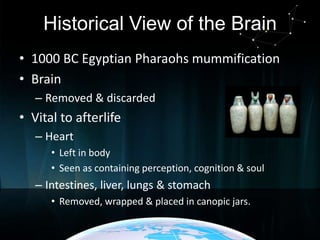
• 1000 BC Egyptian Pharaohs mummification
• Brain
– Removed & discarded

• Vital to afterlife
– Heart
• Left in body
• Seen as containing perception, cognition & soul

– Intestines, liver, lungs & stomach
• Removed, wrapped & placed in canopic jars.
Historical View of the Brain
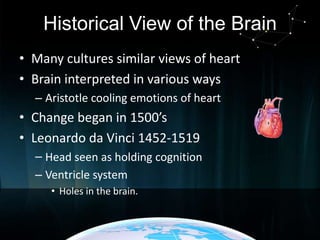
• Many cultures similar views of heart
• Brain interpreted in various ways
– Aristotle cooling emotions of heart

• Change began in 1500’s
• Leonardo da Vinci 1452-1519
– Head seen as holding cognition
– Ventricle system
• Holes in the brain.
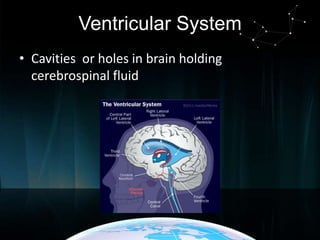
Ventricular System
• Cavities or holes in brain holding
cerebrospinal fluid
Mrs. Garrison’s Theory of Evolution
Evolutionary Psychology
• Focuses on
– Adapted benefits of selected behaviors
• Women
– Talk
– Multi-task
» Women larger area for communication

• Men
– Quiet
– Singularly focused
» Larger area of brain for sex
Evolutionary Psychology
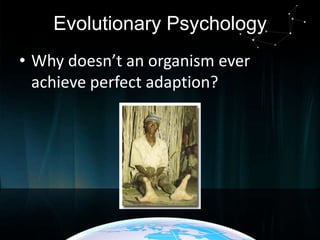
• Why doesn’t an organism ever
achieve perfect adaption?
Evolutionary Psychology
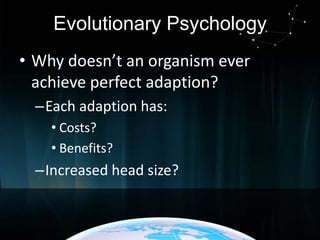
• Why doesn’t an organism ever
achieve perfect adaption?
–Each adaption has:
• Costs?
• Benefits?

–Increased head size?
Evolution
Evolution Does :

• Works to improve
reproduction success

Evolution Doesn’t:

• Work to improve a
species
• Have a conscious plan
or purpose
• Work to produce
happiness or
contentment
Evolutionary Psychology
• Natural Selection & Adaptive Behavior
– Natural selection
• Evolutionary process by which those individuals of a
species that are best adapted are the ones that survive
& reproduce

– Survivors better adapted to world than nonsurvivors
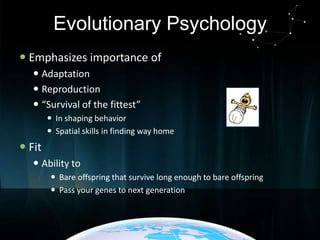
Evolutionary Psychology
ď‚— Emphasizes importance of
ď‚— Adaptation
ď‚— Reproduction
 “Survival of the fittest”
ď‚— In shaping behavior
ď‚— Spatial skills in finding way home

ď‚— Fit
ď‚— Ability to
ď‚— Bare offspring that survive long enough to bare offspring
ď‚— Pass your genes to next generation
Biology and Behavior
• Scientists who study this:
– Represent several disciplines
• Psychology (especially physiological
psychologists)
• Biology
• Medicine
• Others

Copyright © Prentice Hall 2007

2-14
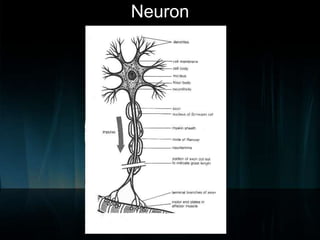
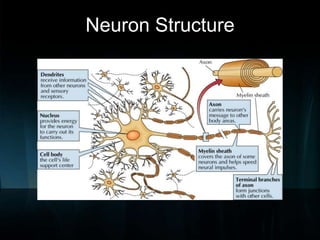
Neuron
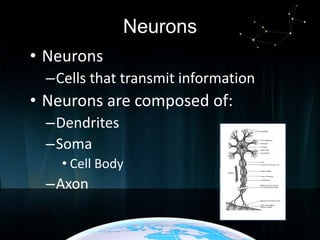
Neurons
• Neurons
–Cells that transmit information

• Neurons are composed of:
–Dendrites
–Soma
• Cell Body

–Axon
Neuron Structure
Myelin Sheath
• Myelin Sheath
– Composed of glial cells
• (Greek word for “glue”)

– Coats axon of some neurons
– White matter of brain
– Functions:
•
•
•
•
•
•

Speeds neurotransmission
Insulates neurons from each other
Makes neurotransmission more efficient
Removes waste
Occupies vacant space when neurons die
Other purposes

Copyright © Prentice Hall 2007

2-18
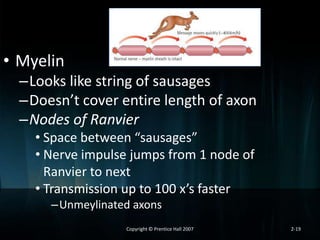
• Myelin
–Looks like string of sausages
–Doesn’t cover entire length of axon
–Nodes of Ranvier
• Space between “sausages”
• Nerve impulse jumps from 1 node of
Ranvier to next
• Transmission up to 100 x’s faster
–Unmeylinated axons
Copyright © Prentice Hall 2007

2-19
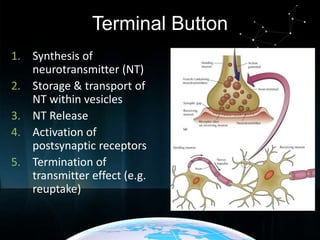
Terminal Button
1. Synthesis of
neurotransmitter (NT)
2. Storage & transport of
NT within vesicles
3. NT Release
4. Activation of
postsynaptic receptors
5. Termination of
transmitter effect (e.g.
reuptake)
Neurotransmitters
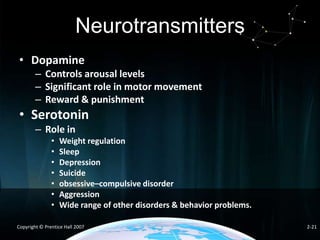
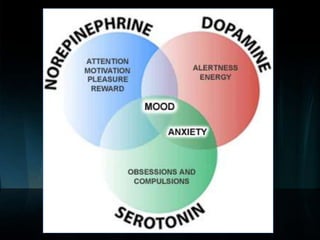
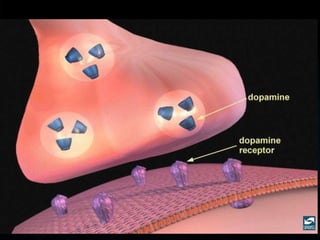
• Dopamine
– Controls arousal levels
– Significant role in motor movement
– Reward & punishment

• Serotonin
– Role in
•
•
•
•
•
•
•

Weight regulation
Sleep
Depression
Suicide
obsessive–compulsive disorder
Aggression
Wide range of other disorders & behavior problems.

Copyright © Prentice Hall 2007

2-21
Neurotransmitters
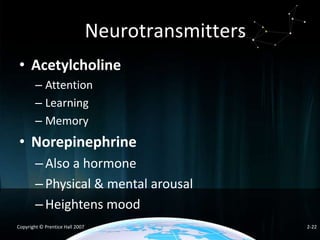
• Acetylcholine
– Attention
– Learning
– Memory

• Norepinephrine
– Also a hormone
– Physical & mental arousal
– Heightens mood
Copyright © Prentice Hall 2007

2-22
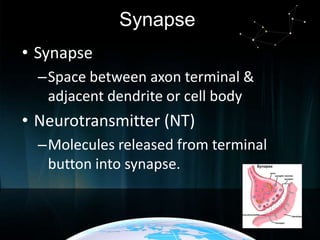
Synapse
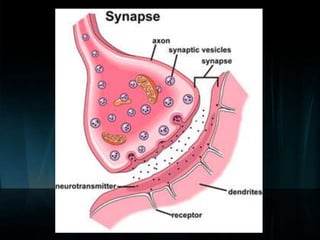
• Synapse
–Space between axon terminal &
adjacent dendrite or cell body

• Neurotransmitter (NT)
–Molecules released from terminal
button into synapse.
Neurons: Basic Cells of the
Nervous System
• Synapses
– Cleared rapidly
• So additional signals can be transmitted

• Cleared in 1 of 2 ways, depending on
neurotransmitter
– 1. breakdown
• Broken down & removed

– 2. Reuptake
• Recycled back into vesicles
Copyright © Prentice Hall 2007

2-26
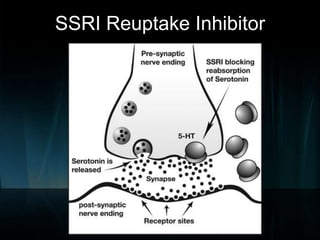
SSRI Reuptake Inhibitor
• SSRIs block reuptake of serotonin
• Called selective
– Primarily affect serotonin

• Changes balance of serotonin
SSRI Reuptake Inhibitor
• Generic names followed by brand names
– Citalopram (Celexa)
– Escitalopram (Lexapro)
– Fluoxetine (Prozac, Prozac Weekly, Sarafem)
– Paroxetine (Paxil, Paxil CR, Pexeva)
– Sertraline (Zoloft)
– Fluoxetine combined with the atypical
antipsychotic olanzapine (Symbyax)
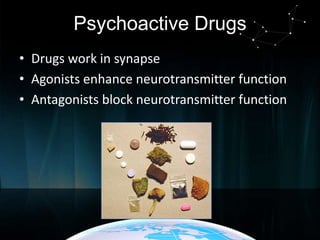
Psychoactive Drugs
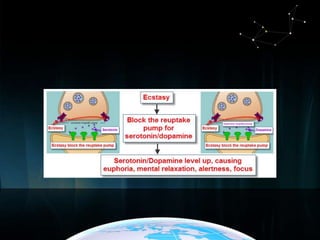
• Drugs work in synapse
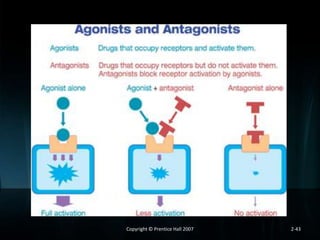
• Agonists enhance neurotransmitter function
• Antagonists block neurotransmitter function
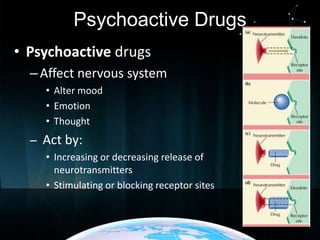
Psychoactive Drugs
• Psychoactive drugs
– Affect nervous system
• Alter mood
• Emotion
• Thought

– Act by:
• Increasing or decreasing release of
neurotransmitters
• Stimulating or blocking receptor sites
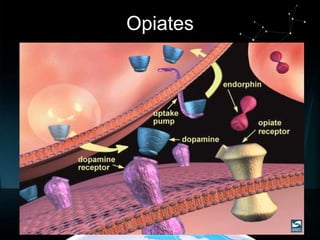
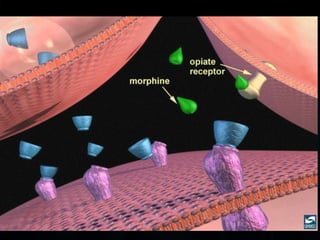
Opiates
Opiates binding to opiate
receptors
• Increased dopamine release
Neurons: Basic Cells of the
Nervous System
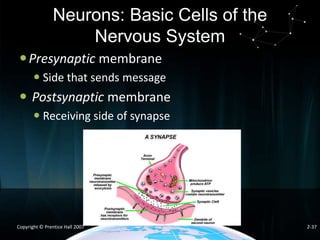
ď‚— Presynaptic membrane
ď‚— Side that sends message

ď‚— Postsynaptic membrane
ď‚— Receiving side of synapse

Copyright © Prentice Hall 2007

2-37
Neurons: Basic Cells of the
Nervous System
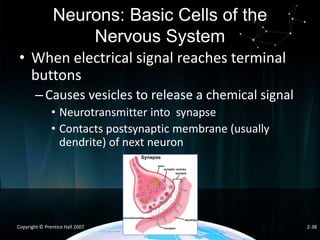
• When electrical signal reaches terminal
buttons
– Causes vesicles to release a chemical signal
• Neurotransmitter into synapse
• Contacts postsynaptic membrane (usually
dendrite) of next neuron

Copyright © Prentice Hall 2007

2-38
Neurons: Basic Cells of the
Nervous System
• Excitation
– More likely to transmit the message to
subsequent neurons

• Inhibition
– Less likely to transmit the message to subsequent
neurons

Copyright © Prentice Hall 2007

2-39
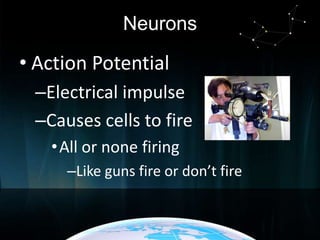
Neurons

• Action Potential
–Electrical impulse
–Causes cells to fire
• All or none firing
–Like guns fire or don’t fire
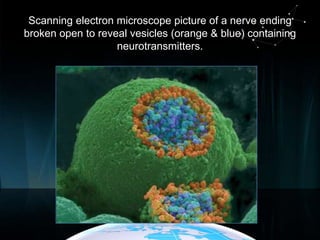
Scanning electron microscope picture of a nerve ending
broken open to reveal vesicles (orange & blue) containing
neurotransmitters.
Neurons: Basic Cells of the
Nervous System
• Most drugs influence operation of
neurotransmitter
– 1. Agonists
• Increase effectiveness
– Or

– 2. Antagonists
• Reduce effectiveness

Copyright © Prentice Hall 2007

2-42
Copyright © Prentice Hall 2007

2-43
http://www.youtube.com/watch?v=L
T3VKAr4roo&feature=related

Psych neuroscience.ppt

  • 1.
  • 2.
    Behavioral Neuroscience • Whystudy this in psychology? • How can it help us understand the goals of psychology? • Goals – Describe – Understand – Predict – Control or modify • Behaviors & thoughts
  • 3.
    Biology and Behavior •Behavioral neuroscience – Studies • Relation between biological & psychological functions –Can help us understand • Nature of personality • Causes of abnormal behavior • Reaction to stress • Effectiveness of therapy Copyright © Prentice Hall 2007 2-3
  • 4.
    Historical View ofthe Brain • 1000 BC Egyptian Pharaohs mummification • Brain – Removed & discarded • Vital to afterlife – Heart • Left in body • Seen as containing perception, cognition & soul – Intestines, liver, lungs & stomach • Removed, wrapped & placed in canopic jars.
  • 5.
    Historical View ofthe Brain • Many cultures similar views of heart • Brain interpreted in various ways – Aristotle cooling emotions of heart • Change began in 1500’s • Leonardo da Vinci 1452-1519 – Head seen as holding cognition – Ventricle system • Holes in the brain.
  • 6.
    Ventricular System • Cavitiesor holes in brain holding cerebrospinal fluid
  • 7.
  • 8.
    Evolutionary Psychology • Focuseson – Adapted benefits of selected behaviors • Women – Talk – Multi-task » Women larger area for communication • Men – Quiet – Singularly focused » Larger area of brain for sex
  • 9.
    Evolutionary Psychology • Whydoesn’t an organism ever achieve perfect adaption?
  • 10.
    Evolutionary Psychology • Whydoesn’t an organism ever achieve perfect adaption? –Each adaption has: • Costs? • Benefits? –Increased head size?
  • 11.
    Evolution Evolution Does : •Works to improve reproduction success Evolution Doesn’t: • Work to improve a species • Have a conscious plan or purpose • Work to produce happiness or contentment
  • 12.
    Evolutionary Psychology • NaturalSelection & Adaptive Behavior – Natural selection • Evolutionary process by which those individuals of a species that are best adapted are the ones that survive & reproduce – Survivors better adapted to world than nonsurvivors
  • 13.
    Evolutionary Psychology  Emphasizesimportance of  Adaptation  Reproduction  “Survival of the fittest”  In shaping behavior  Spatial skills in finding way home  Fit  Ability to  Bare offspring that survive long enough to bare offspring  Pass your genes to next generation
  • 14.
    Biology and Behavior •Scientists who study this: – Represent several disciplines • Psychology (especially physiological psychologists) • Biology • Medicine • Others Copyright © Prentice Hall 2007 2-14
  • 15.
  • 16.
    Neurons • Neurons –Cells thattransmit information • Neurons are composed of: –Dendrites –Soma • Cell Body –Axon
  • 17.
  • 18.
    Myelin Sheath • MyelinSheath – Composed of glial cells • (Greek word for “glue”) – Coats axon of some neurons – White matter of brain – Functions: • • • • • • Speeds neurotransmission Insulates neurons from each other Makes neurotransmission more efficient Removes waste Occupies vacant space when neurons die Other purposes Copyright © Prentice Hall 2007 2-18
  • 19.
    • Myelin –Looks likestring of sausages –Doesn’t cover entire length of axon –Nodes of Ranvier • Space between “sausages” • Nerve impulse jumps from 1 node of Ranvier to next • Transmission up to 100 x’s faster –Unmeylinated axons Copyright © Prentice Hall 2007 2-19
  • 20.
    Terminal Button 1. Synthesisof neurotransmitter (NT) 2. Storage & transport of NT within vesicles 3. NT Release 4. Activation of postsynaptic receptors 5. Termination of transmitter effect (e.g. reuptake)
  • 21.
    Neurotransmitters • Dopamine – Controlsarousal levels – Significant role in motor movement – Reward & punishment • Serotonin – Role in • • • • • • • Weight regulation Sleep Depression Suicide obsessive–compulsive disorder Aggression Wide range of other disorders & behavior problems. Copyright © Prentice Hall 2007 2-21
  • 22.
    Neurotransmitters • Acetylcholine – Attention –Learning – Memory • Norepinephrine – Also a hormone – Physical & mental arousal – Heightens mood Copyright © Prentice Hall 2007 2-22
  • 25.
    Synapse • Synapse –Space betweenaxon terminal & adjacent dendrite or cell body • Neurotransmitter (NT) –Molecules released from terminal button into synapse.
  • 26.
    Neurons: Basic Cellsof the Nervous System • Synapses – Cleared rapidly • So additional signals can be transmitted • Cleared in 1 of 2 ways, depending on neurotransmitter – 1. breakdown • Broken down & removed – 2. Reuptake • Recycled back into vesicles Copyright © Prentice Hall 2007 2-26
  • 27.
  • 28.
    SSRI Reuptake Inhibitor •SSRIs block reuptake of serotonin • Called selective – Primarily affect serotonin • Changes balance of serotonin
  • 29.
    SSRI Reuptake Inhibitor •Generic names followed by brand names – Citalopram (Celexa) – Escitalopram (Lexapro) – Fluoxetine (Prozac, Prozac Weekly, Sarafem) – Paroxetine (Paxil, Paxil CR, Pexeva) – Sertraline (Zoloft) – Fluoxetine combined with the atypical antipsychotic olanzapine (Symbyax)
  • 30.
    Psychoactive Drugs • Drugswork in synapse • Agonists enhance neurotransmitter function • Antagonists block neurotransmitter function
  • 31.
    Psychoactive Drugs • Psychoactivedrugs – Affect nervous system • Alter mood • Emotion • Thought – Act by: • Increasing or decreasing release of neurotransmitters • Stimulating or blocking receptor sites
  • 33.
  • 35.
    Opiates binding toopiate receptors • Increased dopamine release
  • 37.
    Neurons: Basic Cellsof the Nervous System  Presynaptic membrane  Side that sends message  Postsynaptic membrane  Receiving side of synapse Copyright © Prentice Hall 2007 2-37
  • 38.
    Neurons: Basic Cellsof the Nervous System • When electrical signal reaches terminal buttons – Causes vesicles to release a chemical signal • Neurotransmitter into synapse • Contacts postsynaptic membrane (usually dendrite) of next neuron Copyright © Prentice Hall 2007 2-38
  • 39.
    Neurons: Basic Cellsof the Nervous System • Excitation – More likely to transmit the message to subsequent neurons • Inhibition – Less likely to transmit the message to subsequent neurons Copyright © Prentice Hall 2007 2-39
  • 40.
    Neurons • Action Potential –Electricalimpulse –Causes cells to fire • All or none firing –Like guns fire or don’t fire
  • 41.
    Scanning electron microscopepicture of a nerve ending broken open to reveal vesicles (orange & blue) containing neurotransmitters.
  • 42.
    Neurons: Basic Cellsof the Nervous System • Most drugs influence operation of neurotransmitter – 1. Agonists • Increase effectiveness – Or – 2. Antagonists • Reduce effectiveness Copyright © Prentice Hall 2007 2-42
  • 43.
  • 44.