Kingdom of Saudi Arabia

Ministry of Higher Education

   King Faisal University

    College of Medicine


                               Normal Labor
                               By/
                               Fahad AlHulaibi   Mansour Al Omair
                               Ahmed Al Awwad    Abdulaziz Al Barrak
Objectives
By end of this Tutorial, you will be able to :


   Diagnose The Onset Of Labor .


   Define Stages Of Labor.


   Understand The Mechanism Of
    Normal Labor.

   Monitoring The Mother & The Fetus During
    Labor.

   Understand Management Of Normal
    Labor.
30 months
       -
   24 months
      =
   6 months
      Or
   24 weeks
“age of viability”
Definition
  Labor:
Is the process whereby the product of conception are
   expelled from uterian cavity after 24th week of
   gestation.
Definition
 Premature labour:
labour occurring before the commencement of the 37th
  week of gestation

 Prolonged labour:
labour lasting in excess of:
  24 hours in a primigravida
&16 hours in a multigravida.
Onset of labour

   The onset of labour is defined as
    the time of onset of regular, painful
    uterine contractions, which produce
    progressive effacement and
    dilatation of the cervix.

   false labour: where the onset of
    painful contractions is not
    associated with progressive
    dilatation of the cervix.
 The clinical signs of the onset of labour include:
1. The onset of regular, painful contractions that
  produce progressive cervical dilatation.
2. The exhibition of a vaginal show - the passage of
  blood stained mucus.
3. Rupture of the fetal membranes - may occur at the
  time of onset of contractions or it may be delayed
  until the delivery of the fetus.
Stages of labour
   The First Stage
                       • onset of labour
               start
                       • Cervix reached full
               end       dilatation
   The Second Stage
                       • Cervix reached full
              start      dilatation

                       • expulsion of the fetus
              end
   The Third Stage “Placenta Stage “
                      • delivery of the child.
              start
                      • expulsion of placenta.
              end
 The classic signs of placental separation :
1. show of bright blood.
2. apparent lengthening of the umbilical cord
3. elevation of the uterine fundus within the abdominal
  cavity .
MECHANISM OF
NORMAL LABOUR
Mechanism of Normal labour

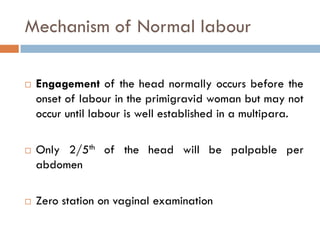
   Engagement of the head normally occurs before the
    onset of labour in the primigravid woman but may not
    occur until labour is well established in a multipara.

   Only 2/5th of the head will be palpable per
    abdomen

   Zero station on vaginal examination
Mechanism of labour
   1. Descent of the head provides a measure of the
    progress of labour


Descent occurs throughout
labour
   2. Flexion of the head occurs as it descends and
    meets the pelvic floor, bringing the chin into contact
    with the fetal thorax.

 Flexion produces
a smaller diameter
 of presentation
(suboccipitobregmatic
 diameter)
 3. Internal rotation:
The head rotates as it reaches pelvic floor and the
  occiput normally rotates anteriorly from the lateral
  position towards the
  pubic symphysis
   4. Extension: The acutely flexed head descends to
    distend the pelvic floor and the vulva, and the base
    of the occiput comes into contact with the inferior
    rami of the pubis.
    The head now extends until
    it is delivered. Maximal
    distension of the perineum
    and introitus accompanies
    the final expulsion of the
    head, a process that is
    known as crowning.
    5. Restitution:
    Following delivery of the head, it rotates back to be
     in line with its normal relationship to the fetal
     shoulders
    6. External rotation: When the
     shoulders reach the pelvic floor,
     they rotate into the
     anteroposterior diameter of the
     pelvis. This is accompanied by
     rotation of the fetal head so that
     the face looks laterally at the
     maternal thigh.
   7. Delivery of the shoulders: The anterior shoulder
    is delivered first by traction posteriorly on the fetal
    head so that the shoulder emerges under the pubic
    arch.
The posterior shoulder is
delivered by lifting the head
anteriorly over the perineum.

This is followed by rapid
delivery of the remainder of
the trunk and the lower limbs
INTRAPARTUM
MONITORING
What to monitor?
   Mother
     Temperature

     Pulse rate
     Blood pressure

     Urine
   Fetus
     Auscultation

     Fetal CTG
     Fetal ECG

     Scalp stimulation test

     Acid-Base balance

     Others

   Partogram
Mother Intrapartum monitoring
   Temperature
     Normal    Temperature
       36.2°-37.2°

     Frequency
       Every   4 hours
     Pyrexia;   Causes
       Infection
       Maternal    exhaustion: Dehydration cause pyrexia.
       Risks
             Mother
             fetus
Cont.
   Pulse Rate
     Normal     Range
       70-100    beats per min
     Frequency
       Hourly
   Blood Pressure
     Normal     Range
       100/60    mm Hg to 140/90 mm Hg
     Frequency
       hourly
   Urine
     Items
       Volume
       Protein
       Ketones

     Frequency
       Every   2 hours
Fetal Monitoring
   Auscultation
   Fetal CTG
   Fetal ECG
   Acid-Base balance
   Scalp stimulation test
   Others
     Vibroacousticstimulation
     Fetal oxygen saturation
Auscultation
   The heart rate should be recorded every 15 minutes
    in the first stage and after each contraction in the
    second stage, using a Pinard fetal stethoscope
   Cardiotocography is not required when the labour
    is classified as low risk.
   However, there are specific indications for electronic
    fetal monitoring.
Indications for continuous electronic
fetal monitoring
   Maternal
     Previous caesarian section
     Pre-eclampsia

     Post-term pregnancy

     Prolonged rupture of the membranes

     Induced labour

     Diabetes

     Antepartum haemorrhage Other maternal medical
      diseases
Cont.
   Fetal
     Fetal growth restriction
     Prematurity

     Oligohydramnios

     Multiple pregnancy

     Meconium-stained liquor

     Breech presentation
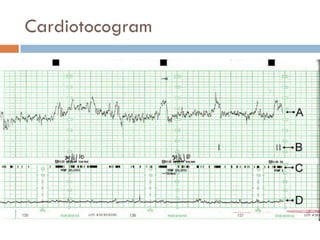
Cardiotocogram
   Components:
   Base line fetal heart rate
   Base line variability
   Accelerations
   Decelerations
   Uterine Contractions
Fetal Heart Rate
   Normal Range
     110-160   beats/min
     More than 160 is tachycardia

     Less than 110 is bradycardia
Baseline Variability
   Normal Range
     6-25

   Increased (more than 25)
     Early Hypoxia
     Prolonged pregnancy

   Decreased (less than 6)
     Latehypoxia
     Sleep
       Vibro-acoustic   stimulation
Accelerations
   Transient increase in heart rate more than or equal
    to 15 beats for more 15 seconds.
   Assuring of good fetal health if present
Decelerations
   Transient decrease in heart rate more than or equal
    to 15 beats for more 15 seconds.
   Normally not present.
   Types (in relation to uterine contractions)
     Early

     Late

     Variable
Early Decelerations
   They are synchronous with uterine contractions.
   The nadir of the deceleration occurs at the peak of
    the contraction and the decrease in heart rate is
    generally less than 40 beats/min.
Cont.
   These decelerations are generally due to head
    compression and are commonly considered to be
    physiological.
   They are a common form of deceleration seen in
    labour
Late Decelerations
   The onset of the slowing of heart rate occurs well
    after the contraction is established and does not
    return to the normal baseline until at least 20
    seconds after the contraction is completed.
   They are indicative of fetal hypoxia.
Variable Decelerations
   Variable decelerations vary in timing and
    amplitude, hence their name.
   An early deceleration where the heart rate falls by
    more than 40 beats/min is also classified as a
    variable deceleration.
   Types:
     Mild:Total duration is >30 sec, or FHR >80 bpm
     Moderate: FHR 80-70 bpm

     Severe: FHR <70 bpm for more than 1 min
Cont.
   The commonest cause is cord compression and the
    changes may be considered to be pathological if
    the cord compression is persistent
Uterine Contractions
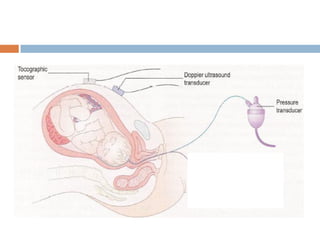
   Tocodynamometer
    A  pressure-sensitive tocodynamometer is placed around
      the maternal abdomen.
     The tocodynamometer measures only the frequency of
      contractions, not their intensity or strength.
   Intrauterine pressure catheter (IUPC).
     Thismethod allows internal monitoring of contractions.
     IUPC measures both the frequency and strength of
      contractions.
Electrocardiogram

   The fetal electrocardiogram (ECG) can be recorded
    from scalp electrodes or by the placement of
    maternal abdominal electrodes.
   Two items are important:
     Acidosis(T wave and QRS height)
     Asphyxia (PR interval and RR interval)

   The fetal ECG can also be used to identify the
    nature of fetal arrhythmias.
Scalp stimulation test
   The examiner rubs the fetal scalp during a digital
    examination.
     An  acceleration is usually seen in the FHR tracing of the
      uncompromised, nonacidotic fetus. The presence of an
      acceleration is associated with an intact ANS and a
      fetal scalp blood pH greater than 7.20.
     If an acceleration is not obtained after scalp
      stimulation, fetal scalp blood can be sampled to
      measure the fetal pH or one can progress to immediate
      surgical delivery.
Fetal scalp blood sampling
   The fetal scalp is visualized through the dilated
    cervix, and blood is collected in heparinized
    capillary tubes
   The normal fetal capillary pH is 7.25 to 7.35 in the
    first stage of labor.
    A   fetal scalp pH greater than or equal to 7.20 is
      reassurance that the fetus is not acidotic. Labor can
      proceed for 20 to 30 minutes.
     A pH of less than 7.20 may represent significant
      acidosis. Delivery is thus indicated by vaginal delivery,
      if possible, or cesarean delivery.
Others
   Vibroacoustic stimuli (VAS). Fetus is stimulated by noise
    for 1 second.
     The presence of fetal accelerations in response to VAS is
      considered reassuring.
     The fetus is restimulated if no accelerations occur within 10
      seconds. The VAS test may be repeated up to four times.


   Normal fetal oxygen saturation: ranges between 35%
    and 75%, If the fetal oxygen saturation remains above
    30% during labor, fetal metabolic acidosis is excluded.
Partogram
   Partogram is a graphical record of key data
    (maternal and fetal) during labour entered against
    time on a single sheet of paper.
Components
   Fetal Parameters:
     FHR

     Statusof membranes or Amniotic Fluid
     Moulding

     Caput
   Progress of Labor:
     Cervical dilatation
     Station of head

     Uterine contractions: Frequency & Duration

   Oxytocin:
     Concentration     /L
     Infusion   rate
   Any other medicine & IV fluid
   Maternal Parameters:
     Vital   data:
       Pulse
       BP
       Temparature

     Urine:
       Output
       Acetone
       Protein   / Glucose
MANAGEMENT OF
NORMAL LABOUR
General principles of the management of
the first stage of labour :

• Observation and intervention if the labour becomes
abnormal by partogram .

• Pain relief during labour and emotional support for
the mother ( Narcotic agents , inhalational analgesia
and regional analgesia )

• Adequate hydration throughout labour.
Fetal monitoring in labour


• Fetal cardiotocography
• Basal heart rate
• Transitory changes

• The fetal electrocardiogram
• Fetal acid-base changes
• Scalp blood sampling
Management of the second stage


   Delivery of the head .
    Controlled descent .
   Minimizing perineal damage.
    Clamping the cord .
   Evaluation of Apgar score.
Evaluation of the Apgar score
                   0           1          2
  Colour        White        Blue       Pink
   Tone         Flaccid      Rigid     Normal
  Pulse       Impalpable     <100      >100
beats/min                  beats/min

Respiration     Absent     Irregular   Regular
Response        Absent       Poor      Normal
Management of the third stage

   Recognition of placental
    separation.

    Assisted delivery of the
    placenta with cord traction.

    Routine use of oxytocic
    agents with crowning of the
    head.
References:
   Essential Obstetrics and Gynaecology, 4th Ed
Thank
 you

Normal labor

  • 1.
    Kingdom of SaudiArabia Ministry of Higher Education King Faisal University College of Medicine Normal Labor By/ Fahad AlHulaibi Mansour Al Omair Ahmed Al Awwad Abdulaziz Al Barrak
  • 2.
    Objectives By end ofthis Tutorial, you will be able to :  Diagnose The Onset Of Labor .  Define Stages Of Labor.  Understand The Mechanism Of Normal Labor.  Monitoring The Mother & The Fetus During Labor.  Understand Management Of Normal Labor.
  • 3.
    30 months - 24 months = 6 months Or 24 weeks “age of viability”
  • 4.
    Definition  Labor: Isthe process whereby the product of conception are expelled from uterian cavity after 24th week of gestation.
  • 5.
    Definition  Premature labour: labouroccurring before the commencement of the 37th week of gestation  Prolonged labour: labour lasting in excess of: 24 hours in a primigravida &16 hours in a multigravida.
  • 6.
    Onset of labour  The onset of labour is defined as the time of onset of regular, painful uterine contractions, which produce progressive effacement and dilatation of the cervix.  false labour: where the onset of painful contractions is not associated with progressive dilatation of the cervix.
  • 8.
     The clinicalsigns of the onset of labour include: 1. The onset of regular, painful contractions that produce progressive cervical dilatation. 2. The exhibition of a vaginal show - the passage of blood stained mucus. 3. Rupture of the fetal membranes - may occur at the time of onset of contractions or it may be delayed until the delivery of the fetus.
  • 9.
    Stages of labour  The First Stage • onset of labour start • Cervix reached full end dilatation
  • 10.
    The Second Stage • Cervix reached full start dilatation • expulsion of the fetus end
  • 11.
    The Third Stage “Placenta Stage “ • delivery of the child. start • expulsion of placenta. end
  • 12.
     The classicsigns of placental separation : 1. show of bright blood. 2. apparent lengthening of the umbilical cord 3. elevation of the uterine fundus within the abdominal cavity .
  • 13.
  • 14.
    Mechanism of Normallabour  Engagement of the head normally occurs before the onset of labour in the primigravid woman but may not occur until labour is well established in a multipara.  Only 2/5th of the head will be palpable per abdomen  Zero station on vaginal examination
  • 21.
    Mechanism of labour  1. Descent of the head provides a measure of the progress of labour Descent occurs throughout labour
  • 22.
    2. Flexion of the head occurs as it descends and meets the pelvic floor, bringing the chin into contact with the fetal thorax. Flexion produces a smaller diameter of presentation (suboccipitobregmatic diameter)
  • 23.
     3. Internalrotation: The head rotates as it reaches pelvic floor and the occiput normally rotates anteriorly from the lateral position towards the pubic symphysis
  • 24.
    4. Extension: The acutely flexed head descends to distend the pelvic floor and the vulva, and the base of the occiput comes into contact with the inferior rami of the pubis. The head now extends until it is delivered. Maximal distension of the perineum and introitus accompanies the final expulsion of the head, a process that is known as crowning.
  • 25.
    5. Restitution: Following delivery of the head, it rotates back to be in line with its normal relationship to the fetal shoulders  6. External rotation: When the shoulders reach the pelvic floor, they rotate into the anteroposterior diameter of the pelvis. This is accompanied by rotation of the fetal head so that the face looks laterally at the maternal thigh.
  • 26.
    7. Delivery of the shoulders: The anterior shoulder is delivered first by traction posteriorly on the fetal head so that the shoulder emerges under the pubic arch. The posterior shoulder is delivered by lifting the head anteriorly over the perineum. This is followed by rapid delivery of the remainder of the trunk and the lower limbs
  • 28.
  • 29.
    What to monitor?  Mother  Temperature  Pulse rate  Blood pressure  Urine
  • 30.
    Fetus  Auscultation  Fetal CTG  Fetal ECG  Scalp stimulation test  Acid-Base balance  Others  Partogram
  • 31.
    Mother Intrapartum monitoring  Temperature  Normal Temperature  36.2°-37.2°  Frequency  Every 4 hours  Pyrexia; Causes  Infection  Maternal exhaustion: Dehydration cause pyrexia.  Risks  Mother  fetus
  • 32.
    Cont.  Pulse Rate  Normal Range  70-100 beats per min  Frequency  Hourly
  • 33.
    Blood Pressure  Normal Range  100/60 mm Hg to 140/90 mm Hg  Frequency  hourly
  • 34.
    Urine  Items  Volume  Protein  Ketones  Frequency  Every 2 hours
  • 35.
    Fetal Monitoring  Auscultation  Fetal CTG  Fetal ECG  Acid-Base balance  Scalp stimulation test  Others  Vibroacousticstimulation  Fetal oxygen saturation
  • 36.
    Auscultation  The heart rate should be recorded every 15 minutes in the first stage and after each contraction in the second stage, using a Pinard fetal stethoscope  Cardiotocography is not required when the labour is classified as low risk.  However, there are specific indications for electronic fetal monitoring.
  • 37.
    Indications for continuouselectronic fetal monitoring  Maternal  Previous caesarian section  Pre-eclampsia  Post-term pregnancy  Prolonged rupture of the membranes  Induced labour  Diabetes  Antepartum haemorrhage Other maternal medical diseases
  • 38.
    Cont.  Fetal  Fetal growth restriction  Prematurity  Oligohydramnios  Multiple pregnancy  Meconium-stained liquor  Breech presentation
  • 39.
    Cardiotocogram  Components:  Base line fetal heart rate  Base line variability  Accelerations  Decelerations  Uterine Contractions
  • 41.
    Fetal Heart Rate  Normal Range  110-160 beats/min  More than 160 is tachycardia  Less than 110 is bradycardia
  • 42.
    Baseline Variability  Normal Range  6-25  Increased (more than 25)  Early Hypoxia  Prolonged pregnancy  Decreased (less than 6)  Latehypoxia  Sleep  Vibro-acoustic stimulation
  • 43.
    Accelerations  Transient increase in heart rate more than or equal to 15 beats for more 15 seconds.  Assuring of good fetal health if present
  • 44.
    Decelerations  Transient decrease in heart rate more than or equal to 15 beats for more 15 seconds.  Normally not present.  Types (in relation to uterine contractions)  Early  Late  Variable
  • 45.
    Early Decelerations  They are synchronous with uterine contractions.  The nadir of the deceleration occurs at the peak of the contraction and the decrease in heart rate is generally less than 40 beats/min.
  • 46.
    Cont.  These decelerations are generally due to head compression and are commonly considered to be physiological.  They are a common form of deceleration seen in labour
  • 47.
    Late Decelerations  The onset of the slowing of heart rate occurs well after the contraction is established and does not return to the normal baseline until at least 20 seconds after the contraction is completed.  They are indicative of fetal hypoxia.
  • 48.
    Variable Decelerations  Variable decelerations vary in timing and amplitude, hence their name.  An early deceleration where the heart rate falls by more than 40 beats/min is also classified as a variable deceleration.  Types:  Mild:Total duration is >30 sec, or FHR >80 bpm  Moderate: FHR 80-70 bpm  Severe: FHR <70 bpm for more than 1 min
  • 49.
    Cont.  The commonest cause is cord compression and the changes may be considered to be pathological if the cord compression is persistent
  • 50.
    Uterine Contractions  Tocodynamometer A pressure-sensitive tocodynamometer is placed around the maternal abdomen.  The tocodynamometer measures only the frequency of contractions, not their intensity or strength.  Intrauterine pressure catheter (IUPC).  Thismethod allows internal monitoring of contractions.  IUPC measures both the frequency and strength of contractions.
  • 52.
    Electrocardiogram  The fetal electrocardiogram (ECG) can be recorded from scalp electrodes or by the placement of maternal abdominal electrodes.
  • 53.
    Two items are important:  Acidosis(T wave and QRS height)  Asphyxia (PR interval and RR interval)  The fetal ECG can also be used to identify the nature of fetal arrhythmias.
  • 54.
    Scalp stimulation test  The examiner rubs the fetal scalp during a digital examination.  An acceleration is usually seen in the FHR tracing of the uncompromised, nonacidotic fetus. The presence of an acceleration is associated with an intact ANS and a fetal scalp blood pH greater than 7.20.  If an acceleration is not obtained after scalp stimulation, fetal scalp blood can be sampled to measure the fetal pH or one can progress to immediate surgical delivery.
  • 55.
    Fetal scalp bloodsampling  The fetal scalp is visualized through the dilated cervix, and blood is collected in heparinized capillary tubes  The normal fetal capillary pH is 7.25 to 7.35 in the first stage of labor. A fetal scalp pH greater than or equal to 7.20 is reassurance that the fetus is not acidotic. Labor can proceed for 20 to 30 minutes.  A pH of less than 7.20 may represent significant acidosis. Delivery is thus indicated by vaginal delivery, if possible, or cesarean delivery.
  • 56.
    Others  Vibroacoustic stimuli (VAS). Fetus is stimulated by noise for 1 second.  The presence of fetal accelerations in response to VAS is considered reassuring.  The fetus is restimulated if no accelerations occur within 10 seconds. The VAS test may be repeated up to four times.  Normal fetal oxygen saturation: ranges between 35% and 75%, If the fetal oxygen saturation remains above 30% during labor, fetal metabolic acidosis is excluded.
  • 57.
    Partogram  Partogram is a graphical record of key data (maternal and fetal) during labour entered against time on a single sheet of paper.
  • 58.
    Components  Fetal Parameters:  FHR  Statusof membranes or Amniotic Fluid  Moulding  Caput
  • 59.
    Progress of Labor:  Cervical dilatation  Station of head  Uterine contractions: Frequency & Duration  Oxytocin:  Concentration /L  Infusion rate  Any other medicine & IV fluid
  • 60.
    Maternal Parameters:  Vital data:  Pulse  BP  Temparature  Urine:  Output  Acetone  Protein / Glucose
  • 63.
  • 64.
    General principles ofthe management of the first stage of labour : • Observation and intervention if the labour becomes abnormal by partogram . • Pain relief during labour and emotional support for the mother ( Narcotic agents , inhalational analgesia and regional analgesia ) • Adequate hydration throughout labour.
  • 65.
    Fetal monitoring inlabour • Fetal cardiotocography • Basal heart rate • Transitory changes • The fetal electrocardiogram • Fetal acid-base changes • Scalp blood sampling
  • 66.
    Management of thesecond stage  Delivery of the head .  Controlled descent .  Minimizing perineal damage.  Clamping the cord .  Evaluation of Apgar score.
  • 67.
    Evaluation of theApgar score 0 1 2 Colour White Blue Pink Tone Flaccid Rigid Normal Pulse Impalpable <100 >100 beats/min beats/min Respiration Absent Irregular Regular Response Absent Poor Normal
  • 68.
    Management of thethird stage  Recognition of placental separation.  Assisted delivery of the placenta with cord traction.  Routine use of oxytocic agents with crowning of the head.
  • 69.
    References:  Essential Obstetrics and Gynaecology, 4th Ed
  • 70.