By-
Dr Nikhil Oza
Intern
BVDUMC
Introduction
๏‚— Glaucoma is an optic neuropathy, specifically a
neurodegenerative disease characterized by loss of
retinal ganglion cells (RGCs) and their axons.
๏‚— In the past, glaucoma was viewed as a disease of raised
intraocular pressure (IOP); however, it has become
increasingly clear that elevated IOP is only one of the
risk factors for this disease.
๏‚— Recent evidence indicates that lowering IOP does not
prevent progression in all patients and that
progression can continue despite effective lowering of
IOP.
Introduction
๏‚— It is therefore imperative that these cells are kept alive.
๏‚— The term neuroprotection refers to mechanisms
within the nervous system, which protect neurons
from apoptosis or degeneration
๏‚— This approach attempts to accelerate or impede
specific biochemical pathways that may prevent
neuronal injury or accelerate neuronal recovery.
Hence, any therapy that prevents, retards or reverses
apoptosis-associated neuronal cell death resulting
from primary neuronal lesions is neuroprotective.
NMDA Antagonists
๏‚— Glutamate concentrations higher than the
physiological levels are toxic to the neurons.
๏‚— In order to maintain the physiological concentrations
and to protect ganglion cells from excitotoxic cell
death, appropriate removal of synaptic glutamate is
necessary.
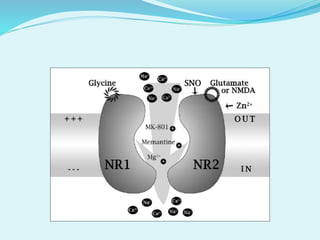
๏‚— N-methyl-D-aspartate (NMDA) receptor activation
leads to opening of associated ion channels in the
neurons and the entry of extracellular calcium and
sodium. Glutamate-mediated neuronal toxicity is
dependent on the influx of extracellular calcium.
๏‚— The development of NMDA blockers that discriminate
excessive NMDA receptor activation without affecting
normal function led to clinically viable antagonists.
๏‚— Memantine is a non-competitive, low-affinity, open
channel blocker.
๏‚— It exhibits selective blockade of the excessively open
channels, thus inhibiting excessive NMDA receptor
activity while maintaining normal neuronal cell
function as it does not accumulate significantly within
the channel.
๏‚— However Clinical trials are currently going on.
Anti-apoptotic agents
๏‚— Approach here is to block the apoptotic machinery by
using caspase inhibitors.
๏‚— Caspases are the effector enzymes that disassemble
cellular contents during apoptosis.
๏‚— Calpeptin, a calpain-specific inhibitor, has been
shown in glaucoma experimental models to confer
neuroprotection by this method.
Currently used drugs that have
some neuroprotection properties
๏‚— Brimonidine- ฮฑ2-adrenoceptor agonist; lowers IOP
essentially by decreasing aqueous humor inflow. based
on neuromodulation instead of direct inhibition of the
NMDA receptor and inhibition the pro-apoptotic
pathway.
๏‚— Betoxolol- ฮฒ1-selective blocker and Timolol- ฮฒ blocker
confer some amount of neuroprotection by reducing
glutamate affinity by acting on NMDA receptors as
well.
Nitric oxide synthase antagonists
๏‚— Inhibition of NOS has been shown to be
neuroprotective in experimental glaucoma models.
๏‚— Nipradilol, a ฮฒ- and ฮฑ1 antagonist has also been
shown to be neuroprotective.
๏‚— However, Pang et al., in a recent study, found no proof
for the release of NOS-2 by astrocytes in patients or
models.
Neurotrophic factors
๏‚— Various studies in experimental models have shown
that neurotrophic factors, especially brain-derived
neurotrophic factors (BDNF) and ciliary
neurotrophic factor (CNTF), can enhance survival of
RGCs after optic nerve injuries but there are to date no
adequately powered clinical trials to substantiate this
in humans.
Antioxidants
๏‚— RGC death by NMDA-induced toxicity may be reduced
by antioxidants and free radical scavengers such as
vitamins C and E (ฮฑ-tocopherol), superoxide
dismutase and catalase.
๏‚— Gingo biloba(EGb761), apart from increasing blood
flow, has been also found to have a free radical
scavenger property. Its extract is also known to
preserve mitochondrial metabolism and enhance ATP
production in various tissues.
Calcium channel blockers
๏‚— Calcium channel blockers like nifedipine and verapamil
may exert neuroprotection by increasing blood flow to the
RGCs.
๏‚— In addition, they also improve glutamate metabolism and
hence cause efficient homeostasis in the optic nerve head.
๏‚— However, there are concerns that by also causing systemic
hypotension these agents can worsen retinal ischemia due
to a reduction in perfusion pressure.
๏‚— A recent study in a rat chronic glaucoma model has shown
that continuous treatment using candesartan
(angiotensin II type I receptor blocker) provided
substantial neuroprotection against RGC loss
Gene therapy
๏‚— The current core of gene therapy is targeted against
apoptotic factors.
๏‚— Candidate agents are deprenyl, a monoamine oxidase
inhibitor (anti-parkinsonism drug) which increases
the gene expression of factors that halt apoptosis, and
flunarizine and aurintricarboxylic acid, which have
shown promising results in retarding apoptosis
following light-induced photoreceptor cell death.
Immunomodulators and
vaccination
๏‚— The objective of vaccination is not only to halt disease
propagation but also to decrease the secondary
degeneration of neurons following the acute insult.
๏‚— The locally activated anti-self T cells target the injury
and supply cytokines and growth factors.
๏‚— These cells arrest the production of TNF-ฮฑ, as well as
remove glutamate and debris and generate growth
factors.
Thank You !

Neuroprotective drugs in glaucoma

  • 1.
  • 2.
    Introduction ๏‚— Glaucoma isan optic neuropathy, specifically a neurodegenerative disease characterized by loss of retinal ganglion cells (RGCs) and their axons. ๏‚— In the past, glaucoma was viewed as a disease of raised intraocular pressure (IOP); however, it has become increasingly clear that elevated IOP is only one of the risk factors for this disease. ๏‚— Recent evidence indicates that lowering IOP does not prevent progression in all patients and that progression can continue despite effective lowering of IOP.
  • 3.
    Introduction ๏‚— It istherefore imperative that these cells are kept alive. ๏‚— The term neuroprotection refers to mechanisms within the nervous system, which protect neurons from apoptosis or degeneration ๏‚— This approach attempts to accelerate or impede specific biochemical pathways that may prevent neuronal injury or accelerate neuronal recovery. Hence, any therapy that prevents, retards or reverses apoptosis-associated neuronal cell death resulting from primary neuronal lesions is neuroprotective.
  • 4.
    NMDA Antagonists ๏‚— Glutamateconcentrations higher than the physiological levels are toxic to the neurons. ๏‚— In order to maintain the physiological concentrations and to protect ganglion cells from excitotoxic cell death, appropriate removal of synaptic glutamate is necessary. ๏‚— N-methyl-D-aspartate (NMDA) receptor activation leads to opening of associated ion channels in the neurons and the entry of extracellular calcium and sodium. Glutamate-mediated neuronal toxicity is dependent on the influx of extracellular calcium.
  • 5.
    ๏‚— The developmentof NMDA blockers that discriminate excessive NMDA receptor activation without affecting normal function led to clinically viable antagonists. ๏‚— Memantine is a non-competitive, low-affinity, open channel blocker. ๏‚— It exhibits selective blockade of the excessively open channels, thus inhibiting excessive NMDA receptor activity while maintaining normal neuronal cell function as it does not accumulate significantly within the channel. ๏‚— However Clinical trials are currently going on.
  • 7.
    Anti-apoptotic agents ๏‚— Approachhere is to block the apoptotic machinery by using caspase inhibitors. ๏‚— Caspases are the effector enzymes that disassemble cellular contents during apoptosis. ๏‚— Calpeptin, a calpain-specific inhibitor, has been shown in glaucoma experimental models to confer neuroprotection by this method.
  • 8.
    Currently used drugsthat have some neuroprotection properties ๏‚— Brimonidine- ฮฑ2-adrenoceptor agonist; lowers IOP essentially by decreasing aqueous humor inflow. based on neuromodulation instead of direct inhibition of the NMDA receptor and inhibition the pro-apoptotic pathway. ๏‚— Betoxolol- ฮฒ1-selective blocker and Timolol- ฮฒ blocker confer some amount of neuroprotection by reducing glutamate affinity by acting on NMDA receptors as well.
  • 9.
    Nitric oxide synthaseantagonists ๏‚— Inhibition of NOS has been shown to be neuroprotective in experimental glaucoma models. ๏‚— Nipradilol, a ฮฒ- and ฮฑ1 antagonist has also been shown to be neuroprotective. ๏‚— However, Pang et al., in a recent study, found no proof for the release of NOS-2 by astrocytes in patients or models.
  • 10.
    Neurotrophic factors ๏‚— Variousstudies in experimental models have shown that neurotrophic factors, especially brain-derived neurotrophic factors (BDNF) and ciliary neurotrophic factor (CNTF), can enhance survival of RGCs after optic nerve injuries but there are to date no adequately powered clinical trials to substantiate this in humans.
  • 11.
    Antioxidants ๏‚— RGC deathby NMDA-induced toxicity may be reduced by antioxidants and free radical scavengers such as vitamins C and E (ฮฑ-tocopherol), superoxide dismutase and catalase. ๏‚— Gingo biloba(EGb761), apart from increasing blood flow, has been also found to have a free radical scavenger property. Its extract is also known to preserve mitochondrial metabolism and enhance ATP production in various tissues.
  • 12.
    Calcium channel blockers ๏‚—Calcium channel blockers like nifedipine and verapamil may exert neuroprotection by increasing blood flow to the RGCs. ๏‚— In addition, they also improve glutamate metabolism and hence cause efficient homeostasis in the optic nerve head. ๏‚— However, there are concerns that by also causing systemic hypotension these agents can worsen retinal ischemia due to a reduction in perfusion pressure. ๏‚— A recent study in a rat chronic glaucoma model has shown that continuous treatment using candesartan (angiotensin II type I receptor blocker) provided substantial neuroprotection against RGC loss
  • 13.
    Gene therapy ๏‚— Thecurrent core of gene therapy is targeted against apoptotic factors. ๏‚— Candidate agents are deprenyl, a monoamine oxidase inhibitor (anti-parkinsonism drug) which increases the gene expression of factors that halt apoptosis, and flunarizine and aurintricarboxylic acid, which have shown promising results in retarding apoptosis following light-induced photoreceptor cell death.
  • 14.
    Immunomodulators and vaccination ๏‚— Theobjective of vaccination is not only to halt disease propagation but also to decrease the secondary degeneration of neurons following the acute insult. ๏‚— The locally activated anti-self T cells target the injury and supply cytokines and growth factors. ๏‚— These cells arrest the production of TNF-ฮฑ, as well as remove glutamate and debris and generate growth factors.
  • 15.

Editor's Notes

  • #10ย using 2-aminoguanidine, i-NOS and L-N[6-(1-iminoethyl) lysine 5-tetrazole amide
  • #15ย which govern sentinel cells and, microglia and enlist macrophages bequeathing the eye with a protective phenotype
  • #16ย Brimonidine and Betoxolol