ELECTRONIC MAIL
SECURITY
Introduction
email is one of the most widely used and
regarded network services
currently message contents are not secure
may be inspected either in transit
or by suitably privileged users on destination
system
Email security requirements
♦ Confidentiality
♦ Authentication
♦ Integrity
♦ Non-repudiation
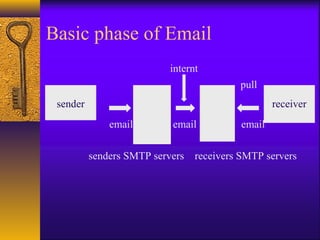
Basic phase of Email
internt
pull
email email email
senders SMTP servers receivers SMTP servers
sender receiver
Privacy enhanced mail
PEM adopted by the Internet
Architecture Board (IAB) to provide
secure electronic mail communication over
the internet
Steps of PEM
♦ Canonical conversion
♦ Digital signature
♦ Encryption
♦ Base 64 encoding
Canonical conversions
♦ PEM transforms each email message into an
abstract canonical representation. This
means that regardless of the architecture
and the operating system of the sending and
receiving computers, the email message
always travels in a uniform, independent
format.
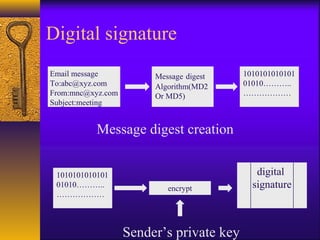
Message digest creation
Sender’s private key
Email message
To:abc@xyz.com
From:mnc@xyz.com
Subject:meeting
Message digest
Algorithm(MD2
Or MD5)
1010101010101
01010………..
………………
1010101010101
01010………..
………………
encrypt
digital
signature
Digital signature
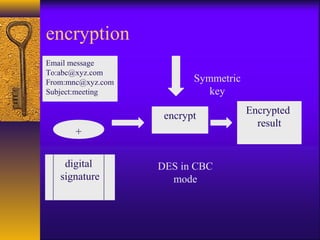
encryption
Email message
To:abc@xyz.com
From:mnc@xyz.com
Subject:meeting
digital
signature
encrypt
Encrypted
result
+
Symmetric
key
DES in CBC
mode
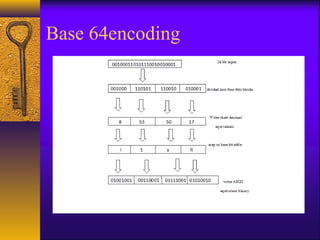
Base 64encoding
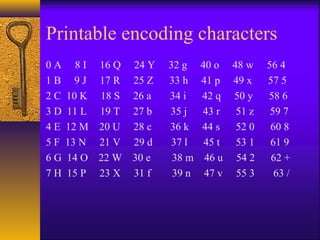
Printable encoding characters
0 A 8 I 16 Q 24 Y 32 g 40 o 48 w 56 4
1 B 9 J 17 R 25 Z 33 h 41 p 49 x 57 5
2 C 10 K 18 S 26 a 34 i 42 q 50 y 58 6
3 D 11 L 19 T 27 b 35 j 43 r 51 z 59 7
4 E 12 M 20 U 28 c 36 k 44 s 52 0 60 8
5 F 13 N 21 V 29 d 37 l 45 t 53 1 61 9
6 G 14 O 22 W 30 e 38 m 46 u 54 2 62 +
7 H 15 P 23 X 31 f 39 n 47 v 55 3 63 /
Pretty Good Privacy (PGP)
PGP provides a confidentiality and
authentication service that can be used for
electronic mail and file storage applications.
A number of reasons can be cited for this
growth.
♦ available free worldwide
♦ It is based on extremely secure algorithm.
♦ wide range of applicability
♦ not developed by governmental
organization.
Operational description
The actual operation of PGP, consists of
five services: authentication,
confidentiality, compression, e-mail
compatibility, and segmentation
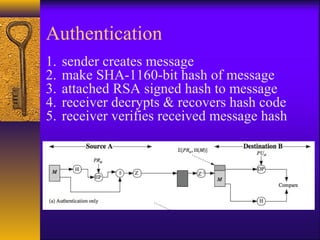
Authentication
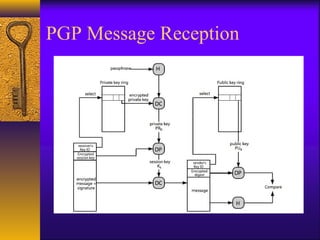
1. sender creates message
2. make SHA-1160-bit hash of message
3. attached RSA signed hash to message
4. receiver decrypts & recovers hash code
5. receiver verifies received message hash
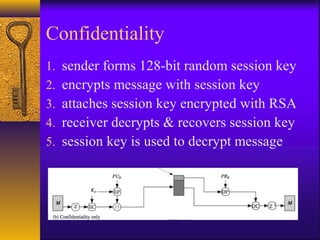
Confidentiality
1. sender forms 128-bit random session key
2. encrypts message with session key
3. attaches session key encrypted with RSA
4. receiver decrypts & recovers session key
5. session key is used to decrypt message
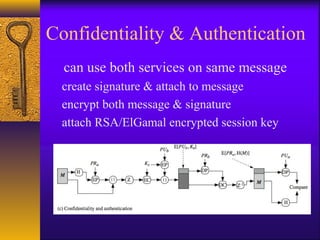
Confidentiality & Authentication
can use both services on same message
create signature & attach to message
encrypt both message & signature
attach RSA/ElGamal encrypted session key
Compression
♦ by default PGP compresses message after
signing but before encrypting
– so can store uncompressed message & signature
for later verification
– & because compression is non deterministic
♦ uses ZIP compression algorithm
Email Compatibility
♦ when using PGP will have binary data to send
(encrypted message etc)
♦ however email was designed only for text
♦ hence PGP must encode raw binary data into
printable ASCII characters
♦ uses radix-64 algorithm
– maps 3 bytes to 4 printable chars
– also appends a CRC
♦ PGP also segments messages if too big
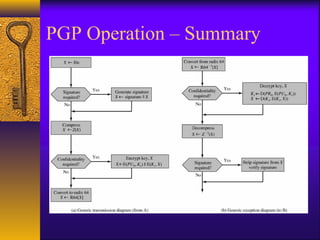
PGP Operation – Summary
PGP Session Keys
♦ need a session key for each message
– of varying sizes: 56-bit DES, 128-bit CAST or
IDEA, 168-bit Triple-DES
♦ generated using ANSI X12.17 mode
♦ uses random inputs taken from previous
uses and from keystroke timing of user
PGP Public & Private Keys
♦ since many public/private keys may be in use,
need to identify which is actually used to encrypt
session key in a message
– could send full public-key with every message
– but this is inefficient
♦ rather use a key identifier based on key
– is least significant 64-bits of the key
– will very likely be unique
♦ also use key ID in signatures
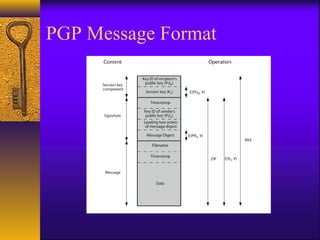
PGP Message Format
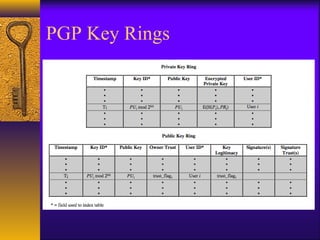
PGP Key Rings
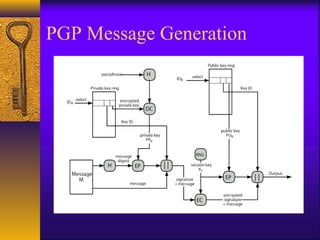
PGP Message Generation
PGP Message Reception
S/MIME (Secure/Multipurpose
Internet Mail Extensions)
♦ security enhancement to MIME email
– original Internet RFC822 email was text only
– MIME provided support for varying content
types and multi-part messages
– with encoding of binary data to textual form
– S/MIME added security enhancements
♦ have S/MIME support in many mail agents
– eg MS Outlook, Mozilla, Mac Mail etc
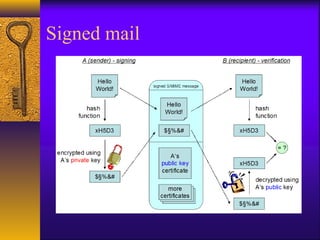
Signed mail
1. The user writes the message as clear-text.
2. The message digest is being calculated
(using SHA-1[2] or MD5[3]).
3. The message digest is being encrypted
using the signer’s private key (DSS[4] or
RSA[5]).
Signed mail
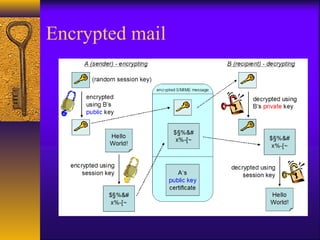
Encrypted mail
1. The user writes the message as clear-text.
2. A random session key is being created
(tripleDES[6] or RC2[7])
3. The message is being encrypted using the
random session key.
4. For every recipient, the session key is being
encrypted using the recipient’s public key
(DH[8] or RSA[5]).
Encrypted mail
S/MIME Cryptographic
Algorithms
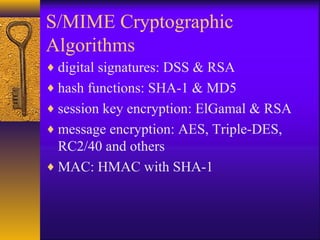
♦ digital signatures: DSS & RSA
♦ hash functions: SHA-1 & MD5
♦ session key encryption: ElGamal & RSA
♦ message encryption: AES, Triple-DES,
RC2/40 and others
♦ MAC: HMAC with SHA-1
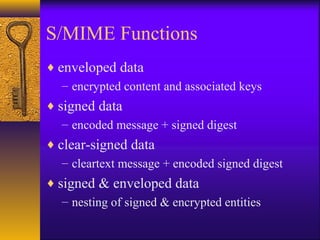
S/MIME Functions
♦ enveloped data
– encrypted content and associated keys
♦ signed data
– encoded message + signed digest
♦ clear-signed data
– cleartext message + encoded signed digest
♦ signed & enveloped data
– nesting of signed & encrypted entities

Email security

  • 1.
  • 2.
    Introduction email is oneof the most widely used and regarded network services currently message contents are not secure may be inspected either in transit or by suitably privileged users on destination system
  • 3.
    Email security requirements ♦Confidentiality ♦ Authentication ♦ Integrity ♦ Non-repudiation
  • 4.
    Basic phase ofEmail internt pull email email email senders SMTP servers receivers SMTP servers sender receiver
  • 5.
    Privacy enhanced mail PEMadopted by the Internet Architecture Board (IAB) to provide secure electronic mail communication over the internet Steps of PEM ♦ Canonical conversion ♦ Digital signature ♦ Encryption ♦ Base 64 encoding
  • 6.
    Canonical conversions ♦ PEMtransforms each email message into an abstract canonical representation. This means that regardless of the architecture and the operating system of the sending and receiving computers, the email message always travels in a uniform, independent format.
  • 7.
    Message digest creation Sender’sprivate key Email message To:abc@xyz.com From:mnc@xyz.com Subject:meeting Message digest Algorithm(MD2 Or MD5) 1010101010101 01010……….. ……………… 1010101010101 01010……….. ……………… encrypt digital signature Digital signature
  • 8.
  • 9.
  • 10.
    Printable encoding characters 0A 8 I 16 Q 24 Y 32 g 40 o 48 w 56 4 1 B 9 J 17 R 25 Z 33 h 41 p 49 x 57 5 2 C 10 K 18 S 26 a 34 i 42 q 50 y 58 6 3 D 11 L 19 T 27 b 35 j 43 r 51 z 59 7 4 E 12 M 20 U 28 c 36 k 44 s 52 0 60 8 5 F 13 N 21 V 29 d 37 l 45 t 53 1 61 9 6 G 14 O 22 W 30 e 38 m 46 u 54 2 62 + 7 H 15 P 23 X 31 f 39 n 47 v 55 3 63 /
  • 11.
    Pretty Good Privacy(PGP) PGP provides a confidentiality and authentication service that can be used for electronic mail and file storage applications. A number of reasons can be cited for this growth. ♦ available free worldwide ♦ It is based on extremely secure algorithm. ♦ wide range of applicability ♦ not developed by governmental organization.
  • 12.
    Operational description The actualoperation of PGP, consists of five services: authentication, confidentiality, compression, e-mail compatibility, and segmentation
  • 13.
    Authentication 1. sender createsmessage 2. make SHA-1160-bit hash of message 3. attached RSA signed hash to message 4. receiver decrypts & recovers hash code 5. receiver verifies received message hash
  • 14.
    Confidentiality 1. sender forms128-bit random session key 2. encrypts message with session key 3. attaches session key encrypted with RSA 4. receiver decrypts & recovers session key 5. session key is used to decrypt message
  • 15.
    Confidentiality & Authentication canuse both services on same message create signature & attach to message encrypt both message & signature attach RSA/ElGamal encrypted session key
  • 16.
    Compression ♦ by defaultPGP compresses message after signing but before encrypting – so can store uncompressed message & signature for later verification – & because compression is non deterministic ♦ uses ZIP compression algorithm
  • 17.
    Email Compatibility ♦ whenusing PGP will have binary data to send (encrypted message etc) ♦ however email was designed only for text ♦ hence PGP must encode raw binary data into printable ASCII characters ♦ uses radix-64 algorithm – maps 3 bytes to 4 printable chars – also appends a CRC ♦ PGP also segments messages if too big
  • 18.
  • 19.
    PGP Session Keys ♦need a session key for each message – of varying sizes: 56-bit DES, 128-bit CAST or IDEA, 168-bit Triple-DES ♦ generated using ANSI X12.17 mode ♦ uses random inputs taken from previous uses and from keystroke timing of user
  • 20.
    PGP Public &Private Keys ♦ since many public/private keys may be in use, need to identify which is actually used to encrypt session key in a message – could send full public-key with every message – but this is inefficient ♦ rather use a key identifier based on key – is least significant 64-bits of the key – will very likely be unique ♦ also use key ID in signatures
  • 21.
  • 22.
  • 23.
  • 24.
  • 25.
    S/MIME (Secure/Multipurpose Internet MailExtensions) ♦ security enhancement to MIME email – original Internet RFC822 email was text only – MIME provided support for varying content types and multi-part messages – with encoding of binary data to textual form – S/MIME added security enhancements ♦ have S/MIME support in many mail agents – eg MS Outlook, Mozilla, Mac Mail etc
  • 26.
    Signed mail 1. Theuser writes the message as clear-text. 2. The message digest is being calculated (using SHA-1[2] or MD5[3]). 3. The message digest is being encrypted using the signer’s private key (DSS[4] or RSA[5]).
  • 27.
  • 28.
    Encrypted mail 1. Theuser writes the message as clear-text. 2. A random session key is being created (tripleDES[6] or RC2[7]) 3. The message is being encrypted using the random session key. 4. For every recipient, the session key is being encrypted using the recipient’s public key (DH[8] or RSA[5]).
  • 29.
  • 30.
    S/MIME Cryptographic Algorithms ♦ digitalsignatures: DSS & RSA ♦ hash functions: SHA-1 & MD5 ♦ session key encryption: ElGamal & RSA ♦ message encryption: AES, Triple-DES, RC2/40 and others ♦ MAC: HMAC with SHA-1
  • 31.
    S/MIME Functions ♦ envelopeddata – encrypted content and associated keys ♦ signed data – encoded message + signed digest ♦ clear-signed data – cleartext message + encoded signed digest ♦ signed & enveloped data – nesting of signed & encrypted entities