DNS : A STUDY
Presented By- MAUOOD HAMIDI
             MSC CS
            CUB1102312006

GUIDED BY:-
    NEMI CHANDRA RATHORE SIR
    HOD Dept. Of Computer Science
    Central University Of Bihar
8/2/2013     Presented For Dissertation On DNS
COVERAGE
 DNS DEFINITION

 DNS SERVER

 DNS TOOLS

 DNS QUERY

 DNS RECORDS
8/2/2013      Presented For Desertation On DNS
COVERAGE
 NETWORK TOOLS

 NEED OF DNS

 DNS COMPONENTS

 DNS TYPES

 DNS CONTEXT
8/2/2013   Presented For Desertation On DNS
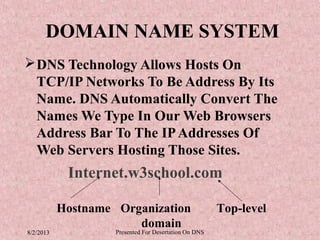
DOMAIN NAME SYSTEM
 DNS Technology Allows Hosts On
  TCP/IP Networks To Be Address By Its
  Name. DNS Automatically Convert The
  Names We Type In Our Web Browsers
  Address Bar To The IP Addresses Of
  Web Servers Hosting Those Sites.
            Internet.w3school.com

           Hostname Organization                       Top-level
                       domain
8/2/2013            Presented For Desertation On DNS
DNS CONTINUED
• DNS Include A Network Protocol for
  Memorizing Host Name And Addresses
  Through A Distributed Data Base.
• All The Top-Level domains, delegates
  authority for second-level domains, and a
  database of registered name servers for
  all second-level domains Monitored by
  The Network Information System(NIC).

 8/2/2013      Presented For Desertation On DNS
DNS CONT………
• Host name assignments maintained
  through zone files on primary DNS
  server. Secondary DNS server gets zone
  file from primary server.


8/2/2013      Presented For Desertation On DNS
DNS SERVER
• There are different types of DNS
  SERVER available we can install any of
  them as per our requirement. It Is Of
  Three Types,
• Primary:- Locally stored files exists on
  the name server data base.
• Secondary:- Gets data called a zone
  transfer from another server that is the
  zone authority.
8/2/2013      Presented For Desertation On DNS
DNS SERVERS
• Caching:- Only caches name server
  information and does not contain its own
  files.

• For example:-
• BIND, DJBDNS, ANS/CNS, POWER
  DNS etc.

8/2/2013      Presented For Desertation On DNS
SERVER SUBSCRIPTION
• Costs range from $20 to $50 per year.
• ISP’s beginning to offer domain name
  registration as part of other packages.
• Need to register a primary and secondary
  domain name servers for your domain
  and arrange to have zone files created on
  DNS servers.


8/2/2013      Presented For Desertation On DNS
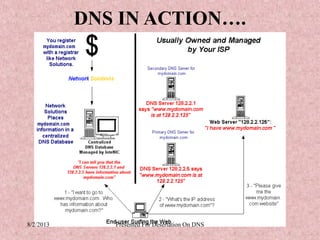
DNS IN ACTION….


8/2/2013      Presented For Desertation On DNS
DNS TOOLS
• There are several tools for monitoring
  DNS information:
  – whois – tells you the owner and
    primary DNS servers associated with a
    domain (e.g. whois yahoo.com). Also
    available via web browser at
    www.networksolutions.com


8/2/2013     Presented For Desertation On DNS
DNS TOOLS
• -nslookup and host (on UNIX machines)
  tell you IP address information for a
  particular hostname on the internet (e.g.
  -nslookup www.gmail.com or host
  www.nic.edu)


8/2/2013      Presented For Desertation On DNS
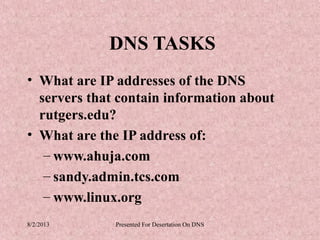
DNS TASKS
• What are IP addresses of the DNS
  servers that contain information about
  rutgers.edu?
• What are the IP address of:
   – www.ahuja.com
   – sandy.admin.tcs.com
   – www.linux.org
8/2/2013      Presented For Desertation On DNS
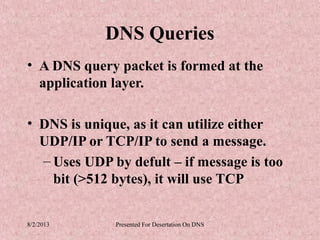
DNS Queries
• A DNS query packet is formed at the
  application layer.

• DNS is unique, as it can utilize either
  UDP/IP or TCP/IP to send a message.
  – Uses UDP by defult – if message is too
    bit (>512 bytes), it will use TCP


8/2/2013      Presented For Desertation On DNS
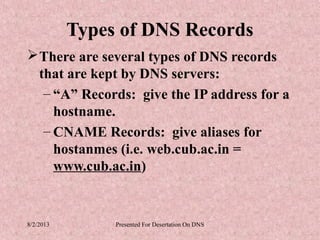
Types of DNS Records
 There are several types of DNS records
  that are kept by DNS servers:
   – “A” Records: give the IP address for a
     hostname.
   – CNAME Records: give aliases for
     hostanmes (i.e. web.cub.ac.in =
     www.cub.ac.in)


8/2/2013        Presented For Desertation On DNS
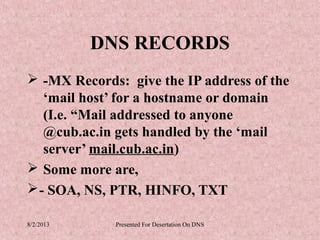
DNS RECORDS
 -MX Records: give the IP address of the
   ‘mail host’ for a hostname or domain
   (I.e. “Mail addressed to anyone
   @cub.ac.in gets handled by the ‘mail
   server’ mail.cub.ac.in)
 Some more are,
 - SOA, NS, PTR, HINFO, TXT

8/2/2013     Presented For Desertation On DNS
Network Tools
• Ping (Windows and UNIX)

• Traceroute (tracert on Windows,
  traceroute on UNIX)

• Nslookup (UNIX only)

• Host (UNIX only)
8/2/2013     Presented For Desertation On DNS
Why We Need DNS
•     As the system grew, HOSTS.TXT had
      problems with:
     – Scalability (traffic and load)
     – Reliability
     – Dynamicity
     – Name collisions
     – Consistency

8/2/2013       Presented For Desertation On DNS
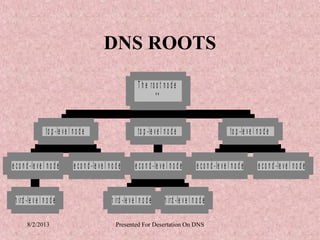
DNS NAME SPACE
• The name space is the structure of the
  DNS database
  – An inverted tree with the root node at the
    top
• Each node has a label
  – The root node has a null label, written as “”


8/2/2013        Presented For Desertation On DNS
DNS ROOTS
                                                                             T h e ro o t n o d e
                                                                                      ""


                      t o p -le v e l n o d e                                t o p -le v e l n o d e                                 t o p -le v e l n o d e


s e c o n d - le v e l n o d e       s e c o n d - le v e l n o d e       s e c o n d - le v e l n o d e       s e c o n d - le v e l n o d e       s e c o n d - le v e l n o d e


  t h ir d -le v e l n o d e                                t h ir d -le v e l n o d e      t h ir d -le v e l n o d e

          8/2/2013                                              Presented For Desertation On DNS
Domain Names
 A domain name is the sequence of labels
  from a node to the root, separated by
  dots (“.”s), read left to right
   – The name space has a maximum depth
     of 127 levels
   – Domain names are limited to 255
     characters in length
 A node’s domain name identifies its
  position in the name space
8/2/2013     Presented For Desertation On DNS
TYPES OF DOMAIN
 GENERIC DOMAIN

 COUNTRY DOMAIN


8/2/2013      Presented For Desertation On DNS
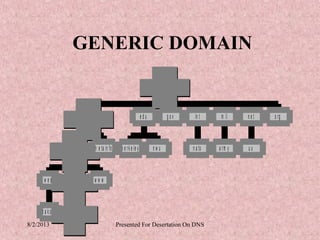
GENERIC DOMAIN

                                                                                     ""


                                 com                                     edu              gov    in t     m il    net   o rg


                  n o m in u m         m e ta in fo     b e r k e le y         nwu              n a to   a rm y   uu


      w est          e a st            www


     d a k o ta    to rn a d o
8/2/2013                                              Presented For Desertation On DNS
COUNTRY DOMAIN
 Each Country Is Assigned A Single
  Top Level Domain, Like

          .in(ac.in, nic.in, gov.in)

          .us(ac.us, af.gov.us)

8/2/2013             Presented For Desertation On DNS
Subdomains
     One domain is a subdomain of another
       if its top node is a descendant of the
                   other’s top node
         More simply, one domain is a
       subdomain of another if its domain
      name ends in the other’s domain name
                          So
      purchase.tradus.com is a subdomain of
                            tradus.com
8/2/2013        Presented For Desertation On DNS
Delegation
 Administrators can create subdomains to
  group hosts
     – According to geography, organizational
       affiliation etc.
 An administrator of a domain can
  delegate responsibility for managing a
  subdomain to someone else
 The parent domain retains links to the
  delegated subdomain
8/2/2013          Presented For Desertation On DNS
Zones By Delegation
 Each time an administrator delegates a
  subdomain, a new unit of administration is
  created
     – The subdomain and its parent domain can now be
       administered independently
     – These units are called zones
     – The boundary between zones is a point of delegation
       in the name space
 Delegation is good: it is the key to scalability
8/2/2013            Presented For Desertation On DNS
Name Servers
 Name servers store information about the name
  space in units called “zones”
   – The name servers that load a complete zone are said
     to “have authority for” or “be authoritative for” the
     zone
 Usually, more than one name server are
  authoritative for the same zone
   – This ensures redundancy and spreads the load
 Also, a single name server may be authoritative
     for many zones
8/2/2013          Presented For Desertation On DNS
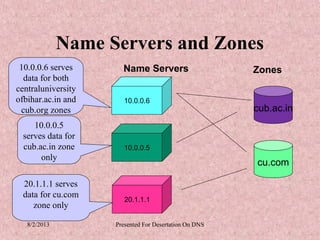
Name Servers and Zones
 10.0.0.6 serves      Name Servers                     Zones
  data for both
centraluniversity
ofbihar.ac.in and      10.0.0.6
 cub.org zones                                         cub.ac.in
     10.0.0.5
  serves data for
  cub.ac.in zone       10.0.0.5
       only
                                                       cu.com

  20.1.1.1 serves
  data for cu.com
                       20.1.1.1
     zone only

   8/2/2013         Presented For Desertation On DNS
Types of Name Servers
 Two main types of servers
     – Authoritative – maintains the data
           • Master – where the data is edited
           • Slave – where data is replicated
     – Caching – stores data obtained from an
       authoritative server
 Other types exist…
 No special hardware necessary


8/2/2013                 Presented For Desertation On DNS
Loads On DNS
 DNS can handle the load
     – DNS root servers get approximately 3000
       queries per second
           o Empirical proofs (DDoS attacks) show root name
             servers can handle 50,000 queries per second
              o Limitation is network bandwidth, not the DNS
                protocol
     – in-addr.arpa zone, which translates numbers
       to names, gets about 2000 queries per second
8/2/2013                Presented For Desertation On DNS
DNS Efficiency
 DNS is a very lightweight protocol
     – Simple query – response
 Any performance limitations are due to
  the network limitations
     – Speed of light
     – Network congestion
     – Switching/forwarding latencies

8/2/2013          Presented For Desertation On DNS
DNS Security
 Base DNS protocol (RFC 1034, 1035) is
  insecure
     – “Spoof” attacks are possible
 DNS Security Enhancements (DNSSEC, RFC
  2565) remedies this flaw
     – But creates new ones
           • DoS attacks
           • Amplification attacks
 DNSSEC strongly discourages large flat zones
     – Hierarchy (delegation) is good
8/2/2013                 Presented For Desertation On DNS
REFERENCES
• Computer Networks-Andrew S
  Tanenbaum
• Fundamental Of Computer Networks
• CDEEP BOMBAY(TUTORIALS)
• Wikipedia.com
• W3school.com


8/2/2013    Presented For Desertation On DNS
Time To Ask


             ?
8/2/2013   Presented For Desertation On DNS

Dns ppt

  • 1.
    DNS : ASTUDY Presented By- MAUOOD HAMIDI MSC CS CUB1102312006 GUIDED BY:- NEMI CHANDRA RATHORE SIR HOD Dept. Of Computer Science Central University Of Bihar 8/2/2013 Presented For Dissertation On DNS
  • 2.
    COVERAGE  DNS DEFINITION DNS SERVER  DNS TOOLS  DNS QUERY  DNS RECORDS 8/2/2013 Presented For Desertation On DNS
  • 3.
    COVERAGE  NETWORK TOOLS NEED OF DNS  DNS COMPONENTS  DNS TYPES  DNS CONTEXT 8/2/2013 Presented For Desertation On DNS
  • 4.
    DOMAIN NAME SYSTEM DNS Technology Allows Hosts On TCP/IP Networks To Be Address By Its Name. DNS Automatically Convert The Names We Type In Our Web Browsers Address Bar To The IP Addresses Of Web Servers Hosting Those Sites. Internet.w3school.com Hostname Organization Top-level domain 8/2/2013 Presented For Desertation On DNS
  • 5.
    DNS CONTINUED • DNSInclude A Network Protocol for Memorizing Host Name And Addresses Through A Distributed Data Base. • All The Top-Level domains, delegates authority for second-level domains, and a database of registered name servers for all second-level domains Monitored by The Network Information System(NIC). 8/2/2013 Presented For Desertation On DNS
  • 6.
    DNS CONT……… • Hostname assignments maintained through zone files on primary DNS server. Secondary DNS server gets zone file from primary server. 8/2/2013 Presented For Desertation On DNS
  • 7.
    DNS SERVER • Thereare different types of DNS SERVER available we can install any of them as per our requirement. It Is Of Three Types, • Primary:- Locally stored files exists on the name server data base. • Secondary:- Gets data called a zone transfer from another server that is the zone authority. 8/2/2013 Presented For Desertation On DNS
  • 8.
    DNS SERVERS • Caching:-Only caches name server information and does not contain its own files. • For example:- • BIND, DJBDNS, ANS/CNS, POWER DNS etc. 8/2/2013 Presented For Desertation On DNS
  • 9.
    SERVER SUBSCRIPTION • Costsrange from $20 to $50 per year. • ISP’s beginning to offer domain name registration as part of other packages. • Need to register a primary and secondary domain name servers for your domain and arrange to have zone files created on DNS servers. 8/2/2013 Presented For Desertation On DNS
  • 10.
    DNS IN ACTION…. 8/2/2013 Presented For Desertation On DNS
  • 11.
    DNS TOOLS • Thereare several tools for monitoring DNS information: – whois – tells you the owner and primary DNS servers associated with a domain (e.g. whois yahoo.com). Also available via web browser at www.networksolutions.com 8/2/2013 Presented For Desertation On DNS
  • 12.
    DNS TOOLS • -nslookupand host (on UNIX machines) tell you IP address information for a particular hostname on the internet (e.g. -nslookup www.gmail.com or host www.nic.edu) 8/2/2013 Presented For Desertation On DNS
  • 13.
    DNS TASKS • Whatare IP addresses of the DNS servers that contain information about rutgers.edu? • What are the IP address of: – www.ahuja.com – sandy.admin.tcs.com – www.linux.org 8/2/2013 Presented For Desertation On DNS
  • 14.
    DNS Queries • ADNS query packet is formed at the application layer. • DNS is unique, as it can utilize either UDP/IP or TCP/IP to send a message. – Uses UDP by defult – if message is too bit (>512 bytes), it will use TCP 8/2/2013 Presented For Desertation On DNS
  • 15.
    Types of DNSRecords  There are several types of DNS records that are kept by DNS servers: – “A” Records: give the IP address for a hostname. – CNAME Records: give aliases for hostanmes (i.e. web.cub.ac.in = www.cub.ac.in) 8/2/2013 Presented For Desertation On DNS
  • 16.
    DNS RECORDS  -MXRecords: give the IP address of the ‘mail host’ for a hostname or domain (I.e. “Mail addressed to anyone @cub.ac.in gets handled by the ‘mail server’ mail.cub.ac.in)  Some more are,  - SOA, NS, PTR, HINFO, TXT 8/2/2013 Presented For Desertation On DNS
  • 17.
    Network Tools • Ping(Windows and UNIX) • Traceroute (tracert on Windows, traceroute on UNIX) • Nslookup (UNIX only) • Host (UNIX only) 8/2/2013 Presented For Desertation On DNS
  • 18.
    Why We NeedDNS • As the system grew, HOSTS.TXT had problems with: – Scalability (traffic and load) – Reliability – Dynamicity – Name collisions – Consistency 8/2/2013 Presented For Desertation On DNS
  • 19.
    DNS NAME SPACE •The name space is the structure of the DNS database – An inverted tree with the root node at the top • Each node has a label – The root node has a null label, written as “” 8/2/2013 Presented For Desertation On DNS
  • 20.
    DNS ROOTS T h e ro o t n o d e "" t o p -le v e l n o d e t o p -le v e l n o d e t o p -le v e l n o d e s e c o n d - le v e l n o d e s e c o n d - le v e l n o d e s e c o n d - le v e l n o d e s e c o n d - le v e l n o d e s e c o n d - le v e l n o d e t h ir d -le v e l n o d e t h ir d -le v e l n o d e t h ir d -le v e l n o d e 8/2/2013 Presented For Desertation On DNS
  • 21.
    Domain Names  Adomain name is the sequence of labels from a node to the root, separated by dots (“.”s), read left to right – The name space has a maximum depth of 127 levels – Domain names are limited to 255 characters in length  A node’s domain name identifies its position in the name space 8/2/2013 Presented For Desertation On DNS
  • 22.
    TYPES OF DOMAIN GENERIC DOMAIN  COUNTRY DOMAIN 8/2/2013 Presented For Desertation On DNS
  • 23.
    GENERIC DOMAIN "" com edu gov in t m il net o rg n o m in u m m e ta in fo b e r k e le y nwu n a to a rm y uu w est e a st www d a k o ta to rn a d o 8/2/2013 Presented For Desertation On DNS
  • 24.
    COUNTRY DOMAIN  EachCountry Is Assigned A Single Top Level Domain, Like  .in(ac.in, nic.in, gov.in)  .us(ac.us, af.gov.us) 8/2/2013 Presented For Desertation On DNS
  • 25.
    Subdomains  One domain is a subdomain of another if its top node is a descendant of the other’s top node  More simply, one domain is a subdomain of another if its domain name ends in the other’s domain name So purchase.tradus.com is a subdomain of tradus.com 8/2/2013 Presented For Desertation On DNS
  • 26.
    Delegation  Administrators cancreate subdomains to group hosts – According to geography, organizational affiliation etc.  An administrator of a domain can delegate responsibility for managing a subdomain to someone else  The parent domain retains links to the delegated subdomain 8/2/2013 Presented For Desertation On DNS
  • 27.
    Zones By Delegation Each time an administrator delegates a subdomain, a new unit of administration is created – The subdomain and its parent domain can now be administered independently – These units are called zones – The boundary between zones is a point of delegation in the name space  Delegation is good: it is the key to scalability 8/2/2013 Presented For Desertation On DNS
  • 28.
    Name Servers  Nameservers store information about the name space in units called “zones” – The name servers that load a complete zone are said to “have authority for” or “be authoritative for” the zone  Usually, more than one name server are authoritative for the same zone – This ensures redundancy and spreads the load  Also, a single name server may be authoritative for many zones 8/2/2013 Presented For Desertation On DNS
  • 29.
    Name Servers andZones 10.0.0.6 serves Name Servers Zones data for both centraluniversity ofbihar.ac.in and 10.0.0.6 cub.org zones cub.ac.in 10.0.0.5 serves data for cub.ac.in zone 10.0.0.5 only cu.com 20.1.1.1 serves data for cu.com 20.1.1.1 zone only 8/2/2013 Presented For Desertation On DNS
  • 30.
    Types of NameServers  Two main types of servers – Authoritative – maintains the data • Master – where the data is edited • Slave – where data is replicated – Caching – stores data obtained from an authoritative server  Other types exist…  No special hardware necessary 8/2/2013 Presented For Desertation On DNS
  • 31.
    Loads On DNS DNS can handle the load – DNS root servers get approximately 3000 queries per second o Empirical proofs (DDoS attacks) show root name servers can handle 50,000 queries per second o Limitation is network bandwidth, not the DNS protocol – in-addr.arpa zone, which translates numbers to names, gets about 2000 queries per second 8/2/2013 Presented For Desertation On DNS
  • 32.
    DNS Efficiency  DNSis a very lightweight protocol – Simple query – response  Any performance limitations are due to the network limitations – Speed of light – Network congestion – Switching/forwarding latencies 8/2/2013 Presented For Desertation On DNS
  • 33.
    DNS Security  BaseDNS protocol (RFC 1034, 1035) is insecure – “Spoof” attacks are possible  DNS Security Enhancements (DNSSEC, RFC 2565) remedies this flaw – But creates new ones • DoS attacks • Amplification attacks  DNSSEC strongly discourages large flat zones – Hierarchy (delegation) is good 8/2/2013 Presented For Desertation On DNS
  • 34.
    REFERENCES • Computer Networks-AndrewS Tanenbaum • Fundamental Of Computer Networks • CDEEP BOMBAY(TUTORIALS) • Wikipedia.com • W3school.com 8/2/2013 Presented For Desertation On DNS
  • 35.
    Time To Ask ? 8/2/2013 Presented For Desertation On DNS

Editor's Notes

  • #31 BIND: Berkeley Internet Name Domain
  • #34 a spoofing attack is a situation in which one person or program successfully masquerades as another by falsifying data