Protein & Amino acid
Metabolism

Dr.Ganesh
Protein and Amino acid Metabolism
The syllabus for this chapter includes
the following topics.

PART I
Protein and Amino acid Metabolism
Breakdown of tissue proteins and amino
acid pool, General Reactions of Amino
acids.

Disposal of Ammonia: urea cycle,
glutamate and glutamine formation.

Metabolism of Amino acids,- Glycine,
serine
Introduction
Overview of Amino Acid
Metabolism
Nitrogen Balance and amino acid
pool

Protein Turnover
Metabolism of Amino Nitrogen

Metabolism of Individual Amino
Acids – Glycine and serine
Protein and Amino acid Metabolism

PART II

Metabolism of Amino acids
sulfur containing amino
acids, aromatic amino acids,
histidine & arginine
Introduction
Proteins are linear hetero polymers
of α – L – Amino acids, which are
linked by peptide bonds. Nitrogen
(N) is characteristic of proteins.
Amino acids are not stored by the
body. Hence, they must be obtained
from the diet, synthesized de novo,
or produced from normal protein
degradation.

Any amino acids in excess of the
biosynthetic needs of the cell are
rapidly degraded.
Biological importance:
1.Proteins contain nitrogen and they
are main source of nitrogen for the
body. Dietary Proteins are the
sources of essential amino acids for
the body.
2.All amino acids are required for the
synthesis of proteins and many amino
acids serve as precursors for the synthesis
of biologically important compounds (Eg:
Melanin, serotonin, creatine etc.)
Medical importance:
1.Genetic defects in the pathways of
amino acid metabolism can cause serious
disease. Eg: Albinism,
Phenlyketonuria, Alkaptonuria
etc.

2. Dietary deficiancy of proteins can
result in disease such as P.E.M
(protein energy malnutrition)
NITROGEN BALANCE
Nitrogen balance = Difference between
total nitrogen intake and total nitrogen loss

from the body.
The normal adult is in nitrogen equilibrium,

nitrogen intake = nitrogen output.
Amino acid catabolism- phases

1.The first phase of catabolism involves the
removal of the α – amino groups (usually by
transamination and subsequent deamination)
ammonia

+

corresponding α – Keto

Converted to UREA

acid.

Enters 2nd phase

and excreted.
(most important route for disposing of nitrogen
from the body.)
Amino acid catabolism- phases

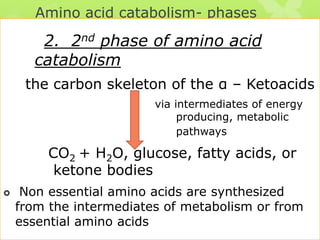
2. 2nd phase of amino acid
catabolism
the carbon skeleton of the α – Ketoacids
via intermediates of energy
producing, metabolic
pathways

CO2 + H2O, glucose, fatty acids, or
ketone bodies


Non essential amino acids are synthesized
from the intermediates of metabolism or from
essential amino acids
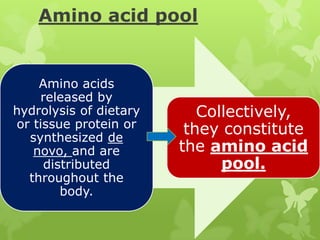
Amino acid pool

Amino acids
released by
hydrolysis of dietary
or tissue protein or
synthesized de
novo, and are
distributed
throughout the
body.

Collectively,
they constitute
the amino acid
pool.
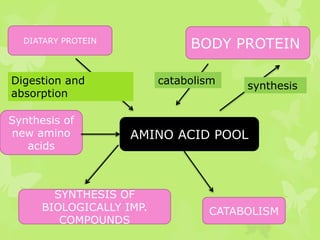
BODY PROTEIN

DIATARY PROTEIN

Digestion and
absorption
Synthesis of
new amino
acids

catabolism

synthesis

AMINO ACID POOL

SYNTHESIS OF
BIOLOGICALLY IMP.
COMPOUNDS

CATABOLISM
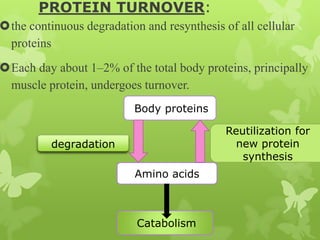
PROTEIN TURNOVER:

the continuous degradation and resynthesis of all cellular
proteins

Each day about 1–2% of the total body proteins, principally
muscle protein, undergoes turnover.
Body proteins
Reutilization for
new protein
synthesis

degradation
Amino acids

Catabolism
Metabolism of Amino Nitrogen
Overview
Transamination
Deamination Reactions (Ammonia
Formation)
•Oxidative deamination
•Non-oxidative deamination

Ammonia Transport
Disposal of Ammonia – Urea cycle.
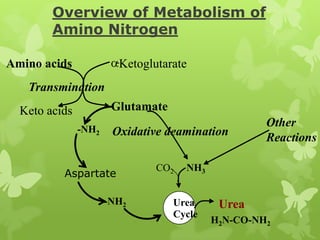
Overview of Metabolism of
Amino Nitrogen
-Ketoglutarate

Amino acids
Transmination

Glutamate

Keto acids
-NH2

Oxidative deamination

Aspartate
-NH2

CO2

Other
Reactions

NH3

Urea
Cycle

Urea
H2N-CO-NH2
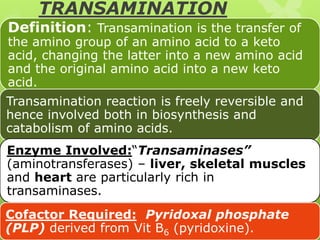
TRANSAMINATION

Definition: Transamination is the transfer of

the amino group of an amino acid to a keto
acid, changing the latter into a new amino acid
and the original amino acid into a new keto
acid.
Transamination reaction is freely reversible and
hence involved both in biosynthesis and
catabolism of amino acids.
Enzyme Involved:“Transaminases”
(aminotransferases) – liver, skeletal muscles
and heart are particularly rich in
transaminases.
Cofactor Required: Pyridoxal phosphate
(PLP) derived from Vit B6 (pyridoxine).
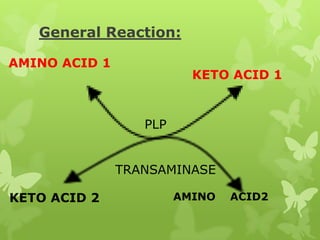
General Reaction:
AMINO ACID 1

KETO ACID 1

PLP
TRANSAMINASE
KETO ACID 2

AMINO

ACID2
Mechanism:
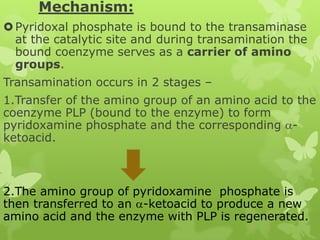
 Pyridoxal phosphate is bound to the transaminase
at the catalytic site and during transamination the
bound coenzyme serves as a carrier of amino
groups.
Transamination occurs in 2 stages –
1.Transfer of the amino group of an amino acid to the
coenzyme PLP (bound to the enzyme) to form
pyridoxamine phosphate and the corresponding ketoacid.

2.The amino group of pyridoxamine phosphate is
then transferred to an -ketoacid to produce a new
amino acid and the enzyme with PLP is regenerated.
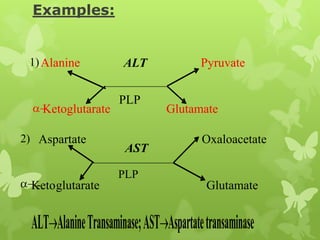
Examples:

1) Alanine

Ketoglutarate
2) Aspartate

ALT
PLP

AST

Pyruvate

Glutamate
Oxaloacetate

PLP
Ketoglutarate

Glutamate

ALT Alanine Transaminase; AST Aspartate transaminase
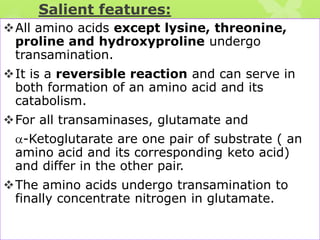
Salient features:
All amino acids except lysine, threonine,
proline and hydroxyproline undergo
transamination.
It is a reversible reaction and can serve in
both formation of an amino acid and its
catabolism.
For all transaminases, glutamate and

-Ketoglutarate are one pair of substrate ( an
amino acid and its corresponding keto acid)
and differ in the other pair.
The amino acids undergo transamination to
finally concentrate nitrogen in glutamate.
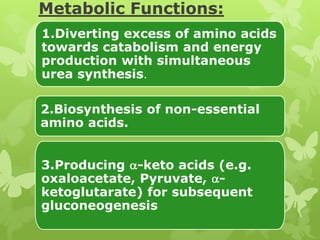
Metabolic Functions:
1.Diverting excess of amino acids
towards catabolism and energy
production with simultaneous
urea synthesis.

2.Biosynthesis of non-essential
amino acids.
3.Producing -keto acids (e.g.
oxaloacetate, Pyruvate, ketoglutarate) for subsequent
gluconeogenesis
Clinical Aspects:

Blood levels of ALT and AST
are elevated in liver diseases
and AST levels in myocardial
infarction. Their estimation is
useful in the diagnosis of
these conditions. (refer Enzymes)
Describe transamination.
Mention the clinical significance
of serum transaminases. (4)
Clinical importance of
transamination
(3) Questions??

Write the reaction, with
cofactors if any, catalyzed by
Alanine transaminase. (3)
Name the coenzyme forms of
vitamin B6; write the
mechanism of transamination
Ammonia Formation –
Deamination Reactions
Ammonia is Produced in the Body by:
1) Cellular Metabolism and
2) In the Intestinal Lumen.
1.Ammonia formation by cellular
metabolism

Cells produce ammonia mostly from
amino acids by deamination, which may
be either
1. oxidative or
2. non-oxidative
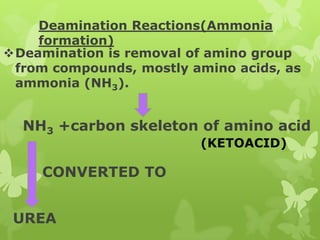
Deamination Reactions(Ammonia
formation)
Deamination is removal of amino group
from compounds, mostly amino acids, as
ammonia (NH3).

NH3 +carbon skeleton of amino acid
(KETOACID)

CONVERTED TO
UREA
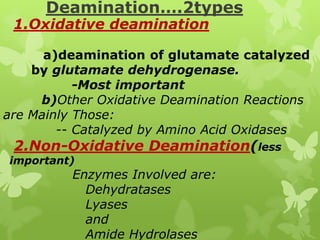
Deamination….2types

1.Oxidative deamination

a)deamination of glutamate catalyzed
by glutamate dehydrogenase.
-Most important
b)Other Oxidative Deamination Reactions
are Mainly Those:
-- Catalyzed by Amino Acid Oxidases

2.Non-Oxidative Deamination(less

important)

Enzymes Involved are:
Dehydratases
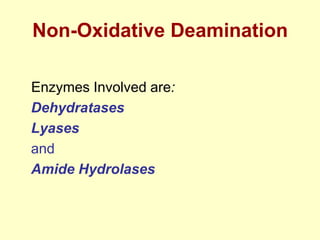
Lyases
and
Amide Hydrolases
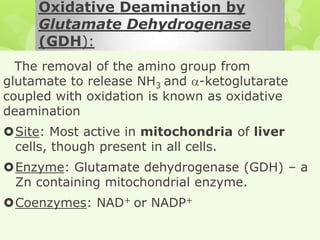
Oxidative Deamination by
Glutamate Dehydrogenase
(GDH):
The removal of the amino group from
glutamate to release NH3 and -ketoglutarate
coupled with oxidation is known as oxidative
deamination
Site: Most active in mitochondria of liver
cells, though present in all cells.
Enzyme: Glutamate dehydrogenase (GDH) – a
Zn containing mitochondrial enzyme.
Coenzymes: NAD+ or NADP+
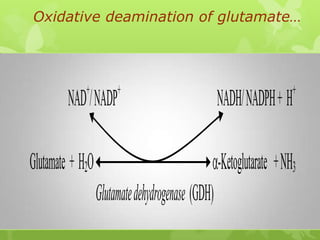
Oxidative deamination of glutamate…

+

NAD / NADP

+

Glutamate + H2O

NADH/ NADPH + H

+

-Ketoglutarate + NH3
Glutamate dehydrogenase (GDH)
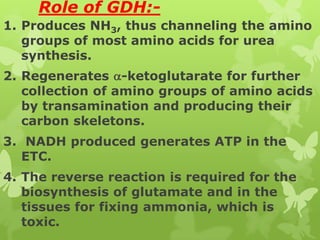
Role of GDH:1. Produces NH3, thus channeling the amino
groups of most amino acids for urea
synthesis.
2. Regenerates -ketoglutarate for further
collection of amino groups of amino acids
by transamination and producing their
carbon skeletons.

3. NADH produced generates ATP in the
ETC.
4. The reverse reaction is required for the
biosynthesis of glutamate and in the
tissues for fixing ammonia, which is
toxic.
What Is Transdeamination ??

Transamination and
deamination often
occur simultaneously
involving glutamate as
the central molecule.
this process is called
transdeamination.
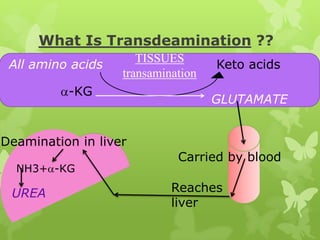
What Is Transdeamination ??
All amino acids

TISSUES
transamination

-KG

Keto acids
GLUTAMATE

Deamination in liver
NH3+ -KG

UREA

Carried by blood
Reaches
liver
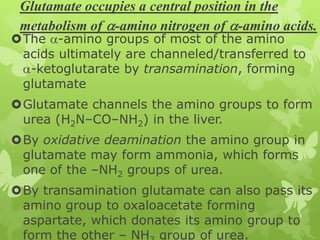
Glutamate occupies a central position in the
metabolism of -amino nitrogen of -amino acids.

The -amino groups of most of the amino
acids ultimately are channeled/transferred to
-ketoglutarate by transamination, forming
glutamate

Glutamate channels the amino groups to form
urea (H2N–CO–NH2) in the liver.

By oxidative deamination the amino group in
glutamate may form ammonia, which forms
one of the –NH2 groups of urea.
By transamination glutamate can also pass its
amino group to oxaloacetate forming
aspartate, which donates its amino group to
form the other – NH group of urea.
What are the sources of ammonia in the
body?
Explain the biochemical basis: glutamate
plays a central role in the catabolism of
amino nitrogen of amino acids.


Give 2 examples for each of the
following.
a)Transaminases b) Reactions forming
ammonia

Write the reaction, with cofactors if any,
catalyzed by Glutamate dehydrogenase.
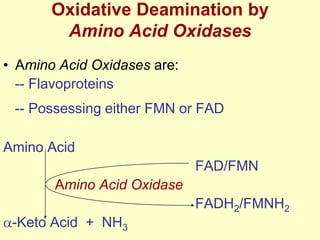
Oxidative Deamination by
Amino Acid Oxidases
• Amino Acid Oxidases are:
-- Flavoproteins
-- Possessing either FMN or FAD
Amino Acid
FAD/FMN
Amino Acid Oxidase
FADH2/FMNH2
-Keto Acid + NH3
Non-Oxidative Deamination
Enzymes Involved are:
Dehydratases
Lyases
and
Amide Hydrolases
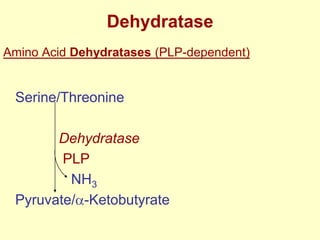
Dehydratase
Amino Acid Dehydratases (PLP-dependent)

Serine/Threonine

Dehydratase
PLP
NH3
Pyruvate/ -Ketobutyrate
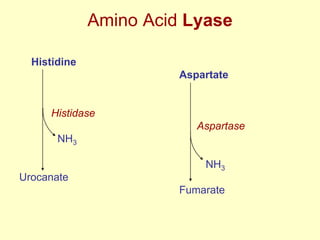
Amino Acid Lyase
Histidine
Aspartate

Histidase
Aspartase

NH3
NH3
Urocanate

Fumarate
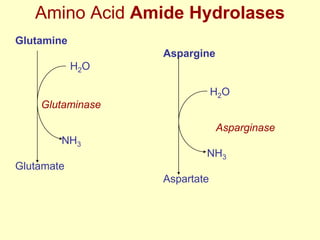
Amino Acid Amide Hydrolases
Glutamine
Aspargine
H2O
H2O
Glutaminase
Asparginase

NH3
NH3
Glutamate
Aspartate
2)NH3 production in intestine
Intestinal Lumen -- Another Major Source
of Ammonia
by the Action of Bacteria on:
-- Urea Present in the
Intestinal Juice
And
Dietary Amino Acids.
• This Ammonia is Absorbed into Hepatic
Vein and Enters Liver Directly.
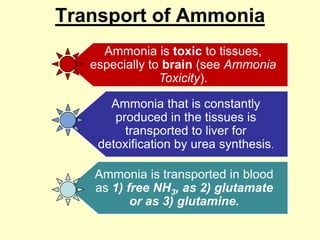
Transport of Ammonia
Ammonia is toxic to tissues,
especially to brain (see Ammonia
Toxicity).
Ammonia that is constantly
produced in the tissues is
transported to liver for
detoxification by urea synthesis.

Ammonia is transported in blood
as 1) free NH3, as 2) glutamate
or as 3) glutamine.
Transport of Ammonia…
• NH3is transported in 3 forms.
1) As free NH3 Ammonia, whose blood level
is 10 to 80 gm/dl, is rapidly removed from
the circulation by the liver and converted to
urea.
2) as glutamate Inside the cells of almost all
tissues ammonia combines with Ketoglutarate to form glutamate by GDH
and is transported to the liver.
Transport of Ammonia…
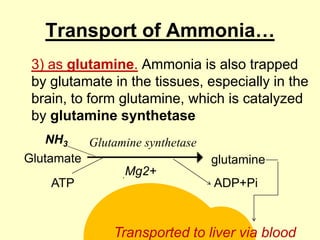
3) as glutamine. Ammonia is also trapped
by glutamate in the tissues, especially in the
brain, to form glutamine, which is catalyzed
by glutamine synthetase
NH3

Glutamine synthetase

Glutamate
ATP

glutamine
.Mg2+

ADP+Pi

Transported to liver via blood
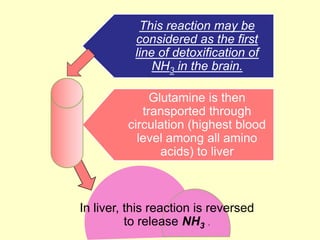
This reaction may be
considered as the first
line of detoxification of
NH3 in the brain.
Glutamine is then
transported through
circulation (highest blood
level among all amino
acids) to liver

In liver, this reaction is reversed
to release NH3 .
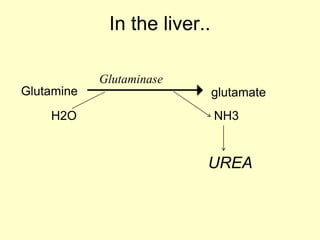
In the liver..
Glutaminase
Glutamine
H2O

glutamate
NH3

UREA
UREA CYCLE
(Detoxification of Ammonia)
Contents:
• Synonyms
• Site
• Sources of Atoms of Urea
• Reactions
• Functions
• Ammonia Toxicity – Hyperammonemia
UREA CYCLE .
(Detoxification of Ammonia)
• Ammonia is Toxic to the Body.
• Hence it is Necessary that the NH3
Produced During Metabolism of Amino
Acids be Removed Immediately.
• This is Done by Conversion of Toxic NH3
into Harmless Water-soluble Urea in the
Liver by Urea Cycle.
UREA CYCLE
(Detoxification of Ammonia)
• Synonyms:
Urea Cycle
Ornithine Cycle
Krebs-Henseleit Cycle
• Site:
Urea Synthesized in Liver
Carried by Blood
And
Excreted by Kidneys
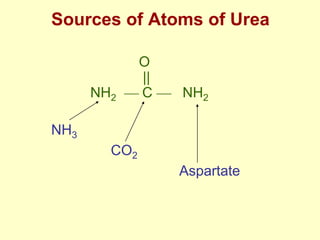
Sources of Atoms of Urea

NH2

O
||
C

NH2

NH3
CO2
Aspartate
UREA CYCLE
(Detoxification of Ammonia)
• Urea Synthesis:
-- A 5-step Cyclic Process
• Enzymes of the First 2 Steps:
-- Present in Mitochondria
• While the Rest:
-- Located in the Cytosol
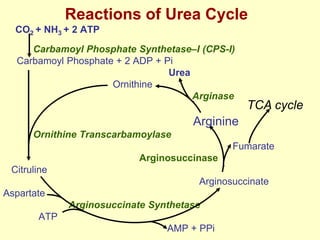
Reactions of Urea Cycle
CO2 + NH3 + 2 ATP
Carbamoyl Phosphate Synthetase–I (CPS-I)
Carbamoyl Phosphate + 2 ADP + Pi
Urea
Ornithine
Arginase

TCA cycle

Arginine
Ornithine Transcarbamoylase
Fumarate
Arginosuccinase
Citruline
Arginosuccinate

Aspartate
Arginosuccinate Synthetase
ATP
AMP + PPi
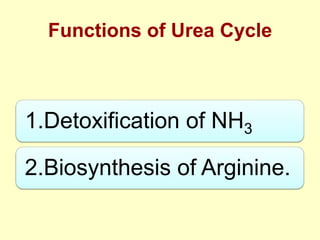
Functions of Urea Cycle

1.Detoxification of NH3
2.Biosynthesis of Arginine.
Ammonia Toxicity –
Hyperammonemia
• Ammonia Concentration Rises in the Blood
(Hyperammonemia) and in other Tissues in:
-- Liver Failure
and
-- Inborn Errors of Urea Synthesis
(that is, due to Genetic Defect)
• This Produces Ammonia Toxicity in Many
Ways.
Causes Of Hyperammonemia
• Causes may be
1.Acquired or 2. Inherited
1.Acquired Causes
– Liver Diseases (e.g. Cirrhosis and Severe
Hepatitis)

-- Liver is Unable to Convert Ammonia
into Urea
– -- Blood Ammonia Level Rises.
2.Inherited Causes
-- Defects Associated with each of the
Enzymes of Urea Cycle Exist.
-- The Levels Substrate of the Defective
Enzyme
Rises in the Cells.
-- This Causes Product Inhibition of the
Enzyme
Catalyzing the Earlier Step.
-- Leading to Accumulation Ultimately of
the Starting Substrate,
Namely, NH3
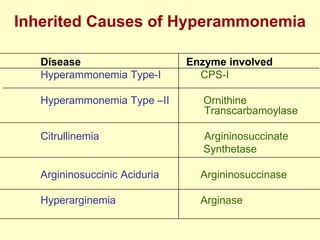
Inherited Causes of Hyperammonemia
Disease
Hyperammonemia Type-I

Enzyme involved
CPS-I

Hyperammonemia Type –II

Ornithine
Transcarbamoylase

Citrullinemia

Argininosuccinate
Synthetase

Argininosuccinic Aciduria

Argininosuccinase

Hyperarginemia

Arginase
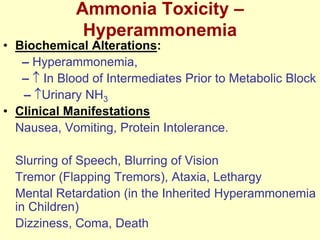
Ammonia Toxicity –
Hyperammonemia

• Biochemical Alterations:
– Hyperammonemia,
– In Blood of Intermediates Prior to Metabolic Block
– Urinary NH3
• Clinical Manifestations
Nausea, Vomiting, Protein Intolerance.
Slurring of Speech, Blurring of Vision
Tremor (Flapping Tremors), Ataxia, Lethargy
Mental Retardation (in the Inherited Hyperammonemia
in Children)
Dizziness, Coma, Death
Blood Urea
In Healthy People, Normal Blood Urea
Concentration is 12-36 mg/dL
Higher Protein Intake Marginally
Increases Blood Urea Level; however,
this will be within Normal Range.
(See Practical Manual for Clinical
Significance of Blood Urea)
1. How ammonia is formed in the body? Explain
the reaction leading to the detoxification of
ammonia.
2. Describe the urea cycle. What is the normal
blood urea level? Name two conditions in which
blood urea level increases.
3. Explain the steps of Urea cycle & Mention the
names of its disorders.
4.Carbamoyl phosphate synthetase deficiency.
5.Give 2 examples for each of the following.
a) Causes for inherited disorders of urea cycle
b)Conditions in which blood urea level
increases
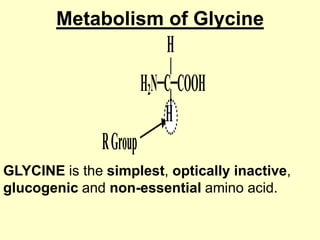
Metabolism of Glycine

H
H2N–C–COOH
H
R Group
GLYCINE is the simplest, optically inactive,
glucogenic and non-essential amino acid.
Metabolism of Glycinecontents
Synthesis
Catabolism
Synthesis of biologically imp. Compounds
from glycine

Inborn errors of glycine metabolism
Synthesis
Glycine is a non-essential amino
acid as it can be synthesized in
the body.
It can be synthesized from many
substances by separate
reactions.
• The major reactions are from:
1.Serine
2.CO2, NH3 and N5, N10 methylene
tetrahydrofolate (N5, N10 methylene
FH4)
3. And Glyoxylate
• These are reversible reactions and thus
also play a role in the catabolism of
glycine.
• Minor pathways for synthesis of
glycine are from:
Threonine and Choline
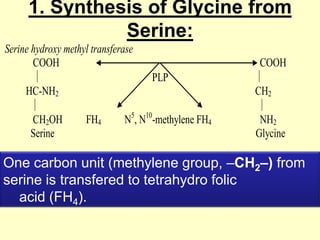
1. Synthesis of Glycine from
Serine:
Serine hydroxy methyl transferase
COOH

COOH
PLP

HC-NH2
CH2OH
Serine

CH2
FH4

N5, N10-methylene FH4

NH2
Glycine

One carbon unit (methylene group, –CH2–) from
serine is transfered to tetrahydro folic
acid (FH4).
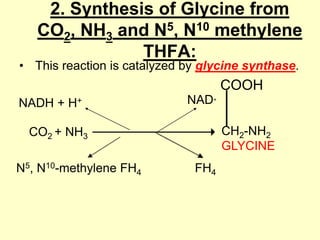
2. Synthesis of Glycine from
CO2, NH3 and N5, N10 methylene
THFA:

• This reaction is catalyzed by glycine synthase.

COOH
NADH + H+

NAD+
CH2-NH2
GLYCINE

CO2 + NH3
N5, N10-methylene FH4

FH4
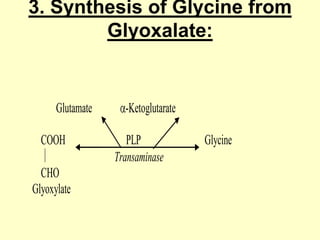
3. Synthesis of Glycine from
Glyoxalate:

Glutamate
COOH
CHO
Glyoxylate

-Ketoglutarate
PLP
Transaminase

Glycine
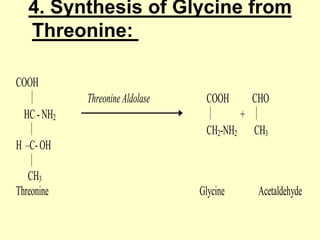
4. Synthesis of Glycine from
Threonine:
COOH
Threonine Aldolase

COOH

HC - NH2
H –C- OH
CH3
Threonine

CHO
+

CH2-NH2

Glycine

CH3

Acetaldehyde
Catabolism:
• There are several paths for catabolism of
glycine.
• All, except one, are reversals of
biosynthetic pathways.
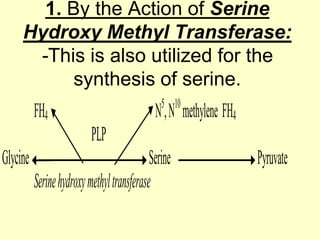
1. By the Action of Serine
Hydroxy Methyl Transferase:
-This is also utilized for the
synthesis of serine.
5 10

FH4

N , N methylene FH4
PLP

Glycine

Serine
Serine hydroxy methyl transferase

Pyruvate
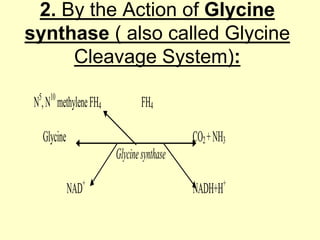
2. By the Action of Glycine
synthase ( also called Glycine
Cleavage System):
5 10

N , N methylene FH4

FH4

Glycine

CO2 + NH3
Glycine synthase
NAD

+

+

NADH+H
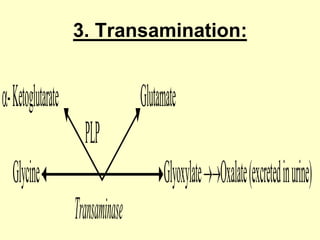
3. Transamination:

- Ketoglutarate

Glutamate
PLP

Glycine

Glyoxylate Oxalate (excreted in urine)
Transaminase
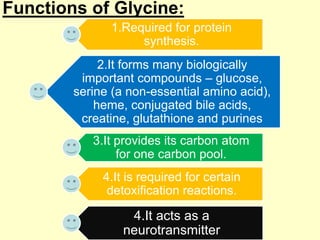
Functions of Glycine:
1.Required for protein
synthesis.

2.It forms many biologically
important compounds – glucose,
serine (a non-essential amino acid),
heme, conjugated bile acids,
creatine, glutathione and purines
3.It provides its carbon atom
for one carbon pool.
4.It is required for certain
detoxification reactions.

4.It acts as a
neurotransmitter
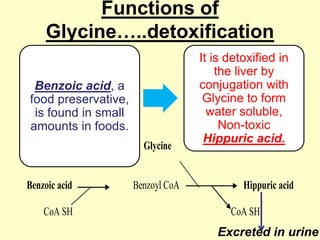
Functions of
Glycine…..detoxification
Benzoic acid, a
food preservative,
is found in small
amounts in foods.
Glycine

Benzoic acid
CoA SH

Benzoyl CoA

It is detoxified in
the liver by
conjugation with
Glycine to form
water soluble,
Non-toxic
Hippuric acid.

Hippuric acid
CoA SH

Excreted in urine
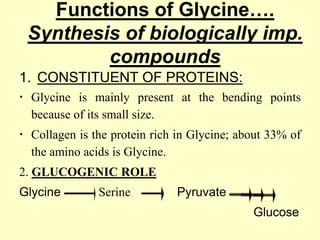
Functions of Glycine….
Synthesis of biologically imp.
compounds
1. CONSTITUENT OF PROTEINS:
 Glycine is mainly present at the bending points
because of its small size.
 Collagen is the protein rich in Glycine; about 33% of
the amino acids is Glycine.

2. GLUCOGENIC ROLE
Glycine

Serine

Pyruvate
Glucose
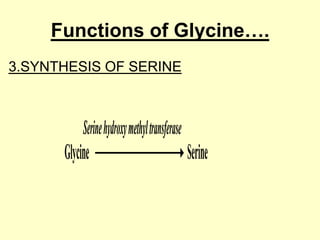
Functions of Glycine….
3.SYNTHESIS OF SERINE

Serine hydroxy methyl transferase

Glycine

Serine
Functions of Glycine….
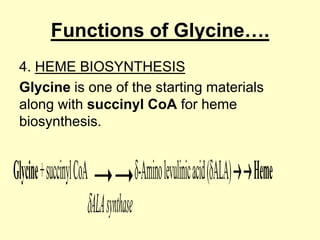
4. HEME BIOSYNTHESIS
Glycine is one of the starting materials
along with succinyl CoA for heme
biosynthesis.

Glycine + succinyl CoA

-Amino levulinic acid ( ALA) Heme
ALA synthase
Functions of Glycine….
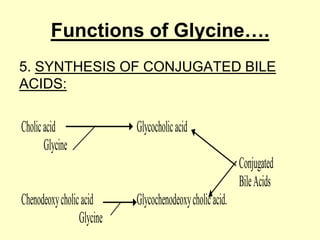
5. SYNTHESIS OF CONJUGATED BILE
ACIDS:

Cholic acid
Glycine

Glycocholic acid
Conjugated
Bile Acids

Chenodeoxy cholic acid
Glycine

Glycochenodeoxy cholic acid.
Functions of Glycine….

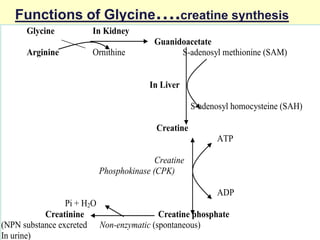
5.CREATINE SYNTHESIS

Creatine phosphate is formed from
glycine, arginine and S-adenosyl
methionine (SAM), in kidneys and
liver.
Functions of Glycine….creatine synthesis
Glycine
Arginine

In Kidney
Ornithine

Guanidoacetate
S-adenosyl methionine (SAM)

In Liver
S-adenosyl homocysteine (SAH)
Creatine
ATP
Creatine
Phosphokinase (CPK)
ADP
Pi + H2O
Creatinine
Creatine phosphate
(NPN substance excreted Non-enzymatic (spontaneous)
In urine)
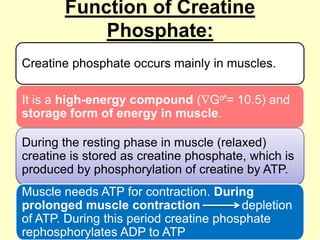
Function of Creatine
Phosphate:
Creatine phosphate occurs mainly in muscles.
It is a high-energy compound ( Go'= 10.5) and
storage form of energy in muscle.
During the resting phase in muscle (relaxed)
creatine is stored as creatine phosphate, which is
produced by phosphorylation of creatine by ATP.

Muscle needs ATP for contraction. During
prolonged muscle contraction
depletion
of ATP. During this period creatine phosphate
rephosphorylates ADP to ATP
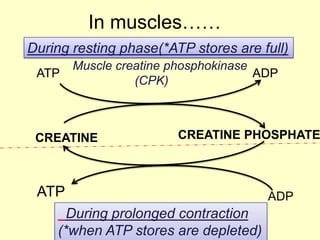
In muscles……
During resting phase(*ATP stores are full)
ATP

Muscle creatine phosphokinase
ADP
(CPK)

CREATINE

CREATINE PHOSPHATE

During prolonged contraction
(*when ATP stores are depleted)
Functions of Glycine….
6.

SYNTHESIS OF GLUTATHIONE:
Glutathione ( -glutamyl-cysteinyl-glycine) is
a tripeptide formed from glycine, glutamate
and cysteine.
The reduced form is monomeric and carries
hydrogen atom in the sulfhydryl group(SH) of cysteinyl residue.
The oxidized form is dimeric.
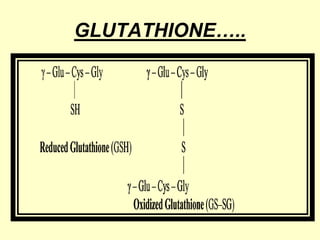
GLUTATHIONE…..
– Glu – Cys – Gly

– Glu – Cys – Gly

SH

S

Reduced Glutathione (GSH)

S
– Glu – Cys – Gly
Oxidized Glutathione (GS–SG)
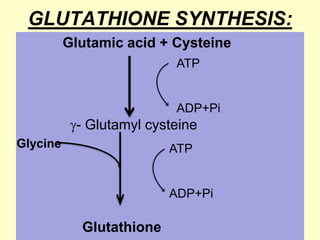
GLUTATHIONE SYNTHESIS:
Glutamic acid + Cysteine
ATP

ADP+Pi

- Glutamyl cysteine
Glycine

Glutathione
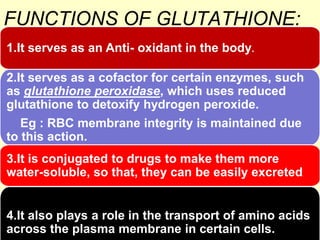
FUNCTIONS OF GLUTATHIONE:
1.It serves as an Anti- oxidant in the body.
2.It serves as a cofactor for certain enzymes, such
as glutathione peroxidase, which uses reduced
glutathione to detoxify hydrogen peroxide.
Eg : RBC membrane integrity is maintained due
to this action.
3.It is conjugated to drugs to make them more
water-soluble, so that, they can be easily excreted

..

4.It also plays a role in the transport of amino acids
across the plasma membrane in certain cells.
Functions of Glycine….
7. SYNTHESIS OF PURINE RING:
• C4, C5 and N7 of the purine ring are
provided by glycine.
• Thus the whole molecule of glycine is
involved in the synthesis of purine.
•
Inborn Errors of Glycine
Metabolism:
1.Glycinuria:
This is a rare genetic disorder, probably resulting
from a defect in the renal tubular reabsorption
of glycine.

It is characterized by excessive excretion of
glycine in urine (0.6 – 1 g per day) and a
tendency to form oxalate renal stones.
However, plasma glycine levels are normal.
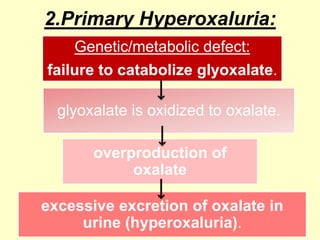
2.Primary Hyperoxaluria:
Genetic/metabolic defect:
failure to catabolize glyoxalate.
glyoxalate is oxidized to oxalate.

overproduction of
oxalate
excessive excretion of oxalate in
urine (hyperoxaluria).
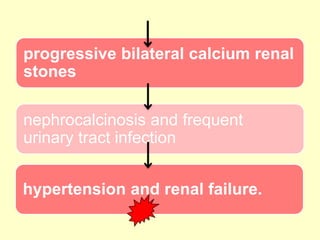
progressive bilateral calcium renal
stones
nephrocalcinosis and frequent
urinary tract infection
hypertension and renal failure.
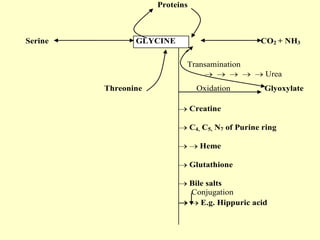
Proteins

Serine

GLYCINE

CO2 + NH3
Transamination
Urea

Threonine

Oxidation

Glyoxylate

Creatine
C4, C5, N7 of Purine ring
Heme
Glutathione
Bile salts
Conjugation
E.g. Hippuric acid
1.Explain the metabolism of glycine. Mention two
disorders of glycine metabolism and their defects.
2.Enumerate the compounds formed from glycine,
giving their biochemical importance.
3.Why glycine is nutritionally non-essential?
4.Metabolic role of glycine.
5.Mention the compounds formed from Glycine.
6.How is Creatinine synthesized? Discuss about
creatinine clearance and its significance.
7.How creatine phosphate is synthesized. Mention
the significance of estimation of urinary
creatinine.
8.Glutathione and its functions.
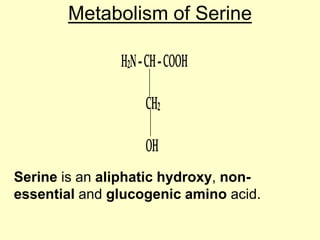
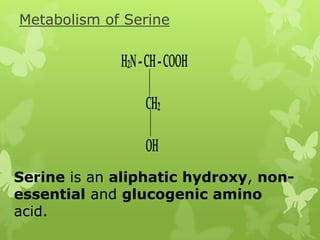
Metabolism of Serine
H2N – CH – COOH
CH2
OH
Serine is an aliphatic hydroxy, nonessential and glucogenic amino acid.
Metabolism of Serine

H2N – CH – COOH
CH2
OH
Serine is an aliphatic hydroxy, nonessential and glucogenic amino
acid.
Metabolism of serine:
Synthesis:
Catabolism:
Functions:
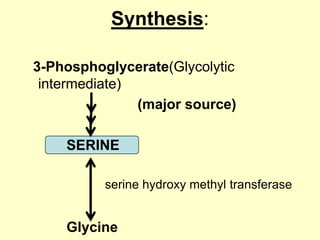
Synthesis:
3-Phosphoglycerate(Glycolytic
intermediate)
(major source)

SERINE
serine hydroxy methyl transferase

Glycine
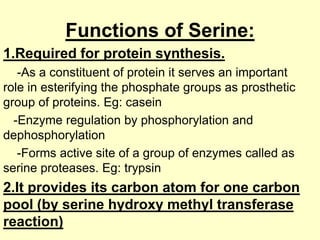
Functions of Serine:
1.Required for protein synthesis.
-As a constituent of protein it serves an important
role in esterifying the phosphate groups as prosthetic
group of proteins. Eg: casein
-Enzyme regulation by phosphorylation and
dephosphorylation
-Forms active site of a group of enzymes called as
serine proteases. Eg: trypsin

2.It provides its carbon atom for one carbon
pool (by serine hydroxy methyl transferase
reaction)
Functions of Serine….
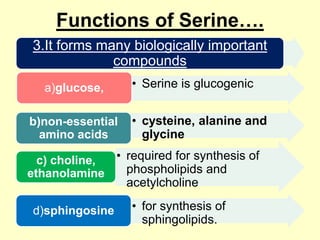
3.It forms many biologically important
compounds
a)glucose,
b)non-essential
amino acids

• Serine is glucogenic
• cysteine, alanine and
glycine

• required for synthesis of
c) choline,
phospholipids and
ethanolamine
acetylcholine
d)sphingosine

• for synthesis of
sphingolipids.
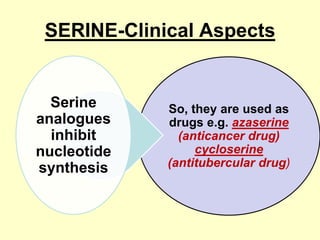
SERINE-Clinical Aspects

Serine
analogues
inhibit
nucleotide
synthesis

So, they are used as
drugs e.g. azaserine
(anticancer drug)
cycloserine
(antitubercular drug)

ProteinMetbolism part1

  • 2.
    Protein & Aminoacid Metabolism Dr.Ganesh
  • 3.
    Protein and Aminoacid Metabolism The syllabus for this chapter includes the following topics. PART I
  • 4.
    Protein and Aminoacid Metabolism Breakdown of tissue proteins and amino acid pool, General Reactions of Amino acids. Disposal of Ammonia: urea cycle, glutamate and glutamine formation. Metabolism of Amino acids,- Glycine, serine
  • 5.
    Introduction Overview of AminoAcid Metabolism Nitrogen Balance and amino acid pool Protein Turnover Metabolism of Amino Nitrogen Metabolism of Individual Amino Acids – Glycine and serine
  • 6.
    Protein and Aminoacid Metabolism PART II Metabolism of Amino acids sulfur containing amino acids, aromatic amino acids, histidine & arginine
  • 7.
    Introduction Proteins are linearhetero polymers of α – L – Amino acids, which are linked by peptide bonds. Nitrogen (N) is characteristic of proteins. Amino acids are not stored by the body. Hence, they must be obtained from the diet, synthesized de novo, or produced from normal protein degradation. Any amino acids in excess of the biosynthetic needs of the cell are rapidly degraded.
  • 8.
    Biological importance: 1.Proteins containnitrogen and they are main source of nitrogen for the body. Dietary Proteins are the sources of essential amino acids for the body. 2.All amino acids are required for the synthesis of proteins and many amino acids serve as precursors for the synthesis of biologically important compounds (Eg: Melanin, serotonin, creatine etc.)
  • 9.
    Medical importance: 1.Genetic defectsin the pathways of amino acid metabolism can cause serious disease. Eg: Albinism, Phenlyketonuria, Alkaptonuria etc. 2. Dietary deficiancy of proteins can result in disease such as P.E.M (protein energy malnutrition)
  • 10.
    NITROGEN BALANCE Nitrogen balance= Difference between total nitrogen intake and total nitrogen loss from the body. The normal adult is in nitrogen equilibrium, nitrogen intake = nitrogen output.
  • 11.
    Amino acid catabolism-phases 1.The first phase of catabolism involves the removal of the α – amino groups (usually by transamination and subsequent deamination) ammonia + corresponding α – Keto Converted to UREA acid. Enters 2nd phase and excreted. (most important route for disposing of nitrogen from the body.)
  • 12.
    Amino acid catabolism-phases 2. 2nd phase of amino acid catabolism the carbon skeleton of the α – Ketoacids via intermediates of energy producing, metabolic pathways CO2 + H2O, glucose, fatty acids, or ketone bodies  Non essential amino acids are synthesized from the intermediates of metabolism or from essential amino acids
  • 13.
    Amino acid pool Aminoacids released by hydrolysis of dietary or tissue protein or synthesized de novo, and are distributed throughout the body. Collectively, they constitute the amino acid pool.
  • 14.
    BODY PROTEIN DIATARY PROTEIN Digestionand absorption Synthesis of new amino acids catabolism synthesis AMINO ACID POOL SYNTHESIS OF BIOLOGICALLY IMP. COMPOUNDS CATABOLISM
  • 15.
    PROTEIN TURNOVER: the continuousdegradation and resynthesis of all cellular proteins Each day about 1–2% of the total body proteins, principally muscle protein, undergoes turnover. Body proteins Reutilization for new protein synthesis degradation Amino acids Catabolism
  • 16.
    Metabolism of AminoNitrogen Overview Transamination Deamination Reactions (Ammonia Formation) •Oxidative deamination •Non-oxidative deamination Ammonia Transport Disposal of Ammonia – Urea cycle.
  • 17.
    Overview of Metabolismof Amino Nitrogen -Ketoglutarate Amino acids Transmination Glutamate Keto acids -NH2 Oxidative deamination Aspartate -NH2 CO2 Other Reactions NH3 Urea Cycle Urea H2N-CO-NH2
  • 18.
    TRANSAMINATION Definition: Transamination isthe transfer of the amino group of an amino acid to a keto acid, changing the latter into a new amino acid and the original amino acid into a new keto acid. Transamination reaction is freely reversible and hence involved both in biosynthesis and catabolism of amino acids. Enzyme Involved:“Transaminases” (aminotransferases) – liver, skeletal muscles and heart are particularly rich in transaminases. Cofactor Required: Pyridoxal phosphate (PLP) derived from Vit B6 (pyridoxine).
  • 19.
    General Reaction: AMINO ACID1 KETO ACID 1 PLP TRANSAMINASE KETO ACID 2 AMINO ACID2
  • 20.
    Mechanism:  Pyridoxal phosphateis bound to the transaminase at the catalytic site and during transamination the bound coenzyme serves as a carrier of amino groups. Transamination occurs in 2 stages – 1.Transfer of the amino group of an amino acid to the coenzyme PLP (bound to the enzyme) to form pyridoxamine phosphate and the corresponding ketoacid. 2.The amino group of pyridoxamine phosphate is then transferred to an -ketoacid to produce a new amino acid and the enzyme with PLP is regenerated.
  • 21.
  • 22.
    Salient features: All aminoacids except lysine, threonine, proline and hydroxyproline undergo transamination. It is a reversible reaction and can serve in both formation of an amino acid and its catabolism. For all transaminases, glutamate and -Ketoglutarate are one pair of substrate ( an amino acid and its corresponding keto acid) and differ in the other pair. The amino acids undergo transamination to finally concentrate nitrogen in glutamate.
  • 23.
    Metabolic Functions: 1.Diverting excessof amino acids towards catabolism and energy production with simultaneous urea synthesis. 2.Biosynthesis of non-essential amino acids. 3.Producing -keto acids (e.g. oxaloacetate, Pyruvate, ketoglutarate) for subsequent gluconeogenesis
  • 24.
    Clinical Aspects: Blood levelsof ALT and AST are elevated in liver diseases and AST levels in myocardial infarction. Their estimation is useful in the diagnosis of these conditions. (refer Enzymes)
  • 25.
    Describe transamination. Mention theclinical significance of serum transaminases. (4) Clinical importance of transamination (3) Questions?? Write the reaction, with cofactors if any, catalyzed by Alanine transaminase. (3) Name the coenzyme forms of vitamin B6; write the mechanism of transamination
  • 26.
    Ammonia Formation – DeaminationReactions Ammonia is Produced in the Body by: 1) Cellular Metabolism and 2) In the Intestinal Lumen.
  • 27.
    1.Ammonia formation bycellular metabolism Cells produce ammonia mostly from amino acids by deamination, which may be either 1. oxidative or 2. non-oxidative
  • 28.
    Deamination Reactions(Ammonia formation) Deamination isremoval of amino group from compounds, mostly amino acids, as ammonia (NH3). NH3 +carbon skeleton of amino acid (KETOACID) CONVERTED TO UREA
  • 29.
    Deamination….2types 1.Oxidative deamination a)deamination ofglutamate catalyzed by glutamate dehydrogenase. -Most important b)Other Oxidative Deamination Reactions are Mainly Those: -- Catalyzed by Amino Acid Oxidases 2.Non-Oxidative Deamination(less important) Enzymes Involved are: Dehydratases Lyases and Amide Hydrolases
  • 30.
    Oxidative Deamination by GlutamateDehydrogenase (GDH): The removal of the amino group from glutamate to release NH3 and -ketoglutarate coupled with oxidation is known as oxidative deamination Site: Most active in mitochondria of liver cells, though present in all cells. Enzyme: Glutamate dehydrogenase (GDH) – a Zn containing mitochondrial enzyme. Coenzymes: NAD+ or NADP+
  • 31.
    Oxidative deamination ofglutamate… + NAD / NADP + Glutamate + H2O NADH/ NADPH + H + -Ketoglutarate + NH3 Glutamate dehydrogenase (GDH)
  • 32.
    Role of GDH:1.Produces NH3, thus channeling the amino groups of most amino acids for urea synthesis. 2. Regenerates -ketoglutarate for further collection of amino groups of amino acids by transamination and producing their carbon skeletons. 3. NADH produced generates ATP in the ETC. 4. The reverse reaction is required for the biosynthesis of glutamate and in the tissues for fixing ammonia, which is toxic.
  • 33.
    What Is Transdeamination?? Transamination and deamination often occur simultaneously involving glutamate as the central molecule. this process is called transdeamination.
  • 34.
    What Is Transdeamination?? All amino acids TISSUES transamination -KG Keto acids GLUTAMATE Deamination in liver NH3+ -KG UREA Carried by blood Reaches liver
  • 35.
    Glutamate occupies acentral position in the metabolism of -amino nitrogen of -amino acids. The -amino groups of most of the amino acids ultimately are channeled/transferred to -ketoglutarate by transamination, forming glutamate Glutamate channels the amino groups to form urea (H2N–CO–NH2) in the liver. By oxidative deamination the amino group in glutamate may form ammonia, which forms one of the –NH2 groups of urea. By transamination glutamate can also pass its amino group to oxaloacetate forming aspartate, which donates its amino group to form the other – NH group of urea.
  • 36.
    What are thesources of ammonia in the body? Explain the biochemical basis: glutamate plays a central role in the catabolism of amino nitrogen of amino acids.  Give 2 examples for each of the following. a)Transaminases b) Reactions forming ammonia Write the reaction, with cofactors if any, catalyzed by Glutamate dehydrogenase.
  • 37.
    Oxidative Deamination by AminoAcid Oxidases • Amino Acid Oxidases are: -- Flavoproteins -- Possessing either FMN or FAD Amino Acid FAD/FMN Amino Acid Oxidase FADH2/FMNH2 -Keto Acid + NH3
  • 38.
    Non-Oxidative Deamination Enzymes Involvedare: Dehydratases Lyases and Amide Hydrolases
  • 39.
    Dehydratase Amino Acid Dehydratases(PLP-dependent) Serine/Threonine Dehydratase PLP NH3 Pyruvate/ -Ketobutyrate
  • 40.
  • 41.
    Amino Acid AmideHydrolases Glutamine Aspargine H2O H2O Glutaminase Asparginase NH3 NH3 Glutamate Aspartate
  • 42.
    2)NH3 production inintestine Intestinal Lumen -- Another Major Source of Ammonia by the Action of Bacteria on: -- Urea Present in the Intestinal Juice And Dietary Amino Acids. • This Ammonia is Absorbed into Hepatic Vein and Enters Liver Directly.
  • 43.
    Transport of Ammonia Ammoniais toxic to tissues, especially to brain (see Ammonia Toxicity). Ammonia that is constantly produced in the tissues is transported to liver for detoxification by urea synthesis. Ammonia is transported in blood as 1) free NH3, as 2) glutamate or as 3) glutamine.
  • 44.
    Transport of Ammonia… •NH3is transported in 3 forms. 1) As free NH3 Ammonia, whose blood level is 10 to 80 gm/dl, is rapidly removed from the circulation by the liver and converted to urea. 2) as glutamate Inside the cells of almost all tissues ammonia combines with Ketoglutarate to form glutamate by GDH and is transported to the liver.
  • 45.
    Transport of Ammonia… 3)as glutamine. Ammonia is also trapped by glutamate in the tissues, especially in the brain, to form glutamine, which is catalyzed by glutamine synthetase NH3 Glutamine synthetase Glutamate ATP glutamine .Mg2+ ADP+Pi Transported to liver via blood
  • 46.
    This reaction maybe considered as the first line of detoxification of NH3 in the brain. Glutamine is then transported through circulation (highest blood level among all amino acids) to liver In liver, this reaction is reversed to release NH3 .
  • 47.
  • 48.
    UREA CYCLE (Detoxification ofAmmonia) Contents: • Synonyms • Site • Sources of Atoms of Urea • Reactions • Functions • Ammonia Toxicity – Hyperammonemia
  • 49.
    UREA CYCLE . (Detoxificationof Ammonia) • Ammonia is Toxic to the Body. • Hence it is Necessary that the NH3 Produced During Metabolism of Amino Acids be Removed Immediately. • This is Done by Conversion of Toxic NH3 into Harmless Water-soluble Urea in the Liver by Urea Cycle.
  • 50.
    UREA CYCLE (Detoxification ofAmmonia) • Synonyms: Urea Cycle Ornithine Cycle Krebs-Henseleit Cycle • Site: Urea Synthesized in Liver Carried by Blood And Excreted by Kidneys
  • 51.
    Sources of Atomsof Urea NH2 O || C NH2 NH3 CO2 Aspartate
  • 52.
    UREA CYCLE (Detoxification ofAmmonia) • Urea Synthesis: -- A 5-step Cyclic Process • Enzymes of the First 2 Steps: -- Present in Mitochondria • While the Rest: -- Located in the Cytosol
  • 53.
    Reactions of UreaCycle CO2 + NH3 + 2 ATP Carbamoyl Phosphate Synthetase–I (CPS-I) Carbamoyl Phosphate + 2 ADP + Pi Urea Ornithine Arginase TCA cycle Arginine Ornithine Transcarbamoylase Fumarate Arginosuccinase Citruline Arginosuccinate Aspartate Arginosuccinate Synthetase ATP AMP + PPi
  • 54.
    Functions of UreaCycle 1.Detoxification of NH3 2.Biosynthesis of Arginine.
  • 55.
    Ammonia Toxicity – Hyperammonemia •Ammonia Concentration Rises in the Blood (Hyperammonemia) and in other Tissues in: -- Liver Failure and -- Inborn Errors of Urea Synthesis (that is, due to Genetic Defect) • This Produces Ammonia Toxicity in Many Ways.
  • 56.
    Causes Of Hyperammonemia •Causes may be 1.Acquired or 2. Inherited 1.Acquired Causes – Liver Diseases (e.g. Cirrhosis and Severe Hepatitis) -- Liver is Unable to Convert Ammonia into Urea – -- Blood Ammonia Level Rises.
  • 57.
    2.Inherited Causes -- DefectsAssociated with each of the Enzymes of Urea Cycle Exist. -- The Levels Substrate of the Defective Enzyme Rises in the Cells. -- This Causes Product Inhibition of the Enzyme Catalyzing the Earlier Step. -- Leading to Accumulation Ultimately of the Starting Substrate, Namely, NH3
  • 58.
    Inherited Causes ofHyperammonemia Disease Hyperammonemia Type-I Enzyme involved CPS-I Hyperammonemia Type –II Ornithine Transcarbamoylase Citrullinemia Argininosuccinate Synthetase Argininosuccinic Aciduria Argininosuccinase Hyperarginemia Arginase
  • 59.
    Ammonia Toxicity – Hyperammonemia •Biochemical Alterations: – Hyperammonemia, – In Blood of Intermediates Prior to Metabolic Block – Urinary NH3 • Clinical Manifestations Nausea, Vomiting, Protein Intolerance. Slurring of Speech, Blurring of Vision Tremor (Flapping Tremors), Ataxia, Lethargy Mental Retardation (in the Inherited Hyperammonemia in Children) Dizziness, Coma, Death
  • 60.
    Blood Urea In HealthyPeople, Normal Blood Urea Concentration is 12-36 mg/dL Higher Protein Intake Marginally Increases Blood Urea Level; however, this will be within Normal Range. (See Practical Manual for Clinical Significance of Blood Urea)
  • 61.
    1. How ammoniais formed in the body? Explain the reaction leading to the detoxification of ammonia. 2. Describe the urea cycle. What is the normal blood urea level? Name two conditions in which blood urea level increases. 3. Explain the steps of Urea cycle & Mention the names of its disorders. 4.Carbamoyl phosphate synthetase deficiency. 5.Give 2 examples for each of the following. a) Causes for inherited disorders of urea cycle b)Conditions in which blood urea level increases
  • 62.
    Metabolism of Glycine H H2N–C–COOH H RGroup GLYCINE is the simplest, optically inactive, glucogenic and non-essential amino acid.
  • 63.
    Metabolism of Glycinecontents Synthesis Catabolism Synthesisof biologically imp. Compounds from glycine Inborn errors of glycine metabolism
  • 64.
    Synthesis Glycine is anon-essential amino acid as it can be synthesized in the body. It can be synthesized from many substances by separate reactions.
  • 65.
    • The majorreactions are from: 1.Serine 2.CO2, NH3 and N5, N10 methylene tetrahydrofolate (N5, N10 methylene FH4) 3. And Glyoxylate • These are reversible reactions and thus also play a role in the catabolism of glycine. • Minor pathways for synthesis of glycine are from: Threonine and Choline
  • 66.
    1. Synthesis ofGlycine from Serine: Serine hydroxy methyl transferase COOH COOH PLP HC-NH2 CH2OH Serine CH2 FH4 N5, N10-methylene FH4 NH2 Glycine One carbon unit (methylene group, –CH2–) from serine is transfered to tetrahydro folic acid (FH4).
  • 67.
    2. Synthesis ofGlycine from CO2, NH3 and N5, N10 methylene THFA: • This reaction is catalyzed by glycine synthase. COOH NADH + H+ NAD+ CH2-NH2 GLYCINE CO2 + NH3 N5, N10-methylene FH4 FH4
  • 68.
    3. Synthesis ofGlycine from Glyoxalate: Glutamate COOH CHO Glyoxylate -Ketoglutarate PLP Transaminase Glycine
  • 69.
    4. Synthesis ofGlycine from Threonine: COOH Threonine Aldolase COOH HC - NH2 H –C- OH CH3 Threonine CHO + CH2-NH2 Glycine CH3 Acetaldehyde
  • 70.
    Catabolism: • There areseveral paths for catabolism of glycine. • All, except one, are reversals of biosynthetic pathways.
  • 71.
    1. By theAction of Serine Hydroxy Methyl Transferase: -This is also utilized for the synthesis of serine. 5 10 FH4 N , N methylene FH4 PLP Glycine Serine Serine hydroxy methyl transferase Pyruvate
  • 72.
    2. By theAction of Glycine synthase ( also called Glycine Cleavage System): 5 10 N , N methylene FH4 FH4 Glycine CO2 + NH3 Glycine synthase NAD + + NADH+H
  • 73.
  • 74.
    Functions of Glycine: 1.Requiredfor protein synthesis. 2.It forms many biologically important compounds – glucose, serine (a non-essential amino acid), heme, conjugated bile acids, creatine, glutathione and purines 3.It provides its carbon atom for one carbon pool. 4.It is required for certain detoxification reactions. 4.It acts as a neurotransmitter
  • 75.
    Functions of Glycine…..detoxification Benzoic acid,a food preservative, is found in small amounts in foods. Glycine Benzoic acid CoA SH Benzoyl CoA It is detoxified in the liver by conjugation with Glycine to form water soluble, Non-toxic Hippuric acid. Hippuric acid CoA SH Excreted in urine
  • 76.
    Functions of Glycine…. Synthesisof biologically imp. compounds 1. CONSTITUENT OF PROTEINS:  Glycine is mainly present at the bending points because of its small size.  Collagen is the protein rich in Glycine; about 33% of the amino acids is Glycine. 2. GLUCOGENIC ROLE Glycine Serine Pyruvate Glucose
  • 77.
    Functions of Glycine…. 3.SYNTHESISOF SERINE Serine hydroxy methyl transferase Glycine Serine
  • 78.
    Functions of Glycine…. 4.HEME BIOSYNTHESIS Glycine is one of the starting materials along with succinyl CoA for heme biosynthesis. Glycine + succinyl CoA -Amino levulinic acid ( ALA) Heme ALA synthase
  • 79.
    Functions of Glycine…. 5.SYNTHESIS OF CONJUGATED BILE ACIDS: Cholic acid Glycine Glycocholic acid Conjugated Bile Acids Chenodeoxy cholic acid Glycine Glycochenodeoxy cholic acid.
  • 80.
    Functions of Glycine…. 5.CREATINESYNTHESIS Creatine phosphate is formed from glycine, arginine and S-adenosyl methionine (SAM), in kidneys and liver.
  • 81.
    Functions of Glycine….creatinesynthesis Glycine Arginine In Kidney Ornithine Guanidoacetate S-adenosyl methionine (SAM) In Liver S-adenosyl homocysteine (SAH) Creatine ATP Creatine Phosphokinase (CPK) ADP Pi + H2O Creatinine Creatine phosphate (NPN substance excreted Non-enzymatic (spontaneous) In urine)
  • 82.
    Function of Creatine Phosphate: Creatinephosphate occurs mainly in muscles. It is a high-energy compound ( Go'= 10.5) and storage form of energy in muscle. During the resting phase in muscle (relaxed) creatine is stored as creatine phosphate, which is produced by phosphorylation of creatine by ATP. Muscle needs ATP for contraction. During prolonged muscle contraction depletion of ATP. During this period creatine phosphate rephosphorylates ADP to ATP
  • 83.
    In muscles…… During restingphase(*ATP stores are full) ATP Muscle creatine phosphokinase ADP (CPK) CREATINE CREATINE PHOSPHATE During prolonged contraction (*when ATP stores are depleted)
  • 84.
    Functions of Glycine…. 6. SYNTHESISOF GLUTATHIONE: Glutathione ( -glutamyl-cysteinyl-glycine) is a tripeptide formed from glycine, glutamate and cysteine. The reduced form is monomeric and carries hydrogen atom in the sulfhydryl group(SH) of cysteinyl residue. The oxidized form is dimeric.
  • 85.
    GLUTATHIONE….. – Glu –Cys – Gly – Glu – Cys – Gly SH S Reduced Glutathione (GSH) S – Glu – Cys – Gly Oxidized Glutathione (GS–SG)
  • 86.
    GLUTATHIONE SYNTHESIS: Glutamic acid+ Cysteine ATP ADP+Pi - Glutamyl cysteine Glycine Glutathione
  • 87.
    FUNCTIONS OF GLUTATHIONE: 1.Itserves as an Anti- oxidant in the body. 2.It serves as a cofactor for certain enzymes, such as glutathione peroxidase, which uses reduced glutathione to detoxify hydrogen peroxide. Eg : RBC membrane integrity is maintained due to this action. 3.It is conjugated to drugs to make them more water-soluble, so that, they can be easily excreted .. 4.It also plays a role in the transport of amino acids across the plasma membrane in certain cells.
  • 88.
    Functions of Glycine…. 7.SYNTHESIS OF PURINE RING: • C4, C5 and N7 of the purine ring are provided by glycine. • Thus the whole molecule of glycine is involved in the synthesis of purine. •
  • 89.
    Inborn Errors ofGlycine Metabolism: 1.Glycinuria: This is a rare genetic disorder, probably resulting from a defect in the renal tubular reabsorption of glycine. It is characterized by excessive excretion of glycine in urine (0.6 – 1 g per day) and a tendency to form oxalate renal stones. However, plasma glycine levels are normal.
  • 90.
    2.Primary Hyperoxaluria: Genetic/metabolic defect: failureto catabolize glyoxalate. glyoxalate is oxidized to oxalate. overproduction of oxalate excessive excretion of oxalate in urine (hyperoxaluria).
  • 91.
    progressive bilateral calciumrenal stones nephrocalcinosis and frequent urinary tract infection hypertension and renal failure.
  • 92.
    Proteins Serine GLYCINE CO2 + NH3 Transamination Urea Threonine Oxidation Glyoxylate Creatine C4,C5, N7 of Purine ring Heme Glutathione Bile salts Conjugation E.g. Hippuric acid
  • 93.
    1.Explain the metabolismof glycine. Mention two disorders of glycine metabolism and their defects. 2.Enumerate the compounds formed from glycine, giving their biochemical importance. 3.Why glycine is nutritionally non-essential? 4.Metabolic role of glycine. 5.Mention the compounds formed from Glycine. 6.How is Creatinine synthesized? Discuss about creatinine clearance and its significance. 7.How creatine phosphate is synthesized. Mention the significance of estimation of urinary creatinine. 8.Glutathione and its functions.
  • 94.
    Metabolism of Serine H2N– CH – COOH CH2 OH Serine is an aliphatic hydroxy, nonessential and glucogenic amino acid.
  • 95.
    Metabolism of Serine H2N– CH – COOH CH2 OH Serine is an aliphatic hydroxy, nonessential and glucogenic amino acid.
  • 96.
  • 97.
  • 98.
    Functions of Serine: 1.Requiredfor protein synthesis. -As a constituent of protein it serves an important role in esterifying the phosphate groups as prosthetic group of proteins. Eg: casein -Enzyme regulation by phosphorylation and dephosphorylation -Forms active site of a group of enzymes called as serine proteases. Eg: trypsin 2.It provides its carbon atom for one carbon pool (by serine hydroxy methyl transferase reaction)
  • 99.
    Functions of Serine…. 3.Itforms many biologically important compounds a)glucose, b)non-essential amino acids • Serine is glucogenic • cysteine, alanine and glycine • required for synthesis of c) choline, phospholipids and ethanolamine acetylcholine d)sphingosine • for synthesis of sphingolipids.
  • 100.
    SERINE-Clinical Aspects Serine analogues inhibit nucleotide synthesis So, theyare used as drugs e.g. azaserine (anticancer drug) cycloserine (antitubercular drug)