.
• 32y old school teacher presents in out patient dept,
with the c/o excess tiredness, breathlessness, loss
of appetite, nervousness, and palpitations.
• On examination, she was very pale, heart rate was
increased.
• History revealed that she was hard core vegetarian,
and she frequently skipped her meals or breakfast
because of her busy schedule.
• Blood reports were normal, except for Hb was 7.5
gms/dl
Dr. ganesh,
Dept of biochemistry.
Minerals are inorganic compounds that are
required for the body as one of the nutrients
A few minerals are essential for the normal
growth, development and maintenance of health.
Therefore, they must be included in the diet.
When the intake in the diet of these minerals is
below the required amount, deficiency symptoms
appear.
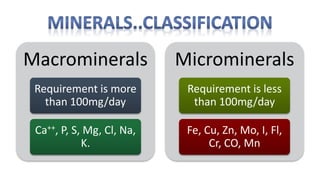
Macrominerals
Requirement is more
than 100mg/day
Ca++, P, S, Mg, Cl, Na,
K.
Microminerals
Requirement is less
than 100mg/day
Fe, Cu, Zn, Mo, I, Fl,
Cr, CO, Mn
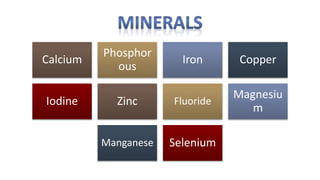
Calcium
Phosphor
ous
Iron Copper
Iodine Zinc Fluoride
Magnesiu
m
Manganese Selenium
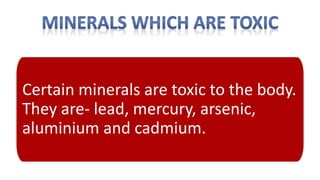
Certain minerals are toxic to the body.
They are- lead, mercury, arsenic,
aluminium and cadmium.
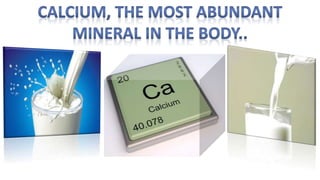
Calcium is the most abundant mineral in
the body
Human body contain about 1-1.5 kg of
calcium
Sources and RDA
Metabolism of calcium
Functions of calcium
Regulation of plasma calcium
Disorders of calcium metabolism
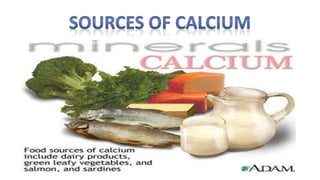
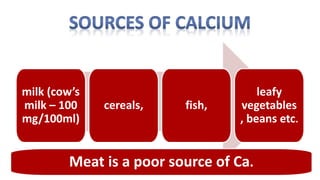
milk (cow’s
milk – 100
mg/100ml)
cereals, fish,
leafy
vegetables
, beans etc.
Meat is a poor source of Ca.
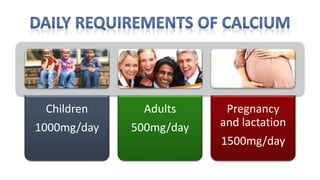
Children
1000mg/day
Adults
500mg/day
Pregnancy
and lactation
1500mg/day
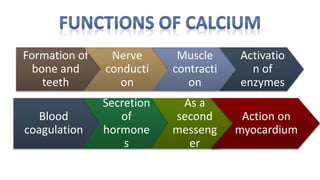
Formation of
bone and
teeth
Nerve
conducti
on
Muscle
contracti
on
Activatio
n of
enzymes
Blood
coagulation
Secretion
of
hormone
s
As a
second
messeng
er
Action on
myocardium
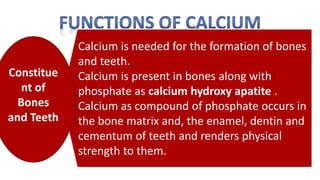
Calcium is needed for the formation of bones
and teeth.
Calcium is present in bones along with
phosphate as calcium hydroxy apatite .
Calcium as compound of phosphate occurs in
the bone matrix and, the enamel, dentin and
cementum of teeth and renders physical
strength to them.
Constitue
nt of
Bones
and Teeth
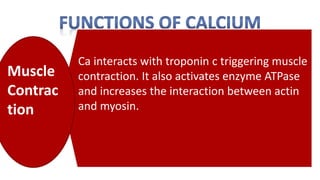
Ca interacts with troponin c triggering muscle
contraction. It also activates enzyme ATPase
and increases the interaction between actin
and myosin.
Muscle
Contrac
tion
Ca (coagulation factor IV) mediates several
reactions of blood coagulation cascade.
Blood
Coagulation
Ca2+ is needed for the direct activation of
enzymes such as lipase, ATPase, succinate
dehydrogenase, etc.
Certain other enzymes get activated via a
regulatory protein – calmodulin.
Activatio
n of
Enzymes
Ca is necessary for nerve impulse
transmission from presynaptic to
postsynaptic region.
Nerve
Impulse
Transmiss
ion
Ca2+ reduces membrane permeability and
thereby decreases neuromuscular
excitability.
A fall in serum Ca2+ raises the neuromuscular
excitability producing spasms of muscles in
hands, feet, face and larynx – hypocalcemic
tetany.
Neuromusc
ular
Excitability
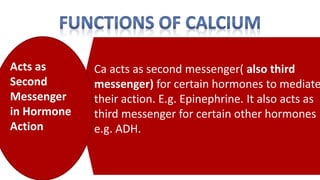
Ca acts as second messenger( also third
messenger) for certain hormones to mediate
their action. E.g. Epinephrine. It also acts as
third messenger for certain other hormones
e.g. ADH.
Acts as
Second
Messenger
in Hormone
Action
Ca is also needed for the secretion or release
of certain hormones such as insulin, PTH,
calcitonin.
Secretion
of
Hormone
Ca acts on myocardium and prolongs systole.
Action on
Heart
Ca regulates microfilament and microtubule
mediated processes such as endocytosis,
exocytosis and cell motility.
Endocyto
sis,
Exocytosi
s and Cell
Motility
Ca2+ influences the transport of water and
several ions and thus nfluences membrane
structure.
Membrane
Transport
and
Structure
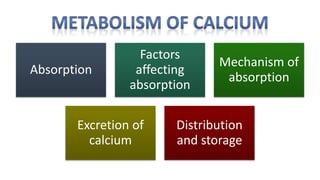
Absorption
Factors
affecting
absorption
Mechanism of
absorption
Excretion of
calcium
Distribution
and storage
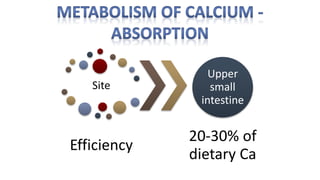
Site
Efficiency
Upper
small
intestine
20-30% of
dietary Ca
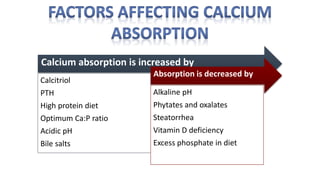
Calcium absorption is increased by
Calcitriol
PTH
High protein diet
Optimum Ca:P ratio
Acidic pH
Bile salts
Absorption is decreased by
Alkaline pH
Phytates and oxalates
Steatorrhea
Vitamin D deficiency
Excess phosphate in diet
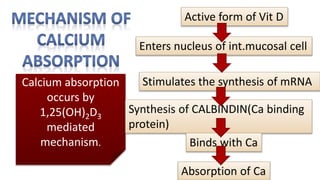
Calcium absorption
occurs by
1,25(OH)2D3
mediated
mechanism.
Enters nucleus of int.mucosal cell
Stimulates the synthesis of mRNA
Synthesis of CALBINDIN(Ca binding
protein)
Binds with Ca
Active form of Vit D
Absorption of Ca
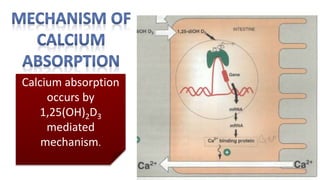
Calcium absorption
occurs by
1,25(OH)2D3
mediated
mechanism.
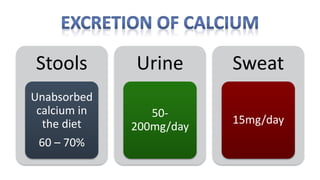
Stools
Unabsorbed
calcium in
the diet
60 – 70%
Urine
50-
200mg/day
Sweat
15mg/day
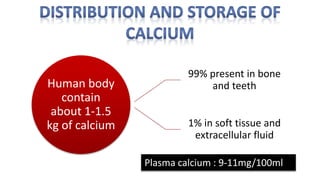
Human body
contain
about 1-1.5
kg of calcium
99% present in bone
and teeth
1% in soft tissue and
extracellular fluid
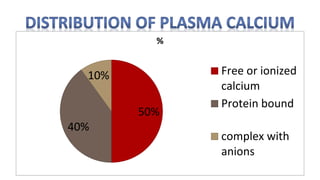
Plasma calcium : 9-11mg/100ml
50%
40%
10%
%
Free or ionized
calcium
Protein bound
complex with
anions
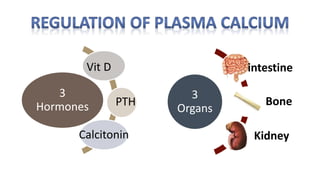
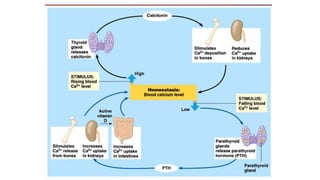
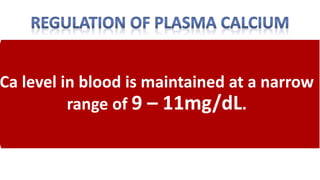
Ca level in blood is maintained at a narrow
range of 9 – 11mg/dL.
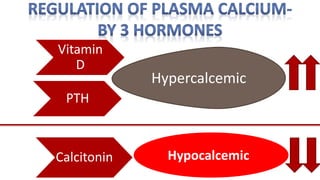
Vitamin
D
PTH
Calcitonin Hypocalcemic
Hypercalcemic
3
Hormones
Vit D
PTH
Calcitonin
3
Organs
intestine
Bone
Kidney
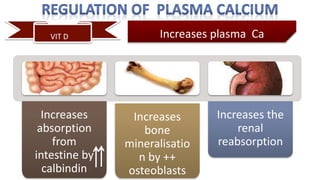
VIT D
Increases
bone
mineralisatio
n by ++
osteoblasts
Increases the
renal
reabsorption
Increases plasma Ca
Increases
absorption
from
intestine by
calbindin
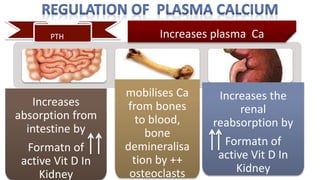
PTH
mobilises Ca
from bones
to blood,
bone
demineralisa
tion by ++
osteoclasts
Increases plasma Ca
Increases
absorption from
intestine by
Formatn of
active Vit D In
Kidney
Increases the
renal
reabsorption by
Formatn of
active Vit D In
Kidney
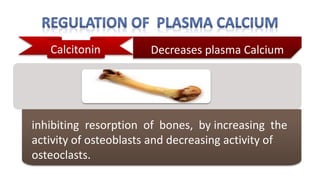
Calcitonin
inhibiting resorption of bones, by increasing the
activity of osteoblasts and decreasing activity of
osteoclasts.
Decreases plasma Calcium
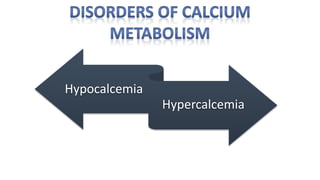
Hypocalcemia
Hypercalcemia
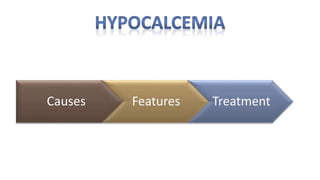
Causes Features Treatment
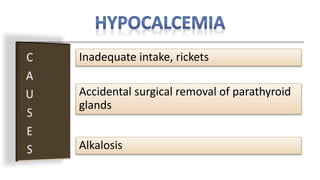
Inadequate intake, rickets
Accidental surgical removal of parathyroid
glands
Alkalosis
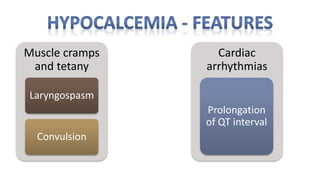
Muscle cramps
and tetany
Laryngospasm
Convulsion
Cardiac
arrhythmias
Prolongation
of QT interval
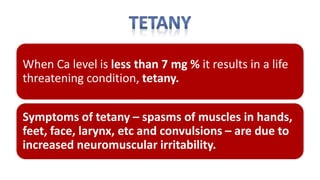
When Ca level is less than 7 mg % it results in a life
threatening condition, tetany.
Symptoms of tetany – spasms of muscles in hands,
feet, face, larynx, etc and convulsions – are due to
increased neuromuscular irritability.
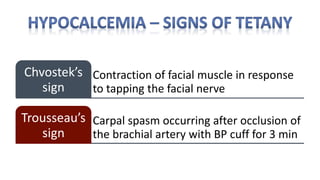
Contraction of facial muscle in response
to tapping the facial nerve
Chvostek’s
sign
Carpal spasm occurring after occlusion of
the brachial artery with BP cuff for 3 min
Trousseau’s
sign
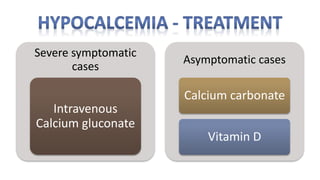
Severe symptomatic
cases
Intravenous
Calcium gluconate
Asymptomatic cases
Calcium carbonate
Vitamin D
Causes Features
Treatment
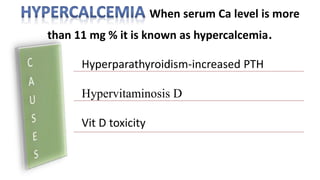
When serum Ca level is more
than 11 mg % it is known as hypercalcemia.
Hyperparathyroidism-increased PTH
Hypervitaminosis D
Vit D toxicity
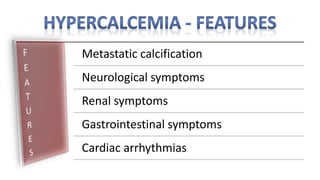
Metastatic calcification
Neurological symptoms
Renal symptoms
Gastrointestinal symptoms
Cardiac arrhythmias
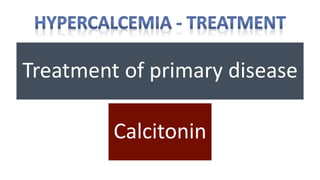
Treatment of primary disease
Calcitonin
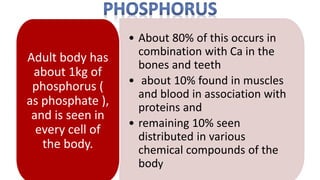
• About 80% of this occurs in
combination with Ca in the
bones and teeth
• about 10% found in muscles
and blood in association with
proteins and
• remaining 10% seen
distributed in various
chemical compounds of the
body
Adult body has
about 1kg of
phosphorus (
as phosphate ),
and is seen in
every cell of
the body.
Sources RDA Metabolism
Functions Disorders
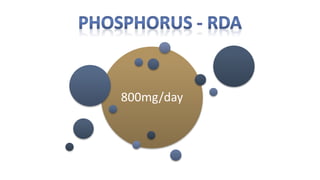
800mg/day
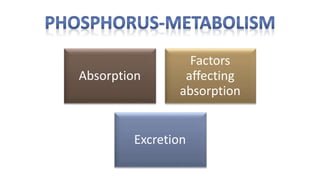
Absorption
Factors
affecting
absorption
Excretion
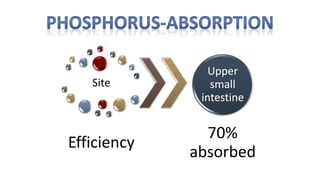
Site
Efficiency
Upper
small
intestine
70%
absorbed
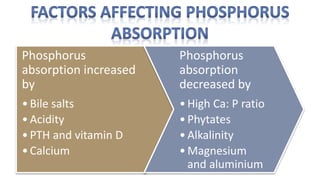
Phosphorus
absorption increased
by
•Bile salts
•Acidity
•PTH and vitamin D
•Calcium
Phosphorus
absorption
decreased by
•High Ca: P ratio
•Phytates
•Alkalinity
•Magnesium
and aluminium
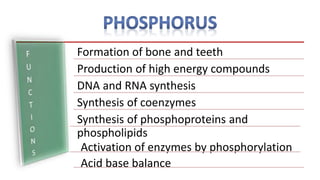
Formation of bone and teeth
Production of high energy compounds
DNA and RNA synthesis
Synthesis of coenzymes
Synthesis of phosphoproteins and
phospholipids
Activation of enzymes by phosphorylation
Acid base balance
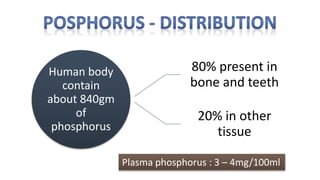
Human body
contain
about 840gm
of
phosphorus
80% present in
bone and teeth
20% in other
tissue
Plasma phosphorus : 3 – 4mg/100ml
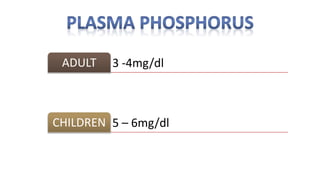
3 -4mg/dl
ADULT
5 – 6mg/dl
CHILDREN
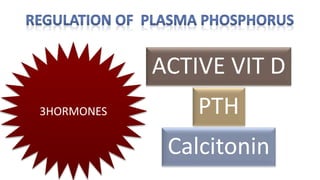
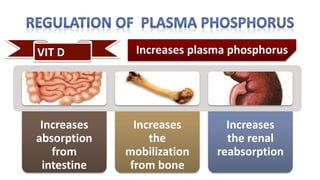
3HORMONES
ACTIVE VIT D
PTH
Calcitonin
VIT D
Increases
absorption
from
intestine
Increases
the
mobilization
from bone
Increases
the renal
reabsorption
Increases plasma phosphorus
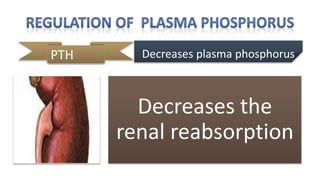
PTH
Decreases the
renal reabsorption
Decreases plasma phosphorus
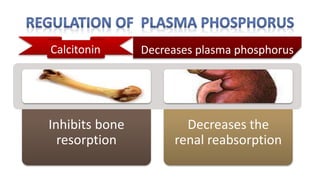
Calcitonin
Inhibits bone
resorption
Decreases the
renal reabsorption
Decreases plasma phosphorus
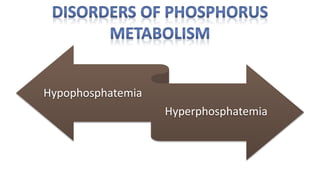
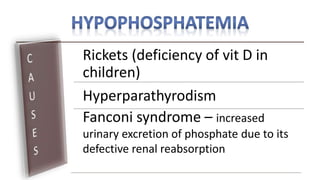
Hypophosphatemia
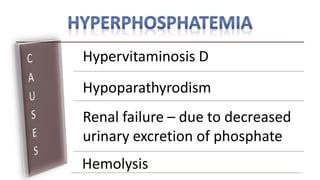
Hyperphosphatemia
Decreased blood
phosphate
Rickets (deficiency of vit D in
children)
Hyperparathyrodism
Fanconi syndrome – increased
urinary excretion of phosphate due to its
defective renal reabsorption
increased blood
phosphate
Hypervitaminosis D
Hypoparathyrodism
Renal failure – due to decreased
urinary excretion of phosphate
Hemolysis
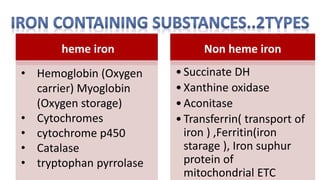
heme iron
• Hemoglobin (Oxygen
carrier) Myoglobin
(Oxygen storage)
• Cytochromes
• cytochrome p450
• Catalase
• tryptophan pyrrolase
Non heme iron
•Succinate DH
•Xanthine oxidase
•Aconitase
•Transferrin( transport of
iron ) ,Ferritin(iron
starage ), Iron suphur
protein of
mitochondrial ETC
Sources RDA
Metabolism
Functions
Disorders
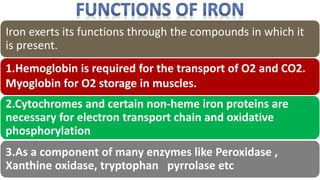
Iron exerts its functions through the compounds in which it
is present.
1.Hemoglobin is required for the transport of O2 and CO2.
Myoglobin for O2 storage in muscles.
2.Cytochromes and certain non-heme iron proteins are
necessary for electron transport chain and oxidative
phosphorylation
3.As a component of many enzymes like Peroxidase ,
Xanthine oxidase, tryptophan pyrrolase etc
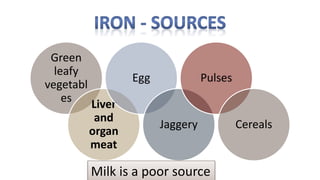
Green
leafy
vegetabl
es
Liver
and
organ
meat
Egg
Jaggery
Pulses
Cereals
Milk is a poor source
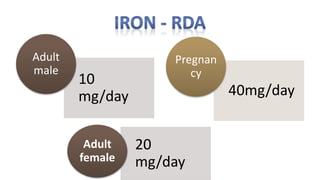
10
mg/day
Adult
male
40mg/day
Pregnan
cy
20
mg/day
Adult
female
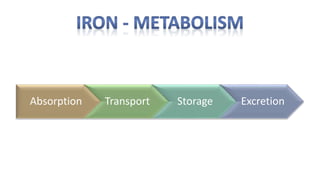
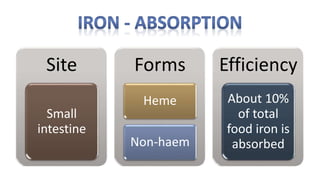
Absorption Transport Storage Excretion
Site
Small
intestine
Forms
Heme
Non-haem
Efficiency
About 10%
of total
food iron is
absorbed
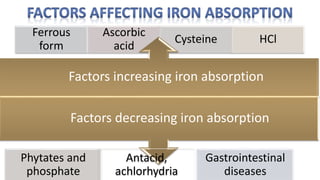
Phytates and
phosphate
Gastrointestinal
diseases
Ferrous
form
Ascorbic
acid
Cysteine HCl
Factors increasing iron absorption
Factors decreasing iron absorption
Antacid,
achlorhydria
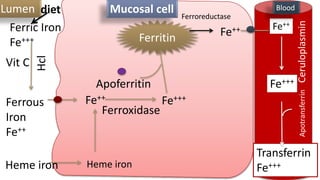
Ferric Iron
Fe+++
Ferrous
Iron
Fe++
Heme iron
Vit C
Hcl
Fe++
Fe+++
Ferritin
Apoferritin
Heme iron
Fe++ Fe++
Fe+++
Transferrin
Fe+++
Lumen Mucosal cell Blood
Ceruloplasmin
Apotransferrin
Ferroxidase
Ferroreductase
diet
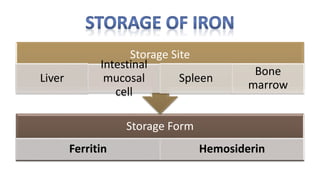
Storage Form
Ferritin Hemosiderin
Storage Site
Liver
Intestinal
mucosal
cell
Spleen
Bone
marrow
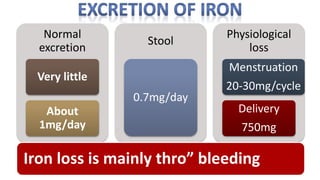
Normal
excretion
Very little
About
1mg/day
Stool
0.7mg/day
Physiological
loss
Menstruation
20-30mg/cycle
Delivery
750mg
Iron loss is mainly thro” bleeding
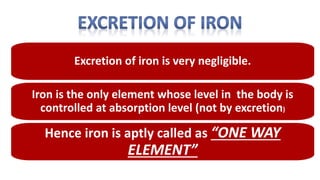
Excretion of iron is very negligible.
Iron is the only element whose level in the body is
controlled at absorption level (not by excretion)
Hence iron is aptly called as “ONE WAY
ELEMENT”
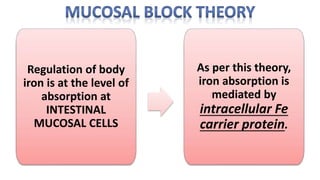
Mucosal block theory
Regulation of body
iron is at the level of
absorption at
INTESTINAL
MUCOSAL CELLS
As per this theory,
iron absorption is
mediated by
intracellular Fe
carrier protein.
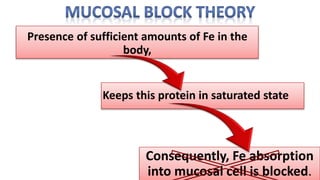
Presence of sufficient amounts of Fe in the
body,
Keeps this protein in saturated state
Consequently, Fe absorption
into mucosal cell is blocked.
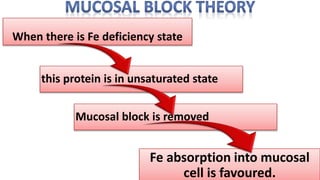
When there is Fe deficiency state
this protein is in unsaturated state
Fe absorption into mucosal
cell is favoured.
Mucosal block is removed
Iron
deficiency Iron excess
Causes Features
Lab
findings
Treatme
nt
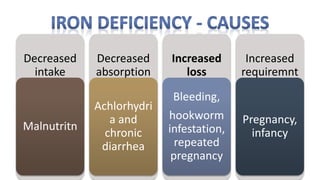
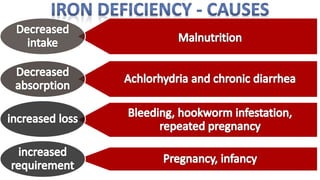
Decreased
intake
Malnutritn
Decreased
absorption
Achlorhydri
a and
chronic
diarrhea
Increased
loss
Bleeding,
hookworm
infestation,
repeated
pregnancy
Increased
requiremnt
Pregnancy,
infancy
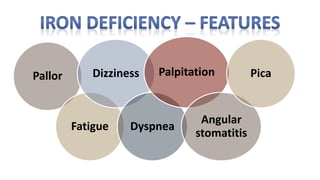
Pallor
Fatigue
Dizziness
Dyspnea
Palpitation
Angular
stomatitis
Pica
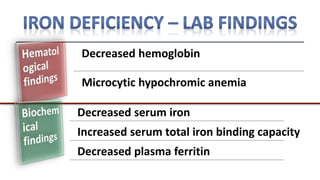
Decreased hemoglobin
Microcytic hypochromic anemia
Decreased serum iron
Increased serum total iron binding capacity
Decreased plasma ferritin
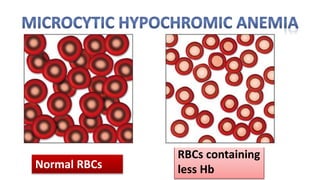
Normal RBCs
Small sized
RBCs containing
less Hb
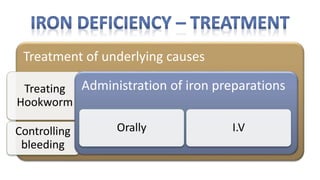
Treatment of underlying causes
Treating
Hookworm
Controlling
bleeding
Administration of iron preparations
Orally I.V
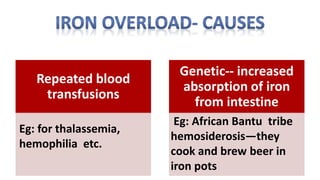
Repeated blood
transfusions
Genetic-- increased
absorption of iron
from intestine
Eg: African Bantu tribe
hemosiderosis—they
cook and brew beer in
iron pots
Eg: for thalassemia,
hemophilia etc.
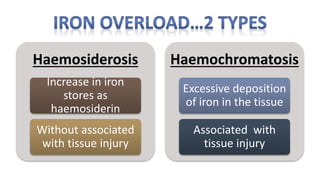
Haemosiderosis
Increase in iron
stores as
haemosiderin
Without associated
with tissue injury
Haemochromatosis
Excessive deposition
of iron in the tissue
Associated with
tissue injury
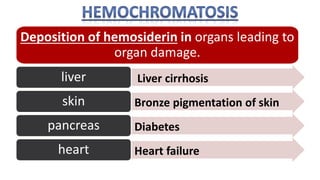
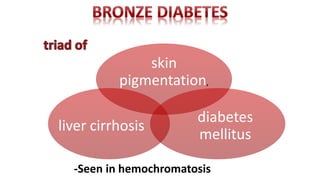
Deposition of hemosiderin in organs leading to
organ damage.
Liver cirrhosis
liver
Bronze pigmentation of skin
skin
Diabetes
pancreas
Heart failure
heart
skin
pigmentation,
diabetes
mellitus
liver cirrhosis
-Seen in hemochromatosis
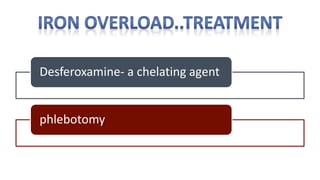
Desferoxamine- a chelating agent
phlebotomy

Minerals-calcium, phosphorus, iron..pptx