PRESENTATION
ON
“PROTEIN METABOLISM”
PRESENTED BY-
ANISHA MUKHERJEE
M.Sc FIRST SEMESTER
BIOTECHNOLOGY
GUIDED BY-
Mrs. SABIHA NAZ MA’AM
CONTENTS
 Proteins
 Amino Acid Pool
 Digestion Of Proteins
 Protein Metabolism-
Anabolism
Catabolism
 Catabolic Phase Of Amino Acid
o Deamination- Oxidative & Non-Oxidative
o Transamination
o Decarboxylation
o Transmethylation
 Ornithine Cycle or Urea Cycle
• Energetics
• Fate of urea
• Disorders
PROTEINS
 Proteins are the polymers of amino acids which play a
crucial role in all biological processes.
 Most abundant organic molecules of the living
system.
 Proteins have many important biological functions:-
o Enzymes - biological catalysts
o Antibodies- defense proteins
o Transport proteins- carrier proteins
o Structural proteins- provides support
o Hormonal proteins- chemical-signaling molecules
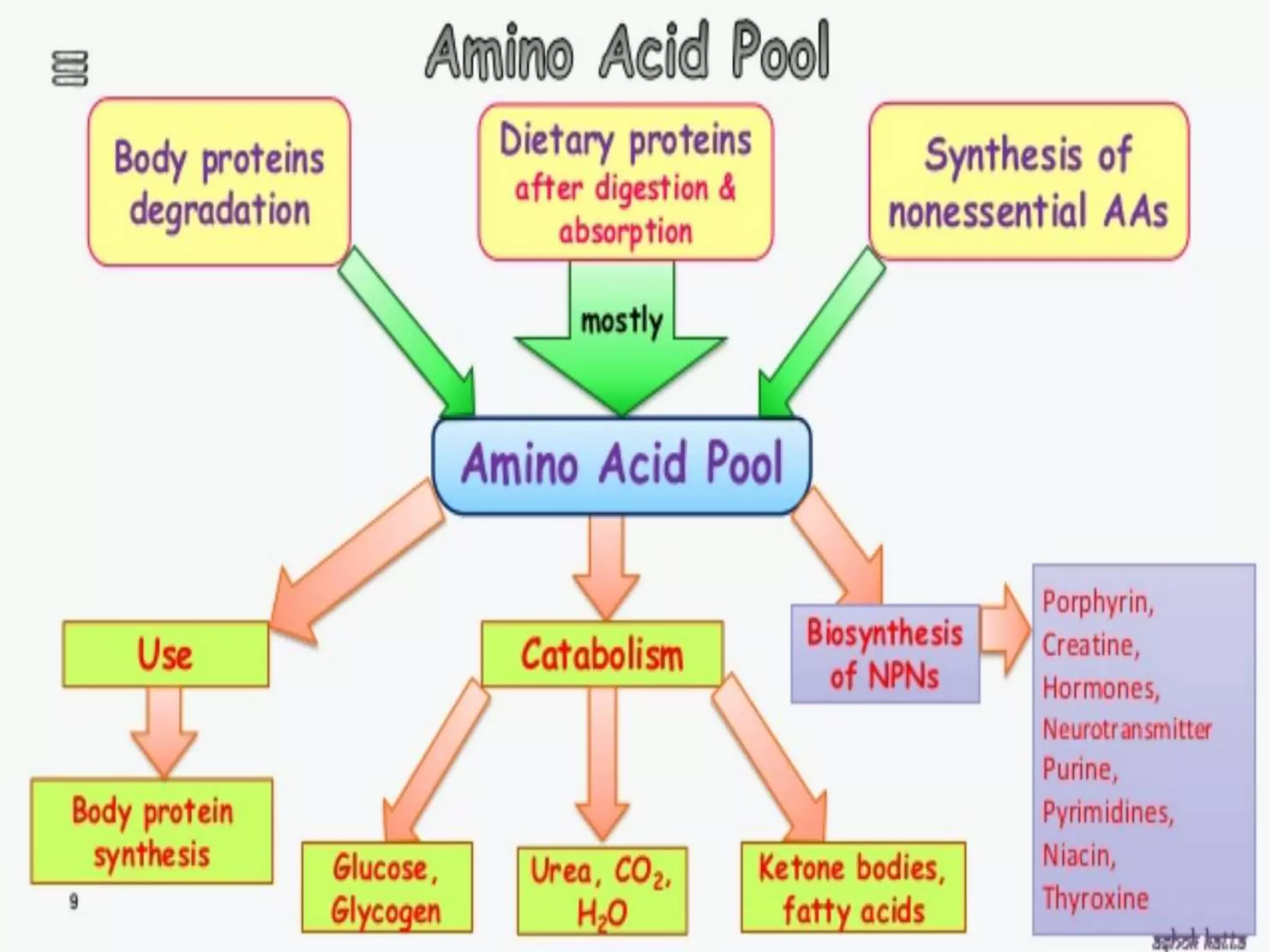
Amino Acid Pool
• The amount of free amino acids distributed
throughout the body is called amino acid pool.
• All the tissues can draw freely any amino acid
from this pool when needed & can also
discharge amino acids into this pool by way of
breakdown of proteins
• There is a dynamic equilibrium between the
breakdown of proteins & formation of new
proteins.
• Sources of amino acid pool
Dietary protein
Breakdown of tissue protein
Biosynthesis of non-essential amino acids
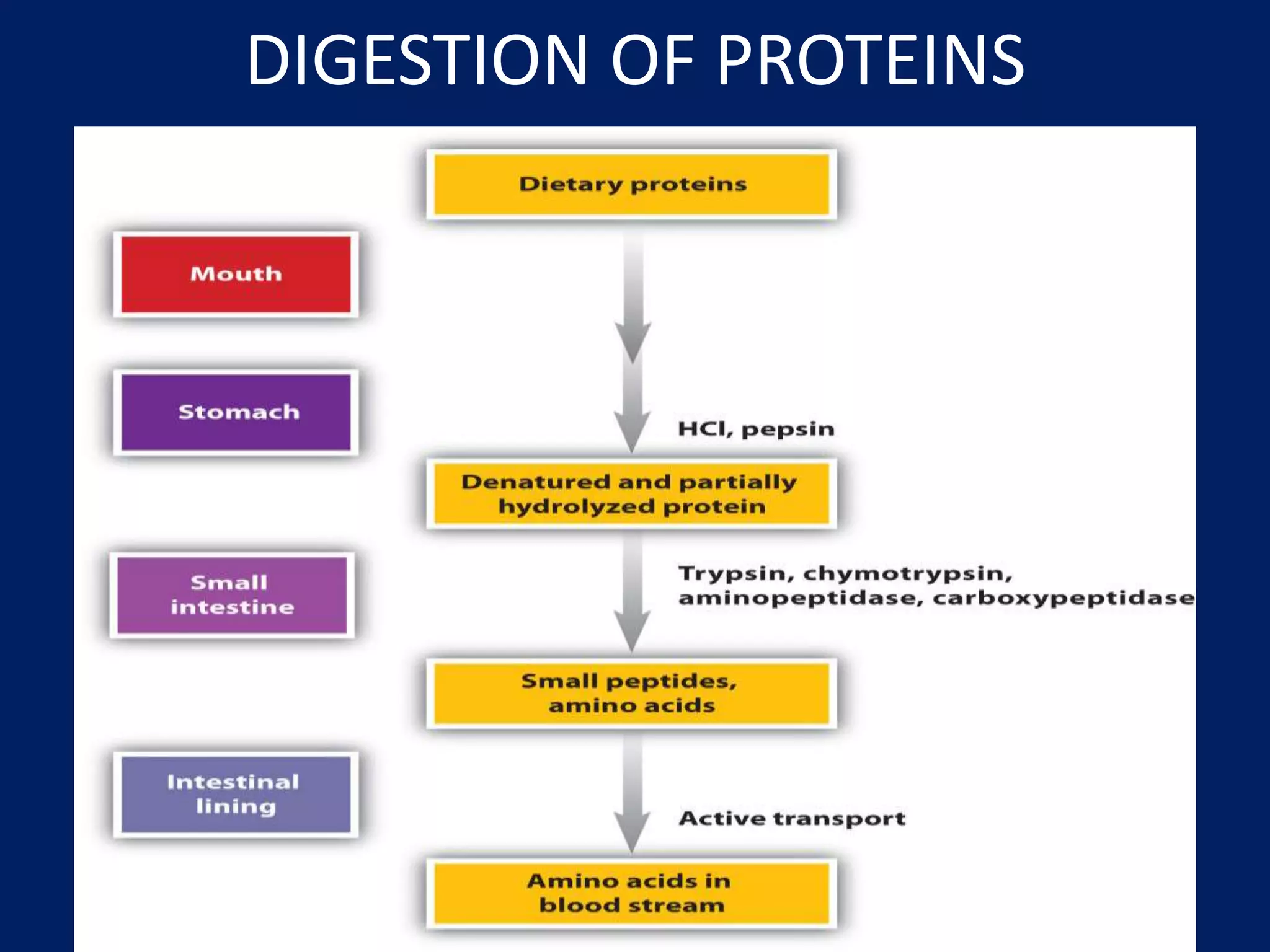
DIGESTION OF PROTEINS
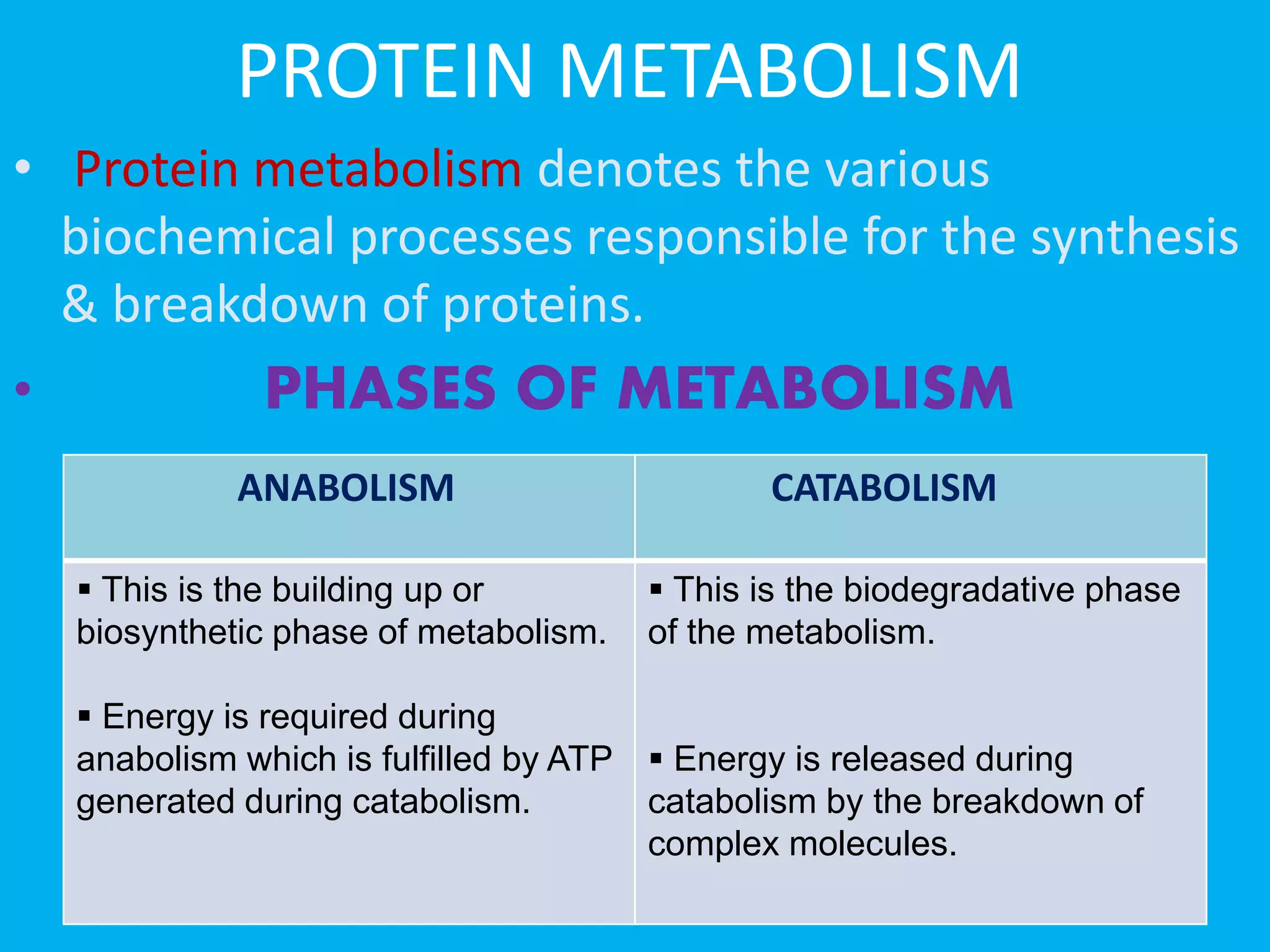
PROTEIN METABOLISM
• Protein metabolism denotes the various
biochemical processes responsible for the synthesis
& breakdown of proteins.
• PHASES OF METABOLISM
ANABOLISM CATABOLISM
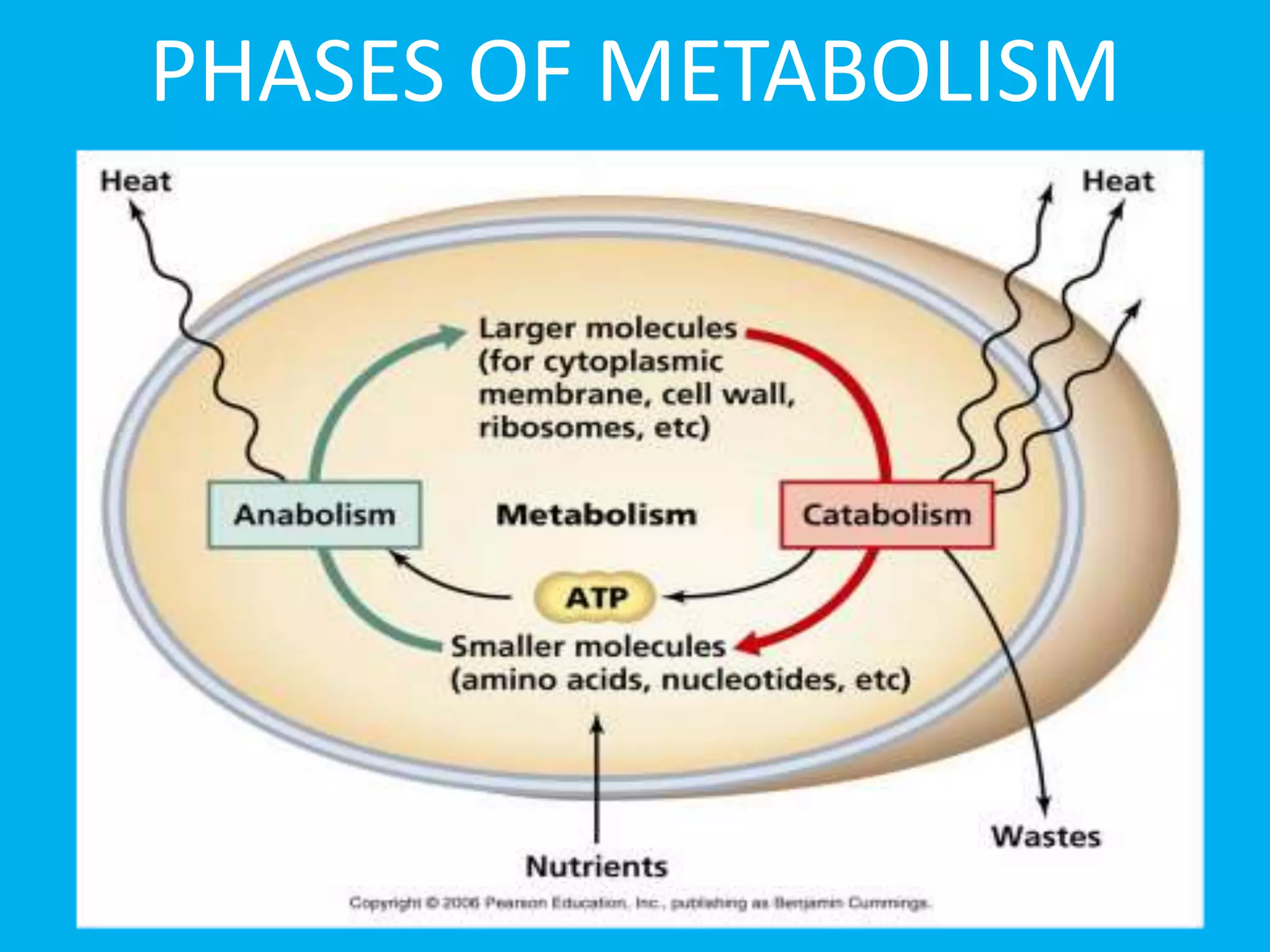
 This is the building up or
biosynthetic phase of metabolism.
 Energy is required during
anabolism which is fulfilled by ATP
generated during catabolism.
 This is the biodegradative phase
of the metabolism.
 Energy is released during
catabolism by the breakdown of
complex molecules.
PHASES OF METABOLISM
CATABOLIC PHASE OF AMINO ACID
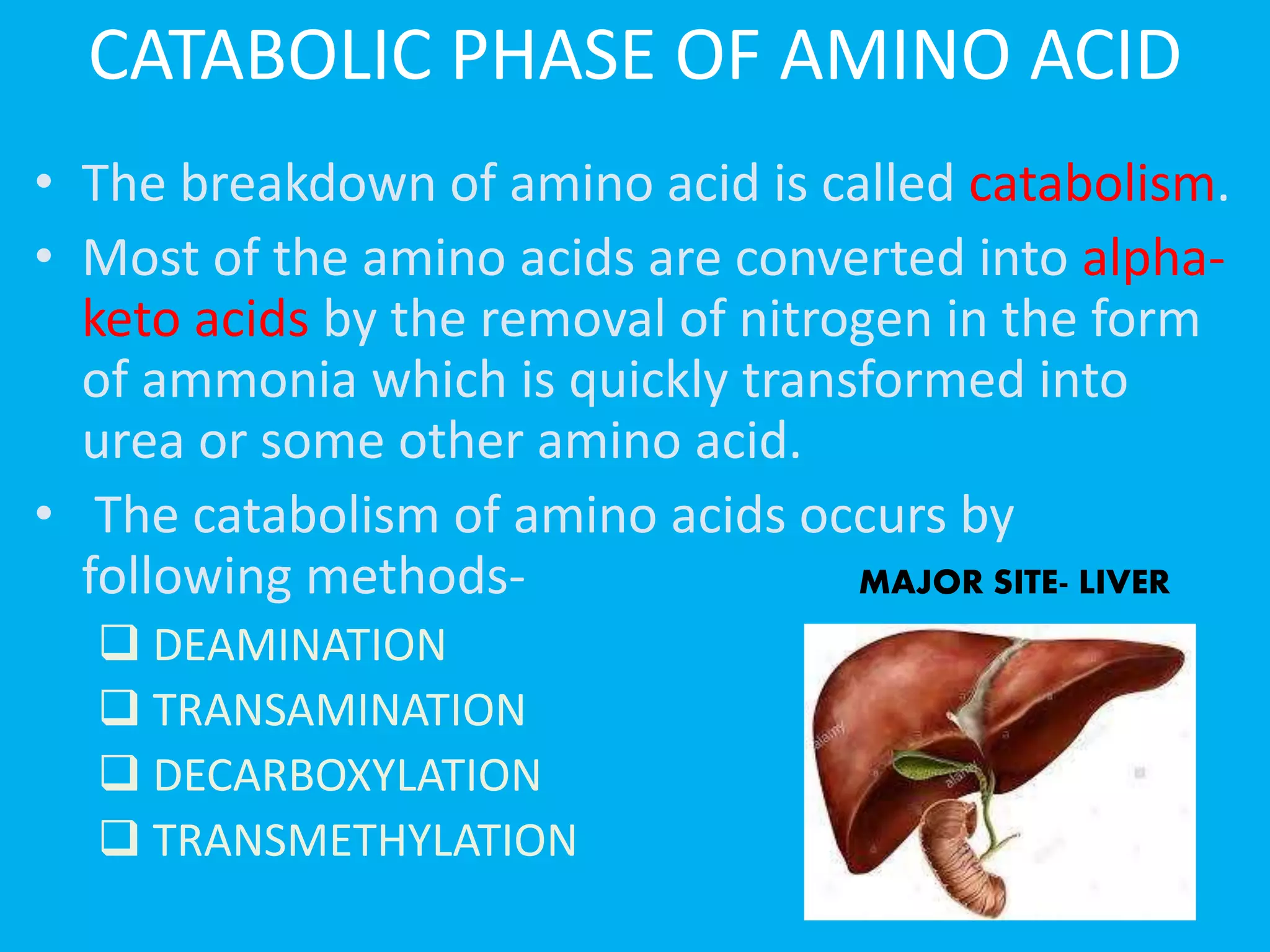
• The breakdown of amino acid is called catabolism.
• Most of the amino acids are converted into alpha-
keto acids by the removal of nitrogen in the form
of ammonia which is quickly transformed into
urea or some other amino acid.
• The catabolism of amino acids occurs by
following methods- MAJOR SITE- LIVER
 DEAMINATION
 TRANSAMINATION
 DECARBOXYLATION
 TRANSMETHYLATION
DEAMINATION
o DEFINITION:
Deamination is the removal of amino
groups from the amino acids with the
formation of keto acids & ammonia.
oTYPES:
It can be of two types:-
 Oxidative Deamination.
 Non-oxidative Deamination.
OXIDATIVE DEAMINATION
• The removal of amino group from amino acid with
the utilization of oxygen is called oxidative
deamination.
• There are two steps in the oxidative deamination:-
Oxidation (Dehydrogenation)
Hydrolysis
• SITE: Mitochondria of Liver and Kidney.
• ENZYMES: Amino acid oxidases(dehydrogenases).
• CO-ENZYMES: FAD(Flavin adenine dinucleotide) or
FMN(Flavin mono nucleotide).
OXIDATIVE DEAMINATION
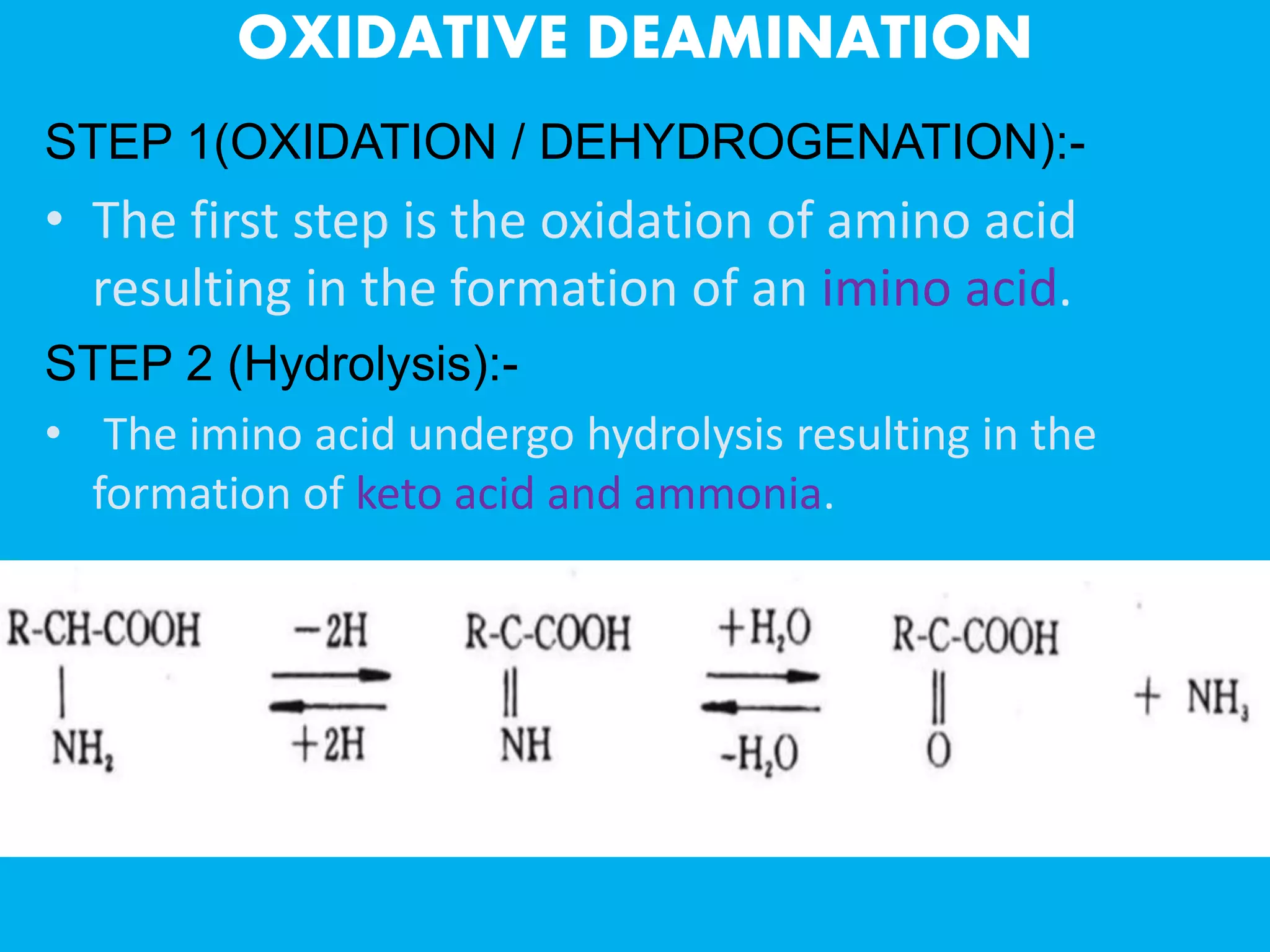
STEP 1(OXIDATION / DEHYDROGENATION):-
• The first step is the oxidation of amino acid
resulting in the formation of an imino acid.
STEP 2 (Hydrolysis):-
• The imino acid undergo hydrolysis resulting in the
formation of keto acid and ammonia.
NON-OXIDATIVE DEAMINATION
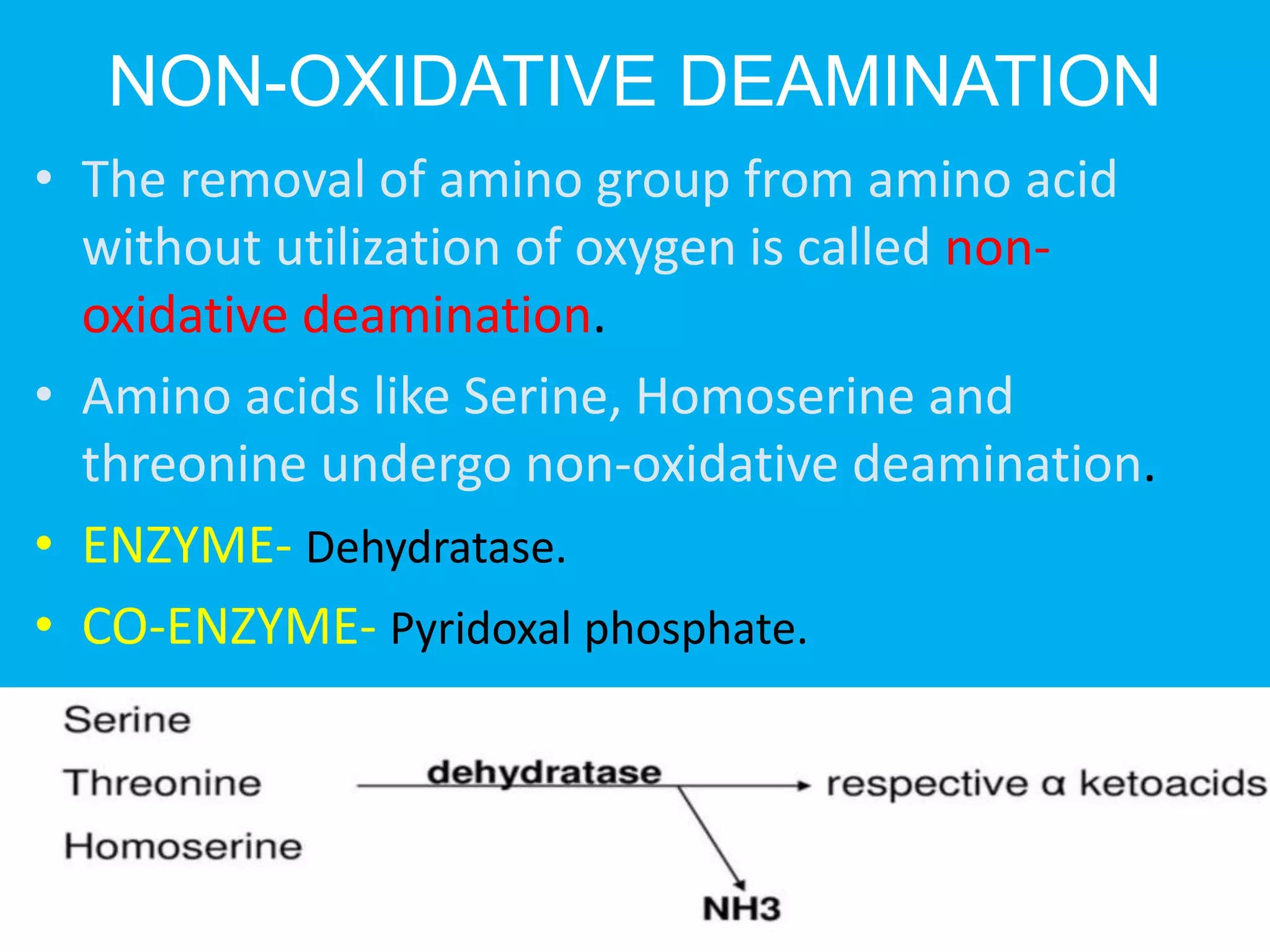
• The removal of amino group from amino acid
without utilization of oxygen is called non-
oxidative deamination.
• Amino acids like Serine, Homoserine and
threonine undergo non-oxidative deamination.
• ENZYME- Dehydratase.
• CO-ENZYME- Pyridoxal phosphate.
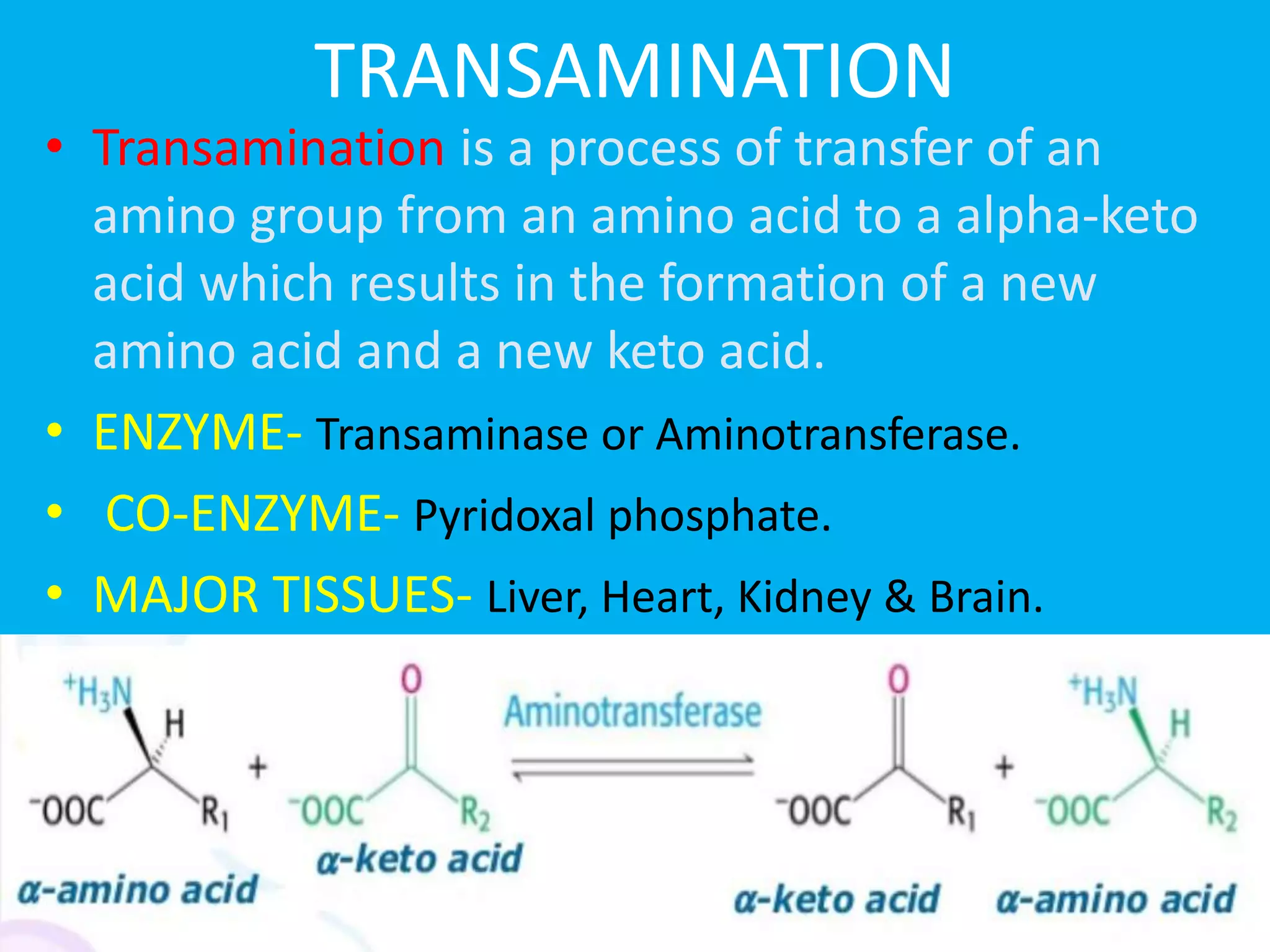
TRANSAMINATION
• Transamination is a process of transfer of an
amino group from an amino acid to a alpha-keto
acid which results in the formation of a new
amino acid and a new keto acid.
• ENZYME- Transaminase or Aminotransferase.
• CO-ENZYME- Pyridoxal phosphate.
• MAJOR TISSUES- Liver, Heart, Kidney & Brain.
Salient Features of Transamination:-
• SUBSTRATES- Amino Acids
Almost all amino acids undergo transfer of
amino group to small or large extent.
• EXCEPTIONS-
Lysine, Threonine, Proline and Hydroxyproline
do not take part in transamination.
• REVERSIBLE REACTION-
Hence keto acid can be derived from amino acid
& amino acids can be obtained from keto acid.
DECARBOXYLATION
• This refers to the removal of carbon-dioxide from
the carboxyl group of amino acids.
• ENZYME- Decarboxylases.
• CO-ENZYME- Pyridoxal phosphate.
TRANSMETHYLATION
• The transfer of methyl group from active
methionine/SAM to an acceptor is called
transmethylation.
• Here there are two compounds involved:-
One donates methyl group known as methyl
donor.
Other accepts the methyl group known as
methyl acceptor.
TRANSMETHYLATION
• ENZYME- Transmethylases/Methyl
transferases.
• CO-ENZYME- Tetra hydro folate(THF)
• Vit B-12 is also involved in this reaction.
• Methionine has to be activated to S-adenosyl
Methionine (SAM) to donate the methyl
group.
• SAM acts as donor of methyl group to the
acceptor, so that acceptor is converted to
methyl acceptor.
Significance of Transmethylation
Transmethylation is an essential process since
many biological compounds becomes
functionally active only after methylation.
Transmethylation synthesizes biologically
important compounds like
Choline,Creatine,Epinephrine,Nor-epinephrine.
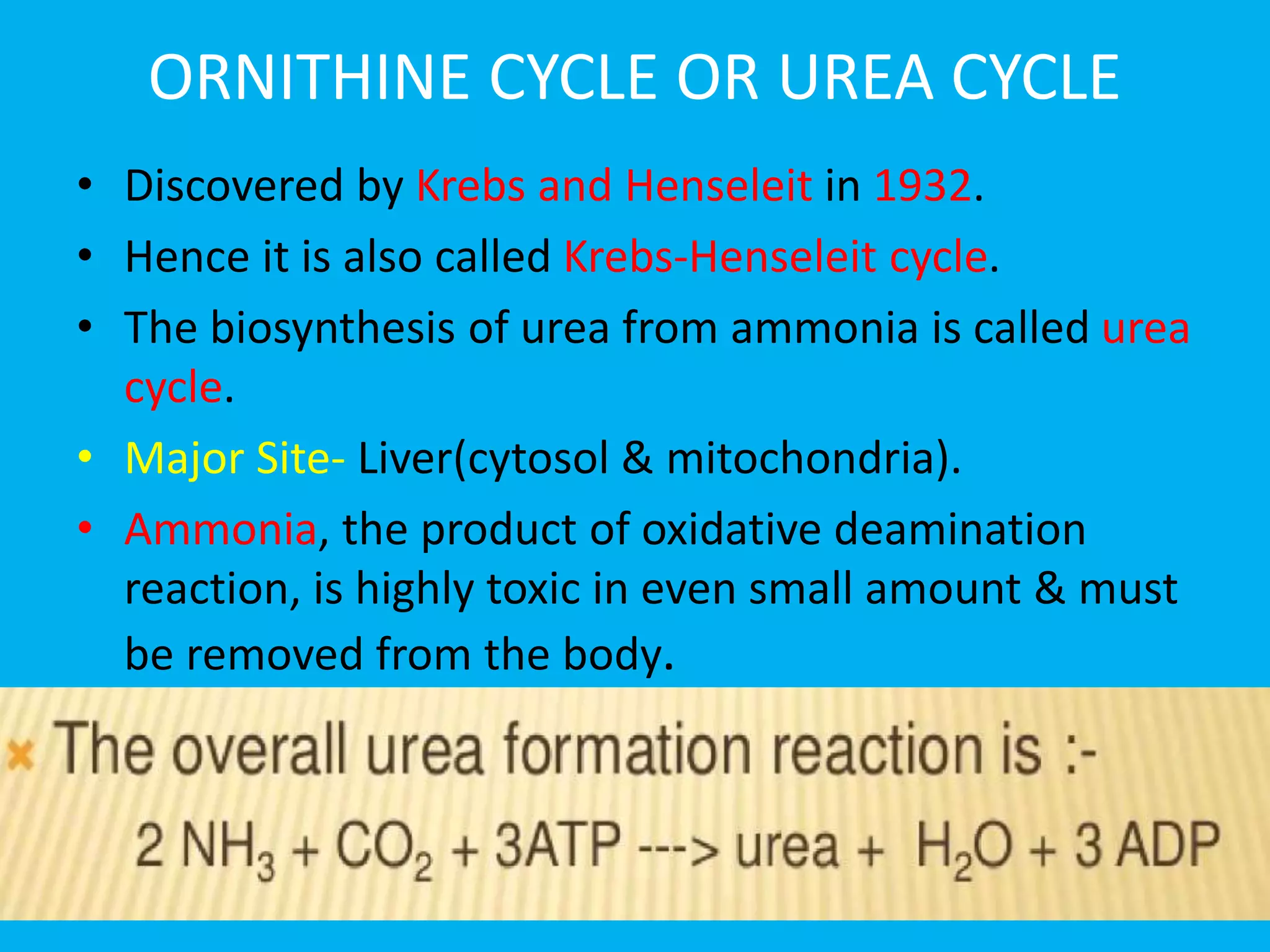
ORNITHINE CYCLE OR UREA CYCLE
• Discovered by Krebs and Henseleit in 1932.
• Hence it is also called Krebs-Henseleit cycle.
• The biosynthesis of urea from ammonia is called urea
cycle.
• Major Site- Liver(cytosol & mitochondria).
• Ammonia, the product of oxidative deamination
reaction, is highly toxic in even small amount & must
be removed from the body.
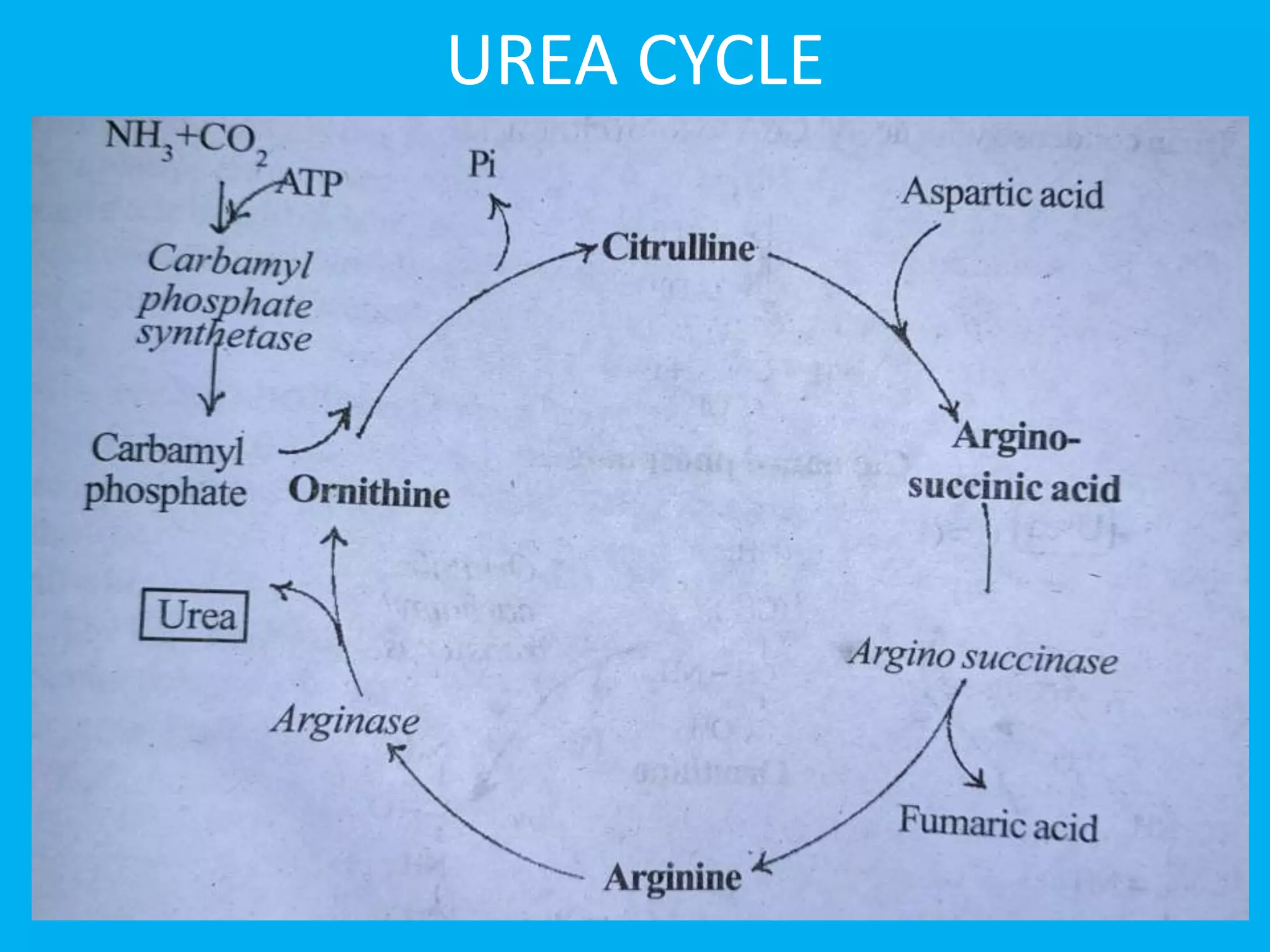
UREA CYCLE
ENERGETICS OF UREA CYCLE
FATE OF UREA
Protein metabolism-Catabolism

Protein metabolism-Catabolism

  • 1.
    PRESENTATION ON “PROTEIN METABOLISM” PRESENTED BY- ANISHAMUKHERJEE M.Sc FIRST SEMESTER BIOTECHNOLOGY GUIDED BY- Mrs. SABIHA NAZ MA’AM
  • 2.
    CONTENTS  Proteins  AminoAcid Pool  Digestion Of Proteins  Protein Metabolism- Anabolism Catabolism  Catabolic Phase Of Amino Acid o Deamination- Oxidative & Non-Oxidative o Transamination o Decarboxylation o Transmethylation  Ornithine Cycle or Urea Cycle • Energetics • Fate of urea • Disorders
  • 3.
    PROTEINS  Proteins arethe polymers of amino acids which play a crucial role in all biological processes.  Most abundant organic molecules of the living system.  Proteins have many important biological functions:- o Enzymes - biological catalysts o Antibodies- defense proteins o Transport proteins- carrier proteins o Structural proteins- provides support o Hormonal proteins- chemical-signaling molecules
  • 4.
    Amino Acid Pool •The amount of free amino acids distributed throughout the body is called amino acid pool. • All the tissues can draw freely any amino acid from this pool when needed & can also discharge amino acids into this pool by way of breakdown of proteins • There is a dynamic equilibrium between the breakdown of proteins & formation of new proteins. • Sources of amino acid pool Dietary protein Breakdown of tissue protein Biosynthesis of non-essential amino acids
  • 6.
  • 7.
    PROTEIN METABOLISM • Proteinmetabolism denotes the various biochemical processes responsible for the synthesis & breakdown of proteins. • PHASES OF METABOLISM ANABOLISM CATABOLISM  This is the building up or biosynthetic phase of metabolism.  Energy is required during anabolism which is fulfilled by ATP generated during catabolism.  This is the biodegradative phase of the metabolism.  Energy is released during catabolism by the breakdown of complex molecules.
  • 8.
  • 9.
    CATABOLIC PHASE OFAMINO ACID • The breakdown of amino acid is called catabolism. • Most of the amino acids are converted into alpha- keto acids by the removal of nitrogen in the form of ammonia which is quickly transformed into urea or some other amino acid. • The catabolism of amino acids occurs by following methods- MAJOR SITE- LIVER  DEAMINATION  TRANSAMINATION  DECARBOXYLATION  TRANSMETHYLATION
  • 10.
    DEAMINATION o DEFINITION: Deamination isthe removal of amino groups from the amino acids with the formation of keto acids & ammonia. oTYPES: It can be of two types:-  Oxidative Deamination.  Non-oxidative Deamination.
  • 11.
    OXIDATIVE DEAMINATION • Theremoval of amino group from amino acid with the utilization of oxygen is called oxidative deamination. • There are two steps in the oxidative deamination:- Oxidation (Dehydrogenation) Hydrolysis • SITE: Mitochondria of Liver and Kidney. • ENZYMES: Amino acid oxidases(dehydrogenases). • CO-ENZYMES: FAD(Flavin adenine dinucleotide) or FMN(Flavin mono nucleotide).
  • 12.
    OXIDATIVE DEAMINATION STEP 1(OXIDATION/ DEHYDROGENATION):- • The first step is the oxidation of amino acid resulting in the formation of an imino acid. STEP 2 (Hydrolysis):- • The imino acid undergo hydrolysis resulting in the formation of keto acid and ammonia.
  • 13.
    NON-OXIDATIVE DEAMINATION • Theremoval of amino group from amino acid without utilization of oxygen is called non- oxidative deamination. • Amino acids like Serine, Homoserine and threonine undergo non-oxidative deamination. • ENZYME- Dehydratase. • CO-ENZYME- Pyridoxal phosphate.
  • 14.
    TRANSAMINATION • Transamination isa process of transfer of an amino group from an amino acid to a alpha-keto acid which results in the formation of a new amino acid and a new keto acid. • ENZYME- Transaminase or Aminotransferase. • CO-ENZYME- Pyridoxal phosphate. • MAJOR TISSUES- Liver, Heart, Kidney & Brain.
  • 15.
    Salient Features ofTransamination:- • SUBSTRATES- Amino Acids Almost all amino acids undergo transfer of amino group to small or large extent. • EXCEPTIONS- Lysine, Threonine, Proline and Hydroxyproline do not take part in transamination. • REVERSIBLE REACTION- Hence keto acid can be derived from amino acid & amino acids can be obtained from keto acid.
  • 16.
    DECARBOXYLATION • This refersto the removal of carbon-dioxide from the carboxyl group of amino acids. • ENZYME- Decarboxylases. • CO-ENZYME- Pyridoxal phosphate.
  • 17.
    TRANSMETHYLATION • The transferof methyl group from active methionine/SAM to an acceptor is called transmethylation. • Here there are two compounds involved:- One donates methyl group known as methyl donor. Other accepts the methyl group known as methyl acceptor.
  • 18.
    TRANSMETHYLATION • ENZYME- Transmethylases/Methyl transferases. •CO-ENZYME- Tetra hydro folate(THF) • Vit B-12 is also involved in this reaction. • Methionine has to be activated to S-adenosyl Methionine (SAM) to donate the methyl group. • SAM acts as donor of methyl group to the acceptor, so that acceptor is converted to methyl acceptor.
  • 20.
    Significance of Transmethylation Transmethylationis an essential process since many biological compounds becomes functionally active only after methylation. Transmethylation synthesizes biologically important compounds like Choline,Creatine,Epinephrine,Nor-epinephrine.
  • 21.
    ORNITHINE CYCLE ORUREA CYCLE • Discovered by Krebs and Henseleit in 1932. • Hence it is also called Krebs-Henseleit cycle. • The biosynthesis of urea from ammonia is called urea cycle. • Major Site- Liver(cytosol & mitochondria). • Ammonia, the product of oxidative deamination reaction, is highly toxic in even small amount & must be removed from the body.
  • 22.
  • 23.
  • 24.