Glycogen metabolism &
gluconeogenesis
-Carbohydrate metabolic
pathways for glucose
homeostasis
GLYCOGEN METABOLISM
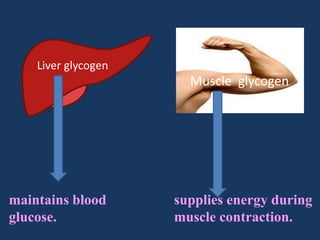
Liver glycogen

Muscle glycogen

maintains blood
glucose.

supplies energy during
muscle contraction.
Introduction
Storage form of carbohydrates in
animals
Sites: Liver & muscle

Glycogen:

Functions
Liver glycogen is used to maintain blood
glucose.
Muscle glycogen supplies energy during
muscle contraction.
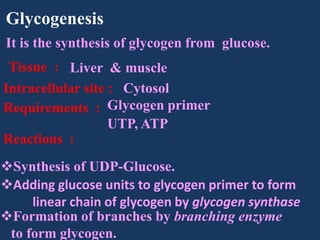
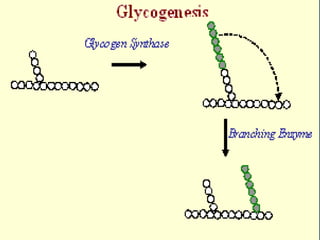
Glycogenesis
It is the synthesis of glycogen from glucose.
Tissue : Liver & muscle
Intracellular site : Cytosol
Requirements : Glycogen primer
UTP, ATP
Reactions :

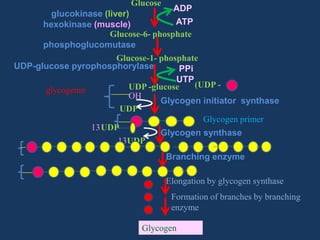
Synthesis of UDP-Glucose.
Adding glucose units to glycogen primer to form
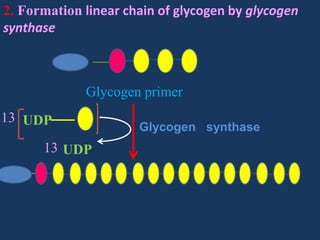
linear chain of glycogen by glycogen synthase
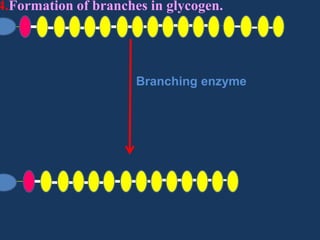
Formation of branches by branching enzyme
to form glycogen.
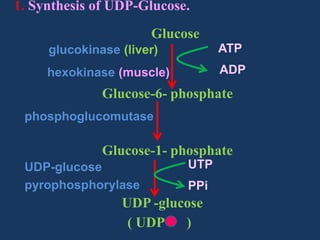
1. Synthesis of UDP-Glucose.

Glucose
glucokinase (liver)

ATP

hexokinase (muscle)

ADP

Glucose-6- phosphate
phosphoglucomutase

Glucose-1- phosphate
UDP-glucose
pyrophosphorylase

UTP
PPi

UDP -glucose
( UDP - )
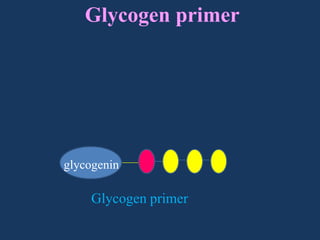
Glycogen primer

glycogenin

Glycogen primer
2. Formation linear chain of glycogen by glycogen
synthase

Glycogen primer
13 UDP
13 UDP

Glycogen synthase
4.Formation of branches in glycogen.

Branching enzyme
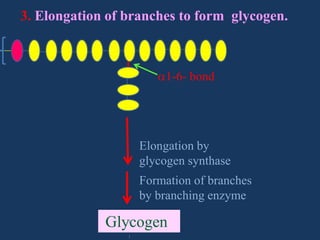
3. Elongation of branches to form glycogen.

1-6- bond

Elongation by
glycogen synthase
Formation of branches
by branching enzyme

Glycogen
Glucose

ADP
glucokinase (liver)
ATP
hexokinase (muscle)
Glucose-6- phosphate
phosphoglucomutase
Glucose-1- phosphate
UDP-glucose pyrophosphorylase
PPi
UTP
(UDP UDP -glucose
glycogenin
OH
Glycogen initiator synthase
UDP
Glycogen primer
13 UDP
Glycogen synthase
13UDP
Branching enzyme
Elongation by glycogen synthase
Formation of branches by branching
enzyme

Glycogen
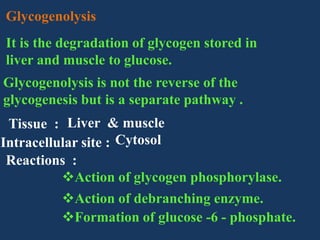
Glycogenolysis
It is the degradation of glycogen stored in
liver and muscle to glucose.
Glycogenolysis is not the reverse of the
glycogenesis but is a separate pathway .
Tissue : Liver & muscle
Intracellular site : Cytosol
Reactions :
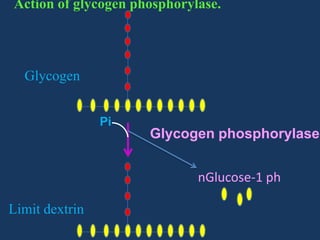
Action of glycogen phosphorylase.
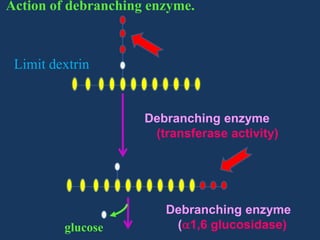
Action of debranching enzyme.
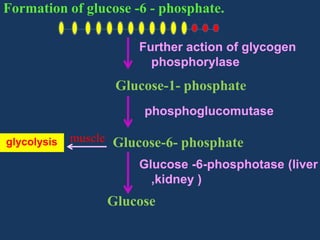
Formation of glucose -6 - phosphate.
Action of glycogen phosphorylase.

Glycogen
Pi

Glycogen phosphorylase
nGlucose-1 ph

Limit dextrin
Action of debranching enzyme.

Limit dextrin

Debranching enzyme
(transferase activity)

glucose

Debranching enzyme
( 1,6 glucosidase)
Formation of glucose -6 - phosphate.
Further action of glycogen
phosphorylase

Glucose-1- phosphate
phosphoglucomutase
glycolysis

muscle Glucose-6- phosphate
Glucose -6-phosphotase (liver
,kidney )

Glucose
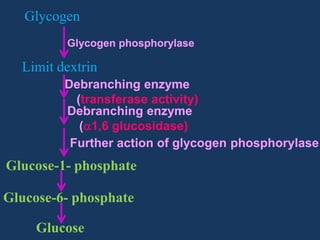
Glycogen
Glycogen phosphorylase

Limit dextrin
Debranching enzyme
(transferase activity)
Debranching enzyme
( 1,6 glucosidase)
Further action of glycogen phosphorylase

Glucose-1- phosphate

Glucose-6- phosphate
Glucose
Regulation of glycogen metabolism
Glycogenesis…..zzzzz!!!!
Glycogenolysis….!!!!
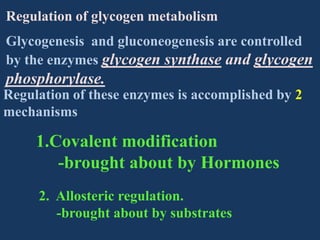
Regulation of glycogen metabolism
Glycogenesis and gluconeogenesis are controlled
by the enzymes glycogen synthase and glycogen
phosphorylase.
Regulation of these enzymes is accomplished by 2
mechanisms

1.Covalent modification
-brought about by Hormones
2. Allosteric regulation.
-brought about by substrates
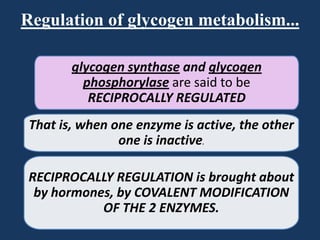
Regulation of glycogen metabolism...
glycogen synthase and glycogen
phosphorylase are said to be
RECIPROCALLY REGULATED
That is, when one enzyme is active, the other
one is inactive.
RECIPROCALLY REGULATION is brought about
by hormones, by COVALENT MODIFICATION
OF THE 2 ENZYMES.
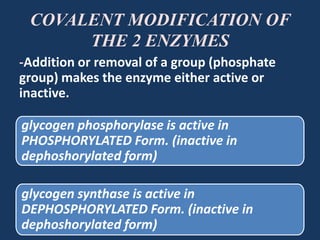
COVALENT MODIFICATION OF
THE 2 ENZYMES
-Addition or removal of a group (phosphate
group) makes the enzyme either active or
inactive.

glycogen phosphorylase is active in
PHOSPHORYLATED Form. (inactive in
dephoshorylated form)
glycogen synthase is active in
DEPHOSPHORYLATED Form. (inactive in
dephoshorylated form)
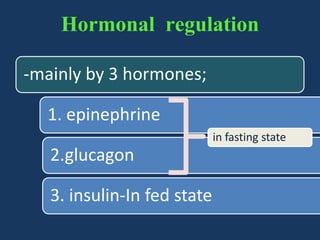
Hormonal regulation
-mainly by 3 hormones;
1. epinephrine
in fasting state

2.glucagon

3. insulin-In fed state
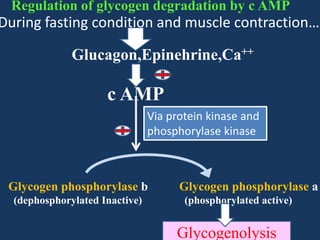
Regulation of glycogen degradation by c AMP

During fasting condition and muscle contraction……
Glucagon,Epinehrine,Ca++

c AMP
Via protein kinase and
phosphorylase kinase

Glycogen phosphorylase b
(dephosphorylated Inactive)

Glycogen phosphorylase a
(phosphorylated active)

Glycogenolysis
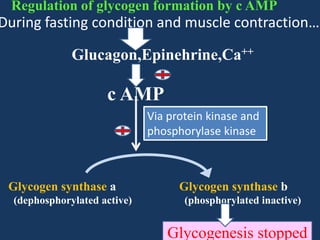
Regulation of glycogen formation by c AMP

During fasting condition and muscle contraction……
Glucagon,Epinehrine,Ca++

c AMP
Via protein kinase and
phosphorylase kinase

Glycogen synthase a
(dephosphorylated active)

Glycogen synthase b
(phosphorylated inactive)

Glycogenesis stopped
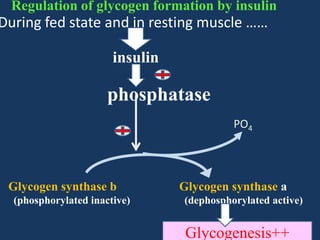
Regulation of glycogen formation by insulin

During fed state and in resting muscle ……
insulin

phosphatase
PO4

Glycogen synthase b
(phosphorylated inactive)

Glycogen synthase a
(dephosphorylated active)

Glycogenesis++
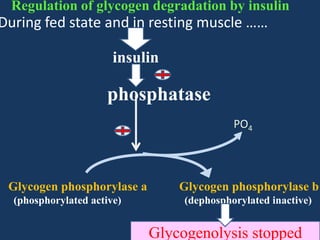
Regulation of glycogen degradation by insulin

During fed state and in resting muscle ……
insulin

phosphatase
PO4

Glycogen phosphorylase a
(phosphorylated active)

Glycogen phosphorylase b
(dephosphorylated inactive)

Glycogenolysis stopped
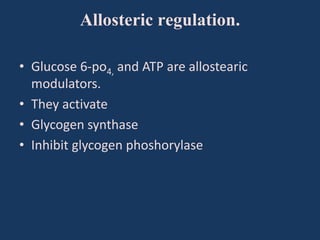
Allosteric regulation.
• Glucose 6-po4, and ATP are allostearic
modulators.
• They activate
• Glycogen synthase
• Inhibit glycogen phoshorylase
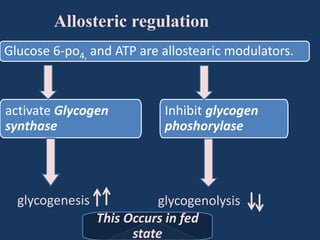
Allosteric regulation
Glucose 6-po4, and ATP are allostearic modulators.

activate Glycogen
synthase

glycogenesis

Inhibit glycogen
phoshorylase

glycogenolysis
This Occurs in fed
state
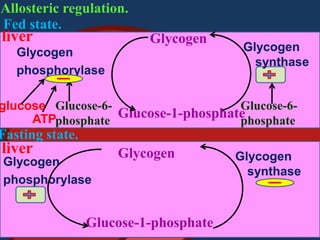
Allosteric regulation.
Fed state.

liver

Glycogen

Glycogen
phosphorylase

Glycogen
synthase

Glucose-6glucose Glucose-6ATPphosphate Glucose-1-phosphate
phosphate

Fasting state.

liver
Glycogen
phosphorylase

Glycogen

Glucose-1-phosphate

Glycogen
synthase
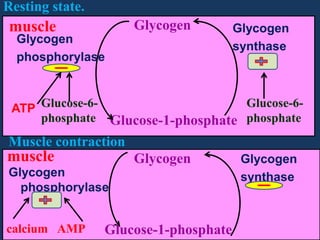
Resting state.
Glycogen

muscle

Glycogen
phosphorylase

Glycogen
synthase

Glucose-6ATP Glucose-6phosphate Glucose-1-phosphate phosphate

Muscle contraction

muscle

Glycogen

Glycogen
phosphorylase

calcium AMP

Glucose-1-phosphate

Glycogen
synthase
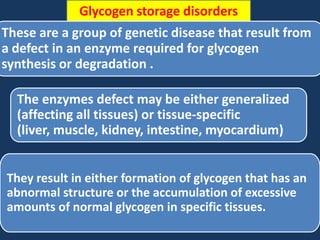
Glycogen storage disorders

These are a group of genetic disease that result from
a defect in an enzyme required for glycogen
synthesis or degradation .
The enzymes defect may be either generalized
(affecting all tissues) or tissue-specific
(liver, muscle, kidney, intestine, myocardium)
They result in either formation of glycogen that has an
abnormal structure or the accumulation of excessive
amounts of normal glycogen in specific tissues.
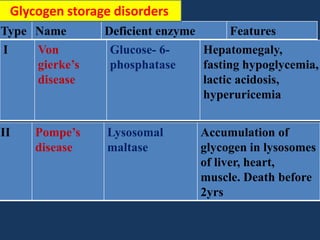
Glycogen storage disorders
Type Name

Deficient enzyme

Features

I

Von
gierke’s
disease

Glucose- 6phosphatase

Hepatomegaly,
fasting hypoglycemia,
lactic acidosis,
hyperuricemia

II

Pompe’s
disease

Lysosomal
maltase

Accumulation of
glycogen in lysosomes
of liver, heart,
muscle. Death before
2yrs
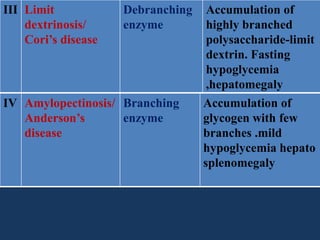
III Limit
dextrinosis/
Cori’s disease

Debranching
enzyme

IV Amylopectinosis/ Branching
Anderson’s
enzyme
disease

Accumulation of
highly branched
polysaccharide-limit
dextrin. Fasting
hypoglycemia
,hepatomegaly
Accumulation of
glycogen with few
branches .mild
hypoglycemia hepato
splenomegaly
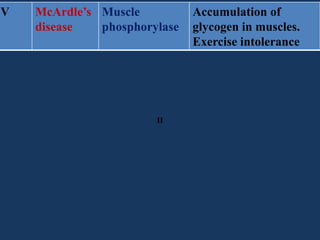
V

McArdle’s Muscle
disease
phosphorylase

II

Accumulation of
glycogen in muscles.
Exercise intolerance
Gluconeogenesis
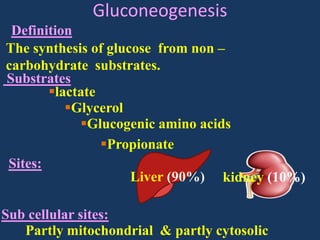
Gluconeogenesis
Definition
The synthesis of glucose from non –
carbohydrate substrates.
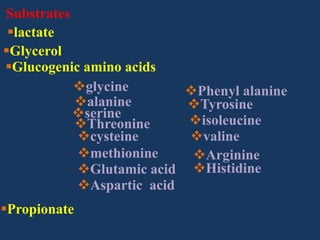
Substrates
lactate
Glycerol
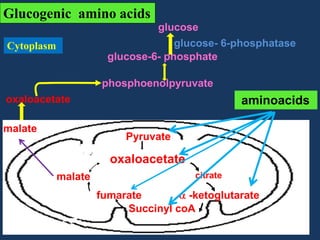
Glucogenic amino acids
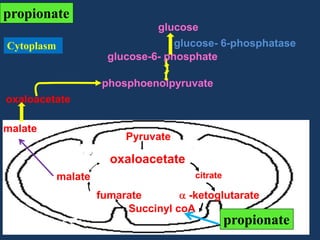
Propionate
Sites:
Liver (90%) kidney (10%)
Sub cellular sites:
Partly mitochondrial & partly cytosolic
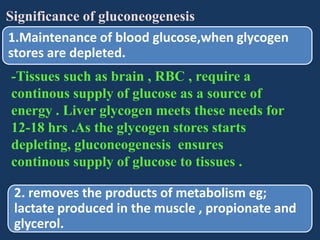
Significance of gluconeogenesis
1.Maintenance of blood glucose,when glycogen
stores are depleted.
-Tissues such as brain , RBC , require a
continous supply of glucose as a source of
energy . Liver glycogen meets these needs for
12-18 hrs .As the glycogen stores starts
depleting, gluconeogenesis ensures
continous supply of glucose to tissues .
2. removes the products of metabolism eg;
lactate produced in the muscle , propionate and
glycerol.
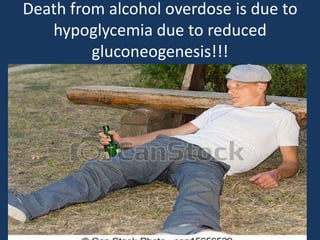
Death from alcohol overdose is due to
hypoglycemia due to reduced
gluconeogenesis!!!
Characteristics
Glycolysis and gluconeogenesis share the
same pathway but in opposite direction.

Gluconeogenesis utilizes all the seven
enzymes of glycolysis catalyzing reversible
reactions

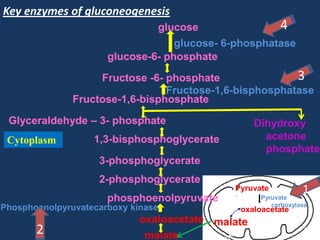
Gluconeogenesis also utilizes four special
enzymes (the so called key enzymes of
gluconeogenesis) for catalyzing the reversal of
the three irreversible reactions of glycolysis
Glucose- 6- phosphatase is only present in
liver and kidney but not in the muscle. Thus
muscle cannot provide blood glucose by
gluconeogenesis.
Reactions of gluconeogenesis
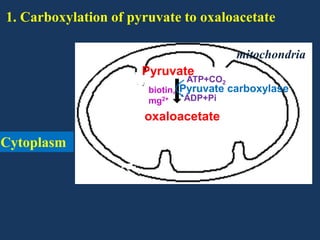
1. Carboxylation of pyruvate to oxaloacetate
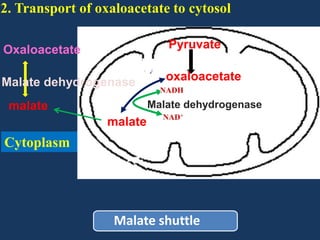
2. Transport of oxaloacetate to cytosol
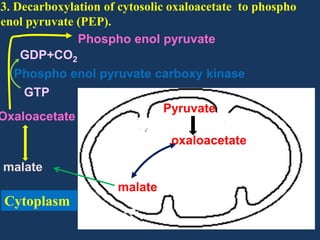
3. Decarboxylation of cytosolic oxaloacetate
to phospho enol pyruvate (PEP).
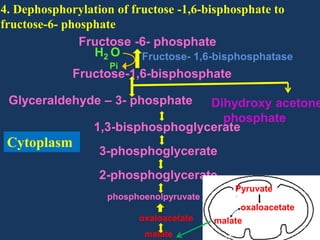
4. Dephosphorylation of fructose -1,6bisphosphate to fructose-6- phosphate
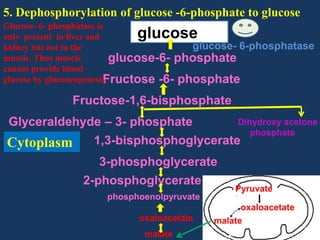
5. Dephosphorylation of glucose -6phosphate to glucose
1. Carboxylation of pyruvate to oxaloacetate
mitochondria
Pyruvate

ATP+CO2

biotin, Pyruvate carboxylase
ADP+Pi
mg2+

oxaloacetate

Cytoplasm
2. Transport of oxaloacetate to cytosol
Oxaloacetate

Pyruvate

Malate dehydrogenase

oxaloacetate
NADH

Malate dehydrogenase

malate
malate

NAD+

Cytoplasm

Malate shuttle
3. Decarboxylation of cytosolic oxaloacetate to phospho
enol pyruvate (PEP).
Phospho enol pyruvate
GDP+CO2
Phospho enol pyruvate carboxy kinase
GTP
Pyruvate

Oxaloacetate

oxaloacetate
malate
malate

Cytoplasm
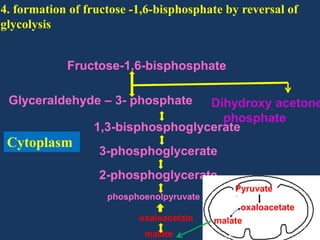
4. formation of fructose -1,6-bisphosphate by reversal of
glycolysis
Fructose-1,6-bisphosphate
Glyceraldehyde – 3- phosphate

Dihydroxy acetone
phosphate
1,3-bisphosphoglycerate

Cytoplasm

3-phosphoglycerate
2-phosphoglycerate
phosphoenolpyruvate
oxaloacetate
malate

Pyruvate
oxaloacetate
malate
4. Dephosphorylation of fructose -1,6-bisphosphate to
fructose-6- phosphate
Fructose -6- phosphate
H2 O
Fructose- 1,6-bisphosphatase
Pi

Fructose-1,6-bisphosphate
Glyceraldehyde – 3- phosphate

Dihydroxy acetone
phosphate
1,3-bisphosphoglycerate

Cytoplasm

3-phosphoglycerate
2-phosphoglycerate
phosphoenolpyruvate
oxaloacetate
malate

Pyruvate
oxaloacetate
malate
5. Dephosphorylation of glucose -6-phosphate to glucose
Glucose- 6- phosphatase is
only present in liver and
glucose- 6-phosphatase
kidney but not in the
muscle. Thus muscle
glucose-6- phosphate
cannot provide blood
glucose by gluconeogenesis.
Fructose -6- phosphate

glucose

Fructose-1,6-bisphosphate
Glyceraldehyde – 3- phosphate

Cytoplasm

Dihydroxy acetone
phosphate

1,3-bisphosphoglycerate
3-phosphoglycerate
2-phosphoglycerate
phosphoenolpyruvate
oxaloacetate
malate

Pyruvate
oxaloacetate
malate
Key enzymes of gluconeogenesis

4
glucose
glucose- 6-phosphatase
glucose-6- phosphate
3
Fructose -6- phosphate
Fructose-1,6-bisphosphatase
Fructose-1,6-bisphosphate
Glyceraldehyde – 3- phosphate
Cytoplasm

Dihydroxy
acetone
phosphate

1,3-bisphosphoglycerate
3-phosphoglycerate
2-phosphoglycerate

Pyruvate

phosphoenolpyruvate
Phosphoenolpyruvatecarboxy kinase

2

Pyruvate
carboxylase

1 oxaloacetate

oxaloacetate malate
malate

1
Substrates
lactate
Glycerol
Glucogenic amino acids
glycine
Phenyl alanine
alanine
Tyrosine
serine
isoleucine
Threonine
cysteine
valine
methionine
Arginine
Glutamic acid Histidine
Aspartic acid
Propionate
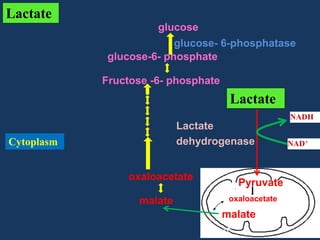
Lactate
glucose
glucose- 6-phosphatase
glucose-6- phosphate
Fructose -6- phosphate

Lactate
NADH

Lactate
dehydrogenase

Cytoplasm

oxaloacetate
malate

Pyruvate
oxaloacetate

malate

NAD+
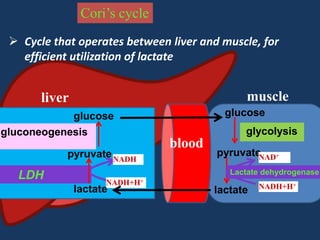
Cori’s cycle
 Cycle that operates between liver and muscle, for
efficient utilization of lactate

muscle

liver

glucose

glucose
gluconeogenesis
pyruvate NADH

LDH

glycolysis

blood

pyruvate +
NAD
Lactate dehydrogenase

NADH+H+

lactate

lactate

NADH+H+
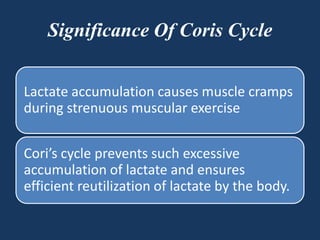
Significance Of Coris Cycle
Lactate accumulation causes muscle cramps
during strenuous muscular exercise
Cori’s cycle prevents such excessive
accumulation of lactate and ensures
efficient reutilization of lactate by the body.
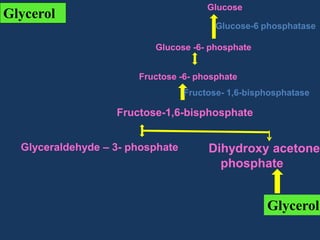
Glucose

Glycerol

Glucose-6 phosphatase
Glucose -6- phosphate
Fructose -6- phosphate
Fructose- 1,6-bisphosphatase

Fructose-1,6-bisphosphate
Glyceraldehyde – 3- phosphate

Dihydroxy acetone
phosphate

Glycerol
Glucogenic amino acids
glucose
glucose- 6-phosphatase
glucose-6- phosphate

Cytoplasm

phosphoenolpyruvate
oxaloacetate
malate

aminoacids
Pyruvate

oxaloacetate
malate

citrate

fumarate
-ketoglutarate
Succinyl coA
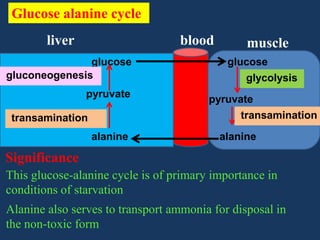
Glucose alanine cycle
liver

blood

glucose
gluconeogenesis
pyruvate
transamination

alanine

muscle
glucose

glycolysis
pyruvate
transamination

alanine

Significance
This glucose-alanine cycle is of primary importance in
conditions of starvation
Alanine also serves to transport ammonia for disposal in
the non-toxic form
propionate
glucose
glucose- 6-phosphatase
glucose-6- phosphate

Cytoplasm

phosphoenolpyruvate
oxaloacetate
malate

Pyruvate

oxaloacetate
malate

citrate

fumarate
-ketoglutarate
Succinyl coA

propionate
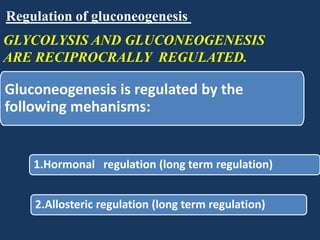
Regulation of gluconeogenesis
GLYCOLYSIS AND GLUCONEOGENESIS
ARE RECIPROCRALLY REGULATED.

Gluconeogenesis is regulated by the
following mehanisms:

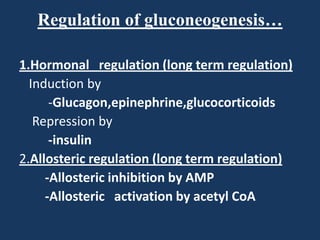
1.Hormonal regulation (long term regulation)
2.Allosteric regulation (long term regulation)
Regulation of gluconeogenesis…
1.Hormonal regulation (long term regulation)
Induction by
-Glucagon,epinephrine,glucocorticoids
Repression by
-insulin
2.Allosteric regulation (long term regulation)
-Allosteric inhibition by AMP
-Allosteric activation by acetyl CoA
Thank you
Thank u………!!

Mail me@ ganeshprasadbond@gmail.com

ganesh.bond1@facebook.com

Carbohydrate metabolism

  • 2.
    Glycogen metabolism & gluconeogenesis -Carbohydratemetabolic pathways for glucose homeostasis
  • 3.
  • 4.
    Liver glycogen Muscle glycogen maintainsblood glucose. supplies energy during muscle contraction.
  • 5.
    Introduction Storage form ofcarbohydrates in animals Sites: Liver & muscle Glycogen: Functions Liver glycogen is used to maintain blood glucose. Muscle glycogen supplies energy during muscle contraction.
  • 6.
    Glycogenesis It is thesynthesis of glycogen from glucose. Tissue : Liver & muscle Intracellular site : Cytosol Requirements : Glycogen primer UTP, ATP Reactions : Synthesis of UDP-Glucose. Adding glucose units to glycogen primer to form linear chain of glycogen by glycogen synthase Formation of branches by branching enzyme to form glycogen.
  • 7.
    1. Synthesis ofUDP-Glucose. Glucose glucokinase (liver) ATP hexokinase (muscle) ADP Glucose-6- phosphate phosphoglucomutase Glucose-1- phosphate UDP-glucose pyrophosphorylase UTP PPi UDP -glucose ( UDP - )
  • 8.
  • 9.
    2. Formation linearchain of glycogen by glycogen synthase Glycogen primer 13 UDP 13 UDP Glycogen synthase
  • 10.
    4.Formation of branchesin glycogen. Branching enzyme
  • 11.
    3. Elongation ofbranches to form glycogen. 1-6- bond Elongation by glycogen synthase Formation of branches by branching enzyme Glycogen
  • 13.
    Glucose ADP glucokinase (liver) ATP hexokinase (muscle) Glucose-6-phosphate phosphoglucomutase Glucose-1- phosphate UDP-glucose pyrophosphorylase PPi UTP (UDP UDP -glucose glycogenin OH Glycogen initiator synthase UDP Glycogen primer 13 UDP Glycogen synthase 13UDP Branching enzyme Elongation by glycogen synthase Formation of branches by branching enzyme Glycogen
  • 14.
    Glycogenolysis It is thedegradation of glycogen stored in liver and muscle to glucose. Glycogenolysis is not the reverse of the glycogenesis but is a separate pathway . Tissue : Liver & muscle Intracellular site : Cytosol Reactions : Action of glycogen phosphorylase. Action of debranching enzyme. Formation of glucose -6 - phosphate.
  • 15.
    Action of glycogenphosphorylase. Glycogen Pi Glycogen phosphorylase nGlucose-1 ph Limit dextrin
  • 16.
    Action of debranchingenzyme. Limit dextrin Debranching enzyme (transferase activity) glucose Debranching enzyme ( 1,6 glucosidase)
  • 17.
    Formation of glucose-6 - phosphate. Further action of glycogen phosphorylase Glucose-1- phosphate phosphoglucomutase glycolysis muscle Glucose-6- phosphate Glucose -6-phosphotase (liver ,kidney ) Glucose
  • 18.
    Glycogen Glycogen phosphorylase Limit dextrin Debranchingenzyme (transferase activity) Debranching enzyme ( 1,6 glucosidase) Further action of glycogen phosphorylase Glucose-1- phosphate Glucose-6- phosphate Glucose
  • 19.
  • 20.
  • 21.
  • 22.
    Regulation of glycogenmetabolism Glycogenesis and gluconeogenesis are controlled by the enzymes glycogen synthase and glycogen phosphorylase. Regulation of these enzymes is accomplished by 2 mechanisms 1.Covalent modification -brought about by Hormones 2. Allosteric regulation. -brought about by substrates
  • 23.
    Regulation of glycogenmetabolism... glycogen synthase and glycogen phosphorylase are said to be RECIPROCALLY REGULATED That is, when one enzyme is active, the other one is inactive. RECIPROCALLY REGULATION is brought about by hormones, by COVALENT MODIFICATION OF THE 2 ENZYMES.
  • 24.
    COVALENT MODIFICATION OF THE2 ENZYMES -Addition or removal of a group (phosphate group) makes the enzyme either active or inactive. glycogen phosphorylase is active in PHOSPHORYLATED Form. (inactive in dephoshorylated form) glycogen synthase is active in DEPHOSPHORYLATED Form. (inactive in dephoshorylated form)
  • 25.
    Hormonal regulation -mainly by3 hormones; 1. epinephrine in fasting state 2.glucagon 3. insulin-In fed state
  • 26.
    Regulation of glycogendegradation by c AMP During fasting condition and muscle contraction…… Glucagon,Epinehrine,Ca++ c AMP Via protein kinase and phosphorylase kinase Glycogen phosphorylase b (dephosphorylated Inactive) Glycogen phosphorylase a (phosphorylated active) Glycogenolysis
  • 27.
    Regulation of glycogenformation by c AMP During fasting condition and muscle contraction…… Glucagon,Epinehrine,Ca++ c AMP Via protein kinase and phosphorylase kinase Glycogen synthase a (dephosphorylated active) Glycogen synthase b (phosphorylated inactive) Glycogenesis stopped
  • 28.
    Regulation of glycogenformation by insulin During fed state and in resting muscle …… insulin phosphatase PO4 Glycogen synthase b (phosphorylated inactive) Glycogen synthase a (dephosphorylated active) Glycogenesis++
  • 29.
    Regulation of glycogendegradation by insulin During fed state and in resting muscle …… insulin phosphatase PO4 Glycogen phosphorylase a (phosphorylated active) Glycogen phosphorylase b (dephosphorylated inactive) Glycogenolysis stopped
  • 30.
    Allosteric regulation. • Glucose6-po4, and ATP are allostearic modulators. • They activate • Glycogen synthase • Inhibit glycogen phoshorylase
  • 31.
    Allosteric regulation Glucose 6-po4,and ATP are allostearic modulators. activate Glycogen synthase glycogenesis Inhibit glycogen phoshorylase glycogenolysis This Occurs in fed state
  • 32.
    Allosteric regulation. Fed state. liver Glycogen Glycogen phosphorylase Glycogen synthase Glucose-6glucoseGlucose-6ATPphosphate Glucose-1-phosphate phosphate Fasting state. liver Glycogen phosphorylase Glycogen Glucose-1-phosphate Glycogen synthase
  • 33.
    Resting state. Glycogen muscle Glycogen phosphorylase Glycogen synthase Glucose-6ATP Glucose-6phosphateGlucose-1-phosphate phosphate Muscle contraction muscle Glycogen Glycogen phosphorylase calcium AMP Glucose-1-phosphate Glycogen synthase
  • 34.
    Glycogen storage disorders Theseare a group of genetic disease that result from a defect in an enzyme required for glycogen synthesis or degradation . The enzymes defect may be either generalized (affecting all tissues) or tissue-specific (liver, muscle, kidney, intestine, myocardium) They result in either formation of glycogen that has an abnormal structure or the accumulation of excessive amounts of normal glycogen in specific tissues.
  • 35.
    Glycogen storage disorders TypeName Deficient enzyme Features I Von gierke’s disease Glucose- 6phosphatase Hepatomegaly, fasting hypoglycemia, lactic acidosis, hyperuricemia II Pompe’s disease Lysosomal maltase Accumulation of glycogen in lysosomes of liver, heart, muscle. Death before 2yrs
  • 36.
    III Limit dextrinosis/ Cori’s disease Debranching enzyme IVAmylopectinosis/ Branching Anderson’s enzyme disease Accumulation of highly branched polysaccharide-limit dextrin. Fasting hypoglycemia ,hepatomegaly Accumulation of glycogen with few branches .mild hypoglycemia hepato splenomegaly
  • 37.
  • 38.
  • 39.
    Gluconeogenesis Definition The synthesis ofglucose from non – carbohydrate substrates. Substrates lactate Glycerol Glucogenic amino acids Propionate Sites: Liver (90%) kidney (10%) Sub cellular sites: Partly mitochondrial & partly cytosolic
  • 40.
    Significance of gluconeogenesis 1.Maintenanceof blood glucose,when glycogen stores are depleted. -Tissues such as brain , RBC , require a continous supply of glucose as a source of energy . Liver glycogen meets these needs for 12-18 hrs .As the glycogen stores starts depleting, gluconeogenesis ensures continous supply of glucose to tissues . 2. removes the products of metabolism eg; lactate produced in the muscle , propionate and glycerol.
  • 41.
    Death from alcoholoverdose is due to hypoglycemia due to reduced gluconeogenesis!!!
  • 42.
    Characteristics Glycolysis and gluconeogenesisshare the same pathway but in opposite direction. Gluconeogenesis utilizes all the seven enzymes of glycolysis catalyzing reversible reactions Gluconeogenesis also utilizes four special enzymes (the so called key enzymes of gluconeogenesis) for catalyzing the reversal of the three irreversible reactions of glycolysis
  • 43.
    Glucose- 6- phosphataseis only present in liver and kidney but not in the muscle. Thus muscle cannot provide blood glucose by gluconeogenesis.
  • 44.
    Reactions of gluconeogenesis 1.Carboxylation of pyruvate to oxaloacetate 2. Transport of oxaloacetate to cytosol 3. Decarboxylation of cytosolic oxaloacetate to phospho enol pyruvate (PEP). 4. Dephosphorylation of fructose -1,6bisphosphate to fructose-6- phosphate 5. Dephosphorylation of glucose -6phosphate to glucose
  • 45.
    1. Carboxylation ofpyruvate to oxaloacetate mitochondria Pyruvate ATP+CO2 biotin, Pyruvate carboxylase ADP+Pi mg2+ oxaloacetate Cytoplasm
  • 46.
    2. Transport ofoxaloacetate to cytosol Oxaloacetate Pyruvate Malate dehydrogenase oxaloacetate NADH Malate dehydrogenase malate malate NAD+ Cytoplasm Malate shuttle
  • 47.
    3. Decarboxylation ofcytosolic oxaloacetate to phospho enol pyruvate (PEP). Phospho enol pyruvate GDP+CO2 Phospho enol pyruvate carboxy kinase GTP Pyruvate Oxaloacetate oxaloacetate malate malate Cytoplasm
  • 48.
    4. formation offructose -1,6-bisphosphate by reversal of glycolysis Fructose-1,6-bisphosphate Glyceraldehyde – 3- phosphate Dihydroxy acetone phosphate 1,3-bisphosphoglycerate Cytoplasm 3-phosphoglycerate 2-phosphoglycerate phosphoenolpyruvate oxaloacetate malate Pyruvate oxaloacetate malate
  • 49.
    4. Dephosphorylation offructose -1,6-bisphosphate to fructose-6- phosphate Fructose -6- phosphate H2 O Fructose- 1,6-bisphosphatase Pi Fructose-1,6-bisphosphate Glyceraldehyde – 3- phosphate Dihydroxy acetone phosphate 1,3-bisphosphoglycerate Cytoplasm 3-phosphoglycerate 2-phosphoglycerate phosphoenolpyruvate oxaloacetate malate Pyruvate oxaloacetate malate
  • 50.
    5. Dephosphorylation ofglucose -6-phosphate to glucose Glucose- 6- phosphatase is only present in liver and glucose- 6-phosphatase kidney but not in the muscle. Thus muscle glucose-6- phosphate cannot provide blood glucose by gluconeogenesis. Fructose -6- phosphate glucose Fructose-1,6-bisphosphate Glyceraldehyde – 3- phosphate Cytoplasm Dihydroxy acetone phosphate 1,3-bisphosphoglycerate 3-phosphoglycerate 2-phosphoglycerate phosphoenolpyruvate oxaloacetate malate Pyruvate oxaloacetate malate
  • 51.
    Key enzymes ofgluconeogenesis 4 glucose glucose- 6-phosphatase glucose-6- phosphate 3 Fructose -6- phosphate Fructose-1,6-bisphosphatase Fructose-1,6-bisphosphate Glyceraldehyde – 3- phosphate Cytoplasm Dihydroxy acetone phosphate 1,3-bisphosphoglycerate 3-phosphoglycerate 2-phosphoglycerate Pyruvate phosphoenolpyruvate Phosphoenolpyruvatecarboxy kinase 2 Pyruvate carboxylase 1 oxaloacetate oxaloacetate malate malate 1
  • 52.
    Substrates lactate Glycerol Glucogenic amino acids glycine Phenylalanine alanine Tyrosine serine isoleucine Threonine cysteine valine methionine Arginine Glutamic acid Histidine Aspartic acid Propionate
  • 53.
    Lactate glucose glucose- 6-phosphatase glucose-6- phosphate Fructose-6- phosphate Lactate NADH Lactate dehydrogenase Cytoplasm oxaloacetate malate Pyruvate oxaloacetate malate NAD+
  • 54.
    Cori’s cycle  Cyclethat operates between liver and muscle, for efficient utilization of lactate muscle liver glucose glucose gluconeogenesis pyruvate NADH LDH glycolysis blood pyruvate + NAD Lactate dehydrogenase NADH+H+ lactate lactate NADH+H+
  • 55.
    Significance Of CorisCycle Lactate accumulation causes muscle cramps during strenuous muscular exercise Cori’s cycle prevents such excessive accumulation of lactate and ensures efficient reutilization of lactate by the body.
  • 56.
    Glucose Glycerol Glucose-6 phosphatase Glucose -6-phosphate Fructose -6- phosphate Fructose- 1,6-bisphosphatase Fructose-1,6-bisphosphate Glyceraldehyde – 3- phosphate Dihydroxy acetone phosphate Glycerol
  • 57.
    Glucogenic amino acids glucose glucose-6-phosphatase glucose-6- phosphate Cytoplasm phosphoenolpyruvate oxaloacetate malate aminoacids Pyruvate oxaloacetate malate citrate fumarate -ketoglutarate Succinyl coA
  • 58.
    Glucose alanine cycle liver blood glucose gluconeogenesis pyruvate transamination alanine muscle glucose glycolysis pyruvate transamination alanine Significance Thisglucose-alanine cycle is of primary importance in conditions of starvation Alanine also serves to transport ammonia for disposal in the non-toxic form
  • 59.
  • 60.
    Regulation of gluconeogenesis GLYCOLYSISAND GLUCONEOGENESIS ARE RECIPROCRALLY REGULATED. Gluconeogenesis is regulated by the following mehanisms: 1.Hormonal regulation (long term regulation) 2.Allosteric regulation (long term regulation)
  • 61.
    Regulation of gluconeogenesis… 1.Hormonalregulation (long term regulation) Induction by -Glucagon,epinephrine,glucocorticoids Repression by -insulin 2.Allosteric regulation (long term regulation) -Allosteric inhibition by AMP -Allosteric activation by acetyl CoA
  • 62.
  • 63.
    Thank u………!! Mail me@ganeshprasadbond@gmail.com ganesh.bond1@facebook.com