Protein Structure
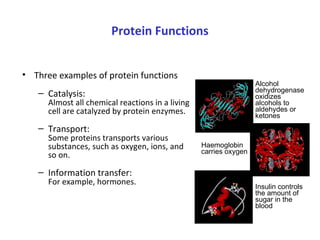
Protein Functions
• Three examples of protein functions
– Catalysis:
Almost all chemical reactions in a living
cell are catalyzed by protein enzymes.
– Transport:
Some proteins transports various
substances, such as oxygen, ions, and
so on.
– Information transfer:
For example, hormones.
Alcohol
dehydrogenase
oxidizes
alcohols to
aldehydes or
ketones
Haemoglobin
carries oxygen
Insulin controls
the amount of
sugar in the
blood
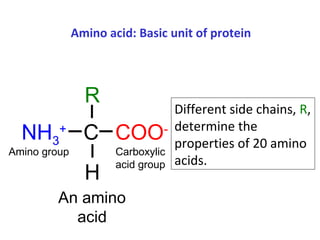
Amino acid: Basic unit of protein
COO-
NH3
+
C
R
H
An amino
acid
Different side chains, R,
determine the
properties of 20 amino
acids.
Amino group Carboxylic
acid group
Each protein has a unique structure!
Amino acid sequence
NLKTEWPELVGKSVEEAK
KVILQDKPEAQIIVLPVGTI
VTMEYRIDRVRLFVDKLD
Folding!
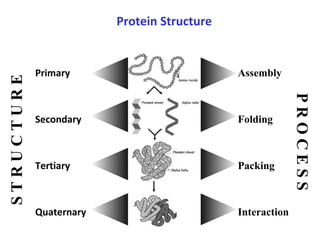
Protein Structure
Primary
Secondary
Tertiary
Quaternary
Assembly
Folding
Packing
Interaction
STRUCTURE
PROCESS
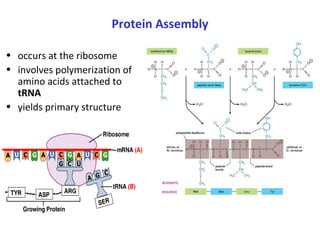
Protein Assembly
• occurs at the ribosome
• involves polymerization of
amino acids attached to
tRNA
• yields primary structure
Primary Structure
• linear
• ordered
• 1 dimensional
• sequence of amino acid
polymer
• by convention, written
from amino end to
carboxyl end
• a perfectly linear amino
acid polymer is neither
functional nor
energetically favorable 
folding!
primary structure of human insulin
CHAIN 1: GIVEQ CCTSI CSLYQ LENYC N
CHAIN 2: FVNQH LCGSH LVEAL YLVCG ERGFF YTPKT
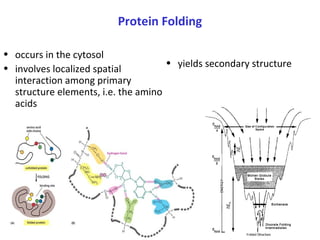
Protein Folding
• yields secondary structure
• occurs in the cytosol
• involves localized spatial
interaction among primary
structure elements, i.e. the amino
acids
Secondary Structure
• non-linear
• 3 dimensional
• localized to regions of an
amino acid chain
• formed and stabilized by
hydrogen bonding,
electrostatic and van der
Waals interactions
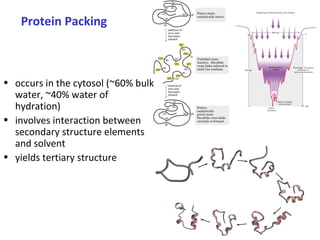
Protein Packing
• occurs in the cytosol (~60% bulk
water, ~40% water of
hydration)
• involves interaction between
secondary structure elements
and solvent
• yields tertiary structure
Tertiary & quaternary Structure
• non-linear
• 3 dimensional
Protein Interaction
• occurs in the cytosol, in close proximity to other folded and
packed proteins
• involves interaction among tertiary structure elements of
separate polymer chains
Class/Motif
• class = secondary structure
composition,
e.g. all α, all β, α/β , α+β
• motif = small, specific combinations of
secondary structure elements,
e.g. β-α-β loop
• both subset of fold
α/
β
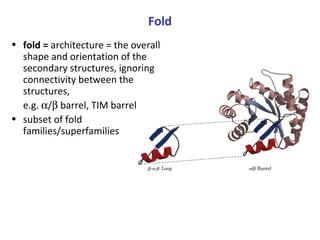
Fold
• fold = architecture = the overall
shape and orientation of the
secondary structures, ignoring
connectivity between the
structures,
e.g. α/β barrel, TIM barrel
• subset of fold
families/superfamilies
Fold families/Superfamilies
• fold families = categorization that
takes into account topology and
previous subsets as well as
empirical/biological properties, e.g.
flavodoxin
• superfamilies = in addition to fold
families, includes
evolutionary/ancestral properties
CLASS: α+β
FOLD: sandwich
FOLD FAMILY: flavodoxin
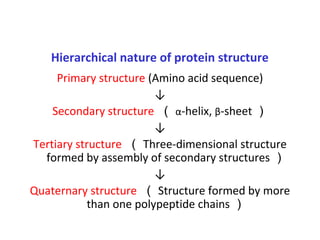
Hierarchical nature of protein structure
Primary structure (Amino acid sequence)
↓
Secondary structure ( α-helix, β-sheet )
↓
Tertiary structure ( Three-dimensional structure
formed by assembly of secondary structures )
↓
Quaternary structure ( Structure formed by more
than one polypeptide chains )
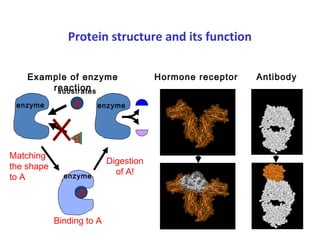
Protein structure and its function
enzyme A
B
A
Binding to A
Digestion
of A!
enzyme
Matching
the shape
to A
Hormone receptor AntibodyExample of enzyme
reaction
enzyme
substrates
Summary
• Proteins are key players in our living systems.
• Proteins are polymers consisting of 20 kinds of amino acids.
• Each protein folds into a unique three-dimensional structure
defined by its amino acid sequence.
• Protein structure has a hierarchical nature.
• Protein structure is closely related to its function.
• Protein structure prediction is a grand challenge of
computational biology.

Protein structure

  • 1.
  • 2.
    Protein Functions • Threeexamples of protein functions – Catalysis: Almost all chemical reactions in a living cell are catalyzed by protein enzymes. – Transport: Some proteins transports various substances, such as oxygen, ions, and so on. – Information transfer: For example, hormones. Alcohol dehydrogenase oxidizes alcohols to aldehydes or ketones Haemoglobin carries oxygen Insulin controls the amount of sugar in the blood
  • 3.
    Amino acid: Basicunit of protein COO- NH3 + C R H An amino acid Different side chains, R, determine the properties of 20 amino acids. Amino group Carboxylic acid group
  • 4.
    Each protein hasa unique structure! Amino acid sequence NLKTEWPELVGKSVEEAK KVILQDKPEAQIIVLPVGTI VTMEYRIDRVRLFVDKLD Folding!
  • 5.
  • 6.
    Protein Assembly • occursat the ribosome • involves polymerization of amino acids attached to tRNA • yields primary structure
  • 7.
    Primary Structure • linear •ordered • 1 dimensional • sequence of amino acid polymer • by convention, written from amino end to carboxyl end • a perfectly linear amino acid polymer is neither functional nor energetically favorable  folding! primary structure of human insulin CHAIN 1: GIVEQ CCTSI CSLYQ LENYC N CHAIN 2: FVNQH LCGSH LVEAL YLVCG ERGFF YTPKT
  • 8.
    Protein Folding • yieldssecondary structure • occurs in the cytosol • involves localized spatial interaction among primary structure elements, i.e. the amino acids
  • 9.
    Secondary Structure • non-linear •3 dimensional • localized to regions of an amino acid chain • formed and stabilized by hydrogen bonding, electrostatic and van der Waals interactions
  • 10.
    Protein Packing • occursin the cytosol (~60% bulk water, ~40% water of hydration) • involves interaction between secondary structure elements and solvent • yields tertiary structure
  • 11.
    Tertiary & quaternaryStructure • non-linear • 3 dimensional
  • 12.
    Protein Interaction • occursin the cytosol, in close proximity to other folded and packed proteins • involves interaction among tertiary structure elements of separate polymer chains
  • 13.
    Class/Motif • class =secondary structure composition, e.g. all α, all β, α/β , α+β • motif = small, specific combinations of secondary structure elements, e.g. β-α-β loop • both subset of fold α/ β
  • 14.
    Fold • fold =architecture = the overall shape and orientation of the secondary structures, ignoring connectivity between the structures, e.g. α/β barrel, TIM barrel • subset of fold families/superfamilies
  • 15.
    Fold families/Superfamilies • foldfamilies = categorization that takes into account topology and previous subsets as well as empirical/biological properties, e.g. flavodoxin • superfamilies = in addition to fold families, includes evolutionary/ancestral properties CLASS: α+β FOLD: sandwich FOLD FAMILY: flavodoxin
  • 16.
    Hierarchical nature ofprotein structure Primary structure (Amino acid sequence) ↓ Secondary structure ( α-helix, β-sheet ) ↓ Tertiary structure ( Three-dimensional structure formed by assembly of secondary structures ) ↓ Quaternary structure ( Structure formed by more than one polypeptide chains )
  • 17.
    Protein structure andits function enzyme A B A Binding to A Digestion of A! enzyme Matching the shape to A Hormone receptor AntibodyExample of enzyme reaction enzyme substrates
  • 18.
    Summary • Proteins arekey players in our living systems. • Proteins are polymers consisting of 20 kinds of amino acids. • Each protein folds into a unique three-dimensional structure defined by its amino acid sequence. • Protein structure has a hierarchical nature. • Protein structure is closely related to its function. • Protein structure prediction is a grand challenge of computational biology.