SRI PARAMAKALYANI COLLEGE,
Reaccredited with A+ grade with a CGPA of 3.39 in the III cycle of NAAC
affiliated to manomanium sundaranar university, tirunelveli.
ALWARKURICHI-627412.
Post graduate & Research Centre – Department of
Microbiology
(Government Aided)
ACADEMIC YEAR 2022-2023
FERMENTATION AND INDUSTRIAL MICROBIOLOGY
SUBMITTED TO,
DR.S.VISWANATHAN PH.D.,
ASSISTANT PROFESSOR &HEAD OF
MICROBIOLOGY DEPARTMENT
SPKC - ALWARKURICHI
SUBMITTED BY :
KAVITHA. V
2'M.SC., MICROBIOLOGY
REG NO :20211232516112
SPKC - ALWARKURICHI
PROTEASE
ENZYME
Protease
enzyme
☟AGENDA
oGeneral characteristics of
protease enzyme
oFunctions of protease
oType of protease
oIndustrial production of
protease enzyme
oApplications of protease enzyme
oReference
Protease constitutes a large and complex group of enzymes
that plays an important nutritional and regulatory role in nature.
Proteases are (physiologically) necessary for living organisms;
they are ubiquitous and found in a wide diversity of sources.
Protease is the most important industrial enzyme of interest
accounting for about 60% of the total enzyme market in the
world and account for approximately 40% of the total worldwide
enzyme sale.
They also have medical and pharmaceutical
applications.
General introduction
Microbial proteases are degradative enzymes, which catalyze
the total hydrolysis of proteins .
 The molecular weight of proteases ranges from 18-90 kDa.
These enzymes are found in a wide diversity of sources such
as plants, animals and microorganisms but they are mainly
produced by bacteria and fungi.
 Microbial proteases are predominantly extracellular and can
be secreted in the fermentation medium.
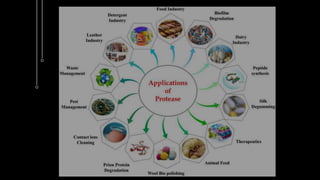
They are generally used in detergents,
 food industries, leather,
meat processing, cheese making, silver recovery from
photographic film, production of digestive and certain medical
treatments of inflammation and virulent wounds .
Continue...
Protease Enzyme Functions
Protease enzymes are essential for many biological processes. They
are required for the regulation of various metabolic and cellular
processes.
They are proteolytic, they help in digestion and catabolism of
proteins. They catalyse the hydrolysis of peptide bonds and convert
them to amino acids, which is then absorbed and utilised by cells.
They are required for the blood coagulation process.
Protease enzymes are involved in the cell division, growth, apoptosis
and migration.
Proteases provide immune support and regulate the
process of tumour growth, metastasis, inflammation, etc.
 Protease enzyme types
Proteases are the second most important industrial enzymes
after amylase.
About 500 tons of the enzymes are produced per year.
This can be produced commercially from bacteria and fungi.
The proteases on the market include-alkaline, neutral and
acidic proteases.
Alkaline protease:
Many bacteria and fungi excrete alkaline protease and the most
important producer are Bacillus strains like Bacillus
licheniformis, Bacillus amylotiquefaciens, B. megaterium, B.
purilis and Streptomyces strains like Streptomyces fradiae, S.
griseus, S. rectus and fungi like Aspergillus niger, A. sojae, A.
oryzae, A. flavus
Alkaline proteases are commonly used in detergents.
Mainly proteases from bacillus licheniformis.
Alkaline proteases have some features which makes its
applications in industrial scales like stability at high temperature,
stability in alkaline range (pH 9-11), stability in association with
chelating agents.
Neutral protease:
Neutral proteases are produced by bacteria and fungi. E.g.
Bacillus subtilis, B. coreus, B. megaterium, Pseudomonas
aeruginosa, Streptomyces griseus, Aspergillus oryzae,
Aspergillus sojae.
Neutral proteases are relatively unstable and calcium, sodium
and chloride must be added for maximal stability.
Its pH range for activity is narrow and sensitive to increased
temperature.
These are quickly inactivated by alkaline proteases.
Because of these limitations, they have restricted industrial
applications but can be used in leather industries and in food
industries (For manufacture of breads and rolls).
Acidic protease:
Acidic proteases are found in animal cells, yeast and molds but
never in bacteria.
These microbial renin-like enzymes are derived from Mucor
michei, Mucor pusillus, Mucor racemaeus, Mucor bacilliformis.
Pepsin like acid proteases are derived from Aspergillus species
and Rhizopus spp.
Renin like proteases are commonly used in cheese production in
optimum pH 2-4.
Industrial production of protease enzyme
‣ SELECTION OF MICROORGANISM
▸ FORMULATION OF MEDIUM
› PRODUCTION PROCESS
▸ RECOVERY AND PURIFICATION OF ENZYMES
SELECTION OF MICROORGANISM
1 Bacterial source:- Bacillus licheniformis, B.
amyloliquefaciens, B. stearothermophilus
2. High carbohydrate level in the medium stimulates
protease production
FORMULATION OF MEDIUM
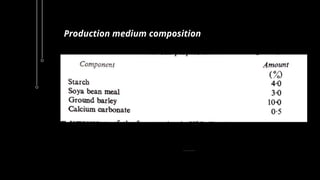
1.Media used contains ground barley as the
carbon source
2. Starch level is limited
3. Protein hydrolysates or sodium glutamate
is
used as the nitrogen source
Production medium composition
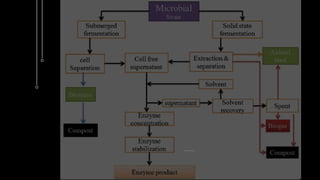
PRODUCTION PROCESS
1. The medium has a pH of 6.5-7.5 and incubation temperature
of 37°C
2. Fermentation proceeds for 3-5 days Preserved inoculum
Inoculum development Inoculation tank Fermenter Cell
disruption Filtration (to remove debris) Remove nucleic acids
Salt treatment Cool storage Fitration Final purification
(chromatography etc.) Freeze drying
*During fermentation, insoluble protein of the medium is
partially hydrolysed by boiling in dilute acid/enzymatic
treatment.
RECOVERY AND PURIFICATION OF ENZYMES
1. Culture is filtered
2. Aqueous portion is concentrated by evaporation at reduced
and at pressure temperature not less than 40°C
3. Recovery can also be carried out by precipitation.
Medical field
Proteases show promising therapeutic properties in medi- cal field
such as gauze, non-woven tissues, and ointment composition. The use
of this fibrinolytic enzyme suggests its future application as an
anticancer drug and in thrombolytic therapy . Slow-release dosage
form preparation containing collagenases with alkaline proteases is
extensively used in therapeutic applications. The hydrolysis of collagen
by the enzyme liberates low molecular weight peptides without any
amino acid release for therapeutic use. For the treatment of various
diseases, such as burns, carbuncles, furuncles, and wounds, a
preparation of elasto- terase immobilized on bandage is used.
Proteases possess distinct therapeutic properties which are helpful in
devel- oping various drugs against fatal diseases like anticancer,
antimicrobial, anti-inflammatory infections and dissolving clots class
with diverse other applications.
Food industry
The use of chemicals in the food industry is increasingly being
recognized as hazardous and natural alternatives are being explored
by food technologists around the globe. Use of eco-friendly microbial
proteases has shown prominent potential in replacing chemical
agents, while improving piquant properties of the food products. The
potential of microbial proteases as biocatalysts has been employed
since time immemorial in the fermentation of food items . It is also
known that proteases of microbial origin are more stable than their
counterparts from animals or plants, with better consistency and
easier potential for optimization or process modification . The
microbial species mainly employed in production of proteases for
food industry have been isolated from the traditional sources of
fermented foods.
Recent approaches to improve protease yield
To improve yield of protease enzyme from microbial sources,
scientists have utilized different techniques includ- ing cloning
and overexpression, fed batch and chemostat fermentation,
and optimization of parameters (medium and growth
conditions) using one factor at a time method and statistical
approaches such as response surface methodol- ogy. The
continuous efforts are being made to enhance the production
of protease enzyme using traditional i.e., UV or chemicals as
well as recent techniques i.e., genetic engi- neering, gene
editing by clustered regularly interspaced short palindromic
repeats (CRISPR), protein engineer- ing and meta genomics.
Market potential of proteases
Changing cleaning habits, higher advancements in protein
engineering technologies to produce high performing prod ucts,
and rapid industrialization are driving forces behind the woofing
market growth for proteases, which is further fueled by rapid
industrialization and growing environmen- tal concern in food
and beverages, livestock feed, soaps and detergents,
pharmaceuticals, and other industries. The protease market is
expected to reach USD 2.21 billion by 2021, with a CAGR of 6%
from 2016 to 2021 . The protease market is divided into three
seg- ments based on their sources: microorganisms, plants, and
animals, with the microbial sector increasing at the quick- est
pace in terms of value due to the inability of plant and animal
sources to fulfil global protease demand.
Reference
 TEXT BOOK OF BIO PROCESS OF TECHNOLOGY.,PT KALAICHELVAN, I ARUL
PANDI
•https://www.onlinebiologynotes.com/microbial-proteases-industrial-application-and-
production-process
•INDUSTRIAL MICROBIOLOGY., A. H. PATEL.

Protease enzyme

  • 1.
    SRI PARAMAKALYANI COLLEGE, Reaccreditedwith A+ grade with a CGPA of 3.39 in the III cycle of NAAC affiliated to manomanium sundaranar university, tirunelveli. ALWARKURICHI-627412. Post graduate & Research Centre – Department of Microbiology (Government Aided) ACADEMIC YEAR 2022-2023 FERMENTATION AND INDUSTRIAL MICROBIOLOGY SUBMITTED TO, DR.S.VISWANATHAN PH.D., ASSISTANT PROFESSOR &HEAD OF MICROBIOLOGY DEPARTMENT SPKC - ALWARKURICHI SUBMITTED BY : KAVITHA. V 2'M.SC., MICROBIOLOGY REG NO :20211232516112 SPKC - ALWARKURICHI PROTEASE ENZYME
  • 2.
  • 3.
    ☟AGENDA oGeneral characteristics of proteaseenzyme oFunctions of protease oType of protease oIndustrial production of protease enzyme oApplications of protease enzyme oReference
  • 4.
    Protease constitutes alarge and complex group of enzymes that plays an important nutritional and regulatory role in nature. Proteases are (physiologically) necessary for living organisms; they are ubiquitous and found in a wide diversity of sources. Protease is the most important industrial enzyme of interest accounting for about 60% of the total enzyme market in the world and account for approximately 40% of the total worldwide enzyme sale. They also have medical and pharmaceutical applications. General introduction
  • 5.
    Microbial proteases aredegradative enzymes, which catalyze the total hydrolysis of proteins .  The molecular weight of proteases ranges from 18-90 kDa. These enzymes are found in a wide diversity of sources such as plants, animals and microorganisms but they are mainly produced by bacteria and fungi.  Microbial proteases are predominantly extracellular and can be secreted in the fermentation medium. They are generally used in detergents,  food industries, leather, meat processing, cheese making, silver recovery from photographic film, production of digestive and certain medical treatments of inflammation and virulent wounds . Continue...
  • 6.
    Protease Enzyme Functions Proteaseenzymes are essential for many biological processes. They are required for the regulation of various metabolic and cellular processes. They are proteolytic, they help in digestion and catabolism of proteins. They catalyse the hydrolysis of peptide bonds and convert them to amino acids, which is then absorbed and utilised by cells. They are required for the blood coagulation process. Protease enzymes are involved in the cell division, growth, apoptosis and migration. Proteases provide immune support and regulate the process of tumour growth, metastasis, inflammation, etc.
  • 7.
     Protease enzymetypes Proteases are the second most important industrial enzymes after amylase. About 500 tons of the enzymes are produced per year. This can be produced commercially from bacteria and fungi. The proteases on the market include-alkaline, neutral and acidic proteases.
  • 8.
    Alkaline protease: Many bacteriaand fungi excrete alkaline protease and the most important producer are Bacillus strains like Bacillus licheniformis, Bacillus amylotiquefaciens, B. megaterium, B. purilis and Streptomyces strains like Streptomyces fradiae, S. griseus, S. rectus and fungi like Aspergillus niger, A. sojae, A. oryzae, A. flavus Alkaline proteases are commonly used in detergents. Mainly proteases from bacillus licheniformis. Alkaline proteases have some features which makes its applications in industrial scales like stability at high temperature, stability in alkaline range (pH 9-11), stability in association with chelating agents.
  • 9.
    Neutral protease: Neutral proteasesare produced by bacteria and fungi. E.g. Bacillus subtilis, B. coreus, B. megaterium, Pseudomonas aeruginosa, Streptomyces griseus, Aspergillus oryzae, Aspergillus sojae. Neutral proteases are relatively unstable and calcium, sodium and chloride must be added for maximal stability. Its pH range for activity is narrow and sensitive to increased temperature. These are quickly inactivated by alkaline proteases. Because of these limitations, they have restricted industrial applications but can be used in leather industries and in food industries (For manufacture of breads and rolls).
  • 10.
    Acidic protease: Acidic proteasesare found in animal cells, yeast and molds but never in bacteria. These microbial renin-like enzymes are derived from Mucor michei, Mucor pusillus, Mucor racemaeus, Mucor bacilliformis. Pepsin like acid proteases are derived from Aspergillus species and Rhizopus spp. Renin like proteases are commonly used in cheese production in optimum pH 2-4.
  • 12.
    Industrial production ofprotease enzyme ‣ SELECTION OF MICROORGANISM ▸ FORMULATION OF MEDIUM › PRODUCTION PROCESS ▸ RECOVERY AND PURIFICATION OF ENZYMES
  • 13.
    SELECTION OF MICROORGANISM 1Bacterial source:- Bacillus licheniformis, B. amyloliquefaciens, B. stearothermophilus 2. High carbohydrate level in the medium stimulates protease production FORMULATION OF MEDIUM 1.Media used contains ground barley as the carbon source 2. Starch level is limited 3. Protein hydrolysates or sodium glutamate is used as the nitrogen source
  • 14.
  • 15.
    PRODUCTION PROCESS 1. Themedium has a pH of 6.5-7.5 and incubation temperature of 37°C 2. Fermentation proceeds for 3-5 days Preserved inoculum Inoculum development Inoculation tank Fermenter Cell disruption Filtration (to remove debris) Remove nucleic acids Salt treatment Cool storage Fitration Final purification (chromatography etc.) Freeze drying *During fermentation, insoluble protein of the medium is partially hydrolysed by boiling in dilute acid/enzymatic treatment.
  • 16.
    RECOVERY AND PURIFICATIONOF ENZYMES 1. Culture is filtered 2. Aqueous portion is concentrated by evaporation at reduced and at pressure temperature not less than 40°C 3. Recovery can also be carried out by precipitation.
  • 18.
    Medical field Proteases showpromising therapeutic properties in medi- cal field such as gauze, non-woven tissues, and ointment composition. The use of this fibrinolytic enzyme suggests its future application as an anticancer drug and in thrombolytic therapy . Slow-release dosage form preparation containing collagenases with alkaline proteases is extensively used in therapeutic applications. The hydrolysis of collagen by the enzyme liberates low molecular weight peptides without any amino acid release for therapeutic use. For the treatment of various diseases, such as burns, carbuncles, furuncles, and wounds, a preparation of elasto- terase immobilized on bandage is used. Proteases possess distinct therapeutic properties which are helpful in devel- oping various drugs against fatal diseases like anticancer, antimicrobial, anti-inflammatory infections and dissolving clots class with diverse other applications.
  • 19.
    Food industry The useof chemicals in the food industry is increasingly being recognized as hazardous and natural alternatives are being explored by food technologists around the globe. Use of eco-friendly microbial proteases has shown prominent potential in replacing chemical agents, while improving piquant properties of the food products. The potential of microbial proteases as biocatalysts has been employed since time immemorial in the fermentation of food items . It is also known that proteases of microbial origin are more stable than their counterparts from animals or plants, with better consistency and easier potential for optimization or process modification . The microbial species mainly employed in production of proteases for food industry have been isolated from the traditional sources of fermented foods.
  • 20.
    Recent approaches toimprove protease yield To improve yield of protease enzyme from microbial sources, scientists have utilized different techniques includ- ing cloning and overexpression, fed batch and chemostat fermentation, and optimization of parameters (medium and growth conditions) using one factor at a time method and statistical approaches such as response surface methodol- ogy. The continuous efforts are being made to enhance the production of protease enzyme using traditional i.e., UV or chemicals as well as recent techniques i.e., genetic engi- neering, gene editing by clustered regularly interspaced short palindromic repeats (CRISPR), protein engineer- ing and meta genomics.
  • 21.
    Market potential ofproteases Changing cleaning habits, higher advancements in protein engineering technologies to produce high performing prod ucts, and rapid industrialization are driving forces behind the woofing market growth for proteases, which is further fueled by rapid industrialization and growing environmen- tal concern in food and beverages, livestock feed, soaps and detergents, pharmaceuticals, and other industries. The protease market is expected to reach USD 2.21 billion by 2021, with a CAGR of 6% from 2016 to 2021 . The protease market is divided into three seg- ments based on their sources: microorganisms, plants, and animals, with the microbial sector increasing at the quick- est pace in terms of value due to the inability of plant and animal sources to fulfil global protease demand.
  • 22.
    Reference  TEXT BOOKOF BIO PROCESS OF TECHNOLOGY.,PT KALAICHELVAN, I ARUL PANDI •https://www.onlinebiologynotes.com/microbial-proteases-industrial-application-and- production-process •INDUSTRIAL MICROBIOLOGY., A. H. PATEL.