L-Glutamic acid Production
BTG203A62: BIOTECHNOLOGY VIII
[INDUSTRIAL BIOTECHNOLOGY]
History of Glutamic acid
• The history of the first amino acid production dates back to 1908
when Dr. K. Ikeda, a chemist in Japan, isolated glutamic acid from
kelp, a marine alga, after acid hydrolysis and fractionation.
• He also discovered that glutamic acid, after neutralization with
castic soda, developed an entirely new, delicious taste.
• This was the birth of the use of monosodium glutamate (MSG) as a
flavour-enhancing compound.
• The breakthrough in the production of MSG was the isolation of a
specific soil-inhabiting gram-positive bacterium, Corynebacterium
glutamicum, by Dr. S. Ukada and Dr. S. Kinoshita in 1957.
• The successful commercialization of monosodium glutamate (MSG)
with this bacterium provided a big boost for amino acid production
and later with other bacteria like E. coli as well.
Courtesy: https://www.foodsweeteners.com/products/l-glutamic-acid/
Biosynthetic Pathway
• The glucose is broken down into C3 and C2 fragments by glutamic acid
producing microorganisms through the Embden Meyerhof-Parnas (EMP)
pathway and the pentose-phosphate pathway and the fragments are
channeled into the tricarboxylic acid (TCA) cycle.
• The reactions of EMP pathway are more common under conditions of
glutamic acid production.
• The key precursor of glutamic acid is α – ketoglutarate, which is formed
in the TCA cycle via citrate, isocitrate and α-ketoglutaric acid, which is
then converted into L-glutamic acid through reductive amination with
free NH + ions.
4
• The last step is catalysed by the NADP dependent glutamate
dehydrogenase.
• The NADPH2 required at this stage of the reaction is furnished through
the preceeding oxidative decarboxylation of isocitrate dehydrogenase.
• The NADPH2 is then used by the reductive amination of α-
ketoglutarate.
Metabolic Pathway
Effect of Permeability on Glutamic Acid
Production
• Production and excretion of glutamic acid is dependent on cell
permeability.
• Increased permeability in glutamic acid producing bacteria
can be accomplished by one of the following ways:
(a) Through biotin deficiency.
(b) Through the addition of penicillin.
(c)Through the addition of saturated fatty acids or fatty acid
derivatives.
(d) Through the oleic acid deficiency in oleic acid auxotrophs.
(e) Through the glycerol deficiency in glycerol auxotrophs.
Conditions of Production
Carbon Source:
• Glucose and sucrose are frequently used.
• However, starch hydrolysates, fructose, maltose, ribose and
xylose are also used less frequently.
• Moreover sucrose, sugarcane molasses, sugar beet molasses can
also be used.
• Both the molasses contain high biotin content (0.4-1.2 mg kg-1
in cane molasses and 0.02-0.08 mg kg-1 in beet molasses).
• Penicillin or fattyacid derivatives (e.g. Tween-66)
must be added to the fermentation medium, when
these molasses are used in the medium preparation.
• For industrial production, generally cane molasses or starch
hydrolysate are used.
Nitrogen Source:
• Ammonium sulphate, ammonium chloride, ammonium
phosphate, aqueous ammonia, ammonia gas and urea
have been used as nitrogen source.
• Although large amount of ammonium ions are necessary,
a high concentration of it inhibits the growth of the
microorganism as well as the yield of L-glutamic acid.
• Therefore, suitable amount of ammonia is added, as the
fermentation progresses.
• These salts also help in the pH control.
Conditions of Production
Growth Factors:
• The important growth factor is biotin.
• Its optimal concentration depends upon the
carbon source used.
• In media with 10% glucose, its requirement is
5 mg liter-1.
• In media with lower glucose concentration, it
is considerably lower.
• Some strains require L-cystine as an additional
growth factor.
Conditions of Production
Oxygen Supply:
• The oxygen concentration should neither be
too low nor too high.
• Excretion of lactate and succinate occurs under
oxygen deficiency.
• Whereas excess oxygen under ammonium
ions deficiency causes growth inhibition and
production of α-ketoglutarate.
• In both the cases, glutamic acid yields are low.
Conditions of Production
pH:
• Optimum pH for growth and glutamic
acid production is 7.0-8.0 and it is
controlled by the addition of ammonium
salts.
….Conditions of Production
Commercial Production of Glutamic Acid
Important features of L-glutamic acid production by fermentation.
...Commercial Production of Glutamic Acid
• Inoculum preparation: A suitable strain
of C. glutamicum is selected and is inoculated
into the sterilized medium.
• The culture is incubated upto 16 hours at 35°C.
• After sufficient growth occurs, approximately
6% by volume of inoculum is added to the
production fermenter.
...Commercial Production of Glutamic Acid
• Fermentation: The fermentation is carried out,
approximately, for 40-48 hours at 30°C
temperature.
• The pH is adjusted to 7.0-8.0.
• The urea is added intermittently during the
fermentation.
• Approximately 50% of the supplied
carbohydrate is converted into L-glutamic acid.
• The broth contains glutamic acid in the form of
its ammonium salt.
Recovery
• In a typical downstream process, the bacterial cells
are separated and the broth is passed through a
basic anion exchange resin.
• Glutamic acid anions get bound to the resin and
ammonia is released.
• This ammonia can be recovered via distillation and
reused in the fermentation.
• Elution is performed with NaOH to directly form
monosodium glutamate (MSG) in the solution and to
regenerate the basic anion exchanger.
• From the elute, MSG may be crystallized directly
followed by further conditioning steps like
decolourization and serving to yield a food-grade
quality of MSG.
Flow Diagram of L-Glutamic acid Production
Vitamin B12 Industrial Production
Vitamin B12
• Vitamin B12, also known as cyanocobalamin, belongs to the cobalamin
family of compounds, which are composed of a corrinoid ring and an
upper and lower ligand.
• The upper ligand can be adenosine, methyl, hydroxy, or a cyano group.
• Vitamin B12 (cyanocobalamin) is a water soluble vitamin with complex
structure. The empirical formula of cyanocobalamin is C63H90N14O14PCo.
• The disease, pernicious anemia, characterized by low levels of
hemoglobin, decreased number of erythrocytes and neurological
manifestations, has been known for several decades.
• It was in 1926 some workers reported the liver extracts could cure
pernicious anemia.
• The active principle was later identified as vitamin B12, a water soluble B-
complex vitamin.
• Vitamin B12 is exclusively synthesized in nature by microorganisms.
• Vitamin B12 is synthesized by prokaryotes and inhibits the development of
pernicious anemia in animals.
Commercial Production of Vitamin B12
B12
• Vitamin was first obtained as a byproduct of Streptomyces
fermentation in the production of certain antibiotics (streptomycin,
chloramphenicol, or neomycin).
– But the yield was very low.
• Later, high-yielding strains were developed. It is estimated that the
world’s annual production of vitamin B12 is around 15,000 kg.
• High concentrations of vitamin B12 are detected in sewage-sludge
solids.
• This is produced by microorganisms.
• Recovery of vitamin B12 from sewage-sludge was carried out in some
parts of United States.
• Unlike most other vitamins, the chemical synthesis of vitamin B12 is not
practicable, since about 20 complicated reaction steps need to be
carried out.
• Fermentation of vitamin B12 is the only choice.
Microorganisms and Yields of Vitamin B12
• The natural process of vitB12 synthesis by approximately 30 enzyme mediated steps.
• Several microorganisms can be employed for the production of vitamin B12, with
varying yields.
• Glucose is the most commonly used carbon source.
• Some examples of microbes and their corresponding yields are given in Table 1.
• The most commonly used microorganisms are —
– Propionibacterium freudenreichii,
– Pseudomonas denitrificans,
– Bacillus megaterium
– Streptomyces olivaceus
Production of Vitamin B12 Using
Propionibacterium sp.
• Propionibacterium freudenreichii and P. shermanii, and their mutant strains
are commonly used for vitamin B12 production.
• The process is carried out by adding cobalt in two phases.
Anaerobic phase:
• This is a preliminary phase that may take 2-4 days.
• In this phase 5′-deoxyadenosylcobinamide is predominantly produced.
Aerobic phase:
• In this phase, 5, 6-dimethyl- Benz imidazole is produced from riboflavin which
gets incorporated to finally form coenzyme of vitamin namely 5′-
deoxyadenosylcobalamin.
• In recent years, some fermentation technologists have successfully clubbed
both an anaerobic and aerobic phases to carry out the operation continuously
in two reaction tanks.
B12
• The bulk production of vit is mostly done by submerged bacterial
fermentation with beet molasses medium supplemented with cobalt chloride.
• The specific details of the process are kept as a guarded secret by the
companies.
Recovery of vitamin B12
• The cobalamins produced by fermentation are mostly
bound to the cells.
• They can be solubilized by heat treatment at 80-120°C for
about 30 minutes at pH 6.5-8.5.
• The solids and mycelium are filtered or centrifuged and the
fermentation broth collected.
• The cobalamins can be converted to more stable
cyanocobalamins.
• This vitamin B12 is around 80% purity and can be directly
used as a feed additive.
• However, for medical use (particularly for treatment of
pernicious anemia), vitamin B12 should be further purified
(95-98% purity).
Production of Vitamin B12 using
Pseudomonas sp.
• Pseudomonas denitrificans is also used for large scale
production of vitamin B12 in a cost-effective manner.
• Starting with a low yield (0.6 mg/l) two decades ago,
several improvements have been made in the strains of
P. denitrificans for a tremendous improvement in the
yield (60 mg/l).
• Addition of cobalt and 5, 6-dimethyl Benz imidazole to
the medium is essential.
• The yield of vitamin B12 increases when the medium is
supplemented with betaine (usual source being sugar
beet molasses).
Carbon Sources for Vitamin B12
Production
• Glucose is themost commonlyused carbonsource for large
scale manufacture of vitamin B12.
• Other carbon sources like alcohols (methanol, ethanol,
isopropanol) and hydrocarbons (alkanes, decane, hexadecane)
with varying yields can also be used.
• A yield of 42 mg/l of vitamin B12 was reported using methanol
as the carbon source by the microorganism Methanosarcina
barkeri, in fed- batch culture system.
An apparatus (usually jacketed cylindrical SS
vessel) for growing organisms such as bacteria,
viruses, or yeast that are used in the production of
pharmaceuticals, antibodies, or vaccines, or for
the bioconversion of organic wastes.
Under optimum conditions of gas (air, oxygen,
nitrogen, and carbon dioxide) flow rates,
temperature, pH, dissolved oxygen level, and
agitation speed, the microorganisms or cells will
reproduce at a rapid rate
In other words……
A bioreactor is a vessel or a device designed to sustain
and support life of cell and tissue cultures.
Types of fermentor (or) Bioreactors
 Typical
 Airlift Bioreactor
 Tower
 Bubble Column Bioreactors
 Immobilized enzyme and cell
5
TYPICAL BIOPROCESSING
Stock Culture Raw Materials
Shake Flasks
Seed
Fermenter
MediumFormulation
Sterilization
Recovery
Purification Products
Air Agitator
View looking down into a stainless steel
fermentor
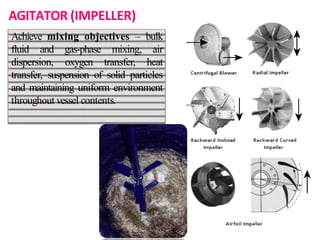
AGITATOR (IMPELLER)
Achieve mixing objectives – bulk
fluid and gas-phase mixing, air
dispersion, oxygen transfer, heat
transfer, suspension of solid particles
and maintaining uniform environment
throughout vessel contents.
Introduction
⚫ Thefunction ofthe fermenter or bioreactor isto provideasuitable
environment in which an organism can efficiently produce atarget product—
the target product might be
⚫ · Cell biomass
⚫ · Metabolite
⚫ · Bioconversion Product
⚫The sizesof the bioreactor can vary over several orders of
magnitudes.
⚫The microbial cell culture (few mm3), shake flask ( 100 -1000 ml),
laboratory fermenter ( 1 – 50 L), pilot scale (0.3 – 10 m3) to plant
scale ( 2 – 500 m3) are all examplesofbioreactors.
Cell culture
fermenter Shake flask fermenter laboratoryfermenter
Pilot fermenter Plant fermenter
DEFINITION:
1. Bubble column bioreactors are tall column bioreactors
where gas is introduced in the bottom section for
mixing and aeration purposes.
2. The vessel used for bubble column bioreactors is
usually cylindrical with an aspect ratio of 4-6.
1. Usually the height-to-diameter ratio is 4-6.
2. Gas is sparged at the base through perforated pipes
or plates or metal porous spargers.
3. O2 transfer, mixing and other performance factors
are influenced mainly by gas flow rate and
rheological properties of the fluid.
4. Mixing and mass transfer can be improved by
placing perforated plates or vertical baffles in the
vessel.
1. In the bubble column bioreactor, the air or gas is
introduced at the base of the column through
perforated pipes or plates, or metal micro porous
spargers and causes a turbulent stream to enable gas
exchange.
2. The flow rate of the air/gas influences the
performance factors —O2 transfer, mixing.
3. The bubble column bioreactors may be fitted with
perforated plates to improve performance.
4. The reactants are compacted in the presence of finely
dispersed catalyst and thus produce the products
using fermentation method.
1. Have high volumetric productivity and excellent heat
management.
2. Better utilization of the plate area and flow
distrubution.
3. Self regulating.
1. Less efficient than other bioreactors
2. Does not have draft tube
3. Higher catalyst consumption than the fixed bed
4. Higher installation cost and difficult to design
1. The reactor is commonly used in the culture of shear
sensitive organisms. E.g.: mould and plant cells
2. Productions of chemicals and pharmaceuticals.
3. Also for fermentation processes.
DEFINITION:
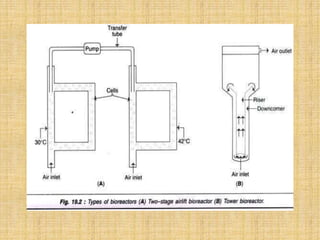
Air-lift bioreactors are similar to bubble column reactors,
but differ by the fact that they contain a draft tube.
The draft tube is always an inner tube (this type of air-lift
bioreactor is called “air-lift bioreactor with an internal
loop”) or an external tube (called “air-lift bioreactor with
an external loop”), which improves circulation and
oxygen transfer and equalizes shear forces in the reactor.
 Internal-loop airlift bioreactor has a single container with a
central draft tube that creates interior liquid circulation
channels. These bioreactors are simple in design, with
volume and circulation at a fixed rate for fermentation.
 External loop airlift bioreactor possesses an external loop
so that the liquid circulates through separate independent
channels.
 These reactors can be suitably modified to suit the
requirements of different fermentations.
 In general, the airlift bioreactors are more efficient than
bubble columns, particularly for more denser suspensions
of microorganisms.
 This is mainly because in these bioreactors, the mixing of
the contents is better compared to bubble columns.
1. Separated as two zones: the sparged zone is called the
riser, and the zone that receives no gas is the
downcomer.
2. The bulk density in the riser region is lower than that in
the downcomer region, causing the circulation (so
circulation is enhanced if there is little or no gas in the
downcomer).
3. For optimal mass transfer, the riser to downcomer cross-
sectional area ratio should be between 1.8 and 4.3.
4. The rate of liquid circulation increases with the square
root of the height of the airlift device. Consequently, the
reactors are designed with high aspect ratios.
5. A gas-liquid separator in the head-zone can reduce the
gas carry-over to the downcomer and hence increase the
1. In general, the performance of the airlift bioreactors
is dependent on the pumping (injection) of air and the
liquid circulation.
2. It is different from the Stirred tank bioreactor that
needs the heat coat or plate surrounding the tank to
make warm bioreactor. It is clear enough that the
Airlift bioreactor has greater heat-removal compare
to Stirred tank.
I. Two-stage airlift bioreactors are used for the
temperature dependent formation of products.
II. Growing cells from one bioreactor (maintained at
temperature 30°C) are pumped into another bioreactor
(at temperature 42°C).
III. There is a necessity for the two-stage airlift bioreactor,
since it is very difficult to raise the temperature
quickly from 30°C to 42°C in the same vessel.
IV. Each one of the bioreactors is fitted with valves and
they are connected by a transfer tube and pump.
V. The cells are grown in the first bioreactor and the
bioprocess proper takes place in the second reactor.
1. Highly energy efficient and productivities are
comparable to those of stirred tank bioreactors.
2. Simple design with no moving parts or agitator for less
maintenance, less risk of defects.
3. Easier sterilization (no agitator shaft parts)
4. Low Energy requirement vs. stirred tank Obviously
doesn’t need the energy for the moving parts (agitator
shaft).
5. Greater heat-removal vs. stirred tank
At theAirlift bioreactor it doesn’t need the heat plate to
control the temperature, because the Draught-Tube
which is inside the bioreactor can be designed to serve
as internal heat exchanger.
1. Greater air throughput and higher pressures needed.
2. The agitation on the Airlift bioreactor is controlled by
the supply air to adjust the supply air then the higher
pressure needed.
3. the higher pressure of air needed then more energy
consumption needed and more cost must pay.
4. Inefficient break the foam when foaming occurs
5. No bubbles breaker, There are no blades that used as
a breaker the bubbles which produced from the air
supply (sparger).
1. The reactor is commonly used in the culture of shear
sensitive organisms.
2. Airlift bioreactors are commonly employed for
aerobic bioprocessing technology. They ensure a
controlled liquid flow in a recycle system by
pumping.
3. Due to high efficiency, airlift bioreactors are
sometimes preferred e.g., methanol production, waste
water treatment, single-cell protein production.

L-Glutamic-acid-Production.pptx

  • 1.
    L-Glutamic acid Production BTG203A62:BIOTECHNOLOGY VIII [INDUSTRIAL BIOTECHNOLOGY]
  • 2.
    History of Glutamicacid • The history of the first amino acid production dates back to 1908 when Dr. K. Ikeda, a chemist in Japan, isolated glutamic acid from kelp, a marine alga, after acid hydrolysis and fractionation. • He also discovered that glutamic acid, after neutralization with castic soda, developed an entirely new, delicious taste. • This was the birth of the use of monosodium glutamate (MSG) as a flavour-enhancing compound. • The breakthrough in the production of MSG was the isolation of a specific soil-inhabiting gram-positive bacterium, Corynebacterium glutamicum, by Dr. S. Ukada and Dr. S. Kinoshita in 1957. • The successful commercialization of monosodium glutamate (MSG) with this bacterium provided a big boost for amino acid production and later with other bacteria like E. coli as well.
  • 4.
  • 5.
    Biosynthetic Pathway • Theglucose is broken down into C3 and C2 fragments by glutamic acid producing microorganisms through the Embden Meyerhof-Parnas (EMP) pathway and the pentose-phosphate pathway and the fragments are channeled into the tricarboxylic acid (TCA) cycle. • The reactions of EMP pathway are more common under conditions of glutamic acid production. • The key precursor of glutamic acid is α – ketoglutarate, which is formed in the TCA cycle via citrate, isocitrate and α-ketoglutaric acid, which is then converted into L-glutamic acid through reductive amination with free NH + ions. 4 • The last step is catalysed by the NADP dependent glutamate dehydrogenase. • The NADPH2 required at this stage of the reaction is furnished through the preceeding oxidative decarboxylation of isocitrate dehydrogenase. • The NADPH2 is then used by the reductive amination of α- ketoglutarate.
  • 6.
  • 7.
    Effect of Permeabilityon Glutamic Acid Production • Production and excretion of glutamic acid is dependent on cell permeability. • Increased permeability in glutamic acid producing bacteria can be accomplished by one of the following ways: (a) Through biotin deficiency. (b) Through the addition of penicillin. (c)Through the addition of saturated fatty acids or fatty acid derivatives. (d) Through the oleic acid deficiency in oleic acid auxotrophs. (e) Through the glycerol deficiency in glycerol auxotrophs.
  • 8.
    Conditions of Production CarbonSource: • Glucose and sucrose are frequently used. • However, starch hydrolysates, fructose, maltose, ribose and xylose are also used less frequently. • Moreover sucrose, sugarcane molasses, sugar beet molasses can also be used. • Both the molasses contain high biotin content (0.4-1.2 mg kg-1 in cane molasses and 0.02-0.08 mg kg-1 in beet molasses). • Penicillin or fattyacid derivatives (e.g. Tween-66) must be added to the fermentation medium, when these molasses are used in the medium preparation. • For industrial production, generally cane molasses or starch hydrolysate are used.
  • 9.
    Nitrogen Source: • Ammoniumsulphate, ammonium chloride, ammonium phosphate, aqueous ammonia, ammonia gas and urea have been used as nitrogen source. • Although large amount of ammonium ions are necessary, a high concentration of it inhibits the growth of the microorganism as well as the yield of L-glutamic acid. • Therefore, suitable amount of ammonia is added, as the fermentation progresses. • These salts also help in the pH control. Conditions of Production
  • 10.
    Growth Factors: • Theimportant growth factor is biotin. • Its optimal concentration depends upon the carbon source used. • In media with 10% glucose, its requirement is 5 mg liter-1. • In media with lower glucose concentration, it is considerably lower. • Some strains require L-cystine as an additional growth factor. Conditions of Production
  • 11.
    Oxygen Supply: • Theoxygen concentration should neither be too low nor too high. • Excretion of lactate and succinate occurs under oxygen deficiency. • Whereas excess oxygen under ammonium ions deficiency causes growth inhibition and production of α-ketoglutarate. • In both the cases, glutamic acid yields are low. Conditions of Production
  • 12.
    pH: • Optimum pHfor growth and glutamic acid production is 7.0-8.0 and it is controlled by the addition of ammonium salts. ….Conditions of Production
  • 13.
    Commercial Production ofGlutamic Acid Important features of L-glutamic acid production by fermentation.
  • 14.
    ...Commercial Production ofGlutamic Acid • Inoculum preparation: A suitable strain of C. glutamicum is selected and is inoculated into the sterilized medium. • The culture is incubated upto 16 hours at 35°C. • After sufficient growth occurs, approximately 6% by volume of inoculum is added to the production fermenter.
  • 15.
    ...Commercial Production ofGlutamic Acid • Fermentation: The fermentation is carried out, approximately, for 40-48 hours at 30°C temperature. • The pH is adjusted to 7.0-8.0. • The urea is added intermittently during the fermentation. • Approximately 50% of the supplied carbohydrate is converted into L-glutamic acid. • The broth contains glutamic acid in the form of its ammonium salt.
  • 16.
    Recovery • In atypical downstream process, the bacterial cells are separated and the broth is passed through a basic anion exchange resin. • Glutamic acid anions get bound to the resin and ammonia is released. • This ammonia can be recovered via distillation and reused in the fermentation. • Elution is performed with NaOH to directly form monosodium glutamate (MSG) in the solution and to regenerate the basic anion exchanger. • From the elute, MSG may be crystallized directly followed by further conditioning steps like decolourization and serving to yield a food-grade quality of MSG.
  • 17.
    Flow Diagram ofL-Glutamic acid Production
  • 18.
  • 19.
    Vitamin B12 • VitaminB12, also known as cyanocobalamin, belongs to the cobalamin family of compounds, which are composed of a corrinoid ring and an upper and lower ligand. • The upper ligand can be adenosine, methyl, hydroxy, or a cyano group. • Vitamin B12 (cyanocobalamin) is a water soluble vitamin with complex structure. The empirical formula of cyanocobalamin is C63H90N14O14PCo. • The disease, pernicious anemia, characterized by low levels of hemoglobin, decreased number of erythrocytes and neurological manifestations, has been known for several decades. • It was in 1926 some workers reported the liver extracts could cure pernicious anemia. • The active principle was later identified as vitamin B12, a water soluble B- complex vitamin. • Vitamin B12 is exclusively synthesized in nature by microorganisms. • Vitamin B12 is synthesized by prokaryotes and inhibits the development of pernicious anemia in animals.
  • 20.
    Commercial Production ofVitamin B12 B12 • Vitamin was first obtained as a byproduct of Streptomyces fermentation in the production of certain antibiotics (streptomycin, chloramphenicol, or neomycin). – But the yield was very low. • Later, high-yielding strains were developed. It is estimated that the world’s annual production of vitamin B12 is around 15,000 kg. • High concentrations of vitamin B12 are detected in sewage-sludge solids. • This is produced by microorganisms. • Recovery of vitamin B12 from sewage-sludge was carried out in some parts of United States. • Unlike most other vitamins, the chemical synthesis of vitamin B12 is not practicable, since about 20 complicated reaction steps need to be carried out. • Fermentation of vitamin B12 is the only choice.
  • 21.
    Microorganisms and Yieldsof Vitamin B12 • The natural process of vitB12 synthesis by approximately 30 enzyme mediated steps. • Several microorganisms can be employed for the production of vitamin B12, with varying yields. • Glucose is the most commonly used carbon source. • Some examples of microbes and their corresponding yields are given in Table 1. • The most commonly used microorganisms are — – Propionibacterium freudenreichii, – Pseudomonas denitrificans, – Bacillus megaterium – Streptomyces olivaceus
  • 22.
    Production of VitaminB12 Using Propionibacterium sp. • Propionibacterium freudenreichii and P. shermanii, and their mutant strains are commonly used for vitamin B12 production. • The process is carried out by adding cobalt in two phases. Anaerobic phase: • This is a preliminary phase that may take 2-4 days. • In this phase 5′-deoxyadenosylcobinamide is predominantly produced. Aerobic phase: • In this phase, 5, 6-dimethyl- Benz imidazole is produced from riboflavin which gets incorporated to finally form coenzyme of vitamin namely 5′- deoxyadenosylcobalamin. • In recent years, some fermentation technologists have successfully clubbed both an anaerobic and aerobic phases to carry out the operation continuously in two reaction tanks. B12 • The bulk production of vit is mostly done by submerged bacterial fermentation with beet molasses medium supplemented with cobalt chloride. • The specific details of the process are kept as a guarded secret by the companies.
  • 23.
    Recovery of vitaminB12 • The cobalamins produced by fermentation are mostly bound to the cells. • They can be solubilized by heat treatment at 80-120°C for about 30 minutes at pH 6.5-8.5. • The solids and mycelium are filtered or centrifuged and the fermentation broth collected. • The cobalamins can be converted to more stable cyanocobalamins. • This vitamin B12 is around 80% purity and can be directly used as a feed additive. • However, for medical use (particularly for treatment of pernicious anemia), vitamin B12 should be further purified (95-98% purity).
  • 24.
    Production of VitaminB12 using Pseudomonas sp. • Pseudomonas denitrificans is also used for large scale production of vitamin B12 in a cost-effective manner. • Starting with a low yield (0.6 mg/l) two decades ago, several improvements have been made in the strains of P. denitrificans for a tremendous improvement in the yield (60 mg/l). • Addition of cobalt and 5, 6-dimethyl Benz imidazole to the medium is essential. • The yield of vitamin B12 increases when the medium is supplemented with betaine (usual source being sugar beet molasses).
  • 25.
    Carbon Sources forVitamin B12 Production • Glucose is themost commonlyused carbonsource for large scale manufacture of vitamin B12. • Other carbon sources like alcohols (methanol, ethanol, isopropanol) and hydrocarbons (alkanes, decane, hexadecane) with varying yields can also be used. • A yield of 42 mg/l of vitamin B12 was reported using methanol as the carbon source by the microorganism Methanosarcina barkeri, in fed- batch culture system.
  • 27.
    An apparatus (usuallyjacketed cylindrical SS vessel) for growing organisms such as bacteria, viruses, or yeast that are used in the production of pharmaceuticals, antibodies, or vaccines, or for the bioconversion of organic wastes. Under optimum conditions of gas (air, oxygen, nitrogen, and carbon dioxide) flow rates, temperature, pH, dissolved oxygen level, and agitation speed, the microorganisms or cells will reproduce at a rapid rate
  • 28.
    In other words…… Abioreactor is a vessel or a device designed to sustain and support life of cell and tissue cultures.
  • 29.
    Types of fermentor(or) Bioreactors  Typical  Airlift Bioreactor  Tower  Bubble Column Bioreactors  Immobilized enzyme and cell
  • 30.
    5 TYPICAL BIOPROCESSING Stock CultureRaw Materials Shake Flasks Seed Fermenter MediumFormulation Sterilization Recovery Purification Products Air Agitator
  • 32.
    View looking downinto a stainless steel fermentor
  • 33.
    AGITATOR (IMPELLER) Achieve mixingobjectives – bulk fluid and gas-phase mixing, air dispersion, oxygen transfer, heat transfer, suspension of solid particles and maintaining uniform environment throughout vessel contents.
  • 34.
    Introduction ⚫ Thefunction ofthefermenter or bioreactor isto provideasuitable environment in which an organism can efficiently produce atarget product— the target product might be ⚫ · Cell biomass ⚫ · Metabolite ⚫ · Bioconversion Product ⚫The sizesof the bioreactor can vary over several orders of magnitudes. ⚫The microbial cell culture (few mm3), shake flask ( 100 -1000 ml), laboratory fermenter ( 1 – 50 L), pilot scale (0.3 – 10 m3) to plant scale ( 2 – 500 m3) are all examplesofbioreactors.
  • 35.
    Cell culture fermenter Shakeflask fermenter laboratoryfermenter Pilot fermenter Plant fermenter
  • 36.
    DEFINITION: 1. Bubble columnbioreactors are tall column bioreactors where gas is introduced in the bottom section for mixing and aeration purposes. 2. The vessel used for bubble column bioreactors is usually cylindrical with an aspect ratio of 4-6.
  • 38.
    1. Usually theheight-to-diameter ratio is 4-6. 2. Gas is sparged at the base through perforated pipes or plates or metal porous spargers. 3. O2 transfer, mixing and other performance factors are influenced mainly by gas flow rate and rheological properties of the fluid. 4. Mixing and mass transfer can be improved by placing perforated plates or vertical baffles in the vessel.
  • 39.
    1. In thebubble column bioreactor, the air or gas is introduced at the base of the column through perforated pipes or plates, or metal micro porous spargers and causes a turbulent stream to enable gas exchange. 2. The flow rate of the air/gas influences the performance factors —O2 transfer, mixing. 3. The bubble column bioreactors may be fitted with perforated plates to improve performance. 4. The reactants are compacted in the presence of finely dispersed catalyst and thus produce the products using fermentation method.
  • 40.
    1. Have highvolumetric productivity and excellent heat management. 2. Better utilization of the plate area and flow distrubution. 3. Self regulating. 1. Less efficient than other bioreactors 2. Does not have draft tube 3. Higher catalyst consumption than the fixed bed 4. Higher installation cost and difficult to design
  • 41.
    1. The reactoris commonly used in the culture of shear sensitive organisms. E.g.: mould and plant cells 2. Productions of chemicals and pharmaceuticals. 3. Also for fermentation processes.
  • 42.
    DEFINITION: Air-lift bioreactors aresimilar to bubble column reactors, but differ by the fact that they contain a draft tube. The draft tube is always an inner tube (this type of air-lift bioreactor is called “air-lift bioreactor with an internal loop”) or an external tube (called “air-lift bioreactor with an external loop”), which improves circulation and oxygen transfer and equalizes shear forces in the reactor.
  • 43.
     Internal-loop airliftbioreactor has a single container with a central draft tube that creates interior liquid circulation channels. These bioreactors are simple in design, with volume and circulation at a fixed rate for fermentation.  External loop airlift bioreactor possesses an external loop so that the liquid circulates through separate independent channels.  These reactors can be suitably modified to suit the requirements of different fermentations.  In general, the airlift bioreactors are more efficient than bubble columns, particularly for more denser suspensions of microorganisms.  This is mainly because in these bioreactors, the mixing of the contents is better compared to bubble columns.
  • 45.
    1. Separated astwo zones: the sparged zone is called the riser, and the zone that receives no gas is the downcomer. 2. The bulk density in the riser region is lower than that in the downcomer region, causing the circulation (so circulation is enhanced if there is little or no gas in the downcomer). 3. For optimal mass transfer, the riser to downcomer cross- sectional area ratio should be between 1.8 and 4.3. 4. The rate of liquid circulation increases with the square root of the height of the airlift device. Consequently, the reactors are designed with high aspect ratios. 5. A gas-liquid separator in the head-zone can reduce the gas carry-over to the downcomer and hence increase the
  • 46.
    1. In general,the performance of the airlift bioreactors is dependent on the pumping (injection) of air and the liquid circulation. 2. It is different from the Stirred tank bioreactor that needs the heat coat or plate surrounding the tank to make warm bioreactor. It is clear enough that the Airlift bioreactor has greater heat-removal compare to Stirred tank.
  • 47.
    I. Two-stage airliftbioreactors are used for the temperature dependent formation of products. II. Growing cells from one bioreactor (maintained at temperature 30°C) are pumped into another bioreactor (at temperature 42°C). III. There is a necessity for the two-stage airlift bioreactor, since it is very difficult to raise the temperature quickly from 30°C to 42°C in the same vessel. IV. Each one of the bioreactors is fitted with valves and they are connected by a transfer tube and pump. V. The cells are grown in the first bioreactor and the bioprocess proper takes place in the second reactor.
  • 49.
    1. Highly energyefficient and productivities are comparable to those of stirred tank bioreactors. 2. Simple design with no moving parts or agitator for less maintenance, less risk of defects. 3. Easier sterilization (no agitator shaft parts) 4. Low Energy requirement vs. stirred tank Obviously doesn’t need the energy for the moving parts (agitator shaft). 5. Greater heat-removal vs. stirred tank At theAirlift bioreactor it doesn’t need the heat plate to control the temperature, because the Draught-Tube which is inside the bioreactor can be designed to serve as internal heat exchanger.
  • 50.
    1. Greater airthroughput and higher pressures needed. 2. The agitation on the Airlift bioreactor is controlled by the supply air to adjust the supply air then the higher pressure needed. 3. the higher pressure of air needed then more energy consumption needed and more cost must pay. 4. Inefficient break the foam when foaming occurs 5. No bubbles breaker, There are no blades that used as a breaker the bubbles which produced from the air supply (sparger).
  • 51.
    1. The reactoris commonly used in the culture of shear sensitive organisms. 2. Airlift bioreactors are commonly employed for aerobic bioprocessing technology. They ensure a controlled liquid flow in a recycle system by pumping. 3. Due to high efficiency, airlift bioreactors are sometimes preferred e.g., methanol production, waste water treatment, single-cell protein production.