
Proteins and their classification
Dr. Vikas Kumar
School of Biotechnology
Shoolini University
Village Bajhol, Solan (H.P)
+91 9459527906
vikaskmr59@gmail.com
2
 Protein name is derived form a Greek word PROTOS which
means “the first or the supreme.
 Protein are extremely complicated and nitrogenous molecule
made up of variable number of amino acid residue joined to each
other by a specific covalent bond called peptide bond.
 22 amino acid which have been found to occur in all proteins,
known as standard amino acid.
Why are proteins important to us:
3

Proteins make up about 15% of the mass of the average person
 Enzyme act as a biological catalyst
Storage and transport- Haemoglobin
Defence -Antibodies
Hormones – Insulin
Ligaments and arteries (mainly formes by elastin Protein)
Muscle – Proteins in the muscle respond to nerve impulses by changing the
packing of their molecules (Actin and myosin)
Hair, nails and skin: Protein keratin as main component
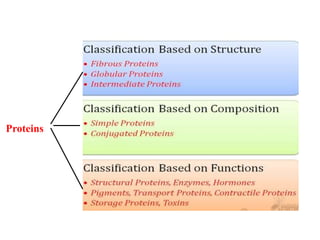
Proteins
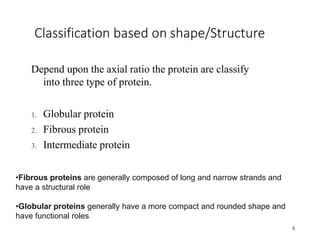
Classification based on shape/Structure
5
Depend upon the axial ratio the protein are classify
into three type of protein.
1. Globular protein
2. Fibrous protein
3. Intermediate protein
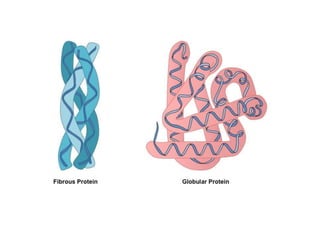
•Fibrous proteins are generally composed of long and narrow strands and
have a structural role
•Globular proteins generally have a more compact and rounded shape and
have functional roles
Fibrous Protein
8
 Axial ratio more than 10.
 Long thread like molecule.
 Their helical strands mainly form fibers.
 These protein are insoluble in water.
 Form structure of the tissue
 Present where support is required.
Example
1.Collagen
2.Elastin
3.Keratin
Globular Protein
• Axial ratio less than 10.
• Spheroid or ovoid in shape.
• Enzyme are mostly globular in shape.
• Subdivided into two type of protein…
9
1. Albumins: Water soluble.
2. Globulin: Soluble in dilute salt solution.
Classification based upon Function
10
Catalytic Protein: These are enzyme which may be simple or conjugated.
1. Alkaline phosphatase
2. Alanine transaminase
Regulatory or Hormonal protein: Many protein and peptide acts as
Hormone.
1. Insulin
2. Growth Hormone
Structural Protein: Contribute to the structure of the tissue.
1. Collagen
2. Elastin
Transport Protein: Serve to carry substances.
1. Transferrin carry Iron
2. Hemoglobin carry Oxygen
Immune Protein: Serve in defense mechanism
Example: Immunoglobulin, IgG, IgA, IgM, IgD, IgE
Contractile Protein: Takes part in the muscle contraction.
1. Actin
2. Myosin
Genetic Protein: Protein present in combination with nucleic acid.
1. Histone Protein.
Storage Protein: To store protein for nutritional purposes.
1. Casein in Milk
2. Gliadin in Wheat.
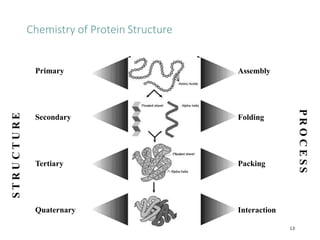
Levels in Protein structure
12
• Majority of protein are compact and highly convoluted
molecules.
• Each polypeptide assumes at least three levels of structural
organization termed as primary, secondary and tertiary
structure.
• Proteins which possess more than one polypeptide chain in
their molecule also possess a fourth structure called
quaternary structure
Chemistry of Protein Structure
13
Primary
Secondary
Tertiary
Quaternary
Assembly
Folding
Packing
Interaction
STRUCTURE
PROCESS
Primary structure
14
 The sequence of amino acid residues along the peptide is called primary structure
of the peptide.
 It also include the determination of the number of amino acid residues in a peptide
chain.
 Shows whether the peptide chain is open, cyclic or branched. Primary structure is
linear, ordered and 1 dimensional.
 Written from amino end to carboxyl end that is N to C.
Secondary Structure
15




Primary structure shows that peptide are quite straight and extended.
X-rays diffraction on protein crystals shows that polypeptide chain tend
to twist or coil upon themselves.
The folding of the polypeptide chain into specific coiled structure held
together by H bonds is called secondary structure of protein.
Secondary structure may take one of the following form.
1. Alpha – Helix
2. Beta Pleated Sheet
3. Loop or Coil Conformation
4. Super secondary motifs
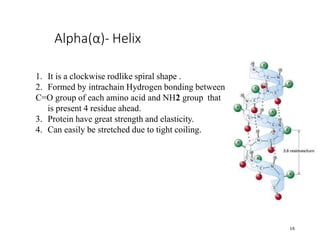
Alpha(α)- Helix
16
1. It is a clockwise rodlike spiral shape .
2. Formed by intrachain Hydrogen bonding between
C=O group of each amino acid and NH2 group that
is present 4 residue ahead.
3. Protein have great strength and elasticity.
4. Can easily be stretched due to tight coiling.
β- Pleated Sheath
17
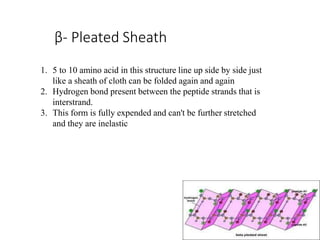
1. 5 to 10 amino acid in this structure line up side by side just
like a sheath of cloth can be folded again and again
2. Hydrogen bond present between the peptide strands that is
interstrand.
3. This form is fully expended and can't be further stretched
and they are inelastic
Super secondary Motifs
18
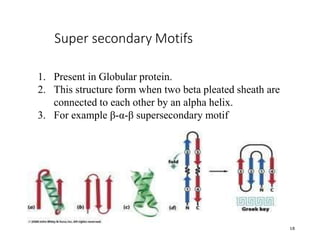
1. Present in Globular protein.
2. This structure form when two beta pleated sheath are
connected to each other by an alpha helix.
3. For example β-α-β supersecondary motif
Tertiary structure
19
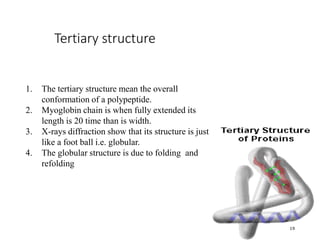
1. The tertiary structure mean the overall
conformation of a polypeptide.
2. Myoglobin chain is when fully extended its
length is 20 time than is width.
3. X-rays diffraction show that its structure is just
like a foot ball i.e. globular.
4. The globular structure is due to folding and
refolding
Quaternary Structure
20
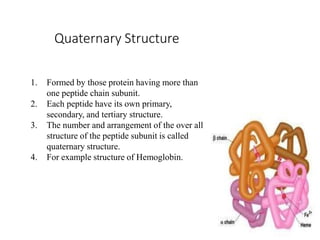
1. Formed by those protein having more than
one peptide chain subunit.
2. Each peptide have its own primary,
secondary, and tertiary structure.
3. The number and arrangement of the over all
structure of the peptide subunit is called
quaternary structure.
4. For example structure of Hemoglobin.
Thank you

Protein and its classification

  • 1.
    Proteins and theirclassification Dr. Vikas Kumar School of Biotechnology Shoolini University Village Bajhol, Solan (H.P) +91 9459527906 vikaskmr59@gmail.com
  • 2.
    2  Protein nameis derived form a Greek word PROTOS which means “the first or the supreme.  Protein are extremely complicated and nitrogenous molecule made up of variable number of amino acid residue joined to each other by a specific covalent bond called peptide bond.  22 amino acid which have been found to occur in all proteins, known as standard amino acid.
  • 3.
    Why are proteinsimportant to us: 3  Proteins make up about 15% of the mass of the average person  Enzyme act as a biological catalyst Storage and transport- Haemoglobin Defence -Antibodies Hormones – Insulin Ligaments and arteries (mainly formes by elastin Protein) Muscle – Proteins in the muscle respond to nerve impulses by changing the packing of their molecules (Actin and myosin) Hair, nails and skin: Protein keratin as main component
  • 4.
  • 5.
    Classification based onshape/Structure 5 Depend upon the axial ratio the protein are classify into three type of protein. 1. Globular protein 2. Fibrous protein 3. Intermediate protein •Fibrous proteins are generally composed of long and narrow strands and have a structural role •Globular proteins generally have a more compact and rounded shape and have functional roles
  • 8.
    Fibrous Protein 8  Axialratio more than 10.  Long thread like molecule.  Their helical strands mainly form fibers.  These protein are insoluble in water.  Form structure of the tissue  Present where support is required. Example 1.Collagen 2.Elastin 3.Keratin
  • 9.
    Globular Protein • Axialratio less than 10. • Spheroid or ovoid in shape. • Enzyme are mostly globular in shape. • Subdivided into two type of protein… 9 1. Albumins: Water soluble. 2. Globulin: Soluble in dilute salt solution.
  • 10.
    Classification based uponFunction 10 Catalytic Protein: These are enzyme which may be simple or conjugated. 1. Alkaline phosphatase 2. Alanine transaminase Regulatory or Hormonal protein: Many protein and peptide acts as Hormone. 1. Insulin 2. Growth Hormone Structural Protein: Contribute to the structure of the tissue. 1. Collagen 2. Elastin
  • 11.
    Transport Protein: Serveto carry substances. 1. Transferrin carry Iron 2. Hemoglobin carry Oxygen Immune Protein: Serve in defense mechanism Example: Immunoglobulin, IgG, IgA, IgM, IgD, IgE Contractile Protein: Takes part in the muscle contraction. 1. Actin 2. Myosin Genetic Protein: Protein present in combination with nucleic acid. 1. Histone Protein. Storage Protein: To store protein for nutritional purposes. 1. Casein in Milk 2. Gliadin in Wheat.
  • 12.
    Levels in Proteinstructure 12 • Majority of protein are compact and highly convoluted molecules. • Each polypeptide assumes at least three levels of structural organization termed as primary, secondary and tertiary structure. • Proteins which possess more than one polypeptide chain in their molecule also possess a fourth structure called quaternary structure
  • 13.
    Chemistry of ProteinStructure 13 Primary Secondary Tertiary Quaternary Assembly Folding Packing Interaction STRUCTURE PROCESS
  • 14.
    Primary structure 14  Thesequence of amino acid residues along the peptide is called primary structure of the peptide.  It also include the determination of the number of amino acid residues in a peptide chain.  Shows whether the peptide chain is open, cyclic or branched. Primary structure is linear, ordered and 1 dimensional.  Written from amino end to carboxyl end that is N to C.
  • 15.
    Secondary Structure 15     Primary structureshows that peptide are quite straight and extended. X-rays diffraction on protein crystals shows that polypeptide chain tend to twist or coil upon themselves. The folding of the polypeptide chain into specific coiled structure held together by H bonds is called secondary structure of protein. Secondary structure may take one of the following form. 1. Alpha – Helix 2. Beta Pleated Sheet 3. Loop or Coil Conformation 4. Super secondary motifs
  • 16.
    Alpha(α)- Helix 16 1. Itis a clockwise rodlike spiral shape . 2. Formed by intrachain Hydrogen bonding between C=O group of each amino acid and NH2 group that is present 4 residue ahead. 3. Protein have great strength and elasticity. 4. Can easily be stretched due to tight coiling.
  • 17.
    β- Pleated Sheath 17 1.5 to 10 amino acid in this structure line up side by side just like a sheath of cloth can be folded again and again 2. Hydrogen bond present between the peptide strands that is interstrand. 3. This form is fully expended and can't be further stretched and they are inelastic
  • 18.
    Super secondary Motifs 18 1.Present in Globular protein. 2. This structure form when two beta pleated sheath are connected to each other by an alpha helix. 3. For example β-α-β supersecondary motif
  • 19.
    Tertiary structure 19 1. Thetertiary structure mean the overall conformation of a polypeptide. 2. Myoglobin chain is when fully extended its length is 20 time than is width. 3. X-rays diffraction show that its structure is just like a foot ball i.e. globular. 4. The globular structure is due to folding and refolding
  • 20.
    Quaternary Structure 20 1. Formedby those protein having more than one peptide chain subunit. 2. Each peptide have its own primary, secondary, and tertiary structure. 3. The number and arrangement of the over all structure of the peptide subunit is called quaternary structure. 4. For example structure of Hemoglobin.
  • 21.

Editor's Notes