Presented by
Deepika Rana Monika Yadav
Roll no-1601 Roll no.-1605
M.Sc. Microbiology M.Sc. Microbiology
1st Semester 1st Semester
MD University, Rohtak MD University, Rohtak
•Cellulose is a major constituent of
plant cell walls, providing strength
and rigidity and preventing the
swelling of the cell and rupture of
the plasma membrane that might
result when osmotic conditions
favour water entry into the cell.
•Each year, worldwide, plants
synthesize more than 1011 metric
tons of cellulose, making this simple
polymer one of the most abundant
compounds in the biosphere.
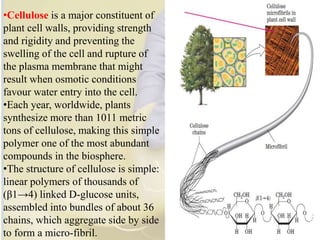
•The structure of cellulose is simple:
linear polymers of thousands of
(β1→4) linked D-glucose units,
assembled into bundles of about 36
chains, which aggregate side by side
to form a micro-fibril.
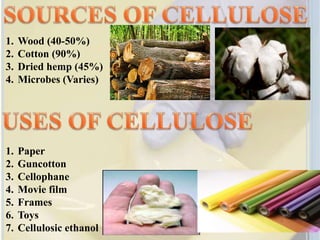
1. Paper
2. Guncotton
3. Cellophane
4. Movie film
5. Frames
6. Toys
7. Cellulosic ethanol
1. Wood (40-50%)
2. Cotton (90%)
3. Dried hemp (45%)
4. Microbes (Varies)
•Microbial cellulose, sometimes called bacterial cellulose,
is a form of cellulose that is produced by bacteria.
•Bacterial cellulose is an organic compound with the
formula (C₆H₁₀O₅)n produced from certain types
of bacteria.
•The glucan chains are held together by inter- and intra-
hydrogen bonding.
•Inherent Purity: free of hemicellulose, lignin, pectin, wax
•Moldable in cultivation. Carbon Sources used:
Glucose, fructose, sucrose, molasses, glycerol
Corn steep liquor, potato effluent, grape pomace, whey
lactose Tea, cola nut, Saccharified food waste
•Natural network structure, High Crystallinity: ~85%,
High DP
•High Carbon-to-Cellulose Conversion Efficiency
•Typical cell converts 108 glucose molecules to cellulose
per hour
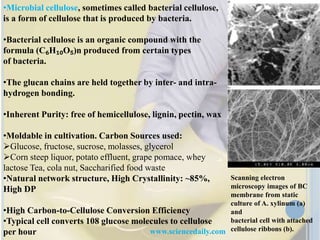
Scanning electron
microscopy images of BC
membrane from static
culture of A. xylinum (a)
and
bacterial cell with attached
cellulose ribbons (b).www.sciencedaily.com
Overview of Bacterial Cellulose Production and Application
Faezah Esa*, Siti Masrinda Tasirin, Norliza Abd Rahman
Department of Chemical and Process Engineering, Faculty of Engineering and Built Environment, Universiti Kebangsaan Malaysia, 43600
Bangi, Selangor, Malaysia
A wet microbial cellulose pellicle being removed from a culture
en.wikipedia.org
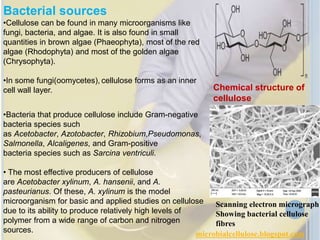
Bacterial sources
•Cellulose can be found in many microorganisms like
fungi, bacteria, and algae. It is also found in small
quantities in brown algae (Phaeophyta), most of the red
algae (Rhodophyta) and most of the golden algae
(Chrysophyta).
•In some fungi(oomycetes), cellulose forms as an inner
cell wall layer.
•Bacteria that produce cellulose include Gram-negative
bacteria species such
as Acetobacter, Azotobacter, Rhizobium,Pseudomonas,
Salmonella, Alcaligenes, and Gram-positive
bacteria species such as Sarcina ventriculi.
• The most effective producers of cellulose
are Acetobacter xylinum, A. hansenii, and A.
pasteurianus. Of these, A. xylinum is the model
microorganism for basic and applied studies on cellulose
due to its ability to produce relatively high levels of
polymer from a wide range of carbon and nitrogen
sources.
Chemical structure of
cellulose
Scanning electron micrograph
Showing bacterial cellulose
fibres
microbialcellulose.blogspot.com
Biosynthesis of Microbial Cellulose
•The synthesis of bacterial cellulose is a multistep process that involve two main
mechanisms: the synthesis of uridine diphosphoglucose (UDPGIc), followed by
the polymerization of glucose into long and unbranched chains (the β-1→4 glucan
chain).
• The production of UDPGIc starts with carbon compounds (such
as hexoses, glycerol, dihydroxyacetone, pyruvate, and di-carboxylic acids) entering
the Krebs cycle, gluconeogenesis, or the pentose phosphate cycle depending on what
carbon source is available.
•It then goes through phosphorylation along with catalysis, followed by isomerization of
the intermediate, and a process known as UDPGIc pyrophosphorylase to convert the
compounds into UDPGIc, a precursor to the production of cellulose.
•The polymerization of glucose into the β-1→4 glucan chain has been hypothesized to
either involve a lipid intermediate or not to involve a lipid intermediate. If the bacteria use
lipid to initiate new chains, it cannot be sterols-bacteria don’t contain sterols.
Handbook of Polymer Nanocomposites. Processing, Performance and Application
edited by Jitendra K. Pandey, Hitoshi Takagi
Biochemical Pathway for Cellulose Synthesis
GK-Glucokinase
PGM-Phosphoglucomutase
UGP-UDP glucose pyrophosphorylase
FBP-Fructose-1,6 bisphosphatase
CS-Cellulose Synthase
PFK-Phosphofructokinase
FK-Fructokinase
PGI-Phosphoglucose isomerase
Glucose
Glucose-6-phosphate
Glucose-1-phosphate
UDP-Glucose
Cellulose
Glukokinase
Phosphglucomutase
UDP-glucose pyrophosphorylase
Cellulose Synthase
•The complex enzymatic machinery that assembles cellulose chains
spans the plasma membrane, with one part positioned to bind the
substrate, UDP-glucose, in the cytosol and another part extending to the
outside, responsible for elongating and crystallizing cellulose molecules
in the extracellular space.
•Freeze-fracture electron microscopy shows these terminal complexes,
also called rosettes, to be composed of six large particles arranged in a
regular hexagon. Several proteins, including the catalytic subunit of
cellulose synthase, make up the terminal complex.
•Much of the recent progress in understanding cellulose synthesis stems
from genetic and molecular genetic studies of the plant Arabidopsis
thaliana, which is especially amenable to genetic dissection and whose
genome has been sequenced.
•Cellulose production depends heavily on several factors such as
the growth medium, environmental conditions, and the formation of
by products.
•The fermentation medium contains carbon, nitrogen, and other
macro and micro nutrients required for bacteria growth.
•Bacteria are most efficient when supplied with an abundant carbon
source and minimal nitrogen source.
•Glucose and sucrose are the most commonly used carbon sources for
cellulose production, while fructose, maltose, xylose, starch,
and glycerol have been tried. Sometimes, ethanol may be used to
increase cellulose production.
•The problem with using glucose is that gluconic acid is formed as a
by product which increases the pH of the culture and in turn,
decreases the production of cellulose.
•Addition of extra nitrogen generally decreases cellulose production
while addition of precursor molecules such as amino
acids and methionine improved yield. Pyridoxine, nicotinic acid, p-
aminobenzoic acid and biotin are vitamins important for cellulose
production whereas pantothenate and riboflavin have opposing
effects.
•According to experimental studies, the optimal temperature for
maximum production was between 28 and 30 °C. For most species,
the optimal pH was between 4.0-6.0. Controlling pH is especially
important in static cultures as the accumulation of gluconic, acetic, or
lactic acid decreases the pH far lower than the optimal range.
Dissolved oxygen content can be varied with stirrer speed as it is
needed for static cultures where substrates need to be transported by
diffusion.
Reactor based
production
•Static and agitated cultures are conventional
ways to produce bacterial cellulose.
•Both static and agitated cultures are not feasible
for large-scale production as static cultures have
a long culture period as well as intensive
manpower and agitated cultures produce
cellulose-negative mutants alongside its reactions
due to rapid growth.
•Thus, reactors are designed to lessen culture
time and inhibit the conversion of bacterial
cellulose-producing strains into cellulose-negative
mutants. Common reactors used are the rotating
disk reactor, the rotary biofilm contactor
(RBC), a bioreactor equipped with a spin filter,
and a reactor with a silicone membrane.
BC pellicle formed
in static culture.
BC pellets formed in
agitated culture.
Bacterial Cellulose
Prof. Dr. Eng. Stanislaw Bielecki1, Dr. Eng.
Alina Krystynowicz2, Prof. Dr. Marianna
Turkiewicz3, Dr. Eng. Halina Kalinowska4
TYPES OF CELLULOSE
Genus Cellulose type
Acetobacter
Extracellular pellicle,
ribbons
Achromobacter Ribbons
Aerobacter Fibrils
Agrobacterium Short fibrils
Alcaligenes Fibrils
Pseudomonas Non-distinct
Rhozobium Short fibrils
Sarcina Amorphous
•Bacteria from
the genera Aerobacter, Acetobacter, Achr
omobacter, Agrobacterium, Alacaligenes,
Azotobacter, Pseudomonas, Rhizobium,
and Sarcina synthesize cellulose.
•However, only
the Gluconacetobacter produce enough
cellulose to justify commercial interest.
The most extensively studied species
is Gluconacetobacter xylinus, formerly
known as Acetobacter xylinum and since
reclassified as Komagataeibacter xylinus.
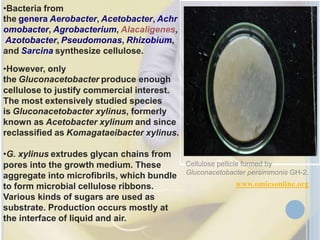
•G. xylinus extrudes glycan chains from
pores into the growth medium. These
aggregate into microfibrils, which bundle
to form microbial cellulose ribbons.
Various kinds of sugars are used as
substrate. Production occurs mostly at
the interface of liquid and air.
Cellulose pellicle formed by
Gluconacetobacter persimmonis GH-2.
www.omicsonline.org
Differences with plant cellulose
Some advantages of microbial cellulose over plant cellulose
include:
•Finer and more intricate structure
•No hemicellulose or lignin to be removed
•Longer fiber length: much stronger and wider
•Can be grown to virtually any shape and thickness
•Can be produced on a variety of substrates
•The formula of the media used and the strain of Acetobacter
xylinum will determine the quality of the pellicle
•More absorbent per unit volume
Fig. 1 Schematic model of BC
microfibrils
(right) drawn in comparison with
the `fringed micelles'; of PC fibrils
(Iguchi et al.,2000)
Disadvantages for commercial use
Some issues that have prevented large-scale commercialization so far
include:
•High price (about 50 x more than plant cellulose)
Due to the inefficient production process, the current price of
bacterial cellulose remains too high to make it commercially
attractive and viable on a large scale.
Because of high-price substrates: sugars
Low volumetric yields
•Lack of large-scale production capacity. Traditional production
methods cannot produce microbial cellulose in commercial
quantities, so further advancements with reactor based production
must be achieved to be able to market many microbial cellulose
products.
•Timely expansion and maintenance of the cell culture for
production
Functions
•One continuing mystery surrounding microbial cellulose is its exact
biological function.
• A. xylinus, since been renamed as Gluconacetobacter xylinus and more
recently as Komagataeibacter xylinus, is a successful and prevalent
bacterium in nature, frequently finding a home in rotting fruits and
sweetened liquids.
• The most familiar form of microbial cellulose is that of a pellicle on the
top of a static cultured growth media. It has, thus, been hypothesized that
cellulose acts as a floatation device, bringing the bacteria to the oxygen-
rich air-media interface.
•This hypothesis has largely been discredited by experiments conducted
on submerged oxygen-permeable silicone tubes that show that cellulose
grows well submerged if enough oxygen is present. Others suspect that
cellulose is used to immobilize the bacteria in an attempt to keep it near
the food source, or as a form of protection against ultraviolet light.
Applications
Bacterial cellulose has a wide variety of
current and potential future applications.
Food
•The oldest known use of bacterial cellulose is as the raw material of nata de coco, a
traditional chewy, translucent, jelly-like foodstuff produced by the
fermentation of coconut water, which gels through the production of microbial
cellulose by Acetobacter xylinum.
•It has also been used as a thickener to maintain the viscosity in food and as a
stabilizing agent. Due to its texture and fiber content, it has been added to many food
products as a dietary fiber. A specific example is Cellulon ®, which is a bulking
agent used as a food ingredient to act as a thickener, texturizer, and/or calorie reducer.
•Microbial cellulose has also been used as an additive in diet beverages in Japan since
1992, specifically kombucha, a healthy tea based drink .
Biofiber bio cellulose microbial
cellulose disposable face facial sheet
It is being tested in the textile
industry, with the possibility of
manufacturing cellulose based
clothing
www.snipview.com
www.alibaba.com
The ‘worlds first’bio-cellulose
membrane transducer of some
Sony headphones a number of
years ago.
Biocellulose is actually grown by
special bacteria, and then treated
to be suitable for
manufacturing. The end result is
a material perfect for speakers
that is about as stiff as aluminum,
but quite a bit lighter, to keep
distortion to a minimum. Having
bacteria grow your parts is novel,
but probably not the quickest nor
the most cost effective
BIOCELLULOSE MEMBRANE IN
HEADPHONES
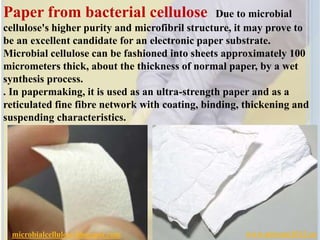
Paper from bacterial cellulose Due to microbial
cellulose's higher purity and microfibril structure, it may prove to
be an excellent candidate for an electronic paper substrate.
Microbial cellulose can be fashioned into sheets approximately 100
micrometers thick, about the thickness of normal paper, by a wet
synthesis process.
. In papermaking, it is used as an ultra-strength paper and as a
reticulated fine fibre network with coating, binding, thickening and
suspending characteristics.
www.adream2012.eumicrobialcellulose.blogspot.com
Microbial cellulose is biocompatible and non-toxic, making it a good candidate material for
medical applications. So far it has found a commercial role in some wound dressings. There
is on-going research to evaluate a possible role for bacterial cellulose in the following
applications:
•Scaffolds for tissue engineering
•Synthetic dura mater
•Bladder neck suspension
•Soft tissue replacement
•Artificial blood vessels
MEDICAL USES
•The microbial cellulose molds very well
to the surface of the skin, providing a
conformal covering even in usually
difficult places to dress wounds, such as
areas on the face.
•Another microbial cellulose
commercial treatment product is XCell
produced by the Xylos Corporation,
which is mainly used to treat wounds
from venous ulcers.
•In addition to increasing the drying
time and water holding abilities, liquid
medicines were able to be absorbed by
the microbial cellulose coated gauze,
allowing them to work at the injury site
www.intechopen.com
•Axcelon leverages
bacterial cellulose
•expertise with
Nanoderm launch
•It has been tested and
successfully
used as a wound dressing,
especially in burn cases.
•Microbial cellulose
products, such
as Biofill ®, Dermafill®,
have been developed.
biotuesdays.com
www.dermafill.com
REFERENCES
Microbial Cellulose Utilization: Fundamentals and Biotechnology
Lee R. Lynd, Paul J. Weimer, Willem H. van Zyl and Isak S. Pretorius
http://www.ncbi.nlm.nih.gov/pmc/articles/PMC120791/
Microbial cellulose - Wikipedia, the free encyclopedia
https://en.wikipedia.org/wiki/Microbial_cellulose
Bacterial cellulose - Wikipedia, the free encyclopedia
https://en.wikipedia.org/wiki/Bacterial_cellulose
Production and application of microbial cellulose
www.sciencedirect.com/science/article/pii/S0141391097001973
Overview of Bacterial Cellulose Production and Application
www.sciencedirect.com/science/article/pii/S2210784314000187
LEHNINGER A.L., Nelson D.L., Principles of Biochemistry, M.M. Cox.
Worth Publishing.
Microbial cellulose

Microbial cellulose

  • 1.
    Presented by Deepika RanaMonika Yadav Roll no-1601 Roll no.-1605 M.Sc. Microbiology M.Sc. Microbiology 1st Semester 1st Semester MD University, Rohtak MD University, Rohtak
  • 2.
    •Cellulose is amajor constituent of plant cell walls, providing strength and rigidity and preventing the swelling of the cell and rupture of the plasma membrane that might result when osmotic conditions favour water entry into the cell. •Each year, worldwide, plants synthesize more than 1011 metric tons of cellulose, making this simple polymer one of the most abundant compounds in the biosphere. •The structure of cellulose is simple: linear polymers of thousands of (β1→4) linked D-glucose units, assembled into bundles of about 36 chains, which aggregate side by side to form a micro-fibril.
  • 3.
    1. Paper 2. Guncotton 3.Cellophane 4. Movie film 5. Frames 6. Toys 7. Cellulosic ethanol 1. Wood (40-50%) 2. Cotton (90%) 3. Dried hemp (45%) 4. Microbes (Varies)
  • 4.
    •Microbial cellulose, sometimescalled bacterial cellulose, is a form of cellulose that is produced by bacteria. •Bacterial cellulose is an organic compound with the formula (C₆H₁₀O₅)n produced from certain types of bacteria. •The glucan chains are held together by inter- and intra- hydrogen bonding. •Inherent Purity: free of hemicellulose, lignin, pectin, wax •Moldable in cultivation. Carbon Sources used: Glucose, fructose, sucrose, molasses, glycerol Corn steep liquor, potato effluent, grape pomace, whey lactose Tea, cola nut, Saccharified food waste •Natural network structure, High Crystallinity: ~85%, High DP •High Carbon-to-Cellulose Conversion Efficiency •Typical cell converts 108 glucose molecules to cellulose per hour Scanning electron microscopy images of BC membrane from static culture of A. xylinum (a) and bacterial cell with attached cellulose ribbons (b).www.sciencedaily.com
  • 5.
    Overview of BacterialCellulose Production and Application Faezah Esa*, Siti Masrinda Tasirin, Norliza Abd Rahman Department of Chemical and Process Engineering, Faculty of Engineering and Built Environment, Universiti Kebangsaan Malaysia, 43600 Bangi, Selangor, Malaysia
  • 6.
    A wet microbialcellulose pellicle being removed from a culture en.wikipedia.org
  • 7.
    Bacterial sources •Cellulose canbe found in many microorganisms like fungi, bacteria, and algae. It is also found in small quantities in brown algae (Phaeophyta), most of the red algae (Rhodophyta) and most of the golden algae (Chrysophyta). •In some fungi(oomycetes), cellulose forms as an inner cell wall layer. •Bacteria that produce cellulose include Gram-negative bacteria species such as Acetobacter, Azotobacter, Rhizobium,Pseudomonas, Salmonella, Alcaligenes, and Gram-positive bacteria species such as Sarcina ventriculi. • The most effective producers of cellulose are Acetobacter xylinum, A. hansenii, and A. pasteurianus. Of these, A. xylinum is the model microorganism for basic and applied studies on cellulose due to its ability to produce relatively high levels of polymer from a wide range of carbon and nitrogen sources. Chemical structure of cellulose Scanning electron micrograph Showing bacterial cellulose fibres microbialcellulose.blogspot.com
  • 8.
    Biosynthesis of MicrobialCellulose •The synthesis of bacterial cellulose is a multistep process that involve two main mechanisms: the synthesis of uridine diphosphoglucose (UDPGIc), followed by the polymerization of glucose into long and unbranched chains (the β-1→4 glucan chain). • The production of UDPGIc starts with carbon compounds (such as hexoses, glycerol, dihydroxyacetone, pyruvate, and di-carboxylic acids) entering the Krebs cycle, gluconeogenesis, or the pentose phosphate cycle depending on what carbon source is available. •It then goes through phosphorylation along with catalysis, followed by isomerization of the intermediate, and a process known as UDPGIc pyrophosphorylase to convert the compounds into UDPGIc, a precursor to the production of cellulose. •The polymerization of glucose into the β-1→4 glucan chain has been hypothesized to either involve a lipid intermediate or not to involve a lipid intermediate. If the bacteria use lipid to initiate new chains, it cannot be sterols-bacteria don’t contain sterols.
  • 9.
    Handbook of PolymerNanocomposites. Processing, Performance and Application edited by Jitendra K. Pandey, Hitoshi Takagi Biochemical Pathway for Cellulose Synthesis GK-Glucokinase PGM-Phosphoglucomutase UGP-UDP glucose pyrophosphorylase FBP-Fructose-1,6 bisphosphatase CS-Cellulose Synthase PFK-Phosphofructokinase FK-Fructokinase PGI-Phosphoglucose isomerase
  • 10.
  • 11.
    •The complex enzymaticmachinery that assembles cellulose chains spans the plasma membrane, with one part positioned to bind the substrate, UDP-glucose, in the cytosol and another part extending to the outside, responsible for elongating and crystallizing cellulose molecules in the extracellular space. •Freeze-fracture electron microscopy shows these terminal complexes, also called rosettes, to be composed of six large particles arranged in a regular hexagon. Several proteins, including the catalytic subunit of cellulose synthase, make up the terminal complex. •Much of the recent progress in understanding cellulose synthesis stems from genetic and molecular genetic studies of the plant Arabidopsis thaliana, which is especially amenable to genetic dissection and whose genome has been sequenced.
  • 13.
    •Cellulose production dependsheavily on several factors such as the growth medium, environmental conditions, and the formation of by products. •The fermentation medium contains carbon, nitrogen, and other macro and micro nutrients required for bacteria growth. •Bacteria are most efficient when supplied with an abundant carbon source and minimal nitrogen source. •Glucose and sucrose are the most commonly used carbon sources for cellulose production, while fructose, maltose, xylose, starch, and glycerol have been tried. Sometimes, ethanol may be used to increase cellulose production. •The problem with using glucose is that gluconic acid is formed as a by product which increases the pH of the culture and in turn, decreases the production of cellulose.
  • 14.
    •Addition of extranitrogen generally decreases cellulose production while addition of precursor molecules such as amino acids and methionine improved yield. Pyridoxine, nicotinic acid, p- aminobenzoic acid and biotin are vitamins important for cellulose production whereas pantothenate and riboflavin have opposing effects. •According to experimental studies, the optimal temperature for maximum production was between 28 and 30 °C. For most species, the optimal pH was between 4.0-6.0. Controlling pH is especially important in static cultures as the accumulation of gluconic, acetic, or lactic acid decreases the pH far lower than the optimal range. Dissolved oxygen content can be varied with stirrer speed as it is needed for static cultures where substrates need to be transported by diffusion.
  • 15.
    Reactor based production •Static andagitated cultures are conventional ways to produce bacterial cellulose. •Both static and agitated cultures are not feasible for large-scale production as static cultures have a long culture period as well as intensive manpower and agitated cultures produce cellulose-negative mutants alongside its reactions due to rapid growth. •Thus, reactors are designed to lessen culture time and inhibit the conversion of bacterial cellulose-producing strains into cellulose-negative mutants. Common reactors used are the rotating disk reactor, the rotary biofilm contactor (RBC), a bioreactor equipped with a spin filter, and a reactor with a silicone membrane. BC pellicle formed in static culture. BC pellets formed in agitated culture. Bacterial Cellulose Prof. Dr. Eng. Stanislaw Bielecki1, Dr. Eng. Alina Krystynowicz2, Prof. Dr. Marianna Turkiewicz3, Dr. Eng. Halina Kalinowska4
  • 17.
    TYPES OF CELLULOSE GenusCellulose type Acetobacter Extracellular pellicle, ribbons Achromobacter Ribbons Aerobacter Fibrils Agrobacterium Short fibrils Alcaligenes Fibrils Pseudomonas Non-distinct Rhozobium Short fibrils Sarcina Amorphous
  • 18.
    •Bacteria from the generaAerobacter, Acetobacter, Achr omobacter, Agrobacterium, Alacaligenes, Azotobacter, Pseudomonas, Rhizobium, and Sarcina synthesize cellulose. •However, only the Gluconacetobacter produce enough cellulose to justify commercial interest. The most extensively studied species is Gluconacetobacter xylinus, formerly known as Acetobacter xylinum and since reclassified as Komagataeibacter xylinus. •G. xylinus extrudes glycan chains from pores into the growth medium. These aggregate into microfibrils, which bundle to form microbial cellulose ribbons. Various kinds of sugars are used as substrate. Production occurs mostly at the interface of liquid and air. Cellulose pellicle formed by Gluconacetobacter persimmonis GH-2. www.omicsonline.org
  • 19.
    Differences with plantcellulose Some advantages of microbial cellulose over plant cellulose include: •Finer and more intricate structure •No hemicellulose or lignin to be removed •Longer fiber length: much stronger and wider •Can be grown to virtually any shape and thickness •Can be produced on a variety of substrates •The formula of the media used and the strain of Acetobacter xylinum will determine the quality of the pellicle •More absorbent per unit volume Fig. 1 Schematic model of BC microfibrils (right) drawn in comparison with the `fringed micelles'; of PC fibrils (Iguchi et al.,2000)
  • 20.
    Disadvantages for commercialuse Some issues that have prevented large-scale commercialization so far include: •High price (about 50 x more than plant cellulose) Due to the inefficient production process, the current price of bacterial cellulose remains too high to make it commercially attractive and viable on a large scale. Because of high-price substrates: sugars Low volumetric yields •Lack of large-scale production capacity. Traditional production methods cannot produce microbial cellulose in commercial quantities, so further advancements with reactor based production must be achieved to be able to market many microbial cellulose products. •Timely expansion and maintenance of the cell culture for production
  • 21.
    Functions •One continuing mysterysurrounding microbial cellulose is its exact biological function. • A. xylinus, since been renamed as Gluconacetobacter xylinus and more recently as Komagataeibacter xylinus, is a successful and prevalent bacterium in nature, frequently finding a home in rotting fruits and sweetened liquids. • The most familiar form of microbial cellulose is that of a pellicle on the top of a static cultured growth media. It has, thus, been hypothesized that cellulose acts as a floatation device, bringing the bacteria to the oxygen- rich air-media interface. •This hypothesis has largely been discredited by experiments conducted on submerged oxygen-permeable silicone tubes that show that cellulose grows well submerged if enough oxygen is present. Others suspect that cellulose is used to immobilize the bacteria in an attempt to keep it near the food source, or as a form of protection against ultraviolet light.
  • 22.
    Applications Bacterial cellulose hasa wide variety of current and potential future applications. Food •The oldest known use of bacterial cellulose is as the raw material of nata de coco, a traditional chewy, translucent, jelly-like foodstuff produced by the fermentation of coconut water, which gels through the production of microbial cellulose by Acetobacter xylinum. •It has also been used as a thickener to maintain the viscosity in food and as a stabilizing agent. Due to its texture and fiber content, it has been added to many food products as a dietary fiber. A specific example is Cellulon ®, which is a bulking agent used as a food ingredient to act as a thickener, texturizer, and/or calorie reducer. •Microbial cellulose has also been used as an additive in diet beverages in Japan since 1992, specifically kombucha, a healthy tea based drink .
  • 23.
    Biofiber bio cellulosemicrobial cellulose disposable face facial sheet It is being tested in the textile industry, with the possibility of manufacturing cellulose based clothing www.snipview.com www.alibaba.com
  • 24.
    The ‘worlds first’bio-cellulose membranetransducer of some Sony headphones a number of years ago. Biocellulose is actually grown by special bacteria, and then treated to be suitable for manufacturing. The end result is a material perfect for speakers that is about as stiff as aluminum, but quite a bit lighter, to keep distortion to a minimum. Having bacteria grow your parts is novel, but probably not the quickest nor the most cost effective BIOCELLULOSE MEMBRANE IN HEADPHONES
  • 25.
    Paper from bacterialcellulose Due to microbial cellulose's higher purity and microfibril structure, it may prove to be an excellent candidate for an electronic paper substrate. Microbial cellulose can be fashioned into sheets approximately 100 micrometers thick, about the thickness of normal paper, by a wet synthesis process. . In papermaking, it is used as an ultra-strength paper and as a reticulated fine fibre network with coating, binding, thickening and suspending characteristics. www.adream2012.eumicrobialcellulose.blogspot.com
  • 26.
    Microbial cellulose isbiocompatible and non-toxic, making it a good candidate material for medical applications. So far it has found a commercial role in some wound dressings. There is on-going research to evaluate a possible role for bacterial cellulose in the following applications: •Scaffolds for tissue engineering •Synthetic dura mater •Bladder neck suspension •Soft tissue replacement •Artificial blood vessels
  • 27.
    MEDICAL USES •The microbialcellulose molds very well to the surface of the skin, providing a conformal covering even in usually difficult places to dress wounds, such as areas on the face. •Another microbial cellulose commercial treatment product is XCell produced by the Xylos Corporation, which is mainly used to treat wounds from venous ulcers. •In addition to increasing the drying time and water holding abilities, liquid medicines were able to be absorbed by the microbial cellulose coated gauze, allowing them to work at the injury site www.intechopen.com
  • 28.
    •Axcelon leverages bacterial cellulose •expertisewith Nanoderm launch •It has been tested and successfully used as a wound dressing, especially in burn cases. •Microbial cellulose products, such as Biofill ®, Dermafill®, have been developed. biotuesdays.com www.dermafill.com
  • 29.
    REFERENCES Microbial Cellulose Utilization:Fundamentals and Biotechnology Lee R. Lynd, Paul J. Weimer, Willem H. van Zyl and Isak S. Pretorius http://www.ncbi.nlm.nih.gov/pmc/articles/PMC120791/ Microbial cellulose - Wikipedia, the free encyclopedia https://en.wikipedia.org/wiki/Microbial_cellulose Bacterial cellulose - Wikipedia, the free encyclopedia https://en.wikipedia.org/wiki/Bacterial_cellulose Production and application of microbial cellulose www.sciencedirect.com/science/article/pii/S0141391097001973 Overview of Bacterial Cellulose Production and Application www.sciencedirect.com/science/article/pii/S2210784314000187 LEHNINGER A.L., Nelson D.L., Principles of Biochemistry, M.M. Cox. Worth Publishing.