UNIT :I AMINO ACIDS AND PROTEINS:
a) Amino acids: Definition- classification- synthesis of α-amino
acid (Gabriel synthesis, Koop synthesis)- properties of amino
acids (isoelectric point, action of heat, peptide formation).b)
Proteins: Definition- classification (simple and conjugated
proteins)- structure of proteins (primary, secondary, tertiary and
quaternary)-properties of proteins (colloidal nature, isoelectric
point, denaturation, hydrolysis)- colour tests for proteins (biuret
test, ninhydrin test).
 Amino acids
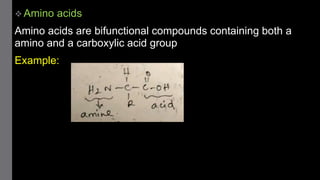
Amino acids are bifunctional compounds containing both a
amino and a carboxylic acid group
Example:
Classification of amino acids
Classification based on reaction in solution
Neutral amino acids: The amino acids which do not contain any amino
group or carboxyl group in the side chain are called neutral amino acid
Example: Glycine, Alanine
Acidic amino acids: The amino acids containing additional carboxylic
groups in the side chain are called acidic amino acids
Example: Aspartic acid, Glutamic acid
Basic amino acids: The amino acids carrying an additional amino
group in the side chain are called basic amino acids
Example: Lysine, Histidine
Synthesis of α-amino acids
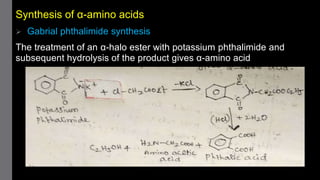
 Gabrial phthalimide synthesis
The treatment of an α-halo ester with potassium phthalimide and
subsequent hydrolysis of the product gives α-amino acid
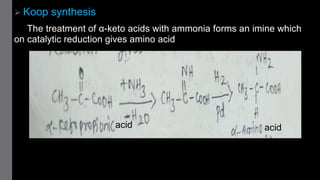
 Koop synthesis
The treatment of α-keto acids with ammonia forms an imine which
on catalytic reduction gives amino acid
acid acid
Properties of amino acids
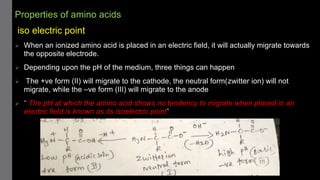
iso electric point
 When an ionized amino acid is placed in an electric field, it will actually migrate towards
the opposite electrode.
 Depending upon the pH of the medium, three things can happen
 The +ve form (II) will migrate to the cathode, the neutral form(zwitter ion) will not
migrate, while the –ve form (III) will migrate to the anode
 “ The pH at which the amino acid shows no tendency to migrate when placed in an
electric field is known as its isoelectric point”
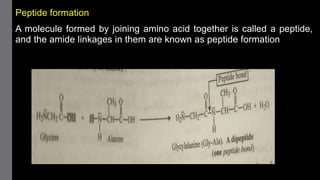
Peptide formation
A molecule formed by joining amino acid together is called a peptide,
and the amide linkages in them are known as peptide formation
b) Proteins: These are complex organic nitrogenous
compounds found in all living systems.
Definition: condensation polymers of α-amino acids and
having peculiar overall structures which determines their
specific physico-logical functions in the living organism
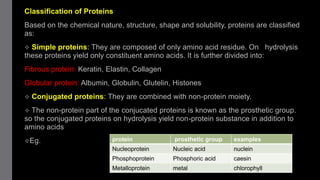
Classification of Proteins
Based on the chemical nature, structure, shape and solubility, proteins are classified
as:
 Simple proteins: They are composed of only amino acid residue. On hydrolysis
these proteins yield only constituent amino acids. It is further divided into:
Fibrous protein: Keratin, Elastin, Collagen
Globular protein: Albumin, Globulin, Glutelin, Histones
 Conjugated proteins: They are combined with non-protein moiety.
 The non-protein part of the conjucated proteins is known as the prosthetic group.
so the conjugated proteins on hydrolysis yield non-protein substance in addition to
amino acids
Eg. protein prosthetic group examples
Nucleoprotein Nucleic acid nuclein
Phosphoprotein Phosphoric acid caesin
Metalloprotein metal chlorophyll
Protein Structure
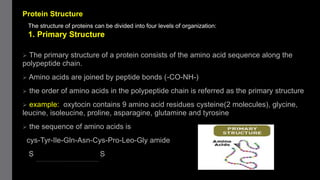
 The primary structure of a protein consists of the amino acid sequence along the
polypeptide chain.
 Amino acids are joined by peptide bonds (-CO-NH-)
 the order of amino acids in the polypeptide chain is referred as the primary structure
 example: oxytocin contains 9 amino acid residues cysteine(2 molecules), glycine,
leucine, isoleucine, proline, asparagine, glutamine and tyrosine
 the sequence of amino acids is
cys-Tyr-Ile-Gln-Asn-Cys-Pro-Leo-Gly amide
S S
The structure of proteins can be divided into four levels of organization:
1. Primary Structure
Secondary structure of protein:
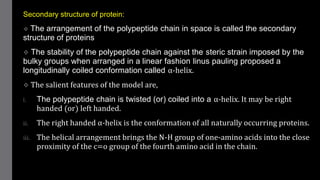
 The arrangement of the polypeptide chain in space is called the secondary
structure of proteins
 The stability of the polypeptide chain against the steric strain imposed by the
bulky groups when arranged in a linear fashion linus pauling proposed a
longitudinally coiled conformation called α-helix.
 The salient features of the model are,
i. The polypeptide chain is twisted (or) coiled into a α-helix. It may be right
handed (or) left handed.
ii. The right handed α-helix is the conformation of all naturally occurring proteins.
iii. The helical arrangement brings the N-H group of one-amino acids into the close
proximity of the c=o group of the fourth amino acid in the chain.
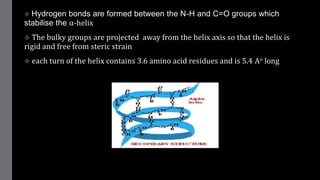
 Hydrogen bonds are formed between the N-H and C=O groups which
stabilise the α-helix
 The bulky groups are projected away from the helix axis so that the helix is
rigid and free from steric strain
 each turn of the helix contains 3.6 amino acid residues and is 5.4 Ao long
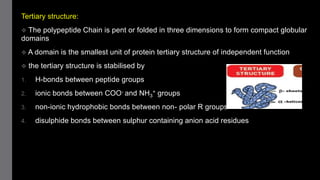
Tertiary structure:
 The polypeptide Chain is pent or folded in three dimensions to form compact globular
domains
 A domain is the smallest unit of protein tertiary structure of independent function
 the tertiary structure is stabilised by
1. H-bonds between peptide groups
2. ionic bonds between COO- and NH3
+ groups
3. non-ionic hydrophobic bonds between non- polar R groups
4. disulphide bonds between sulphur containing anion acid residues
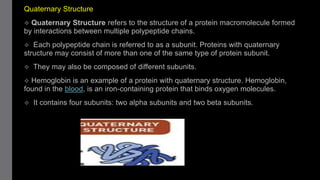
Quaternary Structure
 Quaternary Structure refers to the structure of a protein macromolecule formed
by interactions between multiple polypeptide chains.
 Each polypeptide chain is referred to as a subunit. Proteins with quaternary
structure may consist of more than one of the same type of protein subunit.
 They may also be composed of different subunits.
 Hemoglobin is an example of a protein with quaternary structure. Hemoglobin,
found in the blood, is an iron-containing protein that binds oxygen molecules.
 It contains four subunits: two alpha subunits and two beta subunits.
properties of proteins :
colloidal nature:
 Globular proteins form colloidal dispersions in water readily as their molecules are
very large(25Ao to 200 Ao in diameter)
 They cannot pass through the cell membranes, while true solute can urine in this
way filtered (or) dialysed and protein are retained in the blood stream
Isoelectric point:
 Like amino acids, proteins also exist as zwitter ions and have definite isoelectric
point
 The isoelectric point of a protein depends up on the nature of amino acids present
in it
Example: serum anbumin which has many acidic amino acids, has a low
isoelectric point of 4.7
Denaturation:
Proteins are precipitated from aqeous solution by heat, addition of acids, alkalies (or)
salt solutions and lose their activity. This is termed denaturation
Example: the boiling of egg
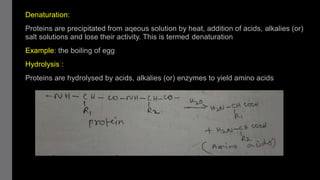
Hydrolysis :
Proteins are hydrolysed by acids, alkalies (or) enzymes to yield amino acids
Colour test for proteins
Biuret test:
 The alkaline solution of a protein gives a violet colour when treated with a few
drops of dil.copper sulphate solution
 The colour is due to the formation of a copper complex between cu2+ ions and the
peptide bonds
 A biuret is likely to form intermediate and hence the name
 This test answered by all proteins
Ninhydrin test:
 When 1 ml of Ninhydrin solution is added to 1 ml protein solution and heated,
formation of a violet colour indicates the presence of α-amino acids.
 If the amino group is substituted, different colours are produced depending on the
nature of substituent
Example: proline and hydroxy proline give yellow colour with nin hydrin

Aminoacids and proteins

  • 1.
    UNIT :I AMINOACIDS AND PROTEINS: a) Amino acids: Definition- classification- synthesis of α-amino acid (Gabriel synthesis, Koop synthesis)- properties of amino acids (isoelectric point, action of heat, peptide formation).b) Proteins: Definition- classification (simple and conjugated proteins)- structure of proteins (primary, secondary, tertiary and quaternary)-properties of proteins (colloidal nature, isoelectric point, denaturation, hydrolysis)- colour tests for proteins (biuret test, ninhydrin test).
  • 2.
     Amino acids Aminoacids are bifunctional compounds containing both a amino and a carboxylic acid group Example:
  • 3.
    Classification of aminoacids Classification based on reaction in solution Neutral amino acids: The amino acids which do not contain any amino group or carboxyl group in the side chain are called neutral amino acid Example: Glycine, Alanine Acidic amino acids: The amino acids containing additional carboxylic groups in the side chain are called acidic amino acids Example: Aspartic acid, Glutamic acid Basic amino acids: The amino acids carrying an additional amino group in the side chain are called basic amino acids Example: Lysine, Histidine
  • 4.
    Synthesis of α-aminoacids  Gabrial phthalimide synthesis The treatment of an α-halo ester with potassium phthalimide and subsequent hydrolysis of the product gives α-amino acid
  • 5.
     Koop synthesis Thetreatment of α-keto acids with ammonia forms an imine which on catalytic reduction gives amino acid acid acid
  • 6.
    Properties of aminoacids iso electric point  When an ionized amino acid is placed in an electric field, it will actually migrate towards the opposite electrode.  Depending upon the pH of the medium, three things can happen  The +ve form (II) will migrate to the cathode, the neutral form(zwitter ion) will not migrate, while the –ve form (III) will migrate to the anode  “ The pH at which the amino acid shows no tendency to migrate when placed in an electric field is known as its isoelectric point”
  • 8.
    Peptide formation A moleculeformed by joining amino acid together is called a peptide, and the amide linkages in them are known as peptide formation
  • 9.
    b) Proteins: Theseare complex organic nitrogenous compounds found in all living systems. Definition: condensation polymers of α-amino acids and having peculiar overall structures which determines their specific physico-logical functions in the living organism
  • 10.
    Classification of Proteins Basedon the chemical nature, structure, shape and solubility, proteins are classified as:  Simple proteins: They are composed of only amino acid residue. On hydrolysis these proteins yield only constituent amino acids. It is further divided into: Fibrous protein: Keratin, Elastin, Collagen Globular protein: Albumin, Globulin, Glutelin, Histones  Conjugated proteins: They are combined with non-protein moiety.  The non-protein part of the conjucated proteins is known as the prosthetic group. so the conjugated proteins on hydrolysis yield non-protein substance in addition to amino acids Eg. protein prosthetic group examples Nucleoprotein Nucleic acid nuclein Phosphoprotein Phosphoric acid caesin Metalloprotein metal chlorophyll
  • 11.
    Protein Structure  Theprimary structure of a protein consists of the amino acid sequence along the polypeptide chain.  Amino acids are joined by peptide bonds (-CO-NH-)  the order of amino acids in the polypeptide chain is referred as the primary structure  example: oxytocin contains 9 amino acid residues cysteine(2 molecules), glycine, leucine, isoleucine, proline, asparagine, glutamine and tyrosine  the sequence of amino acids is cys-Tyr-Ile-Gln-Asn-Cys-Pro-Leo-Gly amide S S The structure of proteins can be divided into four levels of organization: 1. Primary Structure
  • 12.
    Secondary structure ofprotein:  The arrangement of the polypeptide chain in space is called the secondary structure of proteins  The stability of the polypeptide chain against the steric strain imposed by the bulky groups when arranged in a linear fashion linus pauling proposed a longitudinally coiled conformation called α-helix.  The salient features of the model are, i. The polypeptide chain is twisted (or) coiled into a α-helix. It may be right handed (or) left handed. ii. The right handed α-helix is the conformation of all naturally occurring proteins. iii. The helical arrangement brings the N-H group of one-amino acids into the close proximity of the c=o group of the fourth amino acid in the chain.
  • 13.
     Hydrogen bondsare formed between the N-H and C=O groups which stabilise the α-helix  The bulky groups are projected away from the helix axis so that the helix is rigid and free from steric strain  each turn of the helix contains 3.6 amino acid residues and is 5.4 Ao long
  • 14.
    Tertiary structure:  Thepolypeptide Chain is pent or folded in three dimensions to form compact globular domains  A domain is the smallest unit of protein tertiary structure of independent function  the tertiary structure is stabilised by 1. H-bonds between peptide groups 2. ionic bonds between COO- and NH3 + groups 3. non-ionic hydrophobic bonds between non- polar R groups 4. disulphide bonds between sulphur containing anion acid residues
  • 15.
    Quaternary Structure  QuaternaryStructure refers to the structure of a protein macromolecule formed by interactions between multiple polypeptide chains.  Each polypeptide chain is referred to as a subunit. Proteins with quaternary structure may consist of more than one of the same type of protein subunit.  They may also be composed of different subunits.  Hemoglobin is an example of a protein with quaternary structure. Hemoglobin, found in the blood, is an iron-containing protein that binds oxygen molecules.  It contains four subunits: two alpha subunits and two beta subunits.
  • 16.
    properties of proteins: colloidal nature:  Globular proteins form colloidal dispersions in water readily as their molecules are very large(25Ao to 200 Ao in diameter)  They cannot pass through the cell membranes, while true solute can urine in this way filtered (or) dialysed and protein are retained in the blood stream Isoelectric point:  Like amino acids, proteins also exist as zwitter ions and have definite isoelectric point  The isoelectric point of a protein depends up on the nature of amino acids present in it Example: serum anbumin which has many acidic amino acids, has a low isoelectric point of 4.7
  • 17.
    Denaturation: Proteins are precipitatedfrom aqeous solution by heat, addition of acids, alkalies (or) salt solutions and lose their activity. This is termed denaturation Example: the boiling of egg Hydrolysis : Proteins are hydrolysed by acids, alkalies (or) enzymes to yield amino acids
  • 18.
    Colour test forproteins Biuret test:  The alkaline solution of a protein gives a violet colour when treated with a few drops of dil.copper sulphate solution  The colour is due to the formation of a copper complex between cu2+ ions and the peptide bonds  A biuret is likely to form intermediate and hence the name  This test answered by all proteins Ninhydrin test:  When 1 ml of Ninhydrin solution is added to 1 ml protein solution and heated, formation of a violet colour indicates the presence of α-amino acids.  If the amino group is substituted, different colours are produced depending on the nature of substituent Example: proline and hydroxy proline give yellow colour with nin hydrin