Presented by; Ikram Ullah
BS MLT
KMU,Peshawar
Contents
 Animations of Translation
 Introduction
 Translations in Prokaryotes
 Translation in Eukaryotes
 MCQs
 References
Introduction to Translation
 Translation: The biosynthesis of a protein or a
polypeptide inside a living cell.
 In process of translation the language of nucleotides
sequence on mRNA is translated in to the language of
amino acid sequence.
 It occur in cytoplasm where ribosomes are located
 It is a universal process
Cont……
 In translation ,messenger RNA is decoded to produce
a specific polypeptide
 This uses mRNA sequence as a template to guide the
synthesis of a chain of amino acid that form protein
 Many types of transcribed RNA, such
tRNA,rRNA,snRNA are not necessarily translated to
amino acid sequence
Steps of Translation
 Translation proceeds in four phases
- Activation
- Initiation
- Elongation and
- Termination
Most studies do not include activation as a step of
translation
Activation
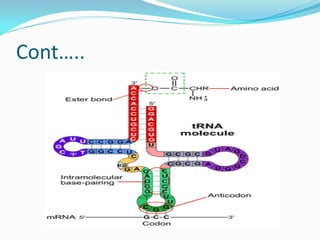
 In activation, the correct amino acid is covalently
bonded to the correct tRNA
 While technically this not a step in translation, it is
required for translation to proceed
 The amino acid is joined by its carboxyl group to the 3`
OH of tRNA by an ester bond with help of ATP
 When tRNA has an amino acid linked to it, it is
termed as “charged”
Cont…..
Initiation
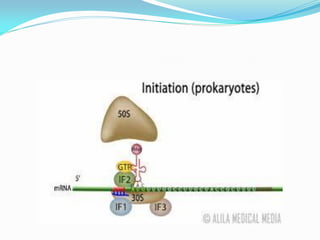
 Prokaryotes initiation require the large and small
subunits, the mRNA, the initiator tRNA and three
initiation factors (IF-1, IF-2, IF-3) and GTP.
 IF-3 binds to the free 30s subunit, this help to prevent
large subunit binding to it without mRNA and
forming an inactive ribosome
 IF-2 complexed with GTP and IF-1 binds to small
subunit . It will assist the charged initiator tRNA to
bind
Cont…..
 The 30s subunit attached to a mRNA molecule
making use of the ribosomal binding site on mRNA
 The initiator tRNA can then bind to the complex by
base pairing of its anticodon with AUG codon on
mRNA
 At this point,IF3 can be released, as its role in keeping
the subunits apart are complete
 This complex is called 30s initiation complex
Cont….
 The 50s subunit can now bind, which displace IF1 and
IF2, and the GTP is hydrolysed in this energy
consuming step
 This complex is called 70s initiation complex
Cont…..
 The assembled ribosome has two tRNA binding sites
 These are called the A and P sites , for amino acyl
and peptidyl sites and one site is E (exit site) for
empty tRNA
 The A site is where incoming amino acyl tRNA
molecule bind, and the p site is where the growing
polypeptide chain is usually found
 The sites are in cleft of small subunit and contain
adjacent codon that are being translated
Cont……
 One major of initiation is the placement of initiator
tRNA in the P site
 It is the only tRNA that does this , as all other must
enter the A site
Elongation
 With the formation of 70s initiation complex the
elongation cycle can begin
 It involves three elongation factors EF-Tu, EF-Ts and
EF-G, GTP, charged tRNA and the 70s initiation
complex
Elongation is divided into 3 steps
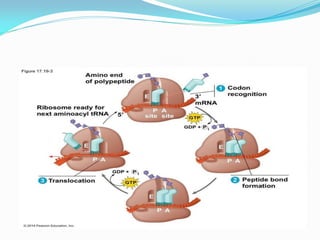
1. Amino acyl tRNA delivery.
• EF-TU is required to deliver the amino acyl tRNA to A site
and energy is consumed in this step by hydrolysis of GTP
• The released EF-Tu GDP complex is regenerated with the
help of EF-TS
• In the EF-Tu EF-Ts exchange cycle EF-Ts displaces the GDP
and replace itself by GTP
• The resultant EF-Tu.GTP complex is now available to bind
another amino acyl tRNA and deliver it to ribosome
Cont….
 All amino acyl tRNA can form this complex with EF-Tu
except the initiator tRNA
Cont…..
2 .Peptide bond formation.
• After aminoacyl-tRNA delivery ,the A and P sites are
both occupied and the two amino acids that are to be
joined are close to each other
• The peptidyl transferase activity of the 50s subunit can
now form a peptide bond between the two amino acids
3. Translocation
 A complex of EF-G(translocase) and GTP binds to the
ribosome and ,is an energy consuming step, the
discharged tRNA is ejected from the P site, the peptidyl-
tRNA is moved from A site to P site
 The mRNA moves by one codon relative to one codon to
the ribosome
 GDP and EF-G are released . A new codon is now present
in the vacant site
Termination
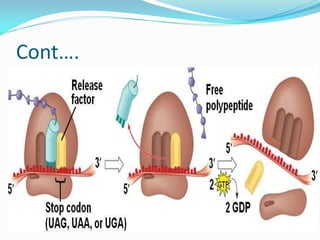
 Termination of translation happens when the A site of
the ribosome faces a stop codon (UUA,UGA or UGA)
 When this happens , no tRNA can recognize it, but a
releasing factor can recognize the stop codons and
causes the release of polypeptide chain
 In prokaryotes once a stop codon occupies the A site,
three termination or release factor (RF1,RF2,RF3)
contribute to the hydrolysis of peptidyl-tRNA bond
Cont…..
 Release the free polypeptide and last uncharged tRNA
from P site
 The dissociation of the 70 s into 30s and 50s subunits
 RF1 binds A site and release the polypeptide and
uncharged tRNA
 RF2 releases the RF1 from A site and release itself as
well from translation binding site(present on large
subunit)
 RF3 function unknown
 Another factor called Ribosomal releasing factor
causes the dissociation of 70s complex
Cont….
Translation in Eukaryotes
Eukaryotic Translation
 In prokaryotic cell, transcription and translation are
coupled, that is, translation begins while the mRNA is still
being synthesized. In a eukaryotic cell, transcription occur
in the nucleus , and translation occur in the cytoplasm.
 Translation process in eukaryotes involve
- Activation ( not essentially the step of translation. This
occur the same way as in prokaryotes)
- Initiation
- Elongation and
- termination
1. Initiation
 The initiation of translation in eukaryotes is complex,
involving at least 10 initiation factors (eIFs) and is
divided into three steps :
a) Formation of 43s preinitiation complex.
b) Formation of 48s initiation complex.
c) Formation of 80s initiation complex.
a. Formation of 43s preinitiation
complex
 A ternary complex containing met-tRNA and eIF-2
bound to GTP attaches to 40s ribosomal subunit to
form 43s preinitiation complex.
 The presence of eIF-3 and eIF-1A stabilizes this
complex.
b.Formation of 48s initiation
complex
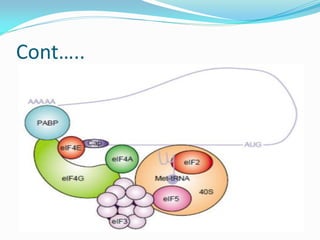
 The binding of mRNA to 43s preinitiation complex
results in formation of 48s initiation complex.
 eIF-4f is formed by the association of eIF-4G, eIF-4A
with eIF-4E
 The eIF-4F(referred to as cap binding protein ) binds
to the cap of mRNA.
Cont…..
 Then eIF-4A and eIF-B binds to mRNA and reduces
its complex structure.
 This mRNA is then transferred to 43s complex
 The ribosomal initiation complex scans the mRNA for
identification of appropriate initiation codon
 5’-AUG is the initiation codon
c.Formation of 80s initiation
complex
 48s initiation complex binds to 60s ribosomal subunit to
form 80s initiation complex
 The binding involves hydrolysis of GTP(bound to eIF-2)
 This step is facilitated by the involvement of eIF-5
 As the 80s complex is formed, the initiation factors
bound to 43s initiation complex are released and recycled
Cont…..
2. Elongation
 Ribosomes elongate the polypeptide chain by
sequential addition of amino acids
 The amino acid sequence is determined by the order of
the codons in the specific mRNA
 Elongation, a cyclic process involving certain
elongation factors(EFs)
 Elongation may be divided into three steps
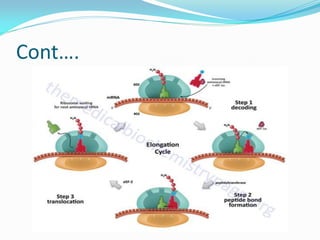
a. Binding of aminoacyl-tRNA to A-site
b. Peptide bond formation
c. translocation
a.Binding of Aminoacyl t-RNA to A-
site
 The 80s initiation complex contains met tRNA in the
P-site and A- site is free
 Another aminoacyl-tRNA is placed in the A site
 This require proper codon recognition on mRNA and
involvement of EF-1a and supply of energy by GTP
 The aminoacyl –tRNA is placed in the A-site ,EF-1a
and GDP are recycled to bring another aminoacyl-
tRNA
b. Peptide bond formation
 The peptidyl transferase catalyzes the formation of
peptide bond
 Net result of peptide bond formation is the
attachment off the growing peptide chain to the tRNA
in A-site
c. Translocation
 The ribosome moves to the next codon of mRNA
(towards 3’ end)
 This process is called translocation, involves the
movement of growing peptide chain from A-site to P-
site
 Translocation require EF-2 and GTP
 GTP get hydrolyzed and supplies energy to move
mRNA
 EF-2 and GTP complex recycles for translocation
Cont….
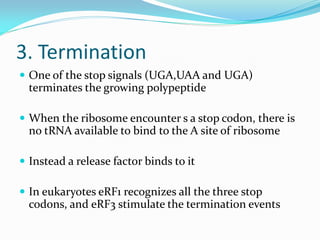
3. Termination
 One of the stop signals (UGA,UAA and UGA)
terminates the growing polypeptide
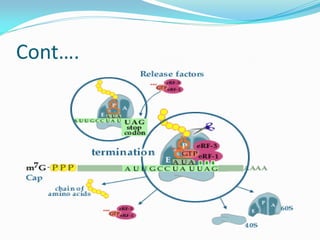
 When the ribosome encounter s a stop codon, there is
no tRNA available to bind to the A site of ribosome
 Instead a release factor binds to it
 In eukaryotes eRF1 recognizes all the three stop
codons, and eRF3 stimulate the termination events
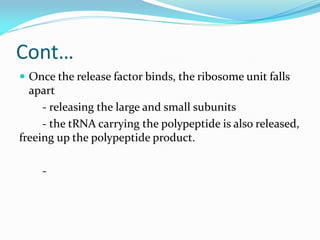
Cont…
 Once the release factor binds, the ribosome unit falls
apart
- releasing the large and small subunits
- the tRNA carrying the polypeptide is also released,
freeing up the polypeptide product.
-
Cont….
References
 www.namrata.com (biochemistry For Medics By
Dr.Namrata Chhabra)
 slideshares
 www.easybiologyclass.com
 YouTube lecture by shomou’s Biology
 Wikipedia
Questions/suggestions:
umairkhan2352@gmail.com
Thank you

Translation in Prokaryotes and Eukaryotes

  • 1.
    Presented by; IkramUllah BS MLT KMU,Peshawar
  • 2.
    Contents  Animations ofTranslation  Introduction  Translations in Prokaryotes  Translation in Eukaryotes  MCQs  References
  • 3.
    Introduction to Translation Translation: The biosynthesis of a protein or a polypeptide inside a living cell.  In process of translation the language of nucleotides sequence on mRNA is translated in to the language of amino acid sequence.  It occur in cytoplasm where ribosomes are located  It is a universal process
  • 4.
    Cont……  In translation,messenger RNA is decoded to produce a specific polypeptide  This uses mRNA sequence as a template to guide the synthesis of a chain of amino acid that form protein  Many types of transcribed RNA, such tRNA,rRNA,snRNA are not necessarily translated to amino acid sequence
  • 5.
    Steps of Translation Translation proceeds in four phases - Activation - Initiation - Elongation and - Termination Most studies do not include activation as a step of translation
  • 6.
    Activation  In activation,the correct amino acid is covalently bonded to the correct tRNA  While technically this not a step in translation, it is required for translation to proceed  The amino acid is joined by its carboxyl group to the 3` OH of tRNA by an ester bond with help of ATP  When tRNA has an amino acid linked to it, it is termed as “charged”
  • 7.
  • 8.
    Initiation  Prokaryotes initiationrequire the large and small subunits, the mRNA, the initiator tRNA and three initiation factors (IF-1, IF-2, IF-3) and GTP.  IF-3 binds to the free 30s subunit, this help to prevent large subunit binding to it without mRNA and forming an inactive ribosome  IF-2 complexed with GTP and IF-1 binds to small subunit . It will assist the charged initiator tRNA to bind
  • 9.
    Cont…..  The 30ssubunit attached to a mRNA molecule making use of the ribosomal binding site on mRNA  The initiator tRNA can then bind to the complex by base pairing of its anticodon with AUG codon on mRNA  At this point,IF3 can be released, as its role in keeping the subunits apart are complete  This complex is called 30s initiation complex
  • 10.
    Cont….  The 50ssubunit can now bind, which displace IF1 and IF2, and the GTP is hydrolysed in this energy consuming step  This complex is called 70s initiation complex
  • 11.
    Cont…..  The assembledribosome has two tRNA binding sites  These are called the A and P sites , for amino acyl and peptidyl sites and one site is E (exit site) for empty tRNA  The A site is where incoming amino acyl tRNA molecule bind, and the p site is where the growing polypeptide chain is usually found  The sites are in cleft of small subunit and contain adjacent codon that are being translated
  • 12.
    Cont……  One majorof initiation is the placement of initiator tRNA in the P site  It is the only tRNA that does this , as all other must enter the A site
  • 14.
    Elongation  With theformation of 70s initiation complex the elongation cycle can begin  It involves three elongation factors EF-Tu, EF-Ts and EF-G, GTP, charged tRNA and the 70s initiation complex
  • 15.
    Elongation is dividedinto 3 steps 1. Amino acyl tRNA delivery. • EF-TU is required to deliver the amino acyl tRNA to A site and energy is consumed in this step by hydrolysis of GTP • The released EF-Tu GDP complex is regenerated with the help of EF-TS • In the EF-Tu EF-Ts exchange cycle EF-Ts displaces the GDP and replace itself by GTP • The resultant EF-Tu.GTP complex is now available to bind another amino acyl tRNA and deliver it to ribosome
  • 16.
    Cont….  All aminoacyl tRNA can form this complex with EF-Tu except the initiator tRNA
  • 17.
    Cont….. 2 .Peptide bondformation. • After aminoacyl-tRNA delivery ,the A and P sites are both occupied and the two amino acids that are to be joined are close to each other • The peptidyl transferase activity of the 50s subunit can now form a peptide bond between the two amino acids
  • 18.
    3. Translocation  Acomplex of EF-G(translocase) and GTP binds to the ribosome and ,is an energy consuming step, the discharged tRNA is ejected from the P site, the peptidyl- tRNA is moved from A site to P site  The mRNA moves by one codon relative to one codon to the ribosome  GDP and EF-G are released . A new codon is now present in the vacant site
  • 20.
    Termination  Termination oftranslation happens when the A site of the ribosome faces a stop codon (UUA,UGA or UGA)  When this happens , no tRNA can recognize it, but a releasing factor can recognize the stop codons and causes the release of polypeptide chain  In prokaryotes once a stop codon occupies the A site, three termination or release factor (RF1,RF2,RF3) contribute to the hydrolysis of peptidyl-tRNA bond
  • 21.
    Cont…..  Release thefree polypeptide and last uncharged tRNA from P site  The dissociation of the 70 s into 30s and 50s subunits  RF1 binds A site and release the polypeptide and uncharged tRNA  RF2 releases the RF1 from A site and release itself as well from translation binding site(present on large subunit)  RF3 function unknown  Another factor called Ribosomal releasing factor causes the dissociation of 70s complex
  • 22.
  • 23.
  • 24.
    Eukaryotic Translation  Inprokaryotic cell, transcription and translation are coupled, that is, translation begins while the mRNA is still being synthesized. In a eukaryotic cell, transcription occur in the nucleus , and translation occur in the cytoplasm.  Translation process in eukaryotes involve - Activation ( not essentially the step of translation. This occur the same way as in prokaryotes) - Initiation - Elongation and - termination
  • 25.
    1. Initiation  Theinitiation of translation in eukaryotes is complex, involving at least 10 initiation factors (eIFs) and is divided into three steps : a) Formation of 43s preinitiation complex. b) Formation of 48s initiation complex. c) Formation of 80s initiation complex.
  • 26.
    a. Formation of43s preinitiation complex  A ternary complex containing met-tRNA and eIF-2 bound to GTP attaches to 40s ribosomal subunit to form 43s preinitiation complex.  The presence of eIF-3 and eIF-1A stabilizes this complex.
  • 27.
    b.Formation of 48sinitiation complex  The binding of mRNA to 43s preinitiation complex results in formation of 48s initiation complex.  eIF-4f is formed by the association of eIF-4G, eIF-4A with eIF-4E  The eIF-4F(referred to as cap binding protein ) binds to the cap of mRNA.
  • 28.
    Cont…..  Then eIF-4Aand eIF-B binds to mRNA and reduces its complex structure.  This mRNA is then transferred to 43s complex  The ribosomal initiation complex scans the mRNA for identification of appropriate initiation codon  5’-AUG is the initiation codon
  • 29.
    c.Formation of 80sinitiation complex  48s initiation complex binds to 60s ribosomal subunit to form 80s initiation complex  The binding involves hydrolysis of GTP(bound to eIF-2)  This step is facilitated by the involvement of eIF-5  As the 80s complex is formed, the initiation factors bound to 43s initiation complex are released and recycled
  • 30.
  • 31.
    2. Elongation  Ribosomeselongate the polypeptide chain by sequential addition of amino acids  The amino acid sequence is determined by the order of the codons in the specific mRNA  Elongation, a cyclic process involving certain elongation factors(EFs)  Elongation may be divided into three steps a. Binding of aminoacyl-tRNA to A-site b. Peptide bond formation c. translocation
  • 32.
    a.Binding of Aminoacylt-RNA to A- site  The 80s initiation complex contains met tRNA in the P-site and A- site is free  Another aminoacyl-tRNA is placed in the A site  This require proper codon recognition on mRNA and involvement of EF-1a and supply of energy by GTP  The aminoacyl –tRNA is placed in the A-site ,EF-1a and GDP are recycled to bring another aminoacyl- tRNA
  • 33.
    b. Peptide bondformation  The peptidyl transferase catalyzes the formation of peptide bond  Net result of peptide bond formation is the attachment off the growing peptide chain to the tRNA in A-site
  • 34.
    c. Translocation  Theribosome moves to the next codon of mRNA (towards 3’ end)  This process is called translocation, involves the movement of growing peptide chain from A-site to P- site  Translocation require EF-2 and GTP  GTP get hydrolyzed and supplies energy to move mRNA  EF-2 and GTP complex recycles for translocation
  • 35.
  • 36.
    3. Termination  Oneof the stop signals (UGA,UAA and UGA) terminates the growing polypeptide  When the ribosome encounter s a stop codon, there is no tRNA available to bind to the A site of ribosome  Instead a release factor binds to it  In eukaryotes eRF1 recognizes all the three stop codons, and eRF3 stimulate the termination events
  • 37.
    Cont…  Once therelease factor binds, the ribosome unit falls apart - releasing the large and small subunits - the tRNA carrying the polypeptide is also released, freeing up the polypeptide product. -
  • 38.
  • 39.
    References  www.namrata.com (biochemistryFor Medics By Dr.Namrata Chhabra)  slideshares  www.easybiologyclass.com  YouTube lecture by shomou’s Biology  Wikipedia
  • 40.
  • 41.