Proteins
Why We need to study About this?
Protein Engineering.
Structural Engineering.
Growth of body.
Major component of body
Curing Different Diseases.
What is Amino Acid?
• Amino acids are derivatives of carboxylic acids
formed by substitution of -hydrogen for amino
functional group
1 2
What is Protein?
The word protein came from a Greek word “Proteios”
Proteins are like long necklaces with differently
shaped beads. Each "bead" is a small molecule
called an amino acid.
Compounds composed of carbon, hydrogen, oxygen, and
nitrogen and arranged as strands of amino acids
 Structural
 Movement
 Transport
 Storage
 Hormone
 Protection
 Enzymes
Collagen; bones, tendons, cartilage
Keratin; hair, skin, wool, nails, feathers
Myosin & Actin; muscle contractions
Hemoglobin; transports O2
Lipoproteins; transports lipids
Casein; in milk. Albumin; in eggs
Insulin; regulates blood glucose
Growth hormone; regulates growth
Immunoglobulins; stimulate immunity
Snake venom; plant toxins;
Sucrase; catalyzes sucrose hydrolysis
Pepsin; catalyzes protein hydrolysis
Functions of Proteins
Protein Deficiency and Excess
• Protein-deficiency symptoms are always
observed when either protein or energy is
deficient
• Extreme food energy deficiency is marasmus
• Extreme protein deficiency is kwashiorkor
• The two diseases overlap most of the time
and together are called PEM
Protein Deficiency and Excess
• Protein-energy malnutrition (PEM)
– World’s most widespread malnutrition problem
– Includes both marasmus and kwashiorkor and
states of overlap
• Hunger
– Physiological craving for food
– Progressive discomfort, illness, and pain resulting
from the lack of food
What do Amino Acids Do?
 Amino acids are essential to life, have a role
in metabolism, and are important in
nutrition.
They form short polymer chains called peptides, as
well as longer chains that are called polypeptides or
proteins.
About 75 percent of the human body is made up of
chains of amino acids, which is why they are so vital
to how your system functions.
All the chemical reactions that occur in the body
depend on amino acids and the proteins they build.
Types of Amino Acids
Amino acids are classified as
• Nonpolar (hydrophobic)
with hydrocarbon side
chains.
• Polar (hydrophilic) with
polar or ionic side chains.
• Acidic (hydrophilic) with
acidic side chains.
• Basic (hydrophilic) with
–NH2 side chains.
Nonpolar Polar
Acidic Basic
3
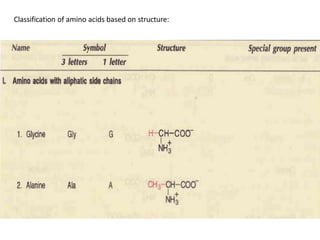
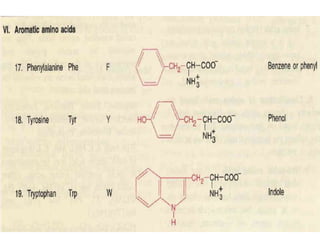
Classification of amino acids based on structure:
C. Nutritional classification of amino
acids
• 1. Essential or indispensable amino acids :
• cannot be synthesized by the body supplied
through the diet
e.g., Arginine, Valine, Histidine, lsoleucine,
• Leucine, Lysine, Methionine, Phenylalanine,
• Threonine, Tryptophan.
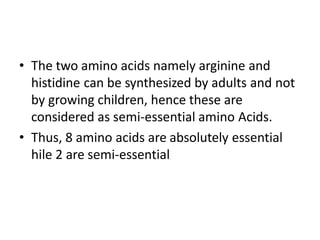
• The two amino acids namely arginine and
histidine can be synthesized by adults and not
by growing children, hence these are
considered as semi-essential amino Acids.
• Thus, 8 amino acids are absolutely essential
hile 2 are semi-essential
• 2. Non-essential or dispensable amino acids :
The body can synthesize about '10 amino
acids to meet the biological needs, hence they
need not be consumed in the diet.
• These are-glycine, alanine, serine, cysteine,
aspartate,a sparagnie, glutamate, glutamine,
tyrosine and proline.
D. Amino acid classification based on
their metabolic fate :
• The carbon skeleton of amino acids can serve as a precursor for the
synthesis of glucose( glycogenico) r fat (ketogenico) r both.
• three groups:
• 1. Glycogenic amino acids : serve as precursors for the formation of
glucose or glycogen.
• e.g. alanine,aspartat
• Eg., lycine,methioninee tc.
• 2. Ketogenic amino acids : Fat can be synthesized from these amino acids.
Two amino acids leucine and lysine are exclusively ketogenic
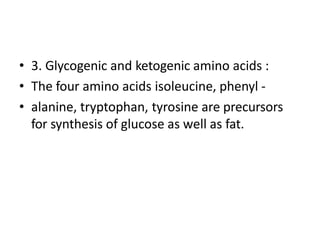
• 3. Glycogenic and ketogenic amino acids :
• The four amino acids isoleucine, phenyl -
• alanine, tryptophan, tyrosine are precursors
for synthesis of glucose as well as fat.
Properties of Amino acids
• A. Physical properties:
• 1. Solubility :
• soluble in water ,
• Insoluble in organic solvents.
• 2. Melting points:
• melt at higher temperature so, often above
200˚C.
• 3. Taste:
• Sweet (Cly, Ala, Val),
• tasteless (Leu) or bitter (Arg, lle).
• Monosodium glutamate - flavoring agent in food industry,
and Chinese foods to increase taste and flavor.
• 4. Optical properties:
• except glycine, All the amino acid possesses optical isomers
due to the
• presence of asymmetric carbon atom.
• Some amino acids also have a second asymmetric carbon.
• e.g. isoleucine, threonine.
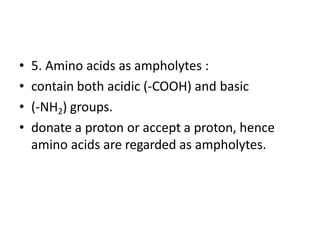
• 5. Amino acids as ampholytes :
• contain both acidic (-COOH) and basic
• (-NH2) groups.
• donate a proton or accept a proton, hence
amino acids are regarded as ampholytes.
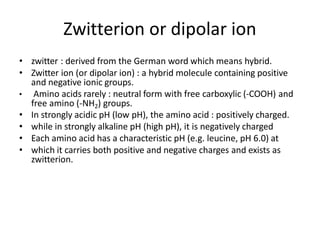
Zwitterion or dipolar ion
• zwitter : derived from the German word which means hybrid.
• Zwitter ion (or dipolar ion) : a hybrid molecule containing positive
and negative ionic groups.
• Amino acids rarely : neutral form with free carboxylic (-COOH) and
free amino (-NH2) groups.
• In strongly acidic pH (low pH), the amino acid : positively charged.
• while in strongly alkaline pH (high pH), it is negatively charged
• Each amino acid has a characteristic pH (e.g. leucine, pH 6.0) at
• which it carries both positive and negative charges and exists as
zwitterion.
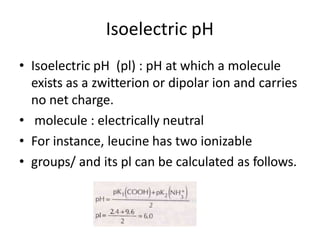
Isoelectric pH
• Isoelectric pH (pl) : pH at which a molecule
exists as a zwitterion or dipolar ion and carries
no net charge.
• molecule : electrically neutral
• For instance, leucine has two ionizable
• groups/ and its pl can be calculated as follows.
• Leucine - cation at pH below 6 and anion at pH
above 6.
• At the isoelectric pH (pl = 6.0), leucine is found
as zwitterion.
• pH of the medium determines the ionic nature
of amino acids.
• For the calculation of pl of amino acids with
more than two ionizable groups, the pKas for
all the groups have to be taken into account.
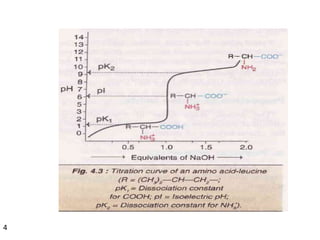
Titration of amino acids :
• At low pH, leucine : protonated form as cation.
• As the titration proceeds with NaOH, leucine loses its protons and
at isoelectric pH (pl), it becomes a zwitterion.
• Further titration results in the formation of anionic form of leucine.
• Some more details on isoelectric pH are
• discussed under the properties of proteins.
4
Chemical properties of Amino Acids
• carboxyl (-COOH) group and amino (-NH2) group.
Reactions due to -COOH group:
• 1. Amino acids form salts (-COONa) with bases
and esters (-COOR') with alcohols.
2. Decarboxylation: produce corresponding Amines.
• This react ion assumes significance in the living
cells due to the formation of many biologically
important amines.
3. Reaction with ammonia: The carboxyl group of dicarboxylic
amino acids reacts with NH3 to form amide.
Reactions due to -NH2 group
• 4. The amino groups behave as bases and
combine with acids (e.g. HCI) to form salts (-
NH3+Cl-).
5. Reaction with ninhydrin : The α-amino acids
react with ninhydrin to form a purple, blue or
pink colour complex (Ruhemann's purple)
Ninhydrin reaction is effectively used for the quantitative determination
of amino acids and proteins. (Note : Proline and hydroxyproline give
yellow colour with ninhydrin)
6.Colour reactions of amino acids : Amino acids can be identified by
specific colour reactions.
7.Transamination: Transfer of an amino group from an amino acid to a
keto acid to form a new amino acid is a very important reaction in amino
acid metabolism.
8.Oxidative deamination : The amino acids undergo oxidative
deamination to liberate free ammonia.
Formation of Peptide Bond
• When the amino group of an amino acid
combines with the carboxyl group of another
amino acid, a peptide bond is formed.
Formation of Peptide bond:
• rigid and planar with partial double bond in
character.
• lt generally exists in trans configuration.
• Both -C=O and –NH groups of peptide bonds
are polar and are involved in hydrogen bond
formation.
Nomenclature of peptides
Short peptides are often given a general name according to how many residues
(amino acids) are linked together.
Glycyl-alanyl-tyrosyl-glycine is a "TETRAPEPTIDE"
Alanyl-valyl-tryptophane is a "TRIPEPTIDE"
A general name for a long peptide is oligopeptide or POLYPEPTIDE.
The Structure of Proteins
• Side chain
– The unique chemical structure attached to the backbone
of each amino acid that differentiates one amino acid
from another
• Essential amino acids
– Amino acids that either cannot be synthesized at all by
the body or cannot be synthesized in amounts sufficient
to meet physiological needs
The Structure of Proteins
• Conditionally essential amino acid
– Amino acid that is normally nonessential, but must be
supplied by the diet in special circumstances when the
need for it exceeds the body’s ability to produce it
• Peptide bond
– Bond that connects one amino acid with another, forming
a link in a protein chain
• Amino acids link into long strands that coil and fold
to make a wide variety of different proteins
Essential AA
• Valin
• Leucin
• Isoleucine
• Threonine
• Lysin
• Methionin
• Phenylalanin
e
• Tryptophan
• Arginine
• Histidine
Nonessential AA
• Alanine
• Asparagine
• Aspartate
• Cysteine
• Glutamate
• Glutamine
• Glycine
• Proline
• Serine
• Tyrosine
Peptide Linkages
• Two dipeptides can result from reaction between A and S, depending on which COOH reacts
with which NH2 we get AS or SA
• The long, repetitive sequence of NCHCO atoms that make up a continuous chain is
called the protein’s backbone
• Peptides are always written with the N-terminal amino acid (the one with the free NH2
group) on the left and the C-terminal amino acid (the one with the free CO2H group) on
the right
• Alanylserine is abbreviated Ala-Ser (or A-S), and serylalanine is abbreviated Ser-Ala (or S-A)
Peptides and Proteins
• Proteins and peptides are amino acid polymers in which the
individual amino acid units, called residues, are linked together by
amide bonds, or peptide bonds
• An amino group from one residue forms an amide bond with the
carboxyl of a second residue
5
References:
Image 1: http://postimg.org/image/yq74xmbtz/
Image 2: http://postimg.org/image/yq74xmbtz/
Image 3: Biochemistry, U. Satyanarayan, Elsevier
India publication
Image 4: Biochemistry, U. Satyanarayan, Elsevier
India publication
Image 5: http://postimg.org/image/61ys84z1j/
Table : Biochemistry, U. Satyanarayan, Elsevier India
publication
THANK YOU
ANY QUERY
?

Protein.pptx

  • 1.
  • 2.
    Why We needto study About this? Protein Engineering. Structural Engineering. Growth of body. Major component of body Curing Different Diseases.
  • 3.
    What is AminoAcid? • Amino acids are derivatives of carboxylic acids formed by substitution of -hydrogen for amino functional group 1 2
  • 4.
    What is Protein? Theword protein came from a Greek word “Proteios” Proteins are like long necklaces with differently shaped beads. Each "bead" is a small molecule called an amino acid. Compounds composed of carbon, hydrogen, oxygen, and nitrogen and arranged as strands of amino acids
  • 5.
     Structural  Movement Transport  Storage  Hormone  Protection  Enzymes Collagen; bones, tendons, cartilage Keratin; hair, skin, wool, nails, feathers Myosin & Actin; muscle contractions Hemoglobin; transports O2 Lipoproteins; transports lipids Casein; in milk. Albumin; in eggs Insulin; regulates blood glucose Growth hormone; regulates growth Immunoglobulins; stimulate immunity Snake venom; plant toxins; Sucrase; catalyzes sucrose hydrolysis Pepsin; catalyzes protein hydrolysis Functions of Proteins
  • 6.
    Protein Deficiency andExcess • Protein-deficiency symptoms are always observed when either protein or energy is deficient • Extreme food energy deficiency is marasmus • Extreme protein deficiency is kwashiorkor • The two diseases overlap most of the time and together are called PEM
  • 7.
    Protein Deficiency andExcess • Protein-energy malnutrition (PEM) – World’s most widespread malnutrition problem – Includes both marasmus and kwashiorkor and states of overlap • Hunger – Physiological craving for food – Progressive discomfort, illness, and pain resulting from the lack of food
  • 8.
    What do AminoAcids Do?  Amino acids are essential to life, have a role in metabolism, and are important in nutrition. They form short polymer chains called peptides, as well as longer chains that are called polypeptides or proteins. About 75 percent of the human body is made up of chains of amino acids, which is why they are so vital to how your system functions. All the chemical reactions that occur in the body depend on amino acids and the proteins they build.
  • 10.
    Types of AminoAcids Amino acids are classified as • Nonpolar (hydrophobic) with hydrocarbon side chains. • Polar (hydrophilic) with polar or ionic side chains. • Acidic (hydrophilic) with acidic side chains. • Basic (hydrophilic) with –NH2 side chains. Nonpolar Polar Acidic Basic 3
  • 11.
    Classification of aminoacids based on structure:
  • 19.
    C. Nutritional classificationof amino acids • 1. Essential or indispensable amino acids : • cannot be synthesized by the body supplied through the diet e.g., Arginine, Valine, Histidine, lsoleucine, • Leucine, Lysine, Methionine, Phenylalanine, • Threonine, Tryptophan.
  • 20.
    • The twoamino acids namely arginine and histidine can be synthesized by adults and not by growing children, hence these are considered as semi-essential amino Acids. • Thus, 8 amino acids are absolutely essential hile 2 are semi-essential
  • 21.
    • 2. Non-essentialor dispensable amino acids : The body can synthesize about '10 amino acids to meet the biological needs, hence they need not be consumed in the diet. • These are-glycine, alanine, serine, cysteine, aspartate,a sparagnie, glutamate, glutamine, tyrosine and proline.
  • 22.
    D. Amino acidclassification based on their metabolic fate : • The carbon skeleton of amino acids can serve as a precursor for the synthesis of glucose( glycogenico) r fat (ketogenico) r both. • three groups: • 1. Glycogenic amino acids : serve as precursors for the formation of glucose or glycogen. • e.g. alanine,aspartat • Eg., lycine,methioninee tc. • 2. Ketogenic amino acids : Fat can be synthesized from these amino acids. Two amino acids leucine and lysine are exclusively ketogenic
  • 23.
    • 3. Glycogenicand ketogenic amino acids : • The four amino acids isoleucine, phenyl - • alanine, tryptophan, tyrosine are precursors for synthesis of glucose as well as fat.
  • 24.
    Properties of Aminoacids • A. Physical properties: • 1. Solubility : • soluble in water , • Insoluble in organic solvents. • 2. Melting points: • melt at higher temperature so, often above 200˚C.
  • 25.
    • 3. Taste: •Sweet (Cly, Ala, Val), • tasteless (Leu) or bitter (Arg, lle). • Monosodium glutamate - flavoring agent in food industry, and Chinese foods to increase taste and flavor. • 4. Optical properties: • except glycine, All the amino acid possesses optical isomers due to the • presence of asymmetric carbon atom. • Some amino acids also have a second asymmetric carbon. • e.g. isoleucine, threonine.
  • 26.
    • 5. Aminoacids as ampholytes : • contain both acidic (-COOH) and basic • (-NH2) groups. • donate a proton or accept a proton, hence amino acids are regarded as ampholytes.
  • 27.
    Zwitterion or dipolarion • zwitter : derived from the German word which means hybrid. • Zwitter ion (or dipolar ion) : a hybrid molecule containing positive and negative ionic groups. • Amino acids rarely : neutral form with free carboxylic (-COOH) and free amino (-NH2) groups. • In strongly acidic pH (low pH), the amino acid : positively charged. • while in strongly alkaline pH (high pH), it is negatively charged • Each amino acid has a characteristic pH (e.g. leucine, pH 6.0) at • which it carries both positive and negative charges and exists as zwitterion.
  • 28.
    Isoelectric pH • IsoelectricpH (pl) : pH at which a molecule exists as a zwitterion or dipolar ion and carries no net charge. • molecule : electrically neutral • For instance, leucine has two ionizable • groups/ and its pl can be calculated as follows.
  • 30.
    • Leucine -cation at pH below 6 and anion at pH above 6. • At the isoelectric pH (pl = 6.0), leucine is found as zwitterion. • pH of the medium determines the ionic nature of amino acids. • For the calculation of pl of amino acids with more than two ionizable groups, the pKas for all the groups have to be taken into account.
  • 31.
    Titration of aminoacids : • At low pH, leucine : protonated form as cation. • As the titration proceeds with NaOH, leucine loses its protons and at isoelectric pH (pl), it becomes a zwitterion. • Further titration results in the formation of anionic form of leucine. • Some more details on isoelectric pH are • discussed under the properties of proteins.
  • 32.
  • 33.
    Chemical properties ofAmino Acids • carboxyl (-COOH) group and amino (-NH2) group. Reactions due to -COOH group: • 1. Amino acids form salts (-COONa) with bases and esters (-COOR') with alcohols. 2. Decarboxylation: produce corresponding Amines. • This react ion assumes significance in the living cells due to the formation of many biologically important amines.
  • 34.
    3. Reaction withammonia: The carboxyl group of dicarboxylic amino acids reacts with NH3 to form amide.
  • 35.
    Reactions due to-NH2 group • 4. The amino groups behave as bases and combine with acids (e.g. HCI) to form salts (- NH3+Cl-). 5. Reaction with ninhydrin : The α-amino acids react with ninhydrin to form a purple, blue or pink colour complex (Ruhemann's purple)
  • 36.
    Ninhydrin reaction iseffectively used for the quantitative determination of amino acids and proteins. (Note : Proline and hydroxyproline give yellow colour with ninhydrin) 6.Colour reactions of amino acids : Amino acids can be identified by specific colour reactions. 7.Transamination: Transfer of an amino group from an amino acid to a keto acid to form a new amino acid is a very important reaction in amino acid metabolism. 8.Oxidative deamination : The amino acids undergo oxidative deamination to liberate free ammonia.
  • 37.
    Formation of PeptideBond • When the amino group of an amino acid combines with the carboxyl group of another amino acid, a peptide bond is formed.
  • 38.
  • 39.
    • rigid andplanar with partial double bond in character. • lt generally exists in trans configuration. • Both -C=O and –NH groups of peptide bonds are polar and are involved in hydrogen bond formation.
  • 40.
    Nomenclature of peptides Shortpeptides are often given a general name according to how many residues (amino acids) are linked together. Glycyl-alanyl-tyrosyl-glycine is a "TETRAPEPTIDE" Alanyl-valyl-tryptophane is a "TRIPEPTIDE" A general name for a long peptide is oligopeptide or POLYPEPTIDE.
  • 41.
    The Structure ofProteins • Side chain – The unique chemical structure attached to the backbone of each amino acid that differentiates one amino acid from another • Essential amino acids – Amino acids that either cannot be synthesized at all by the body or cannot be synthesized in amounts sufficient to meet physiological needs
  • 42.
    The Structure ofProteins • Conditionally essential amino acid – Amino acid that is normally nonessential, but must be supplied by the diet in special circumstances when the need for it exceeds the body’s ability to produce it • Peptide bond – Bond that connects one amino acid with another, forming a link in a protein chain • Amino acids link into long strands that coil and fold to make a wide variety of different proteins
  • 43.
    Essential AA • Valin •Leucin • Isoleucine • Threonine • Lysin • Methionin • Phenylalanin e • Tryptophan • Arginine • Histidine Nonessential AA • Alanine • Asparagine • Aspartate • Cysteine • Glutamate • Glutamine • Glycine • Proline • Serine • Tyrosine
  • 44.
    Peptide Linkages • Twodipeptides can result from reaction between A and S, depending on which COOH reacts with which NH2 we get AS or SA • The long, repetitive sequence of NCHCO atoms that make up a continuous chain is called the protein’s backbone • Peptides are always written with the N-terminal amino acid (the one with the free NH2 group) on the left and the C-terminal amino acid (the one with the free CO2H group) on the right • Alanylserine is abbreviated Ala-Ser (or A-S), and serylalanine is abbreviated Ser-Ala (or S-A)
  • 45.
    Peptides and Proteins •Proteins and peptides are amino acid polymers in which the individual amino acid units, called residues, are linked together by amide bonds, or peptide bonds • An amino group from one residue forms an amide bond with the carboxyl of a second residue 5
  • 46.
    References: Image 1: http://postimg.org/image/yq74xmbtz/ Image2: http://postimg.org/image/yq74xmbtz/ Image 3: Biochemistry, U. Satyanarayan, Elsevier India publication Image 4: Biochemistry, U. Satyanarayan, Elsevier India publication Image 5: http://postimg.org/image/61ys84z1j/ Table : Biochemistry, U. Satyanarayan, Elsevier India publication
  • 47.