PROTEIN CHEMISTRY - I
By Dr ANURAG YADAV
Moderator Dr ARUN KUMAR K
Content :
 Definition of amino acids
 Definition of peptide bond
 General structure of amino acids
 Numbering of amino acids
 Nomenclature of amino acids.
 Classification of amino acids.
 Properties of amino acids.
 Biological importance of amino acid derivatives.
OVERVIEW:
 Proteins are most abundant & functionally diverse
molecule in living system.
Virtually every life process depends on this
class of molecules.
 Enzymes & polypeptide hormones direct & regulate
body metabolism.
 In bone, protein collagen forms a frame work for
deposition of salts.
 Immunoglobulin's fight against infectious bacteria &
viruses
DEFINITION
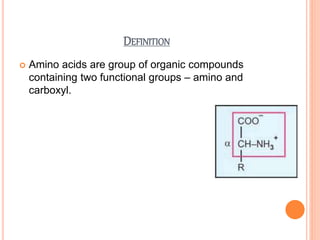
 Amino acids are group of organic compounds
containing two functional groups – amino and
carboxyl.
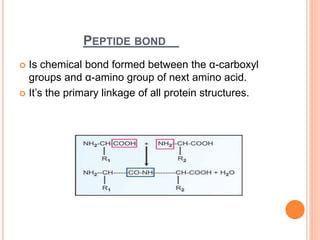
PEPTIDE BOND
 Is chemical bond formed between the α-carboxyl
groups and α-amino group of next amino acid.
 It’s the primary linkage of all protein structures.
NON STANDARD AMINO ACIDS:
 Amino acids can b classed as standard amino acids and
non standard amino acids.
 Of 300 amino acids human body codes 20 amino acids.
 These although never incorporated into structure of protein
, but play several biological role.
 These include :
D-amino acids: bact cell wall, antibiotics
Non-protein amino acids: taurine,homocysteine.etc.,
Amino acid derivatives: GABA, DOPA, hydroxy proline &
hydroxy lysine.
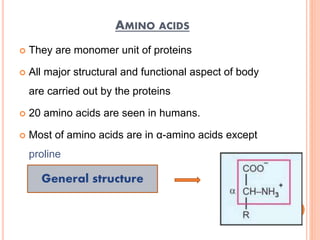
AMINO ACIDS
 They are monomer unit of proteins
 All major structural and functional aspect of body
are carried out by the proteins
 20 amino acids are seen in humans.
 Most of amino acids are in α-amino acids except
proline
General structure
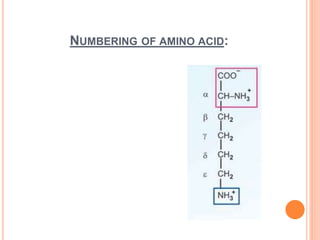
NUMBERING OF AMINO ACID:
ABBREVIATIONS & SYMBOLS FOR AMINO
ACIDS
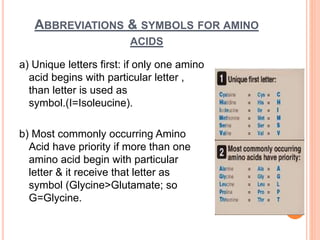
a) Unique letters first: if only one amino
acid begins with particular letter ,
than letter is used as
symbol.(I=Isoleucine).
b) Most commonly occurring Amino
Acid have priority if more than one
amino acid begin with particular
letter & it receive that letter as
symbol (Glycine>Glutamate; so
G=Glycine.
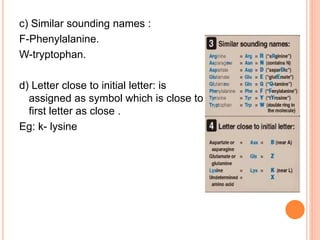
c) Similar sounding names :
F-Phenylalanine.
W-tryptophan.
d) Letter close to initial letter: is
assigned as symbol which is close to
first letter as close .
Eg: k- lysine
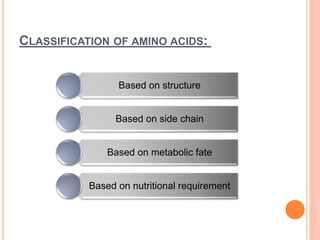
CLASSIFICATION OF AMINO ACIDS:
Based on structure
Based on side chain
Based on metabolic fate
Based on nutritional requirement
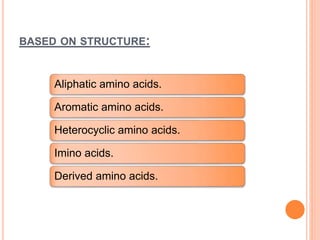
BASED ON STRUCTURE:
Aliphatic amino acids.
Aromatic amino acids.
Heterocyclic amino acids.
Imino acids.
Derived amino acids.
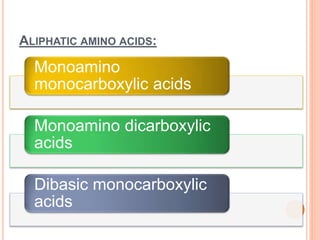
ALIPHATIC AMINO ACIDS:
Monoamino
monocarboxylic acids
Monoamino dicarboxylic
acids
Dibasic monocarboxylic
acids
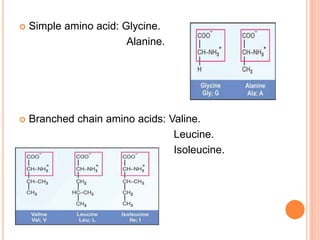
 Simple amino acid: Glycine.
Alanine.
 Branched chain amino acids: Valine.
Leucine.
Isoleucine.
 Hydroxyamino acids: Serine.
Threonine.
 Sulfur containing amino acids: Cysteine.
methionine.
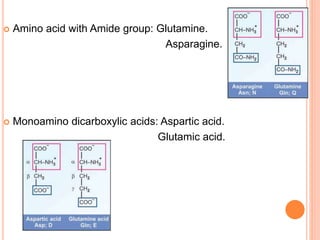
 Amino acid with Amide group: Glutamine.
Asparagine.
 Monoamino dicarboxylic acids: Aspartic acid.
Glutamic acid.
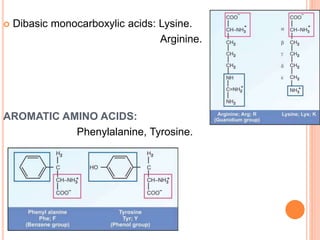
 Dibasic monocarboxylic acids: Lysine.
Arginine.
AROMATIC AMINO ACIDS:
Phenylalanine, Tyrosine.
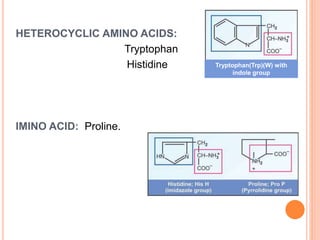
HETEROCYCLIC AMINO ACIDS:
Tryptophan
Histidine
IMINO ACID: Proline.
Tryptophan(Trp)(W) with
indole group
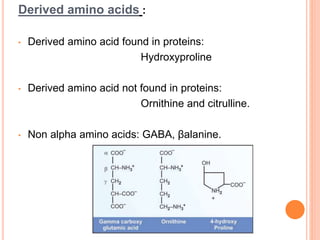
Derived amino acids :
• Derived amino acid found in proteins:
Hydroxyproline
• Derived amino acid not found in proteins:
Ornithine and citrulline.
• Non alpha amino acids: GABA, βalanine.
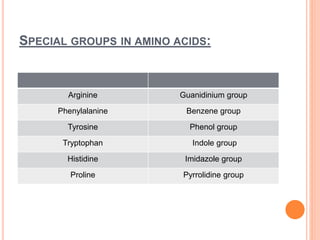
SPECIAL GROUPS IN AMINO ACIDS:
Arginine Guanidinium group
Phenylalanine Benzene group
Tyrosine Phenol group
Tryptophan Indole group
Histidine Imidazole group
Proline Pyrrolidine group
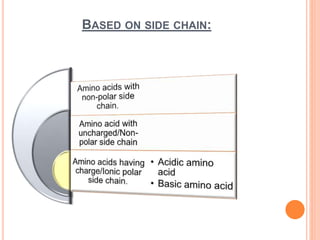
BASED ON SIDE CHAIN:
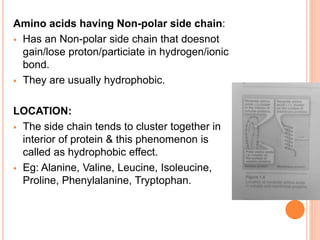
Amino acids having Non-polar side chain:
 Has an Non-polar side chain that doesnot
gain/lose proton/particiate in hydrogen/ionic
bond.
 They are usually hydrophobic.
LOCATION:
 The side chain tends to cluster together in
interior of protein & this phenomenon is
called as hydrophobic effect.
 Eg: Alanine, Valine, Leucine, Isoleucine,
Proline, Phenylalanine, Tryptophan.
Amino acids with uncharged/Non-ionic polar:
 These are with ZERO net charge at neutral pH .
 These amino acids are hydrophilic.
 eg: Glycine, Serine, Threonine & Asparagine.
Amino acids having charged/Ionic polar side
chain:
a)Acidic amino acid: they are negatively charge on R
group. Eg: Aspartic acid.
Glutamic acid.
b) Basic amino acids: they have positive charge on R
group. Eg: Lysine.
Argenine.
Histidine.
BASED ON METABOLIC FATE:
a) Purely ketogenic: converted to ketone bodies (fat
can be synthesized from these amino acids).
Eg:Leucine
b) Both ketogenic & glucogenic: Lysine, isoleucine,
Phenylalanine, Tyrosine, Tryptophan are partially
ketogenic & glucogenic.
c) Purely glucogenic: all remaining 14 amino acids
are glucogenic as they enter only into the
glucogenic pathway.
BASED ON NUTRITIONAL REQUIREMENT:
Essential/indispensable
 Cannot be synthesized by
the body.
 Needed to be supplied in
diet.
 Phenylalanine, Valine,
Threonine, Trptophan,
lsoleucine, Methionine,
Leusine, Lysine
 Non-essential
 they can be synthesized by
body & need not to be
supplemented.
 Alanine, Aspargine,
Aspartate, Glutamate,
Glutamine, Tyrosine,
Serine, Proline, Glycine,
Cysteine.
 Semi-essential amino acids: they are synthesized by the
adults , but the growing children need to be supplemented
in food . They are
:Arginine
Histidine.
 Conditional essential amino acids: when person suffers
from chronic illness he lose ability to manufacture enough
Non-essential amino acids & hence need to be
supplemented.
- Arginine, Glycine, Cysteine, Tyrosine, Proline,
Glutamine & Taurine.
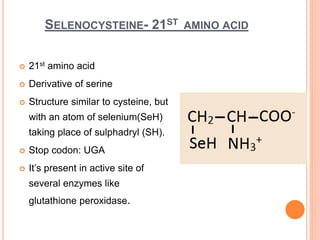
SELENOCYSTEINE- 21ST AMINO ACID
 21st amino acid
 Derivative of serine
 Structure similar to cysteine, but
with an atom of selenium(SeH)
taking place of sulphadryl (SH).
 Stop codon: UGA
 It’s present in active site of
several enzymes like
glutathione peroxidase.
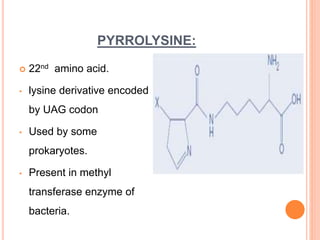
PYRROLYSINE:
 22nd amino acid.
• lysine derivative encoded
by UAG codon
• Used by some
prokaryotes.
• Present in methyl
transferase enzyme of
bacteria.
PROPERTIES OF AMINO ACIDS:
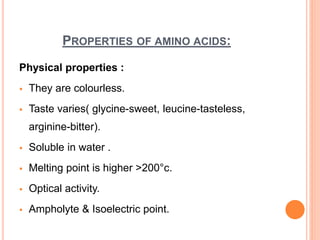
Physical properties :
 They are colourless.
 Taste varies( glycine-sweet, leucine-tasteless,
arginine-bitter).
 Soluble in water .
 Melting point is higher >200°c.
 Optical activity.
 Ampholyte & Isoelectric point.
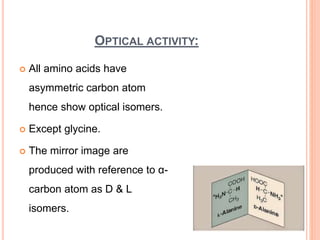
OPTICAL ACTIVITY:
 All amino acids have
asymmetric carbon atom
hence show optical isomers.
 Except glycine.
 The mirror image are
produced with reference to α-
carbon atom as D & L
isomers.
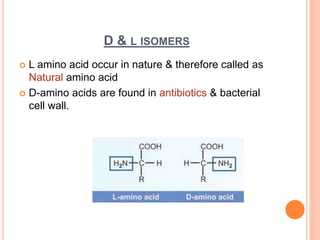
D & L ISOMERS
 L amino acid occur in nature & therefore called as
Natural amino acid
 D-amino acids are found in antibiotics & bacterial
cell wall.
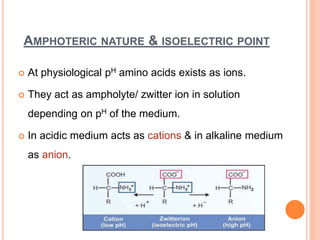
AMPHOTERIC NATURE & ISOELECTRIC POINT
 At physiological pH amino acids exists as ions.
 They act as ampholyte/ zwitter ion in solution
depending on pH of the medium.
 In acidic medium acts as cations & in alkaline medium
as anion.
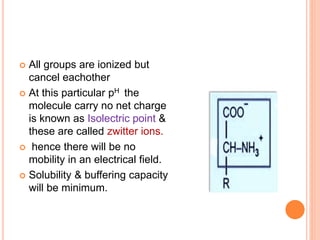
 All groups are ionized but
cancel eachother
 At this particular pH the
molecule carry no net charge
is known as Isolectric point &
these are called zwitter ions.
 hence there will be no
mobility in an electrical field.
 Solubility & buffering capacity
will be minimum.
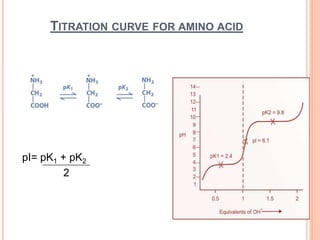
TITRATION CURVE FOR AMINO ACID
pI= pK1 + pK2
2
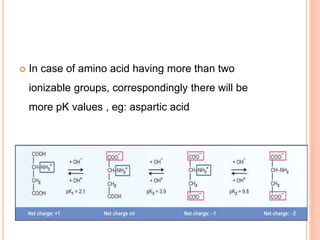
 In case of amino acid having more than two
ionizable groups, correspondingly there will be
more pK values , eg: aspartic acid
Features of a molecule at iso-electric point:
 molecule minimally soluble & maximally
precipitated.
 Viscosity of substance is minimum.
 Buffering capacity is at its minimum.
 The conductivity & osmotic pressure are at
minimum.
 Molecule is electrically neutral.
CHEMICAL REACTIONS
Due to carboxyl group:
1. amino acids form salts (COONa) with bases &
ester (-COOR’ ) with alcohol.
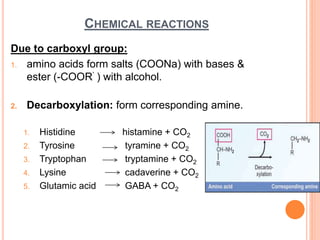
2. Decarboxylation: form corresponding amine.
1. Histidine histamine + CO2
2. Tyrosine tyramine + CO2
3. Tryptophan tryptamine + CO2
4. Lysine cadaverine + CO2
5. Glutamic acid GABA + CO2
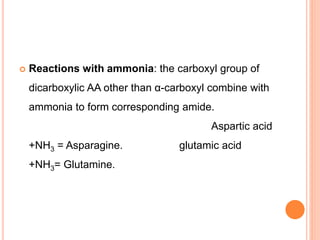
 Reactions with ammonia: the carboxyl group of
dicarboxylic AA other than α-carboxyl combine with
ammonia to form corresponding amide.
Aspartic acid
+NH3 = Asparagine. glutamic acid
+NH3= Glutamine.
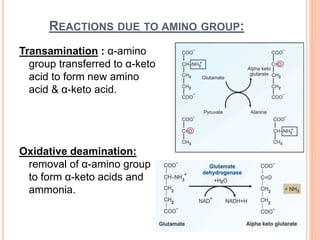
REACTIONS DUE TO AMINO GROUP:
Transamination : α-amino
group transferred to α-keto
acid to form new amino
acid & α-keto acid.
Oxidative deamination:
removal of α-amino group
to form α-keto acids and
ammonia.
Formation of carbamino compound: in alkaline pH
CO2 adds to α-amino group to form carbamino
compound. It serves transport of CO2 by
hemoglobin.
Hb-NH2 Hb-NH-COOH
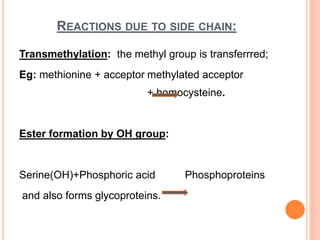
REACTIONS DUE TO SIDE CHAIN:
Transmethylation: the methyl group is transferrred;
Eg: methionine + acceptor methylated acceptor
+ homocysteine.
Ester formation by OH group:
Serine(OH)+Phosphoric acid Phosphoproteins
and also forms glycoproteins.
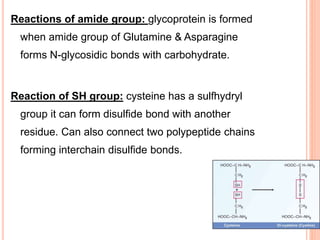
Reactions of amide group: glycoprotein is formed
when amide group of Glutamine & Asparagine
forms N-glycosidic bonds with carbohydrate.
Reaction of SH group: cysteine has a sulfhydryl
group it can form disulfide bond with another
residue. Can also connect two polypeptide chains
forming interchain disulfide bonds.
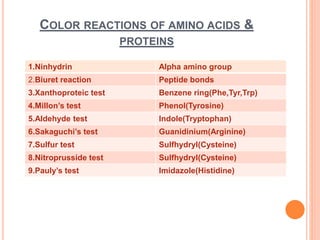
COLOR REACTIONS OF AMINO ACIDS &
PROTEINS
1.Ninhydrin Alpha amino group
2.Biuret reaction Peptide bonds
3.Xanthoproteic test Benzene ring(Phe,Tyr,Trp)
4.Millon’s test Phenol(Tyrosine)
5.Aldehyde test Indole(Tryptophan)
6.Sakaguchi’s test Guanidinium(Arginine)
7.Sulfur test Sulfhydryl(Cysteine)
8.Nitroprusside test Sulfhydryl(Cysteine)
9.Pauly’s test Imidazole(Histidine)
AMINO ACID DERIVATIVES OF IMPORTANCE
GABA:
 Derivative of glutamic acid & dopamine.
 A neurotransmitter
 GABA pentin can pass BBB & form GABA in brain.
Hitamine:
 Synthesized from histidine.
 Mediator in allergic reactions.
Thyroxine:
 From tyrosine.
 An thyroid hormone.
Cycloserine:
 Derivative of serine
 As an antituberculous drug
Histidine:
 Important in buffering.
Ornithine:
 & citrulline are derivative of arginine, essential for urea
synthesis.
REFERENCES:
 Text book of biochemistry- DM Vasudevan.
 Lippincott’s illustrated biochemistry.
 Biochemistry – U Satyanarayana.
Protein chemistry P1 by Dr. Anurag Yadav

Protein chemistry P1 by Dr. Anurag Yadav

  • 1.
    PROTEIN CHEMISTRY -I By Dr ANURAG YADAV Moderator Dr ARUN KUMAR K
  • 2.
    Content :  Definitionof amino acids  Definition of peptide bond  General structure of amino acids  Numbering of amino acids  Nomenclature of amino acids.  Classification of amino acids.  Properties of amino acids.  Biological importance of amino acid derivatives.
  • 3.
    OVERVIEW:  Proteins aremost abundant & functionally diverse molecule in living system. Virtually every life process depends on this class of molecules.  Enzymes & polypeptide hormones direct & regulate body metabolism.  In bone, protein collagen forms a frame work for deposition of salts.  Immunoglobulin's fight against infectious bacteria & viruses
  • 4.
    DEFINITION  Amino acidsare group of organic compounds containing two functional groups – amino and carboxyl.
  • 5.
    PEPTIDE BOND  Ischemical bond formed between the α-carboxyl groups and α-amino group of next amino acid.  It’s the primary linkage of all protein structures.
  • 6.
    NON STANDARD AMINOACIDS:  Amino acids can b classed as standard amino acids and non standard amino acids.  Of 300 amino acids human body codes 20 amino acids.  These although never incorporated into structure of protein , but play several biological role.  These include : D-amino acids: bact cell wall, antibiotics Non-protein amino acids: taurine,homocysteine.etc., Amino acid derivatives: GABA, DOPA, hydroxy proline & hydroxy lysine.
  • 7.
    AMINO ACIDS  Theyare monomer unit of proteins  All major structural and functional aspect of body are carried out by the proteins  20 amino acids are seen in humans.  Most of amino acids are in α-amino acids except proline General structure
  • 8.
  • 9.
    ABBREVIATIONS & SYMBOLSFOR AMINO ACIDS a) Unique letters first: if only one amino acid begins with particular letter , than letter is used as symbol.(I=Isoleucine). b) Most commonly occurring Amino Acid have priority if more than one amino acid begin with particular letter & it receive that letter as symbol (Glycine>Glutamate; so G=Glycine.
  • 10.
    c) Similar soundingnames : F-Phenylalanine. W-tryptophan. d) Letter close to initial letter: is assigned as symbol which is close to first letter as close . Eg: k- lysine
  • 11.
    CLASSIFICATION OF AMINOACIDS: Based on structure Based on side chain Based on metabolic fate Based on nutritional requirement
  • 12.
    BASED ON STRUCTURE: Aliphaticamino acids. Aromatic amino acids. Heterocyclic amino acids. Imino acids. Derived amino acids.
  • 13.
    ALIPHATIC AMINO ACIDS: Monoamino monocarboxylicacids Monoamino dicarboxylic acids Dibasic monocarboxylic acids
  • 14.
     Simple aminoacid: Glycine. Alanine.  Branched chain amino acids: Valine. Leucine. Isoleucine.
  • 15.
     Hydroxyamino acids:Serine. Threonine.  Sulfur containing amino acids: Cysteine. methionine.
  • 16.
     Amino acidwith Amide group: Glutamine. Asparagine.  Monoamino dicarboxylic acids: Aspartic acid. Glutamic acid.
  • 17.
     Dibasic monocarboxylicacids: Lysine. Arginine. AROMATIC AMINO ACIDS: Phenylalanine, Tyrosine.
  • 18.
    HETEROCYCLIC AMINO ACIDS: Tryptophan Histidine IMINOACID: Proline. Tryptophan(Trp)(W) with indole group
  • 19.
    Derived amino acids: • Derived amino acid found in proteins: Hydroxyproline • Derived amino acid not found in proteins: Ornithine and citrulline. • Non alpha amino acids: GABA, βalanine.
  • 20.
    SPECIAL GROUPS INAMINO ACIDS: Arginine Guanidinium group Phenylalanine Benzene group Tyrosine Phenol group Tryptophan Indole group Histidine Imidazole group Proline Pyrrolidine group
  • 21.
  • 22.
    Amino acids havingNon-polar side chain:  Has an Non-polar side chain that doesnot gain/lose proton/particiate in hydrogen/ionic bond.  They are usually hydrophobic. LOCATION:  The side chain tends to cluster together in interior of protein & this phenomenon is called as hydrophobic effect.  Eg: Alanine, Valine, Leucine, Isoleucine, Proline, Phenylalanine, Tryptophan.
  • 23.
    Amino acids withuncharged/Non-ionic polar:  These are with ZERO net charge at neutral pH .  These amino acids are hydrophilic.  eg: Glycine, Serine, Threonine & Asparagine.
  • 24.
    Amino acids havingcharged/Ionic polar side chain: a)Acidic amino acid: they are negatively charge on R group. Eg: Aspartic acid. Glutamic acid. b) Basic amino acids: they have positive charge on R group. Eg: Lysine. Argenine. Histidine.
  • 25.
    BASED ON METABOLICFATE: a) Purely ketogenic: converted to ketone bodies (fat can be synthesized from these amino acids). Eg:Leucine b) Both ketogenic & glucogenic: Lysine, isoleucine, Phenylalanine, Tyrosine, Tryptophan are partially ketogenic & glucogenic. c) Purely glucogenic: all remaining 14 amino acids are glucogenic as they enter only into the glucogenic pathway.
  • 26.
    BASED ON NUTRITIONALREQUIREMENT: Essential/indispensable  Cannot be synthesized by the body.  Needed to be supplied in diet.  Phenylalanine, Valine, Threonine, Trptophan, lsoleucine, Methionine, Leusine, Lysine  Non-essential  they can be synthesized by body & need not to be supplemented.  Alanine, Aspargine, Aspartate, Glutamate, Glutamine, Tyrosine, Serine, Proline, Glycine, Cysteine.
  • 27.
     Semi-essential aminoacids: they are synthesized by the adults , but the growing children need to be supplemented in food . They are :Arginine Histidine.  Conditional essential amino acids: when person suffers from chronic illness he lose ability to manufacture enough Non-essential amino acids & hence need to be supplemented. - Arginine, Glycine, Cysteine, Tyrosine, Proline, Glutamine & Taurine.
  • 28.
    SELENOCYSTEINE- 21ST AMINOACID  21st amino acid  Derivative of serine  Structure similar to cysteine, but with an atom of selenium(SeH) taking place of sulphadryl (SH).  Stop codon: UGA  It’s present in active site of several enzymes like glutathione peroxidase.
  • 29.
    PYRROLYSINE:  22nd aminoacid. • lysine derivative encoded by UAG codon • Used by some prokaryotes. • Present in methyl transferase enzyme of bacteria.
  • 30.
    PROPERTIES OF AMINOACIDS: Physical properties :  They are colourless.  Taste varies( glycine-sweet, leucine-tasteless, arginine-bitter).  Soluble in water .  Melting point is higher >200°c.  Optical activity.  Ampholyte & Isoelectric point.
  • 31.
    OPTICAL ACTIVITY:  Allamino acids have asymmetric carbon atom hence show optical isomers.  Except glycine.  The mirror image are produced with reference to α- carbon atom as D & L isomers.
  • 32.
    D & LISOMERS  L amino acid occur in nature & therefore called as Natural amino acid  D-amino acids are found in antibiotics & bacterial cell wall.
  • 33.
    AMPHOTERIC NATURE &ISOELECTRIC POINT  At physiological pH amino acids exists as ions.  They act as ampholyte/ zwitter ion in solution depending on pH of the medium.  In acidic medium acts as cations & in alkaline medium as anion.
  • 34.
     All groupsare ionized but cancel eachother  At this particular pH the molecule carry no net charge is known as Isolectric point & these are called zwitter ions.  hence there will be no mobility in an electrical field.  Solubility & buffering capacity will be minimum.
  • 35.
    TITRATION CURVE FORAMINO ACID pI= pK1 + pK2 2
  • 36.
     In caseof amino acid having more than two ionizable groups, correspondingly there will be more pK values , eg: aspartic acid
  • 37.
    Features of amolecule at iso-electric point:  molecule minimally soluble & maximally precipitated.  Viscosity of substance is minimum.  Buffering capacity is at its minimum.  The conductivity & osmotic pressure are at minimum.  Molecule is electrically neutral.
  • 38.
    CHEMICAL REACTIONS Due tocarboxyl group: 1. amino acids form salts (COONa) with bases & ester (-COOR’ ) with alcohol. 2. Decarboxylation: form corresponding amine. 1. Histidine histamine + CO2 2. Tyrosine tyramine + CO2 3. Tryptophan tryptamine + CO2 4. Lysine cadaverine + CO2 5. Glutamic acid GABA + CO2
  • 39.
     Reactions withammonia: the carboxyl group of dicarboxylic AA other than α-carboxyl combine with ammonia to form corresponding amide. Aspartic acid +NH3 = Asparagine. glutamic acid +NH3= Glutamine.
  • 40.
    REACTIONS DUE TOAMINO GROUP: Transamination : α-amino group transferred to α-keto acid to form new amino acid & α-keto acid. Oxidative deamination: removal of α-amino group to form α-keto acids and ammonia.
  • 41.
    Formation of carbaminocompound: in alkaline pH CO2 adds to α-amino group to form carbamino compound. It serves transport of CO2 by hemoglobin. Hb-NH2 Hb-NH-COOH
  • 42.
    REACTIONS DUE TOSIDE CHAIN: Transmethylation: the methyl group is transferrred; Eg: methionine + acceptor methylated acceptor + homocysteine. Ester formation by OH group: Serine(OH)+Phosphoric acid Phosphoproteins and also forms glycoproteins.
  • 43.
    Reactions of amidegroup: glycoprotein is formed when amide group of Glutamine & Asparagine forms N-glycosidic bonds with carbohydrate. Reaction of SH group: cysteine has a sulfhydryl group it can form disulfide bond with another residue. Can also connect two polypeptide chains forming interchain disulfide bonds.
  • 44.
    COLOR REACTIONS OFAMINO ACIDS & PROTEINS 1.Ninhydrin Alpha amino group 2.Biuret reaction Peptide bonds 3.Xanthoproteic test Benzene ring(Phe,Tyr,Trp) 4.Millon’s test Phenol(Tyrosine) 5.Aldehyde test Indole(Tryptophan) 6.Sakaguchi’s test Guanidinium(Arginine) 7.Sulfur test Sulfhydryl(Cysteine) 8.Nitroprusside test Sulfhydryl(Cysteine) 9.Pauly’s test Imidazole(Histidine)
  • 45.
    AMINO ACID DERIVATIVESOF IMPORTANCE GABA:  Derivative of glutamic acid & dopamine.  A neurotransmitter  GABA pentin can pass BBB & form GABA in brain. Hitamine:  Synthesized from histidine.  Mediator in allergic reactions.
  • 46.
    Thyroxine:  From tyrosine. An thyroid hormone. Cycloserine:  Derivative of serine  As an antituberculous drug Histidine:  Important in buffering. Ornithine:  & citrulline are derivative of arginine, essential for urea synthesis.
  • 47.
    REFERENCES:  Text bookof biochemistry- DM Vasudevan.  Lippincott’s illustrated biochemistry.  Biochemistry – U Satyanarayana.