Amino Acids
Ms. Jigisha Pancholi
Head
Dept. of Biochemistry &
Microbiology
Indian Instittute of Ayurvedic
Pharmaceutical Sciences
Gujarat Ayurved University
Jamnagar
INTRODUCTION
 Proteins are of paramount importance for
biological systems.
 All the major structural and functional aspects
of the body are carried out by protein
molecules.
 All proteins are polymers of amino acids.
Definition and Structure
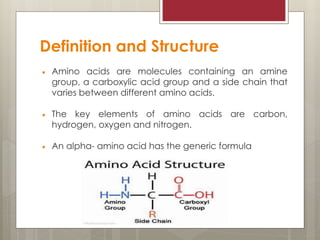
 Amino acids are molecules containing an amine
group, a carboxylic acid group and a side chain that
varies between different amino acids.
 The key elements of amino acids are carbon,
hydrogen, oxygen and nitrogen.
 An alpha- amino acid has the generic formula
INTRODUCTION
 Amino acids are critical to life and have many
functions in metabolism. One particularly important
function is to serve as the building blocks of proteins,
which are linear chains of amino acids.
 Amino acids can be linked together in various
sequences to form a vast variety of proteins.
 Twenty amino acids are naturally incorporated into
polypeptides and are called proteinogenic or standard
amino acids.
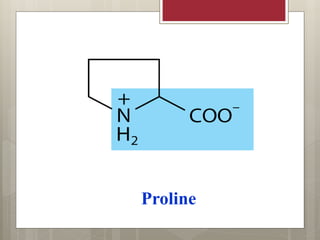
Proline
CLASSIFICATION
a. Classification based on structure
b. Classification based in side chain characters
c. Classification based on metabolic fate
d. Classification based on nutritional
requirements
a. Classification based on
structure
A. Amino acids with aliphatic side chains
a. Mono amino mono carboxylic acids

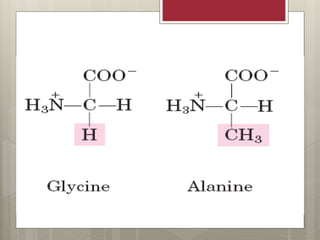
i. Simple amino acid: Glycine, Alanine

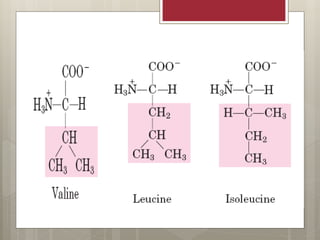
ii. Branched chain amino acid: Valine, Leucine, Isoleucine

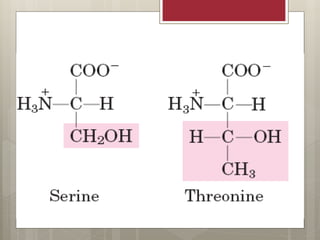
iii. Amino acids containing hydroxyl groups: Serine, Threonine

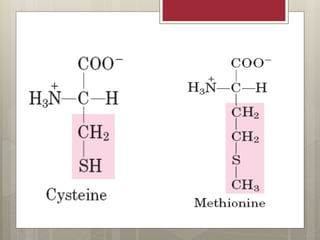
iv. Amino acids containing sulphur group: Cysteine, Methionine

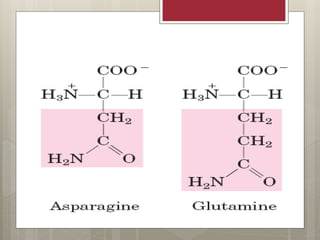
v. Amino acids with amide group: Asparagine, Glutamine
a. Classification based on
structure
b. Mono amino di carboxylic acids
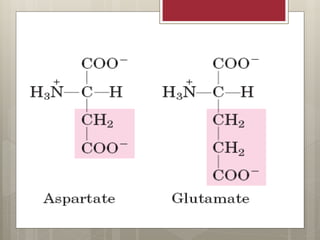
Aspartic acid, glutamic acid
c. Di amino mono carboxylic acid
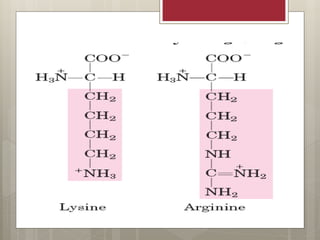
Lysine, arginine
a. Classification based on
structure
B. Aromatic amino acid
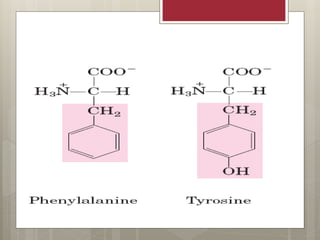
Phenylalanine, tyrosine
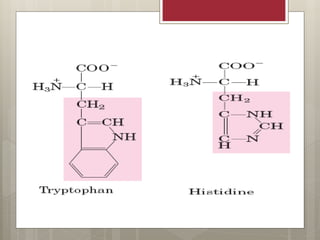
C. Heterocyclic amino acid
Tryptophan, Histidine
D. Imino acid
Proline
a. Classification based on
structure
E. Derived amino acids
i. Derived amino acid found in proteins: After the synthesis
of proteins, some of the amino acids are modified e.g., hydroxy
proline and hydroxy lysine are important components of
collagen.
Gamma carboxylation of glutamic acid residues of proteins
is important for clotting process.
In ribosomal proteins and histones, amino acids are extensively
methylated and acetylated.
a. Classification based on
structure
E. Derived amino acids
ii. Derived amino acid not seen in proteins: Some derived amino
acids are seen free in cells, e.g. Ornithine, citrulline, homocysteine
are produced during the metabolism of amino acids.
Thyroxine is derived from tyrosine.
Iii. Non- alpha amino acids: Gamma amino butyric acid is derived
from glutamic acid. Beta alanine is a constituent of pantothenic acid
and coenzyme A.
b. Classification based on side
chain characters
i. Amino acids with non polar side chains
 Alanine, Valine, Leucine, Isoleucine, Methionine, Proline,
Phenylalanine and Tryptophan.
 These are hydrophobic and lipophilic.
ii. Amino acids with uncharged or non ionic polar side chains
 Glycine, Serine, Threonine, Cysteine, Tyrosine, Glutamine
and asparagine belong to this group.
 These are hydrophilic in nature.
b. Classification based in side
chain characters
iii. Amino acids with polar charged side chain
Acidic amino acid: They have a negative charge on R
group. Example: Aspartic acid and Glutamic acid.
Basic amino acid: They have a positive charge on R
group. Example: Lysine, arginine and histidine.
c. Classification based on
metabolic fate
i. Purely ketogenic: Leucine
ii. Ketogenic and glucogenic: Lysine, Isoleucine,
Phenylalanine, Tyrosine and tryptophan are
partially ketogenic and partially glucogenic.
iii. Purely glucogenic: All the remaining 14 amino
acids are purely glucogenic.
d. Classification based on
nutritional requirements
i. Essential amino acid:
 The amino acids are not synthesised in the body and so they have to
be taken in the food for normal growth.
 Isoleucine, Leucine, Threonine, Lysine, Methionine, Phenylalanine,
Tryptophan and Valine.
ii. Semi essential amino acid:
 Histidine and arginine.
 Growing children requires them in food.
 But they are not essential for the adults.
Iii. Non essential amino acids:
 They are synthesized by the body and need not be taken in food.
 The remaining 10 amino acids are non essential.
Properties of amino acids
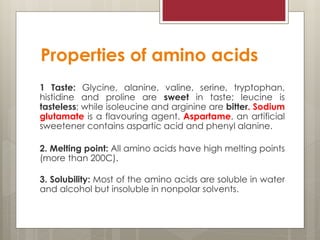
1 Taste: Glycine, alanine, valine, serine, tryptophan,
histidine and proline are sweet in taste; leucine is
tasteless; while isoleucine and arginine are bitter. Sodium
glutamate is a flavouring agent. Aspartame, an artificial
sweetener contains aspartic acid and phenyl alanine.
2. Melting point: All amino acids have high melting points
(more than 200C).
3. Solubility: Most of the amino acids are soluble in water
and alcohol but insoluble in nonpolar solvents.
Isomerism
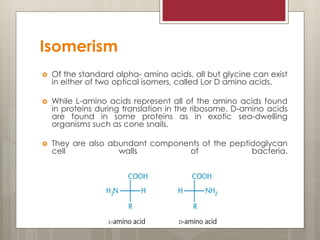
 Of the standard alpha- amino acids, all but glycine can exist
in either of two optical isomers, called Lor D amino acids.
 While L-amino acids represent all of the amino acids found
in proteins during translation in the ribosome, D-amino acids
are found in some proteins as in exotic sea-dwelling
organisms such as cone snails.
 They are also abundant components of the peptidoglycan
cell walls of bacteria.
Optical activity
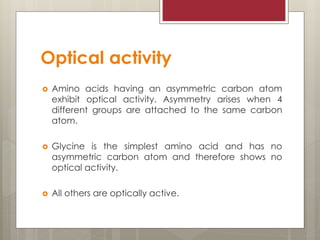
 Amino acids having an asymmetric carbon atom
exhibit optical activity. Asymmetry arises when 4
different groups are attached to the same carbon
atom.
 Glycine is the simplest amino acid and has no
asymmetric carbon atom and therefore shows no
optical activity.
 All others are optically active.
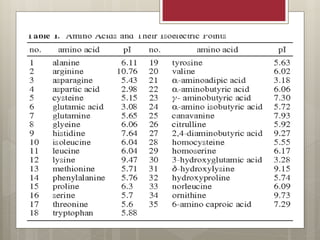
Iso- electric point
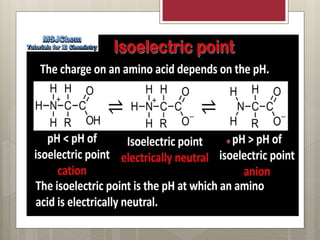
 Amino acids can exist as ampholytes or zwitter ions in
solution, depending on the pH of the medium.
 The pH at which the molecule carries no net charge
is known as iso electric point or iso-electric pH (Pi or
p H (I)).
 In acidic solution they are cationic in form and in
alkaline solution they behave as anions.
 At iso-electric pH, they will carry no net charge, all
the groups are ionized but the charges will cancel
each other.
 Therefore, at this point, there is no mobility in an
electric field.
 Solubility and buffering capacity will be minimum at iso-
electric pH.
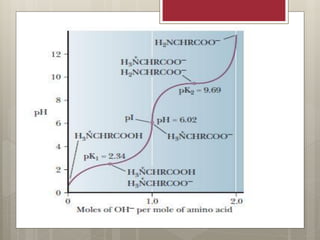
 To such a solution, if we add hydrochloric acid drop by drop,
at a particular pH, 50 % of the molecules are in cationic form
and 50% in the zwitter ion form. This pH is pK1 (with regard to
-COOH).
 If more HCl is added, more molecules become cationic in
nature and solubility increases.
 On the other hand, if we titrate the solution from iso-electric
point with NaOH, molecules acquire the anionic form. When
50 % of molecules are anions, that pH is called as pK2 (with
respect to NH2).
Materials Required
 0.1M Hydrochloric acid
 0.1M Sodium Hydroxide
 pH Meter
 0.1M amino acid solution
 Burette -2
 Beaker
 Stirrer
 Standard Buffer of pH=4, pH= 7, pH=10
Working steps
 Pipette out 20ml of the amino acid solution into a 100ml beaker.
 Standardize the pH meter using the standard buffer solutions.
 Determine the pH of the amino acid solution.
 Add 0.3ml of 0.1M HCl from the burette and record the pH after
each addition.
 Continue adding the acid until the pH falls to 1.6
 Wash thoroughly the pH electrode in distilled water.
 Take 20 ml of amino acid solution in another beaker and check its
pH.
 Now titrate the amino acid solution by adding 0.3ml of 0.1M NaOH
until the pH reaches 12.5.
 Plot the titration curve using the values recorded and find the pKa
values.
 For mono amino mono carboxylic amino acids,
pI = pK1+ pK2
2
Example: pI of glycine = 2.4 + 9.8 = 6.1
2
 From the graph, it is evident that the buffering capacity is
maximum in and around pK1 and pK2 and minimum at pI.
 In the case of amino acids having more than two ionizable
groups, correspondingly there will be more pK values, e.g.
Aspartic acid.
 The pK value of histidine is 6.1, and therefore effective as a
buffer at the physiological pH of 7.4.
 The buffering capacity of plasma proteins and
haemoglobin is mainly due to histidine residue.
Chemical reactions
of
amino acids
Reactions due to carboxyl
group
1. Decarboxylation: The amino acids undergo decarboxylation to
form corresponding amine.
 Histidine --> histamine + CO2 [Involved in inflammatory response]
 Tyrosine --> tyramine + CO2 [Regulates blood pressure]
 Tryptophan --> tryptamine + CO2 [Neurotransmitter]
 Lysine --> Cadaverine + CO2 [Fowl smell of dead animal tissue]
 Glutamic acid --> GABA + CO2 [Neurotransmitter]
2. Amide formation: The -COOH group can
combine with ammonia to form
corresponding amide.
 Aspartic acid + NH3 --> Asparagine
 Glutamic acid + NH3 --> Glutamine
Reactions due to amine group
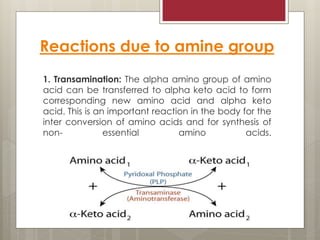
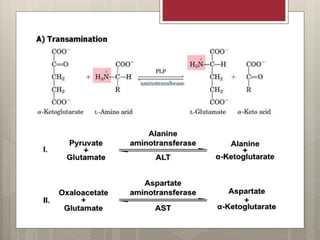
1. Transamination: The alpha amino group of amino
acid can be transferred to alpha keto acid to form
corresponding new amino acid and alpha keto
acid. This is an important reaction in the body for the
inter conversion of amino acids and for synthesis of
non- essential amino acids.
Reactions due to amine group
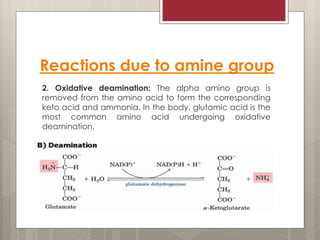
2. Oxidative deamination: The alpha amino group is
removed from the amino acid to form the corresponding
keto acid and ammonia. In the body, glutamic acid is the
most common amino acid undergoing oxidative
deamination.
Reactions due to amine group
3. Formation of carbamino compound: Carbon dioxide
adds to the alpha amino group of amino acid to form
carbamino compounds. The reaction occurs at alkaline
pH and serves as a mechanism for transport of carbon
dioxide from tissues to lungs.
Hb- NH2 + CO2 --> Hb- NH – COOH
Reactions due to side chains
1. Transmethylation: The methyl group of
methionine is transferred to the acceptor. The
universal methyl donor is S- adenosyl methionine
(SAM)
Methionine + Acceptor --> Methylated acceptor +
Homocysteine
2. Ester formation by OH group: The hydroxyl groups
of serine and threonine form esters with phosphoric
acid and form phosphoproteins. Also they are
involved in o – linked glycoproteins.
3. Reaction of the amide group: The amide
group of asparagine and glutamine are
involved in N- linked glycoproteins.
4. Reactions due to SH group: Cysteine has a
sulfhydryl group and it can form disulfide bond
with another cysteine residue to form cystine.
They are necessary for the formation of disulfide
bonds to maintain a stable structure of many
proteins.
THANK YOU

Amino acids

  • 1.
    Amino Acids Ms. JigishaPancholi Head Dept. of Biochemistry & Microbiology Indian Instittute of Ayurvedic Pharmaceutical Sciences Gujarat Ayurved University Jamnagar
  • 2.
    INTRODUCTION  Proteins areof paramount importance for biological systems.  All the major structural and functional aspects of the body are carried out by protein molecules.  All proteins are polymers of amino acids.
  • 3.
    Definition and Structure Amino acids are molecules containing an amine group, a carboxylic acid group and a side chain that varies between different amino acids.  The key elements of amino acids are carbon, hydrogen, oxygen and nitrogen.  An alpha- amino acid has the generic formula
  • 4.
    INTRODUCTION  Amino acidsare critical to life and have many functions in metabolism. One particularly important function is to serve as the building blocks of proteins, which are linear chains of amino acids.  Amino acids can be linked together in various sequences to form a vast variety of proteins.  Twenty amino acids are naturally incorporated into polypeptides and are called proteinogenic or standard amino acids.
  • 14.
  • 15.
    CLASSIFICATION a. Classification basedon structure b. Classification based in side chain characters c. Classification based on metabolic fate d. Classification based on nutritional requirements
  • 16.
    a. Classification basedon structure A. Amino acids with aliphatic side chains a. Mono amino mono carboxylic acids  i. Simple amino acid: Glycine, Alanine  ii. Branched chain amino acid: Valine, Leucine, Isoleucine  iii. Amino acids containing hydroxyl groups: Serine, Threonine  iv. Amino acids containing sulphur group: Cysteine, Methionine  v. Amino acids with amide group: Asparagine, Glutamine
  • 17.
    a. Classification basedon structure b. Mono amino di carboxylic acids Aspartic acid, glutamic acid c. Di amino mono carboxylic acid Lysine, arginine
  • 18.
    a. Classification basedon structure B. Aromatic amino acid Phenylalanine, tyrosine C. Heterocyclic amino acid Tryptophan, Histidine D. Imino acid Proline
  • 19.
    a. Classification basedon structure E. Derived amino acids i. Derived amino acid found in proteins: After the synthesis of proteins, some of the amino acids are modified e.g., hydroxy proline and hydroxy lysine are important components of collagen. Gamma carboxylation of glutamic acid residues of proteins is important for clotting process. In ribosomal proteins and histones, amino acids are extensively methylated and acetylated.
  • 20.
    a. Classification basedon structure E. Derived amino acids ii. Derived amino acid not seen in proteins: Some derived amino acids are seen free in cells, e.g. Ornithine, citrulline, homocysteine are produced during the metabolism of amino acids. Thyroxine is derived from tyrosine. Iii. Non- alpha amino acids: Gamma amino butyric acid is derived from glutamic acid. Beta alanine is a constituent of pantothenic acid and coenzyme A.
  • 21.
    b. Classification basedon side chain characters i. Amino acids with non polar side chains  Alanine, Valine, Leucine, Isoleucine, Methionine, Proline, Phenylalanine and Tryptophan.  These are hydrophobic and lipophilic. ii. Amino acids with uncharged or non ionic polar side chains  Glycine, Serine, Threonine, Cysteine, Tyrosine, Glutamine and asparagine belong to this group.  These are hydrophilic in nature.
  • 22.
    b. Classification basedin side chain characters iii. Amino acids with polar charged side chain Acidic amino acid: They have a negative charge on R group. Example: Aspartic acid and Glutamic acid. Basic amino acid: They have a positive charge on R group. Example: Lysine, arginine and histidine.
  • 23.
    c. Classification basedon metabolic fate i. Purely ketogenic: Leucine ii. Ketogenic and glucogenic: Lysine, Isoleucine, Phenylalanine, Tyrosine and tryptophan are partially ketogenic and partially glucogenic. iii. Purely glucogenic: All the remaining 14 amino acids are purely glucogenic.
  • 24.
    d. Classification basedon nutritional requirements i. Essential amino acid:  The amino acids are not synthesised in the body and so they have to be taken in the food for normal growth.  Isoleucine, Leucine, Threonine, Lysine, Methionine, Phenylalanine, Tryptophan and Valine. ii. Semi essential amino acid:  Histidine and arginine.  Growing children requires them in food.  But they are not essential for the adults. Iii. Non essential amino acids:  They are synthesized by the body and need not be taken in food.  The remaining 10 amino acids are non essential.
  • 25.
    Properties of aminoacids 1 Taste: Glycine, alanine, valine, serine, tryptophan, histidine and proline are sweet in taste; leucine is tasteless; while isoleucine and arginine are bitter. Sodium glutamate is a flavouring agent. Aspartame, an artificial sweetener contains aspartic acid and phenyl alanine. 2. Melting point: All amino acids have high melting points (more than 200C). 3. Solubility: Most of the amino acids are soluble in water and alcohol but insoluble in nonpolar solvents.
  • 26.
    Isomerism  Of thestandard alpha- amino acids, all but glycine can exist in either of two optical isomers, called Lor D amino acids.  While L-amino acids represent all of the amino acids found in proteins during translation in the ribosome, D-amino acids are found in some proteins as in exotic sea-dwelling organisms such as cone snails.  They are also abundant components of the peptidoglycan cell walls of bacteria.
  • 27.
    Optical activity  Aminoacids having an asymmetric carbon atom exhibit optical activity. Asymmetry arises when 4 different groups are attached to the same carbon atom.  Glycine is the simplest amino acid and has no asymmetric carbon atom and therefore shows no optical activity.  All others are optically active.
  • 29.
    Iso- electric point Amino acids can exist as ampholytes or zwitter ions in solution, depending on the pH of the medium.  The pH at which the molecule carries no net charge is known as iso electric point or iso-electric pH (Pi or p H (I)).  In acidic solution they are cationic in form and in alkaline solution they behave as anions.  At iso-electric pH, they will carry no net charge, all the groups are ionized but the charges will cancel each other.  Therefore, at this point, there is no mobility in an electric field.
  • 30.
     Solubility andbuffering capacity will be minimum at iso- electric pH.  To such a solution, if we add hydrochloric acid drop by drop, at a particular pH, 50 % of the molecules are in cationic form and 50% in the zwitter ion form. This pH is pK1 (with regard to -COOH).  If more HCl is added, more molecules become cationic in nature and solubility increases.  On the other hand, if we titrate the solution from iso-electric point with NaOH, molecules acquire the anionic form. When 50 % of molecules are anions, that pH is called as pK2 (with respect to NH2).
  • 31.
    Materials Required  0.1MHydrochloric acid  0.1M Sodium Hydroxide  pH Meter  0.1M amino acid solution  Burette -2  Beaker  Stirrer  Standard Buffer of pH=4, pH= 7, pH=10
  • 32.
    Working steps  Pipetteout 20ml of the amino acid solution into a 100ml beaker.  Standardize the pH meter using the standard buffer solutions.  Determine the pH of the amino acid solution.  Add 0.3ml of 0.1M HCl from the burette and record the pH after each addition.  Continue adding the acid until the pH falls to 1.6  Wash thoroughly the pH electrode in distilled water.  Take 20 ml of amino acid solution in another beaker and check its pH.  Now titrate the amino acid solution by adding 0.3ml of 0.1M NaOH until the pH reaches 12.5.  Plot the titration curve using the values recorded and find the pKa values.
  • 34.
     For monoamino mono carboxylic amino acids, pI = pK1+ pK2 2 Example: pI of glycine = 2.4 + 9.8 = 6.1 2  From the graph, it is evident that the buffering capacity is maximum in and around pK1 and pK2 and minimum at pI.  In the case of amino acids having more than two ionizable groups, correspondingly there will be more pK values, e.g. Aspartic acid.  The pK value of histidine is 6.1, and therefore effective as a buffer at the physiological pH of 7.4.  The buffering capacity of plasma proteins and haemoglobin is mainly due to histidine residue.
  • 36.
  • 37.
    Reactions due tocarboxyl group 1. Decarboxylation: The amino acids undergo decarboxylation to form corresponding amine.  Histidine --> histamine + CO2 [Involved in inflammatory response]  Tyrosine --> tyramine + CO2 [Regulates blood pressure]  Tryptophan --> tryptamine + CO2 [Neurotransmitter]  Lysine --> Cadaverine + CO2 [Fowl smell of dead animal tissue]  Glutamic acid --> GABA + CO2 [Neurotransmitter]
  • 38.
    2. Amide formation:The -COOH group can combine with ammonia to form corresponding amide.  Aspartic acid + NH3 --> Asparagine  Glutamic acid + NH3 --> Glutamine
  • 39.
    Reactions due toamine group 1. Transamination: The alpha amino group of amino acid can be transferred to alpha keto acid to form corresponding new amino acid and alpha keto acid. This is an important reaction in the body for the inter conversion of amino acids and for synthesis of non- essential amino acids.
  • 41.
    Reactions due toamine group 2. Oxidative deamination: The alpha amino group is removed from the amino acid to form the corresponding keto acid and ammonia. In the body, glutamic acid is the most common amino acid undergoing oxidative deamination.
  • 42.
    Reactions due toamine group 3. Formation of carbamino compound: Carbon dioxide adds to the alpha amino group of amino acid to form carbamino compounds. The reaction occurs at alkaline pH and serves as a mechanism for transport of carbon dioxide from tissues to lungs. Hb- NH2 + CO2 --> Hb- NH – COOH
  • 43.
    Reactions due toside chains 1. Transmethylation: The methyl group of methionine is transferred to the acceptor. The universal methyl donor is S- adenosyl methionine (SAM) Methionine + Acceptor --> Methylated acceptor + Homocysteine 2. Ester formation by OH group: The hydroxyl groups of serine and threonine form esters with phosphoric acid and form phosphoproteins. Also they are involved in o – linked glycoproteins.
  • 44.
    3. Reaction ofthe amide group: The amide group of asparagine and glutamine are involved in N- linked glycoproteins. 4. Reactions due to SH group: Cysteine has a sulfhydryl group and it can form disulfide bond with another cysteine residue to form cystine. They are necessary for the formation of disulfide bonds to maintain a stable structure of many proteins.
  • 45.