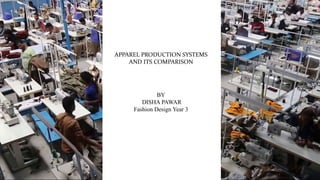
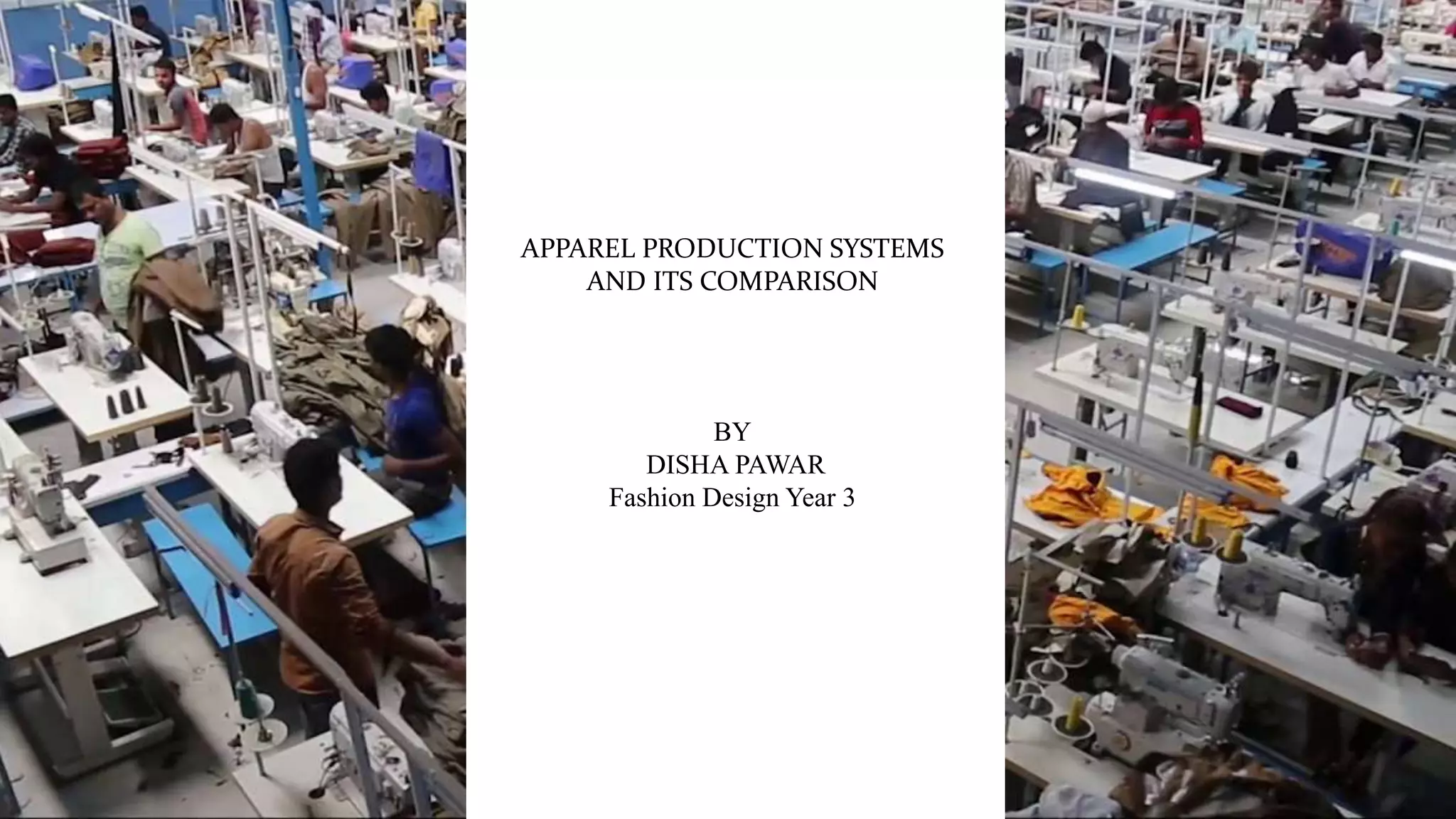
APPAREL PRODUCTION SYSTEMS
AND ITS COMPARISON
BY
DISHA PAWAR
Fashion Design Year 3
 Introduction To PPC
 Production Planning
 Production Control
 Role of PPC
 Production Systems
 Sewing Layouts
CONTENTS
INTRODUCTION TO PPC
(PRODUCTION PLANNING AND CONTROL)
Production planning and control is a vital part of the
garment industry. Accuracy in PPC equates to timely
shipment of orders, better utilization of operators and
guarantees that proper supplies and machineries are
available for each style and order.
It includes every process from scheduling of each
and every task in the particular process to dispatch of
the garment.
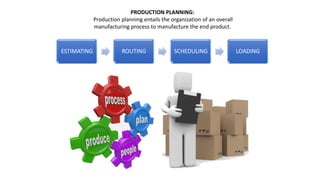
ESTIMATING ROUTING SCHEDULING LOADING
PRODUCTION PLANNING:
Production planning entails the organization of an overall
manufacturing process to manufacture the end product.
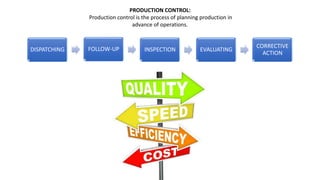
PRODUCTION CONTROL:
Production control is the process of planning production in
advance of operations.
DISPATCHING FOLLOW-UP INSPECTION EVALUATING
CORRECTIVE
ACTION
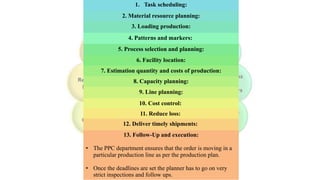
1. Task scheduling:
• It involves planning of Time & Action (T&A) calendar for
every order from the receipt of the order to dispatch of the
same.
• Alongside each task the production planner cites the start
time of a task and the scheduled date for completion.
2. Material resource planning:
• It is the planning and creation of material requirement
sheet based on sample product and the specification sheet.
• The consumption of raw material such as fabric, button,
sewing thread, and twill tape and their costs are estimated.
3. Loading production:
• Production planner allocates garment style and how the
quantity has to be put into the production line.
4. Patterns and markers:
• Once markers of each style are finalized, one can easily
calculate the yield of fabric needed for production and in
turn can order the fabric.
• When planning for the production schedule one must
speak to the fabric supplier about the turnaround of the
fabric and any additional time needed for dyeing or
washing the fabric.
5. Process selection and planning:
• The operations required to finish an order differs from
garment style to style.
• Based on the buyer requirement, production planning
section decides on processes for the orders.
6. Facility location:
• For a garment industry that has multiple factories for
production and are set for specific products, the production
planner has to identify which facility will be the most
appropriate for new orders.
7. Estimation quantity and costs of production:
• The production planner should estimate the daily
production based on garment style work content.
• Planner should also estimate production cost per pieces.
8. Capacity planning:
• The PPC department has to provide information regarding
quantity of order they could accept based on their
estimated production capacity.
9. Line planning:
• It is the preparation of comprehensive production line
planning along with daily production target for the specific
production line.
• Prepared after having a discussion with the production
department.
10. Cost control:
• Raw material prices rise consistently, with styles changing
rapidly and vendors making increasingly smaller orders to
keep up with changing trends, the planning phase of each
production piece must planned and be as accurate as
possible.
11. Reduce loss:
• About 60-70% of the cost of a garment is in the fabric.
Therefore, it is vital that one orders appropriately and
tracks the cutting room processes to keep errors to a
minimum.
12. Deliver timely shipments:
• Ideally, the planning should allow for exact delivery when
the customer demands. At the same time, there must be
sufficient labor and raw material delivery in the exact
proportions to meet the deadlines without having to pay
extra for overtime.
13. Follow-Up and execution:
• The PPC department ensures that the order is moving in a
particular production line as per the production plan.
• Once the deadlines are set the planner has to go on very
strict inspections and follow ups.
Material handling
Investment capacity
Production processes
Personnel
Equipment
WHAT IS APPAREL PRODUCTION SYSTEM?
Apparel production system is the way of manufacturing
process that converts the fabric into garment.
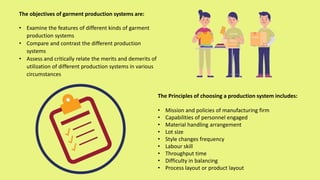
The Principles of choosing a production system includes:
• Mission and policies of manufacturing firm
• Capabilities of personnel engaged
• Material handling arrangement
• Lot size
• Style changes frequency
• Labour skill
• Throughput time
• Difficulty in balancing
• Process layout or product layout
The objectives of garment production systems are:
• Examine the features of different kinds of garment
production systems
• Compare and contrast the different production
systems
• Assess and critically relate the merits and demerits of
utilization of different production systems in various
circumstances
Any production system has four primary factors that
make up the system.
Processing time
+ Transportation time
+ Temporary storage time
+ Inspection time
= Total Production Time.
1. Processing time: It is the total working time of all the
processes involved in assembling a garment.
2. Transportation time: It is the total time consumed for
movement of semi finished or finished garments from one
workstation or department to another.
3. Temporary storage time: It is the idle time of a work
bundle when it waits for the next operation.
4. Inspection time: It is time taken for in-process inspection
of semi finished garments or final inspection of finished
garments before packing.
DIFFERENT TYPES OF
GARMENT PRODUCTION
SYSTEMS
Make through
system
Section
production system
Whole garment
production system
Modular
Production
System (MPS)
Assembly line
production system
Progressive
Bundle
System(PBS)
Unit Production
System(UPS)
Straight line/
Synchro
production system
Production systems are named according to the
various factors, like-
• Number of machines is used to make a garment
• Machines layout
• Total number of operators or tailors involved to
sew a complete garment
• Number of pieces moving in a line during
making a garment.
1. Make Through System:
 When a tailor alone makes a complete garment,
then it is called as make though systems.
 The tailor even makes a pattern (use ready-made
pattern), cuts fabric and does the finishing of the
garment.
 For example, tailors in the tailor shops do all jobs
from cut to pack. In this system, tailors are not
depended to others.
Positives:
 Quick throughput time
 Easy to supervise
Negatives:
 Low productivity
 High labour cost
 It necessitates an experienced operator for assembling
 This system is limited to couture and sample making
2. Section/Group Production
System
 In this system machines of similar
operations are clubbed together
instead of spreading over in all
lines.
 For example, when a man’s
formal shirt is being made in a
section layout – collars, cuffs and
sleeves are in the preparatory
sections and then send to the
assembly section. This system is
popular to improve line balancing
and utilization of human
resources.
Advantages:
• The labour cost is lower and productivity is higher compared to the
make through system as operators of various levels of skill and
specialized machines are utilised in this system.
• This system is very efficient for producing a variety of styles in
reasonable quantities.
• Automation and specialization can be done.
• Breakdown of machines and absenteeism will not cause serious
problems.
Disadvantages:
 The garment quality should be strictly maintained as all levels of
operators are involved in the work.
 Highly skilled operators are necessary to do simple operations
within the section.
 The inventory cost is high due to high work-in-process (WIP),
which is necessary in this system as a group of people are involved
in each section.
 As the cut pieces are not bundled as in the case of a bundling
system, there could be a chance for a lot of mix up, shade variation
and sizes.
3. Whole garment production system:
• The departmental whole garment
system is also used by custom
wholesale manufacturers as well as
high price or better dress
manufacturers. In the departmental
whole garment system one individual
does all the work with the equipment
allocated to a department.
• For example on person does all the
cutting work in cutting department,
second person does all the sewing work
in sewing department, third person does
the pressing and packing work. The
workers in this system may use more
than one equipment to complete his/her
job.
Advantages of whole garment production system:
• This system is more effective when a very large variety of
garments have to be produced in extremely small quantities.
• In individual piece rate system the operators will do with full
involvement. To finish more pieces, to earn more money.
• Operator will be specialized in his own working area.
• As the pay depends upon the complication of the operation, the
operator tries to finish the complicated operation without any
difficulties.
• The work in progress (WIP) is reduced, at a time one cut garment
to one operator and so the amount as inventory is reduced.
Disadvantages of whole garment production system:
• Labor cost is higher due to the utilization of highly skilled laborers
for the particular job.
• The operator is more concerned on the number of pieces finished
rather than the quality of work.
• Productivity is less due to lack of specialization.
• For long run/bulk quantity of same style is not effective in this
system.
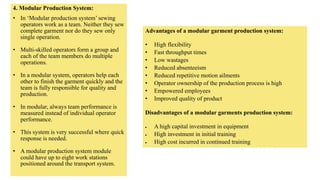
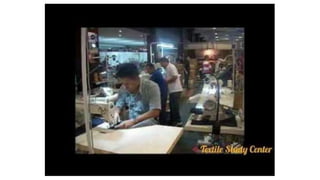
4. Modular Production System:
• In ‘Modular production system’ sewing
operators work as a team. Neither they sew
complete garment nor do they sew only
single operation.
• Multi-skilled operators form a group and
each of the team members do multiple
operations.
• In a modular system, operators help each
other to finish the garment quickly and the
team is fully responsible for quality and
production.
• In modular, always team performance is
measured instead of individual operator
performance.
• This system is very successful where quick
response is needed.
• A modular production system module
could have up to eight work stations
positioned around the transport system.
Advantages of a modular garment production system:
• High flexibility
• Fast throughput times
• Low wastages
• Reduced absenteeism
• Reduced repetitive motion ailments
• Operator ownership of the production process is high
• Empowered employees
• Improved quality of product
Disadvantages of a modular garments production system:
 A high capital investment in equipment
 High investment in initial training
 High cost incurred in continued training
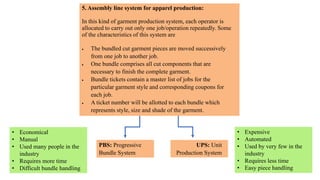
5. Assembly line system for apparel production:
In this kind of garment production system, each operator is
allocated to carry out only one job/operation repeatedly. Some
of the characteristics of this system are
 The bundled cut garment pieces are moved successively
from one job to another job.
 One bundle comprises all cut components that are
necessary to finish the complete garment.
 Bundle tickets contain a master list of jobs for the
particular garment style and corresponding coupons for
each job.
 A ticket number will be allotted to each bundle which
represents style, size and shade of the garment.
PBS: Progressive
Bundle System
UPS: Unit
Production System
• Economical
• Manual
• Used many people in the
industry
• Requires more time
• Difficult bundle handling
• Expensive
• Automated
• Used by very few in the
industry
• Requires less time
• Easy piece handling
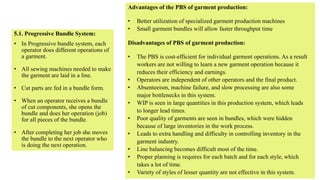
5.1. Progressive Bundle System:
• In Progressive bundle system, each
operator does different operations of
a garment.
• All sewing machines needed to make
the garment are laid in a line.
• Cut parts are fed in a bundle form.
• When an operator receives a bundle
of cut components, she opens the
bundle and does her operation (job)
for all pieces of the bundle.
• After completing her job she moves
the bundle to the next operator who
is doing the next operation.
Advantages of the PBS of garment production:
• Better utilization of specialized garment production machines
• Small garment bundles will allow faster throughput time
Disadvantages of PBS of garment production:
• The PBS is cost-efficient for individual garment operations. As a result
workers are not willing to learn a new garment operation because it
reduces their efficiency and earnings.
• Operators are independent of other operators and the final product.
• Absenteeism, machine failure, and slow processing are also some
major bottlenecks in this system.
• WIP is seen in large quantities in this production system, which leads
to longer lead times.
• Poor quality of garments are seen in bundles, which were hidden
because of large inventories in the work process.
• Leads to extra handling and difficulty in controlling inventory in the
garment industry.
• Line balancing becomes difficult most of the time.
• Proper planning is requires for each batch and for each style, which
takes a lot of time.
• Variety of styles of lesser quantity are not effective in this system.
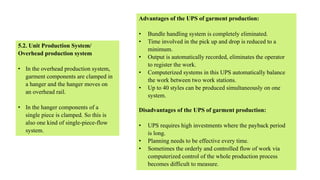
5.2. Unit Production System/
Overhead production system
• In the overhead production system,
garment components are clamped in
a hanger and the hanger moves on
an overhead rail.
• In the hanger components of a
single piece is clamped. So this is
also one kind of single-piece-flow
system.
Advantages of the UPS of garment production:
• Bundle handling system is completely eliminated.
• Time involved in the pick up and drop is reduced to a
minimum.
• Output is automatically recorded, eliminates the operator
to register the work.
• Computerized systems in this UPS automatically balance
the work between two work stations.
• Up to 40 styles can be produced simultaneously on one
system.
Disadvantages of the UPS of garment production:
• UPS requires high investments where the payback period
is long.
• Planning needs to be effective every time.
• Sometimes the orderly and controlled flow of work via
computerized control of the whole production process
becomes difficult to measure.
Straight line or ‘Synchro’ production system:
• This kind of production system is based on a
harmonised or synchronised flow of work in each
stage.
• Synchronisation of time is a critical factor of this
system as synchronisation of workflow could not be
done if more variations in (SAM) Standard Allowed
Minute of particular operations are present.
• Assume if one operation has a SAM of 1.7 minutes,
then all the other operations in the particular
production line should have the same, or closer SAM
value.
• Balancing of standard time for each operator could
result in irrational combinations of whole or part
operations which could minimise the efficiency of
individual operators.
Advantages:
• Very ideal and economical for same type of
garment production
• Synchronization leads to low throughput
time.
• All processes start and finish at almost the
same times which results in better utilization
of resources
Disadvantages:
• The synchro system by its very nature is rigid
and particularly vulnerable to absenteeism
and machine breakdowns.
• At all times reserve operators and machines
must be available to fill the gaps.
• In addition, this system requires a sufficient
volume of the same type of garment to keep
the line in continuous operation.
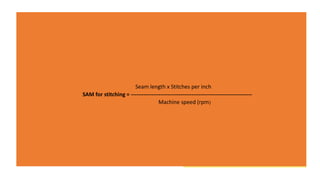
Seam length x Stitches per inch
SAM for stitching = ------------------------------------------------------------------
Machine speed (rpm)
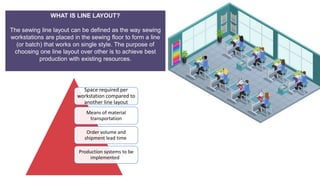
WHAT IS LINE LAYOUT?
The sewing line layout can be defined as the way sewing
workstations are placed in the sewing floor to form a line
(or batch) that works on single style. The purpose of
choosing one line layout over other is to achieve best
production with existing resources.
Space required per
workstation compared to
another line layout
Means of material
transportation
Order volume and
shipment lead time
Production systems to be
implemented
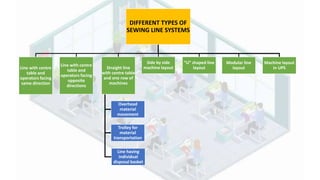
DIFFERENT TYPES OF
SEWING LINE SYSTEMS
Line with centre
table and
operators facing
same direction
Line with centre
table and
operators facing
opposite
directions
Side by side
machine layout
“U” shaped line
layoutStraight line
with centre table
and one row of
machines
Overhead
material
movement
Trolley for
material
transportation
Line having
individual
disposal basket
Modular line
layout
Machine layout
in UPS
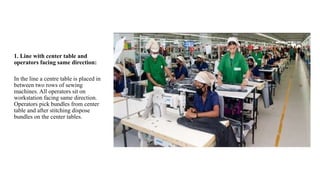
1. Line with center table and
operators facing same direction:
In the line a centre table is placed in
between two rows of sewing
machines. All operators sit on
workstation facing same direction.
Operators pick bundles from center
table and after stitching dispose
bundles on the center tables.
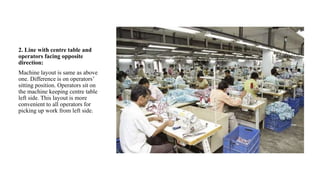
2. Line with centre table and
operators facing opposite
direction:
Machine layout is same as above
one. Difference is on operators’
sitting position. Operators sit on
the machine keeping centre table
left side. This layout is more
convenient to all operators for
picking up work from left side.
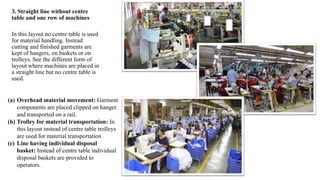
3. Straight line without centre
table and one row of machines
In this layout no centre table is used
for material handling. Instead
cutting and finished garments are
kept of hangers, on baskets or on
trolleys. See the different form of
layout where machines are placed in
a straight line but no centre table is
used.
(a) Overhead material movement: Garment
components are placed clipped on hanger.
and transported on a rail.
(b) Trolley for material transportation: In
this layout instead of centre table trolleys
are used for material transportation
(c) Line having individual disposal
basket: Instead of centre table individual
disposal baskets are provided to
operators.
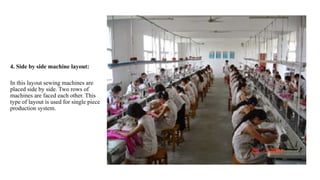
4. Side by side machine layout:
In this layout sewing machines are
placed side by side. Two rows of
machines are faced each other. This
type of layout is used for single piece
production system.
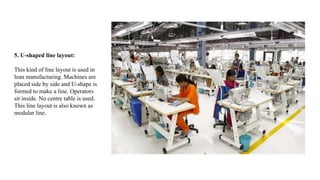
5. U-shaped line layout:
This kind of line layout is used in
lean manufacturing. Machines are
placed side by side and U-shape is
formed to make a line. Operators
sit inside. No centre table is used.
This line layout is also known as
modular line.
6. Modular line layout:
In lean manufacturing, to reduce
material transportation and increase the
machine utilization sewing machines
are placed in such a way that neither it
forms a U-shape nor a straight line.
Instead machines are placed such that it
is better to work into multiple sewing
machines sitting in single chair.
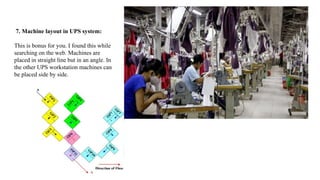
7. Machine layout in UPS system:
This is bonus for you. I found this while
searching on the web. Machines are
placed in straight line but in an angle. In
the other UPS workstation machines can
be placed side by side.
THANK YOU

PRODUCTION PLANNING AND CONTROL

  • 1.
    APPAREL PRODUCTION SYSTEMS ANDITS COMPARISON BY DISHA PAWAR Fashion Design Year 3
  • 2.
     Introduction ToPPC  Production Planning  Production Control  Role of PPC  Production Systems  Sewing Layouts CONTENTS
  • 3.
    INTRODUCTION TO PPC (PRODUCTIONPLANNING AND CONTROL) Production planning and control is a vital part of the garment industry. Accuracy in PPC equates to timely shipment of orders, better utilization of operators and guarantees that proper supplies and machineries are available for each style and order. It includes every process from scheduling of each and every task in the particular process to dispatch of the garment.
  • 4.
    ESTIMATING ROUTING SCHEDULINGLOADING PRODUCTION PLANNING: Production planning entails the organization of an overall manufacturing process to manufacture the end product.
  • 5.
    PRODUCTION CONTROL: Production controlis the process of planning production in advance of operations. DISPATCHING FOLLOW-UP INSPECTION EVALUATING CORRECTIVE ACTION
  • 6.
    1. Task scheduling: •It involves planning of Time & Action (T&A) calendar for every order from the receipt of the order to dispatch of the same. • Alongside each task the production planner cites the start time of a task and the scheduled date for completion. 2. Material resource planning: • It is the planning and creation of material requirement sheet based on sample product and the specification sheet. • The consumption of raw material such as fabric, button, sewing thread, and twill tape and their costs are estimated. 3. Loading production: • Production planner allocates garment style and how the quantity has to be put into the production line. 4. Patterns and markers: • Once markers of each style are finalized, one can easily calculate the yield of fabric needed for production and in turn can order the fabric. • When planning for the production schedule one must speak to the fabric supplier about the turnaround of the fabric and any additional time needed for dyeing or washing the fabric. 5. Process selection and planning: • The operations required to finish an order differs from garment style to style. • Based on the buyer requirement, production planning section decides on processes for the orders. 6. Facility location: • For a garment industry that has multiple factories for production and are set for specific products, the production planner has to identify which facility will be the most appropriate for new orders. 7. Estimation quantity and costs of production: • The production planner should estimate the daily production based on garment style work content. • Planner should also estimate production cost per pieces. 8. Capacity planning: • The PPC department has to provide information regarding quantity of order they could accept based on their estimated production capacity. 9. Line planning: • It is the preparation of comprehensive production line planning along with daily production target for the specific production line. • Prepared after having a discussion with the production department. 10. Cost control: • Raw material prices rise consistently, with styles changing rapidly and vendors making increasingly smaller orders to keep up with changing trends, the planning phase of each production piece must planned and be as accurate as possible. 11. Reduce loss: • About 60-70% of the cost of a garment is in the fabric. Therefore, it is vital that one orders appropriately and tracks the cutting room processes to keep errors to a minimum. 12. Deliver timely shipments: • Ideally, the planning should allow for exact delivery when the customer demands. At the same time, there must be sufficient labor and raw material delivery in the exact proportions to meet the deadlines without having to pay extra for overtime. 13. Follow-Up and execution: • The PPC department ensures that the order is moving in a particular production line as per the production plan. • Once the deadlines are set the planner has to go on very strict inspections and follow ups.
  • 7.
    Material handling Investment capacity Productionprocesses Personnel Equipment WHAT IS APPAREL PRODUCTION SYSTEM? Apparel production system is the way of manufacturing process that converts the fabric into garment.
  • 8.
    The Principles ofchoosing a production system includes: • Mission and policies of manufacturing firm • Capabilities of personnel engaged • Material handling arrangement • Lot size • Style changes frequency • Labour skill • Throughput time • Difficulty in balancing • Process layout or product layout The objectives of garment production systems are: • Examine the features of different kinds of garment production systems • Compare and contrast the different production systems • Assess and critically relate the merits and demerits of utilization of different production systems in various circumstances
  • 9.
    Any production systemhas four primary factors that make up the system. Processing time + Transportation time + Temporary storage time + Inspection time = Total Production Time. 1. Processing time: It is the total working time of all the processes involved in assembling a garment. 2. Transportation time: It is the total time consumed for movement of semi finished or finished garments from one workstation or department to another. 3. Temporary storage time: It is the idle time of a work bundle when it waits for the next operation. 4. Inspection time: It is time taken for in-process inspection of semi finished garments or final inspection of finished garments before packing.
  • 10.
    DIFFERENT TYPES OF GARMENTPRODUCTION SYSTEMS Make through system Section production system Whole garment production system Modular Production System (MPS) Assembly line production system Progressive Bundle System(PBS) Unit Production System(UPS) Straight line/ Synchro production system Production systems are named according to the various factors, like- • Number of machines is used to make a garment • Machines layout • Total number of operators or tailors involved to sew a complete garment • Number of pieces moving in a line during making a garment.
  • 11.
    1. Make ThroughSystem:  When a tailor alone makes a complete garment, then it is called as make though systems.  The tailor even makes a pattern (use ready-made pattern), cuts fabric and does the finishing of the garment.  For example, tailors in the tailor shops do all jobs from cut to pack. In this system, tailors are not depended to others. Positives:  Quick throughput time  Easy to supervise Negatives:  Low productivity  High labour cost  It necessitates an experienced operator for assembling  This system is limited to couture and sample making
  • 12.
    2. Section/Group Production System In this system machines of similar operations are clubbed together instead of spreading over in all lines.  For example, when a man’s formal shirt is being made in a section layout – collars, cuffs and sleeves are in the preparatory sections and then send to the assembly section. This system is popular to improve line balancing and utilization of human resources. Advantages: • The labour cost is lower and productivity is higher compared to the make through system as operators of various levels of skill and specialized machines are utilised in this system. • This system is very efficient for producing a variety of styles in reasonable quantities. • Automation and specialization can be done. • Breakdown of machines and absenteeism will not cause serious problems. Disadvantages:  The garment quality should be strictly maintained as all levels of operators are involved in the work.  Highly skilled operators are necessary to do simple operations within the section.  The inventory cost is high due to high work-in-process (WIP), which is necessary in this system as a group of people are involved in each section.  As the cut pieces are not bundled as in the case of a bundling system, there could be a chance for a lot of mix up, shade variation and sizes.
  • 13.
    3. Whole garmentproduction system: • The departmental whole garment system is also used by custom wholesale manufacturers as well as high price or better dress manufacturers. In the departmental whole garment system one individual does all the work with the equipment allocated to a department. • For example on person does all the cutting work in cutting department, second person does all the sewing work in sewing department, third person does the pressing and packing work. The workers in this system may use more than one equipment to complete his/her job. Advantages of whole garment production system: • This system is more effective when a very large variety of garments have to be produced in extremely small quantities. • In individual piece rate system the operators will do with full involvement. To finish more pieces, to earn more money. • Operator will be specialized in his own working area. • As the pay depends upon the complication of the operation, the operator tries to finish the complicated operation without any difficulties. • The work in progress (WIP) is reduced, at a time one cut garment to one operator and so the amount as inventory is reduced. Disadvantages of whole garment production system: • Labor cost is higher due to the utilization of highly skilled laborers for the particular job. • The operator is more concerned on the number of pieces finished rather than the quality of work. • Productivity is less due to lack of specialization. • For long run/bulk quantity of same style is not effective in this system.
  • 14.
    4. Modular ProductionSystem: • In ‘Modular production system’ sewing operators work as a team. Neither they sew complete garment nor do they sew only single operation. • Multi-skilled operators form a group and each of the team members do multiple operations. • In a modular system, operators help each other to finish the garment quickly and the team is fully responsible for quality and production. • In modular, always team performance is measured instead of individual operator performance. • This system is very successful where quick response is needed. • A modular production system module could have up to eight work stations positioned around the transport system. Advantages of a modular garment production system: • High flexibility • Fast throughput times • Low wastages • Reduced absenteeism • Reduced repetitive motion ailments • Operator ownership of the production process is high • Empowered employees • Improved quality of product Disadvantages of a modular garments production system:  A high capital investment in equipment  High investment in initial training  High cost incurred in continued training
  • 16.
    5. Assembly linesystem for apparel production: In this kind of garment production system, each operator is allocated to carry out only one job/operation repeatedly. Some of the characteristics of this system are  The bundled cut garment pieces are moved successively from one job to another job.  One bundle comprises all cut components that are necessary to finish the complete garment.  Bundle tickets contain a master list of jobs for the particular garment style and corresponding coupons for each job.  A ticket number will be allotted to each bundle which represents style, size and shade of the garment. PBS: Progressive Bundle System UPS: Unit Production System • Economical • Manual • Used many people in the industry • Requires more time • Difficult bundle handling • Expensive • Automated • Used by very few in the industry • Requires less time • Easy piece handling
  • 17.
    5.1. Progressive BundleSystem: • In Progressive bundle system, each operator does different operations of a garment. • All sewing machines needed to make the garment are laid in a line. • Cut parts are fed in a bundle form. • When an operator receives a bundle of cut components, she opens the bundle and does her operation (job) for all pieces of the bundle. • After completing her job she moves the bundle to the next operator who is doing the next operation. Advantages of the PBS of garment production: • Better utilization of specialized garment production machines • Small garment bundles will allow faster throughput time Disadvantages of PBS of garment production: • The PBS is cost-efficient for individual garment operations. As a result workers are not willing to learn a new garment operation because it reduces their efficiency and earnings. • Operators are independent of other operators and the final product. • Absenteeism, machine failure, and slow processing are also some major bottlenecks in this system. • WIP is seen in large quantities in this production system, which leads to longer lead times. • Poor quality of garments are seen in bundles, which were hidden because of large inventories in the work process. • Leads to extra handling and difficulty in controlling inventory in the garment industry. • Line balancing becomes difficult most of the time. • Proper planning is requires for each batch and for each style, which takes a lot of time. • Variety of styles of lesser quantity are not effective in this system.
  • 19.
    5.2. Unit ProductionSystem/ Overhead production system • In the overhead production system, garment components are clamped in a hanger and the hanger moves on an overhead rail. • In the hanger components of a single piece is clamped. So this is also one kind of single-piece-flow system. Advantages of the UPS of garment production: • Bundle handling system is completely eliminated. • Time involved in the pick up and drop is reduced to a minimum. • Output is automatically recorded, eliminates the operator to register the work. • Computerized systems in this UPS automatically balance the work between two work stations. • Up to 40 styles can be produced simultaneously on one system. Disadvantages of the UPS of garment production: • UPS requires high investments where the payback period is long. • Planning needs to be effective every time. • Sometimes the orderly and controlled flow of work via computerized control of the whole production process becomes difficult to measure.
  • 21.
    Straight line or‘Synchro’ production system: • This kind of production system is based on a harmonised or synchronised flow of work in each stage. • Synchronisation of time is a critical factor of this system as synchronisation of workflow could not be done if more variations in (SAM) Standard Allowed Minute of particular operations are present. • Assume if one operation has a SAM of 1.7 minutes, then all the other operations in the particular production line should have the same, or closer SAM value. • Balancing of standard time for each operator could result in irrational combinations of whole or part operations which could minimise the efficiency of individual operators. Advantages: • Very ideal and economical for same type of garment production • Synchronization leads to low throughput time. • All processes start and finish at almost the same times which results in better utilization of resources Disadvantages: • The synchro system by its very nature is rigid and particularly vulnerable to absenteeism and machine breakdowns. • At all times reserve operators and machines must be available to fill the gaps. • In addition, this system requires a sufficient volume of the same type of garment to keep the line in continuous operation. Seam length x Stitches per inch SAM for stitching = ------------------------------------------------------------------ Machine speed (rpm)
  • 22.
    WHAT IS LINELAYOUT? The sewing line layout can be defined as the way sewing workstations are placed in the sewing floor to form a line (or batch) that works on single style. The purpose of choosing one line layout over other is to achieve best production with existing resources. Space required per workstation compared to another line layout Means of material transportation Order volume and shipment lead time Production systems to be implemented
  • 23.
    DIFFERENT TYPES OF SEWINGLINE SYSTEMS Line with centre table and operators facing same direction Line with centre table and operators facing opposite directions Side by side machine layout “U” shaped line layoutStraight line with centre table and one row of machines Overhead material movement Trolley for material transportation Line having individual disposal basket Modular line layout Machine layout in UPS
  • 24.
    1. Line withcenter table and operators facing same direction: In the line a centre table is placed in between two rows of sewing machines. All operators sit on workstation facing same direction. Operators pick bundles from center table and after stitching dispose bundles on the center tables.
  • 25.
    2. Line withcentre table and operators facing opposite direction: Machine layout is same as above one. Difference is on operators’ sitting position. Operators sit on the machine keeping centre table left side. This layout is more convenient to all operators for picking up work from left side.
  • 26.
    3. Straight linewithout centre table and one row of machines In this layout no centre table is used for material handling. Instead cutting and finished garments are kept of hangers, on baskets or on trolleys. See the different form of layout where machines are placed in a straight line but no centre table is used. (a) Overhead material movement: Garment components are placed clipped on hanger. and transported on a rail. (b) Trolley for material transportation: In this layout instead of centre table trolleys are used for material transportation (c) Line having individual disposal basket: Instead of centre table individual disposal baskets are provided to operators.
  • 27.
    4. Side byside machine layout: In this layout sewing machines are placed side by side. Two rows of machines are faced each other. This type of layout is used for single piece production system.
  • 28.
    5. U-shaped linelayout: This kind of line layout is used in lean manufacturing. Machines are placed side by side and U-shape is formed to make a line. Operators sit inside. No centre table is used. This line layout is also known as modular line.
  • 29.
    6. Modular linelayout: In lean manufacturing, to reduce material transportation and increase the machine utilization sewing machines are placed in such a way that neither it forms a U-shape nor a straight line. Instead machines are placed such that it is better to work into multiple sewing machines sitting in single chair.
  • 30.
    7. Machine layoutin UPS system: This is bonus for you. I found this while searching on the web. Machines are placed in straight line but in an angle. In the other UPS workstation machines can be placed side by side.
  • 31.