1
Introduction:
Textile Testing is an important part for textile production, distribution, and
consumption. We can also define Textile Testing as the process of determining the
properties of different kinds of Textile substances. The primary purpose of textile
testing and analysis is to assess textile product performance and to use test results
to make predictions about product performance. Product performance must be
considered in conjunction with end use; therefore, tests are performed with the
ultimate end use in mind. Examples of testing for end-use performance include
testing draperies for light fastness or tire cords for strength. [1]
What is Testing?
Testing is the way of control or the process to check or verify the nature, kind or
character of fiber, yarn, fabric or any material, hence control the degree of
excellence.
Now, testing may be different type
Fiber- length, strength, fineness, maturity.
Yarn- strength, count, twist
Fabric- EPI, PPI, GSM. [2]
Objects of textile testing:
The objectives of Textile Testing are as follows –
 In case of research, the results of testing will help the scientist to decide
which route should be followed.
 It helps to select the properraw materials. Raw material is a relative term.
As for example, fibre is the raw material of spinner, yarn is the raw material
of weaver etc.
 Textile Testing helps to controlthe different processes. Suchas Spinning,
Weaving, Dyeing, Finishing etc. End breakage is controlled by controlling
weight per lap length, sliver length and roving length. Weaving process is
controlled by controlling the excessive breakage of warp and weft yarn.
Dyeing process is controlled by M : L, temperature and pressure.
2
 In case of productcontrol, it helps to ensure the fulfillment of the desired
quality of the end product. Suchas the end productof spinning is yarn.
 In case of process development, it helps to improve the quality of end
productby avoiding unnecessary waste of time and money.
 In case of productdevelopment, it helps in continual search for new
knowledge and to develop new products.
Types Of Textile Testing:
There are mainly two types of testing, one is routine process testing and another
is quality record testing. The result of routine process testing can be got quickly in
the working field. The resultof quality record testing is to be recorded for
different objects to finish the work.
Fibre Testing:
In fiber testing, there are various properties of fiber have to be checked according
to an end product. Mainly fiber testing is carried out in spinning and nonwoven
departments.
Staple length.
Fibre fineness.
Strength.
Maturity.
Rigidity.
Fibre Friction.
Shortfibre %.
3
Trash content, etc.
Aboveproperties of fibers are mainly tested on AFIS & HVI machines.
Yarn Testing:
The yarn is raw material for fabric production so it becomes necessary to test the
yarn for particular required fabric production. Parameters of yarn tested mainly
are,
Single yarn strength
Lea strength
CSP.
Moistureregain.
Hairiness.
Friction.
Abrasion.
Twistmeasurement.
U%.
Count.
Yarn elongation.
This property of yarn is tested on instruments like Instron, Uster, yarn hairiness
tester, friction tester, Tensolab, etc.
4
Fabric Testing (Woven, Knitted & Nonwoven)
Our ultimate aim is to achieve optimum quality fabric. So to check whether the
quality is achieved or not testing of fabric is done.
Tensile strength.
GSM.
Pilling tendency.
Abrasion.
Drapeability or hanging property.
Moisture%.
Cover factor.
Creaserecovery and creaseresistance.
Stiffness.
Air permeability.
Shrinkage, etc.
All these testing is done after conditioning of material and in standard
atmospheric conditions.[4]
5
Importance of Textile Testing:
1. Research Work: Test of the textiles helps the authority to decide the next
route.
2. Selection of Raw Materials: During textiles testing the variation of a fibre or
fabric i.e. length, color, fineness (in case of textile fibre), threads per inch, cover
factor (in case of textile fabric), is detected properly. Thus proper raw materials
are selected properly.
3. Process Control: Certain standard level should be maintained to control
increase of waste, rise of costetc. By textile testing we can easily detect the faults
of machinery and materials during test of textiles.
4. Process Development: Research Institute, pilot plants can achieve process
development through testing or exact investigation into better, cheaper and
quicker methods.
5. Search for effective productivity: Continuous test of the textiles results a
enhanced and efficient output of the production.
6. Specification Test: To meet up the customer requirement, specification is very
useful. In this concept, testing plays a vital role.[5]
Factors affecting testresults:
-The sampling
-Atmospheric condition during testing
-Methods of testing
-Instruments used
-Efficiency of the technician[2]
6
Some important testing standards:
AATCC: American Association of Textile Chemists & Colorists
ASTM: American Society for Testing & Materials
ISO: International Organization for Standardization
BSTI: Bangladesh Standards & Testing Institution
WIRA: The Wool Industries Research Association
AS: Australian Standard
BSI: British Standards Institution [2]
Moisture in case oftesting
Most textile fibers are hygroscopic, i.e. they have the ability to absorb or give up
moisture. This moisture is picked up or absorbed bythe hygroscopic material from
the atmosphere if the relative amount of moisture in the air is greater than that in
the material. Conversely, the moisture will be given up by the material if the
relative amount of moisture in the air is less than that in the material.
Many physical properties of a fiber are affected by the amount of water absorbed,
such as dimensions, tensile strength, elastic recovery, electrical resistance and so
on. [2]
Different Types OfTextile Testing Methods
Different buyers usedifferent Textile testing methods. There are different types of
Textile and Garments Testing methods such as –
 American Society of Testing &Materials (ASTM)
 American Association of Textile Chemists and Colorists (AATCC)
 International Organization for Standardization (ISO)
 European Norms (EN)
 British Standards (BS)
 British Standards for European Nations (BS EN)
 DeutschesInstitut fur Normung (DIN)
 Bureau of Indian Standards (BIS)
7
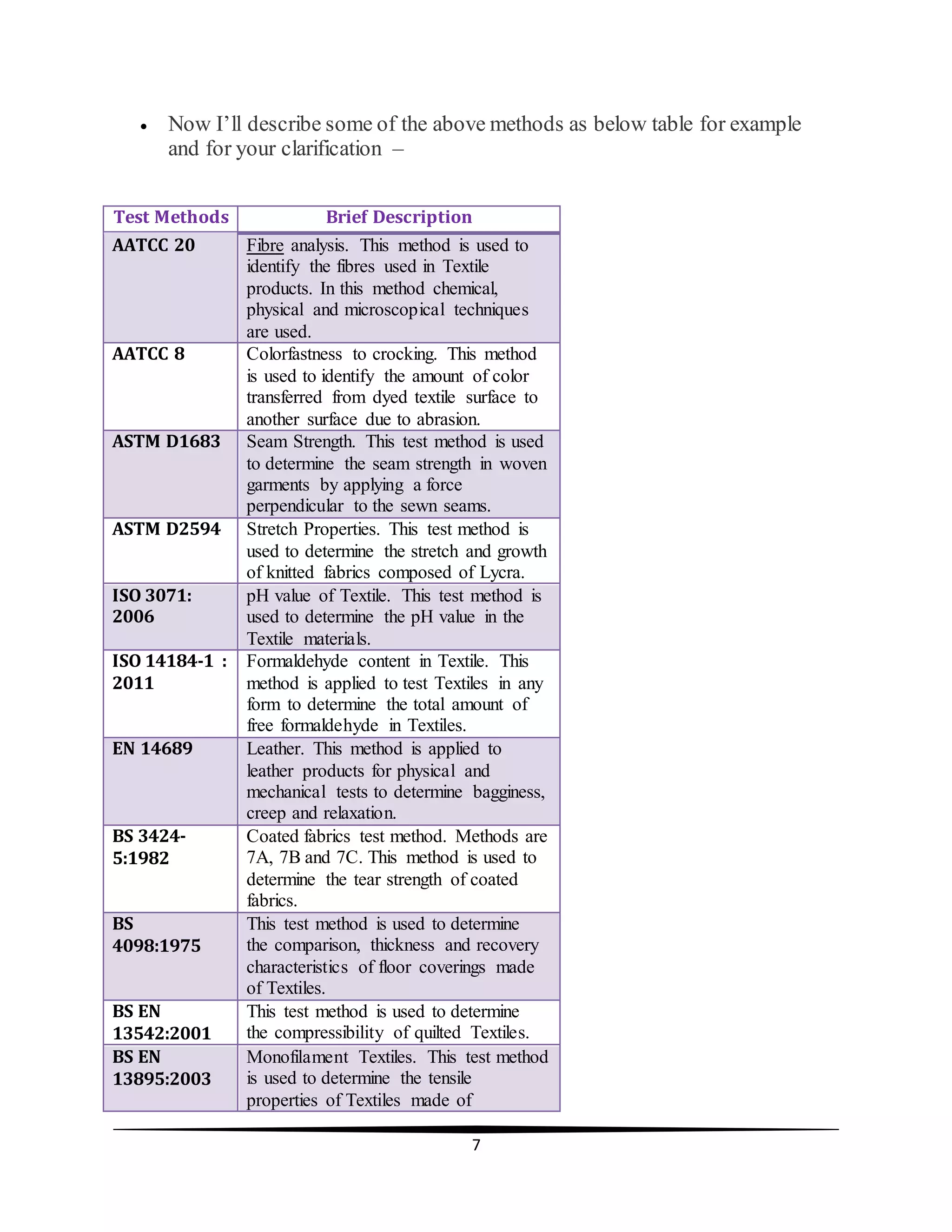
 Now I’ll describe some of the above methods as below table for example
and for your clarification –
Test Methods Brief Description
AATCC 20 Fibre analysis. This method is used to
identify the fibres used in Textile
products. In this method chemical,
physical and microscopical techniques
are used.
AATCC 8 Colorfastness to crocking. This method
is used to identify the amount of color
transferred from dyed textile surface to
another surface due to abrasion.
ASTM D1683 Seam Strength. This test method is used
to determine the seam strength in woven
garments by applying a force
perpendicular to the sewn seams.
ASTM D2594 Stretch Properties. This test method is
used to determine the stretch and growth
of knitted fabrics composed of Lycra.
ISO 3071:
2006
pH value of Textile. This test method is
used to determine the pH value in the
Textile materials.
ISO 14184-1 :
2011
Formaldehyde content in Textile. This
method is applied to test Textiles in any
form to determine the total amount of
free formaldehyde in Textiles.
EN 14689 Leather. This method is applied to
leather products for physical and
mechanical tests to determine bagginess,
creep and relaxation.
BS 3424-
5:1982
Coated fabrics test method. Methods are
7A, 7B and 7C. This method is used to
determine the tear strength of coated
fabrics.
BS
4098:1975
This test method is used to determine
the comparison, thickness and recovery
characteristics of floor coverings made
of Textiles.
BS EN
13542:2001
This test method is used to determine
the compressibility of quilted Textiles.
BS EN
13895:2003
Monofilament Textiles. This test method
is used to determine the tensile
properties of Textiles made of
8
[10]
Conclusion:
Testing means checking, examine and verification of some items. On the other
way we can define testing as; it is the process or procedureto determines the
quality of a product.
Reference:
1: https://textileapex.blogspot.com/2015/10/what-is-textile-testing-definition.html
2/7/8/9: http://textilequalitytest.blogspot.com/
4: http://textilelearner.blogspot.com/2012/02/textile-testing-objects-of-textile.html
5 :http://www.testextextile.com/textile-testing-importance-of-testing-in-textiles/
10: https://textileapex.blogspot.com/2016/06/textile-testing-methods.html
monofilament yarns.
BS EN ISO
9073-4:1997
Non-woven Textiles. This test method is
used to determine the tear resistance of
Non-Woven Textiles.
BS EN ISO
105-
E01:2013
Colorfastness to water. This test method
is used to define the amount of color
transferred from dyed textiles in
presence of water.
JIS L
1041:2011
Formaldehyde content in Textiles. This
test method is used to determine the
amount of formaldehyde content in
Textiles.

Important of textile testing

  • 1.
    1 Introduction: Textile Testing isan important part for textile production, distribution, and consumption. We can also define Textile Testing as the process of determining the properties of different kinds of Textile substances. The primary purpose of textile testing and analysis is to assess textile product performance and to use test results to make predictions about product performance. Product performance must be considered in conjunction with end use; therefore, tests are performed with the ultimate end use in mind. Examples of testing for end-use performance include testing draperies for light fastness or tire cords for strength. [1] What is Testing? Testing is the way of control or the process to check or verify the nature, kind or character of fiber, yarn, fabric or any material, hence control the degree of excellence. Now, testing may be different type Fiber- length, strength, fineness, maturity. Yarn- strength, count, twist Fabric- EPI, PPI, GSM. [2] Objects of textile testing: The objectives of Textile Testing are as follows –  In case of research, the results of testing will help the scientist to decide which route should be followed.  It helps to select the properraw materials. Raw material is a relative term. As for example, fibre is the raw material of spinner, yarn is the raw material of weaver etc.  Textile Testing helps to controlthe different processes. Suchas Spinning, Weaving, Dyeing, Finishing etc. End breakage is controlled by controlling weight per lap length, sliver length and roving length. Weaving process is controlled by controlling the excessive breakage of warp and weft yarn. Dyeing process is controlled by M : L, temperature and pressure.
  • 2.
    2  In caseof productcontrol, it helps to ensure the fulfillment of the desired quality of the end product. Suchas the end productof spinning is yarn.  In case of process development, it helps to improve the quality of end productby avoiding unnecessary waste of time and money.  In case of productdevelopment, it helps in continual search for new knowledge and to develop new products. Types Of Textile Testing: There are mainly two types of testing, one is routine process testing and another is quality record testing. The result of routine process testing can be got quickly in the working field. The resultof quality record testing is to be recorded for different objects to finish the work. Fibre Testing: In fiber testing, there are various properties of fiber have to be checked according to an end product. Mainly fiber testing is carried out in spinning and nonwoven departments. Staple length. Fibre fineness. Strength. Maturity. Rigidity. Fibre Friction. Shortfibre %.
  • 3.
    3 Trash content, etc. Abovepropertiesof fibers are mainly tested on AFIS & HVI machines. Yarn Testing: The yarn is raw material for fabric production so it becomes necessary to test the yarn for particular required fabric production. Parameters of yarn tested mainly are, Single yarn strength Lea strength CSP. Moistureregain. Hairiness. Friction. Abrasion. Twistmeasurement. U%. Count. Yarn elongation. This property of yarn is tested on instruments like Instron, Uster, yarn hairiness tester, friction tester, Tensolab, etc.
  • 4.
    4 Fabric Testing (Woven,Knitted & Nonwoven) Our ultimate aim is to achieve optimum quality fabric. So to check whether the quality is achieved or not testing of fabric is done. Tensile strength. GSM. Pilling tendency. Abrasion. Drapeability or hanging property. Moisture%. Cover factor. Creaserecovery and creaseresistance. Stiffness. Air permeability. Shrinkage, etc. All these testing is done after conditioning of material and in standard atmospheric conditions.[4]
  • 5.
    5 Importance of TextileTesting: 1. Research Work: Test of the textiles helps the authority to decide the next route. 2. Selection of Raw Materials: During textiles testing the variation of a fibre or fabric i.e. length, color, fineness (in case of textile fibre), threads per inch, cover factor (in case of textile fabric), is detected properly. Thus proper raw materials are selected properly. 3. Process Control: Certain standard level should be maintained to control increase of waste, rise of costetc. By textile testing we can easily detect the faults of machinery and materials during test of textiles. 4. Process Development: Research Institute, pilot plants can achieve process development through testing or exact investigation into better, cheaper and quicker methods. 5. Search for effective productivity: Continuous test of the textiles results a enhanced and efficient output of the production. 6. Specification Test: To meet up the customer requirement, specification is very useful. In this concept, testing plays a vital role.[5] Factors affecting testresults: -The sampling -Atmospheric condition during testing -Methods of testing -Instruments used -Efficiency of the technician[2]
  • 6.
    6 Some important testingstandards: AATCC: American Association of Textile Chemists & Colorists ASTM: American Society for Testing & Materials ISO: International Organization for Standardization BSTI: Bangladesh Standards & Testing Institution WIRA: The Wool Industries Research Association AS: Australian Standard BSI: British Standards Institution [2] Moisture in case oftesting Most textile fibers are hygroscopic, i.e. they have the ability to absorb or give up moisture. This moisture is picked up or absorbed bythe hygroscopic material from the atmosphere if the relative amount of moisture in the air is greater than that in the material. Conversely, the moisture will be given up by the material if the relative amount of moisture in the air is less than that in the material. Many physical properties of a fiber are affected by the amount of water absorbed, such as dimensions, tensile strength, elastic recovery, electrical resistance and so on. [2] Different Types OfTextile Testing Methods Different buyers usedifferent Textile testing methods. There are different types of Textile and Garments Testing methods such as –  American Society of Testing &Materials (ASTM)  American Association of Textile Chemists and Colorists (AATCC)  International Organization for Standardization (ISO)  European Norms (EN)  British Standards (BS)  British Standards for European Nations (BS EN)  DeutschesInstitut fur Normung (DIN)  Bureau of Indian Standards (BIS)
  • 7.
    7  Now I’lldescribe some of the above methods as below table for example and for your clarification – Test Methods Brief Description AATCC 20 Fibre analysis. This method is used to identify the fibres used in Textile products. In this method chemical, physical and microscopical techniques are used. AATCC 8 Colorfastness to crocking. This method is used to identify the amount of color transferred from dyed textile surface to another surface due to abrasion. ASTM D1683 Seam Strength. This test method is used to determine the seam strength in woven garments by applying a force perpendicular to the sewn seams. ASTM D2594 Stretch Properties. This test method is used to determine the stretch and growth of knitted fabrics composed of Lycra. ISO 3071: 2006 pH value of Textile. This test method is used to determine the pH value in the Textile materials. ISO 14184-1 : 2011 Formaldehyde content in Textile. This method is applied to test Textiles in any form to determine the total amount of free formaldehyde in Textiles. EN 14689 Leather. This method is applied to leather products for physical and mechanical tests to determine bagginess, creep and relaxation. BS 3424- 5:1982 Coated fabrics test method. Methods are 7A, 7B and 7C. This method is used to determine the tear strength of coated fabrics. BS 4098:1975 This test method is used to determine the comparison, thickness and recovery characteristics of floor coverings made of Textiles. BS EN 13542:2001 This test method is used to determine the compressibility of quilted Textiles. BS EN 13895:2003 Monofilament Textiles. This test method is used to determine the tensile properties of Textiles made of
  • 8.
    8 [10] Conclusion: Testing means checking,examine and verification of some items. On the other way we can define testing as; it is the process or procedureto determines the quality of a product. Reference: 1: https://textileapex.blogspot.com/2015/10/what-is-textile-testing-definition.html 2/7/8/9: http://textilequalitytest.blogspot.com/ 4: http://textilelearner.blogspot.com/2012/02/textile-testing-objects-of-textile.html 5 :http://www.testextextile.com/textile-testing-importance-of-testing-in-textiles/ 10: https://textileapex.blogspot.com/2016/06/textile-testing-methods.html monofilament yarns. BS EN ISO 9073-4:1997 Non-woven Textiles. This test method is used to determine the tear resistance of Non-Woven Textiles. BS EN ISO 105- E01:2013 Colorfastness to water. This test method is used to define the amount of color transferred from dyed textiles in presence of water. JIS L 1041:2011 Formaldehyde content in Textiles. This test method is used to determine the amount of formaldehyde content in Textiles.