COURSE CODE :18EE72
POWER SYSTEM PROTECTION
(Core Subject)
Faculty : SRIDHAR N H
Assistant professor
Module-1
 Introduction to Power System Protection:
 Need for protective schemes
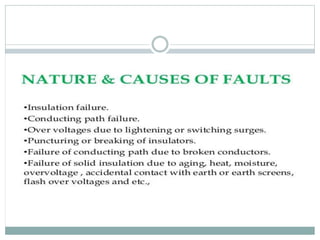
 Nature and Cause of Faults
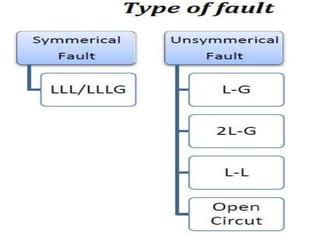
 Types of Faults, Effects of Faults
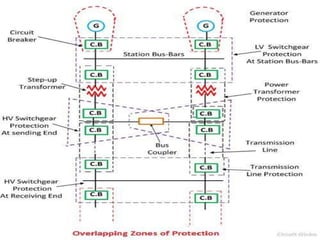
 Fault Statistics, Zones of Protection
 Primary and Backup Protection
 Essential Qualities of Protection
 Performance of Protective Relaying
 Classification of Protective Relays
 Automatic Reclosing
 CTs-VTs for protection
Cont…..,
 Relay Construction and Operating Principles:
 Electromechanical Relays,
 Static Relays – Merits and Demerits of Static Relays,
 Numerical Relays,
 Comparison between Electromechanical Relays and Numerical
Relays.
 Overcurrent Protection:
 Introduction,
 Time – current Characteristics,
 Current Setting,
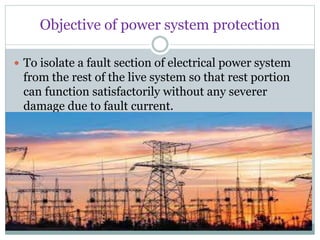
Objective of power system protection
 To isolate a fault section of electrical power system
from the rest of the live system so that rest portion
can function satisfactorily without any severer
damage due to fault current.
 What Components (Equipment) Do We Protect?
•Generators
•Transformers
•Lines
•Buses
•Capacitors
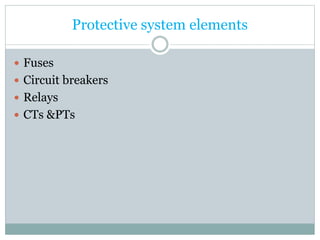
Protective system elements
 Fuses
 Circuit breakers
 Relays
 CTs &PTs
An electrical power system consists of generators,
transformers, transmission and distribution lines, etc.
Short circuits and other abnormal conditions often
occur on a power system. The heavy current associated
with short circuits is likely to cause damage to
equipment if suitable protective relays and circuit
breakers are not provided for the protection of each
section of the power system. Short circuits are usually
called faults by power engineers. Strictly speaking, the
term fault simply means a defect. Some defects, other
than short circuits, are also termed as faults. For
example, the failure of conducting path due to a break in
a conductor is a type of fault.
NEED FOR PROTECTIVE SCHEMES
Effects of faults
 Heavy short circuit current may damage to equipment or
any other element due to over heating and high
mechanical force set up due to heavy current.
 Area associated with short circuit may cause fire hazards.
 There may be reduction in the supply voltage of the
healthy feeders, resulting in the loss of industrial loads.
 Short circuit may cause the unbalancing of supply
voltages and currents ,thereby heating rotating
machines.
 There may be loss of system stability.
 Loss of revenue.
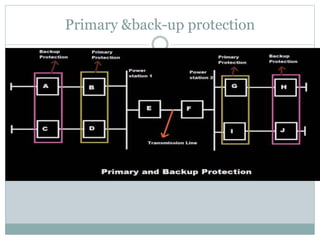
Primary &back-up protection
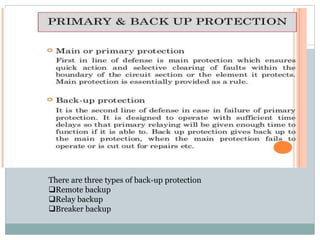
There are three types of back-up protection
Remote backup
Relay backup
Breaker backup
Performance of protective relay
 Correct operation
 Incorrect operation
 No conclusion
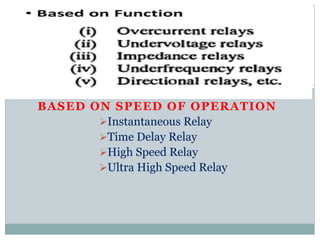
BASED ON SPEED OF OPERATION
Instantaneous Relay
Time Delay Relay
High Speed Relay
Ultra High Speed Relay
Over Current Protection
Distance Protection
Carrier Current Protection
Differential Protection
classification of protective
schemes
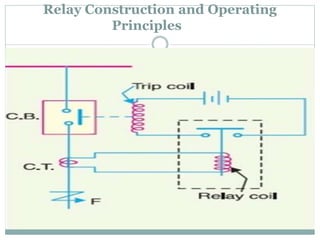
Relay Construction and Operating
Principles
Electromechanical Relays
 A relay is an electromechanical device having
electrical, magnetic and mechanical components.
The relays control the electric circuit by opening or
closing the contacts of that circuit. An
electromechanical relay consists of three terminals
namely common (COM), normally closed (NC) and
normally opened (NO) contacts. These can either get
opened or closed when the relay is in operation.
These relays can work on both AC and DC supply
sources.
1. HINGED ARMATURE TYPE
2. PLUNGER TYPE
3. BALANCED BEAM TYPE
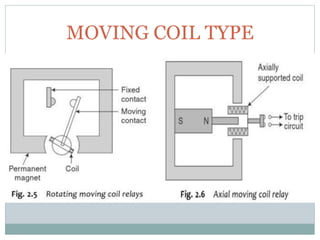
4.MOVING COIL TYPE
5. POLARISED MOVING IRON
TYPE
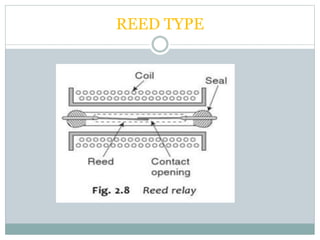
6.REED TYPE
ATTRACTED ARMATURE
RELAYS
HINGED ARMATURE TYPE
PLUNGER TYPE
BALANCED BEAM TYPE
MOVING COIL TYPE
POLARISED MOVING IRON TYPE
REED TYPE

power system protection

  • 1.
    COURSE CODE :18EE72 POWERSYSTEM PROTECTION (Core Subject) Faculty : SRIDHAR N H Assistant professor
  • 2.
    Module-1  Introduction toPower System Protection:  Need for protective schemes  Nature and Cause of Faults  Types of Faults, Effects of Faults  Fault Statistics, Zones of Protection  Primary and Backup Protection  Essential Qualities of Protection  Performance of Protective Relaying  Classification of Protective Relays  Automatic Reclosing  CTs-VTs for protection
  • 3.
    Cont…..,  Relay Constructionand Operating Principles:  Electromechanical Relays,  Static Relays – Merits and Demerits of Static Relays,  Numerical Relays,  Comparison between Electromechanical Relays and Numerical Relays.  Overcurrent Protection:  Introduction,  Time – current Characteristics,  Current Setting,
  • 4.
    Objective of powersystem protection  To isolate a fault section of electrical power system from the rest of the live system so that rest portion can function satisfactorily without any severer damage due to fault current.
  • 5.
     What Components(Equipment) Do We Protect? •Generators •Transformers •Lines •Buses •Capacitors
  • 6.
    Protective system elements Fuses  Circuit breakers  Relays  CTs &PTs
  • 7.
    An electrical powersystem consists of generators, transformers, transmission and distribution lines, etc. Short circuits and other abnormal conditions often occur on a power system. The heavy current associated with short circuits is likely to cause damage to equipment if suitable protective relays and circuit breakers are not provided for the protection of each section of the power system. Short circuits are usually called faults by power engineers. Strictly speaking, the term fault simply means a defect. Some defects, other than short circuits, are also termed as faults. For example, the failure of conducting path due to a break in a conductor is a type of fault. NEED FOR PROTECTIVE SCHEMES
  • 10.
    Effects of faults Heavy short circuit current may damage to equipment or any other element due to over heating and high mechanical force set up due to heavy current.  Area associated with short circuit may cause fire hazards.  There may be reduction in the supply voltage of the healthy feeders, resulting in the loss of industrial loads.  Short circuit may cause the unbalancing of supply voltages and currents ,thereby heating rotating machines.  There may be loss of system stability.  Loss of revenue.
  • 14.
  • 15.
    There are threetypes of back-up protection Remote backup Relay backup Breaker backup
  • 17.
    Performance of protectiverelay  Correct operation  Incorrect operation  No conclusion
  • 19.
    BASED ON SPEEDOF OPERATION Instantaneous Relay Time Delay Relay High Speed Relay Ultra High Speed Relay
  • 20.
    Over Current Protection DistanceProtection Carrier Current Protection Differential Protection classification of protective schemes
  • 24.
    Relay Construction andOperating Principles
  • 25.
    Electromechanical Relays  Arelay is an electromechanical device having electrical, magnetic and mechanical components. The relays control the electric circuit by opening or closing the contacts of that circuit. An electromechanical relay consists of three terminals namely common (COM), normally closed (NC) and normally opened (NO) contacts. These can either get opened or closed when the relay is in operation. These relays can work on both AC and DC supply sources.
  • 27.
    1. HINGED ARMATURETYPE 2. PLUNGER TYPE 3. BALANCED BEAM TYPE 4.MOVING COIL TYPE 5. POLARISED MOVING IRON TYPE 6.REED TYPE ATTRACTED ARMATURE RELAYS
  • 28.
  • 29.
  • 30.
  • 31.
  • 32.
  • 33.