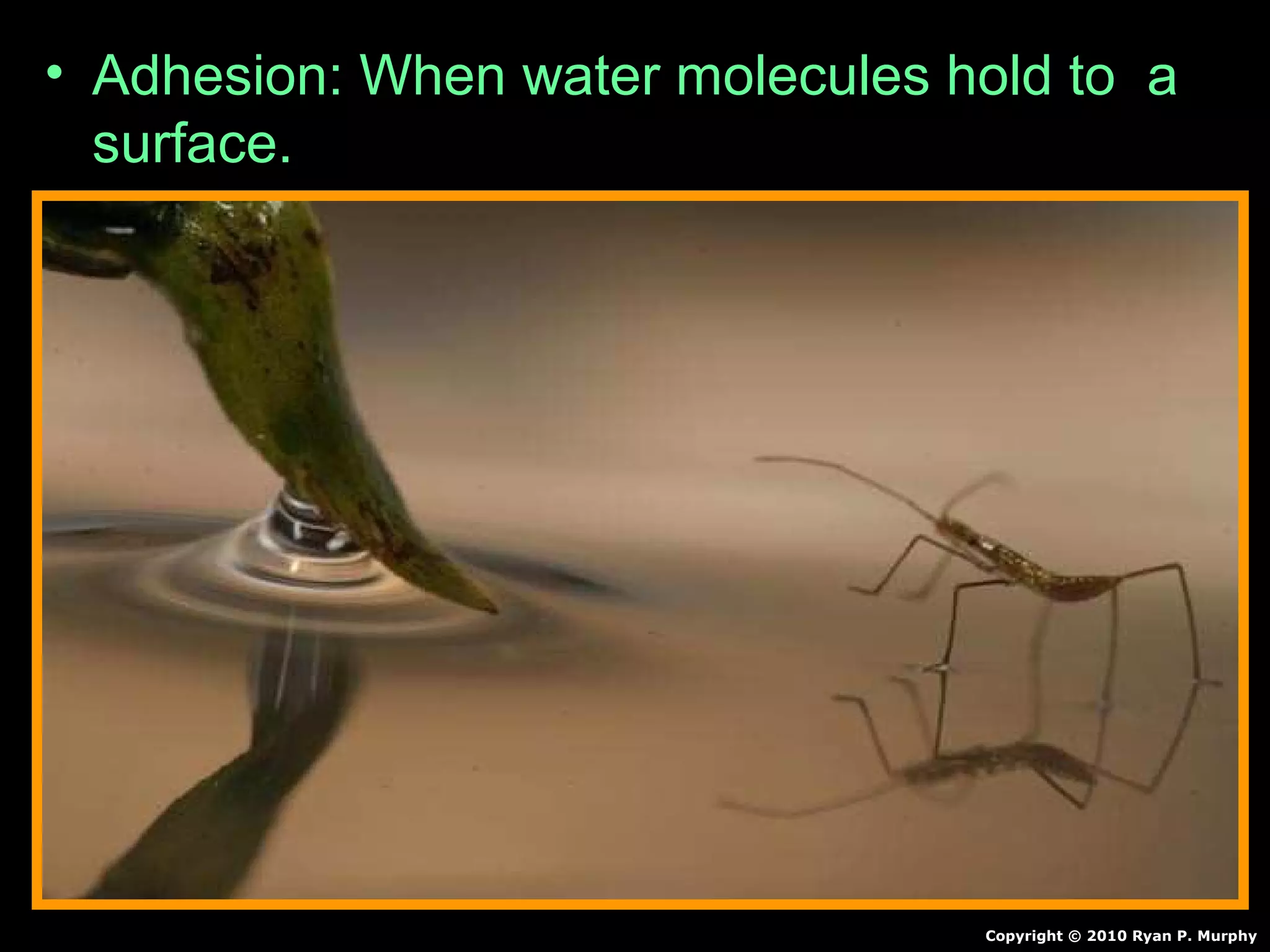
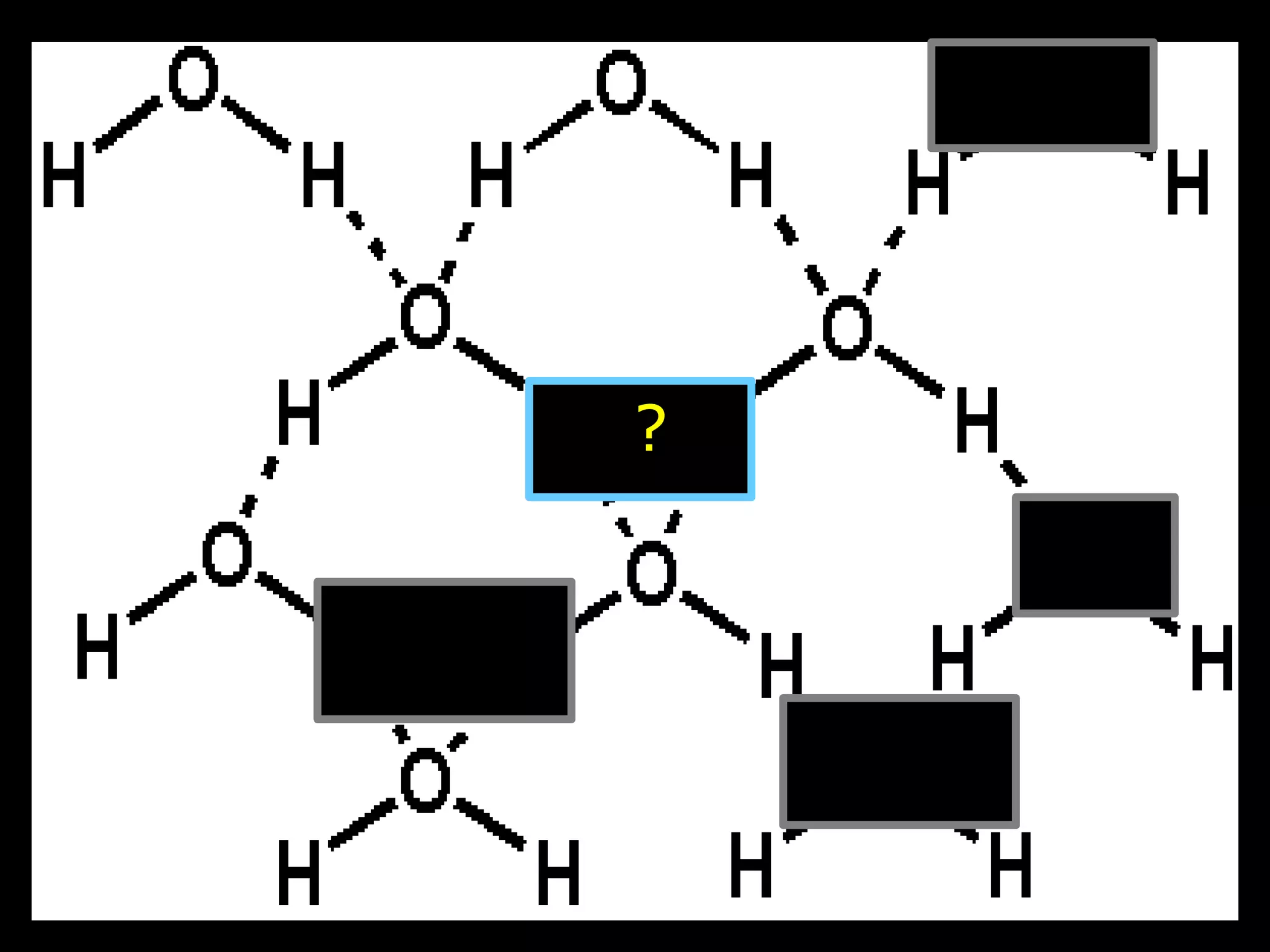
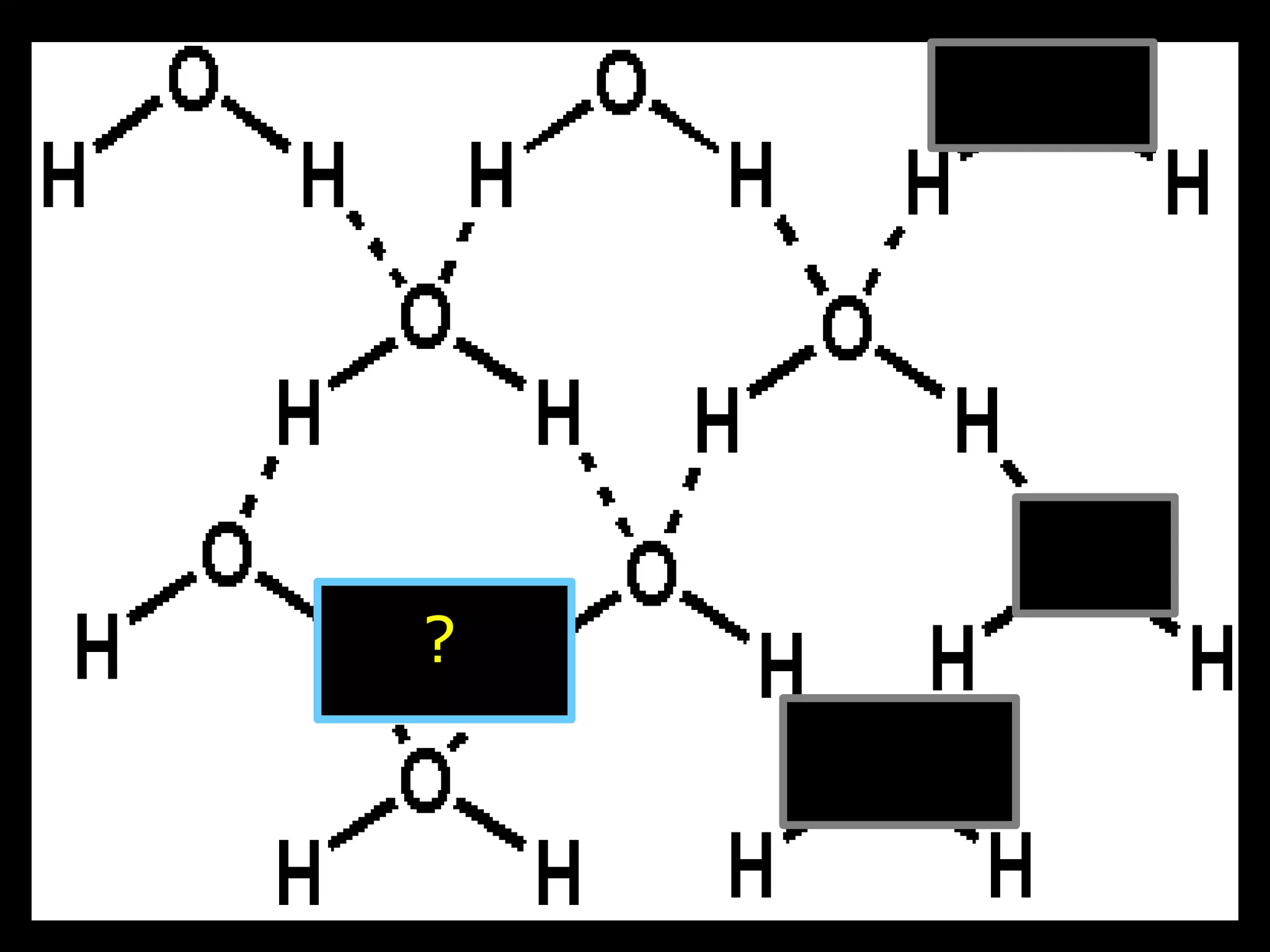
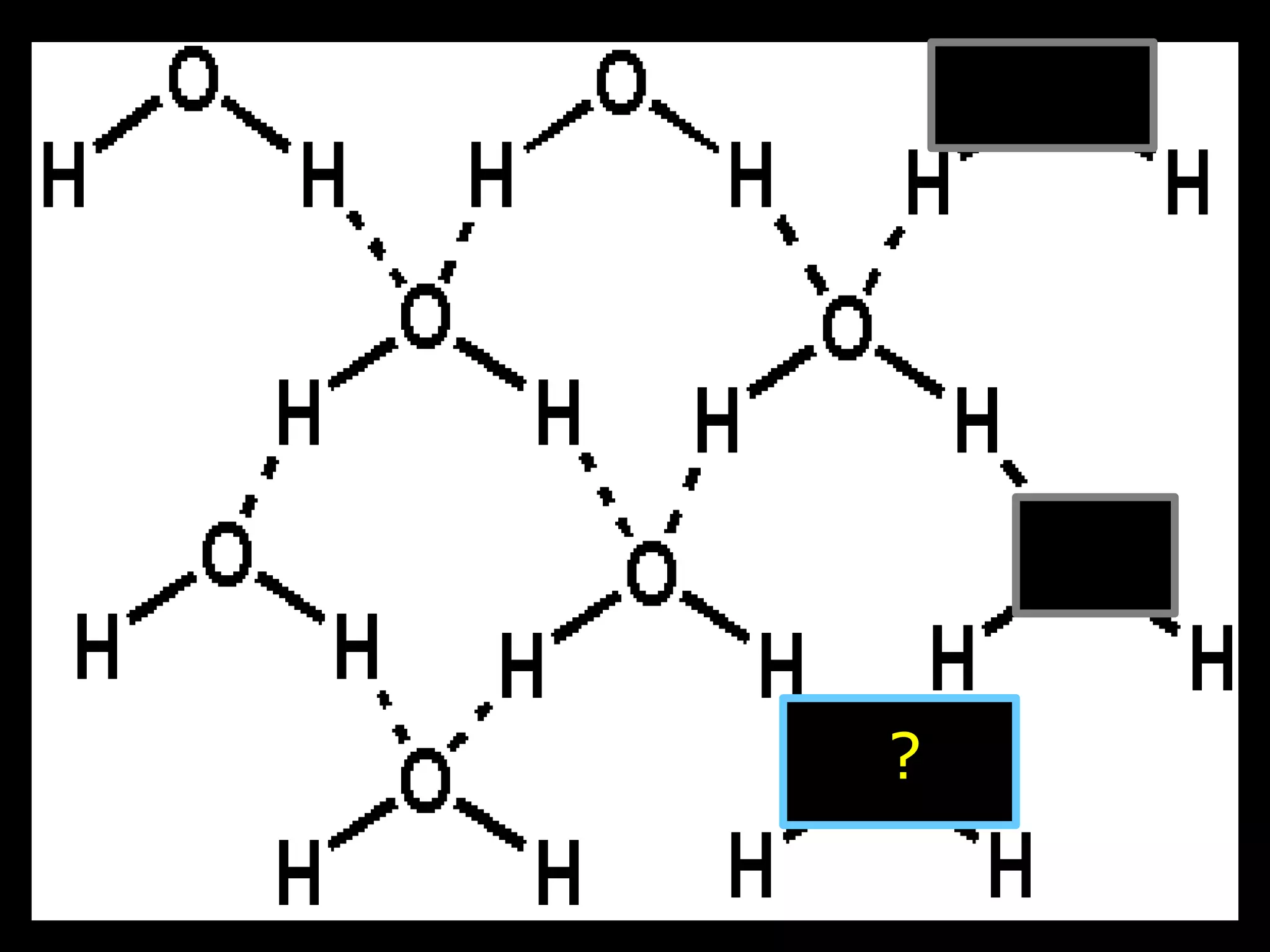
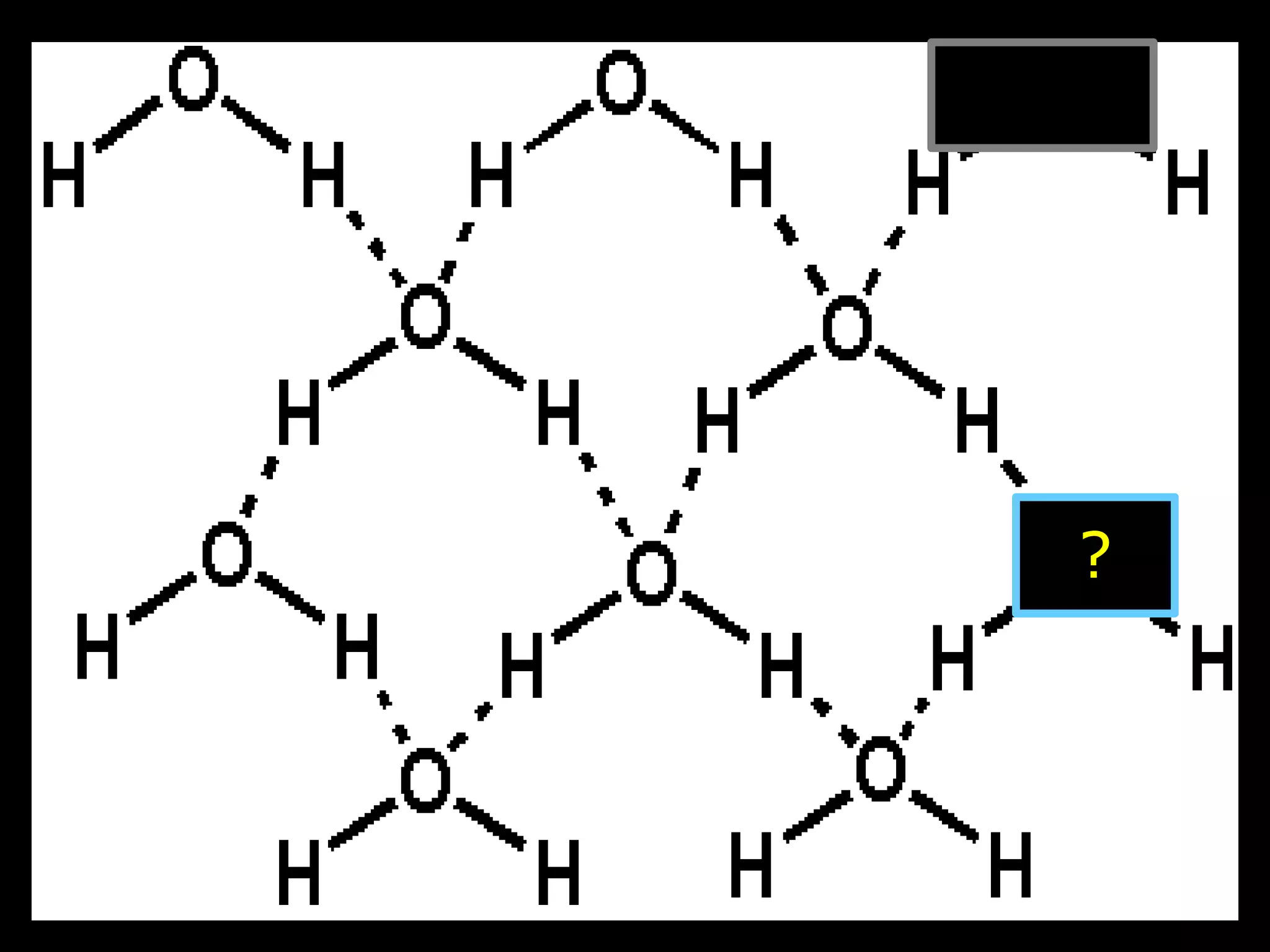
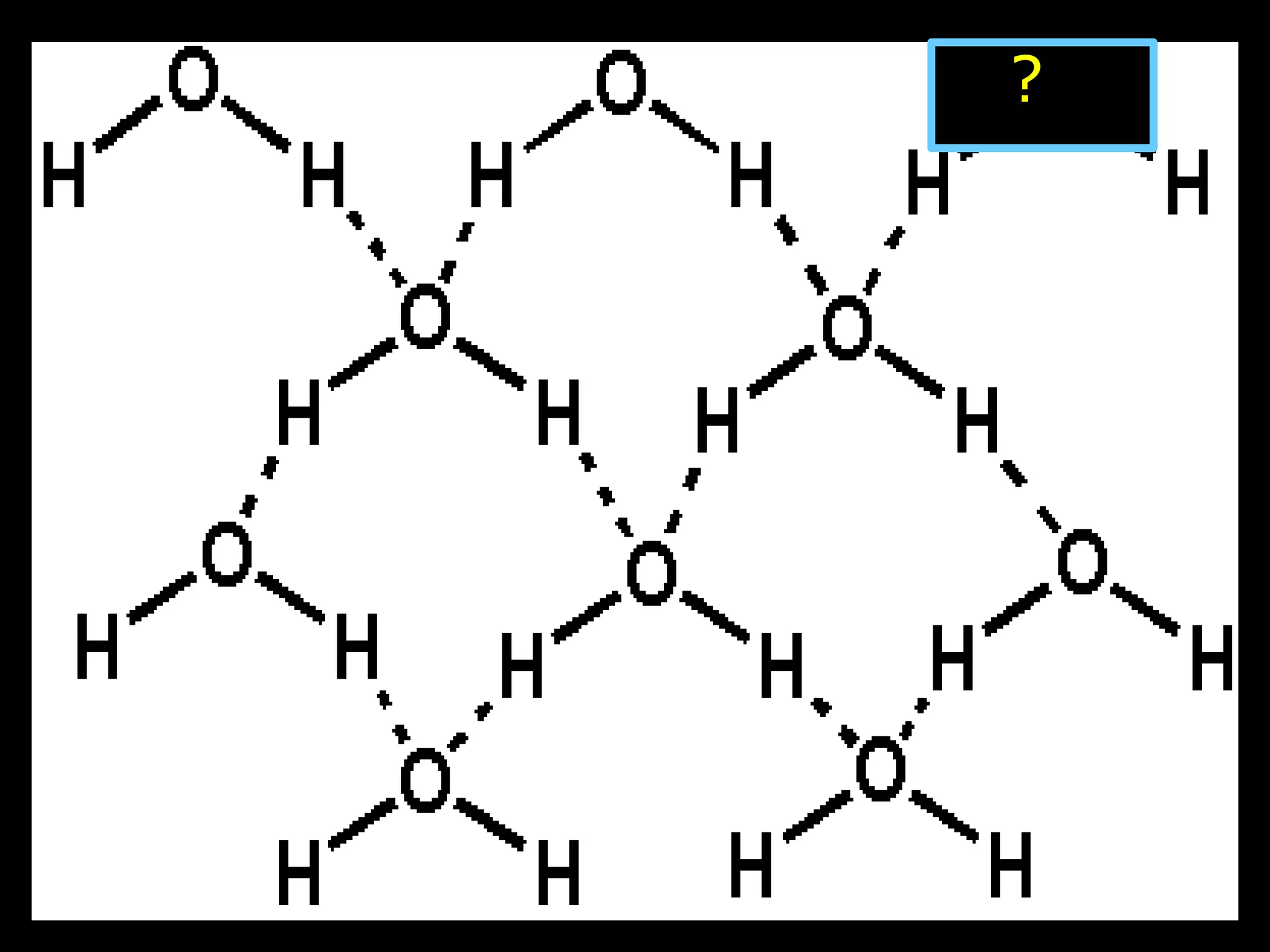
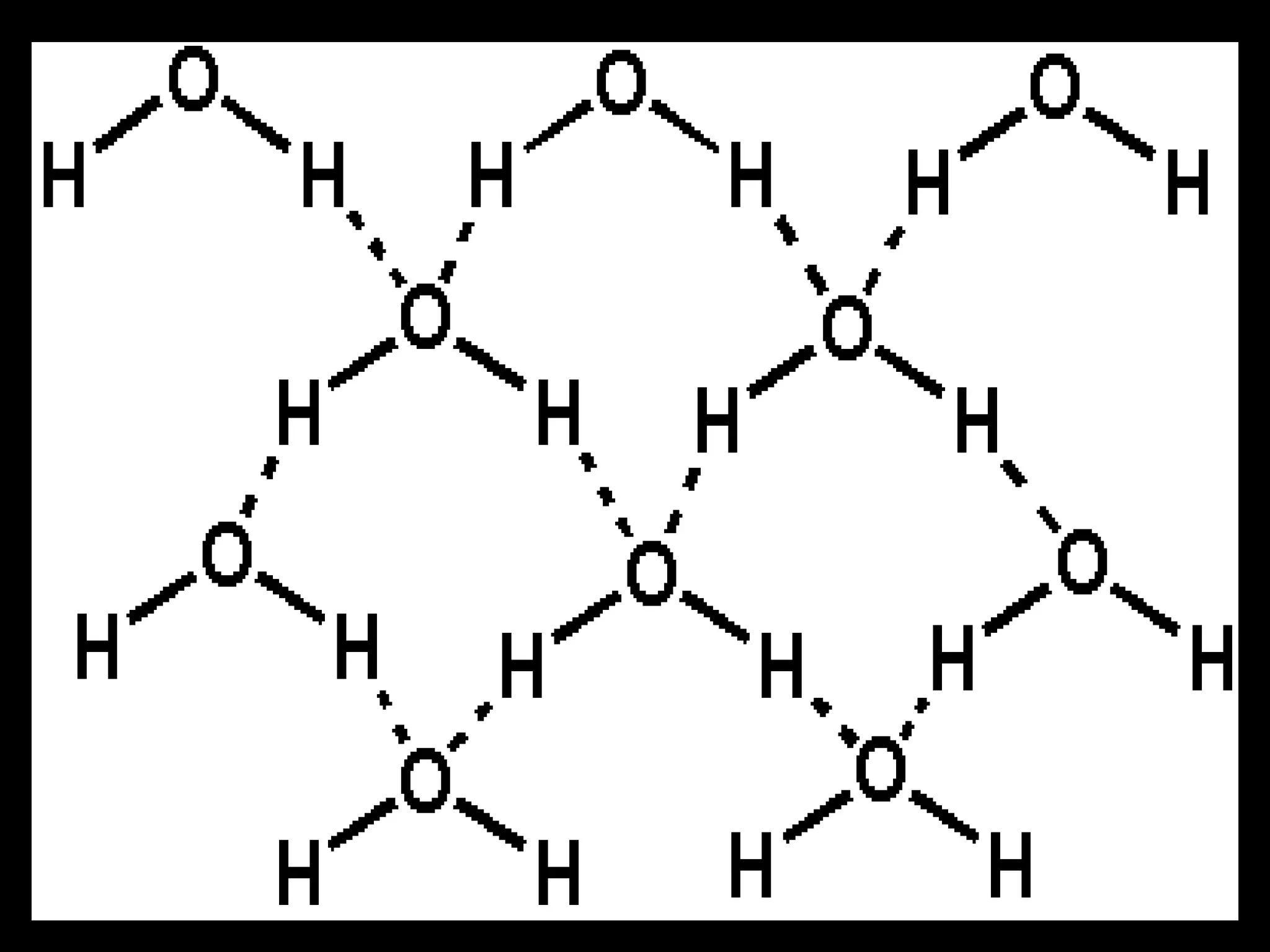
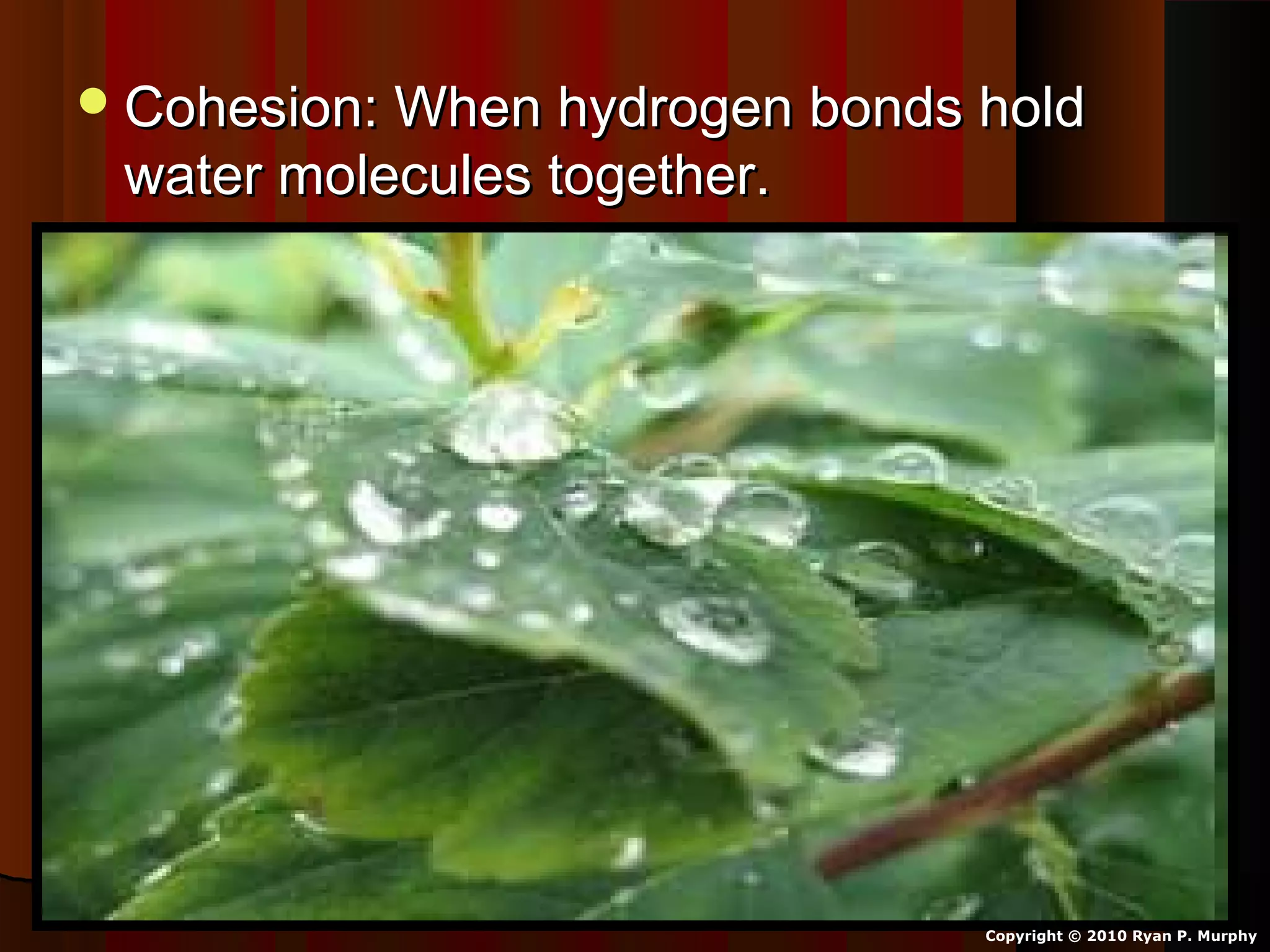
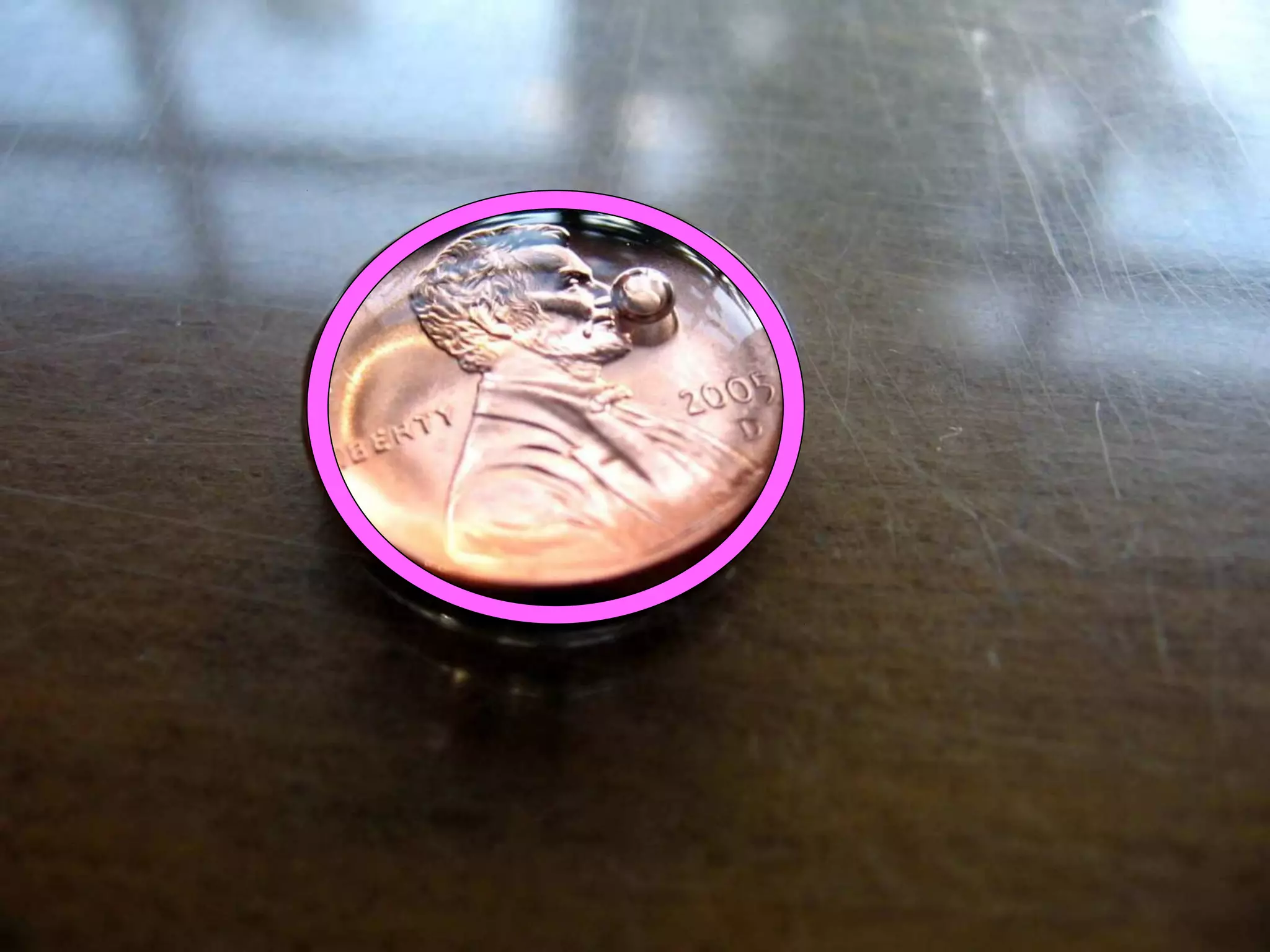
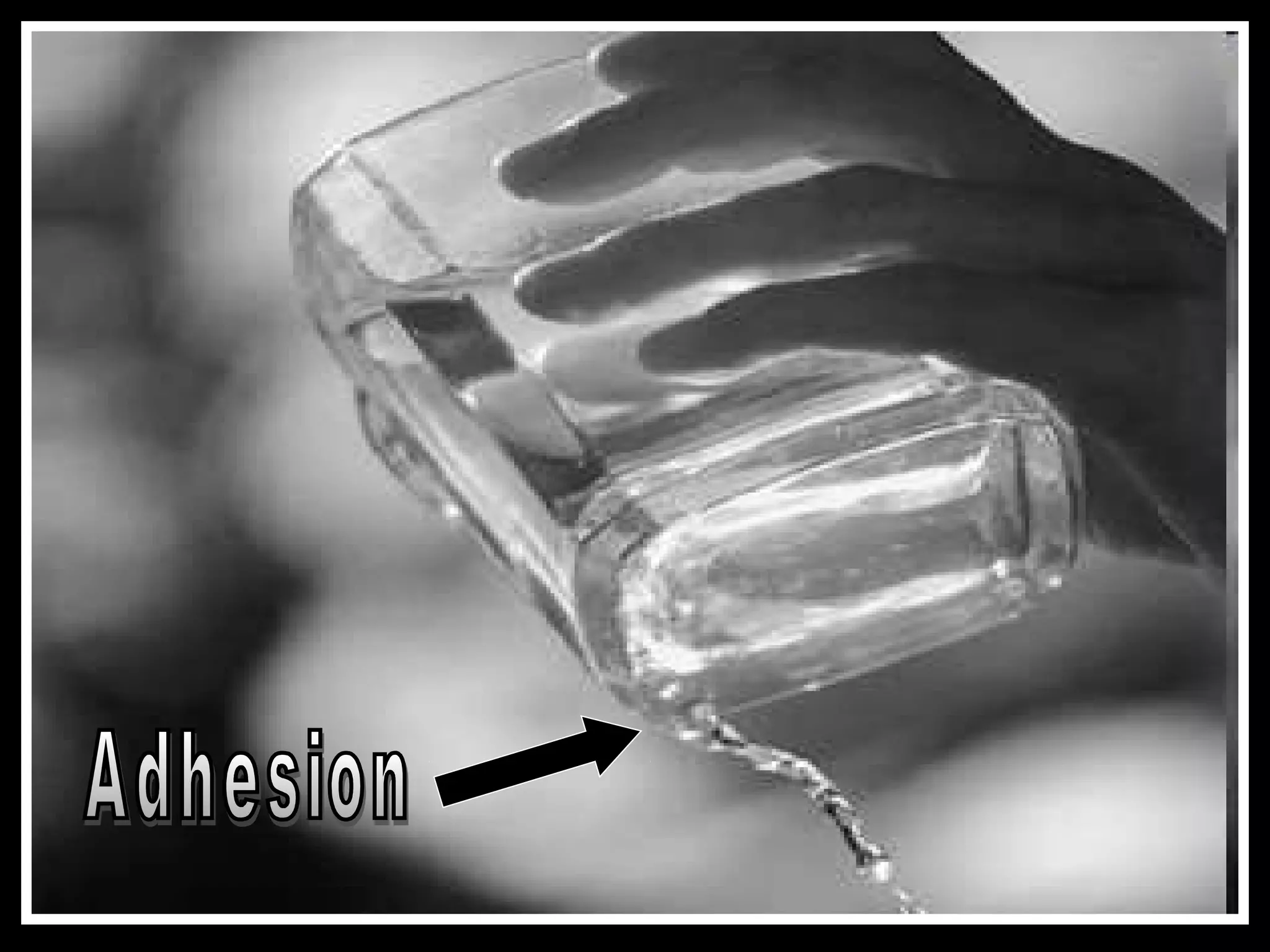
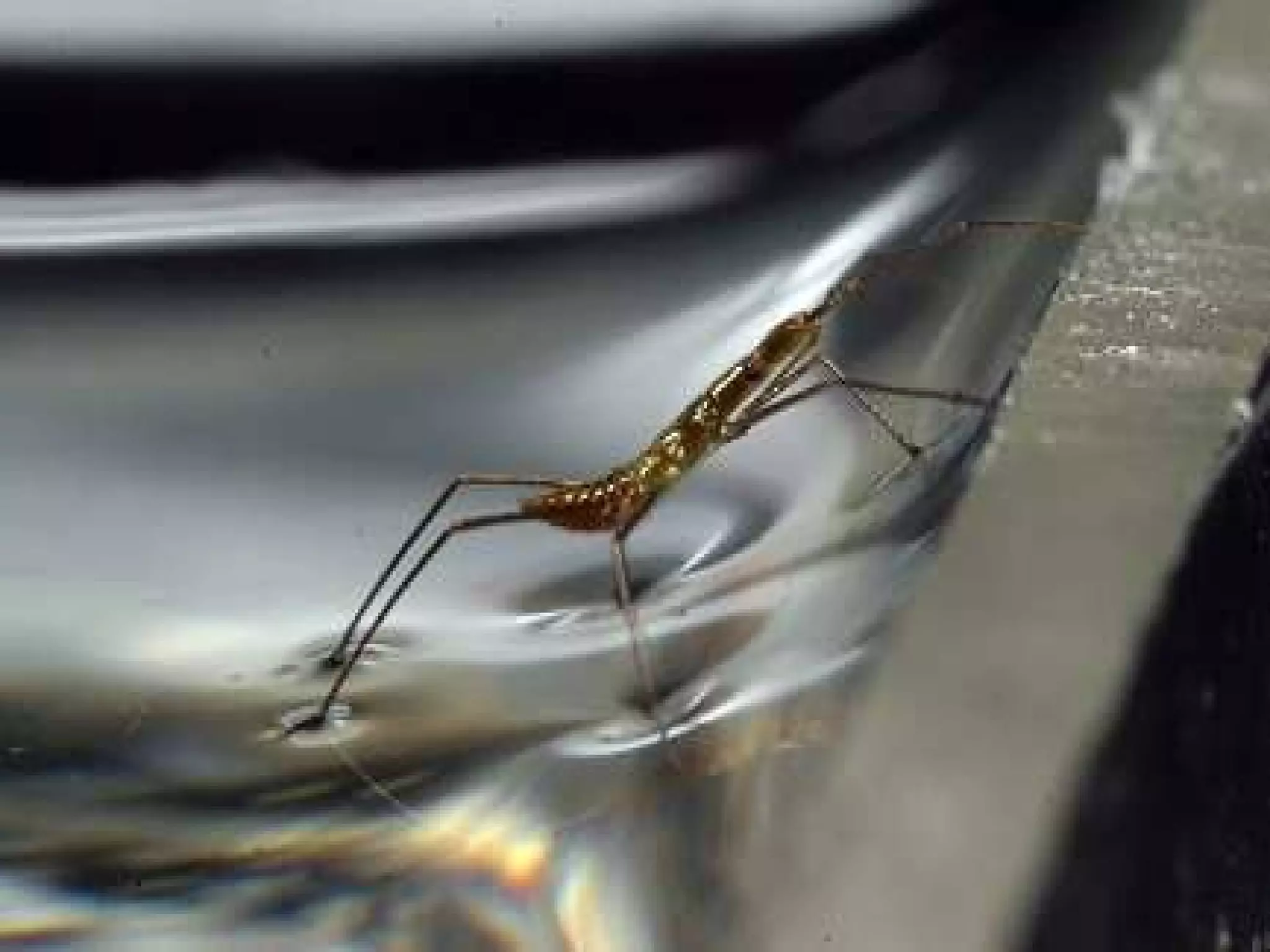
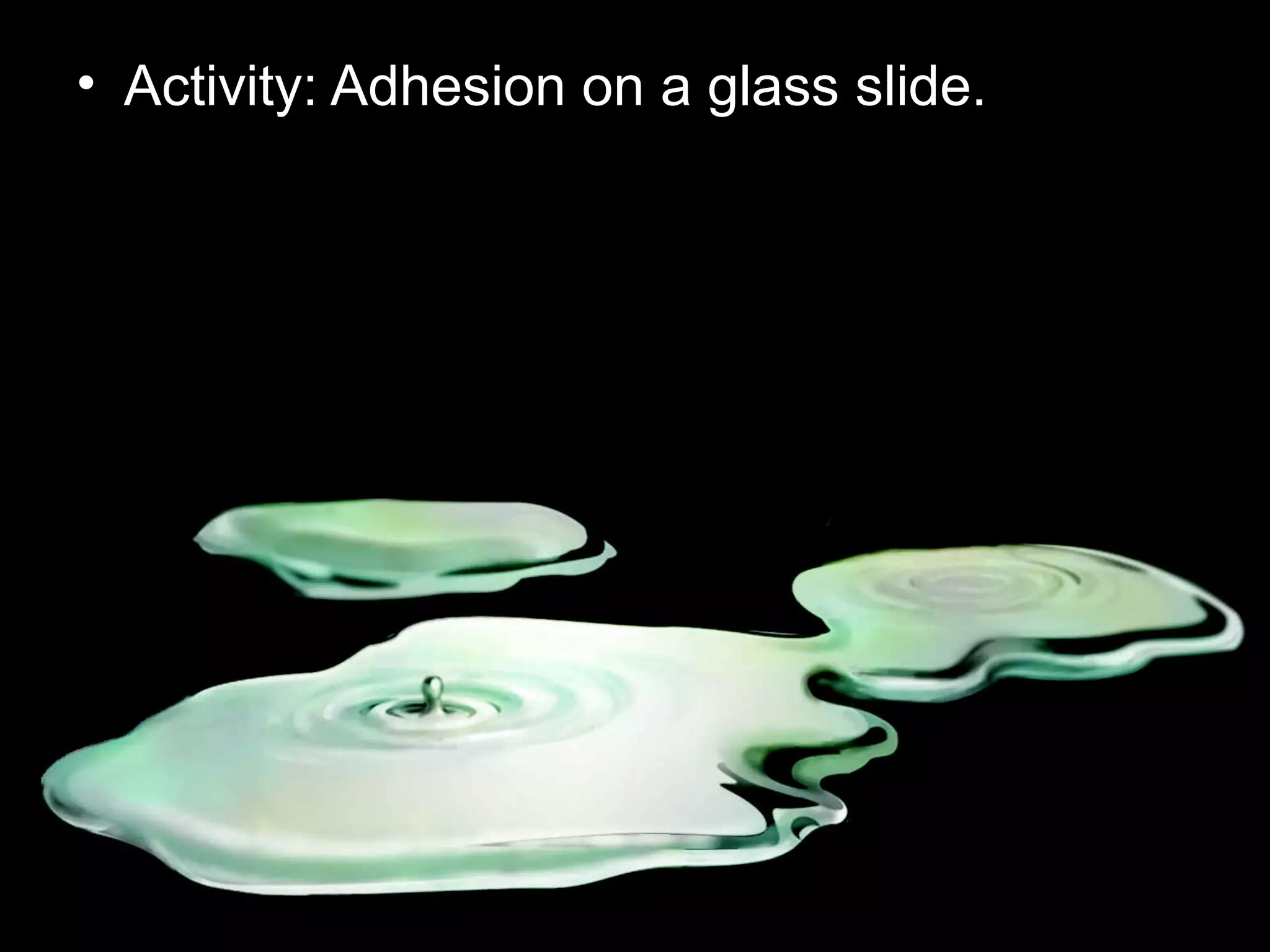

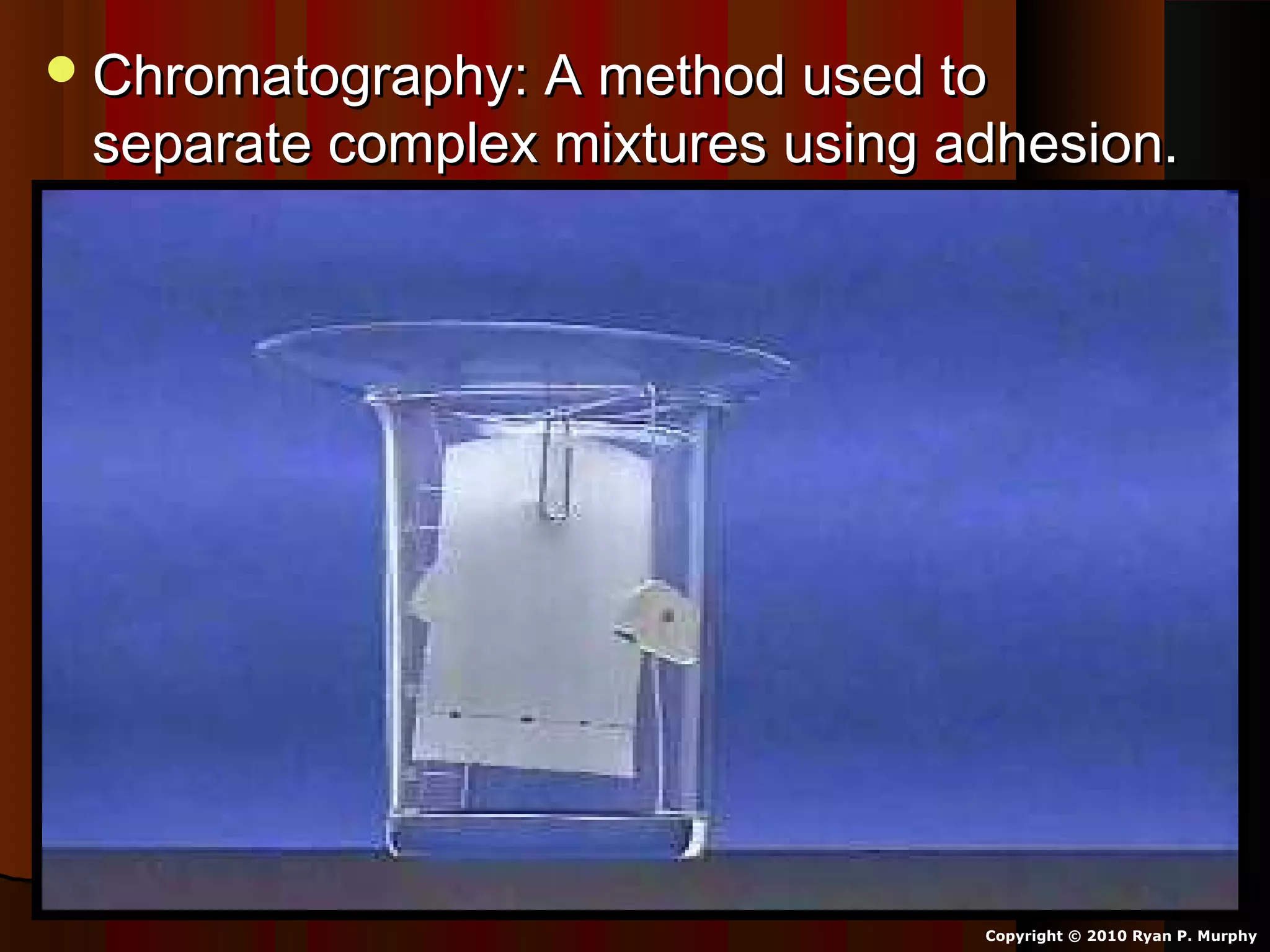
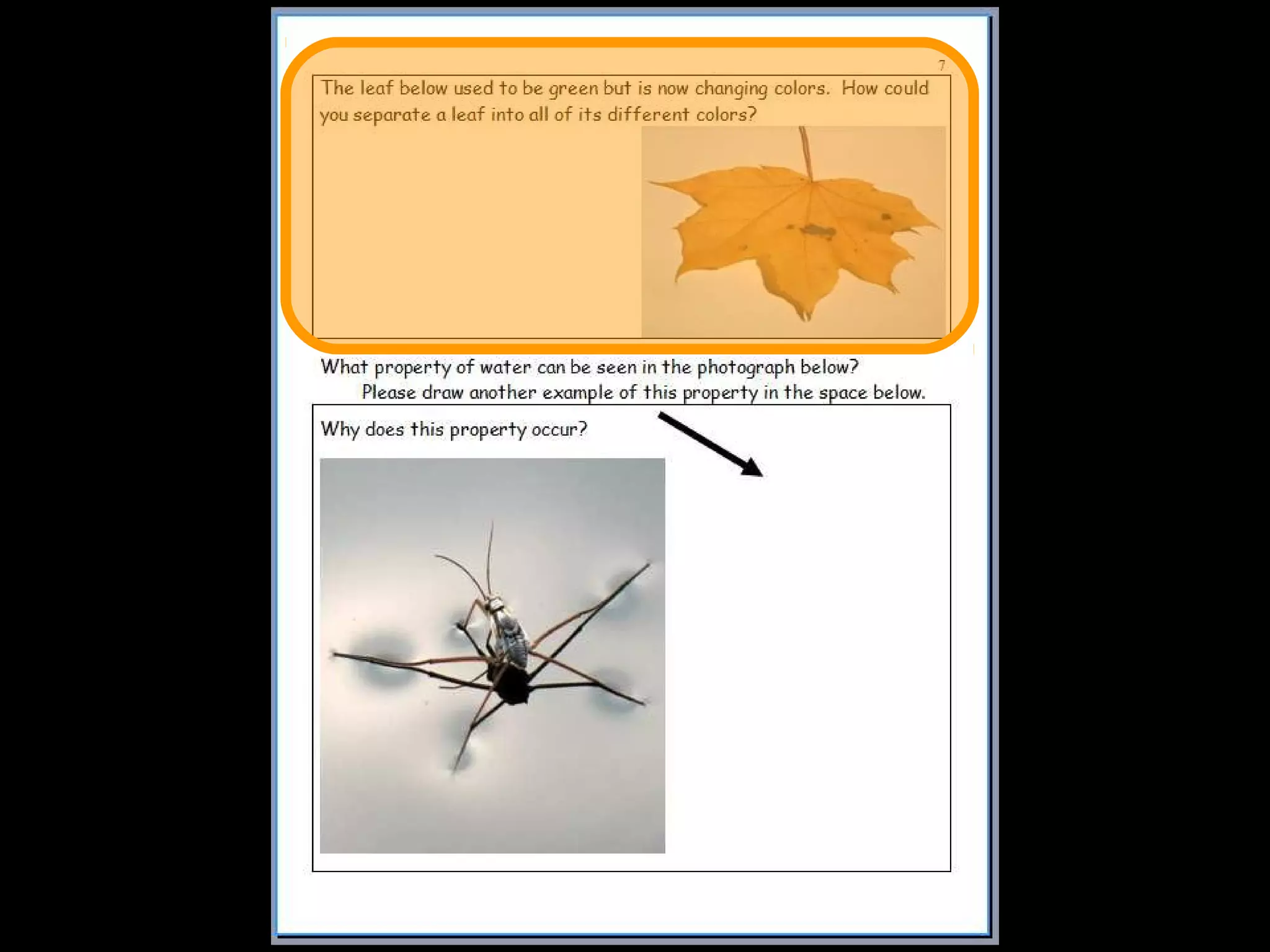








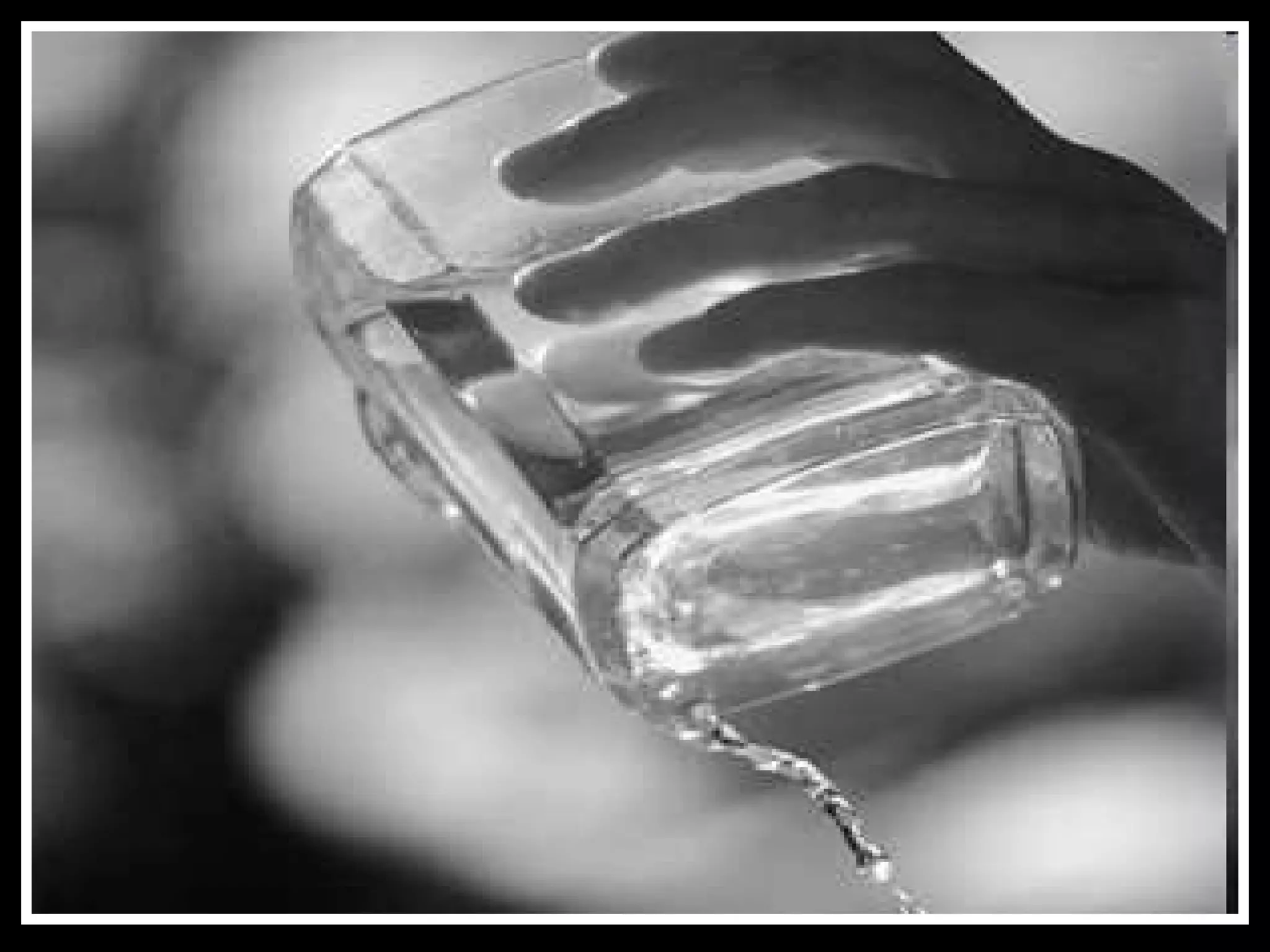
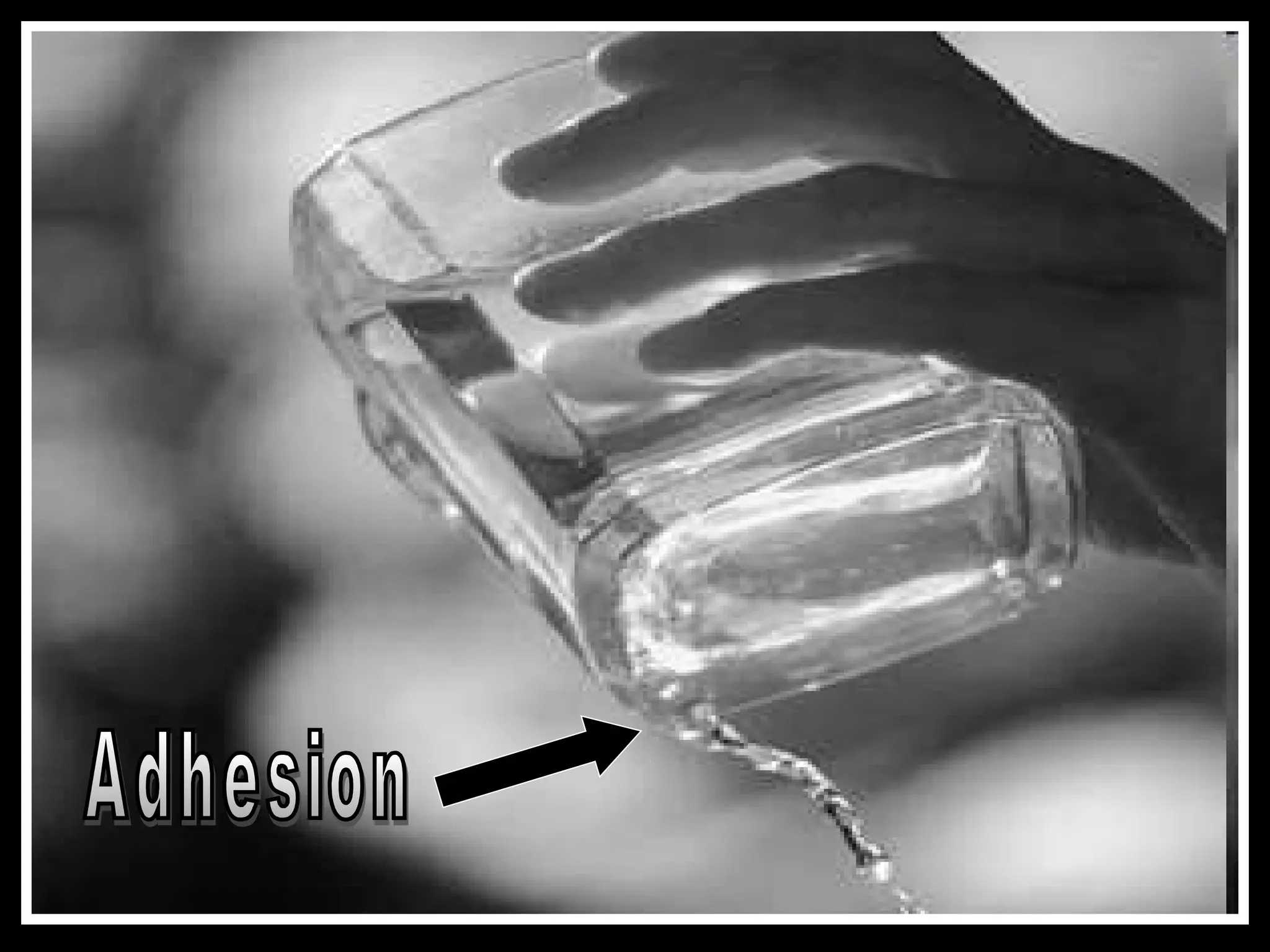
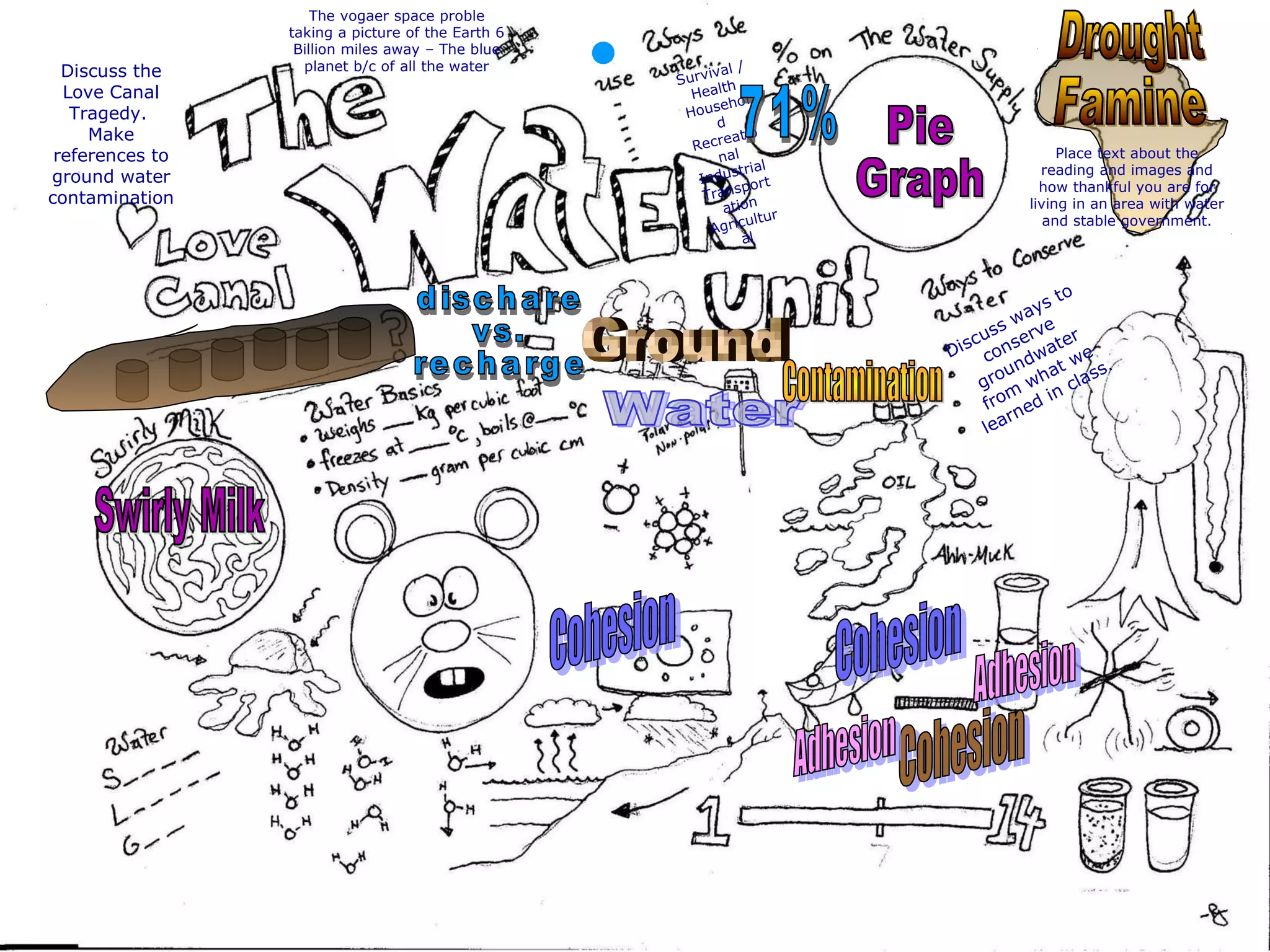
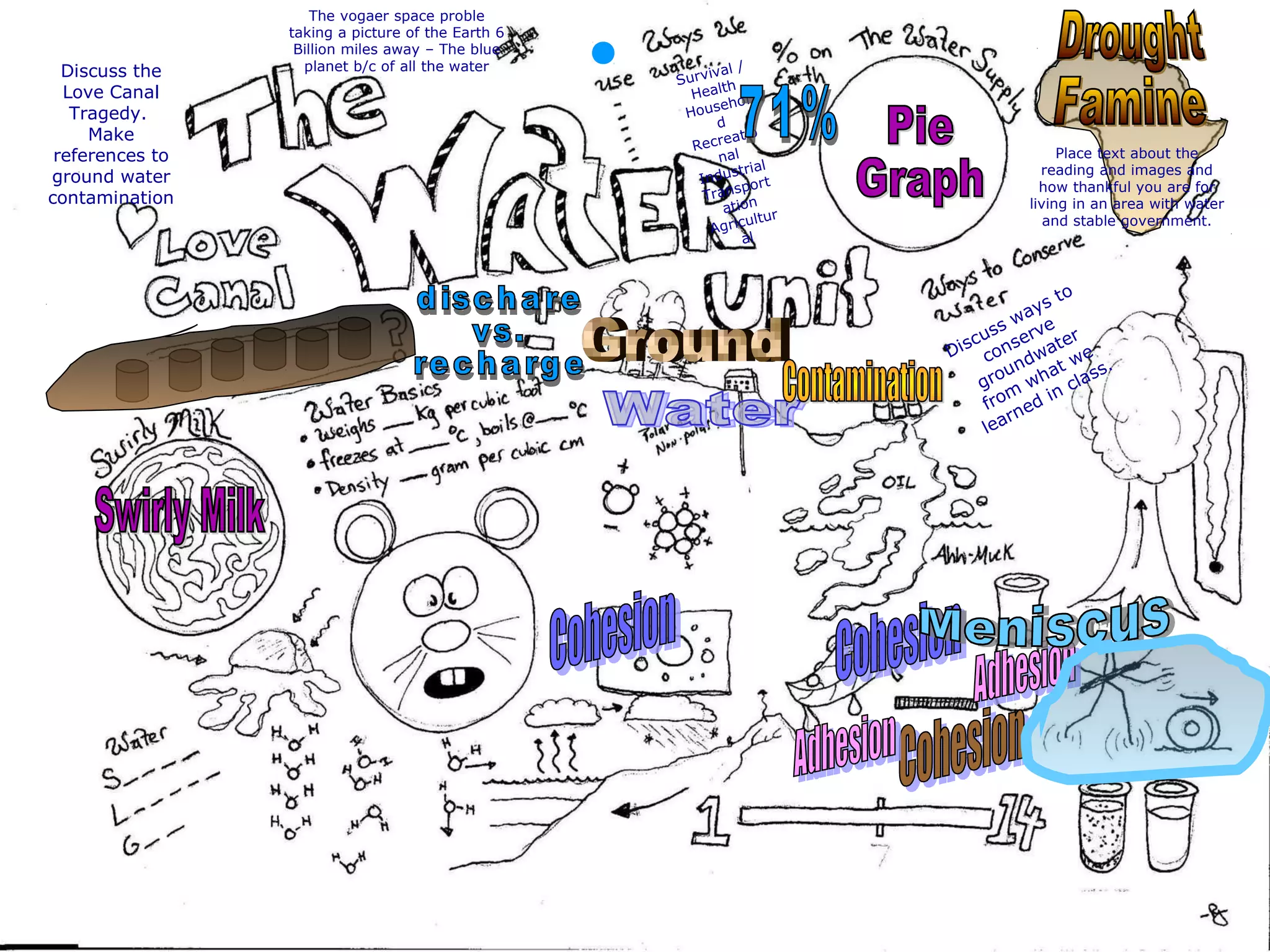
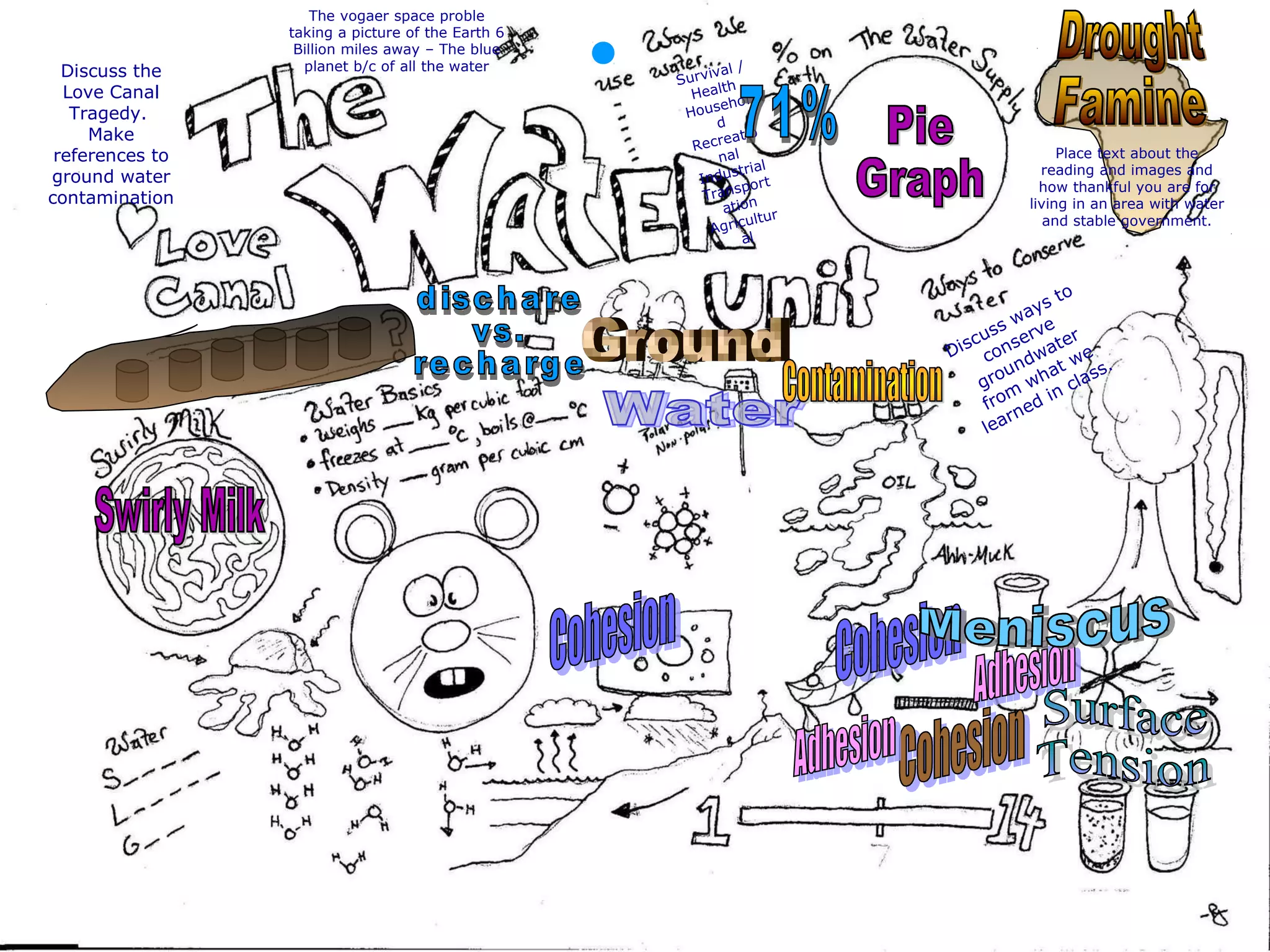
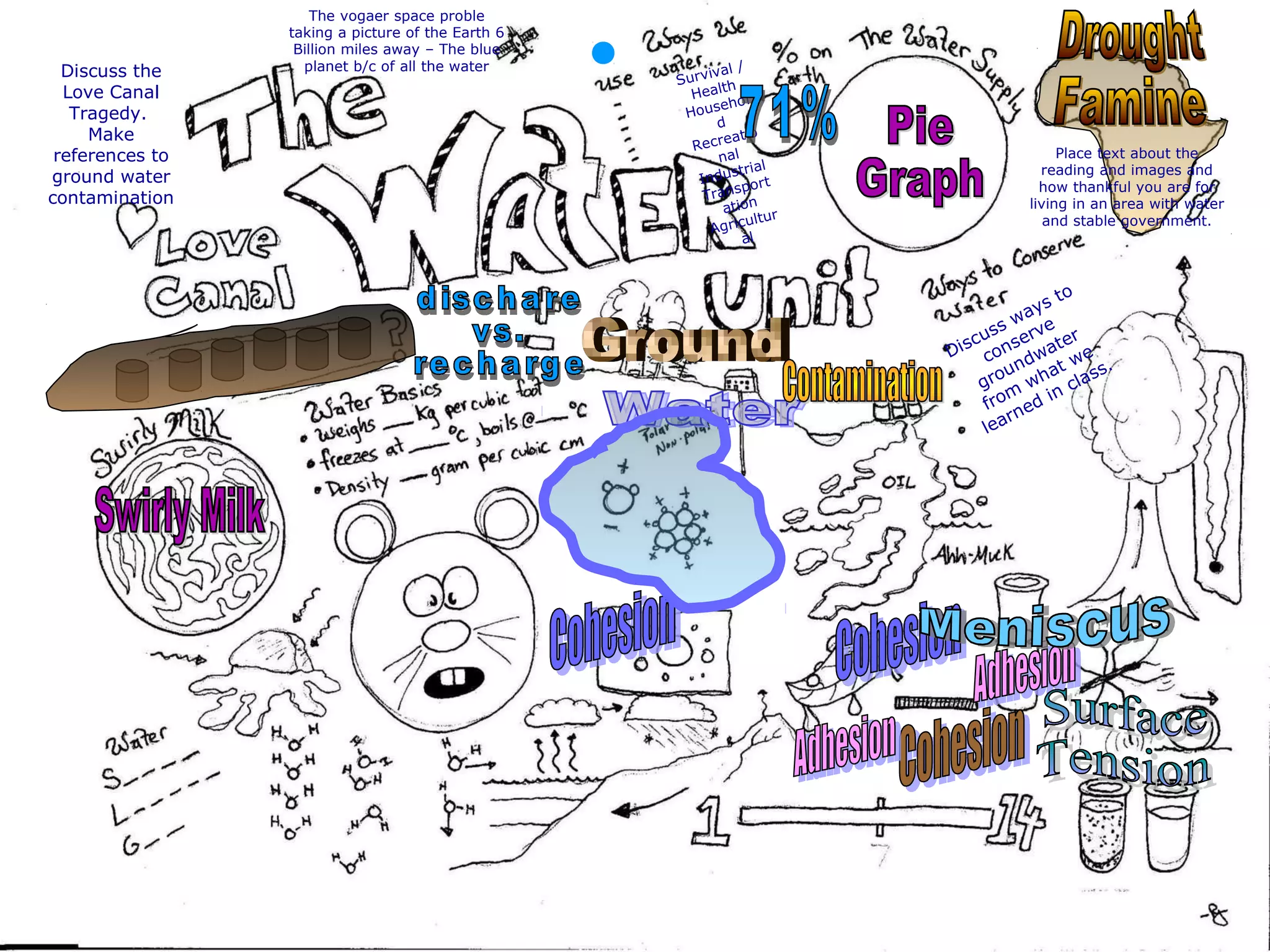
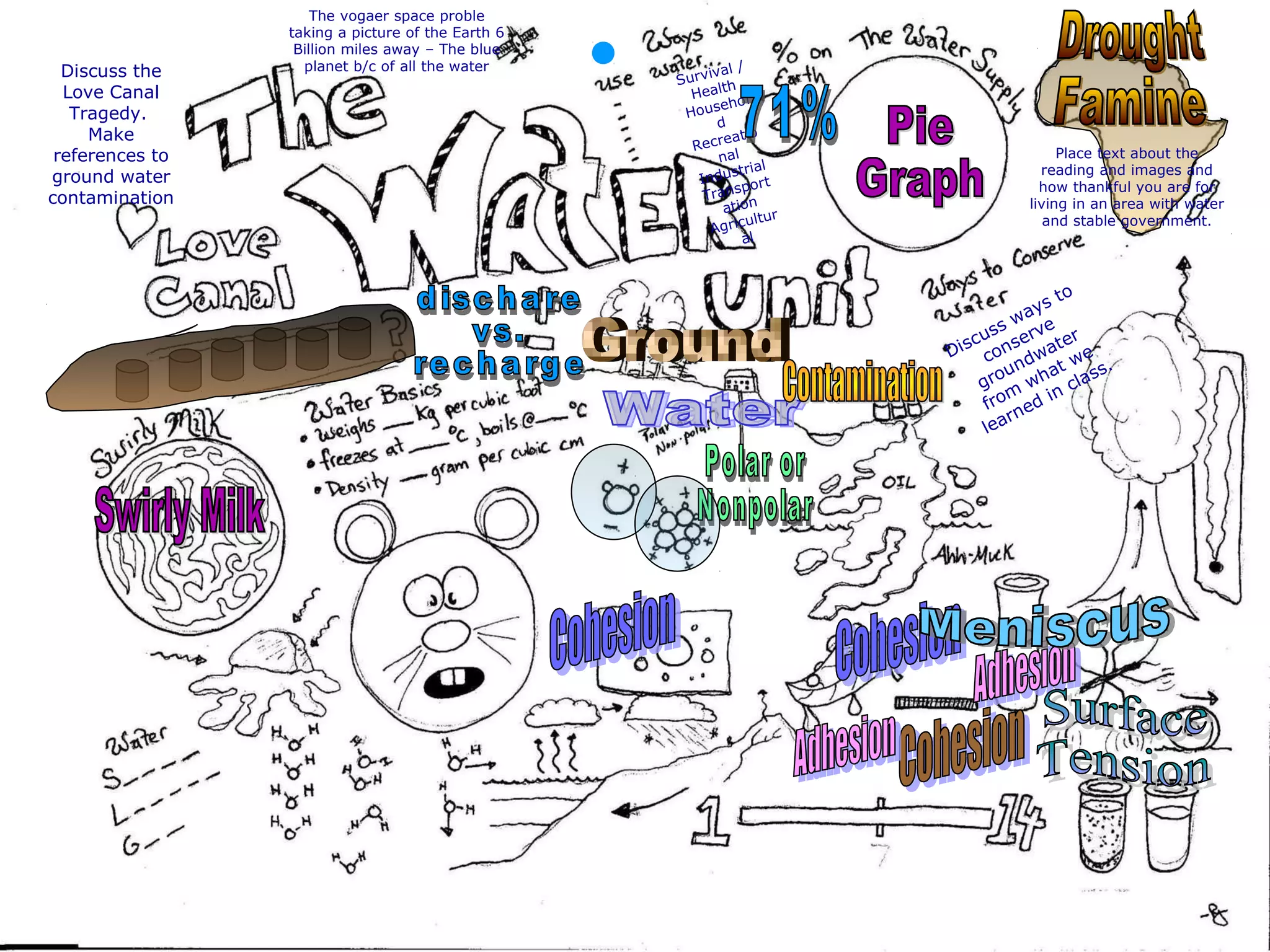
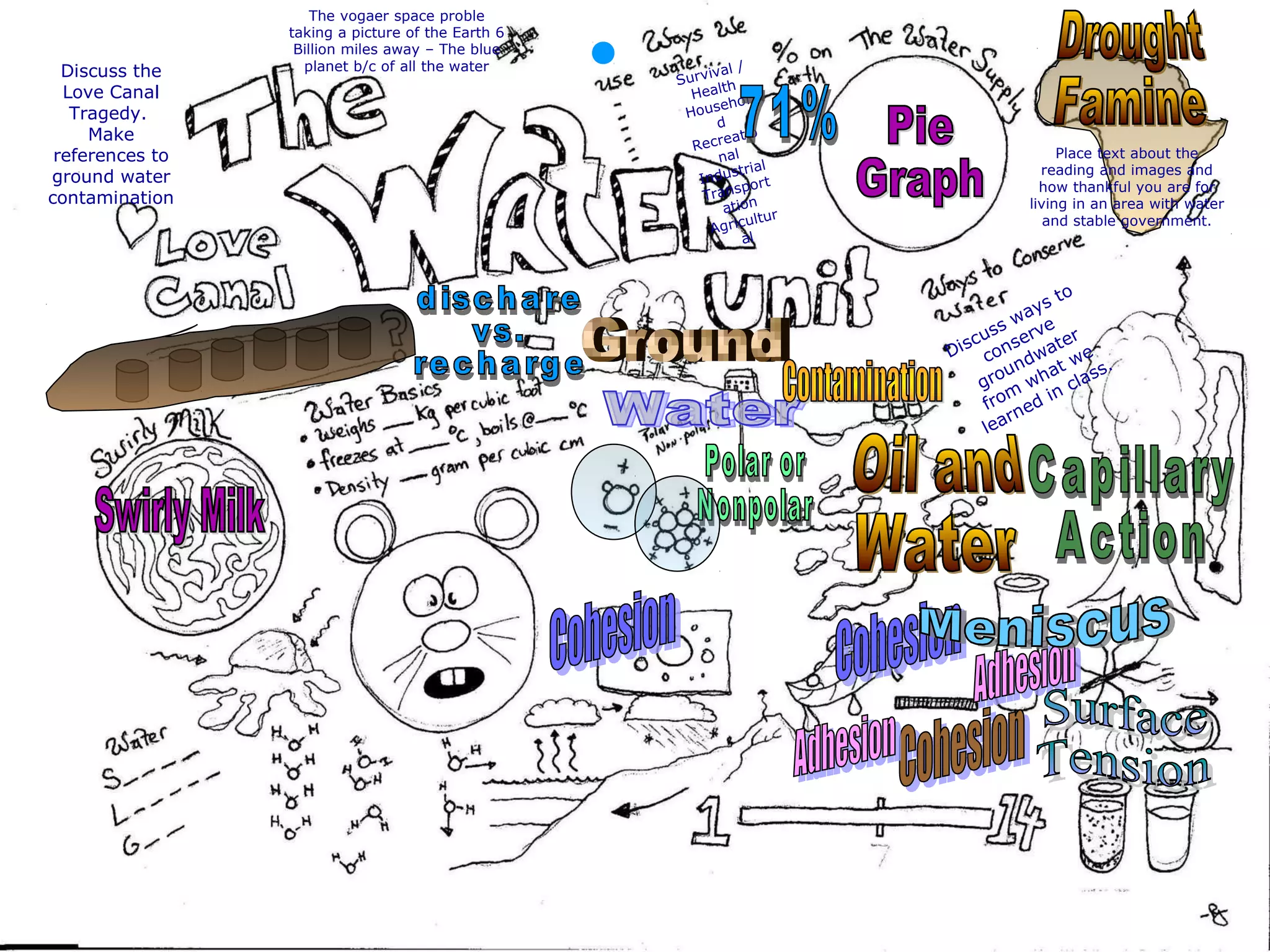


• Adhesion: When water molecules hold to a
surface.
Copyright © 2010 Ryan P. Murphy
• RED SLIDE: These are notes that are very
important and should be recorded in your
science journal.
Copyright © 2010 Ryan P. Murphy
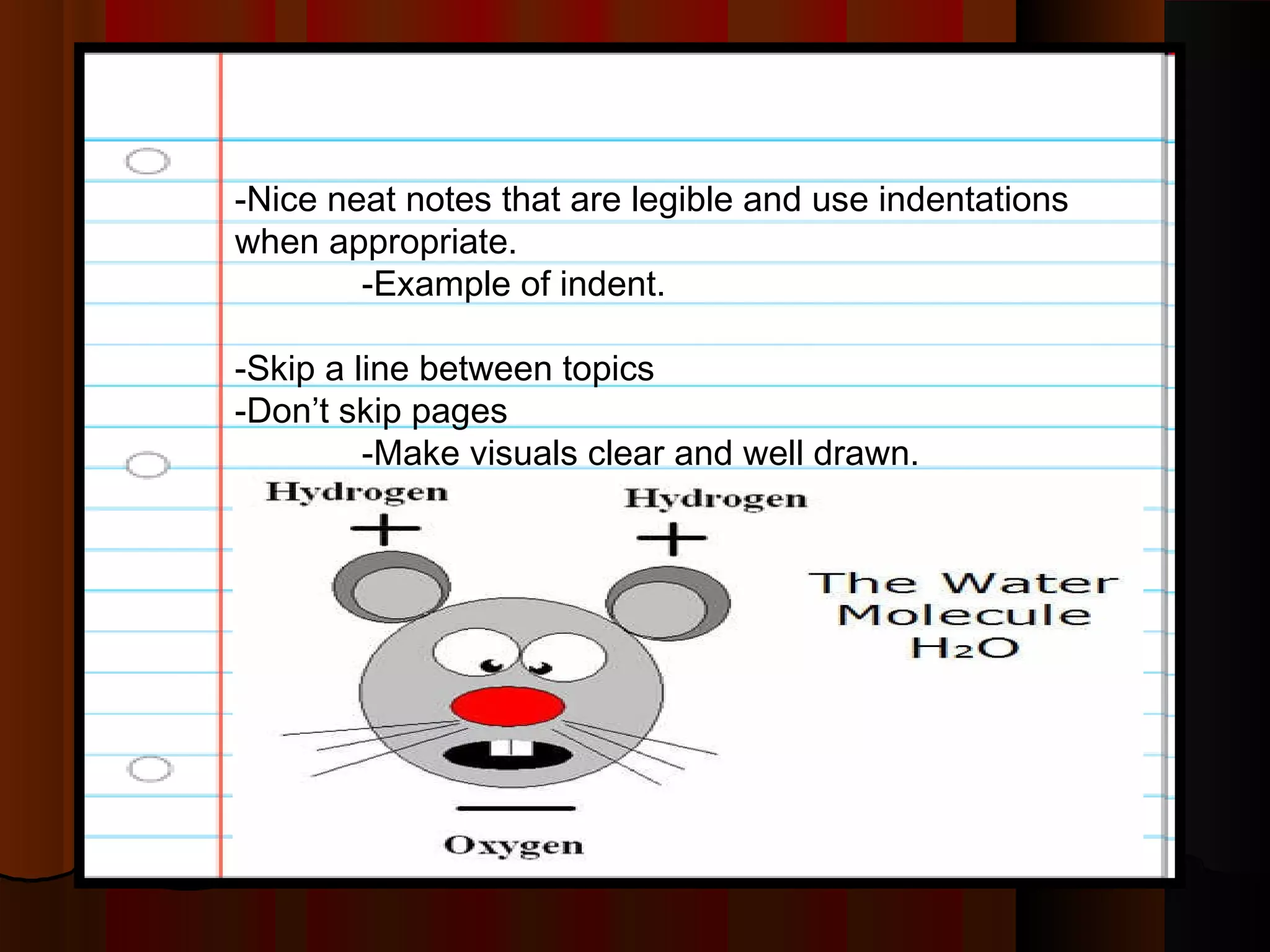
-Nice neat notes that are legible and use indentations
when appropriate.
-Example of indent.
-Skip a line between topics
-Don’t skip pages
-Make visuals clear and well drawn.
• RED SLIDE: These are notes that are very
important and should be recorded in your
science journal.
• BLACK SLIDE: Pay attention, follow
directions, complete projects as described
and answer required questions neatly.
Copyright © 2010 Ryan P. Murphy
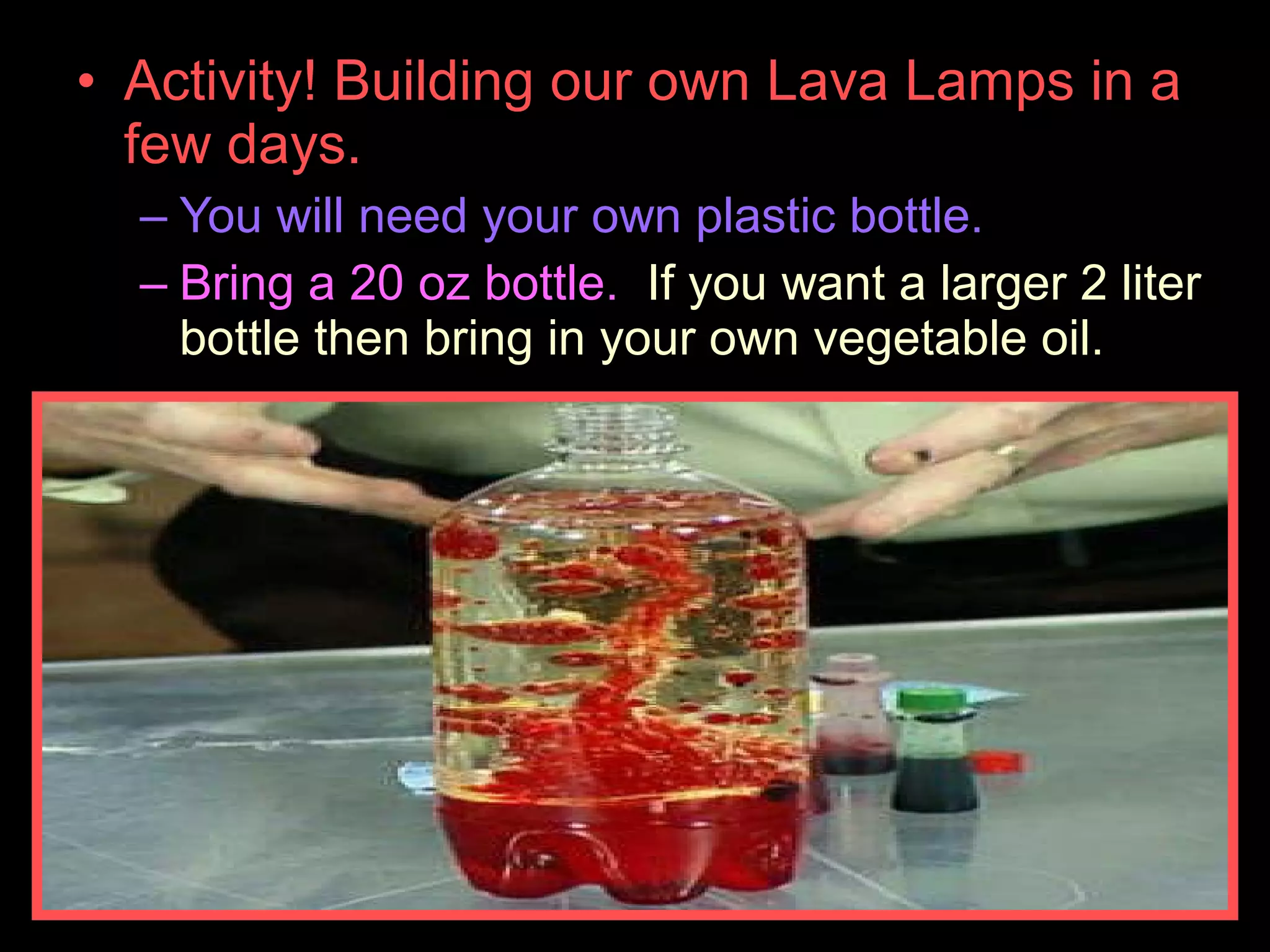
• Activity! Building our own Lava Lamps in a
few days.
– You will need your own plastic bottle.
– Bring a 20 oz bottle. If you want a larger 2 liter
bottle then bring in your own vegetable oil.
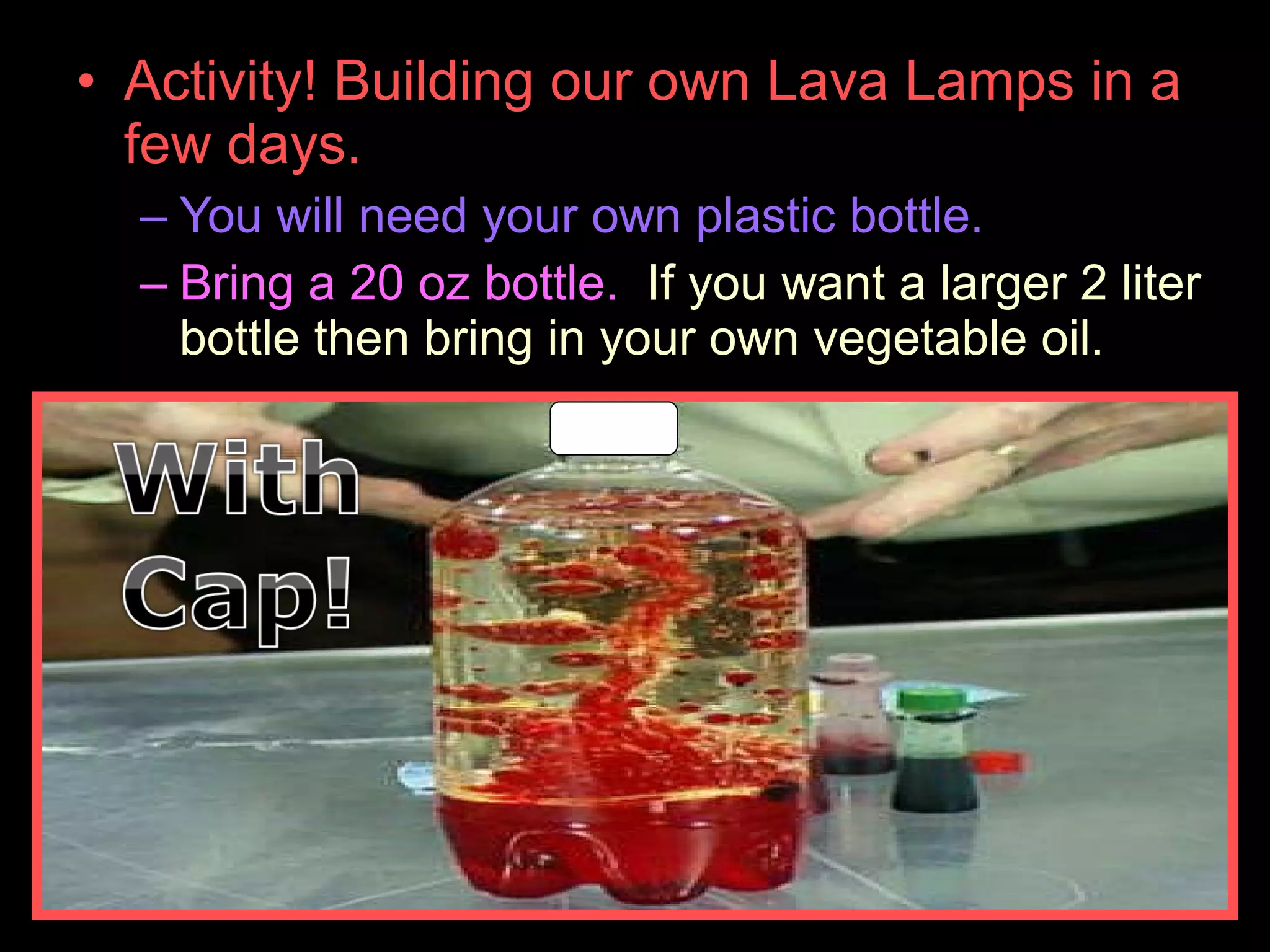
• Activity! Building our own Lava Lamps in a
few days.
– You will need your own plastic bottle.
– Bring a 20 oz bottle. If you want a larger 2 liter
bottle then bring in your own vegetable oil.
• Caution! We will be using dihydrogen
monoxide shortly. (DHMO)
– DHMO (dihydrogen monoxide) causes the
following…
• Also known as hydroxl acid, and is the major
component of acid rain.
• Can cause death if inhaled in large quantities.
• Industrial solvent and coolant.
• Used in nuclear power plants.
• Ingestion causes excessive sweating and urination.
• Causes severe erosion of our natural landscape.
• Used in pesticide production and distribution.
• An additive to food products.
• and much more…
• Caution! We will be using dihydrogen
monoxide shortly. (DHMO)
– DHMO (dihydrogen monoxide) causes the
following…
• Also known as hydroxl acid, and is the major
component of acid rain.
• Can cause death if inhaled in large quantities.
• Industrial solvent and coolant.
• Used in nuclear power plants.
• Ingestion causes excessive sweating and urination.
• Causes severe erosion of our natural landscape.
• Used in pesticide production and distribution.
• An additive to food products.
• and much more…
• Caution! We will be using dihydrogen
monoxide shortly. (DHMO)
– DHMO (dihydrogen monoxide) causes the
following…
• Also known as hydroxl acid, and is the major
component of acid rain.
• Can cause death if inhaled in large quantities.
• Industrial solvent and coolant.
• Used in nuclear power plants.
• Ingestion causes excessive sweating and urination.
• Causes severe erosion of our natural landscape.
• Used in pesticide production and distribution.
• An additive to food products.
• and much more…
• I will place a sample of dihydrogen
monoxide on your table.
• Please do not touch it until instructed.
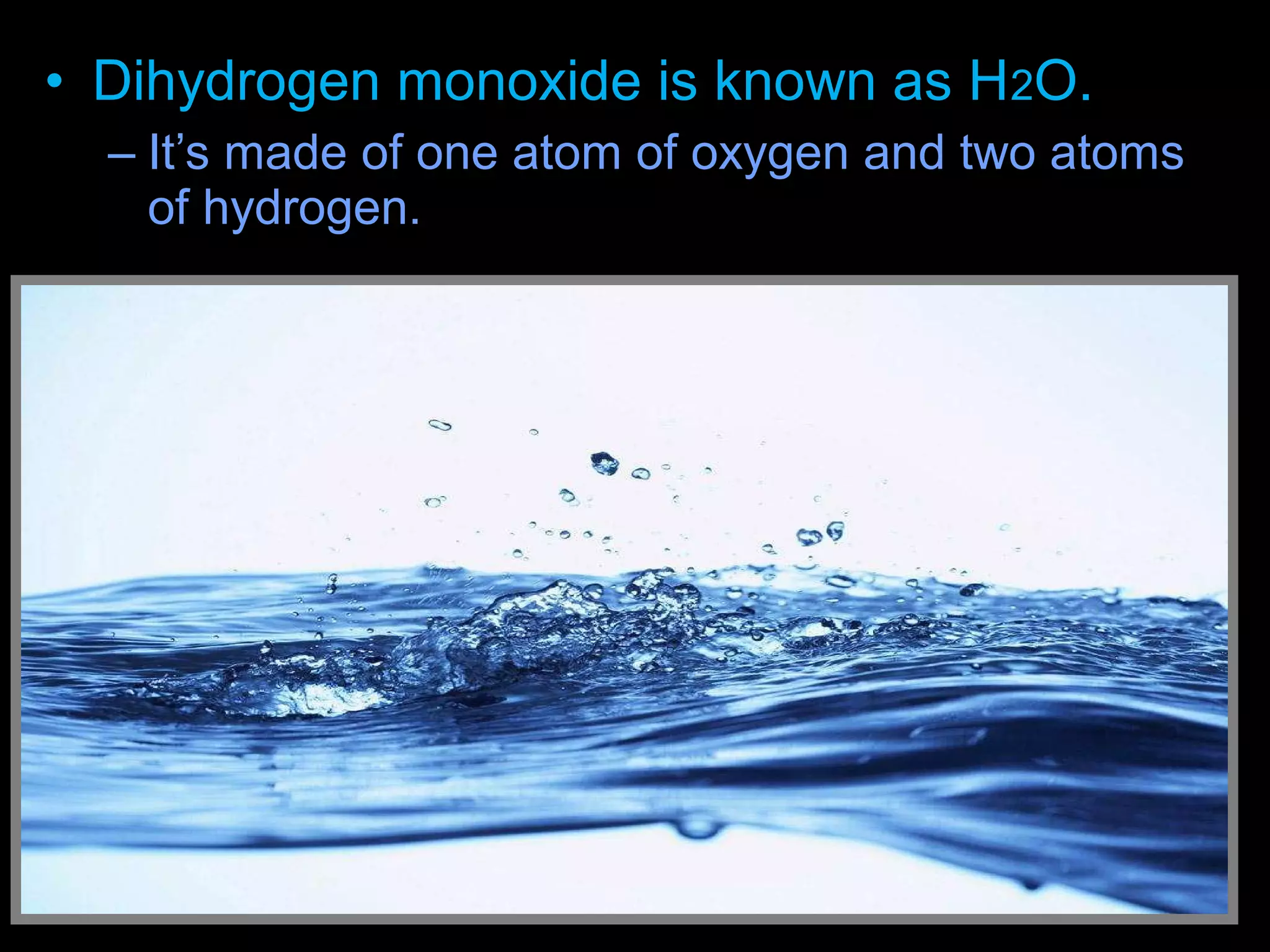
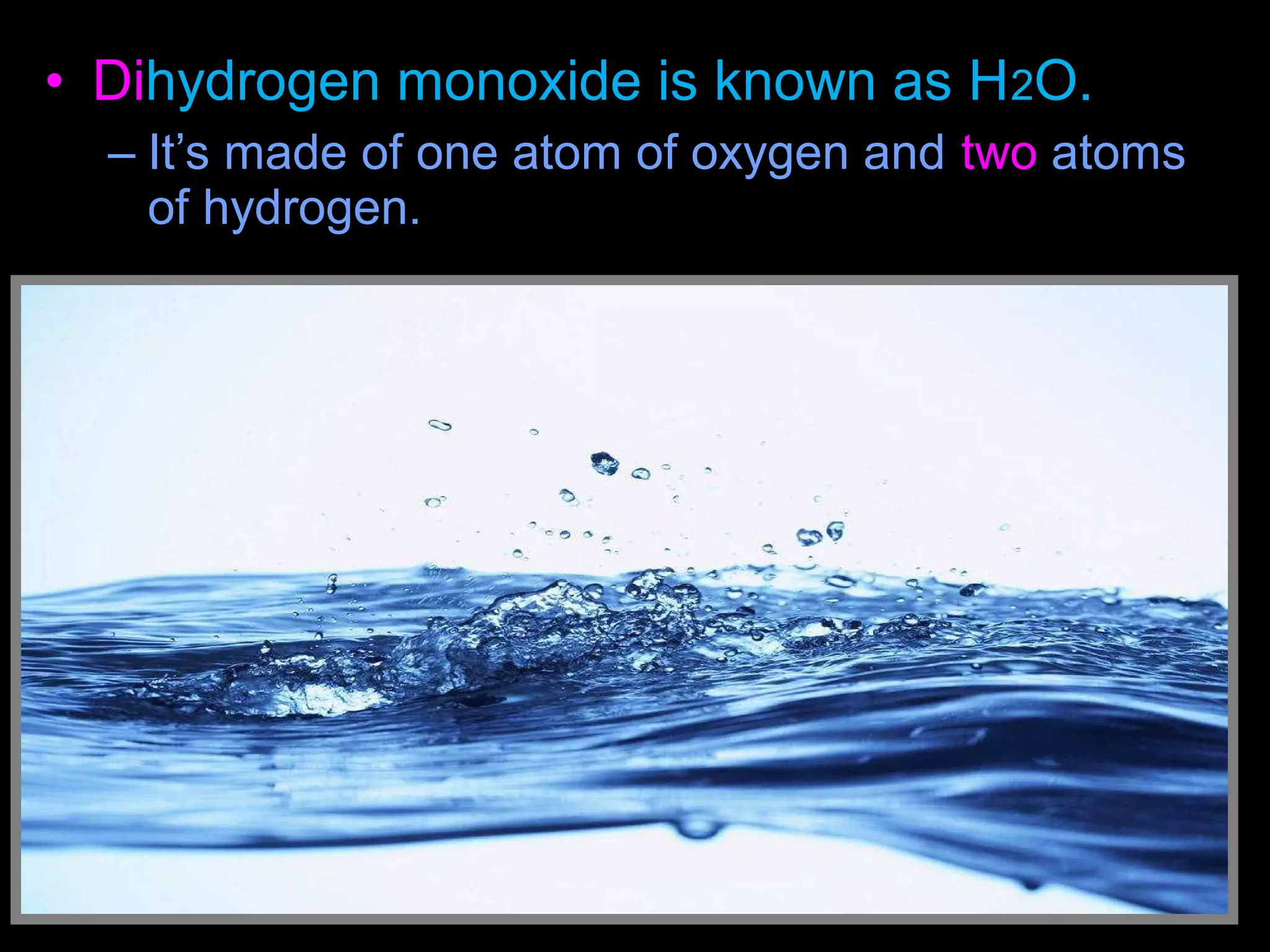
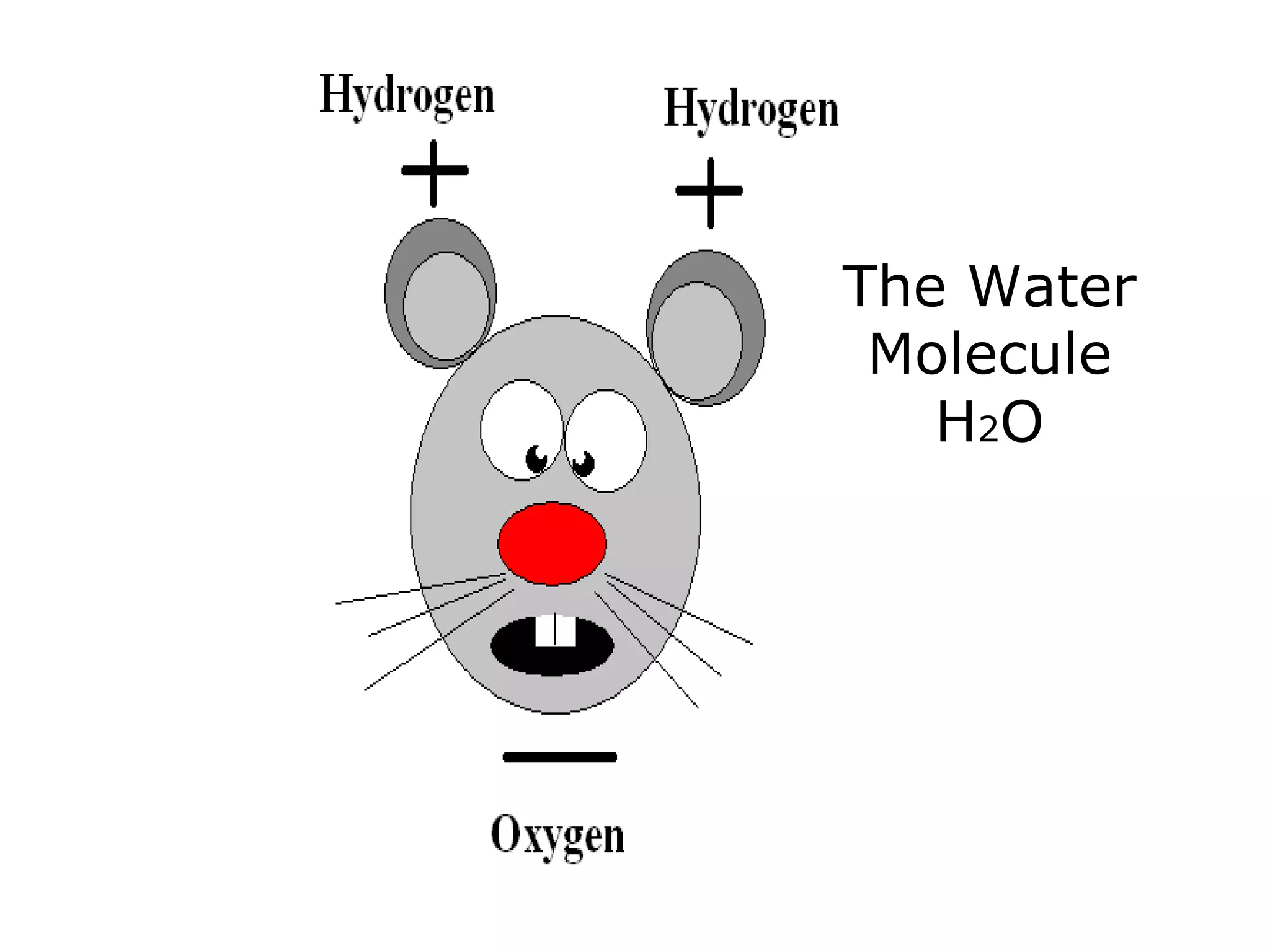
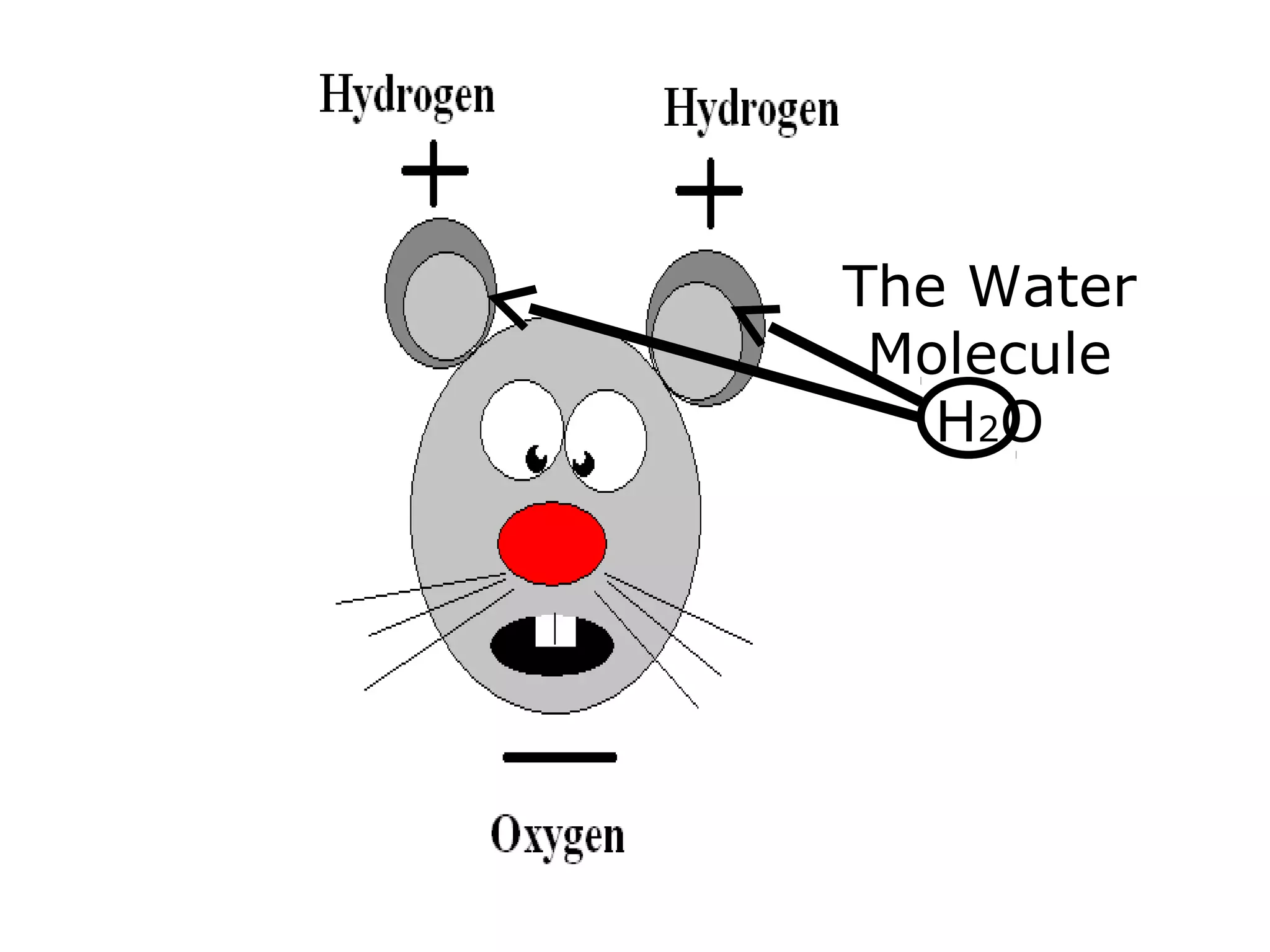
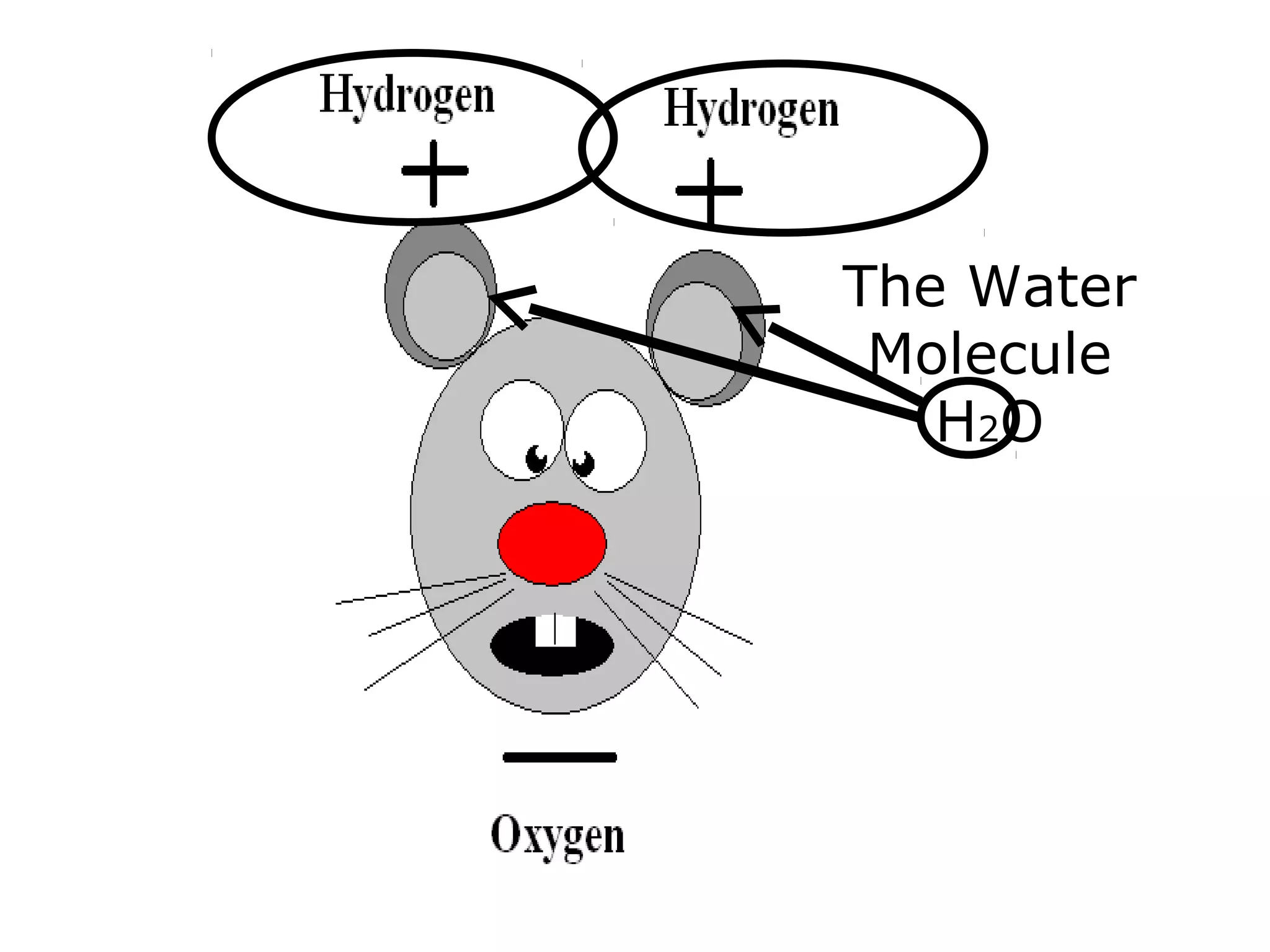
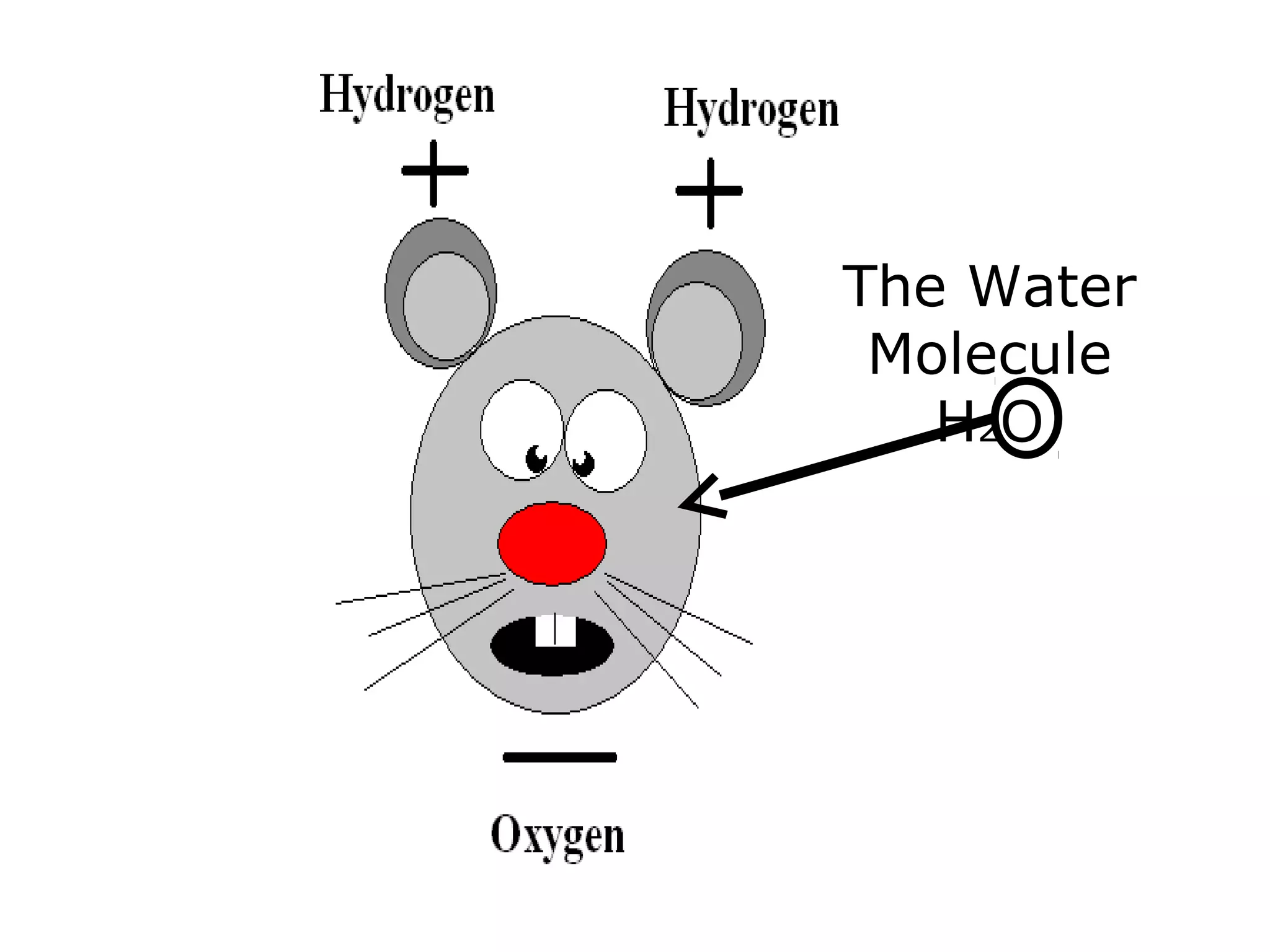
• Dihydrogen monoxide is known as H2O.
– It’s made of one atom of oxygen and two atoms
of hydrogen.
• Dihydrogen monoxide is known as H2O.
– It’s made of one atom of oxygen and two atoms
of hydrogen.
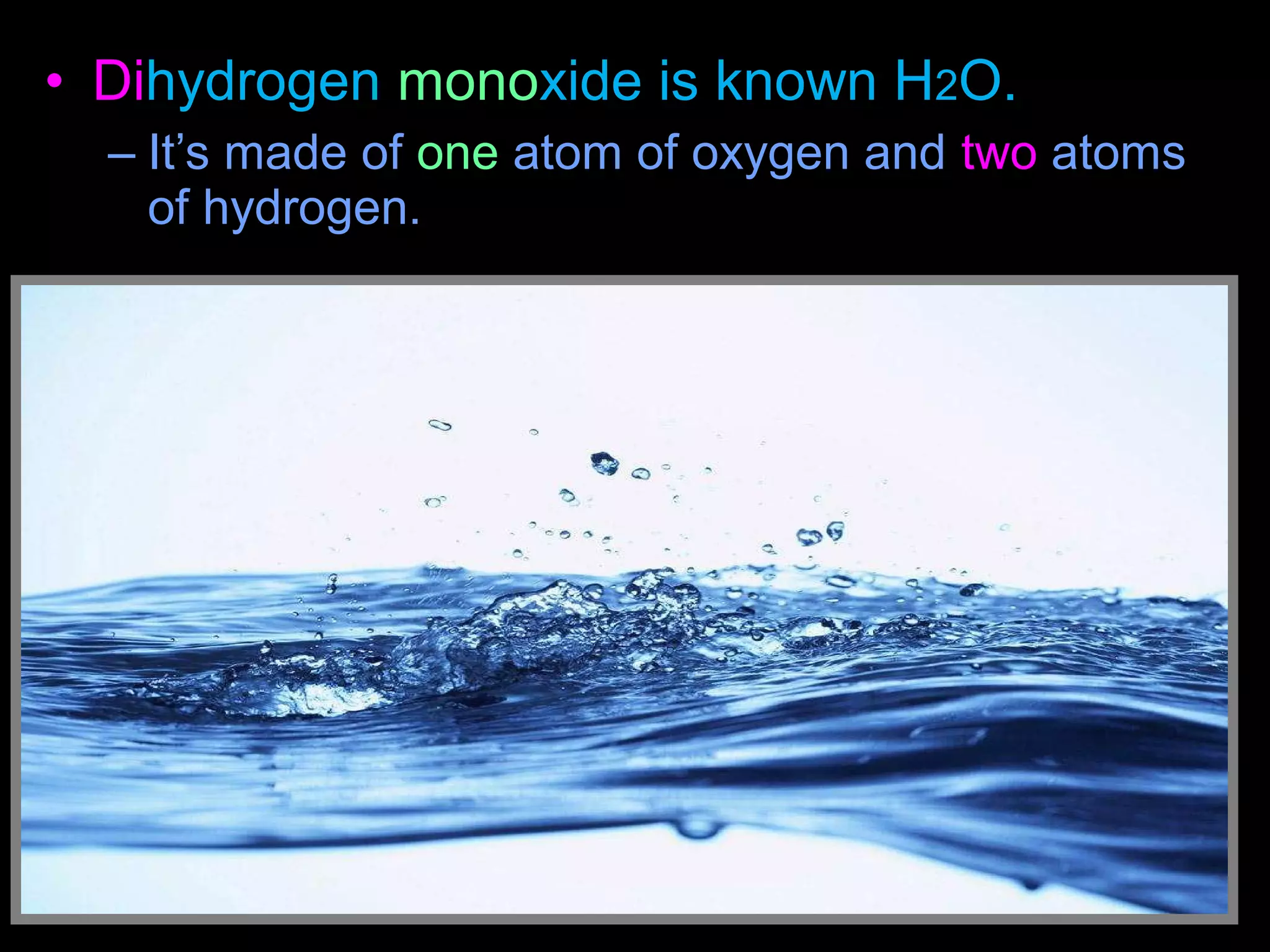
• Dihydrogen monoxide is known H2O.
– It’s made of one atom of oxygen and two atoms
of hydrogen.
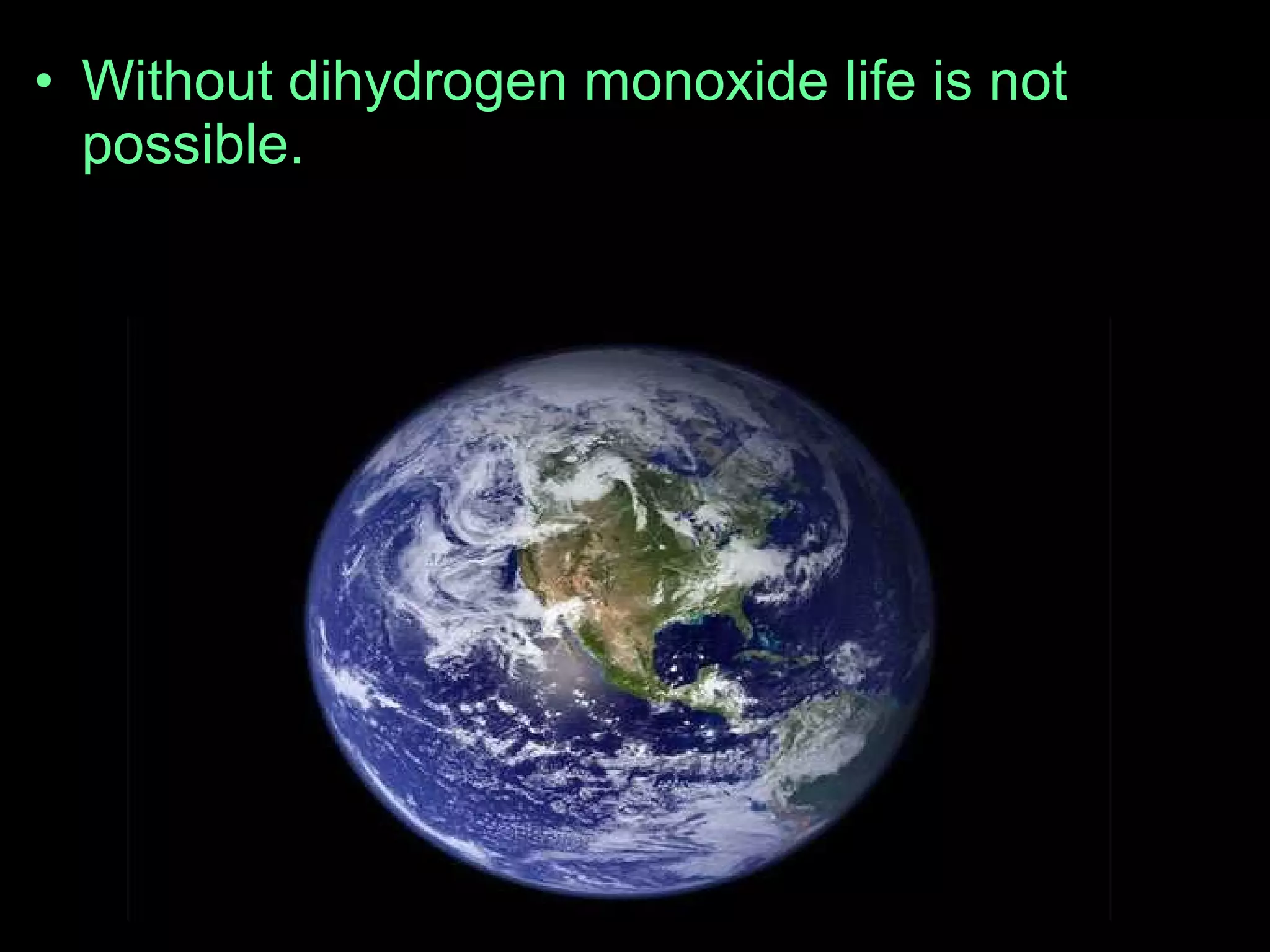
• Without dihydrogen monoxide life is not
possible.
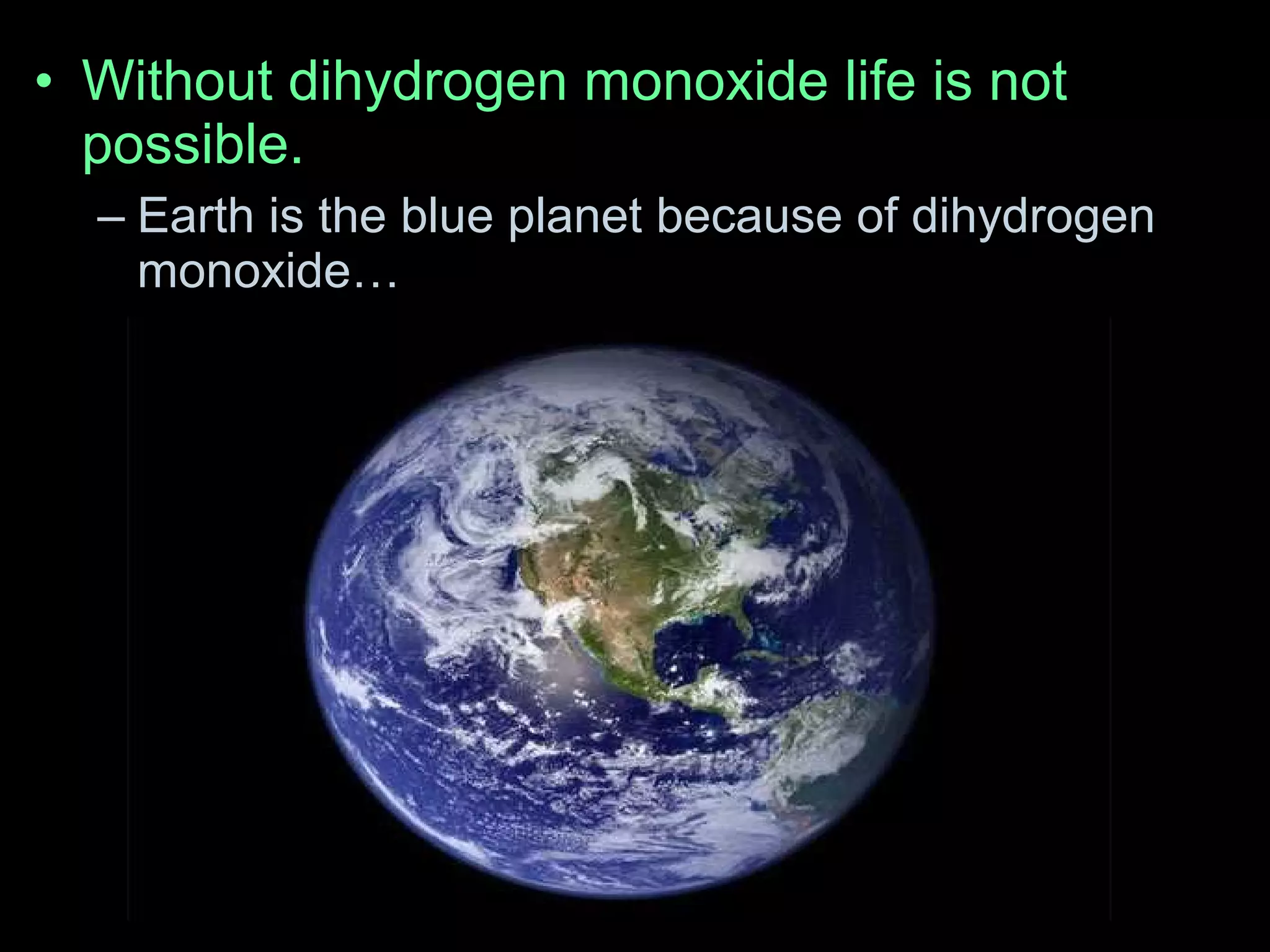
• Without dihydrogen monoxide life is not
possible.
– Earth is the blue planet because of dihydrogen
monoxide…
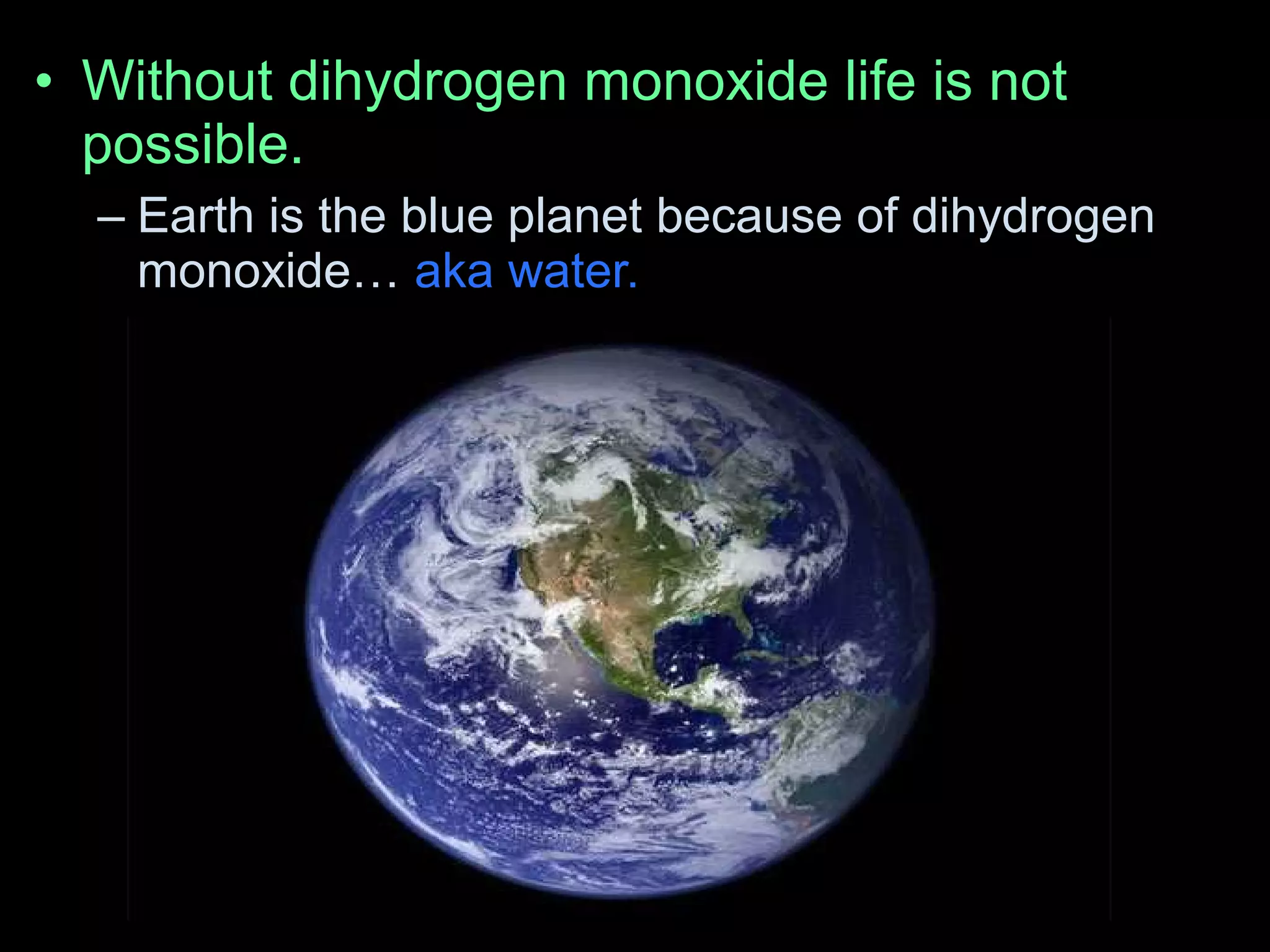
• Without dihydrogen monoxide life is not
possible.
– Earth is the blue planet because of dihydrogen
monoxide… aka water.
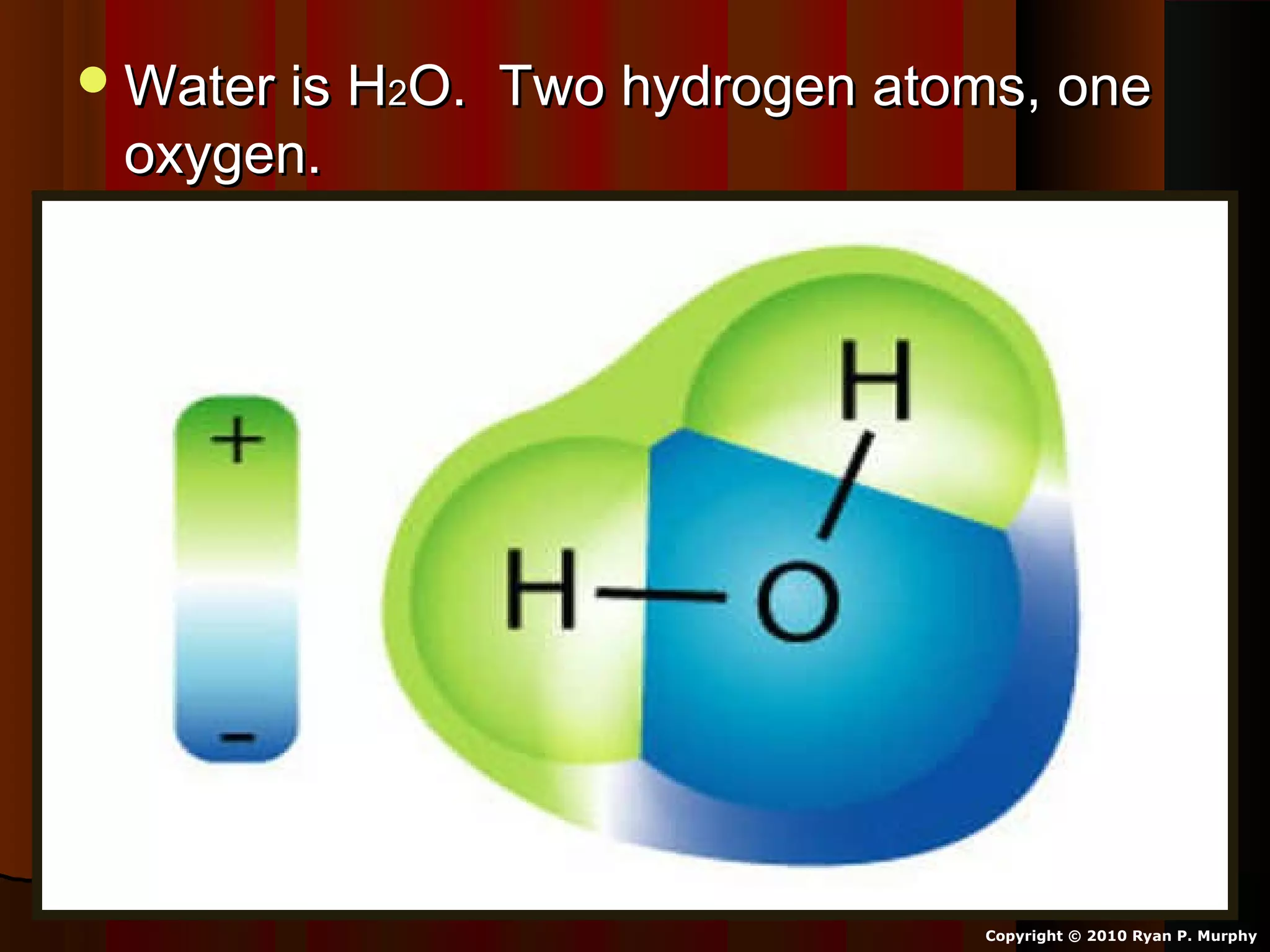
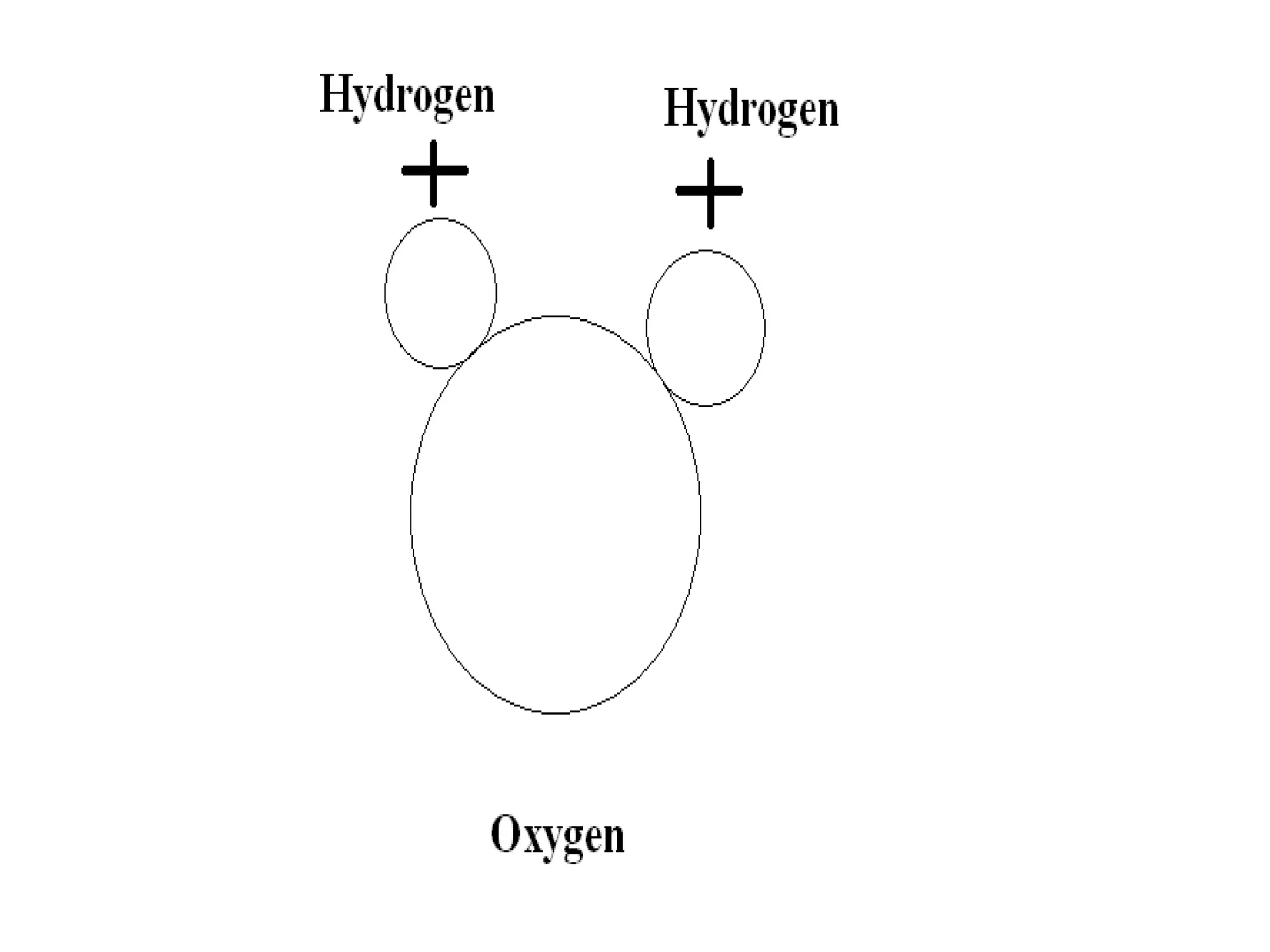
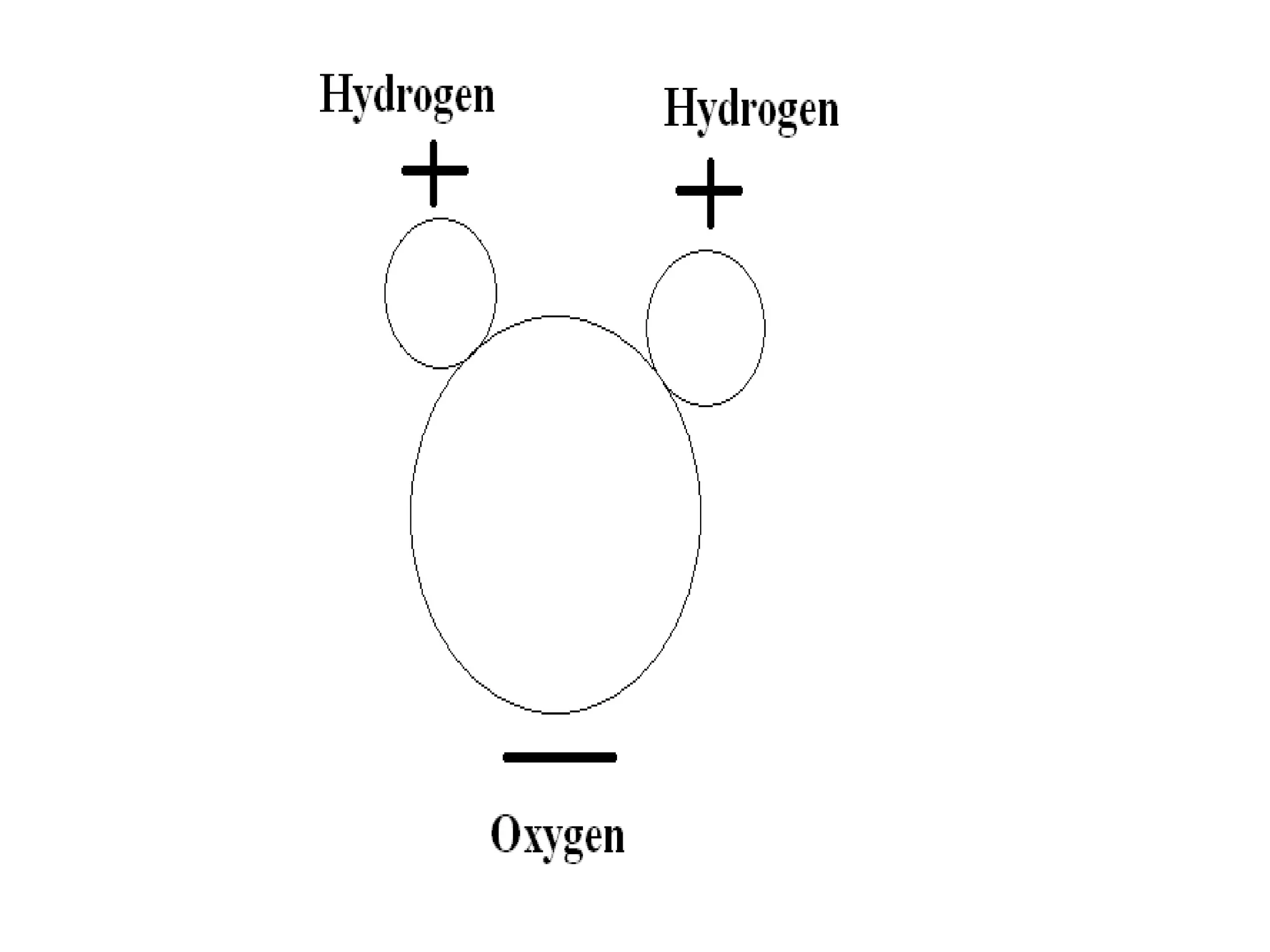
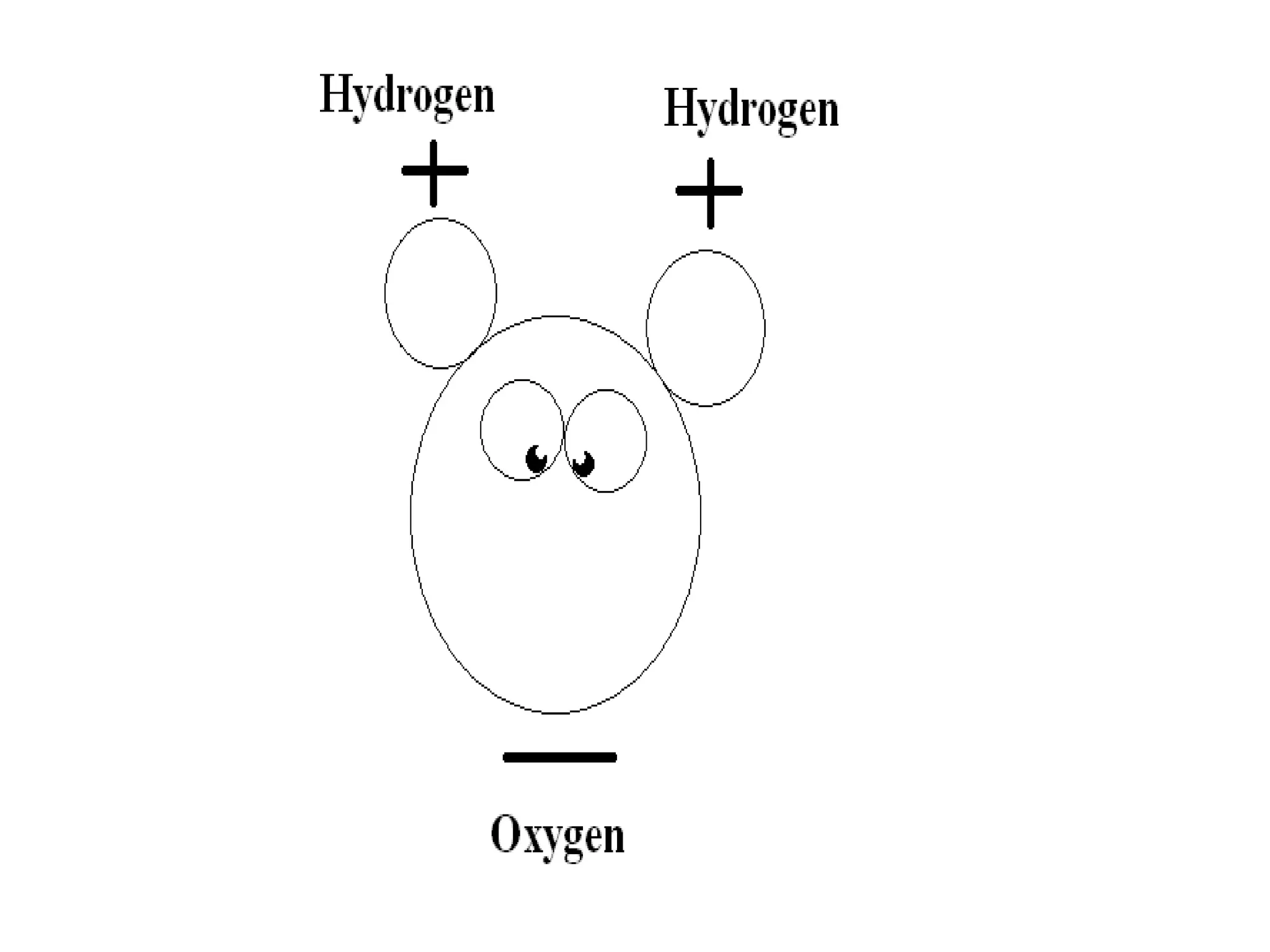
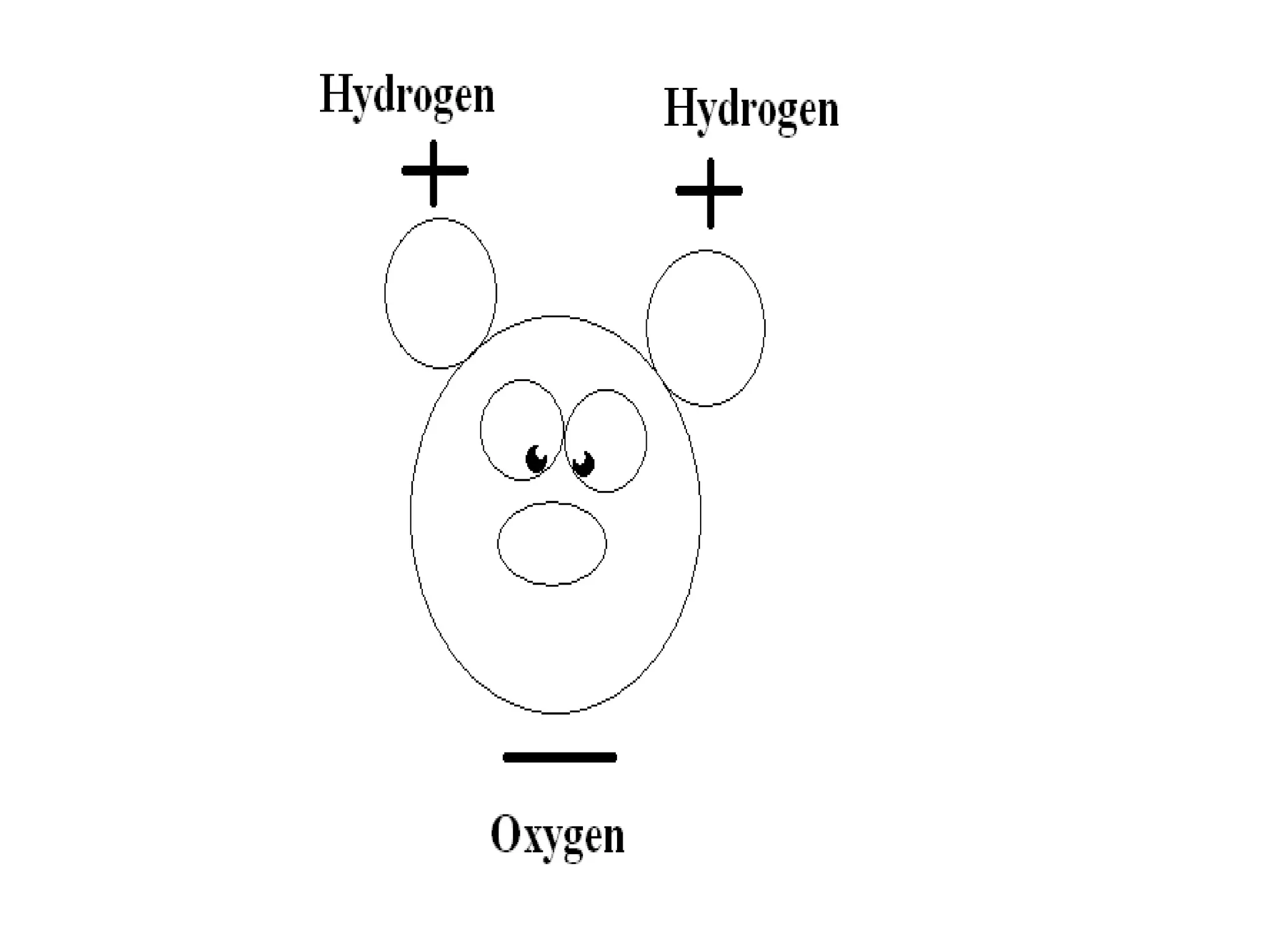
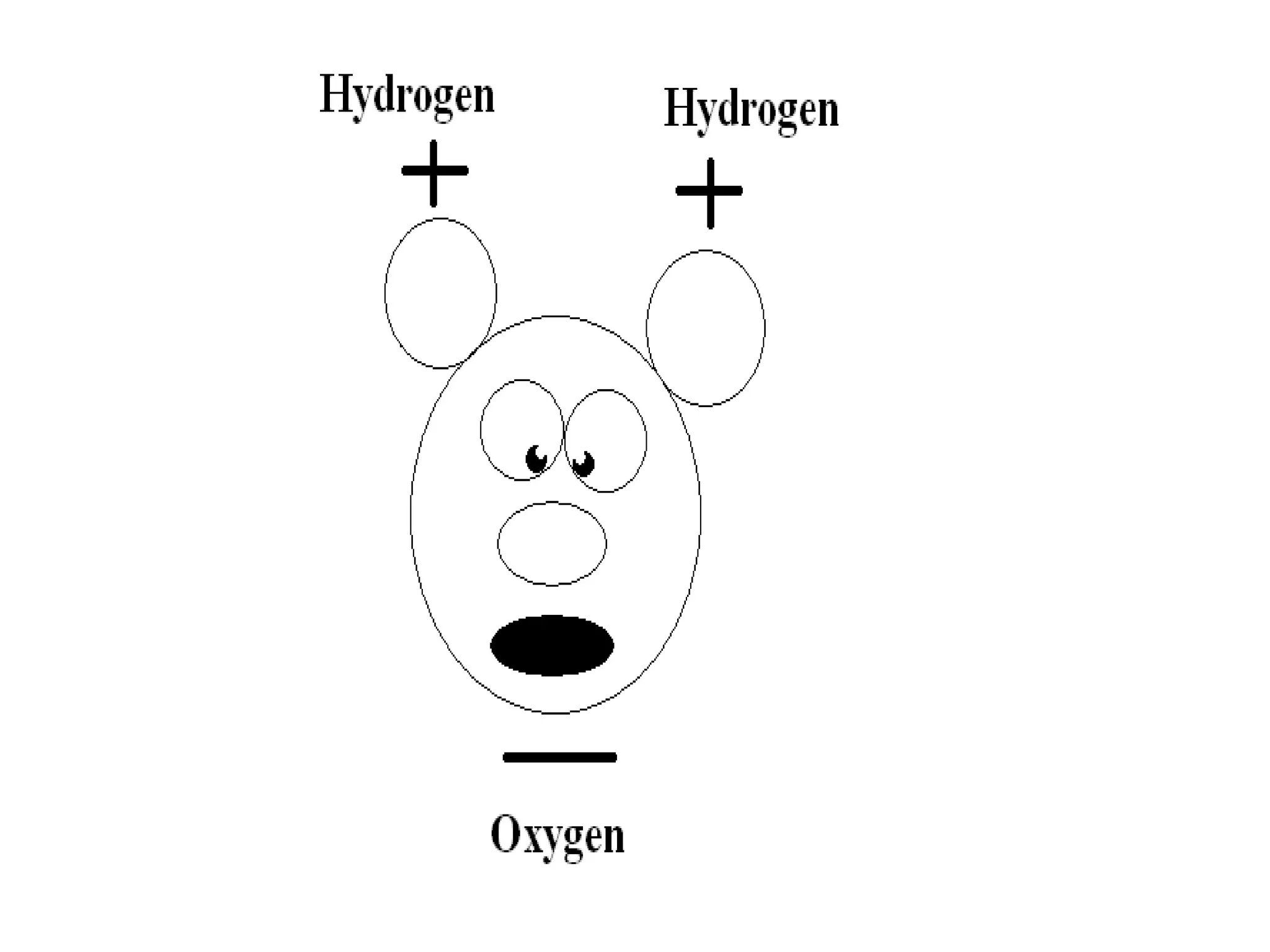
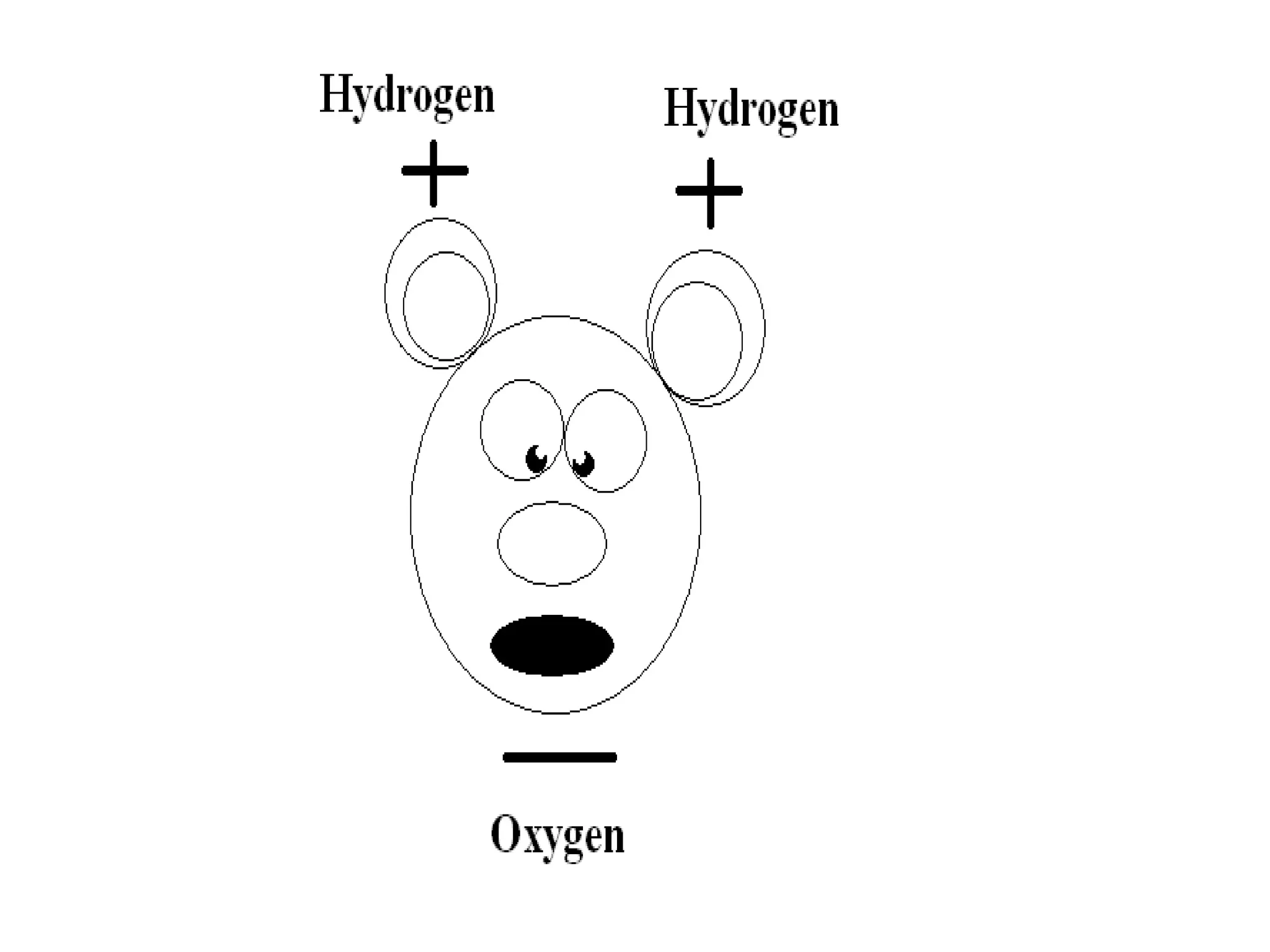
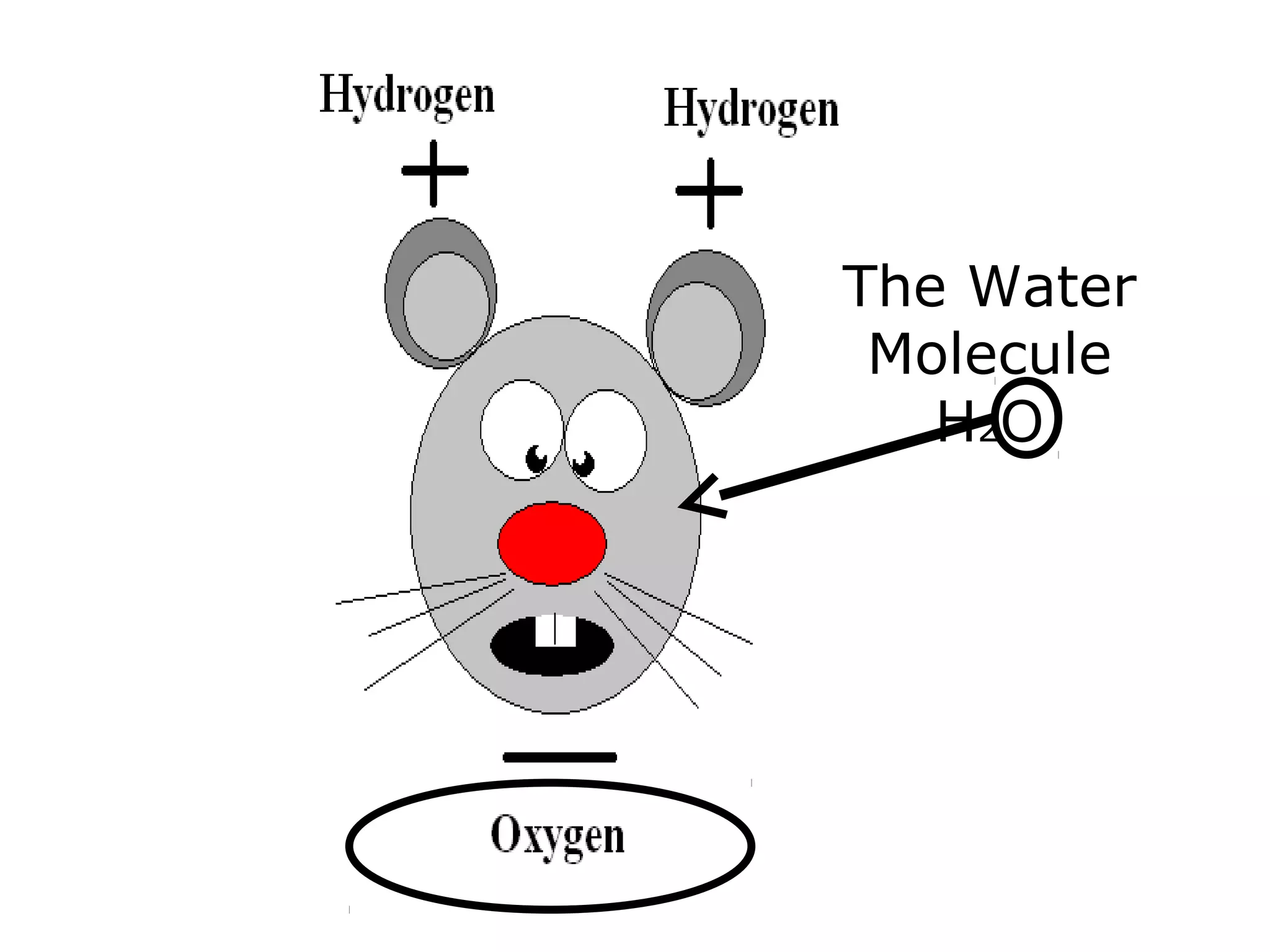
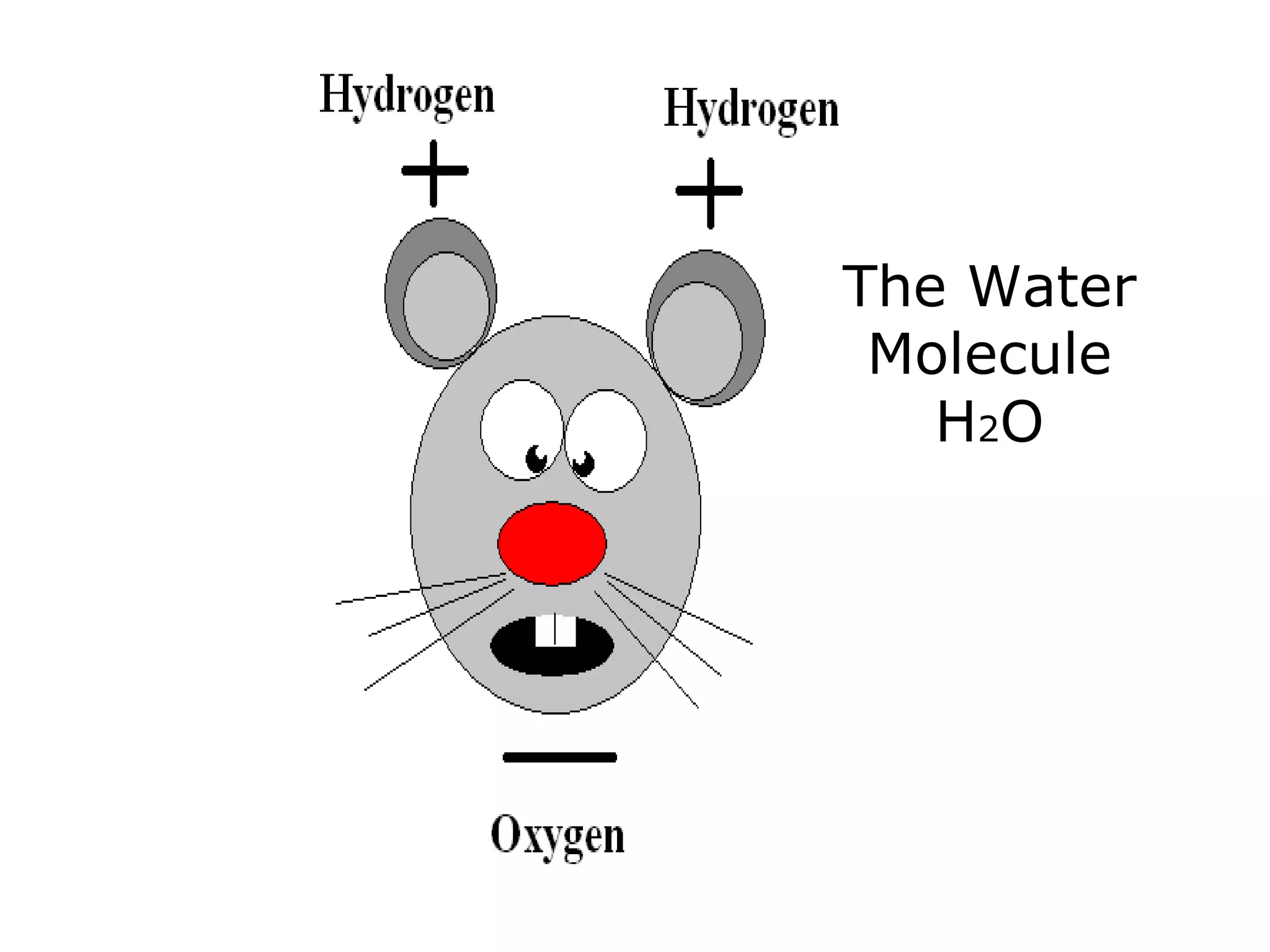
Water is HWater is H22O. Two hydrogen atoms, oneO. Two hydrogen atoms, one
oxygen.oxygen.
Copyright © 2010 Ryan P. Murphy
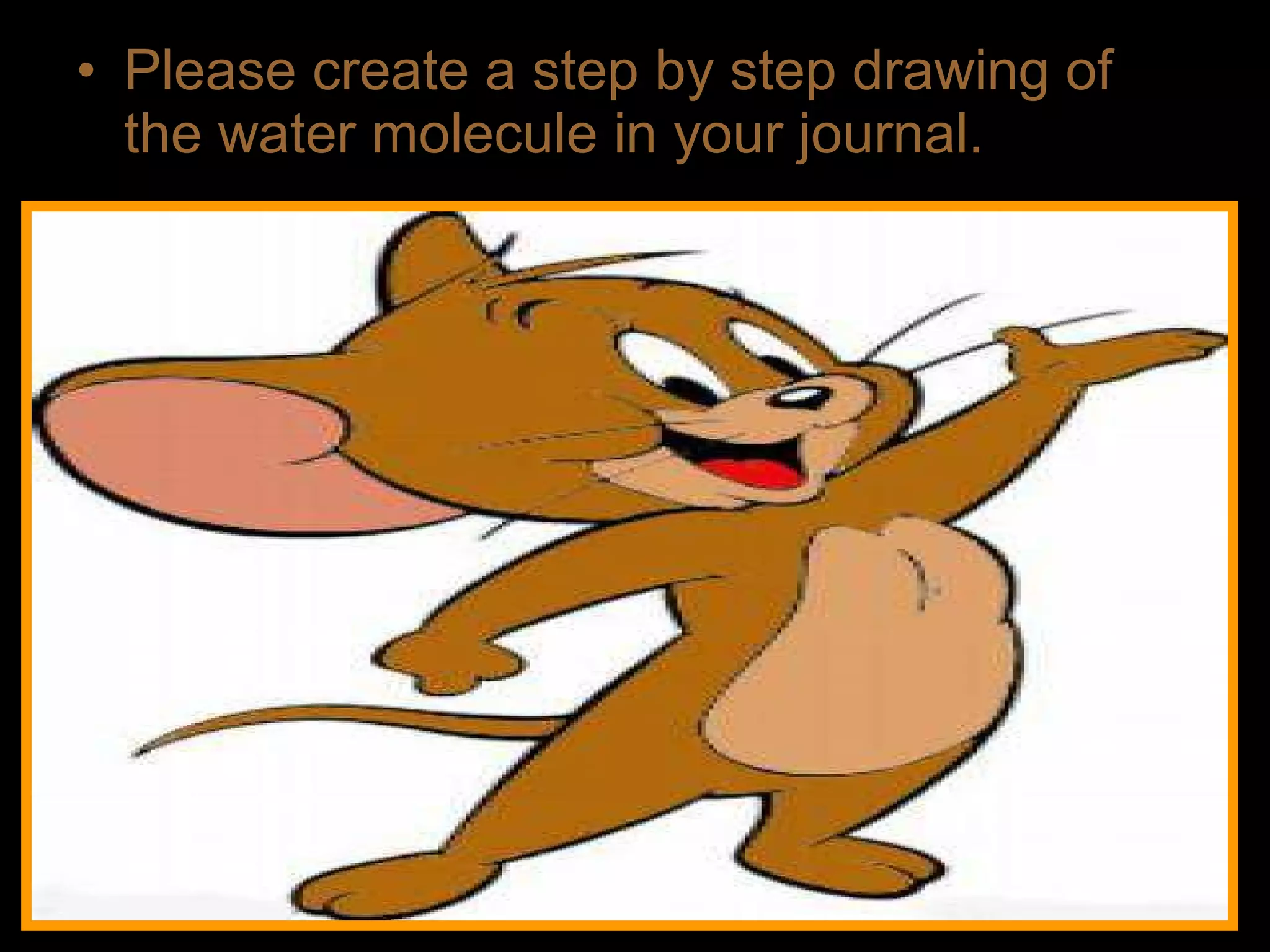
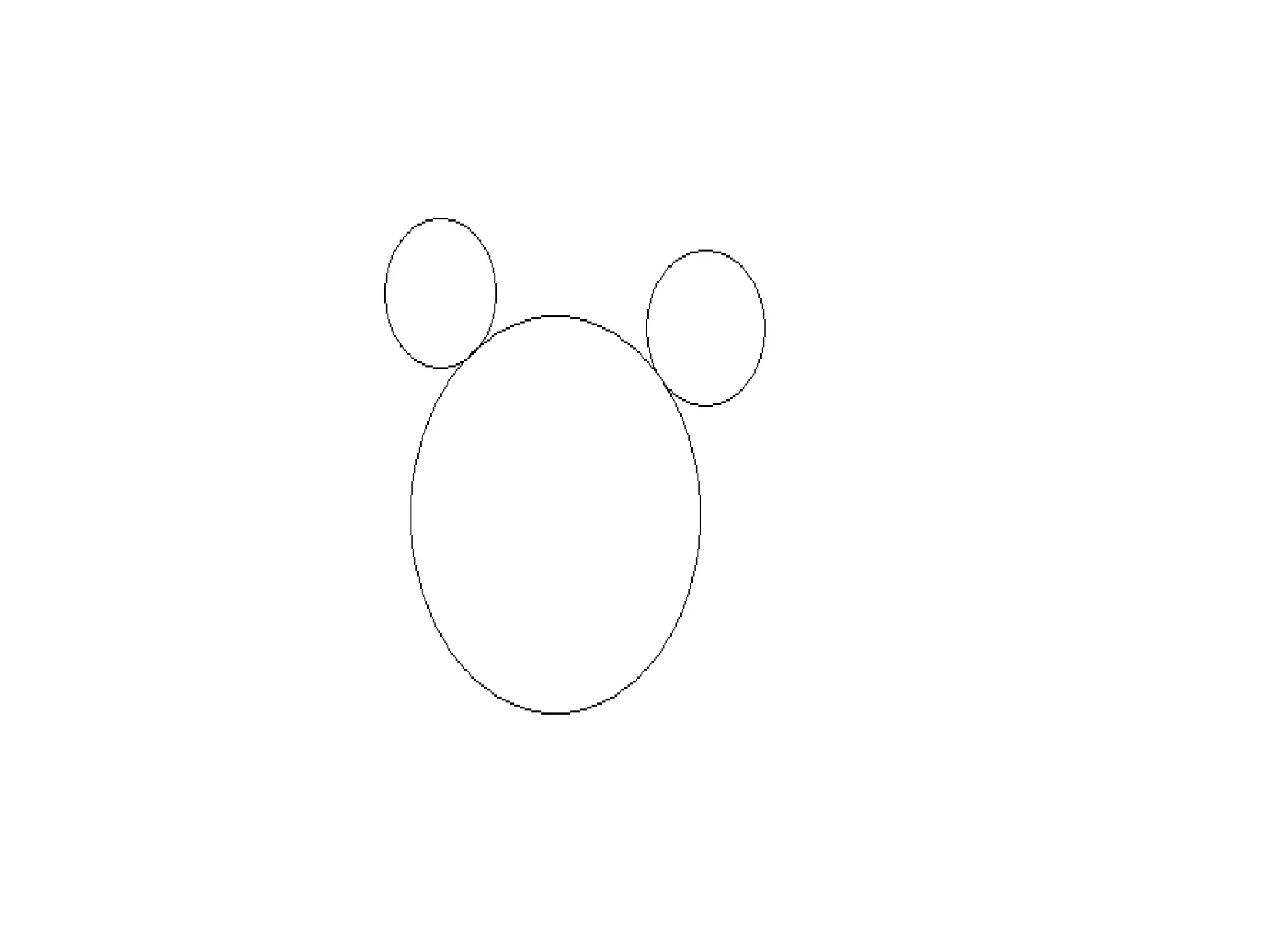
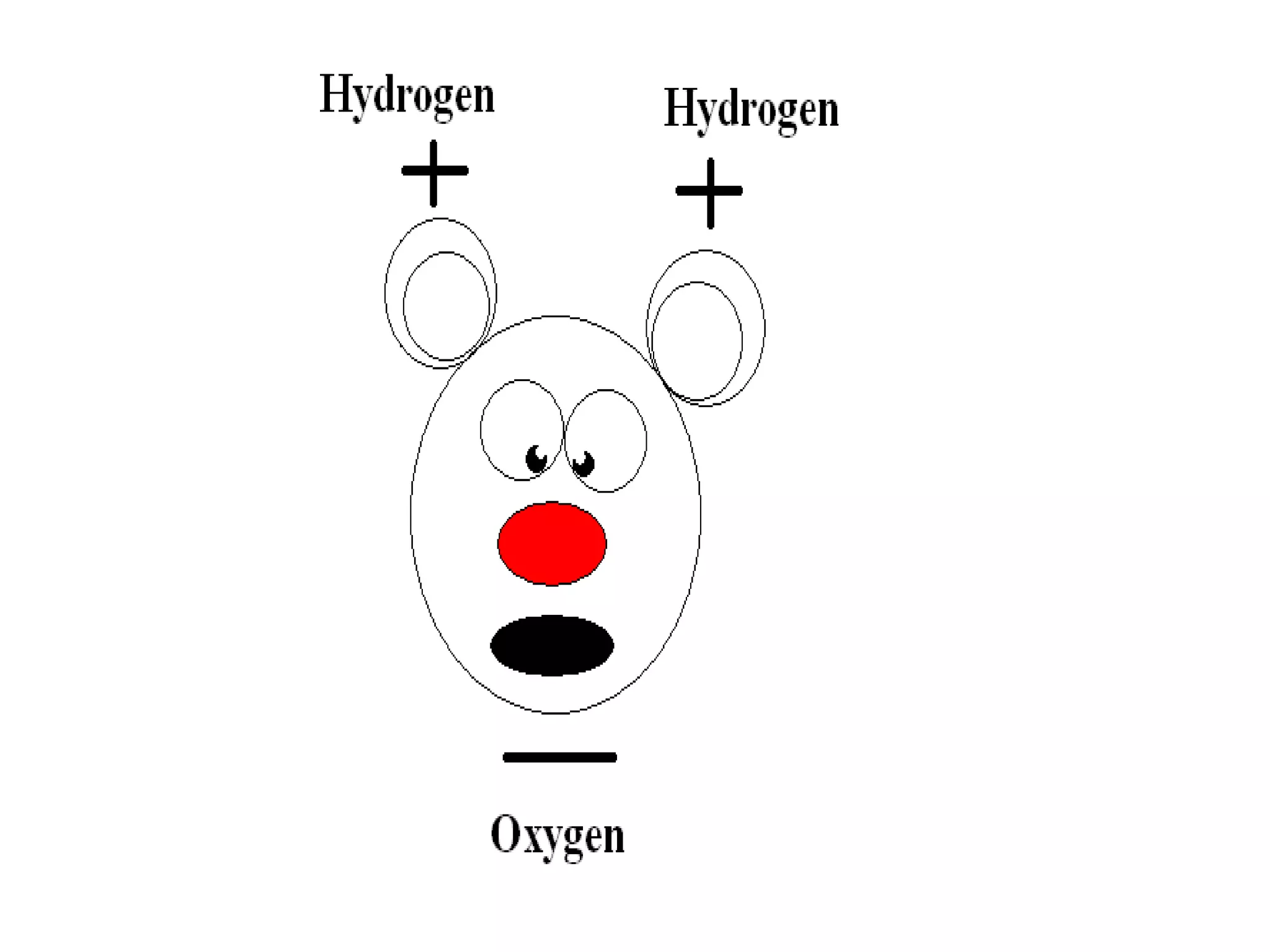
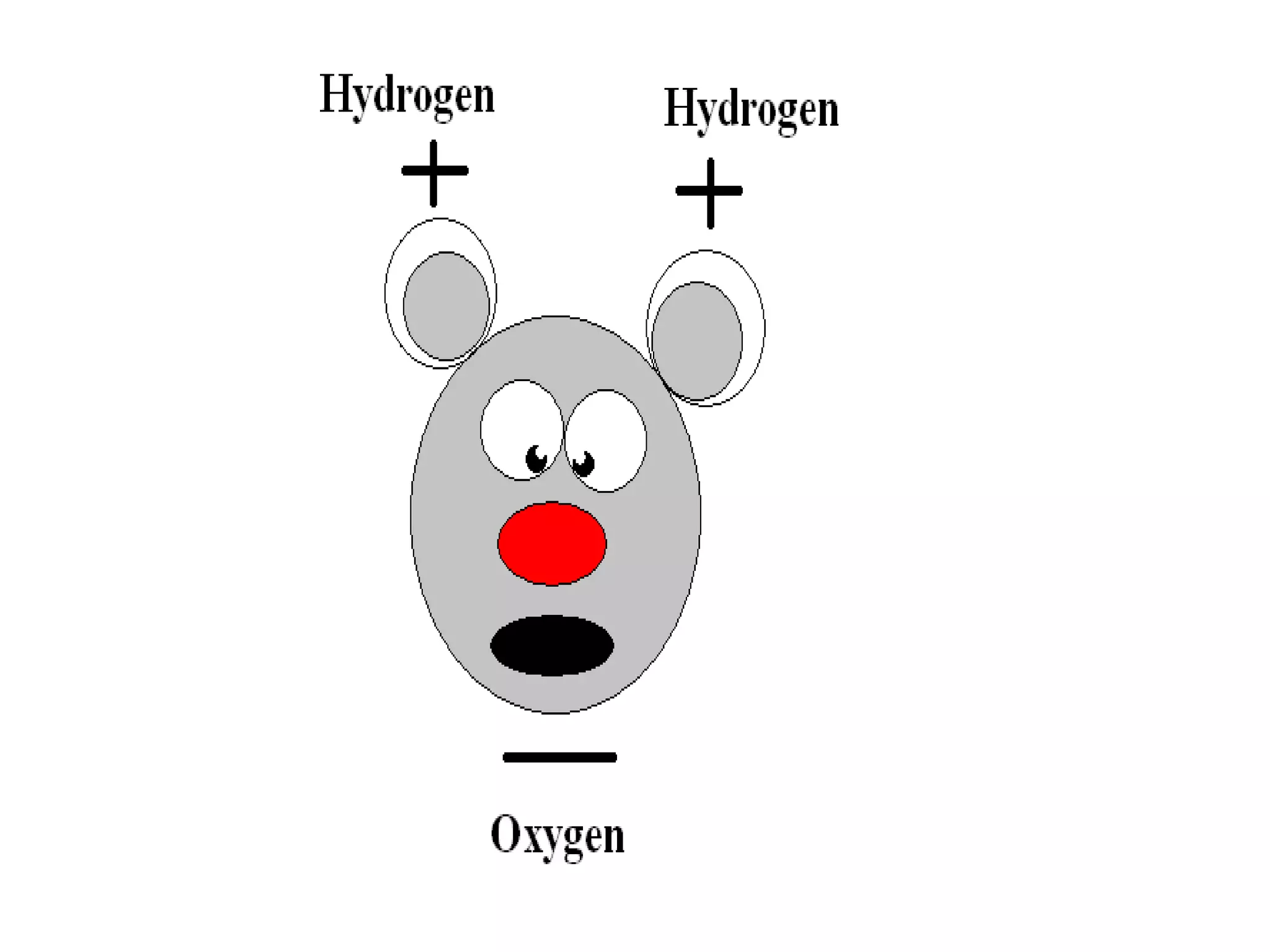
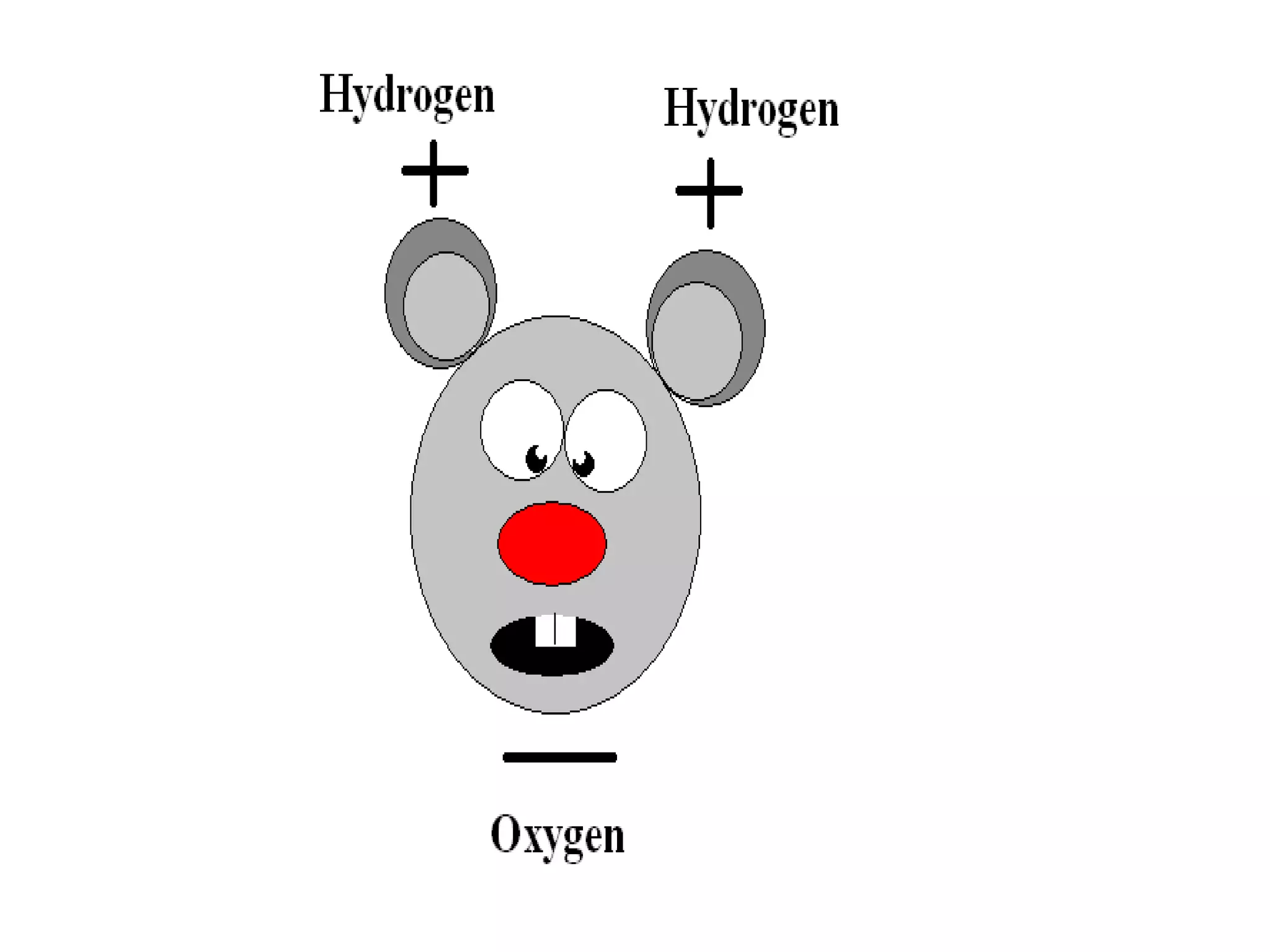
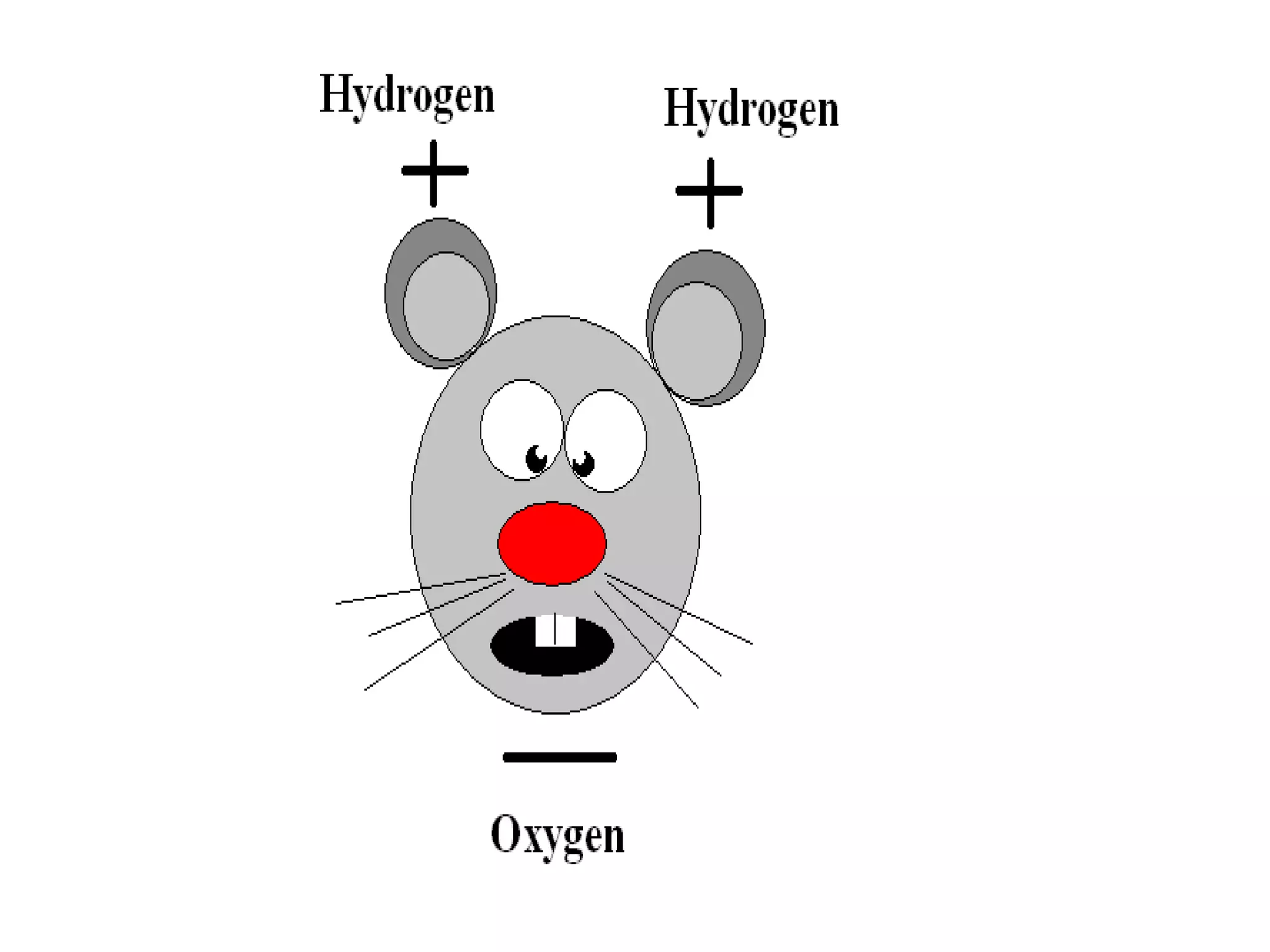
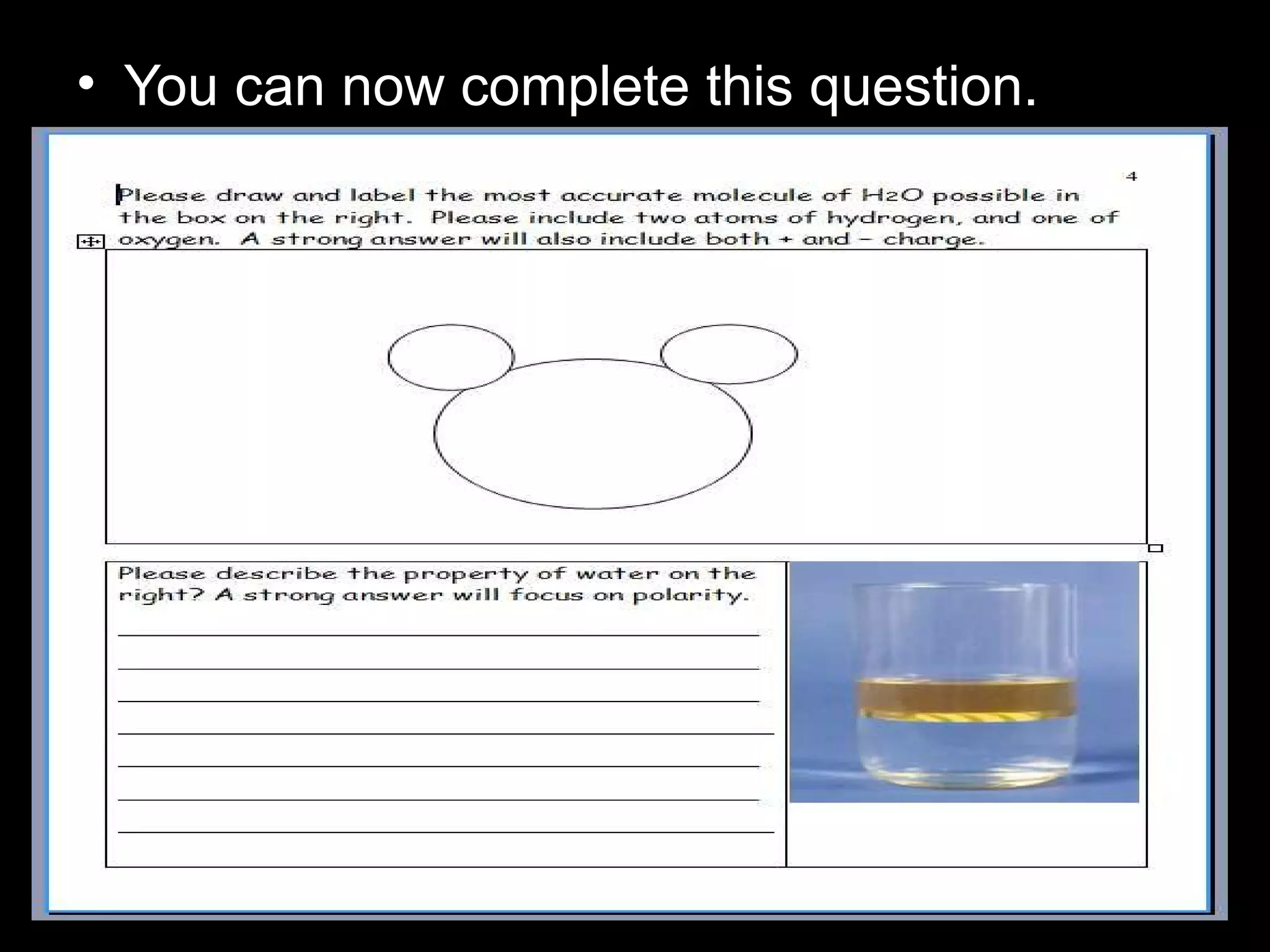
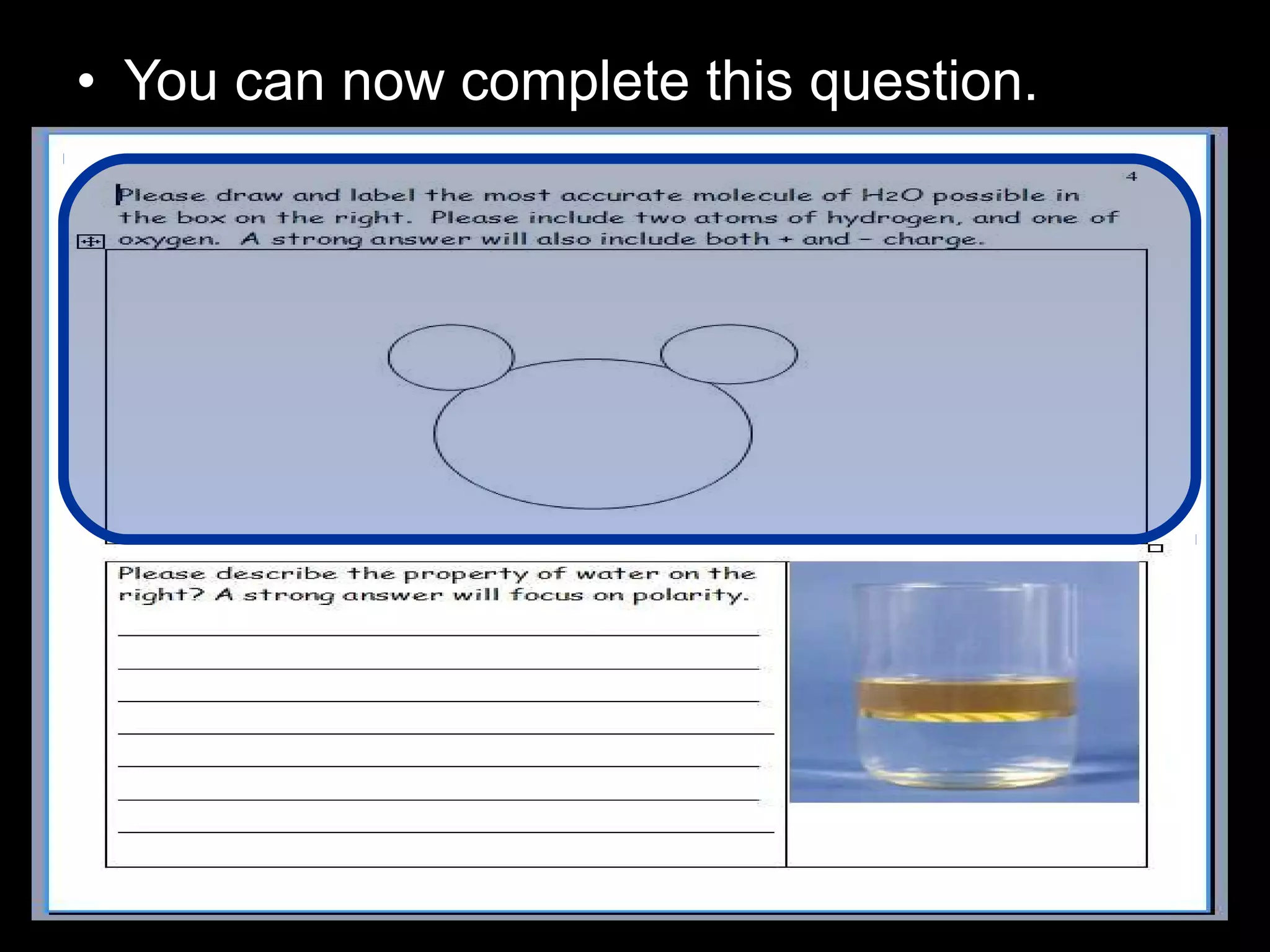
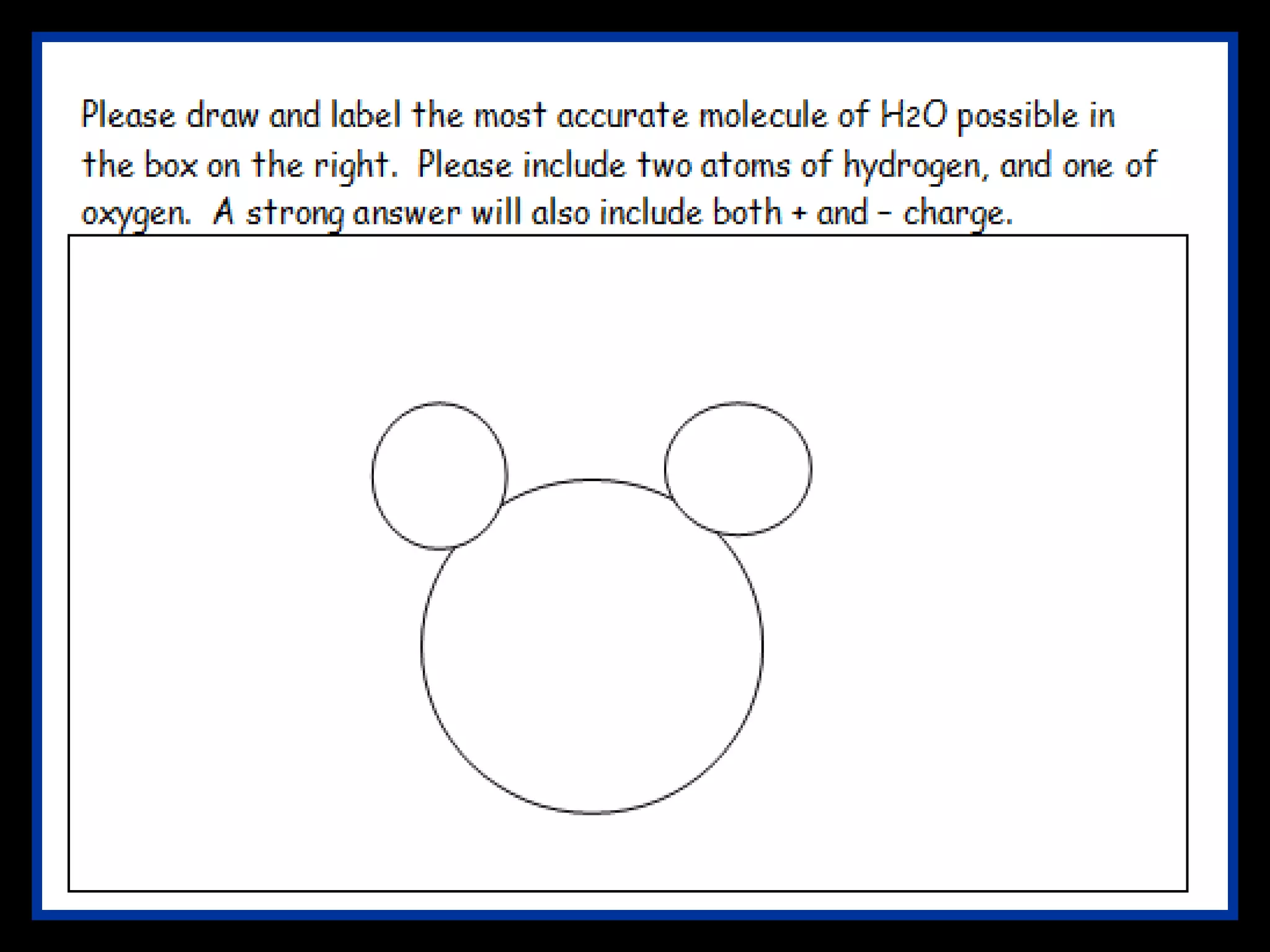
• Please create a step by step drawing of
the water molecule in your journal.
The Water
Molecule
H2O
The Water
Molecule
H2O
The Water
Molecule
H2O
The Water
Molecule
H2O
The Water
Molecule
H2O
The Water
Molecule
H2O
The Water
Molecule
H2O
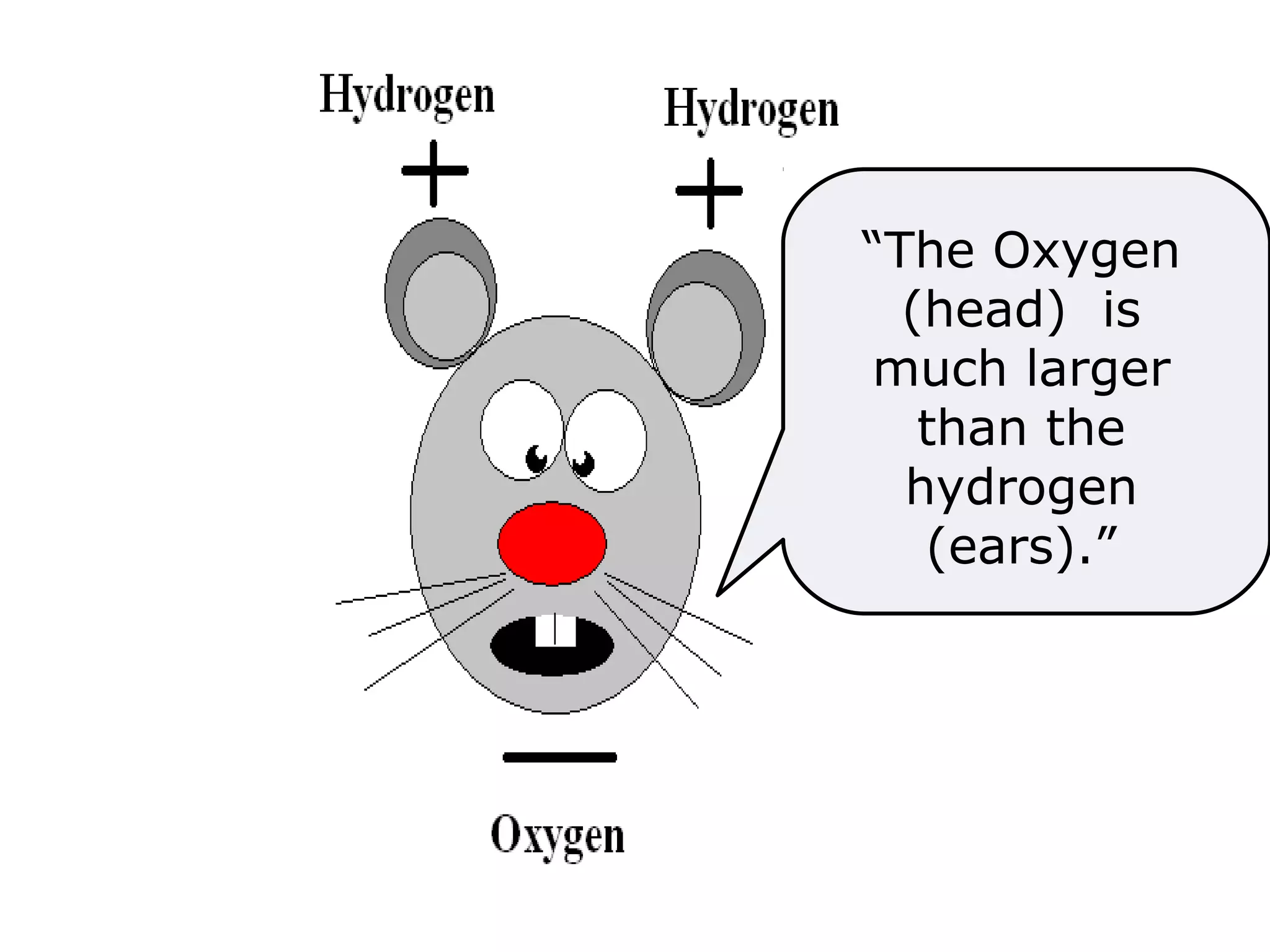
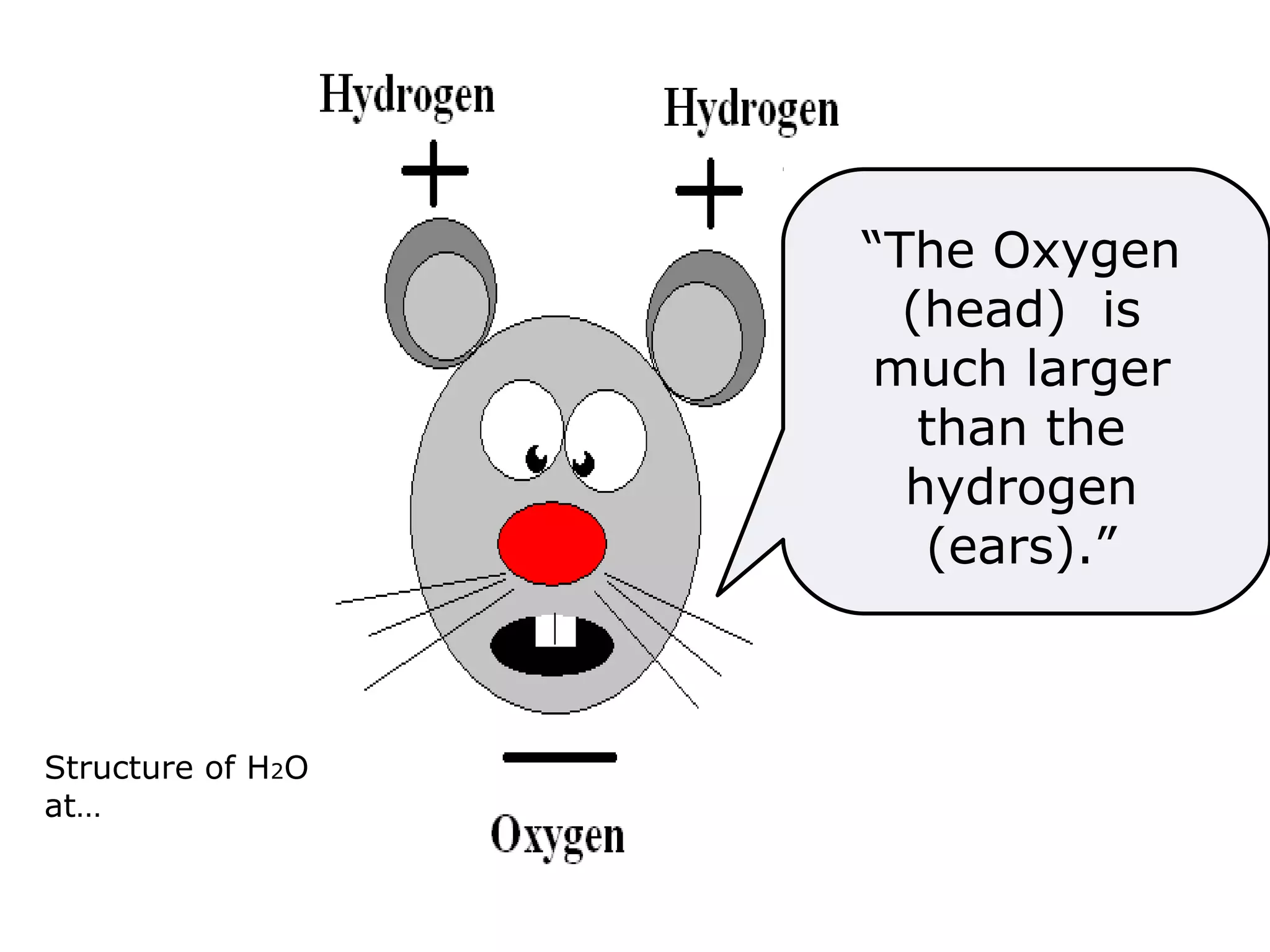
“The Oxygen
(head) is
much larger
than the
hydrogen
(ears).”
The Water
Molecule
H2O
“The Oxygen
(head) is
much larger
than the
hydrogen
(ears).”
Structure of H2O
at…
http://www.johnky
rk.com/H2O.html
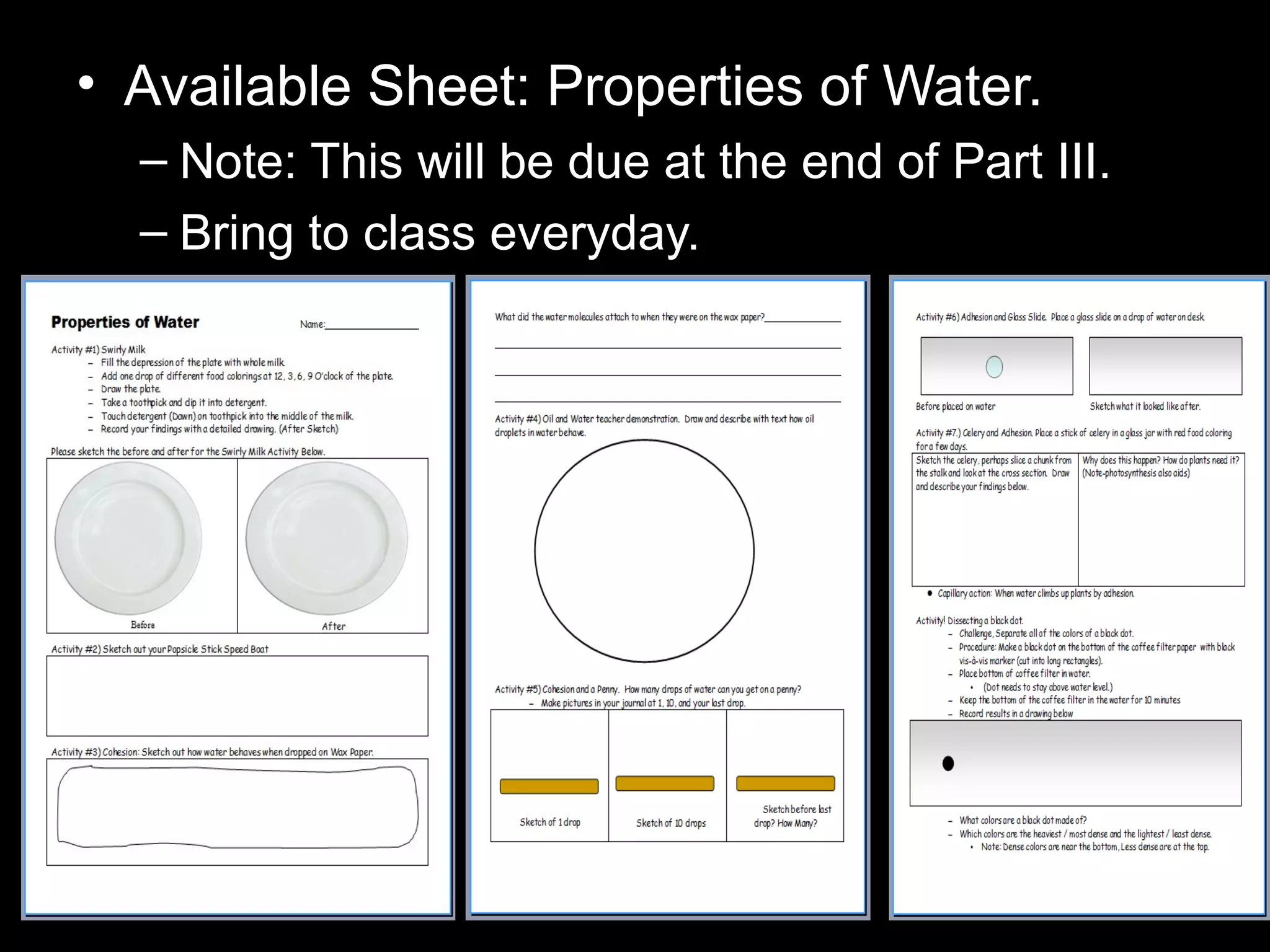
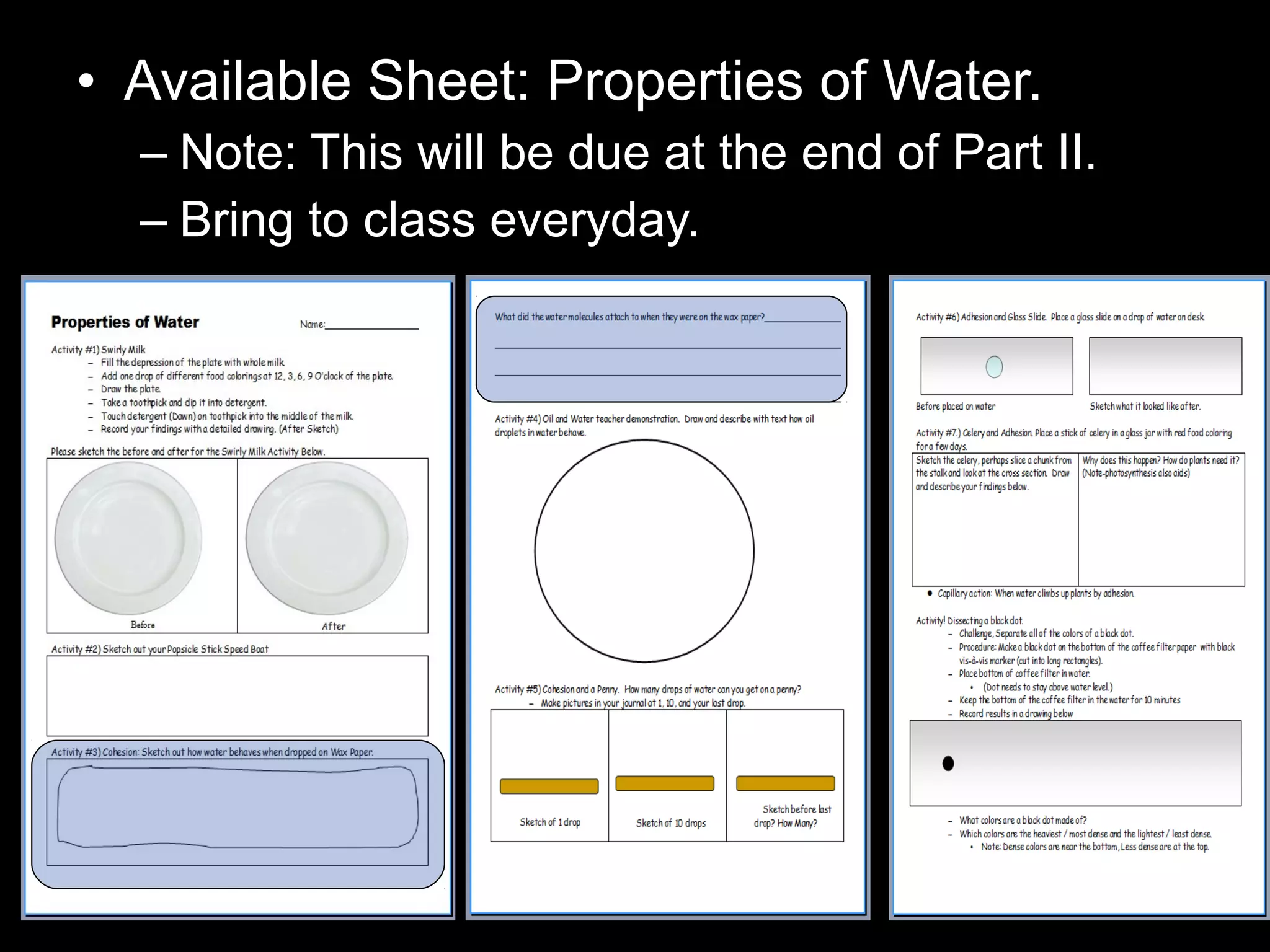
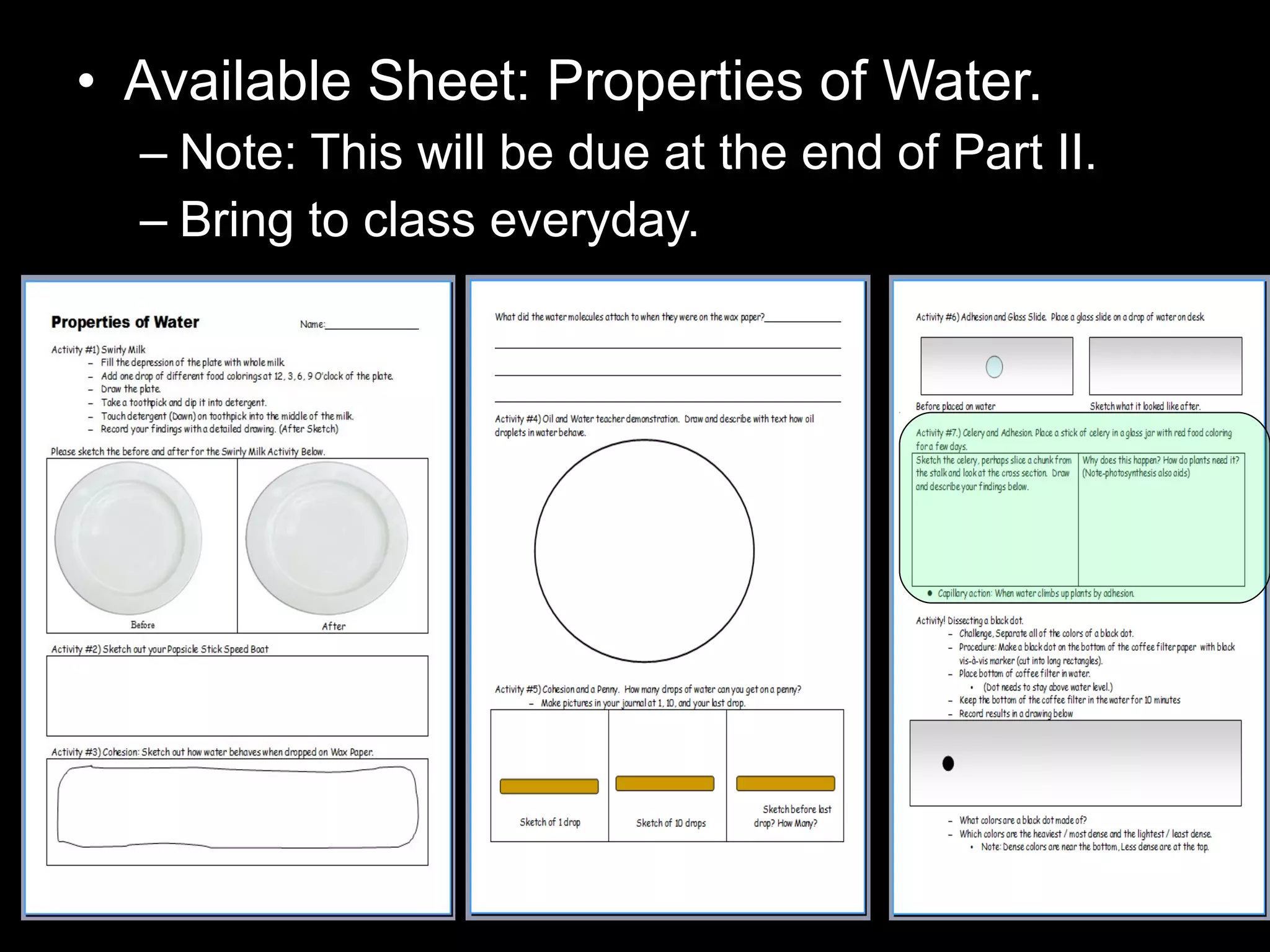
• Available Sheet: Properties of Water.
– Note: This will be due at the end of Part III.
– Bring to class everyday.
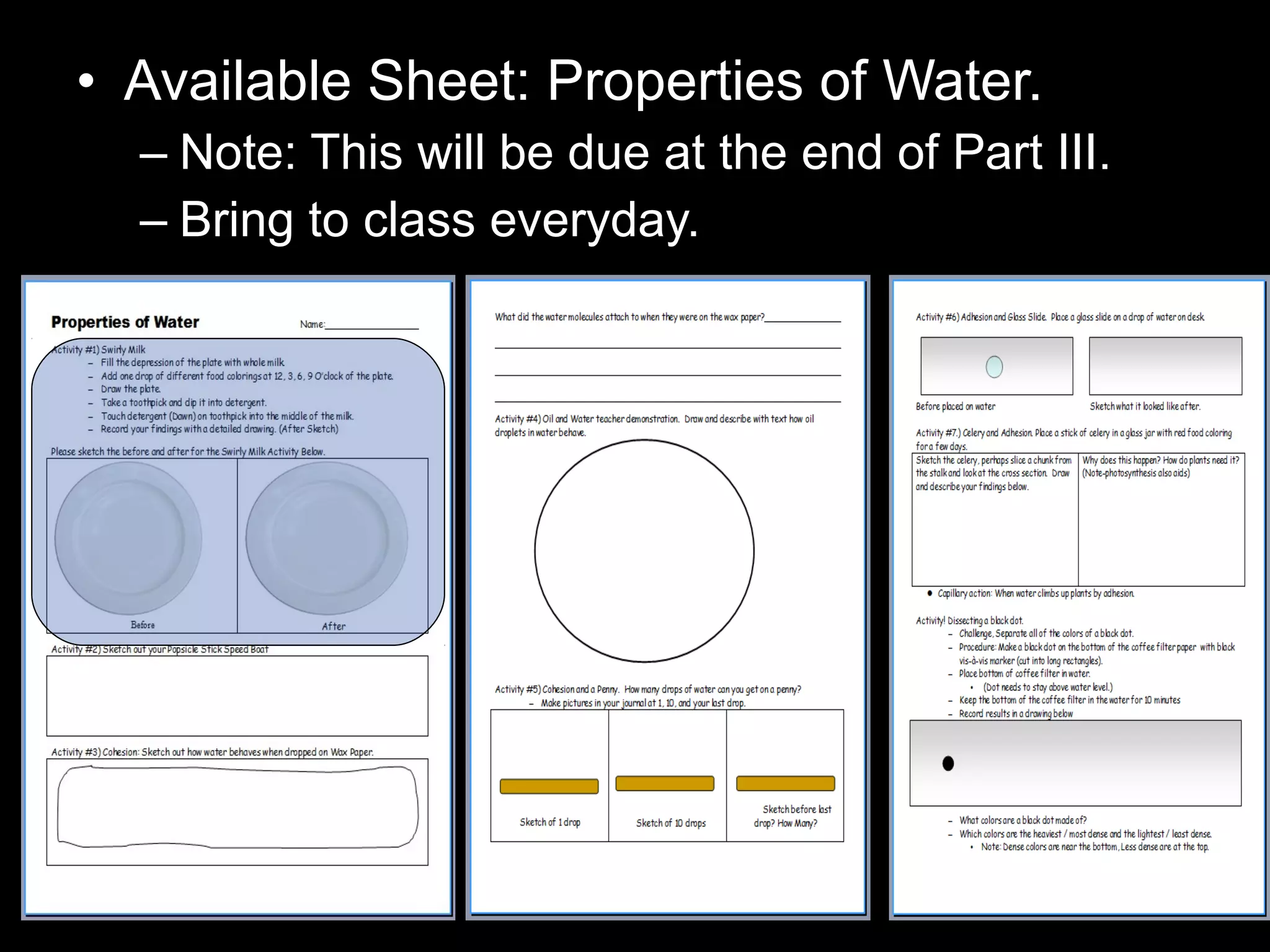
• Available Sheet: Properties of Water.
– Note: This will be due at the end of Part III.
– Bring to class everyday.
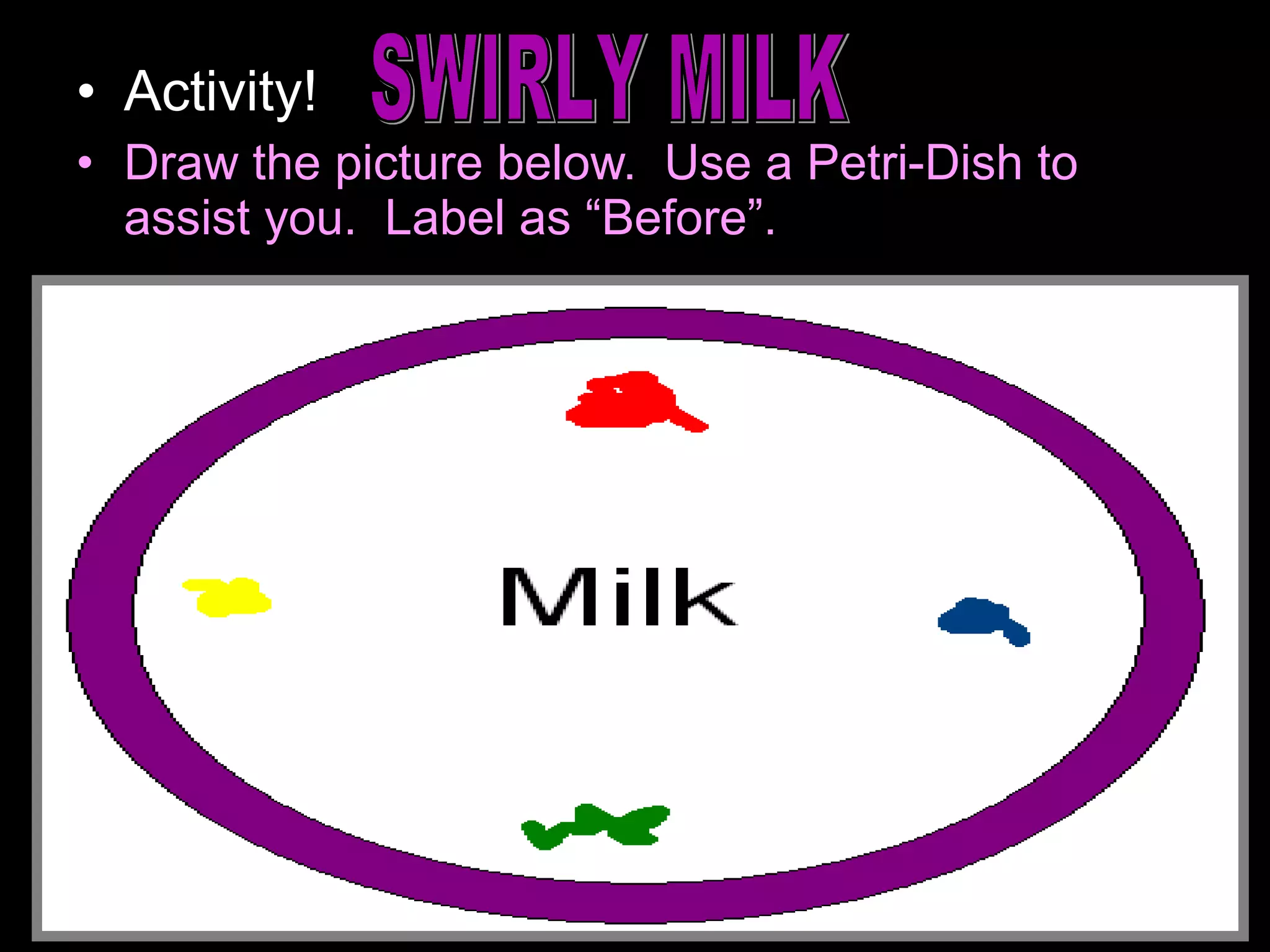
• Activity!
• Draw the picture below. Use a Petri-Dish to
assist you. Label as “Before”.
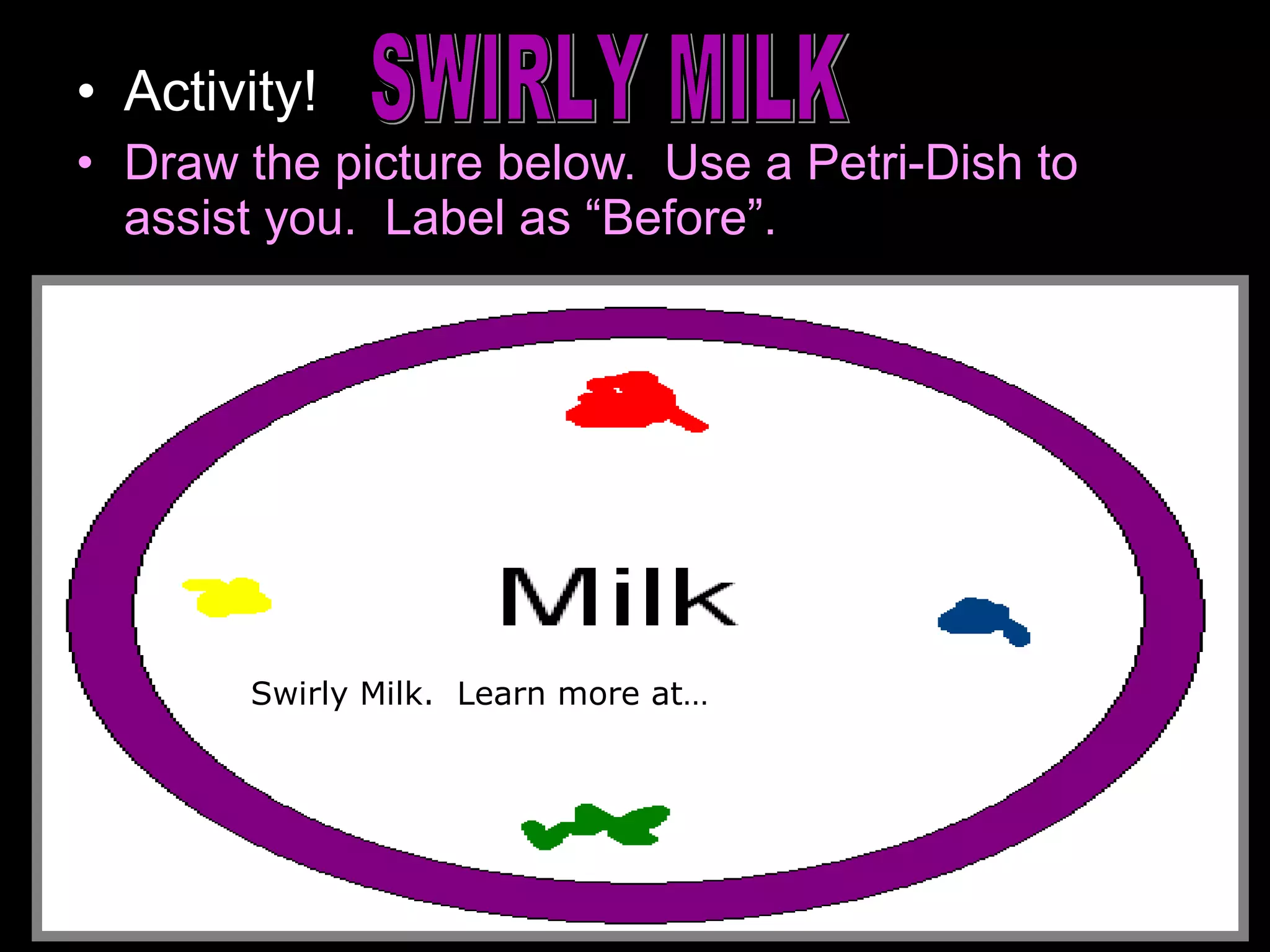
• Activity!
• Draw the picture below. Use a Petri-Dish to
assist you. Label as “Before”.
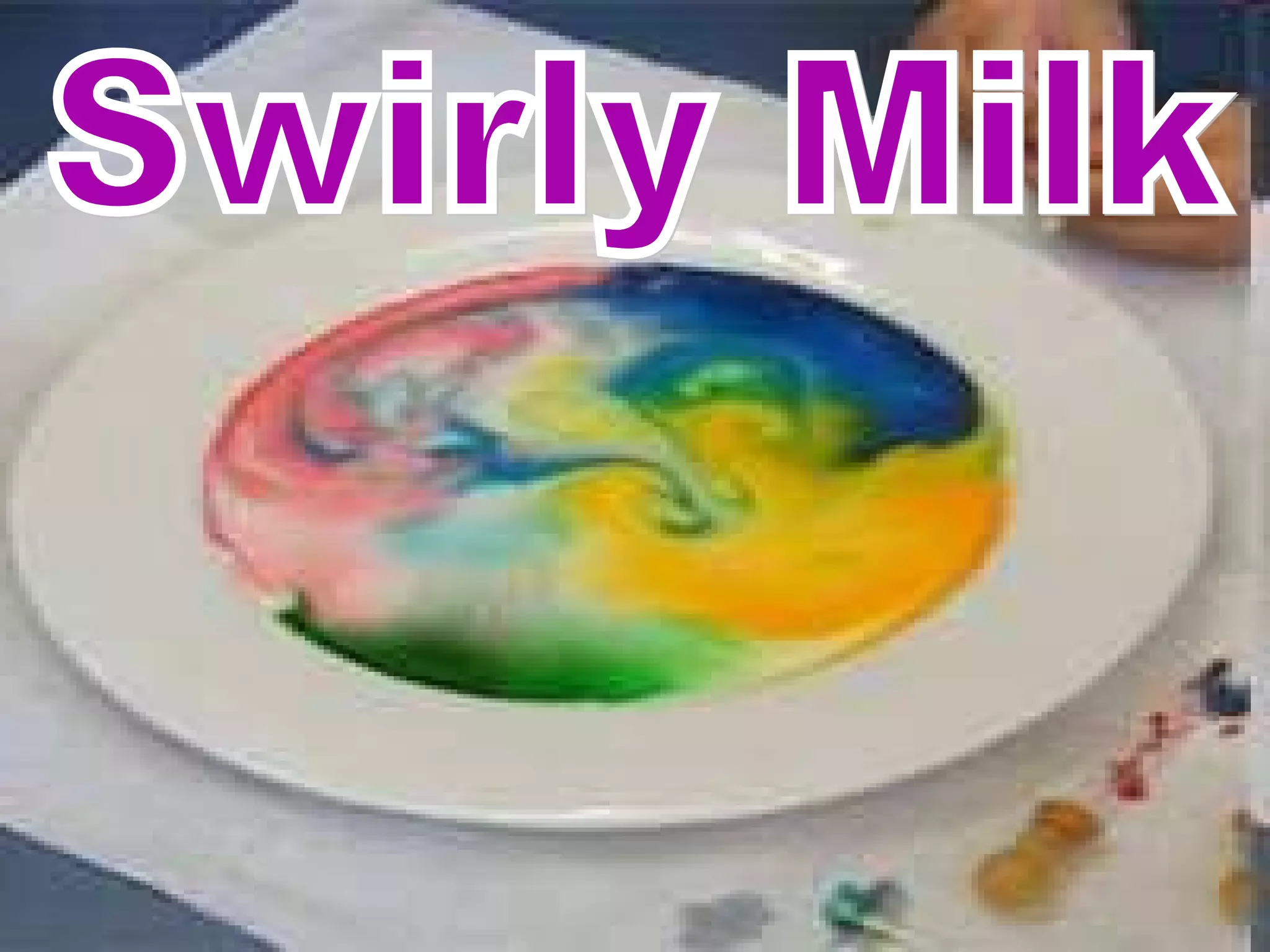
Swirly Milk. Learn more at…
http://chemistry.about.com/od/chemistryhowto
guide/a/magicmilk.htm
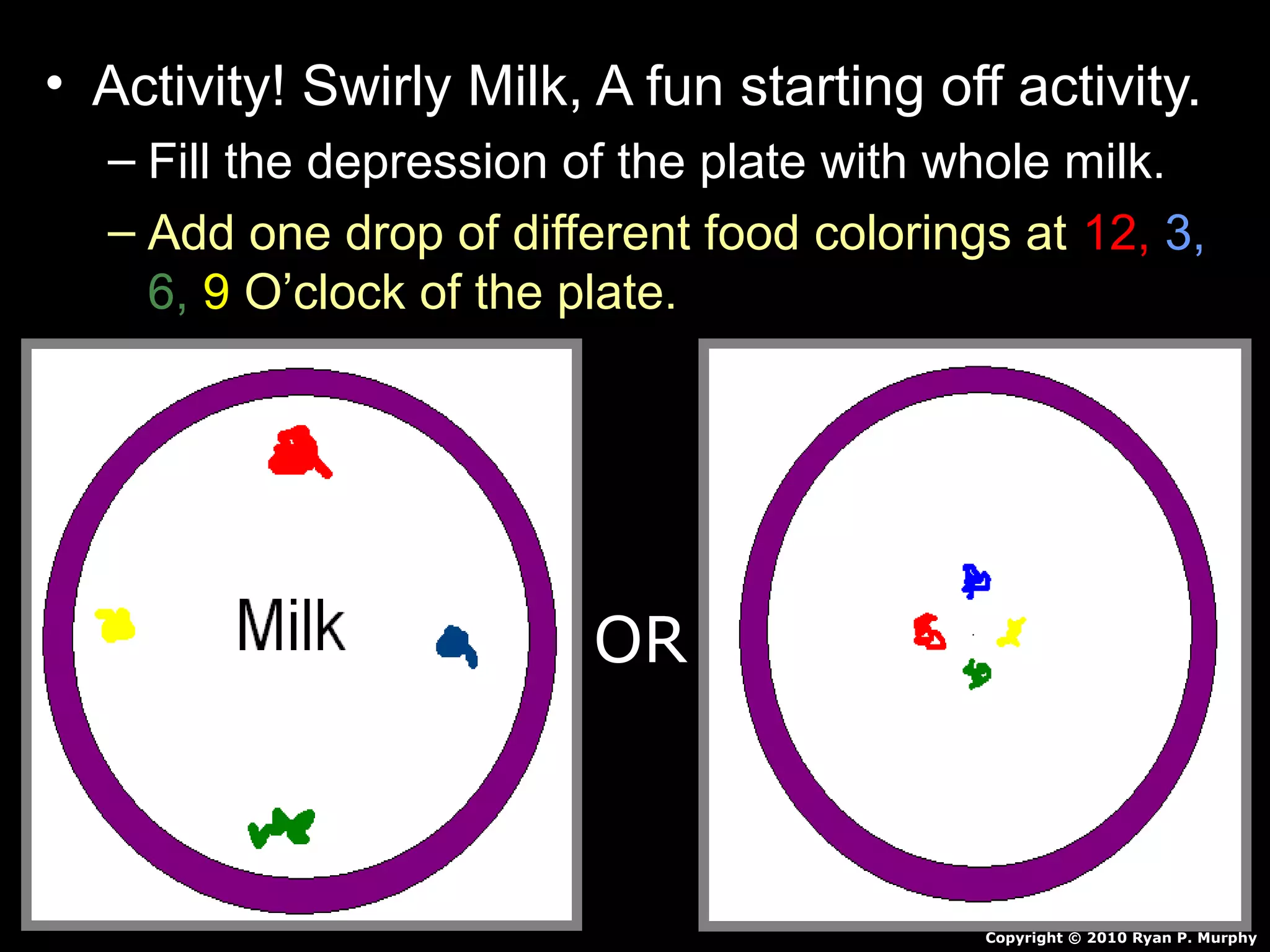
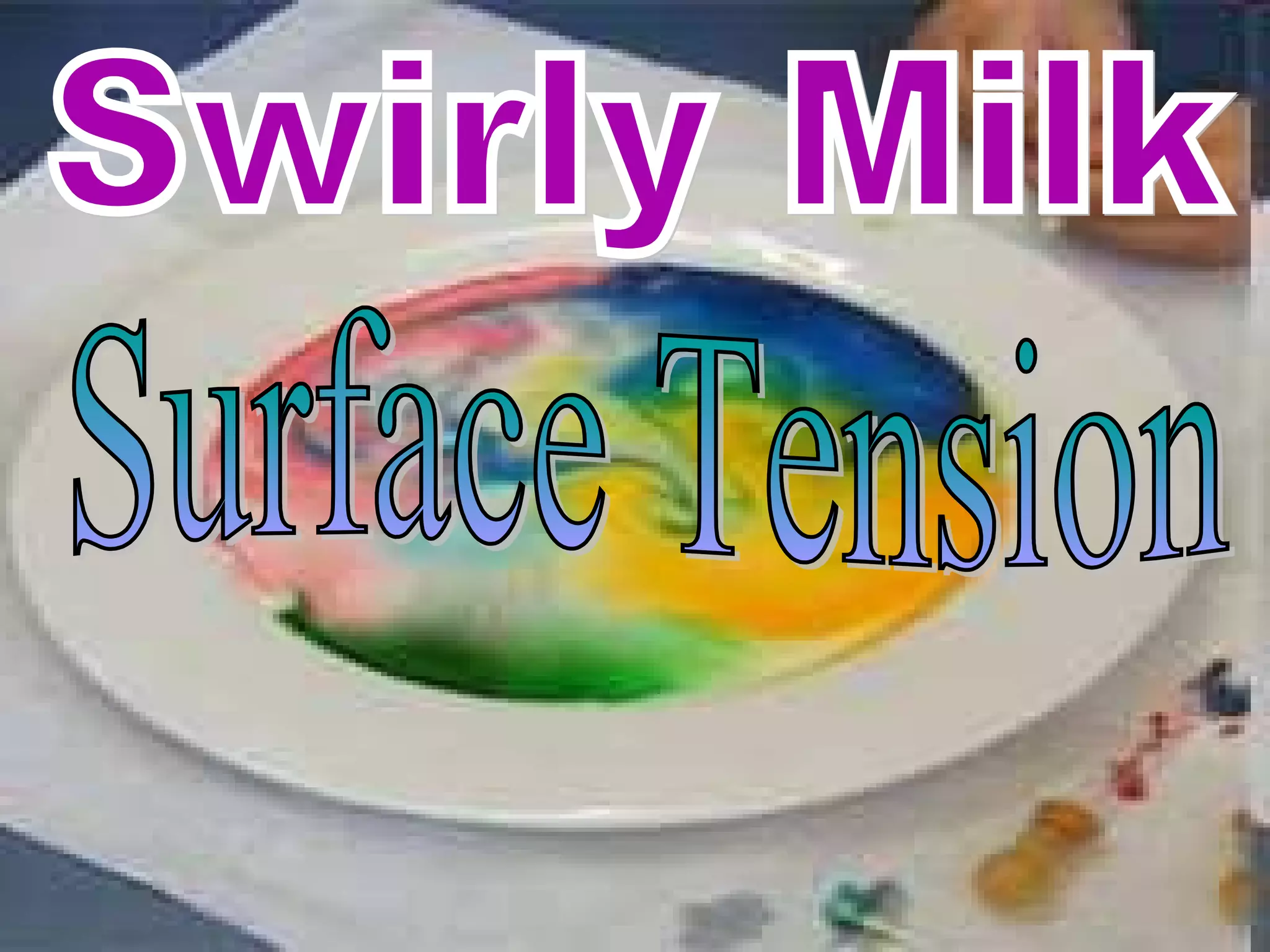
• Activity! Swirly Milk, A fun starting off activity.
– Fill the depression of the plate with whole milk.
– Add one drop of different food colorings at 12, 3,
6, 9 O’clock of the plate.
OR
Copyright © 2010 Ryan P. Murphy
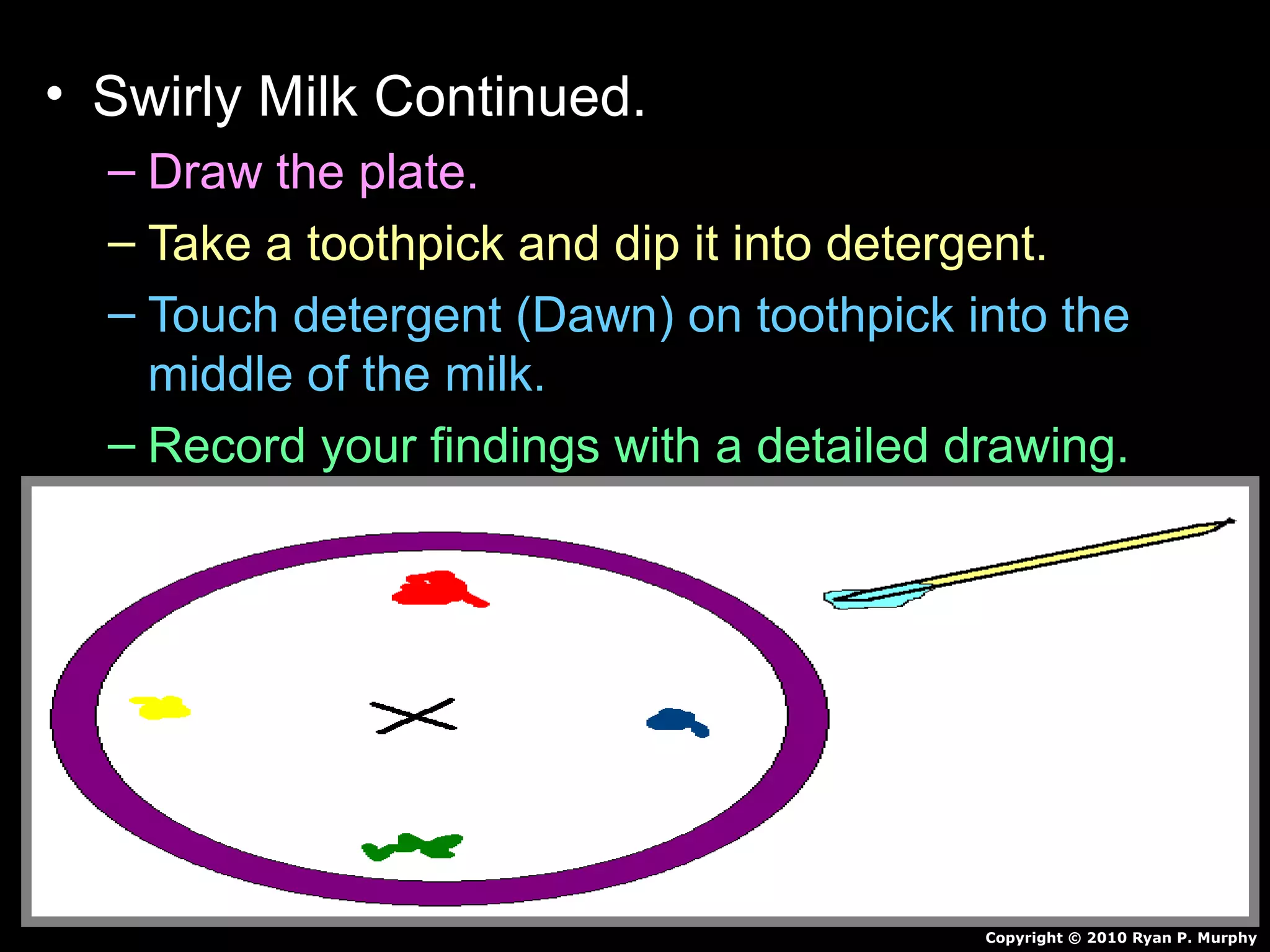
• Swirly Milk Continued.
– Draw the plate.
– Take a toothpick and dip it into detergent.
– Touch detergent (Dawn) on toothpick into the
middle of the milk.
– Record your findings with a detailed drawing.
Copyright © 2010 Ryan P. Murphy
This product belongs to Ryan P. Murphy
www.sciencepowerpoint.com Copyright
2010
• Draw a “After” Sketch of the SWIRLY
MILK . Use a Petri-dish to assist you.
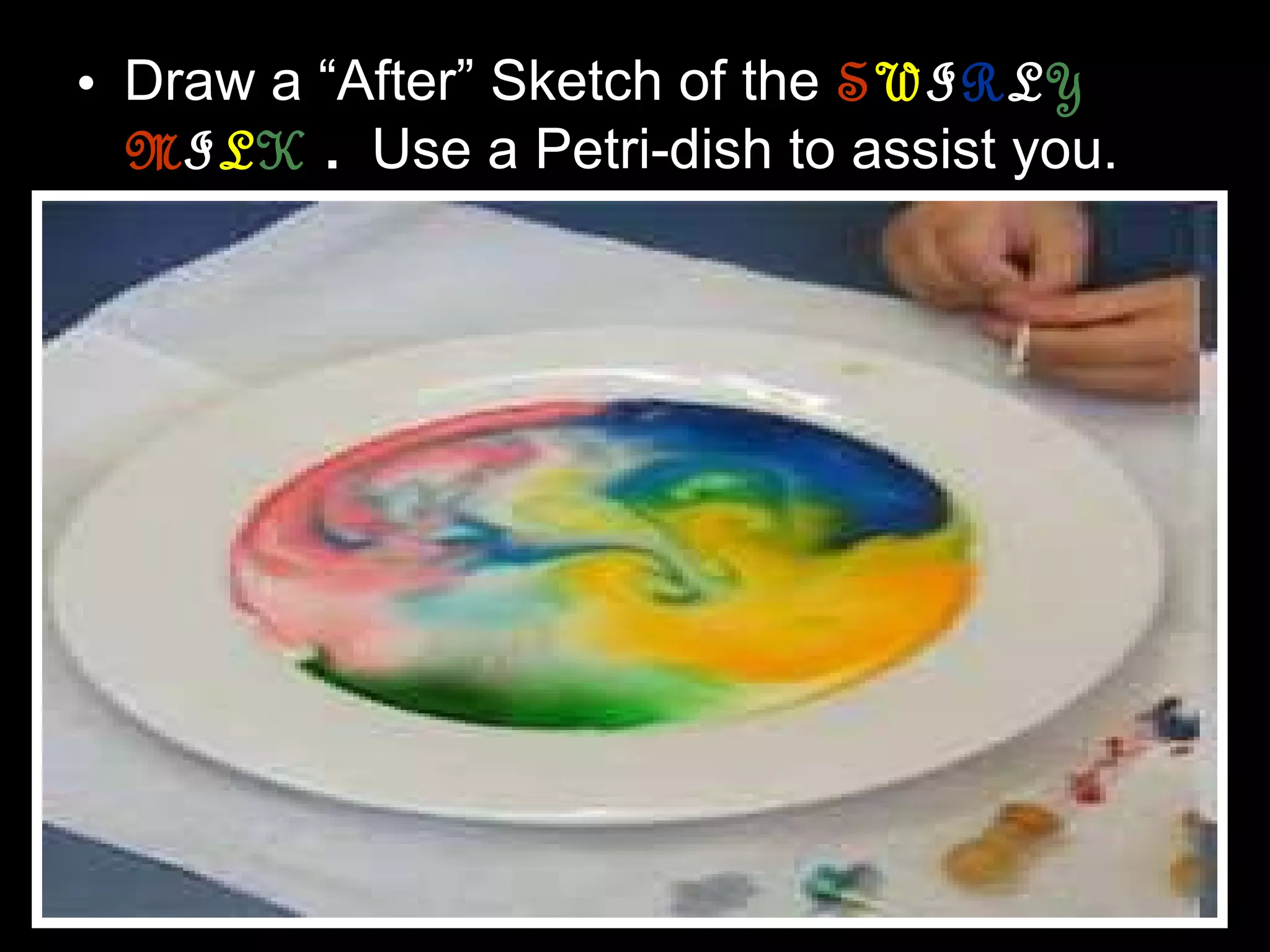
• Draw a “After” Sketch of the SWIRLY
MILK . Use a Petri-dish to assist you.
• Questions! Swirly Milk.
– What happened to the milk? Why?
Copyright © 2010 Ryan P. Murphy
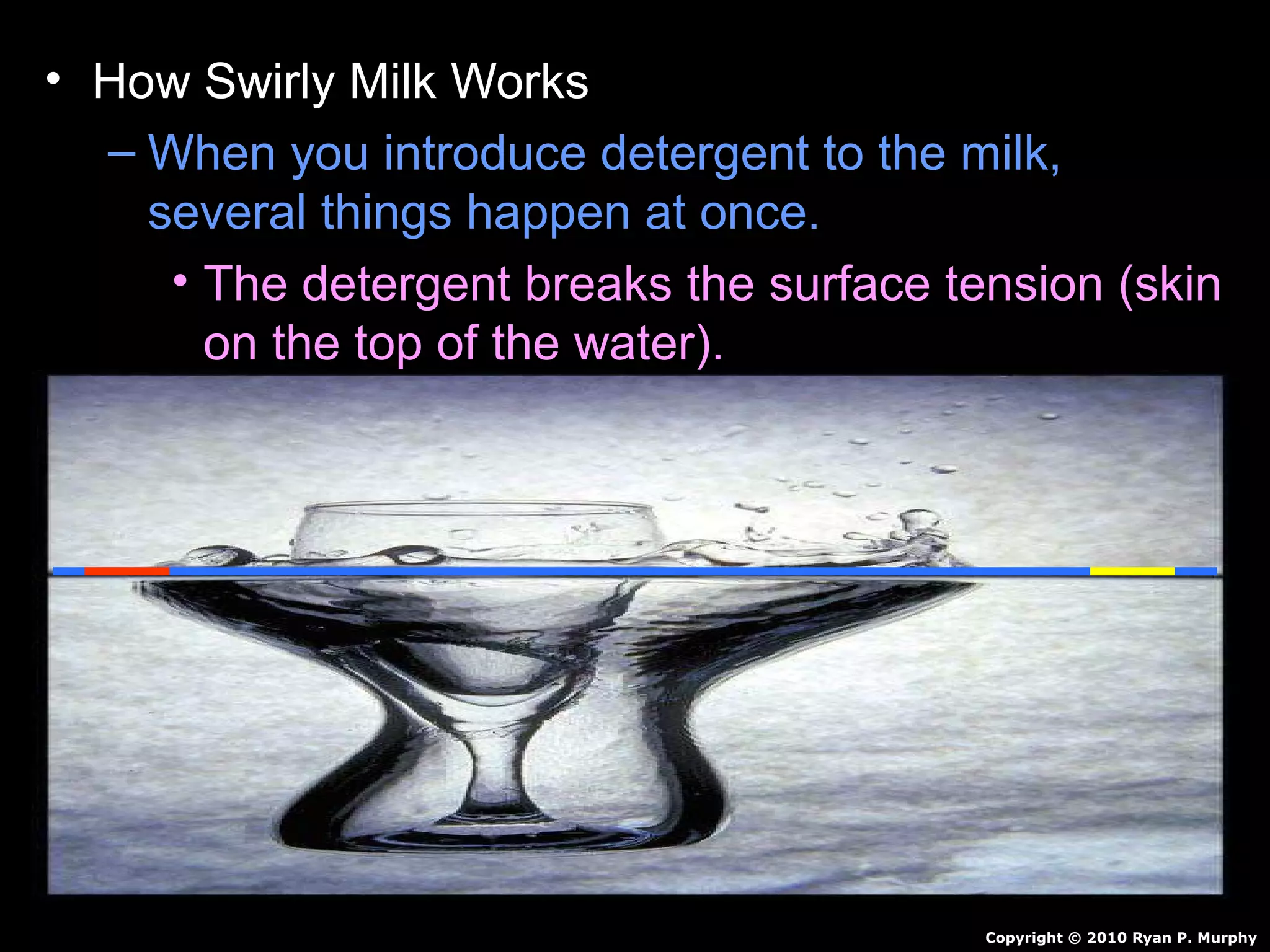
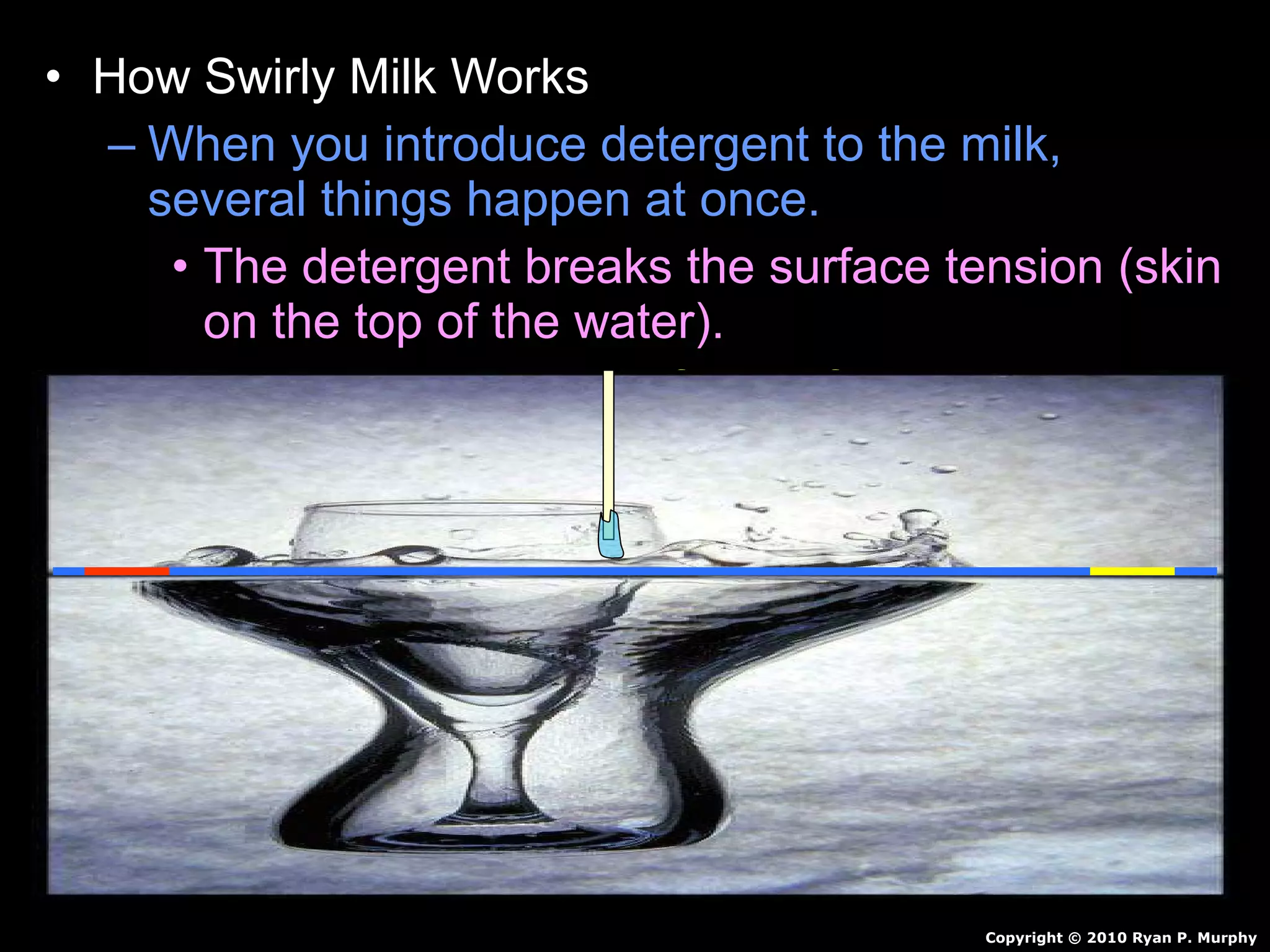
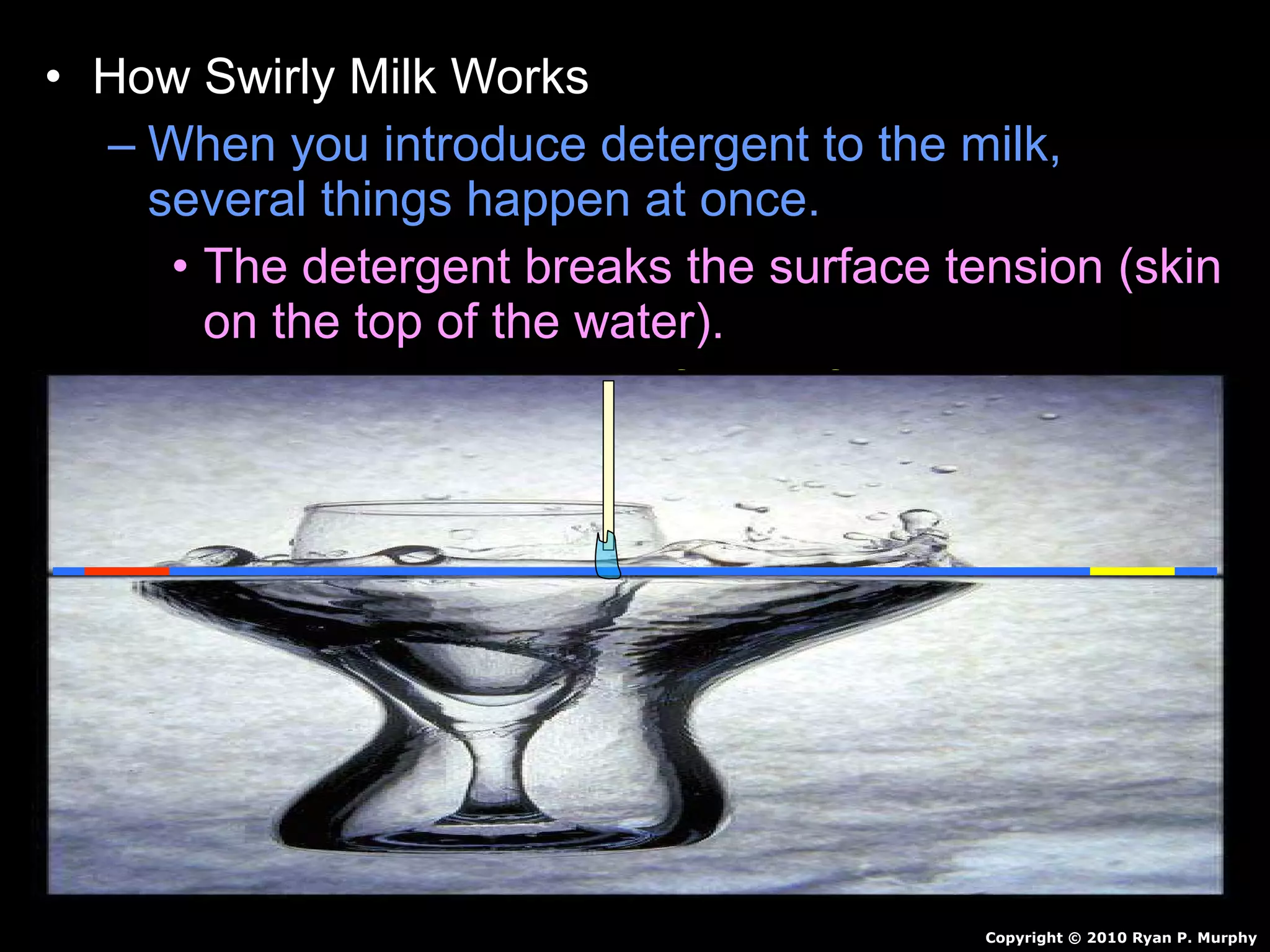
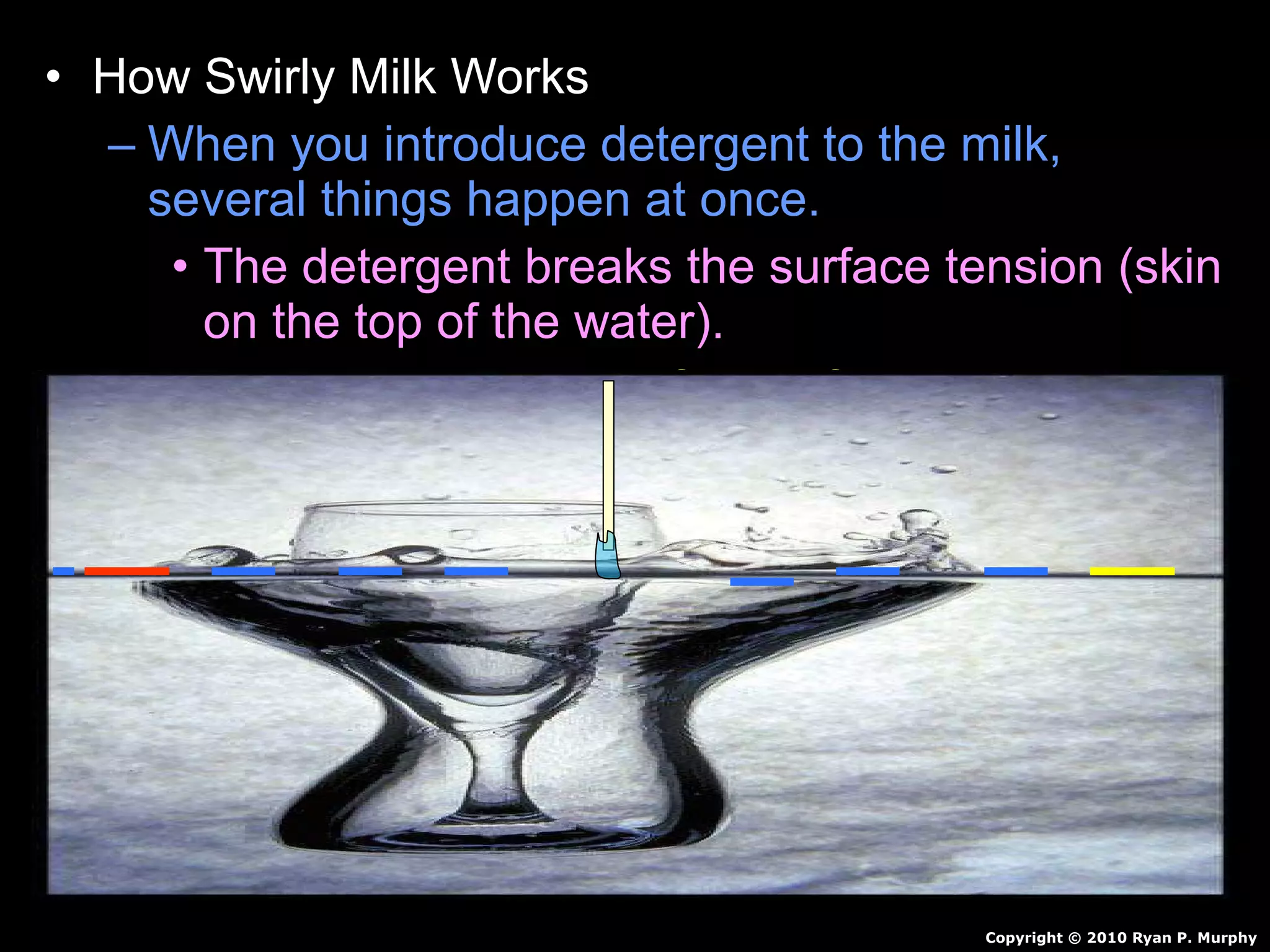
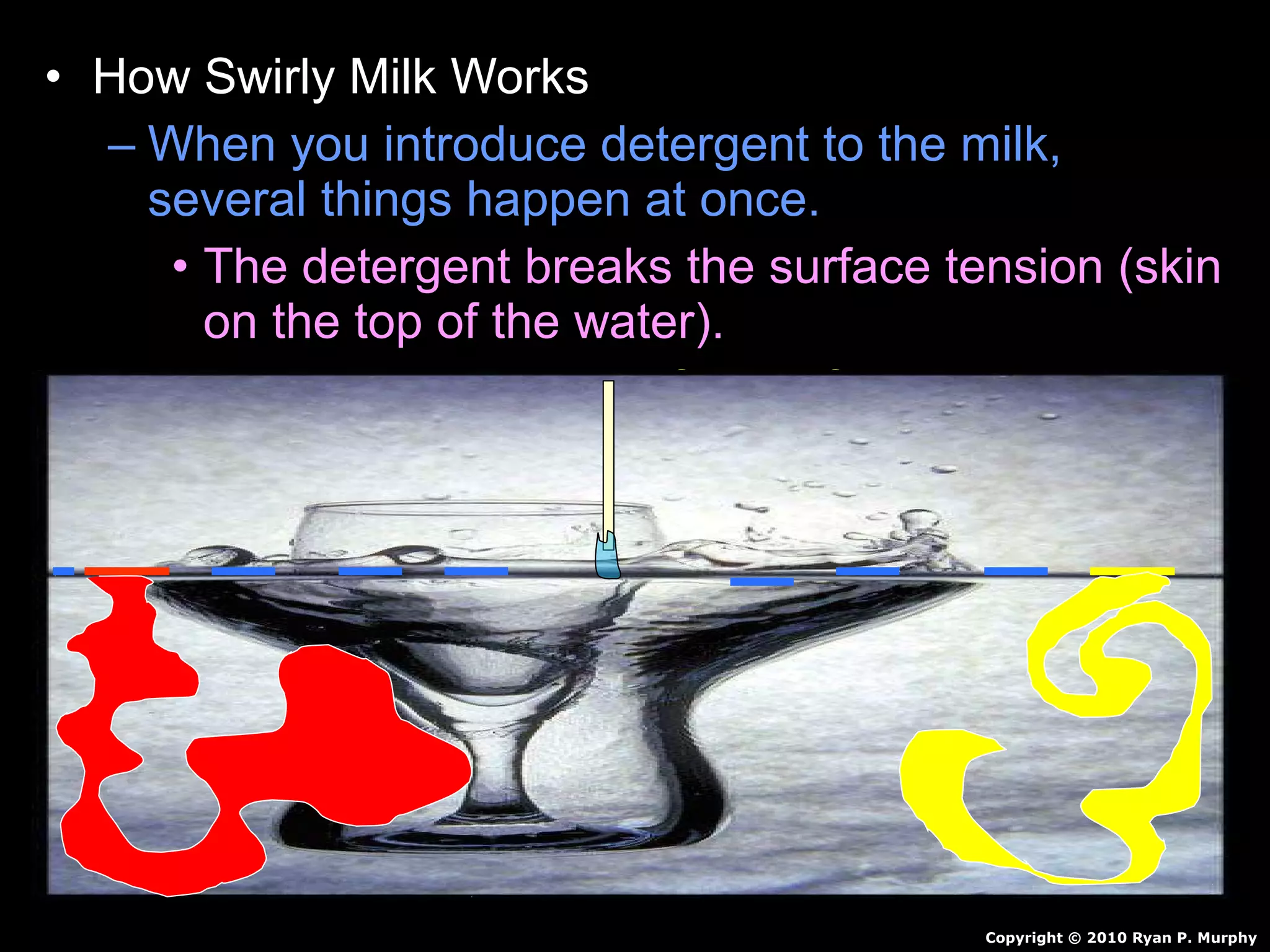
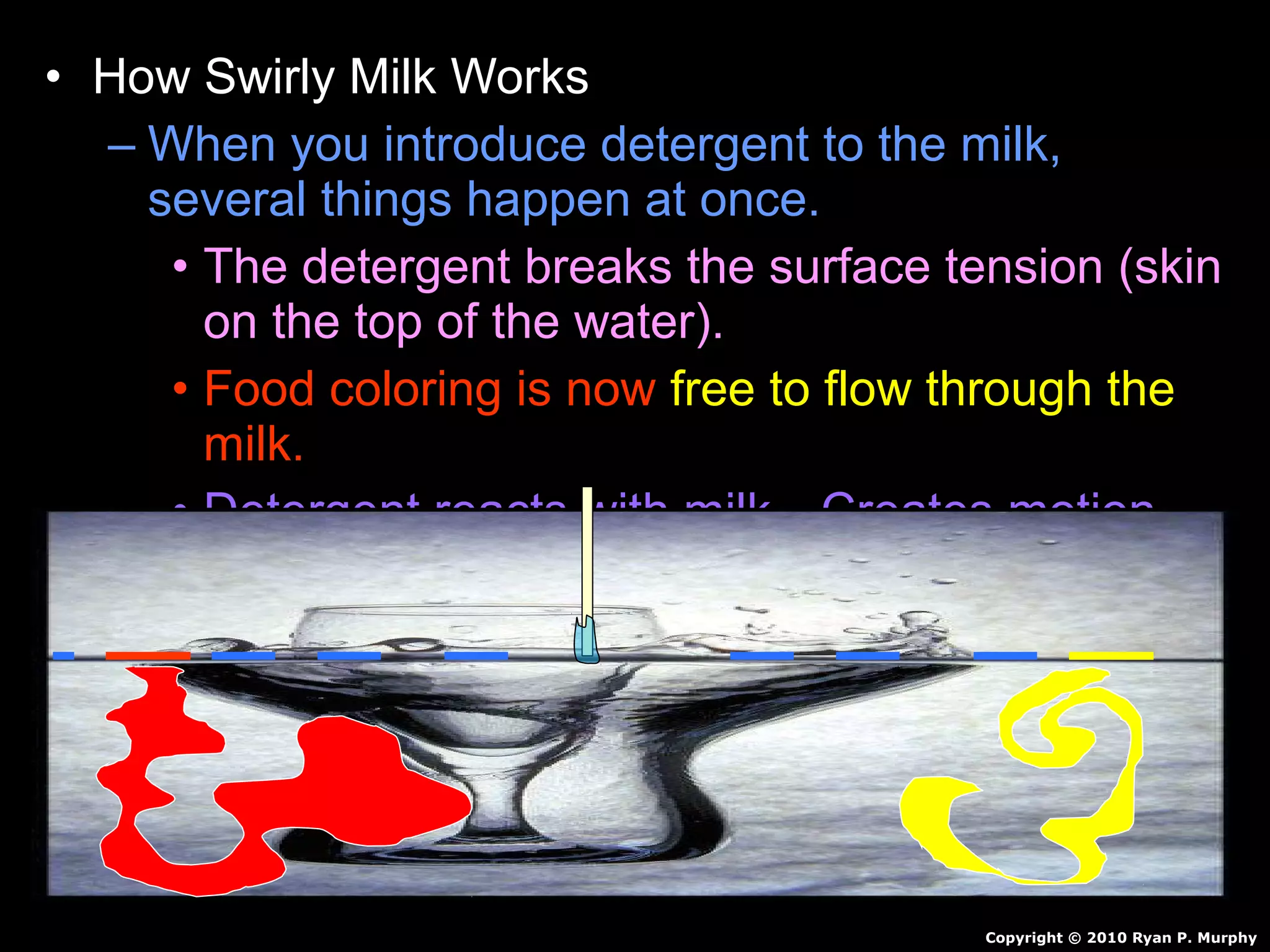
• How Swirly Milk Works
– When you introduce detergent to the milk,
several things happen at once.
• The detergent breaks the surface tension (skin
on the top of the water).
• Food coloring is now free to flow through the
milk.
• Detergent reacts with milk…Creates motion.
• Detergent also breaks up fat in milk / pushes
color around.
• Continues for awhile and then stops.
Copyright © 2010 Ryan P. Murphy
• How Swirly Milk Works
– When you introduce detergent to the milk,
several things happen at once.
• The detergent breaks the surface tension (skin
on the top of the water).
• Food coloring is now free to flow through the
milk.
• Detergent reacts with milk…Creates motion.
• Detergent also breaks up fat in milk / pushes
color around.
• Continues for awhile and then stops.
Copyright © 2010 Ryan P. Murphy
• How Swirly Milk Works
– When you introduce detergent to the milk,
several things happen at once.
• The detergent breaks the surface tension (skin
on the top of the water).
• Food coloring is now free to flow through the
milk.
• Detergent reacts with milk…Creates motion.
• Detergent also breaks up fat in milk / pushes
color around.
• Continues for awhile and then stops.
Copyright © 2010 Ryan P. Murphy
• How Swirly Milk Works
– When you introduce detergent to the milk,
several things happen at once.
• The detergent breaks the surface tension (skin
on the top of the water).
• Food coloring is now free to flow through the
milk.
• Detergent reacts with milk…Creates motion.
• Detergent also breaks up fat in milk / pushes
color around.
• Continues for awhile and then stops.
Copyright © 2010 Ryan P. Murphy
• How Swirly Milk Works
– When you introduce detergent to the milk,
several things happen at once.
• The detergent breaks the surface tension (skin
on the top of the water).
• Food coloring is now free to flow through the
milk.
• Detergent reacts with milk…Creates motion.
• Detergent also breaks up fat in milk / pushes
color around.
• Continues for awhile and then stops.
Copyright © 2010 Ryan P. Murphy
• How Swirly Milk Works
– When you introduce detergent to the milk,
several things happen at once.
• The detergent breaks the surface tension (skin
on the top of the water).
• Food coloring is now free to flow through the
milk.
• Detergent reacts with milk…Creates motion.
• Detergent also breaks up fat in milk / pushes
color around.
• Continues for awhile and then stops.
Copyright © 2010 Ryan P. Murphy
• How Swirly Milk Works
– When you introduce detergent to the milk,
several things happen at once.
• The detergent breaks the surface tension (skin
on the top of the water).
• Food coloring is now free to flow through the
milk.
• Detergent reacts with milk…Creates motion.
• Detergent also breaks up fat in milk / pushes
color around.
• Continues for awhile and then stops.
Copyright © 2010 Ryan P. Murphy
• How Swirly Milk Works
– When you introduce detergent to the milk,
several things happen at once.
• The detergent breaks the surface tension (skin
on the top of the water).
• Food coloring is now free to flow through the
milk.
• Detergent reacts with milk…Creates motion.
• Detergent also breaks up fat in milk / pushes
color around.
• Continues for awhile and then stops.
Copyright © 2010 Ryan P. Murphy
• How Swirly Milk Works
– When you introduce detergent to the milk,
several things happen at once.
• The detergent breaks the surface tension (skin
on the top of the water).
• Food coloring is now free to flow through the
milk.
• Detergent reacts with milk…Creates motion.
• Detergent also breaks up fat in milk / pushes
color around.
• Continues for awhile and then stops.
Copyright © 2010 Ryan P. Murphy
• How Swirly Milk Works
– When you introduce detergent to the milk,
several things happen at once.
• The detergent breaks the surface tension (skin
on the top of the water).
• Food coloring is now free to flow through the
milk.
• Detergent reacts with milk…Creates motion.
• Detergent also breaks up fat in milk / pushes
color around.
Copyright © 2010 Ryan P. Murphy
• How Swirly Milk Works
– When you introduce detergent to the milk,
several things happen at once.
• The detergent breaks the surface tension (skin
on the top of the water).
• Food coloring is now free to flow through the
milk.
• Detergent reacts with milk…Creates motion.
• Detergent also breaks up fat in milk / pushes
color around.
• Continues for awhile and then stops.
Copyright © 2010 Ryan P. Murphy
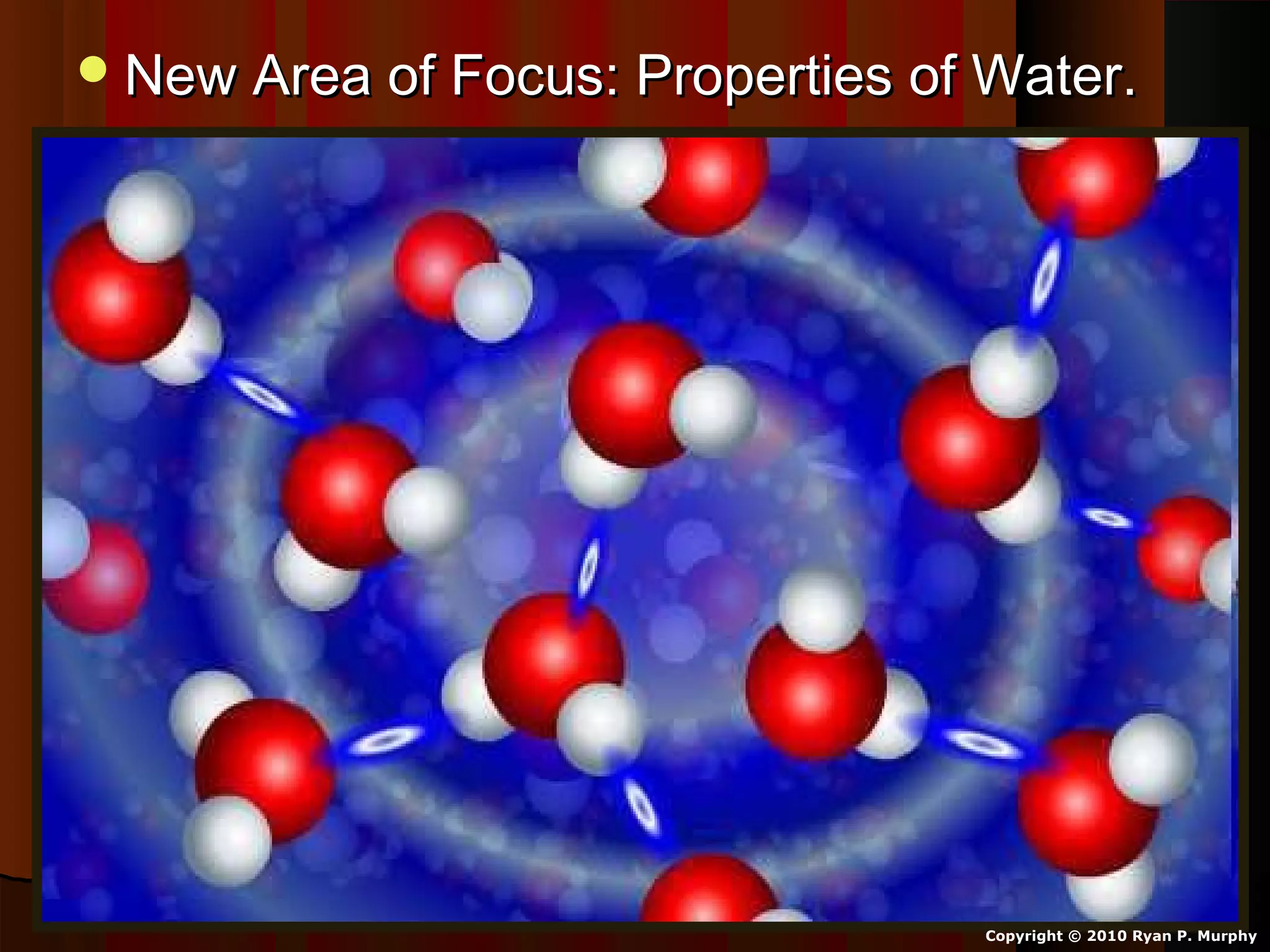
New Area of Focus: Properties of Water.New Area of Focus: Properties of Water.
Copyright © 2010 Ryan P. Murphy
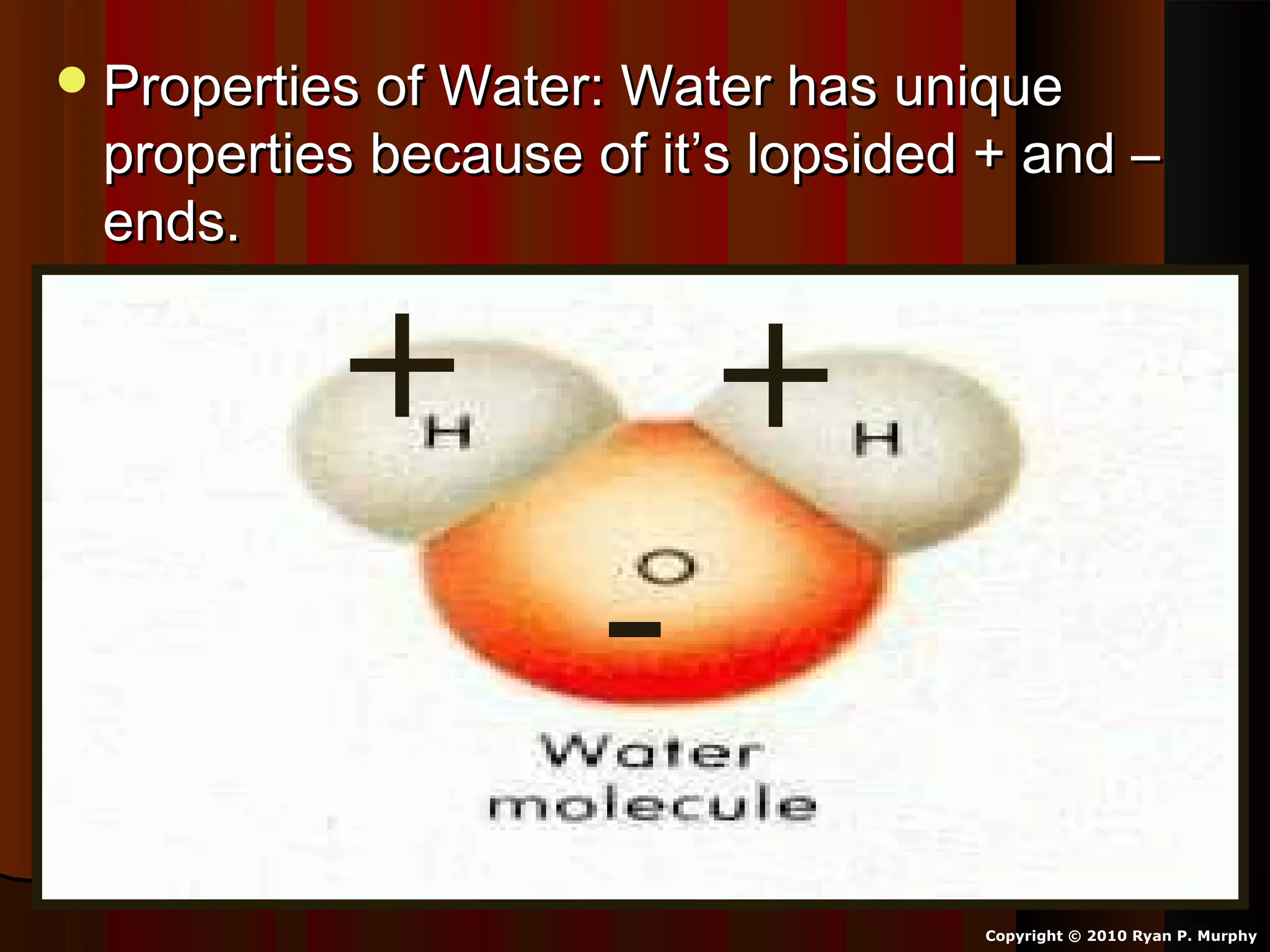
Properties of Water: Water has uniqueProperties of Water: Water has unique
properties because of it’s lopsided + and –properties because of it’s lopsided + and –
ends.ends.
-
+
+
Copyright © 2010 Ryan P. Murphy
Some water basicsSome water basics
--
--
--
Copyright © 2010 Ryan P. Murphy
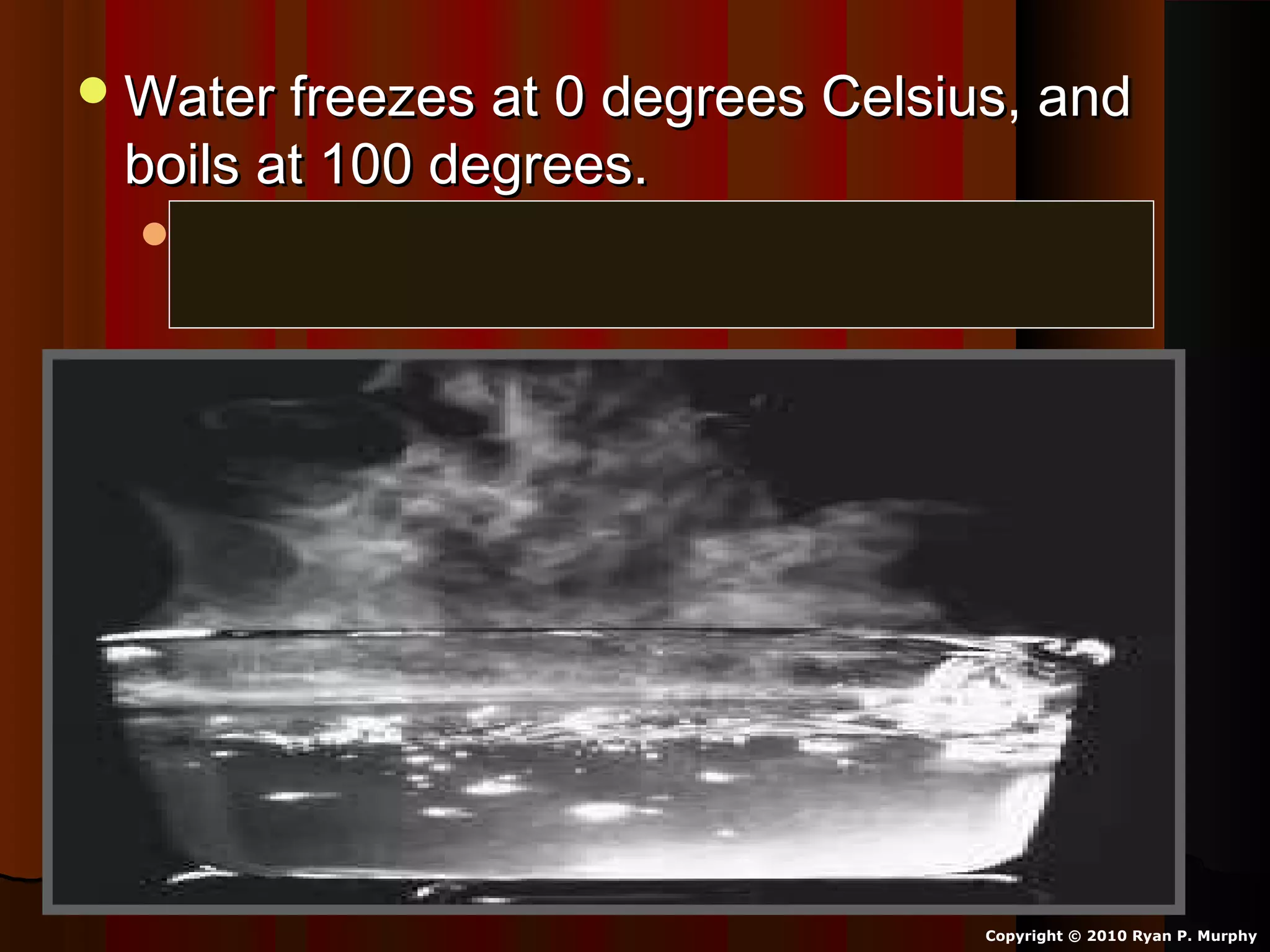
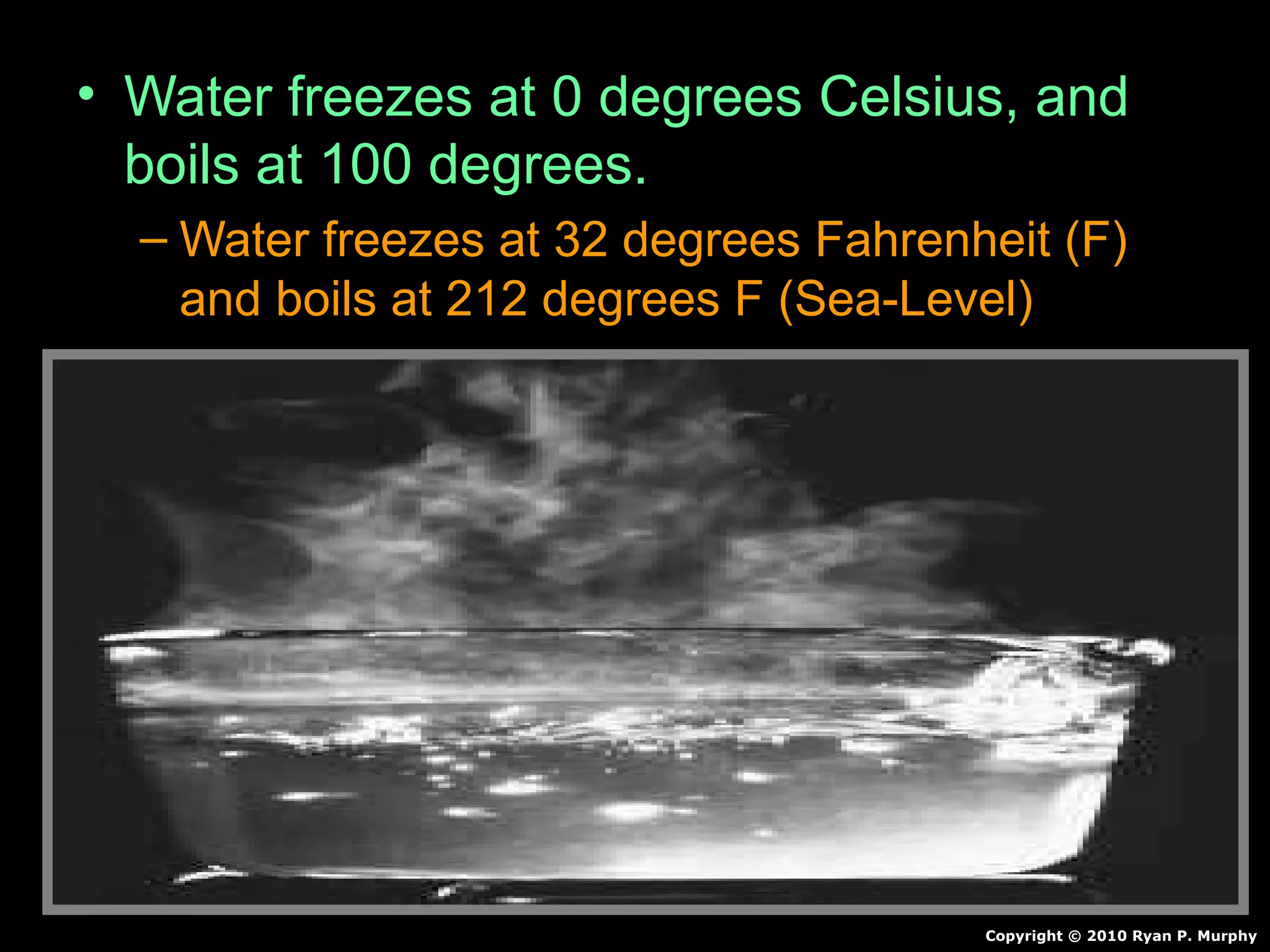
Water freezes at 0 degrees Celsius, andWater freezes at 0 degrees Celsius, and
boils at 100 degrees.boils at 100 degrees.
Water freezes at 32 degrees Fahrenheit (F)Water freezes at 32 degrees Fahrenheit (F)
and boils at 212 degrees F (Sea-Level)and boils at 212 degrees F (Sea-Level)
Copyright © 2010 Ryan P. Murphy
• Water freezes at 0 degrees Celsius, andWater freezes at 0 degrees Celsius, and
boils at 100 degrees.boils at 100 degrees.
– Water freezes at 32 degrees Fahrenheit (F)Water freezes at 32 degrees Fahrenheit (F)
and boils at 212 degrees F (Sea-Level)and boils at 212 degrees F (Sea-Level)
Copyright © 2010 Ryan P. Murphy
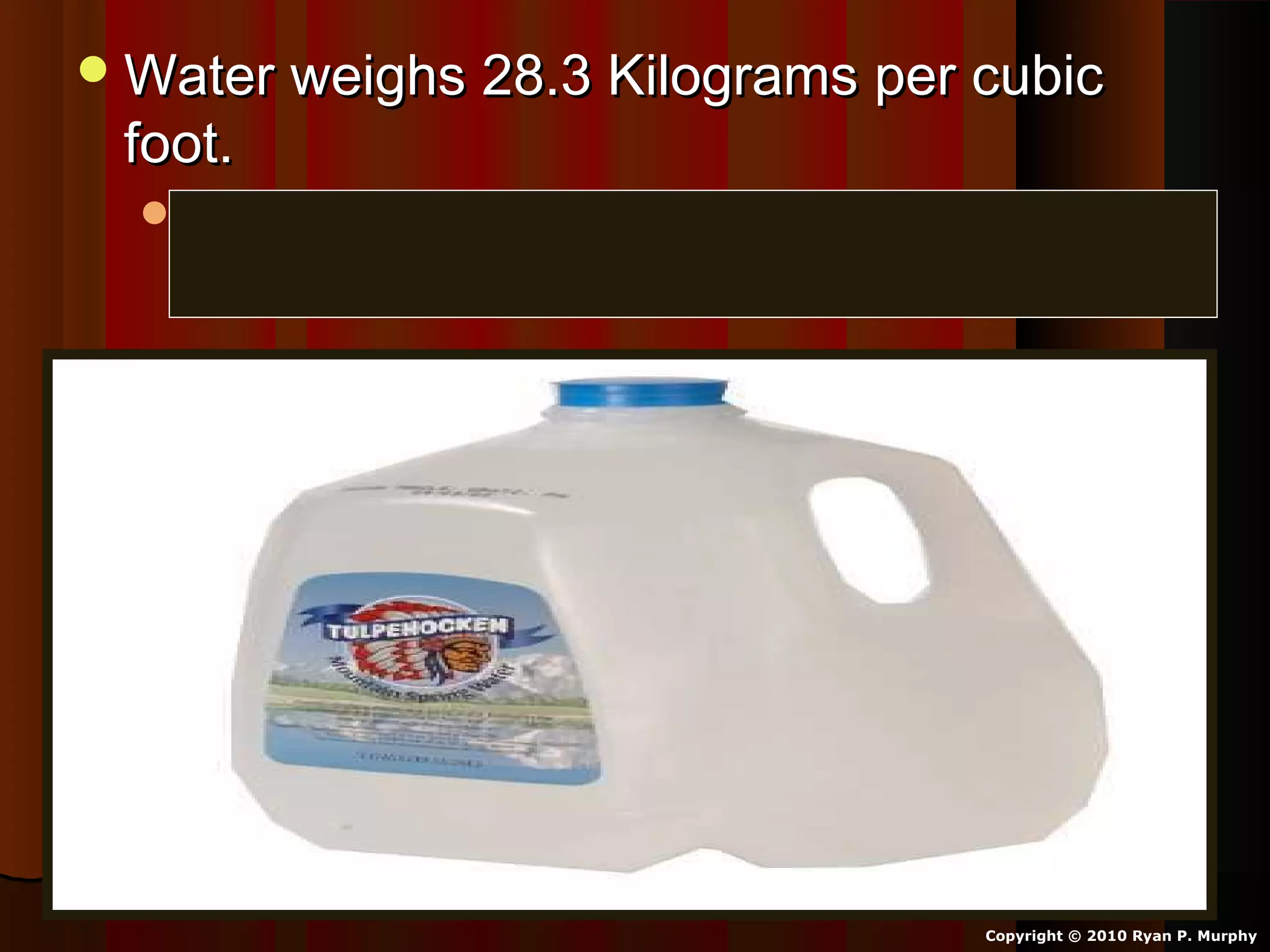
Water weighs 28.3 Kilograms per cubicWater weighs 28.3 Kilograms per cubic
foot.foot.
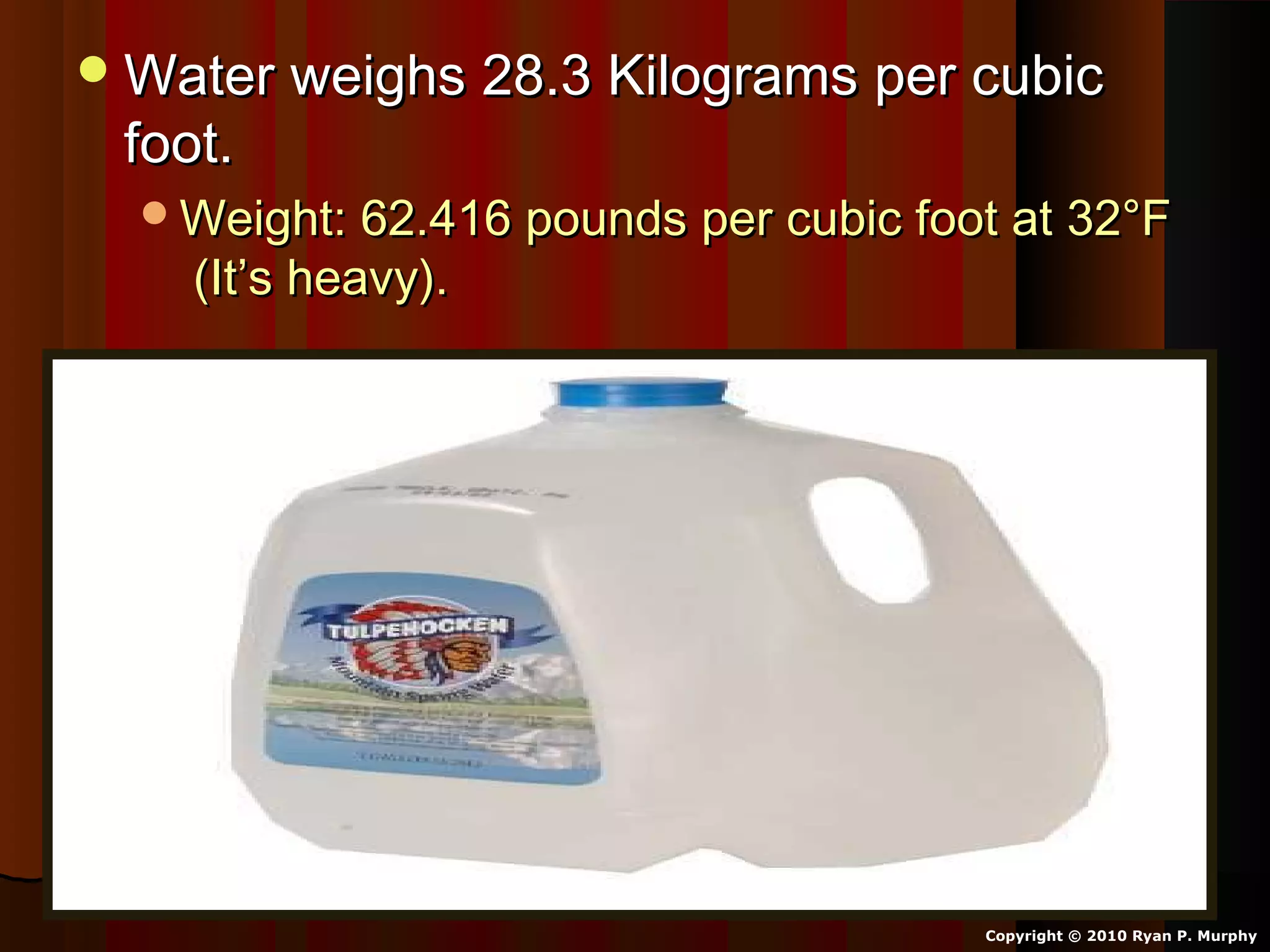
Weight: 62.416 pounds per cubic foot atWeight: 62.416 pounds per cubic foot at
32°F (It’s heavy).32°F (It’s heavy).
Copyright © 2010 Ryan P. Murphy
Water weighs 28.3 Kilograms per cubicWater weighs 28.3 Kilograms per cubic
foot.foot.
Weight: 62.416 pounds per cubic foot at 32°FWeight: 62.416 pounds per cubic foot at 32°F
(It’s heavy).(It’s heavy).
Copyright © 2010 Ryan P. Murphy
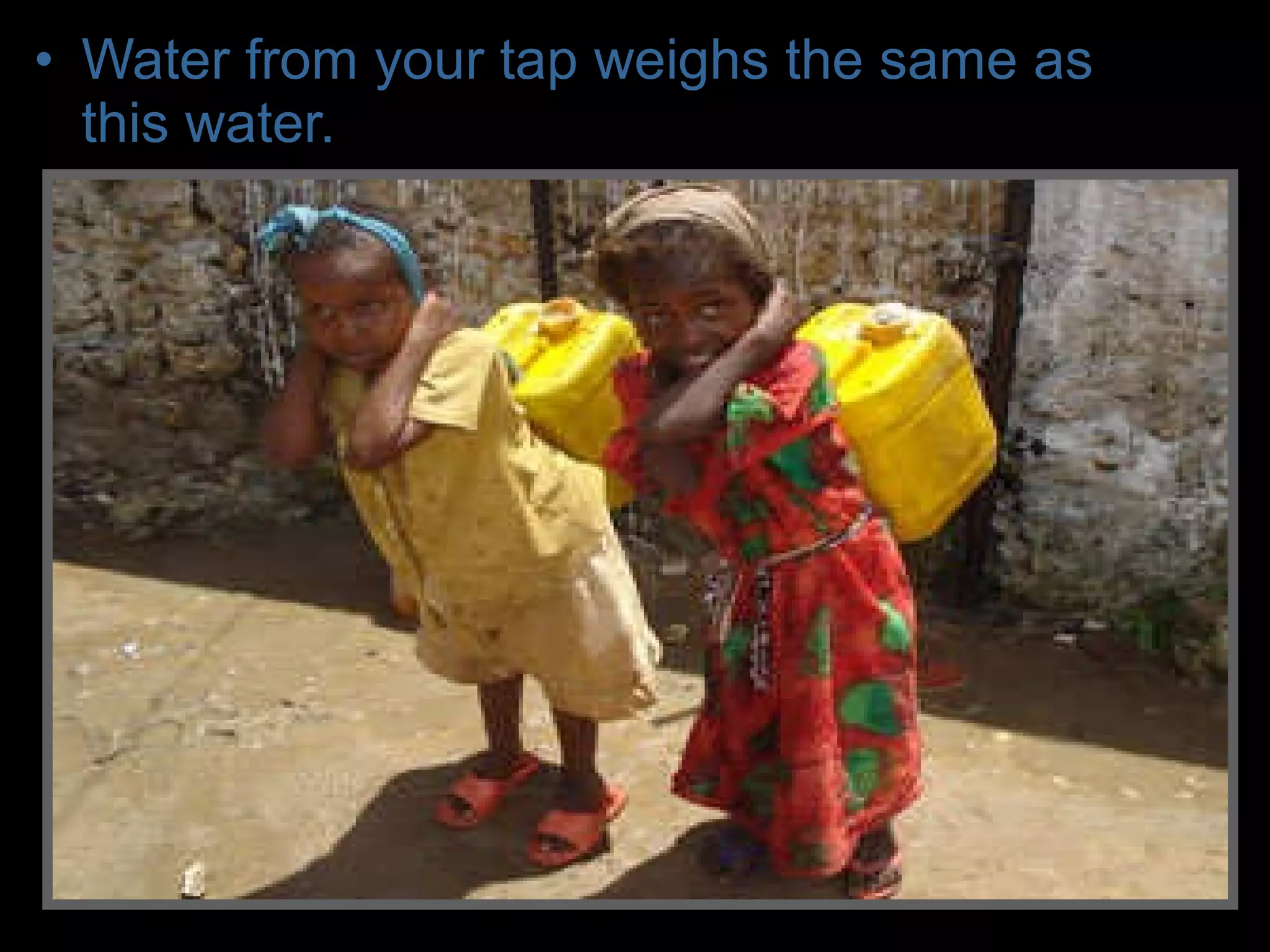
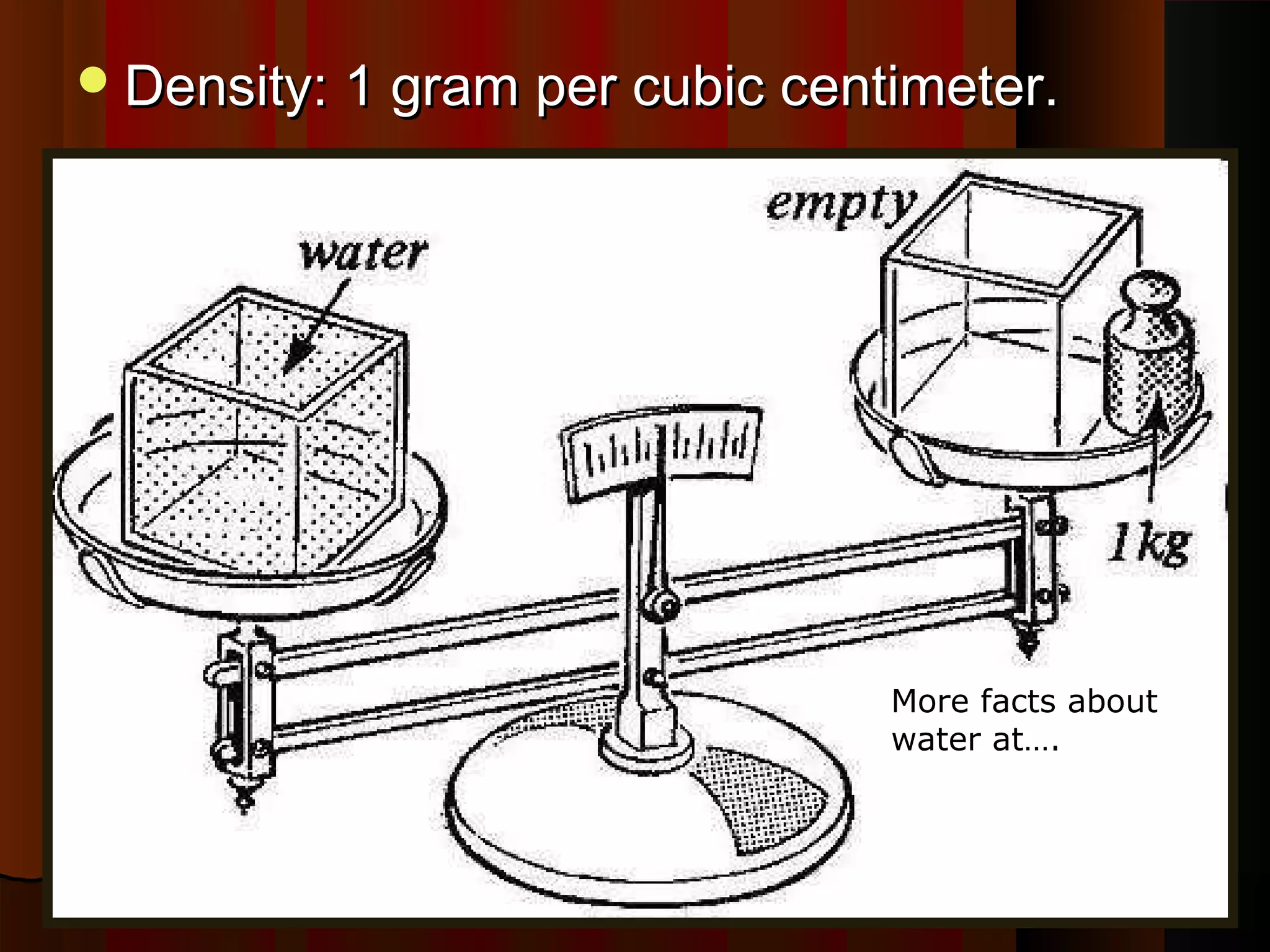
• Water from your tap weighs the same as
this water.
Density: 1 gram per cubic centimeter.Density: 1 gram per cubic centimeter.
More facts about
water at….
http://www.scienc
ekids.co.nz/scienc
efacts/water.html
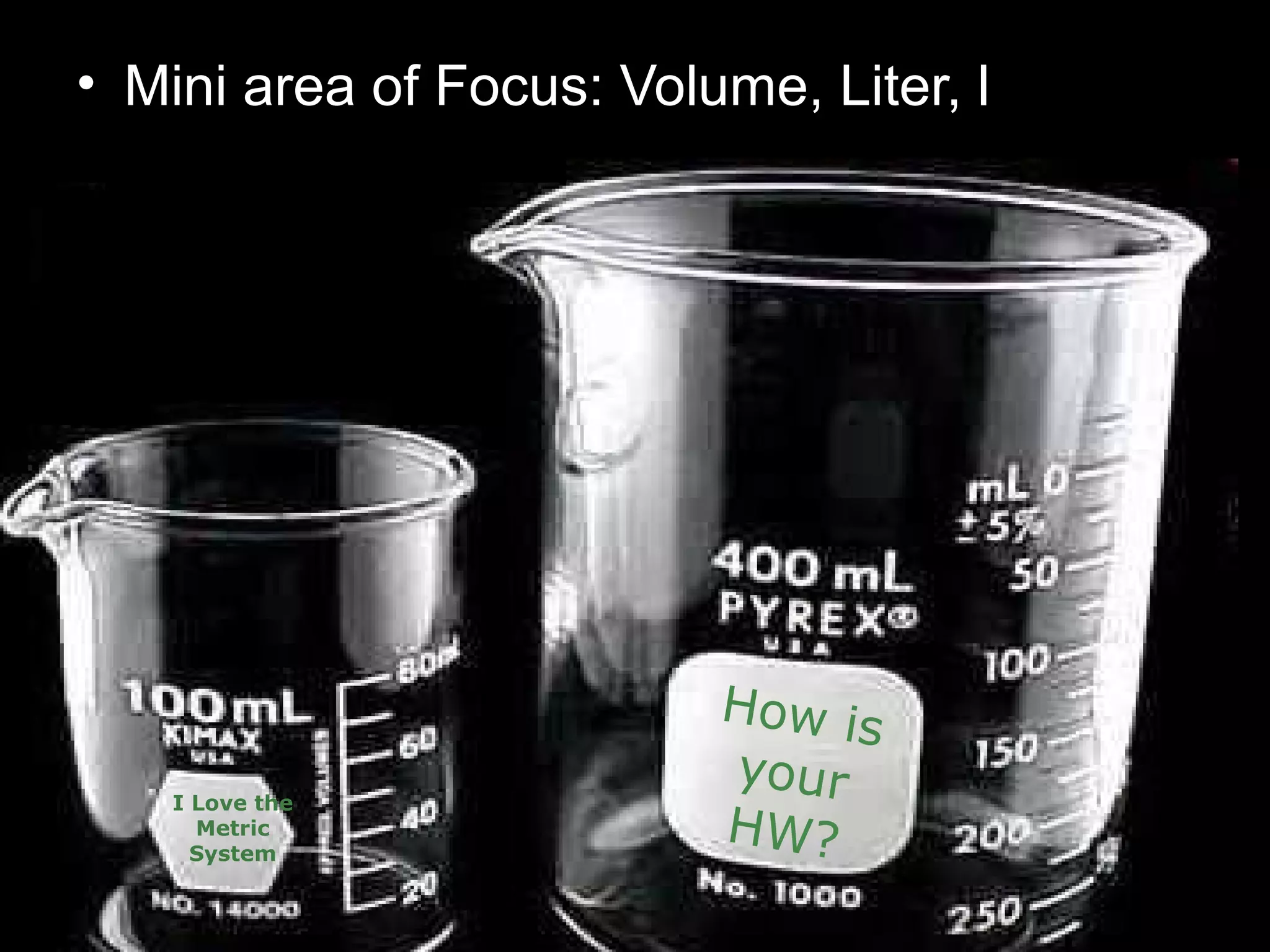
• Mini area of Focus: Volume, Liter, l
How is
your
HW?
I Love the
Metric
System
• Volume: The three-dimensional space an
object occupies.
Copyright © 2010 Ryan P. Murphy
Metric
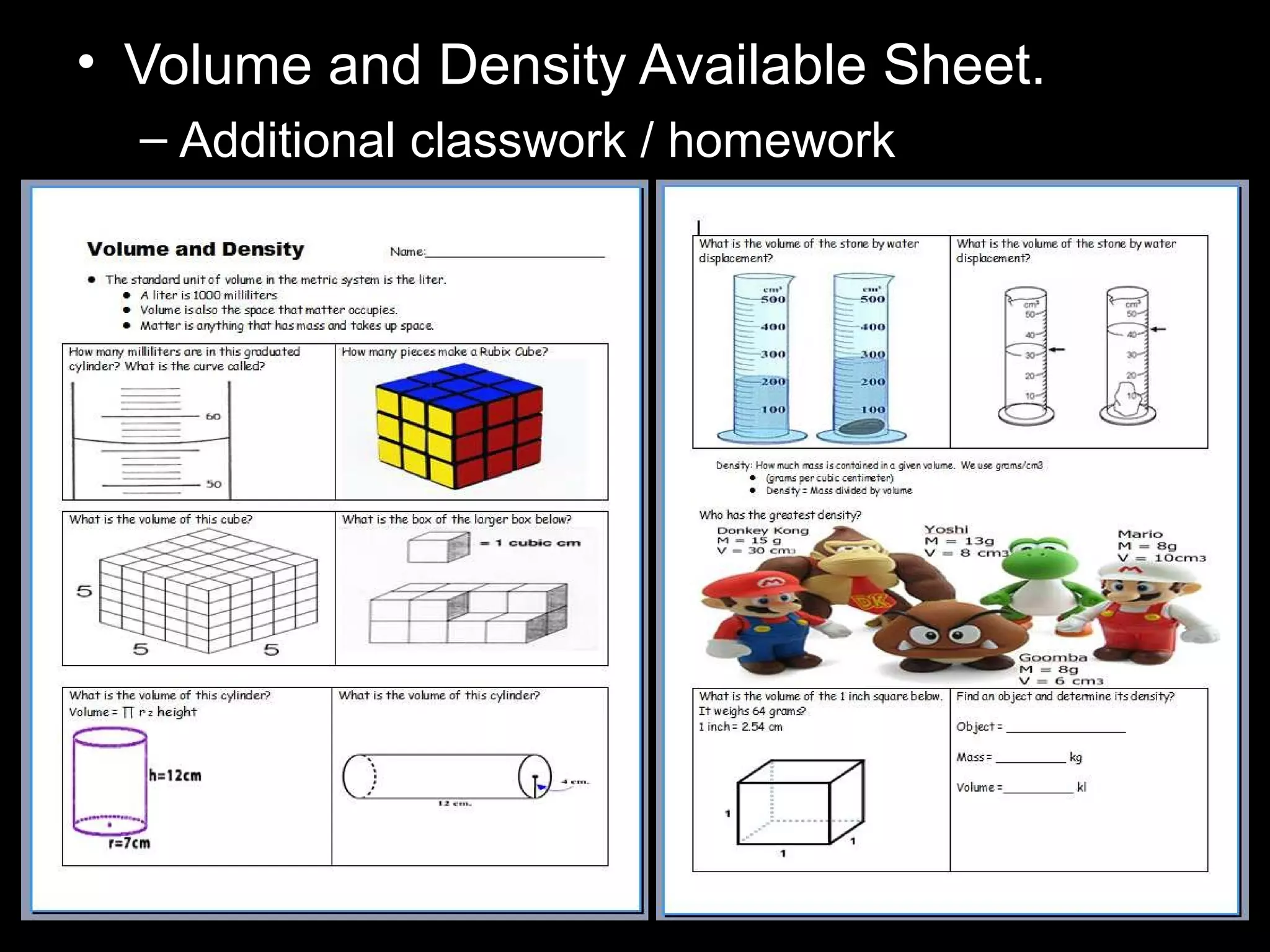
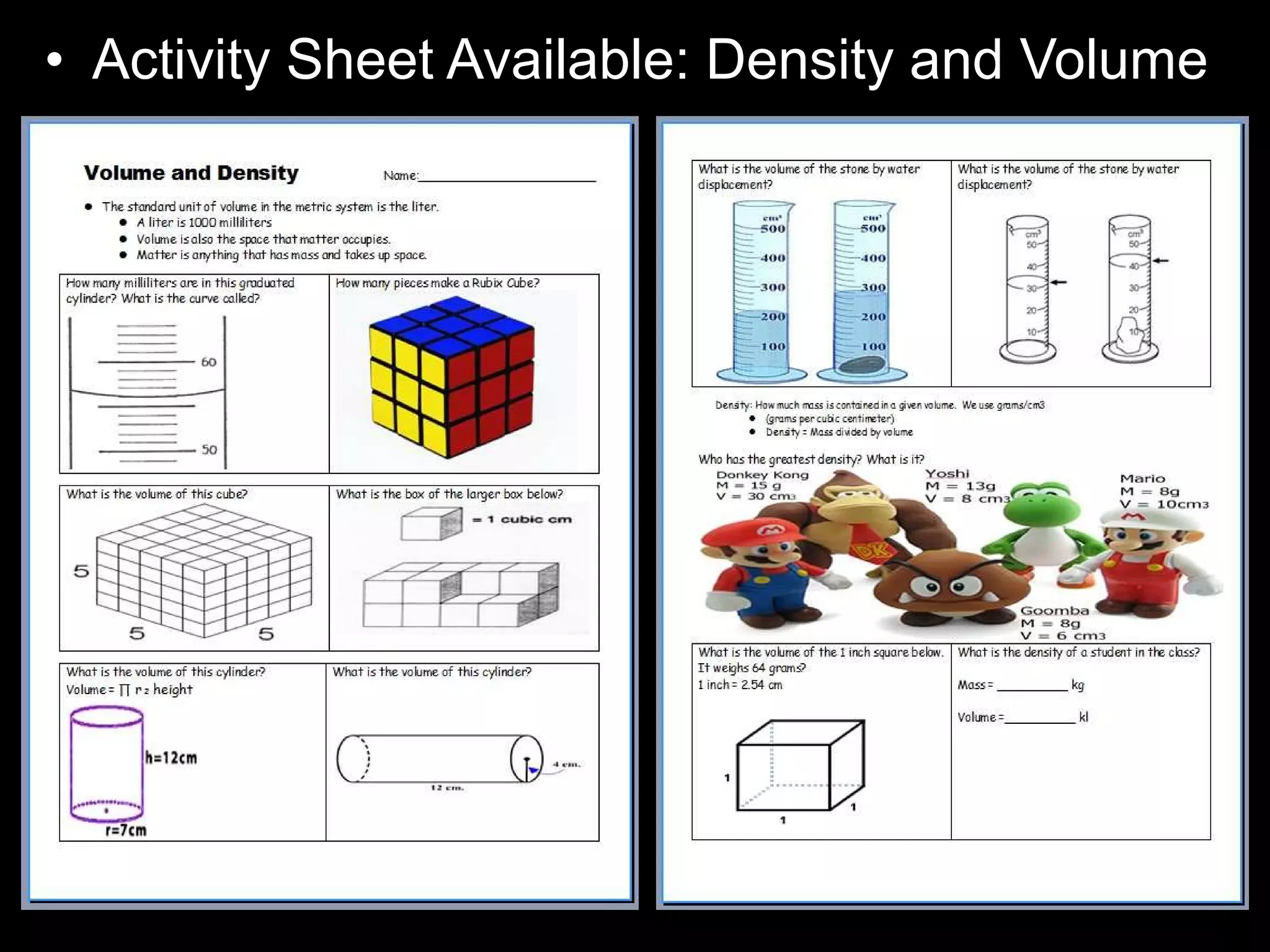
• Volume and Density Available Sheet.
– Additional classwork / homework
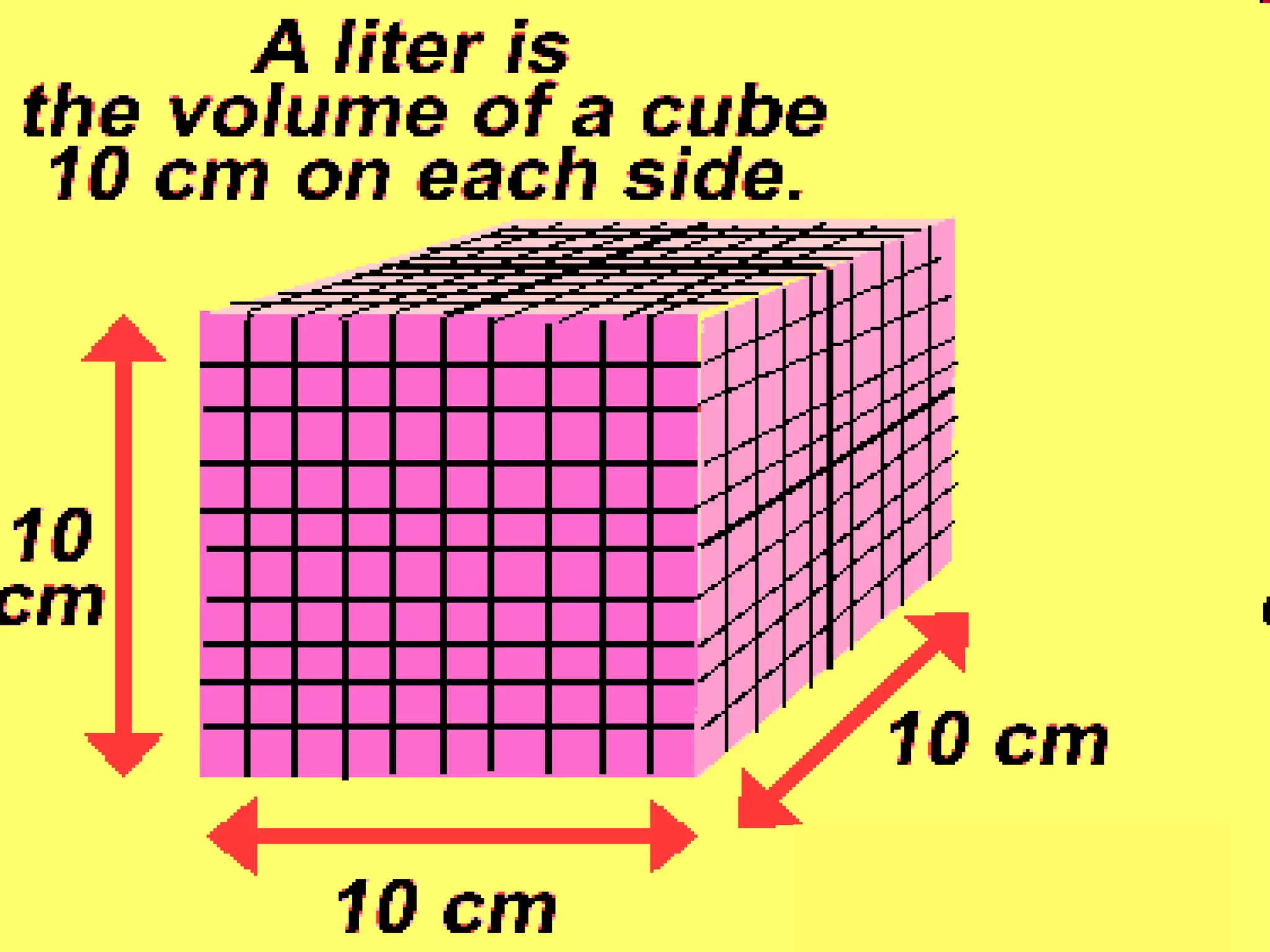
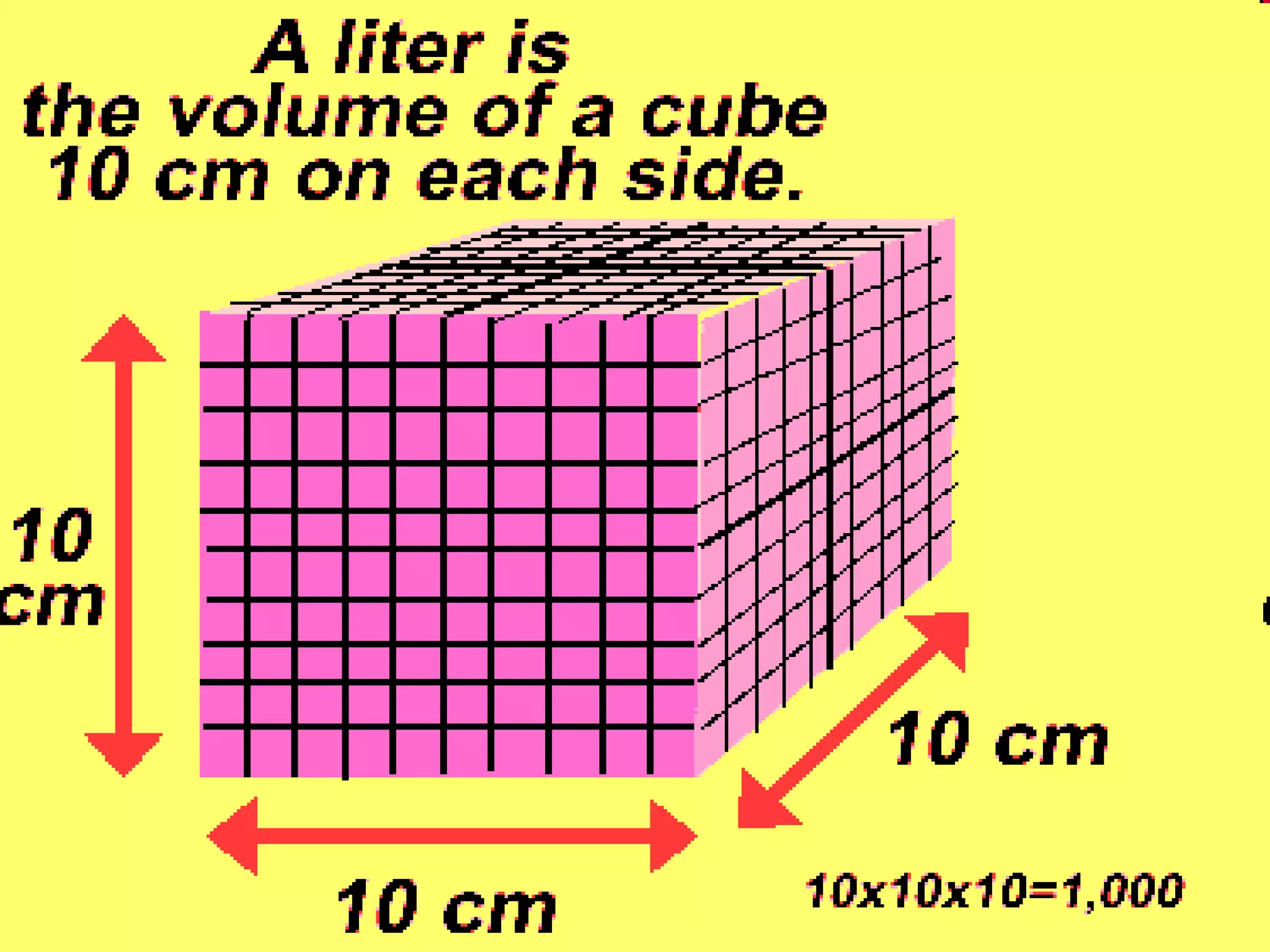
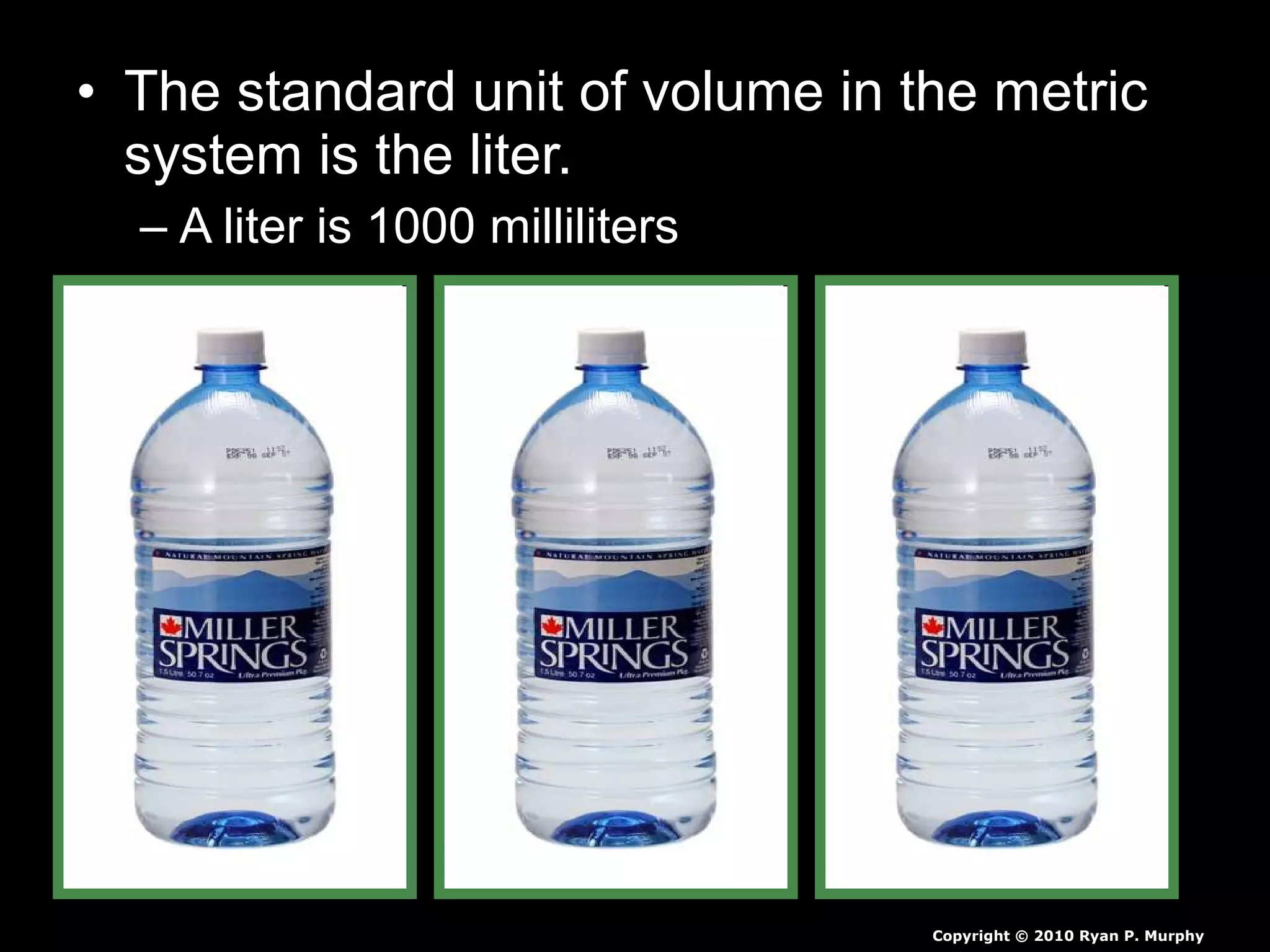
• The standard unit of volume in the metric
system is the liter.
– A liter is 1000 milliliters
Copyright © 2010 Ryan P. Murphy
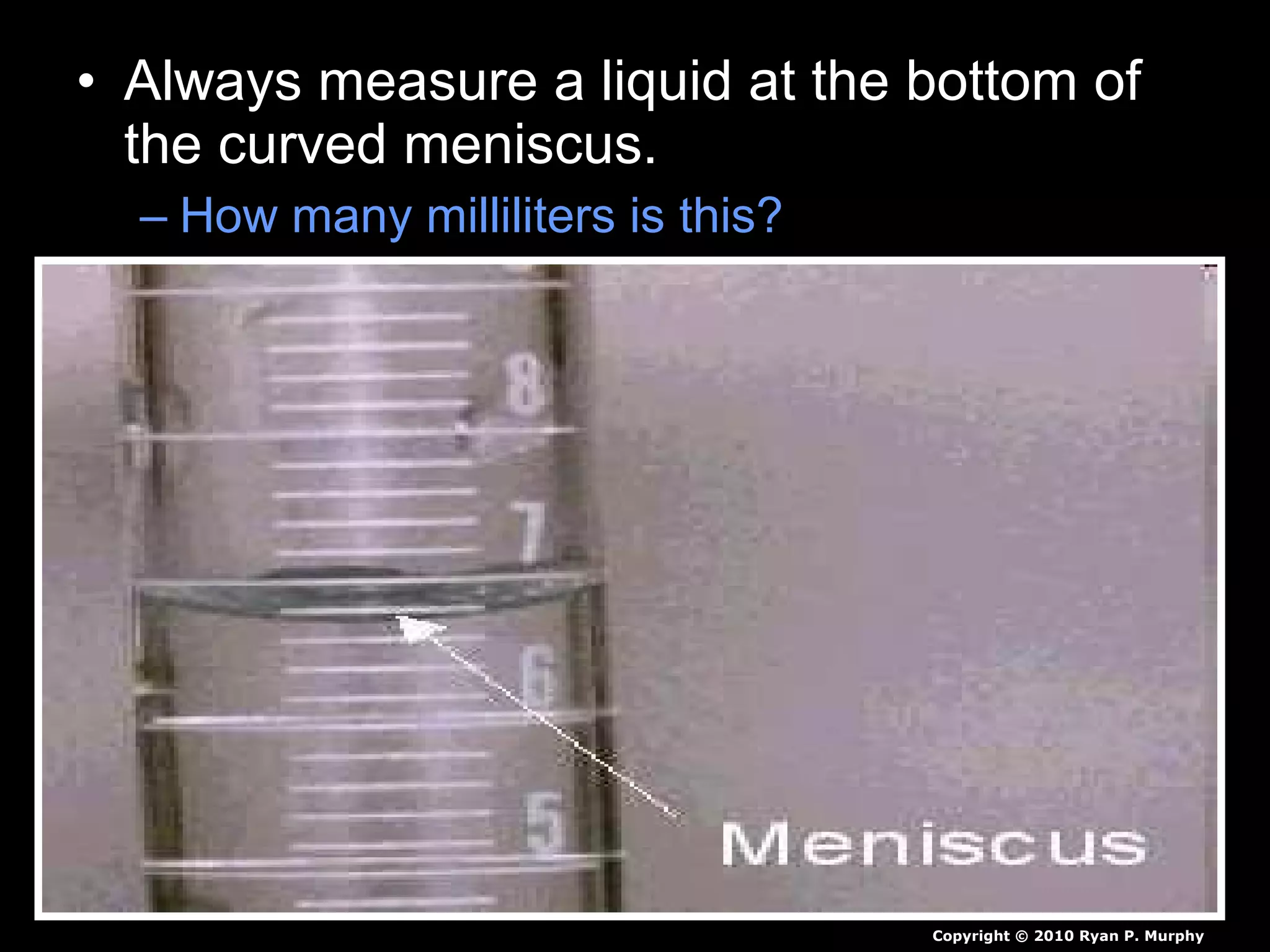
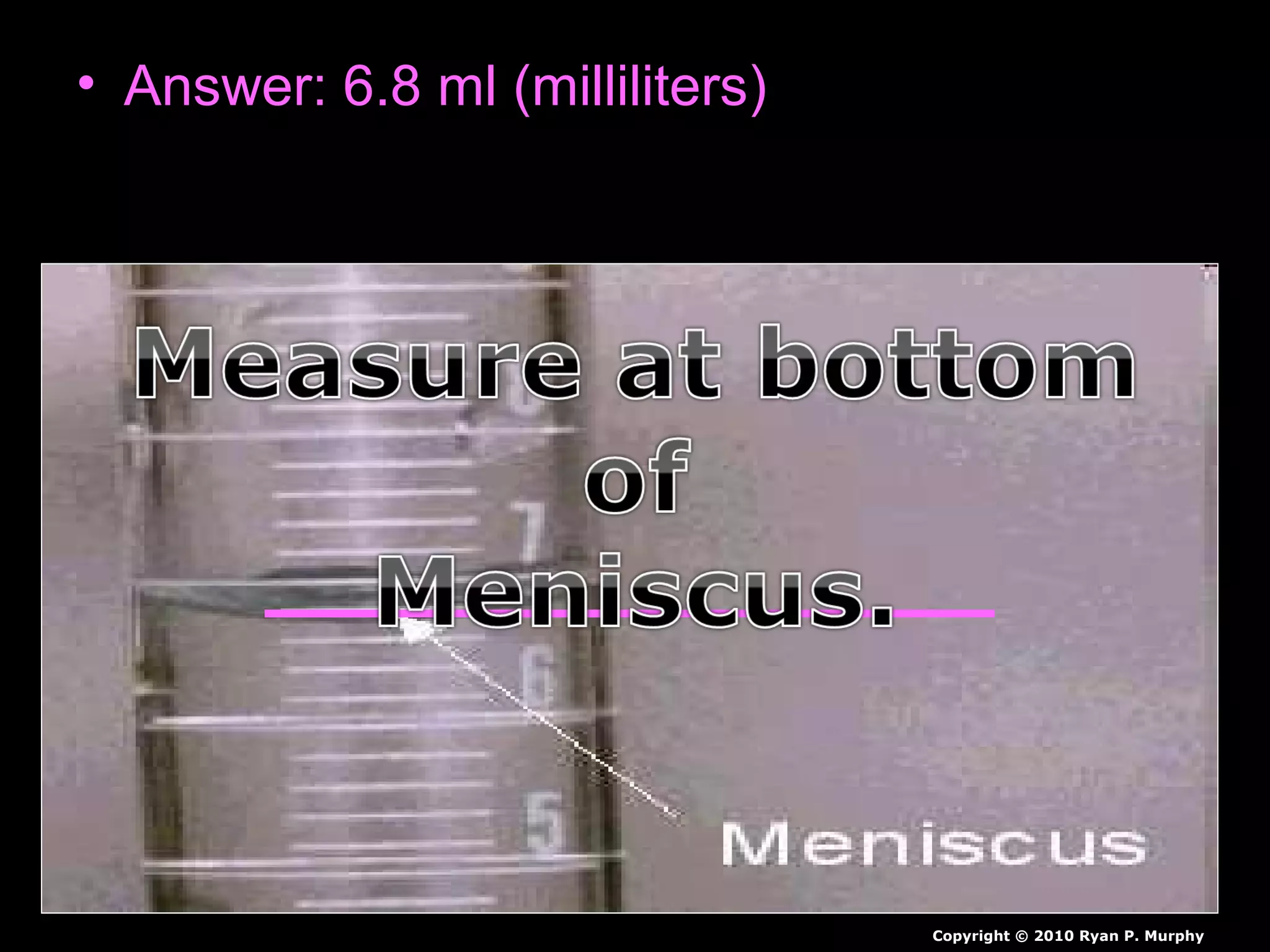
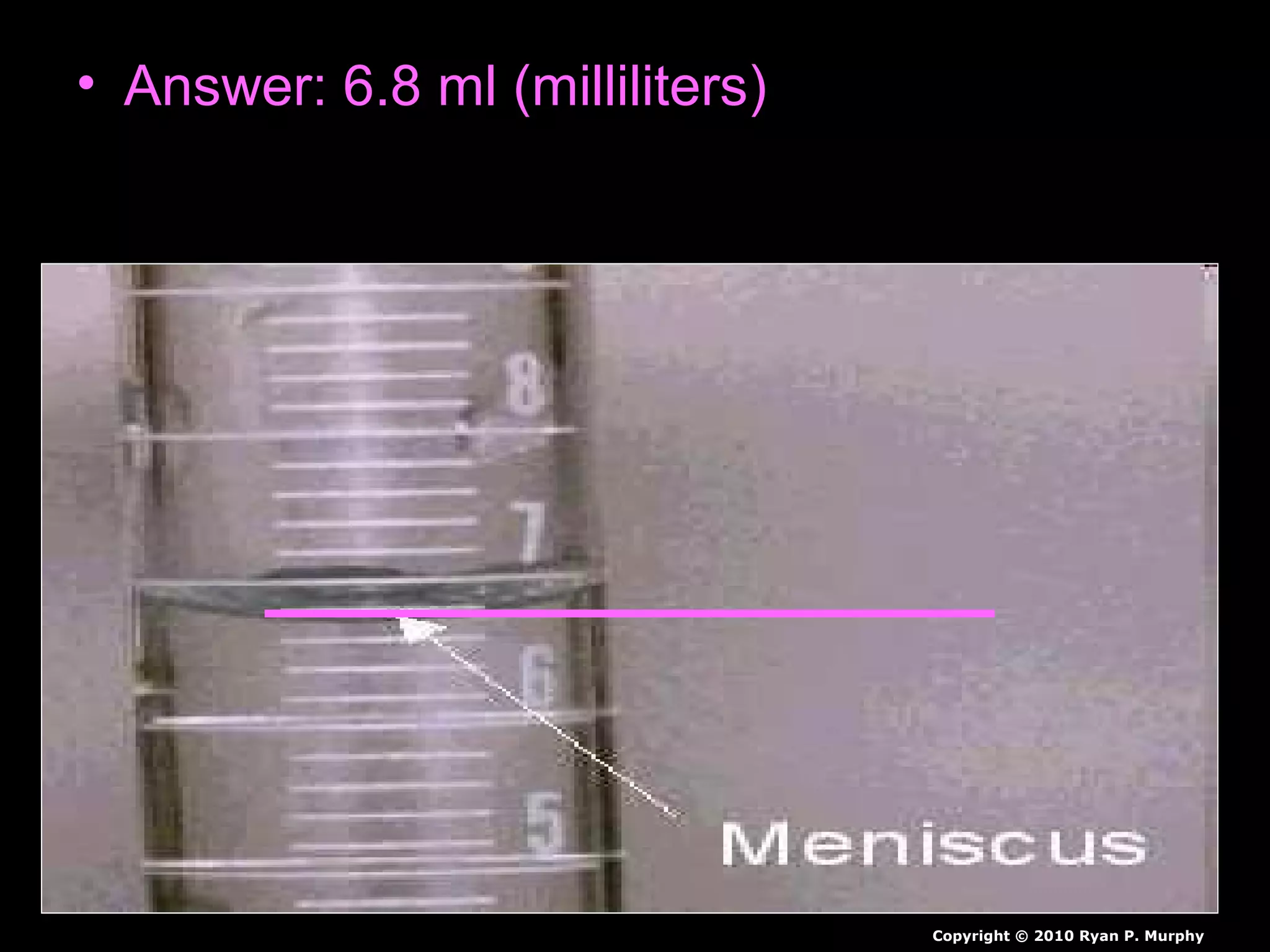
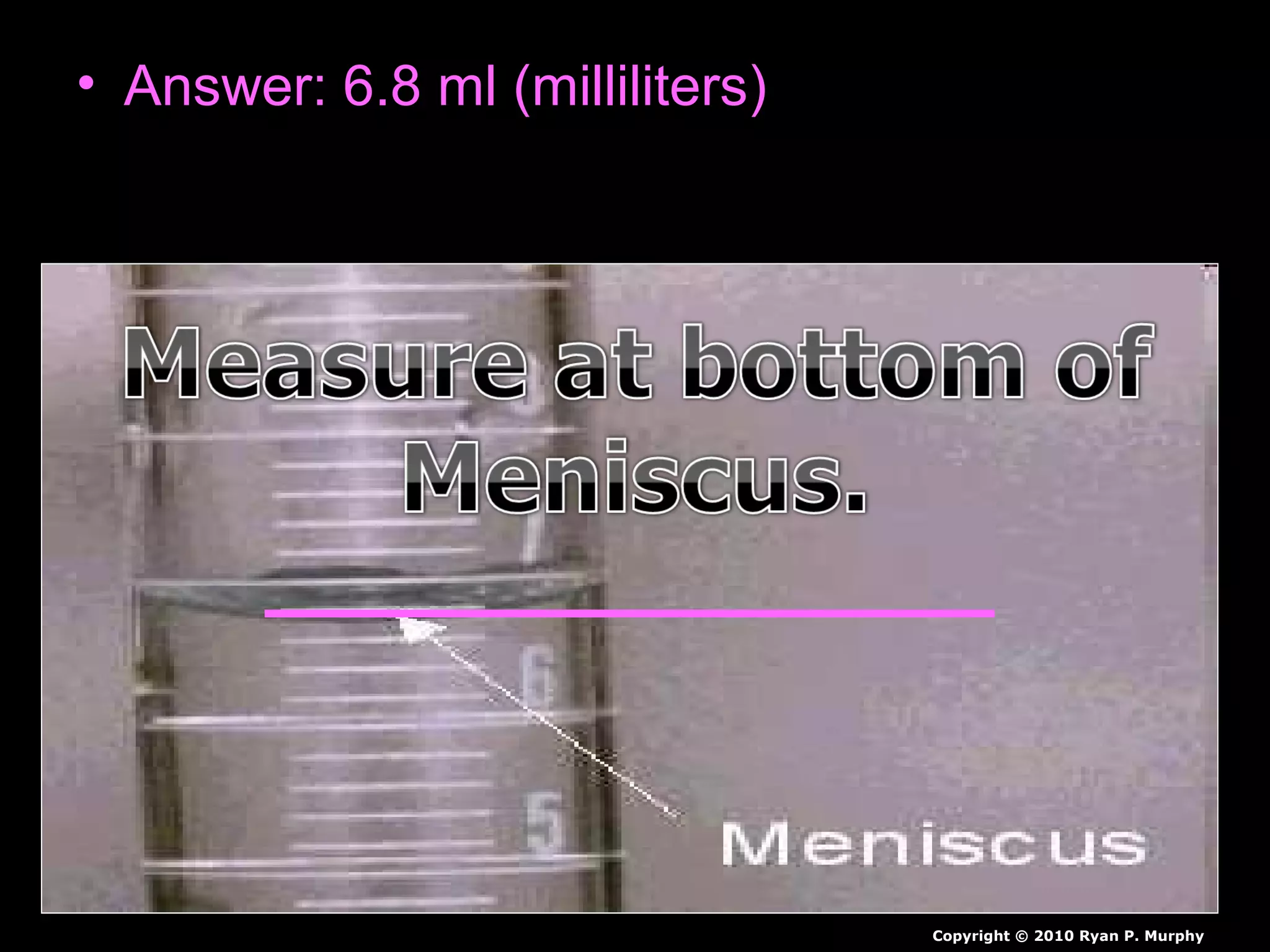
• Always measure a liquid at the bottom of
the curved meniscus.
– How many milliliters is this?
Copyright © 2010 Ryan P. Murphy
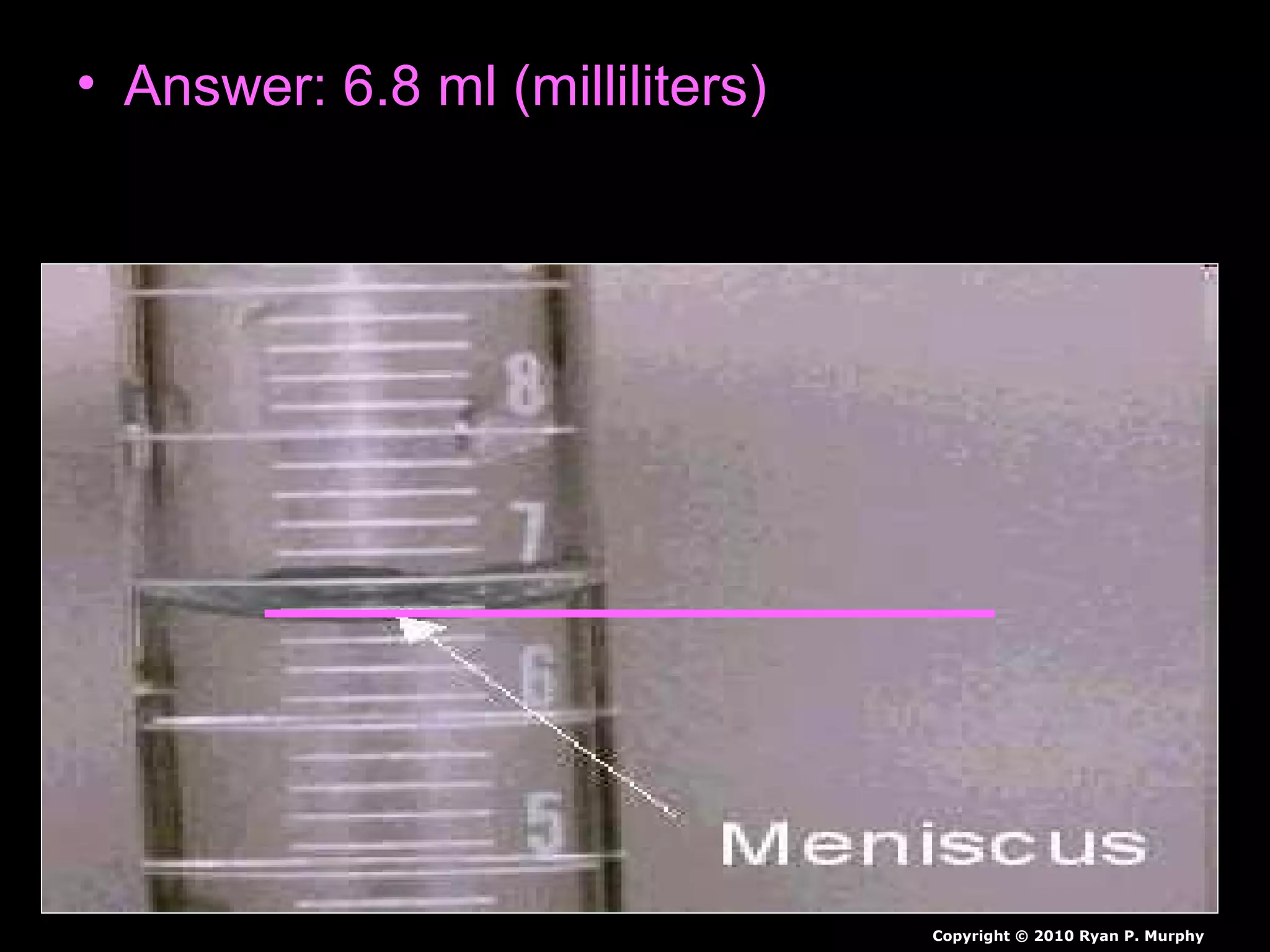
• Answer: 6.8 ml (milliliters)
Copyright © 2010 Ryan P. Murphy
• Answer: 6.8 ml (milliliters)
Copyright © 2010 Ryan P. Murphy
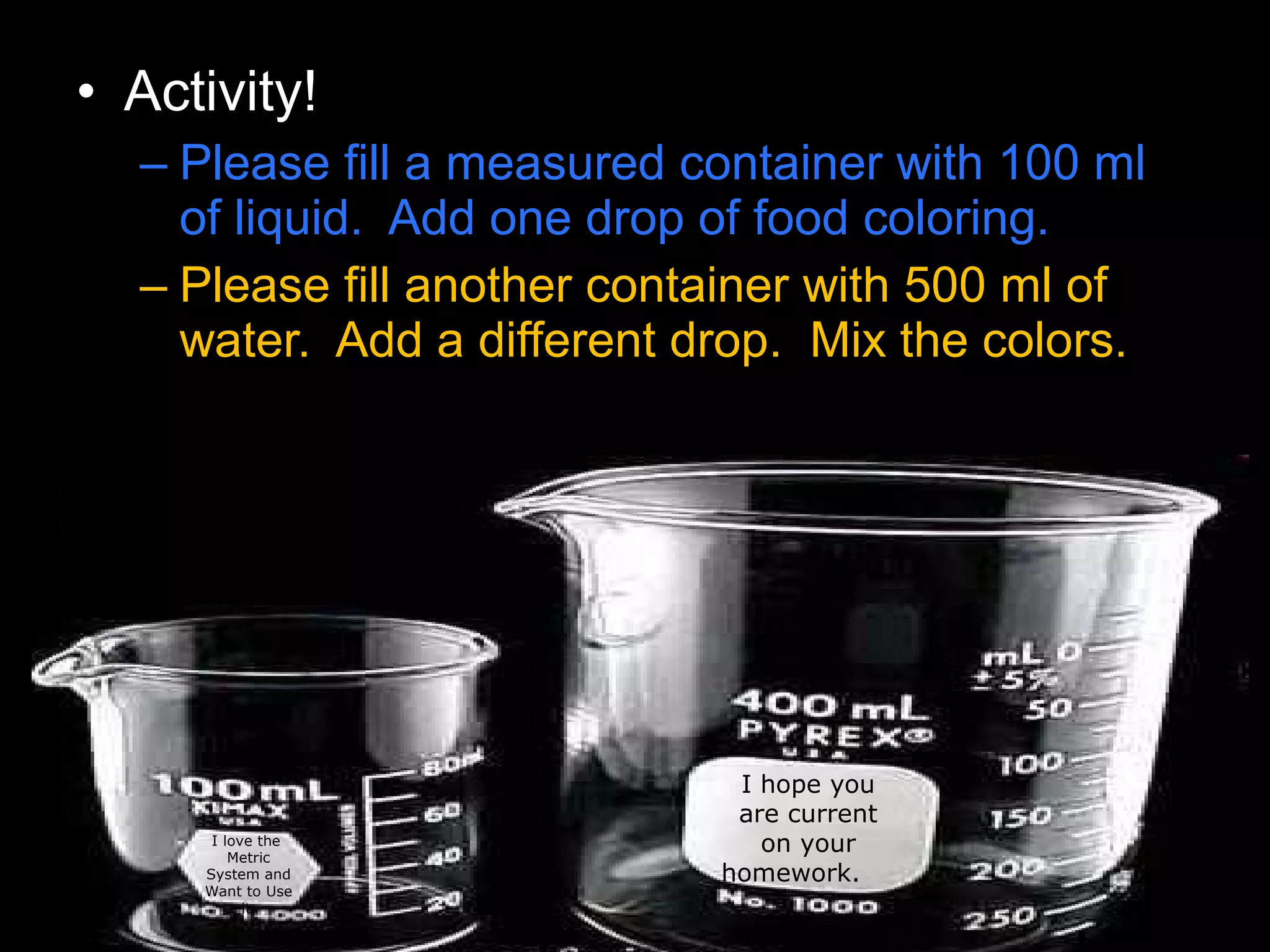
• Activity!
– Please fill a measured container with 100 ml
of liquid. Add one drop of food coloring.
– Please fill another container with 500 ml of
water. Add a different drop. Mix the colors.
I hope you
are current
on your
homework.
I love the
Metric
System and
Want to Use
it.
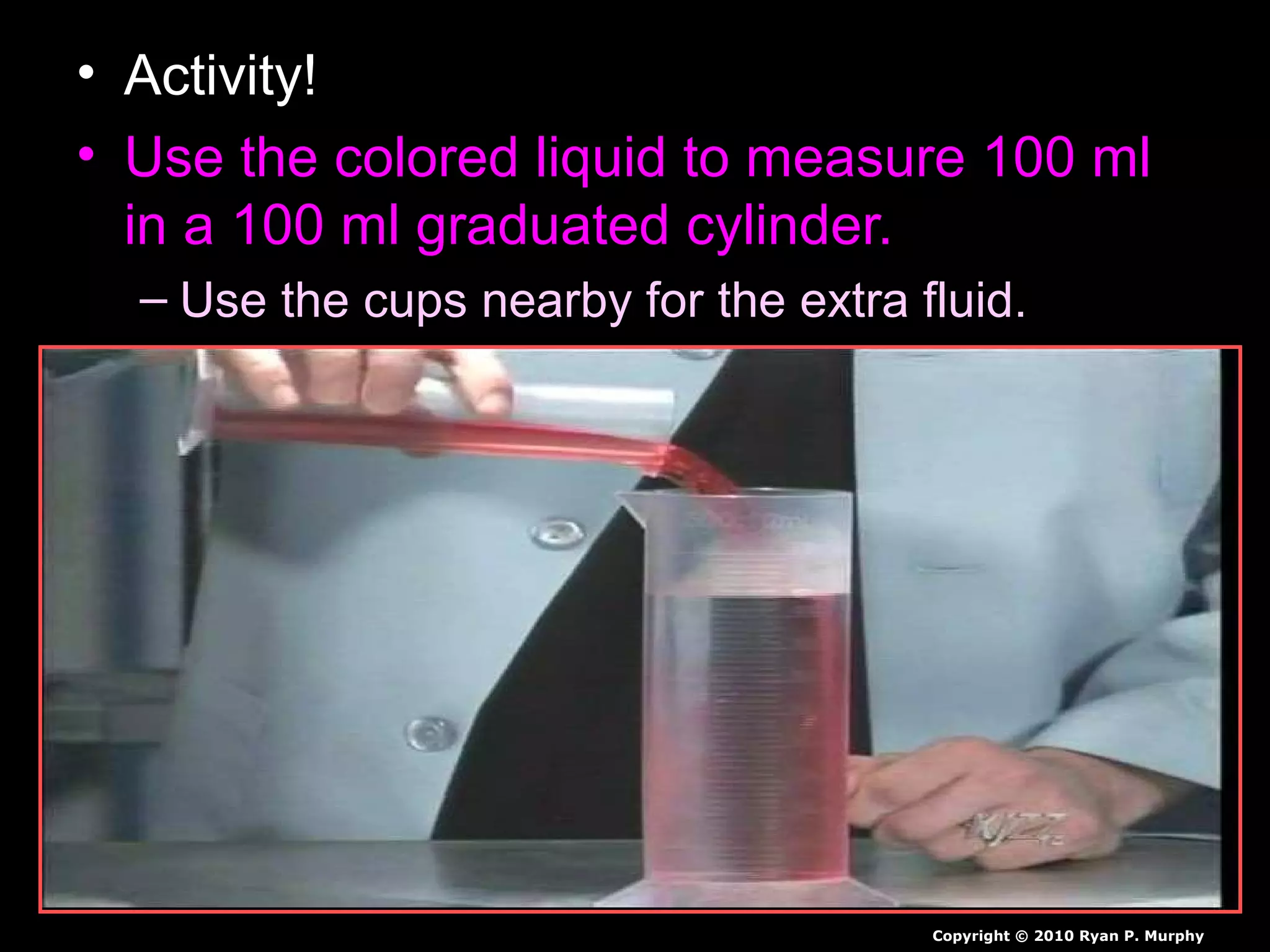
• Activity!
• Use the colored liquid to measure 100 ml
in a 100 ml graduated cylinder.
– Use the cups nearby for the extra fluid.
Copyright © 2010 Ryan P. Murphy
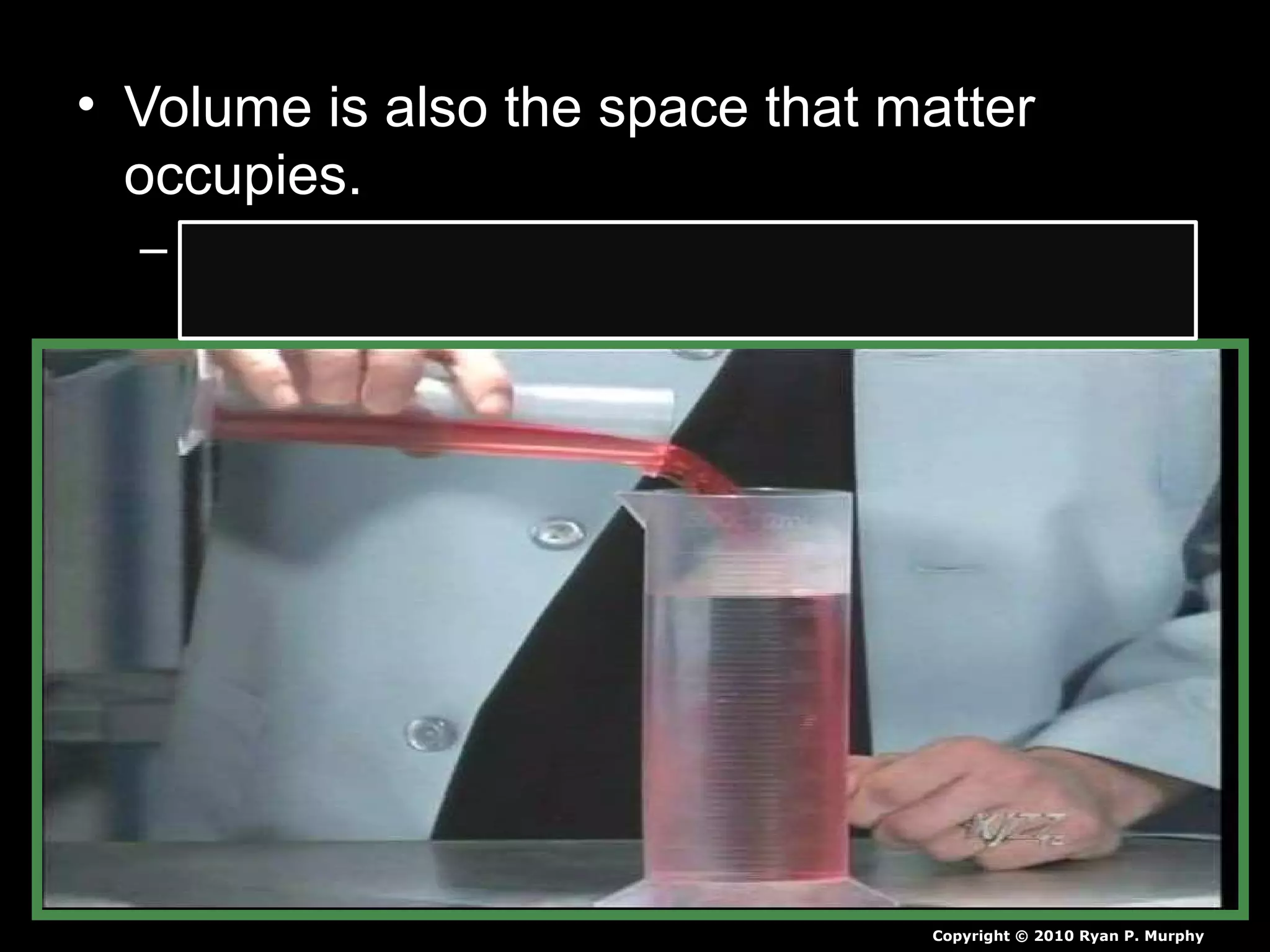
• Volume is also the space that matter
occupies.
– Matter is anything that has mass and takes up
space.
Copyright © 2010 Ryan P. Murphy
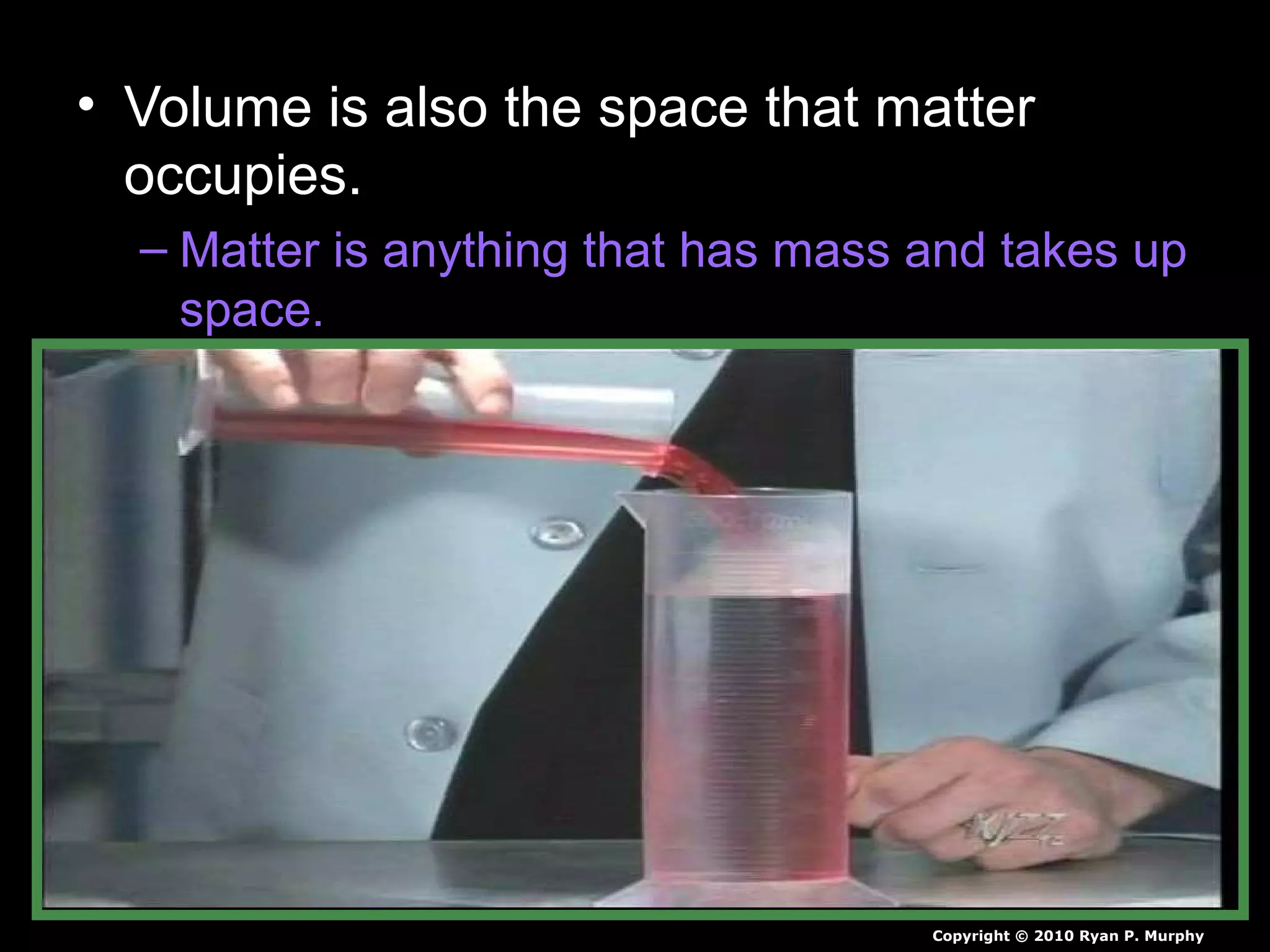
• Volume is also the space that matter
occupies.
– Matter is anything that has mass and takes up
space.
Copyright © 2010 Ryan P. Murphy
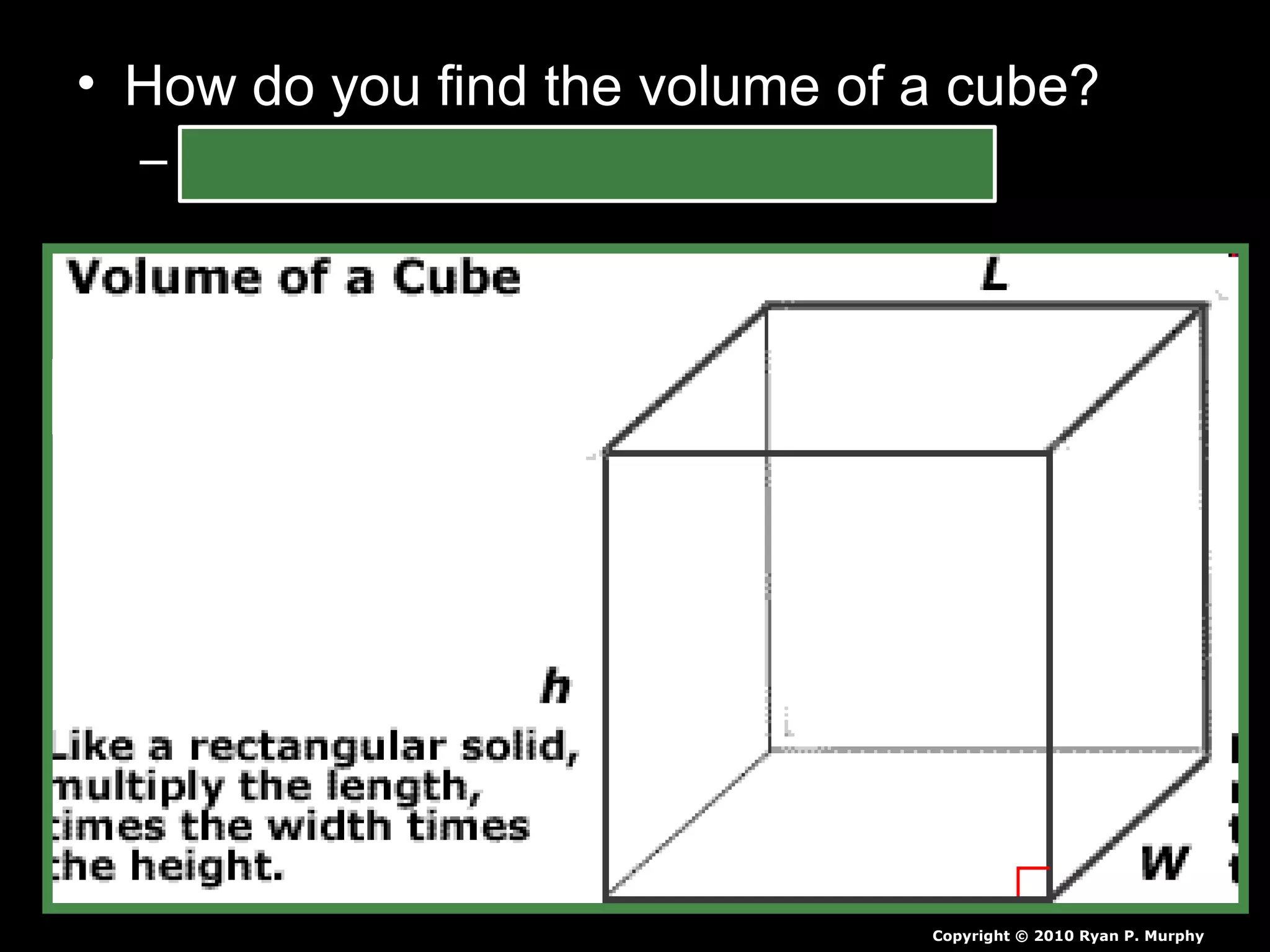
• How do you find the volume of a cube?
– Length x Width x Height - ____cm3
Copyright © 2010 Ryan P. Murphy
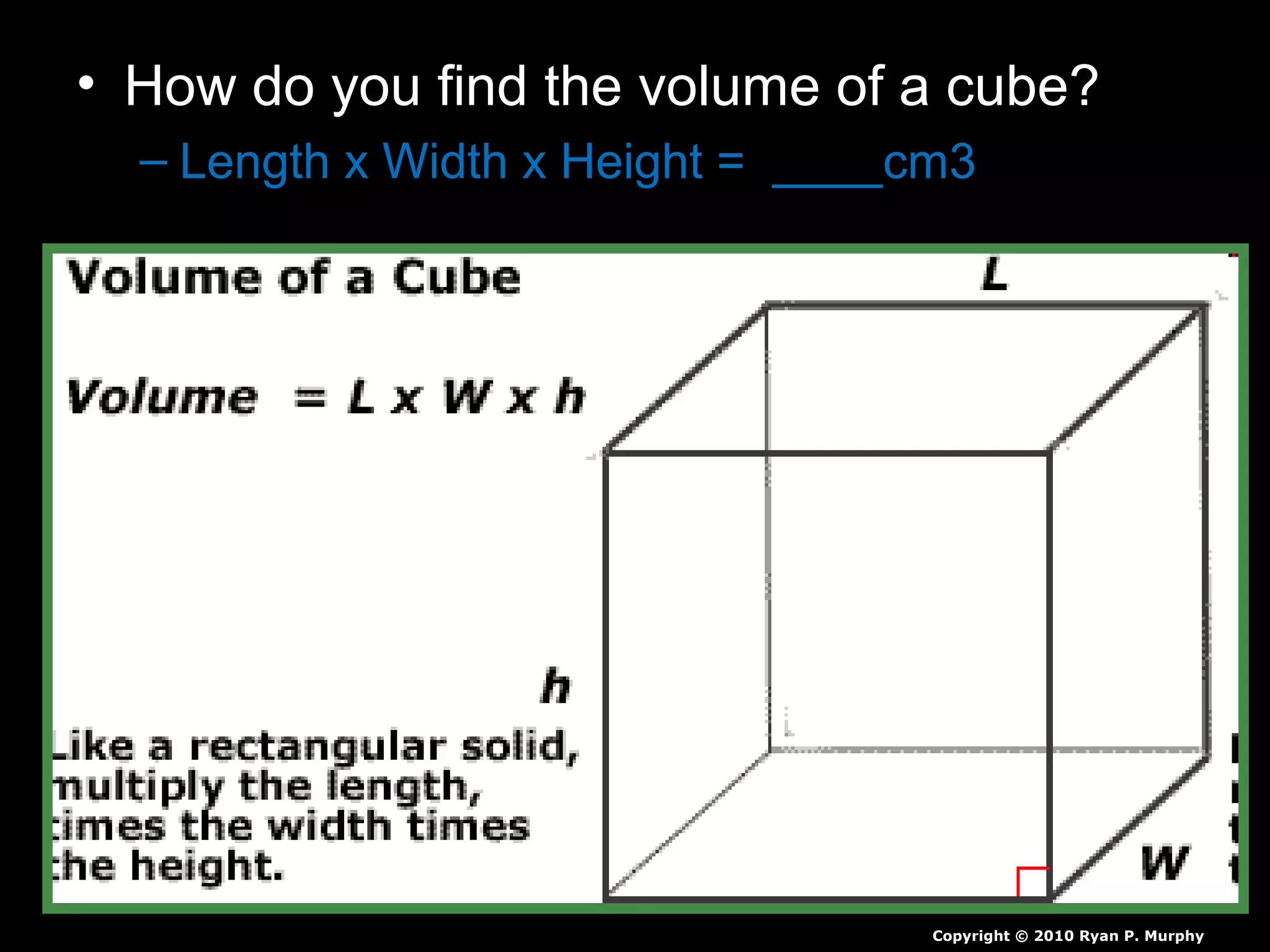
• How do you find the volume of a cube?
– Length x Width x Height = ____cm3
Copyright © 2010 Ryan P. Murphy
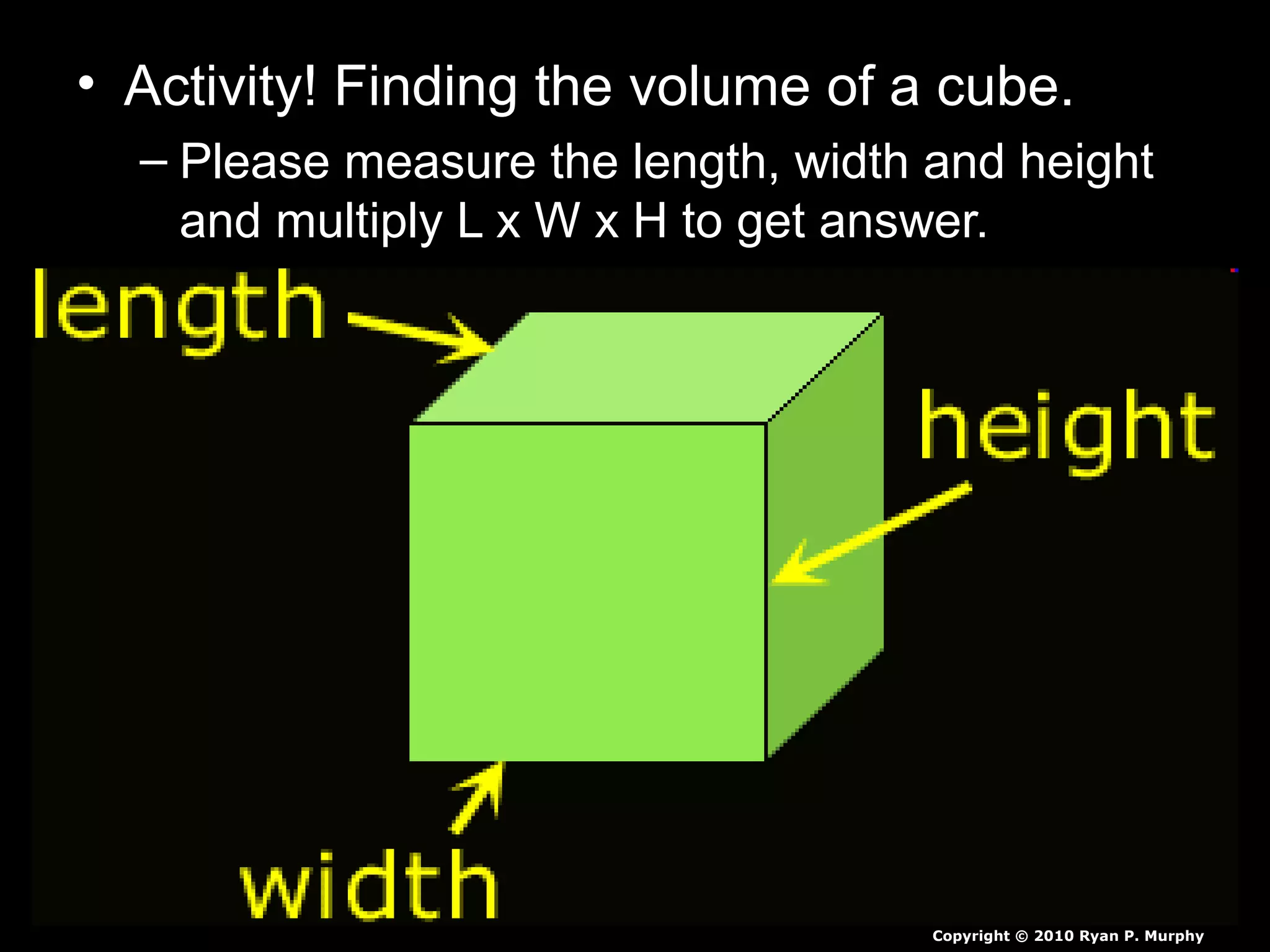
• Activity! Finding the volume of a cube.
– Please measure the length, width and height
and multiply L x W x H to get answer.
Copyright © 2010 Ryan P. Murphy
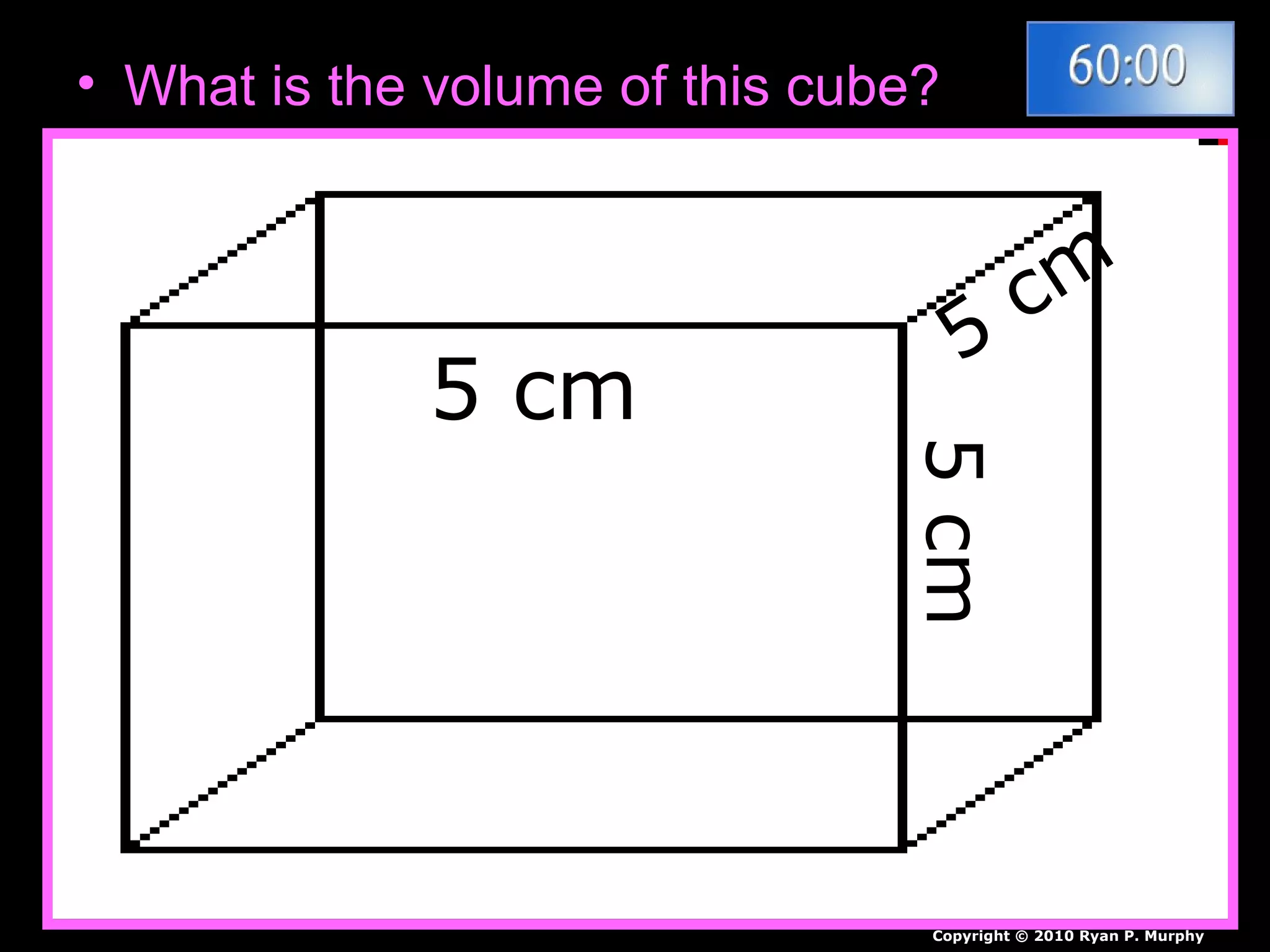
• What is the volume of this cube?
5 cm
5cm
5
cm
Copyright © 2010 Ryan P. Murphy
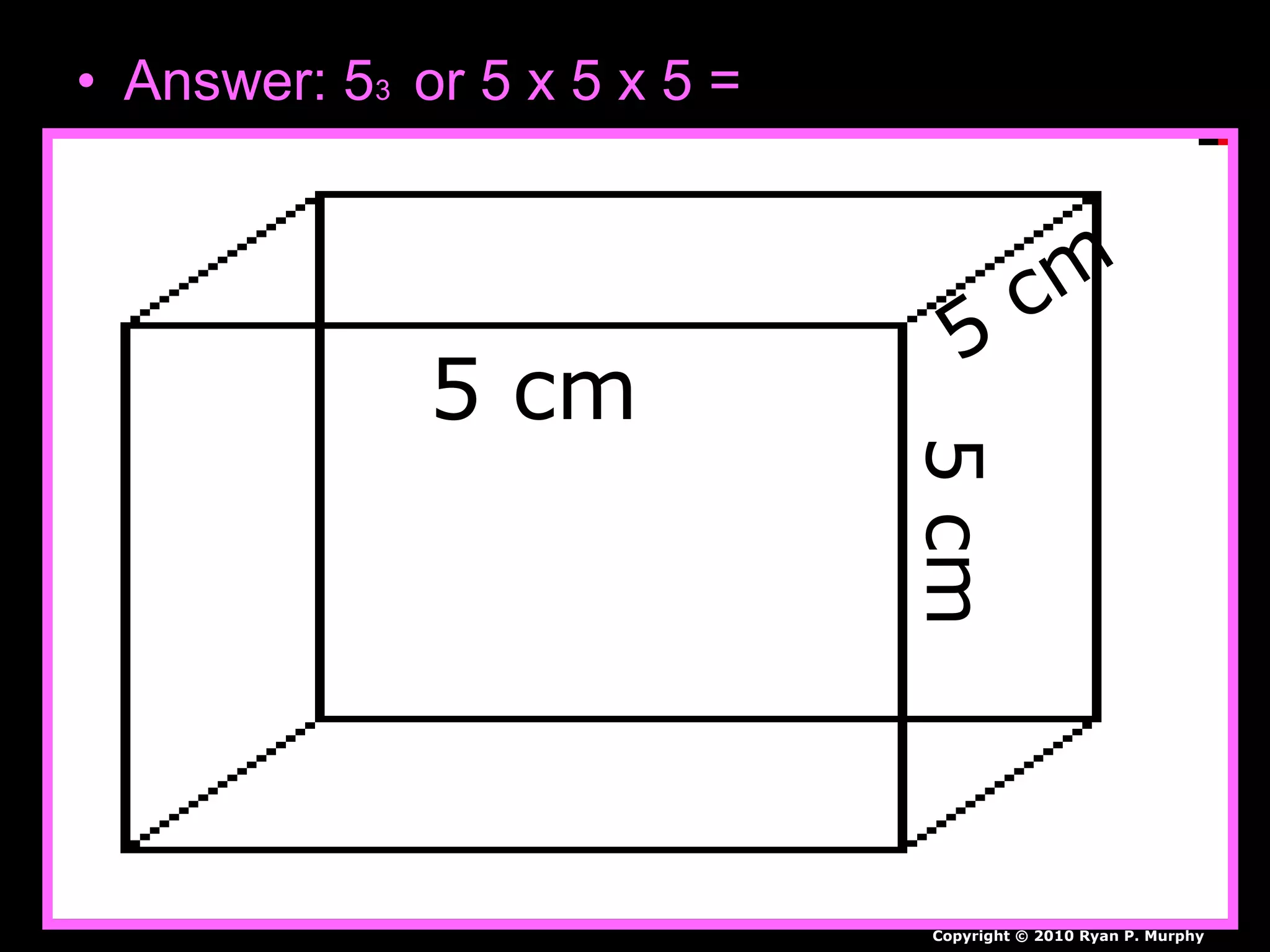
• Answer: 53 or 5 x 5 x 5 =
5 cm
5cm
5
cm
Copyright © 2010 Ryan P. Murphy
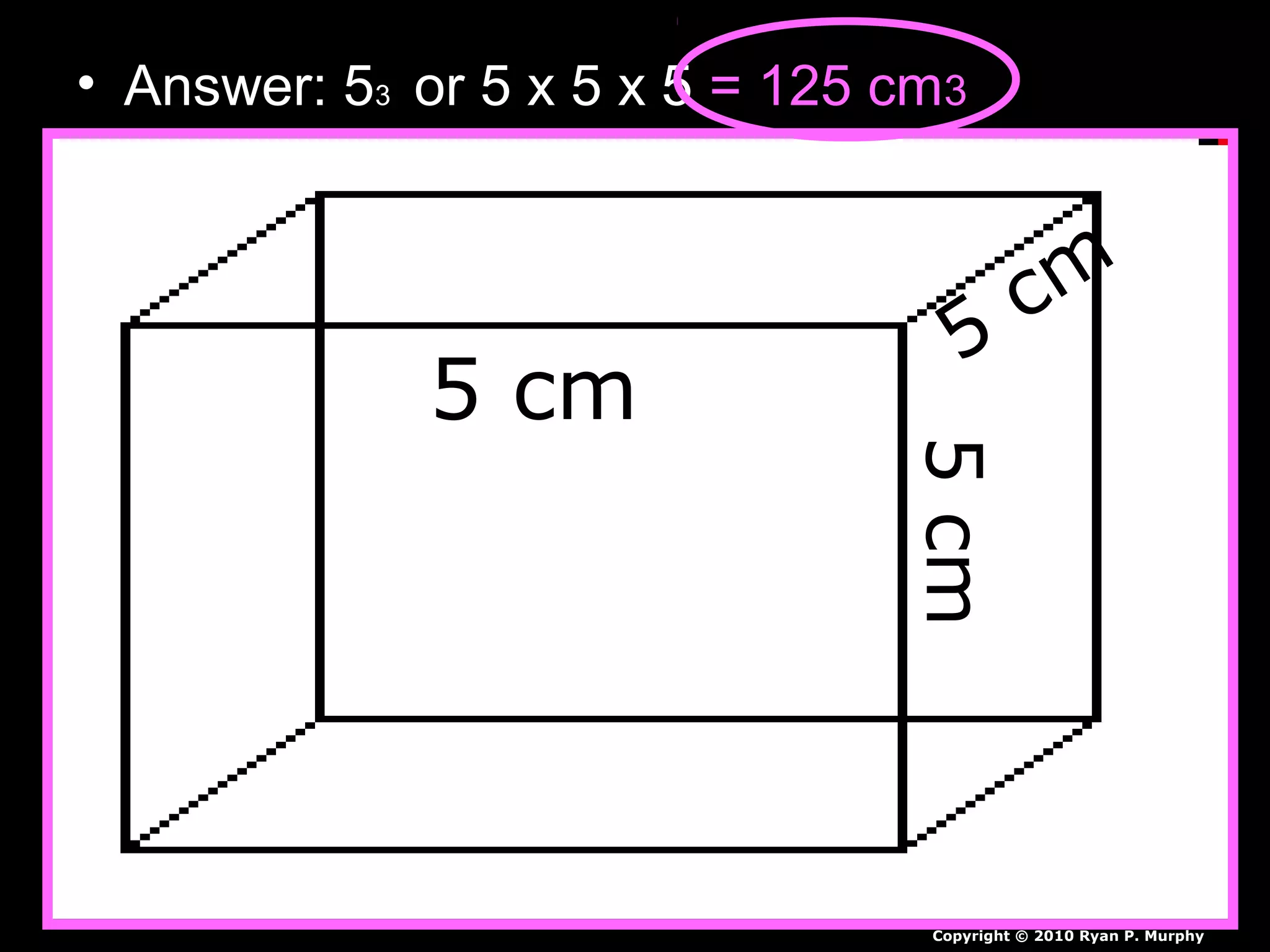
• Answer: 53 or 5 x 5 x 5 = 125 cm3
5 cm
5cm
5
cm
Copyright © 2010 Ryan P. Murphy
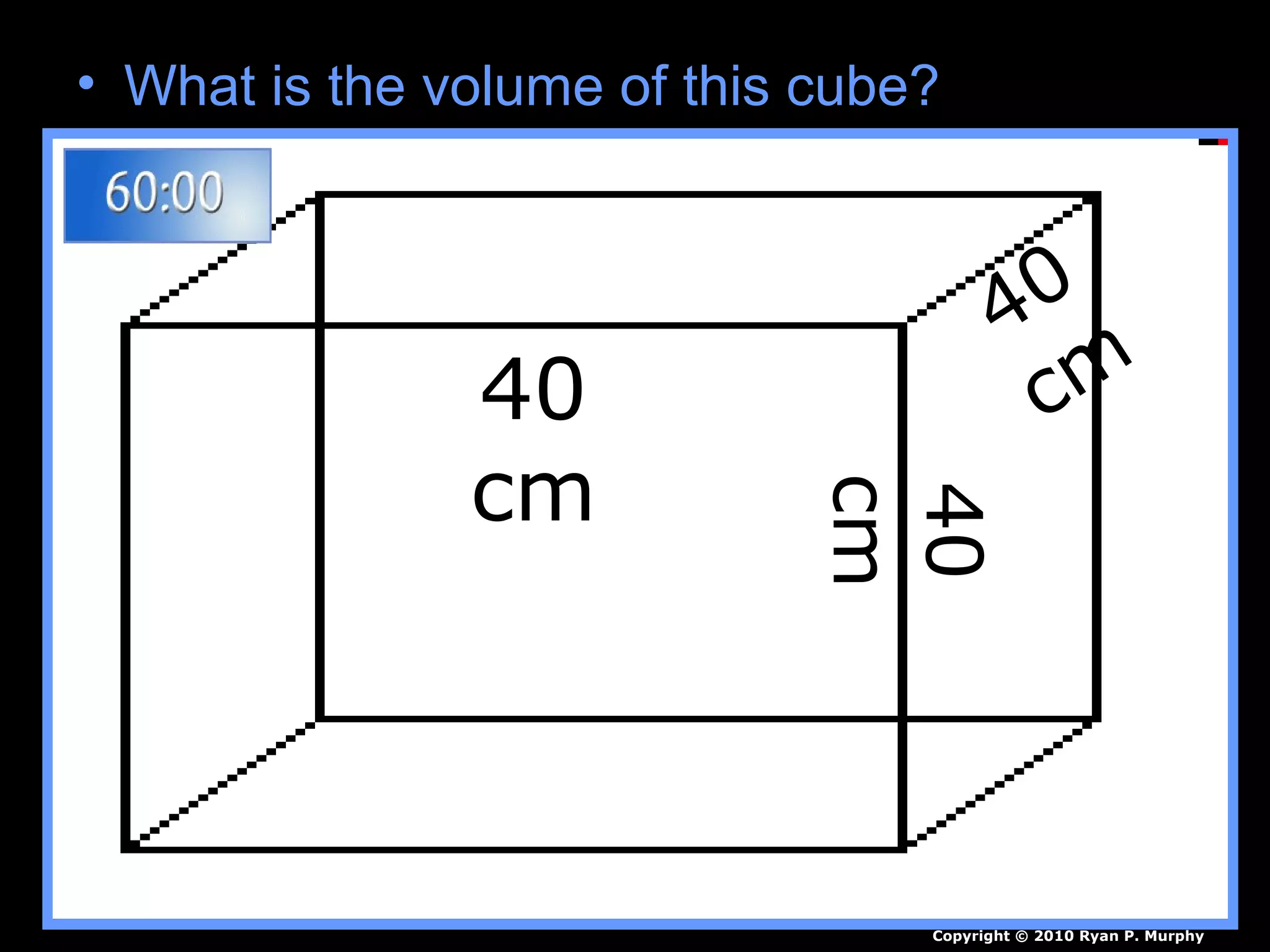
• What is the volume of this cube?
40
cm
40
cm
40
cm
Copyright © 2010 Ryan P. Murphy
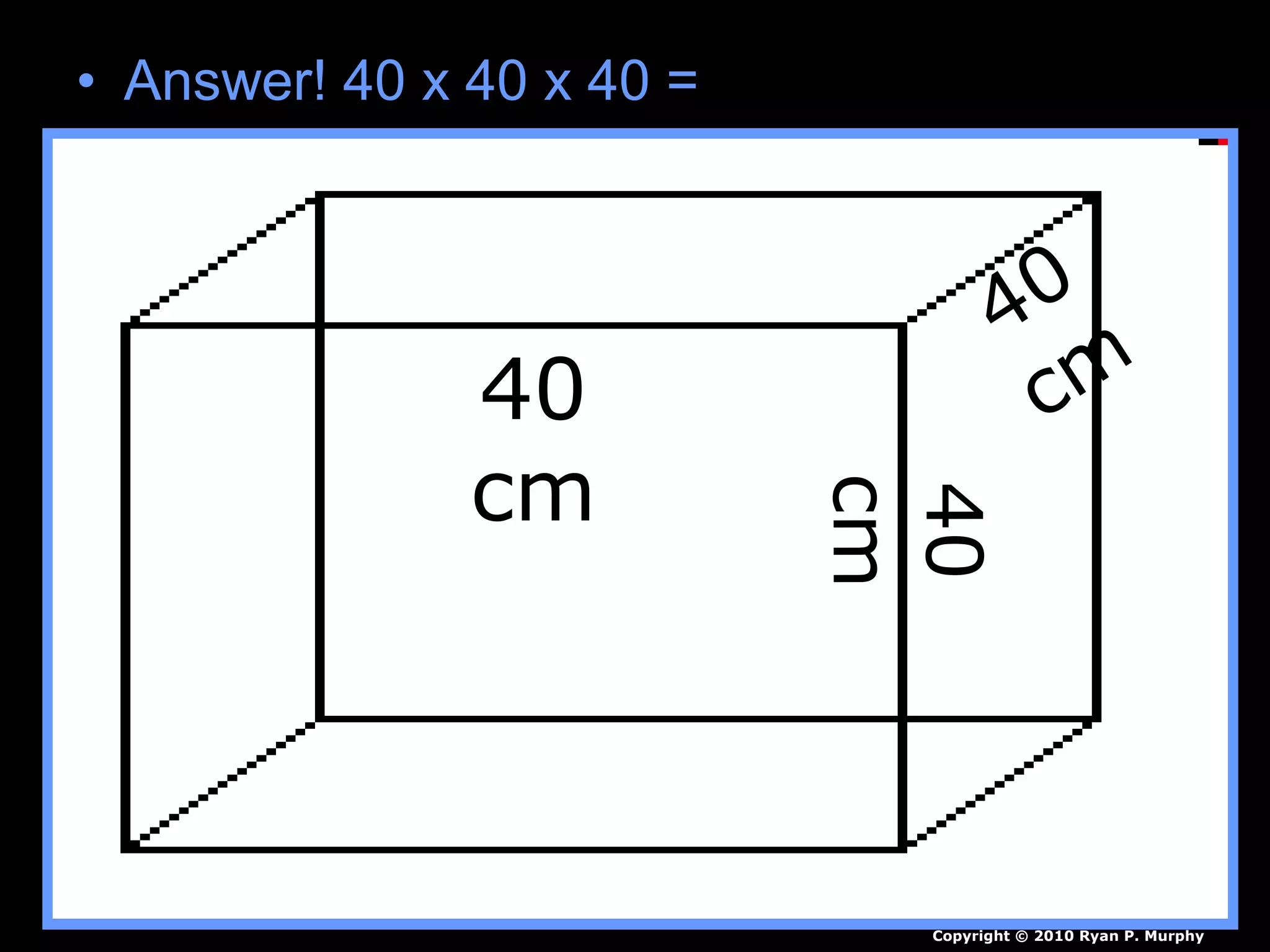
• Answer! 40 x 40 x 40 =
40
cm
40
cm
40
cm
Copyright © 2010 Ryan P. Murphy
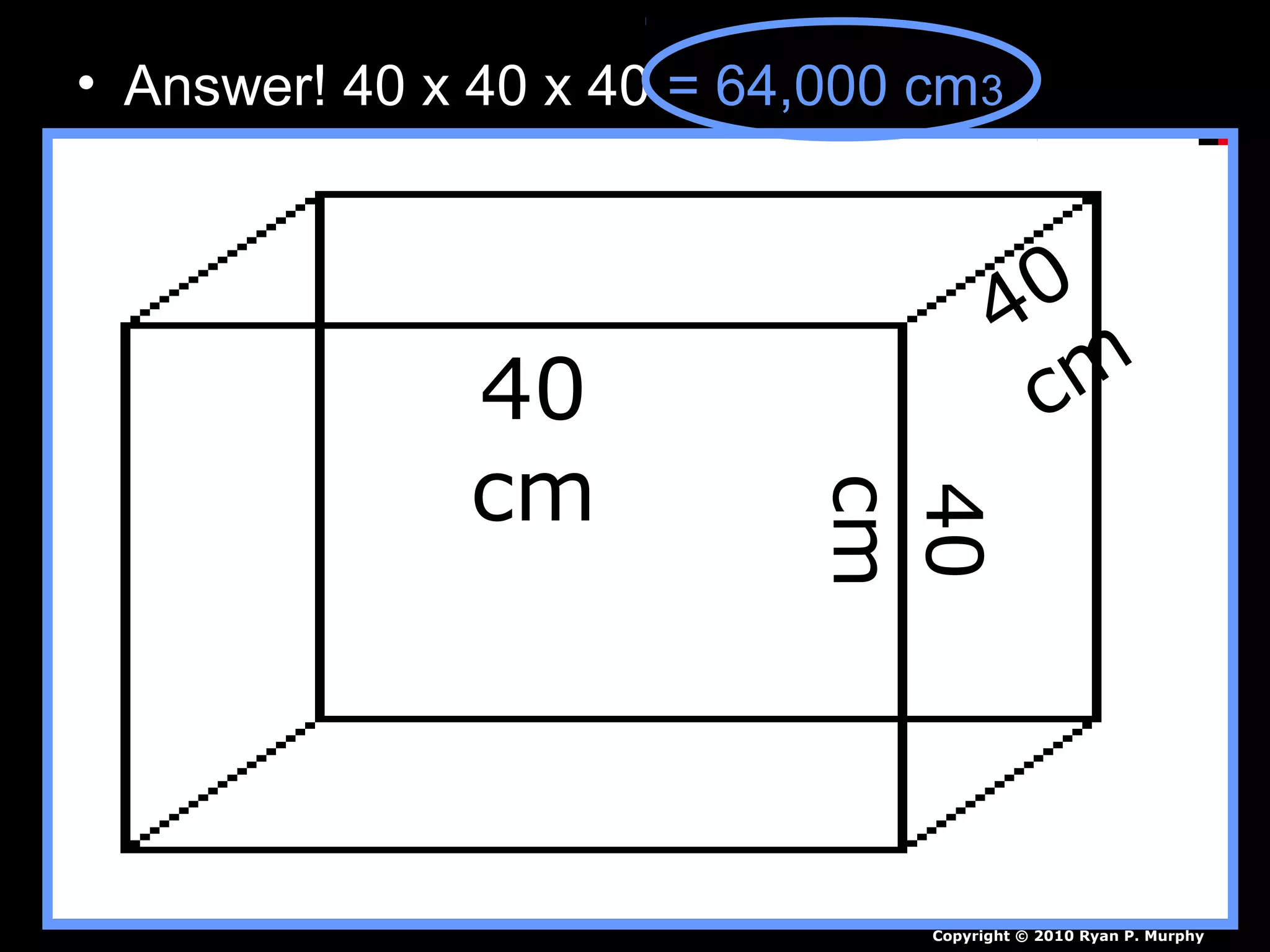
• Answer! 40 x 40 x 40 = 64,000 cm3
40
cm
40
cm
40
cm
Copyright © 2010 Ryan P. Murphy
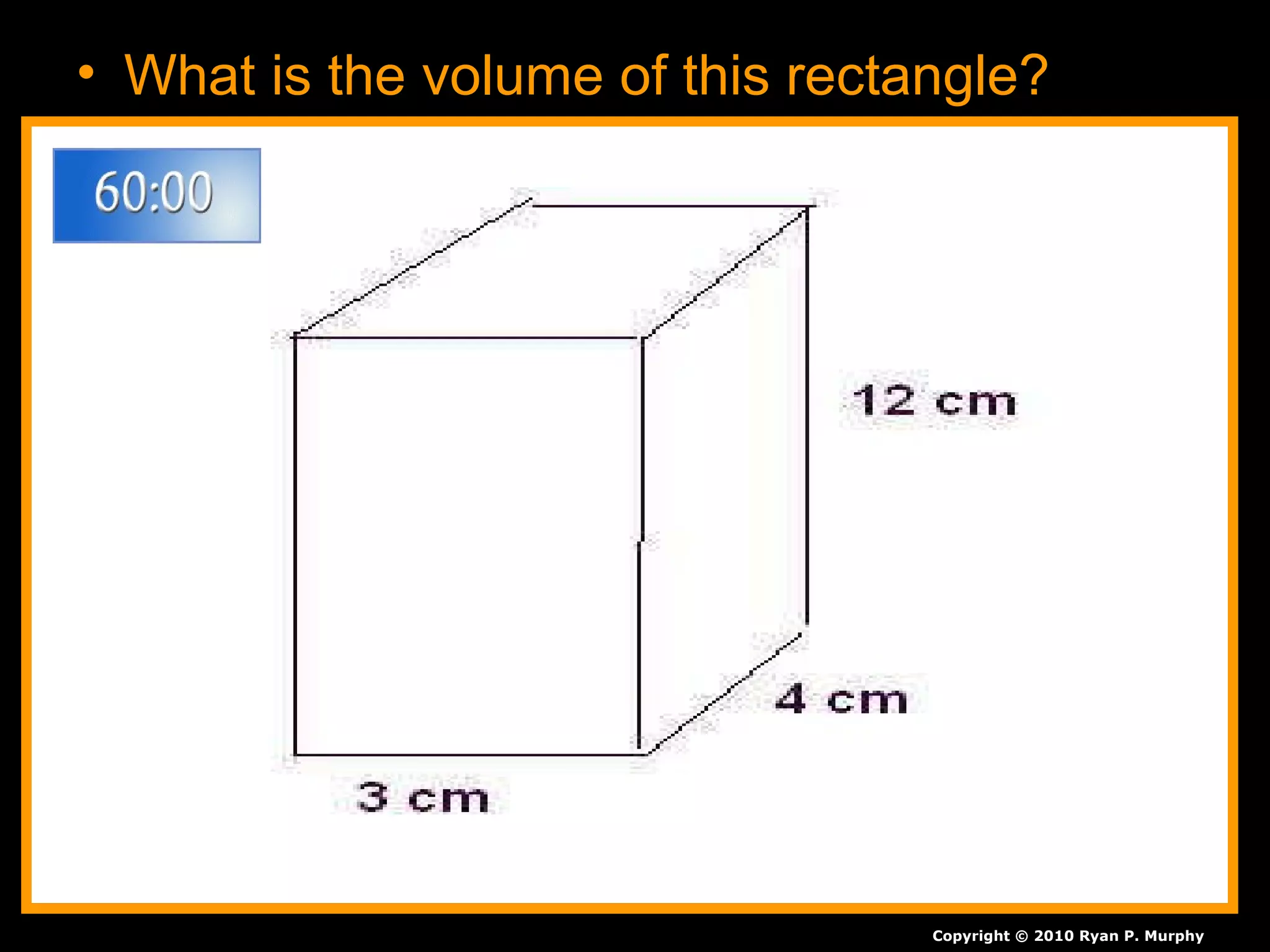
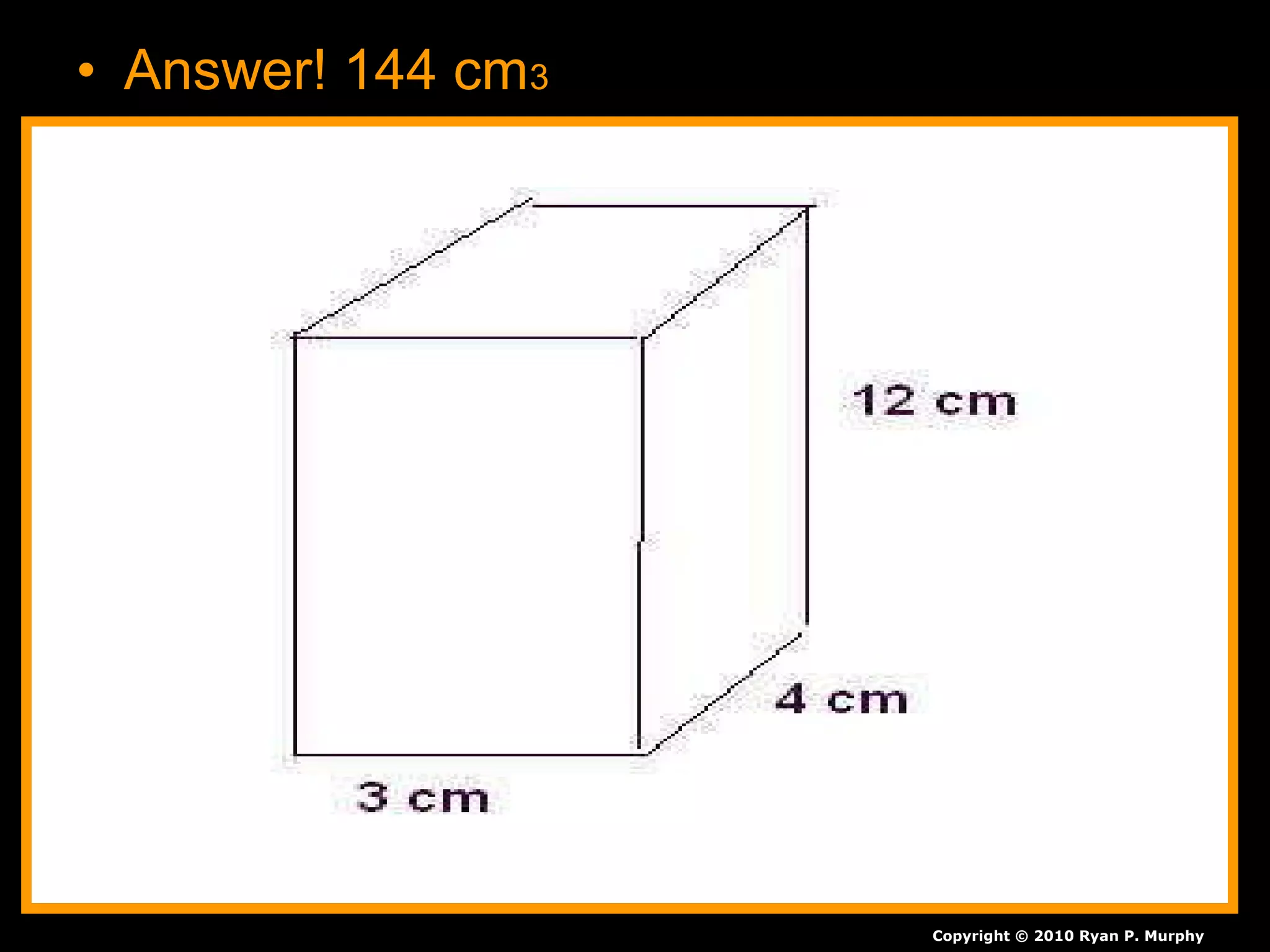
• What is the volume of this rectangle?
Copyright © 2010 Ryan P. Murphy
• Answer! 144 cm3
Copyright © 2010 Ryan P. Murphy
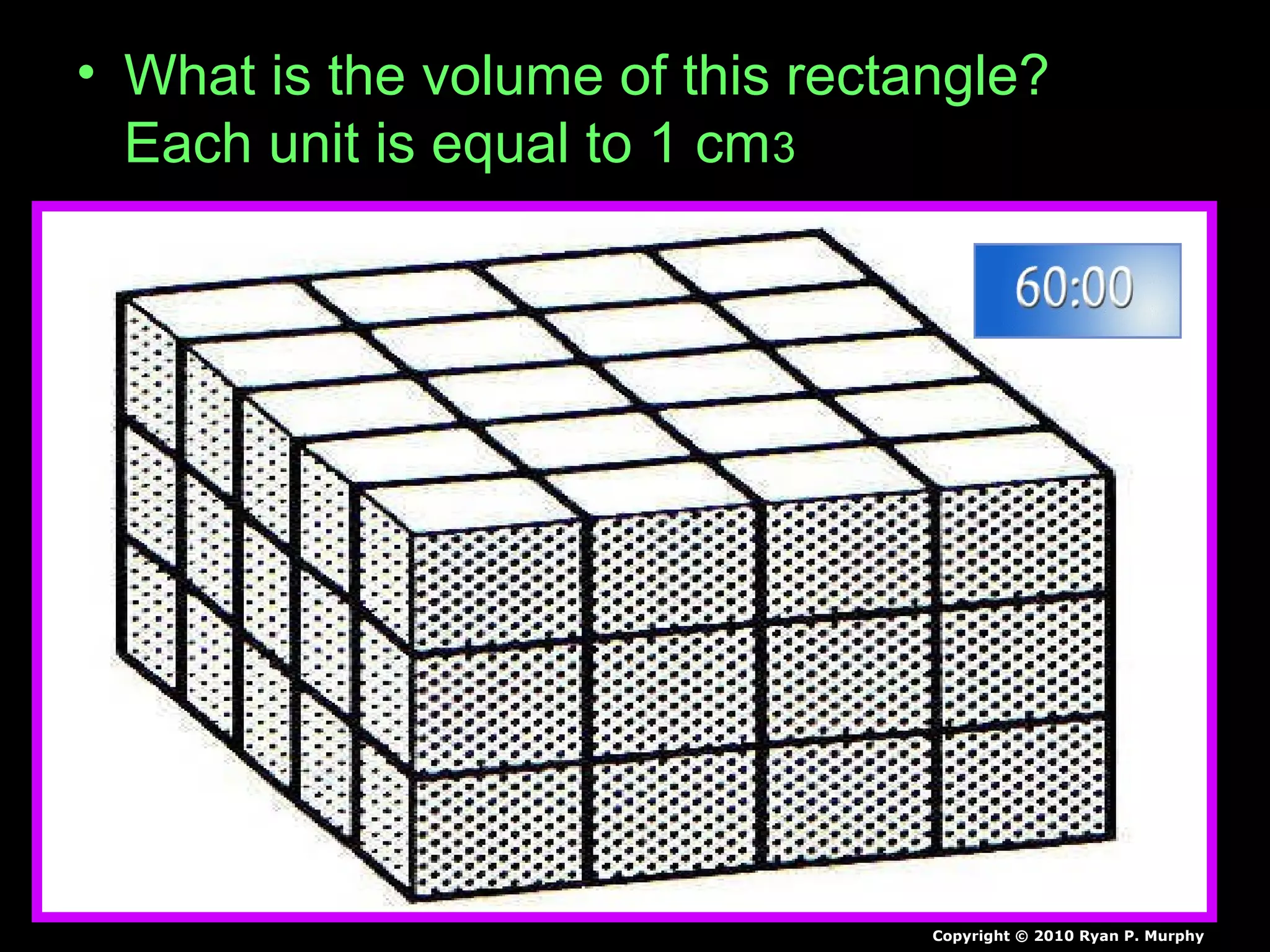
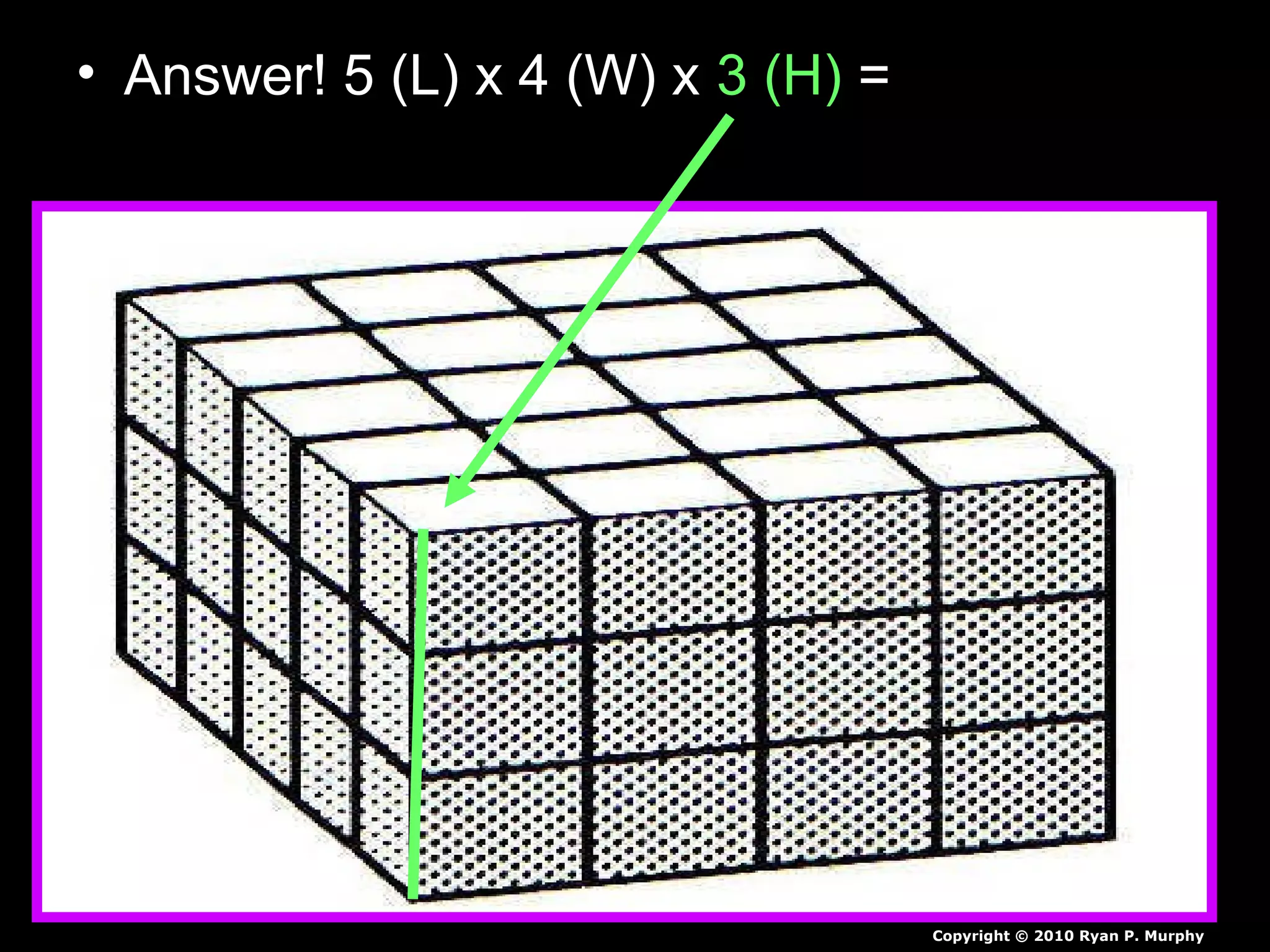
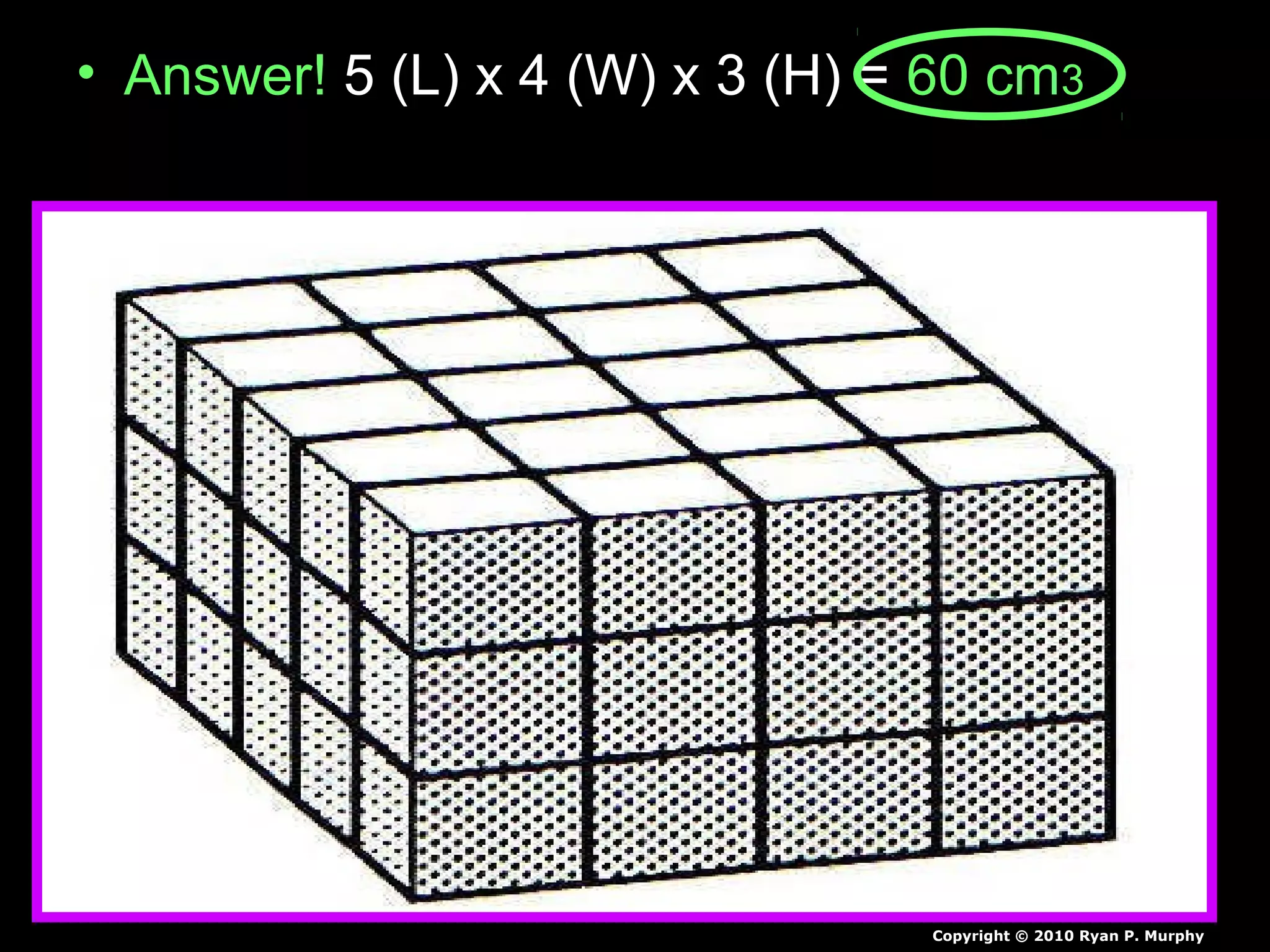
• What is the volume of this rectangle?
Each unit is equal to 1 cm3
Copyright © 2010 Ryan P. Murphy
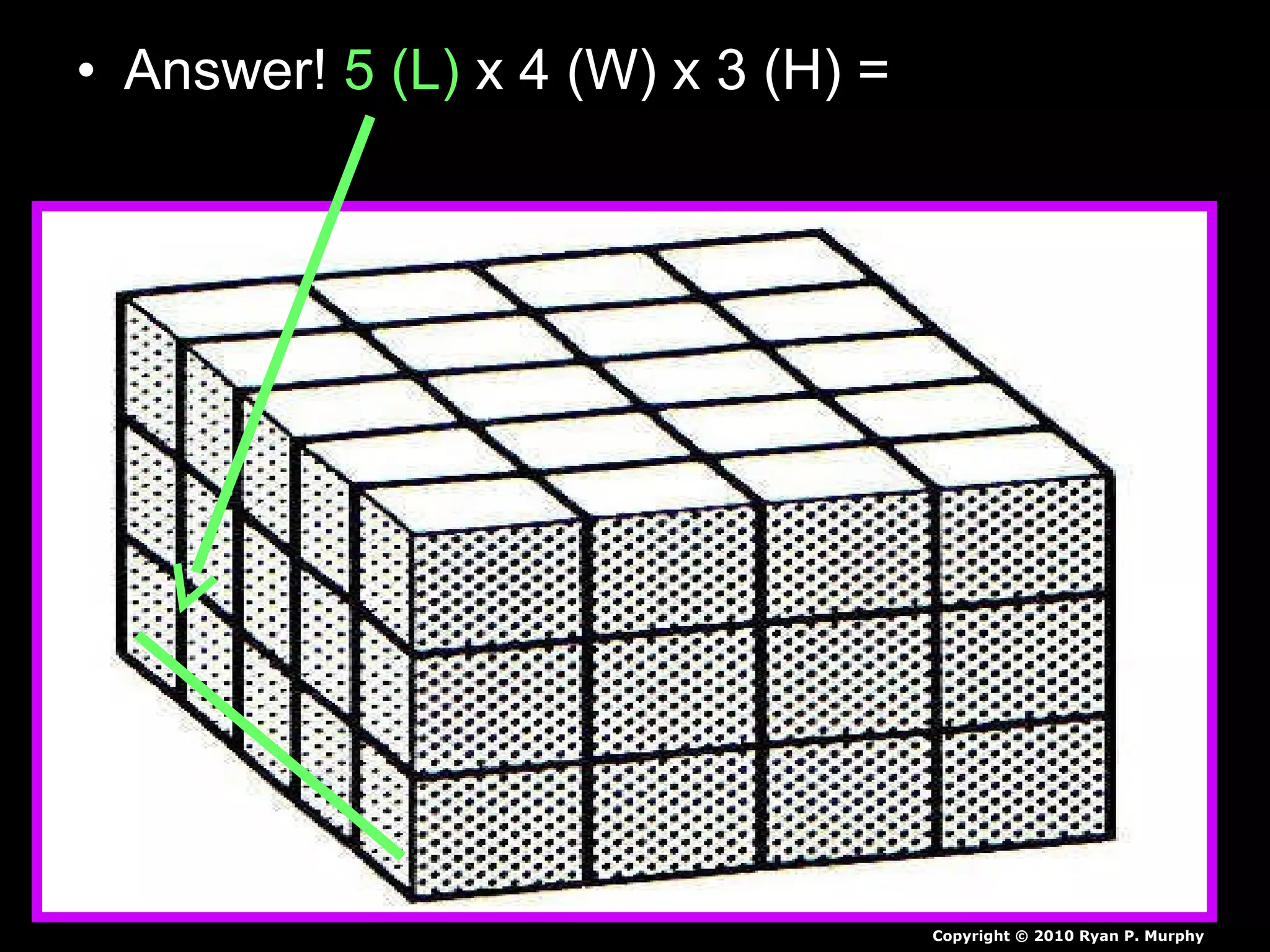
• Answer! 5 (L) x 4 (W) x 3 (H) =
Copyright © 2010 Ryan P. Murphy
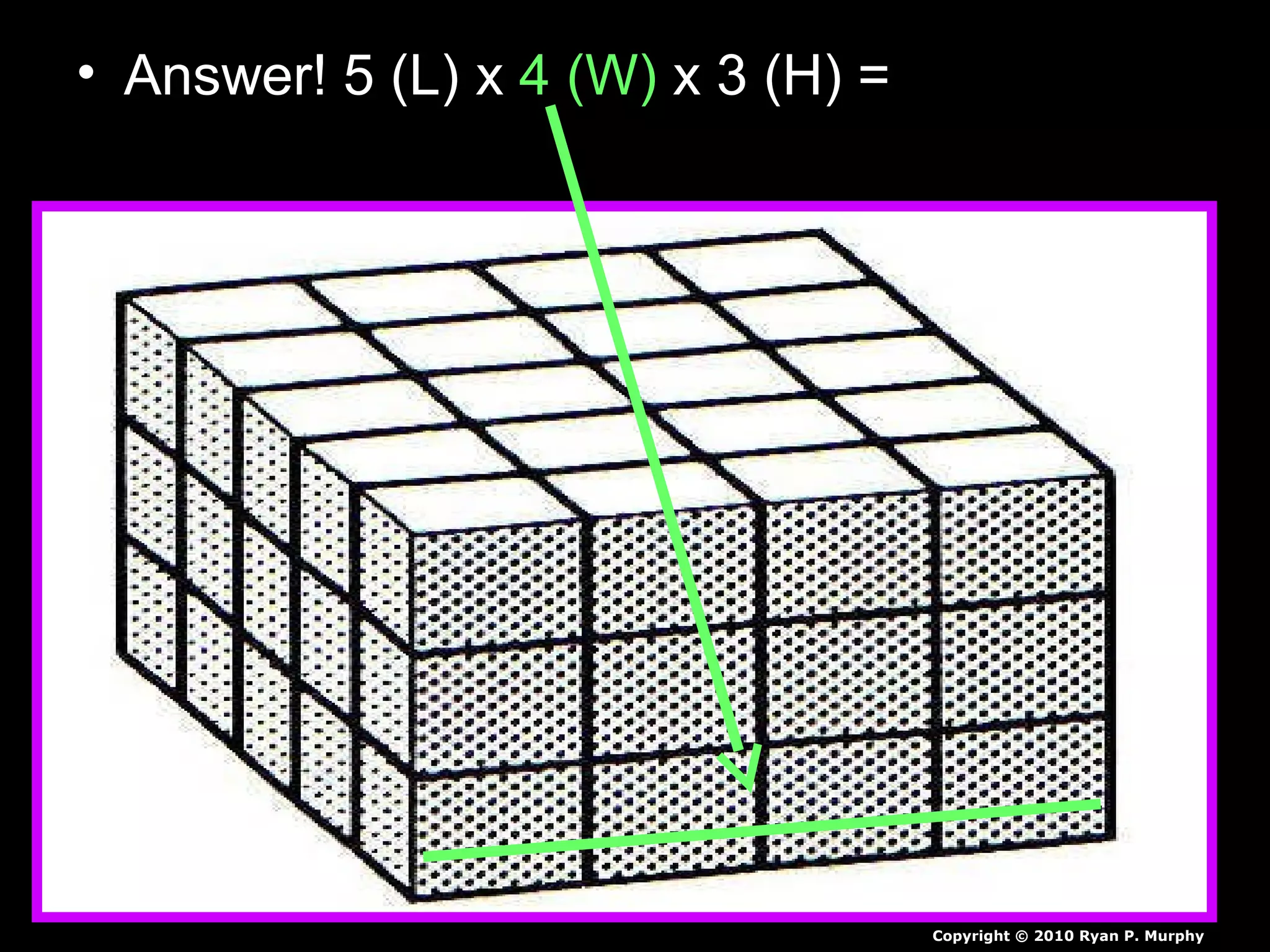
• Answer! 5 (L) x 4 (W) x 3 (H) =
Copyright © 2010 Ryan P. Murphy
• Answer! 5 (L) x 4 (W) x 3 (H) =
Copyright © 2010 Ryan P. Murphy
• Answer! 5 (L) x 4 (W) x 3 (H) = 60 cm3
Copyright © 2010 Ryan P. Murphy
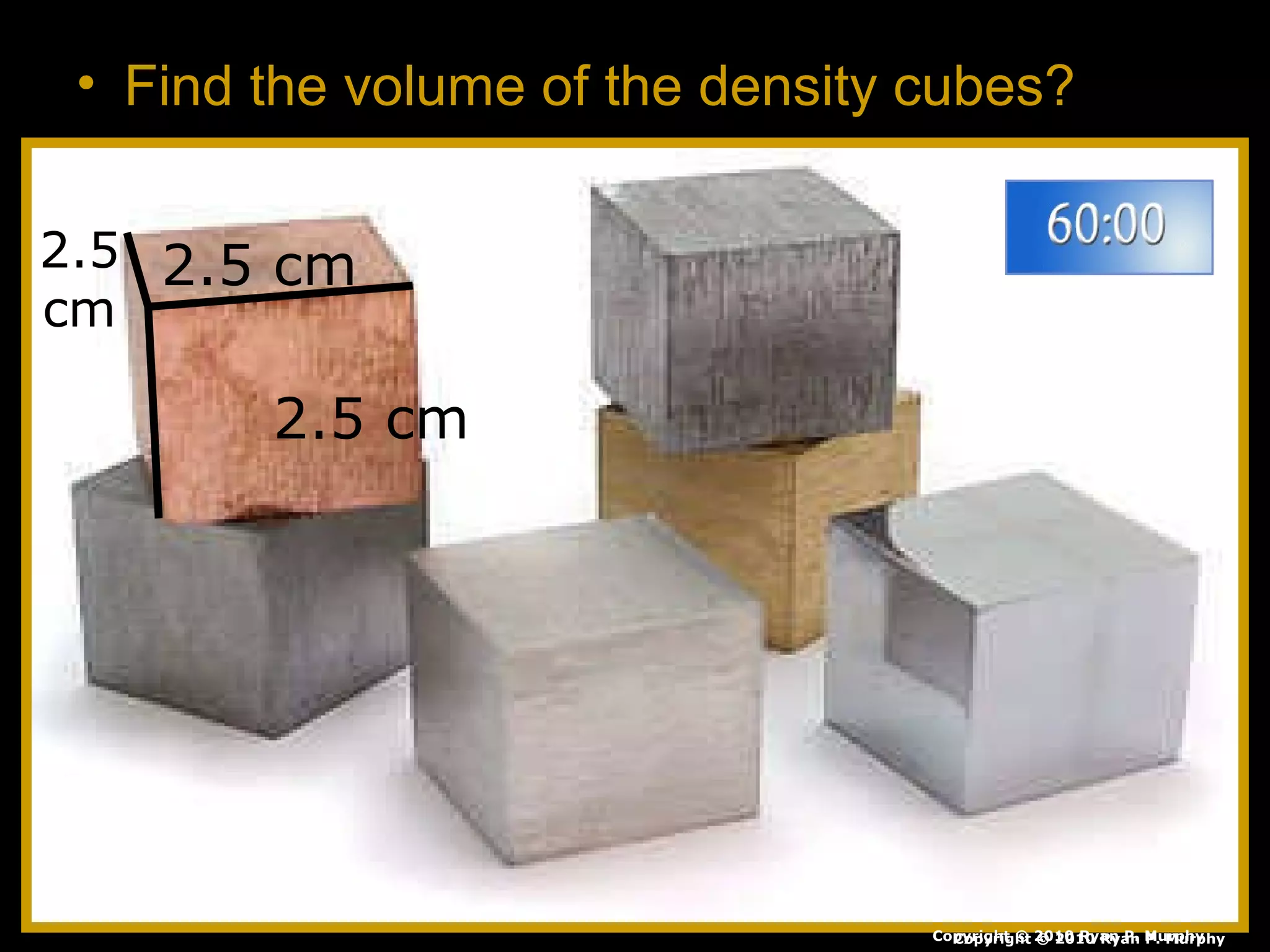
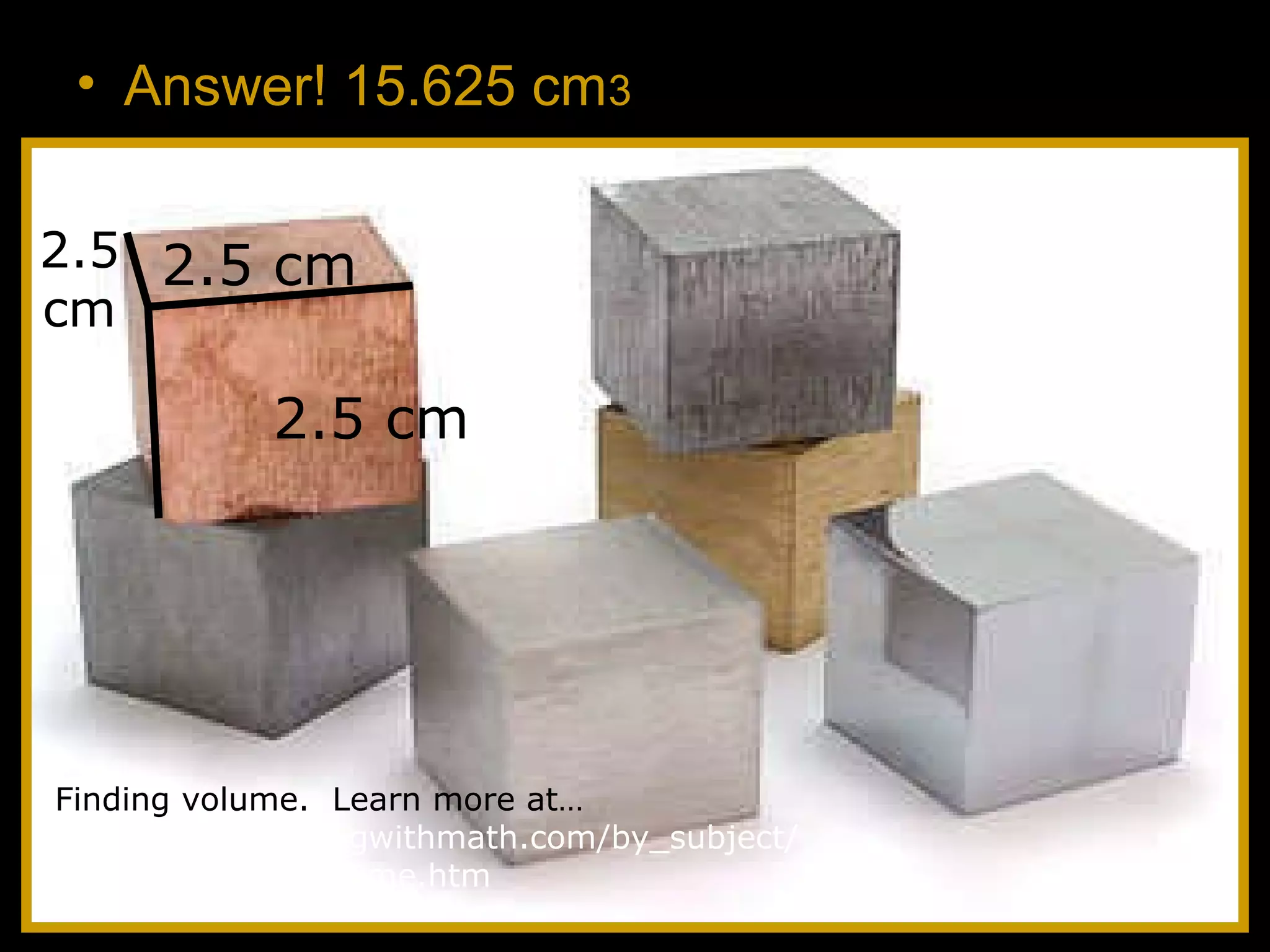
• Find the volume of the density cubes?
2.5 cm
2.5 cm
2.5
cm
Copyright © 2010 Ryan P. MurphyCopyright © 2010 Ryan P. Murphy
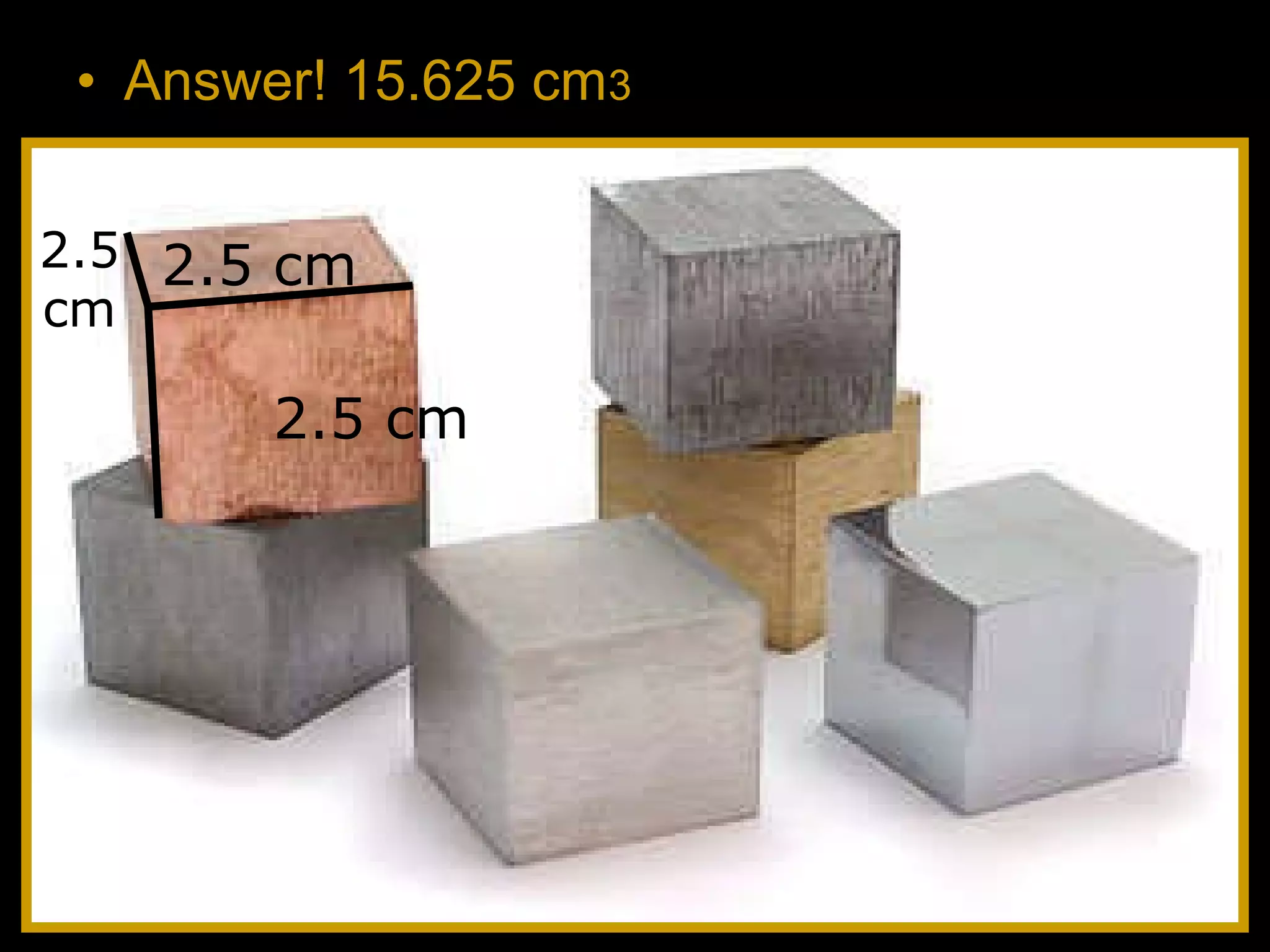
• Answer! 15.625 cm3
2.5 cm
2.5 cm
2.5
cm
• Answer! 15.625 cm3
2.5 cm
2.5 cm
2.5
cm
Finding volume. Learn more at…
http://www.helpingwithmath.com/by_subject/
geometry/geo_volume.htm
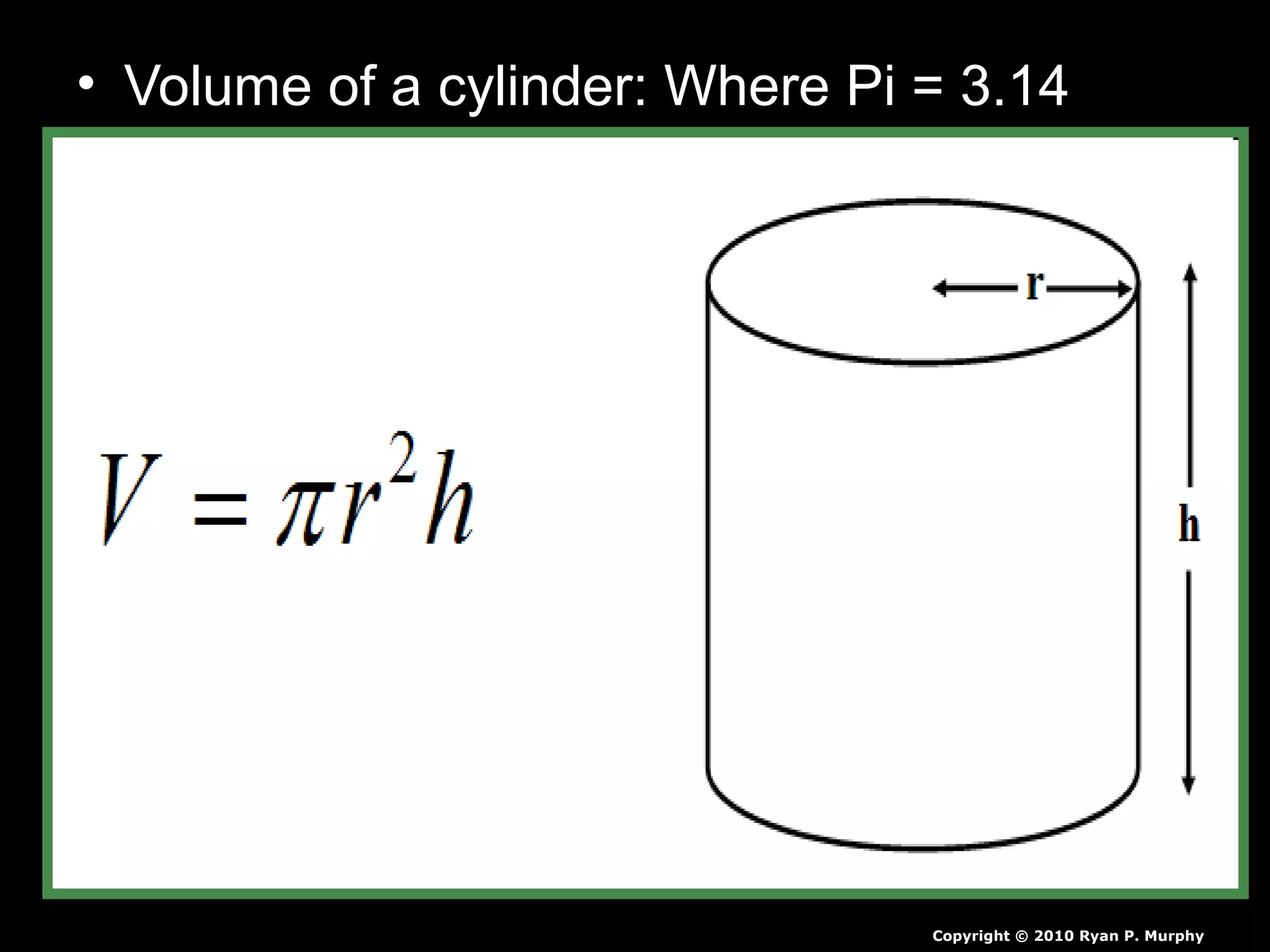
• Volume of a cylinder: Where Pi = 3.14
Copyright © 2010 Ryan P. Murphy
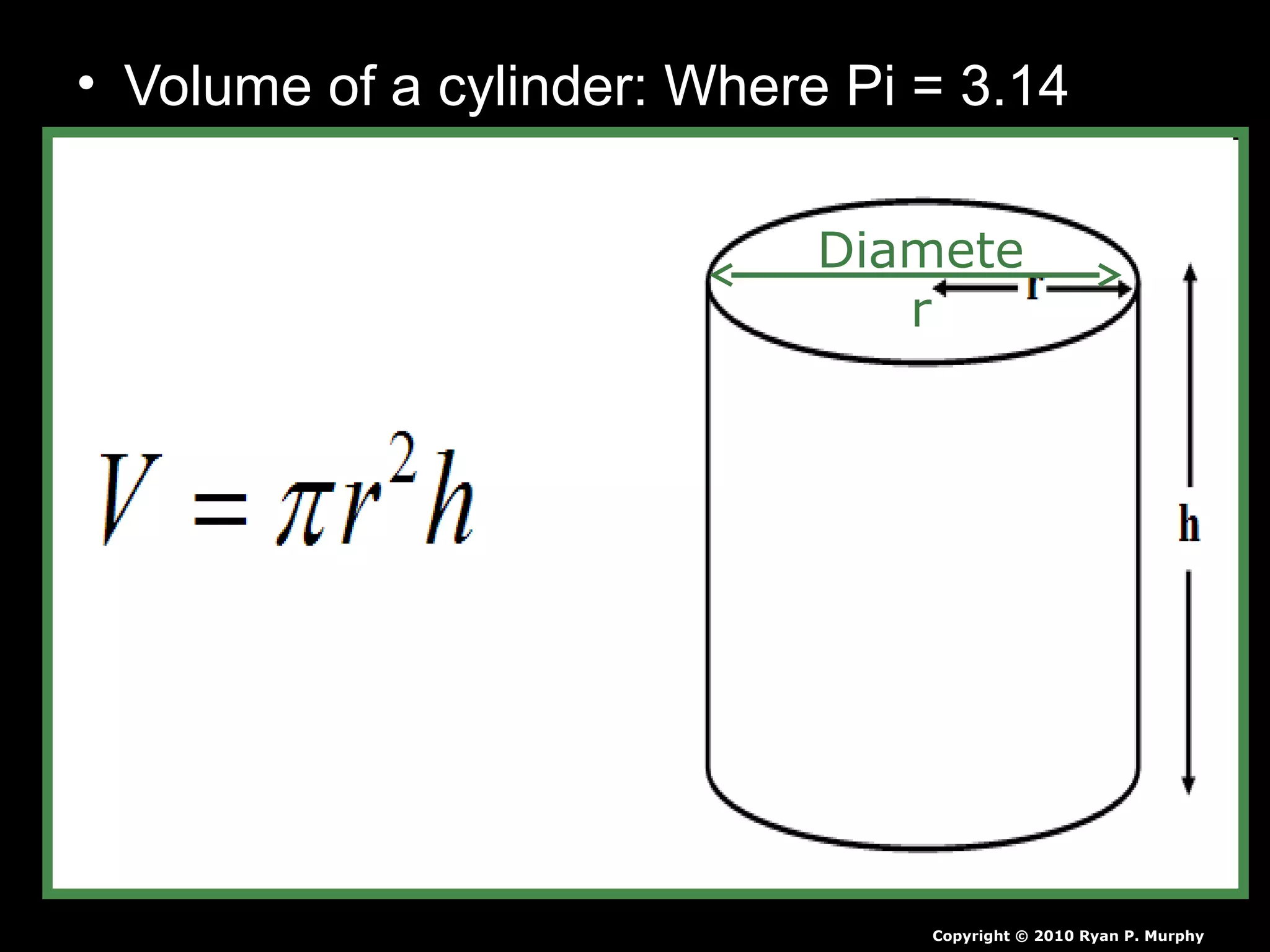
• Volume of a cylinder: Where Pi = 3.14
Copyright © 2010 Ryan P. Murphy
Diamete
r
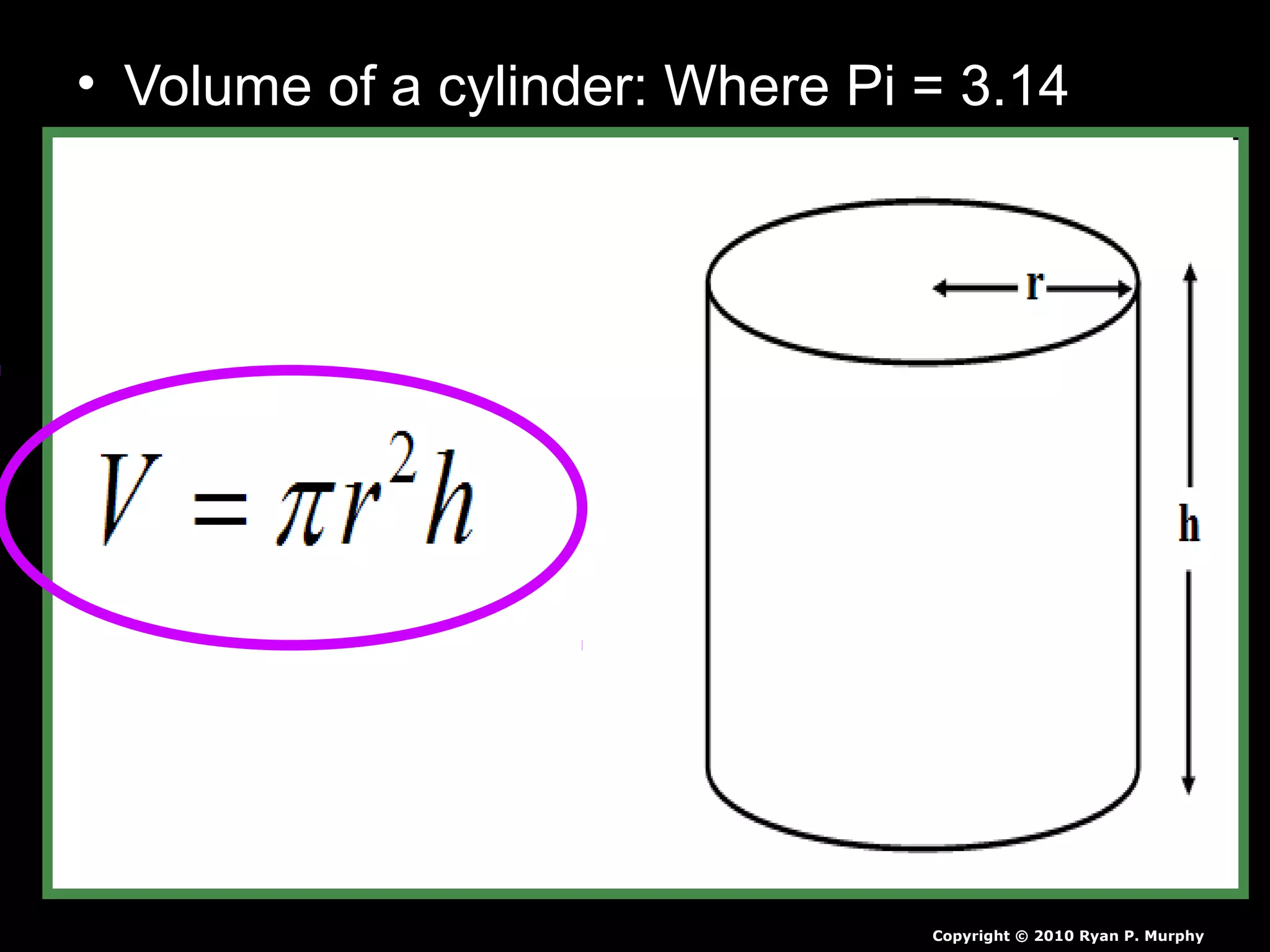
• Volume of a cylinder: Where Pi = 3.14
Copyright © 2010 Ryan P. Murphy
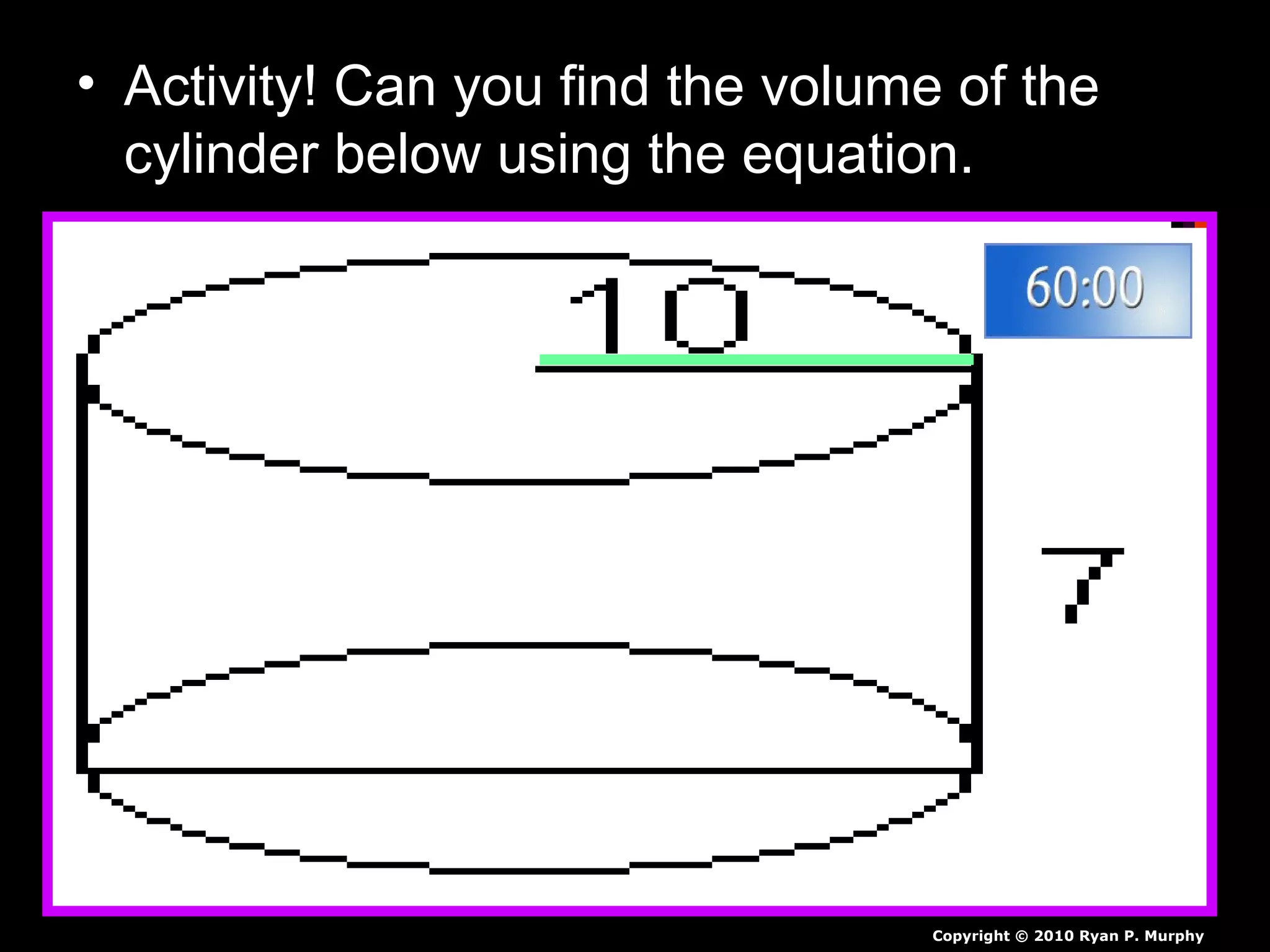
• Activity! Can you find the volume of the
cylinder below using the equation.
Copyright © 2010 Ryan P. Murphy
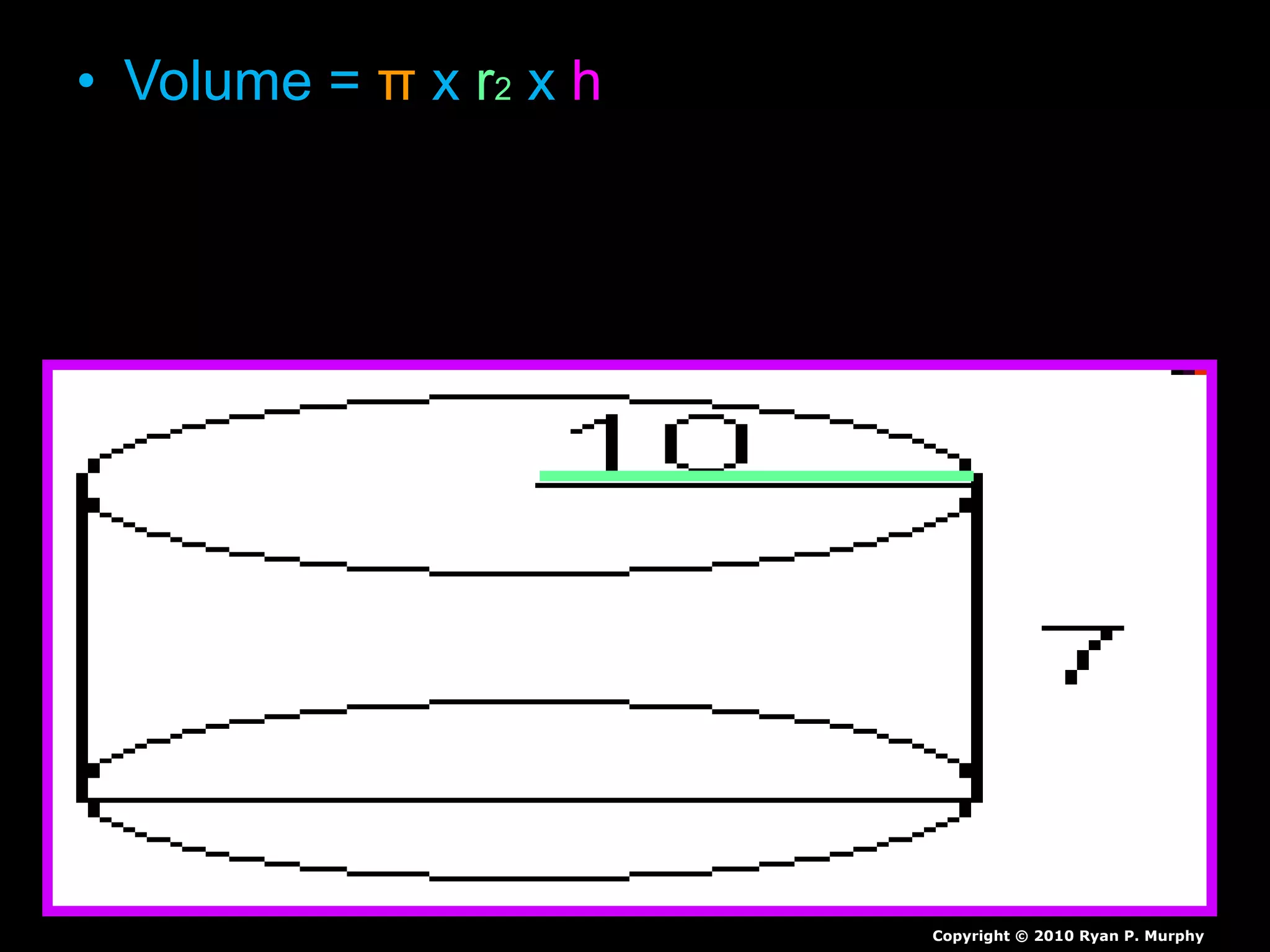
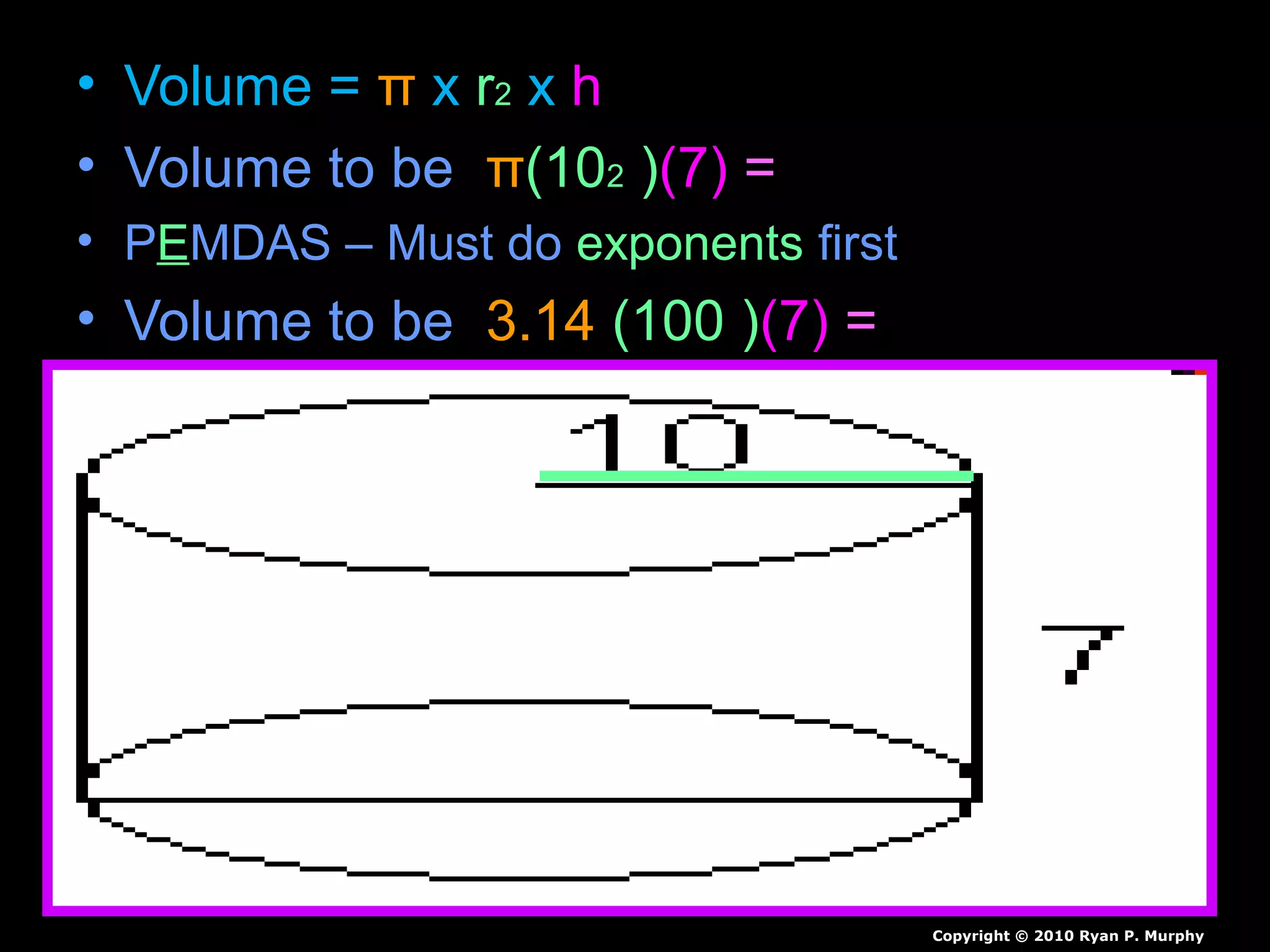
• Volume = π x r2 x h
Copyright © 2010 Ryan P. Murphy
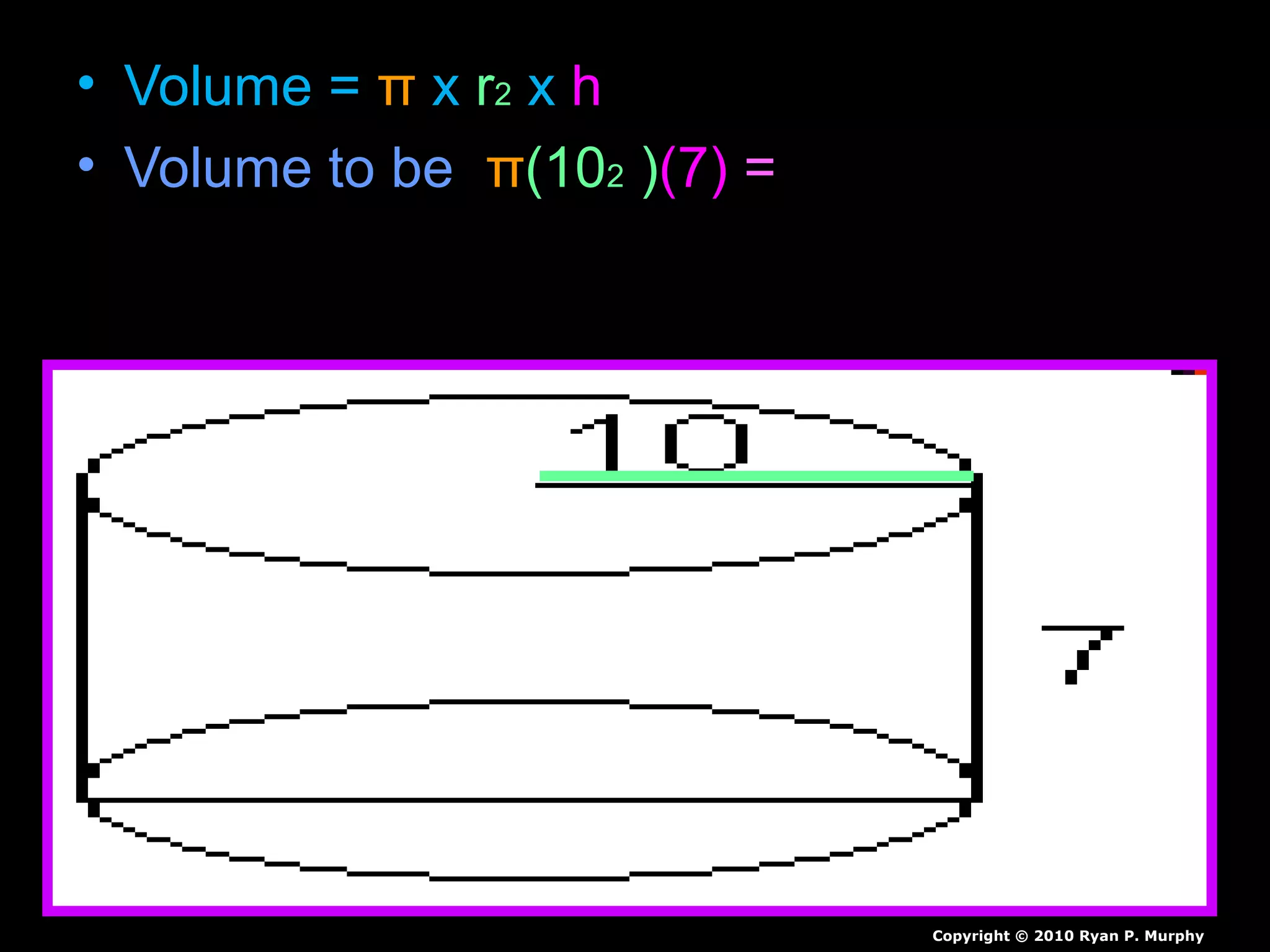
• Volume = π x r2 x h
• Volume to be π(102 )(7) =
Copyright © 2010 Ryan P. Murphy
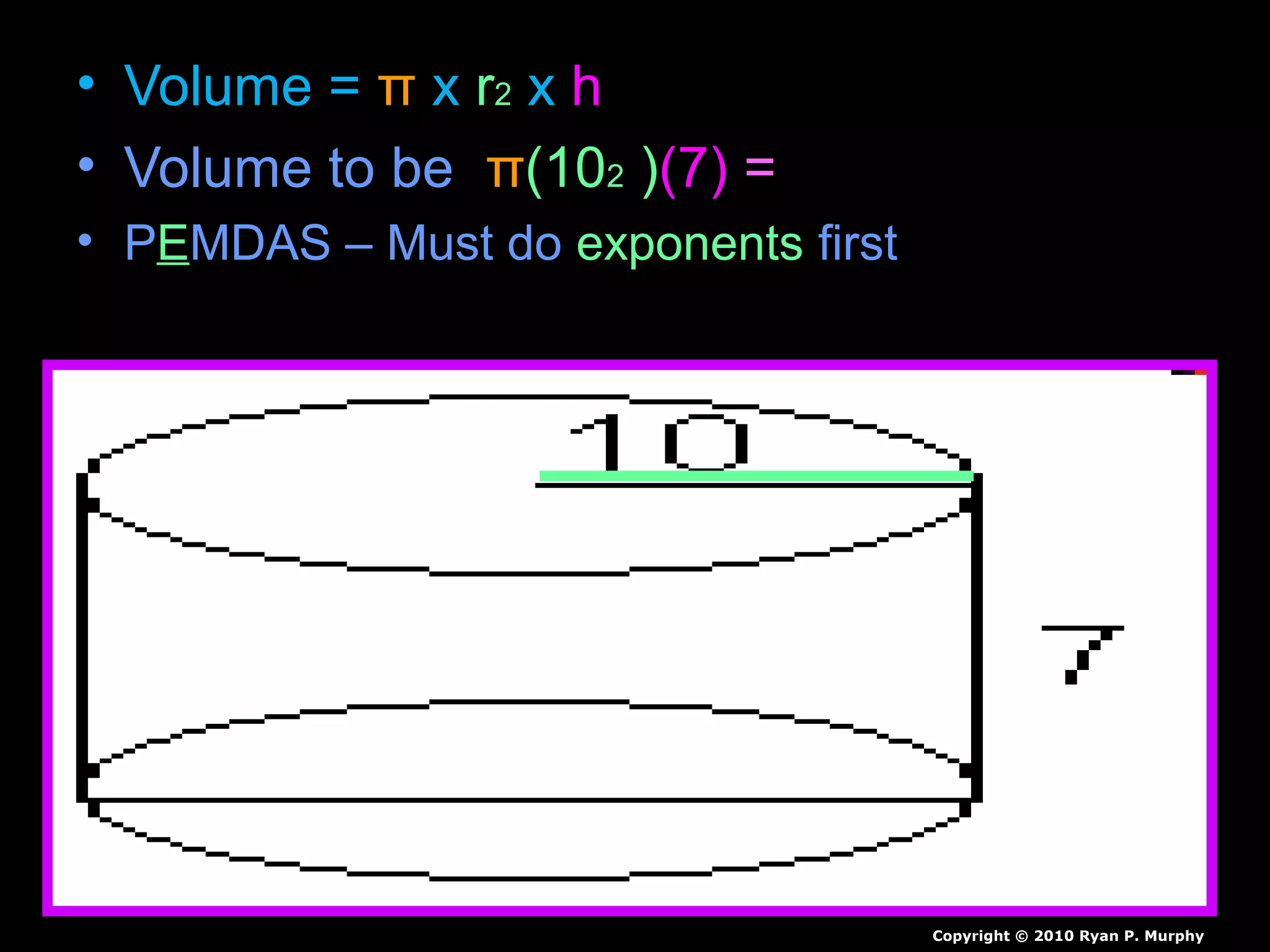
• Volume = π x r2 x h
• Volume to be π(102 )(7) =
• PEMDAS – Must do exponents first
Copyright © 2010 Ryan P. Murphy
• Volume = π x r2 x h
• Volume to be π(102 )(7) =
• PEMDAS – Must do exponents first
• Volume to be 3.14 (100 )(7) =
Copyright © 2010 Ryan P. Murphy
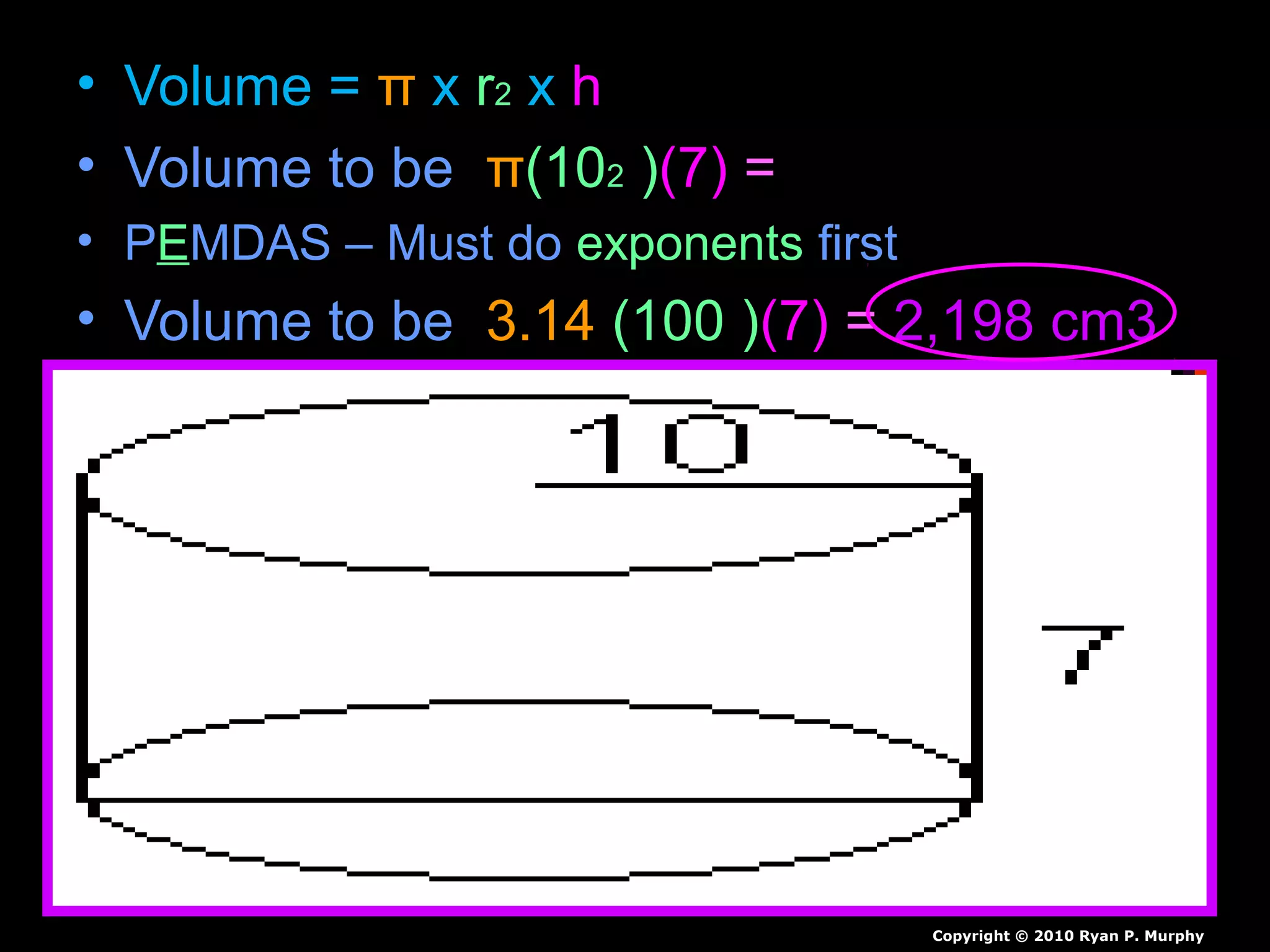
• Volume = π x r2 x h
• Volume to be π(102 )(7) =
• PEMDAS – Must do exponents first
• Volume to be 3.14 (100 )(7) = 2,198 cm3
Copyright © 2010 Ryan P. Murphy
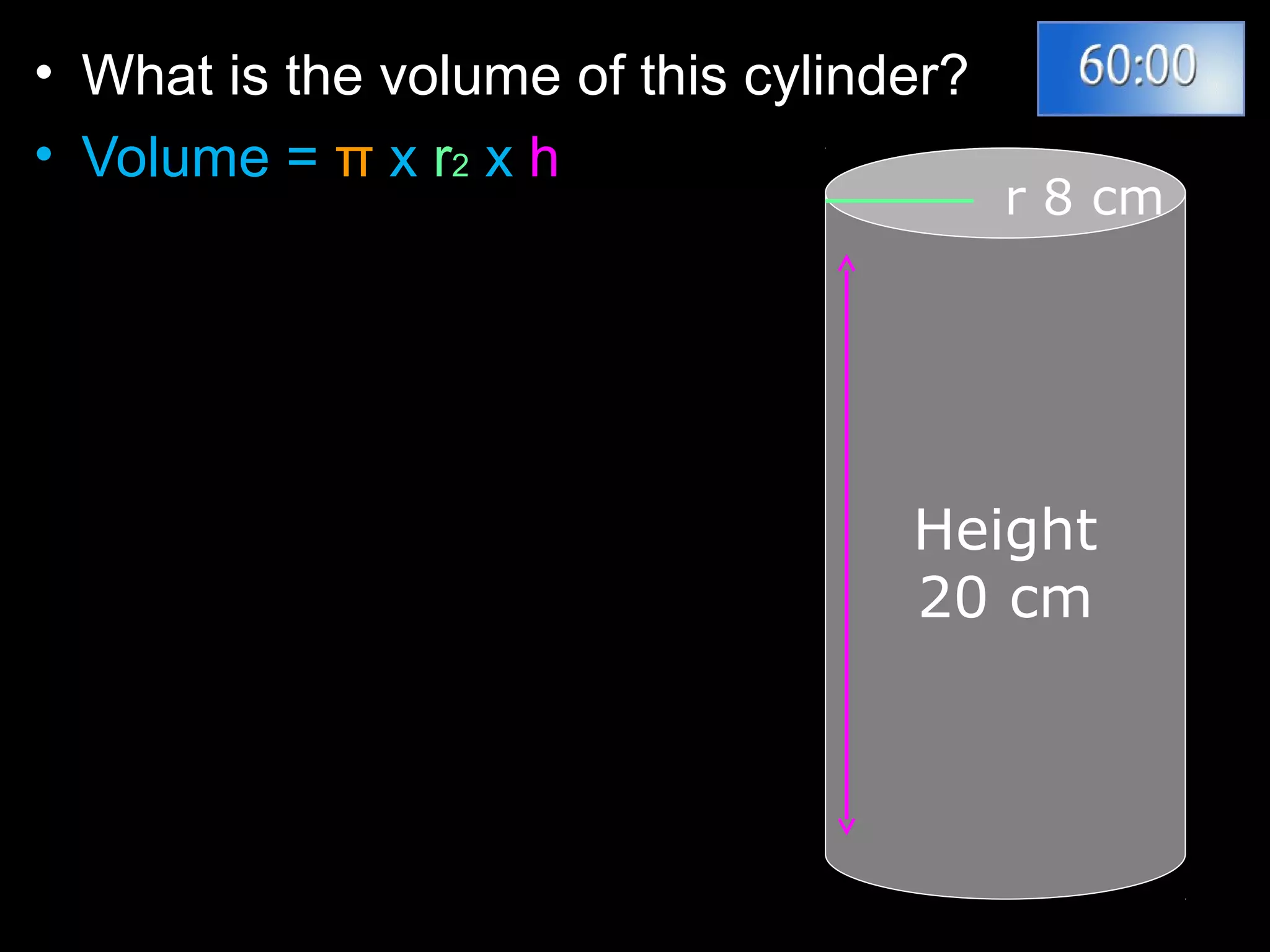
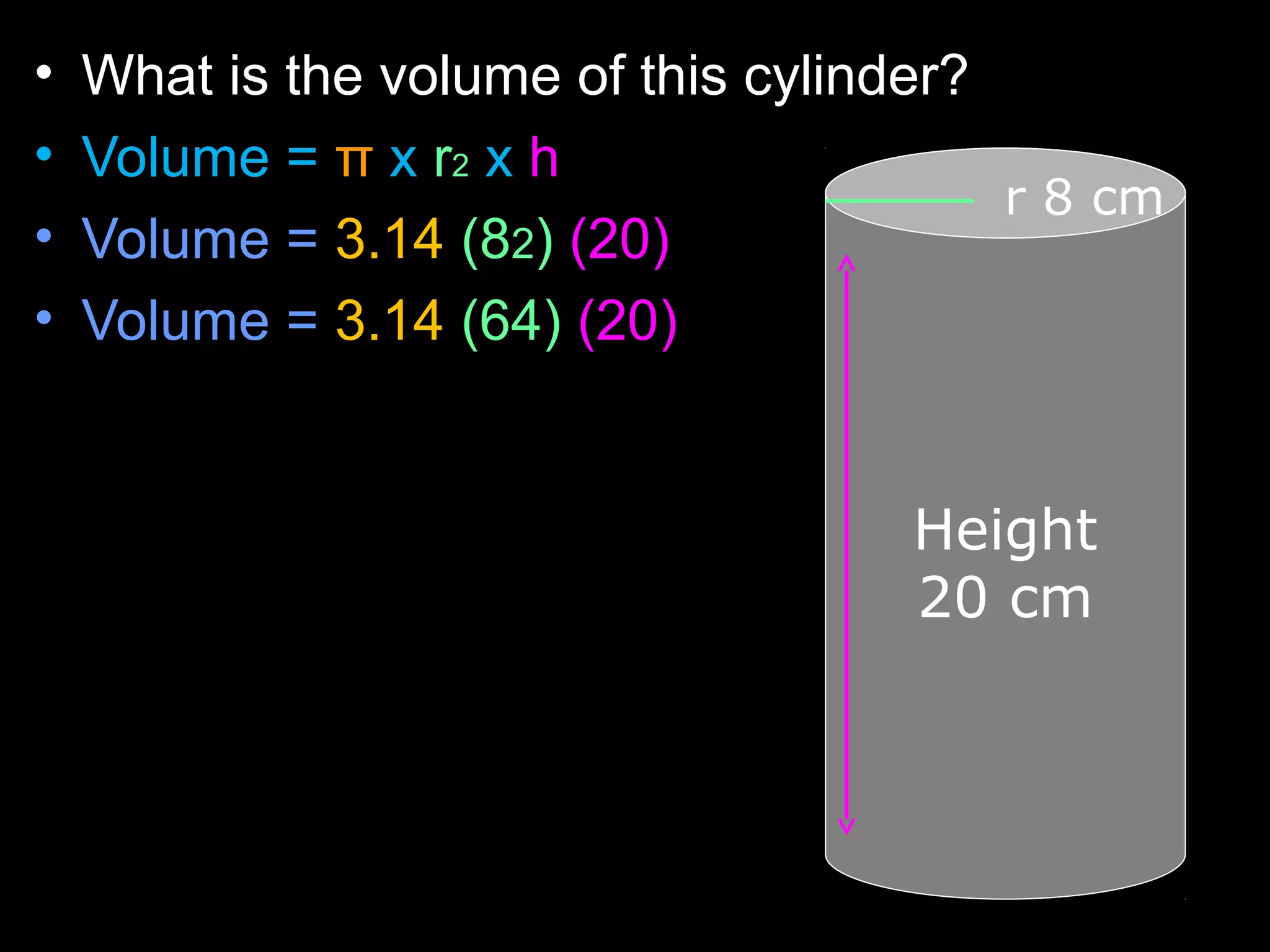
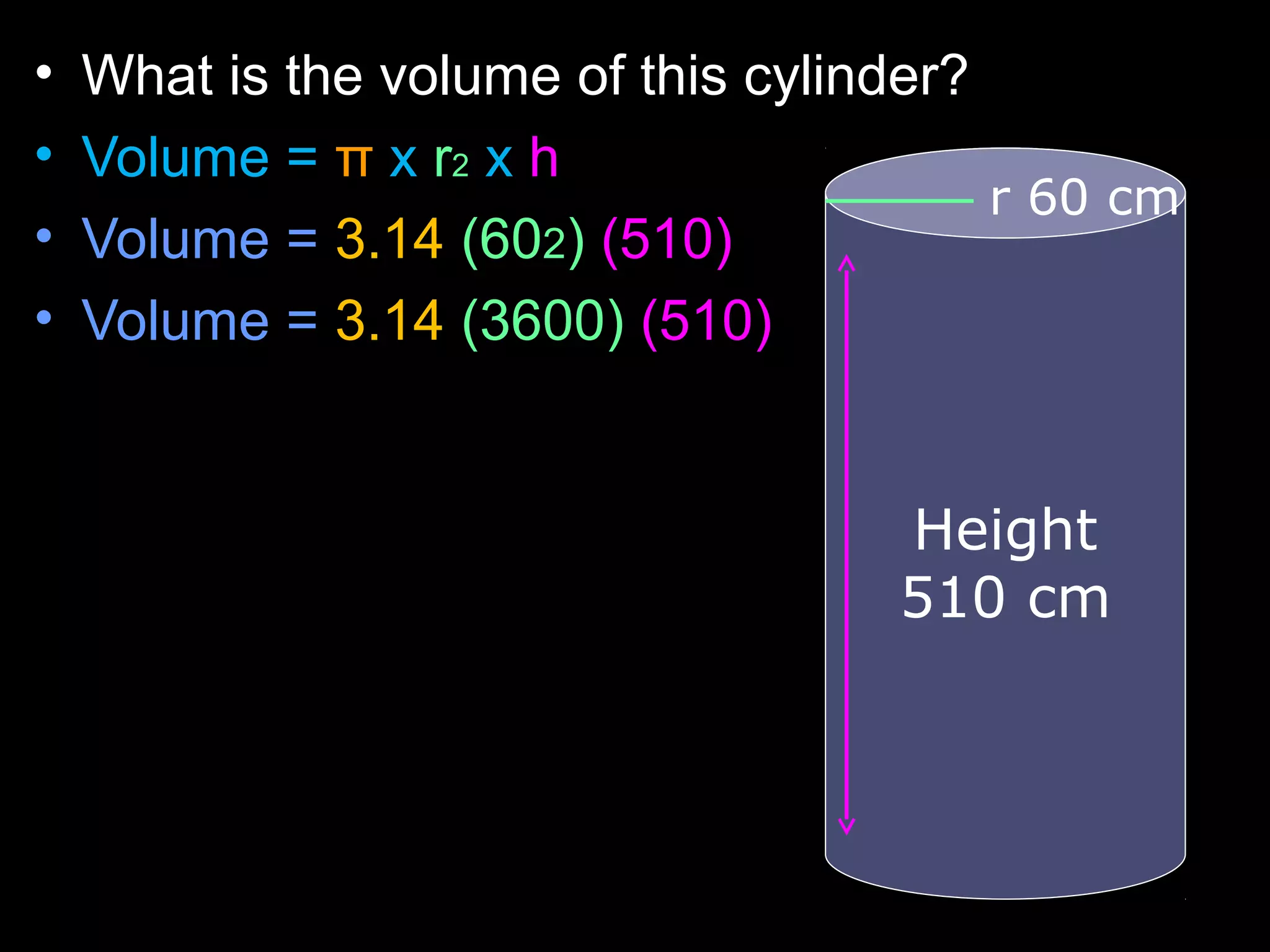
• What is the volume of this cylinder?
• Volume = π x r2 x h
r 8 cm
Height
20 cm
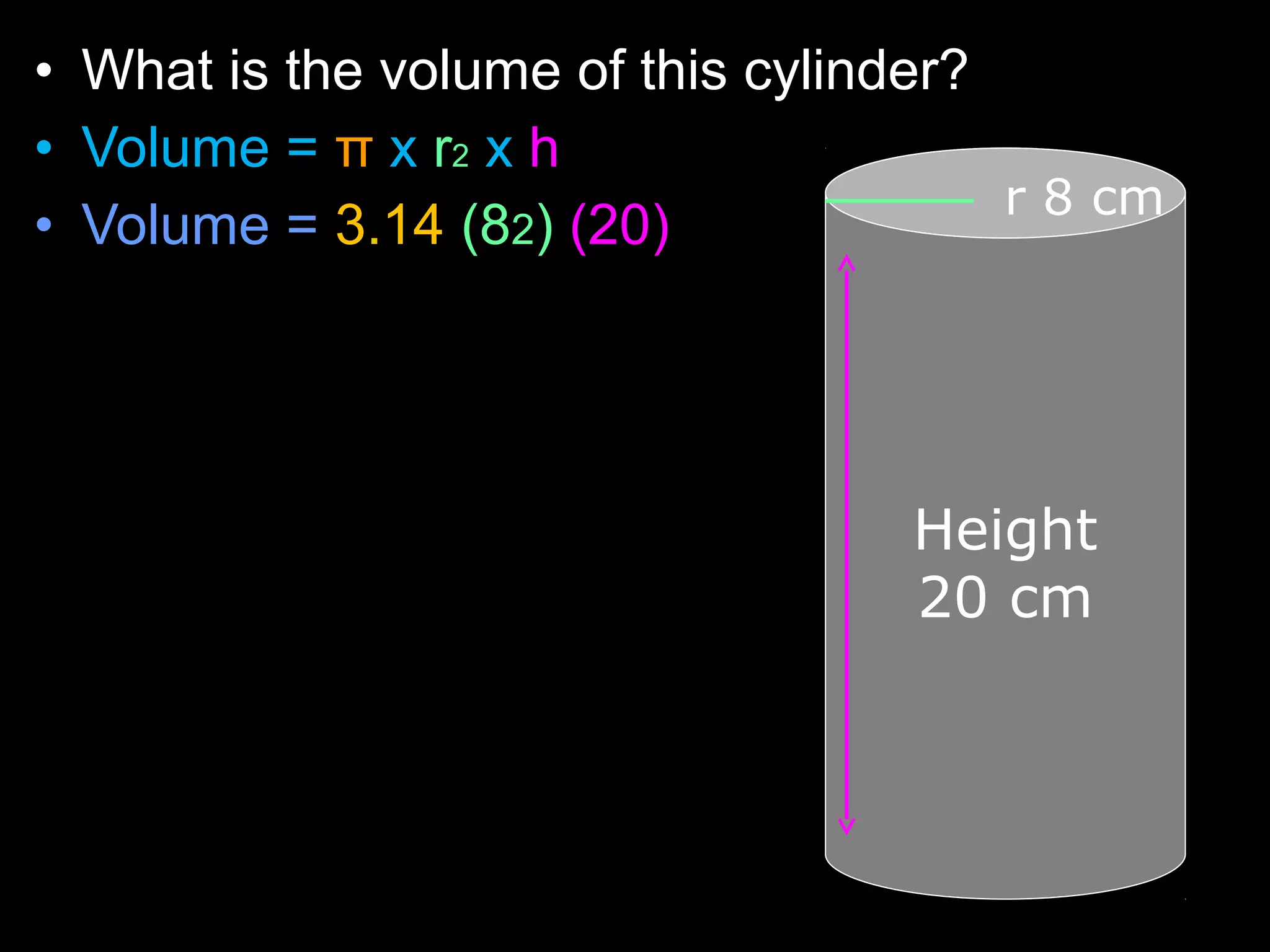
• What is the volume of this cylinder?
• Volume = π x r2 x h
• Volume = 3.14 (82) (20)
r 8 cm
Height
20 cm
• What is the volume of this cylinder?
• Volume = π x r2 x h
• Volume = 3.14 (82) (20)
• Volume = 3.14 (64) (20)
r 8 cm
Height
20 cm
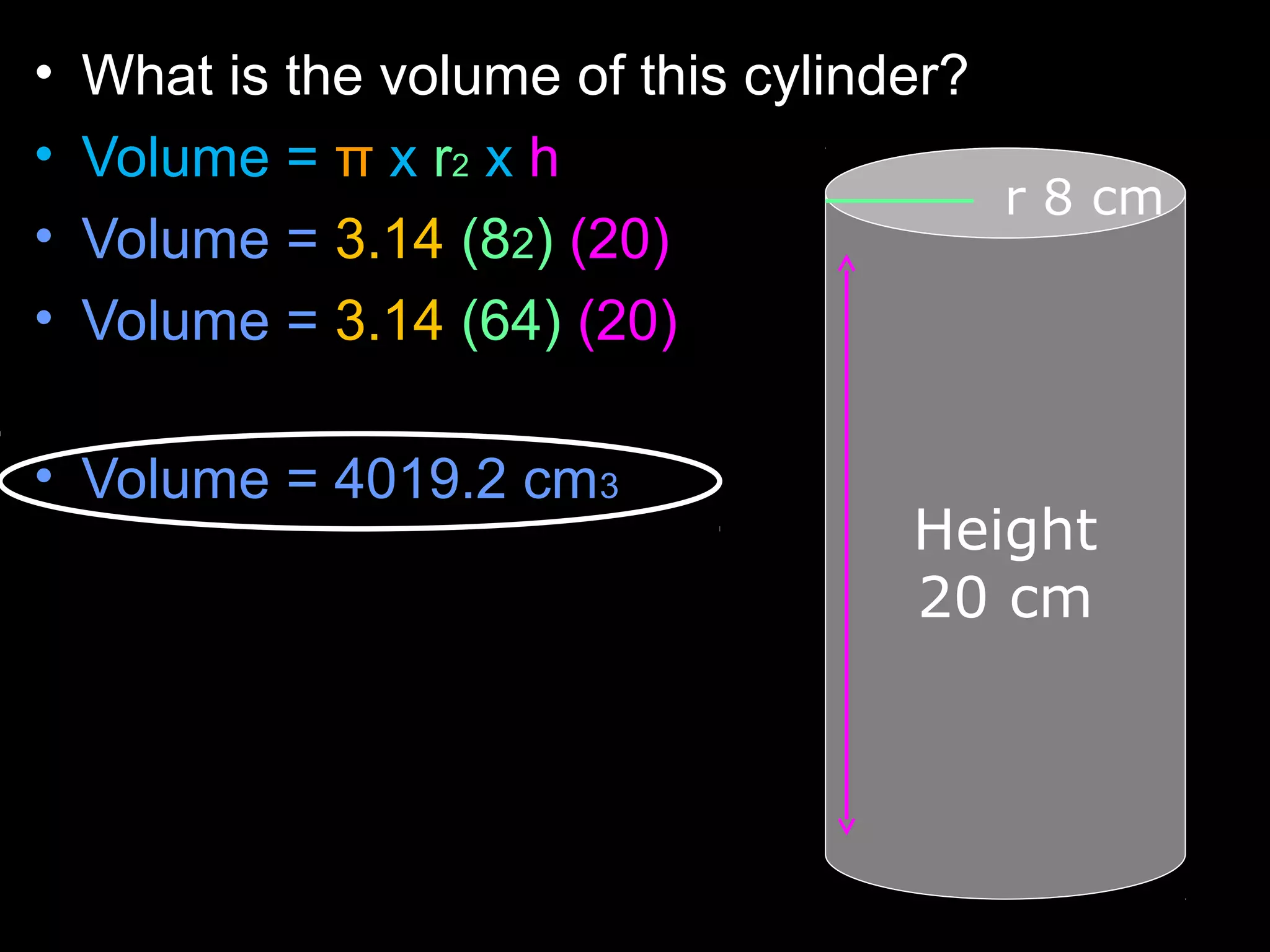
• What is the volume of this cylinder?
• Volume = π x r2 x h
• Volume = 3.14 (82) (20)
• Volume = 3.14 (64) (20)
• Volume = 4019.2 cm3
r 8 cm
Height
20 cm
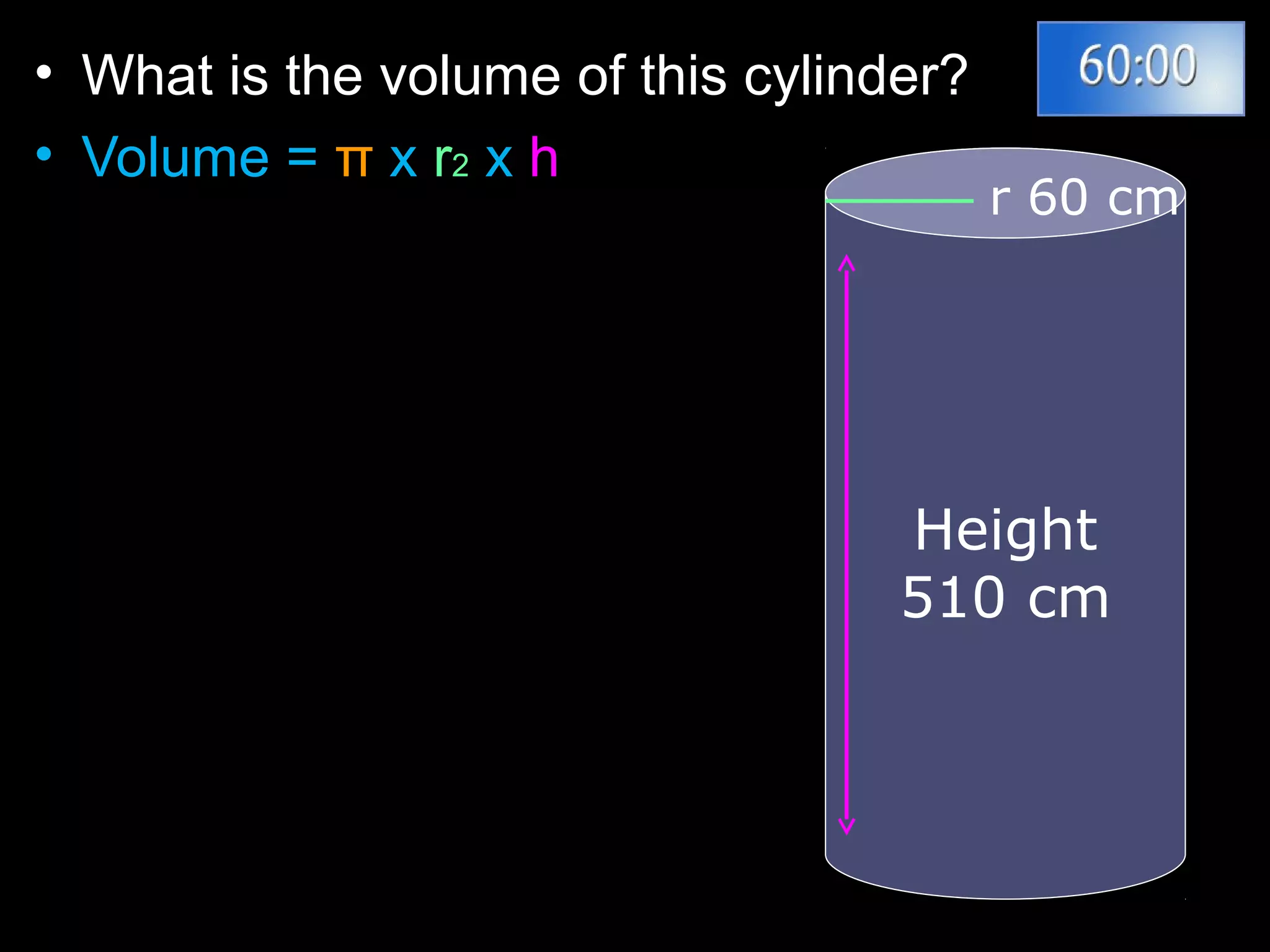
• What is the volume of this cylinder?
• Volume = π x r2 x h
r 60 cm
Height
510 cm
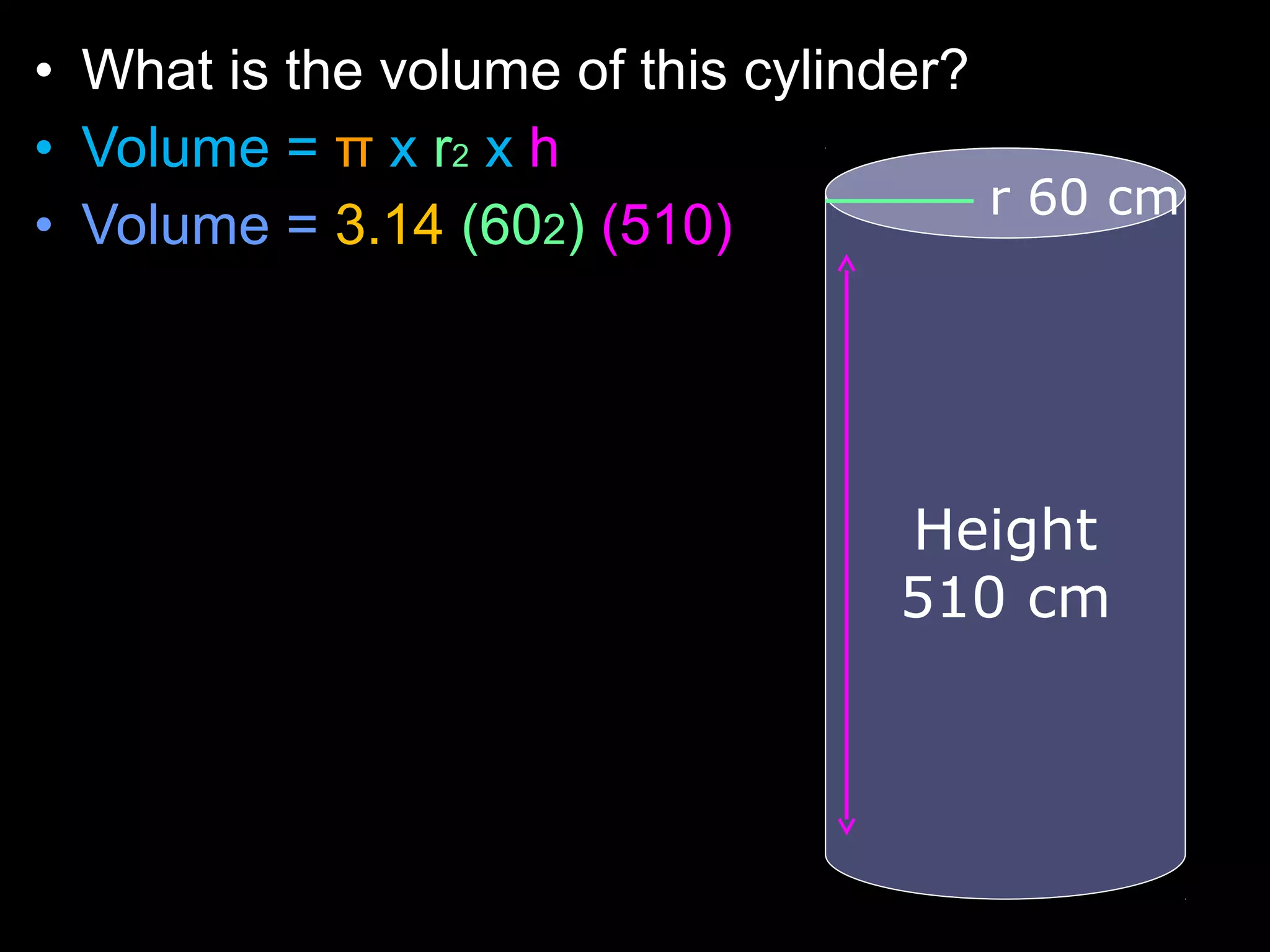
• What is the volume of this cylinder?
• Volume = π x r2 x h
• Volume = 3.14 (602) (510)
r 60 cm
Height
510 cm
• What is the volume of this cylinder?
• Volume = π x r2 x h
• Volume = 3.14 (602) (510)
• Volume = 3.14 (3600) (510)
r 60 cm
Height
510 cm
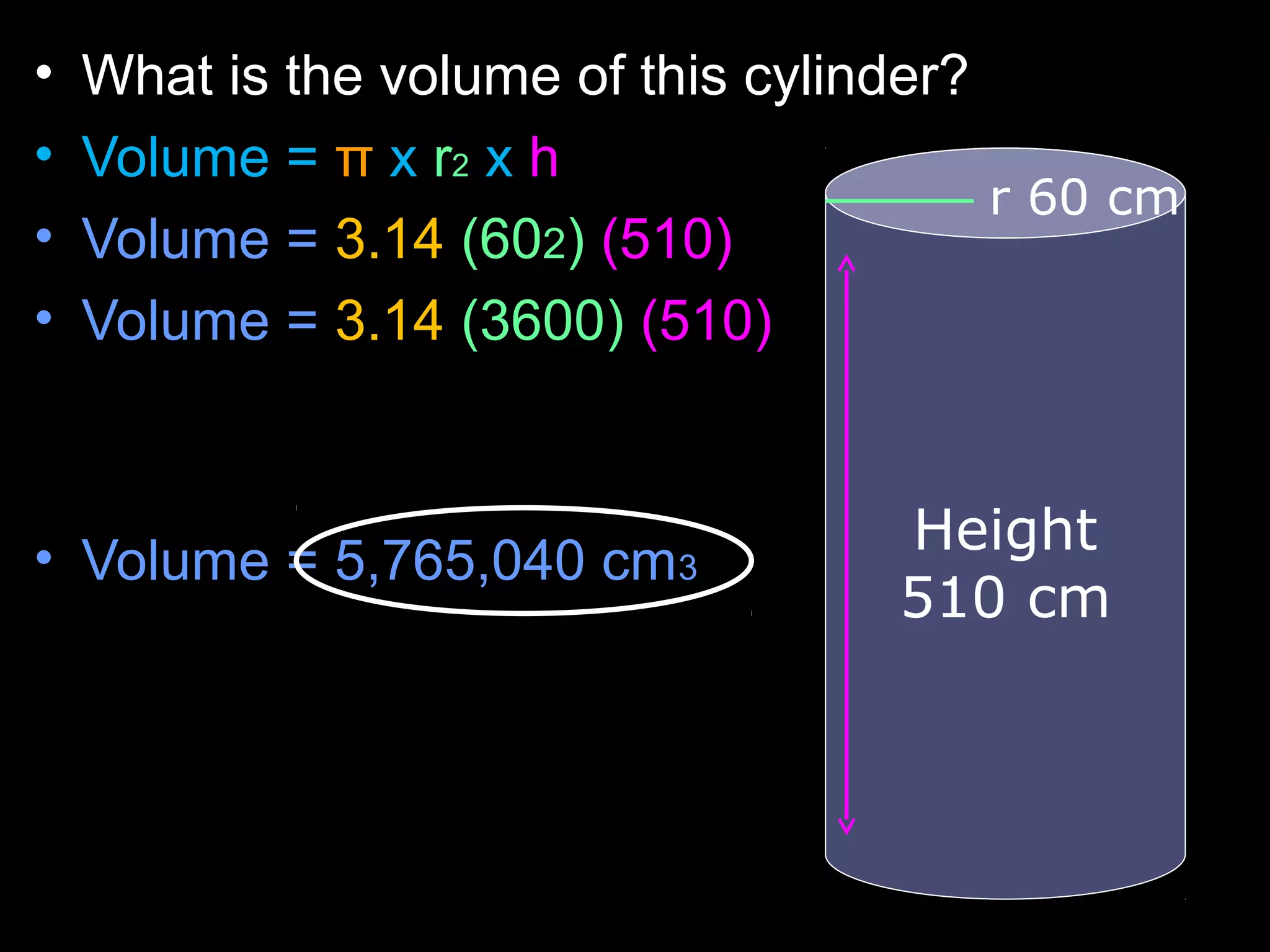
• What is the volume of this cylinder?
• Volume = π x r2 x h
• Volume = 3.14 (602) (510)
• Volume = 3.14 (3600) (510)
• Volume = 5,765,040 cm3
r 60 cm
Height
510 cm
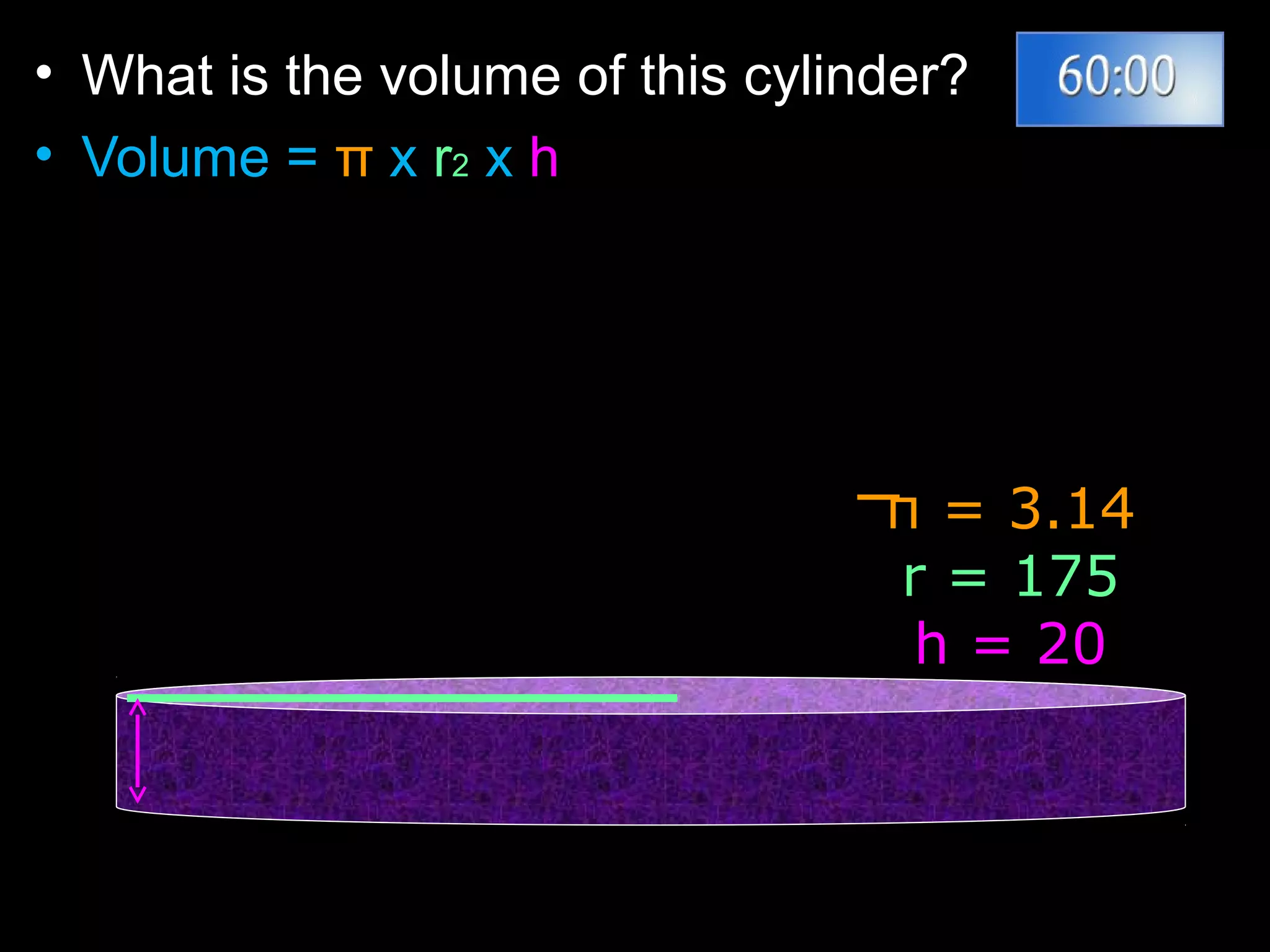
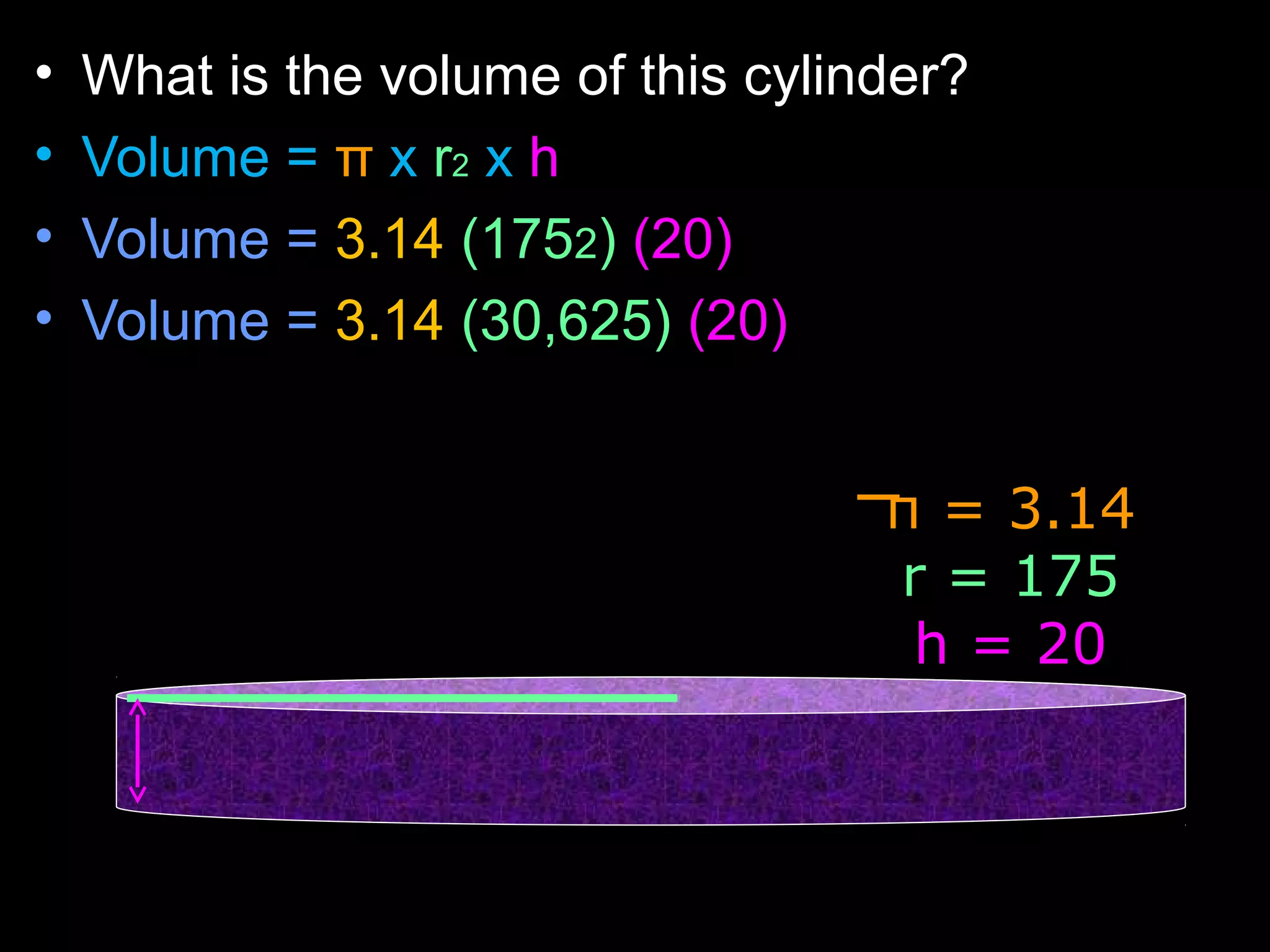
• What is the volume of this cylinder?
• Volume = π x r2 x h
π = 3.14
r = 175
h = 20
• What is the volume of this cylinder?
• Volume = π x r2 x h
• Volume = 3.14 (1752) (20)
π = 3.14
r = 175
h = 20
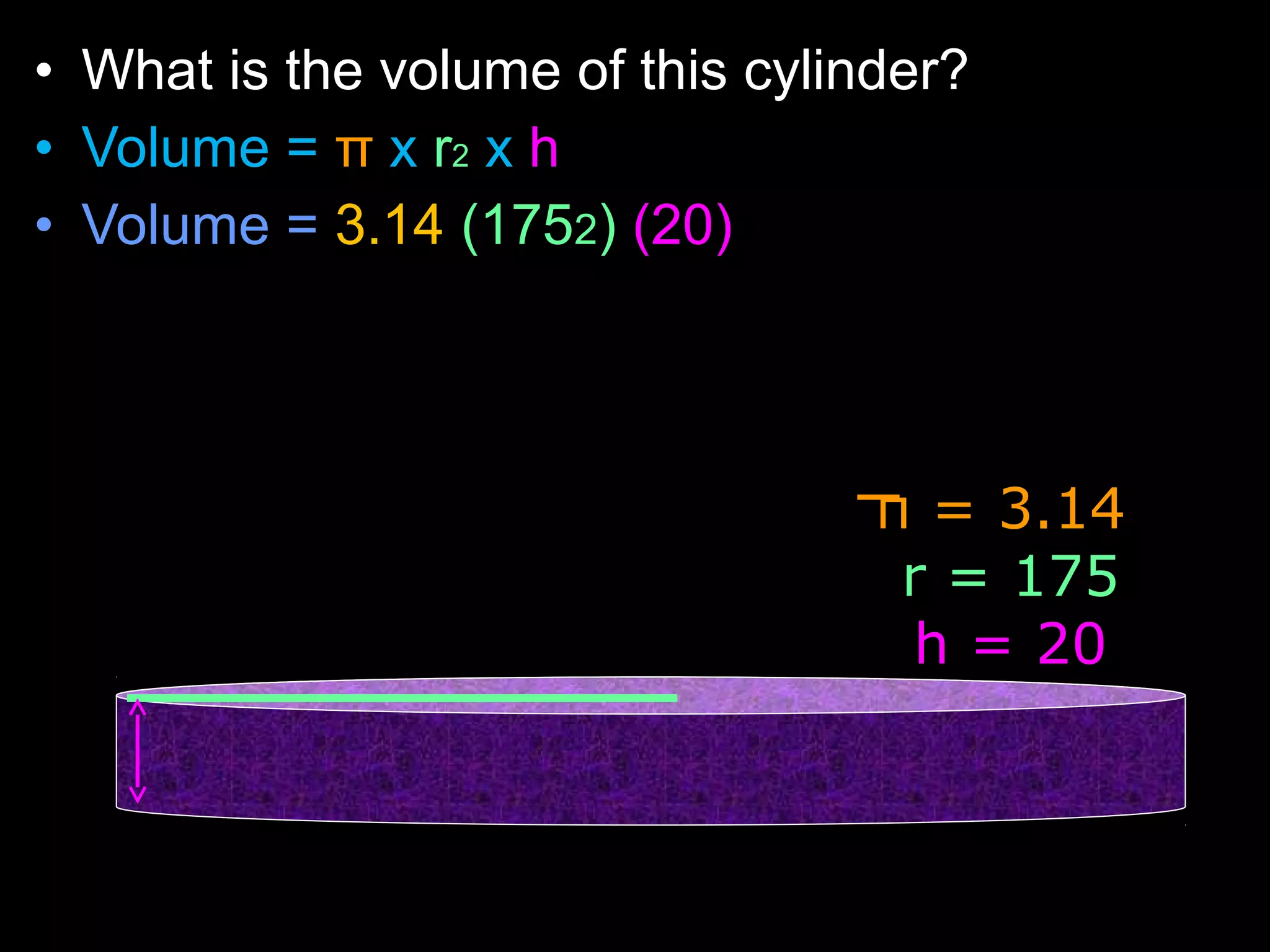
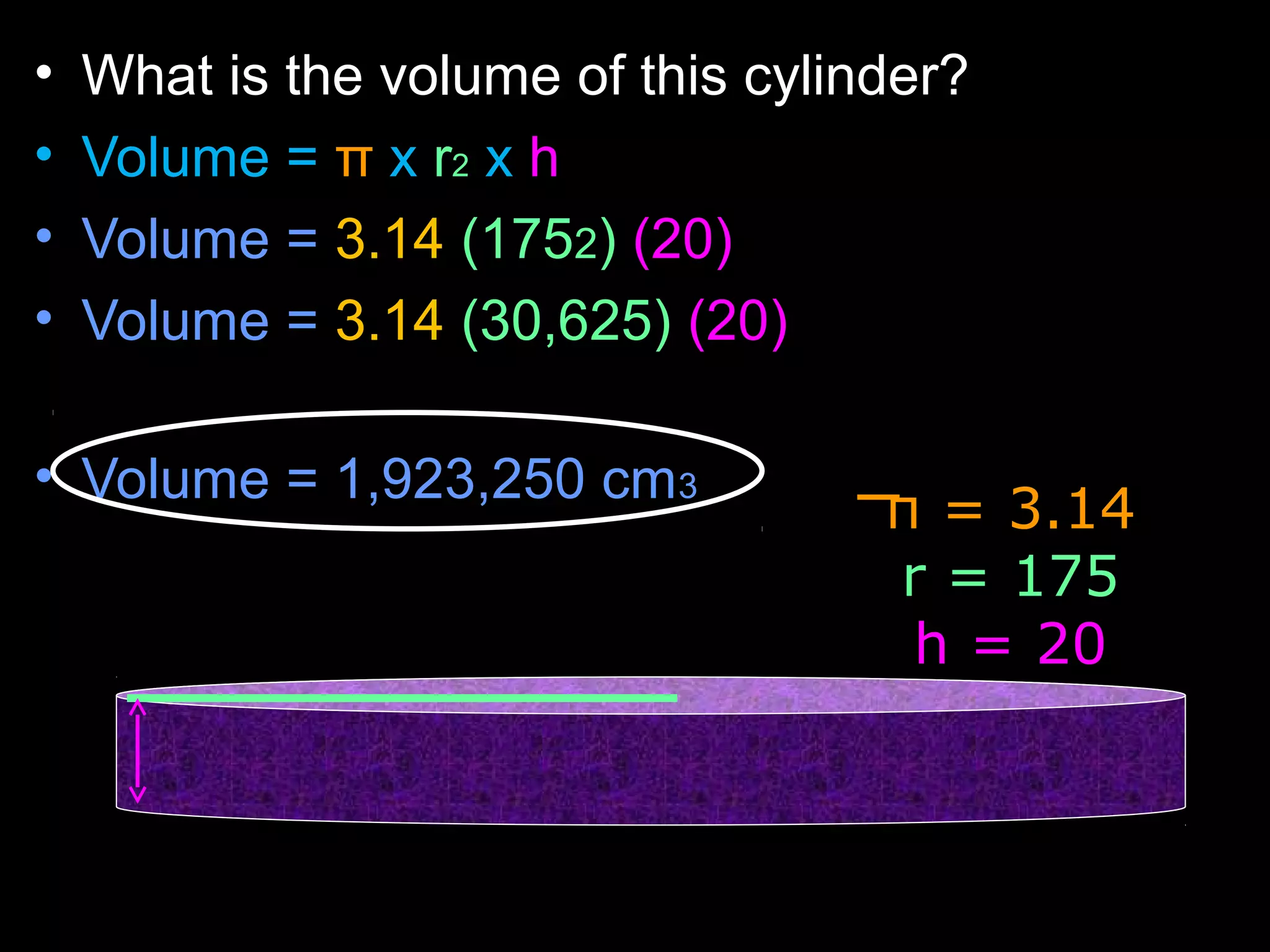
• What is the volume of this cylinder?
• Volume = π x r2 x h
• Volume = 3.14 (1752) (20)
• Volume = 3.14 (30,625) (20)
π = 3.14
r = 175
h = 20
• What is the volume of this cylinder?
• Volume = π x r2 x h
• Volume = 3.14 (1752) (20)
• Volume = 3.14 (30,625) (20)
• Volume = 1,923,250 cm3
π = 3.14
r = 175
h = 20
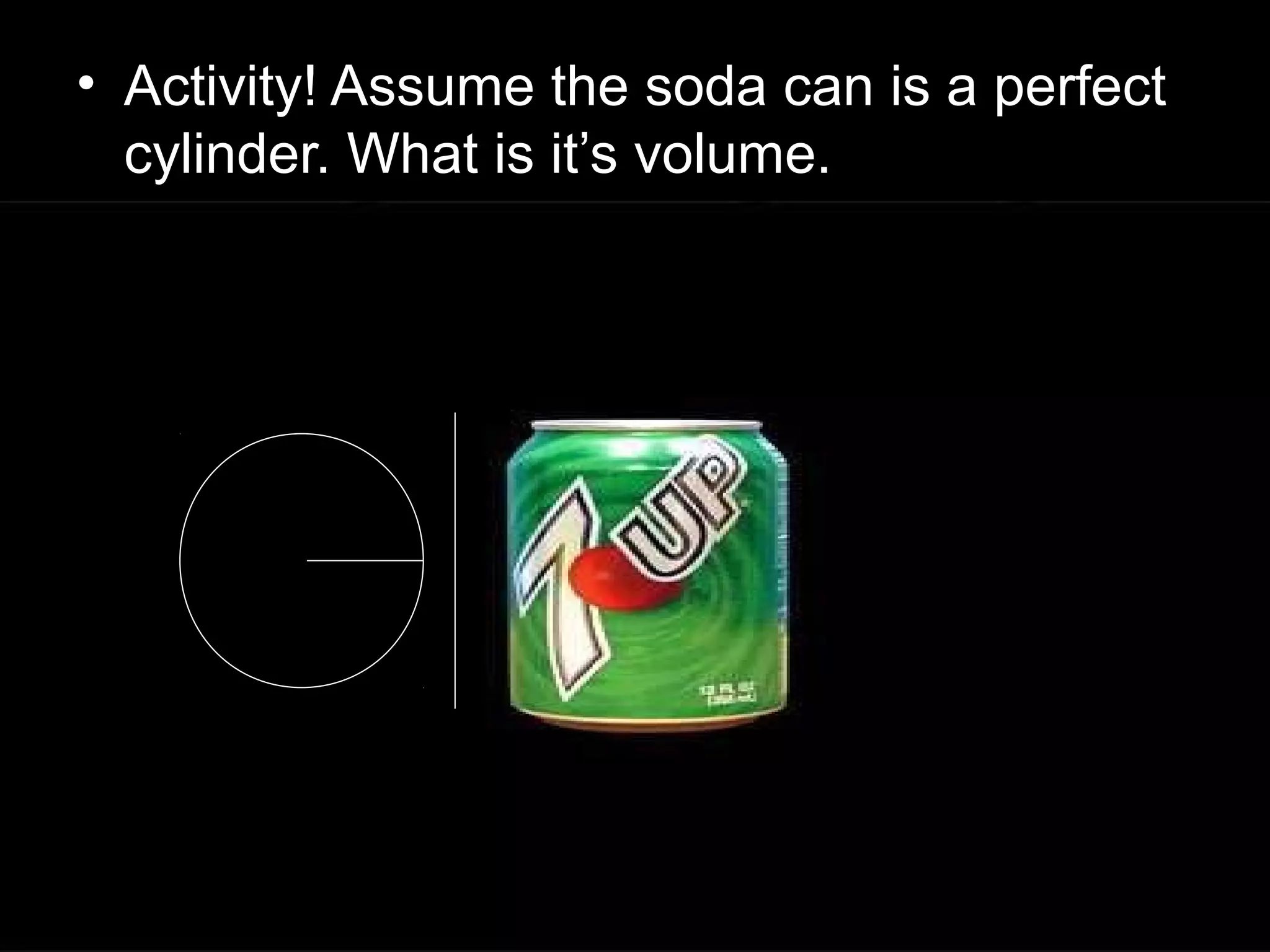
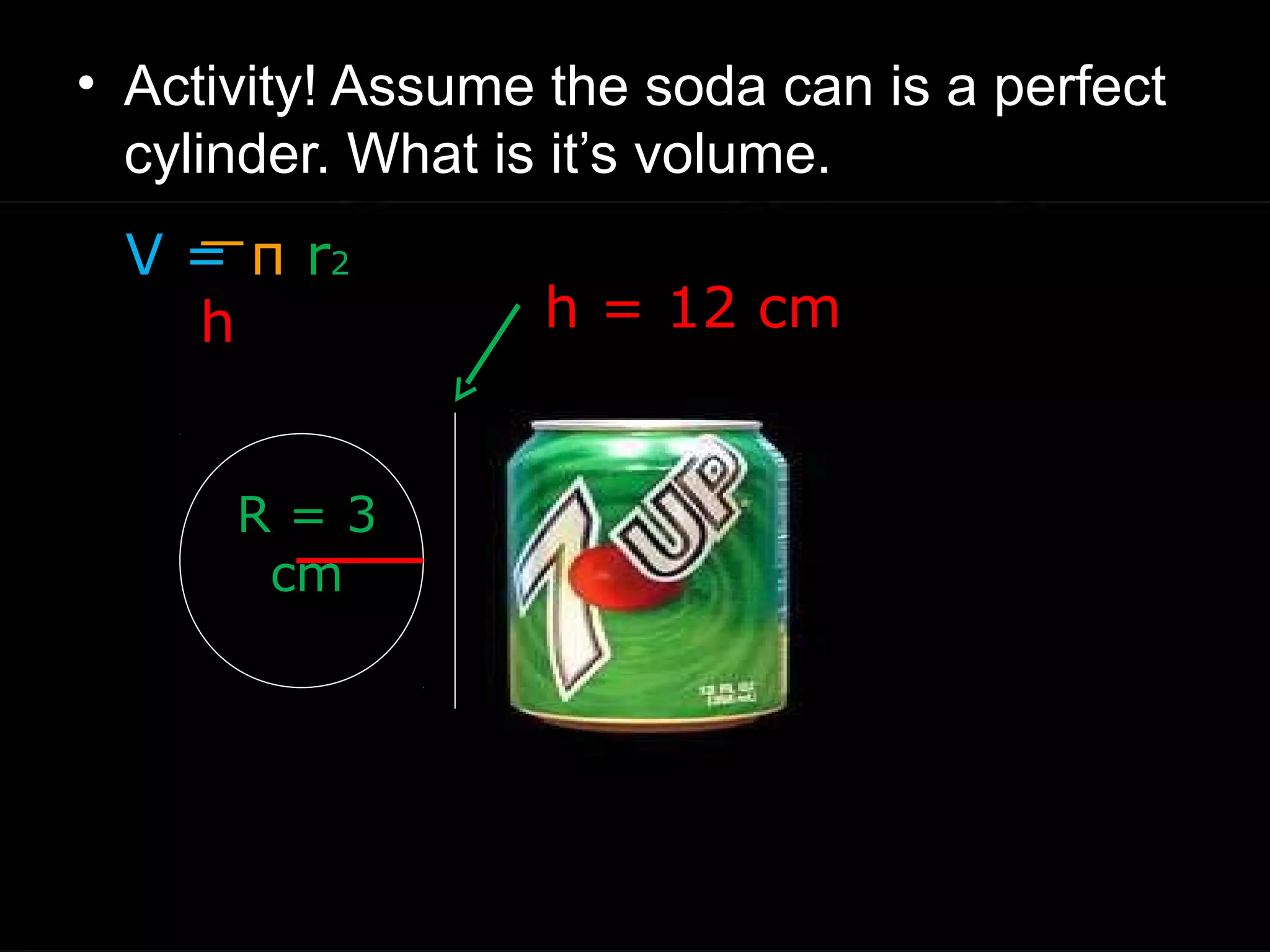
• Activity! Assume the soda can is a perfect
cylinder. What is it’s volume.
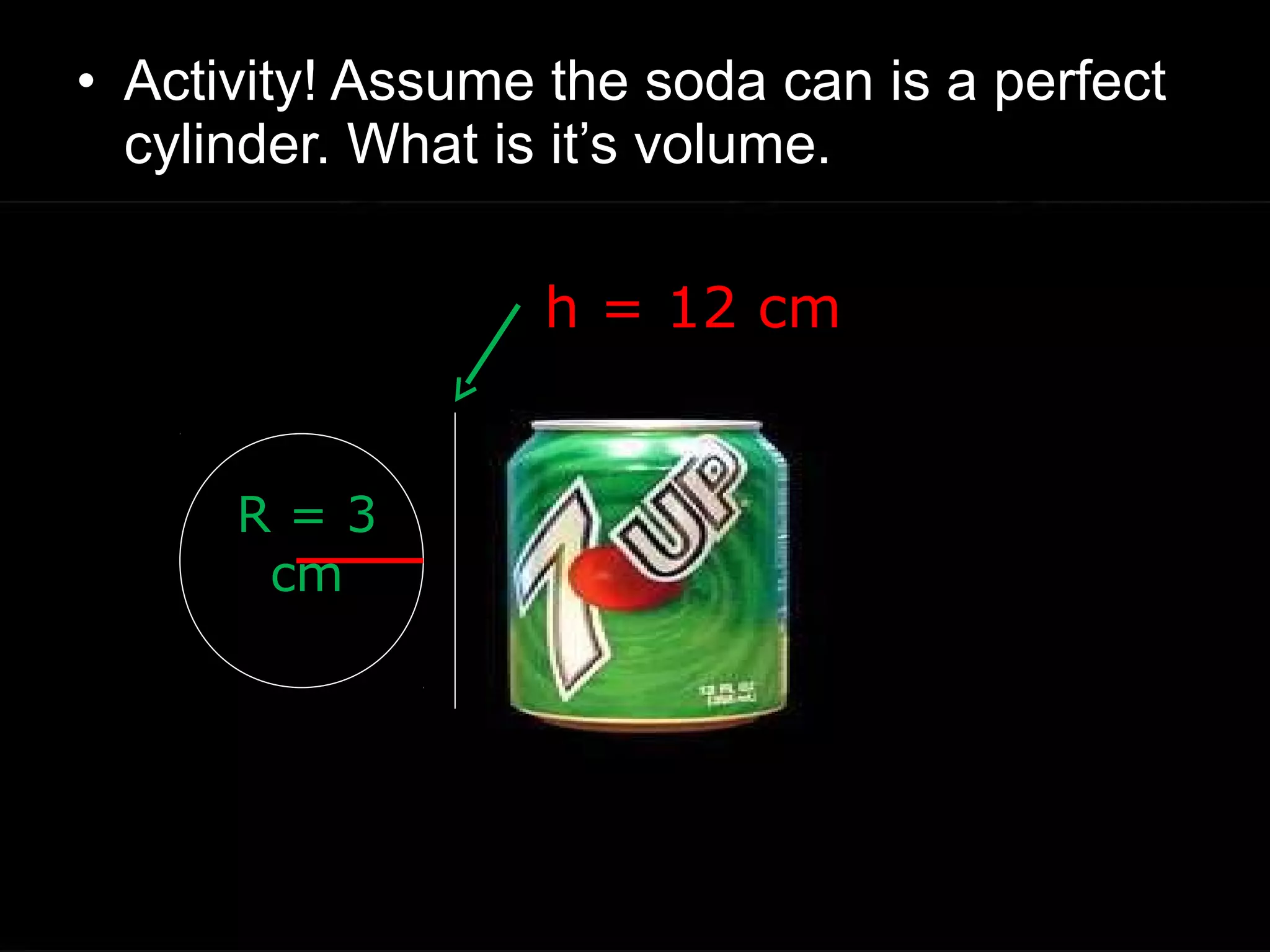
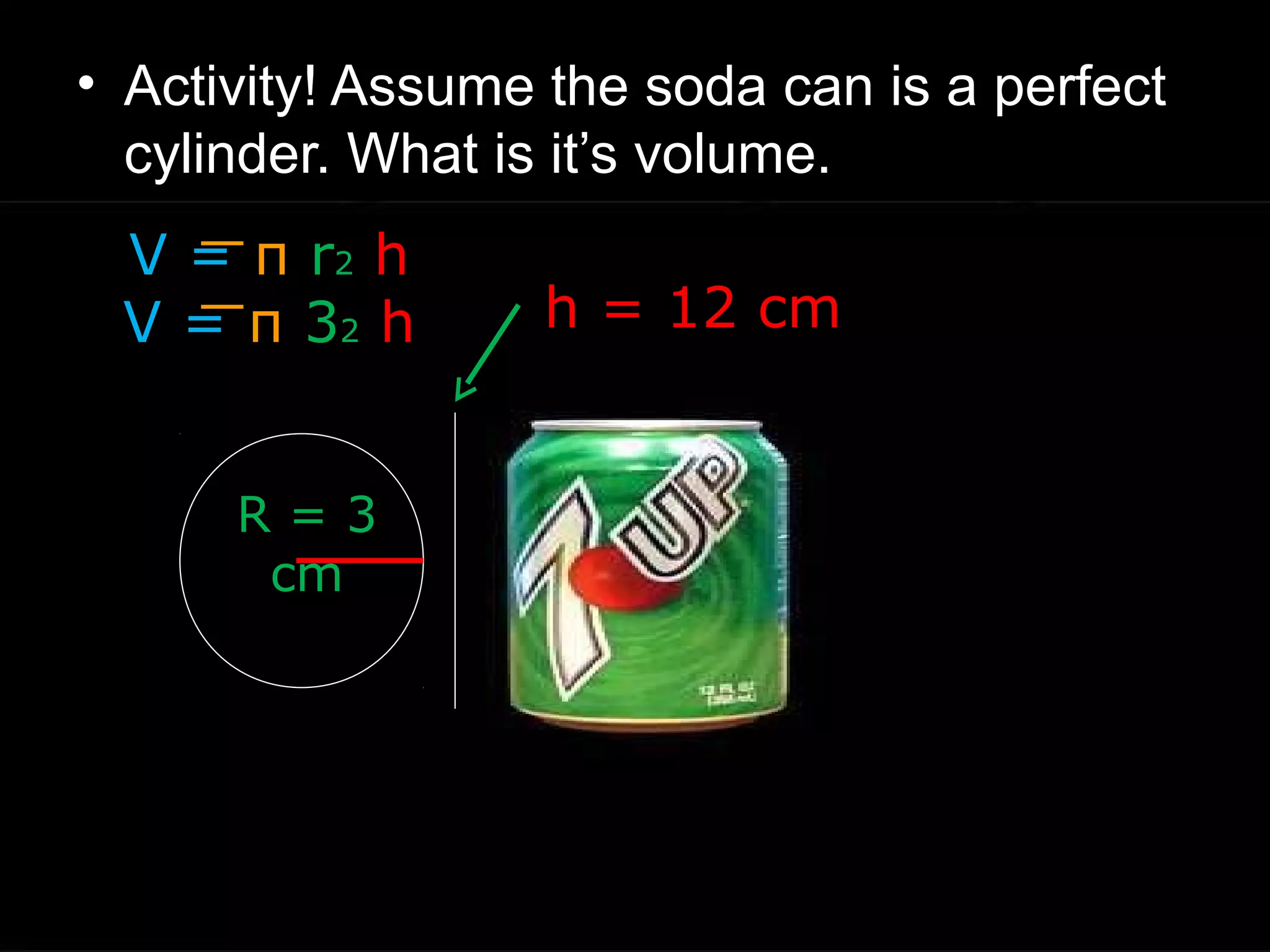
• Activity! Assume the soda can is a perfect
cylinder. What is it’s volume.
h = 12 cm
R = 3
cm
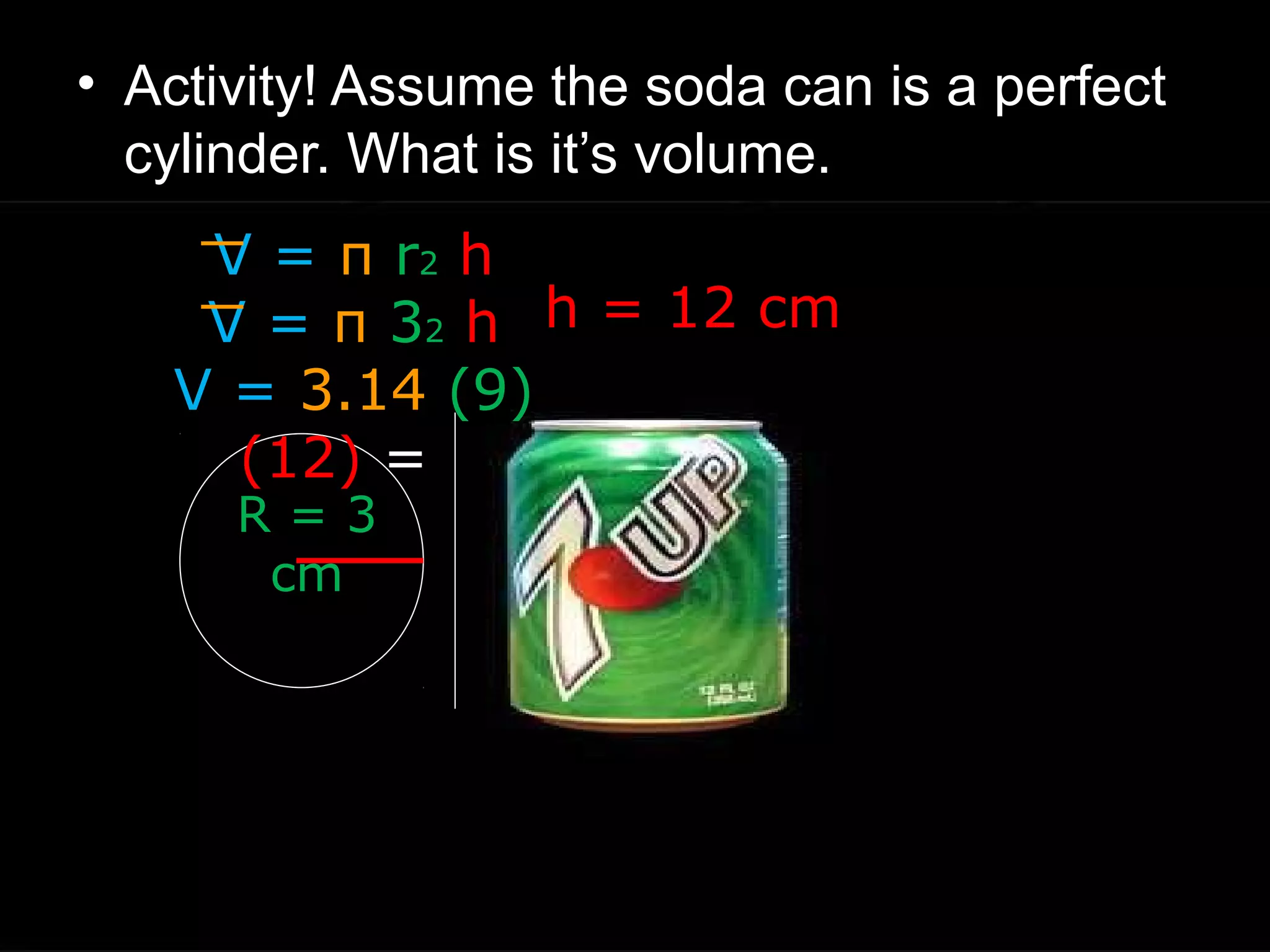
• Activity! Assume the soda can is a perfect
cylinder. What is it’s volume.
h = 12 cm
R = 3
cm
V = π r2
h
• Activity! Assume the soda can is a perfect
cylinder. What is it’s volume.
h = 12 cm
R = 3
cm
V = π r2 h
V = π 32 h
• Activity! Assume the soda can is a perfect
cylinder. What is it’s volume.
h = 12 cm
R = 3
cm
V = π r2 h
V = π 32 h
V = 3.14 (9)
(12) =
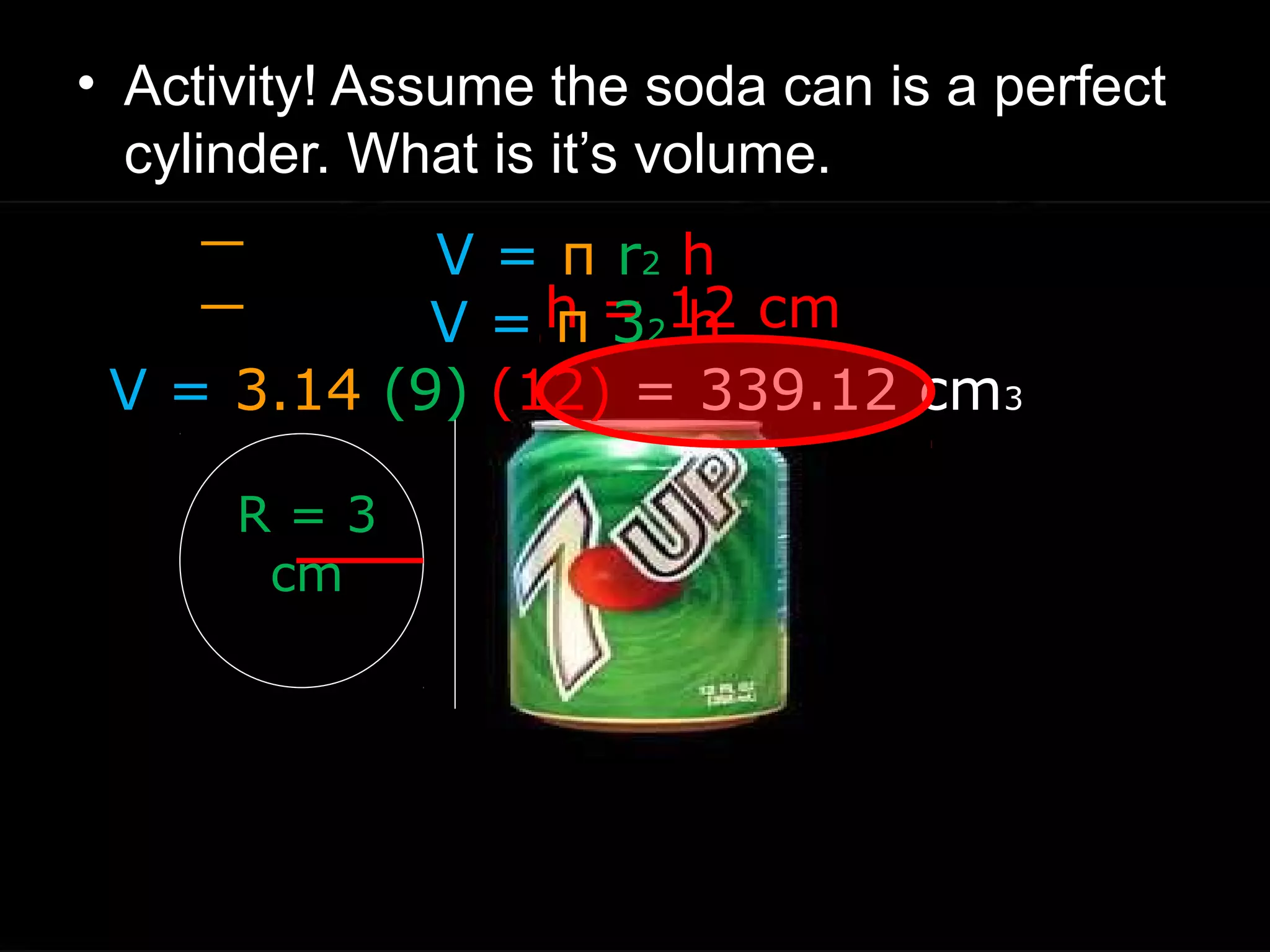
• Activity! Assume the soda can is a perfect
cylinder. What is it’s volume.
h = 12 cm
R = 3
cm
V = π r2 h
V = π 32 h
V = 3.14 (9) (12) = 339.12 cm3
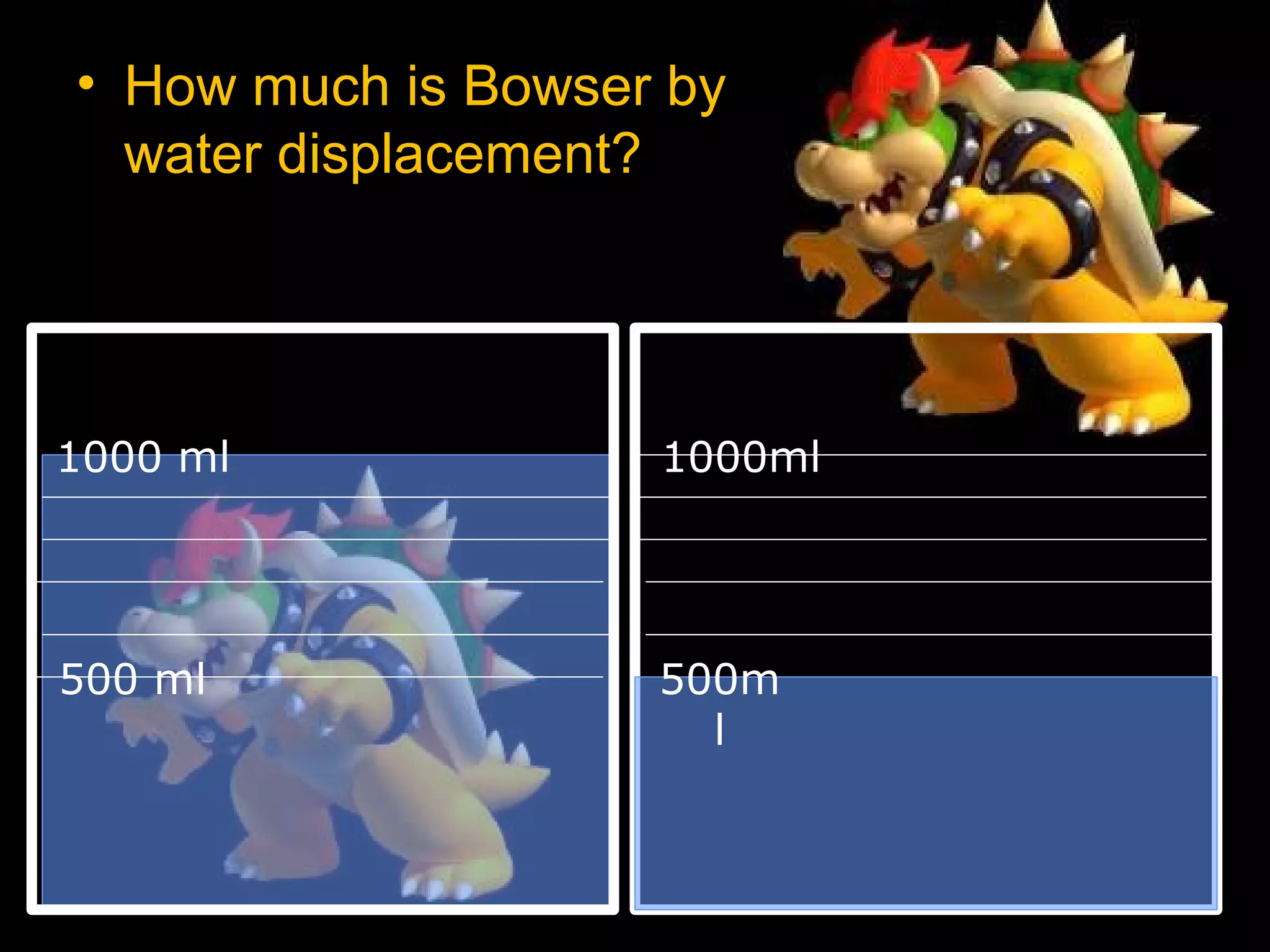
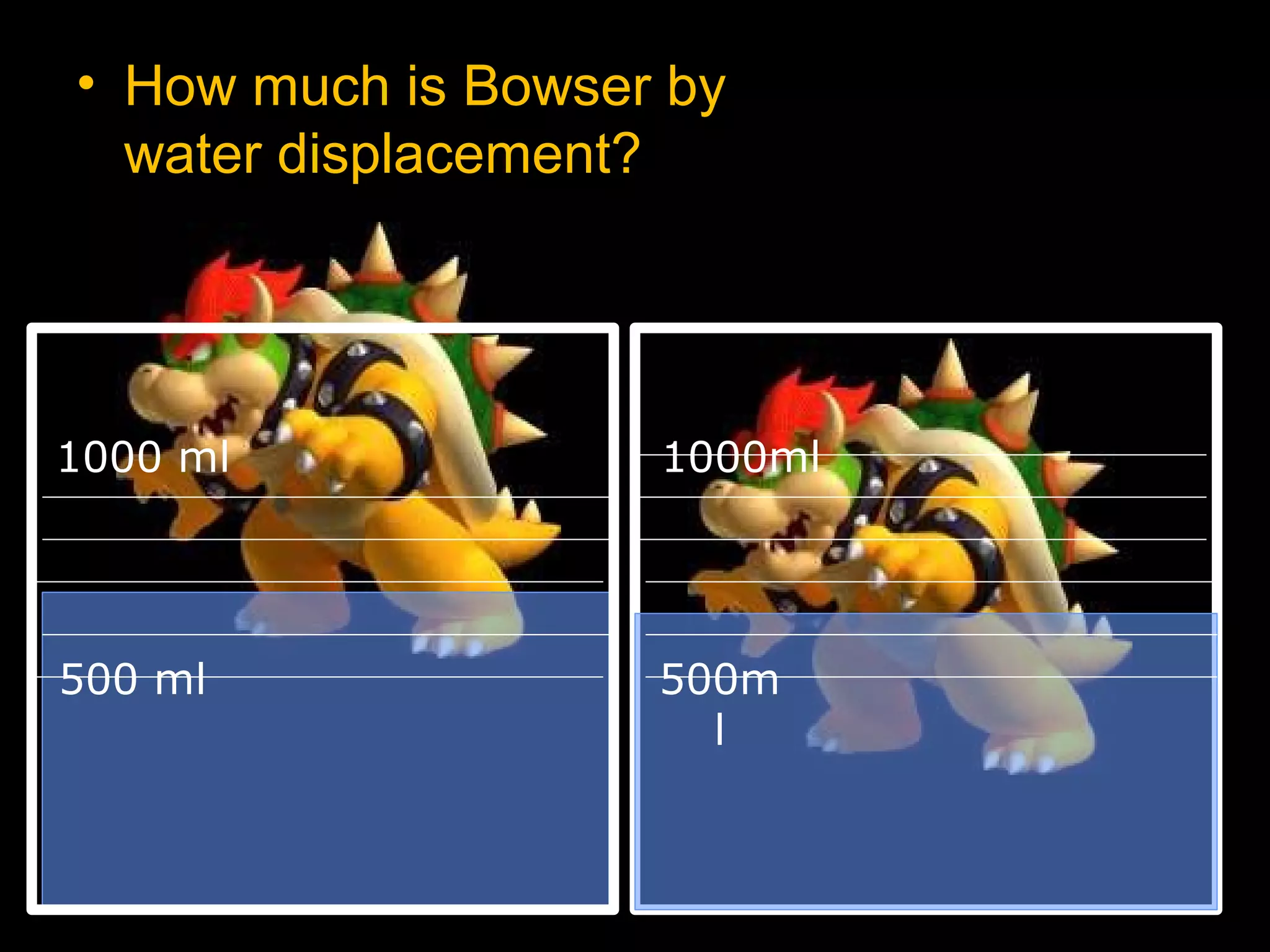
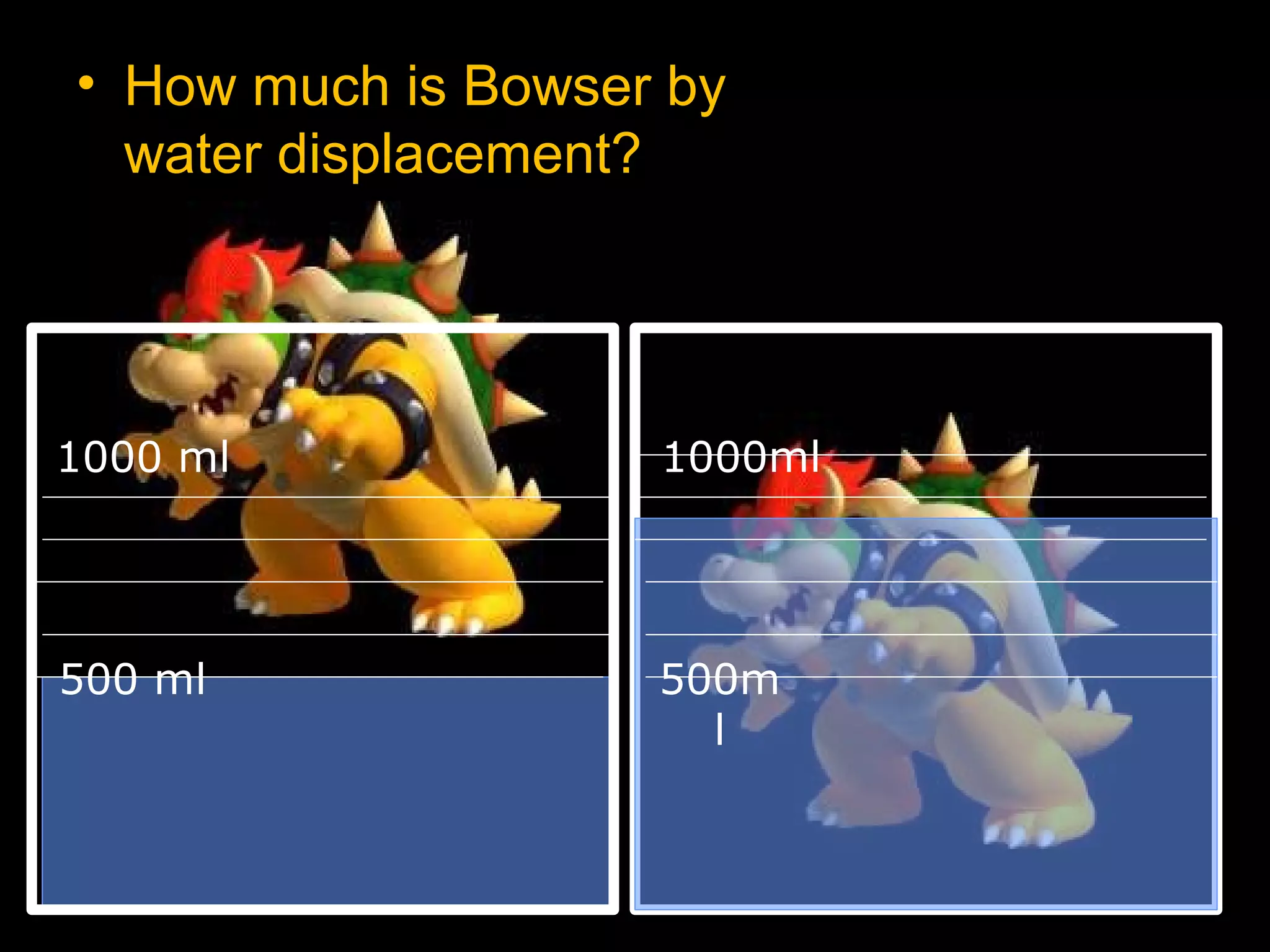
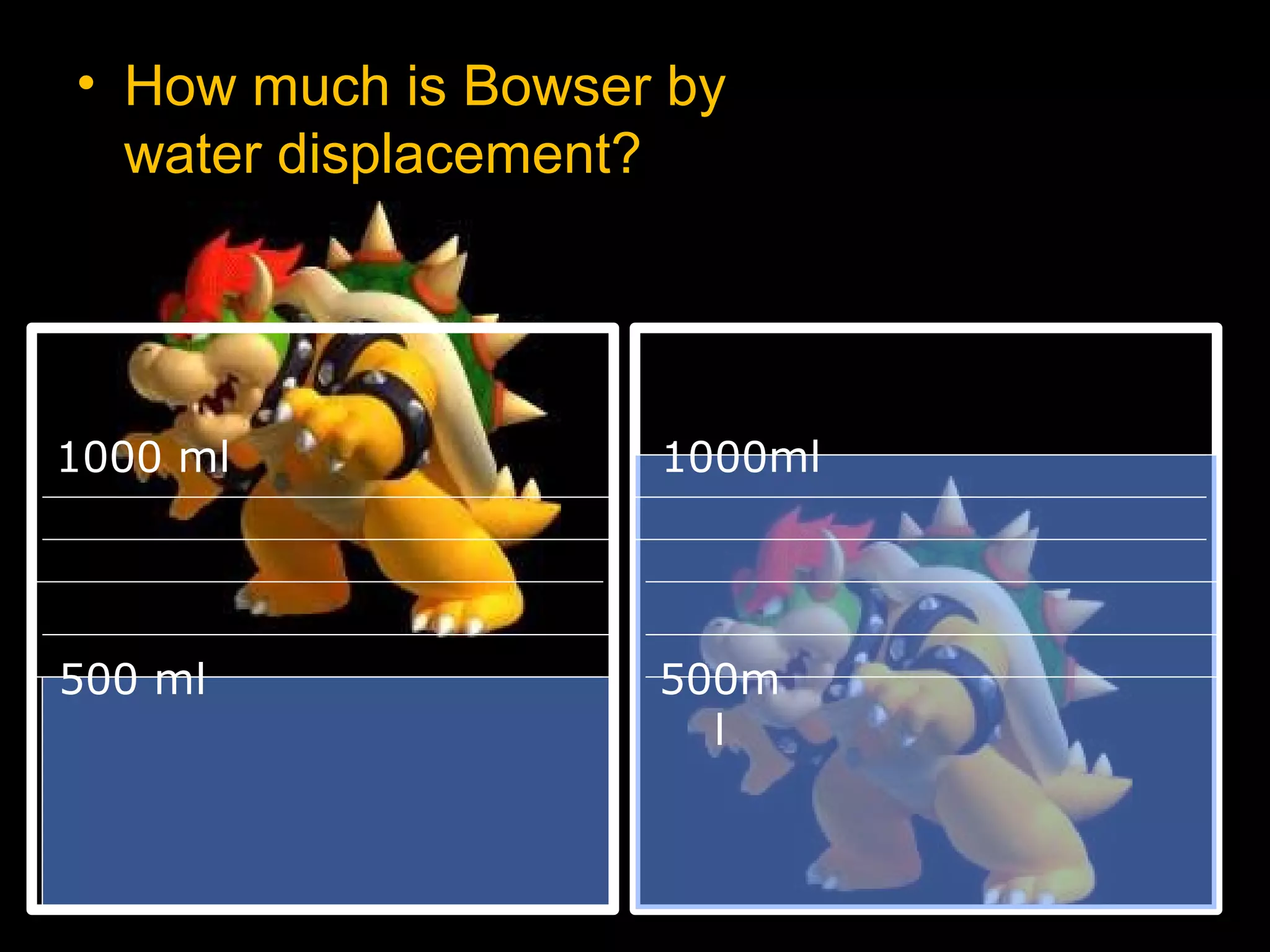
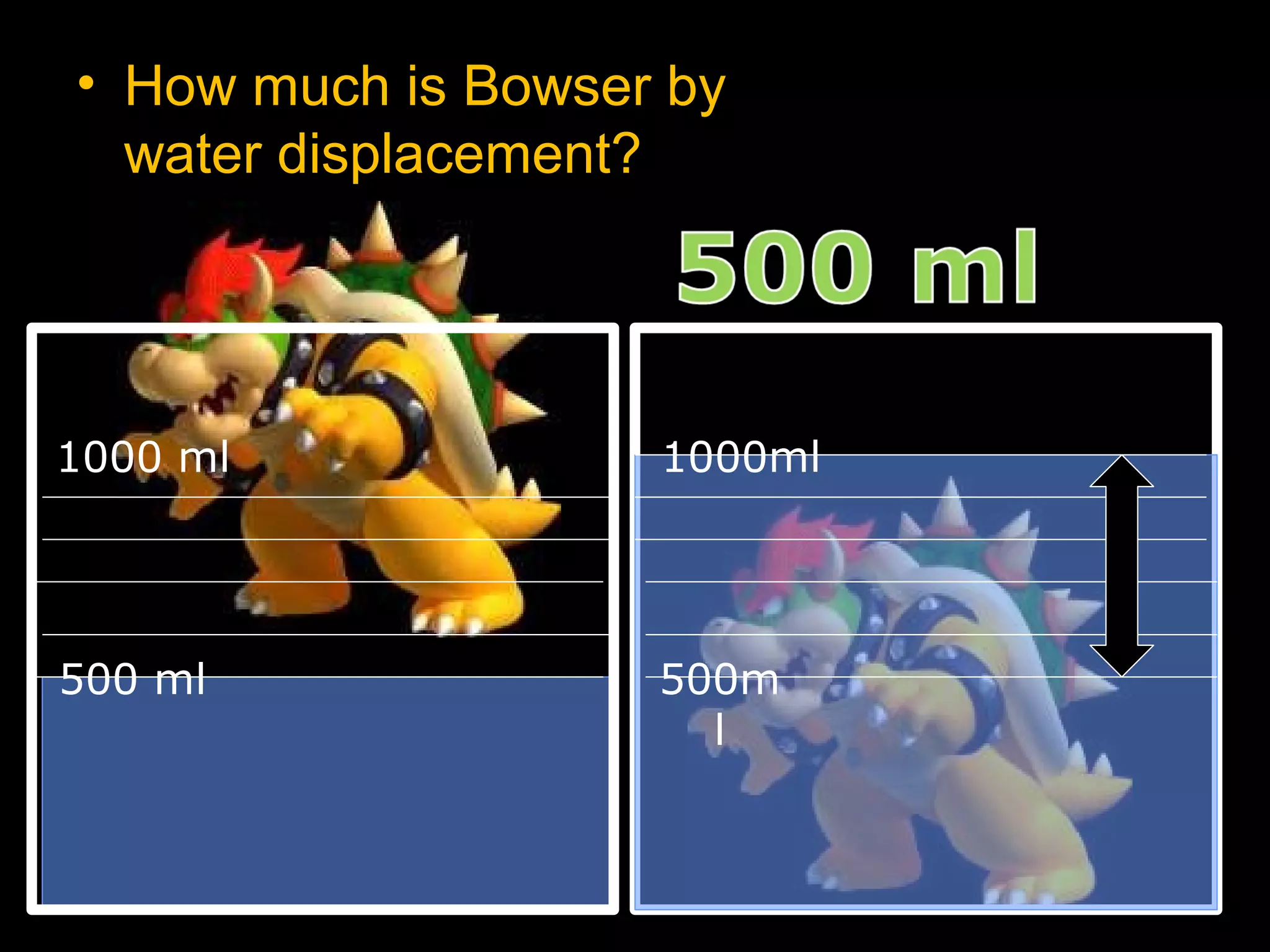
• How much is Bowser by
water displacement?
1000 ml 1000ml
500 ml 500m
l
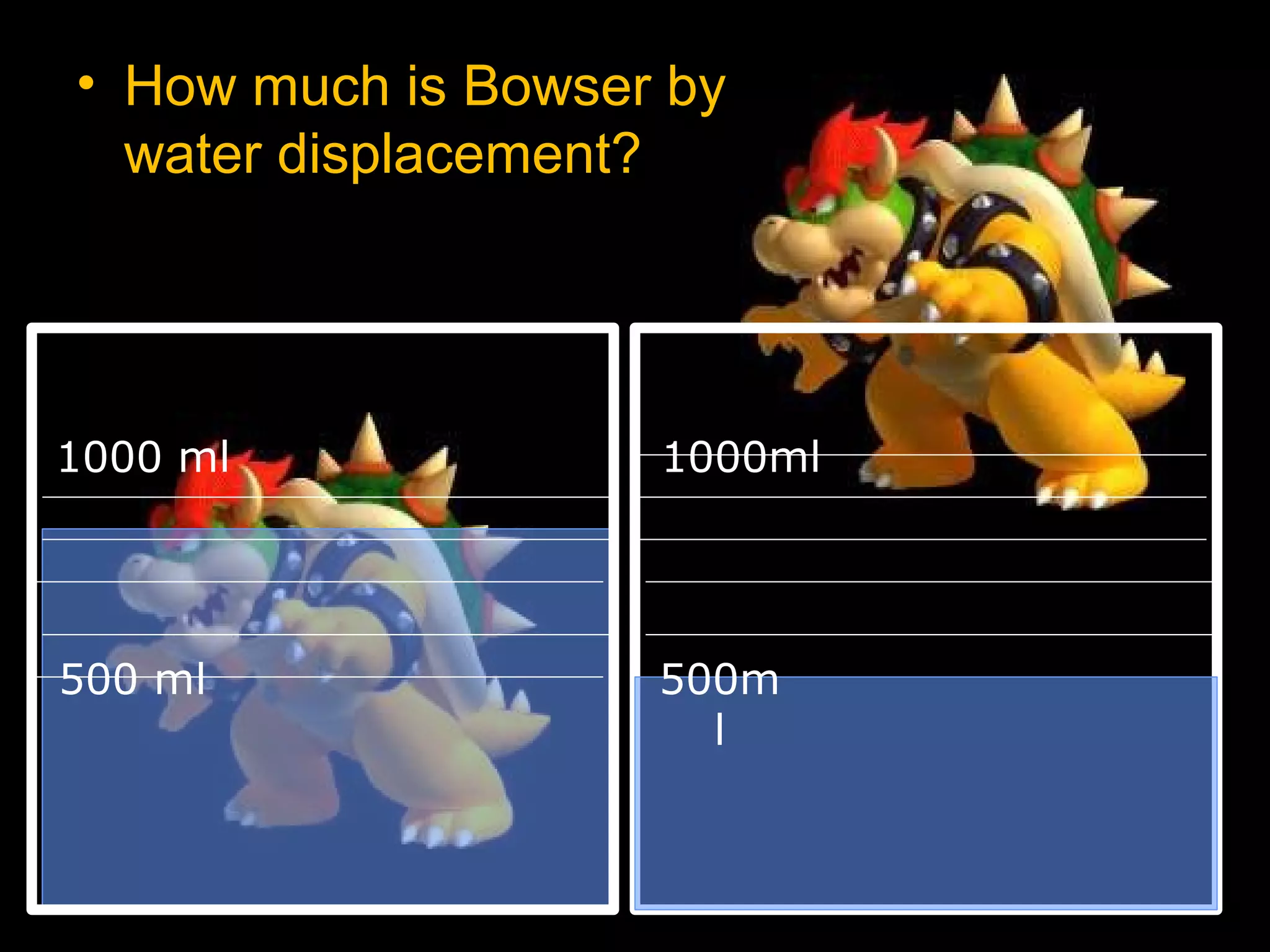
• How much is Bowser by
water displacement?
1000 ml 1000ml
500 ml 500m
l
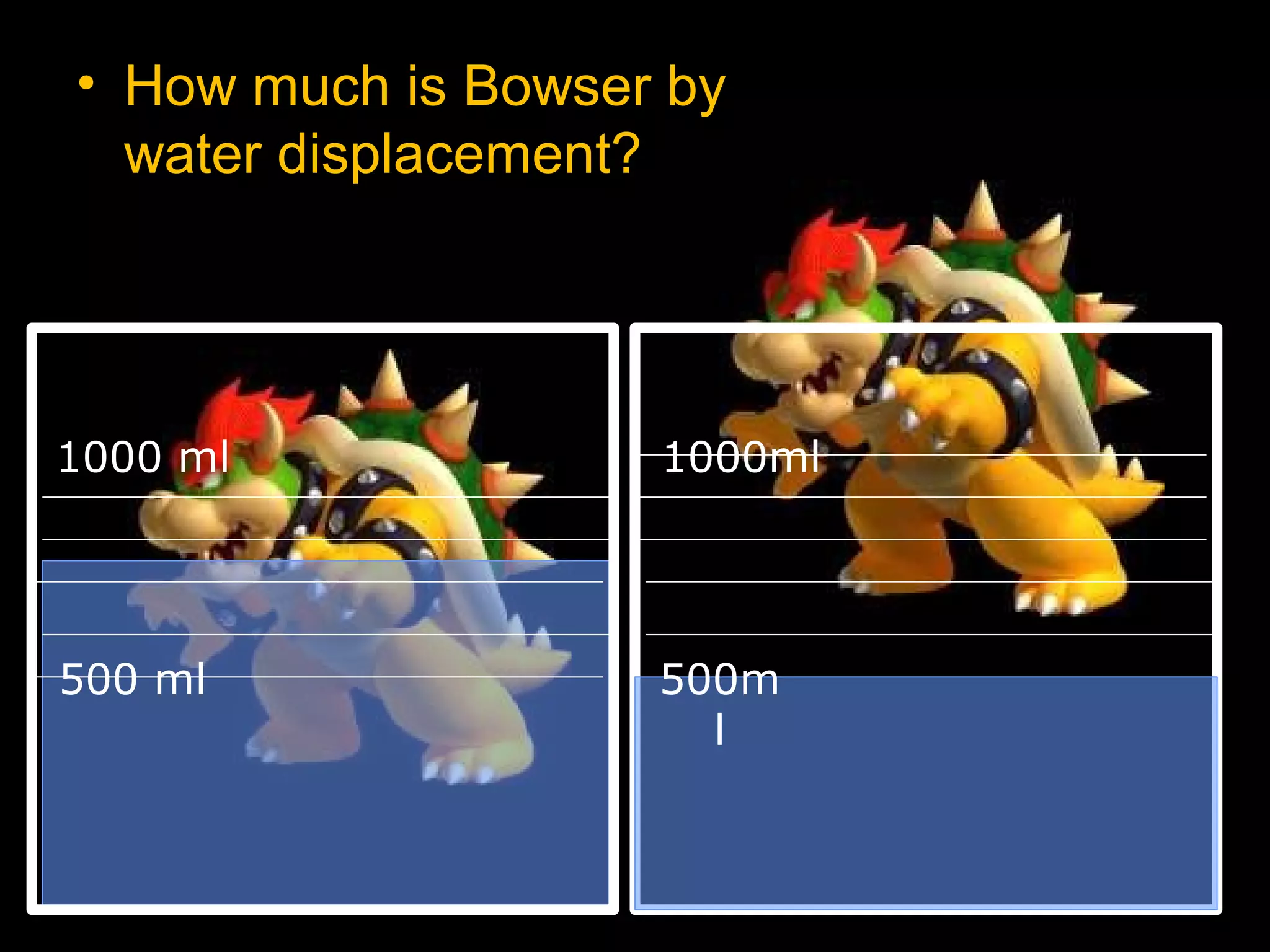
• How much is Bowser by
water displacement?
1000 ml 1000ml
500 ml 500m
l
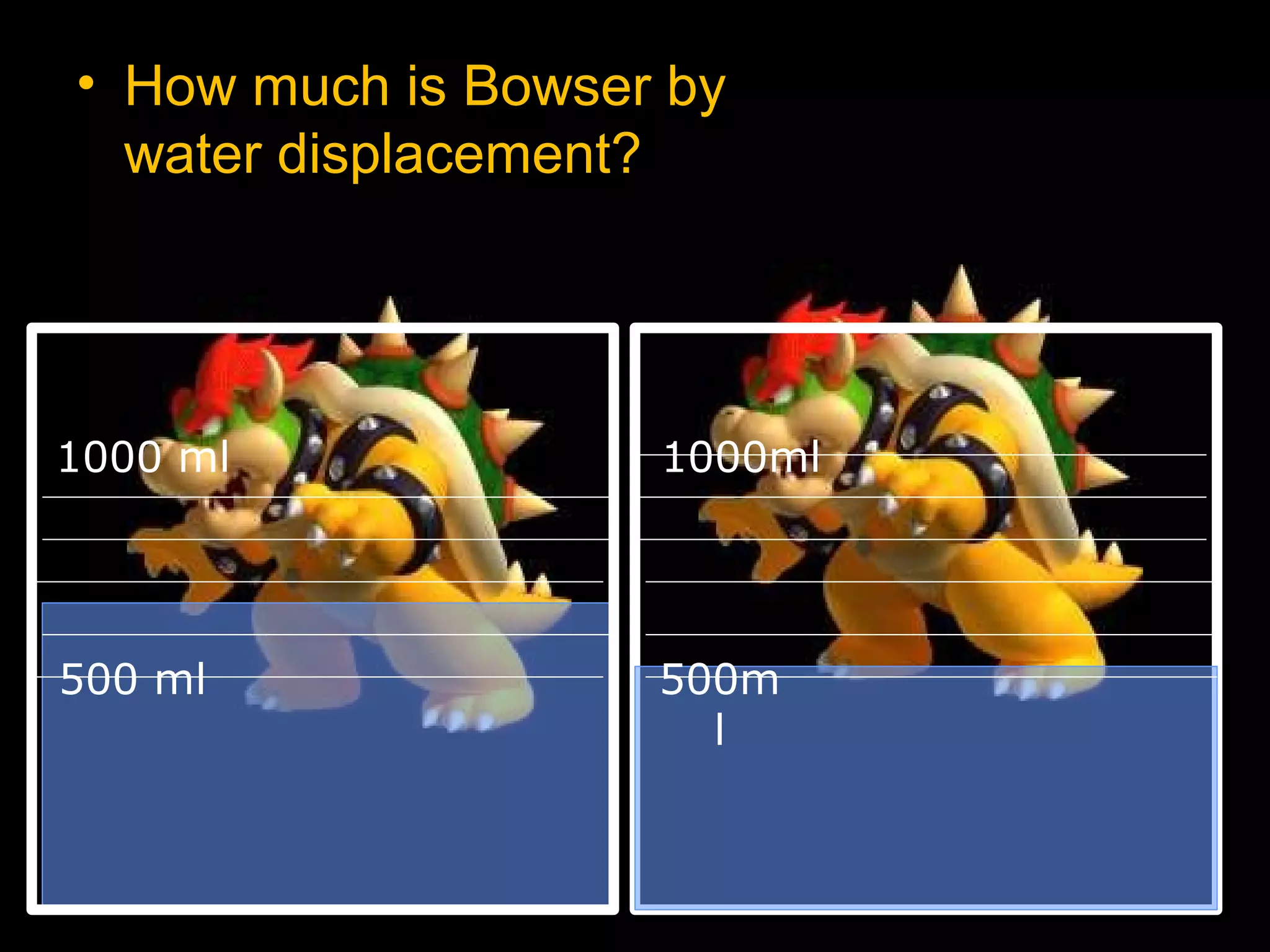
• How much is Bowser by
water displacement?
1000 ml 1000ml
500 ml 500m
l
• How much is Bowser by
water displacement?
1000 ml 1000ml
500 ml 500m
l
• How much is Bowser by
water displacement?
1000 ml 1000ml
500 ml 500m
l
• How much is Bowser by
water displacement?
1000 ml 1000ml
500 ml 500m
l
• How much is Bowser by
water displacement?
1000 ml 1000ml
500 ml 500m
l
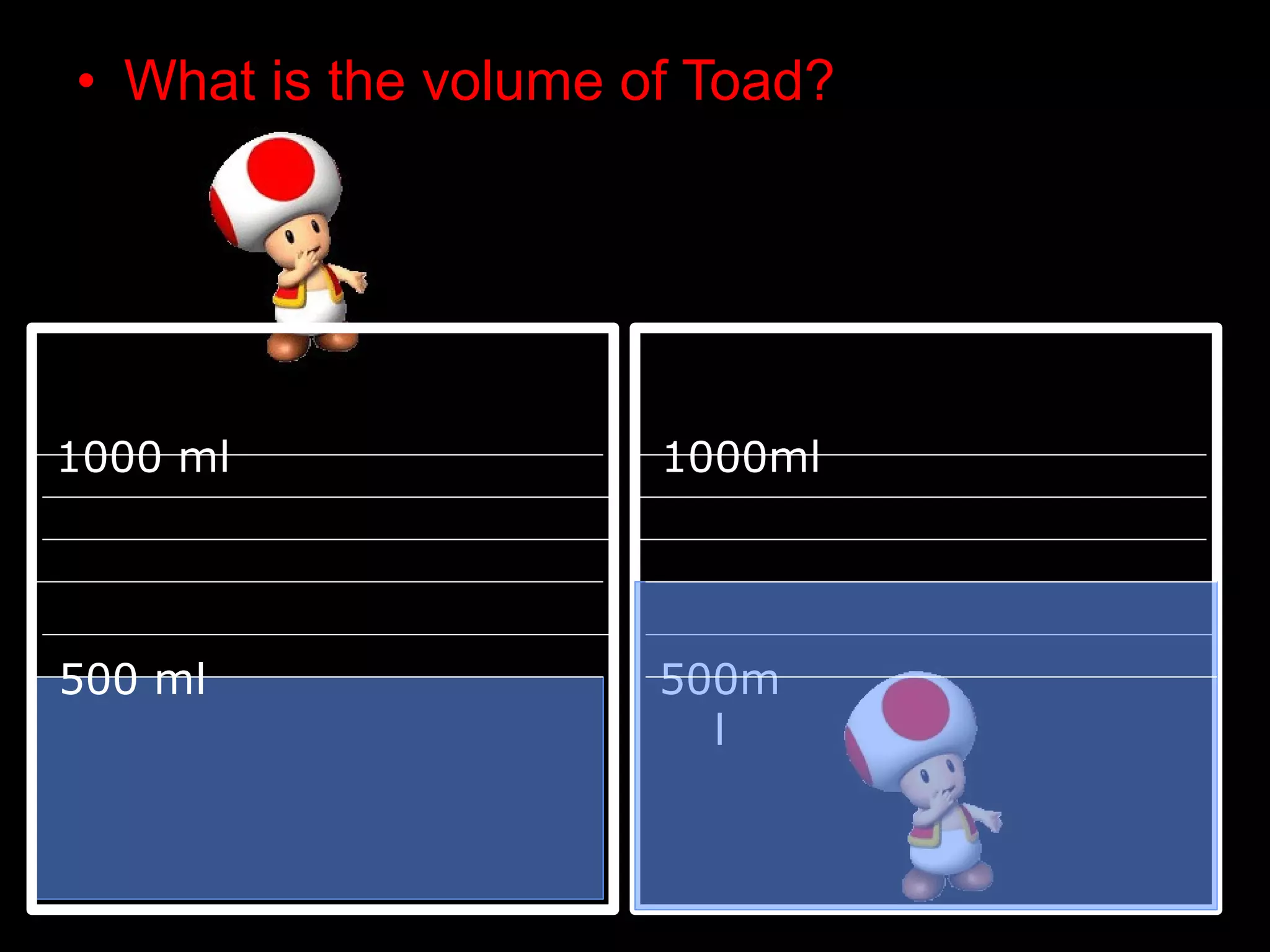
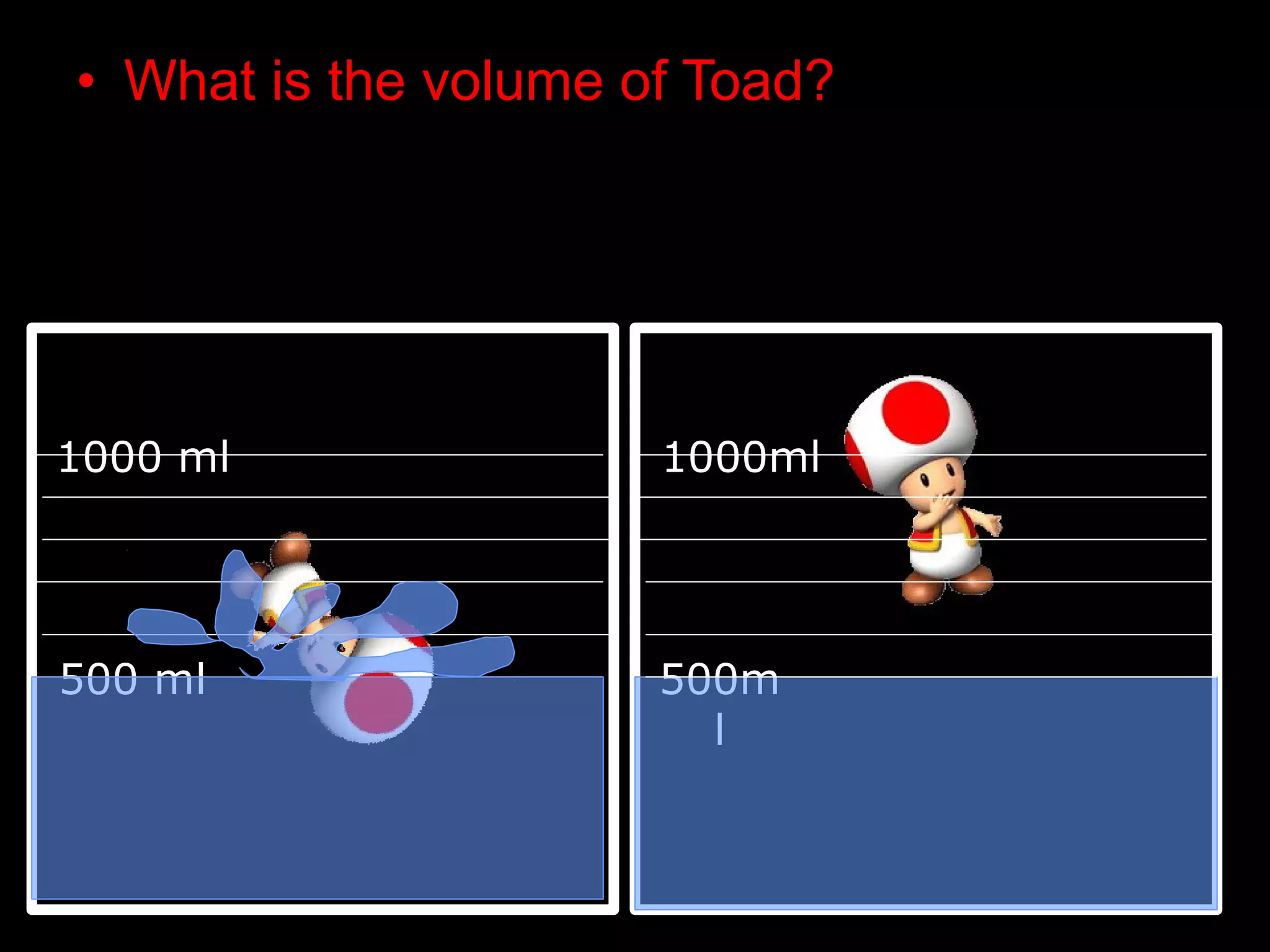
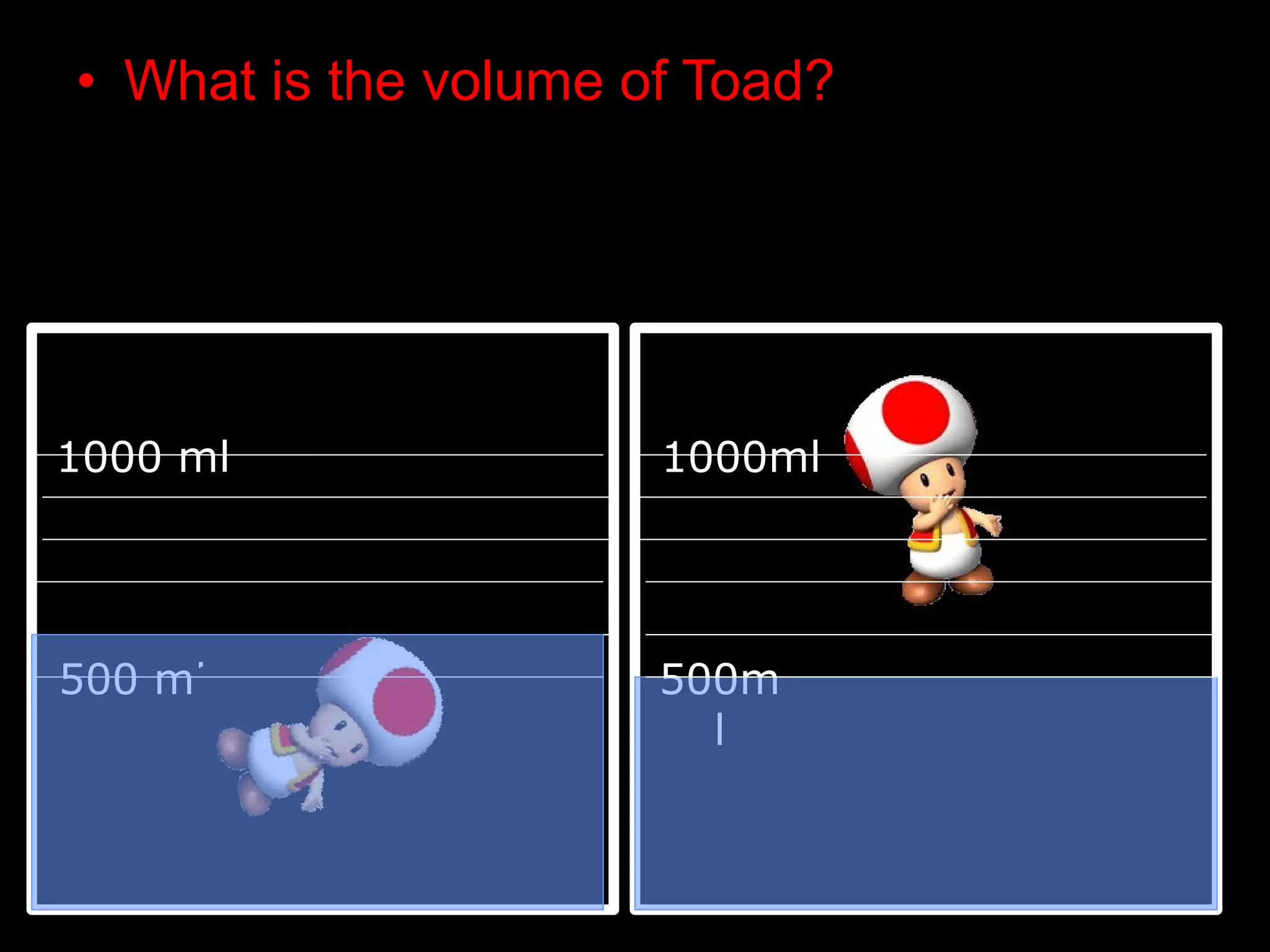
• What is the volume of Toad?
1000 ml 1000ml
500 ml 500m
l
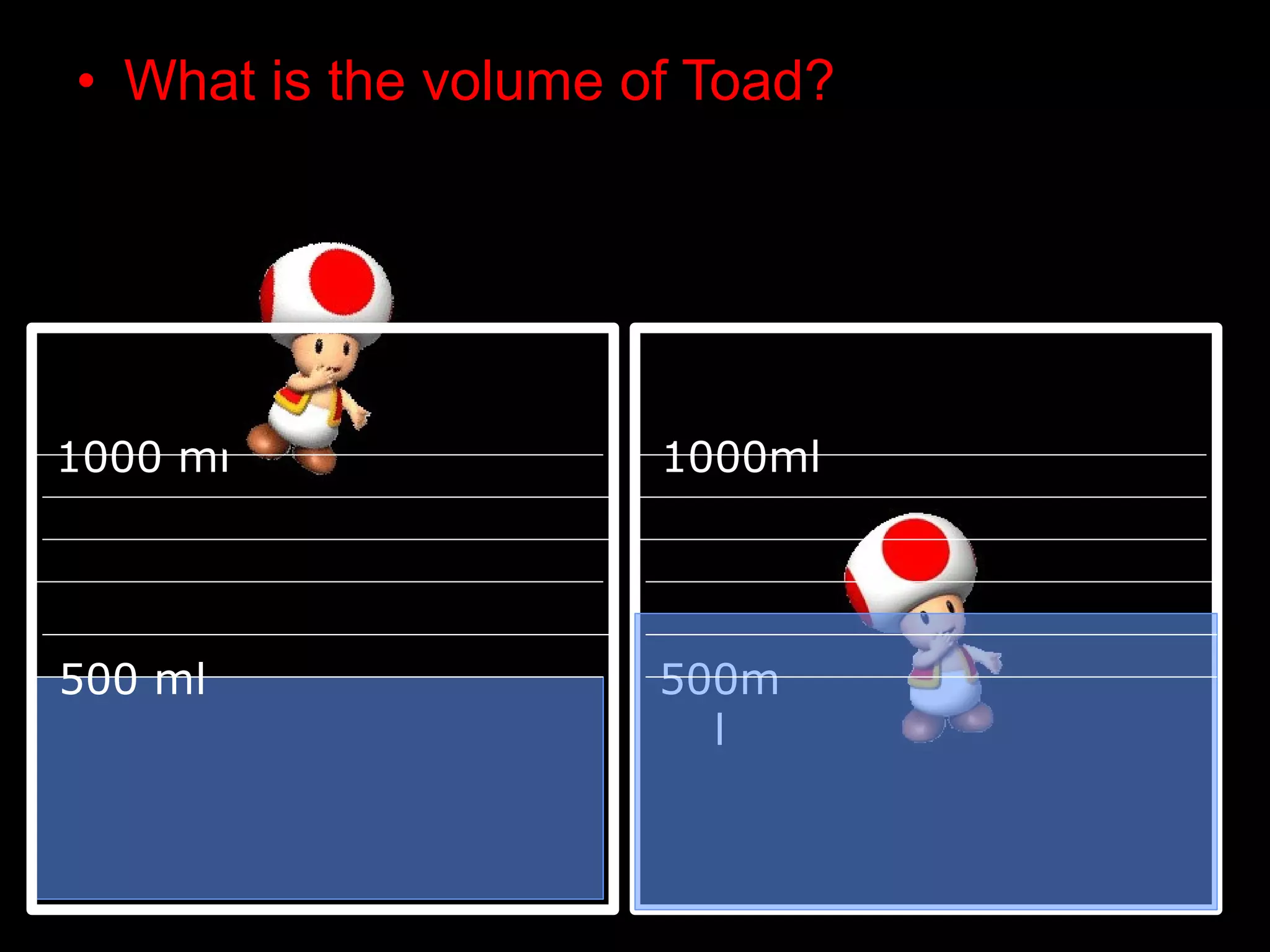
• What is the volume of Toad?
1000 ml 1000ml
500 ml 500m
l
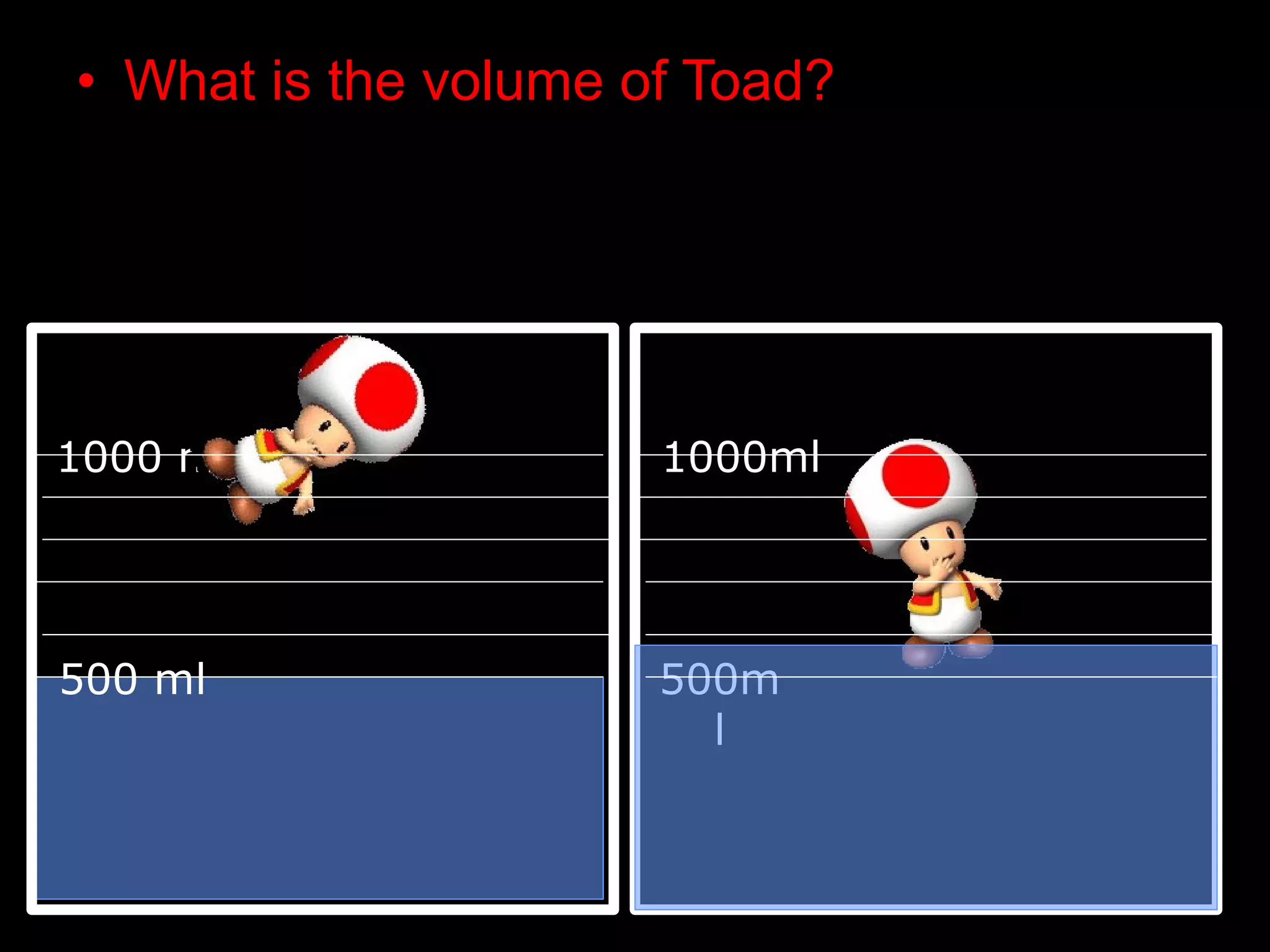
• What is the volume of Toad?
1000 ml
500 ml 500m
l
1000ml
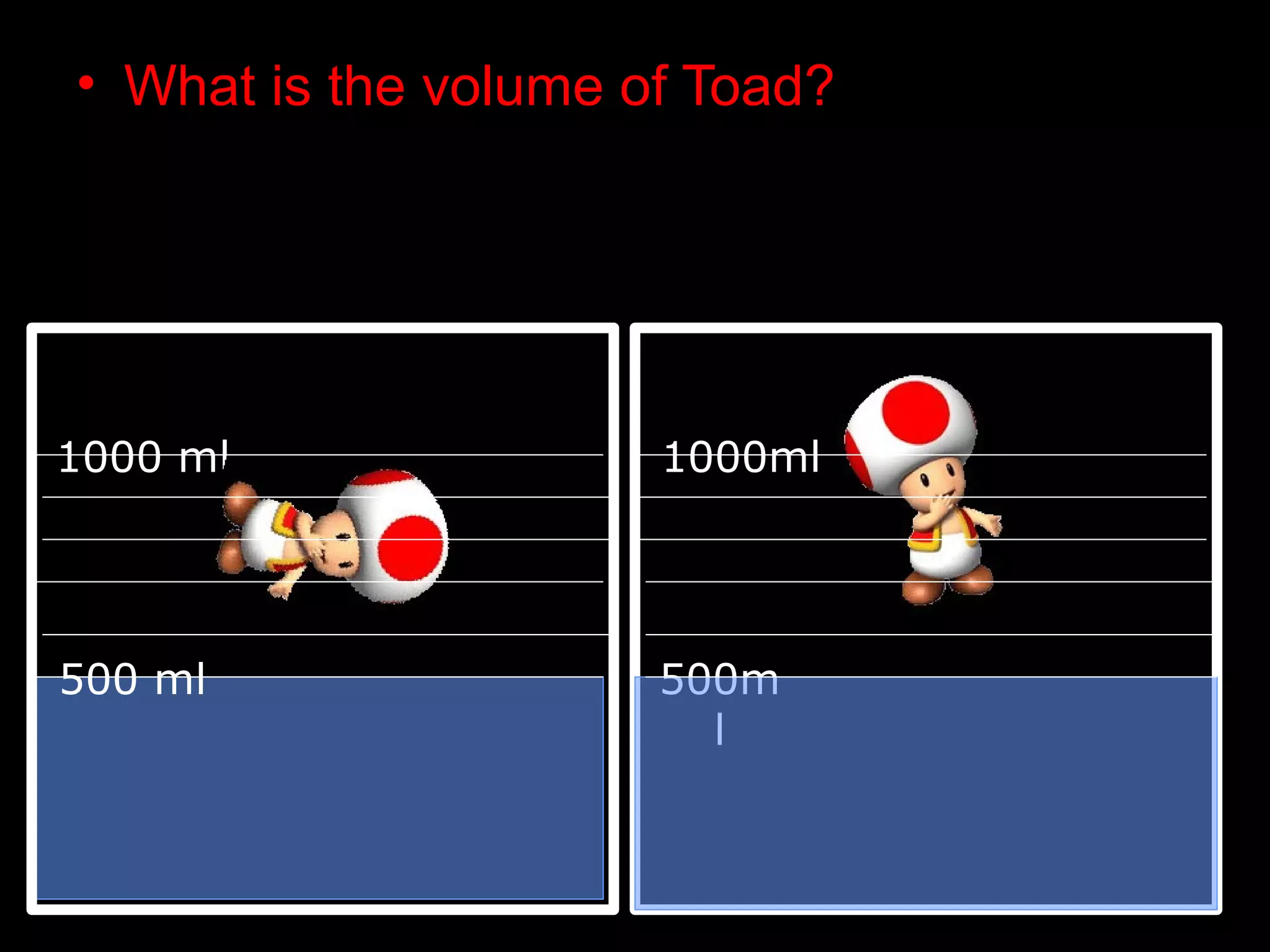
• What is the volume of Toad?
1000 ml 1000ml
500 ml 500m
l
• What is the volume of Toad?
1000 ml 1000ml
500 ml 500m
l
• What is the volume of Toad?
1000 ml 1000ml
500 ml 500m
l
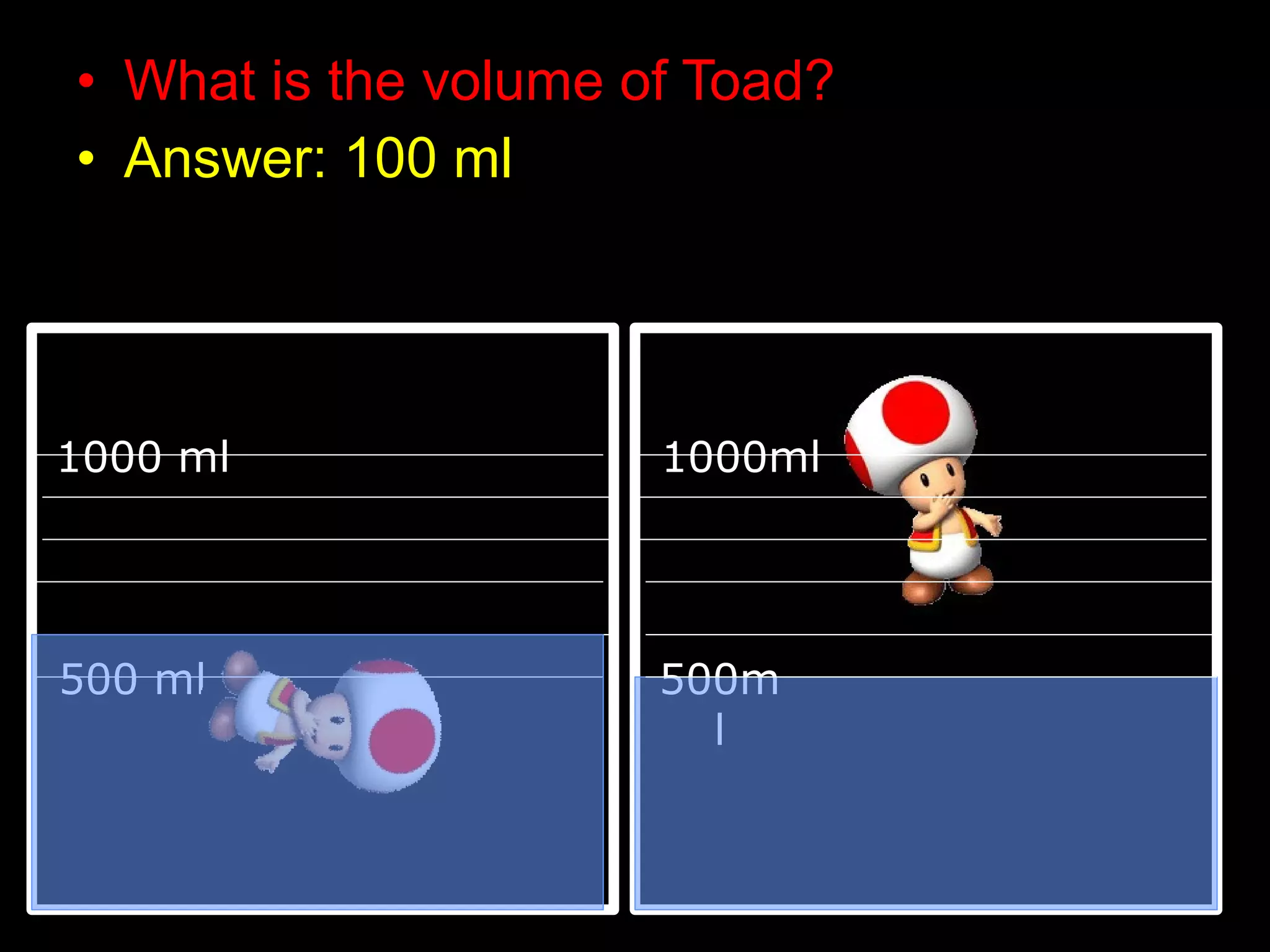
• What is the volume of Toad?
• Answer: 100 ml
1000 ml 1000ml
500 ml 500m
l
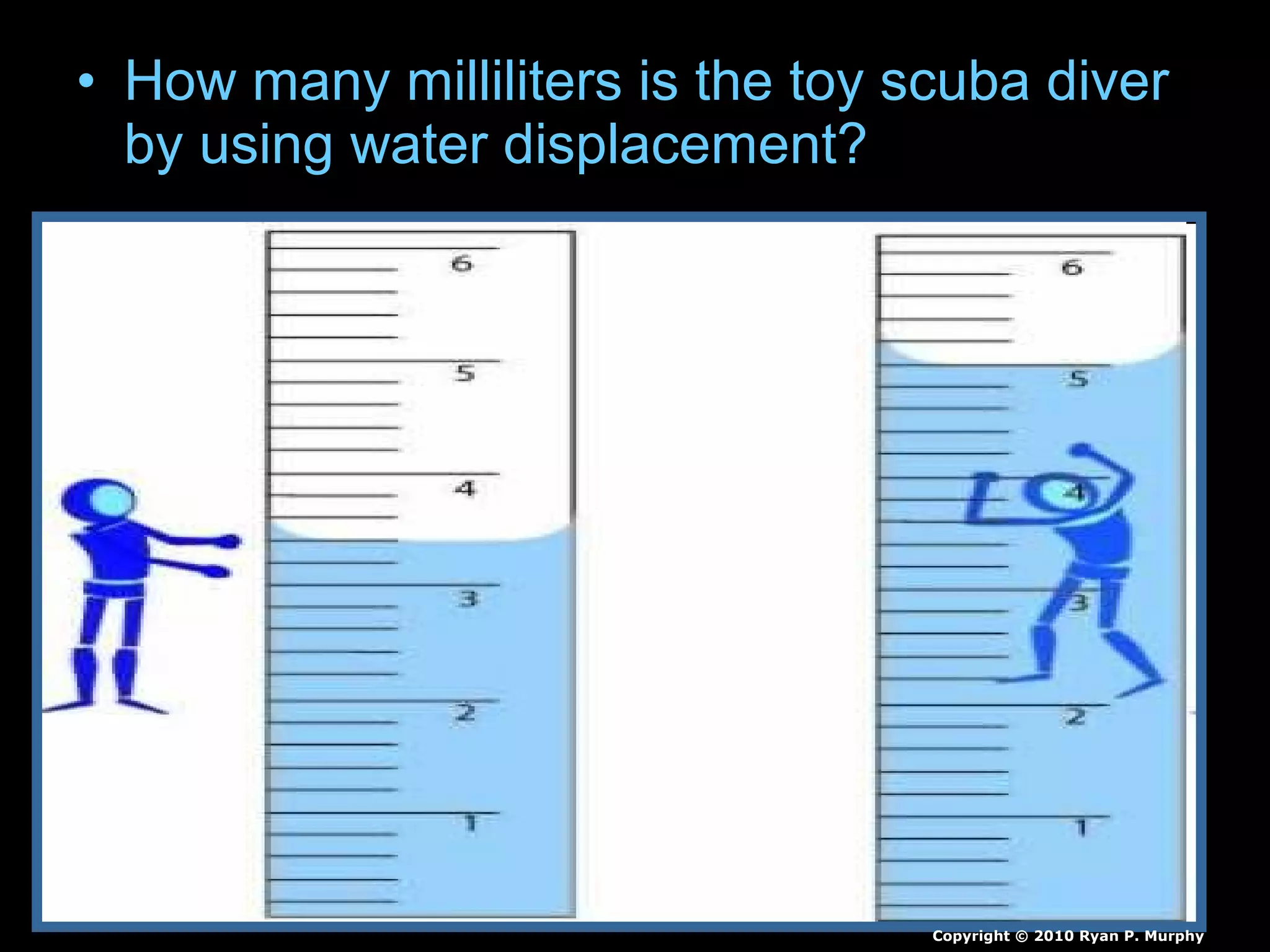
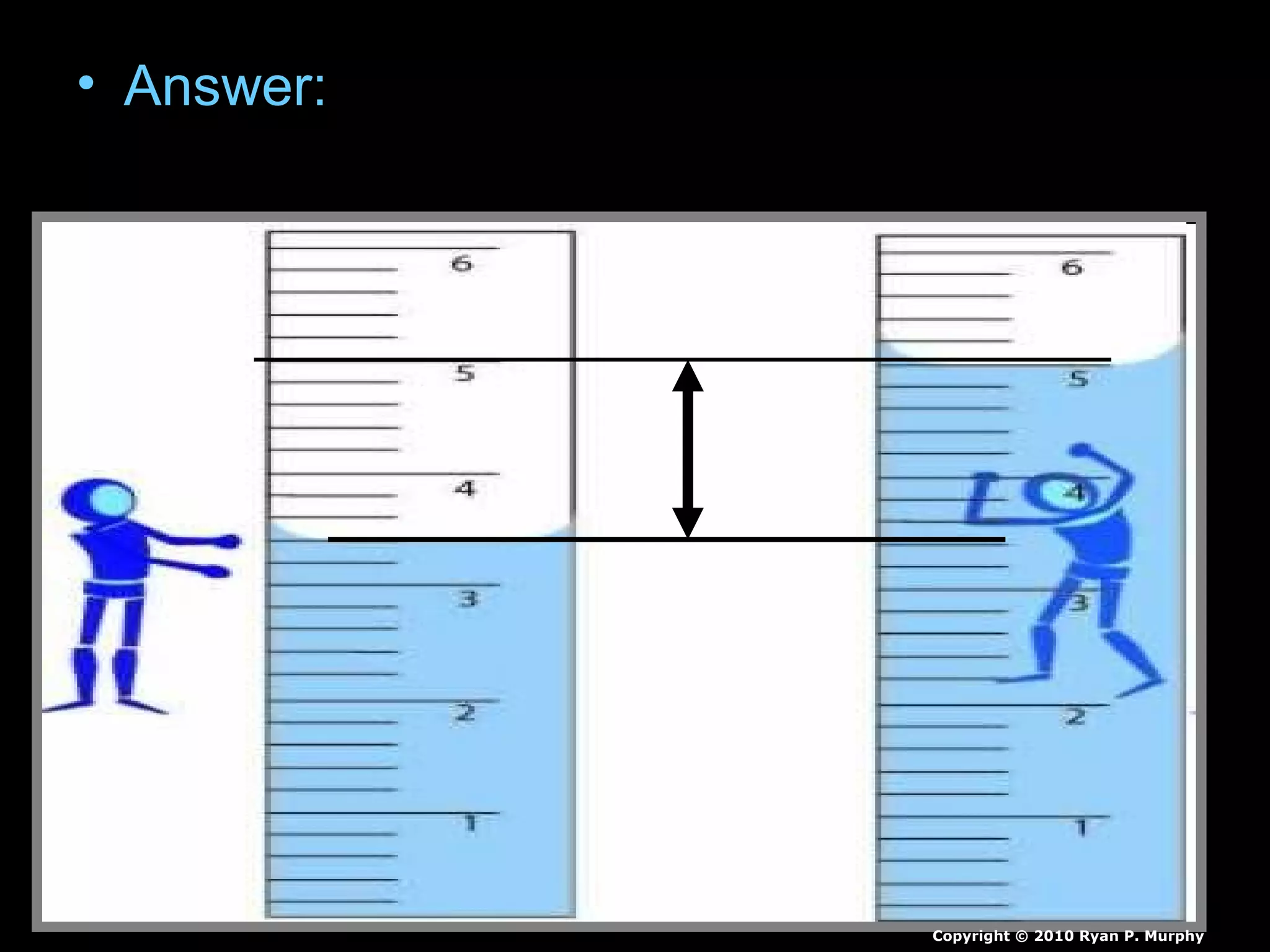
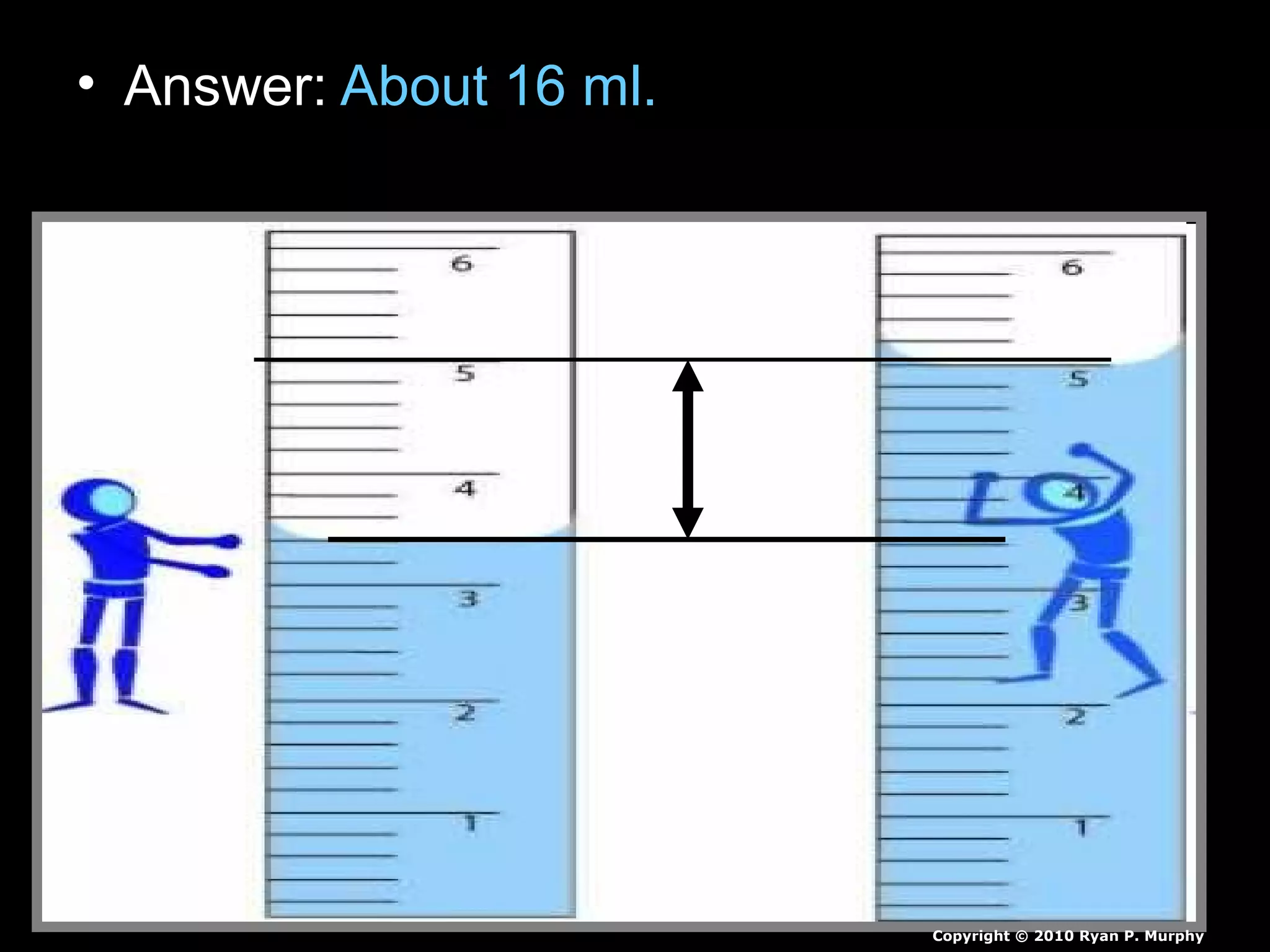
• How many milliliters is the toy scuba diver
by using water displacement?
Copyright © 2010 Ryan P. Murphy
• Answer:
Copyright © 2010 Ryan P. Murphy
• Answer: About 16 ml.
Copyright © 2010 Ryan P. Murphy
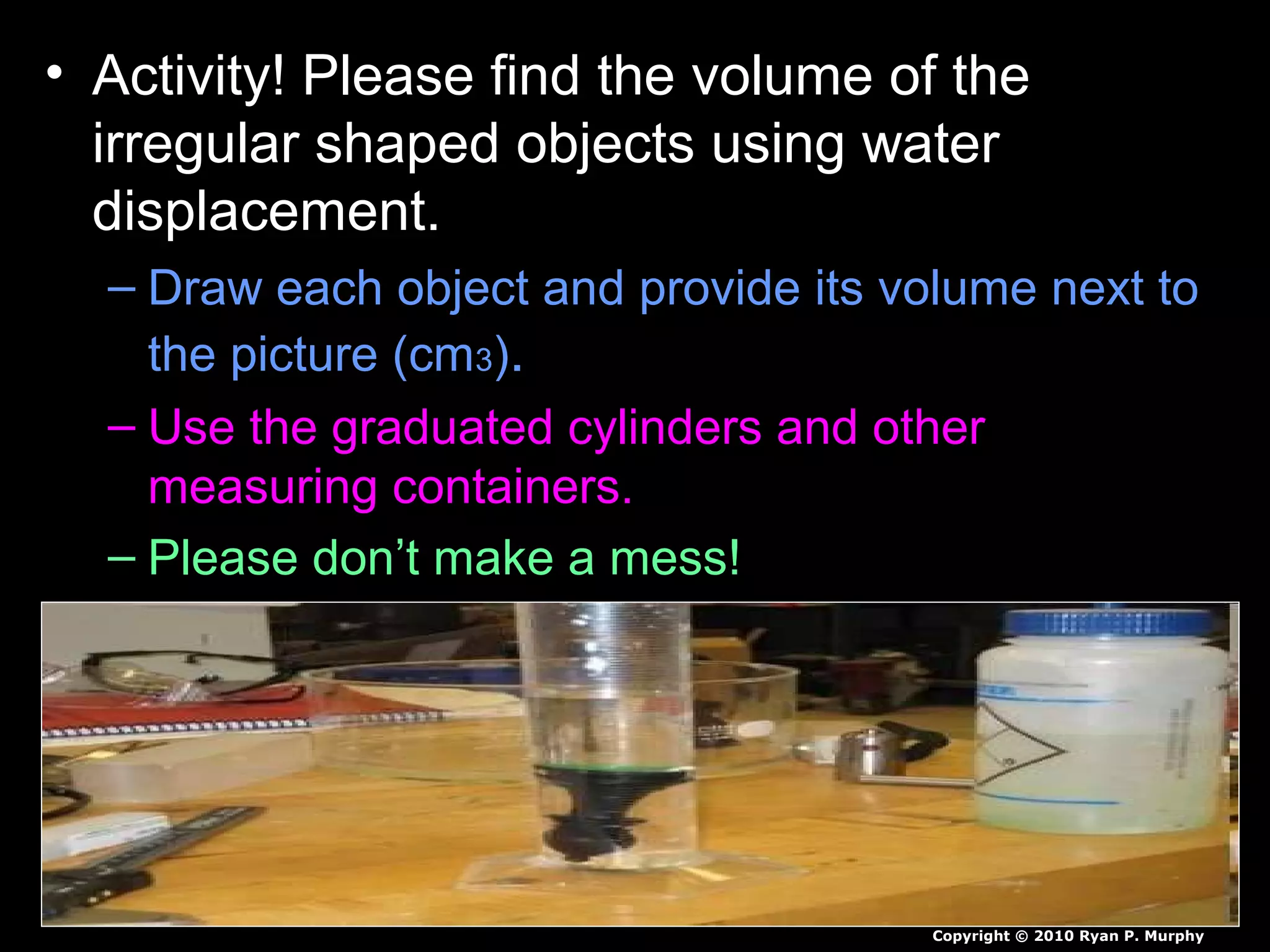
• Activity! Please find the volume of the
irregular shaped objects using water
displacement.
– Draw each object and provide its volume next to
the picture (cm3).
– Use the graduated cylinders and other
measuring containers.
– Please don’t make a mess!
Copyright © 2010 Ryan P. Murphy
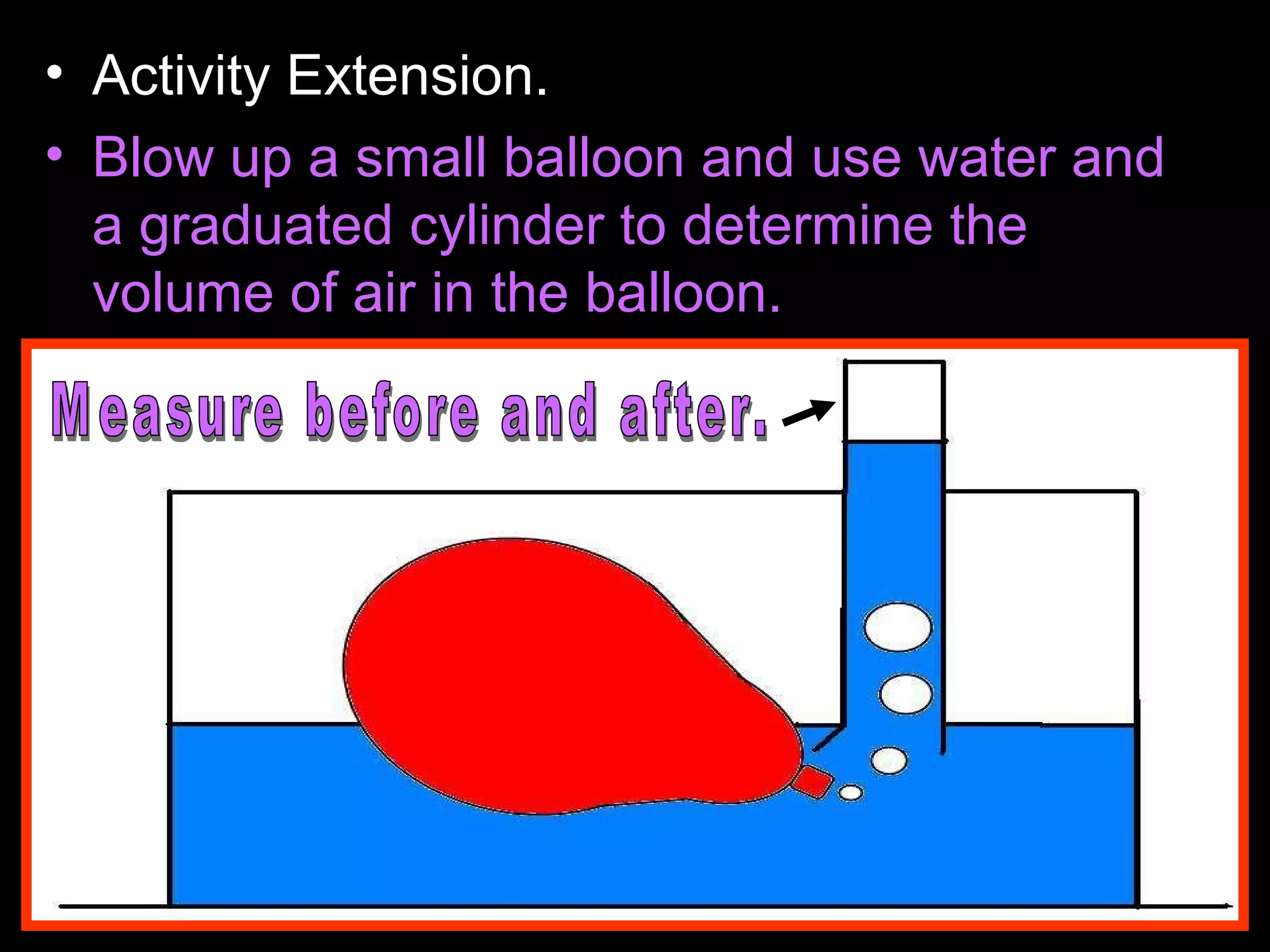
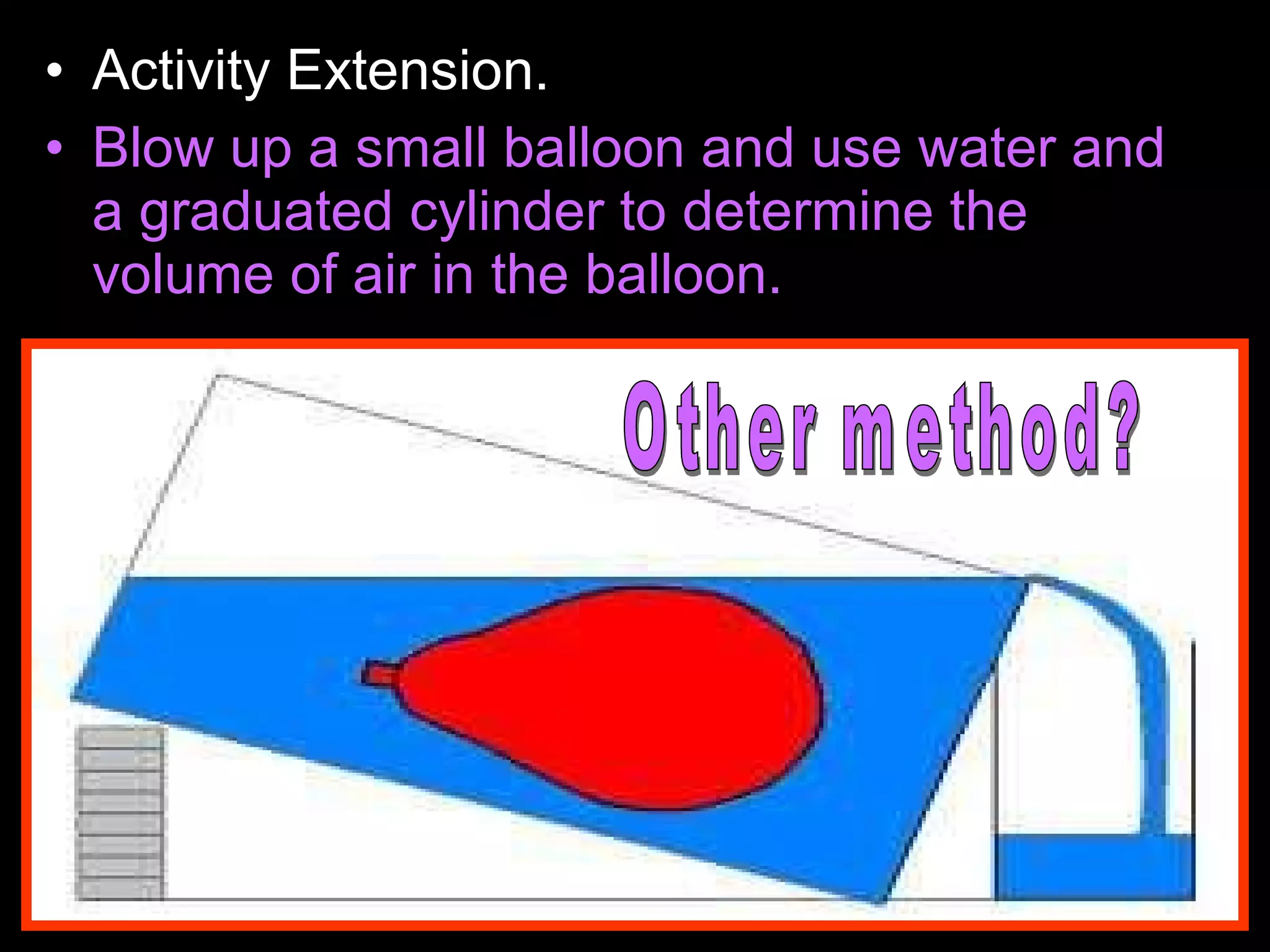
• Activity Extension.
• Blow up a small balloon and use water and
a graduated cylinder to determine the
volume of air in the balloon.
• Activity Extension.
• Blow up a small balloon and use water and
a graduated cylinder to determine the
volume of air in the balloon.
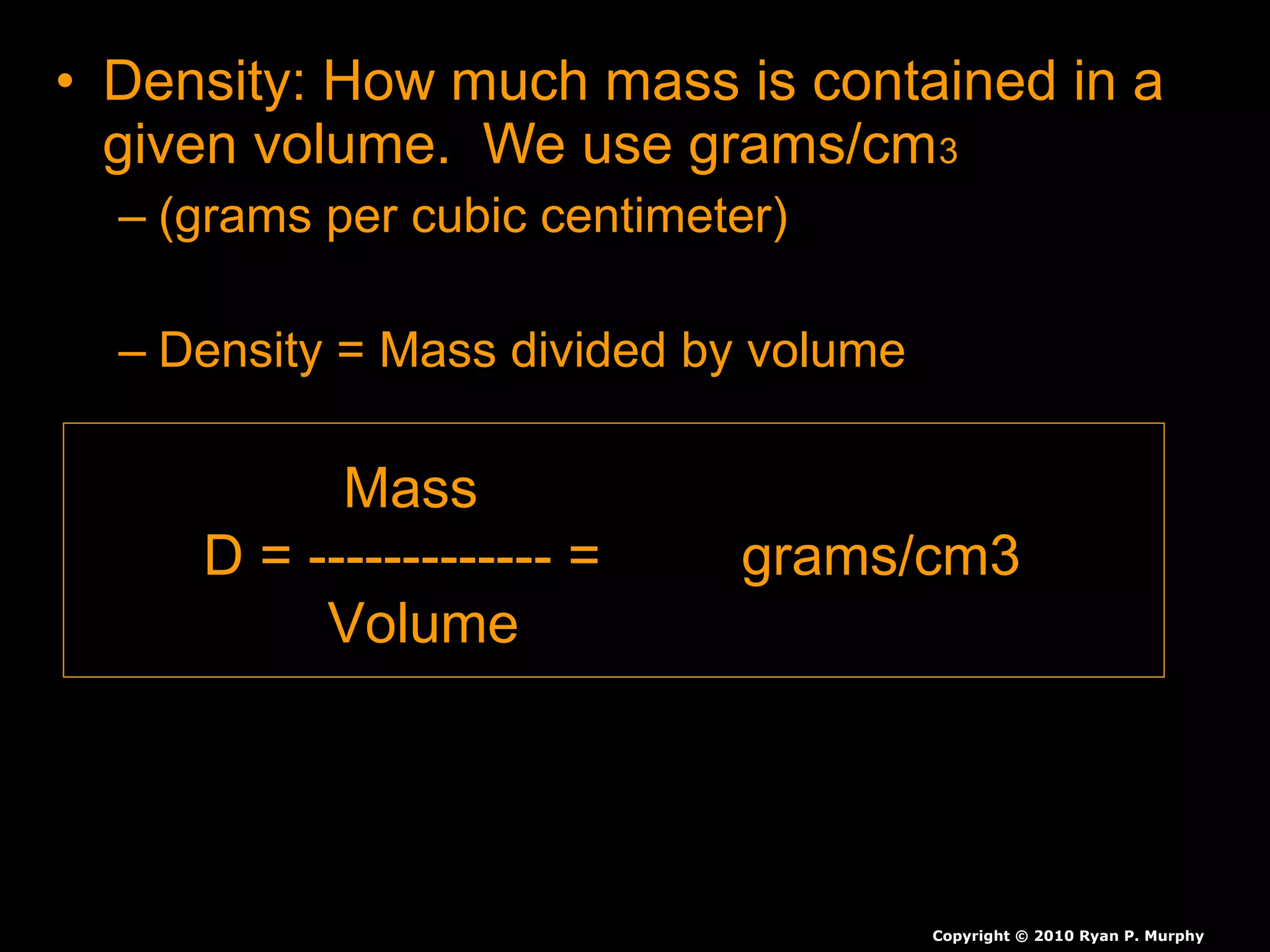
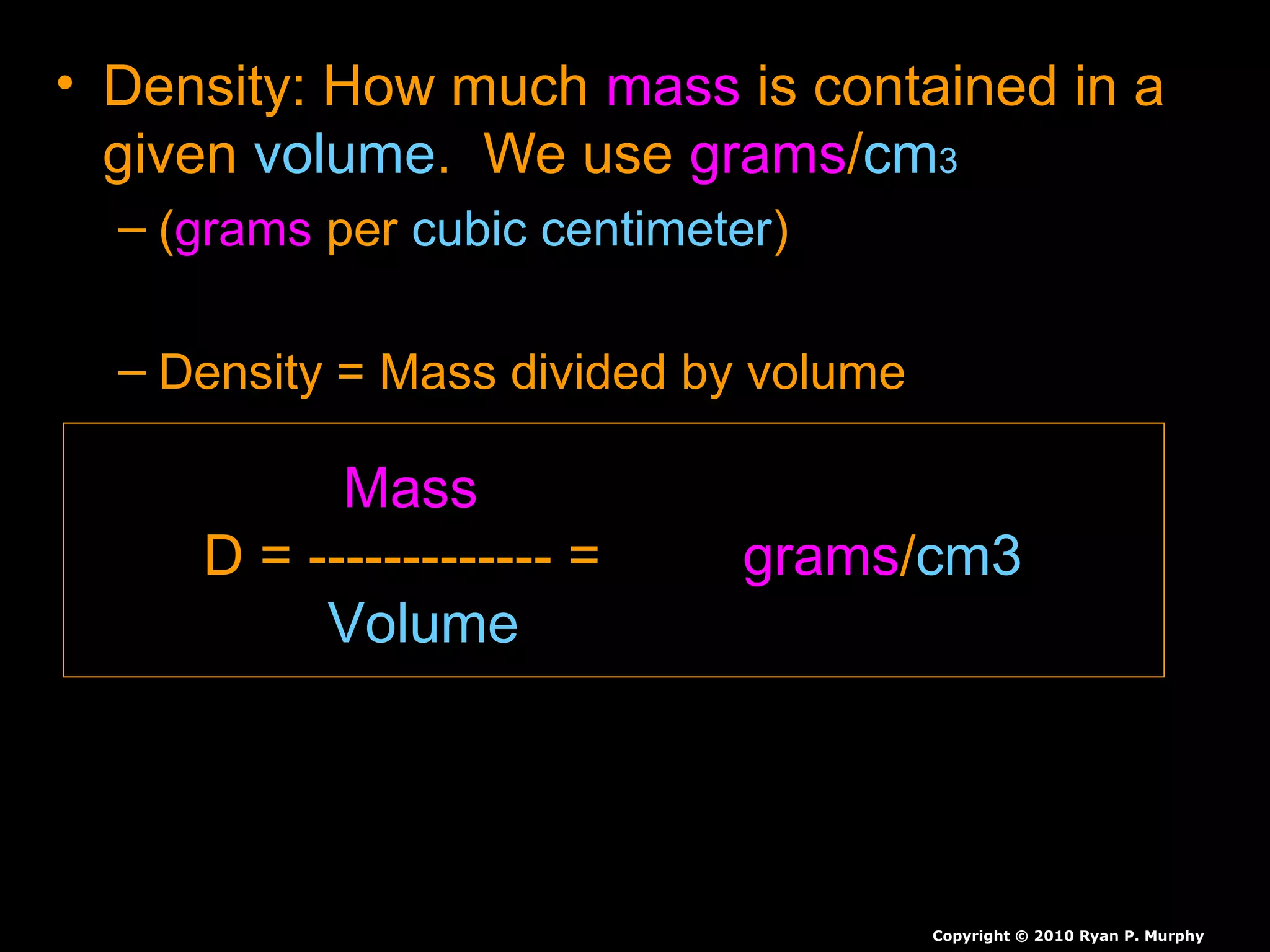
• Density: How much mass is contained in a
given volume. We use grams/cm3
– (grams per cubic centimeter)
Copyright © 2010 Ryan P. Murphy
• Density: How much mass is contained in a
given volume. We use grams/cm3
– (grams per cubic centimeter)
– Density = Mass divided by volume
Copyright © 2010 Ryan P. Murphy
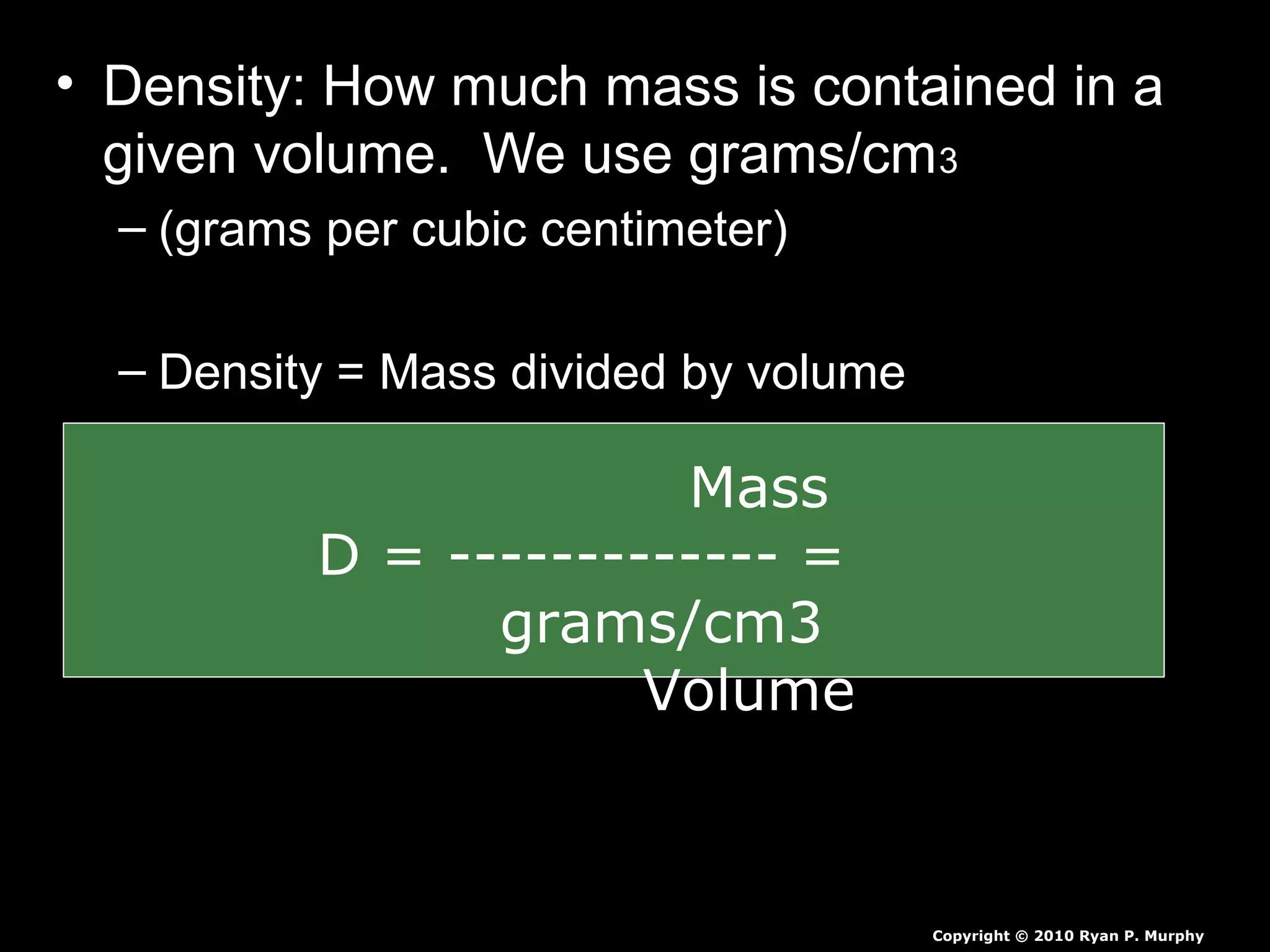
• Density: How much mass is contained in a
given volume. We use grams/cm3
– (grams per cubic centimeter)
– Density = Mass divided by volume
Copyright © 2010 Ryan P. Murphy
Mass
D = ------------- =
grams/cm3
Volume
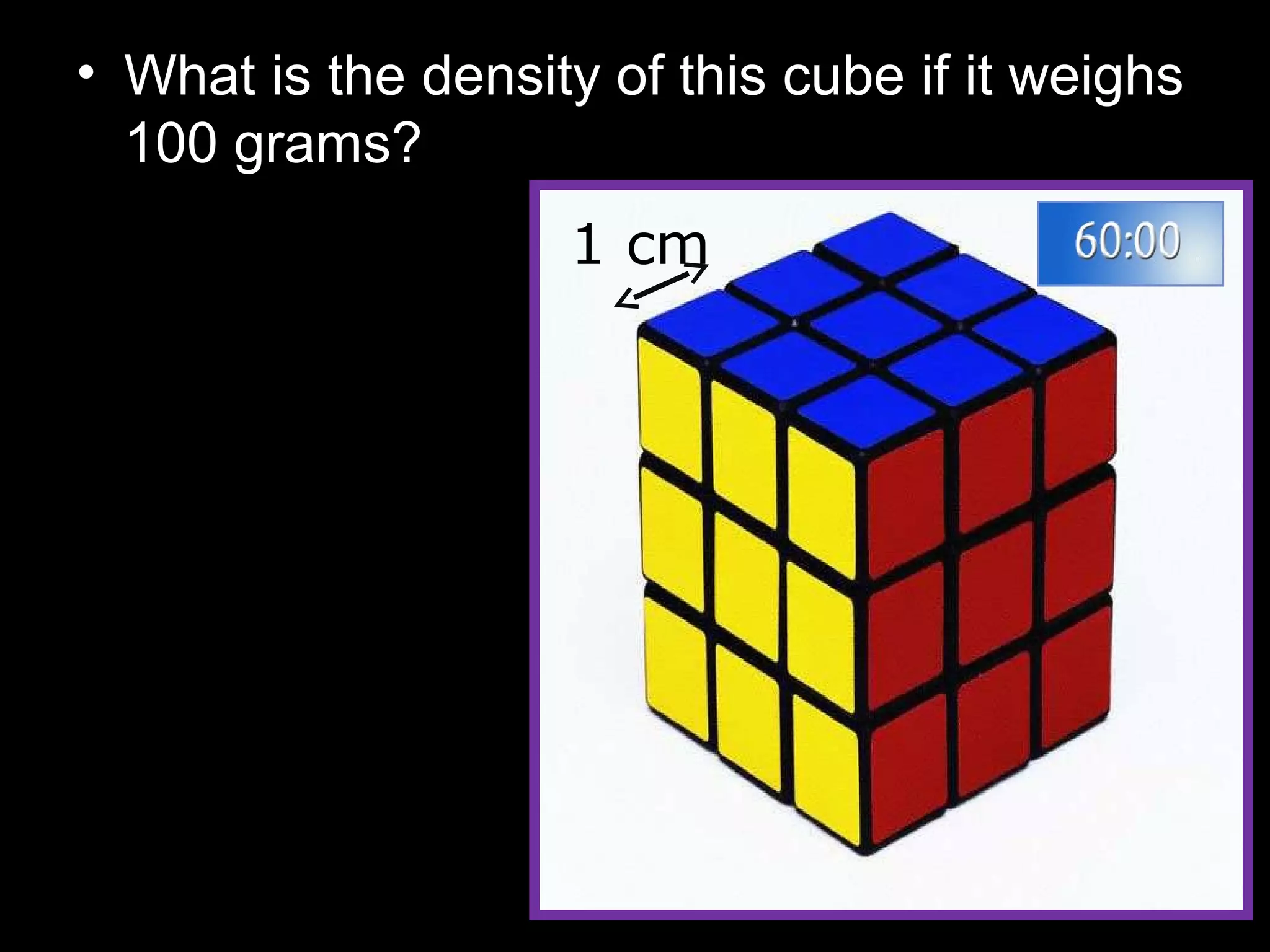
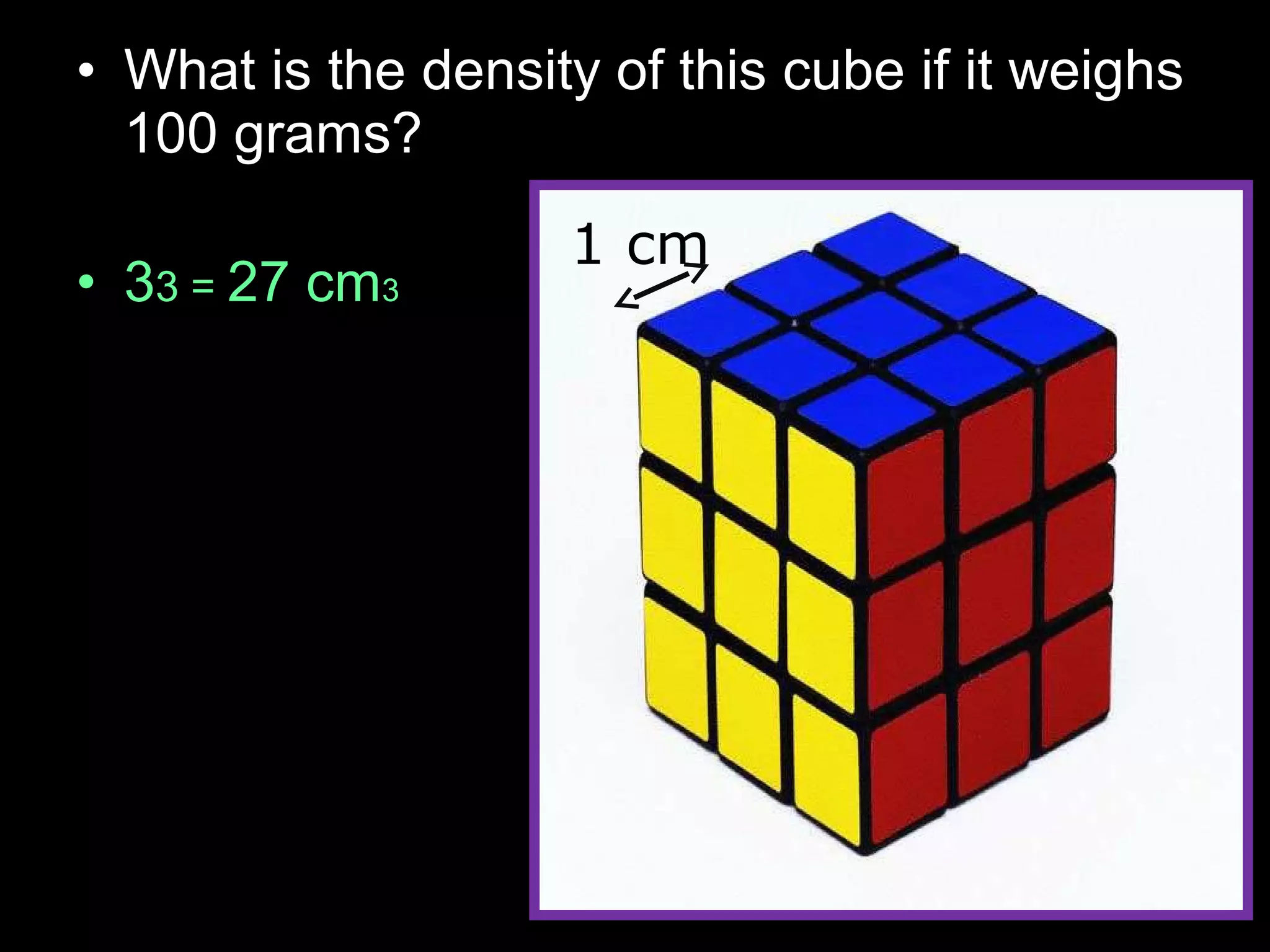
• What is the density of this cube if it weighs
100 grams?
1 cm
• What is the density of this cube if it weighs
100 grams?
• 33 = 27 cm3
1 cm
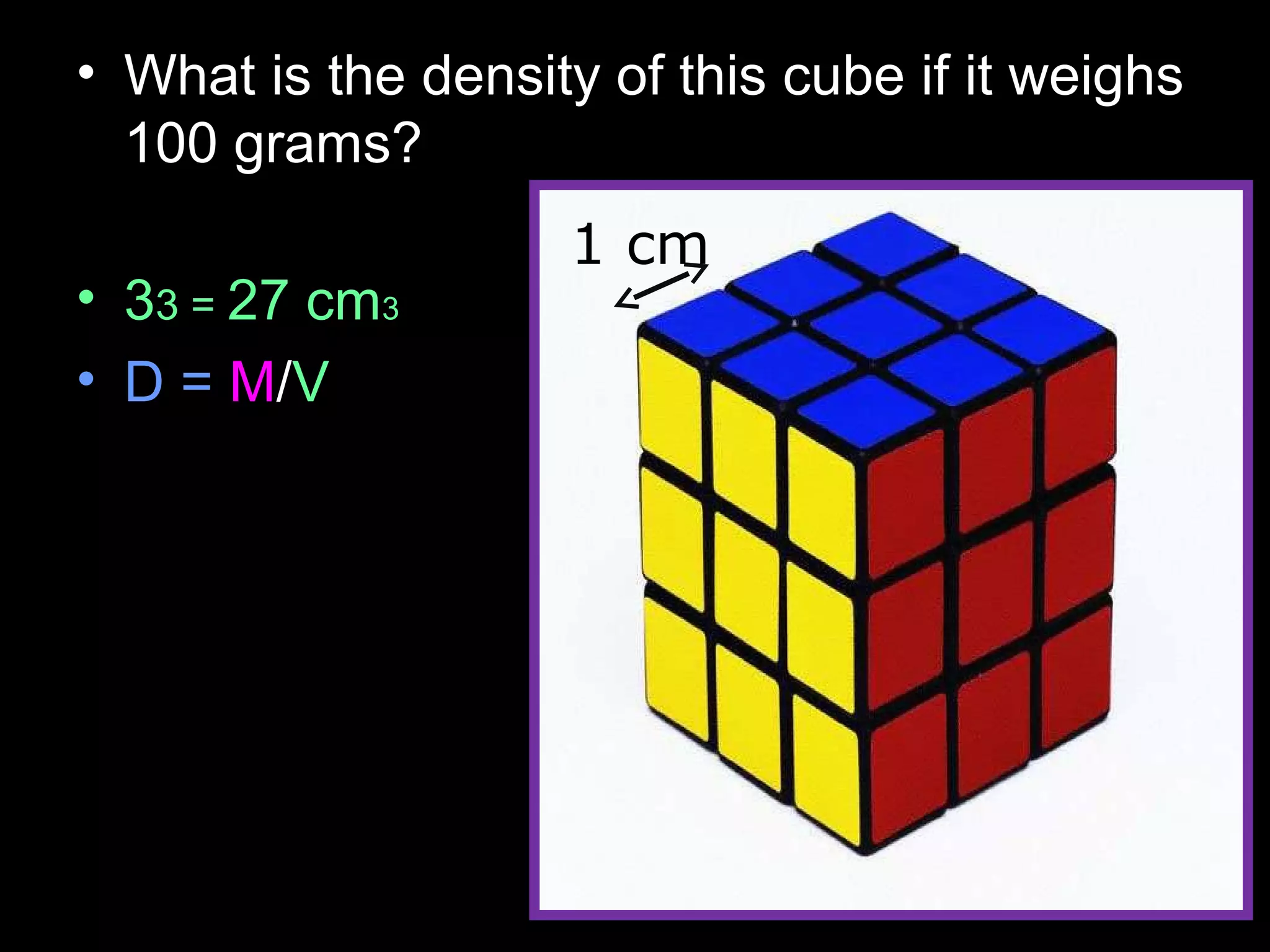
• What is the density of this cube if it weighs
100 grams?
• 33 = 27 cm3
• D = M/V
1 cm
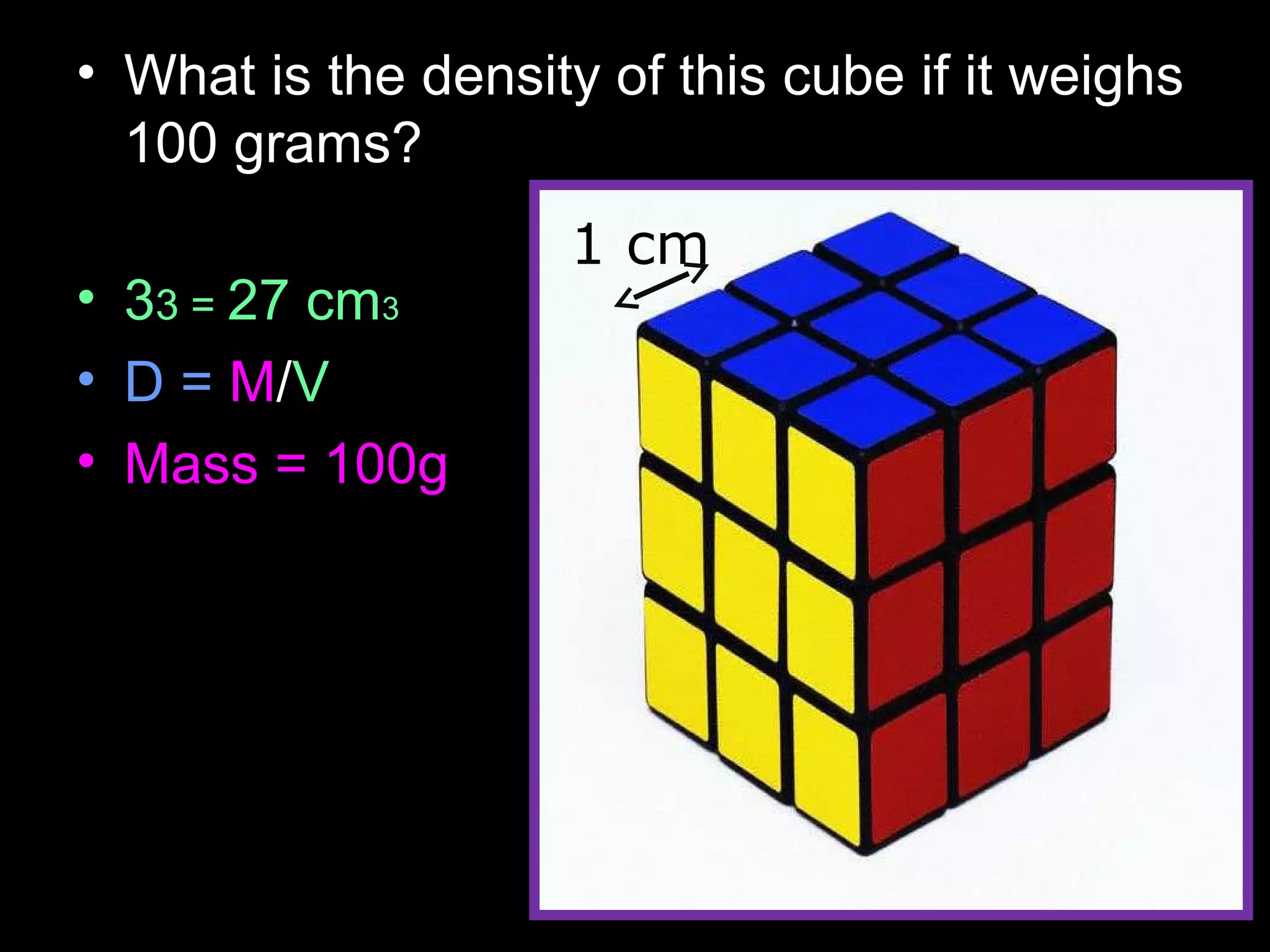
• What is the density of this cube if it weighs
100 grams?
• 33 = 27 cm3
• D = M/V
• Mass = 100g
1 cm
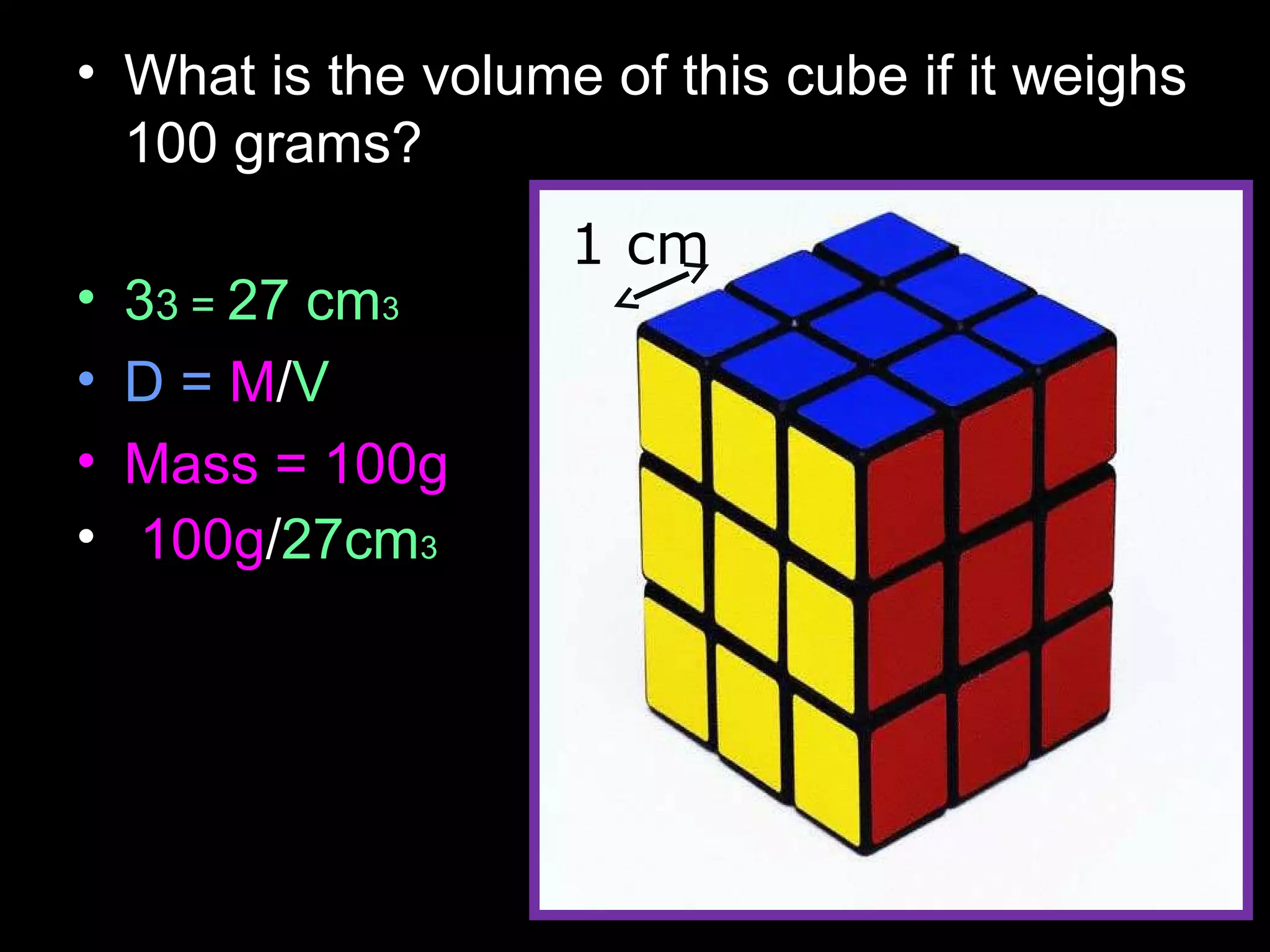
• What is the volume of this cube if it weighs
100 grams?
• 33 = 27 cm3
• D = M/V
• Mass = 100g
• 100g/27cm3
1 cm
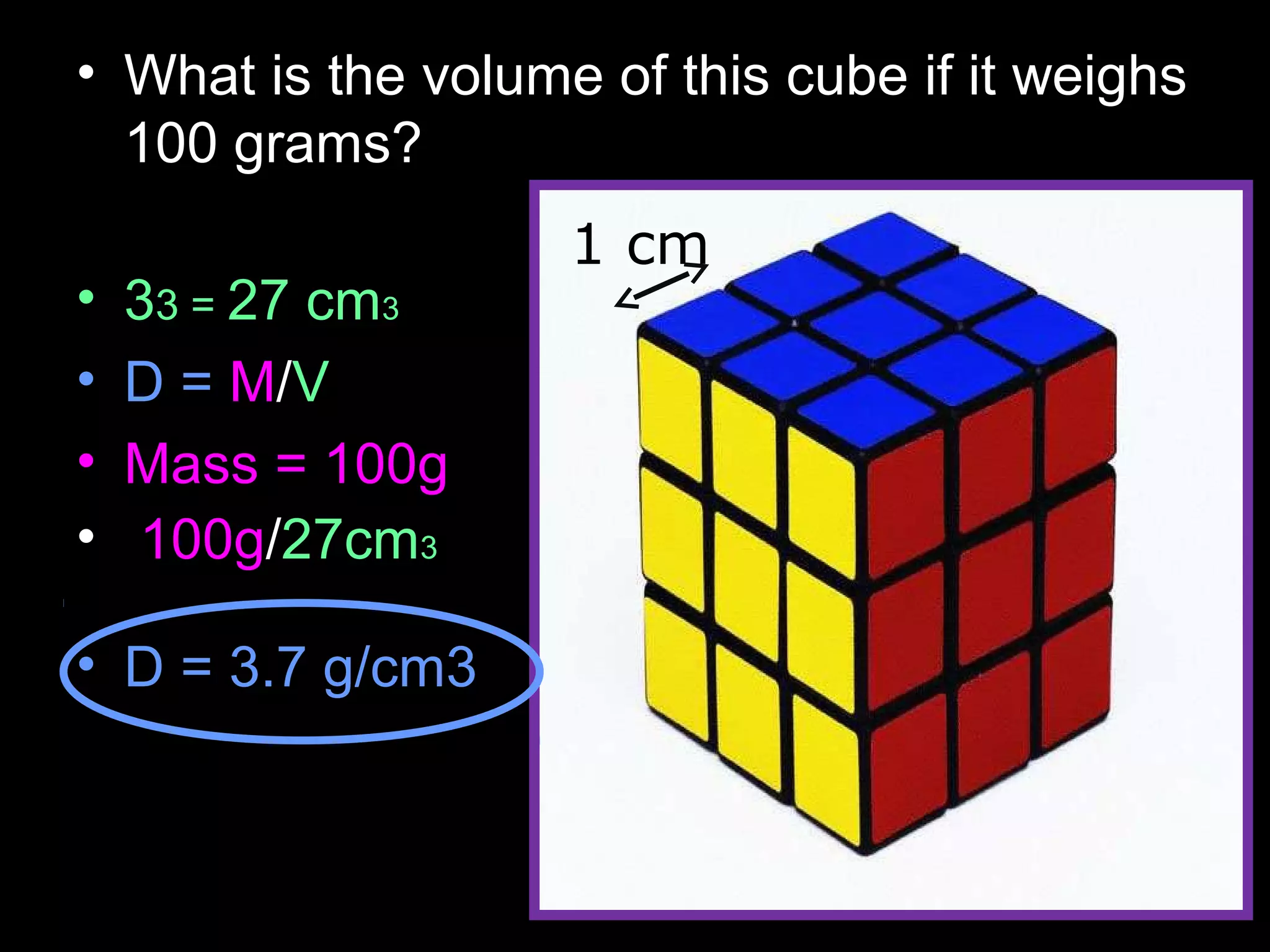
• What is the volume of this cube if it weighs
100 grams?
• 33 = 27 cm3
• D = M/V
• Mass = 100g
• 100g/27cm3
• D = 3.7 g/cm3
1 cm
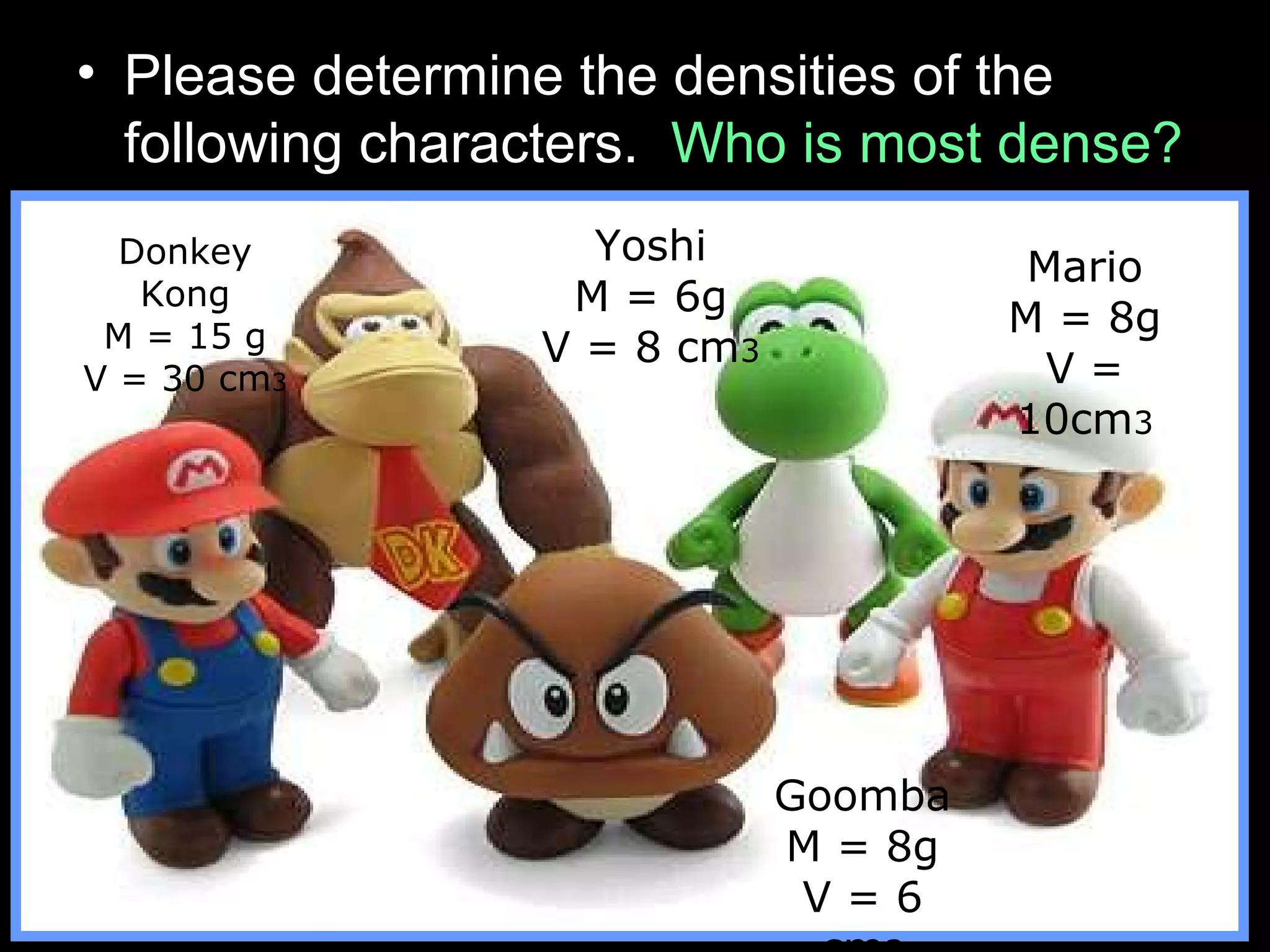
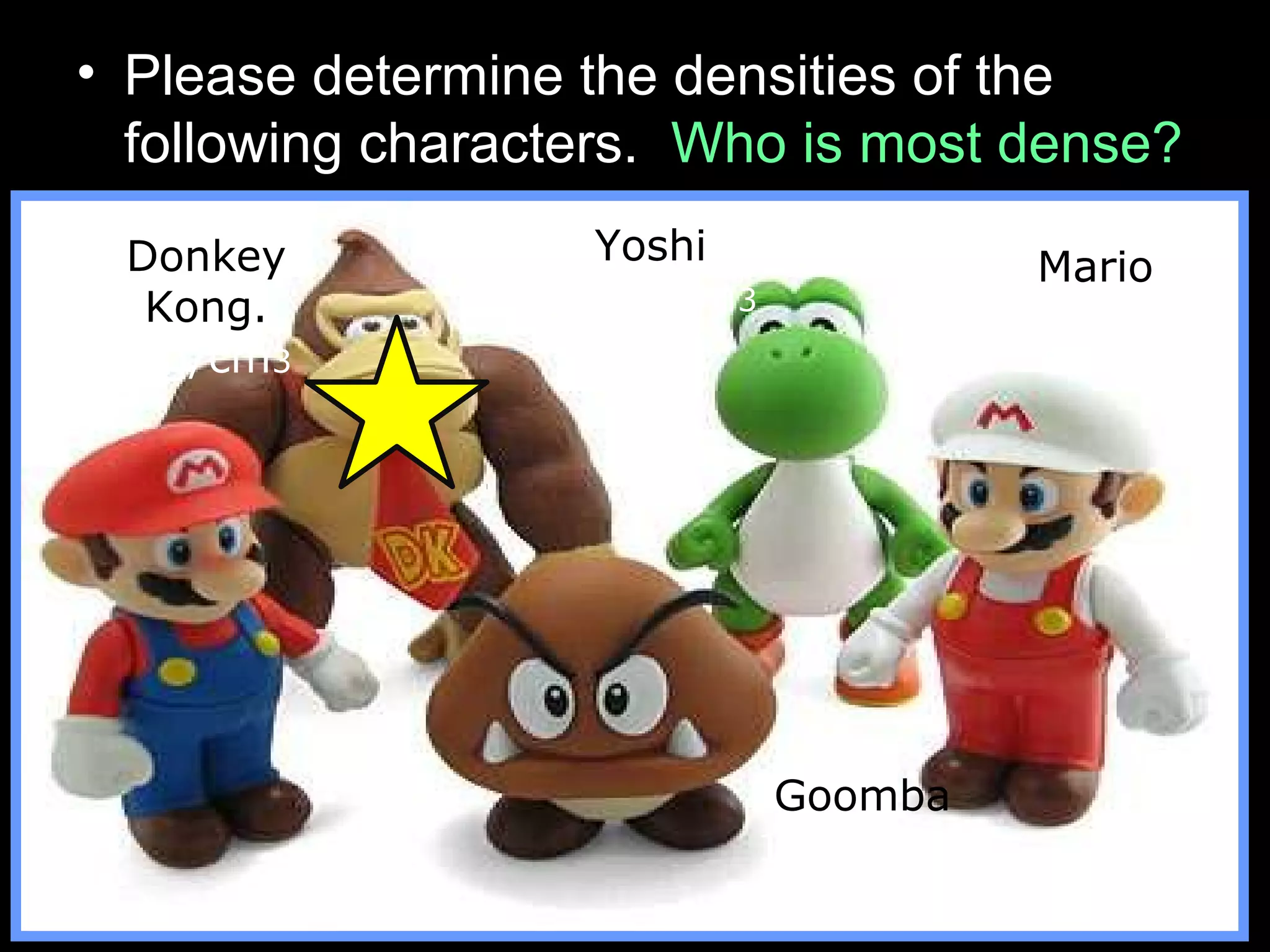
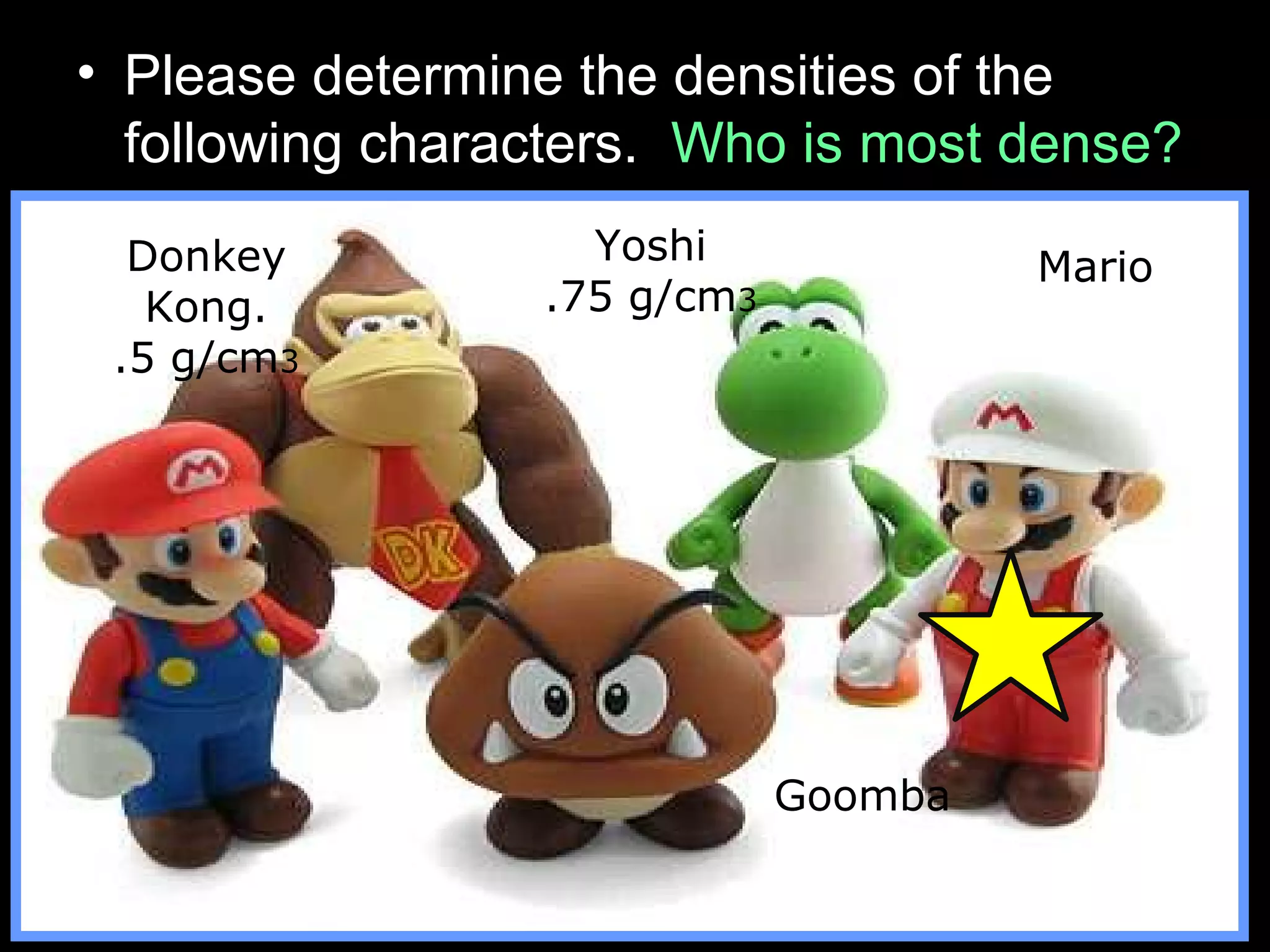
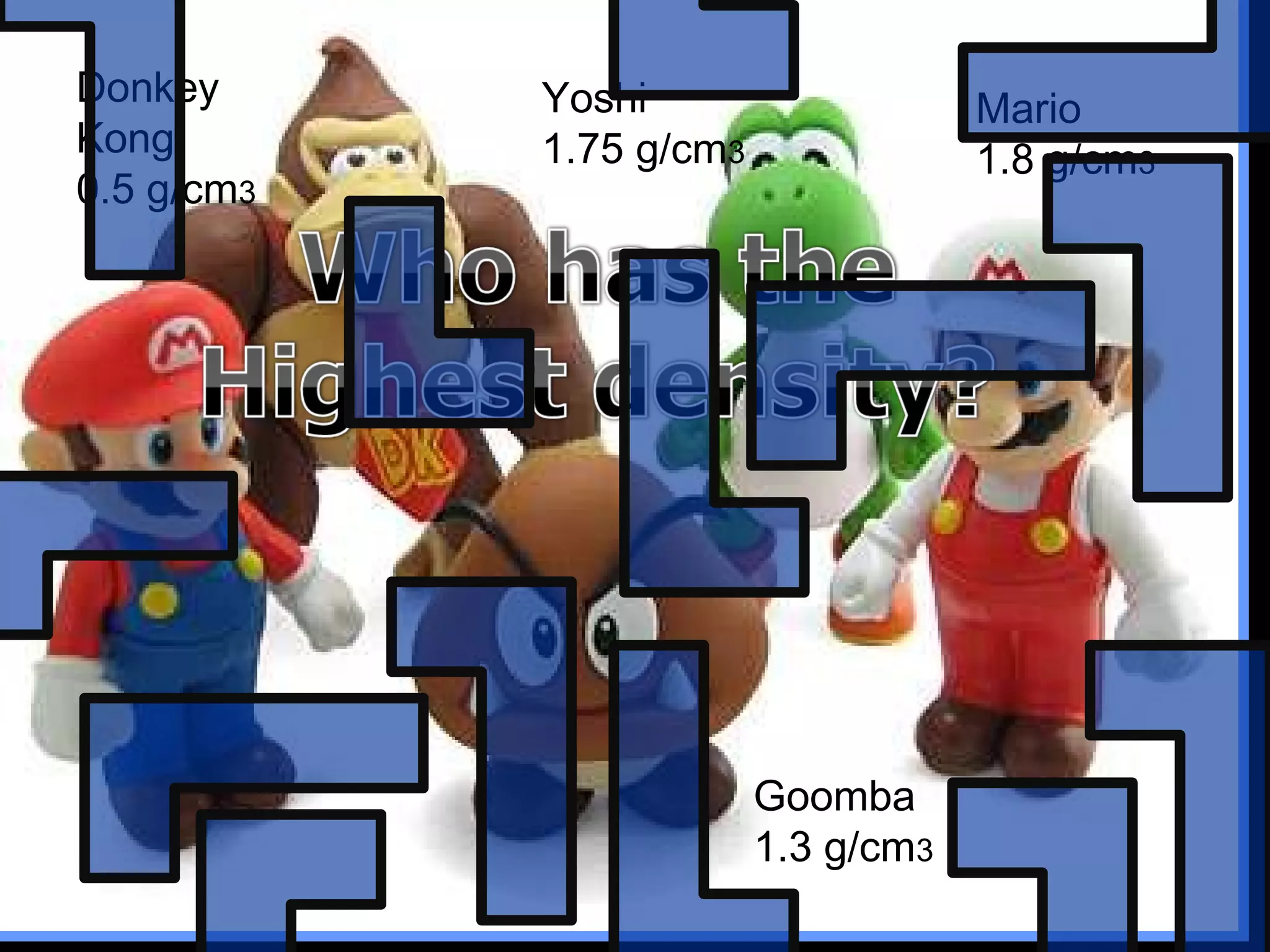
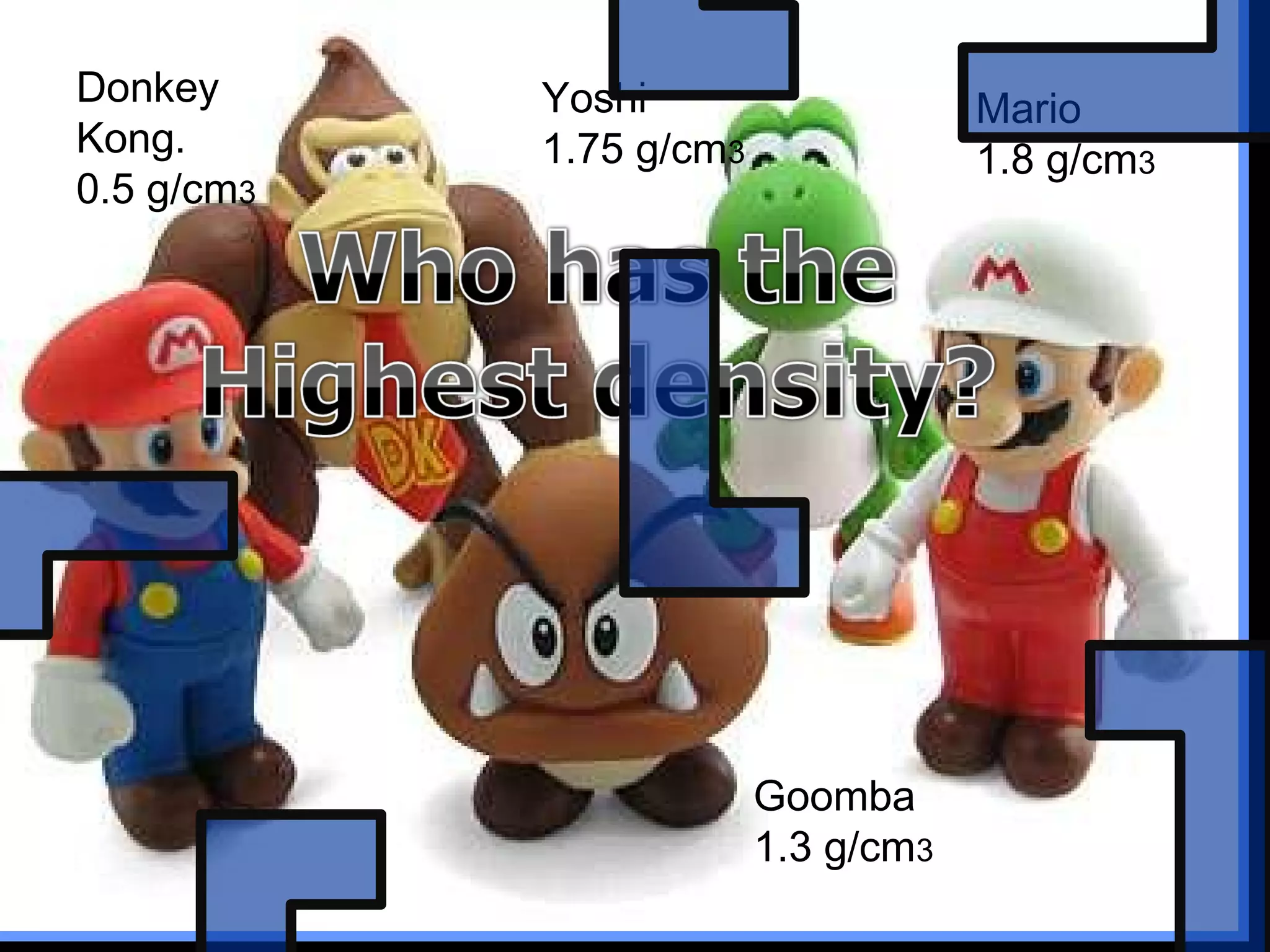
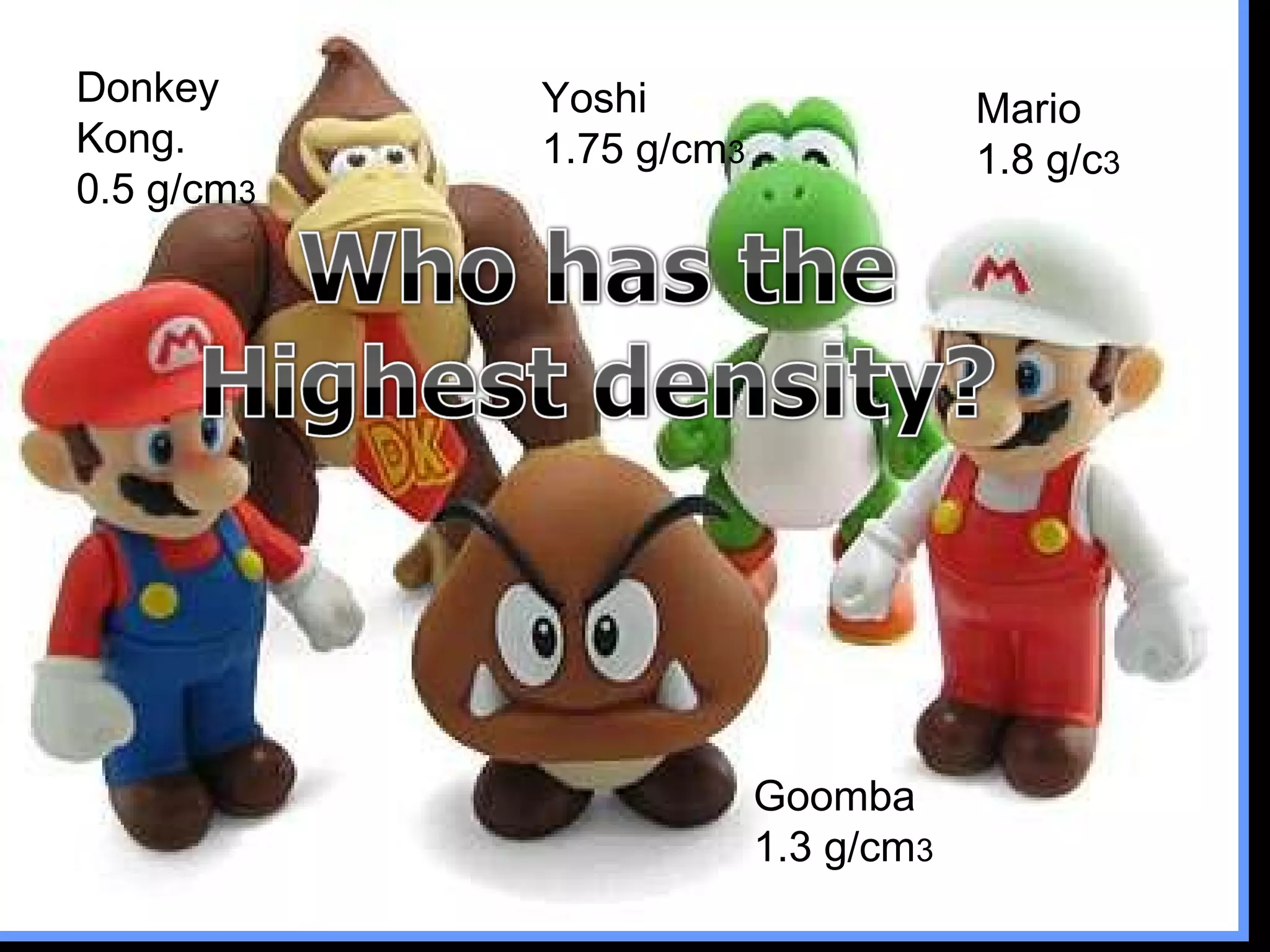
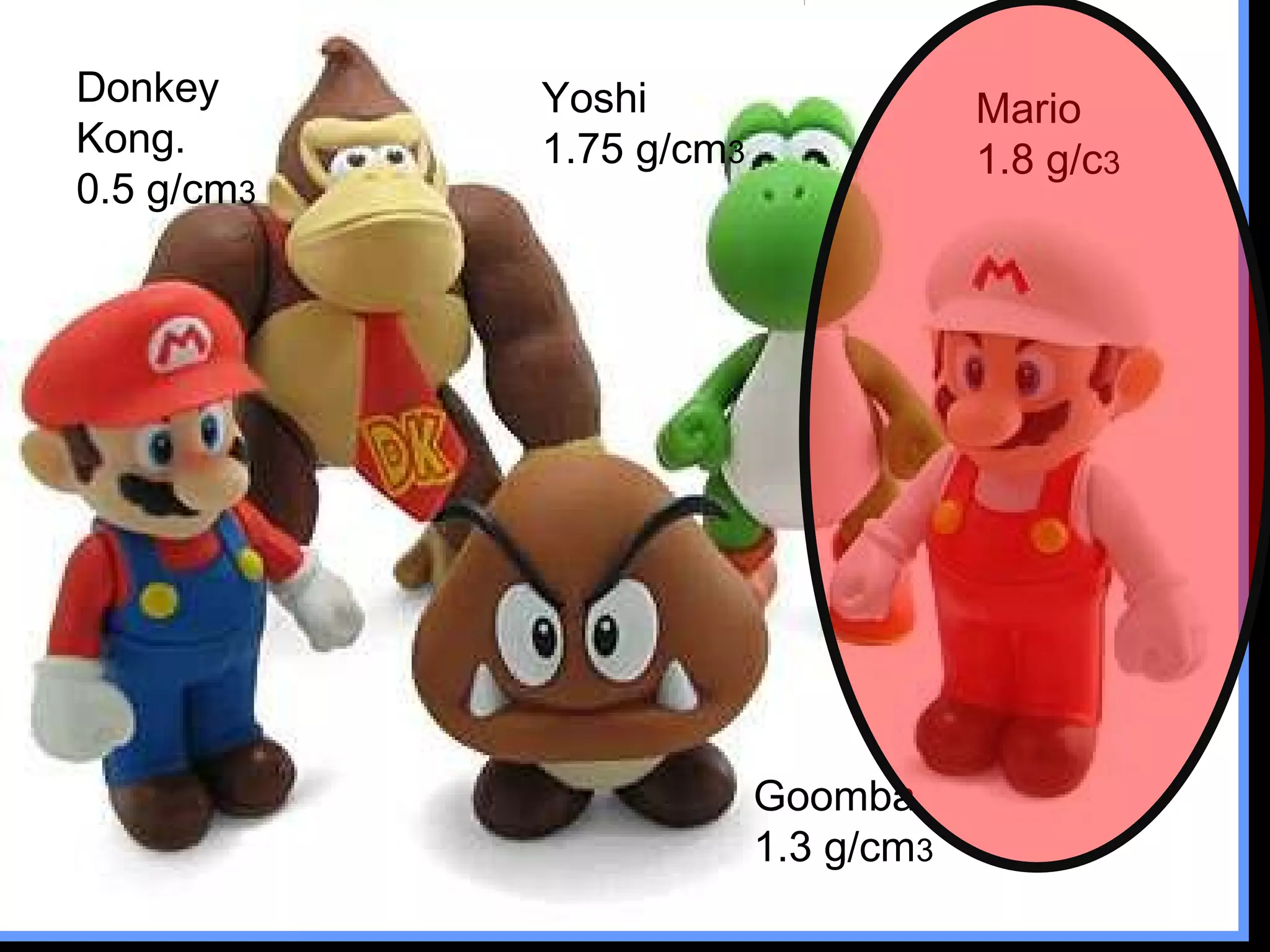
• Please determine the densities of the
following characters. Who is most dense?
Donkey
Kong
M = 15 g
V = 30 cm3
Yoshi
M = 6g
V = 8 cm3
Mario
M = 8g
V =
10cm3
Goomba
M = 8g
V = 6
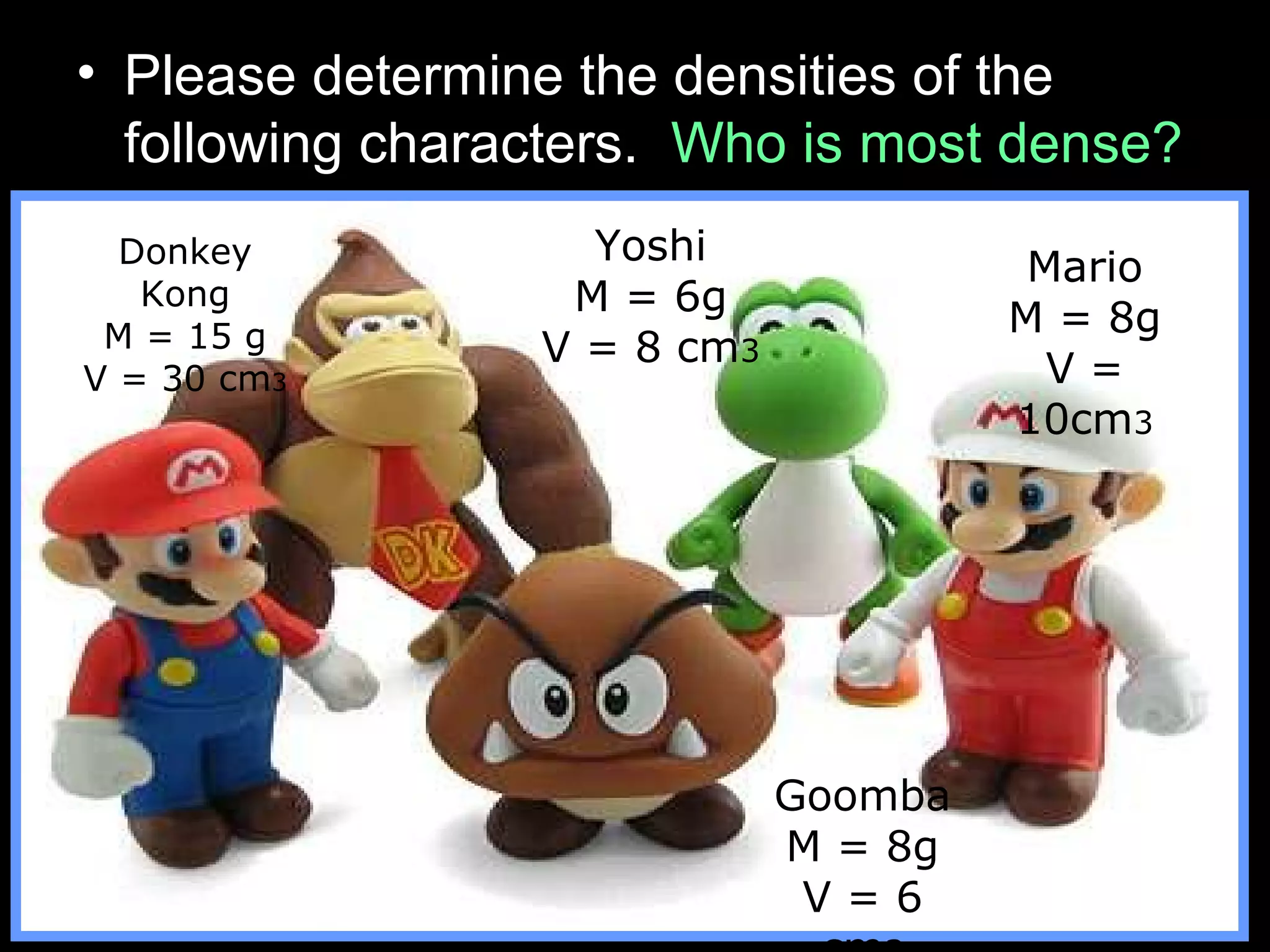
• Please determine the densities of the
following characters. Who is most dense?
Donkey
Kong
M = 15 g
V = 30 cm3
Yoshi
M = 6g
V = 8 cm3
Mario
M = 8g
V =
10cm3
Goomba
M = 8g
V = 6
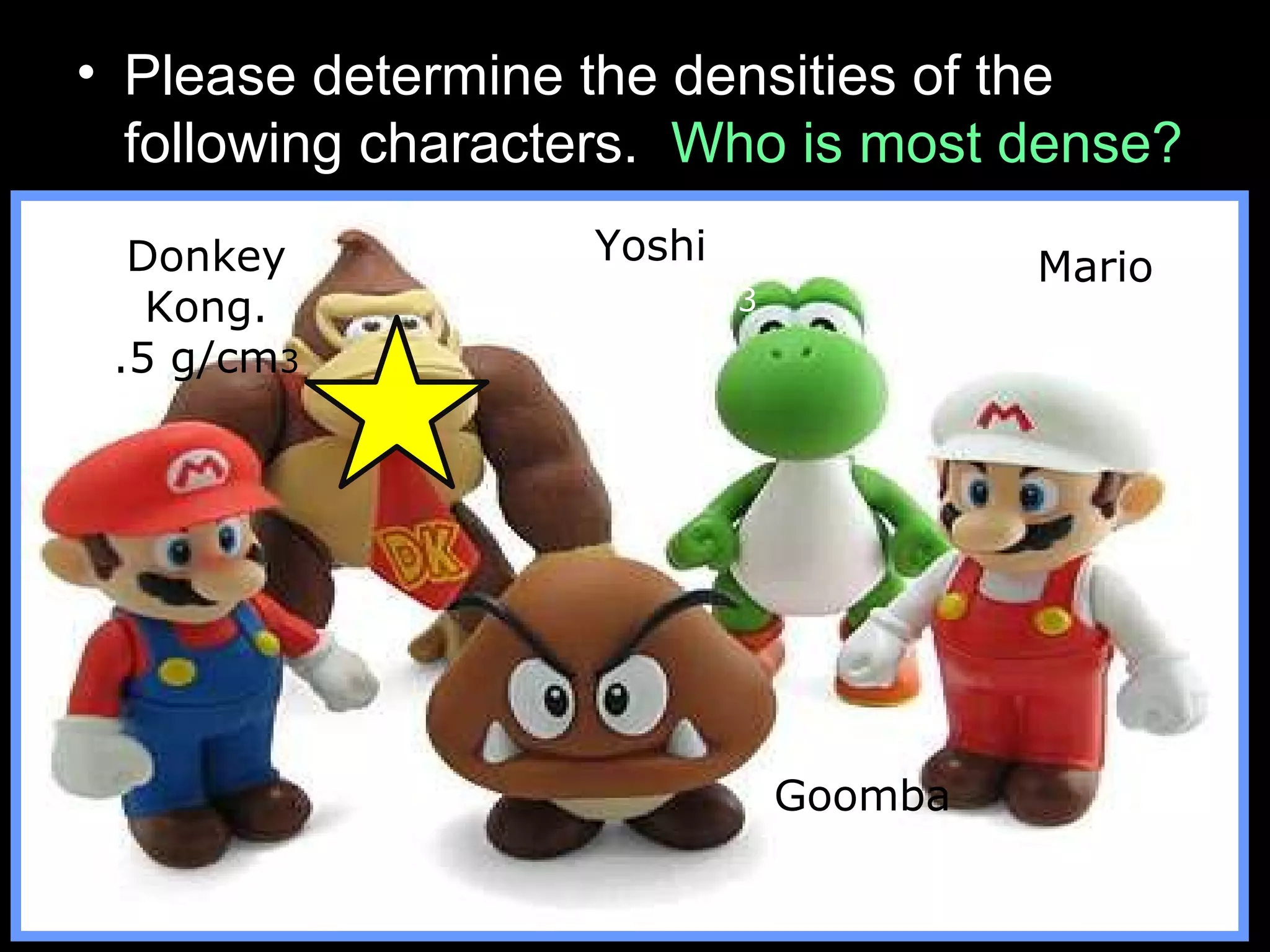
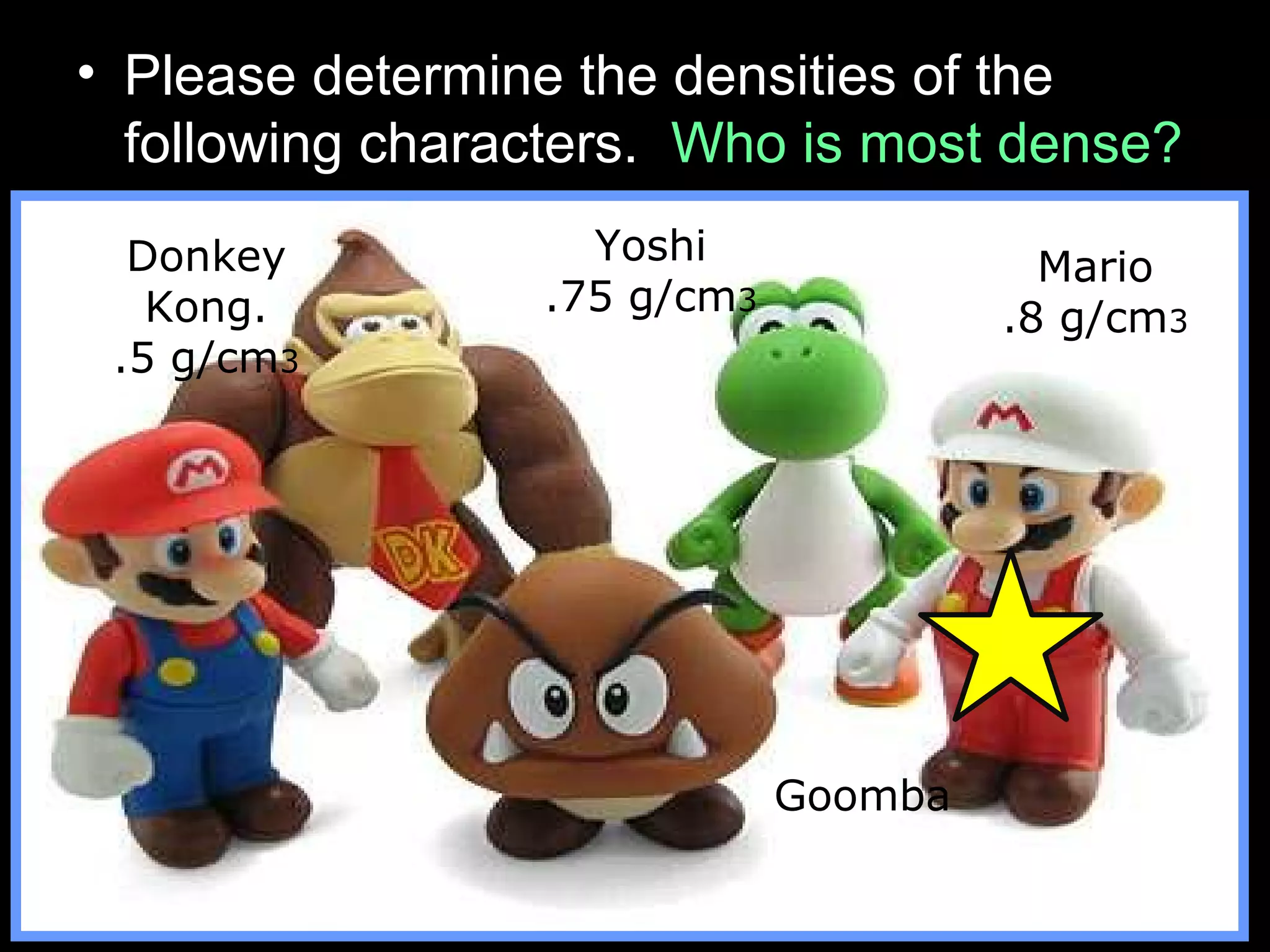
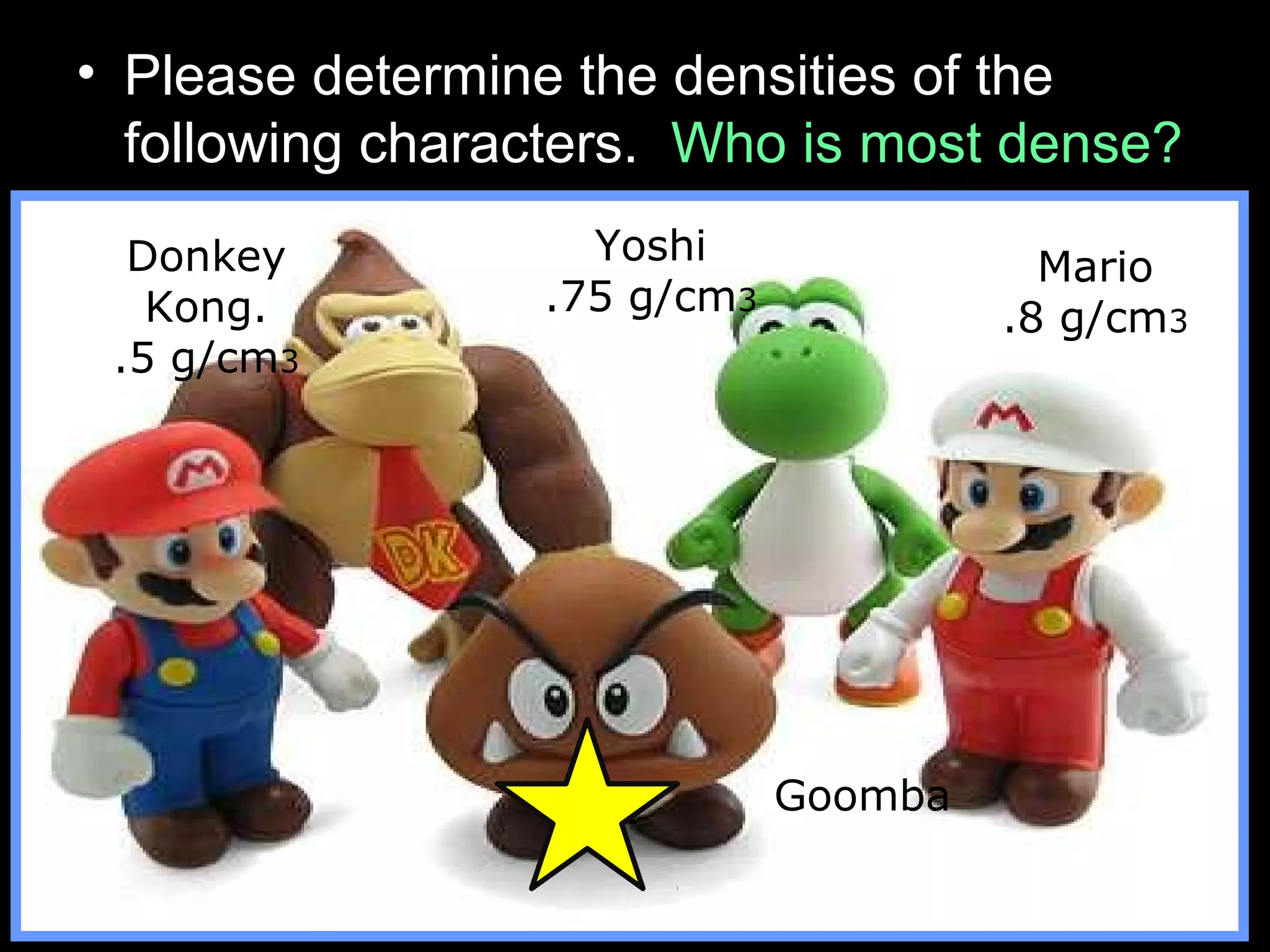
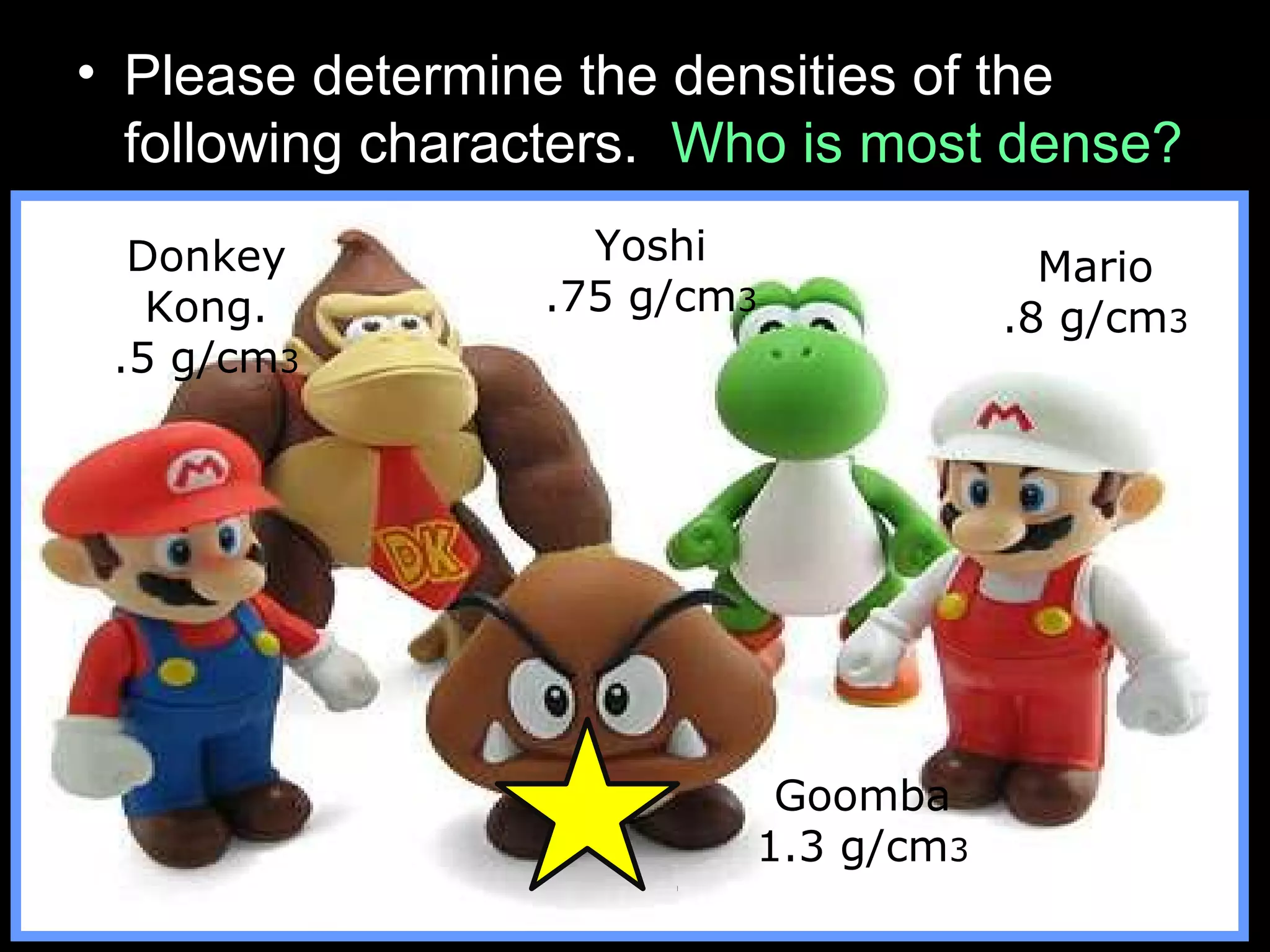
• Please determine the densities of the
following characters. Who is most dense?
Donkey
Kong.
5 g/cm3
Yoshi
.75 g/cm3
Mario
.8 g/cm3
Goomba
1.3 g/cm3
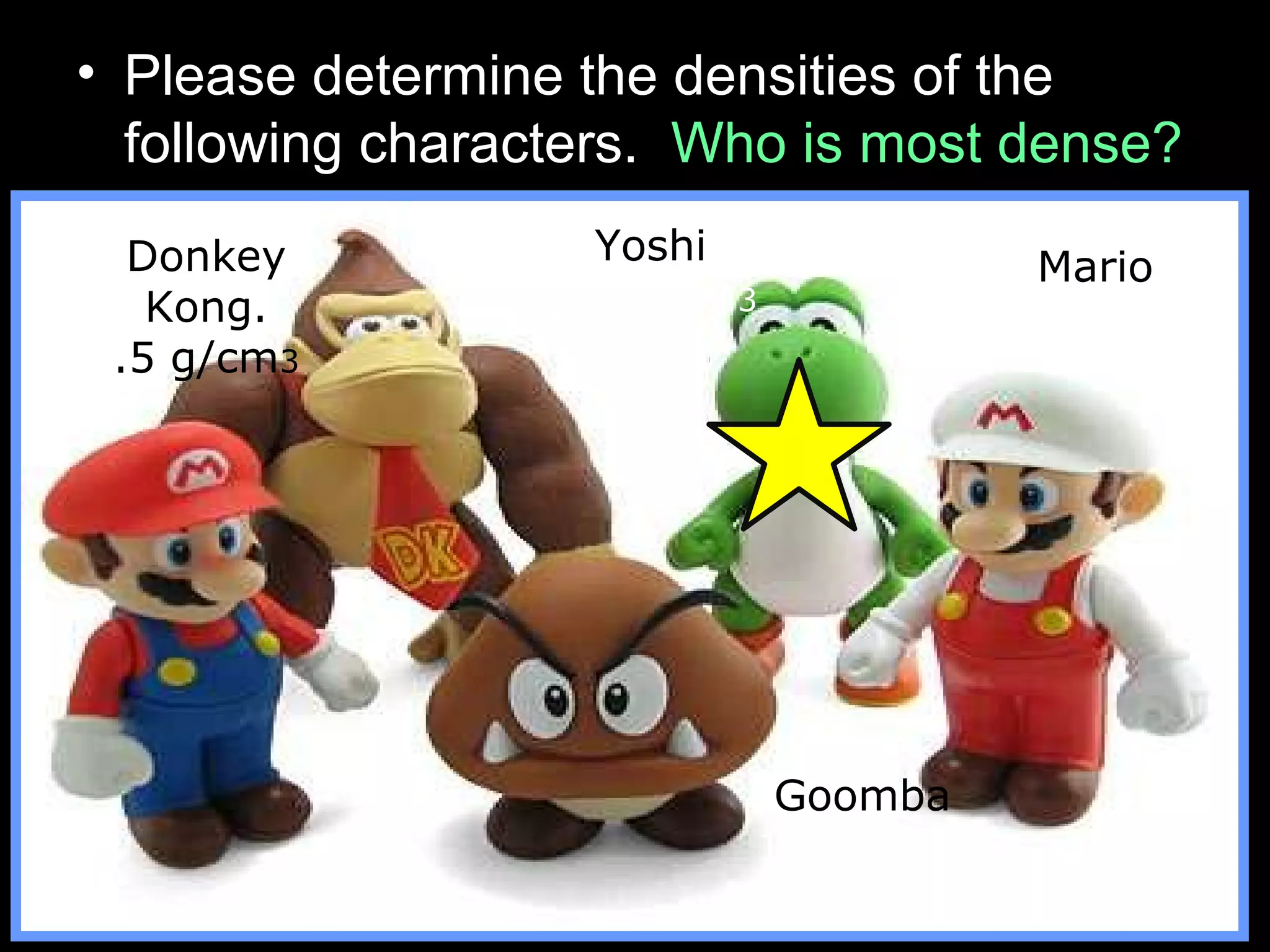
• Please determine the densities of the
following characters. Who is most dense?
Donkey
Kong.
.5 g/cm3
Yoshi
.75 g/cm3
Mario
.8 g/cm3
Goomba
1.3 g/cm3
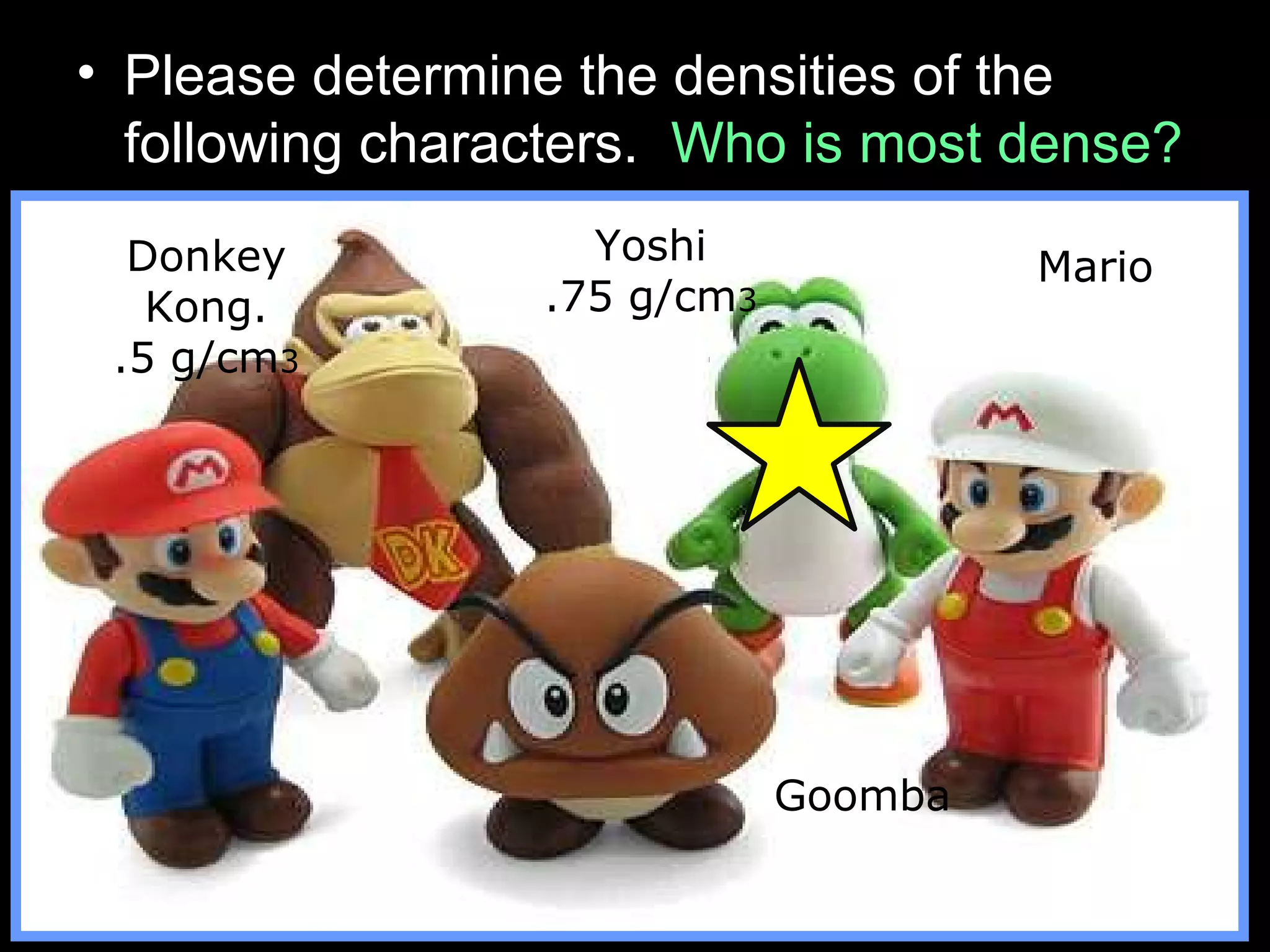
• Please determine the densities of the
following characters. Who is most dense?
Donkey
Kong.
.5 g/cm3
Yoshi
.75 g/cm3
Mario
.8 g/cm3
Goomba
1.3 g/cm3
• Please determine the densities of the
following characters. Who is most dense?
Donkey
Kong.
.5 g/cm3
Yoshi
.75 g/cm3
Mario
.8 g/cm3
Goomba
1.3 g/cm3
• Please determine the densities of the
following characters. Who is most dense?
Donkey
Kong.
.5 g/cm3
Yoshi
.75 g/cm3
Mario
.8 g/cm3
Goomba
1.3 g/cm3
• Please determine the densities of the
following characters. Who is most dense?
Donkey
Kong.
.5 g/cm3
Yoshi
.75 g/cm3
Mario
.8 g/cm3
Goomba
1.3 g/cm3
• Please determine the densities of the
following characters. Who is most dense?
Donkey
Kong.
.5 g/cm3
Yoshi
.75 g/cm3
Mario
.8 g/cm3
Goomba
1.3 g/cm3
• Please determine the densities of the
following characters. Who is most dense?
Donkey
Kong.
.5 g/cm3
Yoshi
.75 g/cm3
Mario
.8 g/cm3
Goomba
1.3 g/cm3
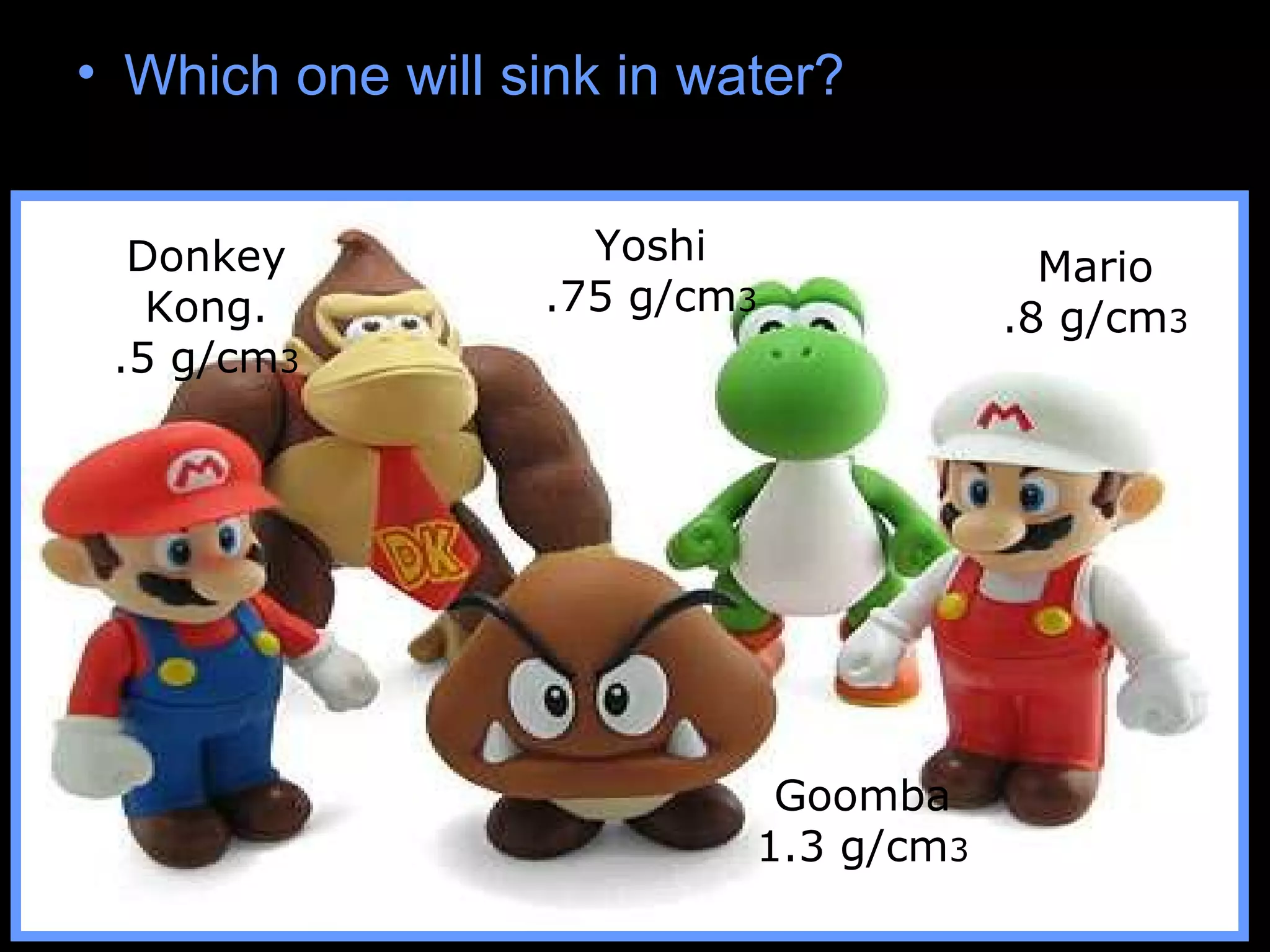
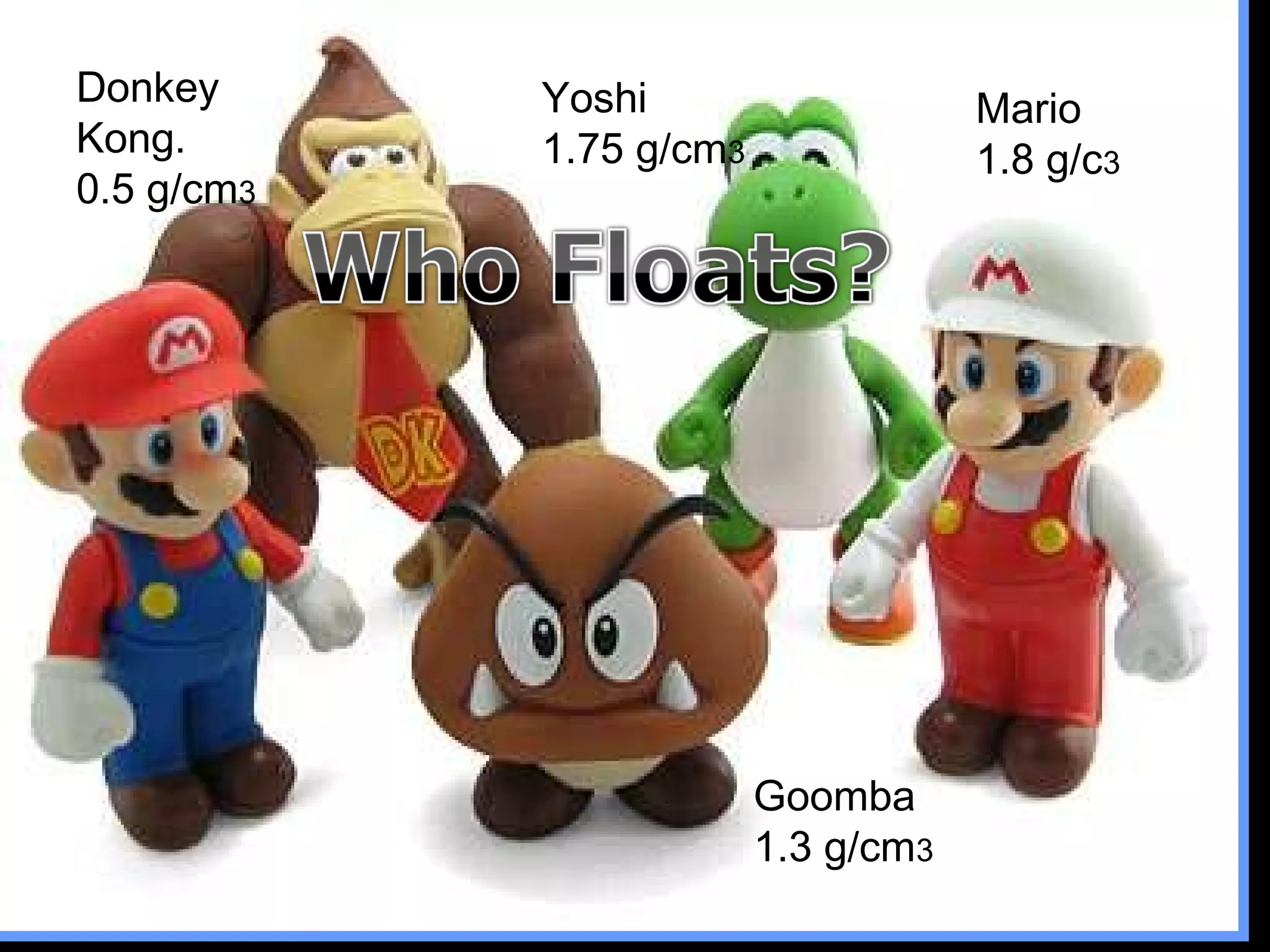
• Which one will sink in water?
Donkey
Kong.
.5 g/cm3
Yoshi
.75 g/cm3
Mario
.8 g/cm3
Goomba
1.3 g/cm3
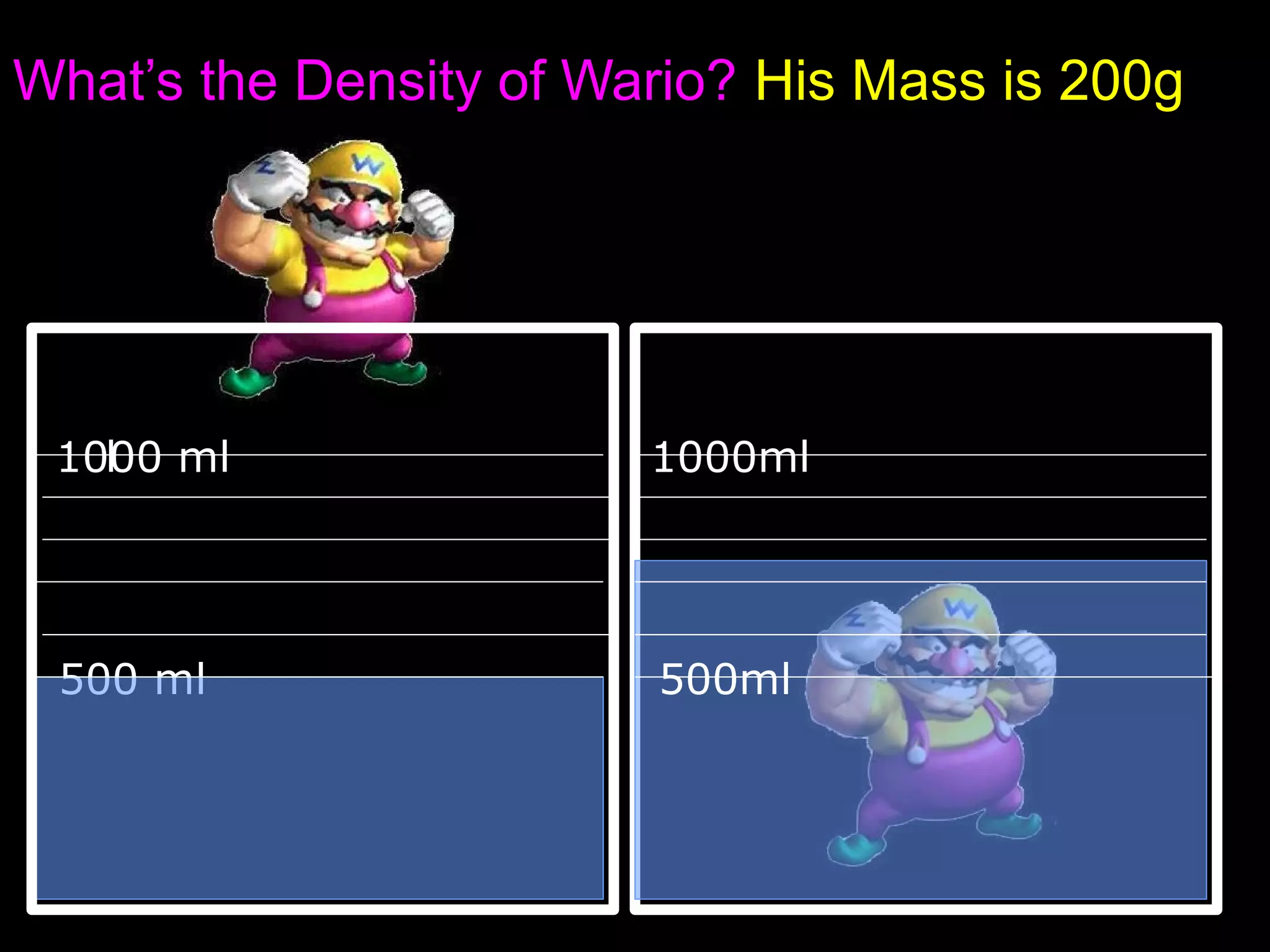
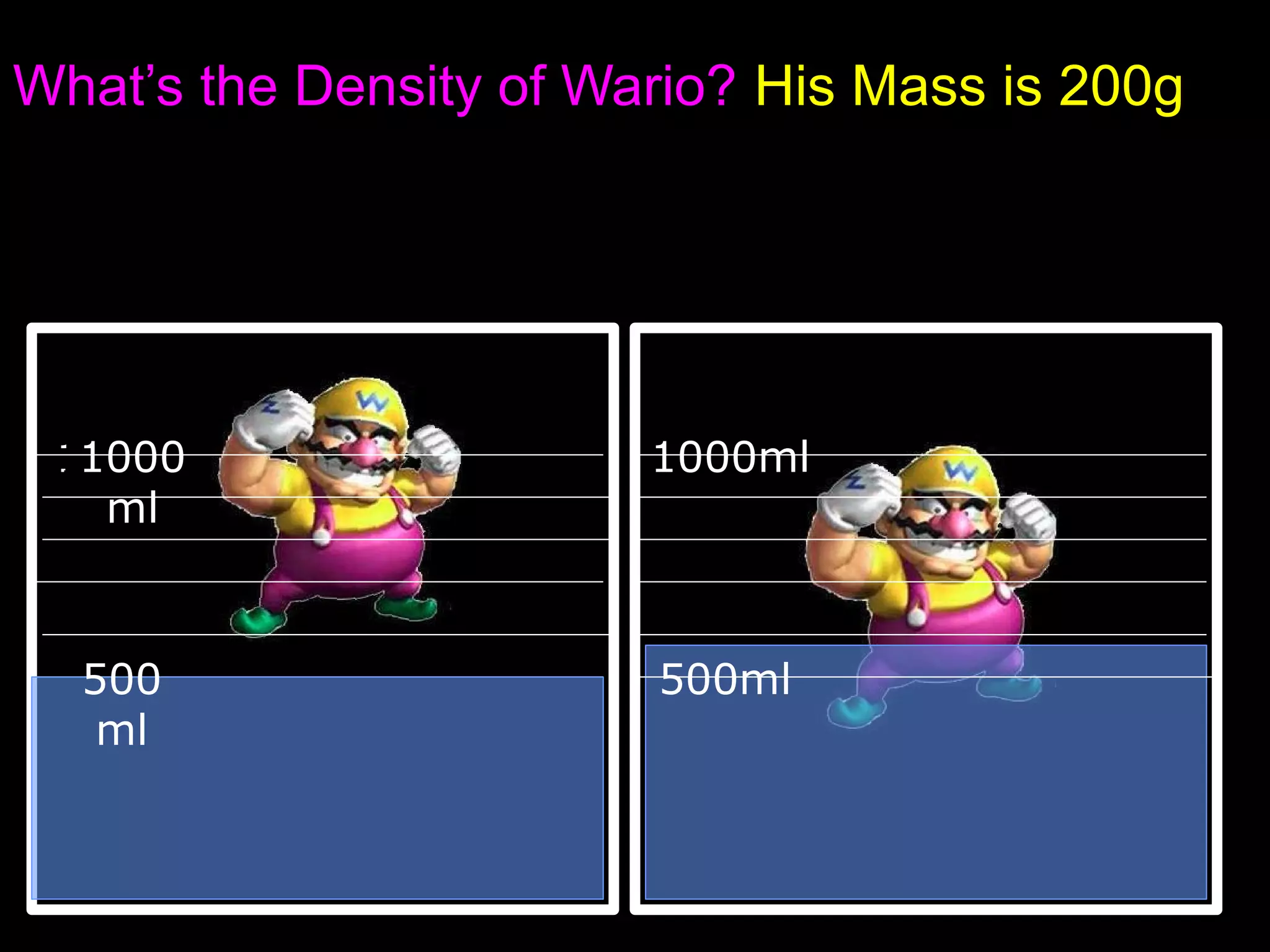
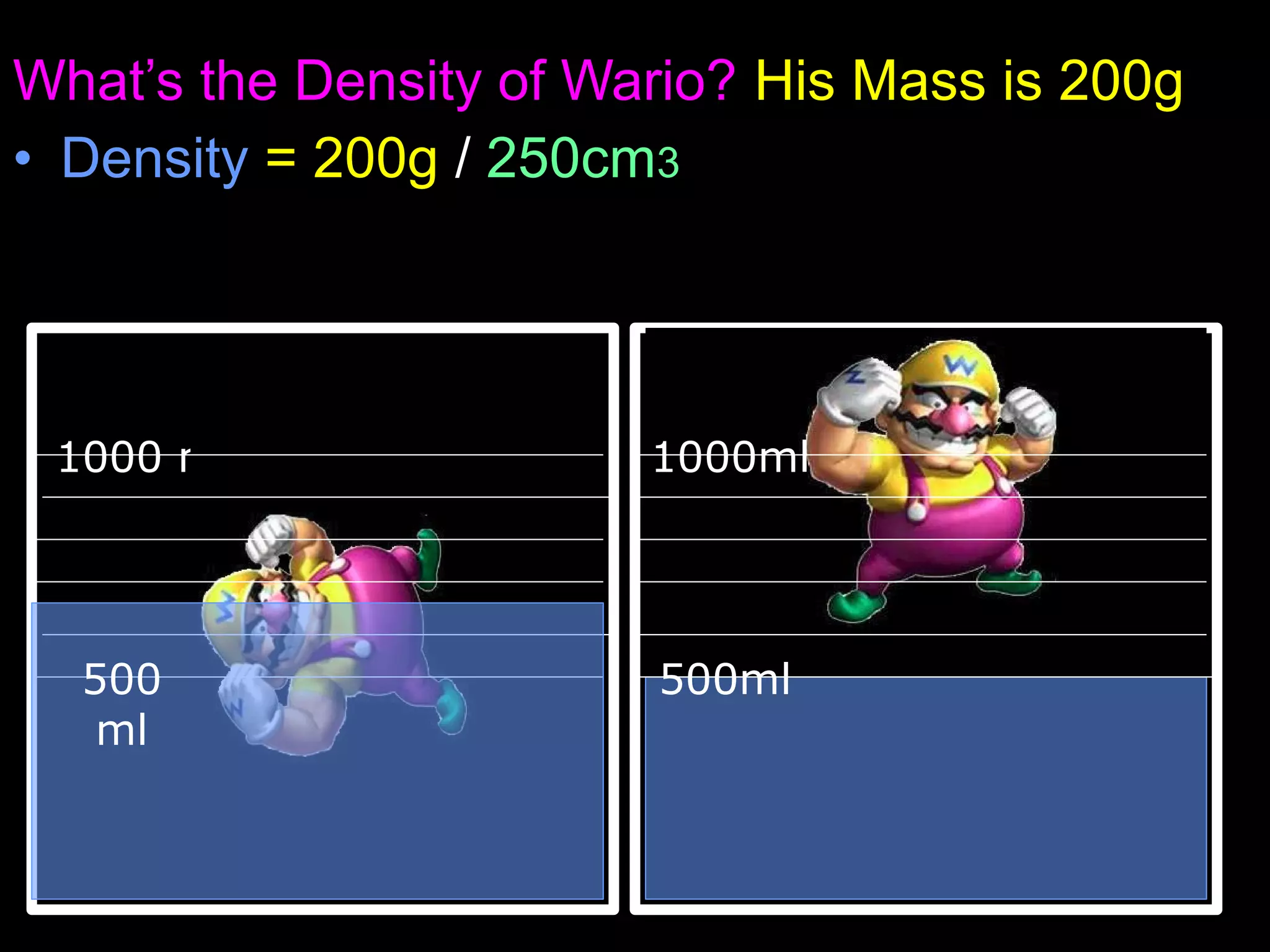
What’s the Density of Wario? His Mass is 200g
1000 ml
500 ml
1000ml
500ml
l
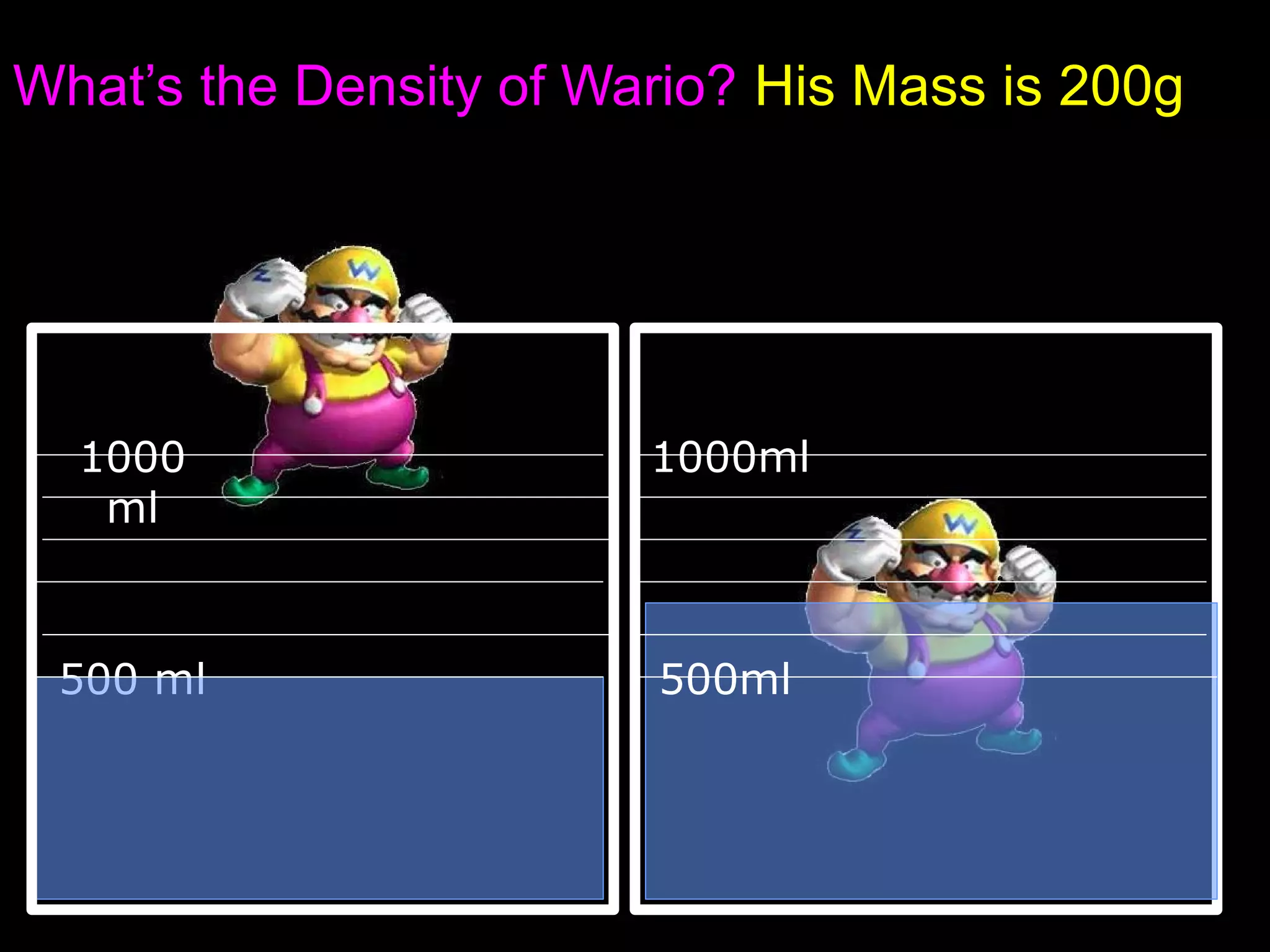
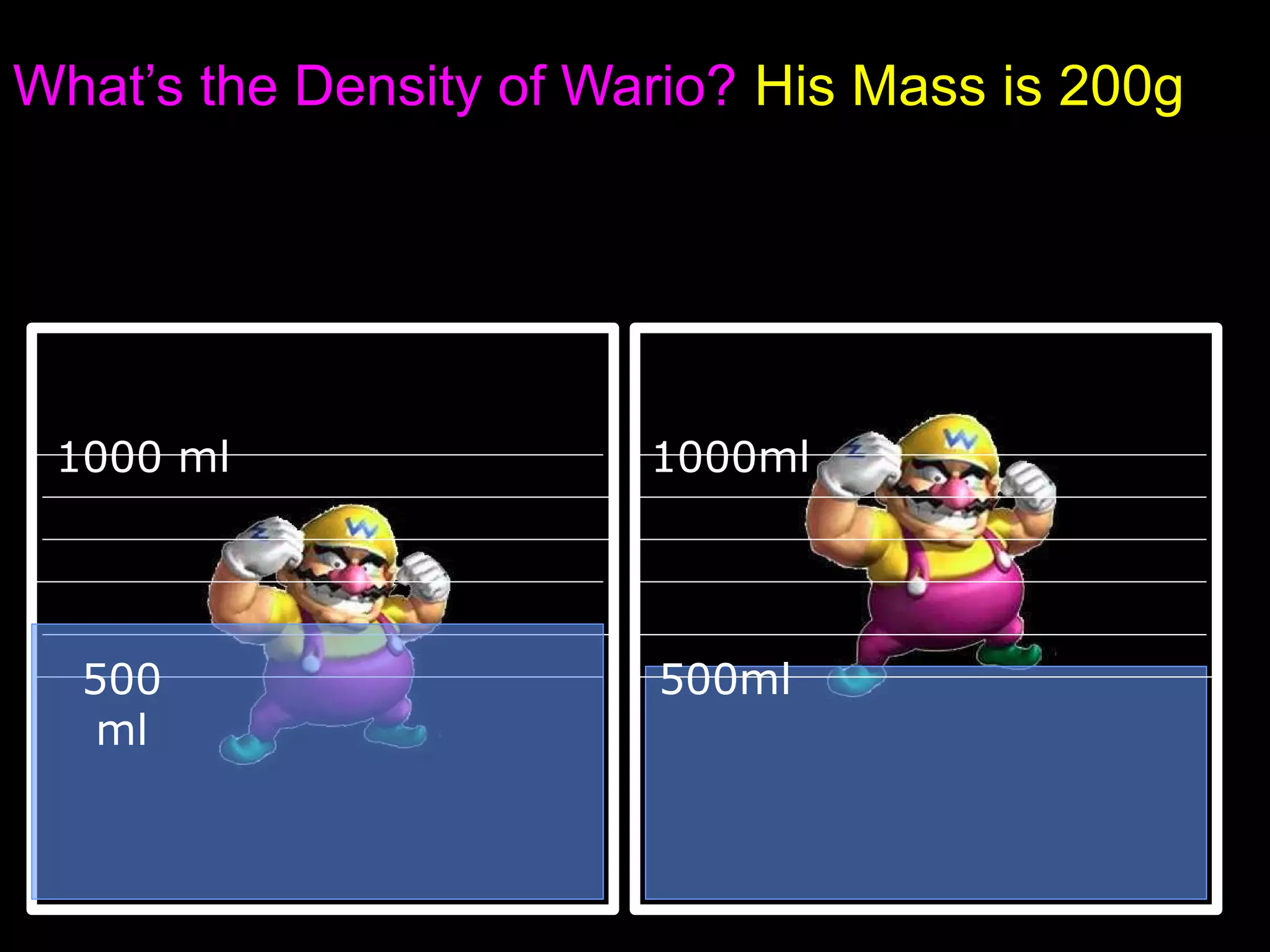
What’s the Density of Wario? His Mass is 200g
1000 ml
500 ml
1000ml
500ml
1000
ml
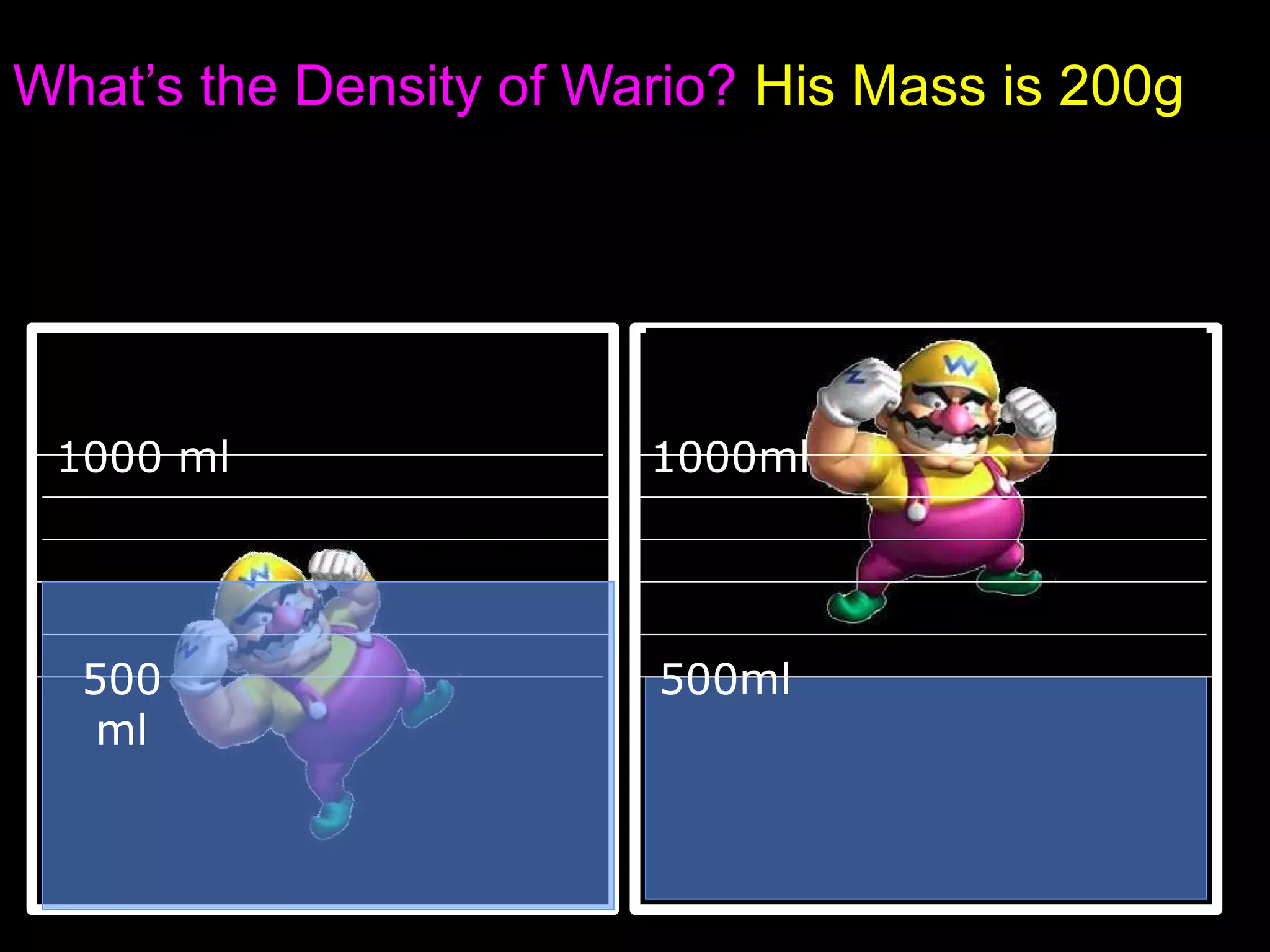
What’s the Density of Wario? His Mass is 200g
1000 ml 1000ml
500ml
1000
ml
500
ml
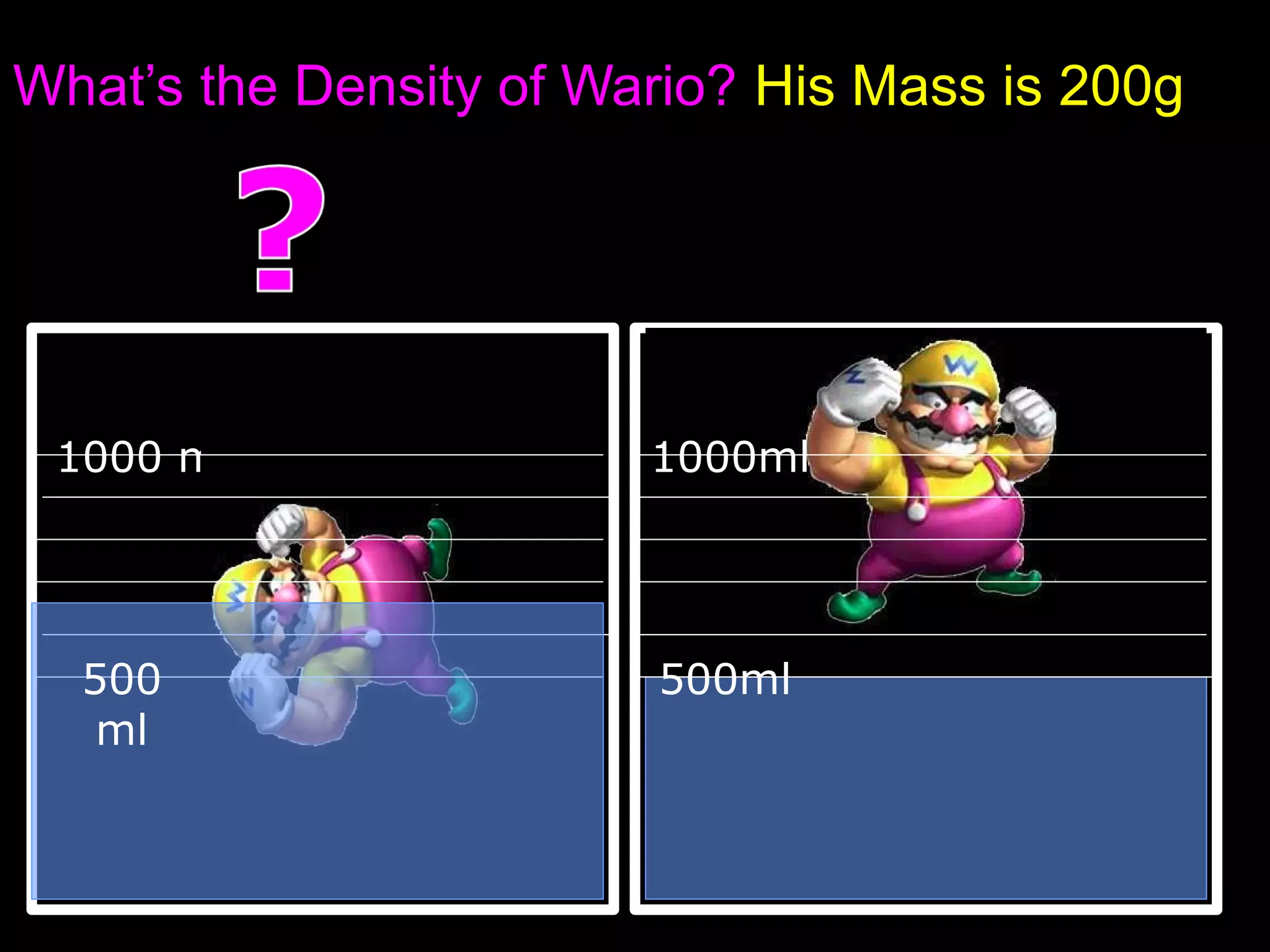
What’s the Density of Wario? His Mass is 200g
1000 ml 1000ml
500ml500
ml
What’s the Density of Wario? His Mass is 200g
1000 ml 1000ml
500ml500
ml
What’s the Density of Wario? His Mass is 200g
1000 ml 1000ml
500ml500
ml
What’s the Density of Wario? His Mass is 200g
1000 ml 1000ml
500ml500
ml
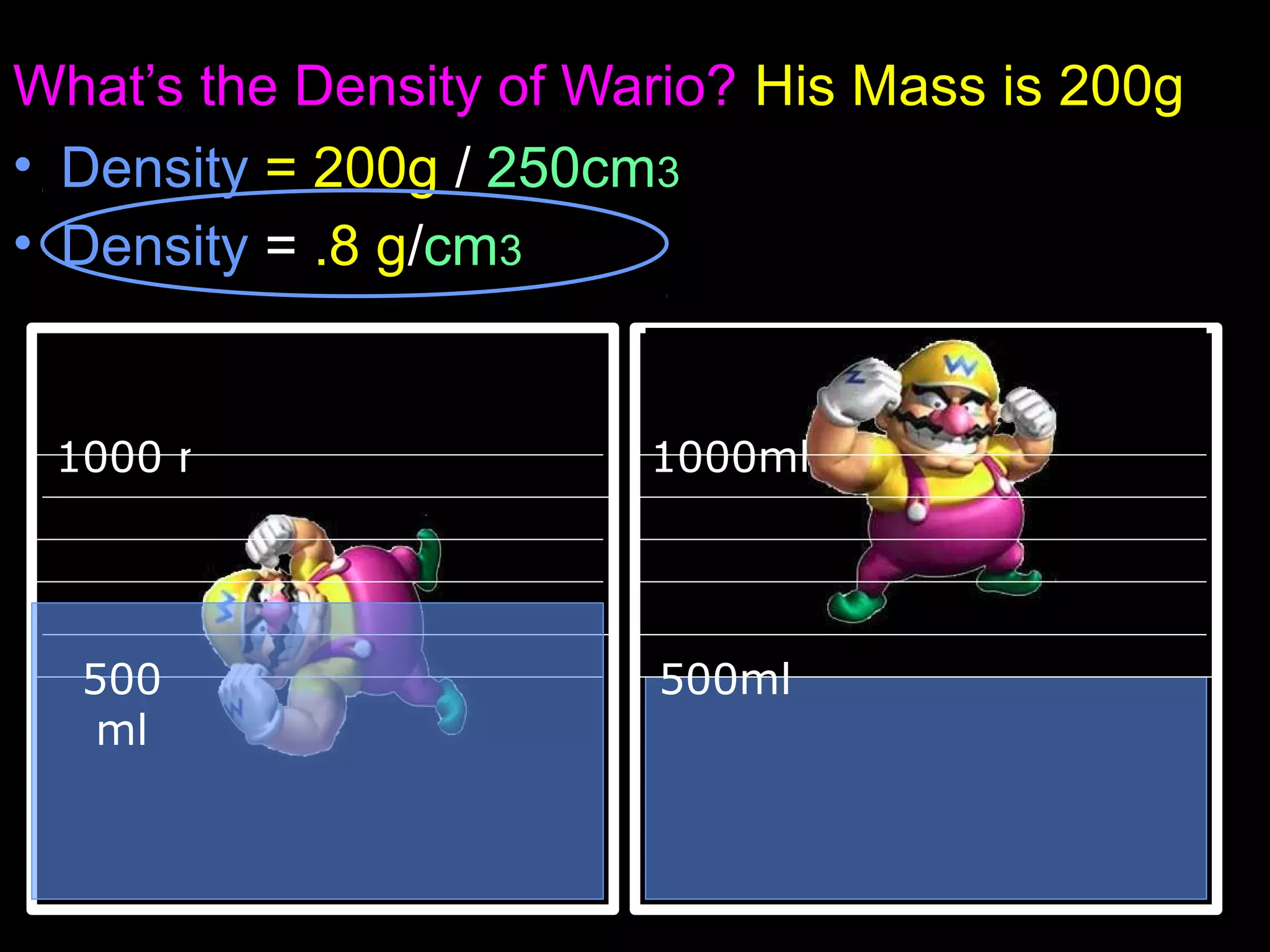
What’s the Density of Wario? His Mass is 200g
• Density = 200g / 250cm3
1000 ml 1000ml
500ml500
ml
What’s the Density of Wario? His Mass is 200g
• Density = 200g / 250cm3
• Density = .8 g/cm3
1000 ml 1000ml
500ml500
ml
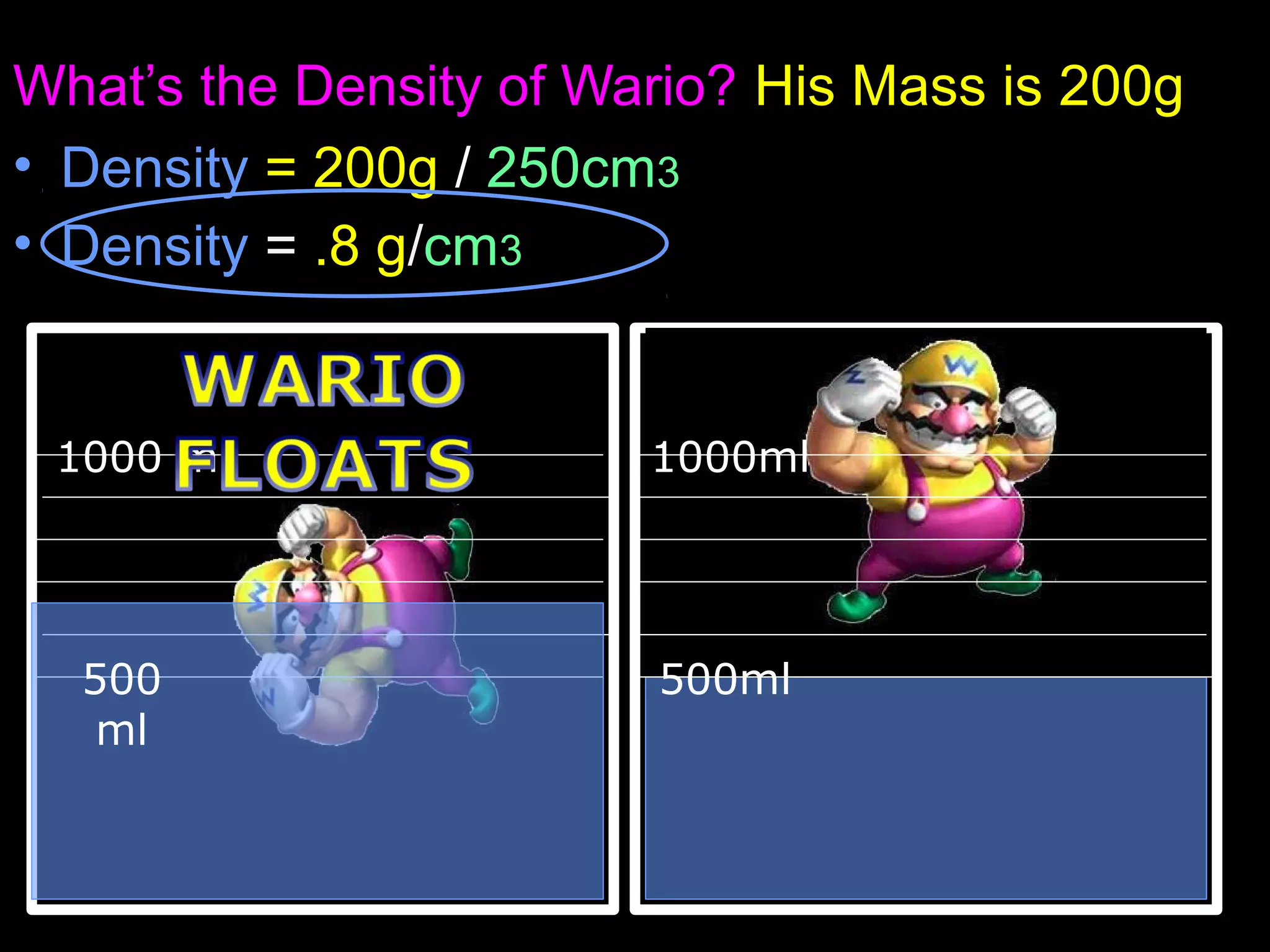
What’s the Density of Wario? His Mass is 200g
• Density = 200g / 250cm3
• Density = .8 g/cm3
1000 ml 1000ml
500ml500
ml
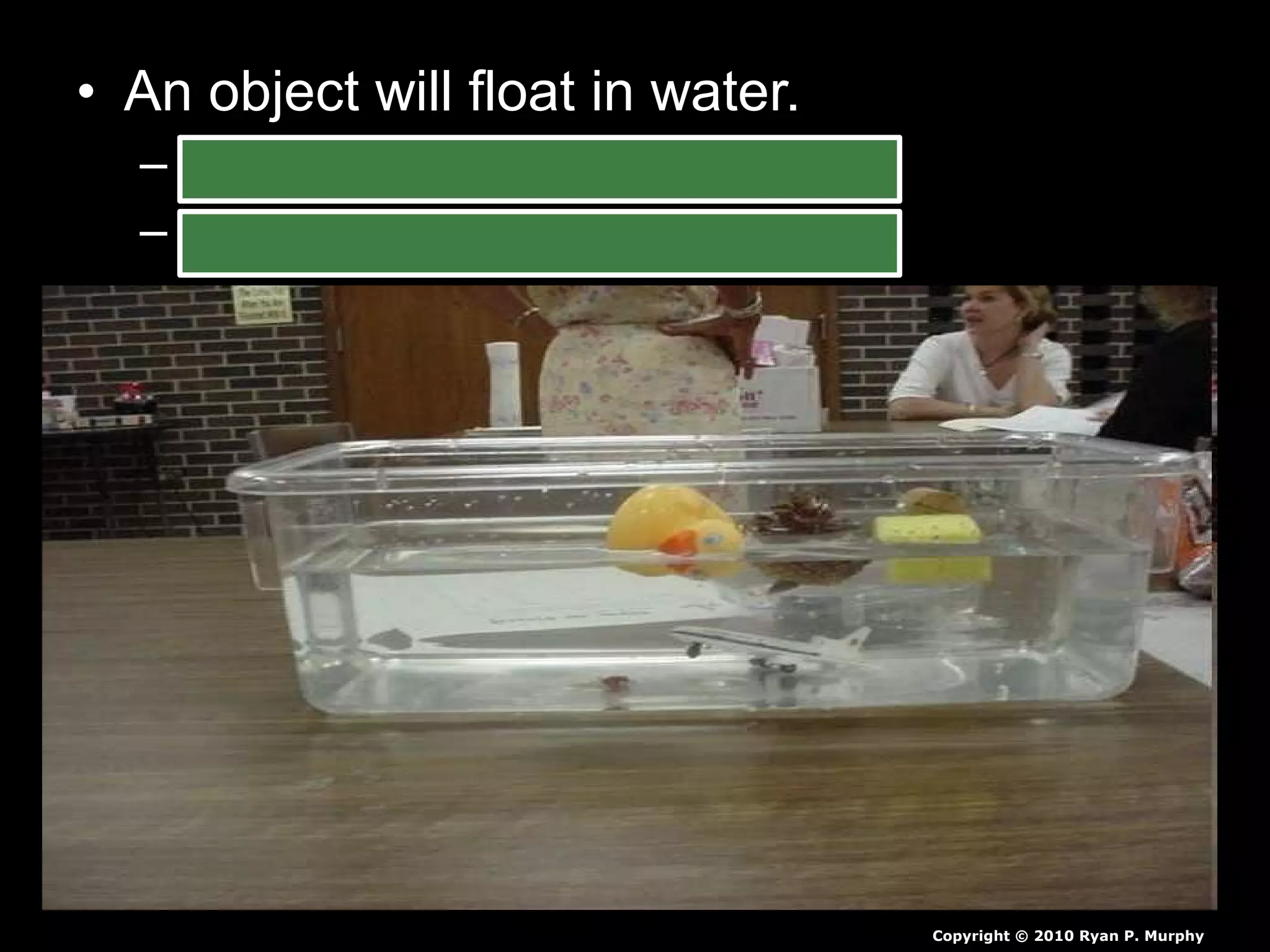
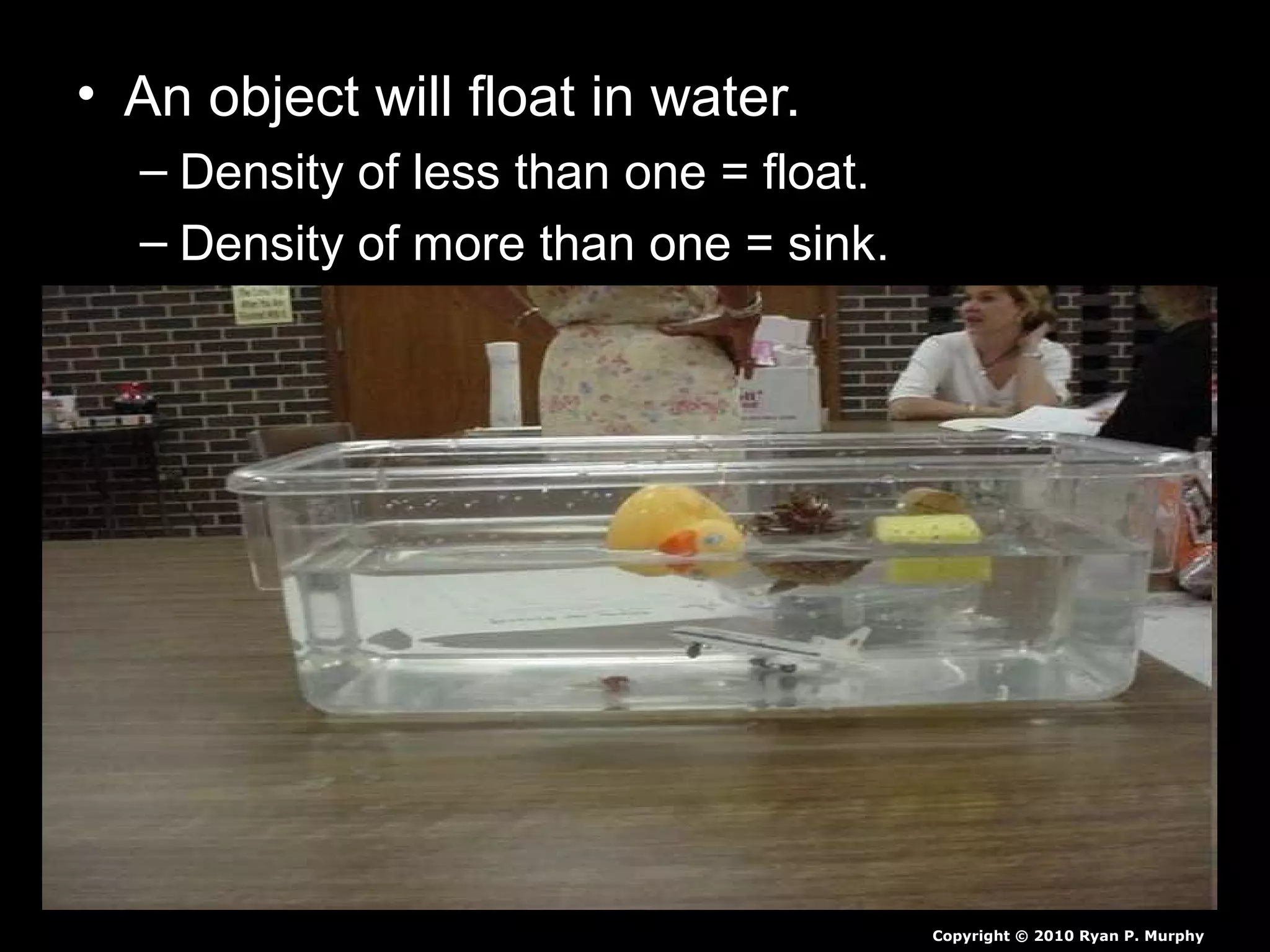
• An object will float in water.
– Density of less than one = float.
– Density of more than one = sink.
Copyright © 2010 Ryan P. Murphy
• An object will float in water.
– Density of less than one = float.
– Density of more than one = sink.
Copyright © 2010 Ryan P. Murphy
• An object will float in water.
– Density of less than one = float.
– Density of more than one = sink.
Copyright © 2010 Ryan P. Murphy
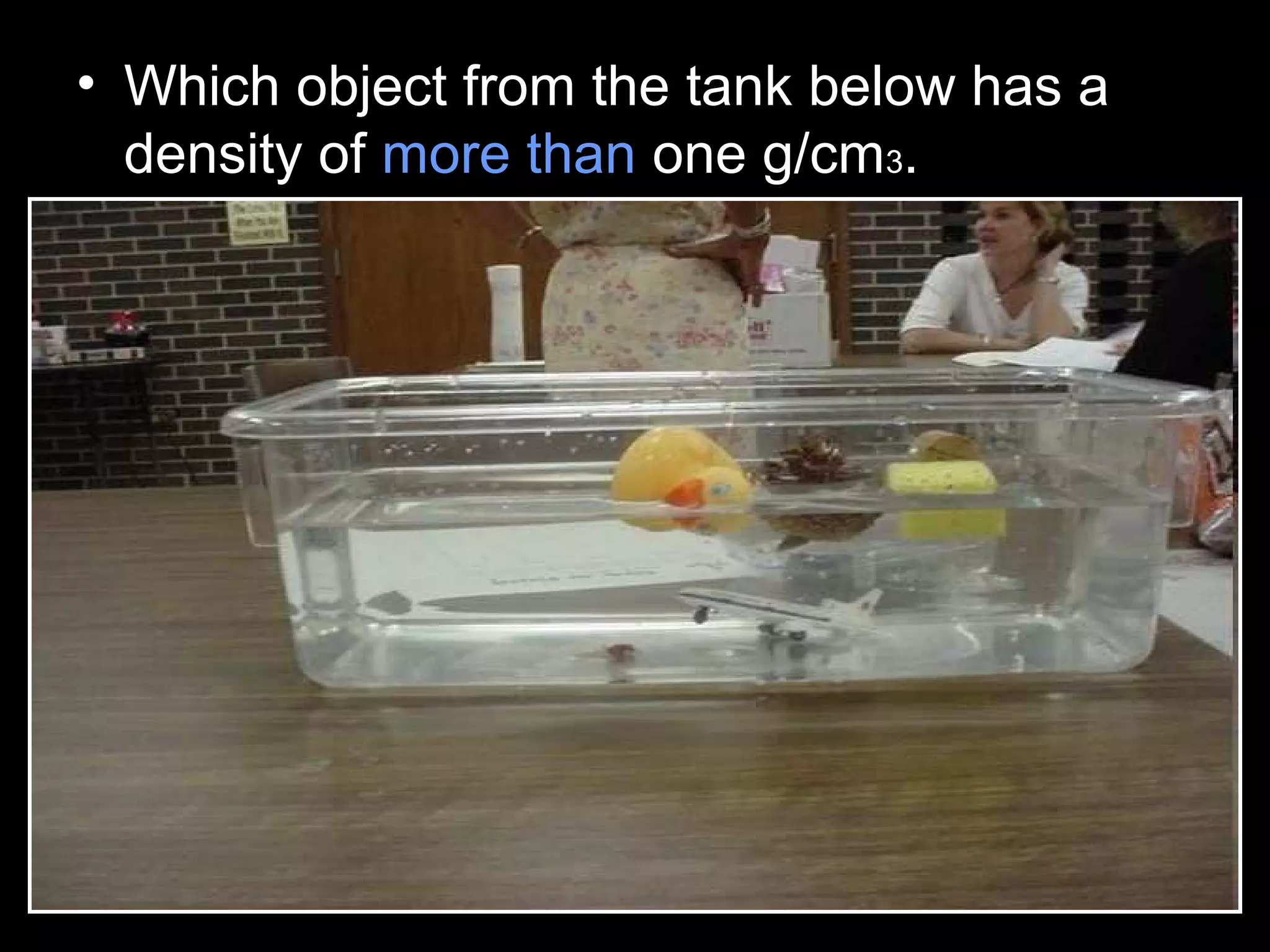
• Which object from the tank below has a
density of more than one g/cm3.
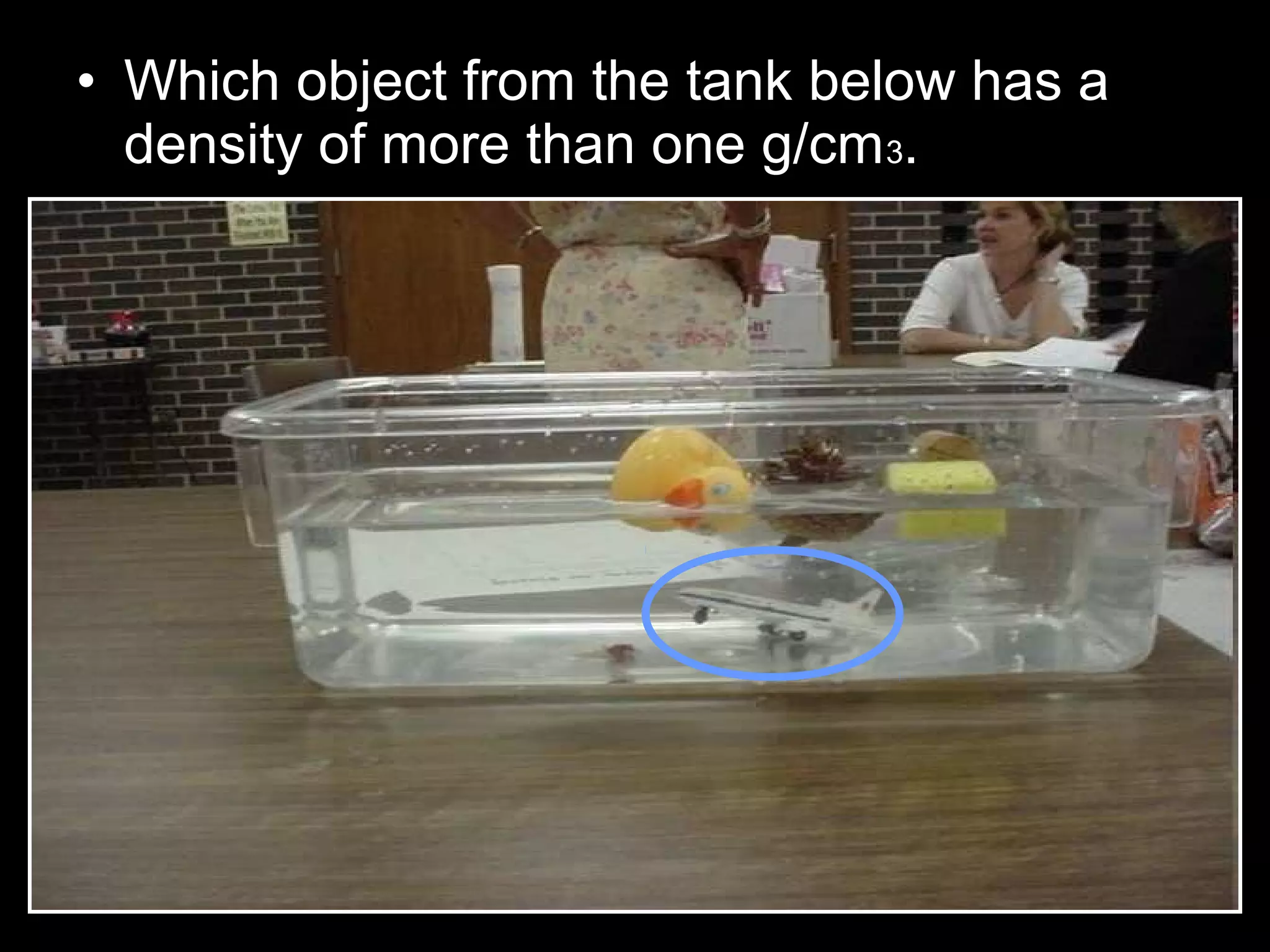
• Which object from the tank below has a
density of more than one g/cm3.
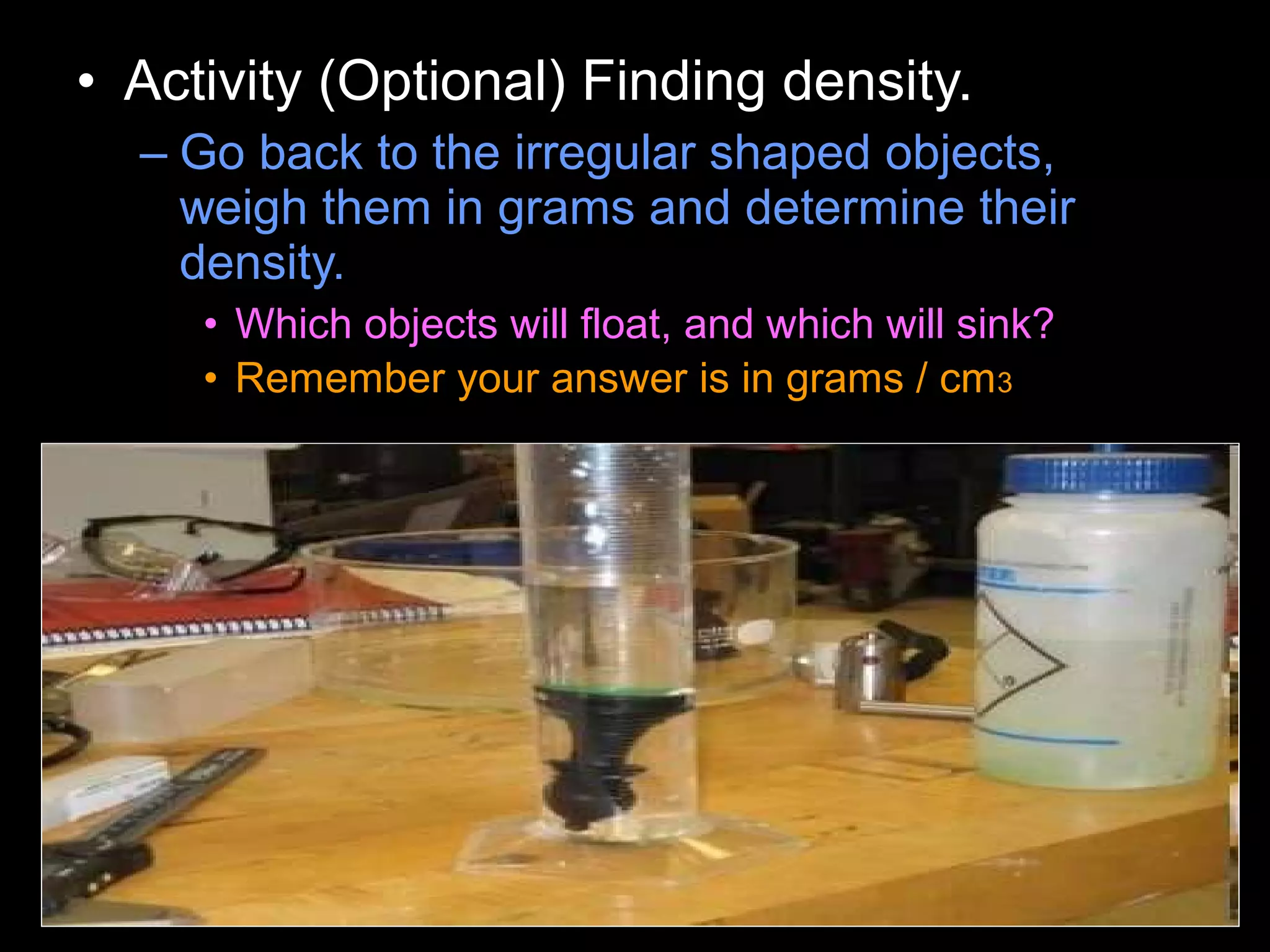
• Activity (Optional) Finding density.
– Go back to the irregular shaped objects,
weigh them in grams and determine their
density.
• Which objects will float, and which will sink?
• Remember your answer is in grams / cm3
• How can we determine the density of a
person?
– Measuring the L x W x H is difficult because we
aren’t made of boxes.
• Activity Sheet Available: Density and Volume
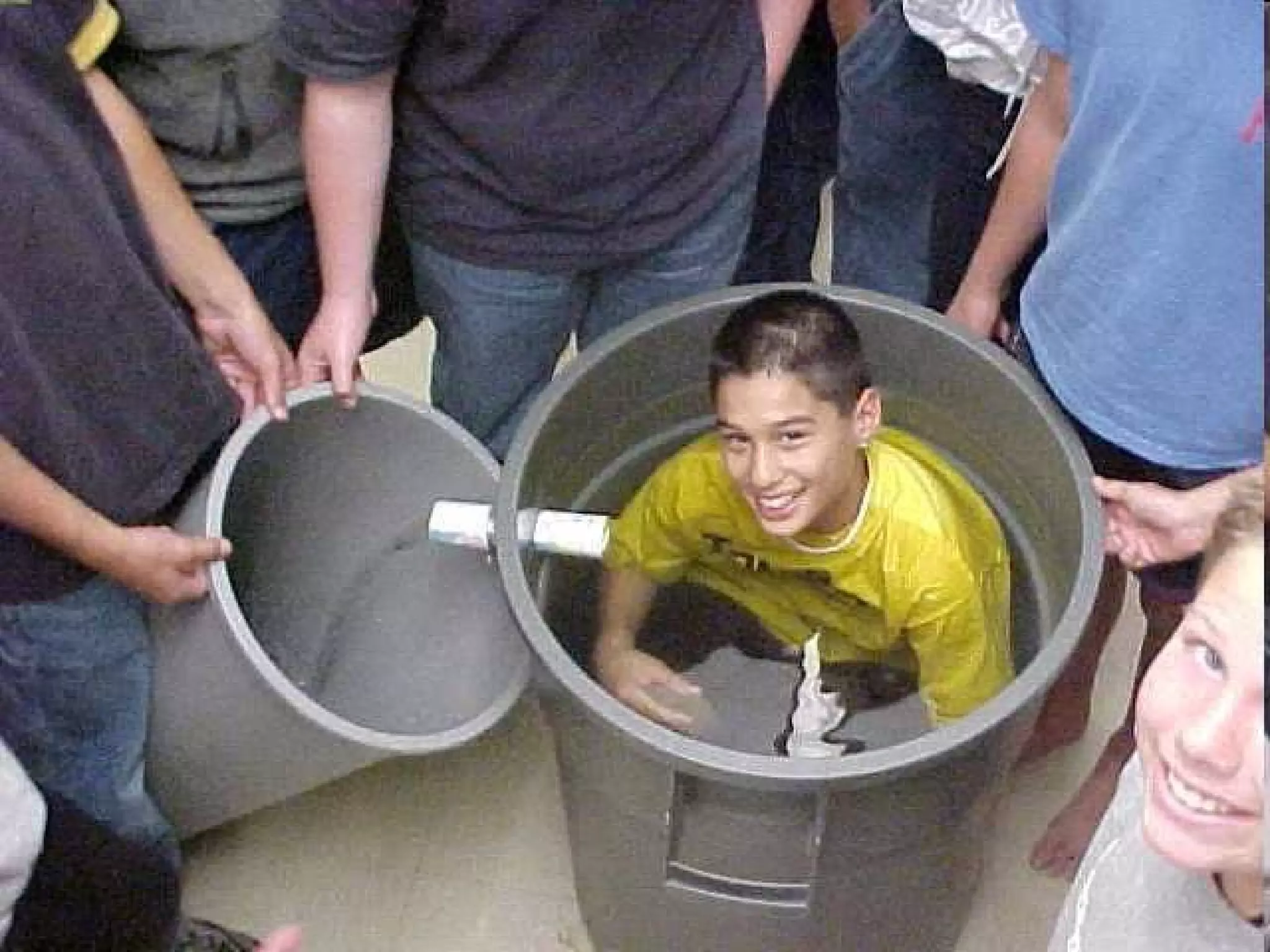
• Finding the Density of a student (Optional)
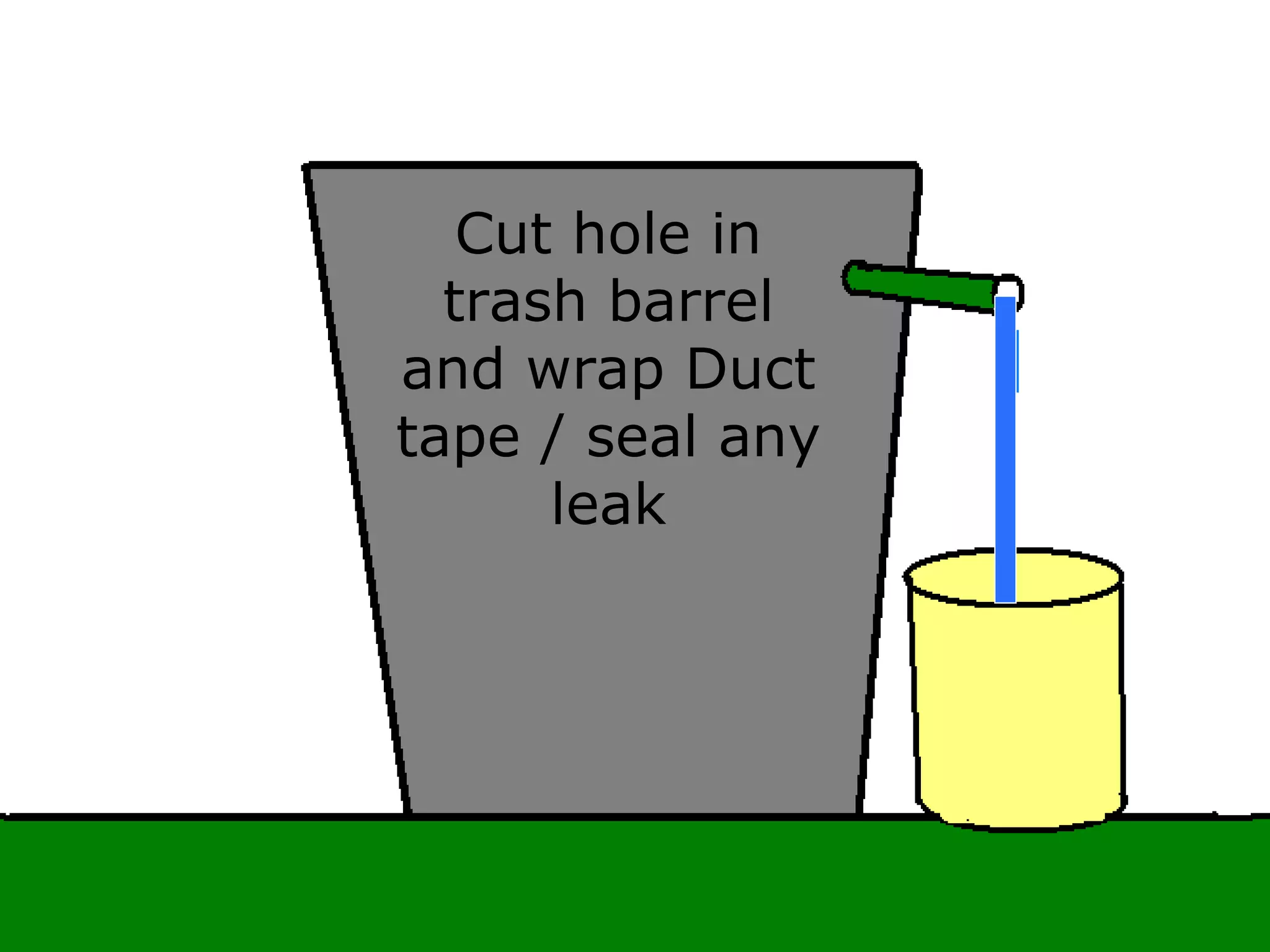
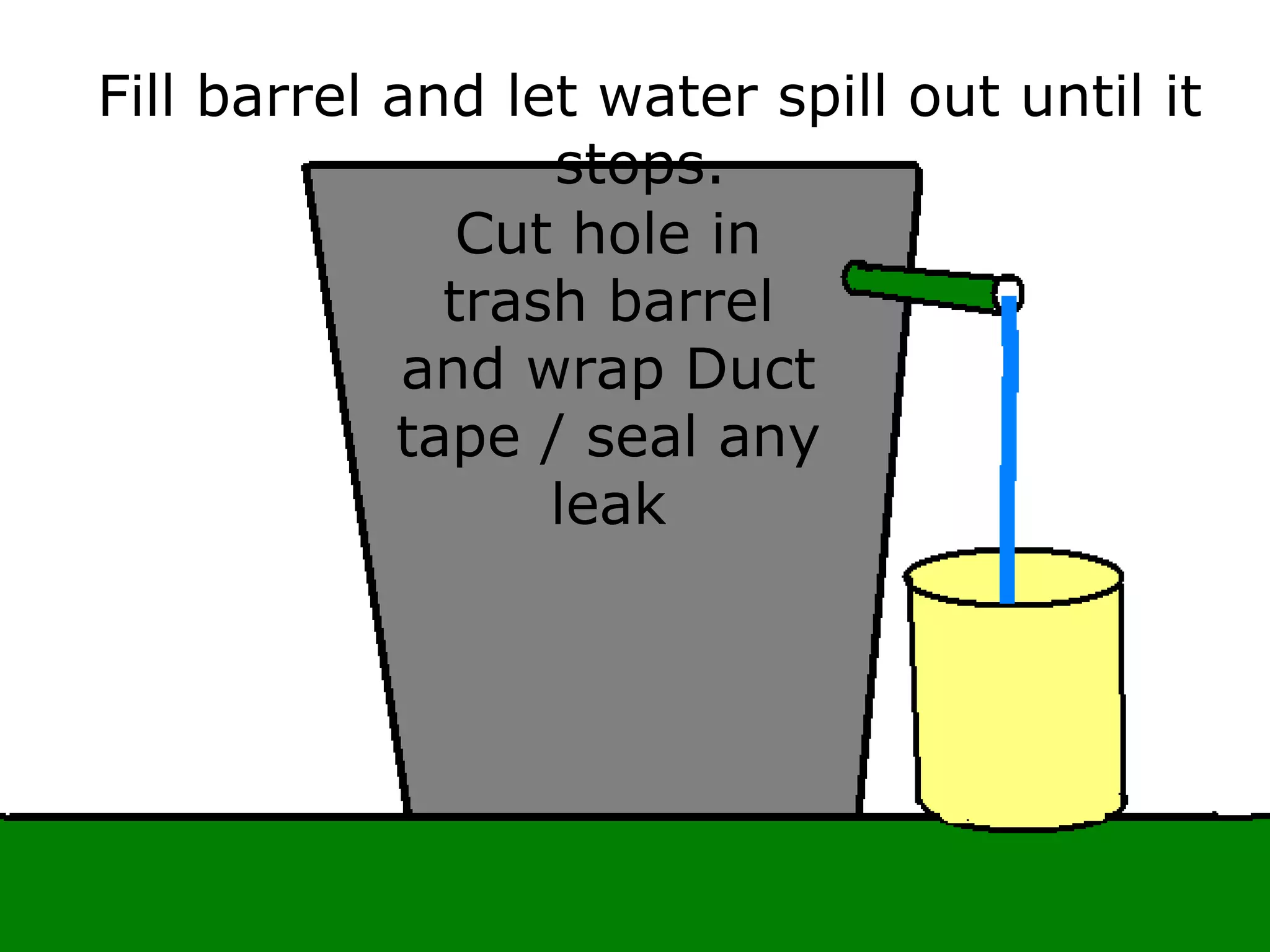
Cut hole in
trash barrel
and wrap Duct
tape / seal any
leak
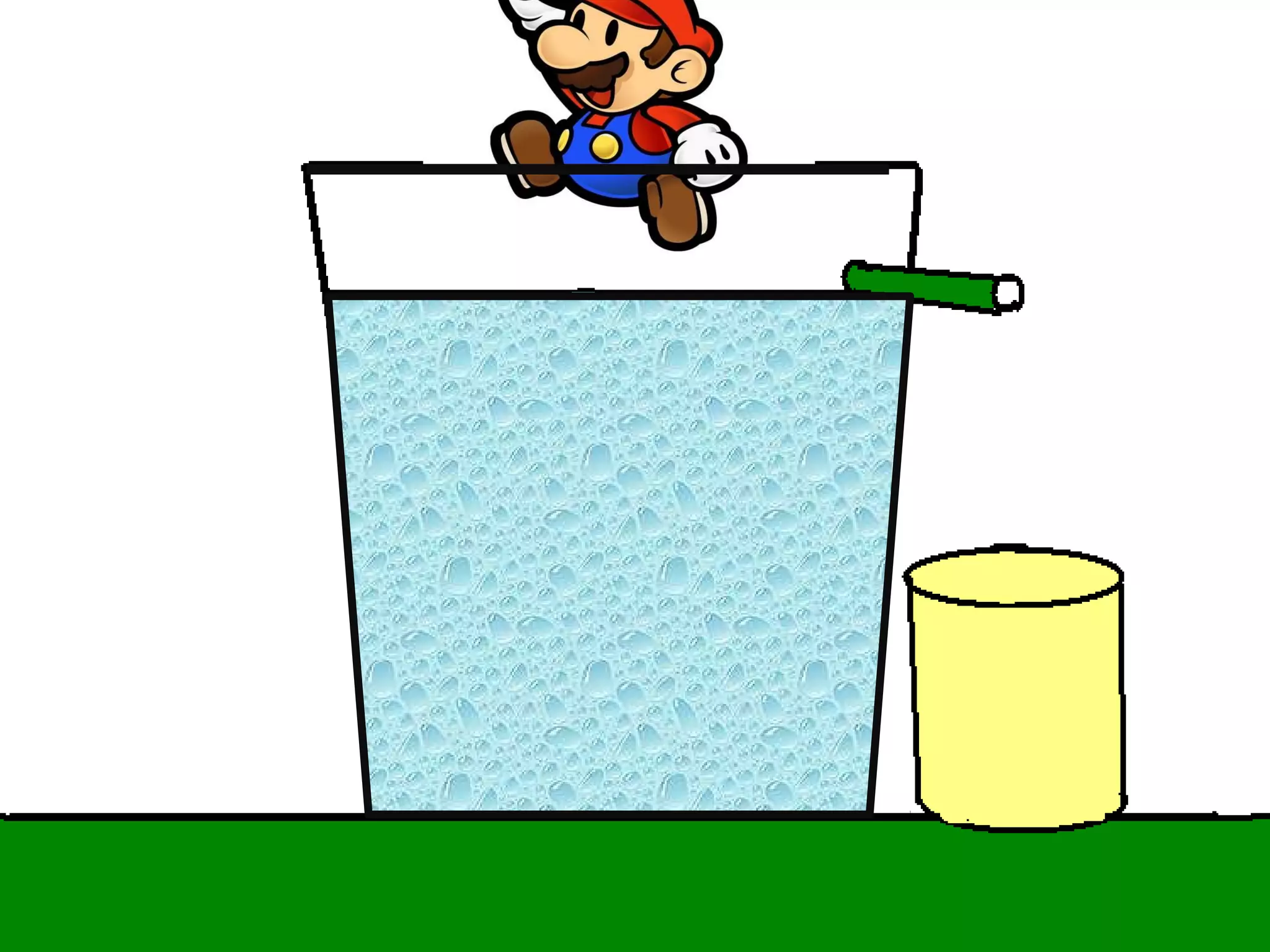
• Activity! Finding the volume of a person by
water displacement.
– First we need to find out the volume of a large
bucket.
– Cut hole in side of plastic garbage can and stick
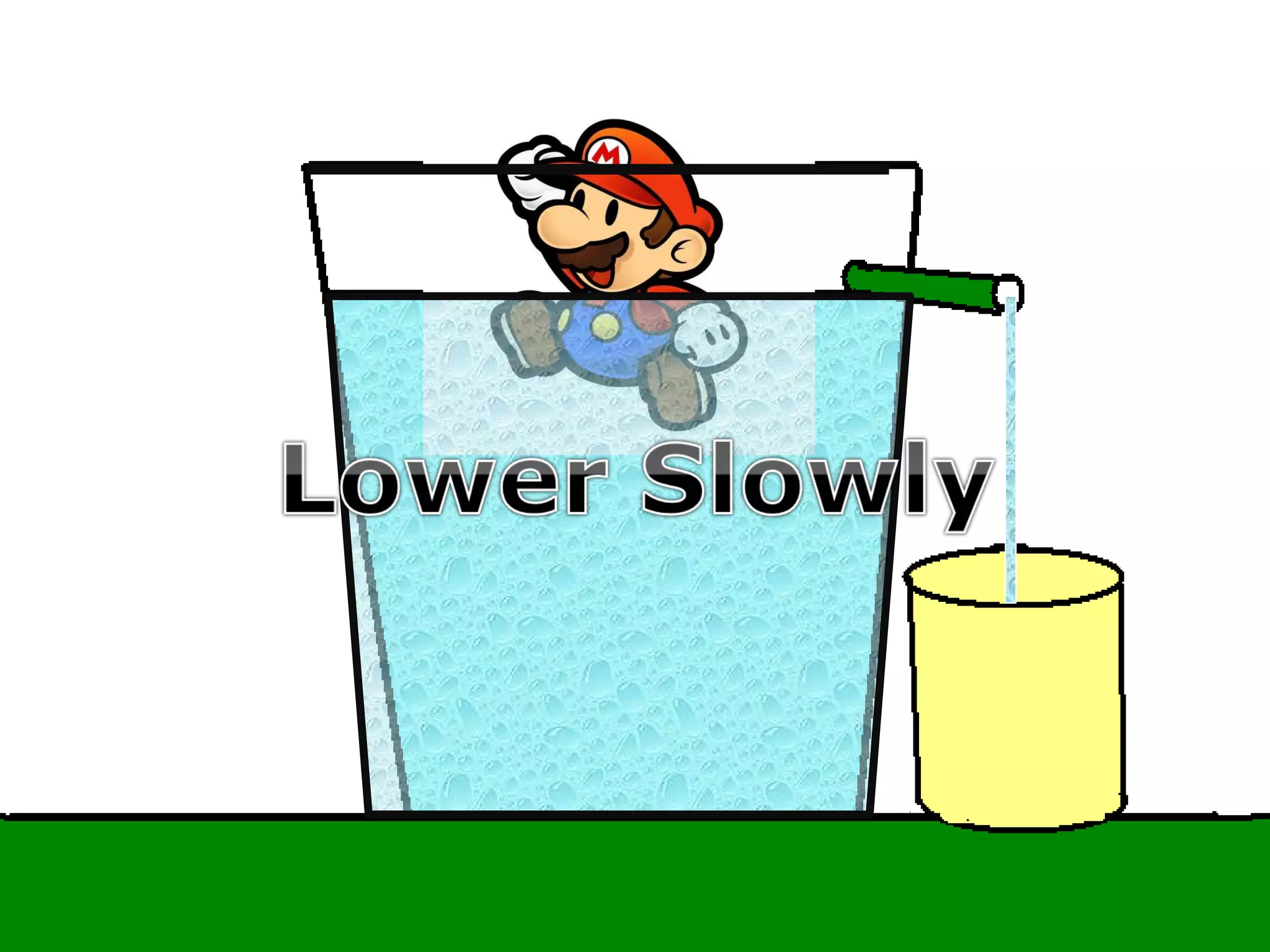
hose in with leak prevention.
– Next we need to fill it with some warm water.
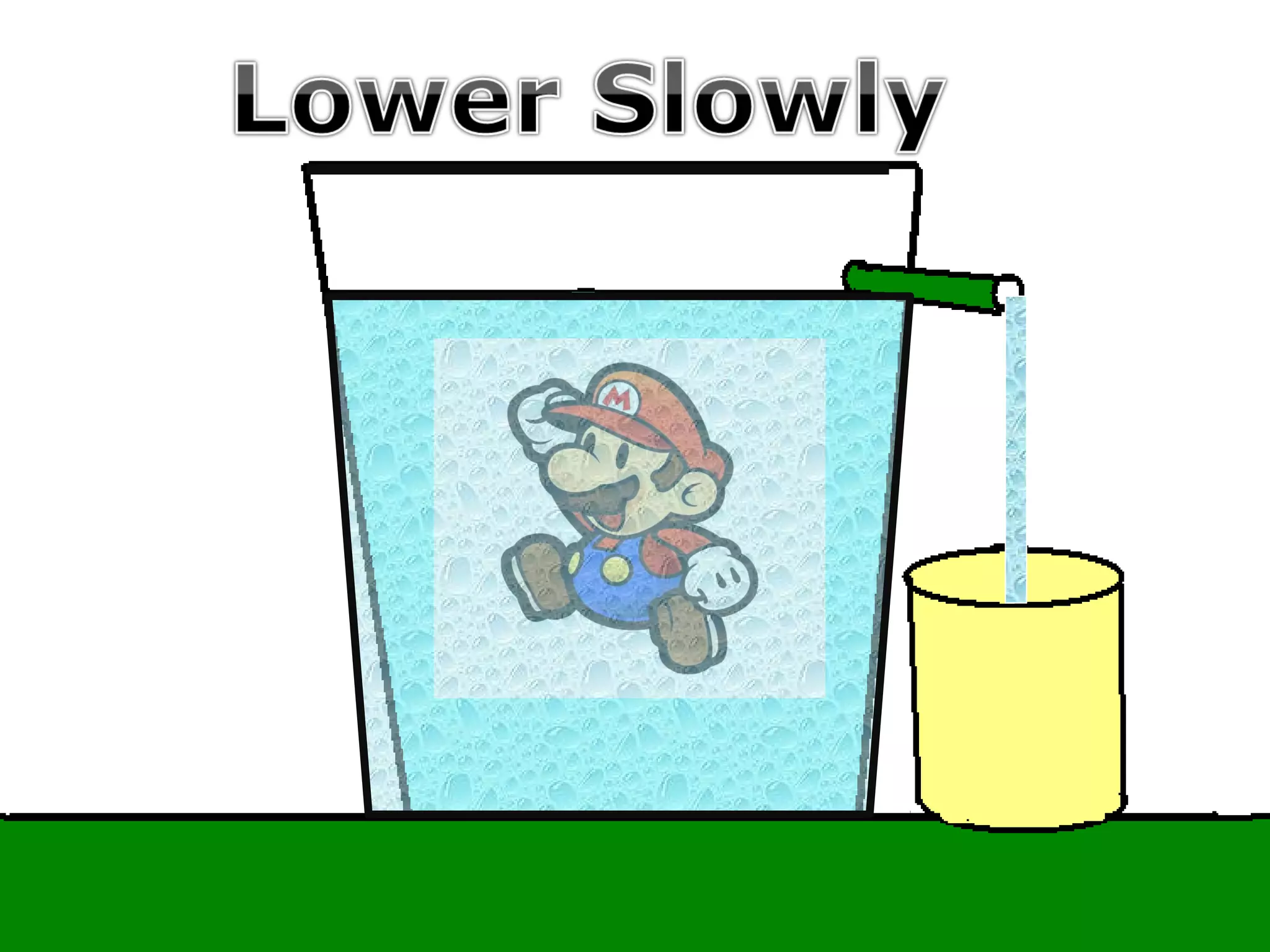
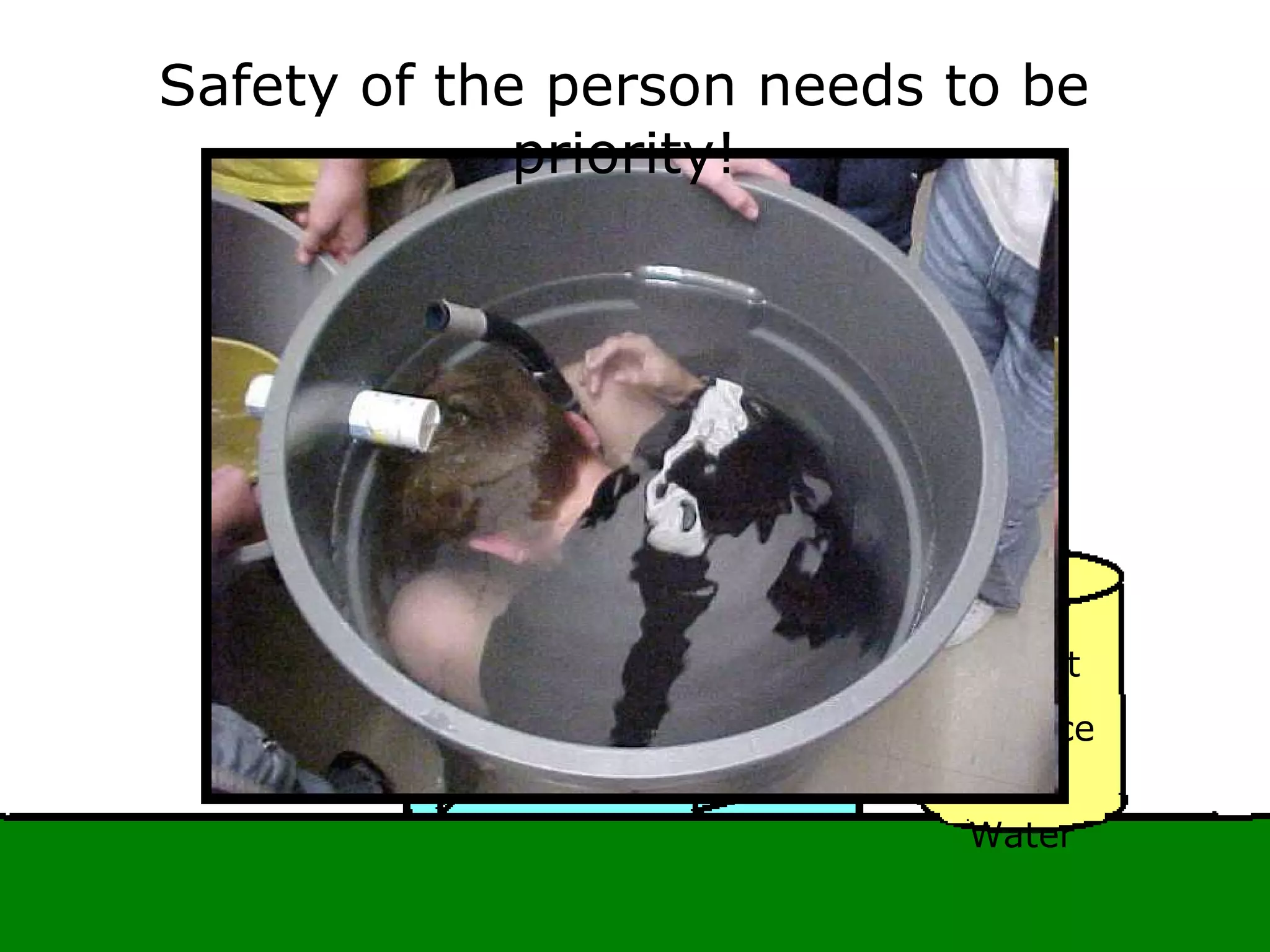
– Next we need a smaller person to submerge
themselves slowly, as we catch all the water.
– Measure all of the water displaced, then we will
weigh student to find the students density.
Copyright © 2010 Ryan P. Murphy
• Activity! Finding the volume of a person by
water displacement.
– First we need to find out the volume of a large
bucket.
– Cut hole in side of plastic garbage can and stick
hose in with leak prevention.
– Next we need to fill it with some warm water.
– Next we need a smaller person to submerge
themselves slowly, as we catch all the water.
– Measure all of the water displaced, then we will
weigh student to find the students density.
Copyright © 2010 Ryan P. Murphy
• Activity! Finding the volume of a person by
water displacement.
– First we need to find out the volume of a large
bucket.
– Cut hole in side of plastic garbage barrel and
stick hose in with leak prevention.
– Next we need to fill it with some warm water.
– Next we need a smaller person to submerge
themselves slowly, as we catch all the water.
– Measure all of the water displaced, then we will
weigh student to find the students density.
Copyright © 2010 Ryan P. Murphy
• Activity! Finding the volume of a person by
water displacement.
– First we need to find out the volume of a large
bucket.
– Cut hole in side of plastic garbage barrel and
stick hose in with leak prevention.
– Next we need to fill it with some warm water.
– Next we need a smaller person to submerge
themselves slowly, as we catch all the water.
– Measure all of the water displaced, then we will
weigh student to find the students density.
Copyright © 2010 Ryan P. Murphy
• Activity! Finding the volume of a person by
water displacement.
– First we need to find out the volume of a large
bucket.
– Cut hole in side of plastic garbage barrel and
stick hose in with leak prevention.
– Next we need to fill it with some warm water.
– Next we need a smaller person to submerge
themselves slowly, as we catch all the water.
– Measure all of the water displaced, then we will
weigh student to find the students density.
Copyright © 2010 Ryan P. Murphy
• Activity! Finding the volume of a person by
water displacement.
– First we need to find out the volume of a large
bucket.
– Cut hole in side of plastic garbage barrel and
stick hose in with leak prevention.
– Next we need to fill it with some warm water.
– Next we need a smaller person to submerge
themselves slowly, as we catch all the water.
– Measure all of the water displaced, then we will
weigh student to find the students density.
Copyright © 2010 Ryan P. Murphy
• Activity! Finding the volume of a person by
water displacement.
– First we need to find out the volume of a large
bucket.
– Cut hole in side of plastic garbage barrel and
stick hose in with leak prevention.
– Next we need to fill it with some warm water.
– Next we need a smaller person to submerge
themselves slowly, as we catch all the water.
– Measure all of the water displaced, then we will
weigh student to find the students density.
D=M/V
Copyright © 2010 Ryan P. Murphy
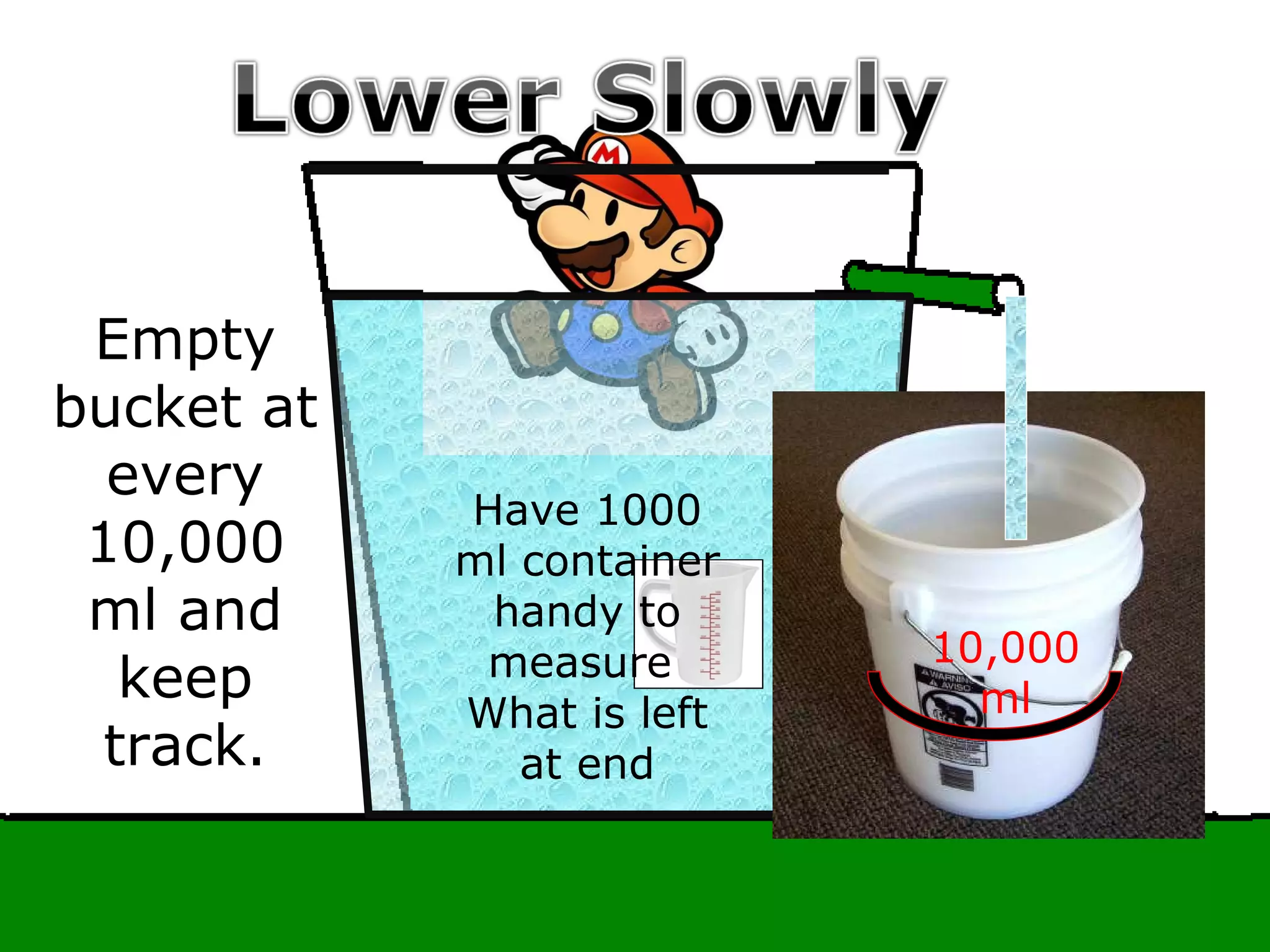
Fill barrel and let water spill out until it
stops.
Cut hole in
trash barrel
and wrap Duct
tape / seal any
leak
Collect
Displace
d
Water
Safety of the person needs to be
priority!
Collect
And
measure
displace
d water
10,000
ml
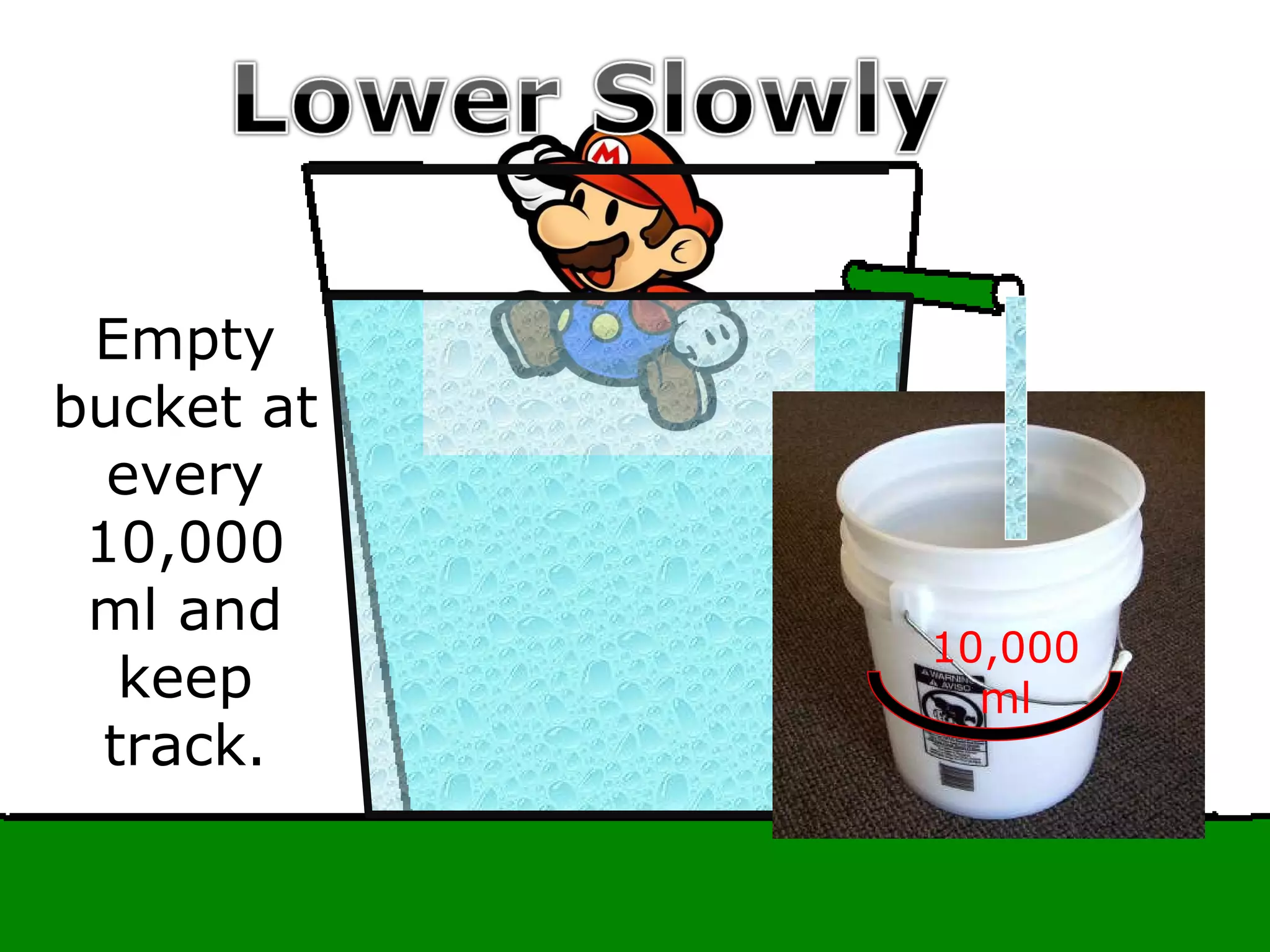
Empty
bucket at
every
10,000
ml and
keep
track.
Collect
And
measure
displace
d water
10,000
ml
Empty
bucket at
every
10,000
ml and
keep
track.
Have 1000
ml container
handy to
measure
What is left
at end
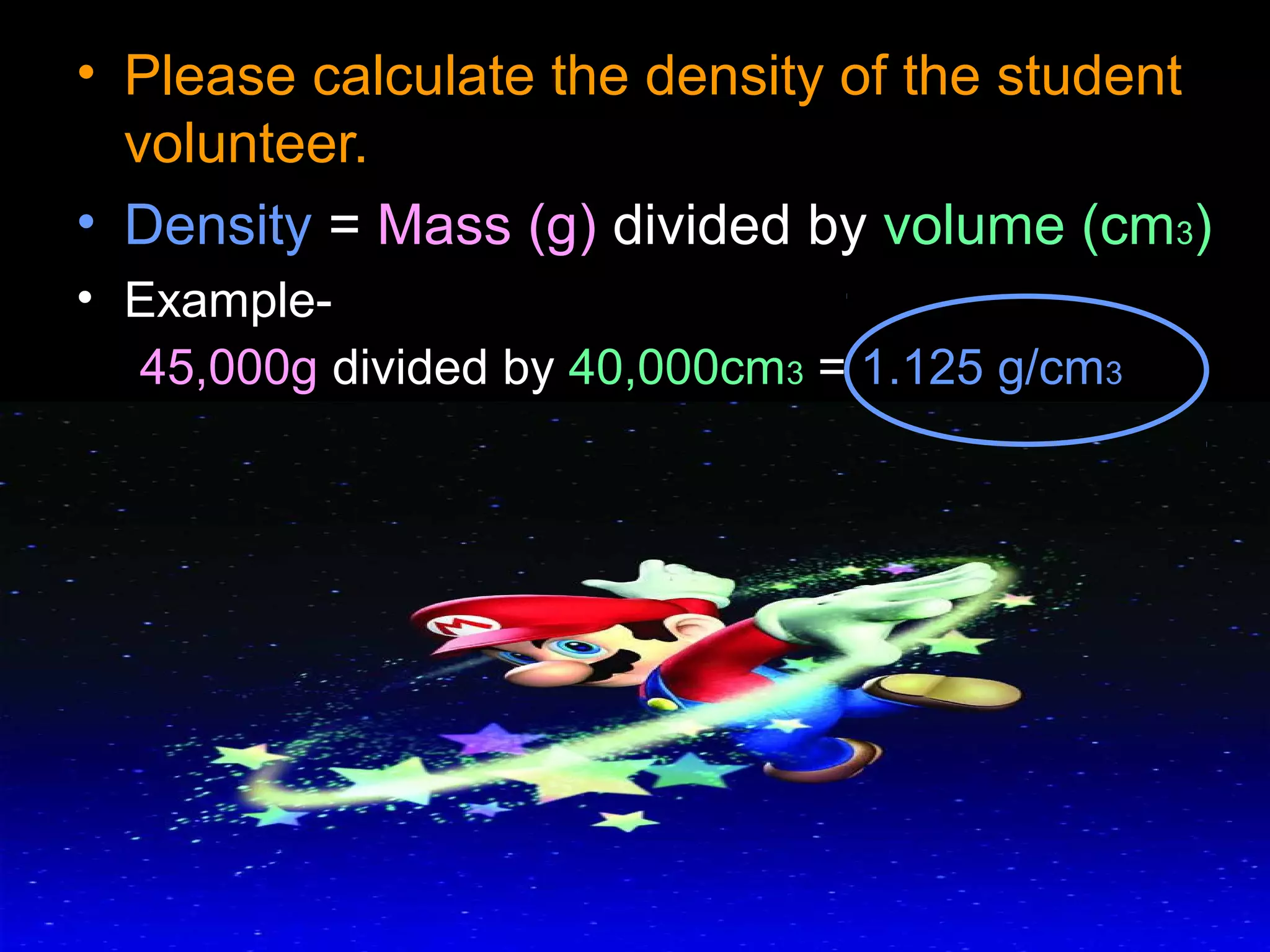
• Please calculate the density of the student
volunteer.
• Density = Mass (g) divided by volume (cm3)
• Example-
45,000g divided by 40,000cm3 = 1.125 g/cm3
• Density: How much mass is contained in aDensity: How much mass is contained in a
given volume. We use grams/cmgiven volume. We use grams/cm33
– (grams per cubic centimeter)(grams per cubic centimeter)
– Density = Mass divided by volumeDensity = Mass divided by volume
Copyright © 2010 Ryan P. Murphy
Mass
D = ------------- = grams/cm3
Volume
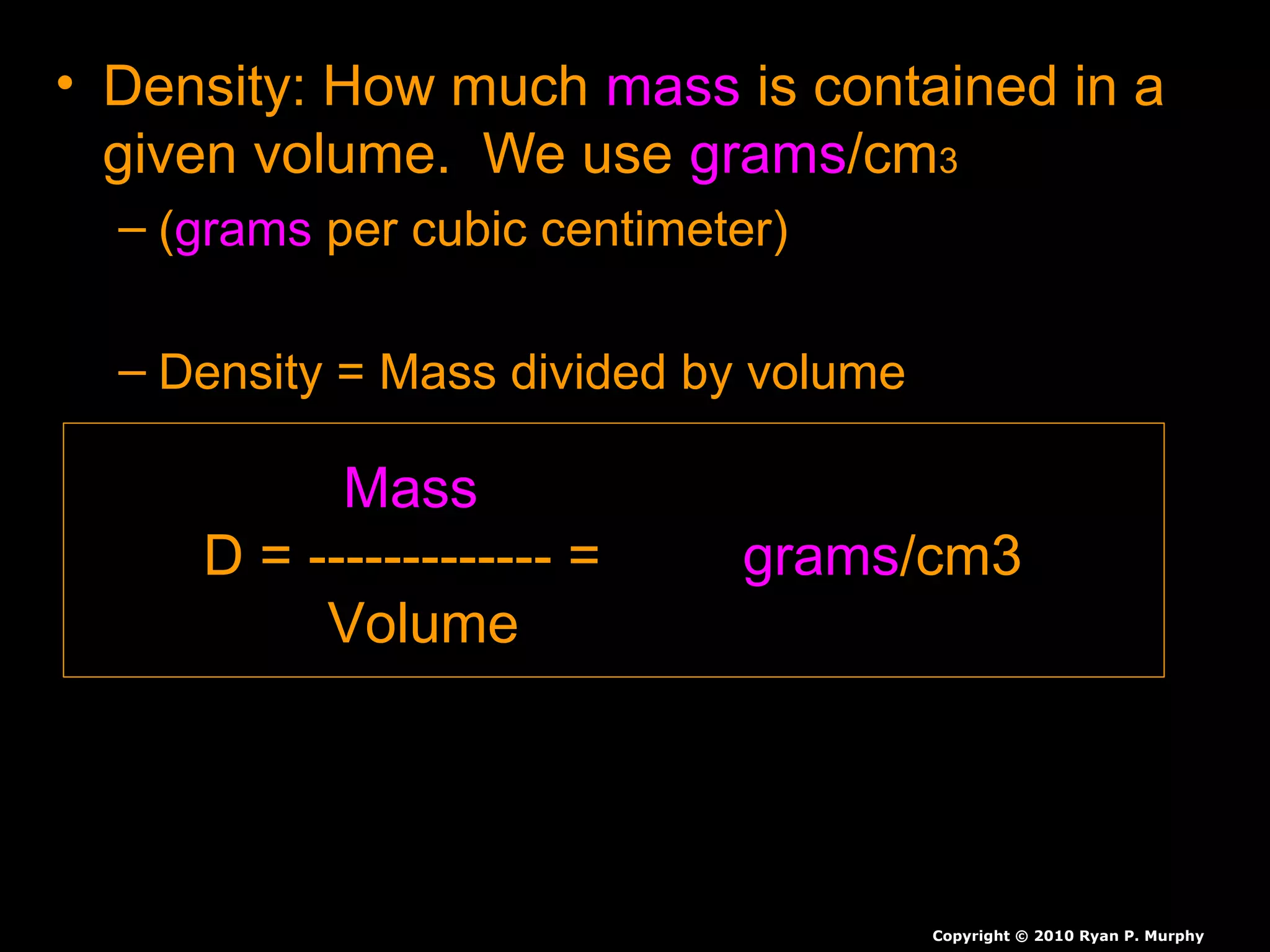
• Density: How muchDensity: How much massmass is contained in ais contained in a
given volume. We usegiven volume. We use gramsgrams/cm/cm33
– ((gramsgrams per cubic centimeter)per cubic centimeter)
– Density = Mass divided by volumeDensity = Mass divided by volume
Copyright © 2010 Ryan P. Murphy
Mass
D = ------------- = grams/cm3
Volume
• Density: How muchDensity: How much massmass is contained in ais contained in a
givengiven volumevolume. We use. We use gramsgrams//cmcm33
– ((gramsgrams perper cubic centimetercubic centimeter))
– Density = Mass divided by volumeDensity = Mass divided by volume
Copyright © 2010 Ryan P. Murphy
Mass
D = ------------- = grams/cm3
Volume
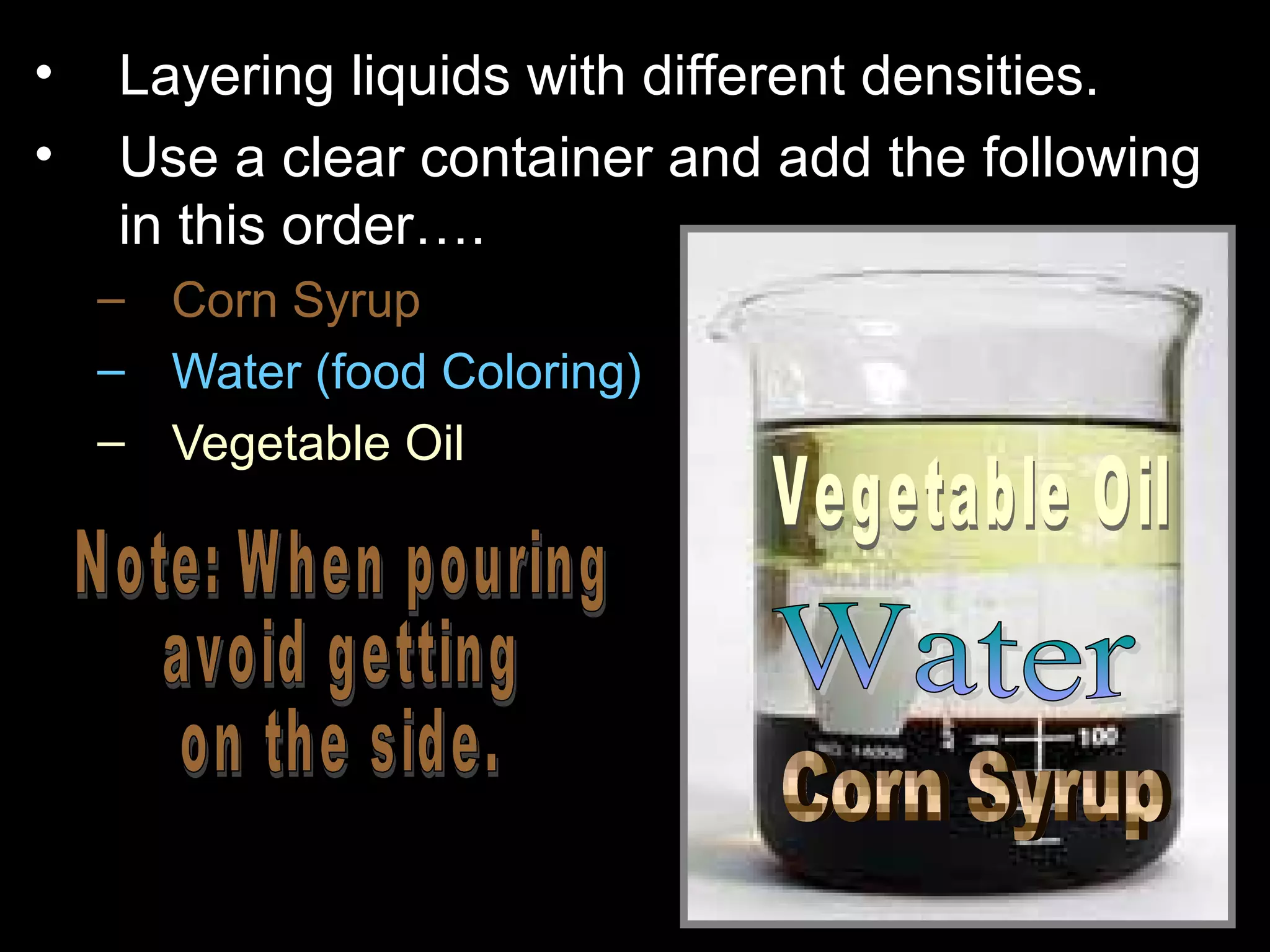
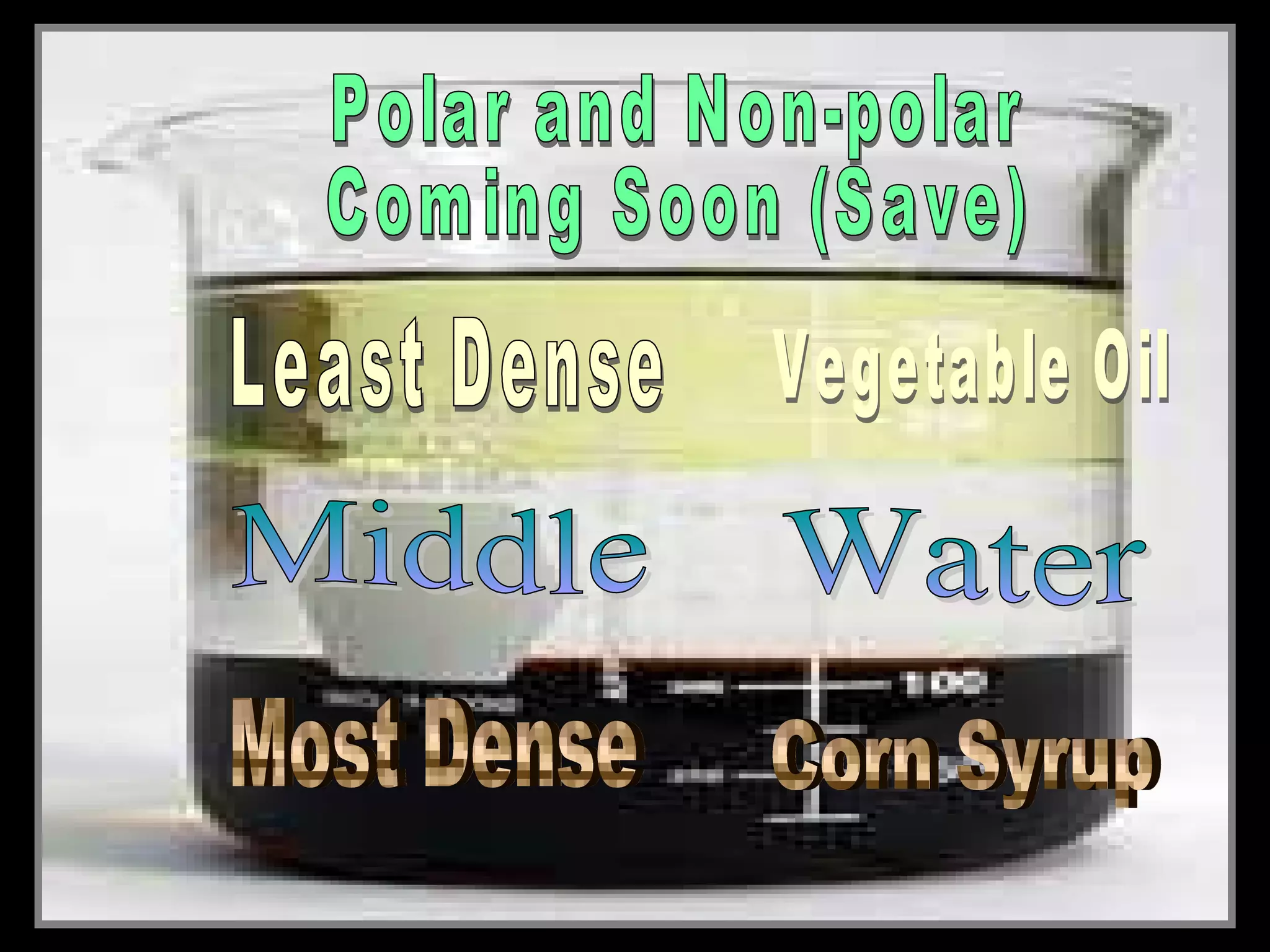
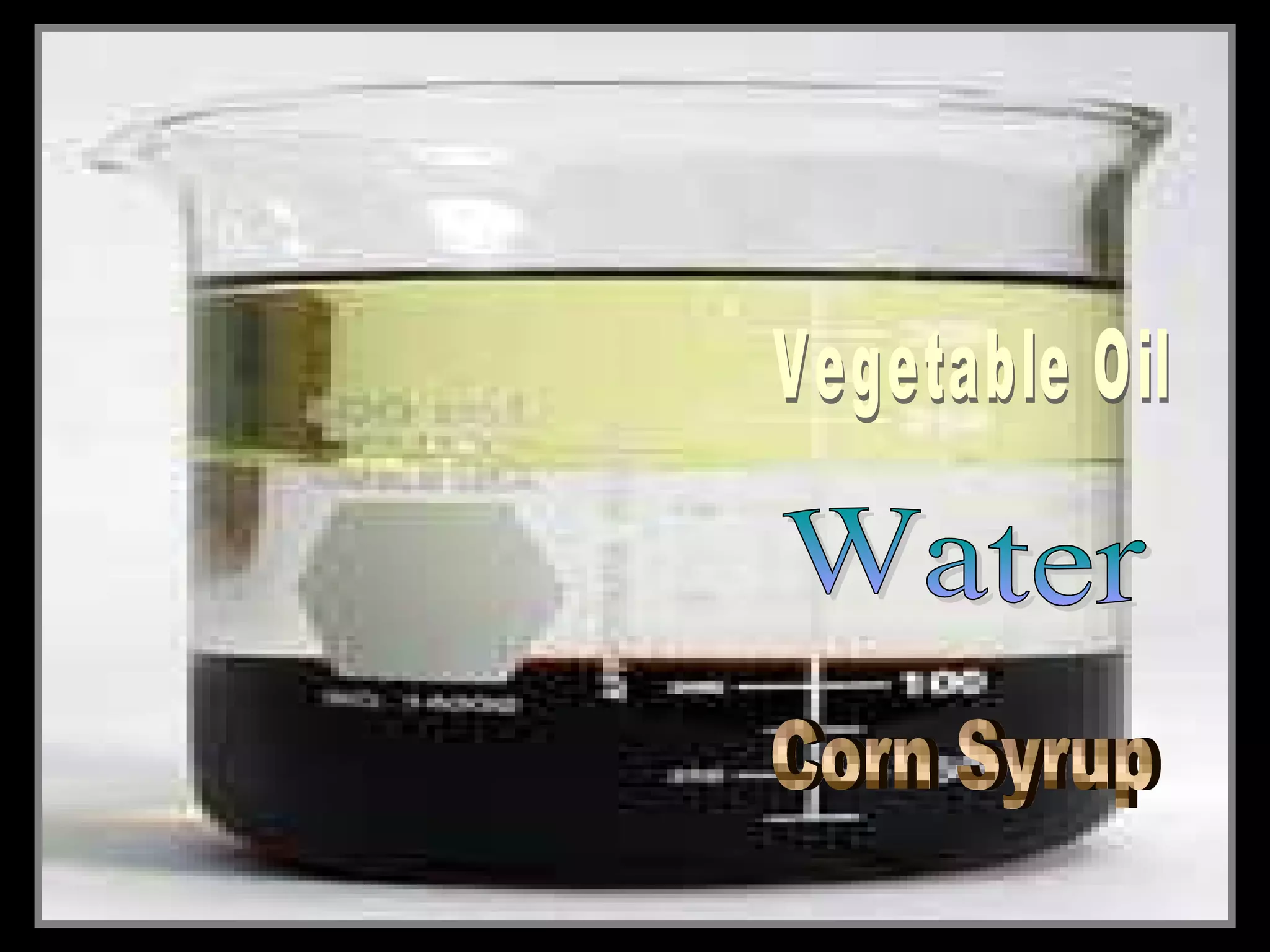
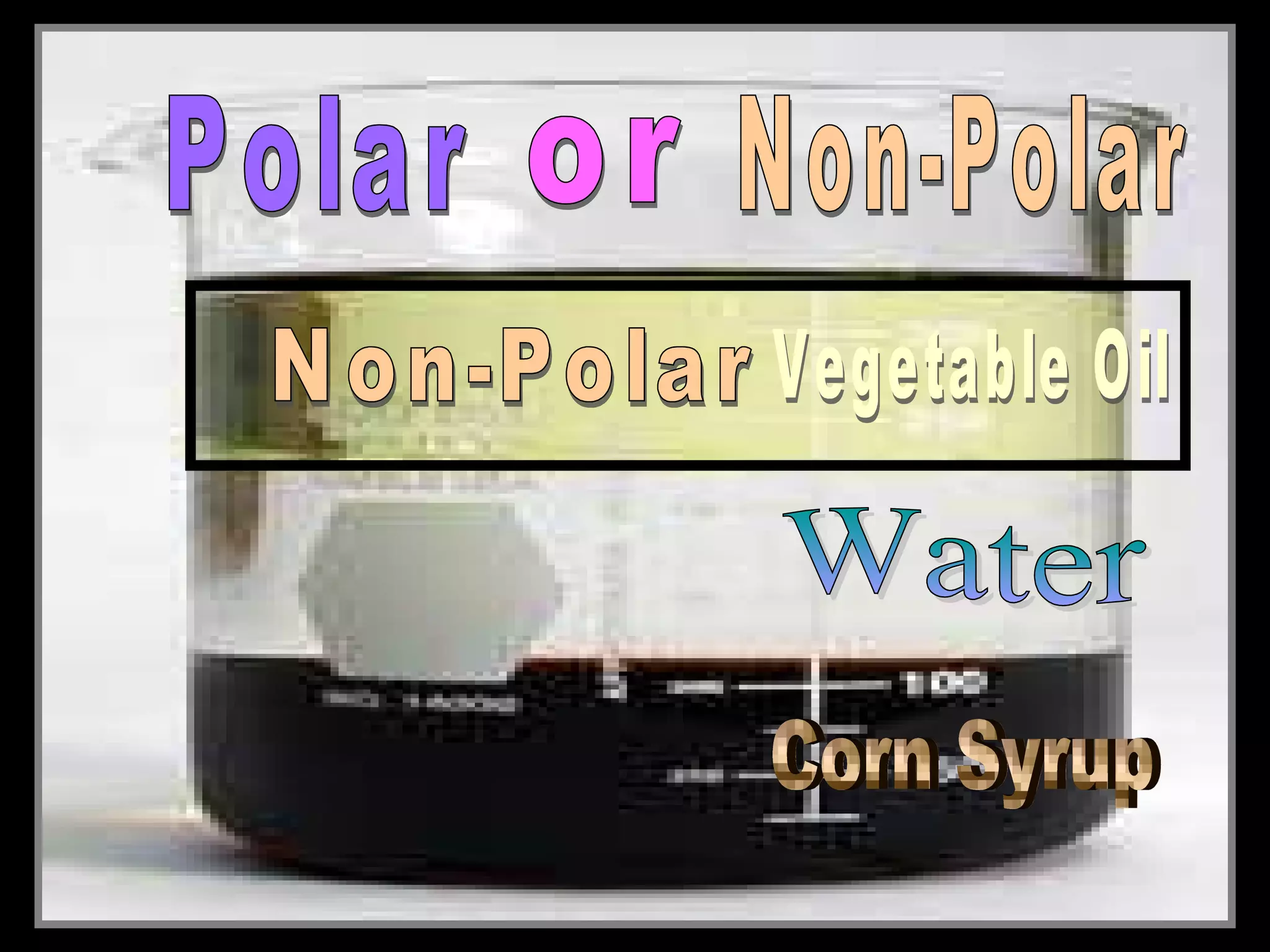
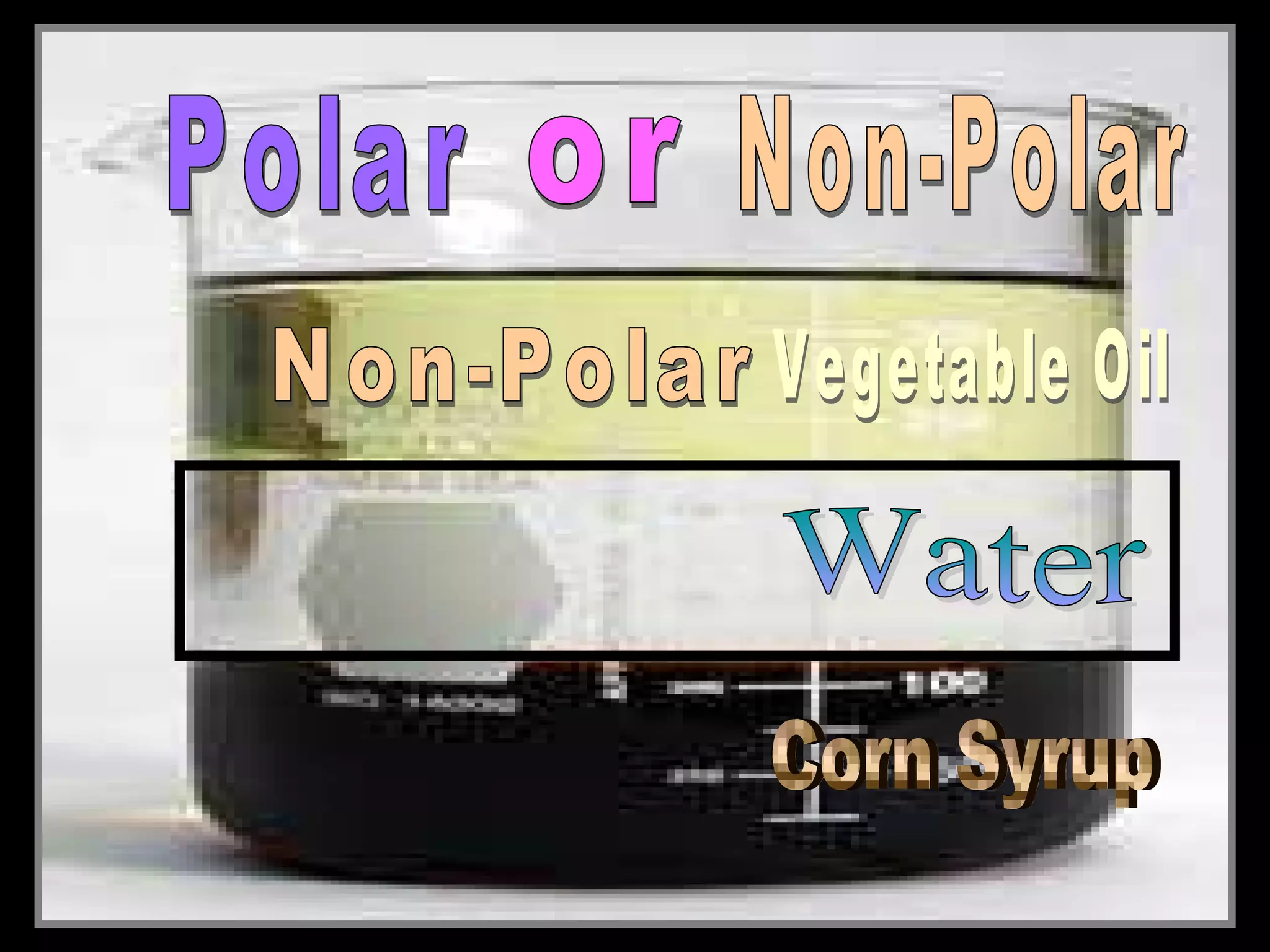
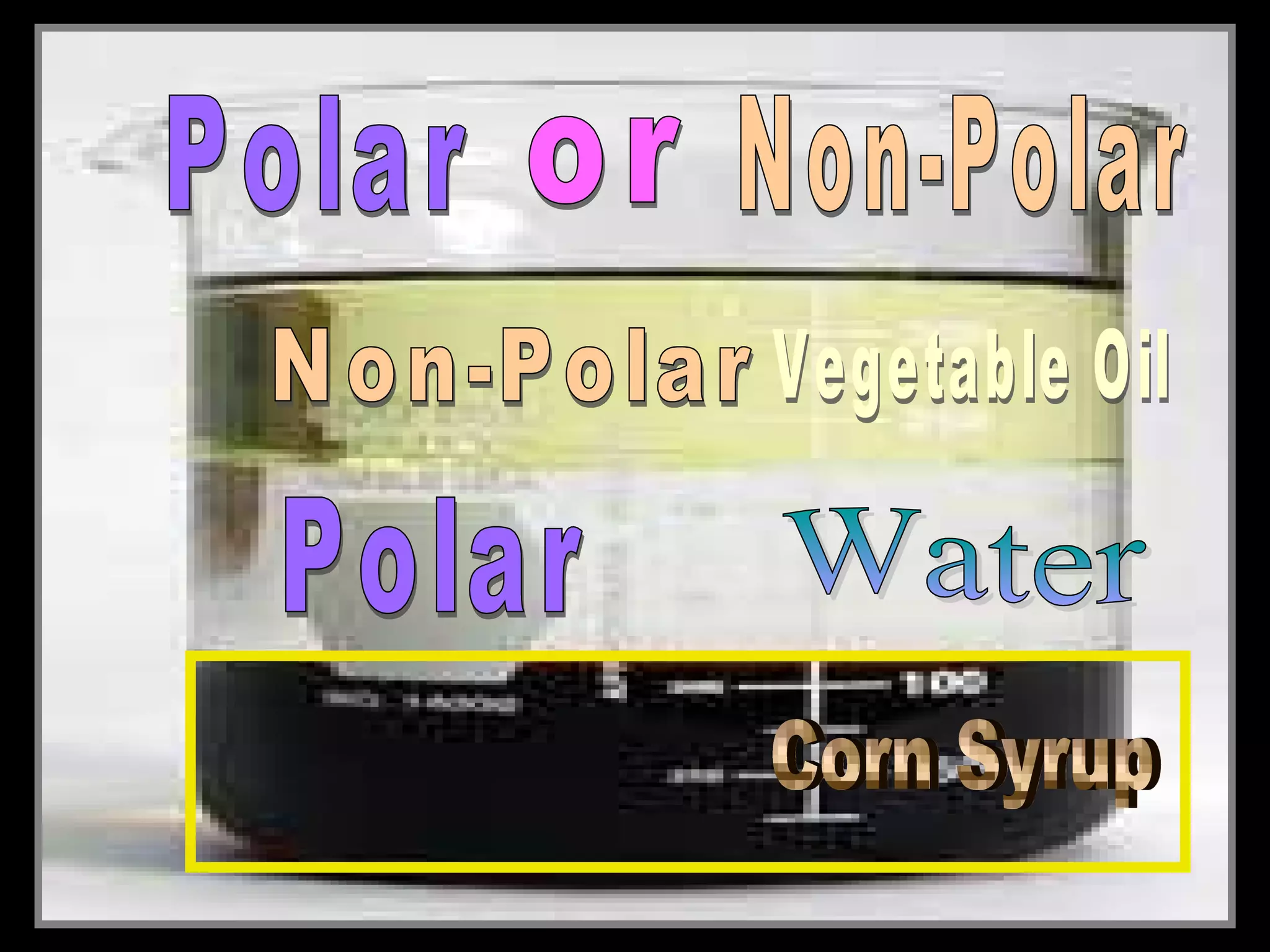
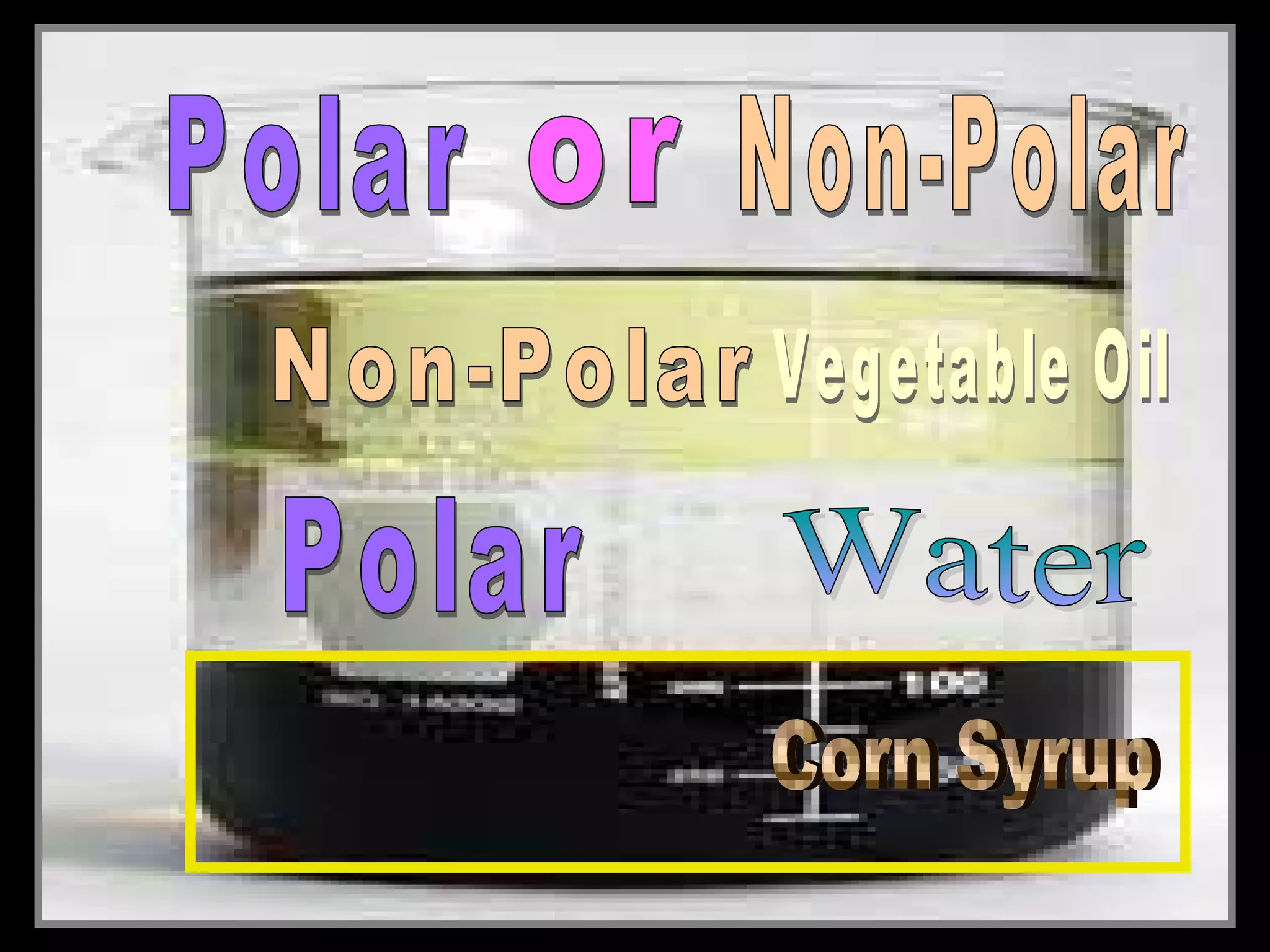
• Layering liquids with different densities.
• Use a clear container and add the following
in this order….
– Corn Syrup
– Water (food Coloring)
– Vegetable Oil
• Layering liquids with different densities.
• Use a clear container and add the following
in this order….
– Corn Syrup
– Water (food Coloring)
– Vegetable Oil
• The word “miscibility” describes how well
two substances mix.
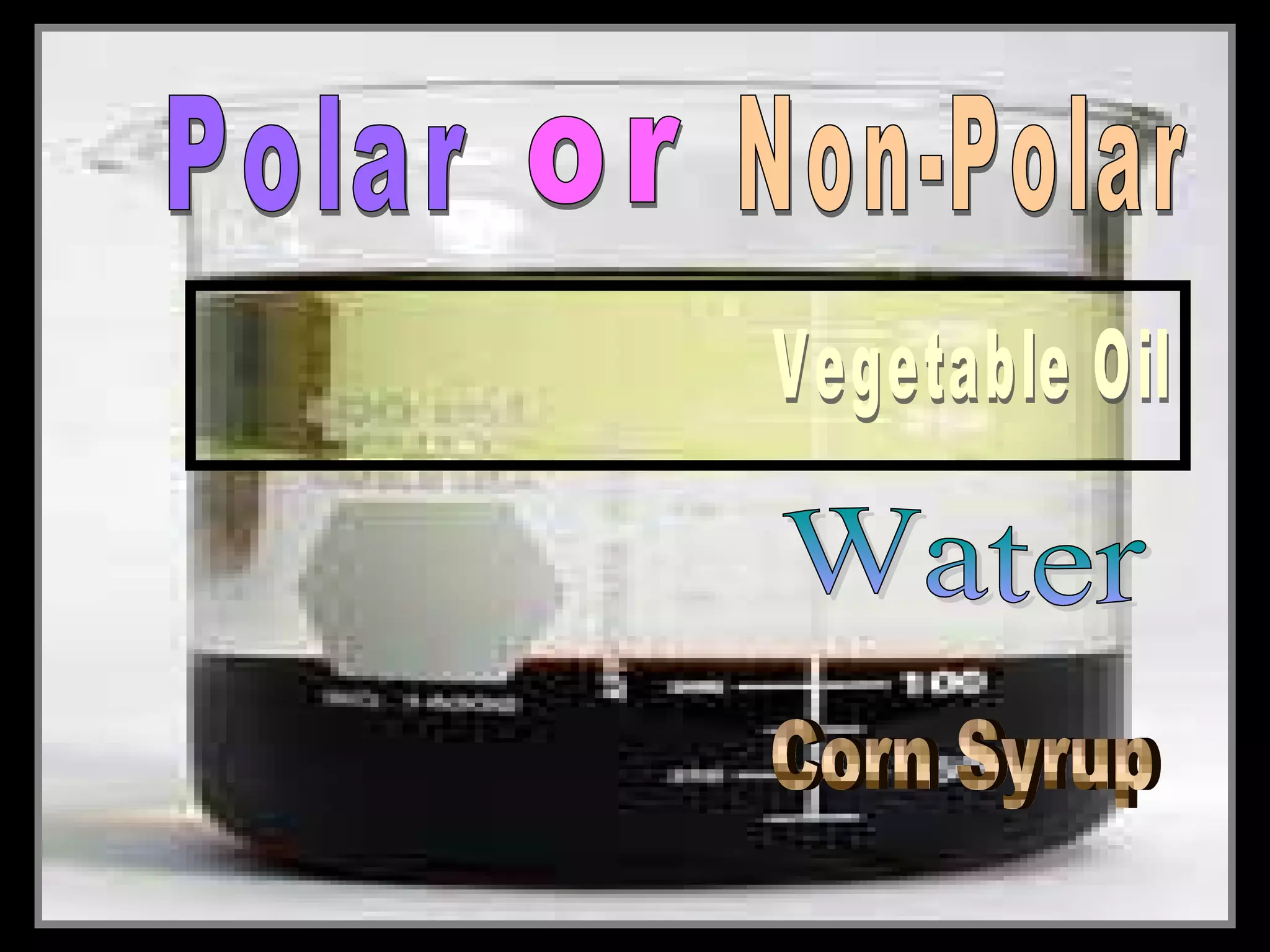
• Oil and water are said to be “immiscible,”
because they do not mix.
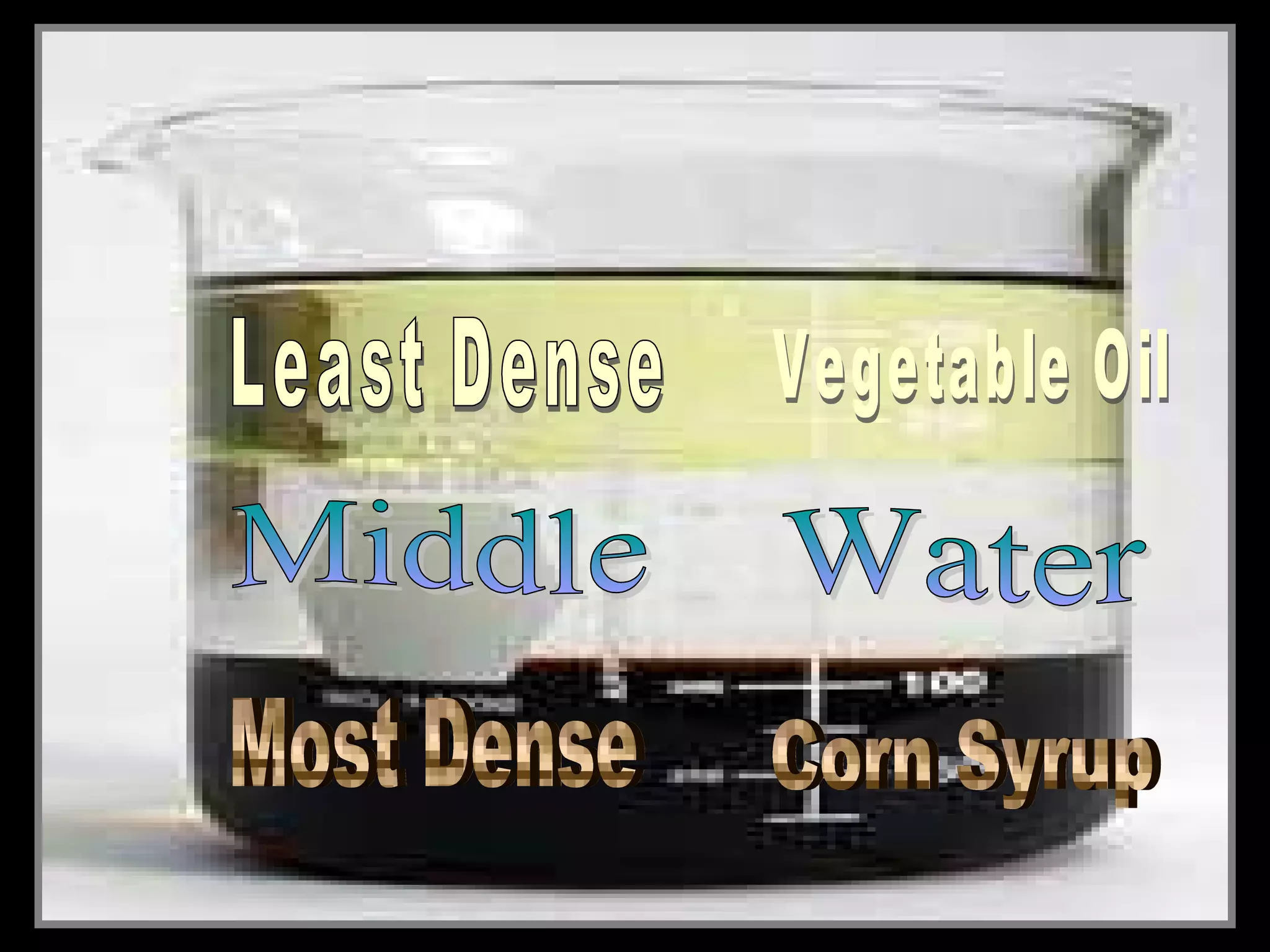
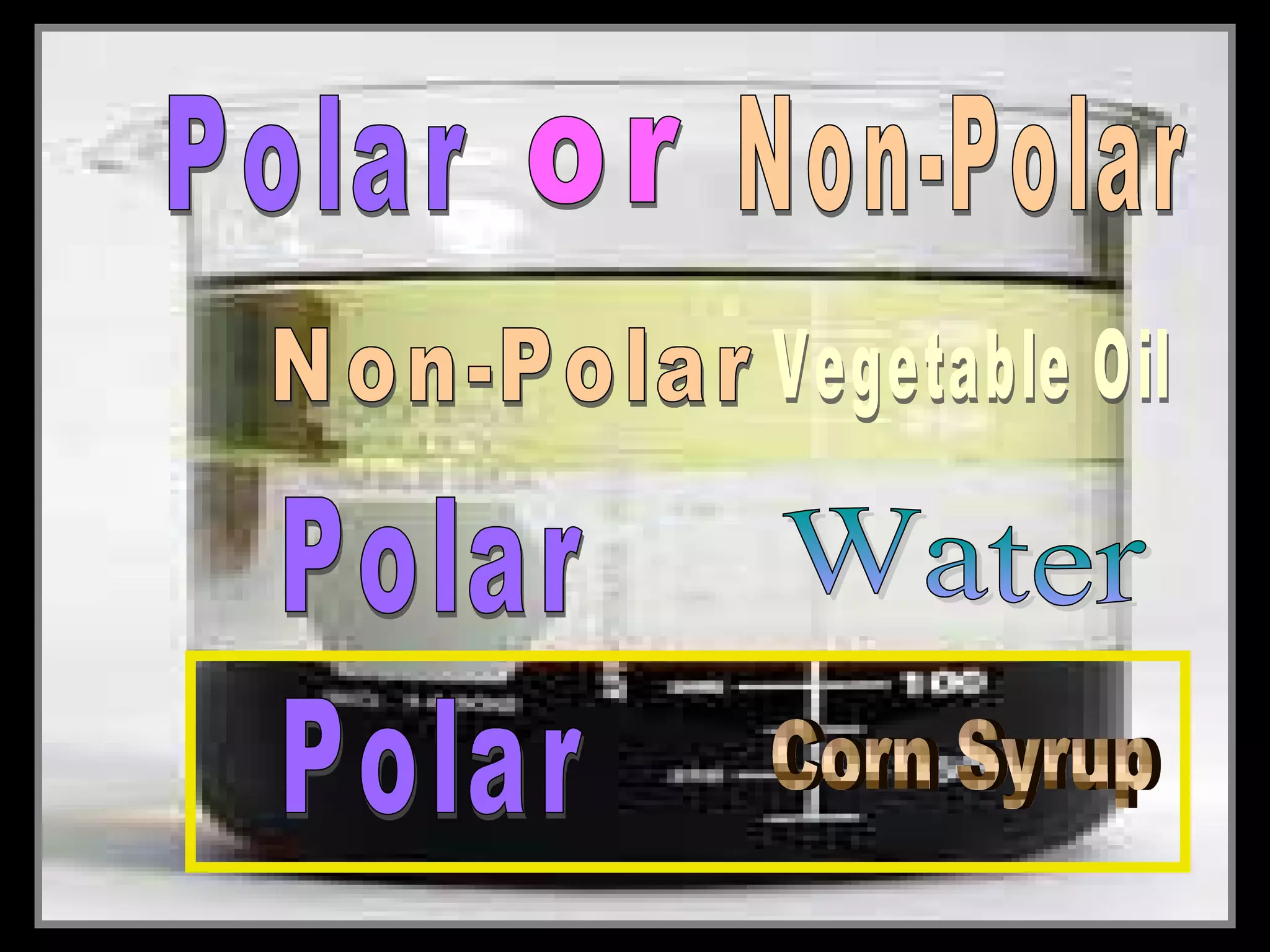
• The oil layer is on top of the water because
of the difference in density of the two liquids.
– The density of a substance is the ratio of its
mass (weight) to its volume. The oil is less
dense than the water and so is on top. The corn
syrup is the most dense so it is on the bottom.
• The word “miscibility” describes how well
two substances mix.
• Oil and water are said to be “immiscible,”
because they do not mix.
• The oil layer is on top of the water because
of the difference in density of the two liquids.
– The density of a substance is the ratio of its
mass (weight) to its volume. The oil is less
dense than the water and so is on top. The corn
syrup is the most dense so it is on the bottom.
• The word “miscibility” describes how well
two substances mix.
• Oil and water are said to be “immiscible,”
because they do not mix.
• The oil layer is on top of the water because
of the difference in density of the two liquids.
– The density of a substance is the ratio of its
mass (weight) to its volume. The oil is less
dense than the water and so is on top. The corn
syrup is the most dense so it is on the bottom.
• The word “miscibility” describes how well
two substances mix.
• Oil and water are said to be “immiscible,”
because they do not mix.
• The oil layer is on top of the water because
of the difference in density of the two liquids.
– The density of a substance is the ratio of its
mass (weight) to its volume. The oil is less
dense than the water and so it’s on top. The
corn syrup is the most dense so it’s on the
bottom.
• Layering liquids with different densities.
• Use a clear container and add the following
in this order….
– Corn Syrup
– Water (food Coloring)
– Vegetable Oil
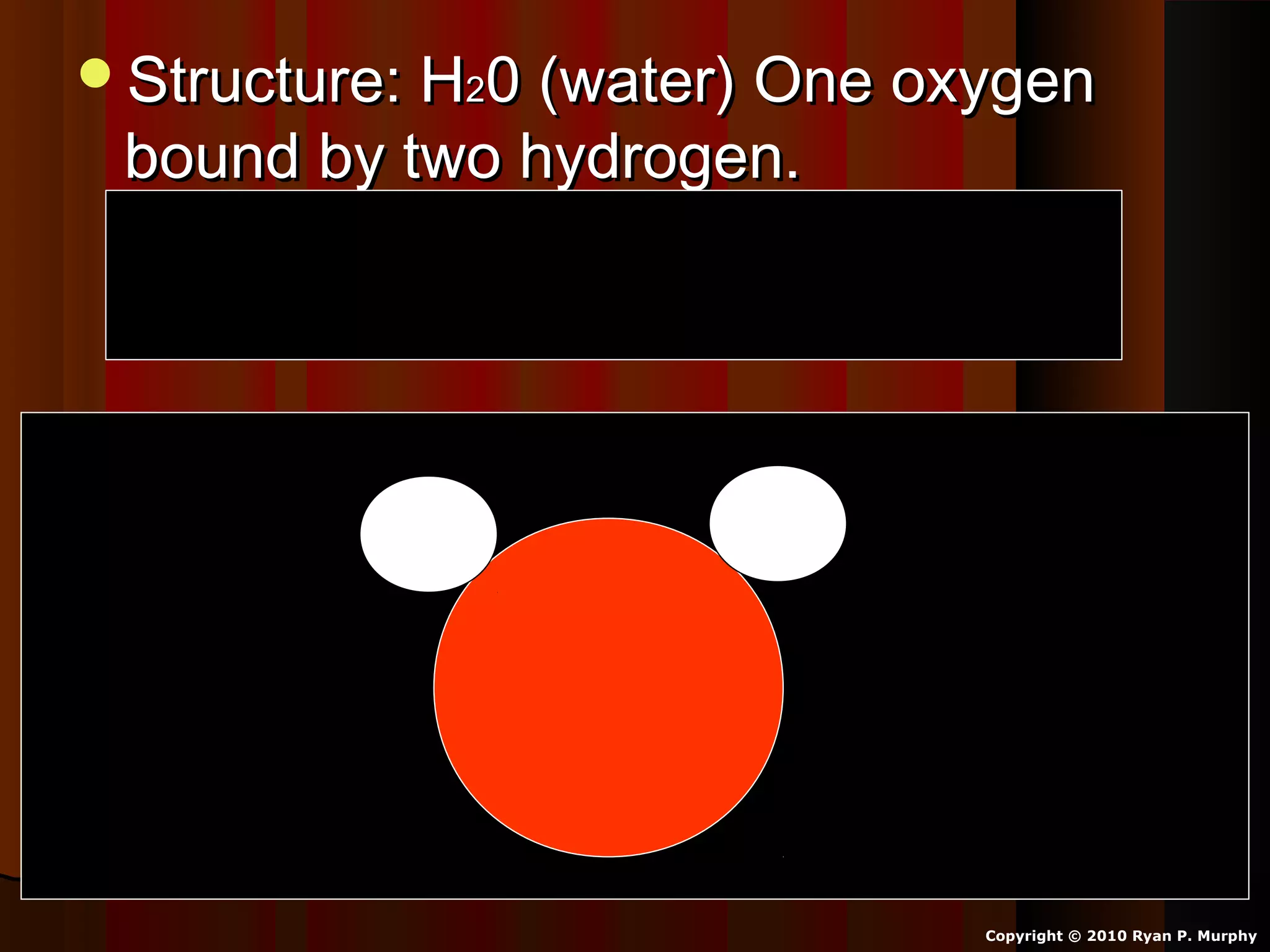
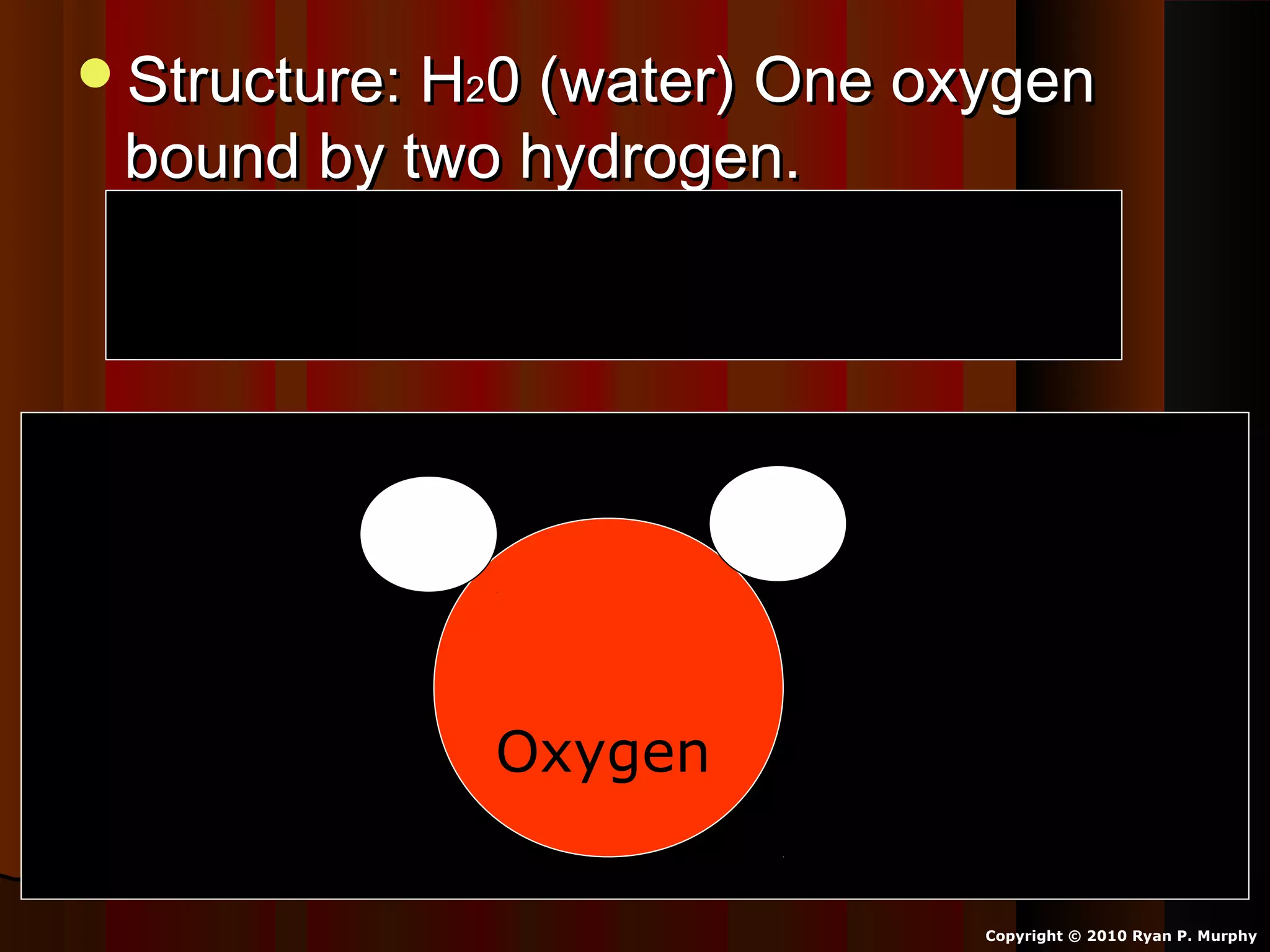
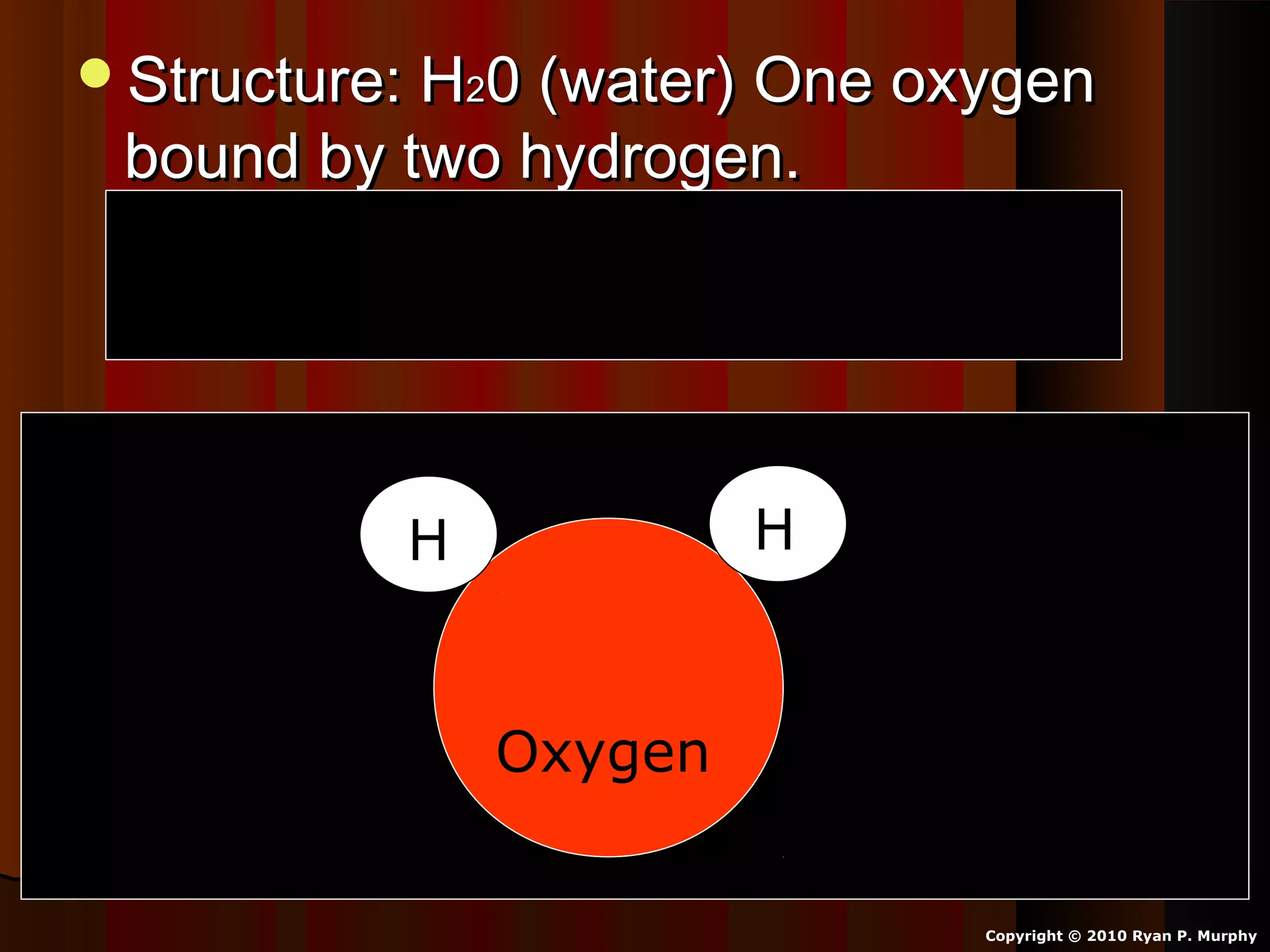
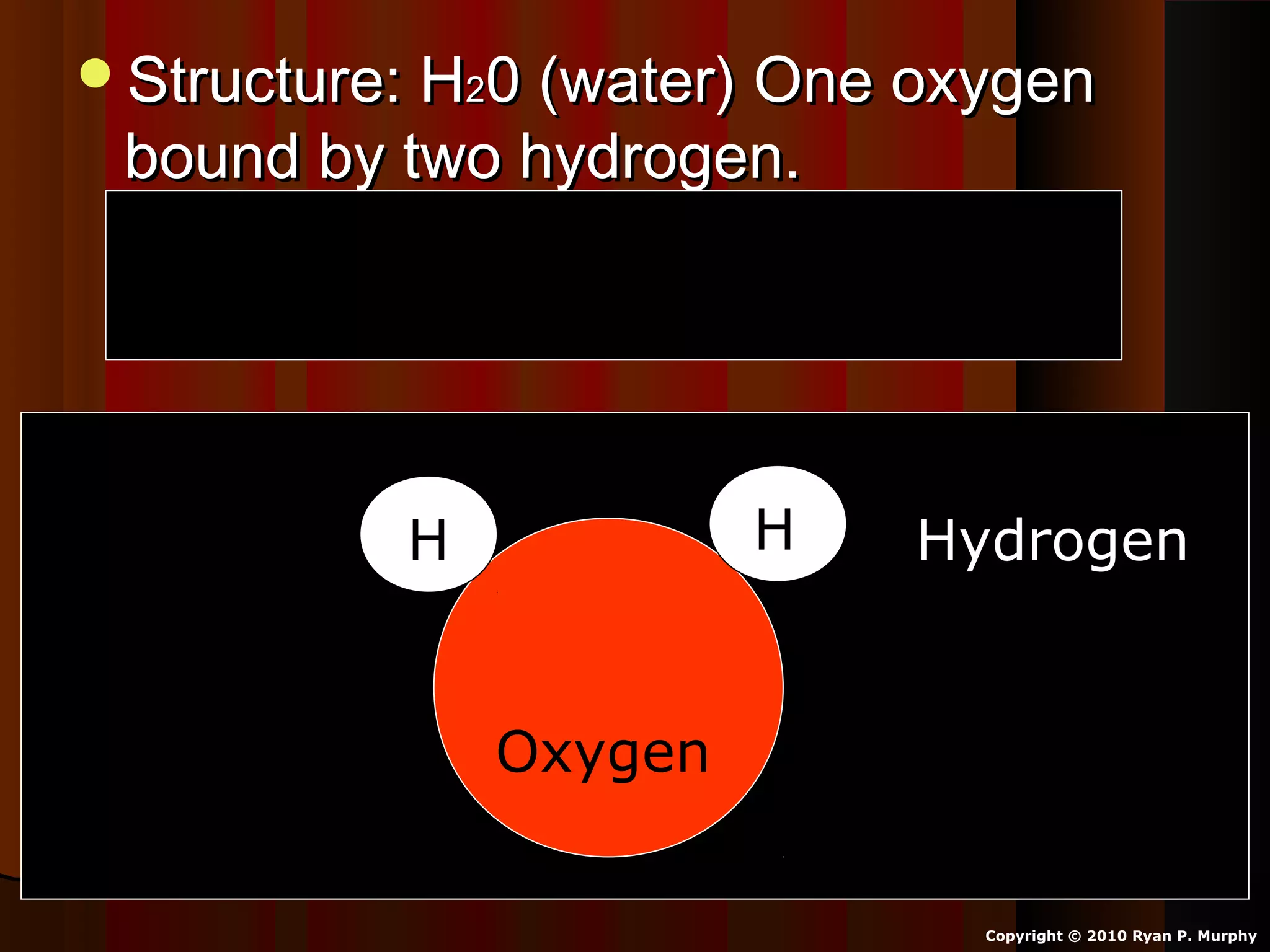
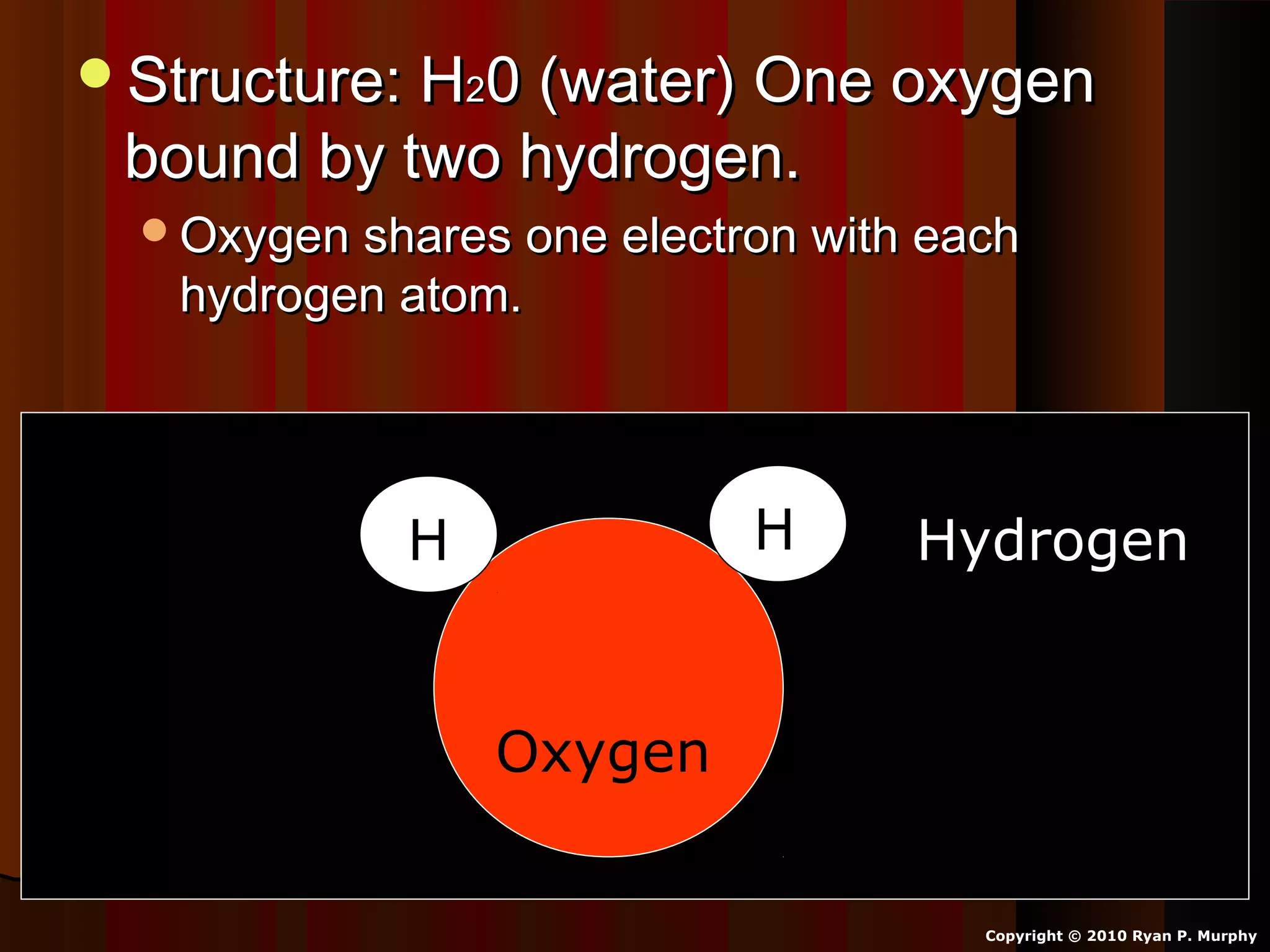
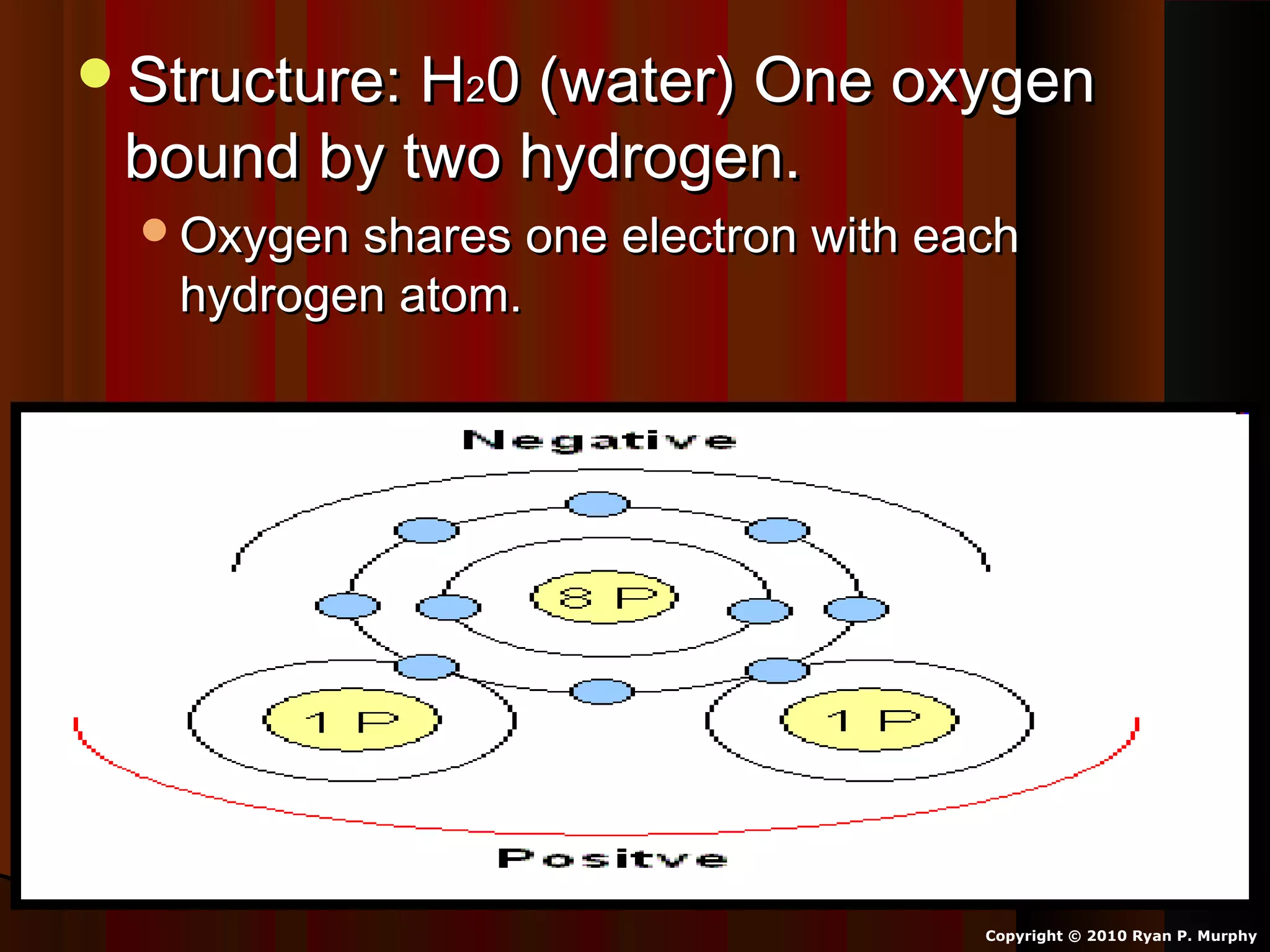
Structure: HStructure: H220 (water) One oxygen0 (water) One oxygen
bound by two hydrogen.bound by two hydrogen.
Oxygen shares one electron with eachOxygen shares one electron with each
hydrogen atom.hydrogen atom.
Copyright © 2010 Ryan P. Murphy
Structure: HStructure: H220 (water) One oxygen0 (water) One oxygen
bound by two hydrogen.bound by two hydrogen.
Oxygen shares one electron with eachOxygen shares one electron with each
hydrogen atom.hydrogen atom.
Copyright © 2010 Ryan P. Murphy
Oxygen
Structure: HStructure: H220 (water) One oxygen0 (water) One oxygen
bound by two hydrogen.bound by two hydrogen.
Oxygen shares one electron with eachOxygen shares one electron with each
hydrogen atom.hydrogen atom.
Copyright © 2010 Ryan P. Murphy
Oxygen
HH
Structure: HStructure: H220 (water) One oxygen0 (water) One oxygen
bound by two hydrogen.bound by two hydrogen.
Oxygen shares one electron with eachOxygen shares one electron with each
hydrogen atom.hydrogen atom.
Copyright © 2010 Ryan P. Murphy
Oxygen
HH Hydrogen
Structure: HStructure: H220 (water) One oxygen0 (water) One oxygen
bound by two hydrogen.bound by two hydrogen.
Oxygen shares one electron with eachOxygen shares one electron with each
hydrogen atom.hydrogen atom.
Copyright © 2010 Ryan P. Murphy
Oxygen
HH Hydrogen
Structure: HStructure: H220 (water) One oxygen0 (water) One oxygen
bound by two hydrogen.bound by two hydrogen.
Oxygen shares one electron with eachOxygen shares one electron with each
hydrogen atom.hydrogen atom.
Copyright © 2010 Ryan P. Murphy
Oxygen
HH Hydrogen
?
?
?
?
?
?
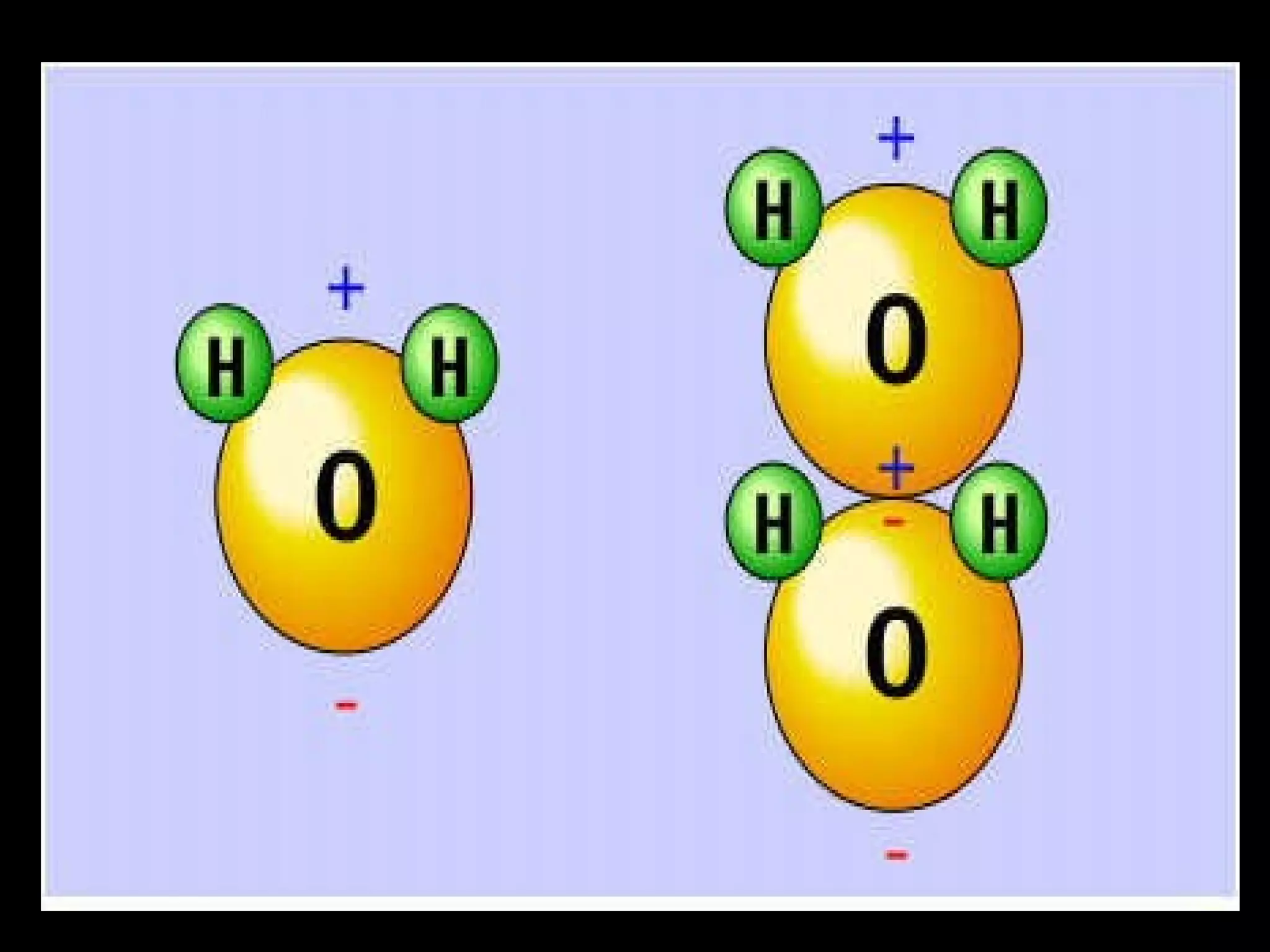
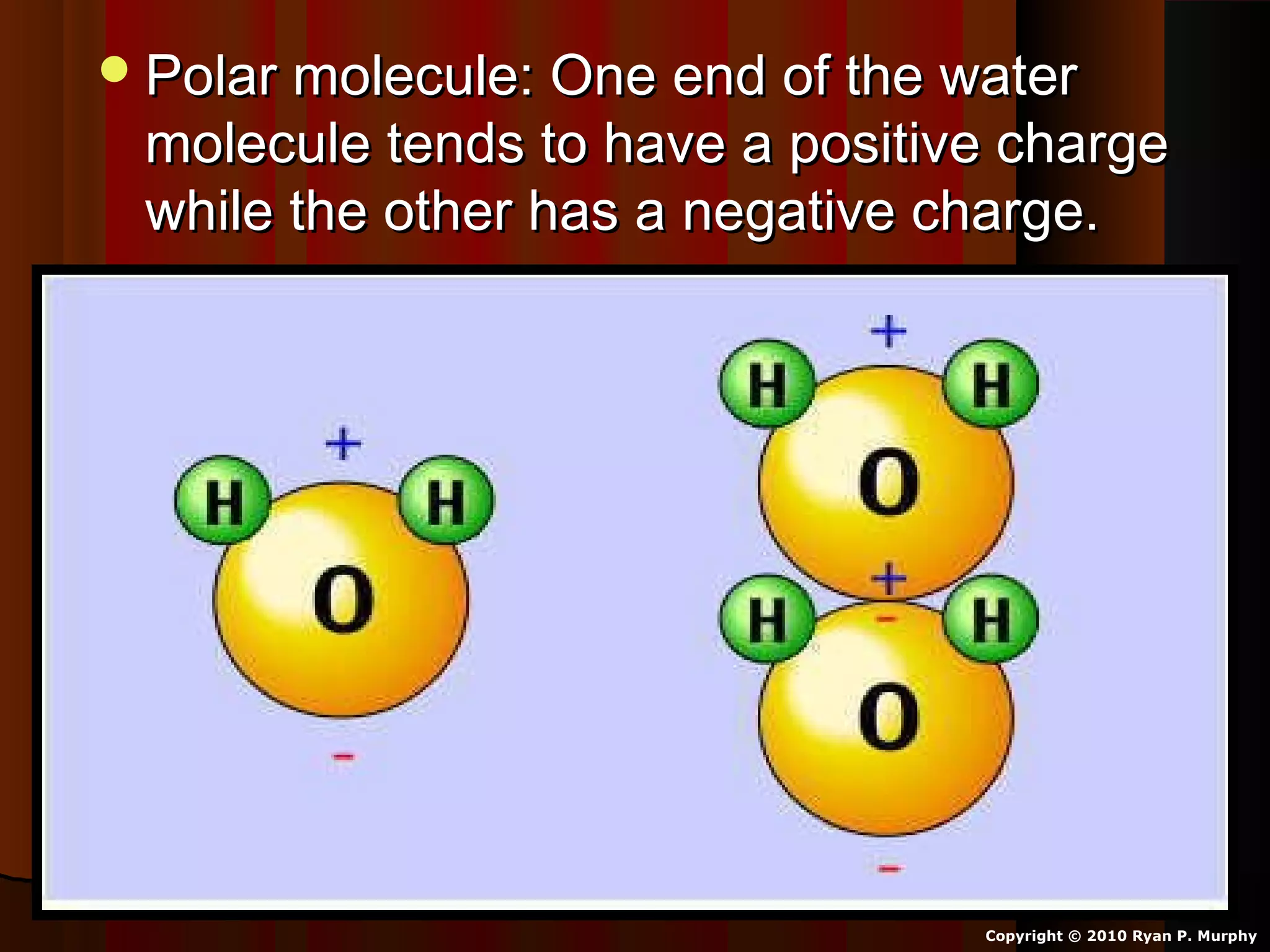
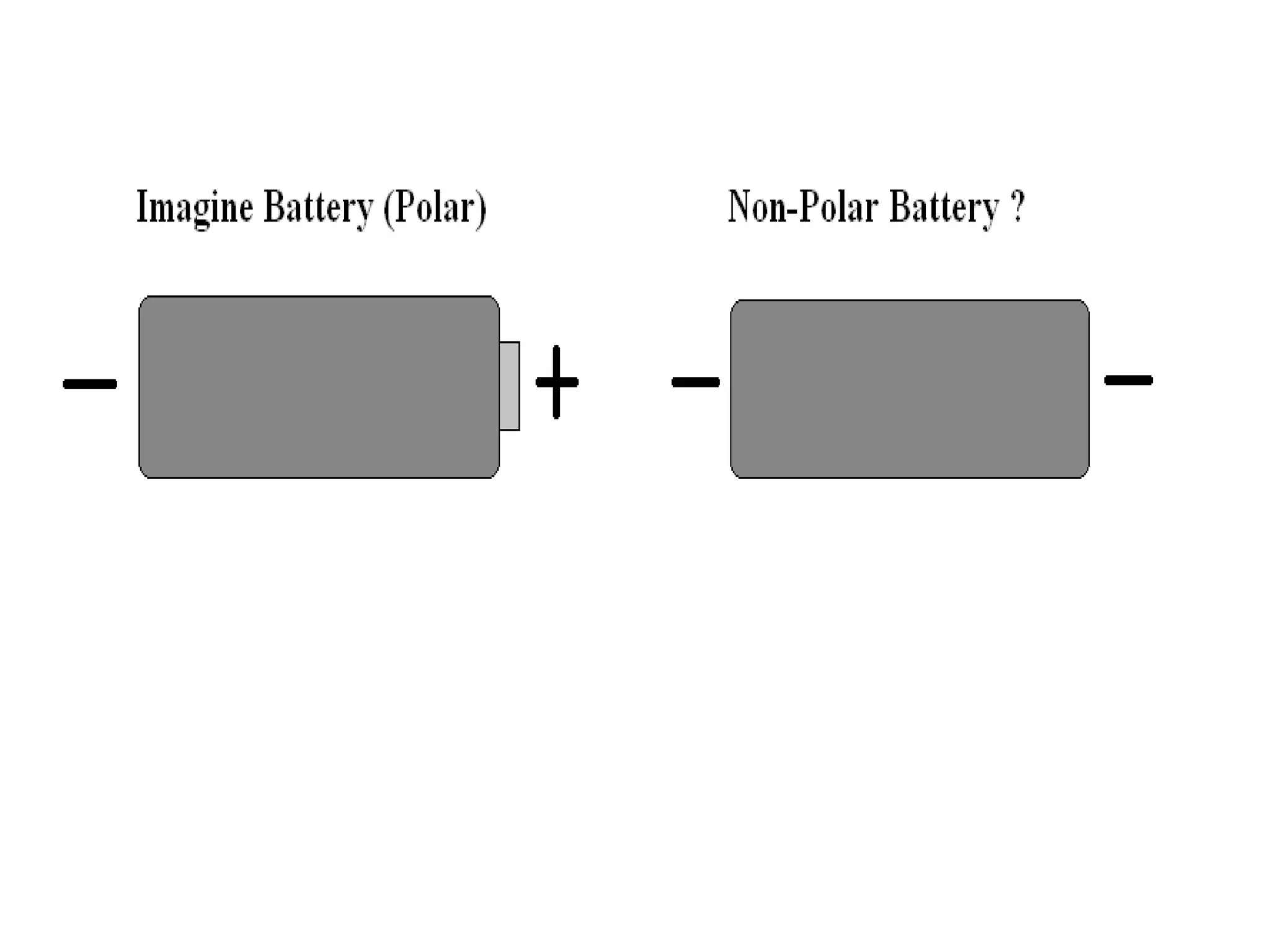
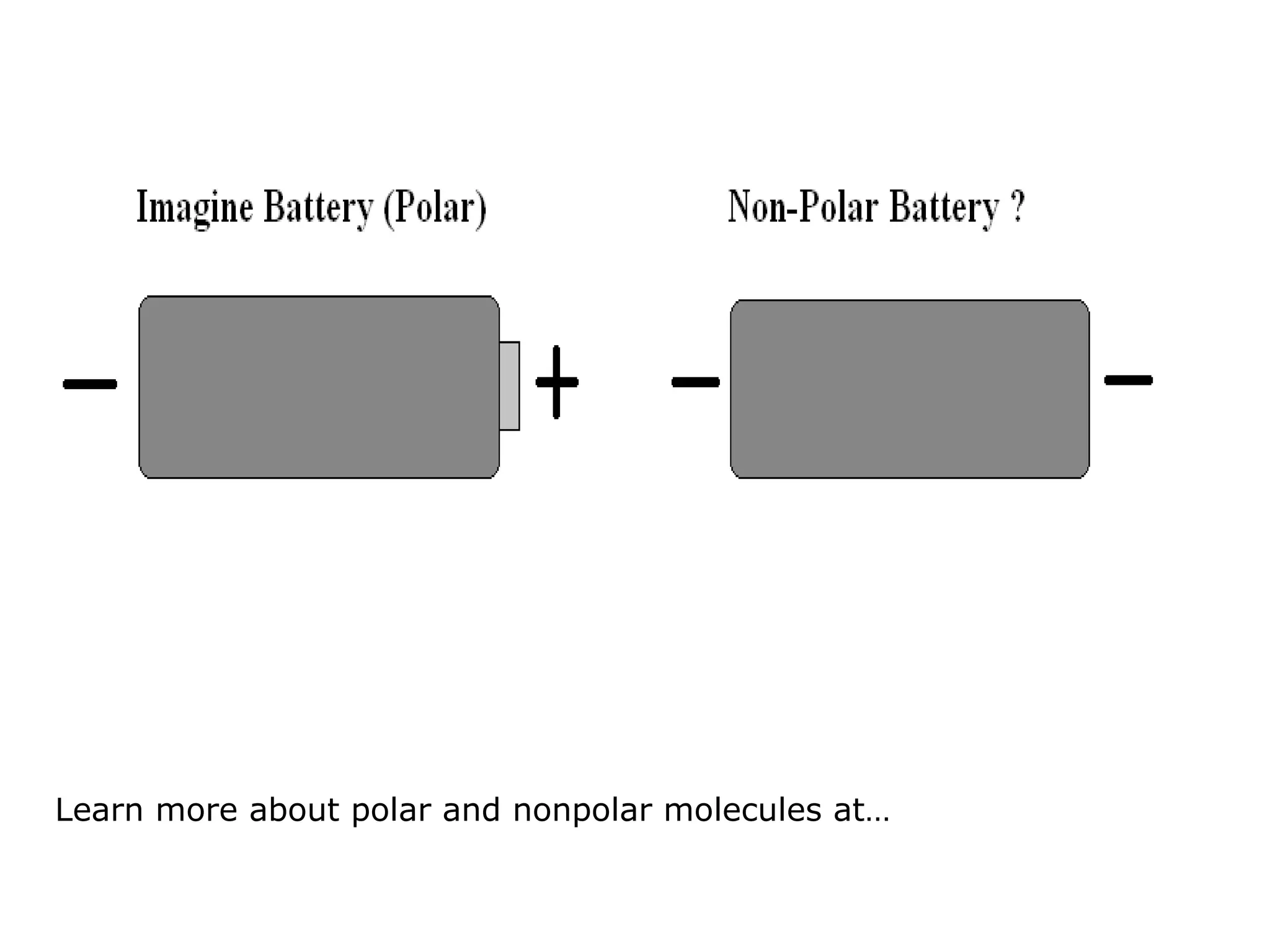
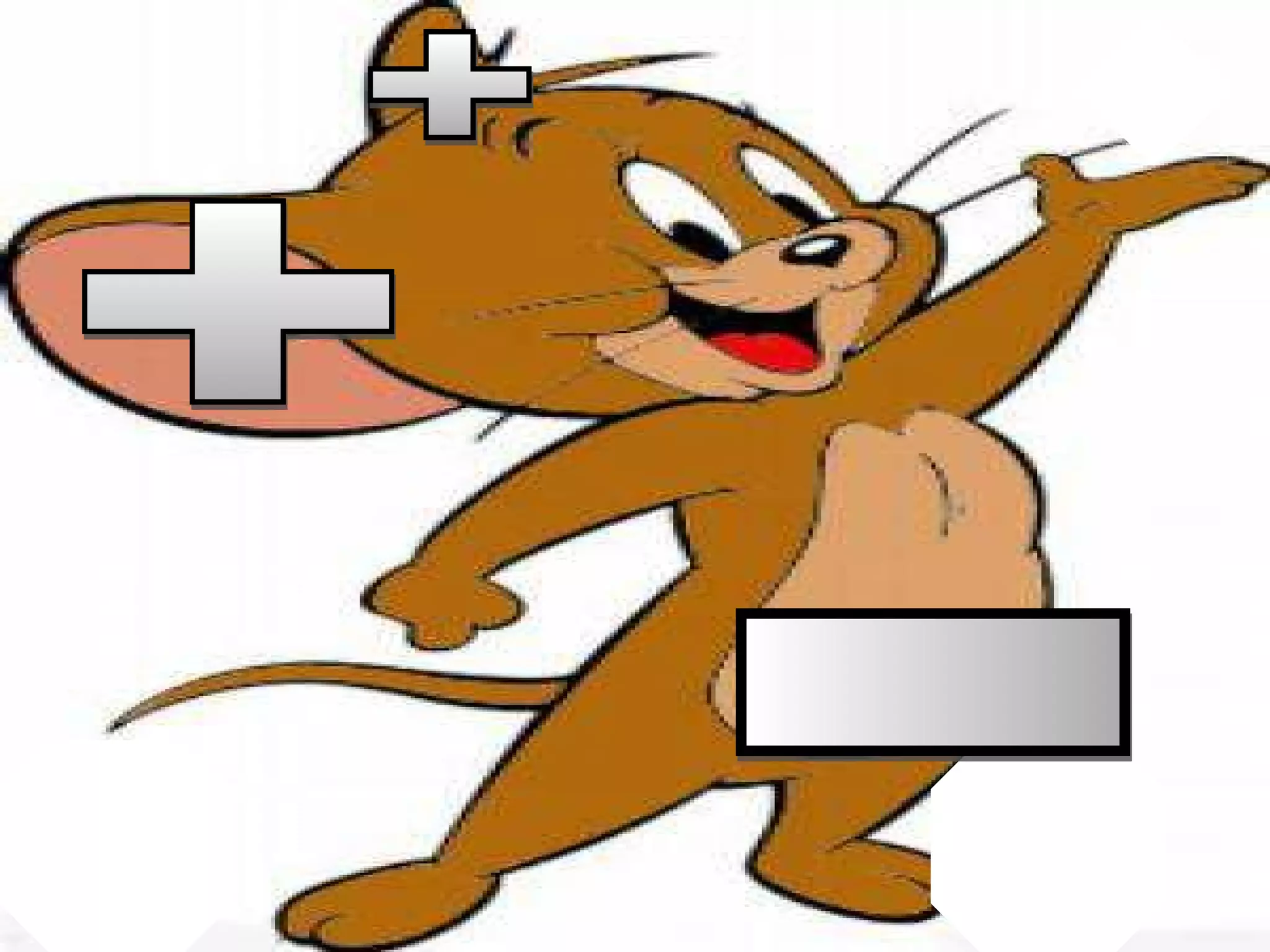
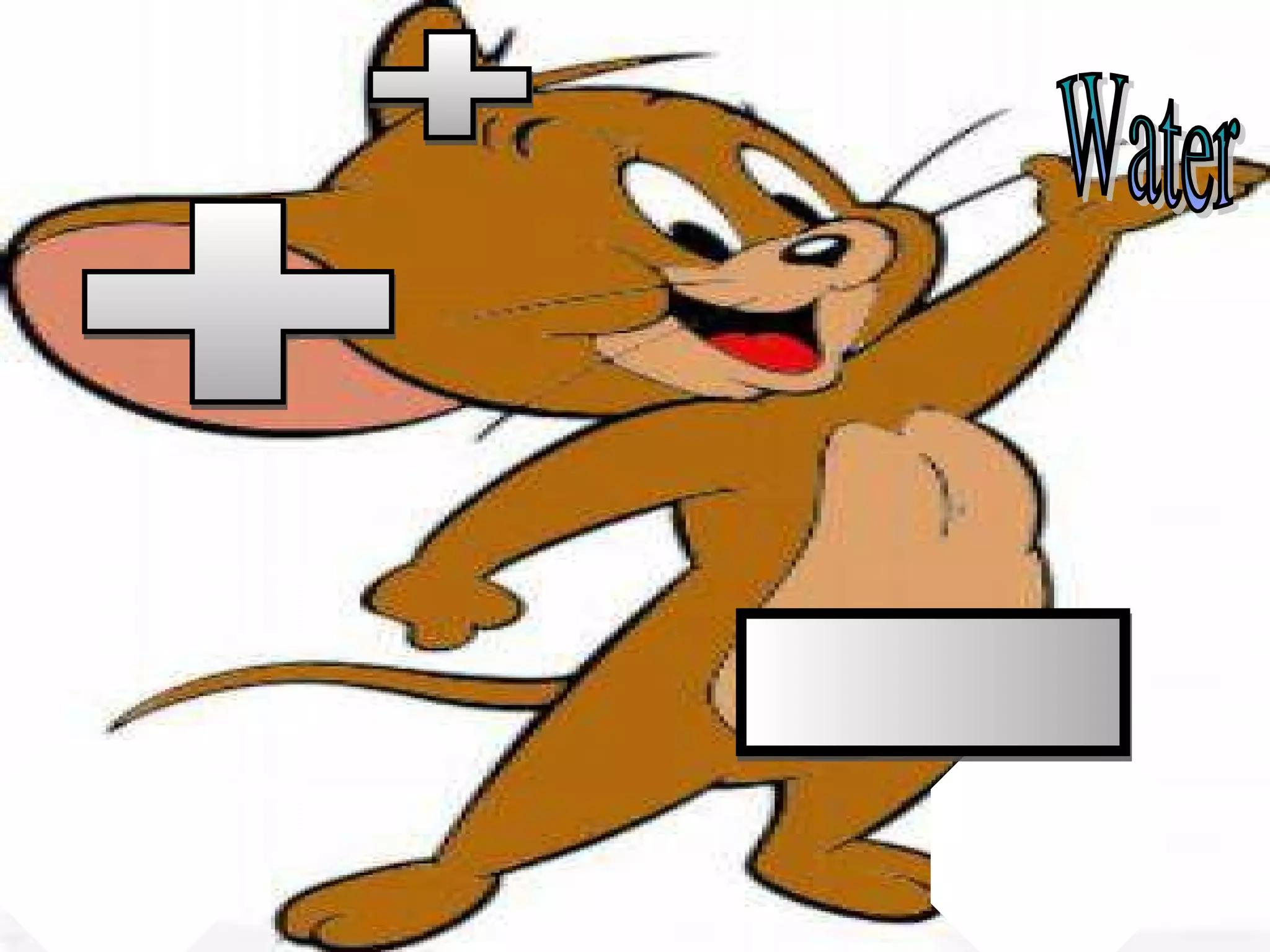
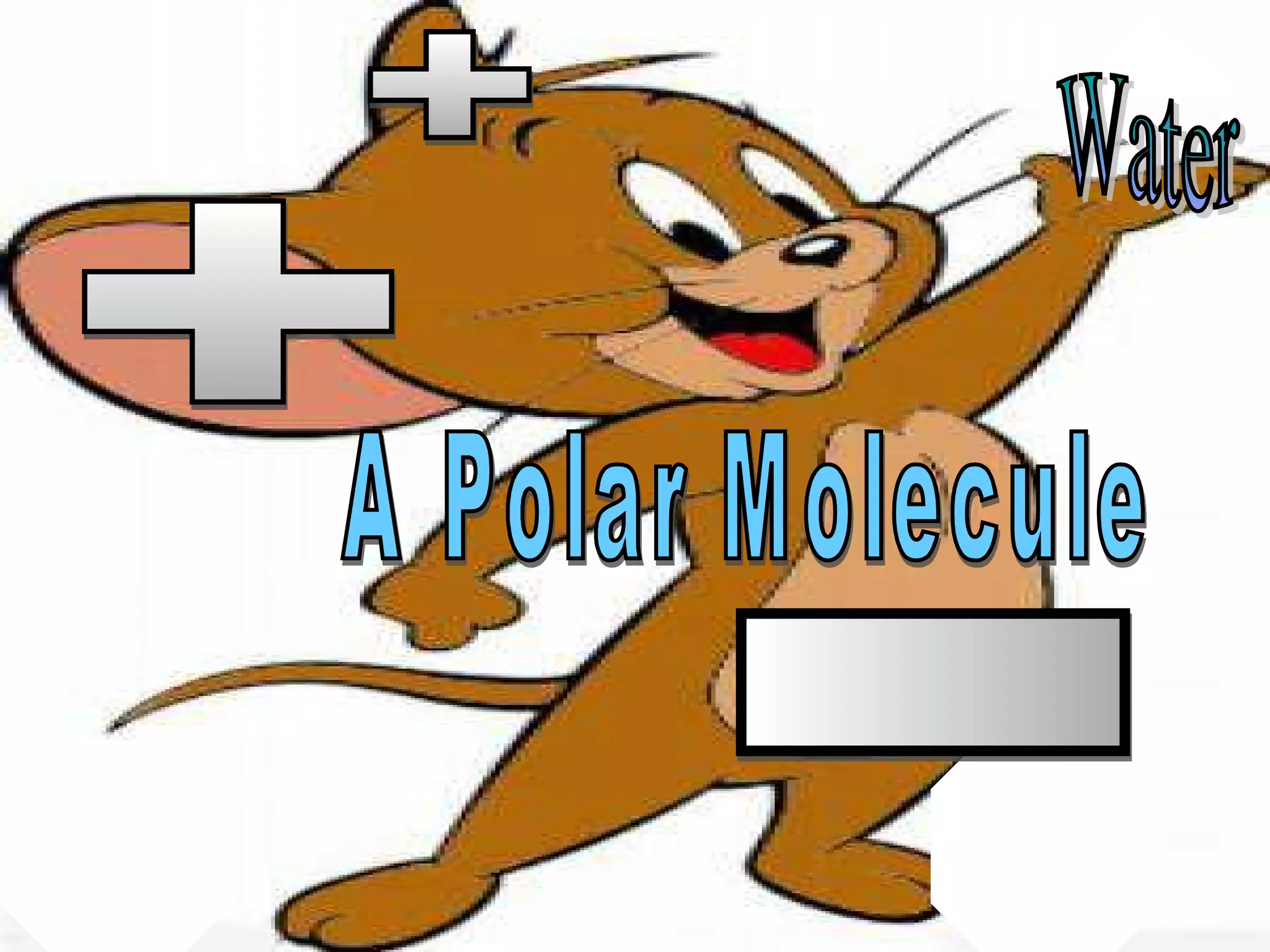
Polar molecule: One end of the waterPolar molecule: One end of the water
molecule tends to have a positive chargemolecule tends to have a positive charge
while the other has a negative charge.while the other has a negative charge.
Copyright © 2010 Ryan P. Murphy
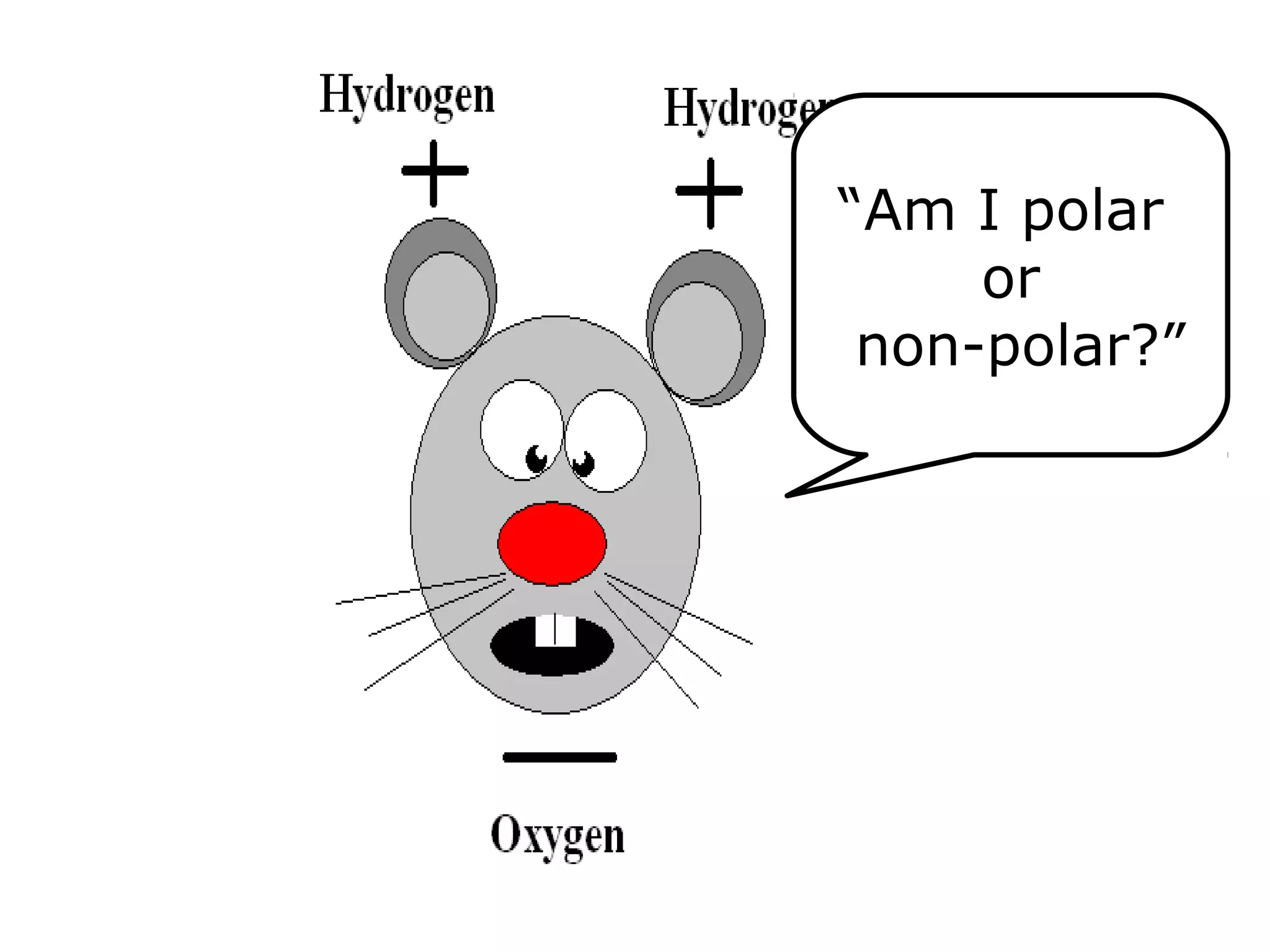
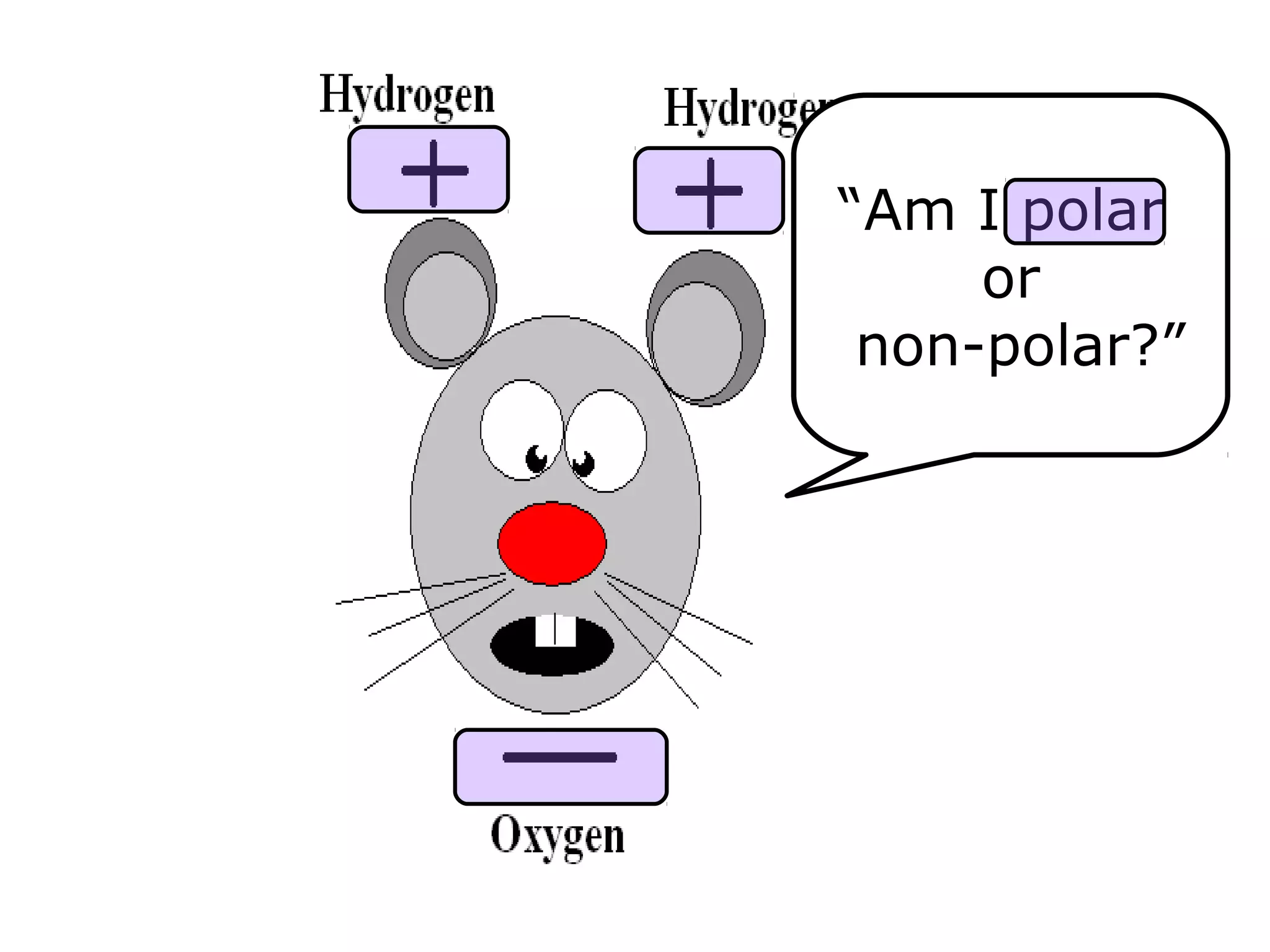
“Am I polar
or
non-polar?”
“Am I polar
or
non-polar?”
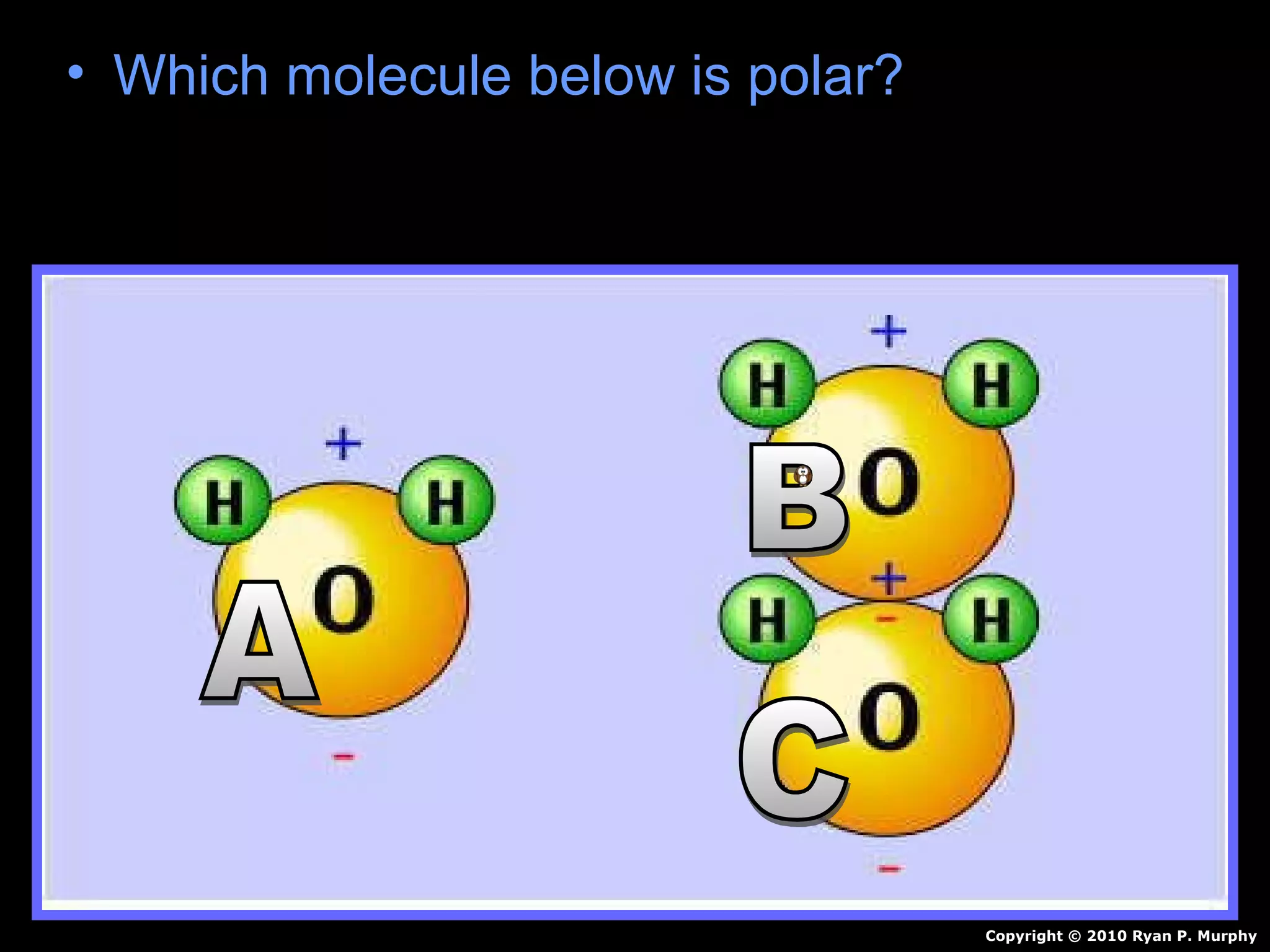
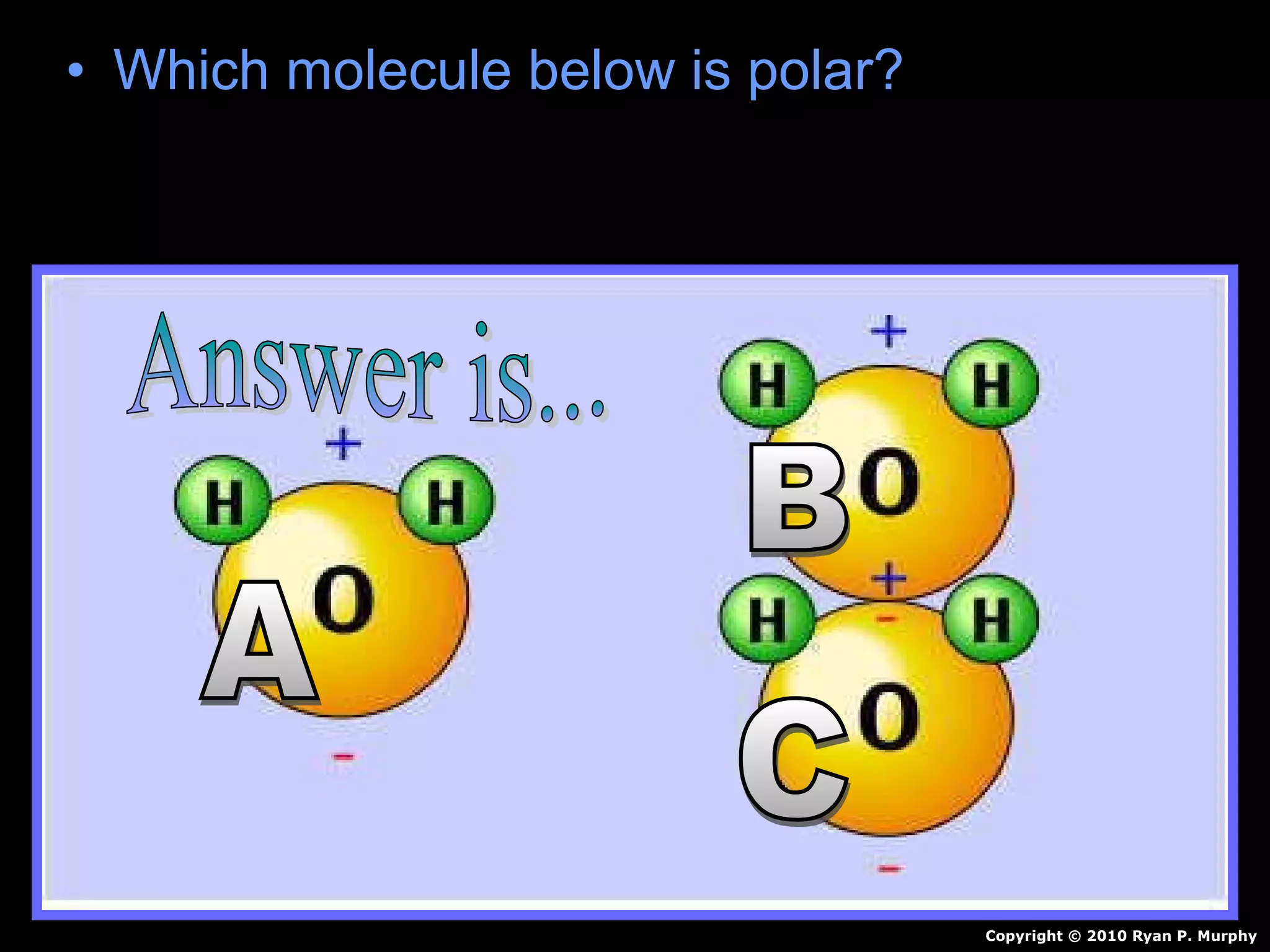
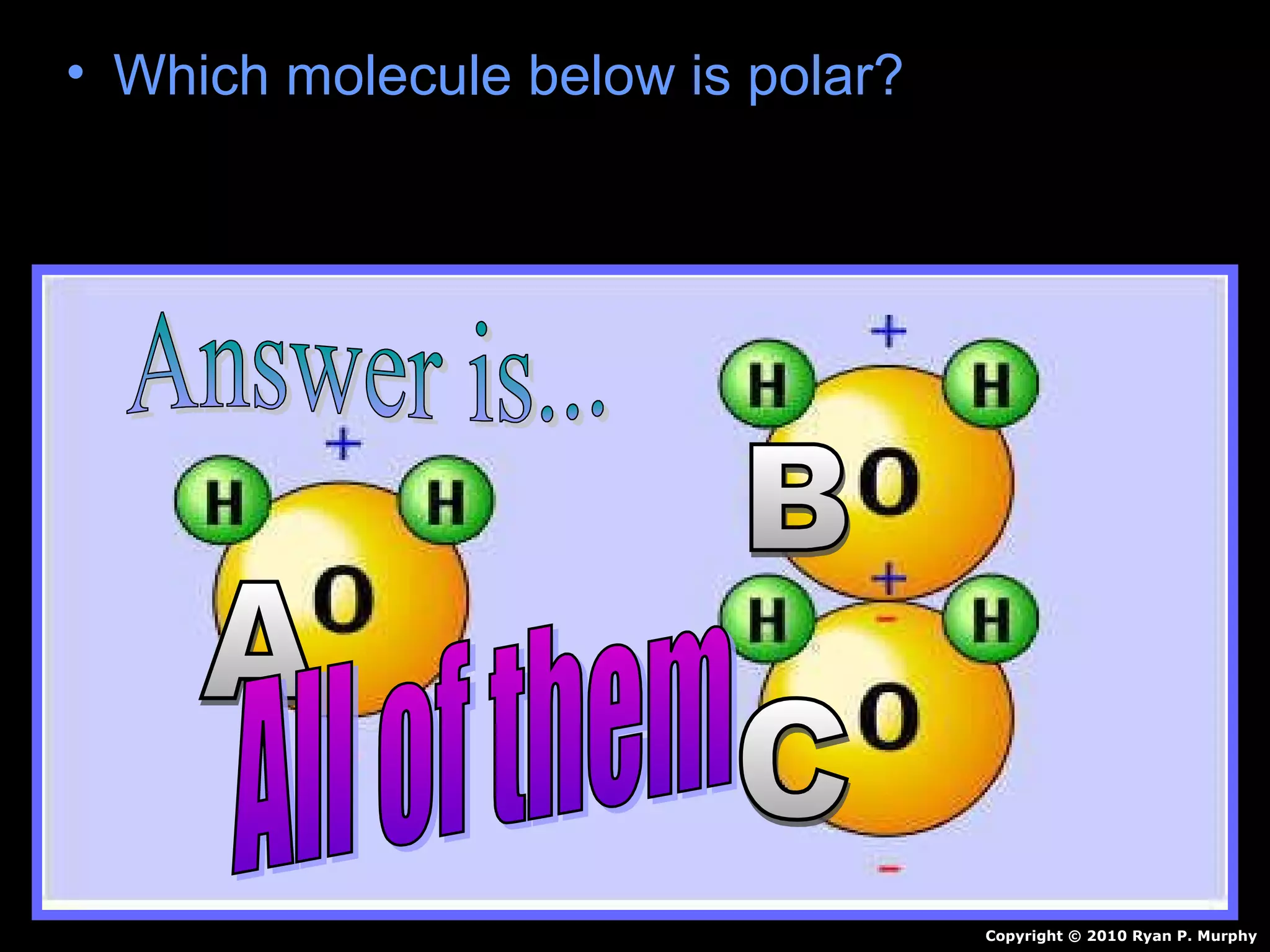
• Which molecule below is polar?Which molecule below is polar?
Copyright © 2010 Ryan P. Murphy
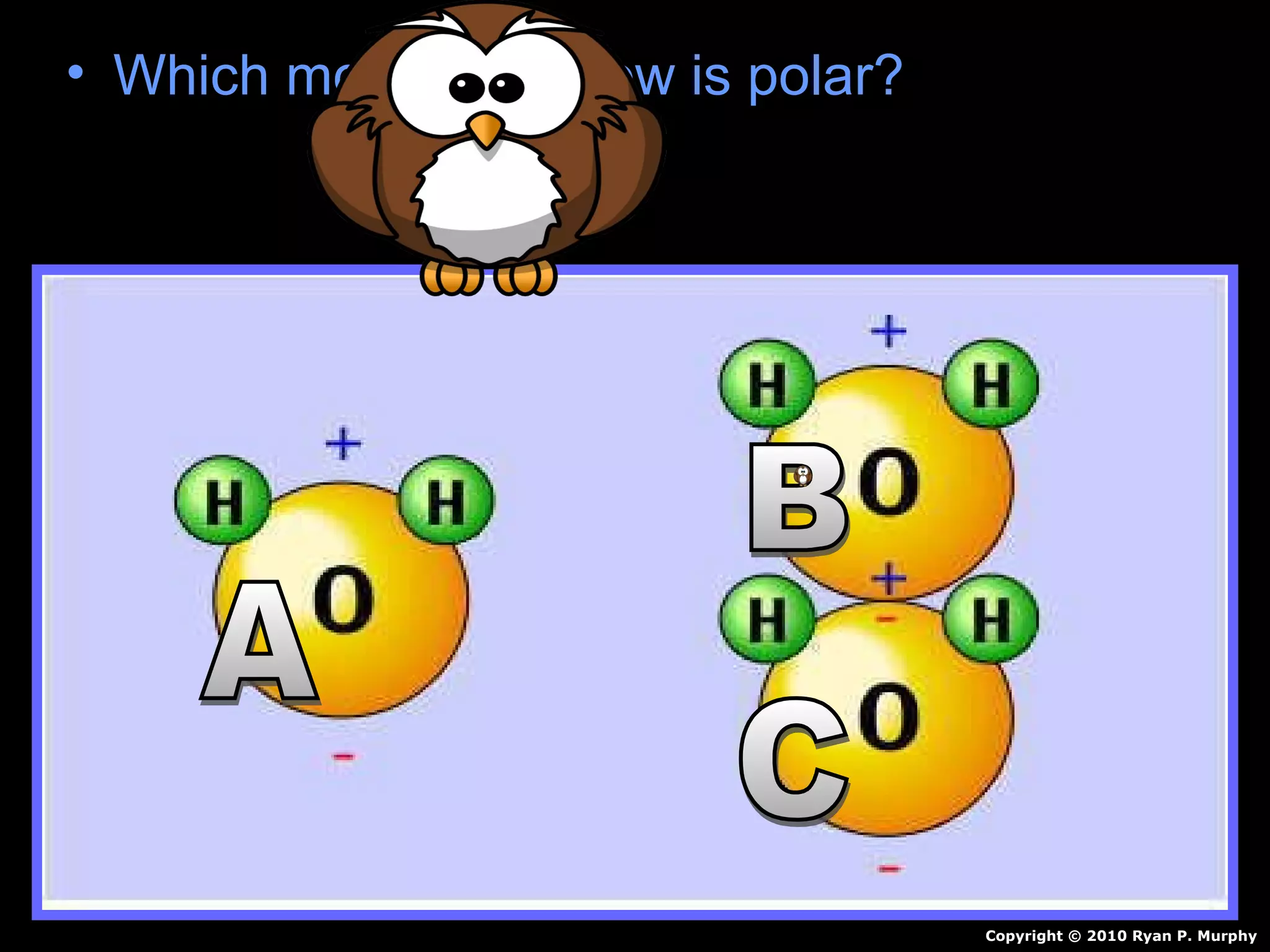
• Which molecule below is polar?Which molecule below is polar?
Copyright © 2010 Ryan P. Murphy
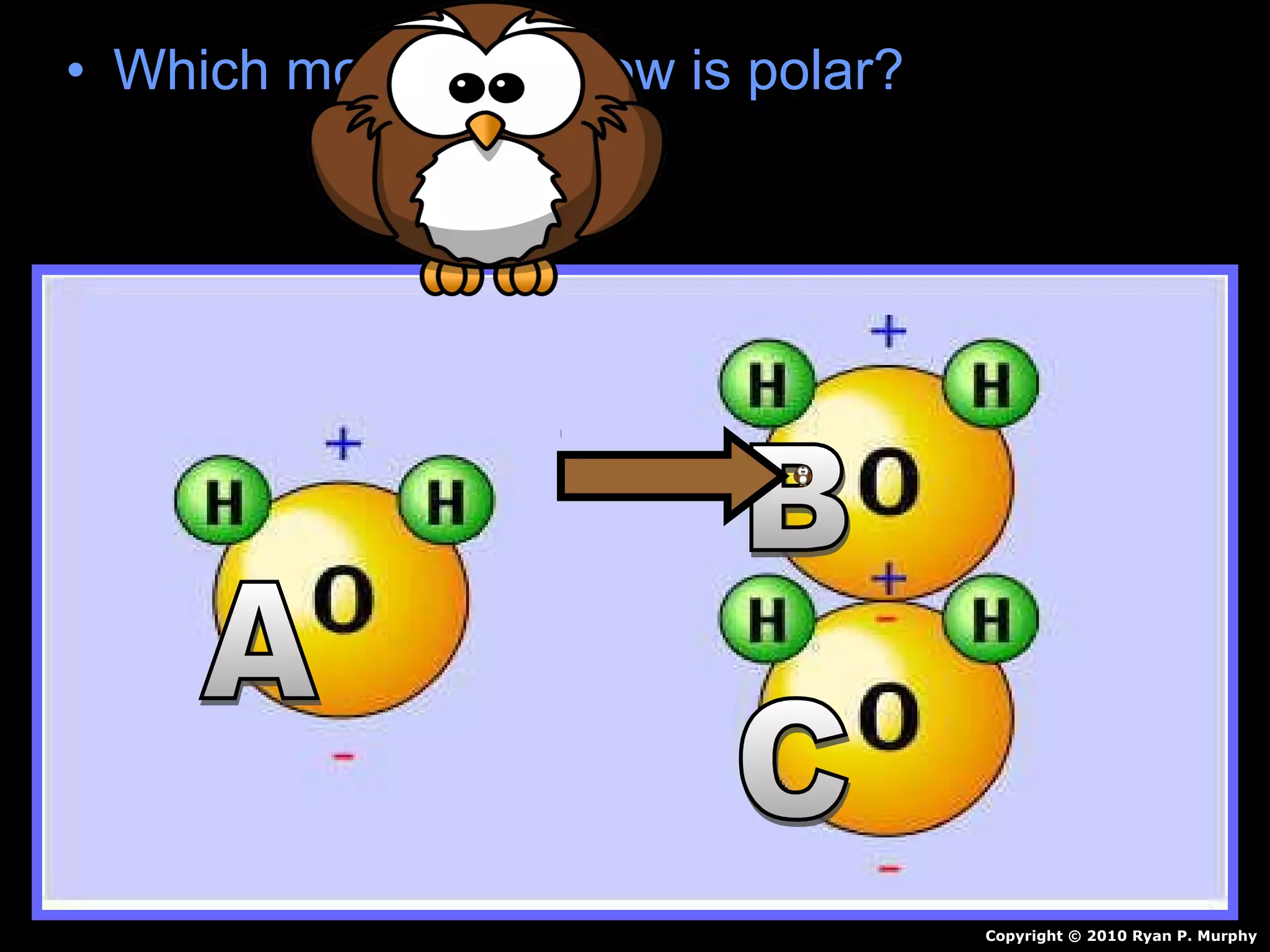
• Which molecule below is polar?Which molecule below is polar?
Copyright © 2010 Ryan P. Murphy
• Which molecule below is polar?Which molecule below is polar?
Copyright © 2010 Ryan P. Murphy
• Which molecule below is polar?Which molecule below is polar?
Copyright © 2010 Ryan P. Murphy
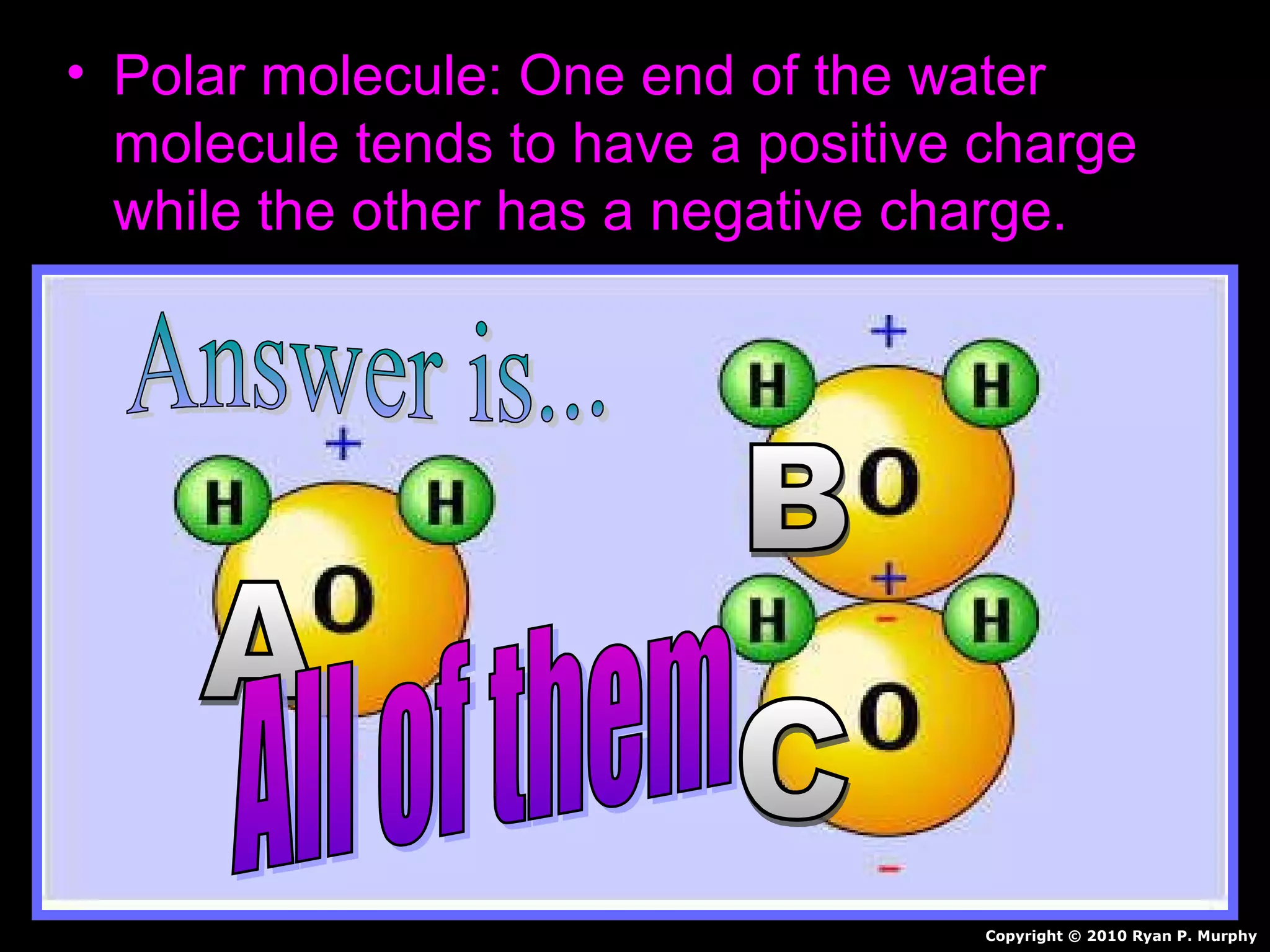
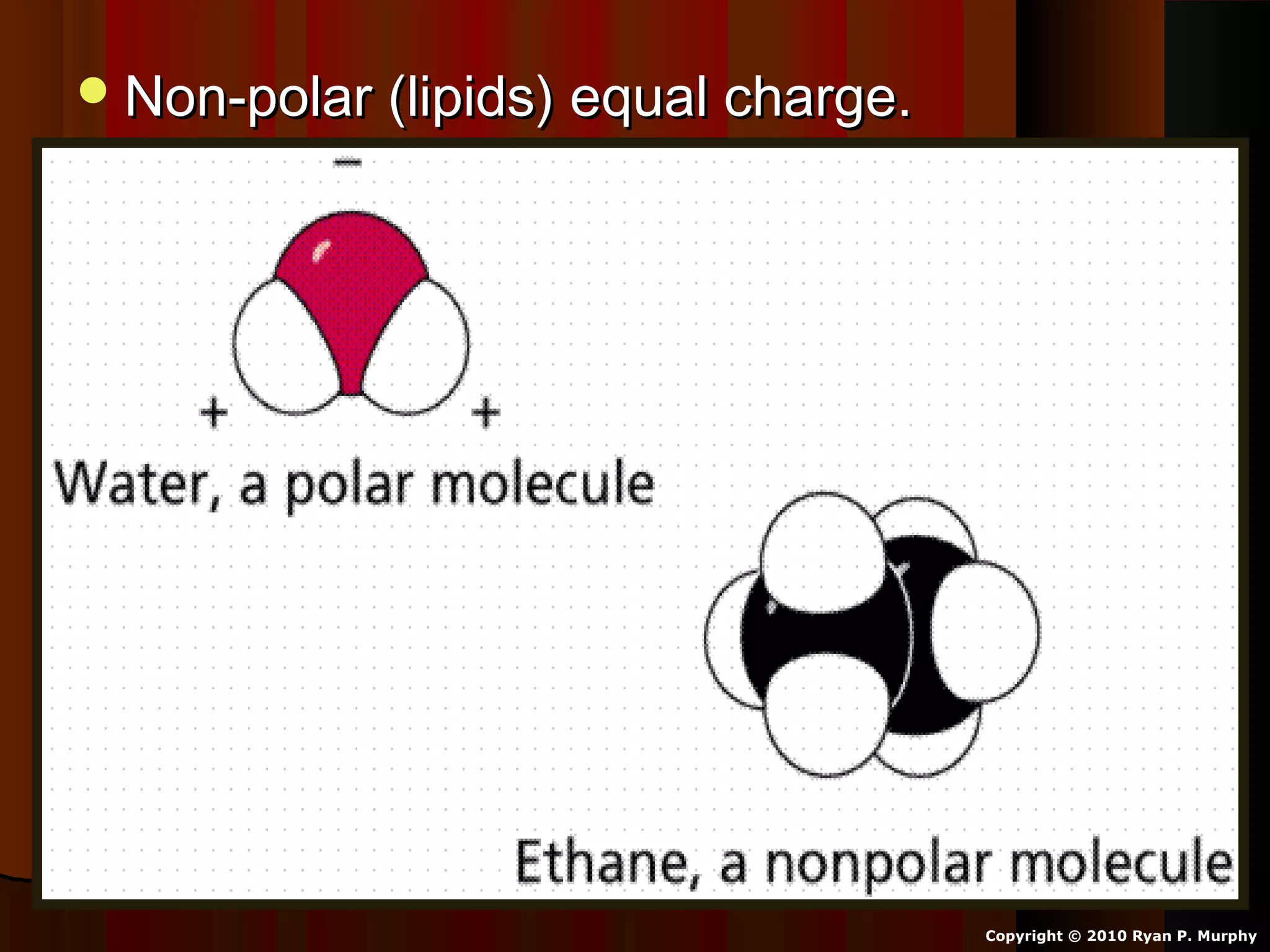
• Polar molecule: One end of the waterPolar molecule: One end of the water
molecule tends to have a positive chargemolecule tends to have a positive charge
while the other has a negative charge.while the other has a negative charge.
Copyright © 2010 Ryan P. Murphy
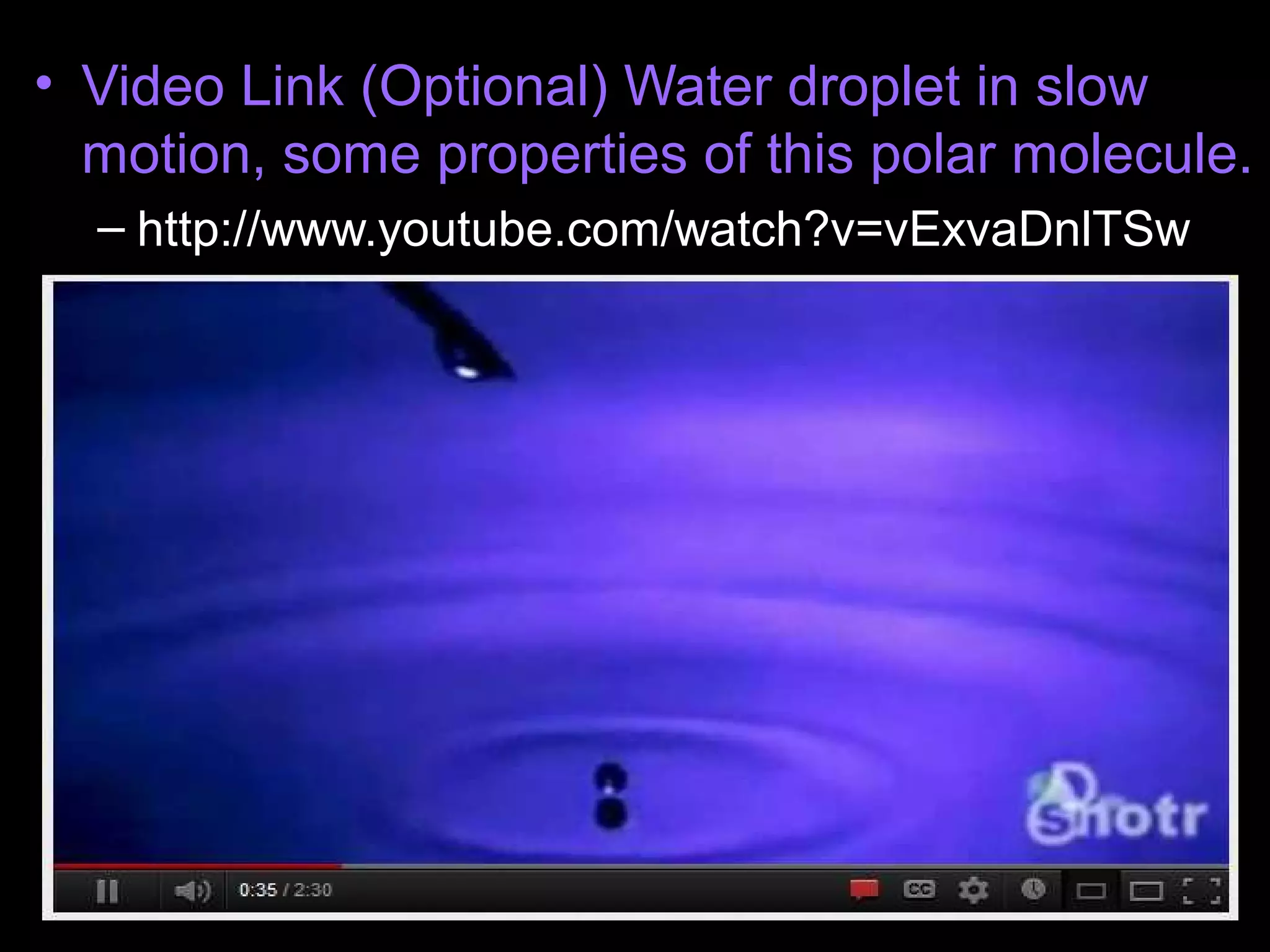
• Video Link (Optional) Water droplet in slow
motion, some properties of this polar molecule.
– http://www.youtube.com/watch?v=vExvaDnlTSw
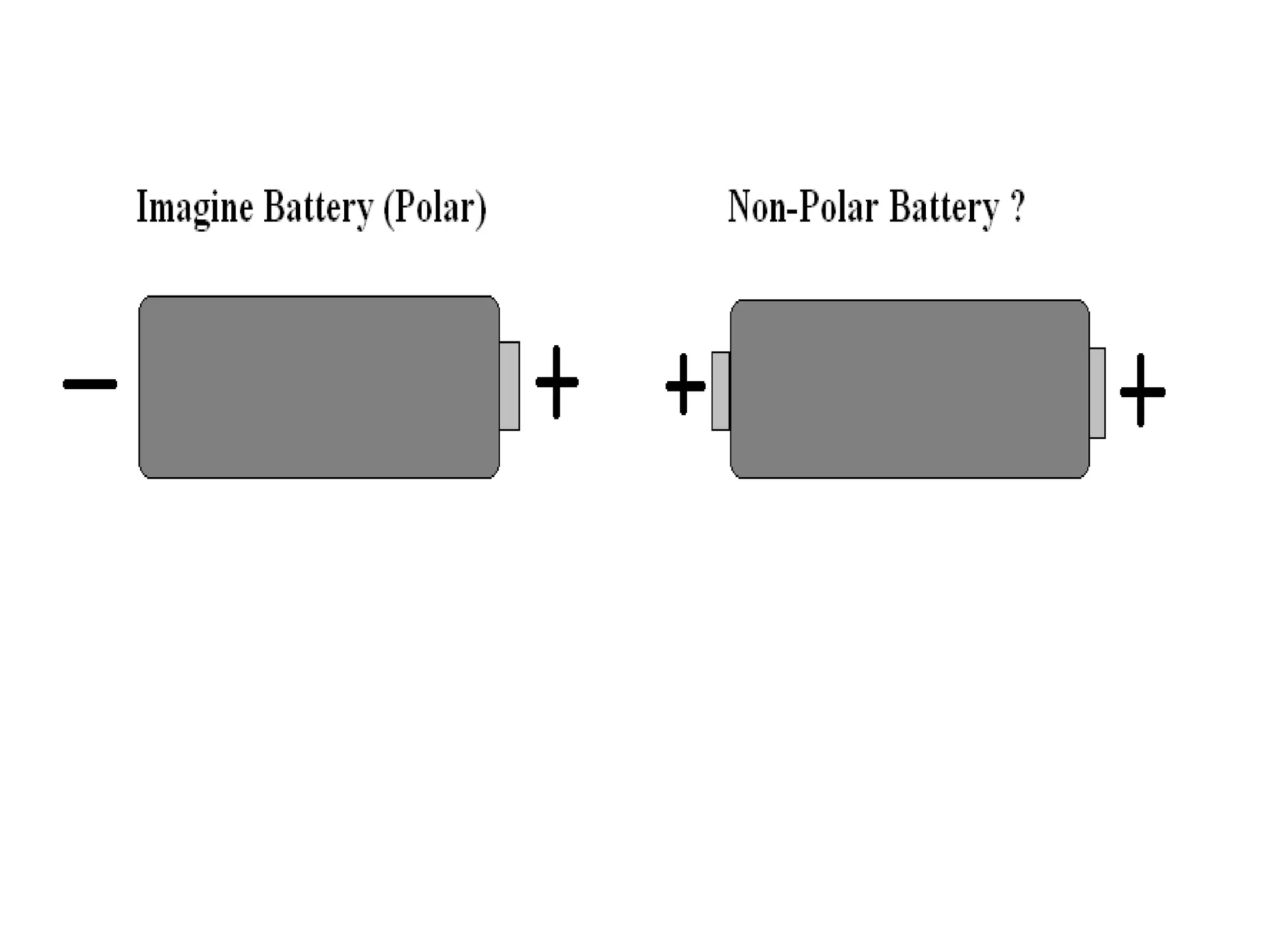
Non-polar (lipids) equal charge.Non-polar (lipids) equal charge.
Copyright © 2010 Ryan P. Murphy
Or….
Learn more about polar and nonpolar molecules at…
http://www.school-for-
champions.com/chemistry/polar_molecules.htm
• Layering liquids with different densities.
• Use a clear container and add the following
in this order….
– Corn Syrup
– Water (food Coloring)
– Vegetable Oil
• Layering liquids with different densities.
• Use a clear container and add the following
in this order….
– Corn Syrup
– Water (food Coloring)
– Vegetable Oil
• Layering liquids with different densities.
• Use a clear container and add the following
in this order….
– Corn Syrup
– Water (food Coloring)
– Vegetable Oil
• Layering liquids with different densities.
• Use a clear container and add the following
in this order….
– Corn Syrup
– Water (food Coloring)
– Vegetable Oil
• Layering liquids with different densities.
• Use a clear container and add the following
in this order….
– Corn Syrup
– Water (food Coloring)
– Vegetable Oil
• Layering liquids with different densities.
• Use a clear container and add the following
in this order….
– Corn Syrup
– Water (food Coloring)
– Vegetable Oil
• Layering liquids with different densities.
• Use a clear container and add the following
in this order….
– Corn Syrup
– Water (food Coloring)
– Vegetable Oil
• Layering liquids with different densities.
• Use a clear container and add the following
in this order….
– Corn Syrup
– Water (food Coloring)
– Vegetable Oil
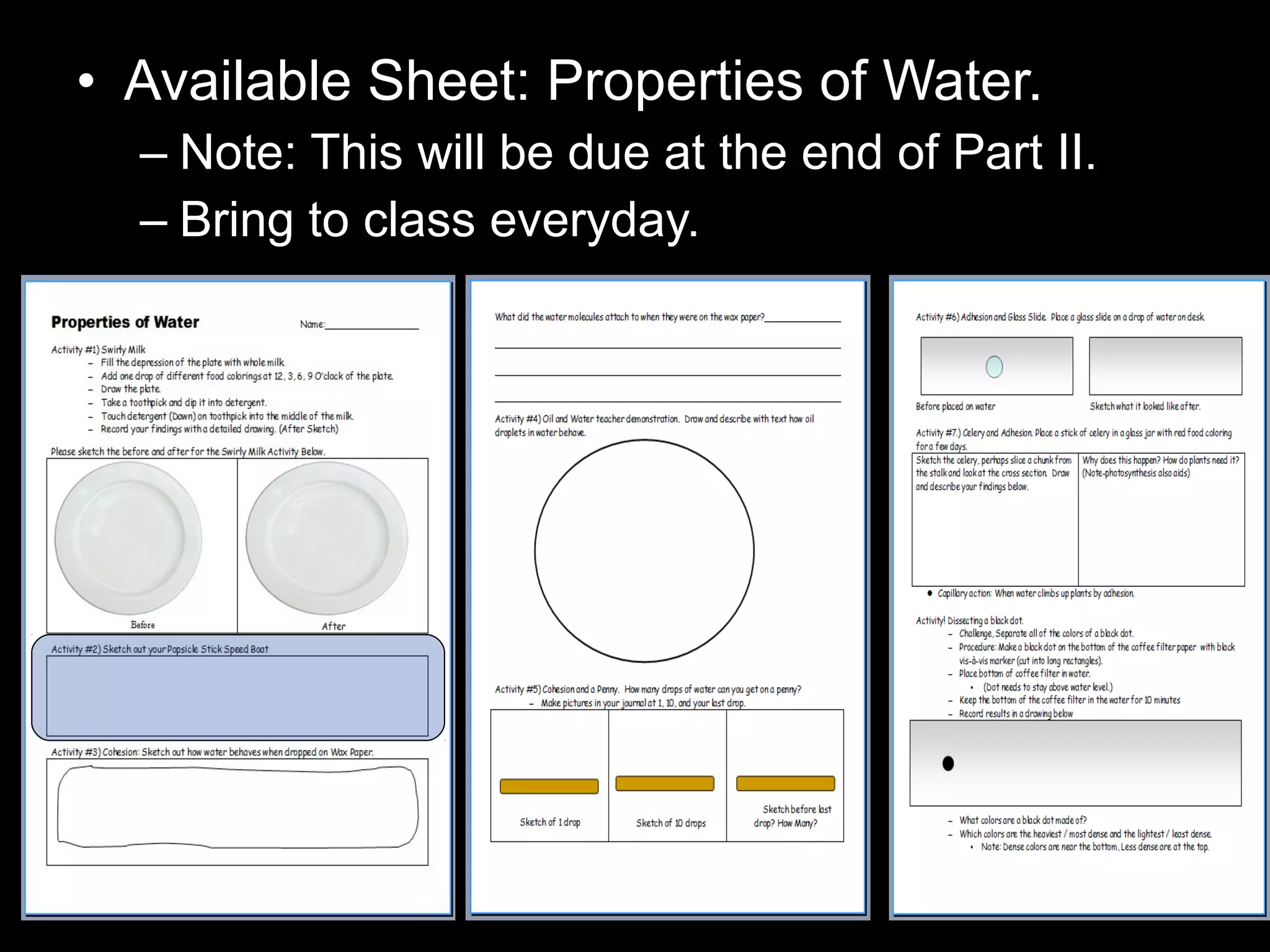
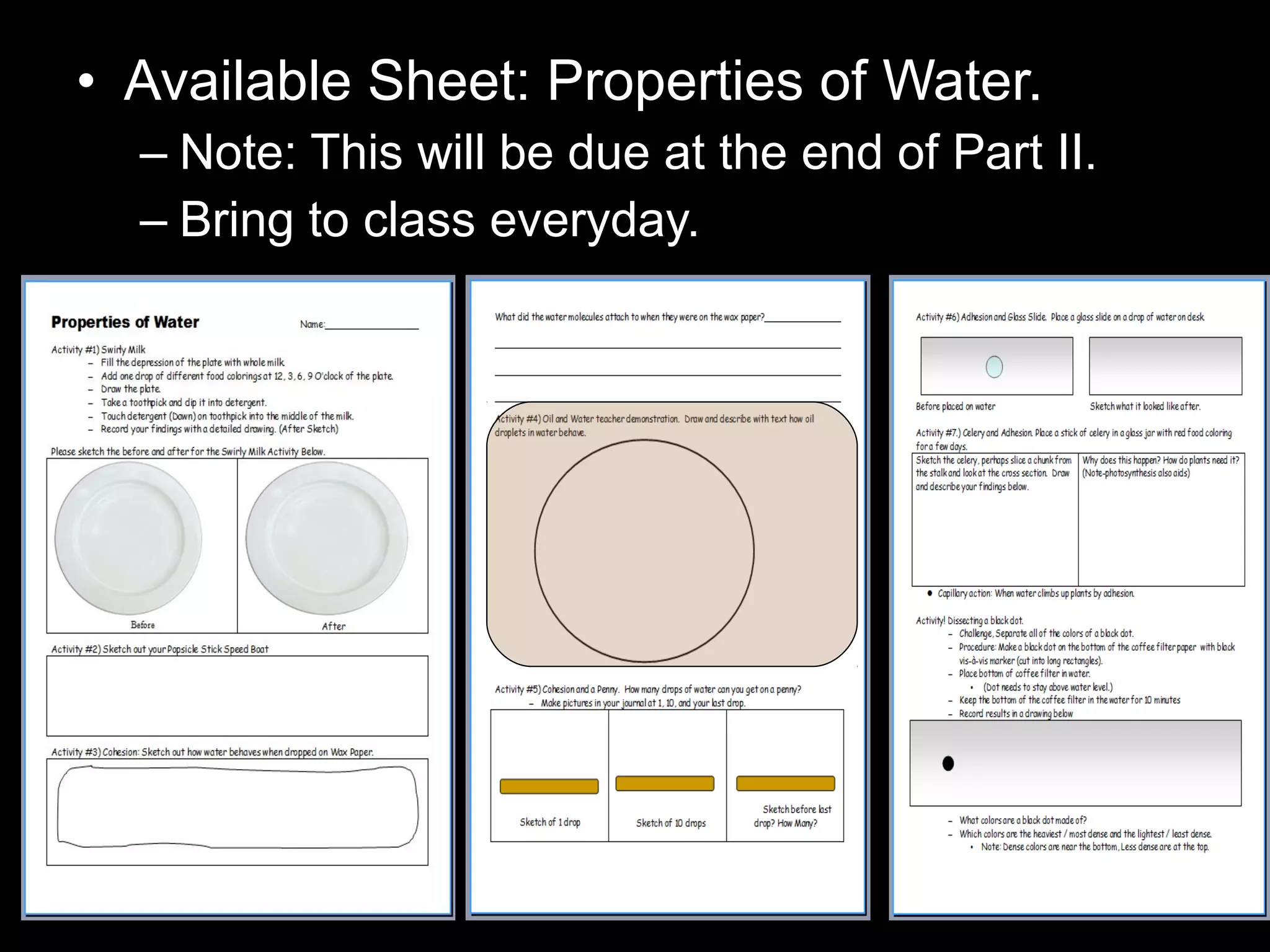
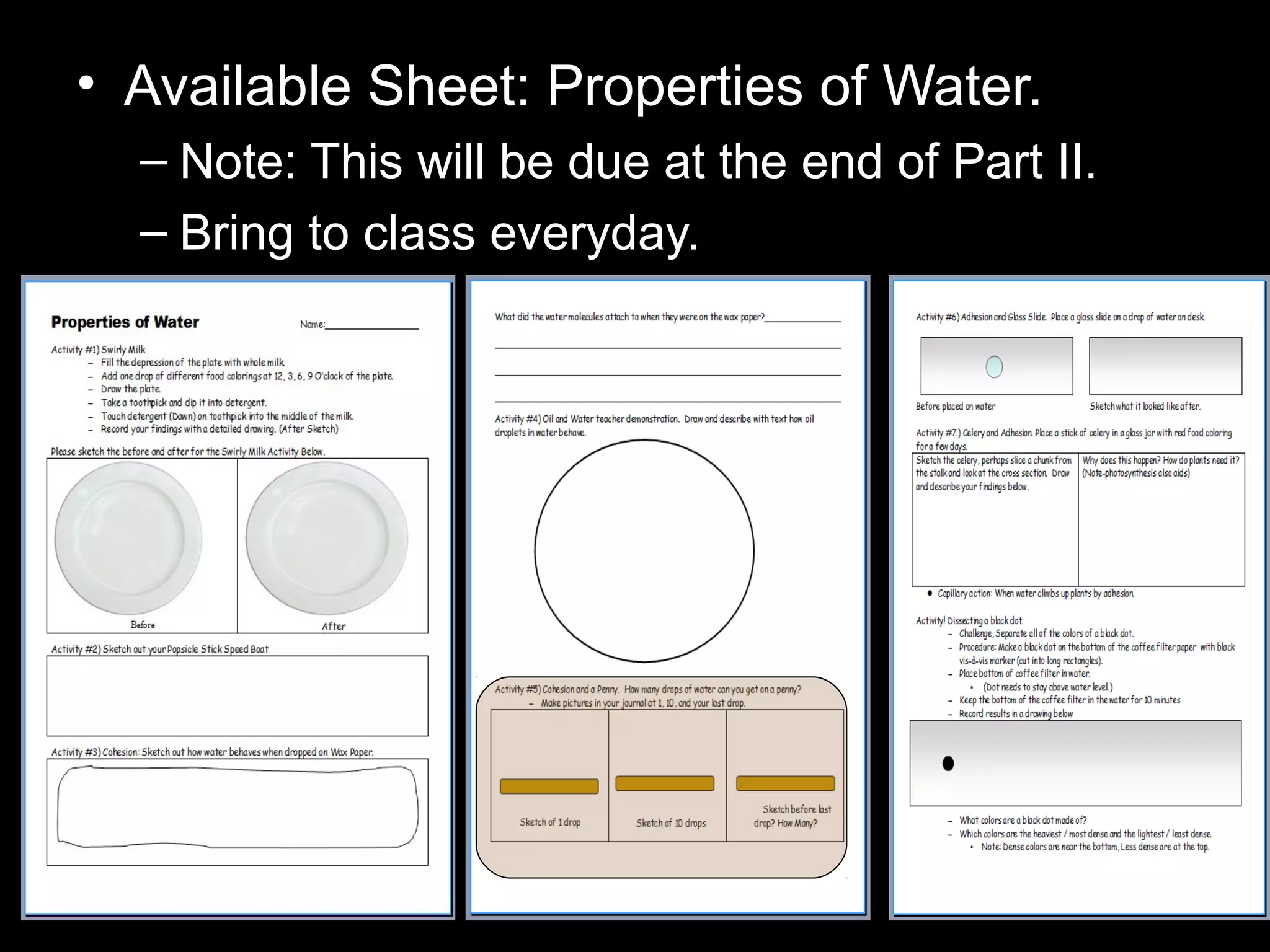
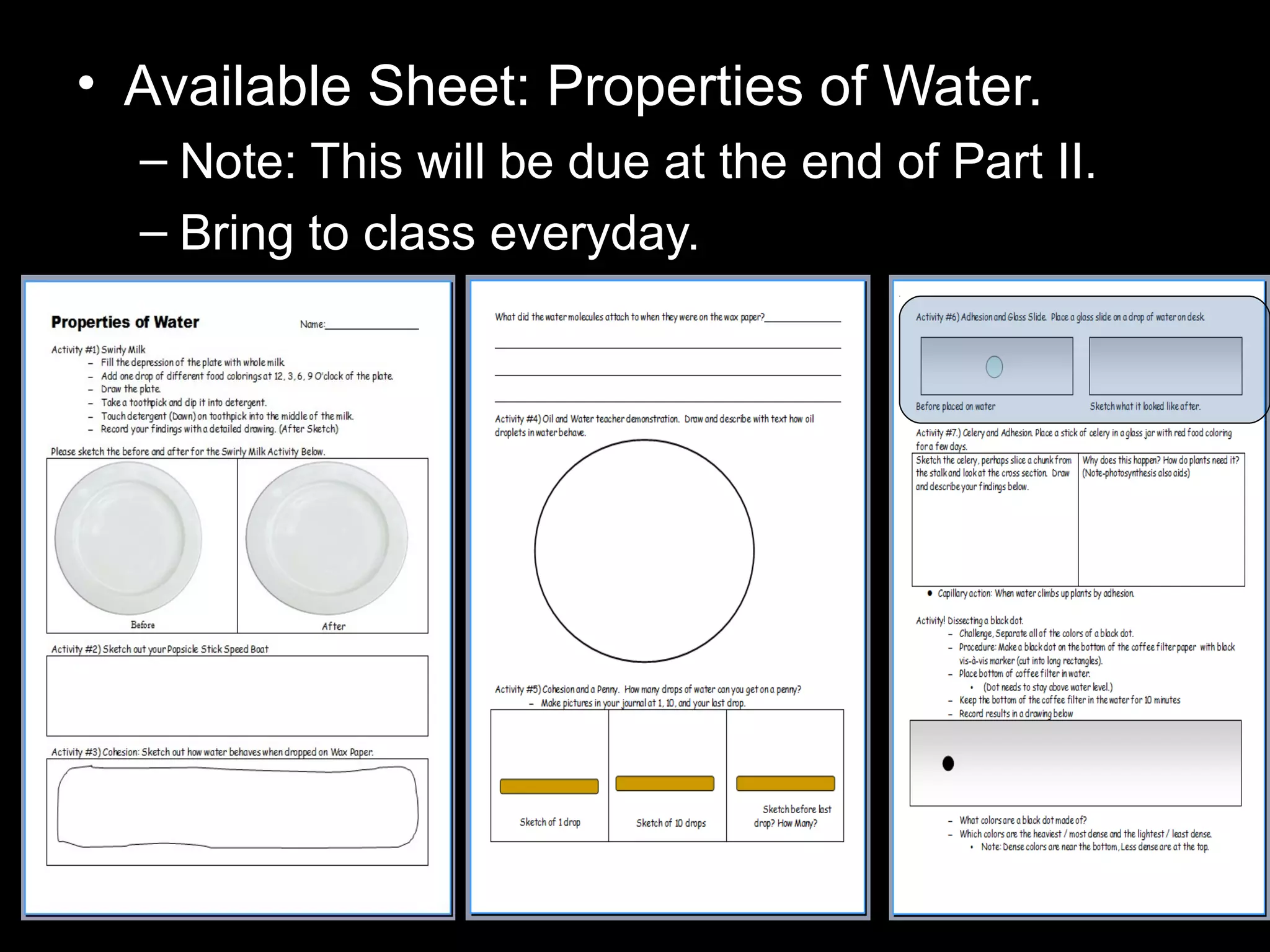
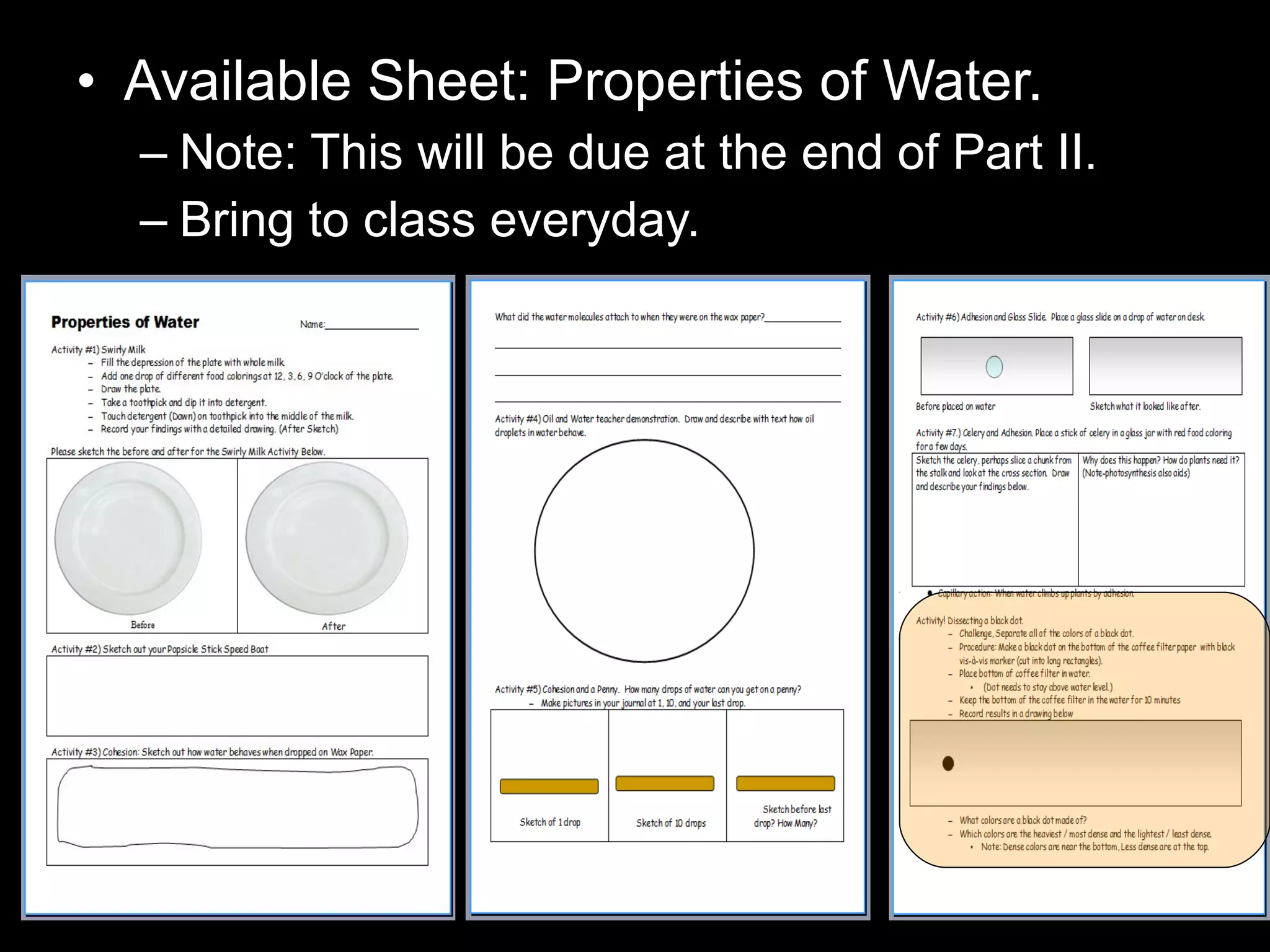
• Available Sheet: Properties of Water.
– Note: This will be due at the end of Part II.
– Bring to class everyday.
• Activity! Making a surface tension speed
boat.
– Break a popsicle stick in half and place a small
amount of detergent on the end.
– Place on a plate of water.
– You only get one shot at this so enjoy.
Copyright © 2010 Ryan P. Murphy
• Questions to speed boat.
– Sketch your boat in your journal and describe
it’s journey.
– Why do you think the boat moved around?
Copyright © 2010 Ryan P. Murphy
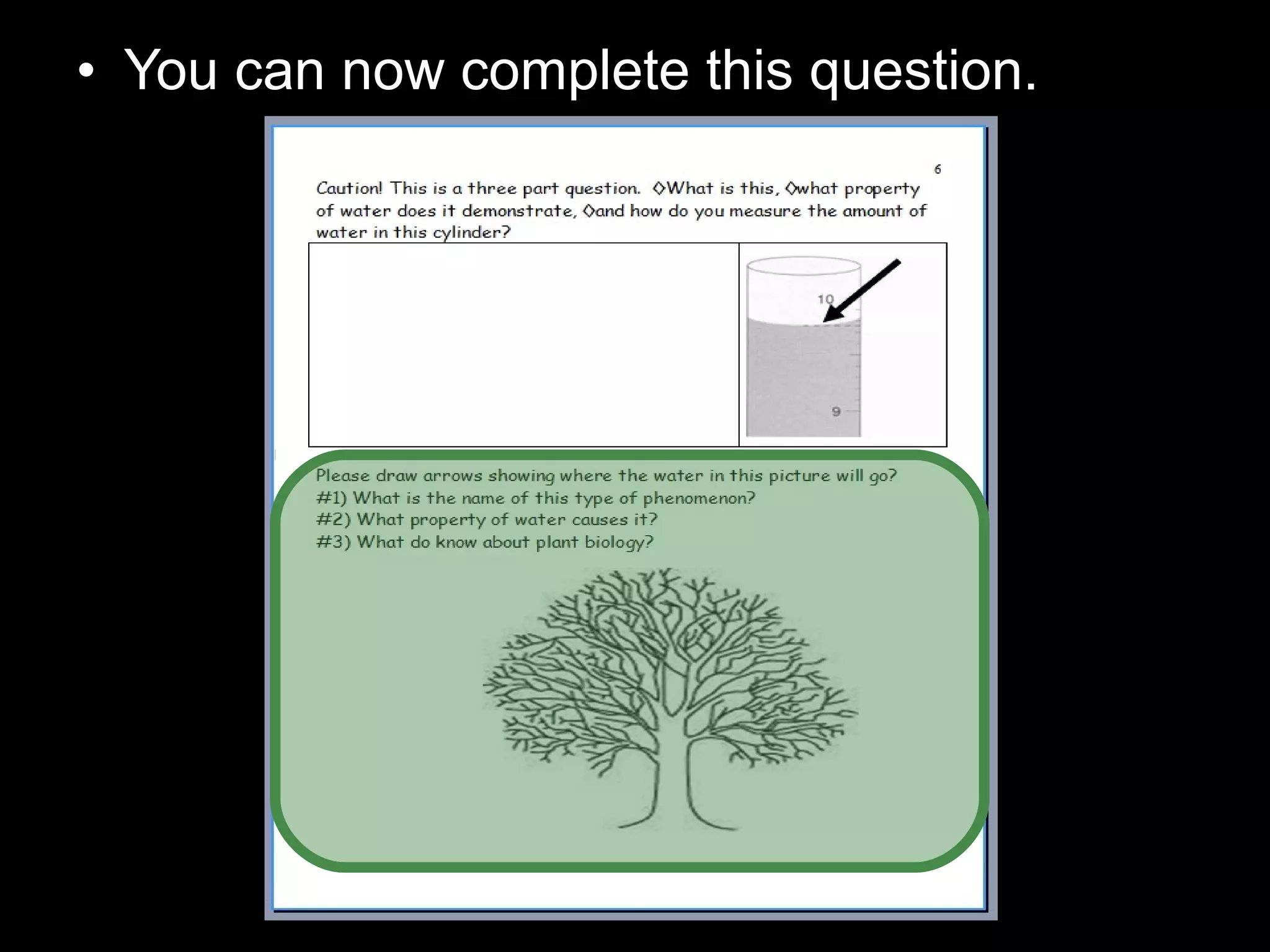
• You can now complete this question.
• Available Sheet: Properties of Water.
– Note: This will be due at the end of Part II.
– Bring to class everyday.
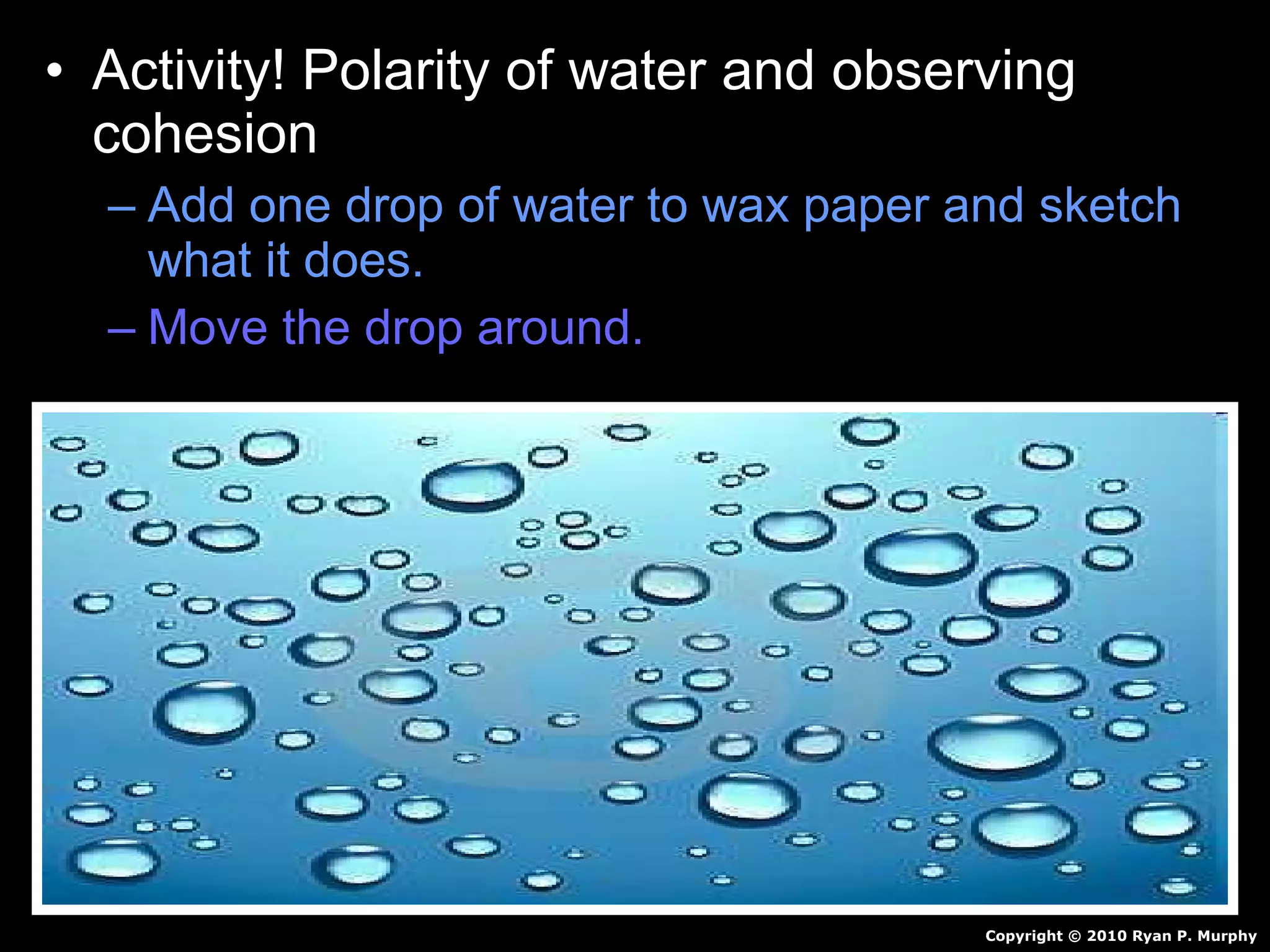
• Activity! Polarity of water and observing
cohesion
– Add one drop of water to wax paper and sketch
what it does.
– Move the drop around.
Copyright © 2010 Ryan P. Murphy
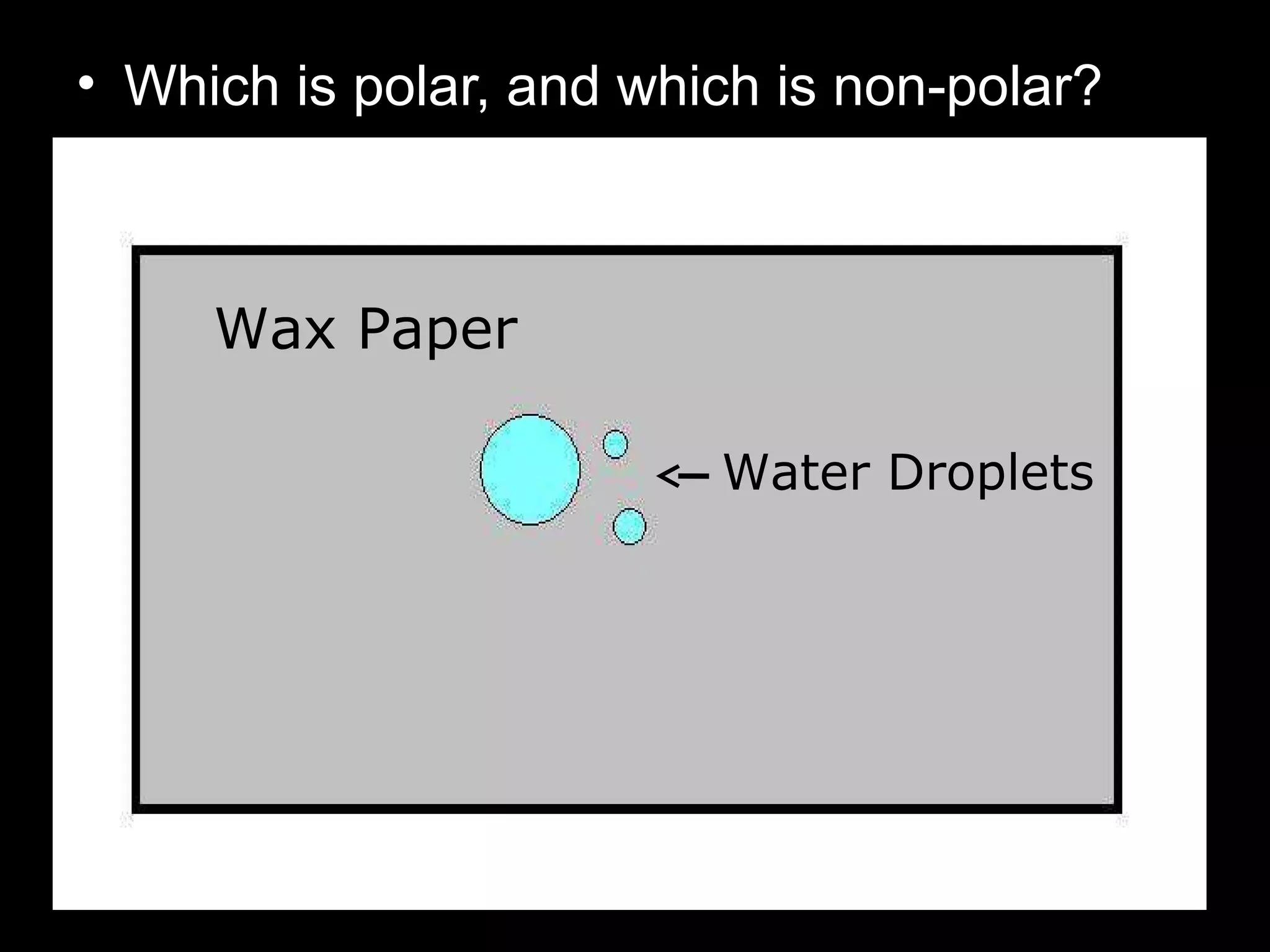
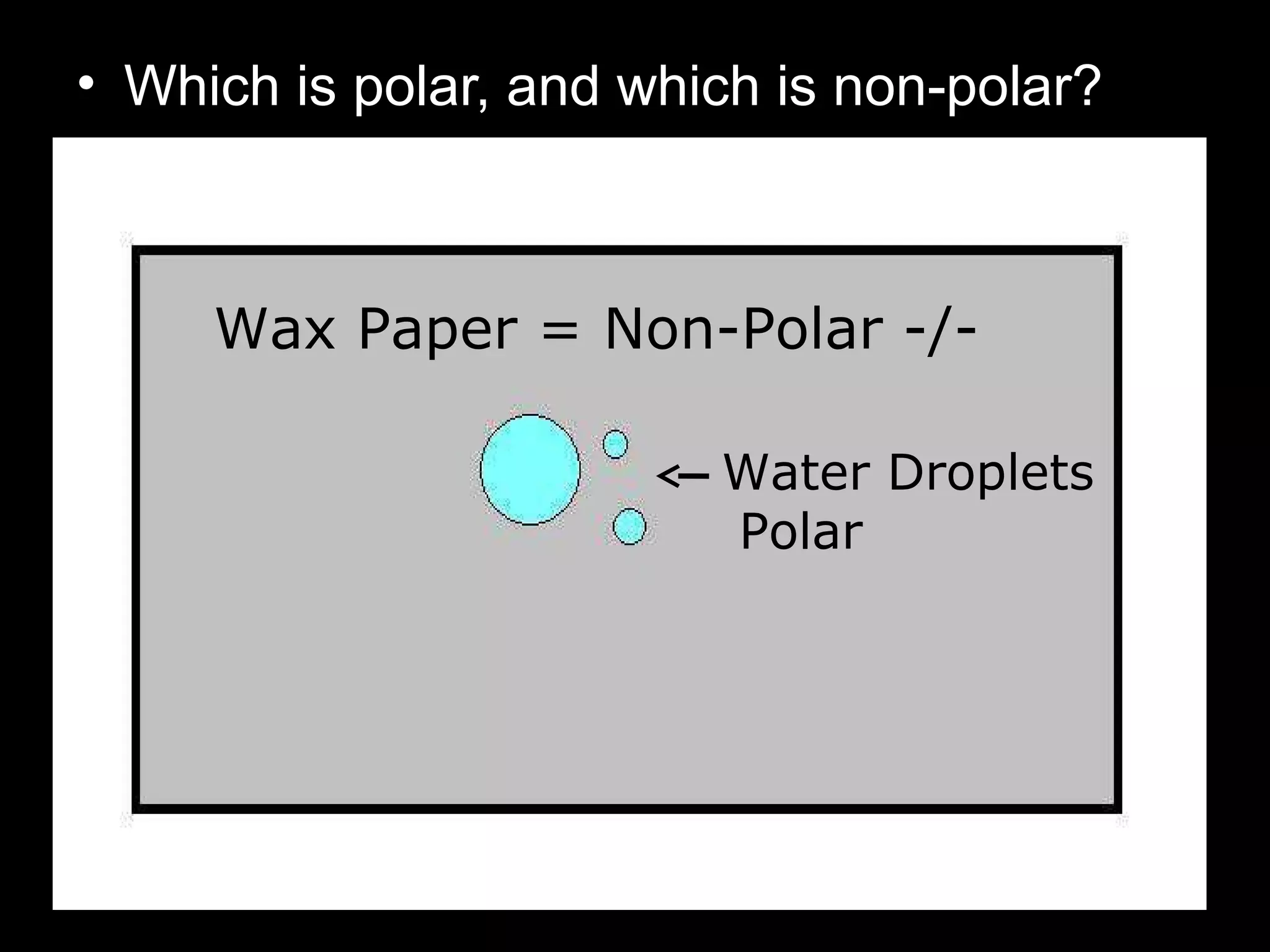
• Which is polar, and which is non-polar?
Wax Paper
Water Droplets
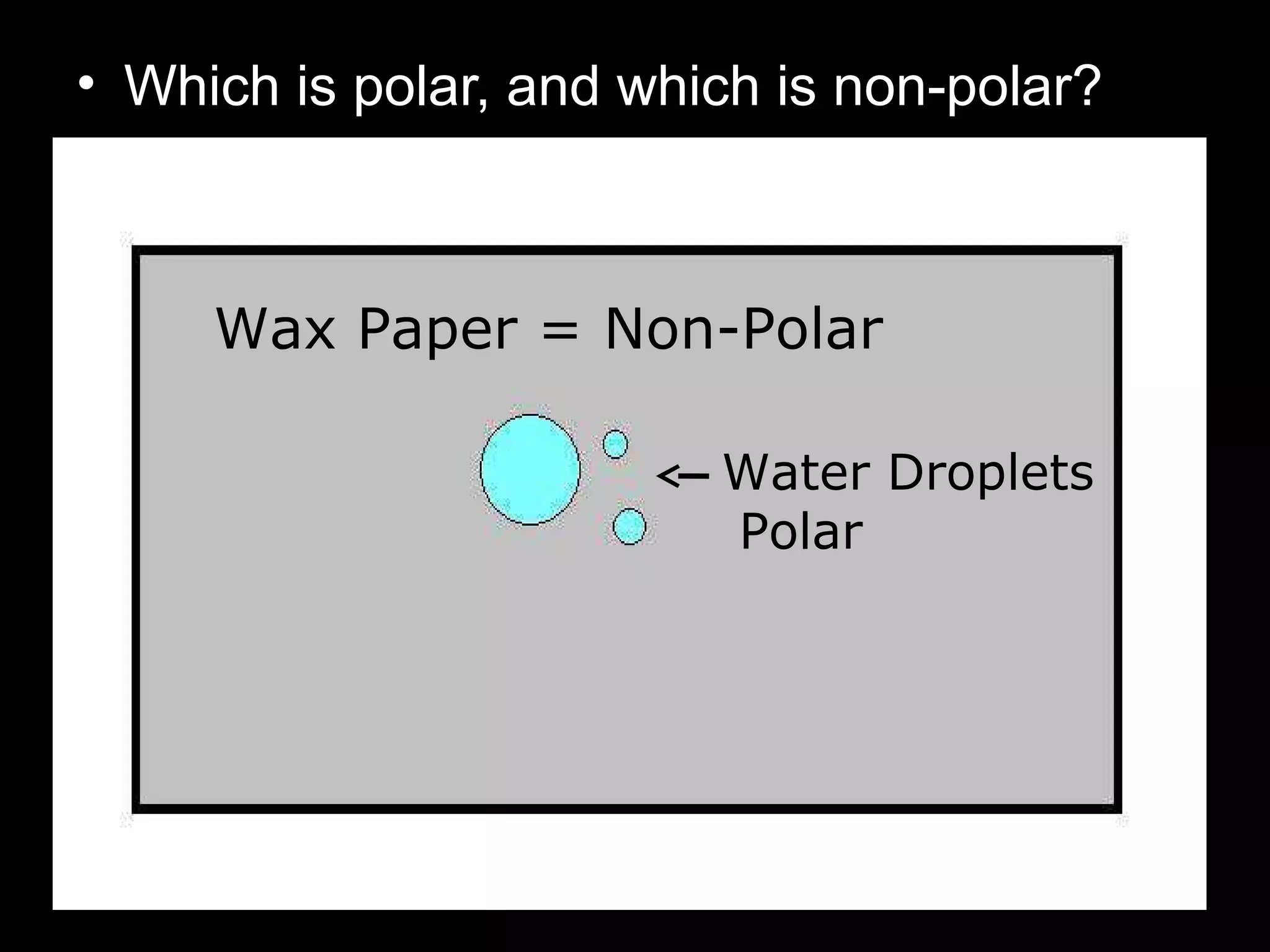
• Which is polar, and which is non-polar?
Wax Paper = Non-Polar
Water Droplets
Polar
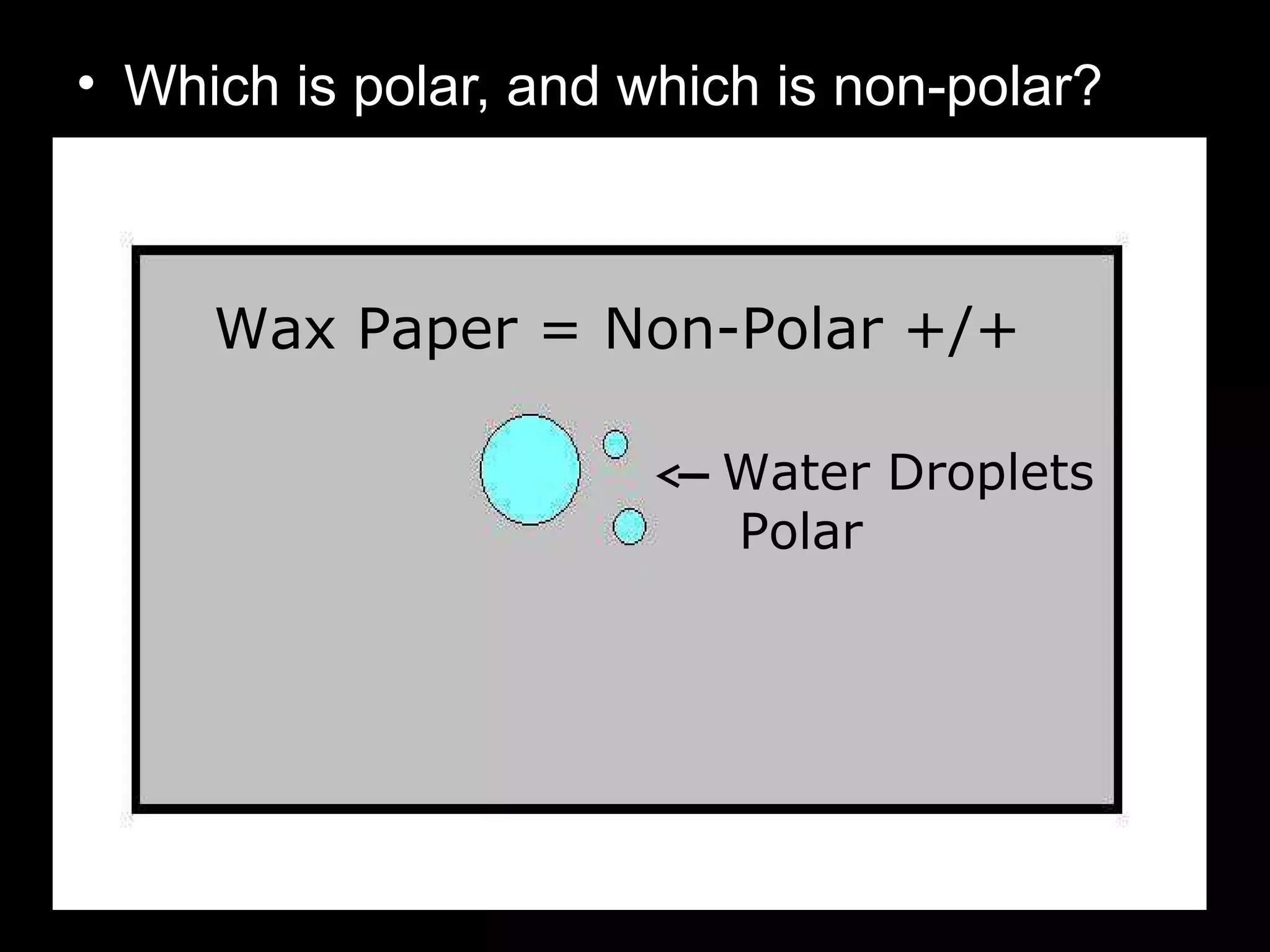
• Which is polar, and which is non-polar?
Wax Paper = Non-Polar +/+
Water Droplets
Polar
• Which is polar, and which is non-polar?
Wax Paper = Non-Polar -/-
Water Droplets
Polar
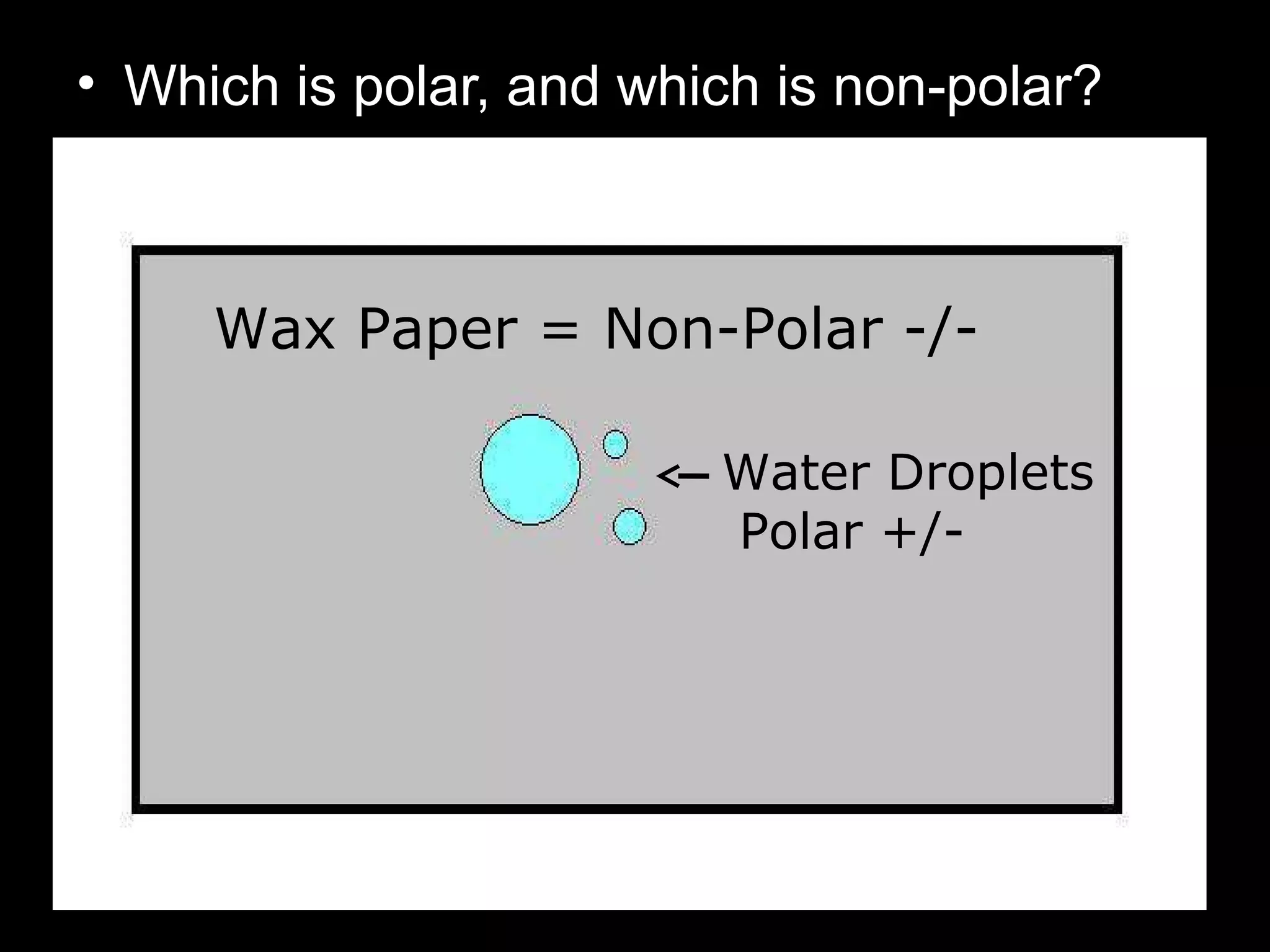
• Which is polar, and which is non-polar?
Wax Paper = Non-Polar -/-
Water Droplets
Polar +/-
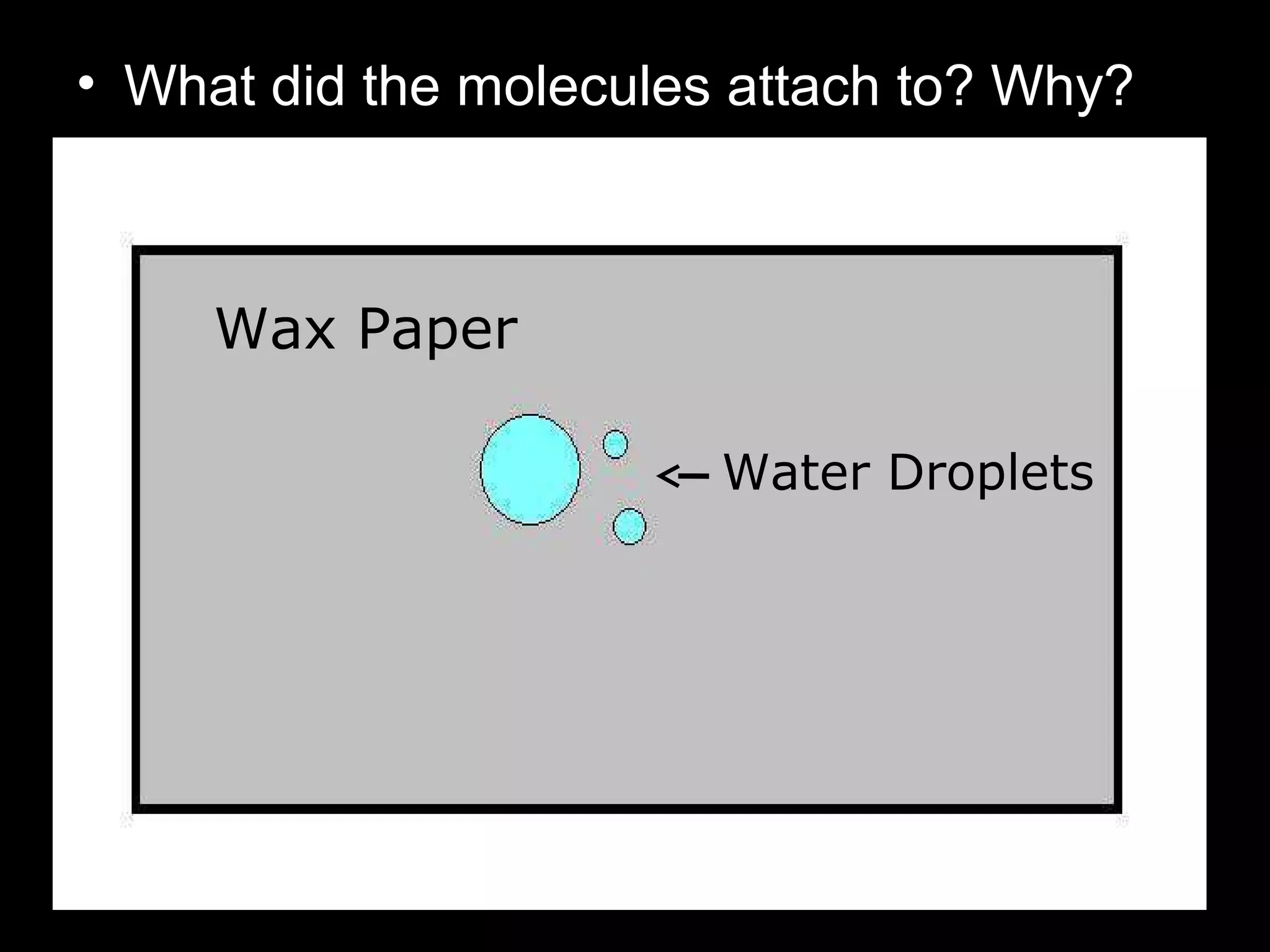
• What did the molecules attach to? Why?
Wax Paper
Water Droplets
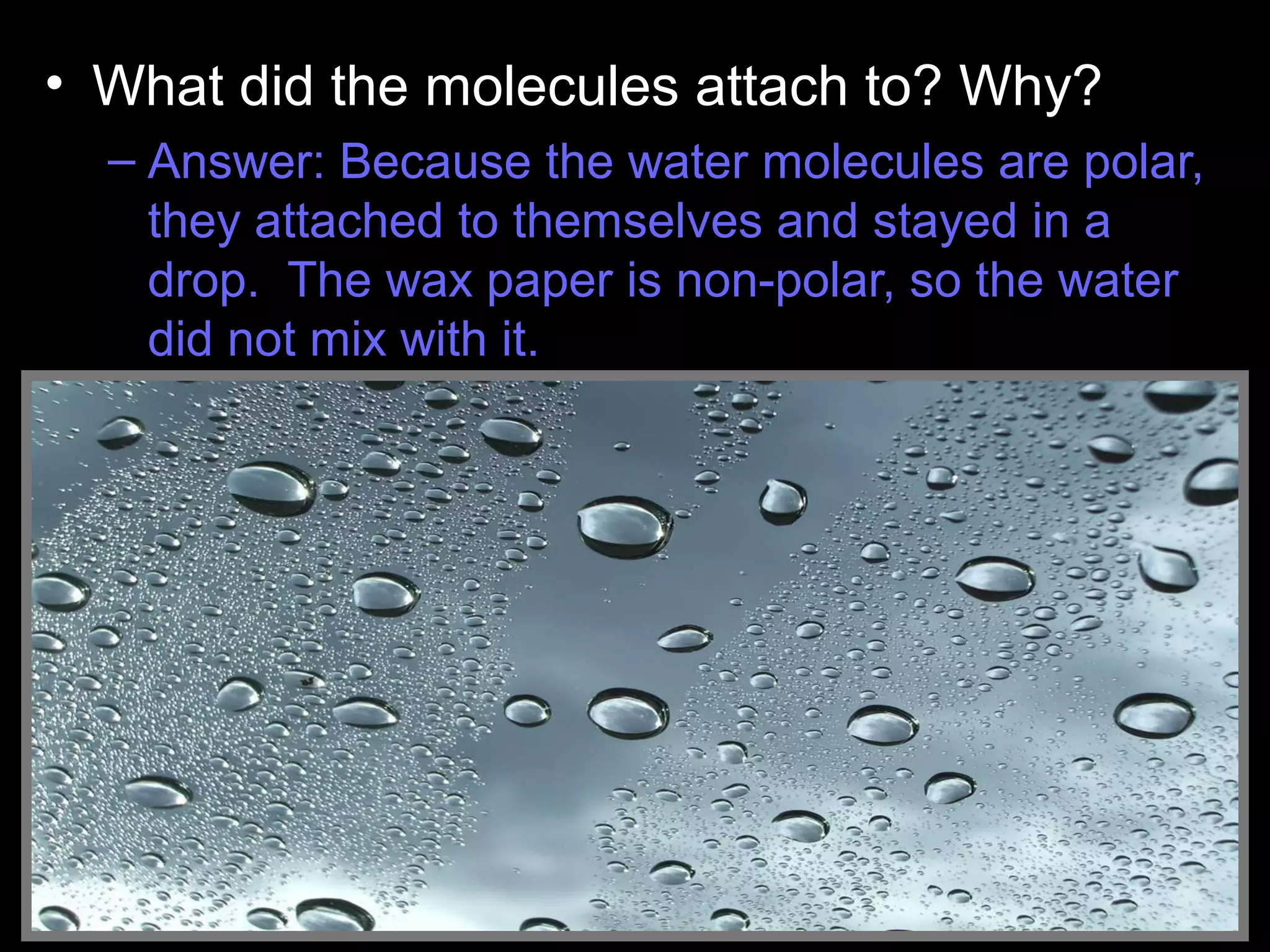
• What did the molecules attach to? Why?
– Answer: Because the water molecules are polar,
they attached to themselves and stayed in a
drop. The wax paper is non-polar, so the water
did not mix with it.
Water Droplets
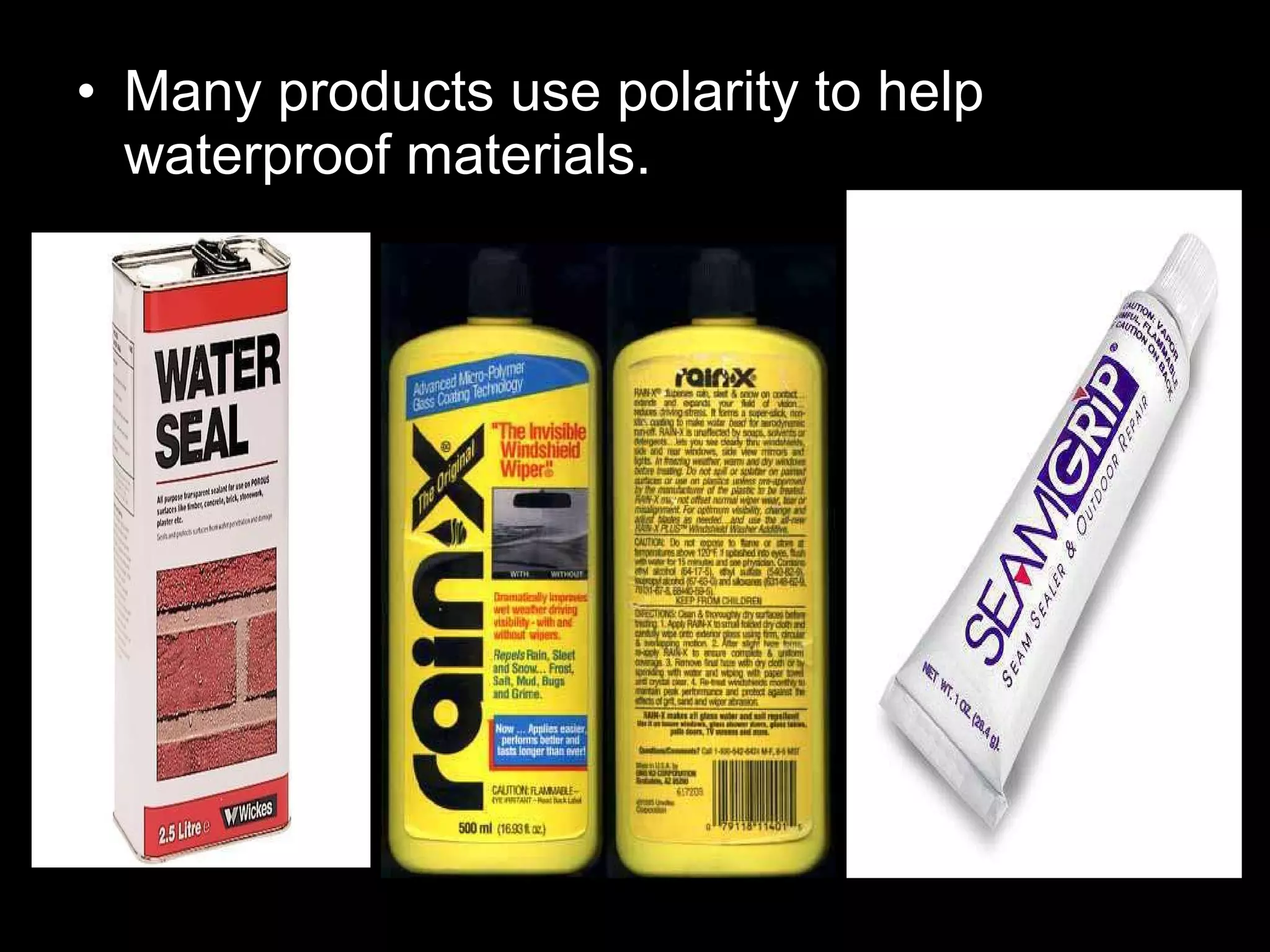
• Many products use polarity to help
waterproof materials.
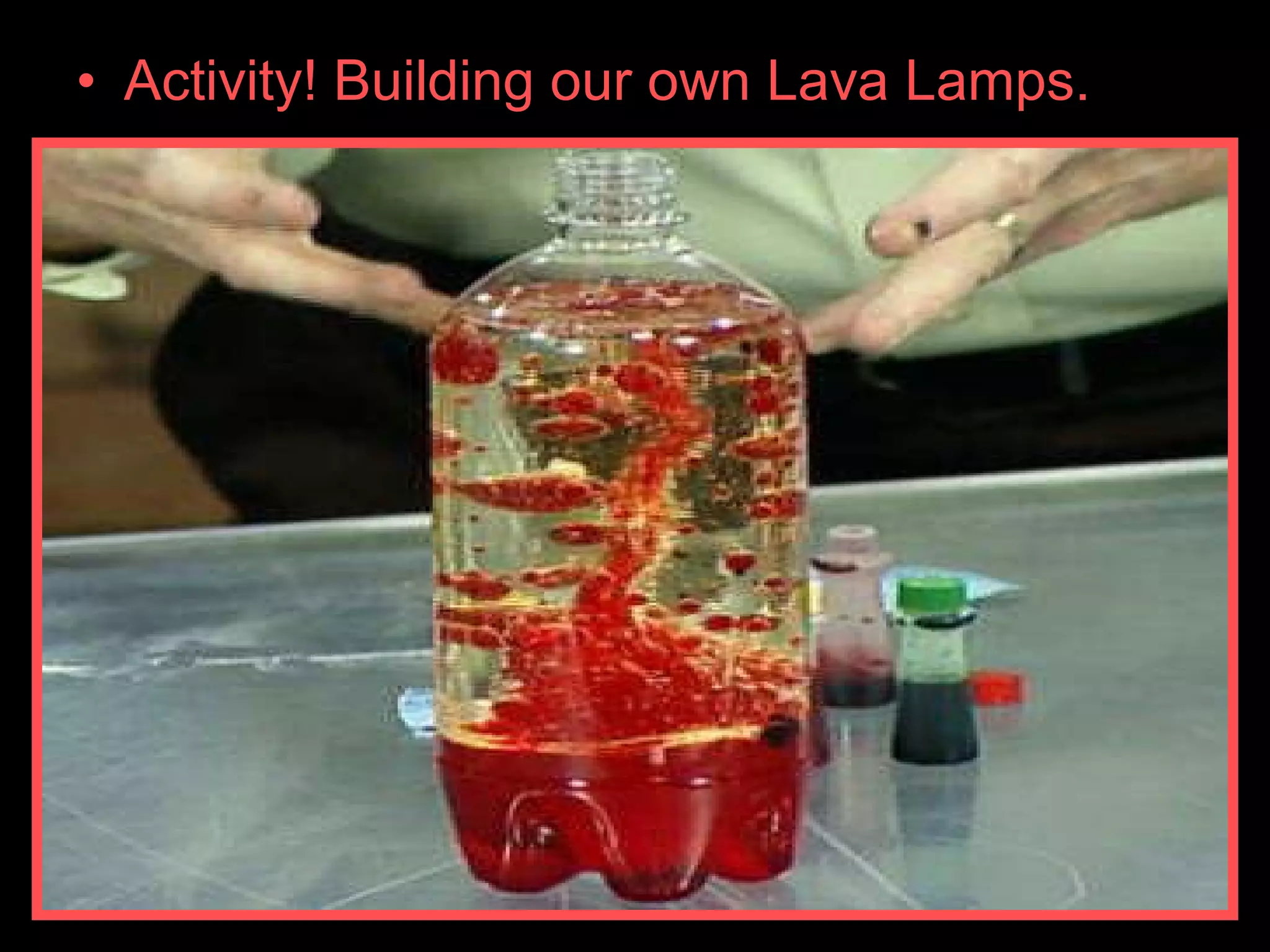
• Activity! Building our own Lava Lamps.
• Everyone needs a clear 20 oz bottle +
cap.
– If you want to create a larger lamp (2 liter)
please bring in your own vegetable oil.
• Remove wrapper / label.
• Fill the bottle about ¾ with vegetable oil.
• Fill the rest of the bottle with clean water
almost to the very top.
• Add many drops of food coloring (15 ish),
more if you have a larger bottle.
– You can experiment with colors if you wish.
• Cap and enjoy. (Anyone have a flashlight)
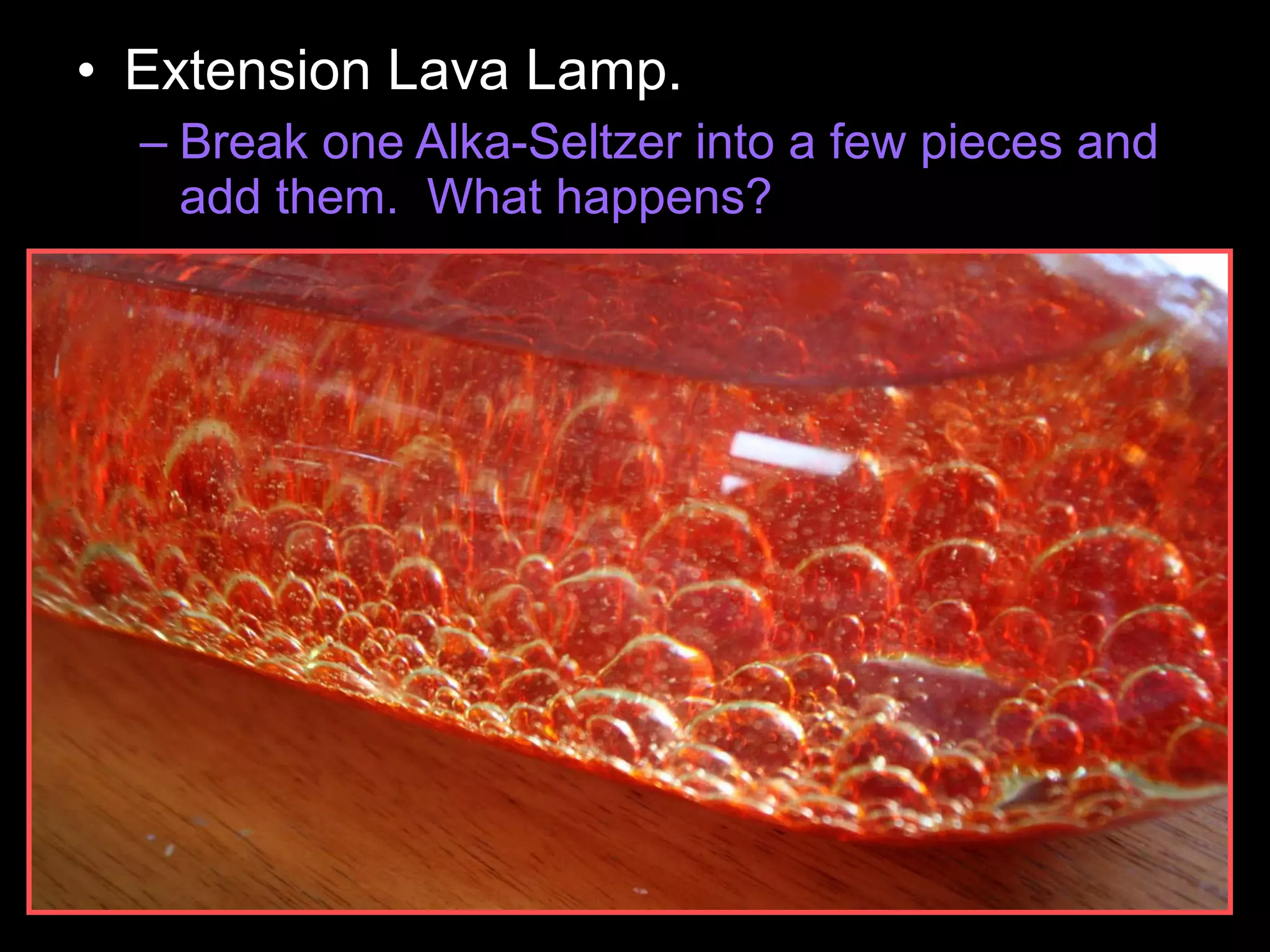
• Extension Lava Lamp.
– Break one Alka-Seltzer into a few pieces and
add them. What happens?
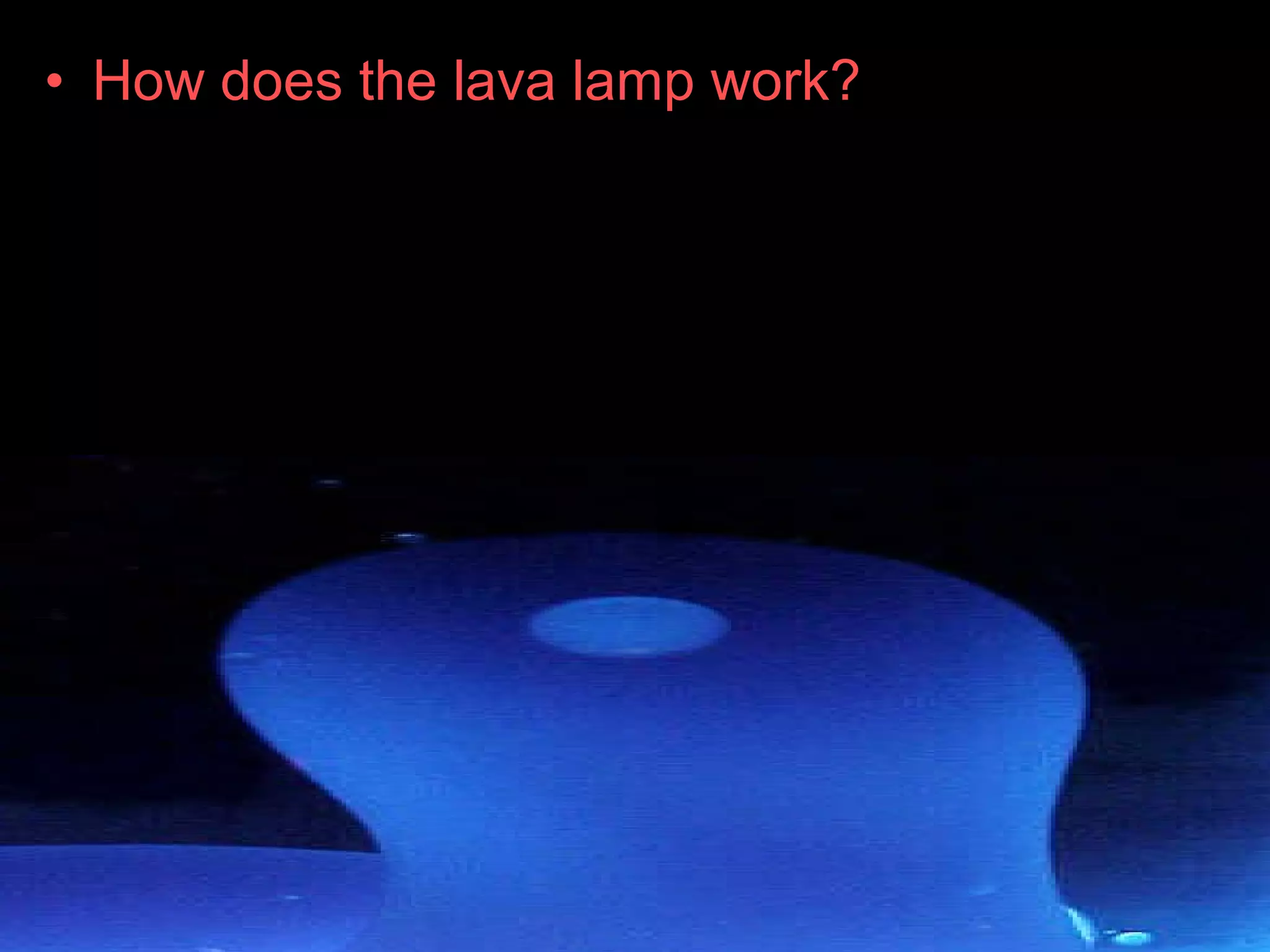
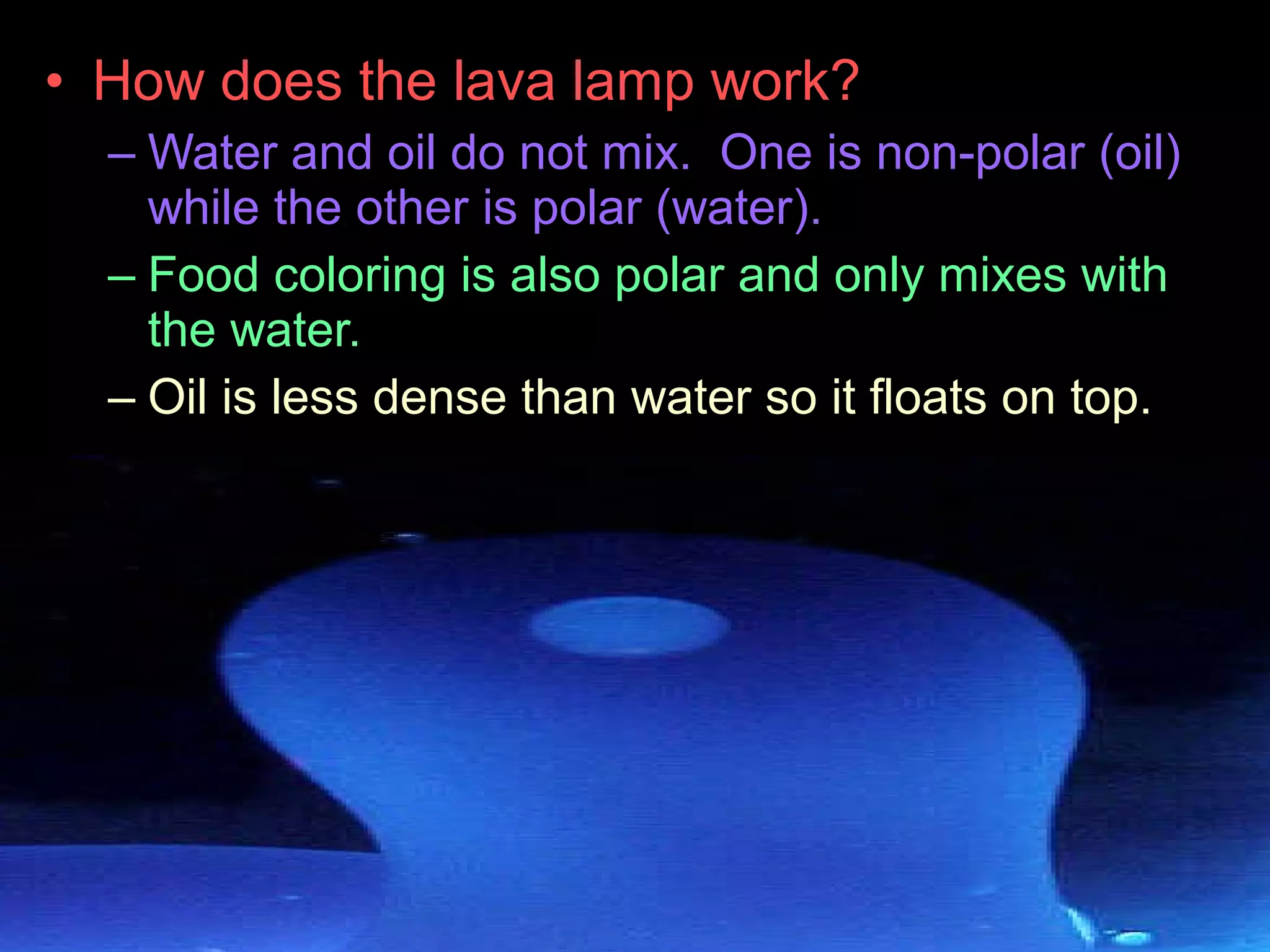
• How does the lava lamp work?
– Water and oil do not mix. One is non-polar (oil)
while the other is polar (water).
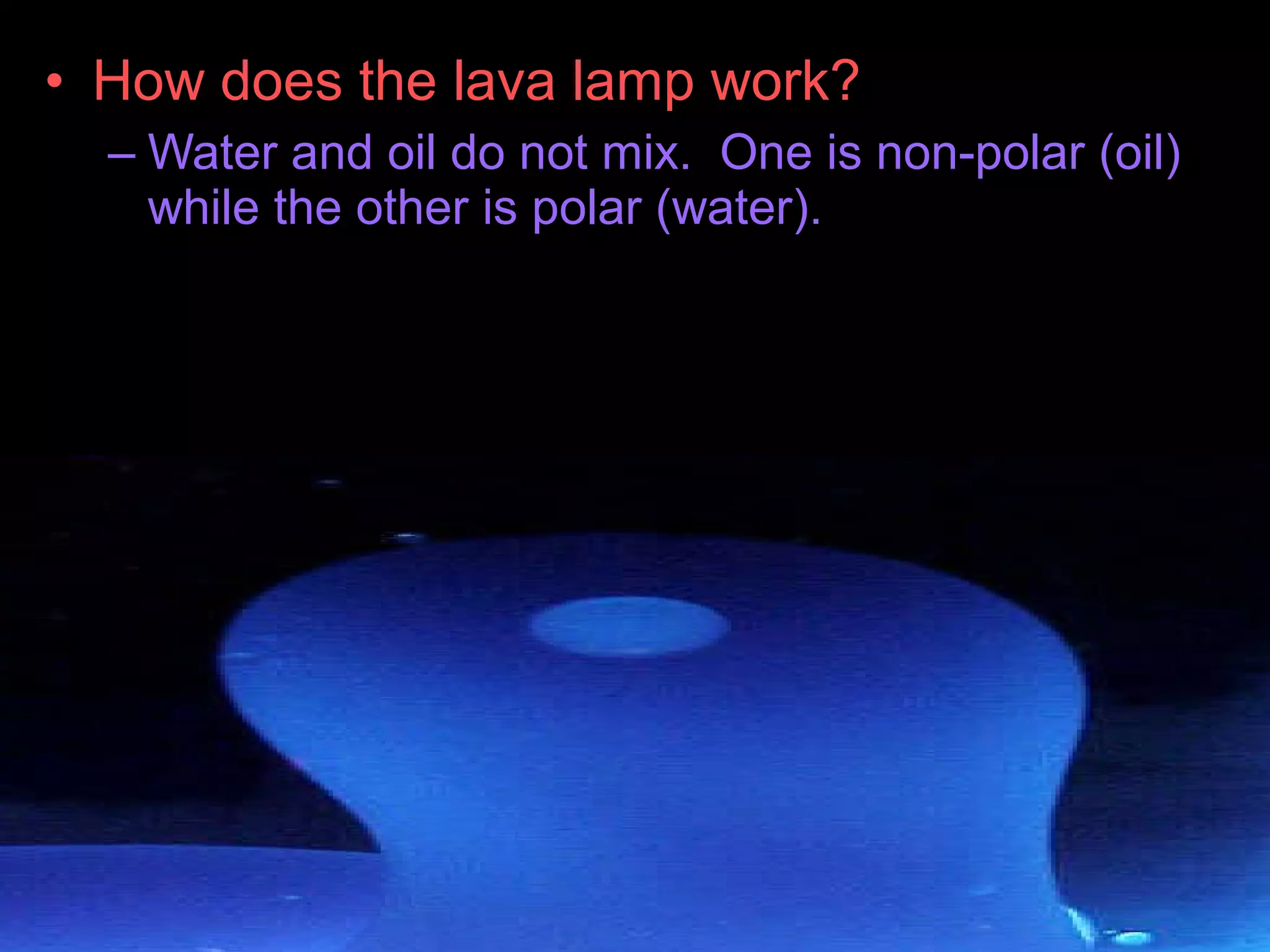
• How does the lava lamp work?
– Water and oil do not mix. One is non-polar (oil)
while the other is polar (water).
– Food coloring is also polar and only mixes with
the water.
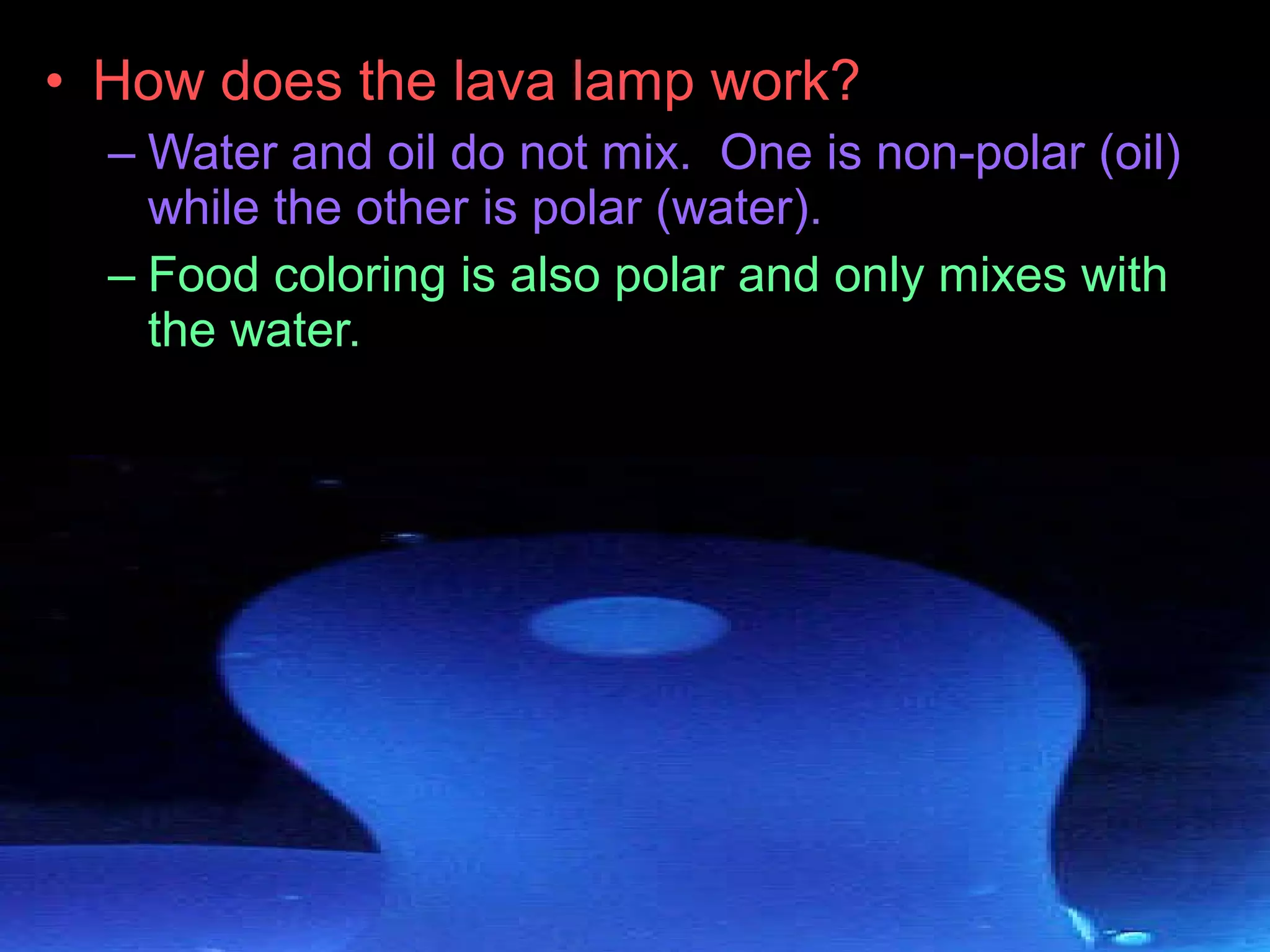
• How does the lava lamp work?
– Water and oil do not mix. One is non-polar (oil)
while the other is polar (water).
– Food coloring is also polar and only mixes with
the water.
– Oil is less dense than water so it floats on top.
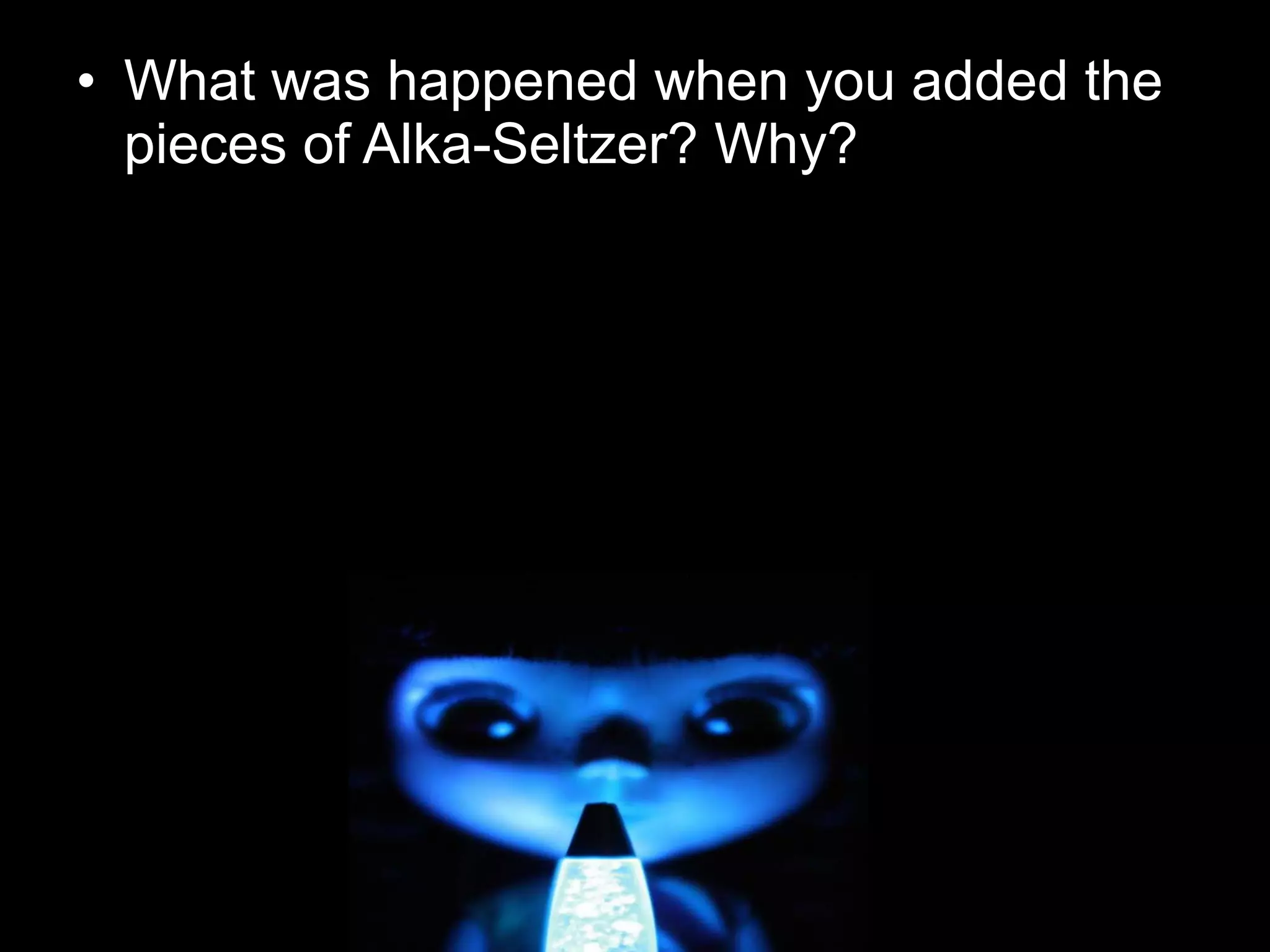
• What was happened when you added the
pieces of Alka-Seltzer? Why?
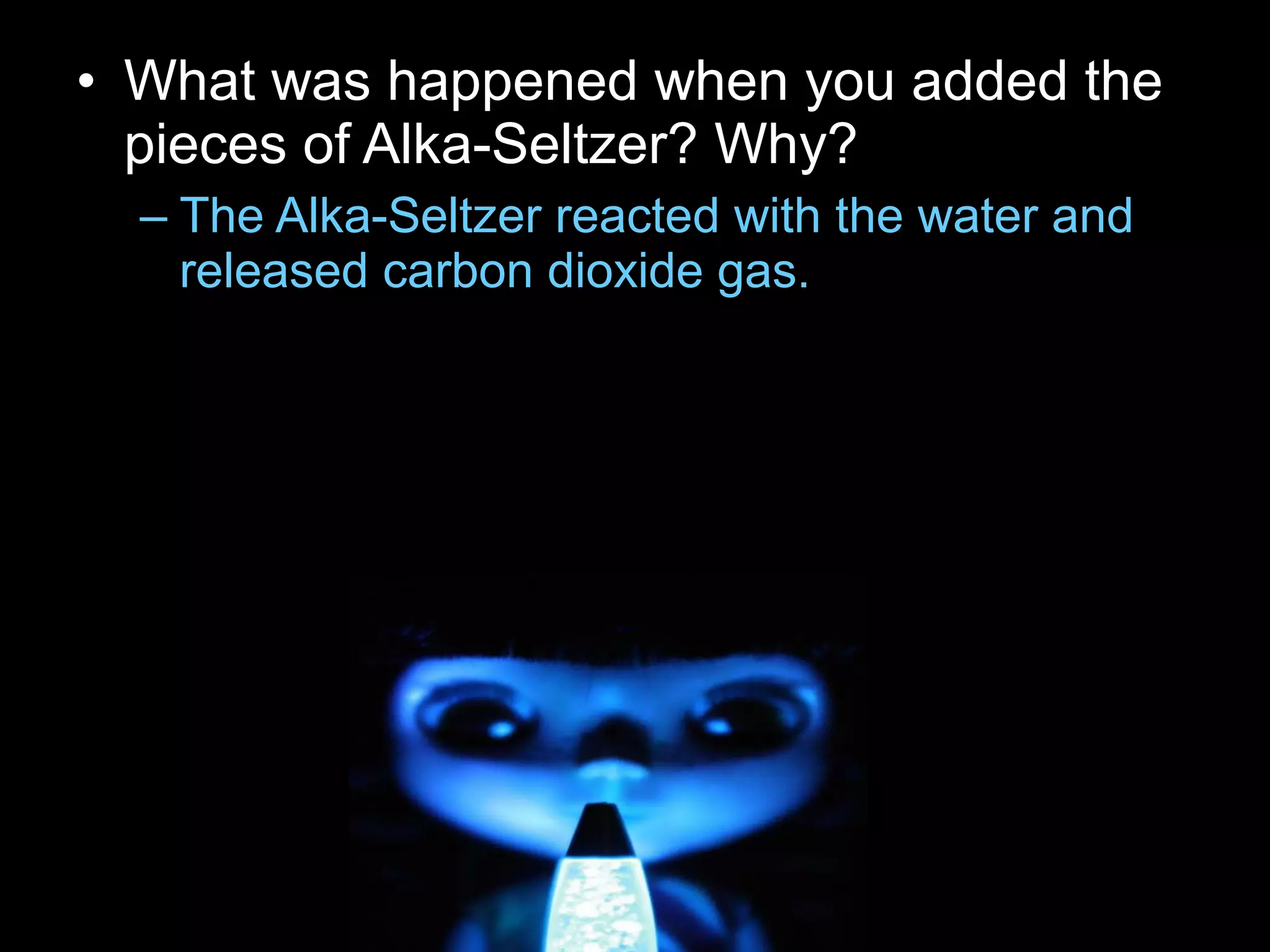
• What was happened when you added the
pieces of Alka-Seltzer? Why?
– The Alka-Seltzer reacted with the water and
released carbon dioxide gas.
• What was happened when you added the
pieces of Alka-Seltzer? Why?
– The Alka-Seltzer reacted with the water and
released carbon dioxide gas.
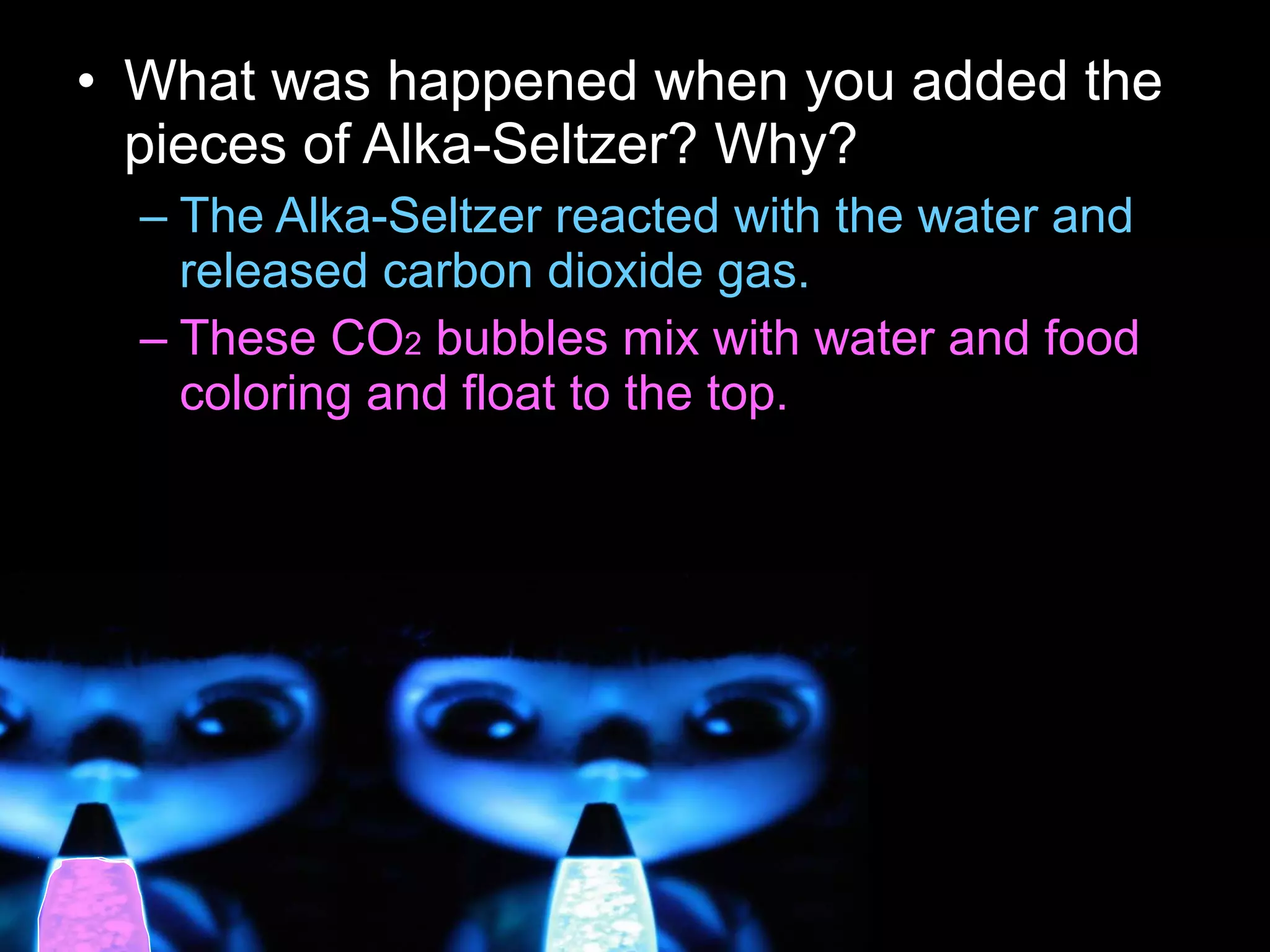
– These CO2 bubbles mix with water and food
coloring and float to the top.
• What was happened when you added the
pieces of Alka-Seltzer? Why?
– The Alka-Seltzer reacted with the water and
released carbon dioxide gas.
– These CO2 bubbles mix with water and food
coloring and float to the top. When the bubble
pops the CO2 leaves at the top and the water
and food coloring sink back down (denser).
• Available Sheet: Properties of Water.
– Note: This will be due at the end of Part II.
– Bring to class everyday.
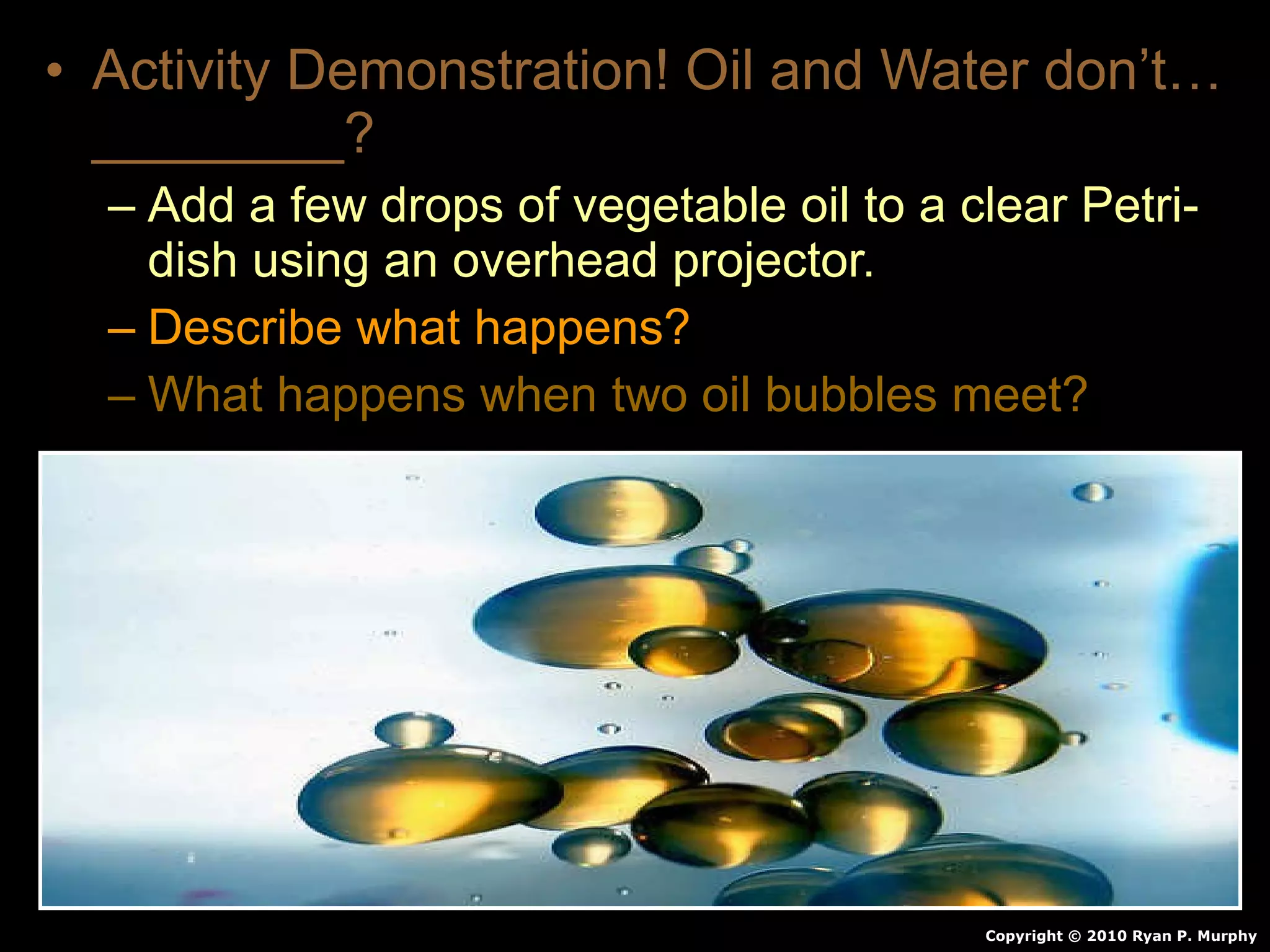
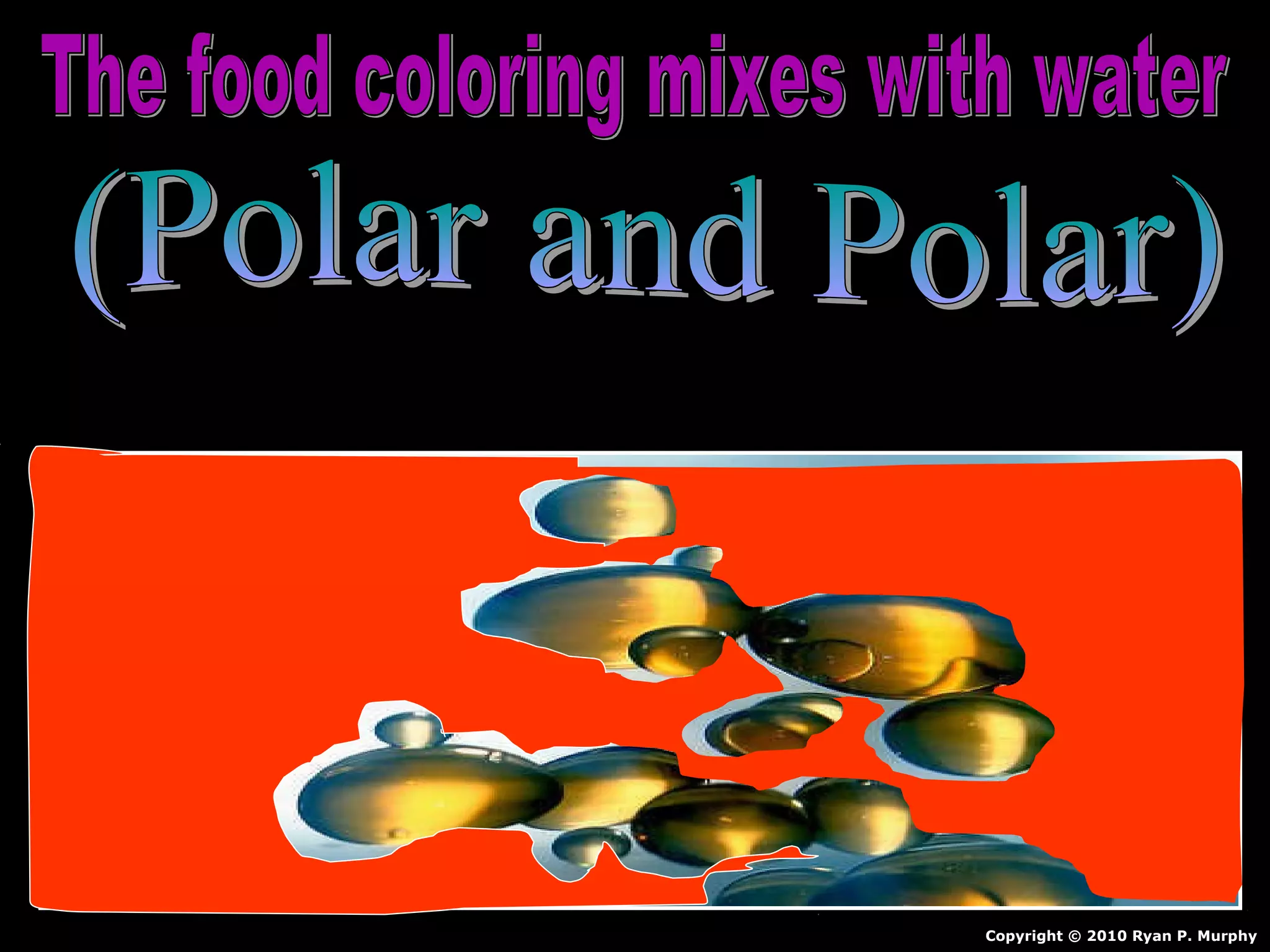
• Activity Demonstration! Oil and Water don’t…
________?
– Add a few drops of vegetable oil to a clear Petri-
dish using an overhead projector.
– Describe what happens?
– What happens when two oil bubbles meet?
Copyright © 2010 Ryan P. Murphy
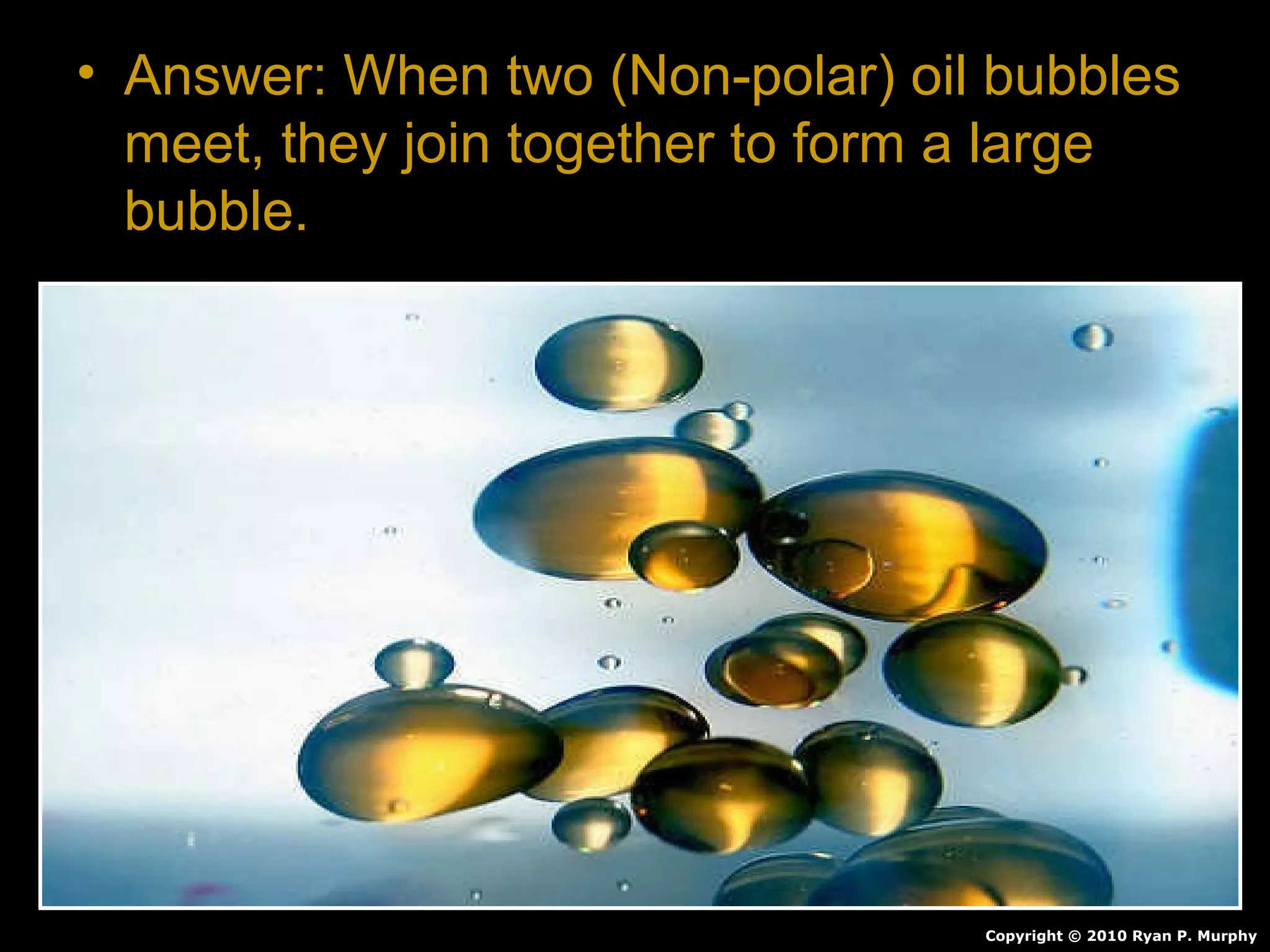
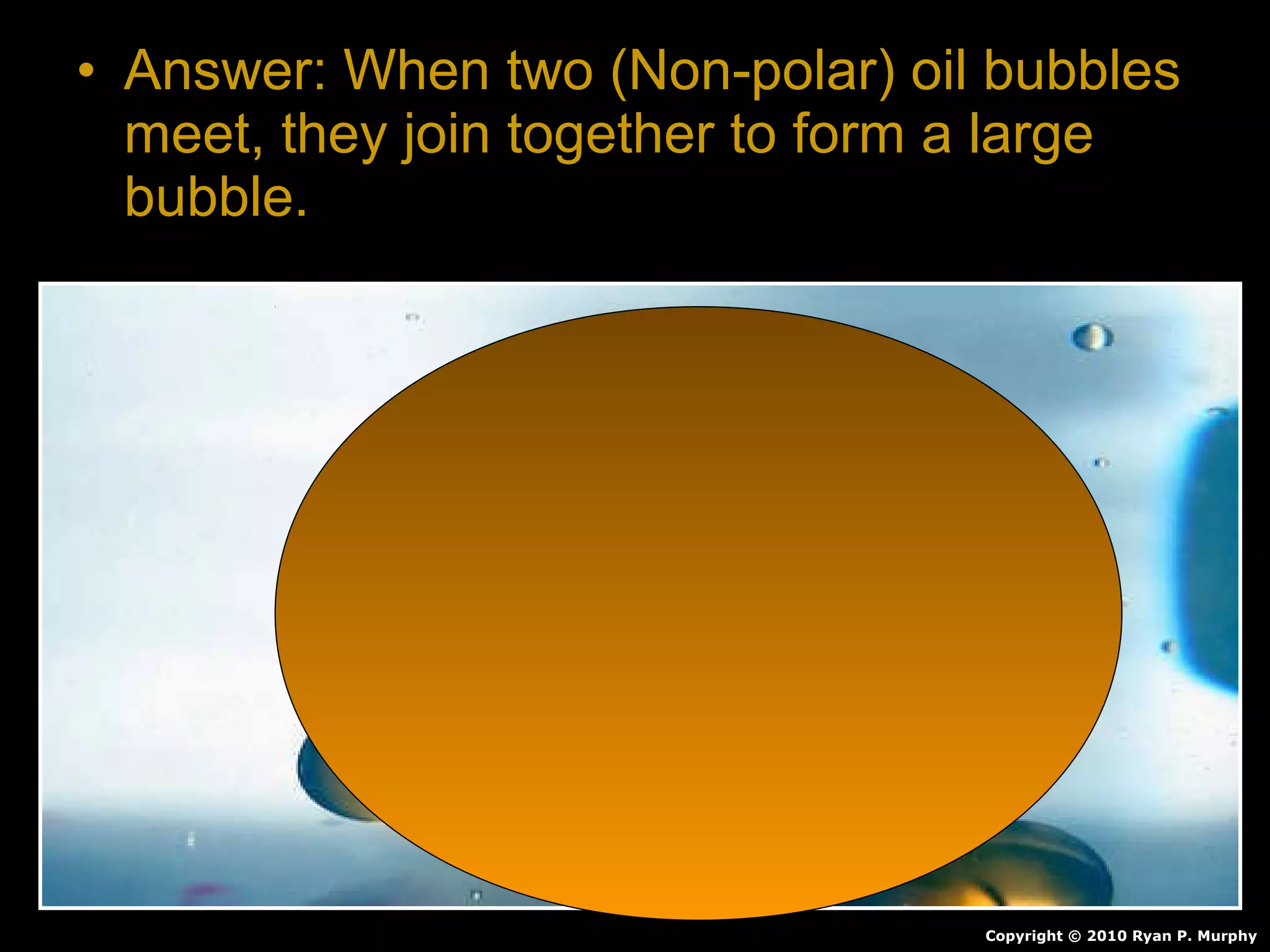
• Answer: When two (Non-polar) oil bubbles
meet, they join together to form a large
bubble.
Copyright © 2010 Ryan P. Murphy
• Answer: When two (Non-polar) oil bubbles
meet, they join together to form a large
bubble.
Copyright © 2010 Ryan P. Murphy
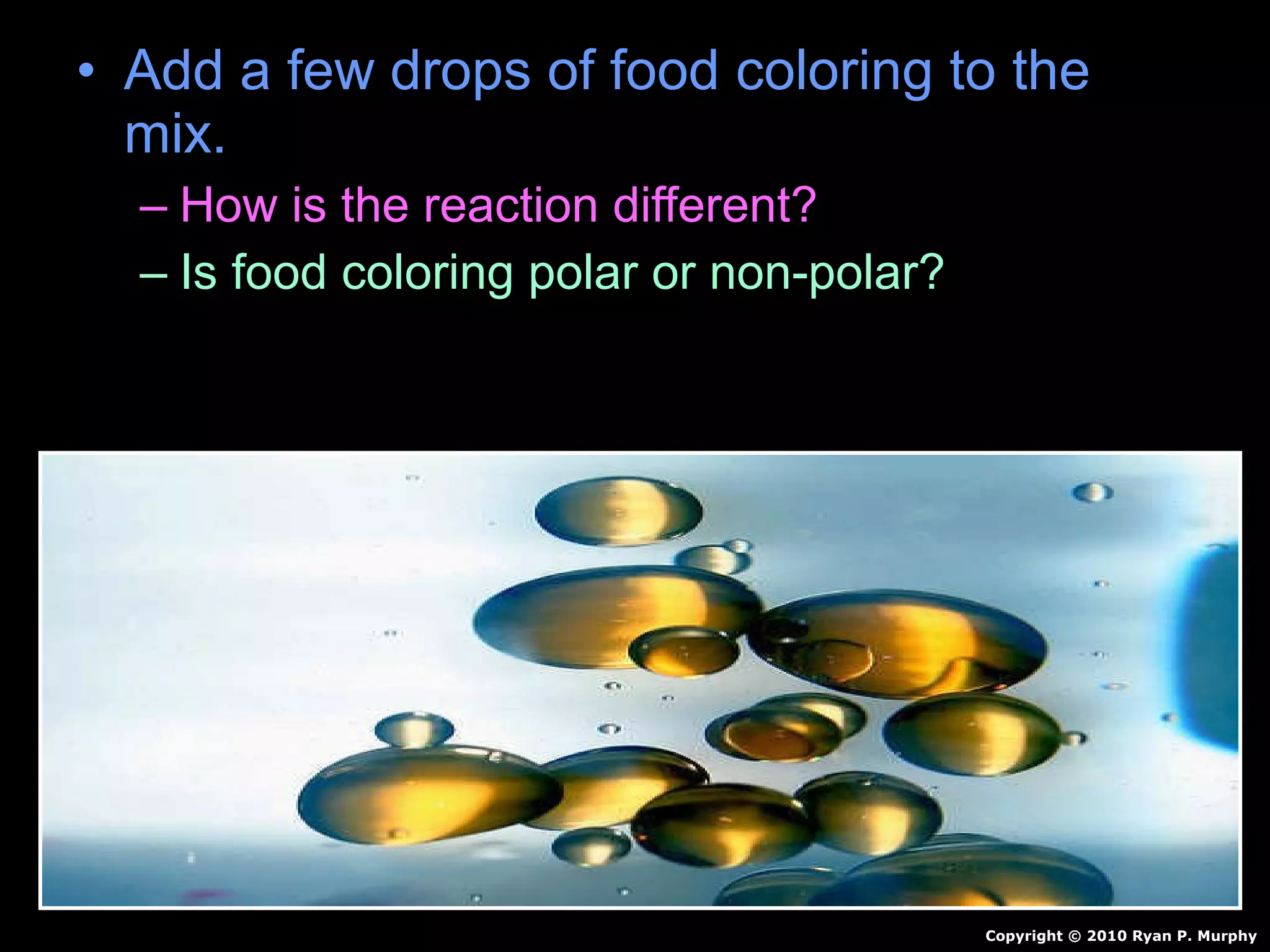
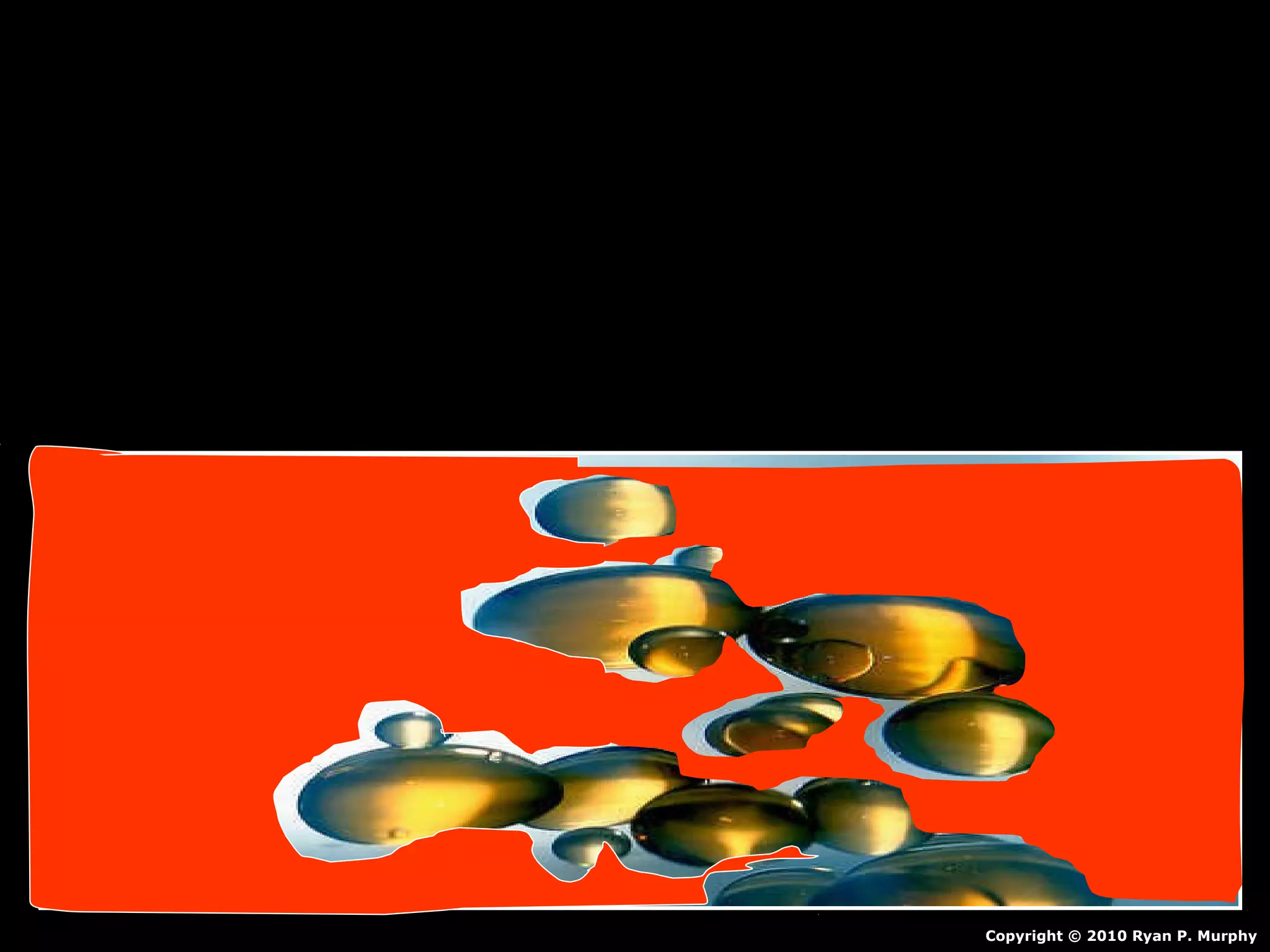
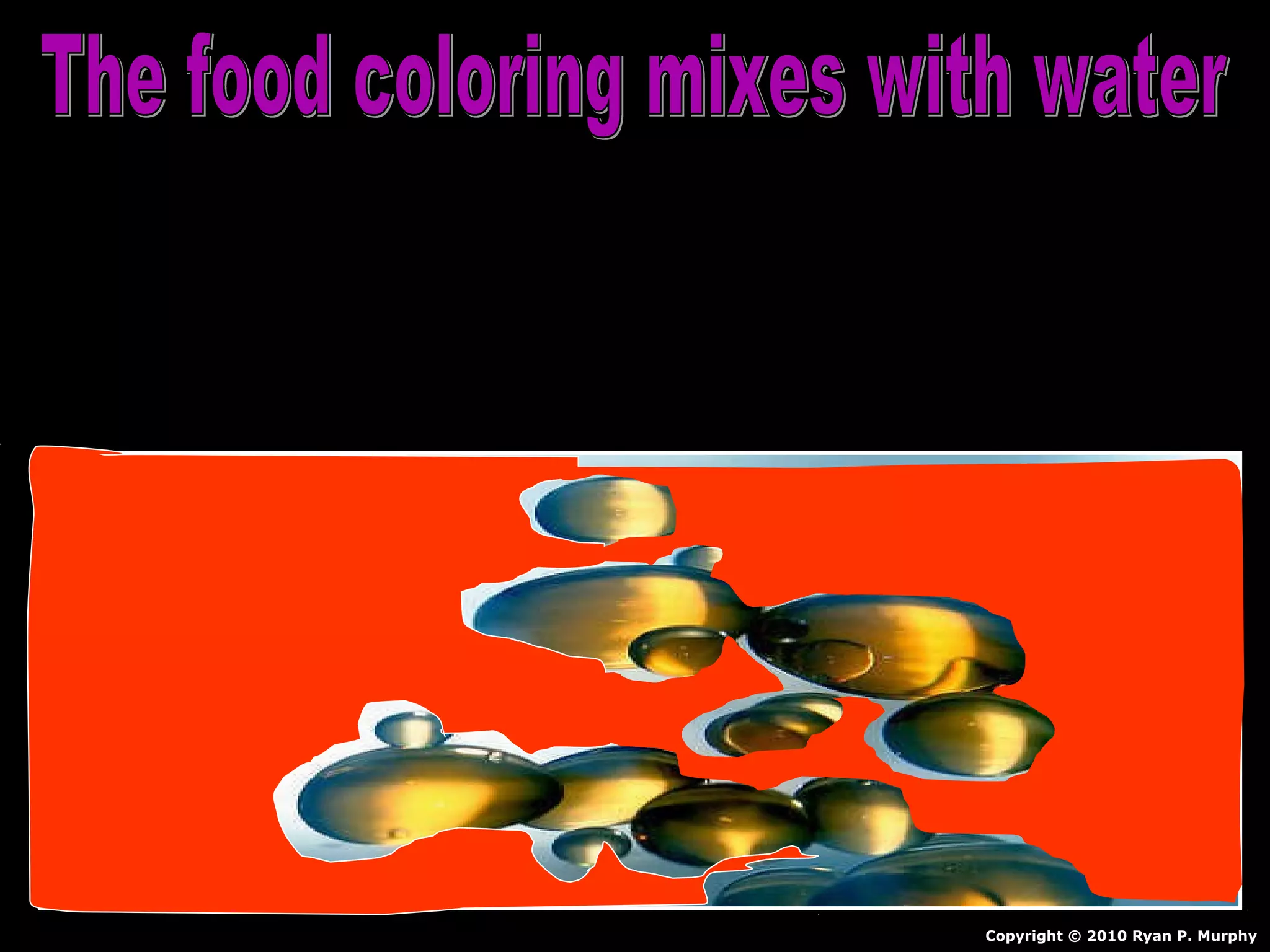
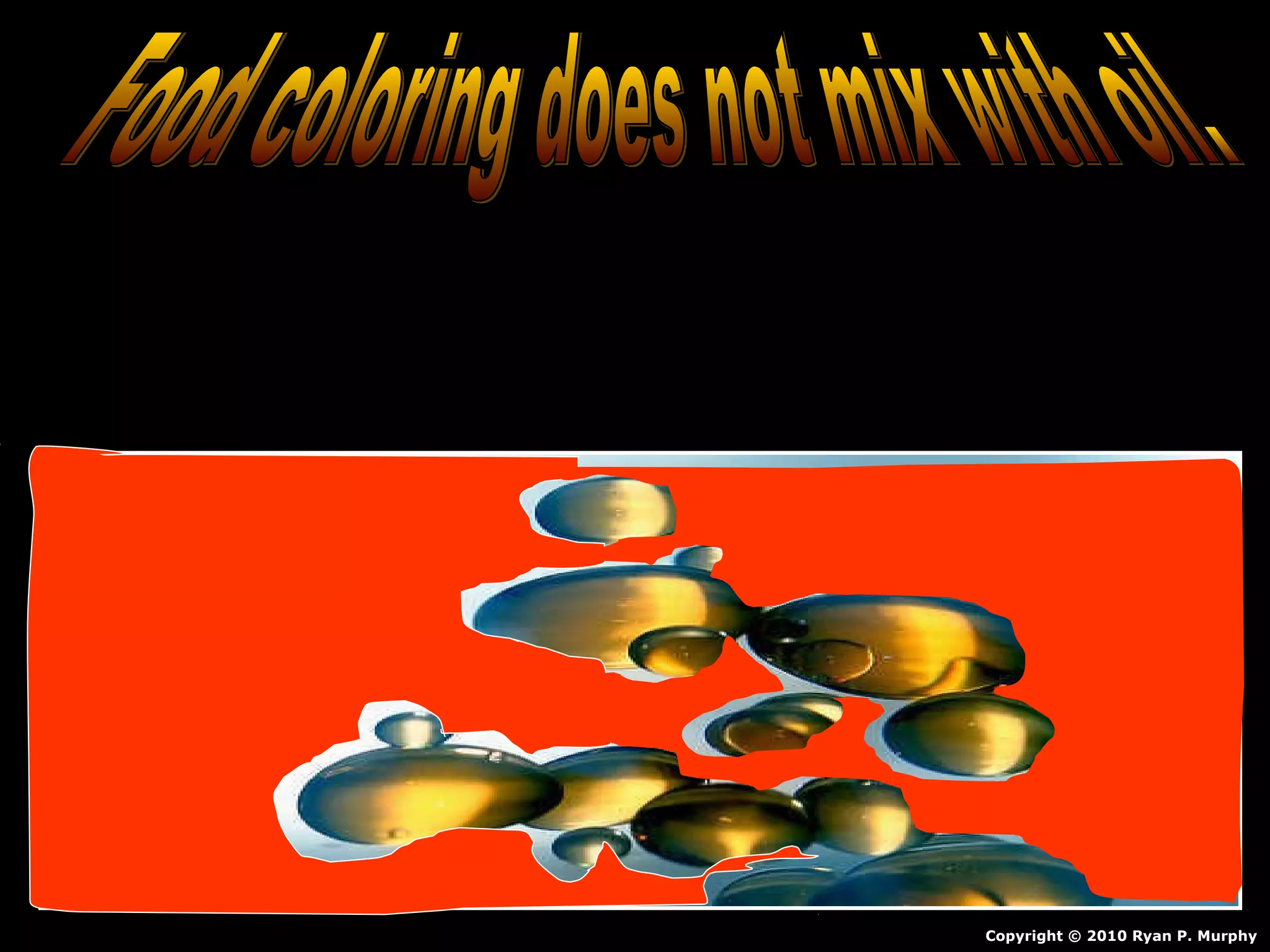
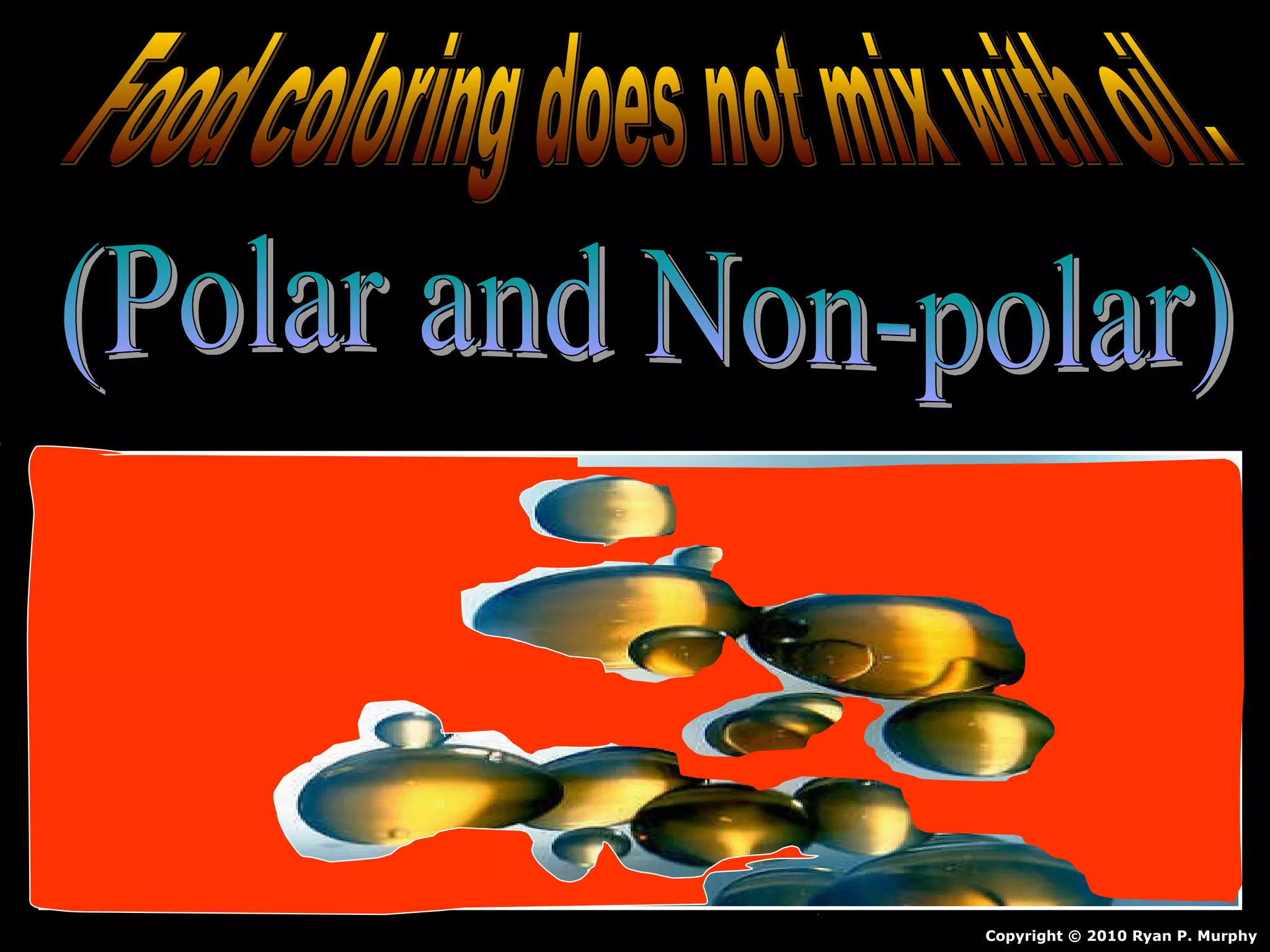
• Add a few drops of food coloring to the
mix.
– How is the reaction different?
– Is food coloring polar or non-polar?
Copyright © 2010 Ryan P. Murphy
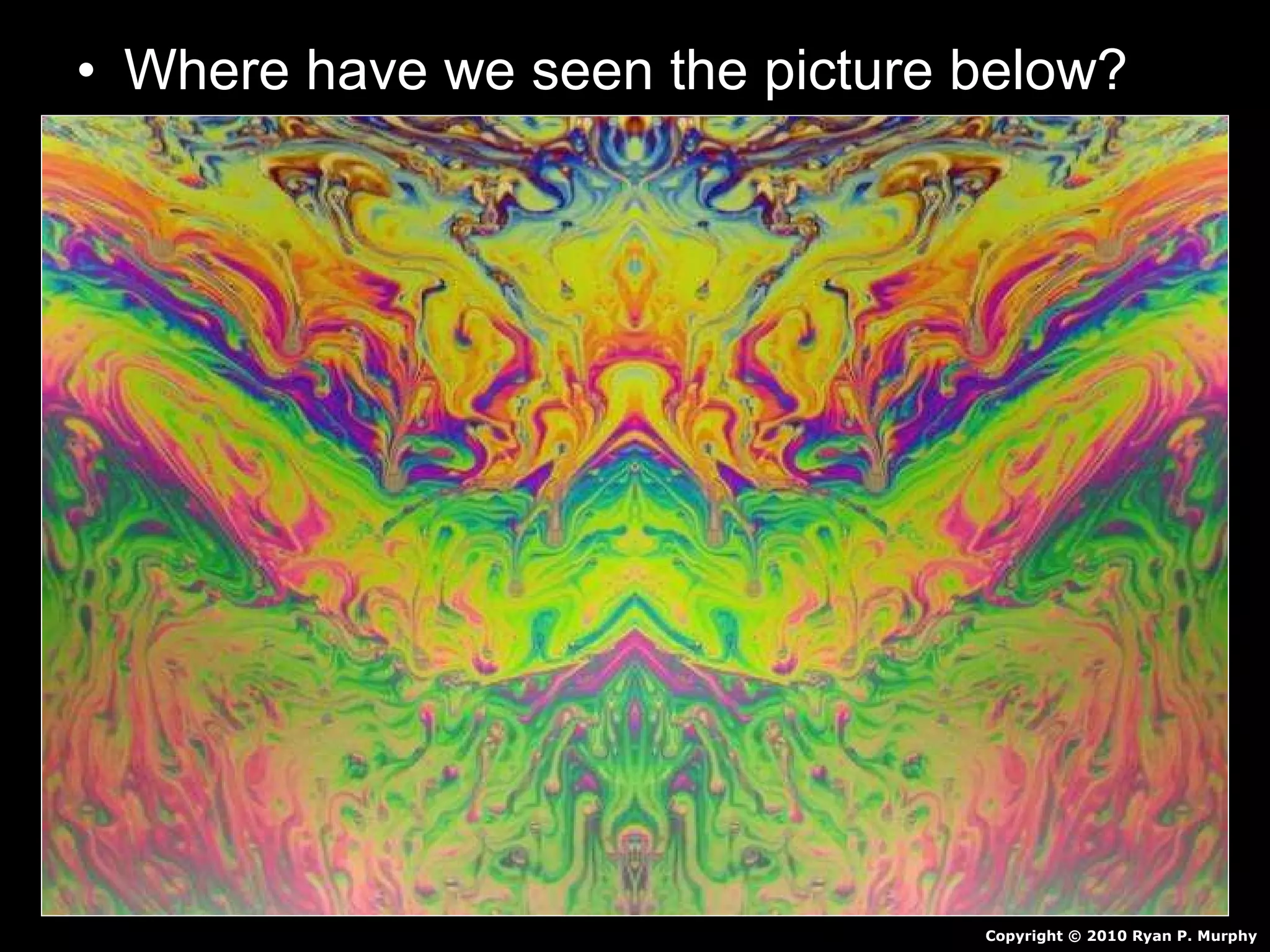
• Where have we seen the picture below?
Copyright © 2010 Ryan P. Murphy
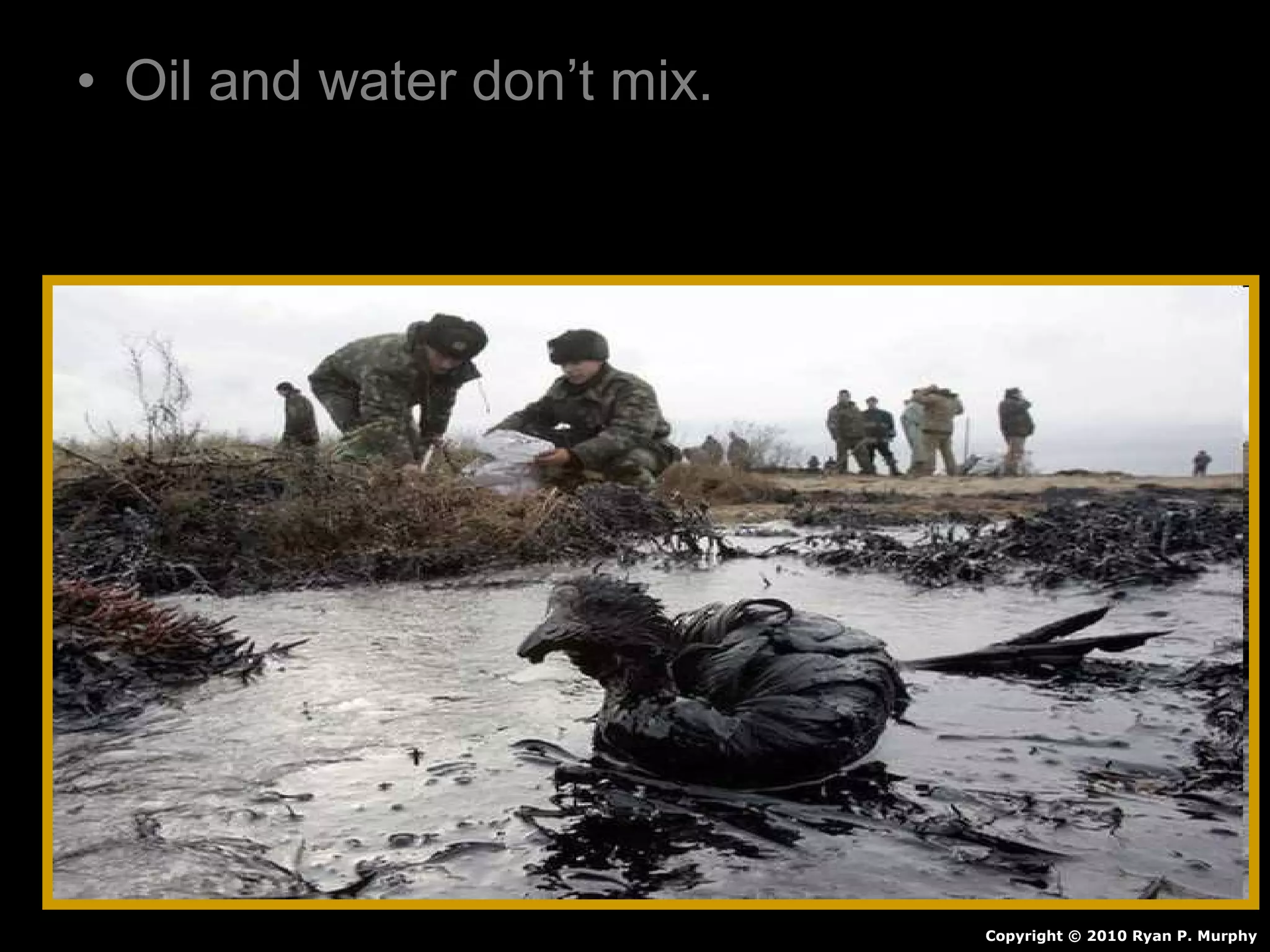
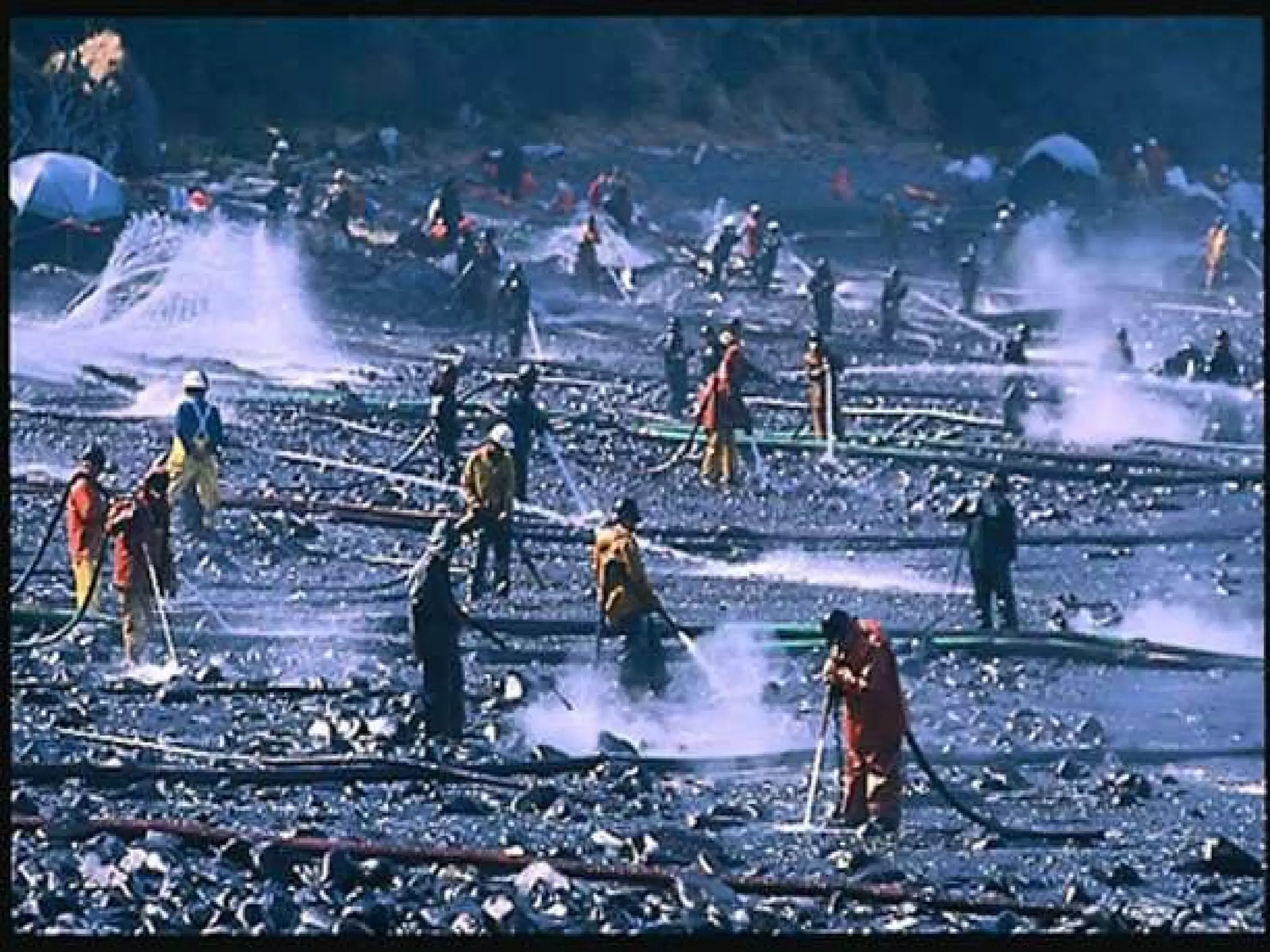
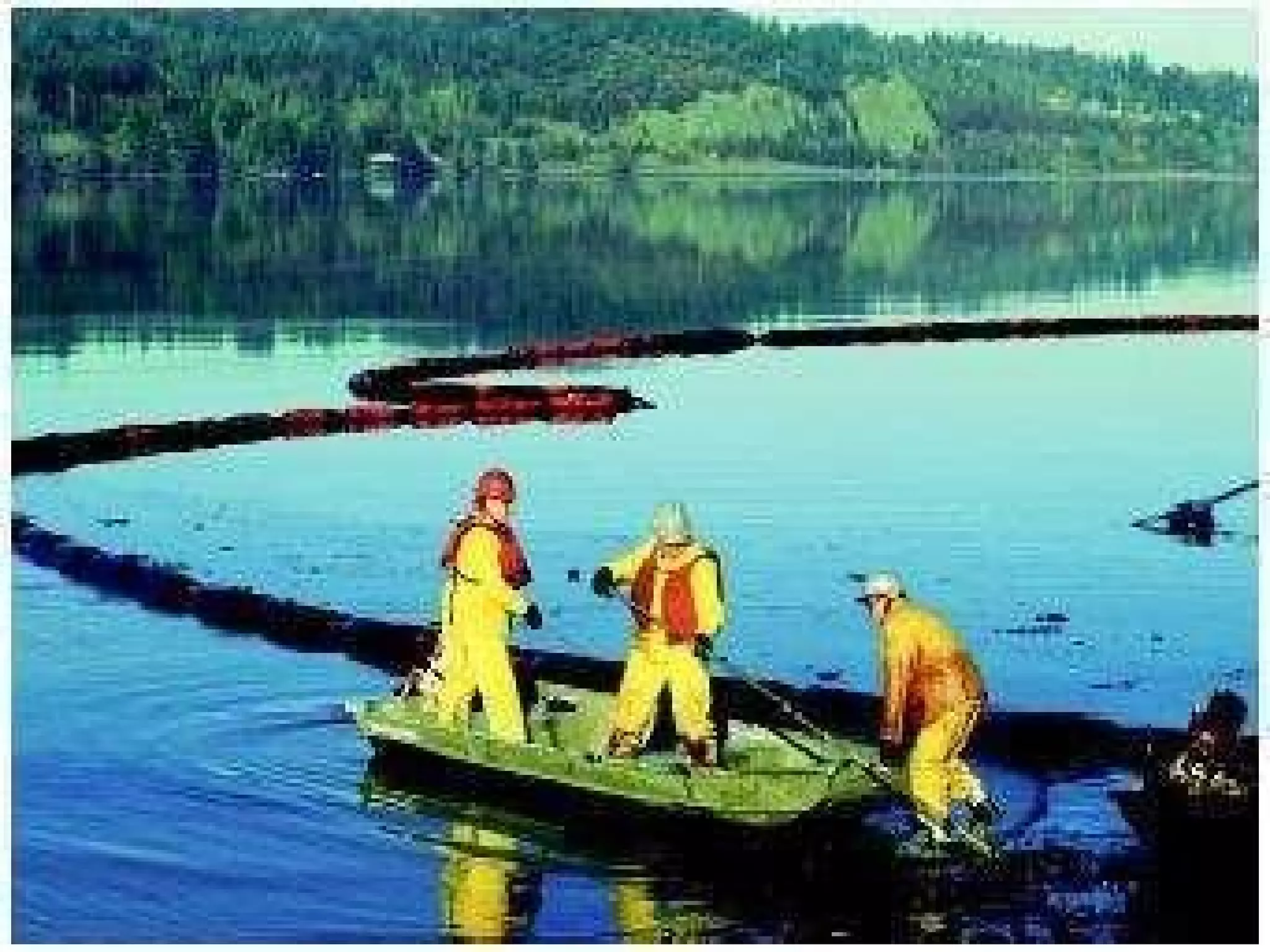
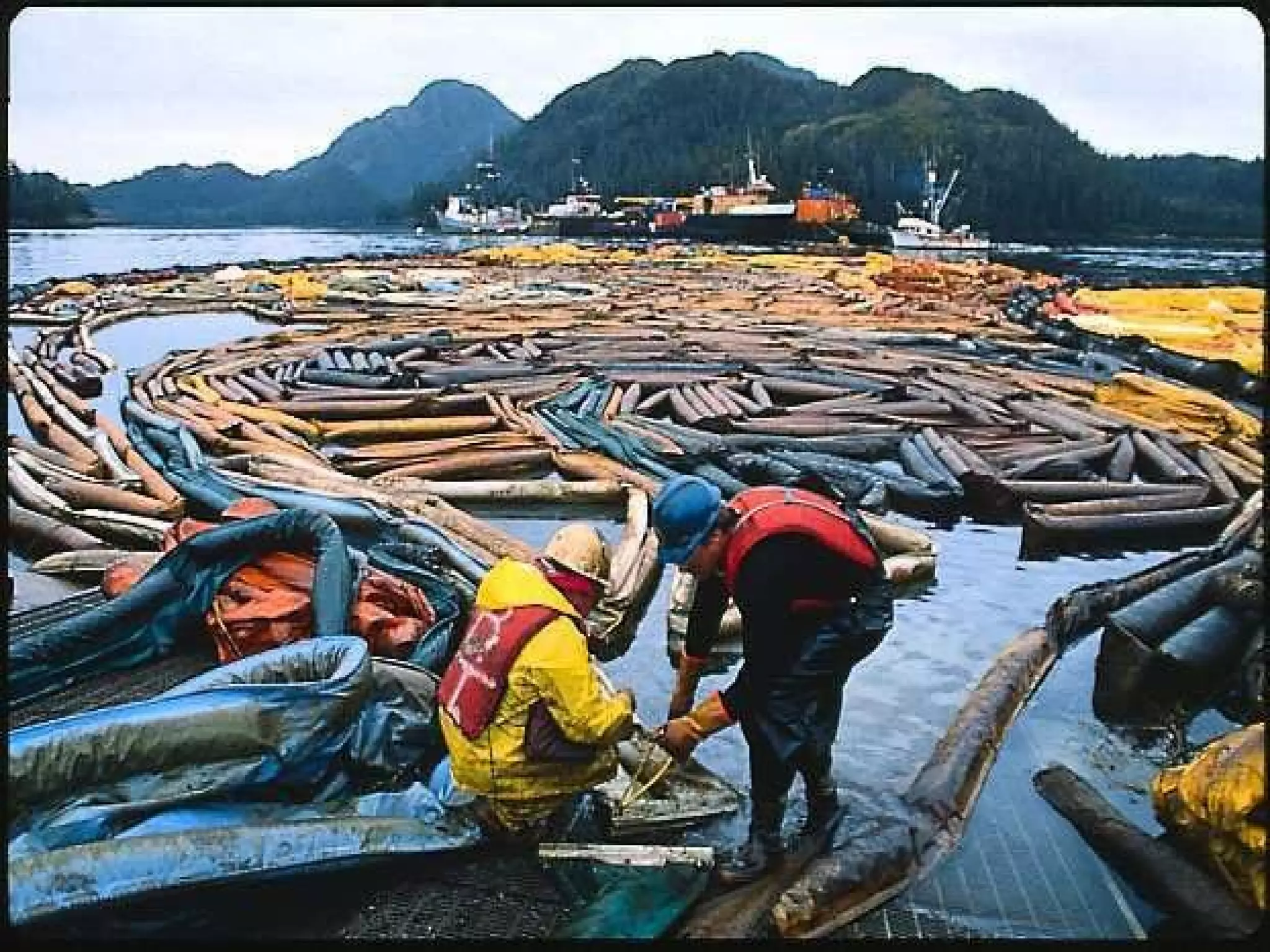
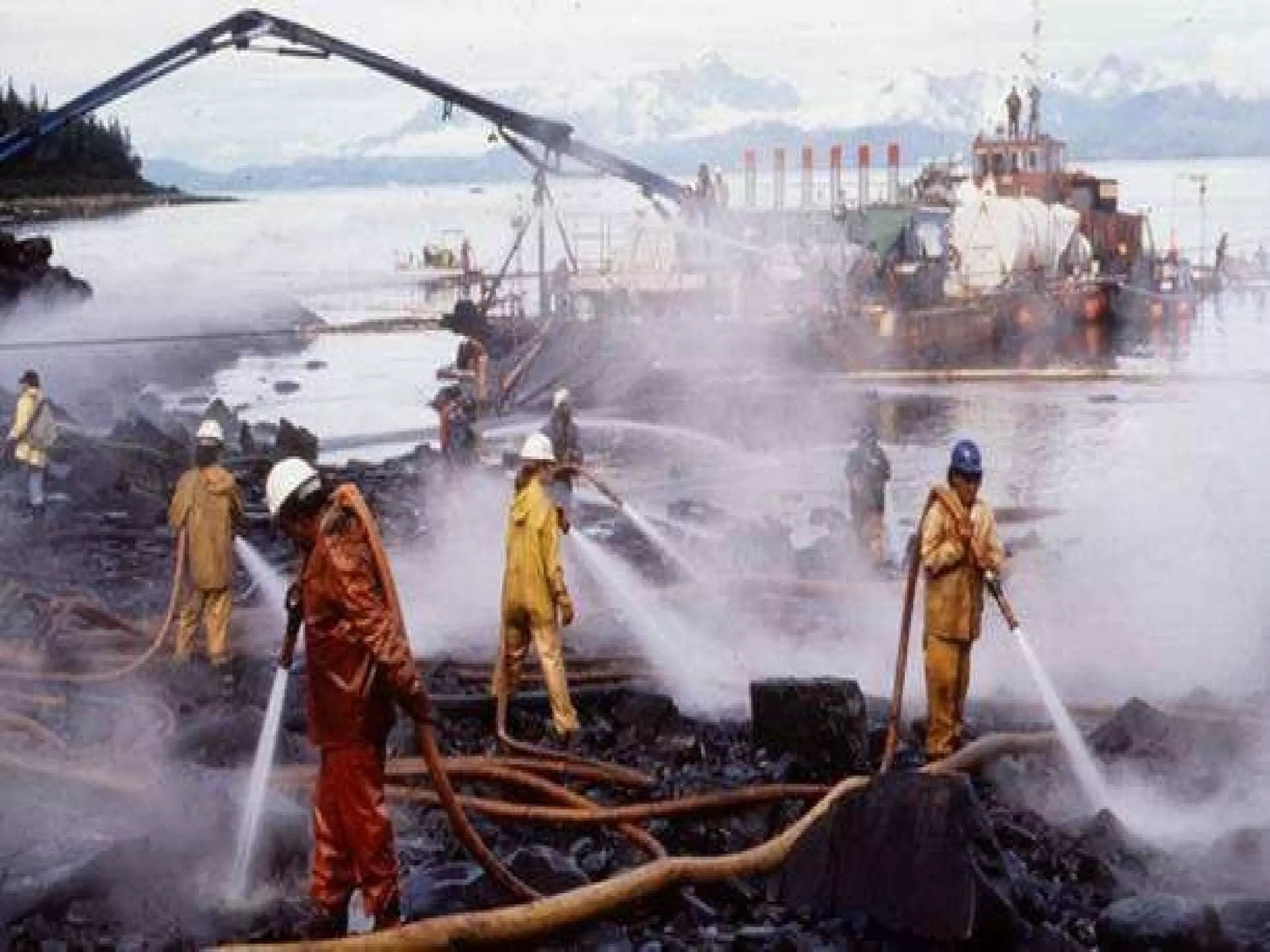
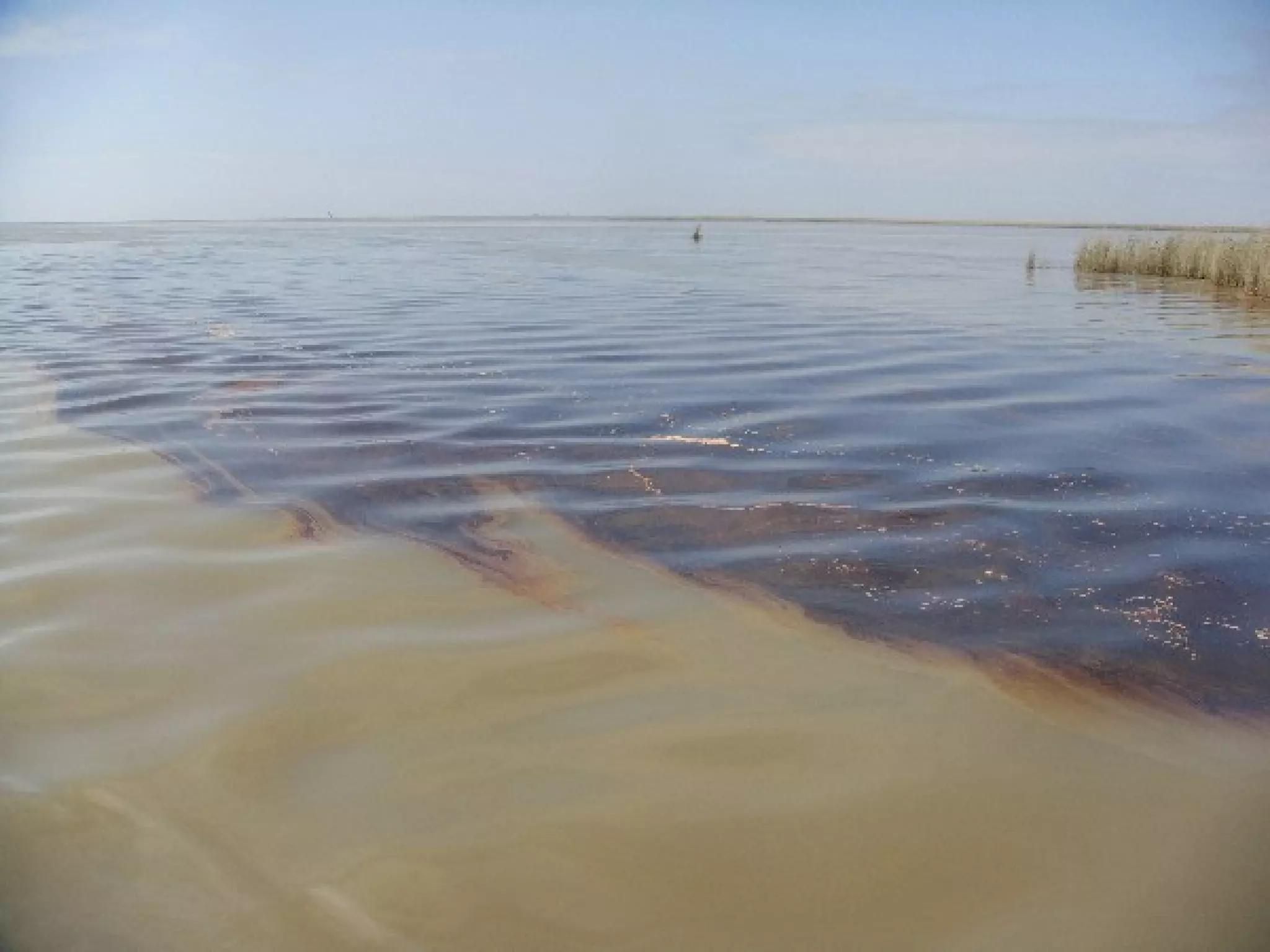
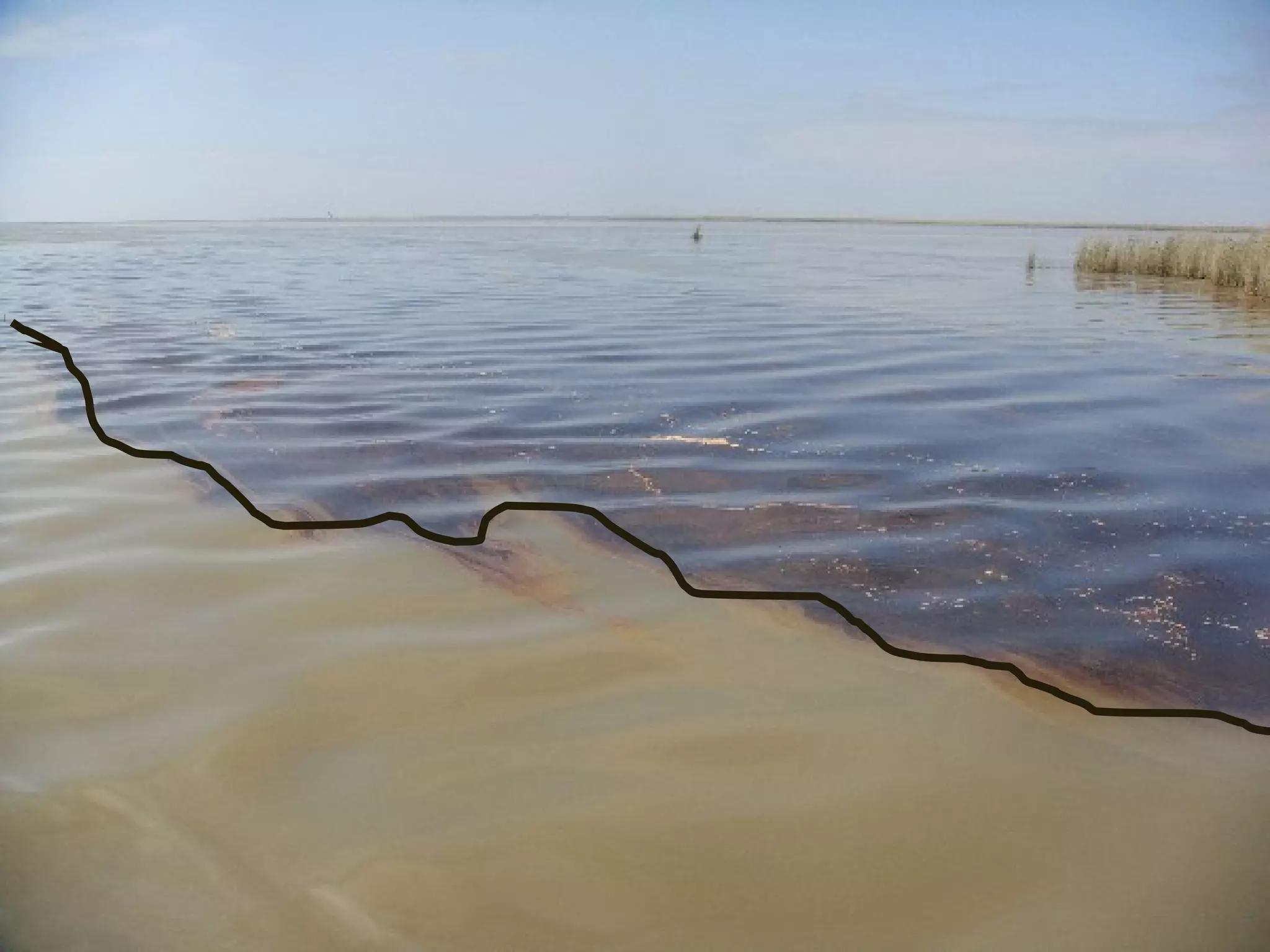
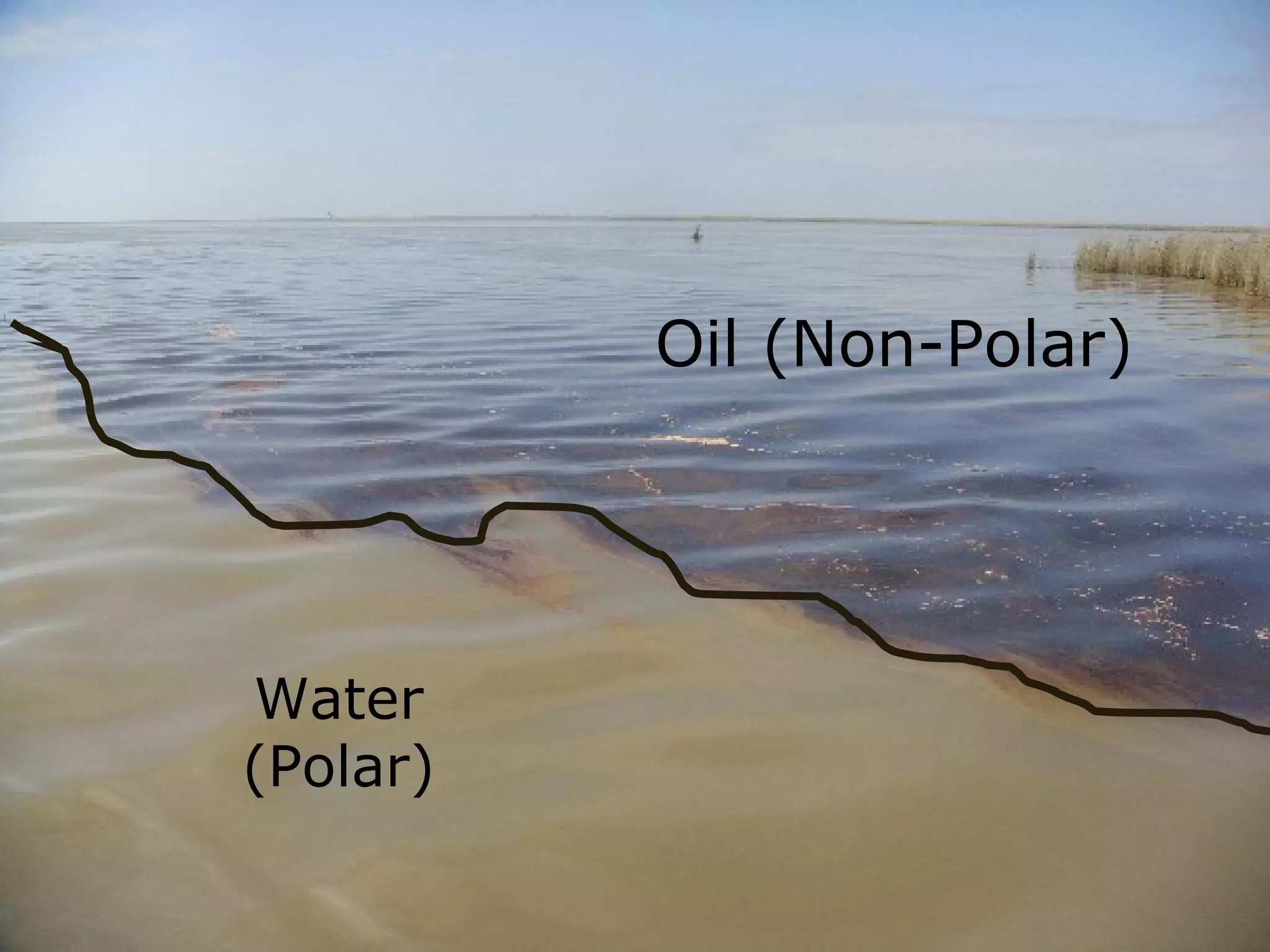
• Oil and water don’t mix.
Copyright © 2010 Ryan P. Murphy
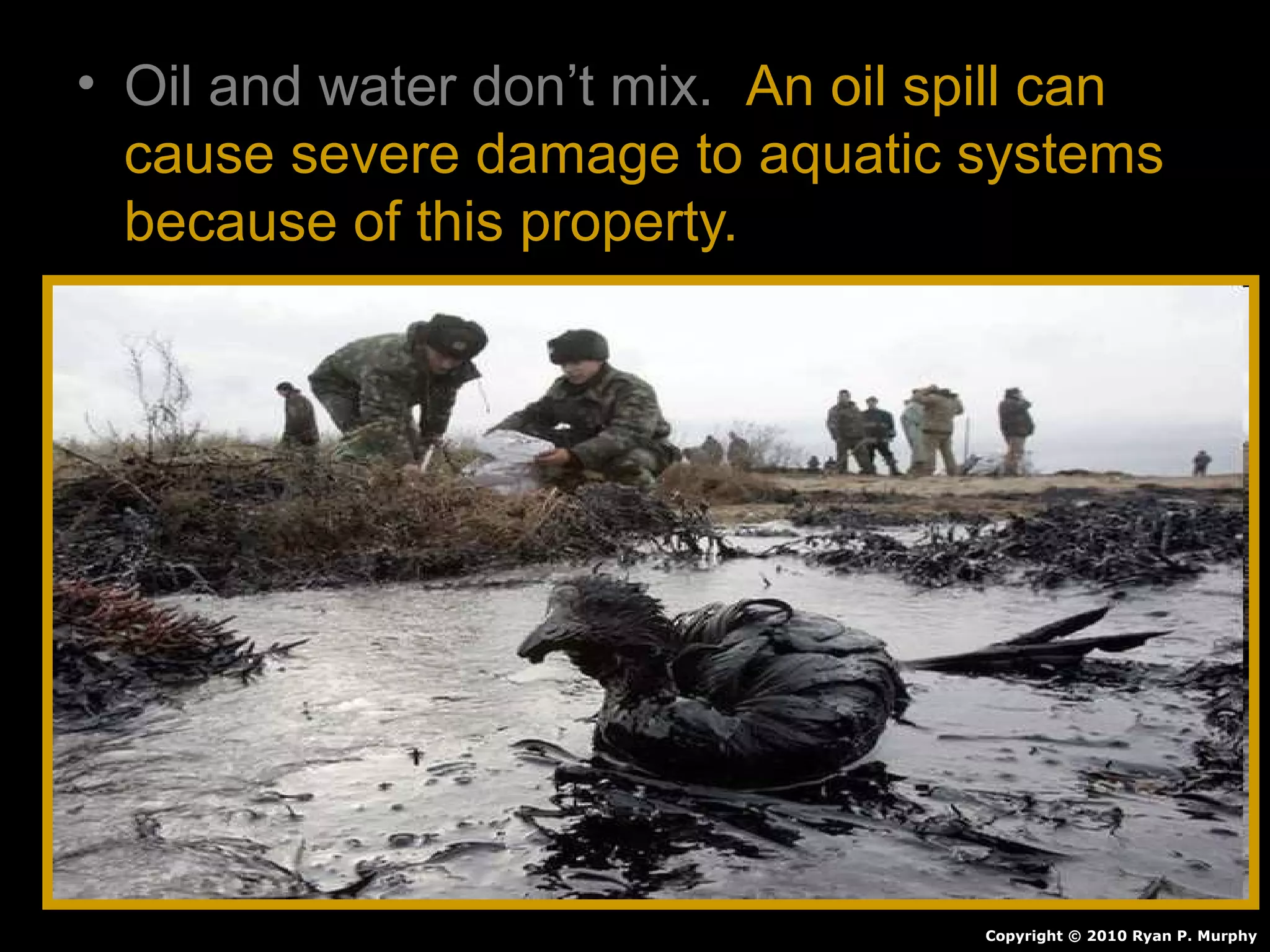
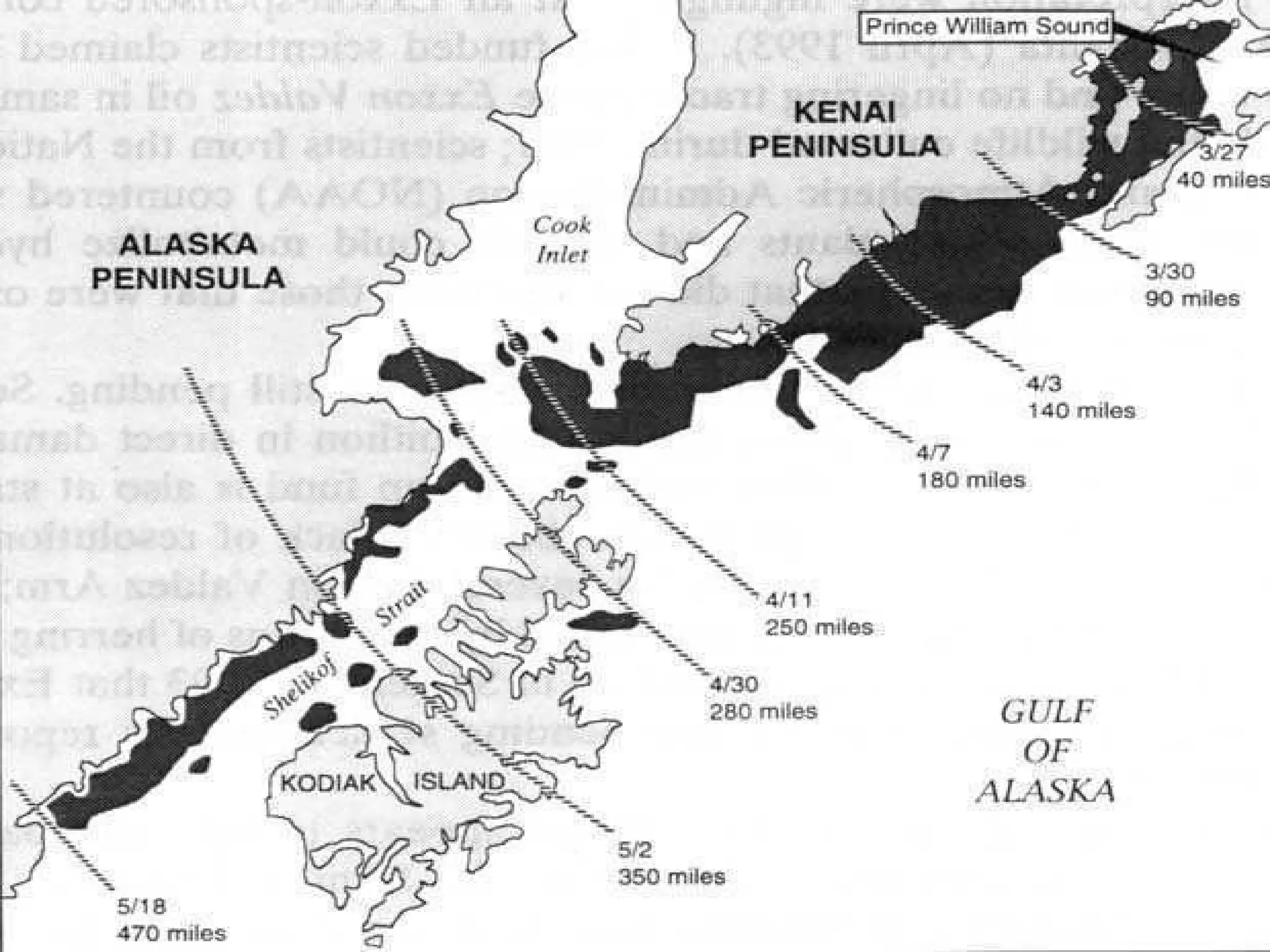
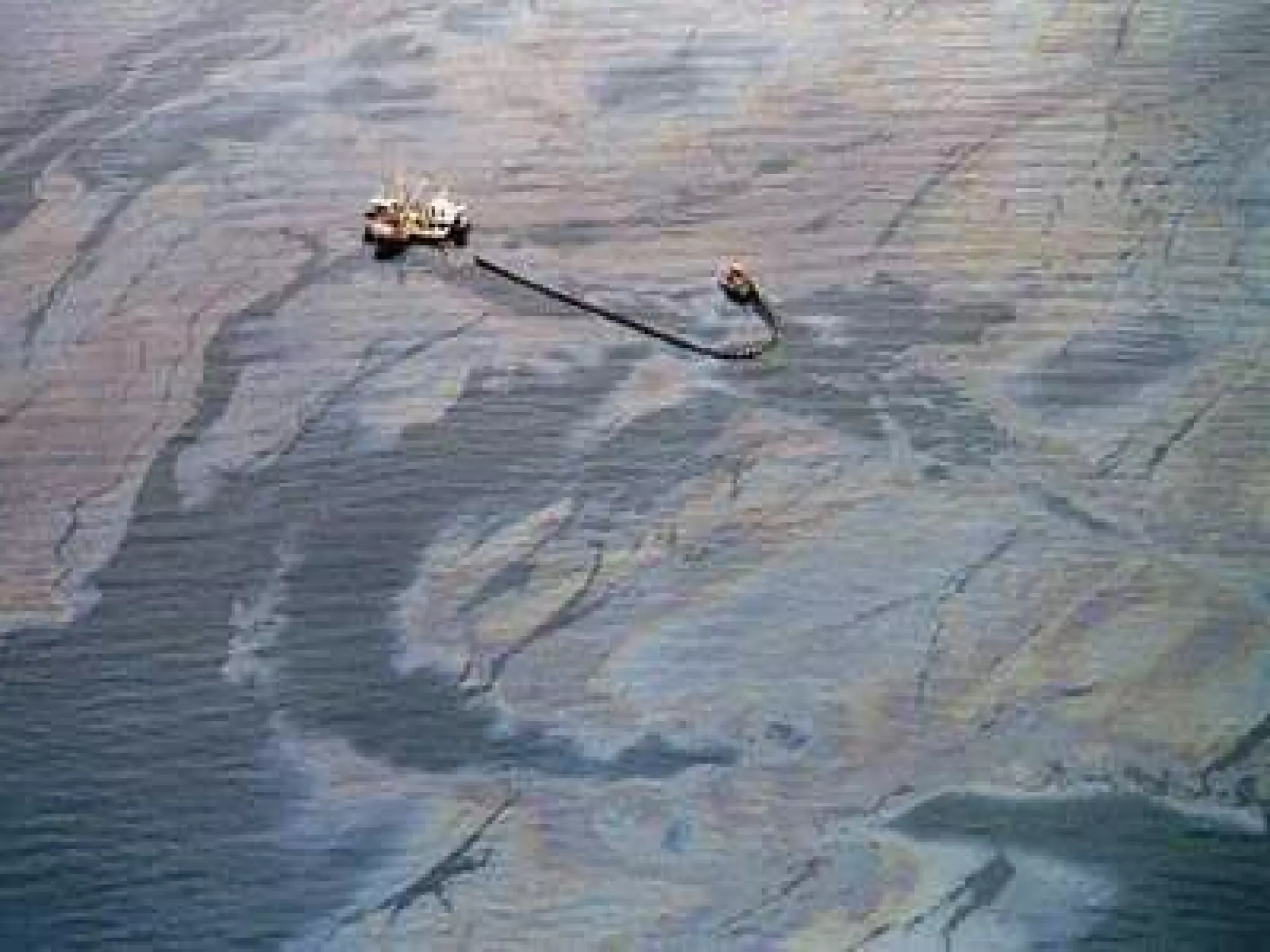
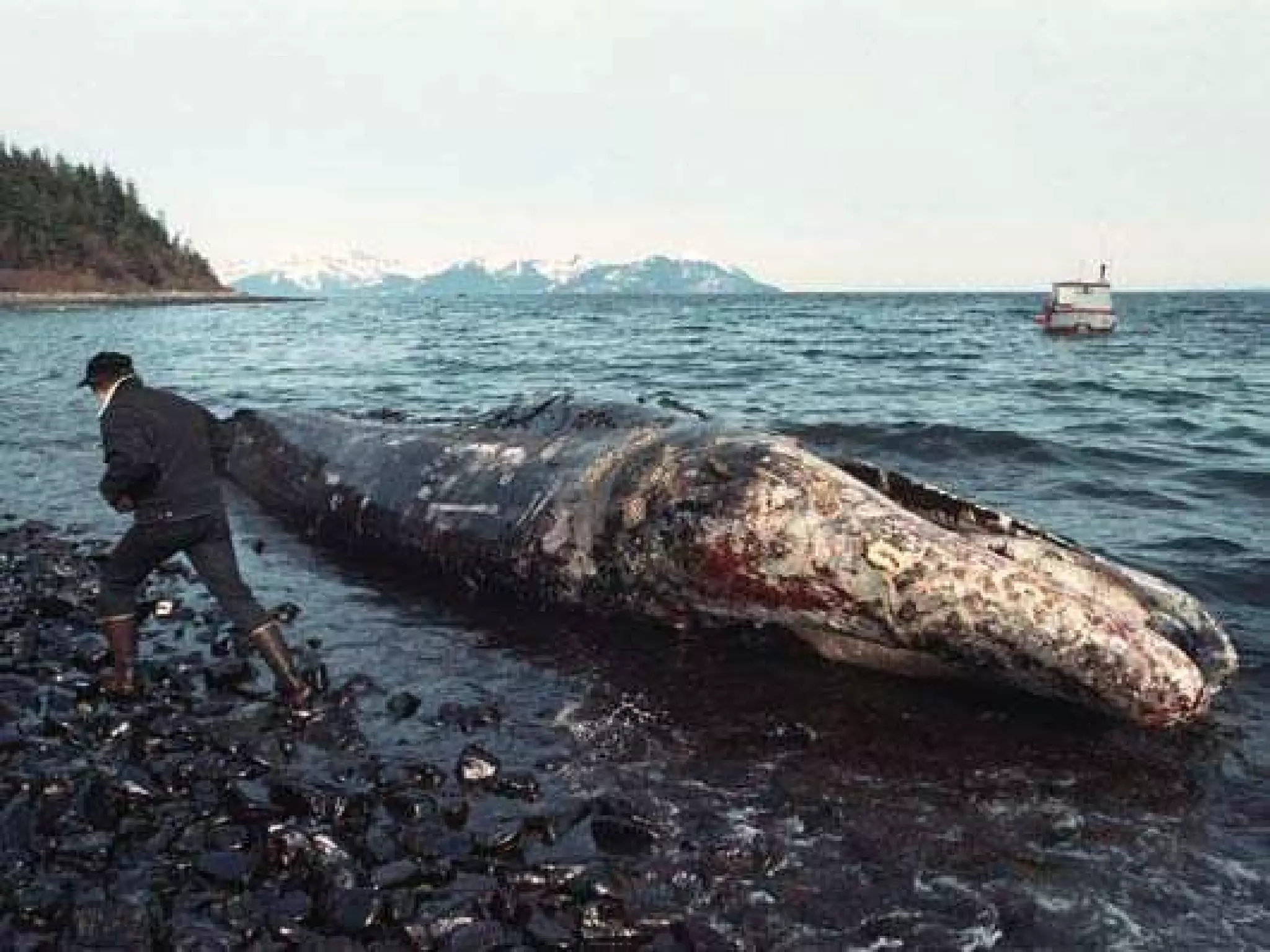
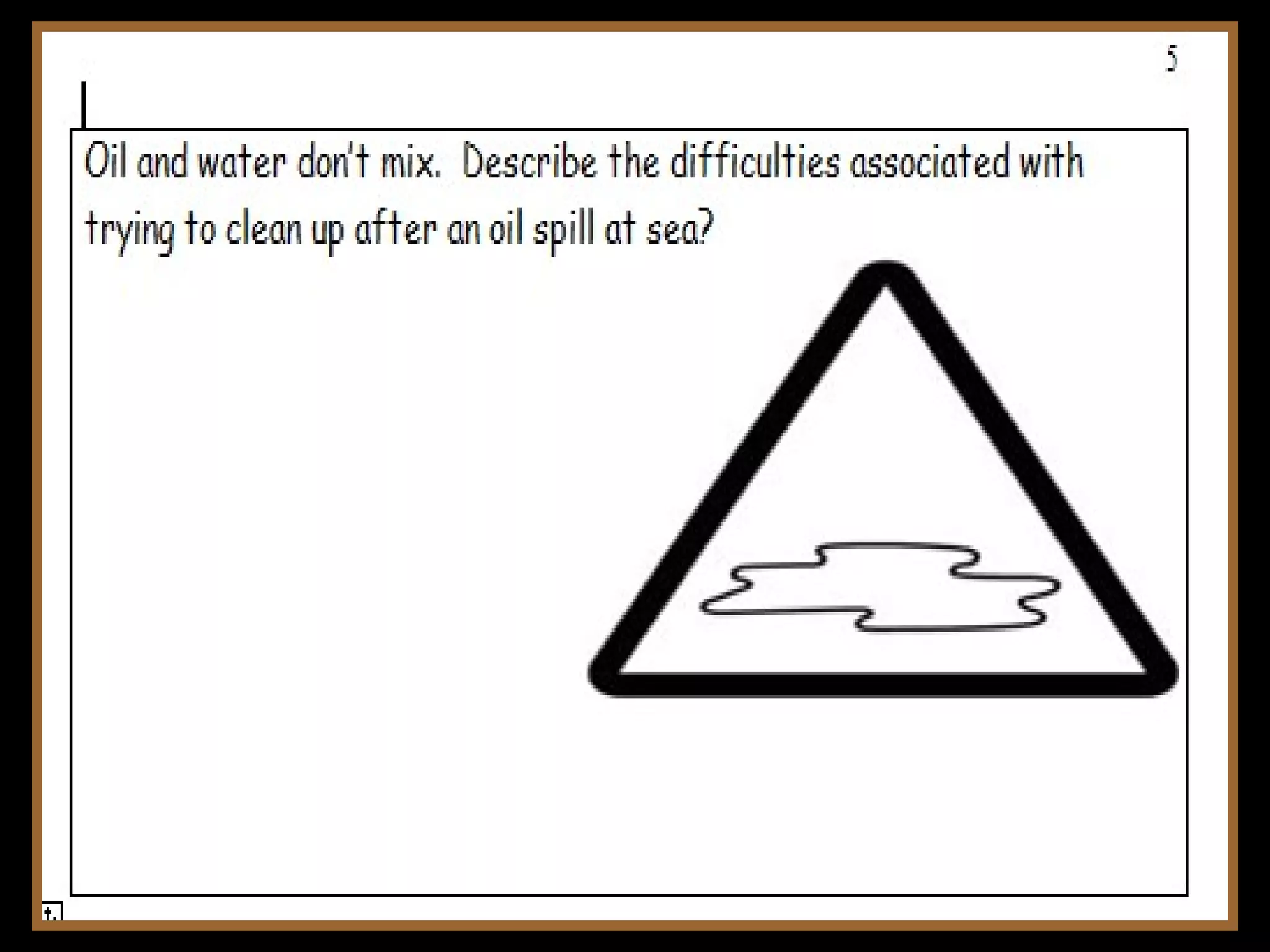
• Oil and water don’t mix. An oil spill can
cause severe damage to aquatic systems
because of this property.
Copyright © 2010 Ryan P. Murphy
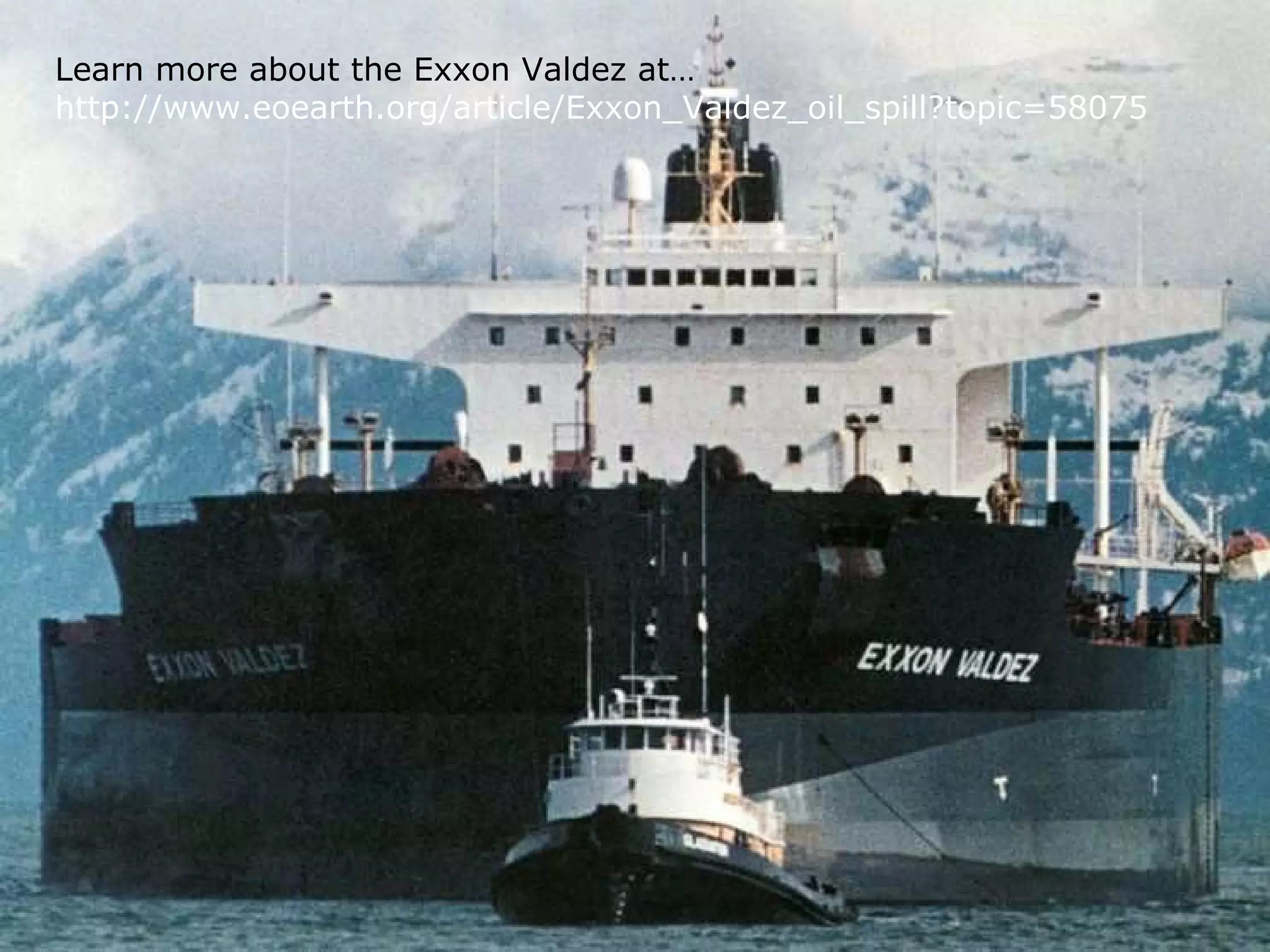
Learn more about the Exxon Valdez at…
http://www.eoearth.org/article/Exxon_Valdez_oil_spill?topic=58075
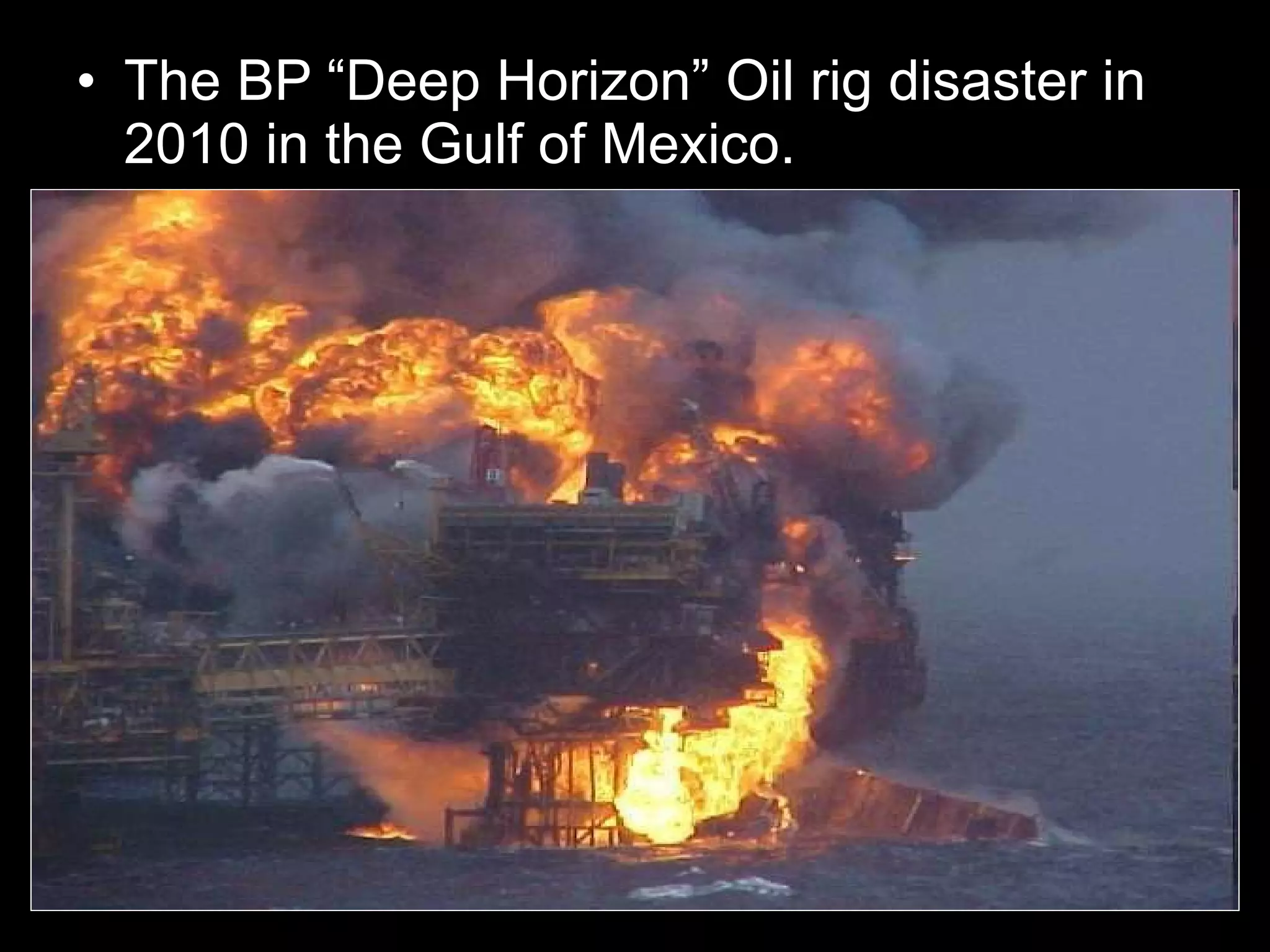
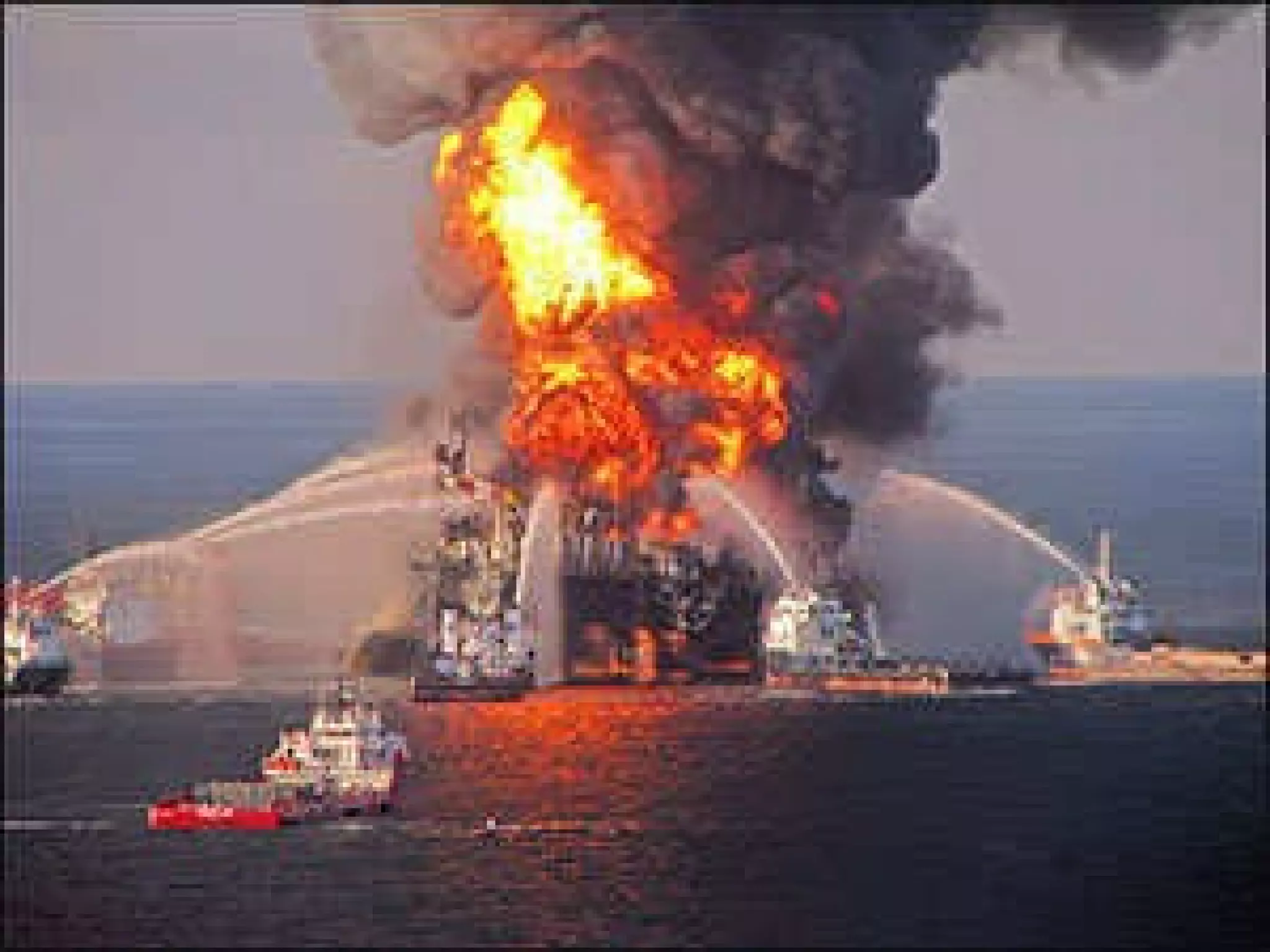
• The BP “Deep Horizon” Oil rig disaster in
2010 in the Gulf of Mexico.
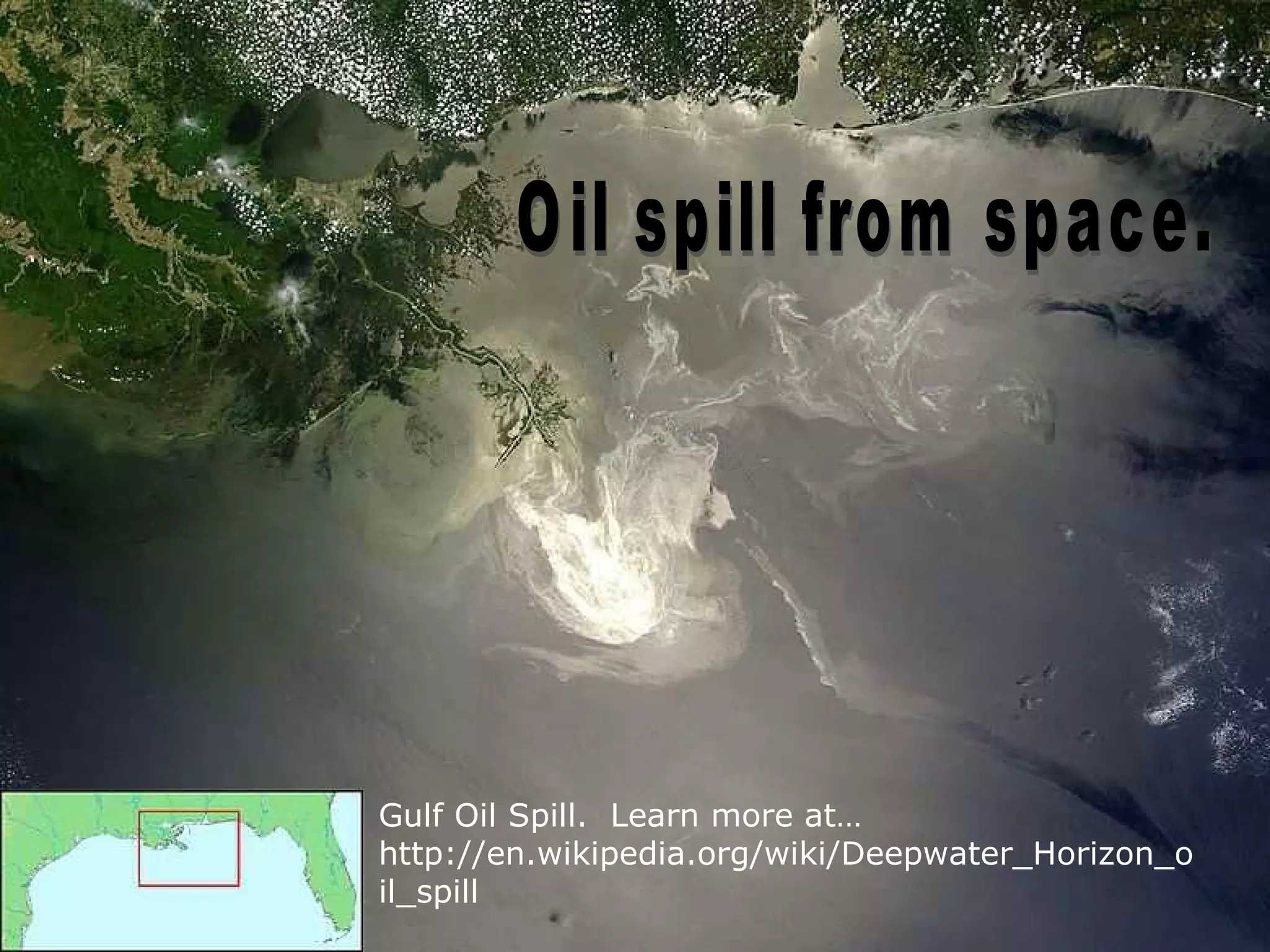
Gulf Oil Spill. Learn more at…
http://en.wikipedia.org/wiki/Deepwater_Horizon_o
il_spill
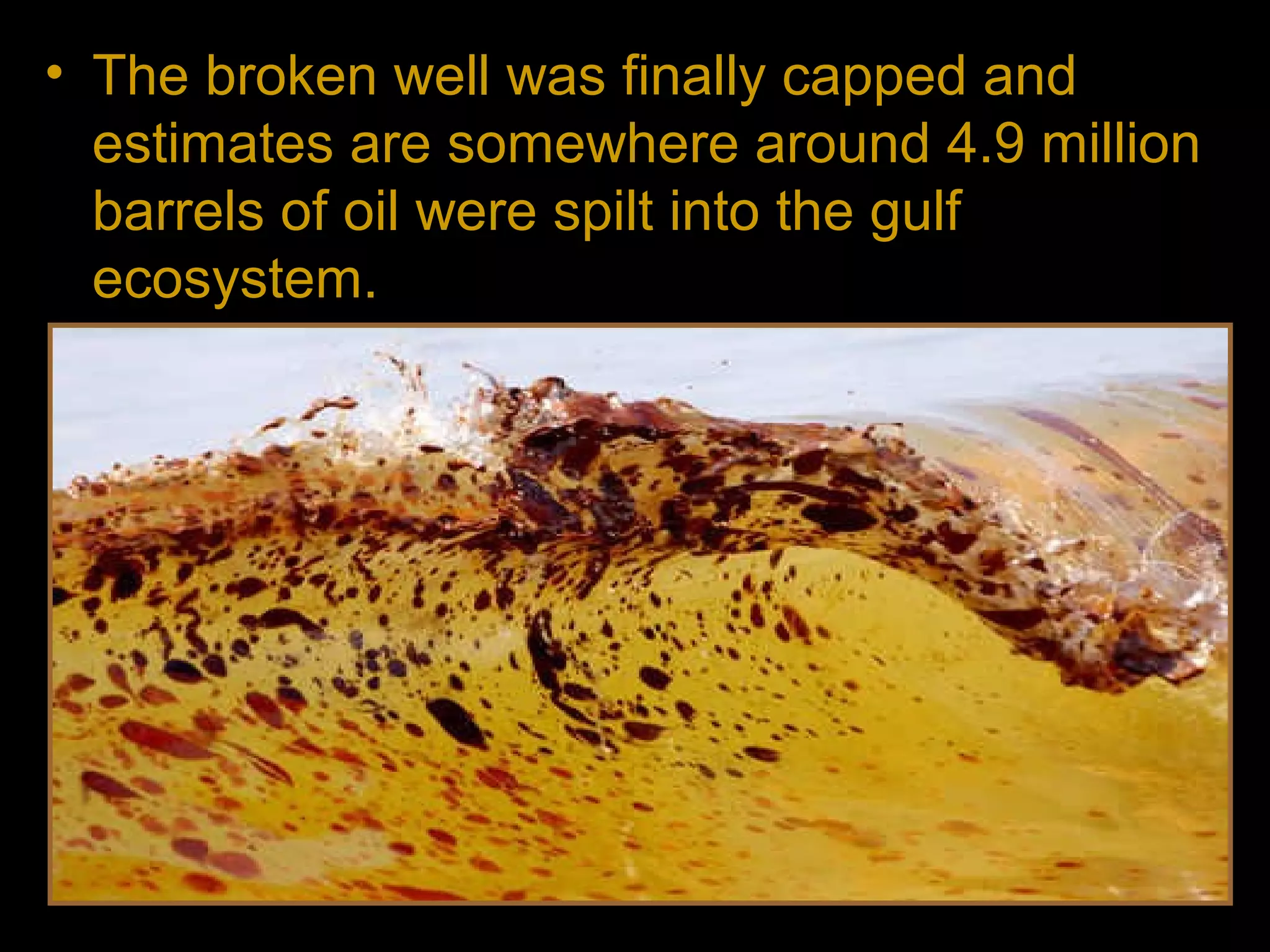
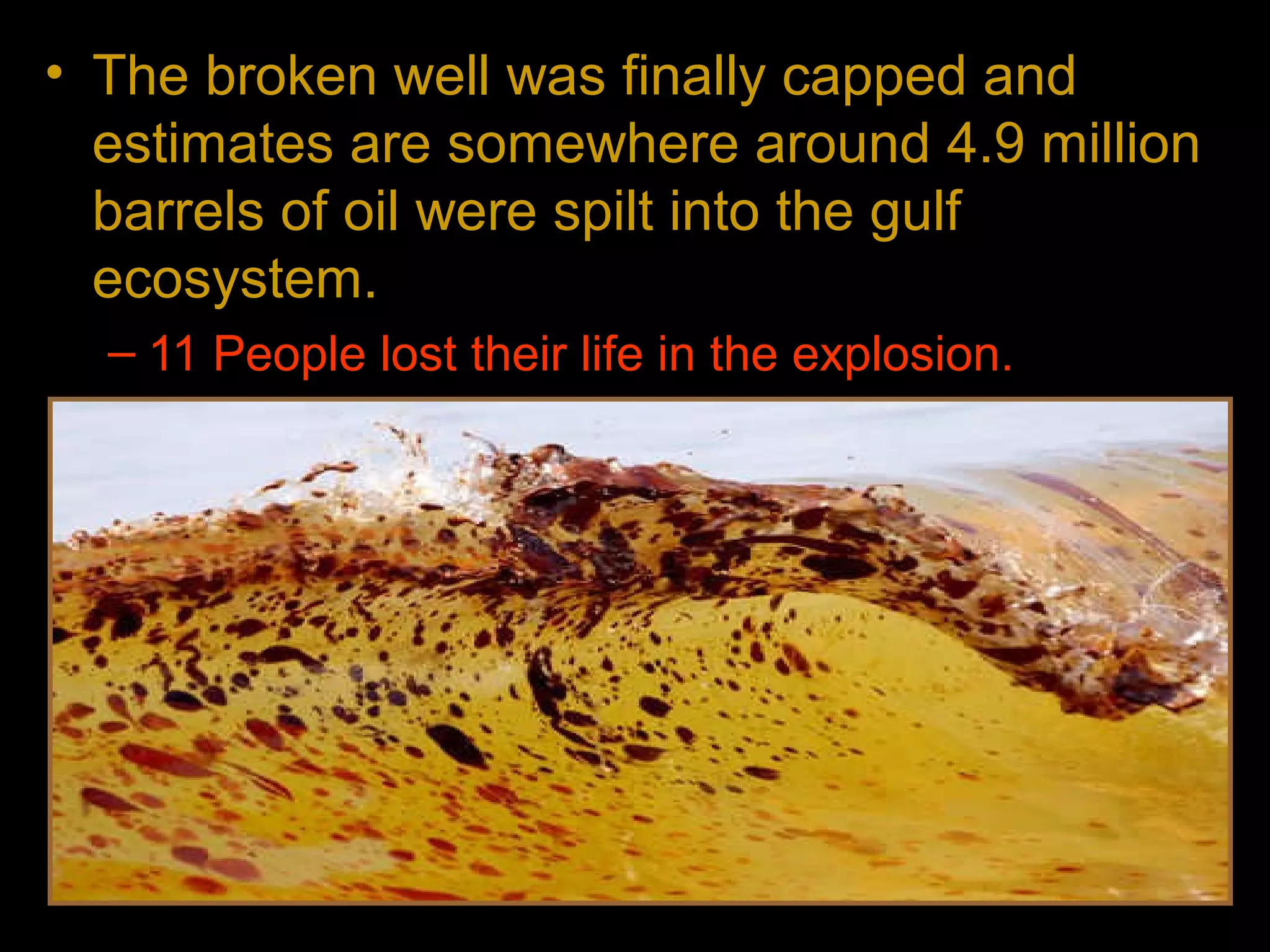
• The broken well was finally capped and
estimates are somewhere around 4.9 million
barrels of oil were spilt into the gulf
ecosystem.
– 11 People lost their life in the explosion.
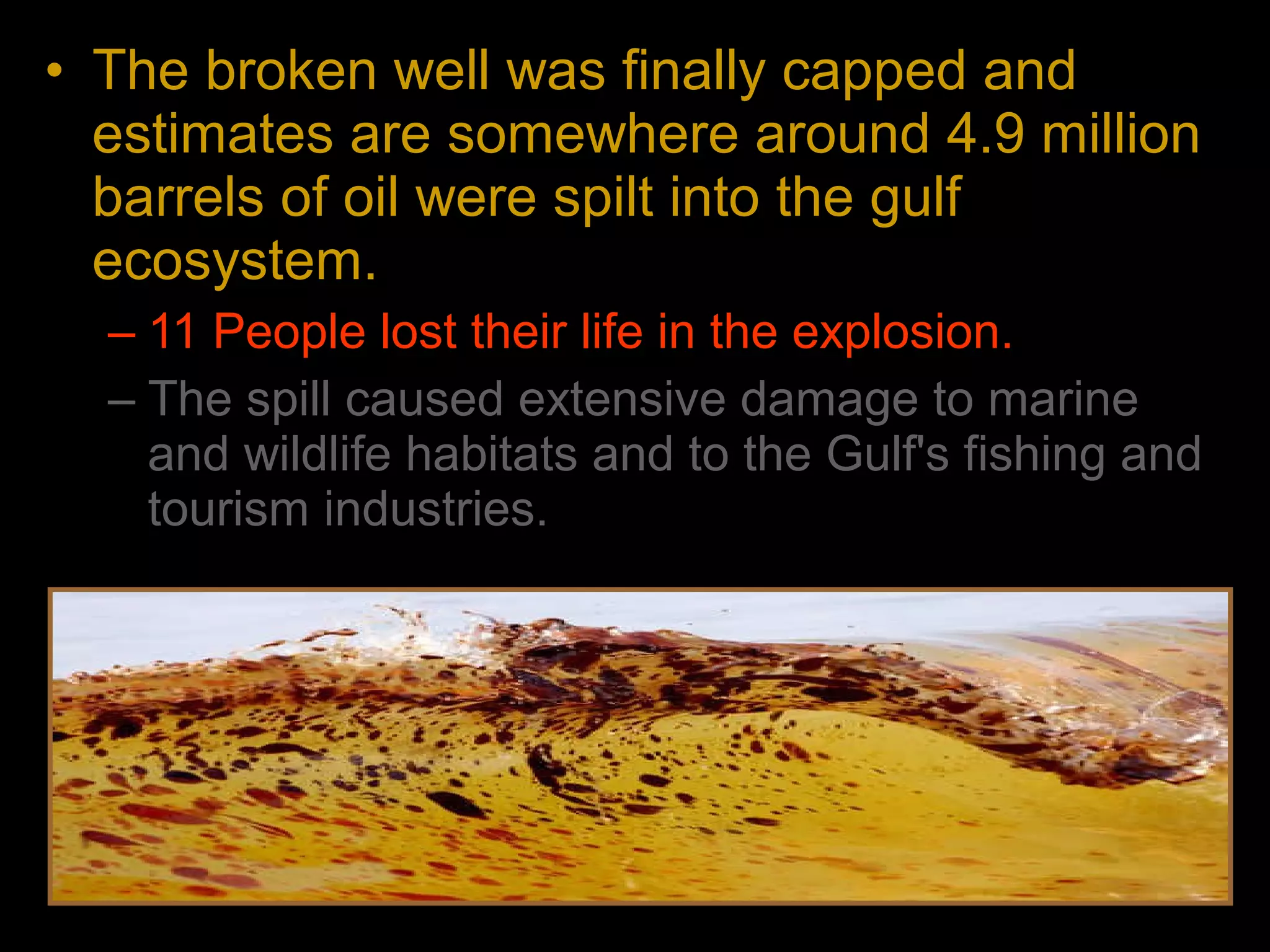
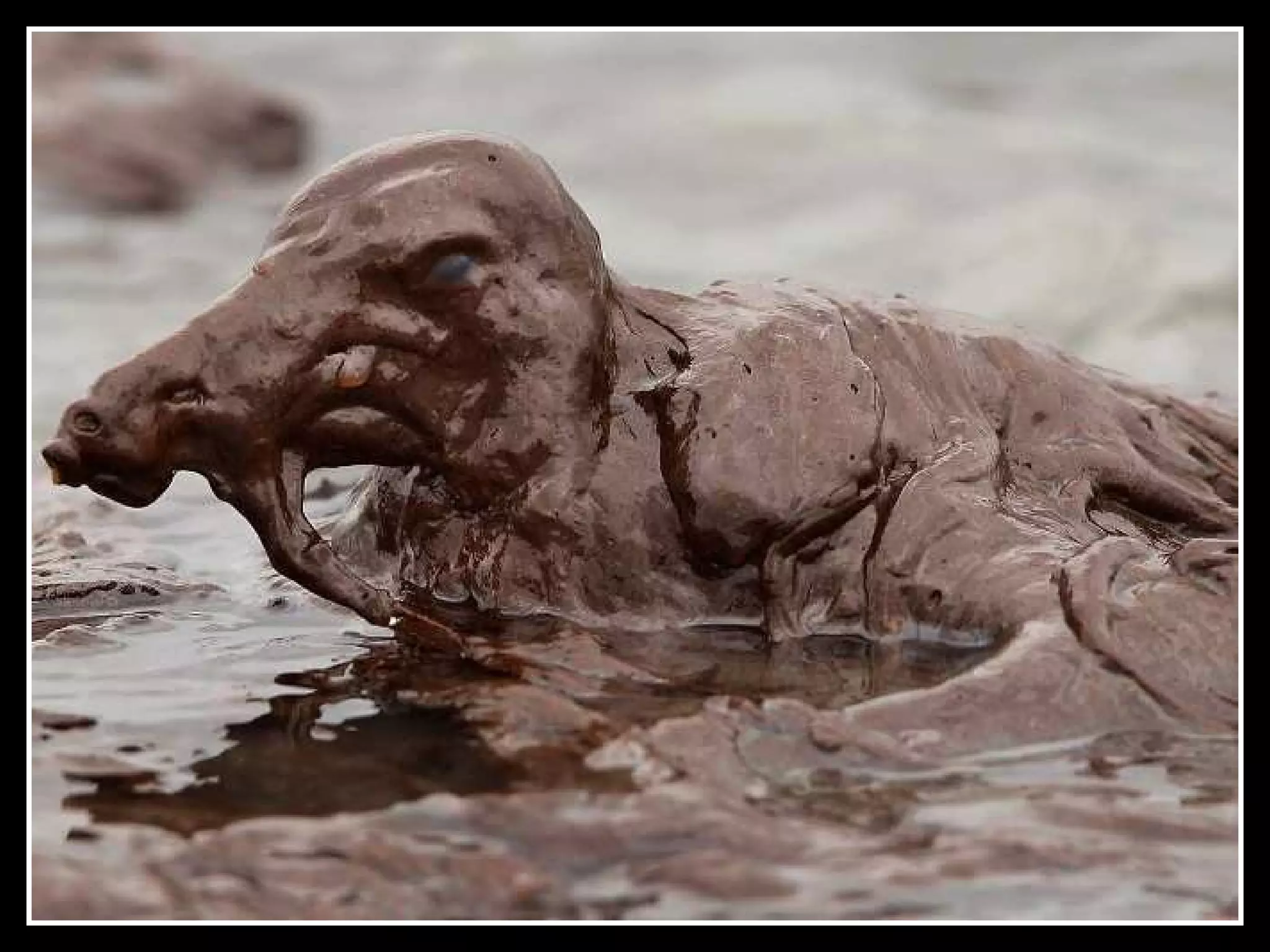
– The spill caused extensive damage to marine
and wildlife habitats and to the Gulf's fishing and
tourism industries.
• The broken well was finally capped and
estimates are somewhere around 4.9 million
barrels of oil were spilt into the gulf
ecosystem.
– 11 People lost their life in the explosion.
– The spill caused extensive damage to marine
and wildlife habitats and to the Gulf's fishing and
tourism industries.
• The broken well was finally capped and
estimates are somewhere around 4.9 million
barrels of oil were spilt into the gulf
ecosystem.
– 11 People lost their life in the explosion.
– The spill caused extensive damage to marine
and wildlife habitats and to the Gulf's fishing and
tourism industries.
Oil (Non-Polar)
Water
(Polar)
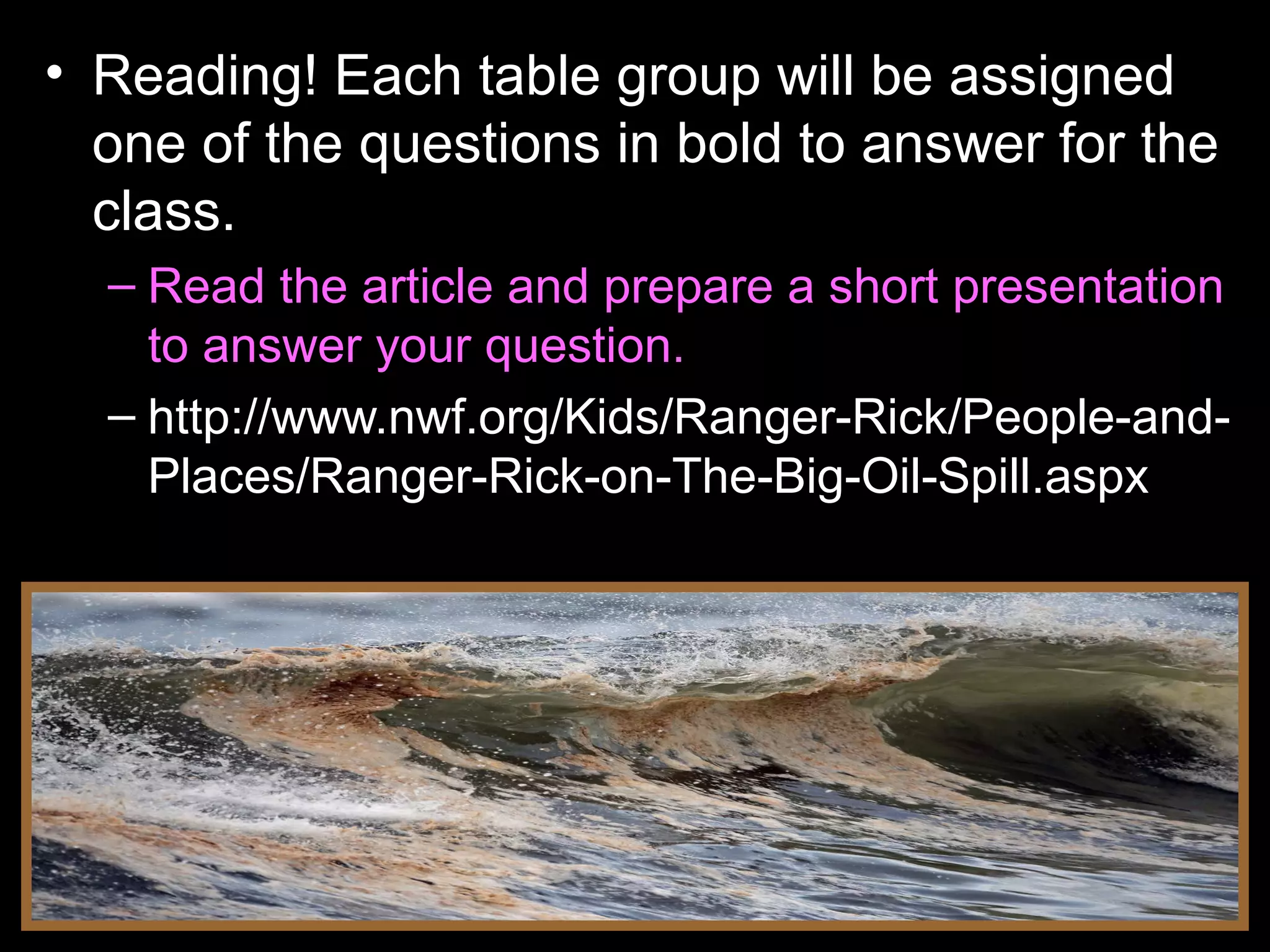
• Reading! Each table group will be assigned
one of the questions in bold to answer for the
class.
– Read the article and prepare a short presentation
to answer your question.
– http://www.nwf.org/Kids/Ranger-Rick/People-and-
Places/Ranger-Rick-on-The-Big-Oil-Spill.aspx
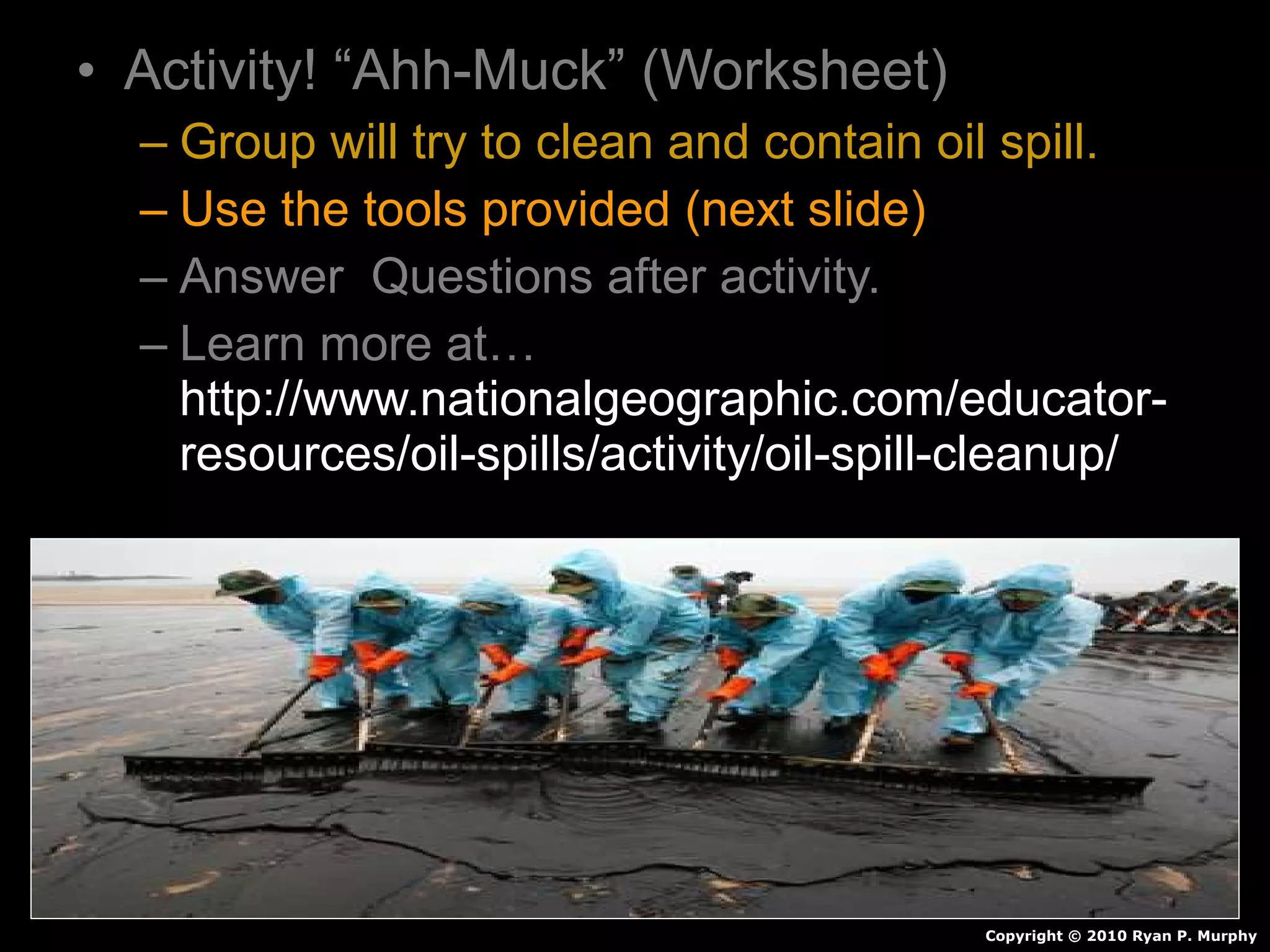
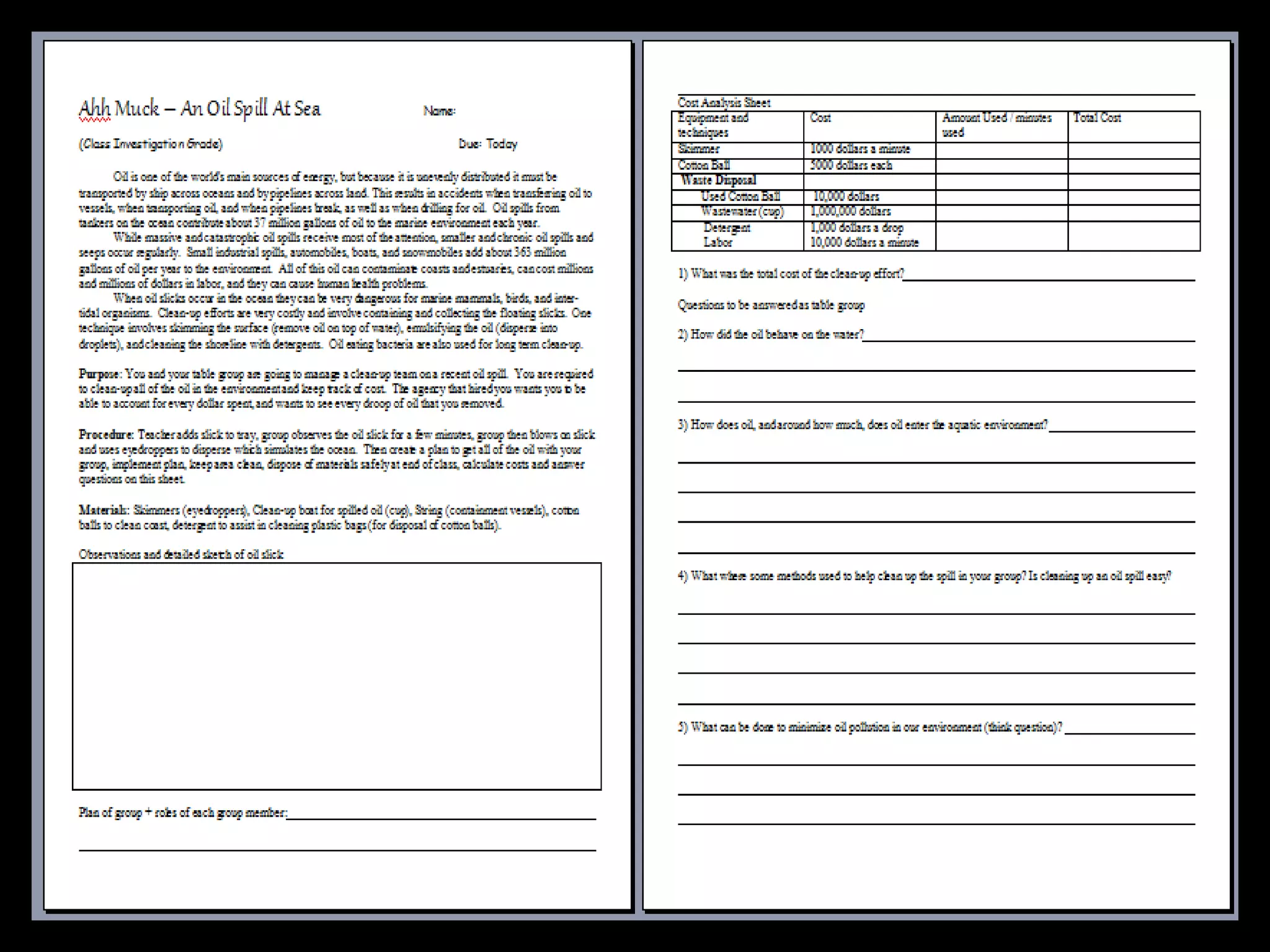
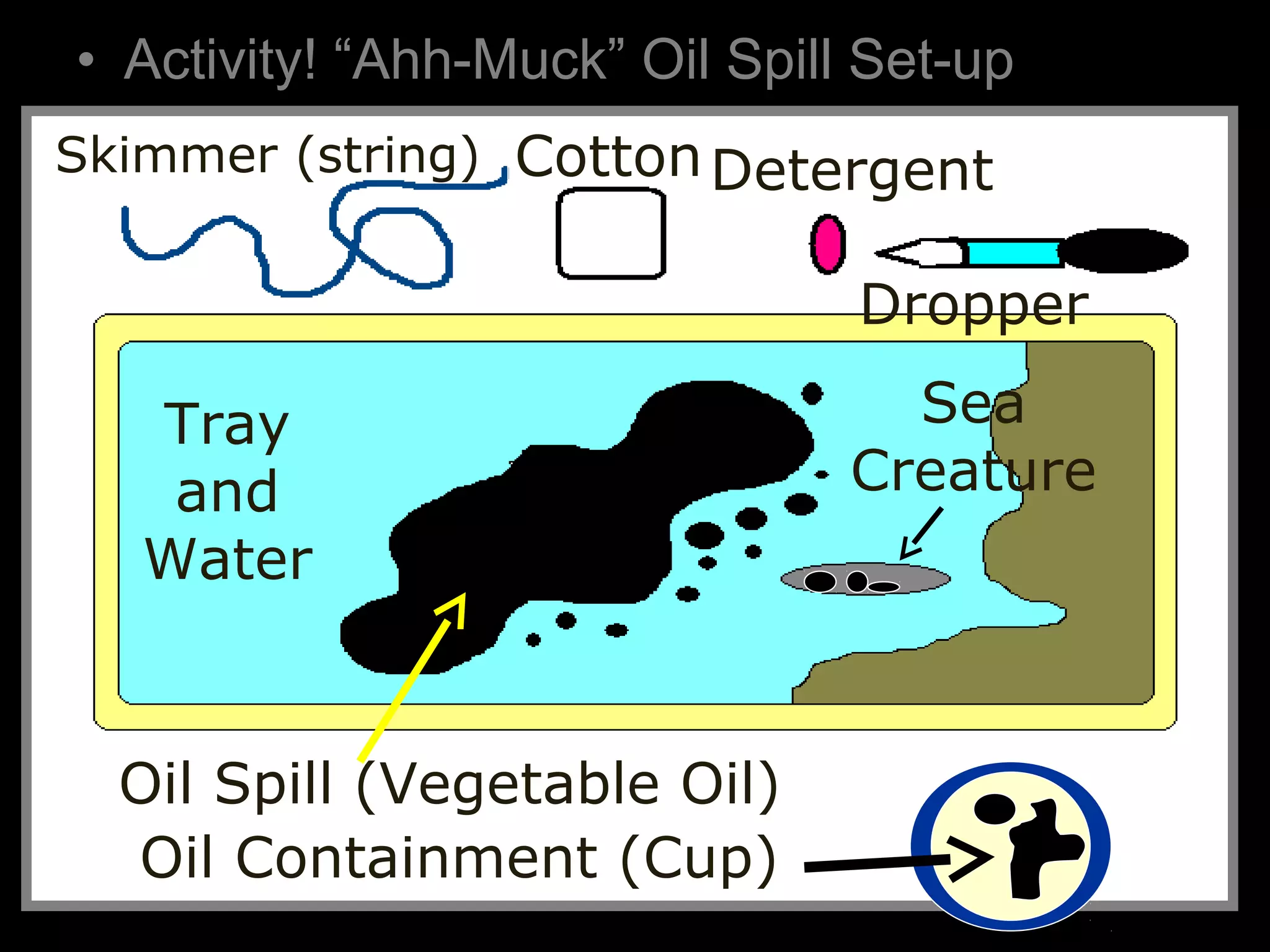
• Activity! “Ahh-Muck” (Worksheet)
– Group will try to clean and contain oil spill.
– Use the tools provided (next slide)
– Answer Questions after activity.
– Learn more at…
http://www.nationalgeographic.com/educator-
resources/oil-spills/activity/oil-spill-cleanup/
Copyright © 2010 Ryan P. Murphy
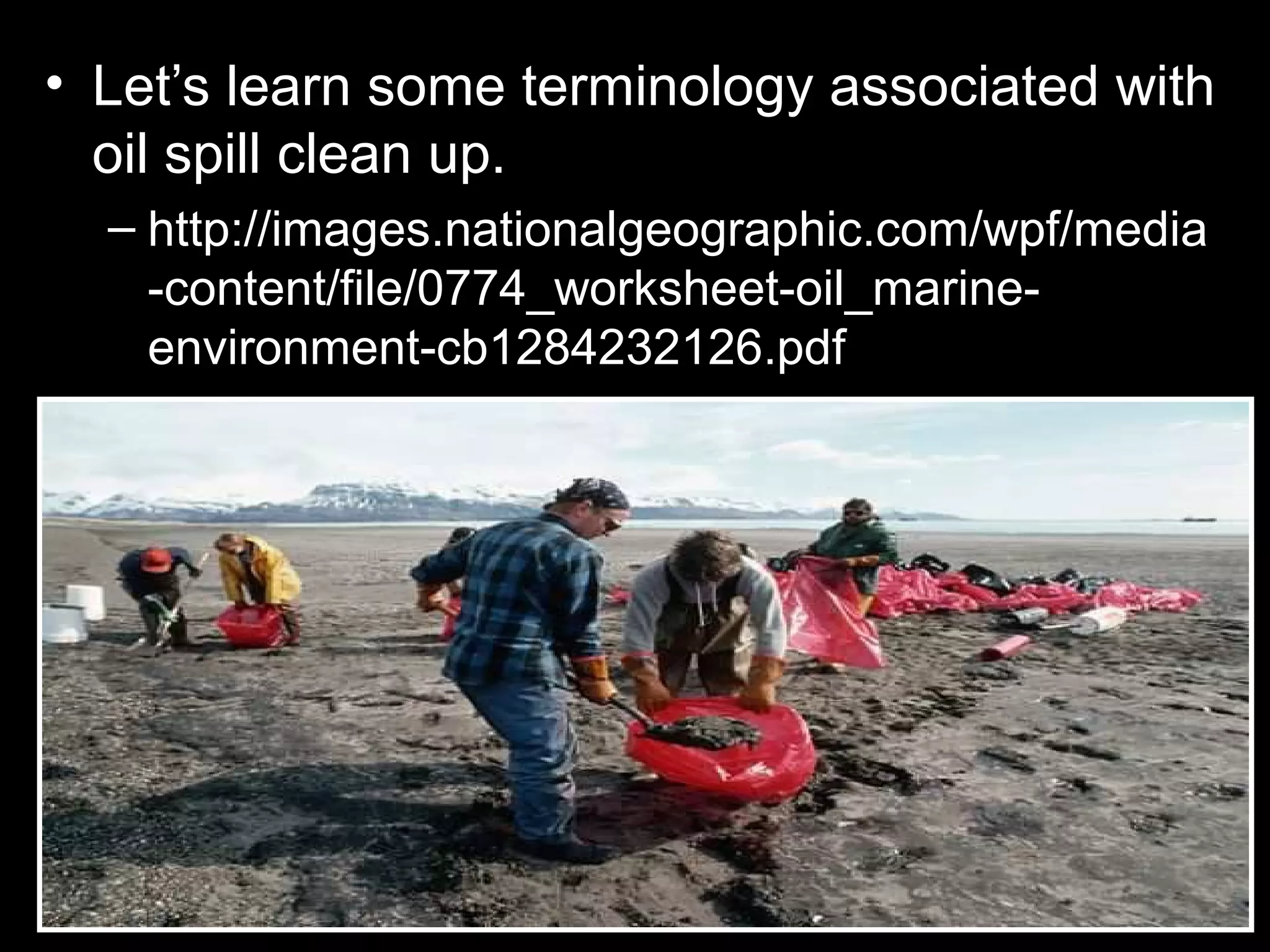
• Let’s learn some terminology associated with
oil spill clean up.
– http://images.nationalgeographic.com/wpf/media
-content/file/0774_worksheet-oil_marine-
environment-cb1284232126.pdf
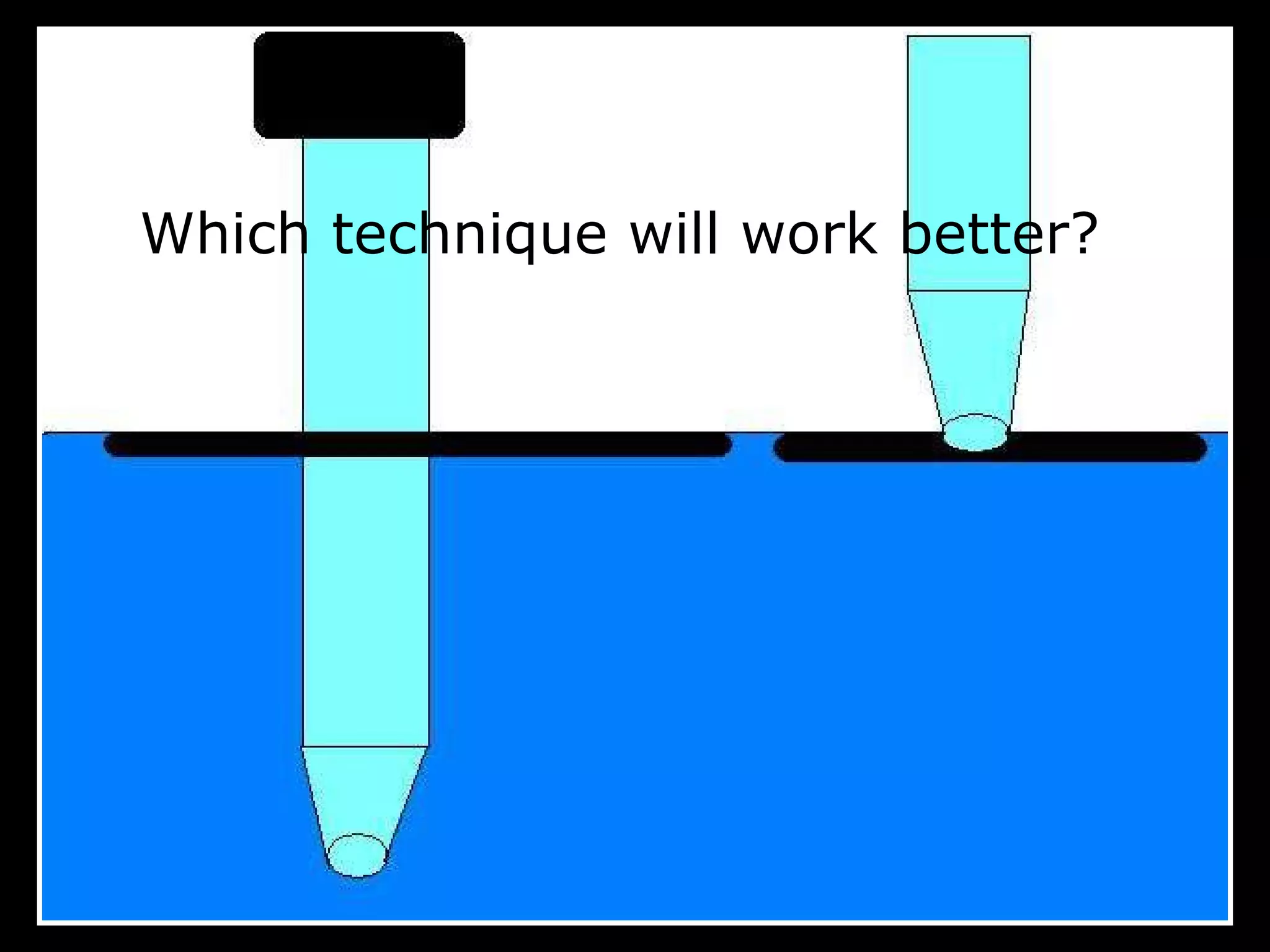
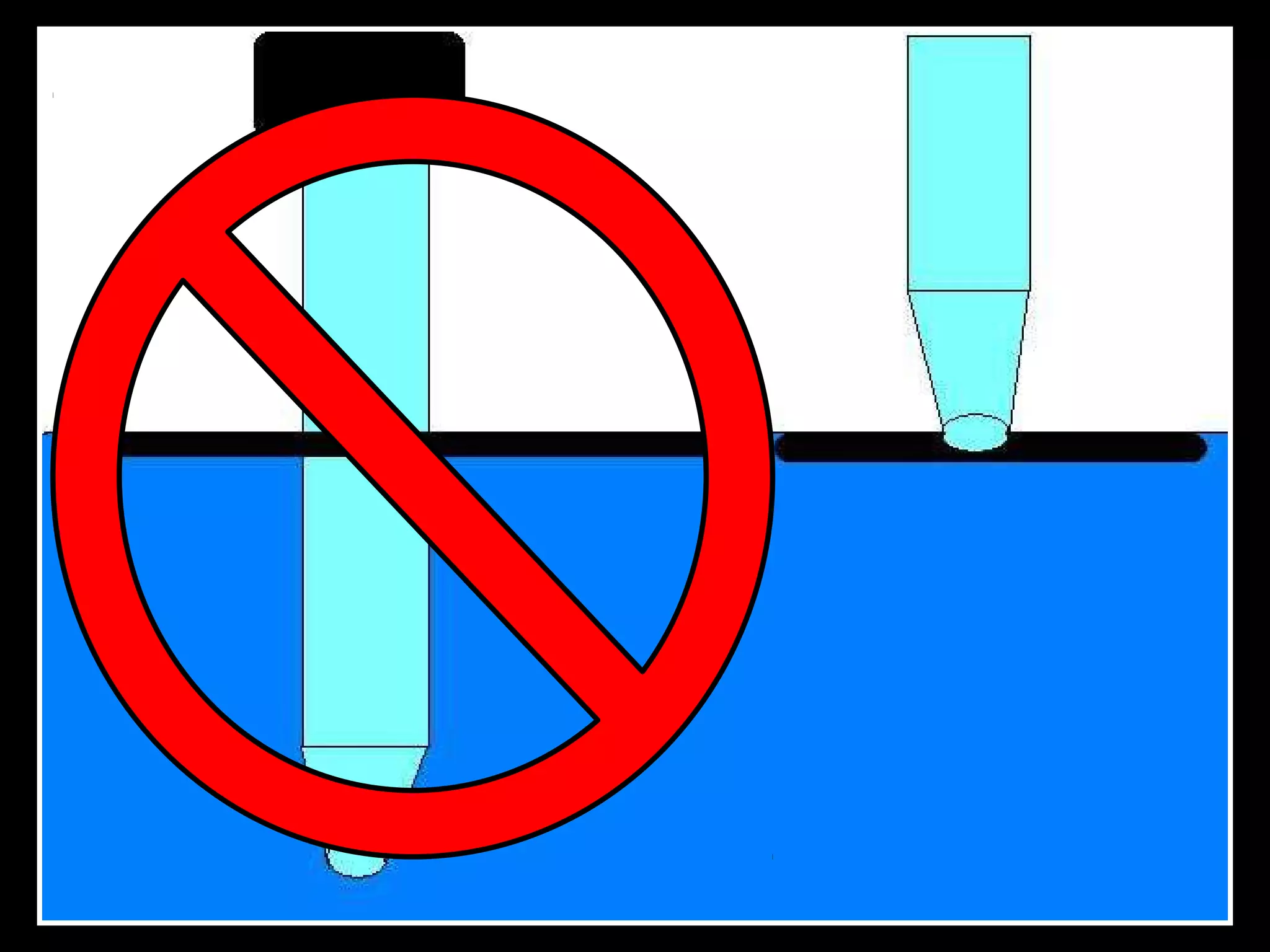
Which technique will work better?
• Activity! “Ahh-Muck” Oil Spill Set-up
Oil Spill (Vegetable Oil)
Oil Containment (Cup)
Skimmer (string) CottonDetergent
Dropper
Sea
Creature
Tray
and
Water
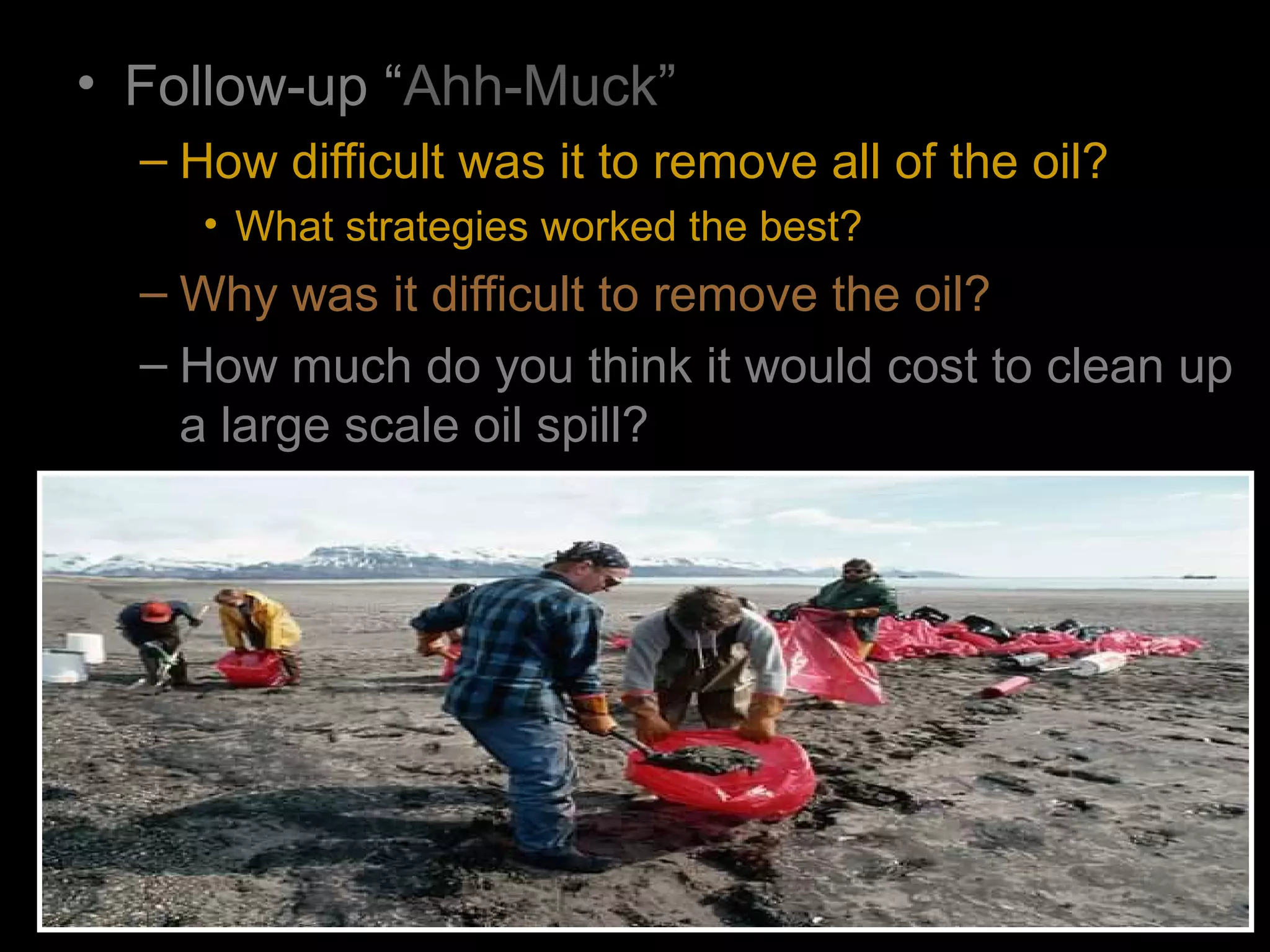
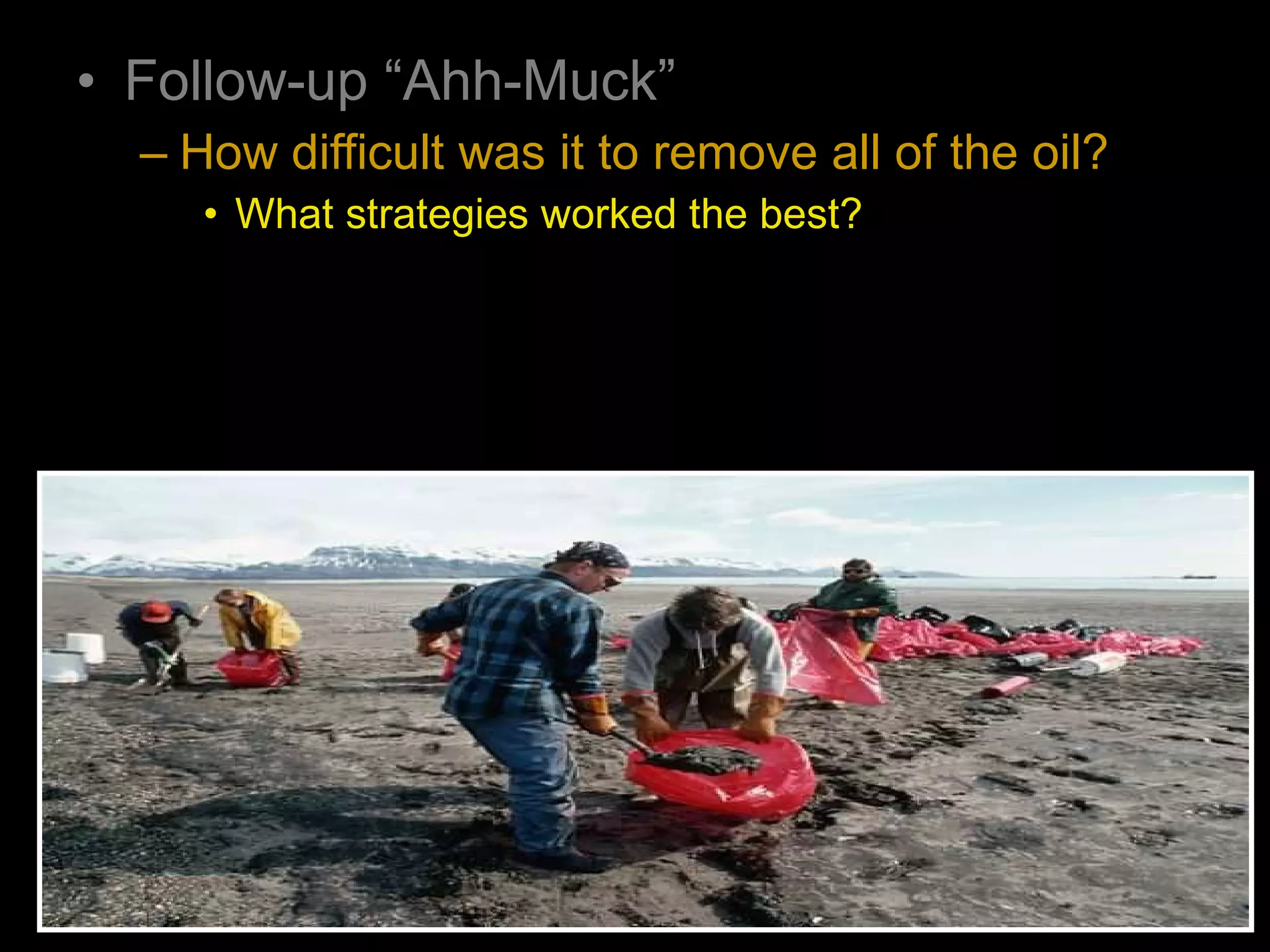
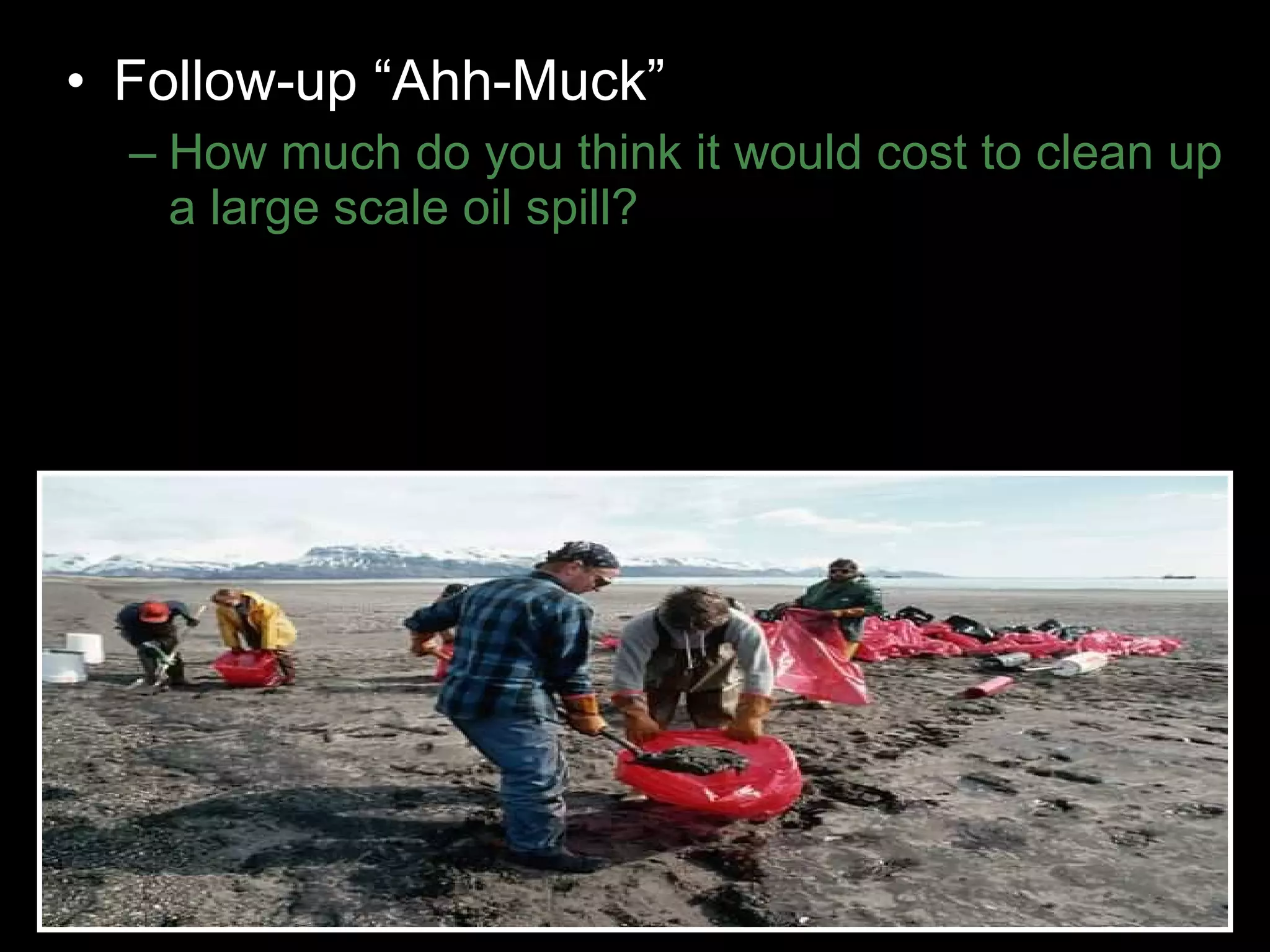
• Follow-up “Ahh-Muck”
– How difficult was it to remove all of the oil?
• What strategies worked the best?
– Why was it difficult to remove the oil?
– How much do you think it would cost to clean up
a large scale oil spill?
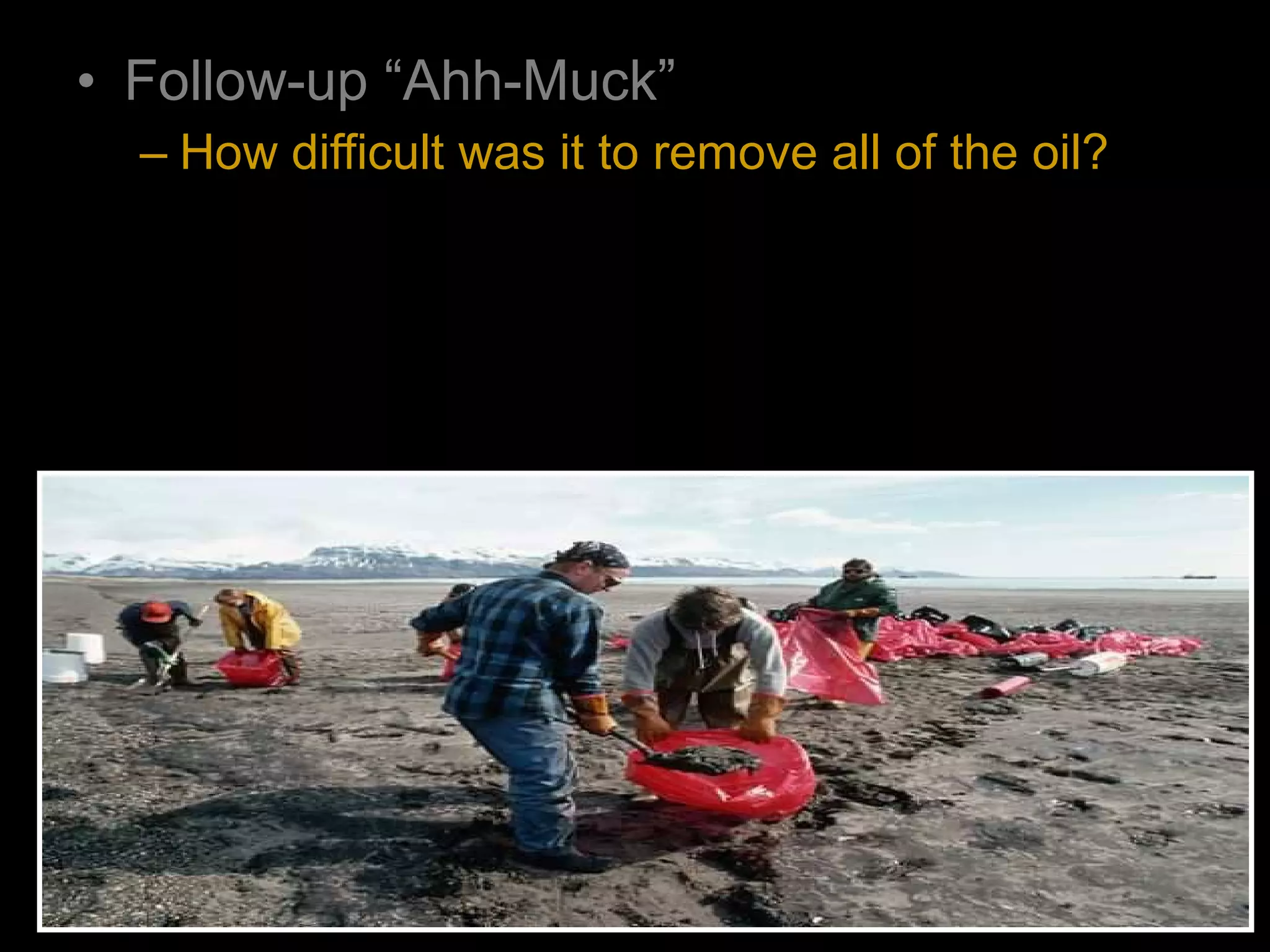
• Follow-up “Ahh-Muck”
– How difficult was it to remove all of the oil?
• Follow-up “Ahh-Muck”
– How difficult was it to remove all of the oil?
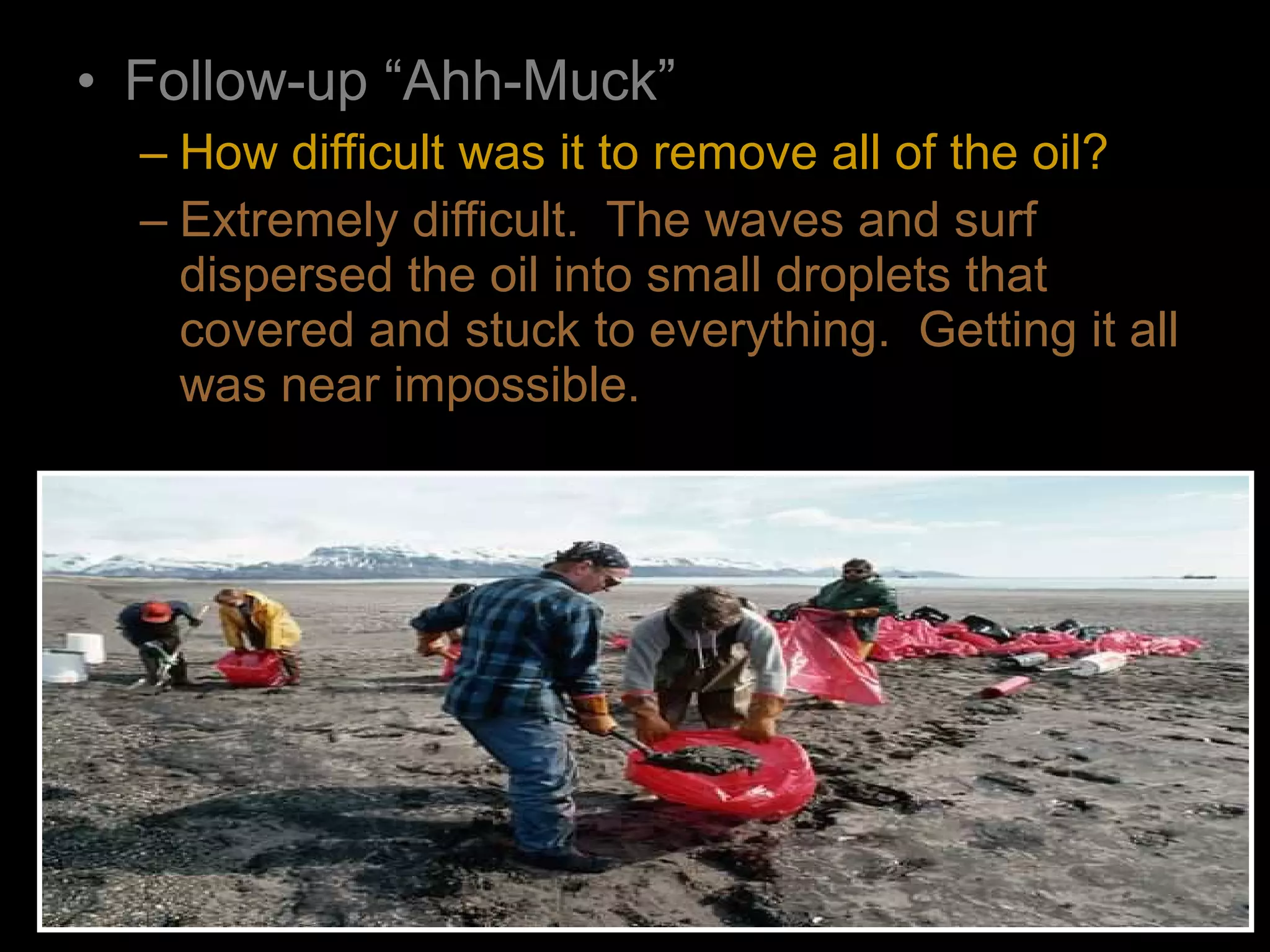
– Extremely difficult. The waves and surf
dispersed the oil into small droplets that
covered and stuck to everything. Getting it all
was near impossible.
• Follow-up “Ahh-Muck”
– How difficult was it to remove all of the oil?
• What strategies worked the best?
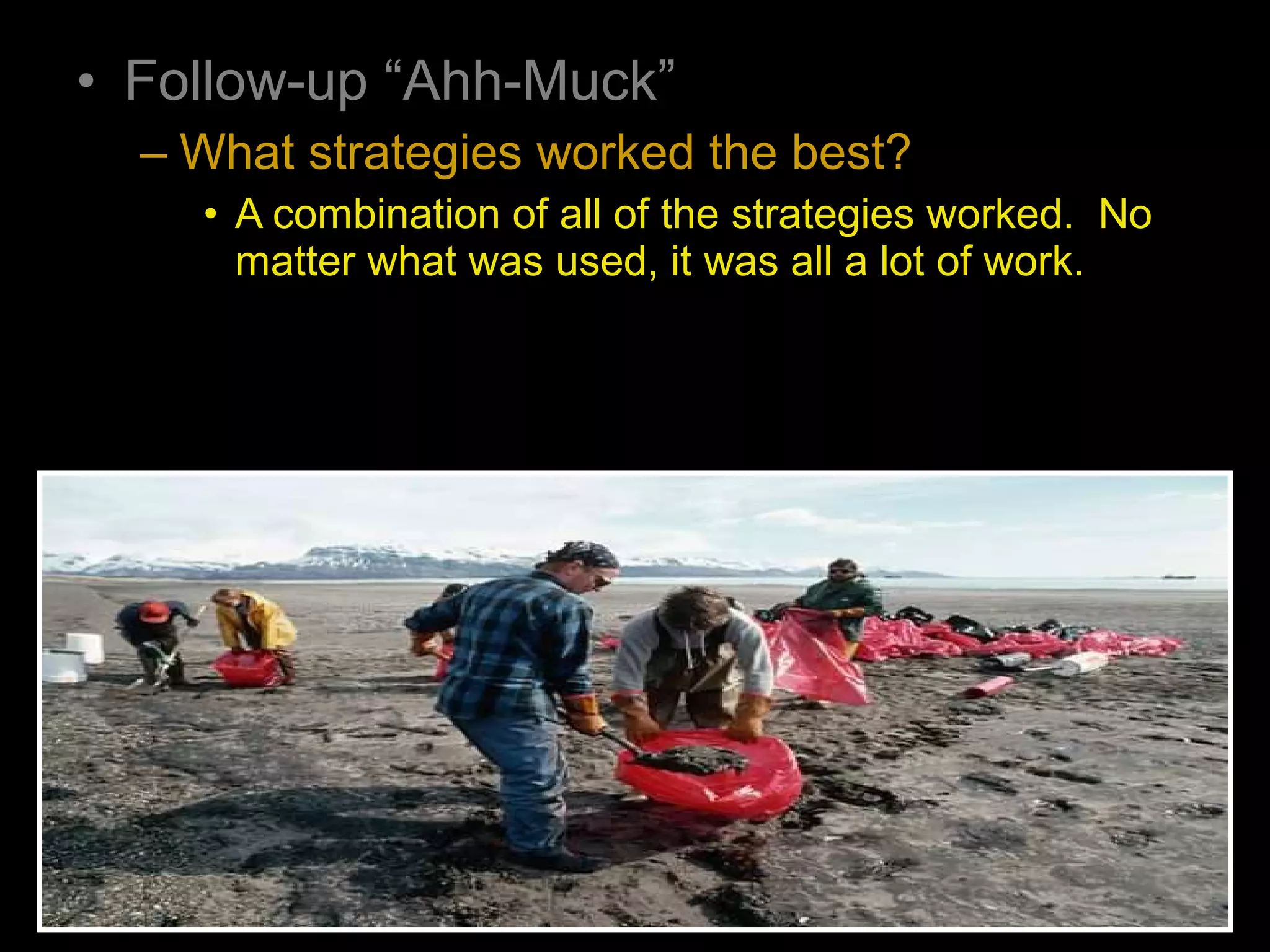
• Follow-up “Ahh-Muck”
– What strategies worked the best?
• A combination of all of the strategies worked. No
matter what was used, it was all a lot of work.
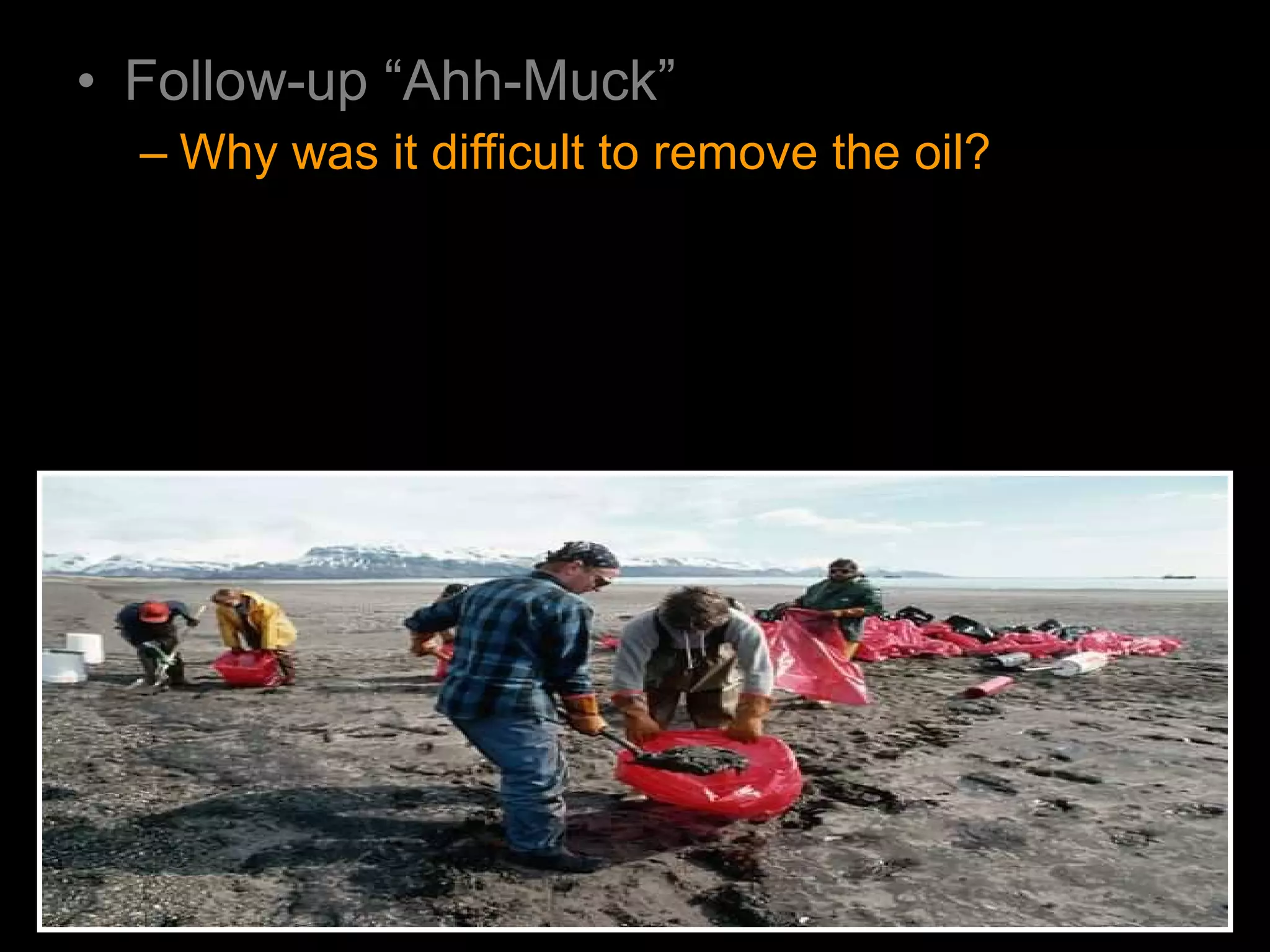
• Follow-up “Ahh-Muck”
– Why was it difficult to remove the oil?
• Follow-up “Ahh-Muck”
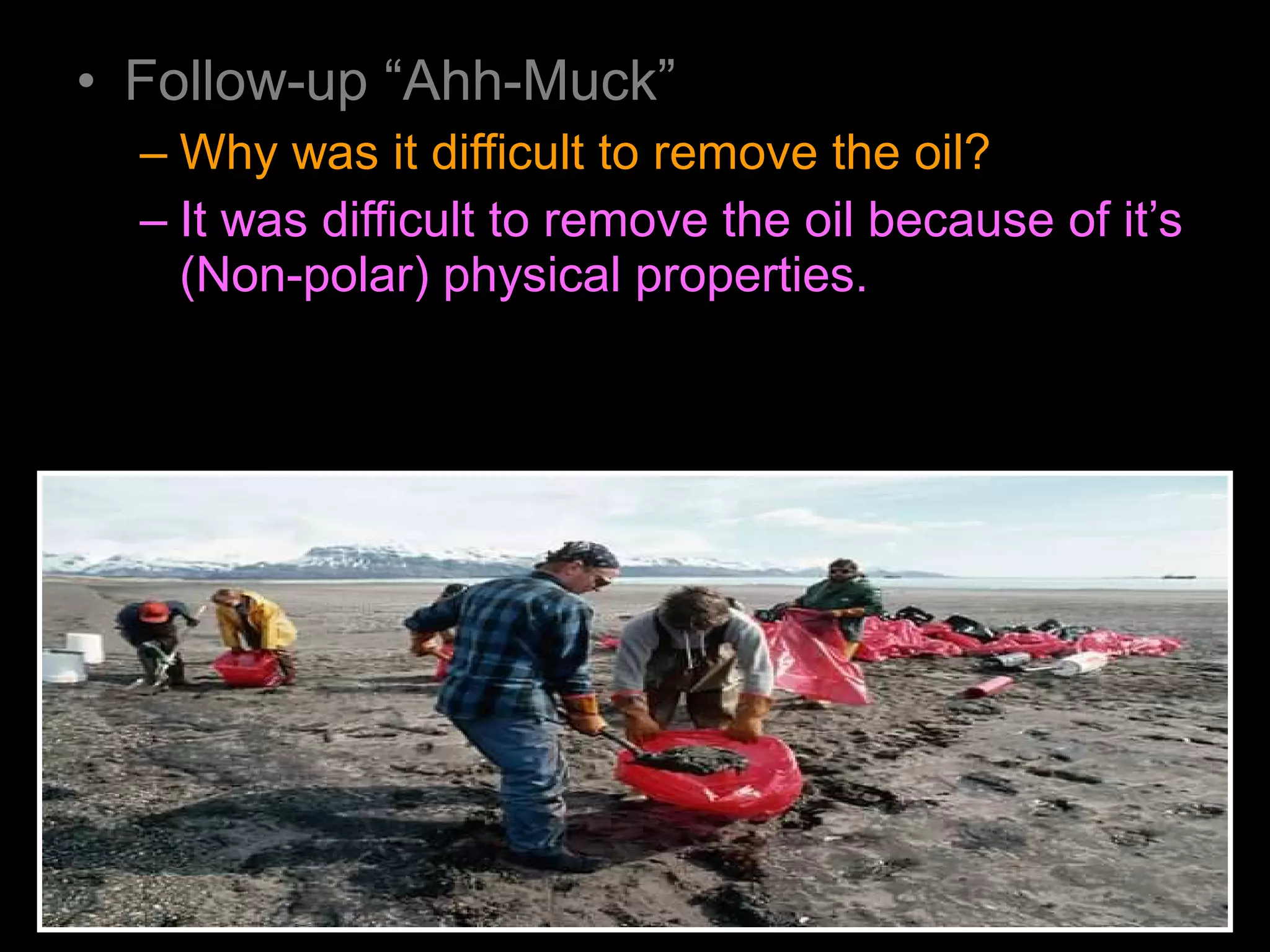
– Why was it difficult to remove the oil?
– It was difficult to remove the oil because of it’s
(Non-polar) physical properties.
• Follow-up “Ahh-Muck”
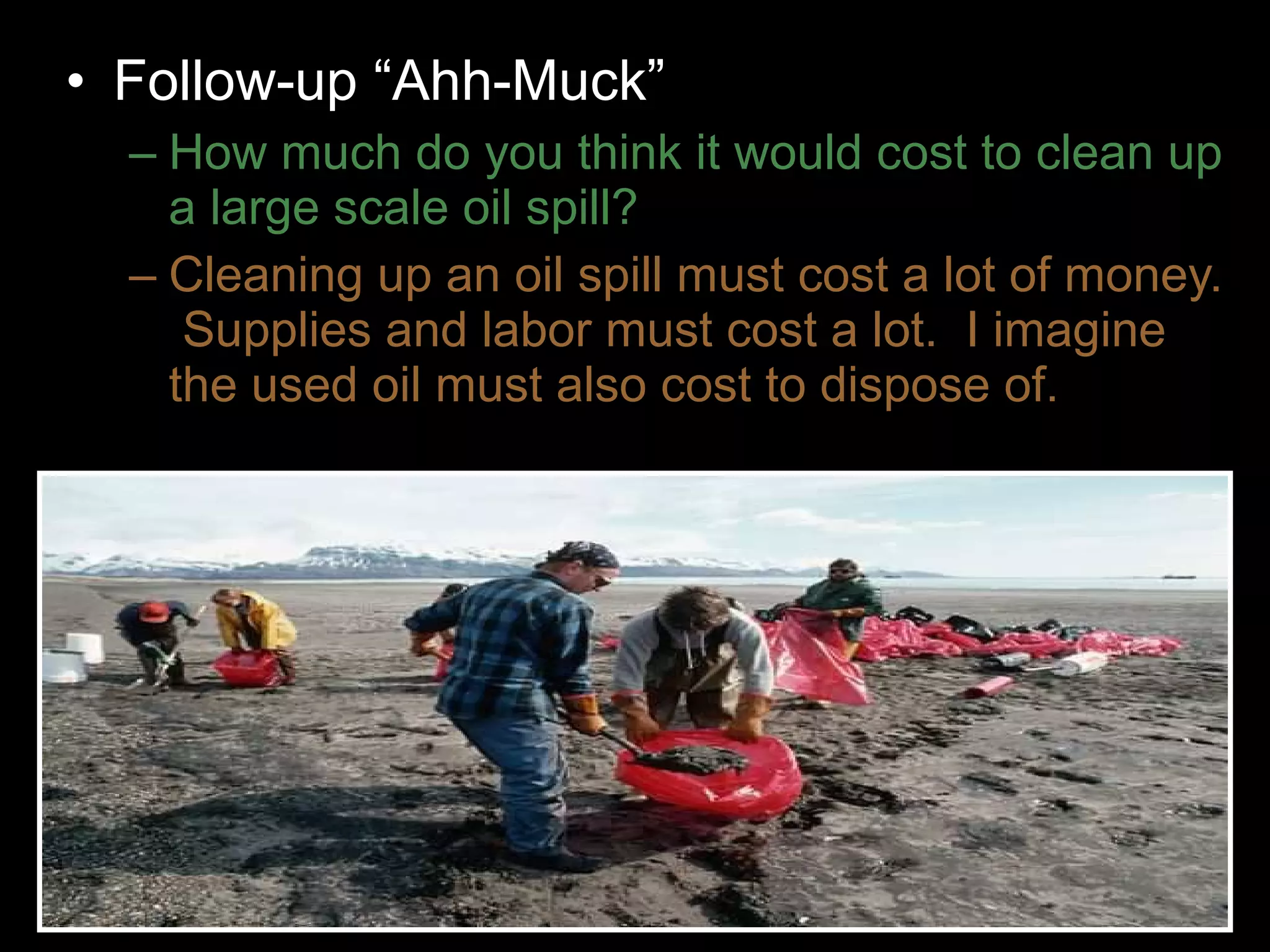
– How much do you think it would cost to clean up
a large scale oil spill?
– Cleaning up an oil spill must cost a lot of money.
Supplies and labor must cost a lot. I imagine
the used oil must also cost to dispose of.
• Follow-up “Ahh-Muck”
– How much do you think it would cost to clean up
a large scale oil spill?
– Cleaning up an oil spill must cost a lot of money.
Supplies and labor must cost a lot. I imagine
the used oil must also cost to dispose of.
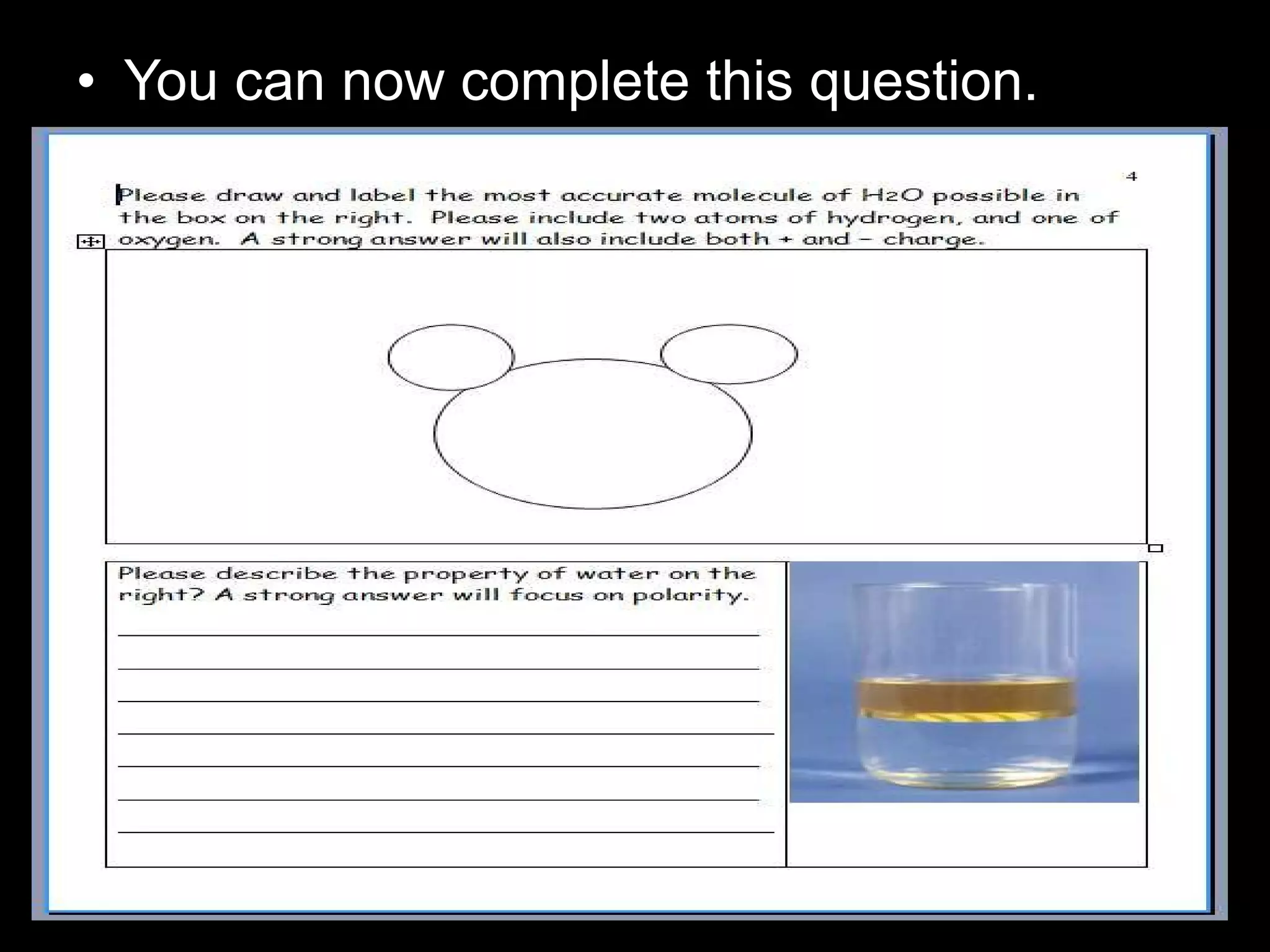
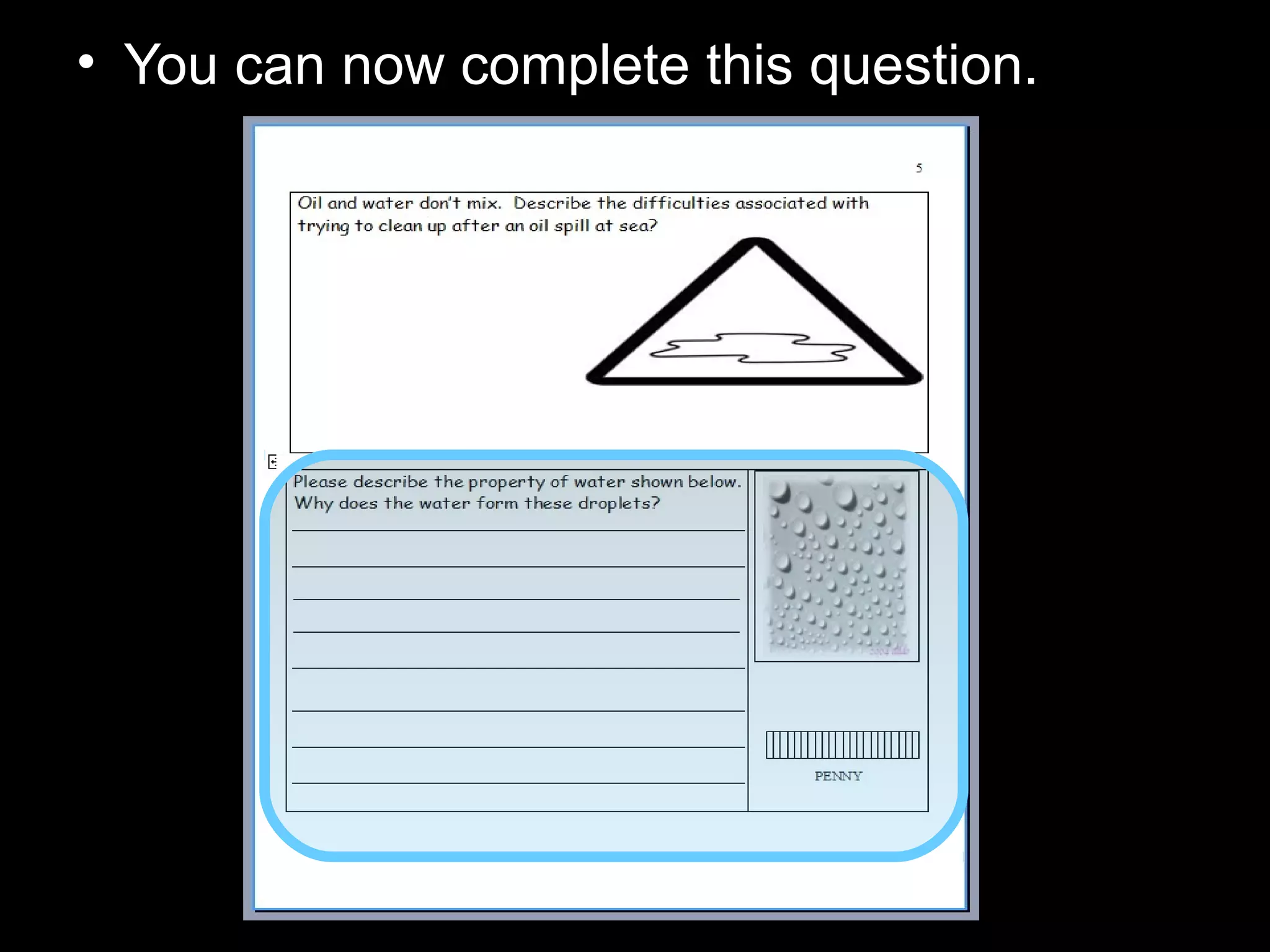
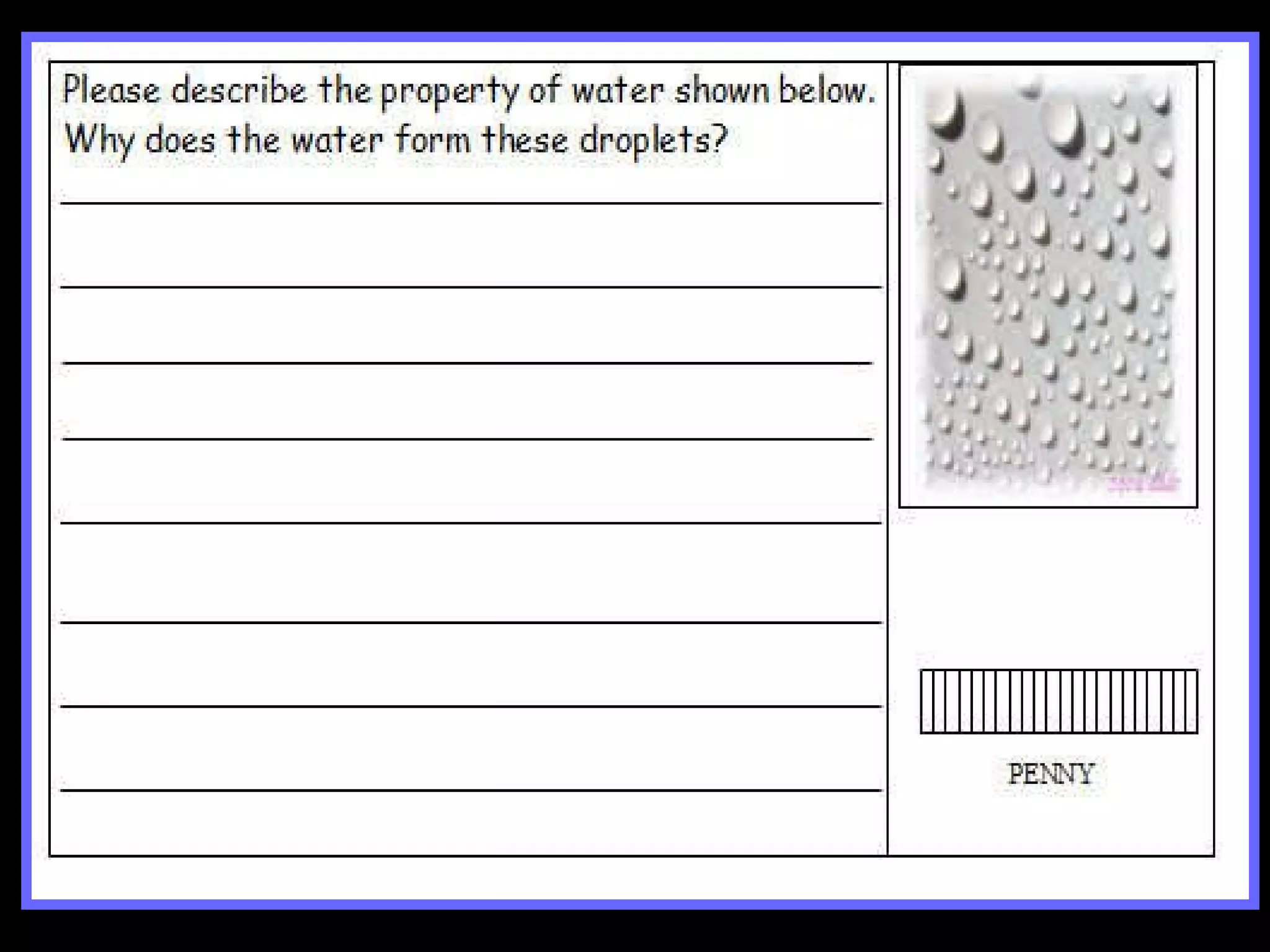
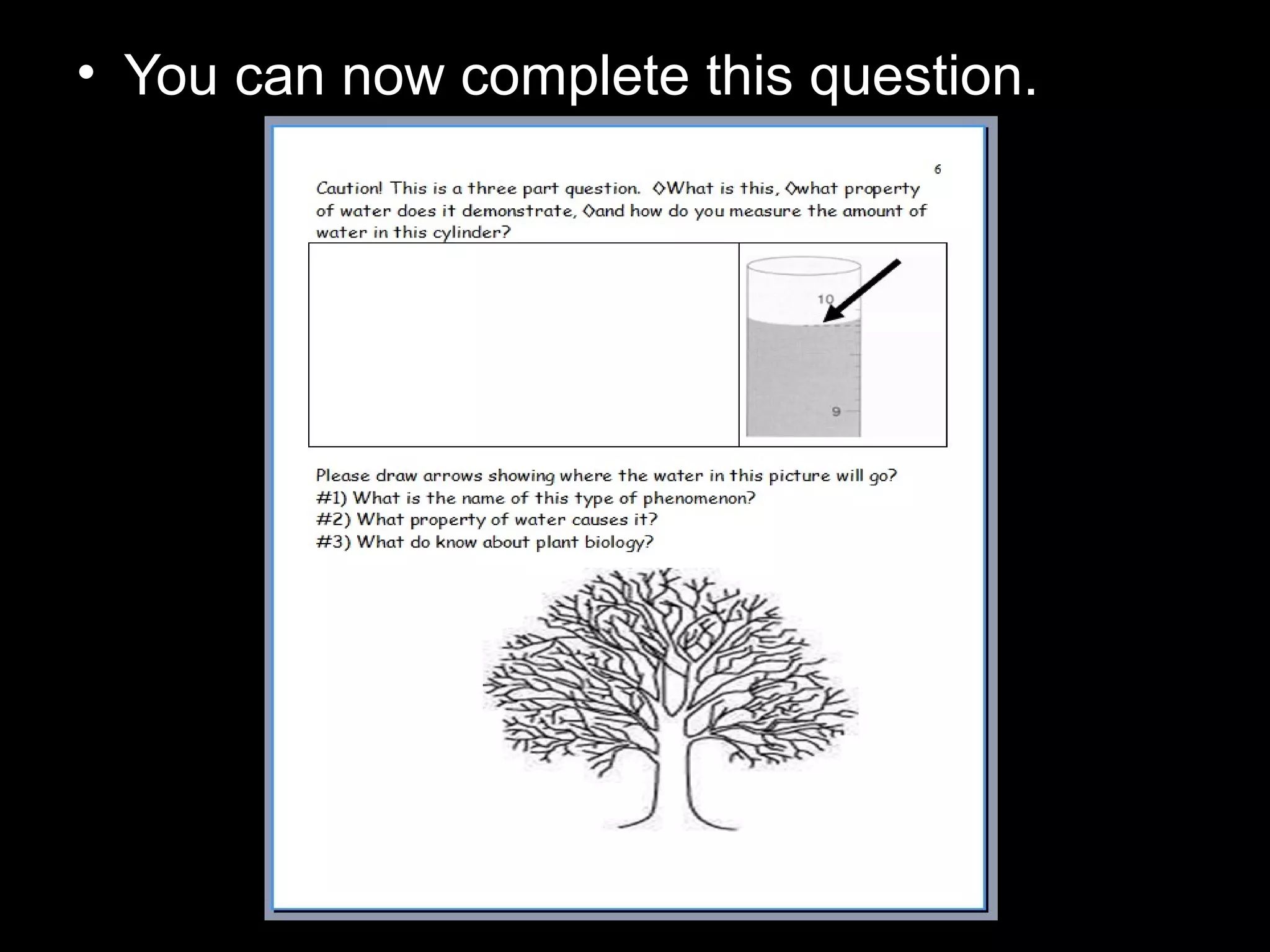
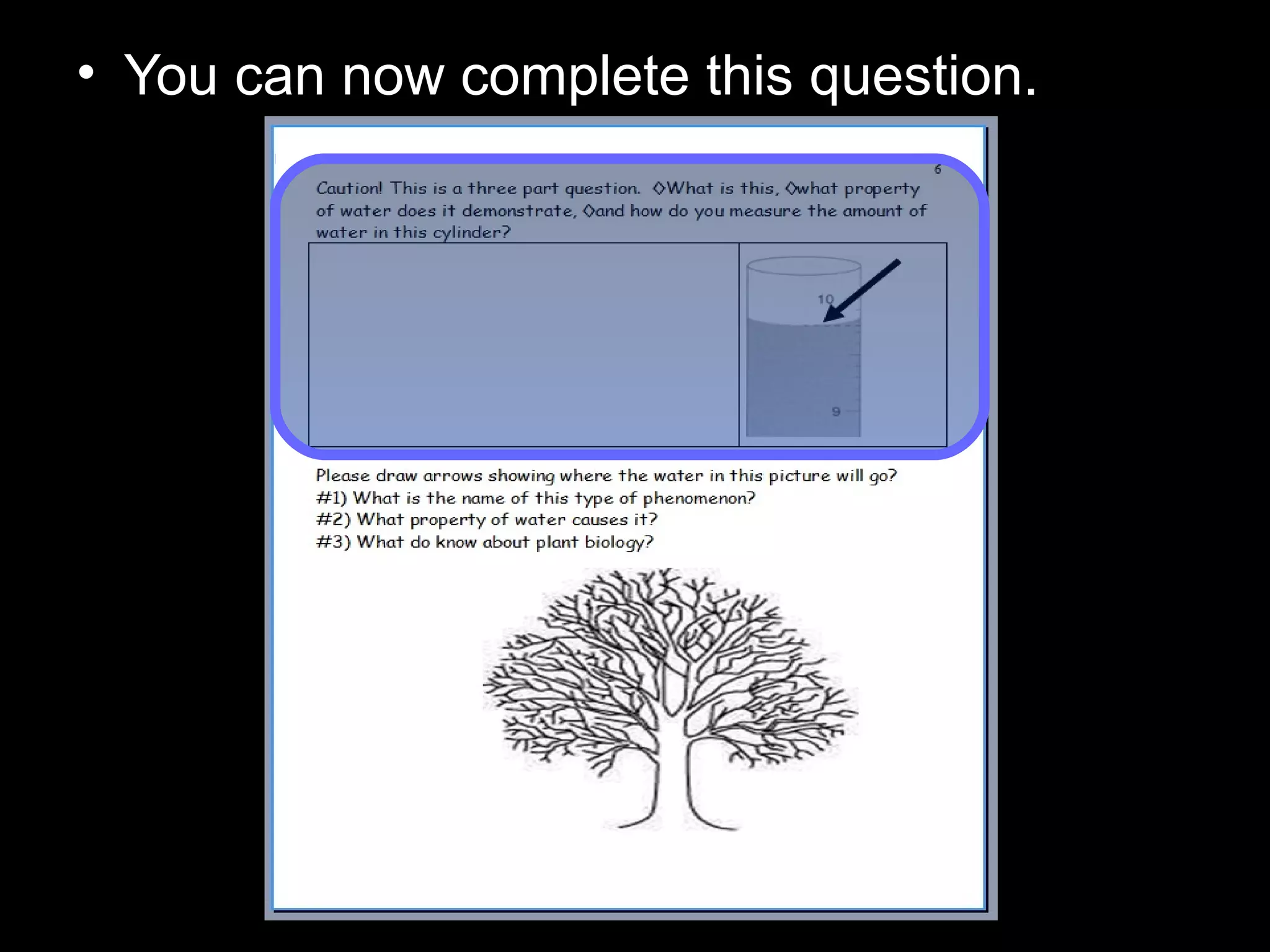
• You can now complete this question.
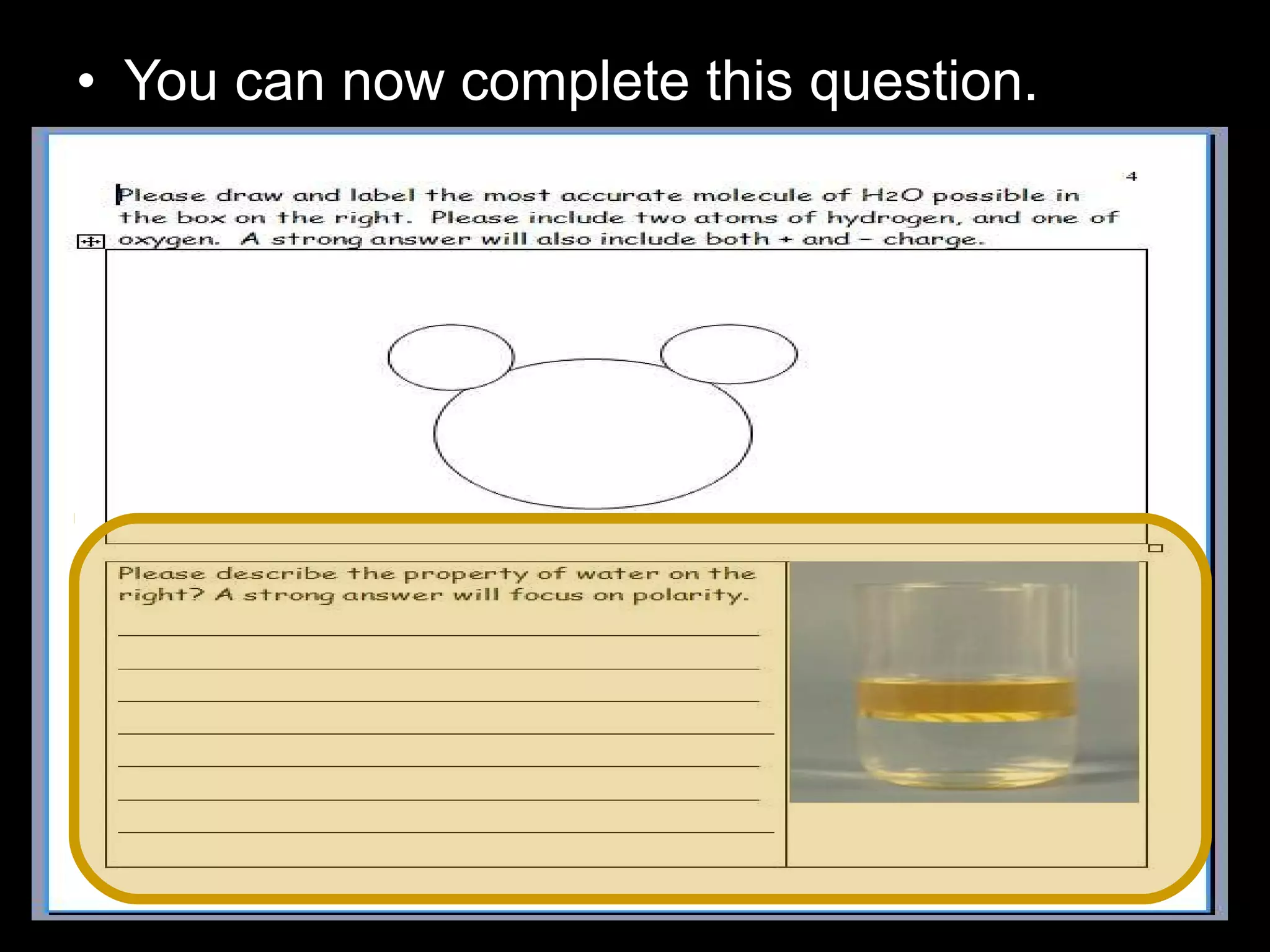
• You can also complete this question.
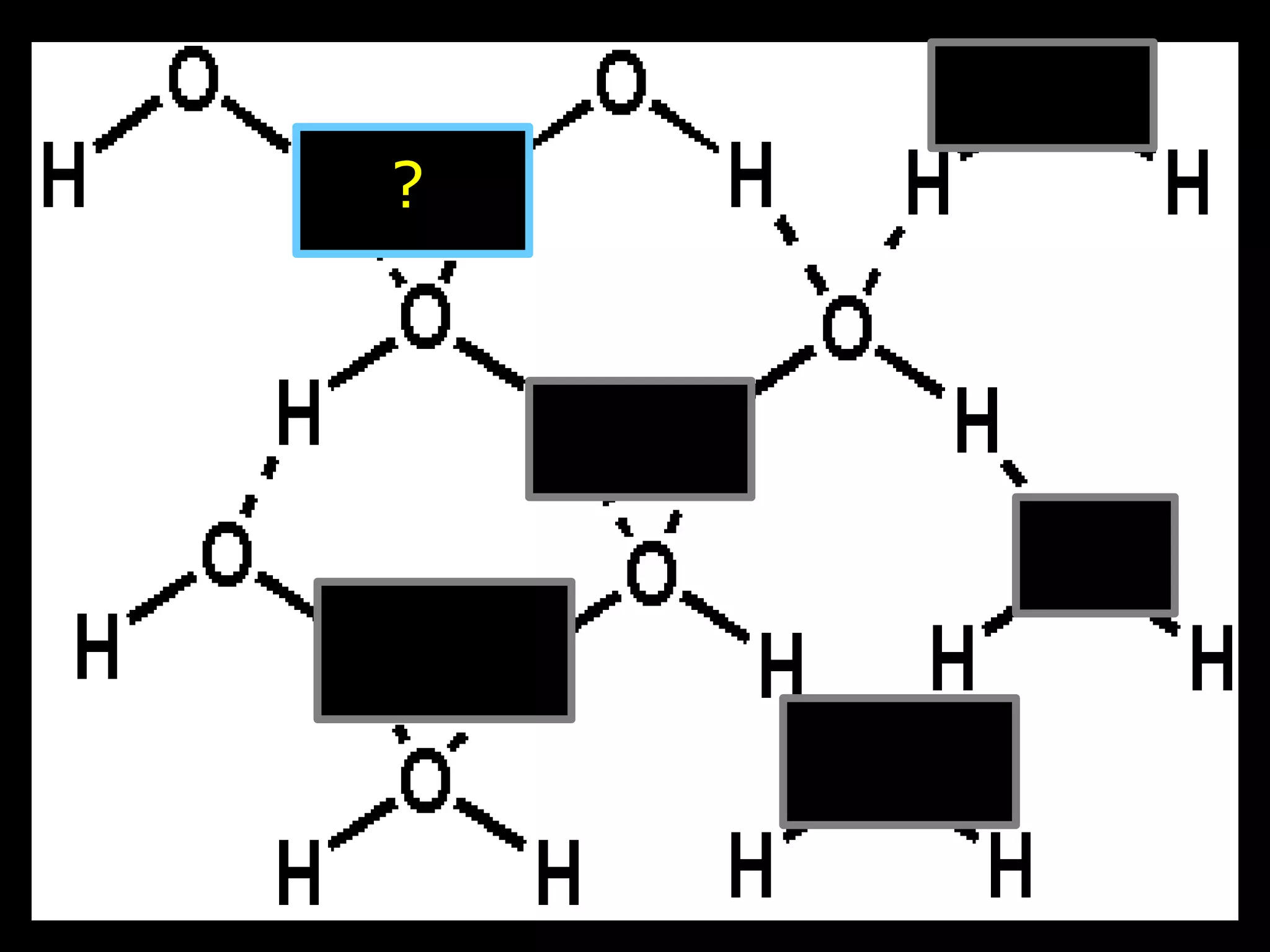
Cohesion: When hydrogen bonds holdCohesion: When hydrogen bonds hold
water molecules together.water molecules together.
Copyright © 2010 Ryan P. Murphy
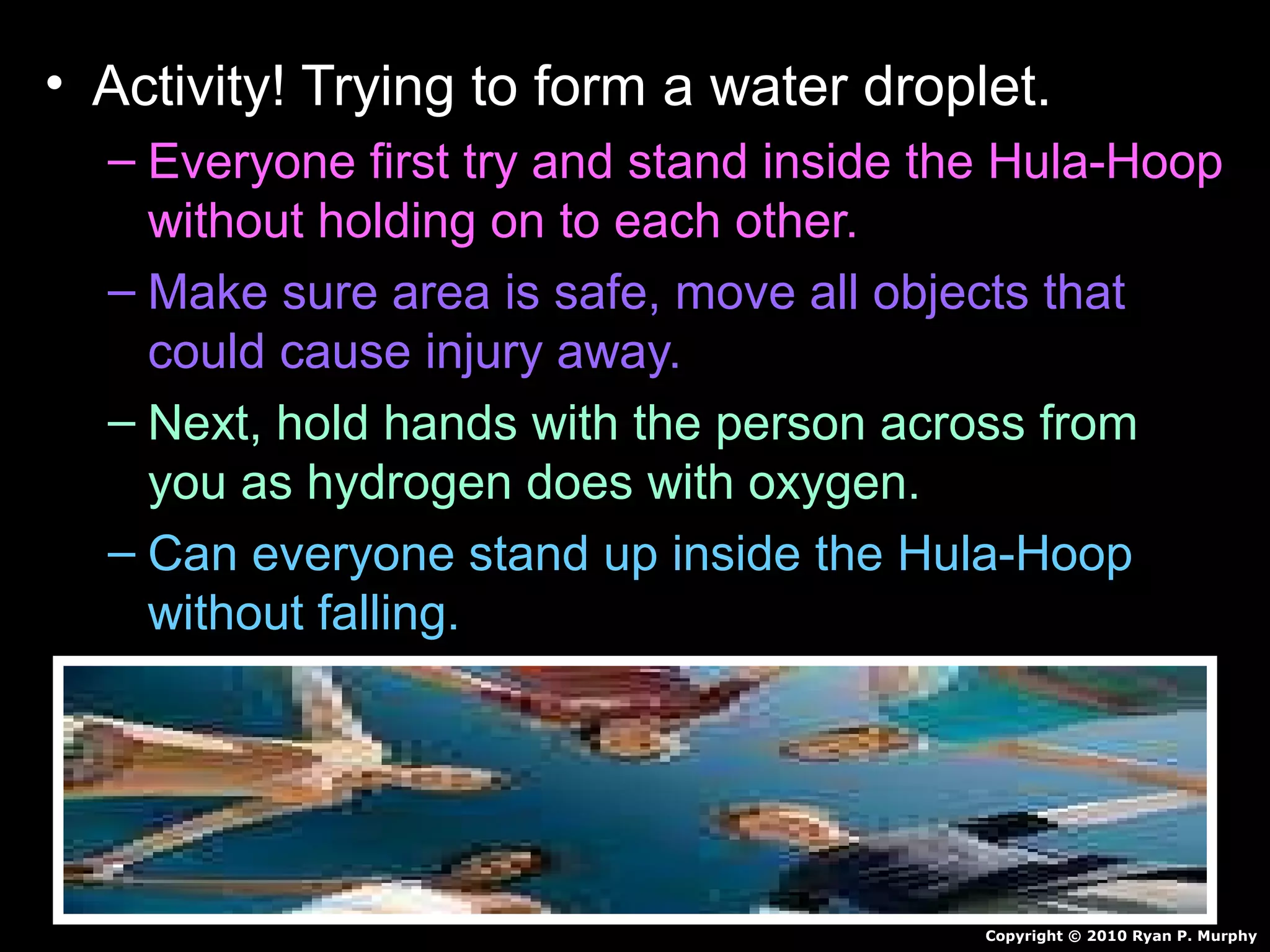
• Activity! Trying to form a water droplet.
– Everyone first try and stand inside the Hula-Hoop
without holding on to each other.
– Make sure area is safe, move all objects that
could cause injury away.
– Next, hold hands with the person across from
you as hydrogen does with oxygen.
– Can everyone stand up inside the Hula-Hoop
without falling.
Copyright © 2010 Ryan P. Murphy
• Available Sheet: Properties of Water.
– Note: This will be due at the end of Part II.
– Bring to class everyday.
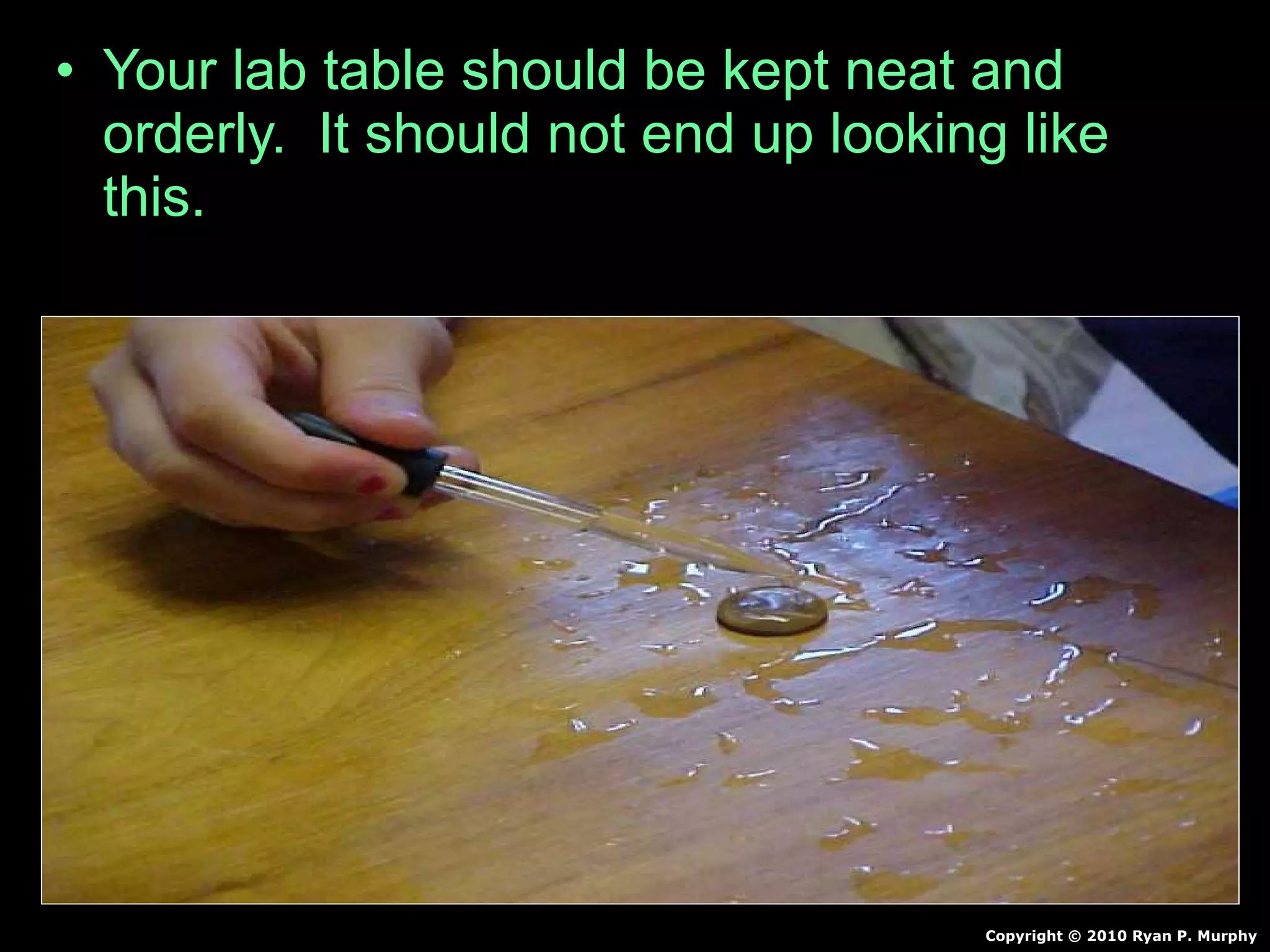
• Your lab table should be kept neat and
orderly. It should not end up looking like
this.
Copyright © 2010 Ryan P. Murphy
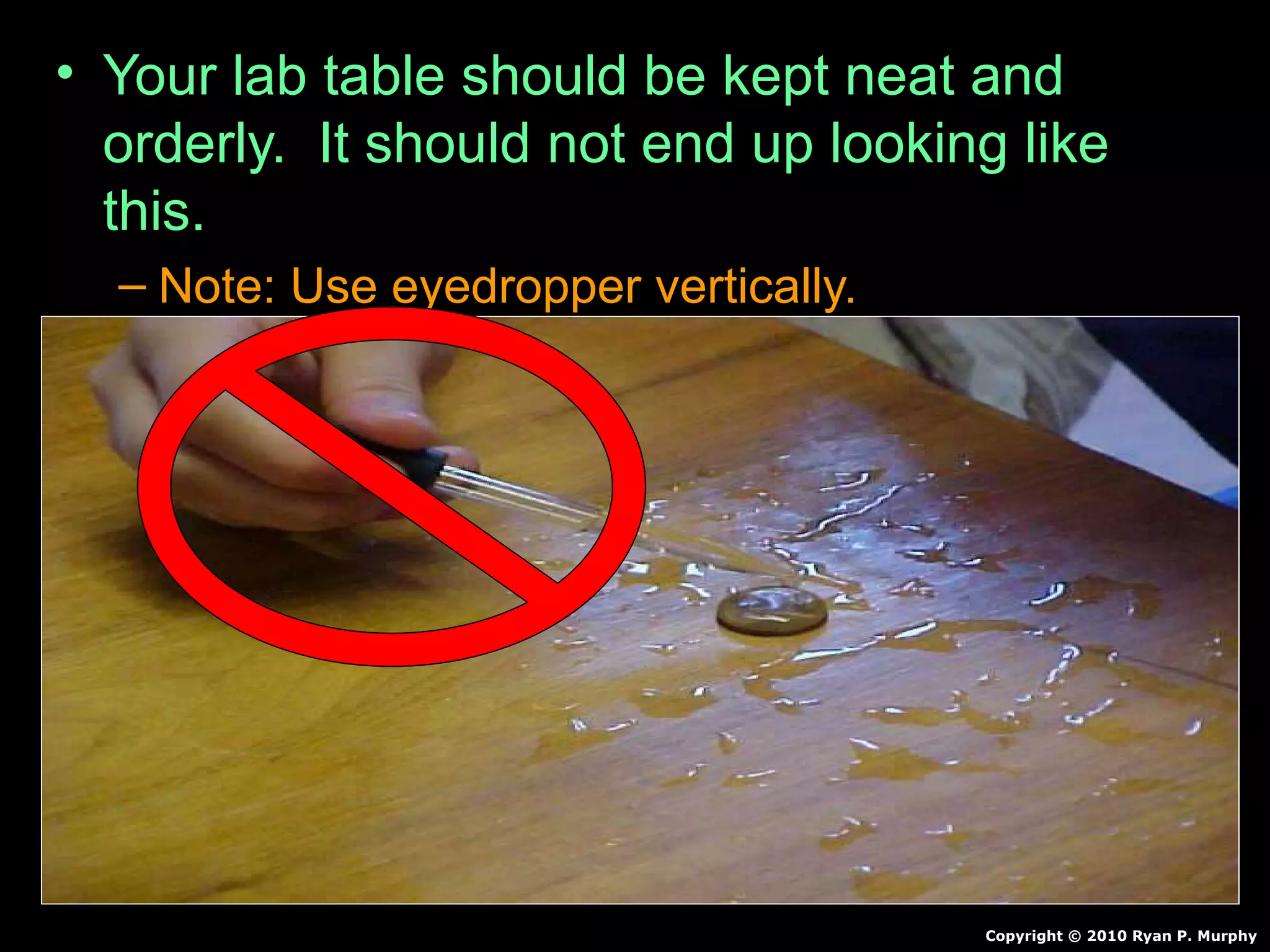
• Your lab table should be kept neat and
orderly. It should not end up looking like
this.
– Note: Use eyedropper vertically.
Copyright © 2010 Ryan P. Murphy
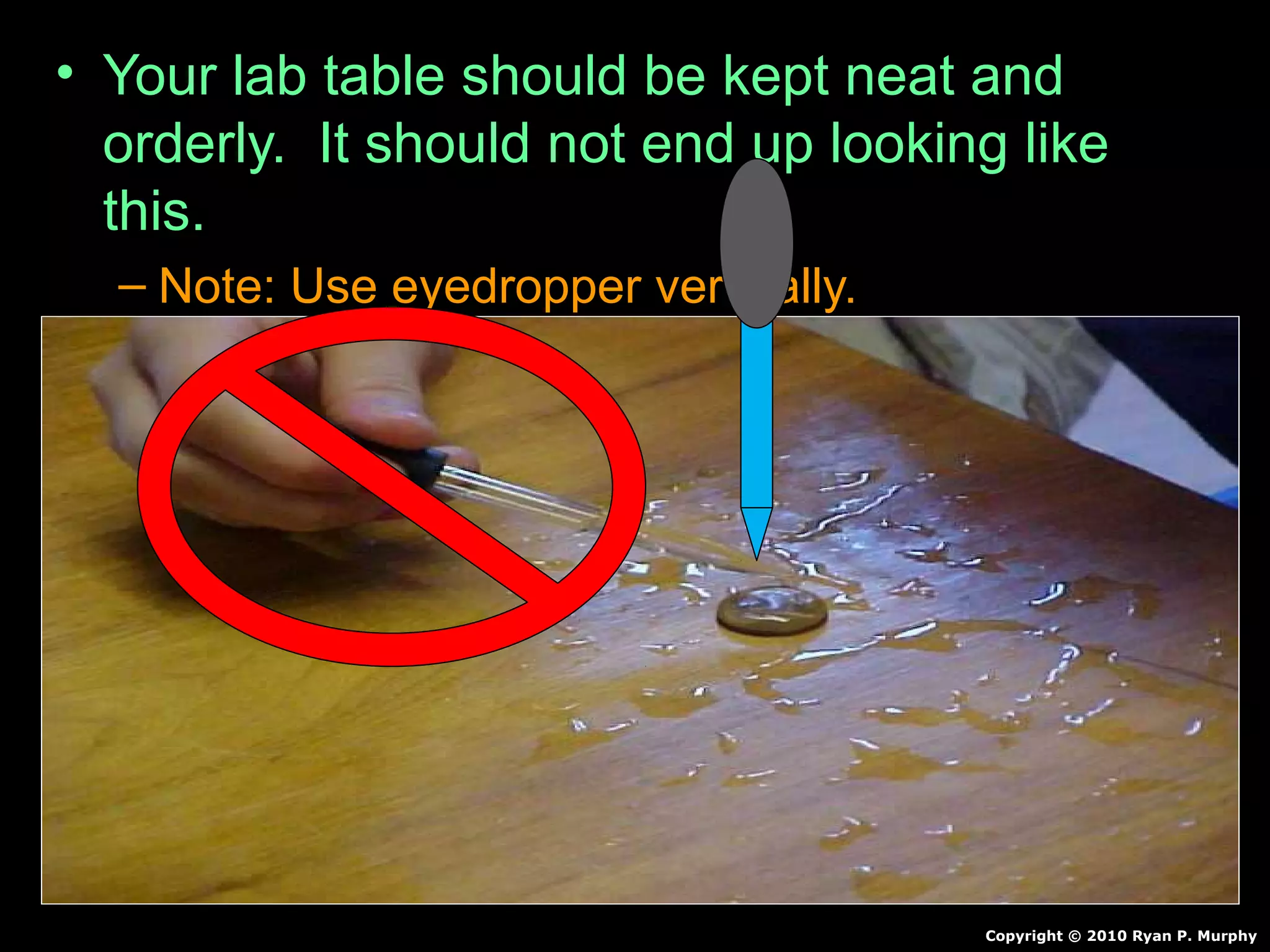
• Your lab table should be kept neat and
orderly. It should not end up looking like
this.
– Note: Use eyedropper vertically.
Copyright © 2010 Ryan P. Murphy
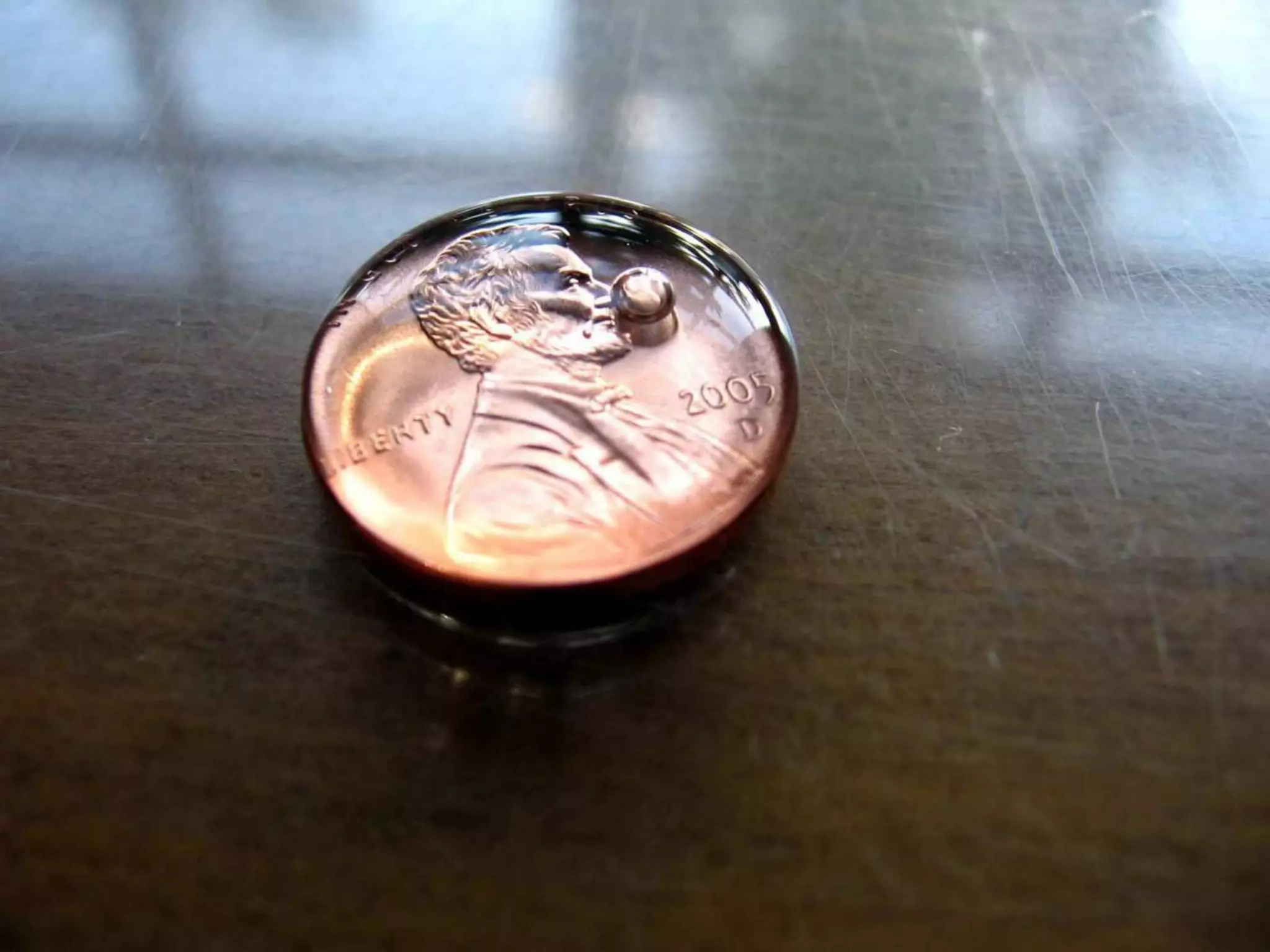
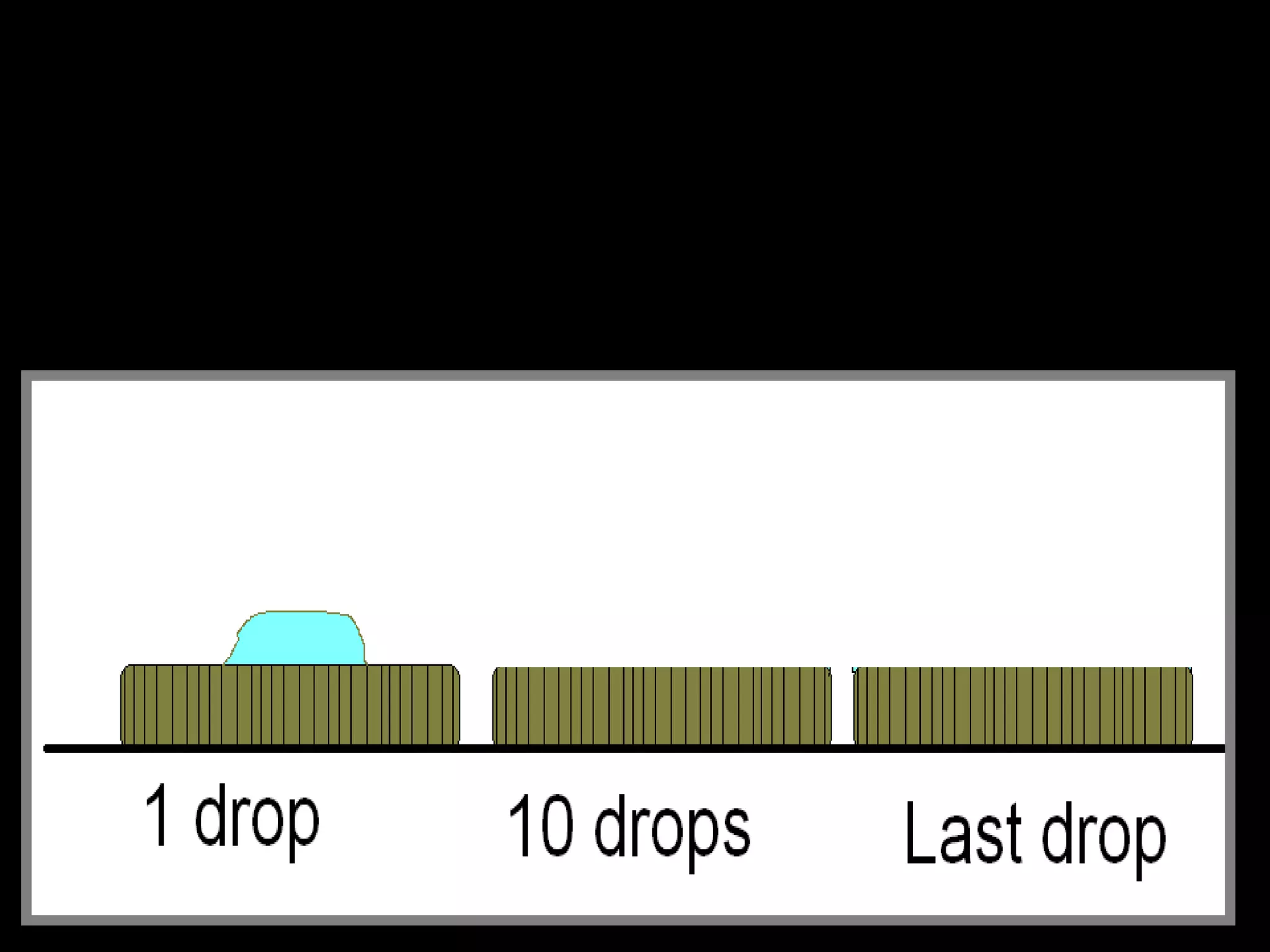
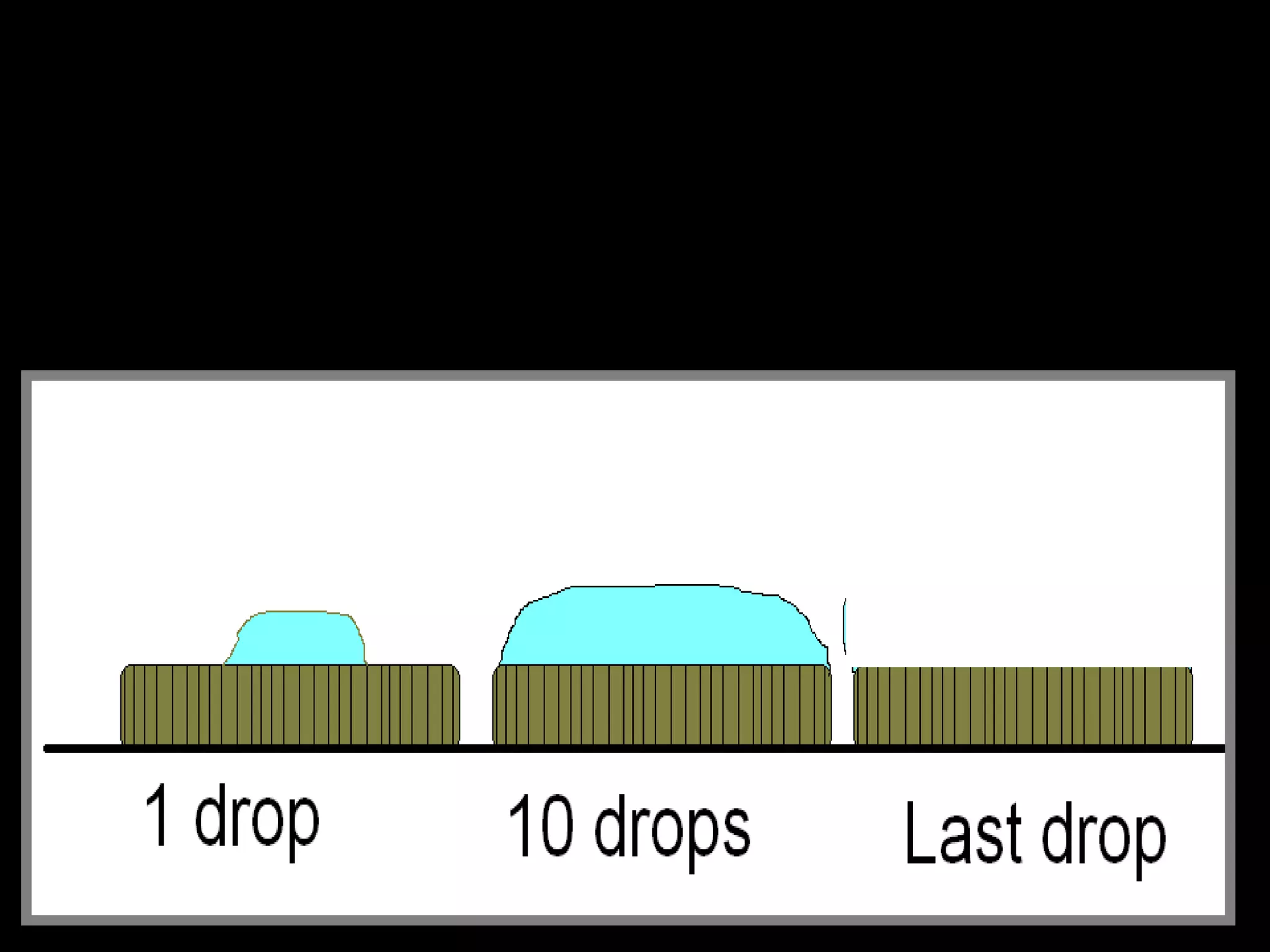
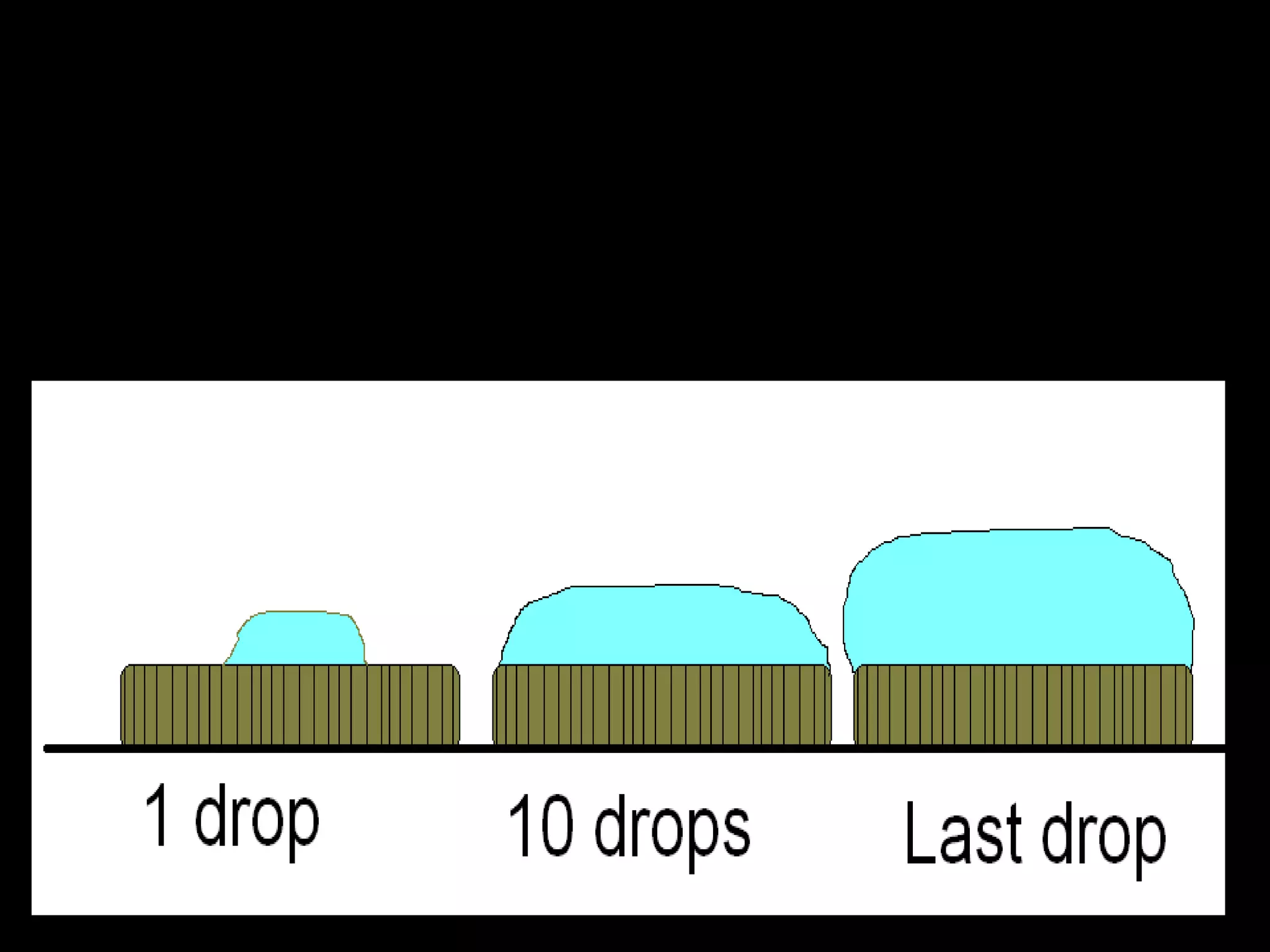
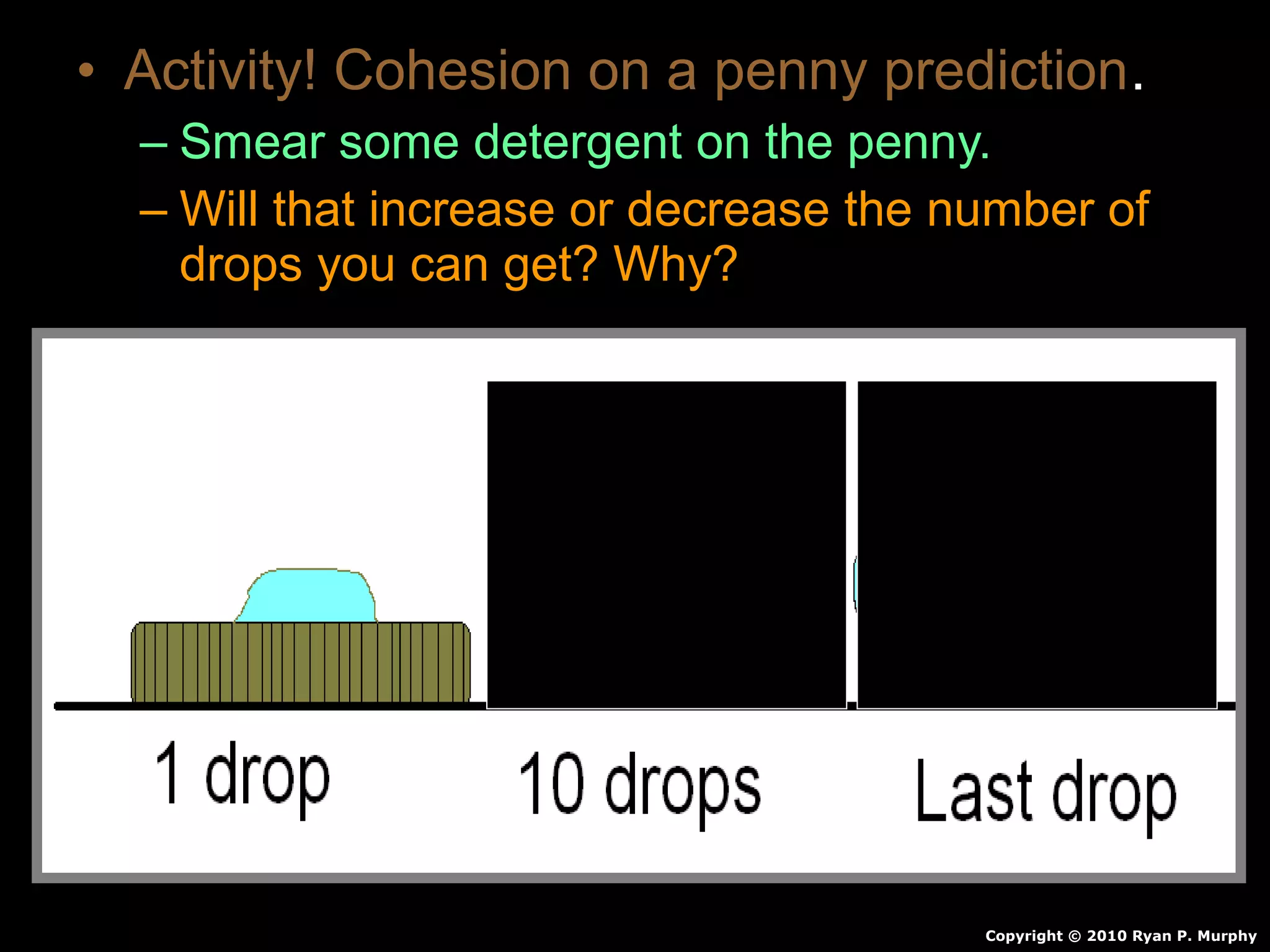
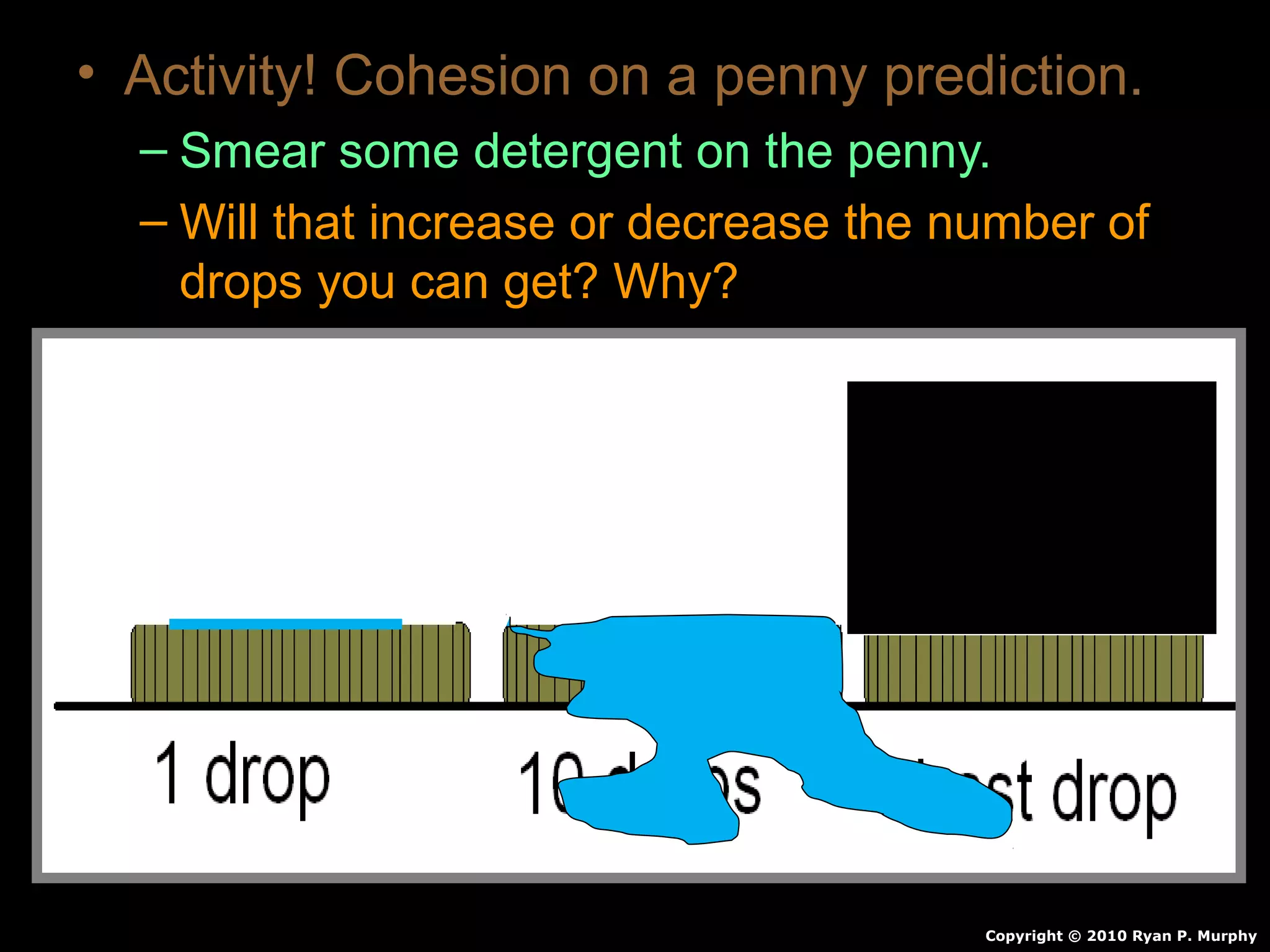
• Cohesion on a penny.
– How many drops of water can you get on a
penny?
– Make pictures in your journal at 1, 10, and
your last drop.
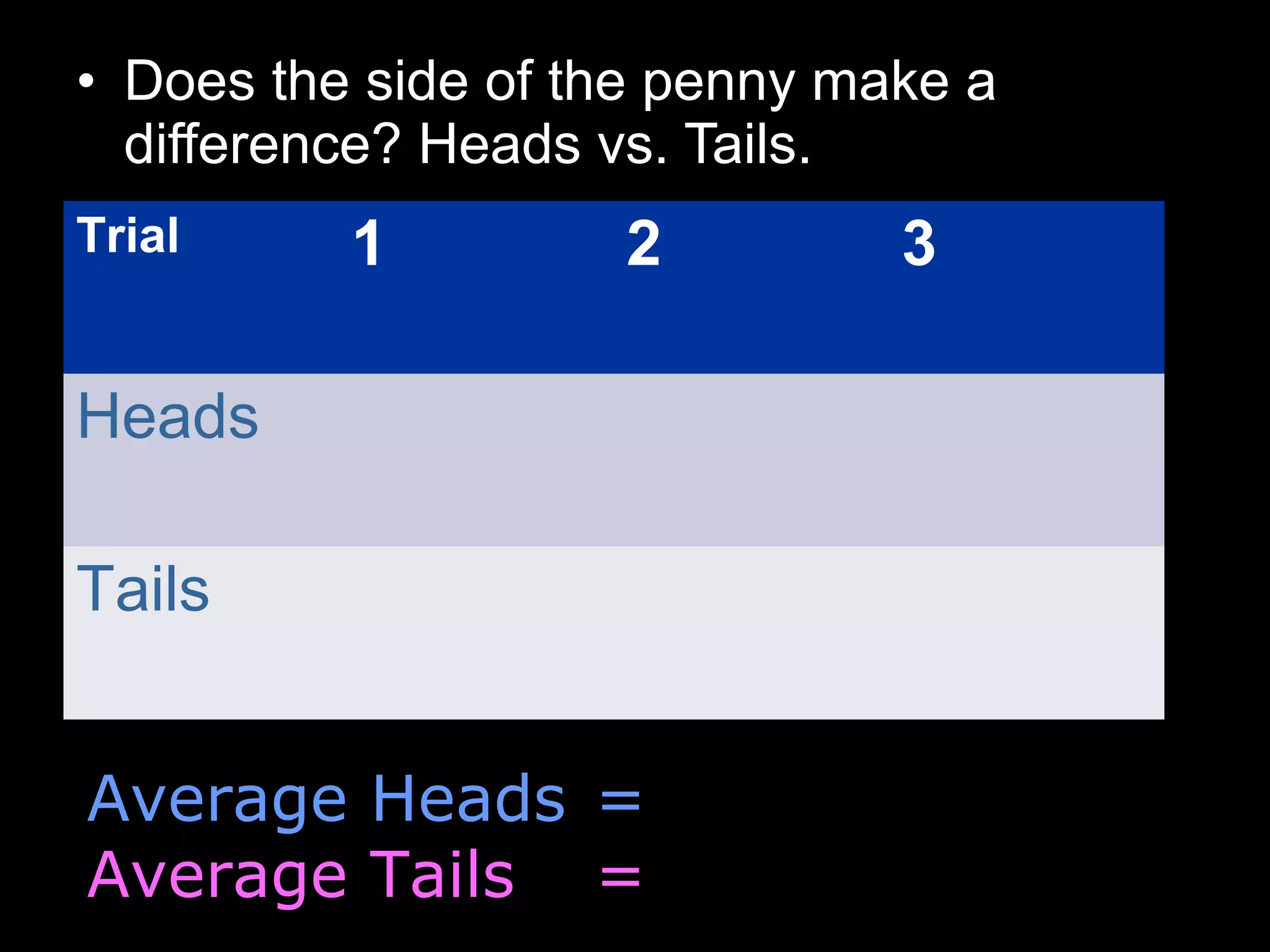
• Does the side of the penny make a
difference? Heads vs. Tails.
Trial 1 2 3
Heads
Tails
Average Heads =
Average Tails =
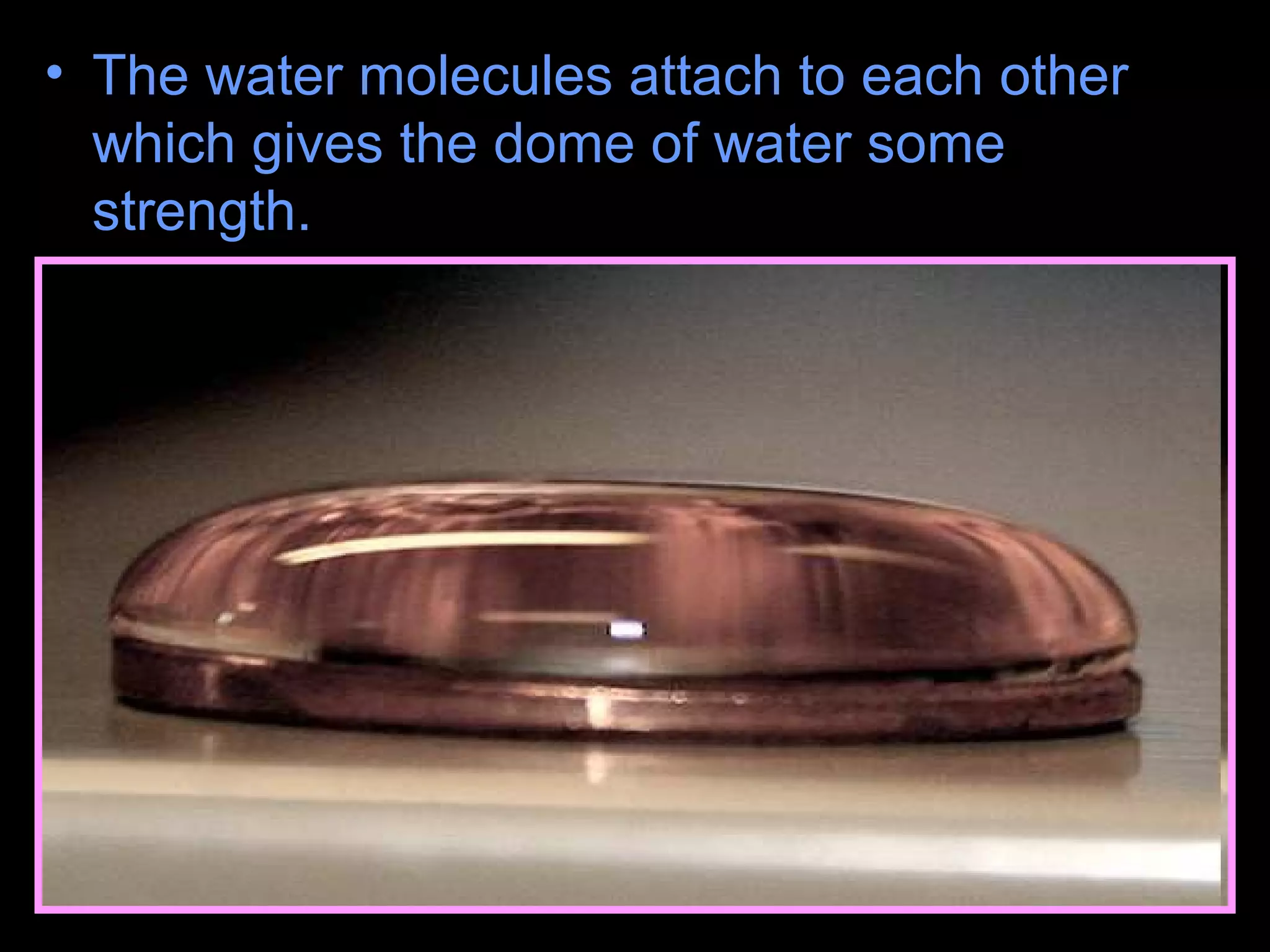
• The water molecules attach to each other
which gives the dome of water some
strength.
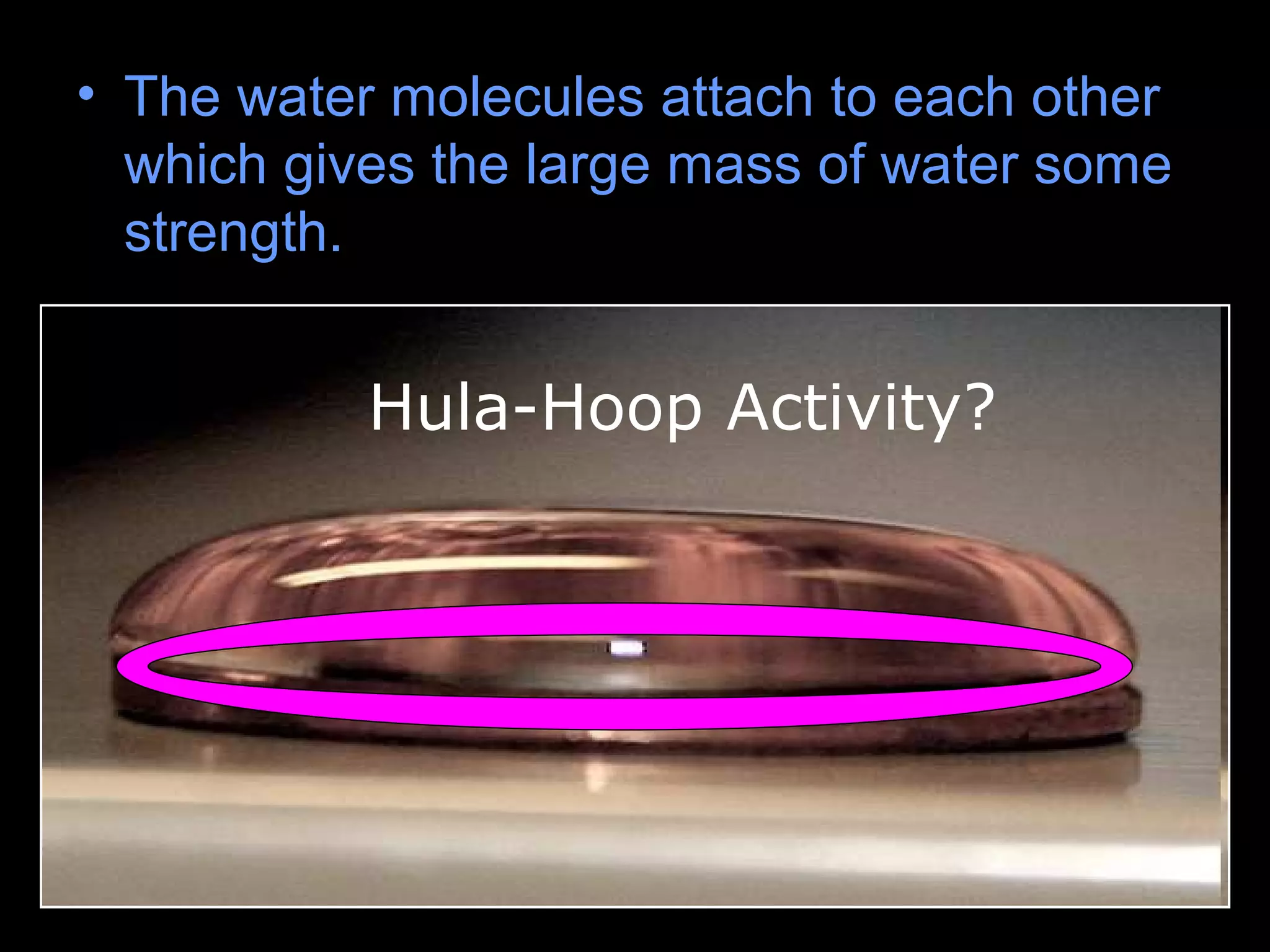
• The water molecules attach to each other
which gives the large mass of water some
strength.
Hula-Hoop Activity?
• The water molecules attach to each other
which gives the large mass of water some
strength.
Hula-Hoop Activity?
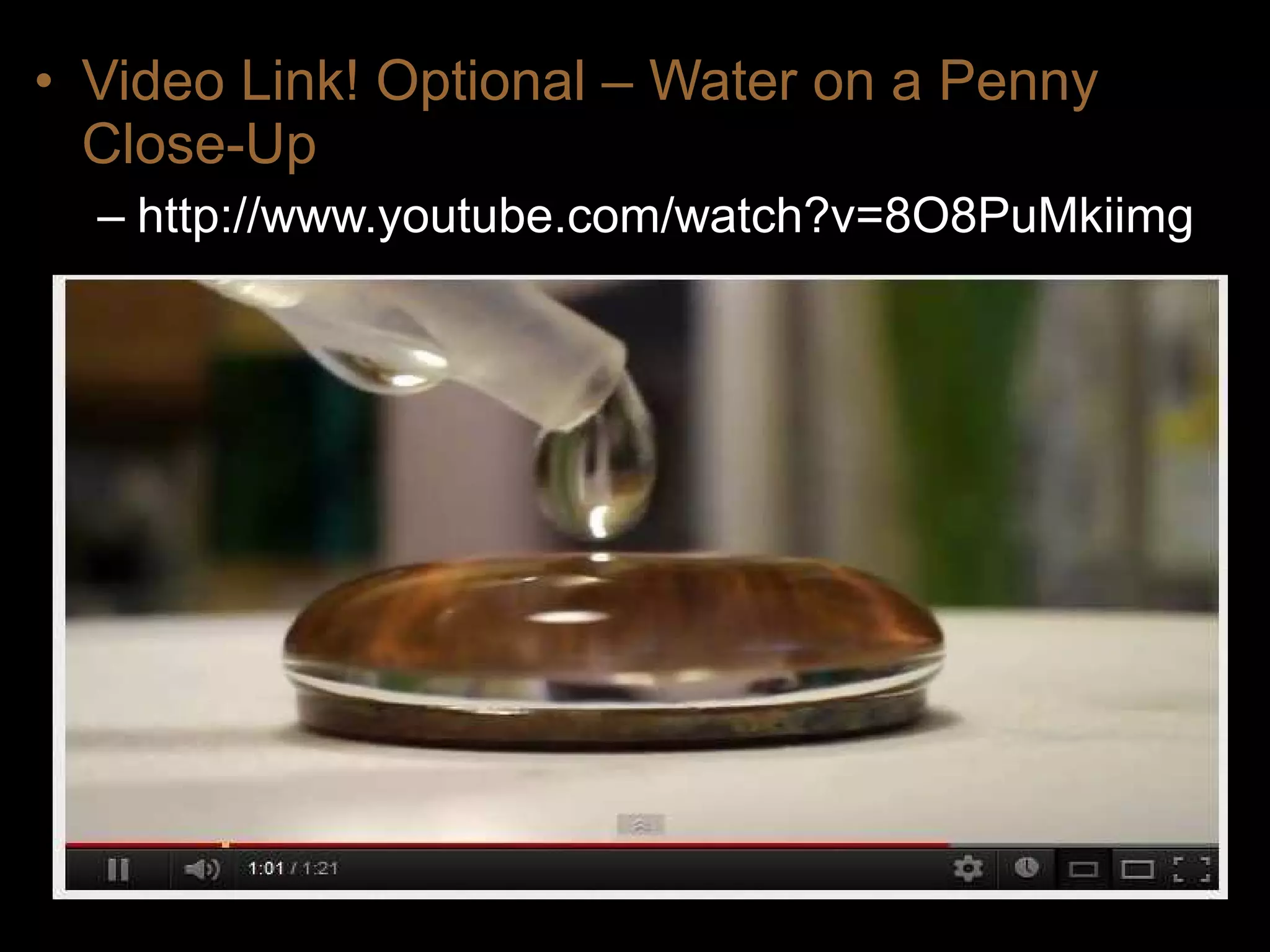
• Video Link! Optional – Water on a Penny
Close-Up
– http://www.youtube.com/watch?v=8O8PuMkiimg
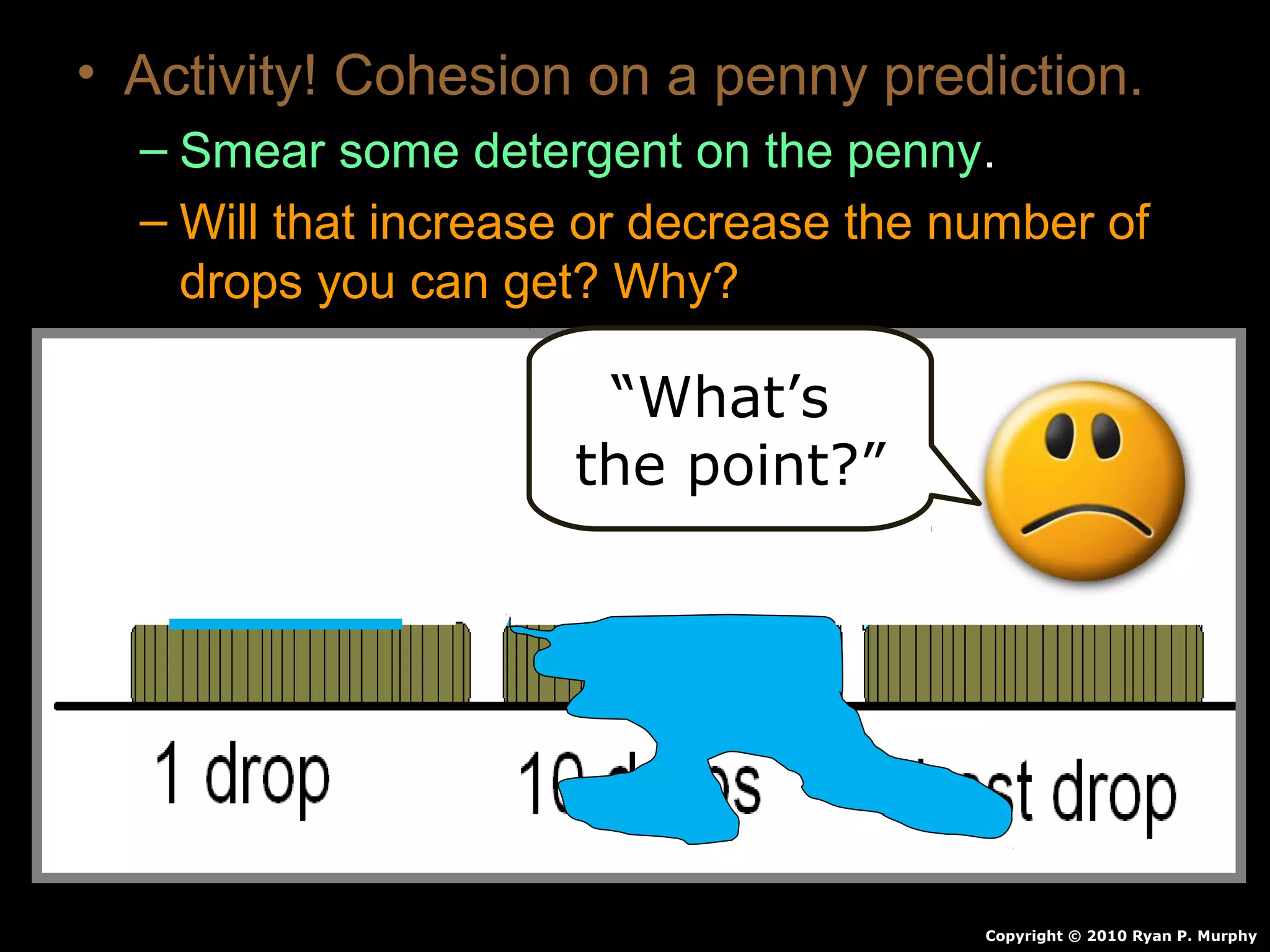
• Activity! Cohesion on a penny prediction.
– Smear some detergent on the penny.
– Will that increase or decrease the number of
drops you can get? Why?
Copyright © 2010 Ryan P. Murphy
• Activity! Cohesion on a penny prediction.
– Smear some detergent on the penny.
– Will that increase or decrease the number of
drops you can get? Why?
Copyright © 2010 Ryan P. Murphy
• Activity! Cohesion on a penny prediction.
– Smear some detergent on the penny.
– Will that increase or decrease the number of
drops you can get? Why?
Copyright © 2010 Ryan P. Murphy
“What’s
the point?”
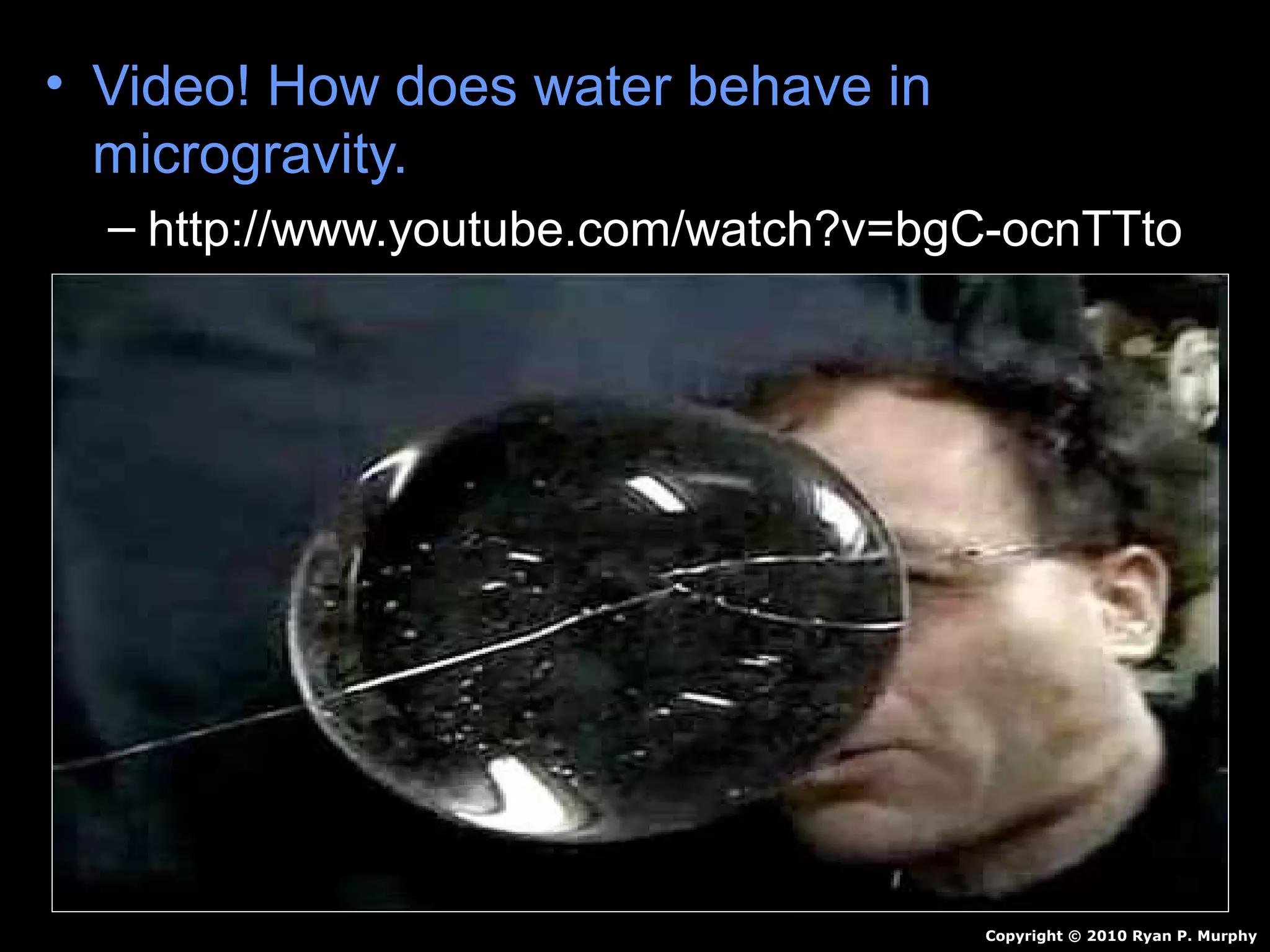
• Video! How does water behave in
microgravity.
– http://www.youtube.com/watch?v=bgC-ocnTTto
Copyright © 2010 Ryan P. Murphy
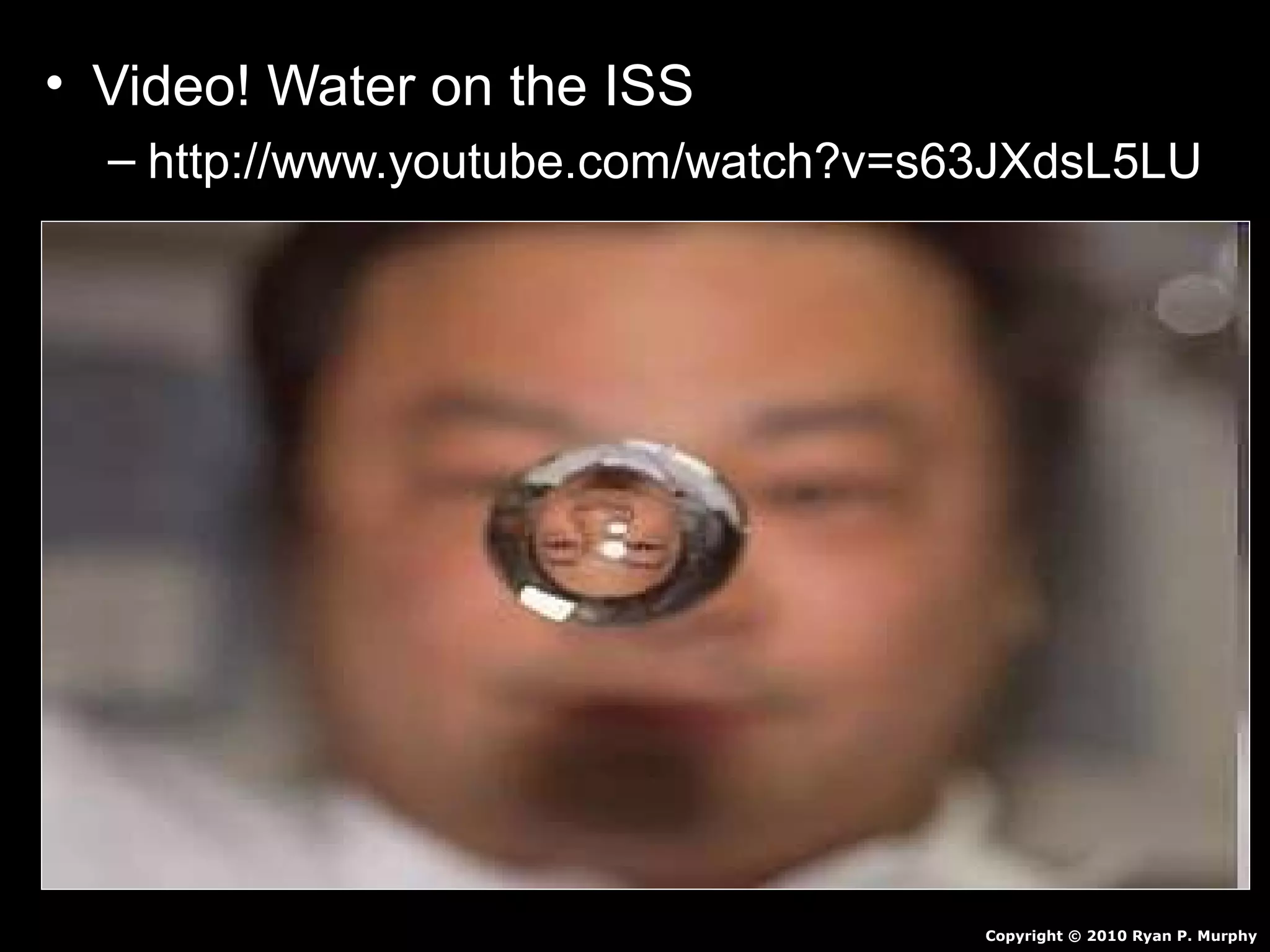
• Video! Water on the ISS
– http://www.youtube.com/watch?v=s63JXdsL5LU
Copyright © 2010 Ryan P. Murphy
• You can now complete this question.
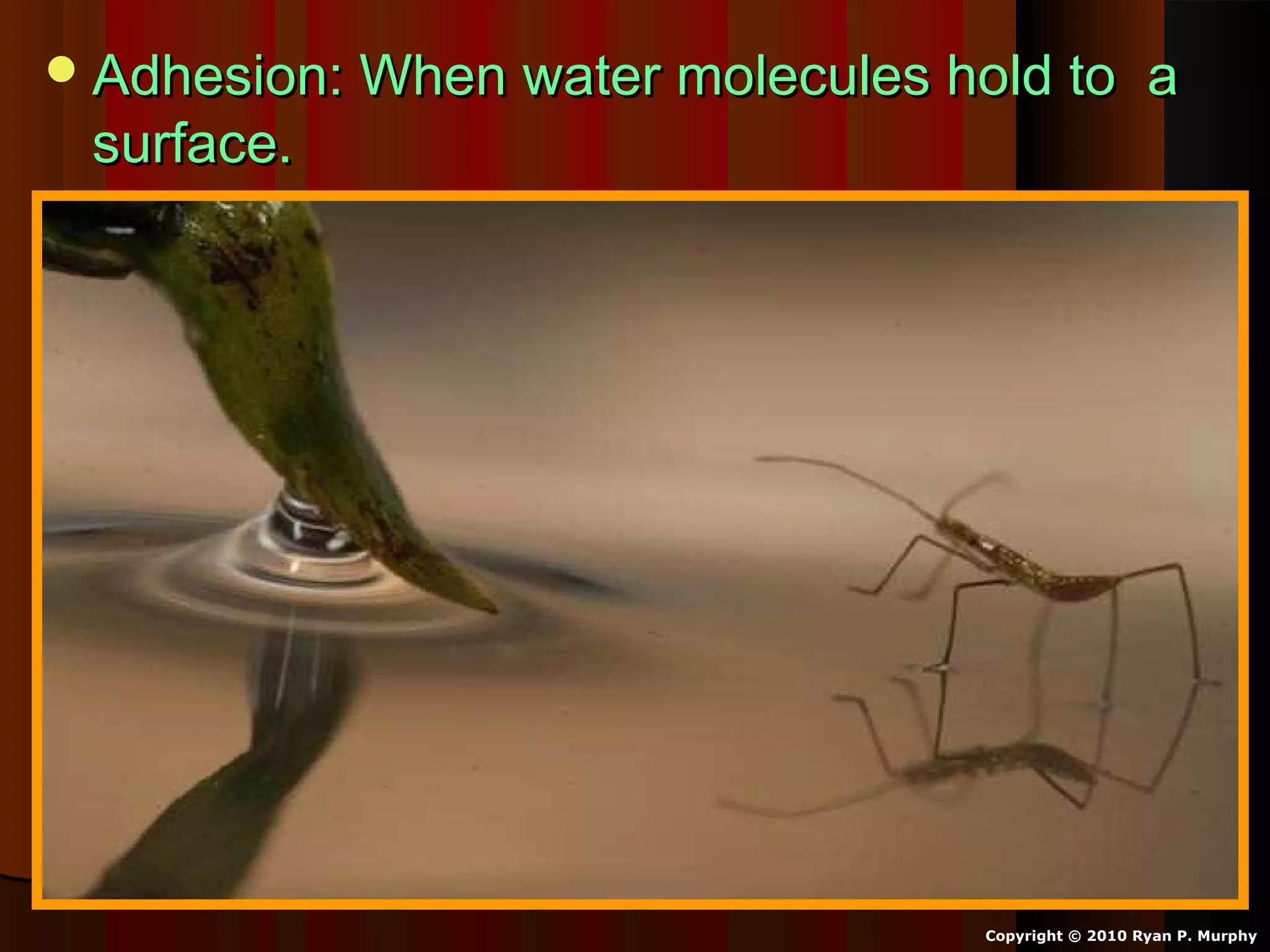
Adhesion: When water molecules hold to aAdhesion: When water molecules hold to a
surface.surface.
Copyright © 2010 Ryan P. Murphy
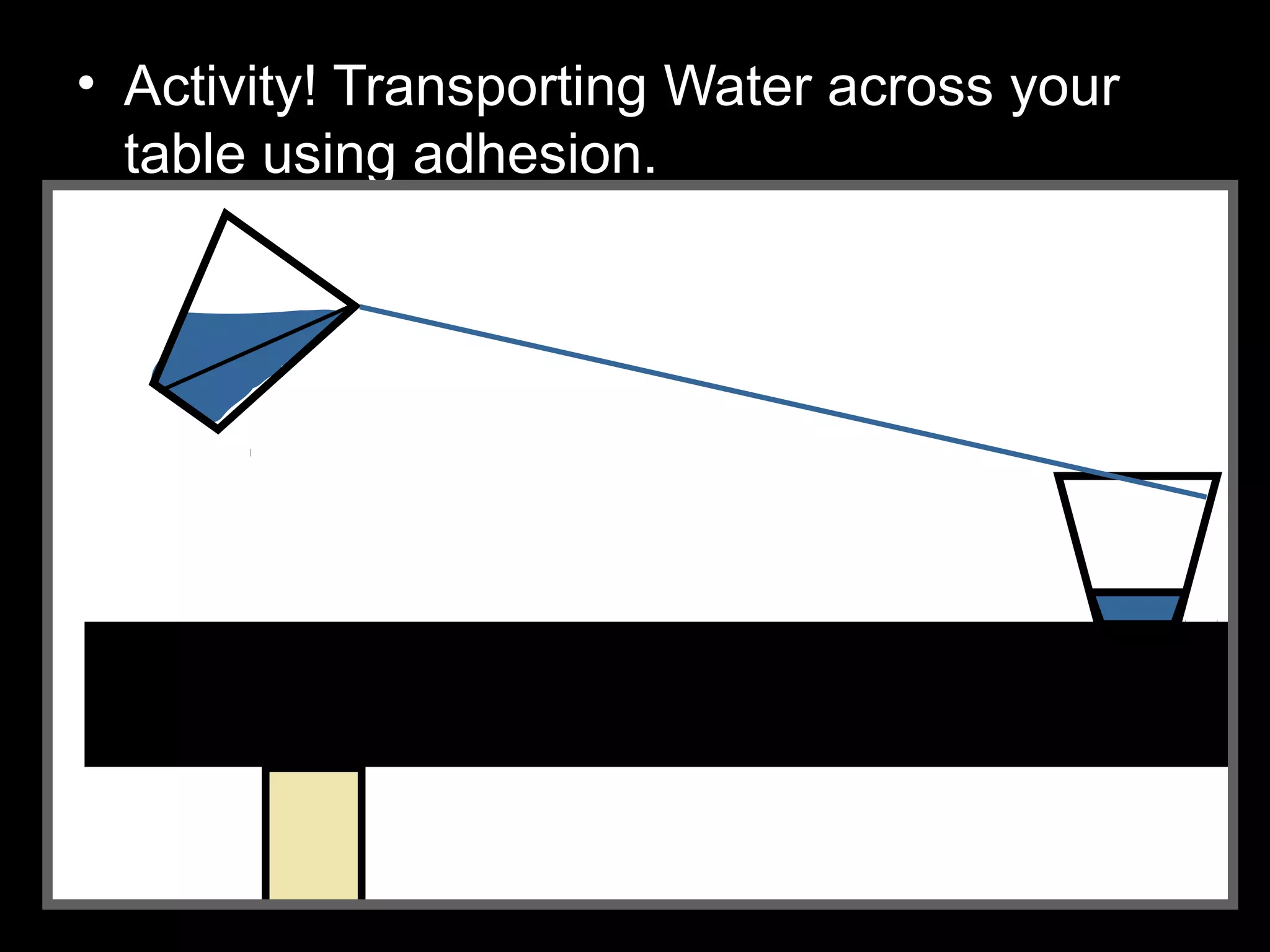
• Activity! Transporting Water across your
table using adhesion.
– Tie knots at the end of thick string.
– Secure string to the bottom of two clear
plastic cups.
– Fill one with water and food coloring and hold
high in the air.
– Keep the other near the table.
– Slowly pour the contents down the string to
the cup on the table. Adhesion!
• Activity! Transporting Water across your
table using adhesion.
– Tie knots at the end of thick string.
– Dip string into water.
– Secure string to two clear plastic cups. How
you do this will determine your success.
– Fill one with water and food coloring and hold
high in the air and pinch string with finger.
– Keep the other near the table / lower.
– Slowly pour the contents down the wet string
to the cup on the table. Adhesion!
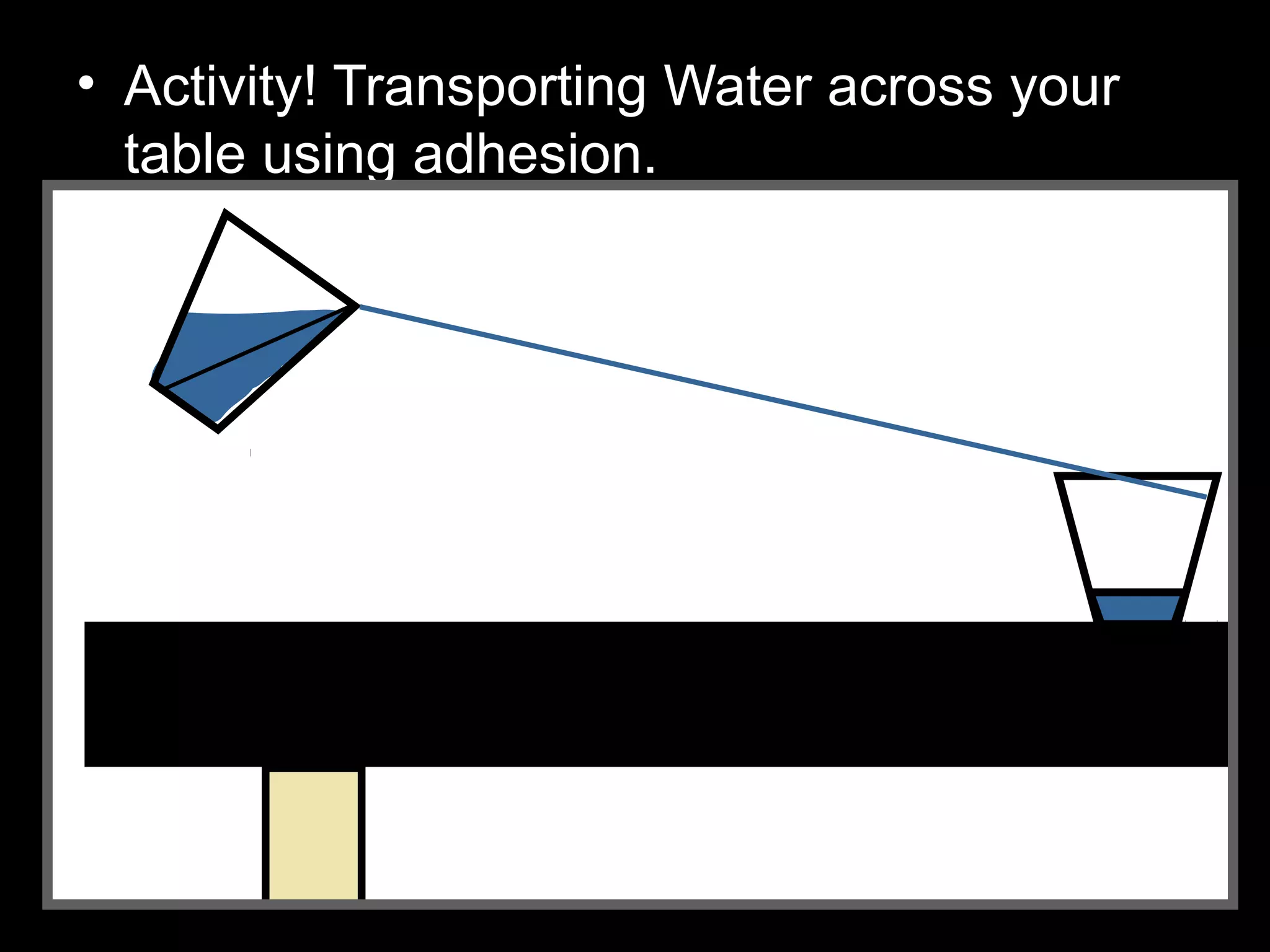
• Activity! Transporting Water across your
table using adhesion.
– Tie knots at the end of thick string.
– Secure string to the bottom of two clear
plastic cups.
– Fill one with water and food coloring and hold
high in the air.
– Keep the other near the table.
– Slowly pour the contents down the string to
the cup on the table. Adhesion!
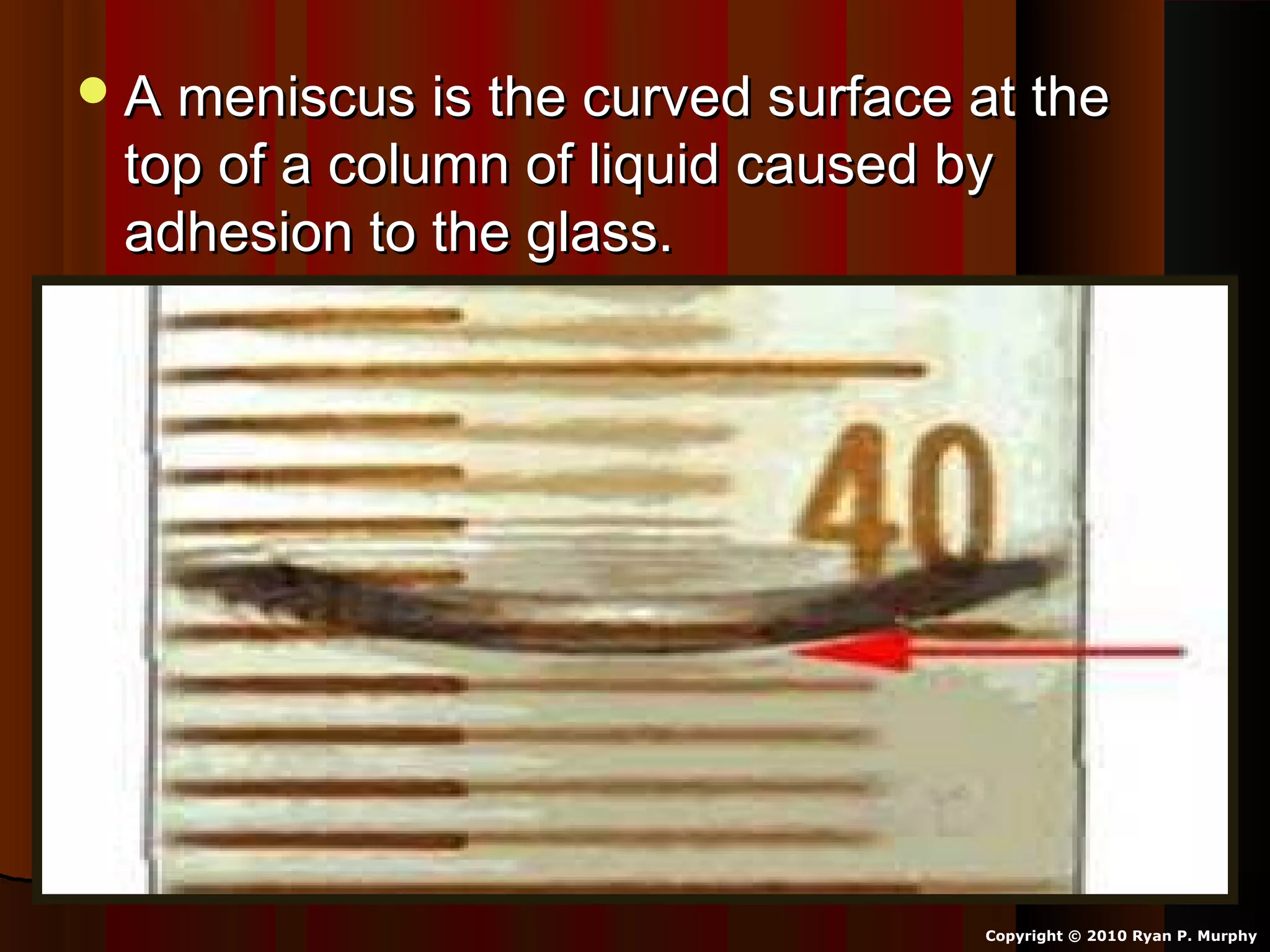
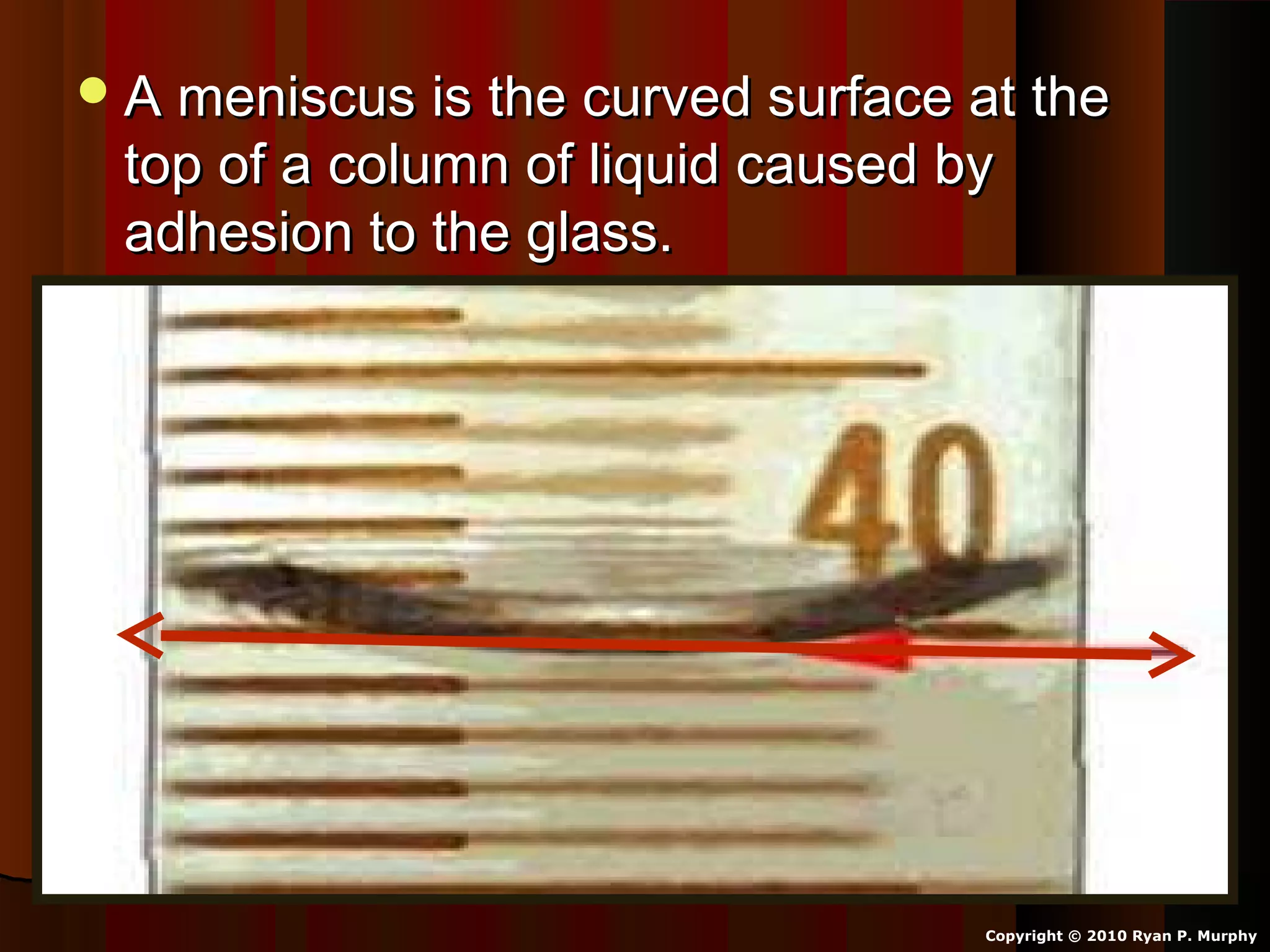
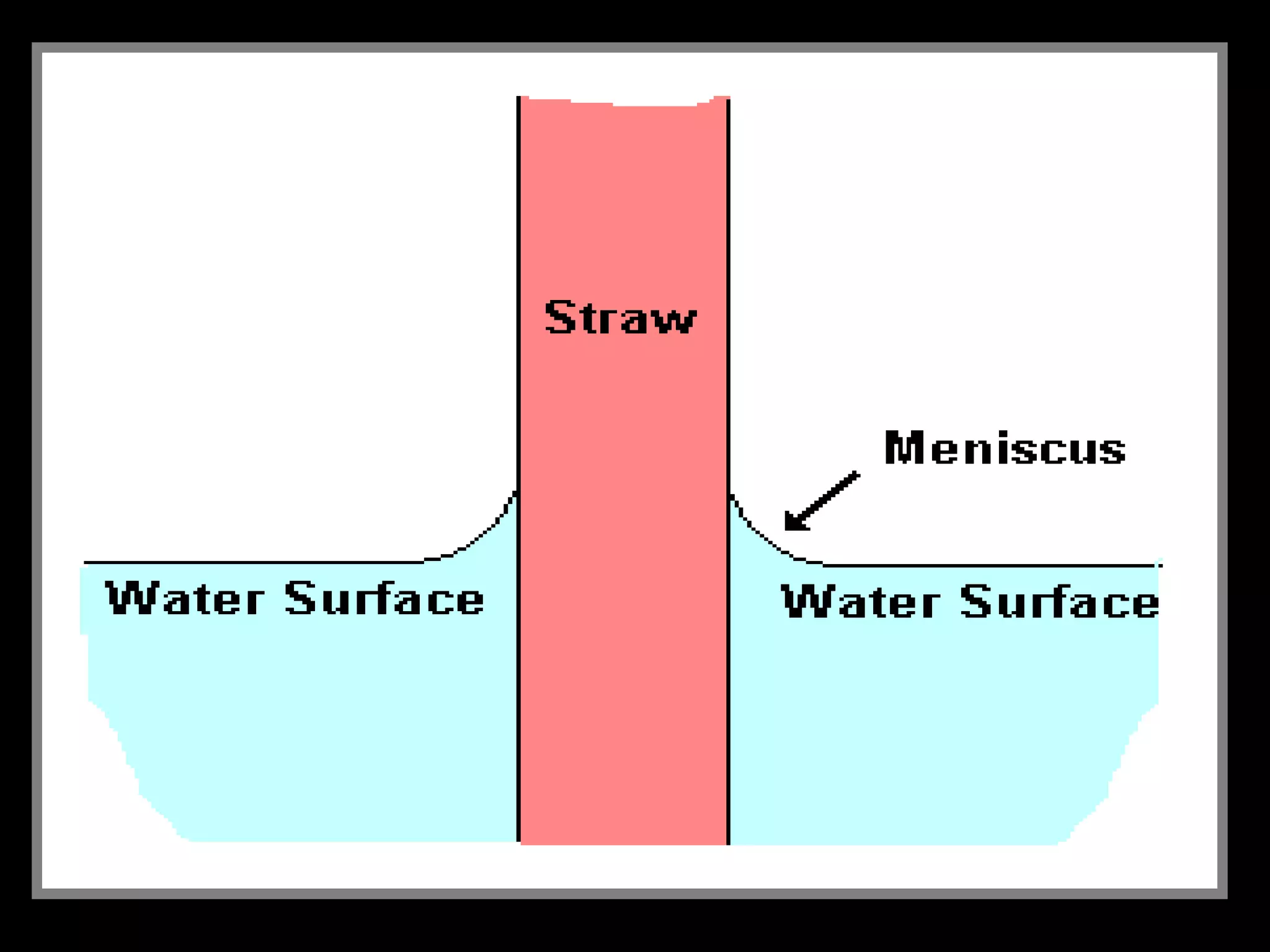
A meniscus is the curved surface at theA meniscus is the curved surface at the
top of a column of liquid caused bytop of a column of liquid caused by
adhesion to the glass.adhesion to the glass.
Copyright © 2010 Ryan P. Murphy
A meniscus is the curved surface at theA meniscus is the curved surface at the
top of a column of liquid caused bytop of a column of liquid caused by
adhesion to the glass.adhesion to the glass.
Copyright © 2010 Ryan P. Murphy
A meniscus is the curved surface at theA meniscus is the curved surface at the
top of a column of liquid caused bytop of a column of liquid caused by
adhesion to the glass.adhesion to the glass.
Copyright © 2010 Ryan P. Murphy
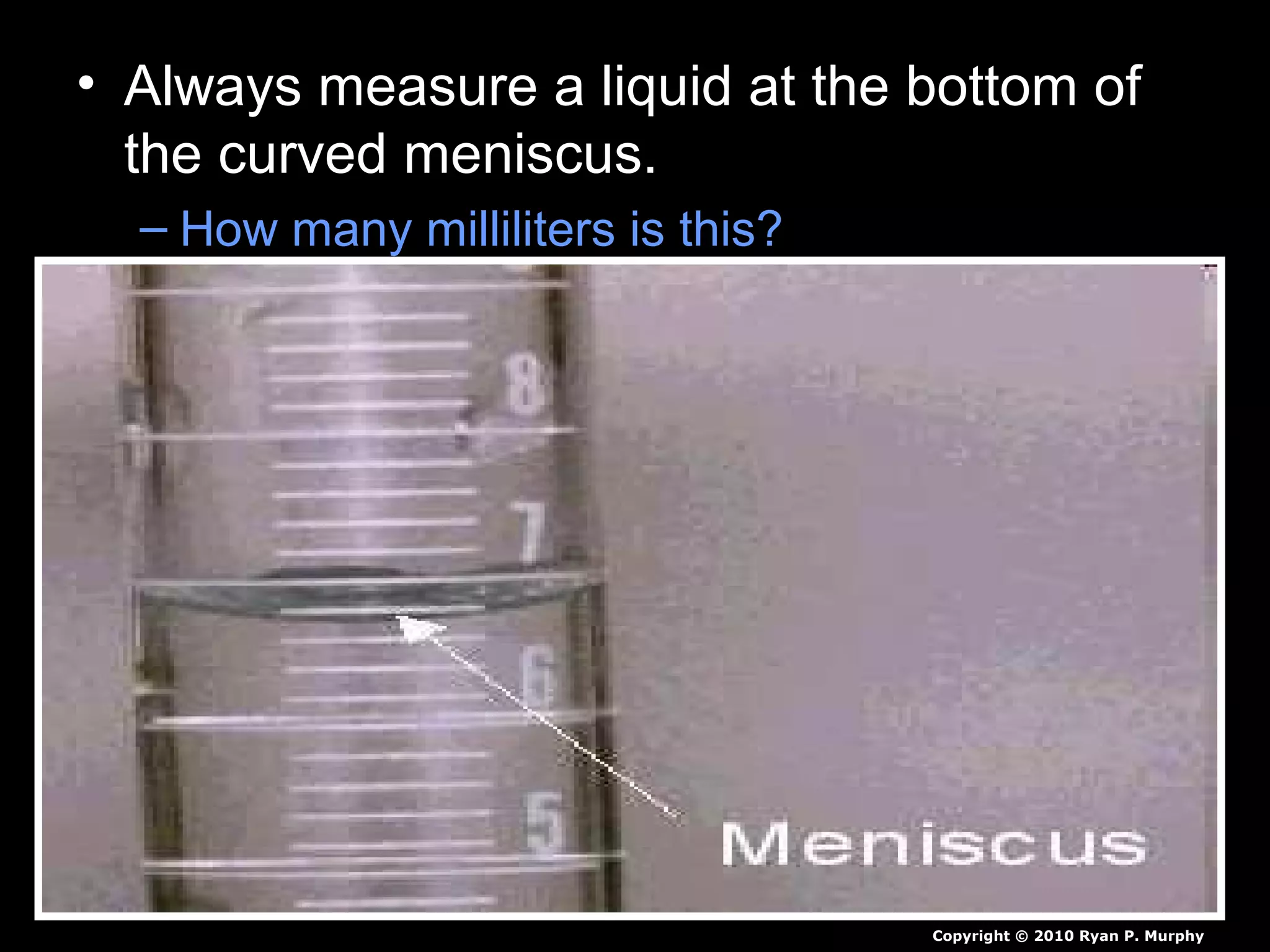
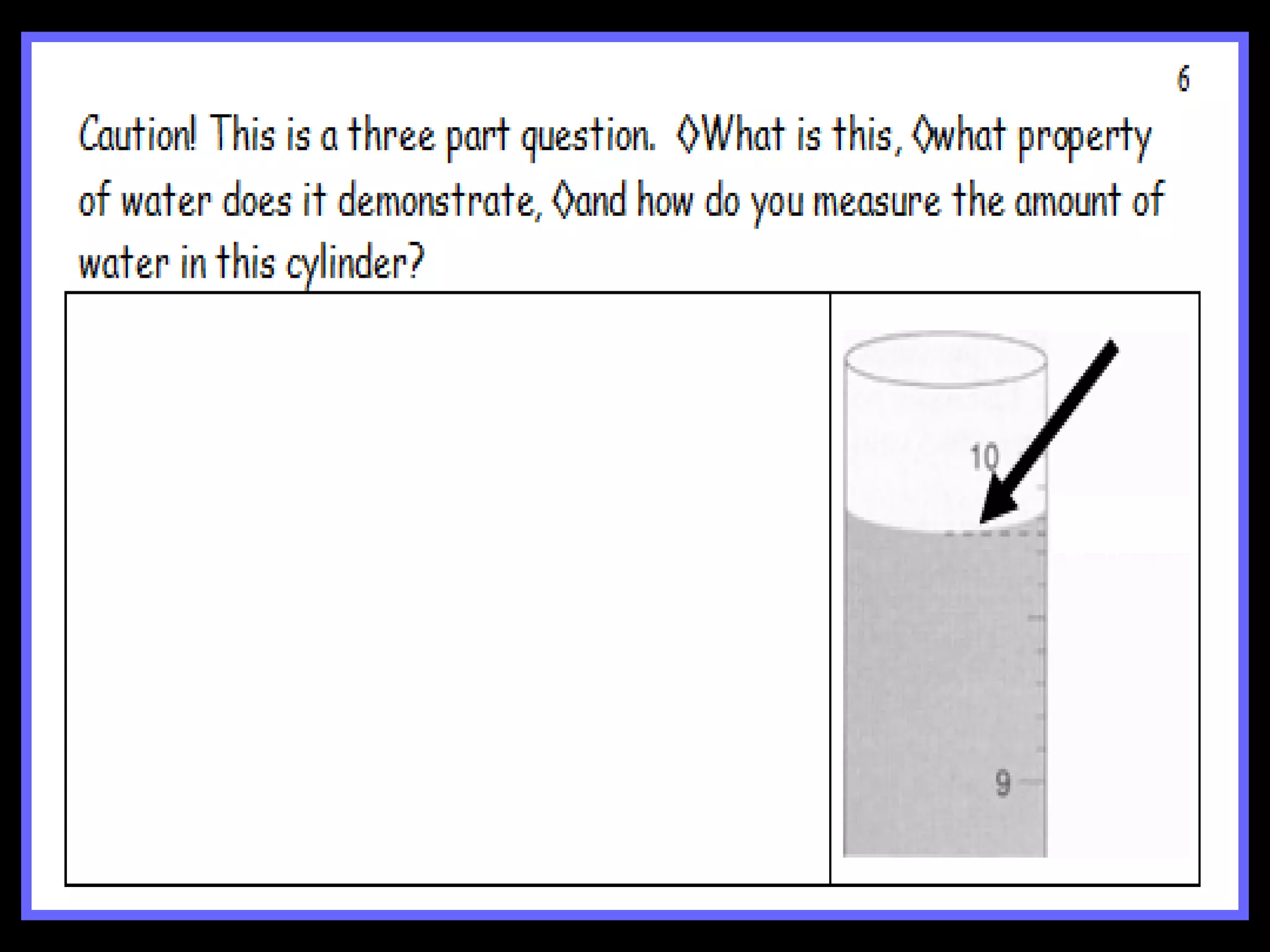
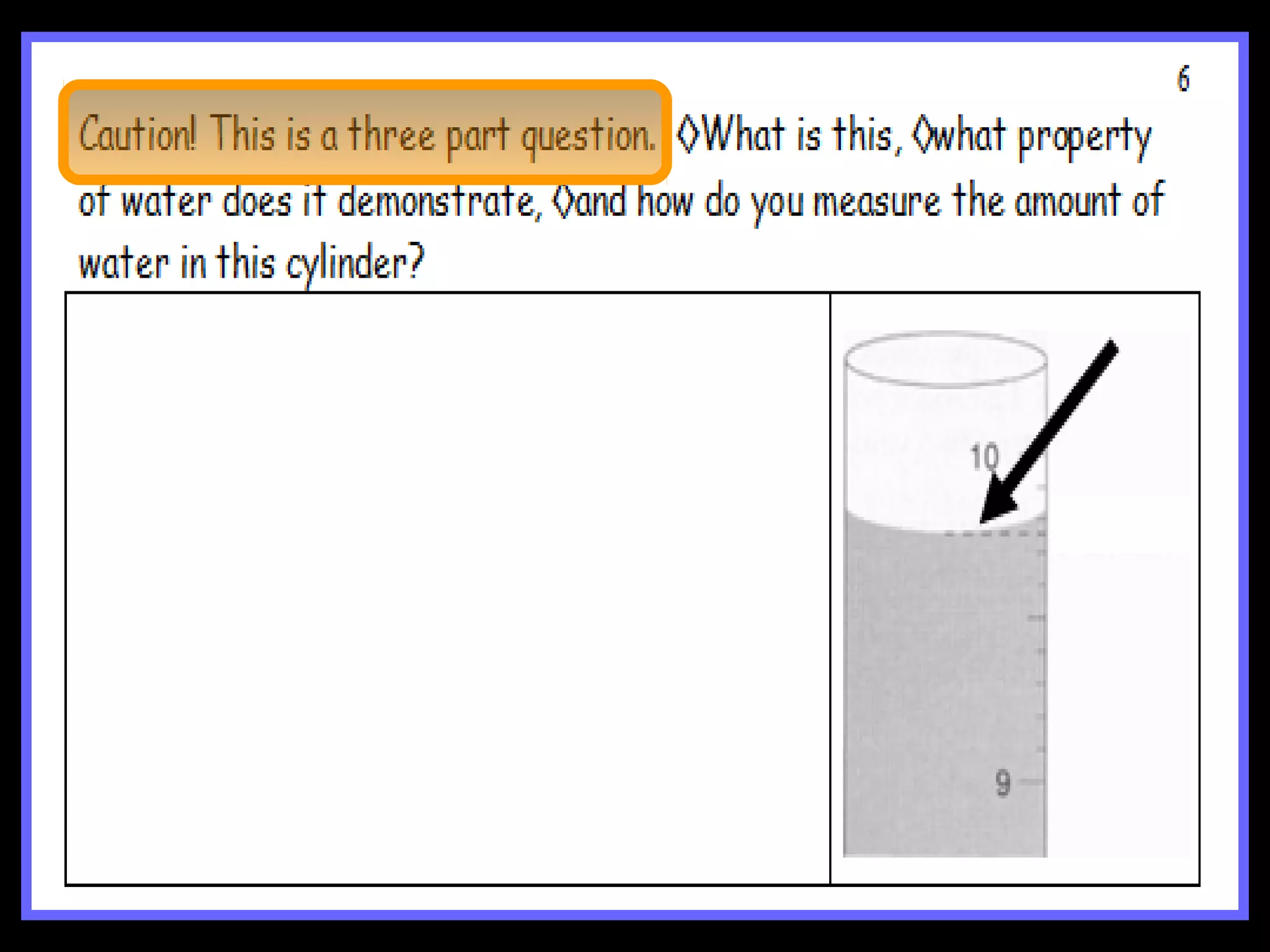
• Always measure a liquid at the bottom of
the curved meniscus.
– How many milliliters is this?
Copyright © 2010 Ryan P. Murphy
• Answer: 6.8 ml (milliliters)
Copyright © 2010 Ryan P. Murphy
• Answer: 6.8 ml (milliliters)
Copyright © 2010 Ryan P. Murphy
Learn more about adhesion and cohesion of
water at…
http://ga.water.usgs.gov/edu/adhesion.html
• Available Sheet: Properties of Water.
– Note: This will be due at the end of Part II.
– Bring to class everyday.
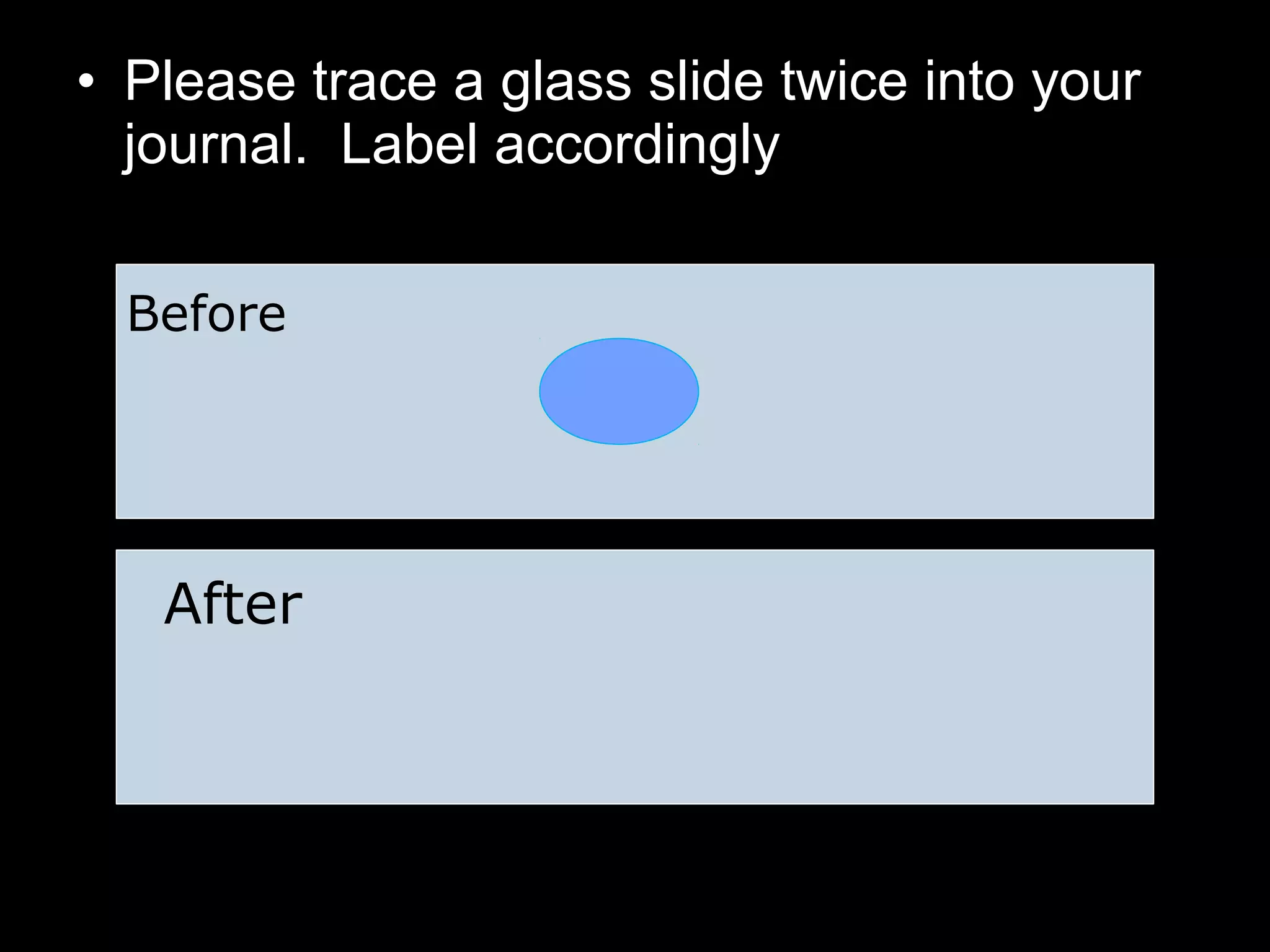
• Please trace a glass slide twice into your
journal. Label accordingly
Before
After
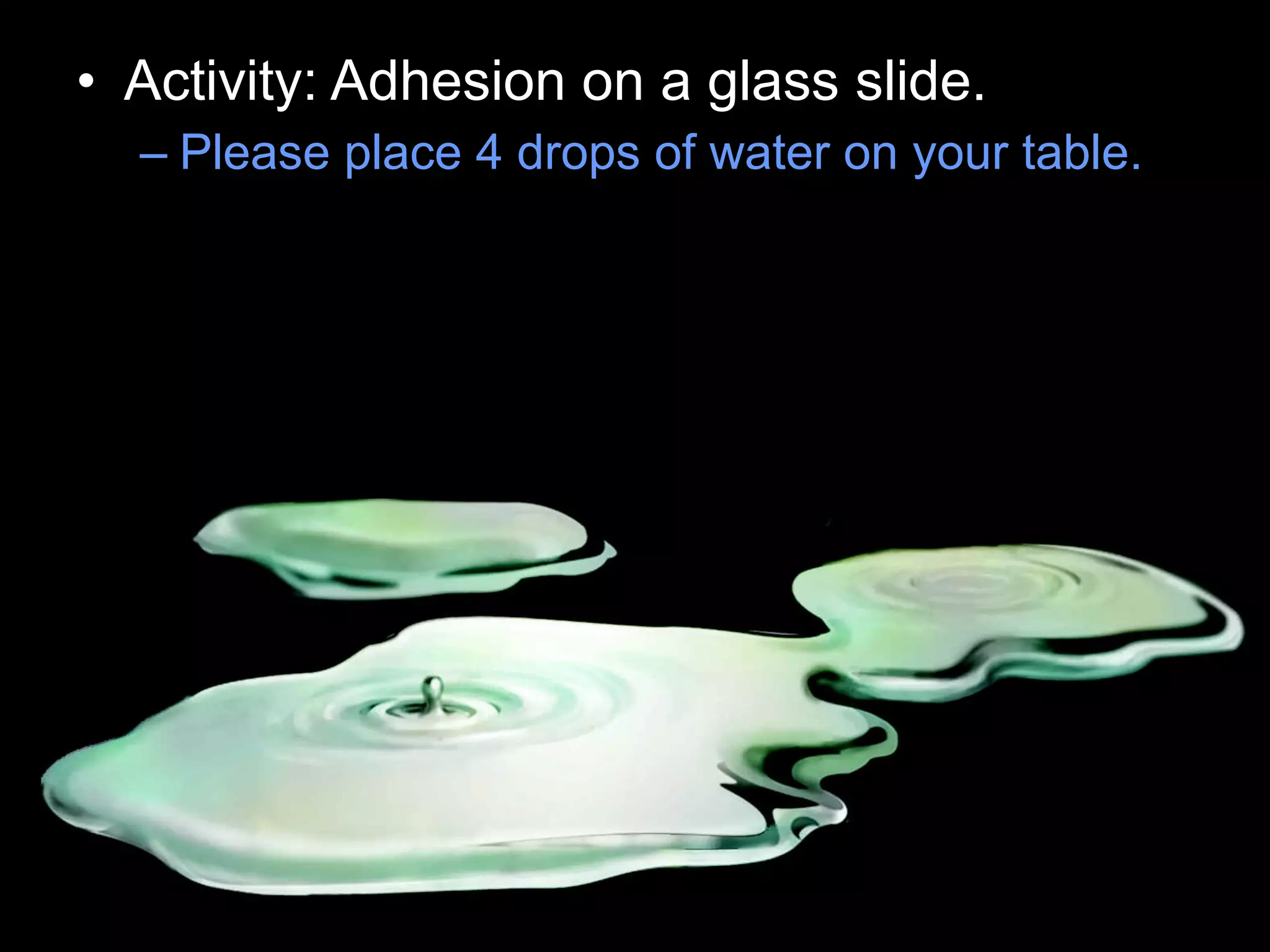
• Activity: Adhesion on a glass slide.
Copyright © 2010 Ryan P. Murphy
• Activity: Adhesion on a glass slide.
– Please place 4 drops of water on your table.
Copyright © 2010 Ryan P. Murphy
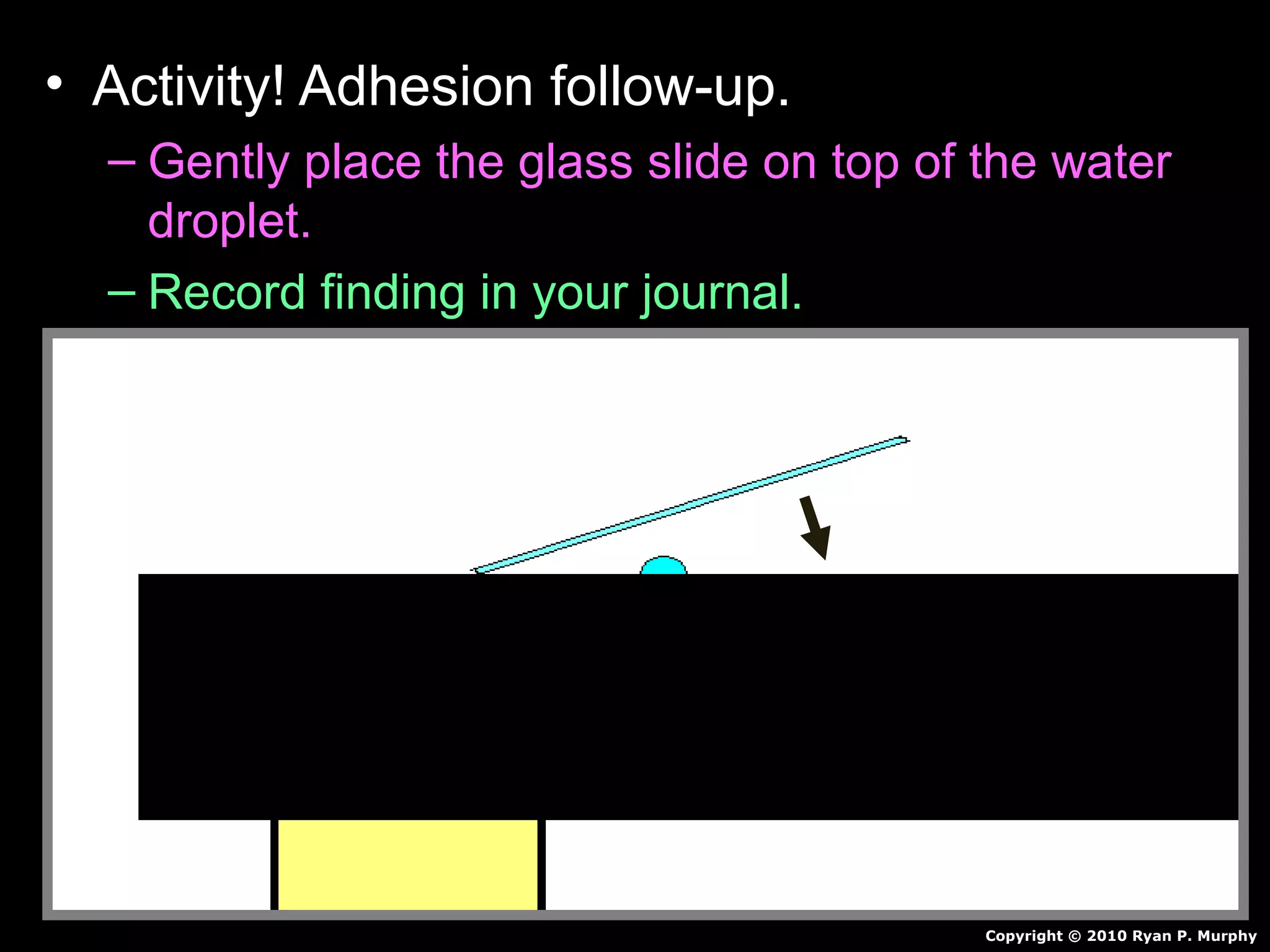
• Activity! Adhesion follow-up.
– Gently place the glass slide on top of the water
droplet.
– Record finding in your journal.
Copyright © 2010 Ryan P. Murphy
After
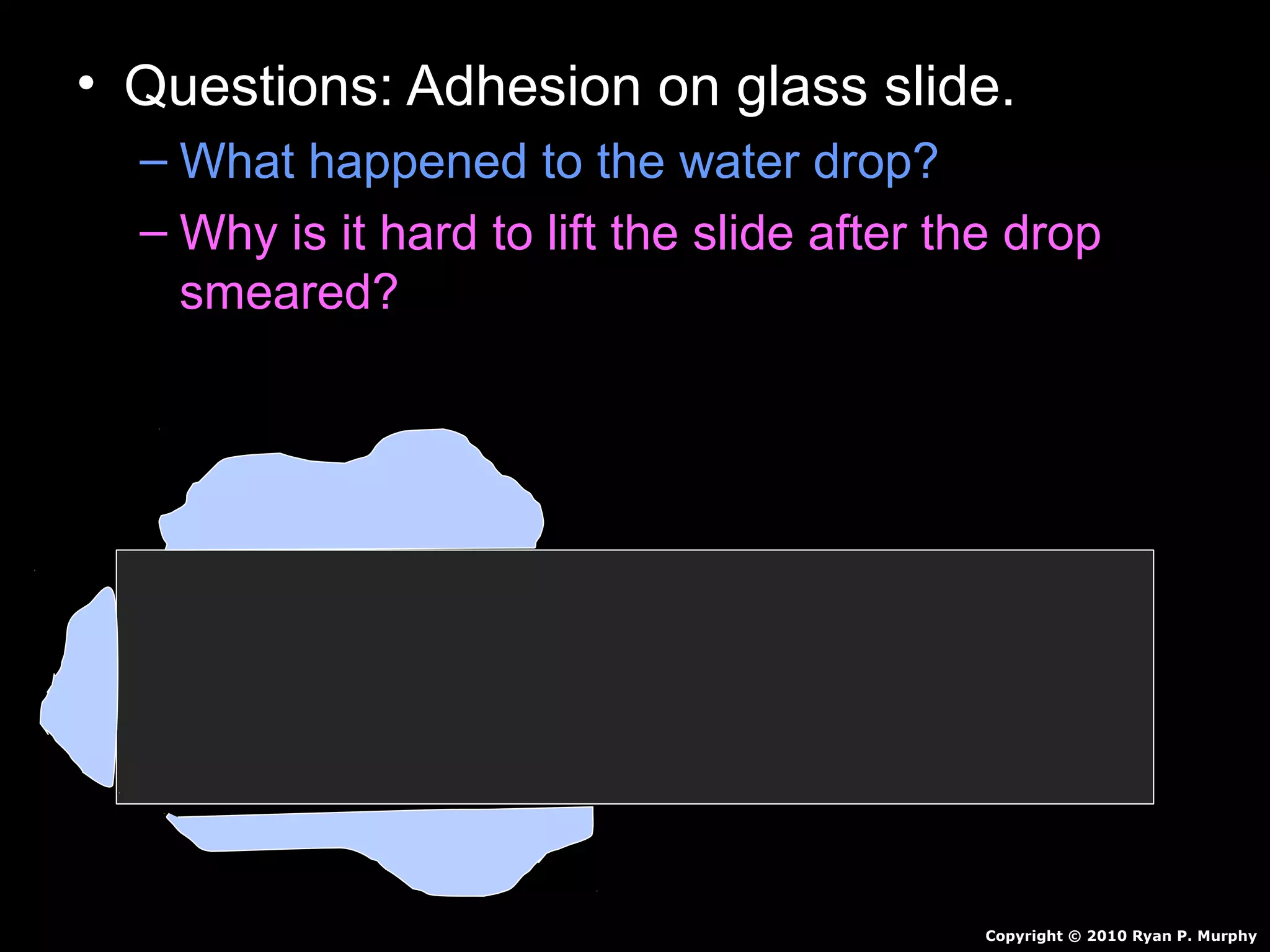
• Questions: Adhesion on glass slide.
– What happened to the water drop?
– Why is it hard to lift the slide after the drop
smeared?
Copyright © 2010 Ryan P. Murphy
• Questions: Adhesion on glass slide.
– What happened to the water drop?
Copyright © 2010 Ryan P. Murphy
• Questions: Adhesion on glass slide.
– What happened to the water drop?
– Answer: The water spread out between the
glass and the table because of adhesion.
Copyright © 2010 Ryan P. Murphy
• Questions: Adhesion on glass slide.
– Why is it hard to lift the slide after the drop
smeared?
Copyright © 2010 Ryan P. Murphy
• Questions: Adhesion on glass slide.
– Why is it hard to lift the slide after the drop
smeared?
– The water molecules adhered to the table,
glass, and other water molecules.
Copyright © 2010 Ryan P. Murphy
• You can now complete this question.
• Available Sheet: Properties of Water.
– Note: This will be due at the end of Part II.
– Bring to class everyday.
• Activity! Adhesion and Capillary Action.
– Please dip one end of the celery into a
container with red food coloring.
– Record your observations in your journal
every few minutes with pictures and text.
– Leave the celery in the water for overnight.
Copyright © 2010 Ryan P. Murphy
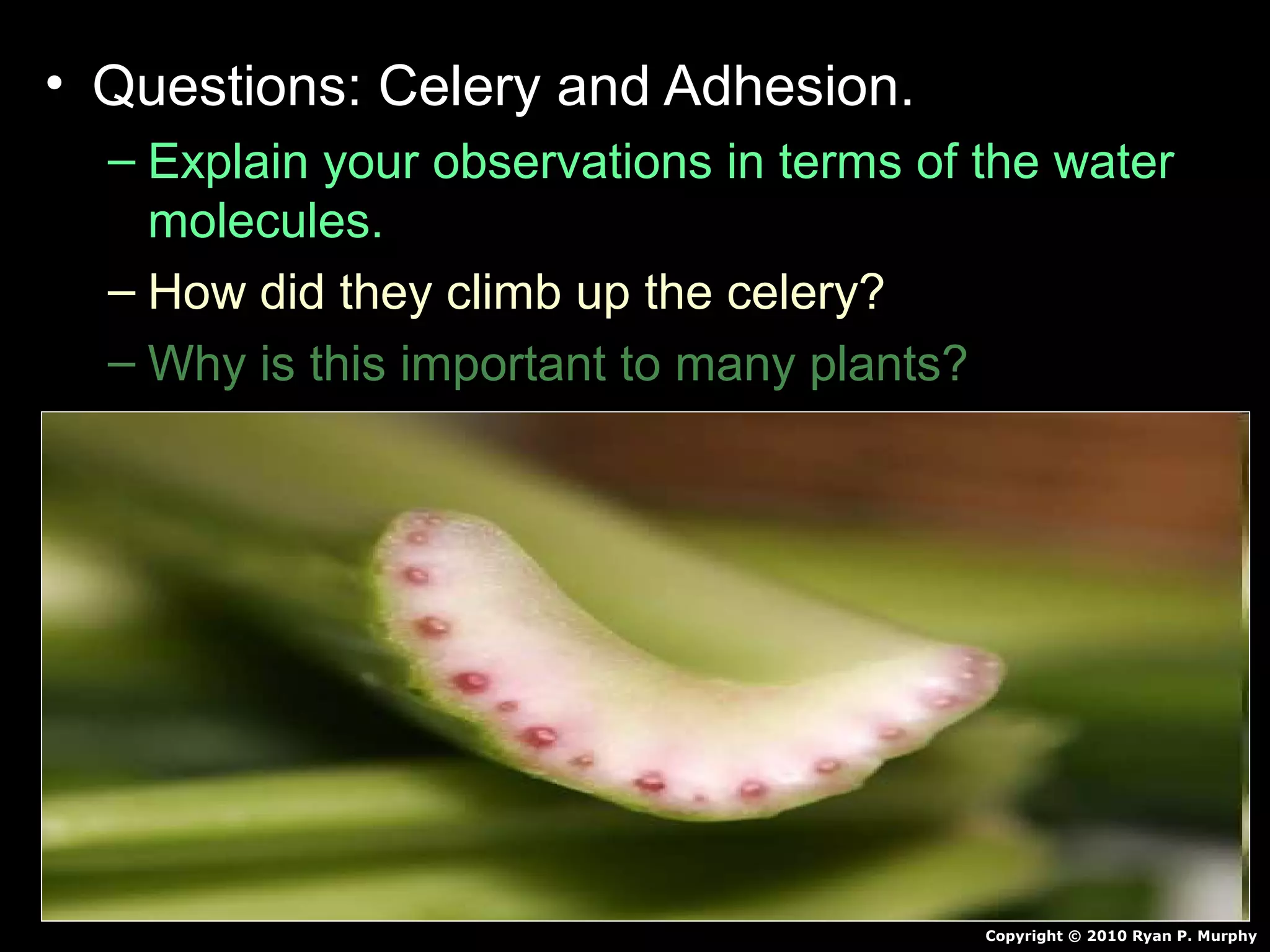
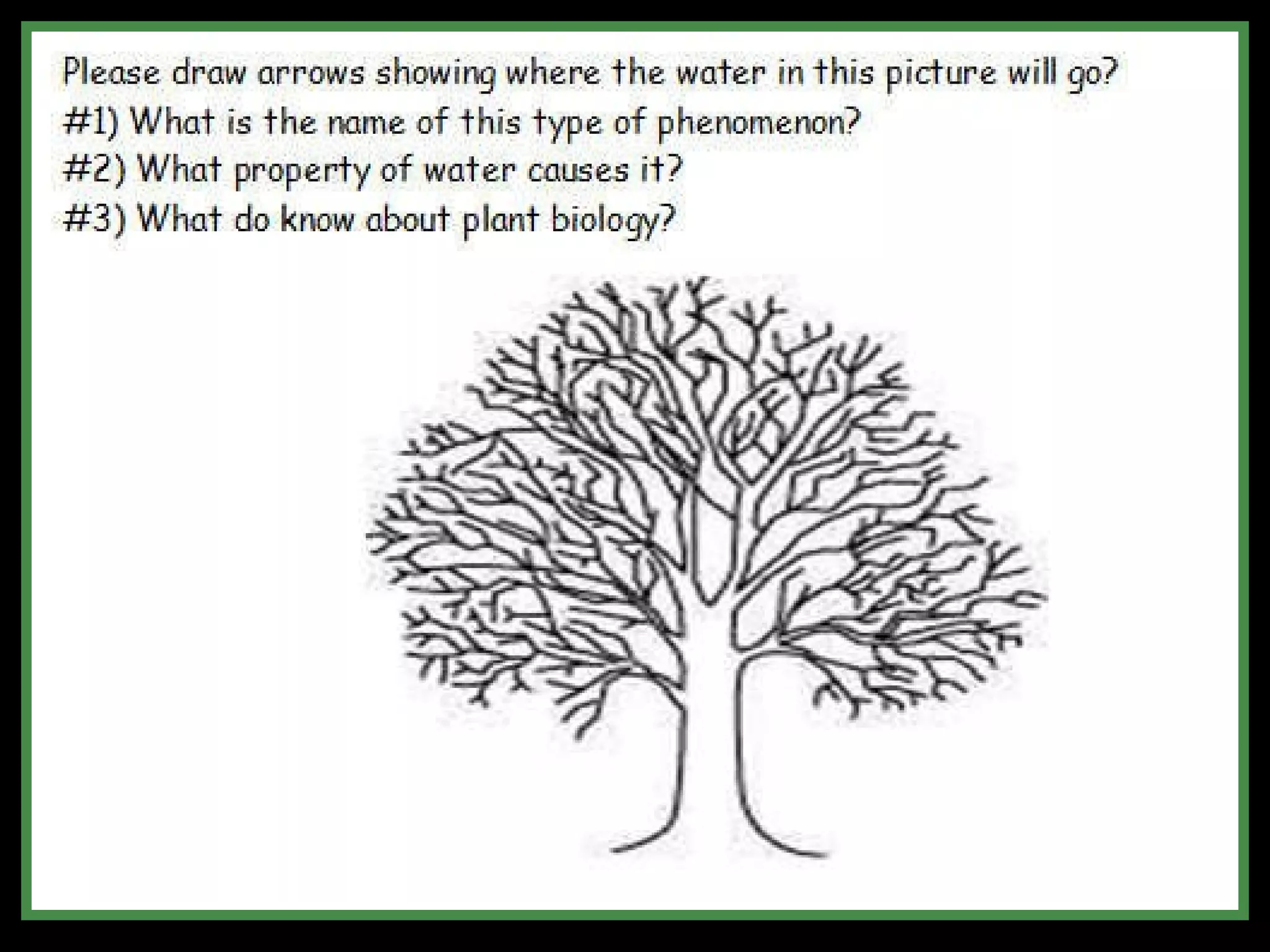
• Questions: Celery and Adhesion.
– Explain your observations in terms of the water
molecules.
– How did they climb up the celery?
– Why is this important to many plants?
Copyright © 2010 Ryan P. Murphy
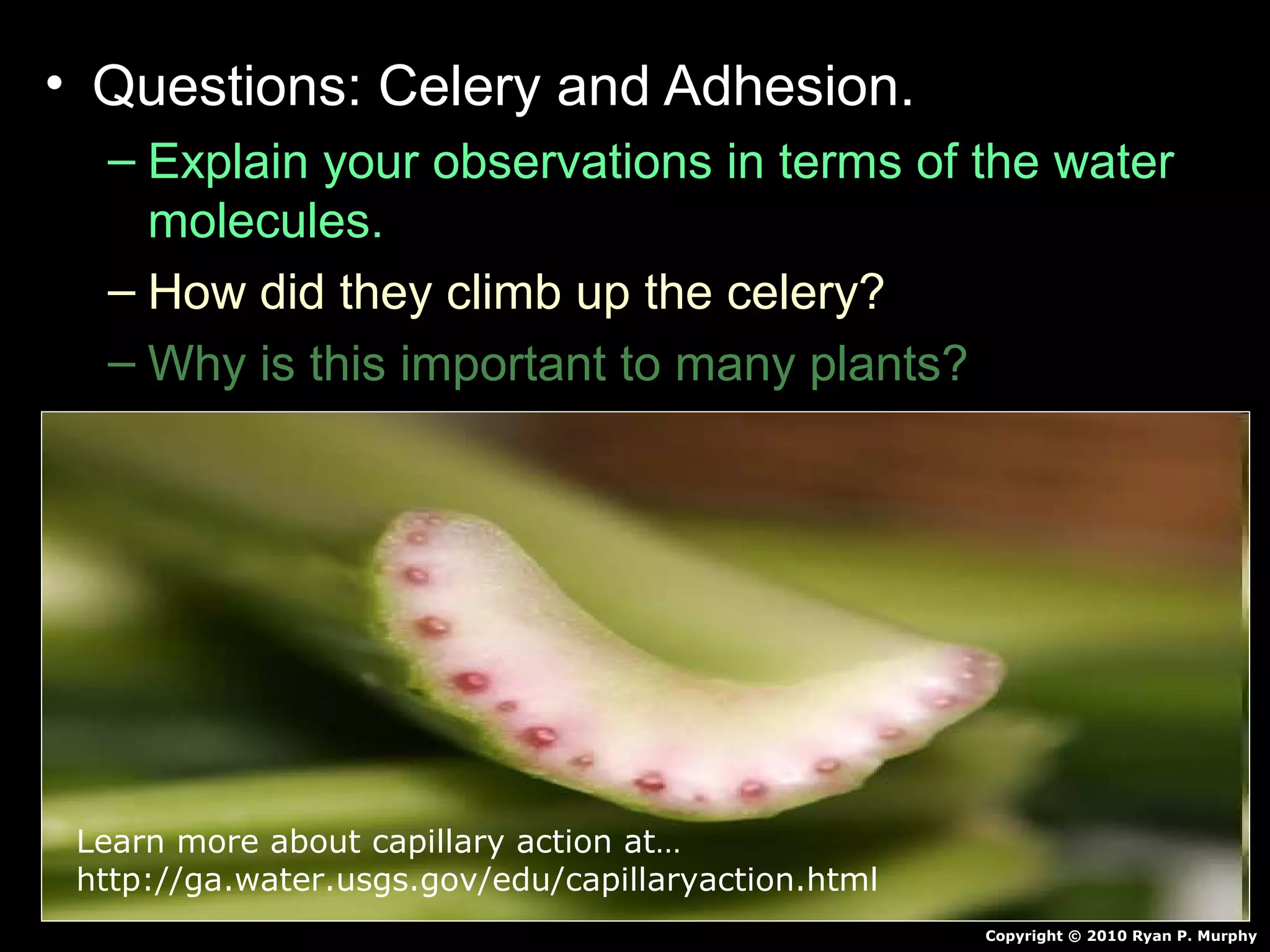
• Questions: Celery and Adhesion.
– Explain your observations in terms of the water
molecules.
– How did they climb up the celery?
– Why is this important to many plants?
Copyright © 2010 Ryan P. Murphy
Learn more about capillary action at…
http://ga.water.usgs.gov/edu/capillaryaction.html
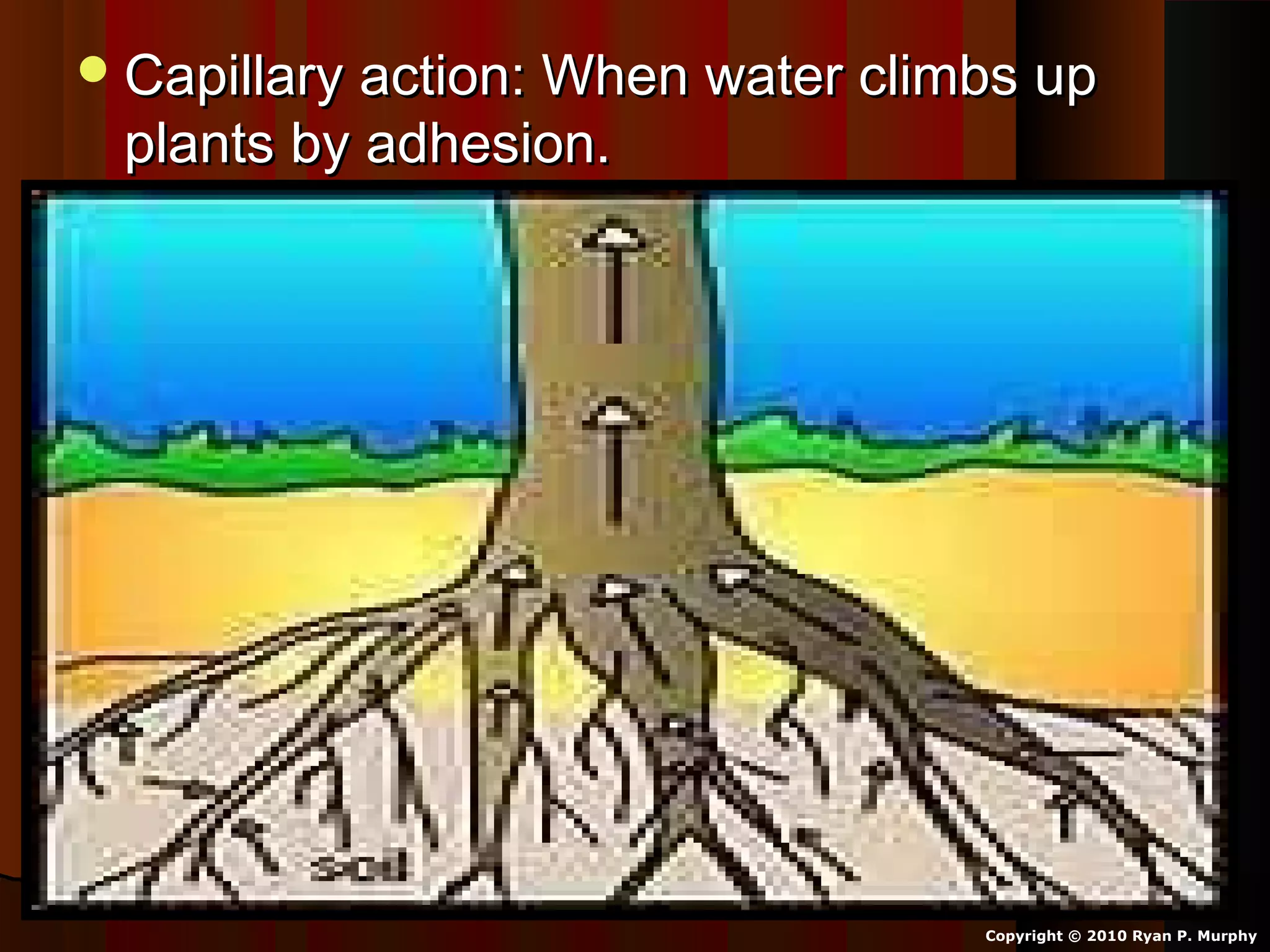
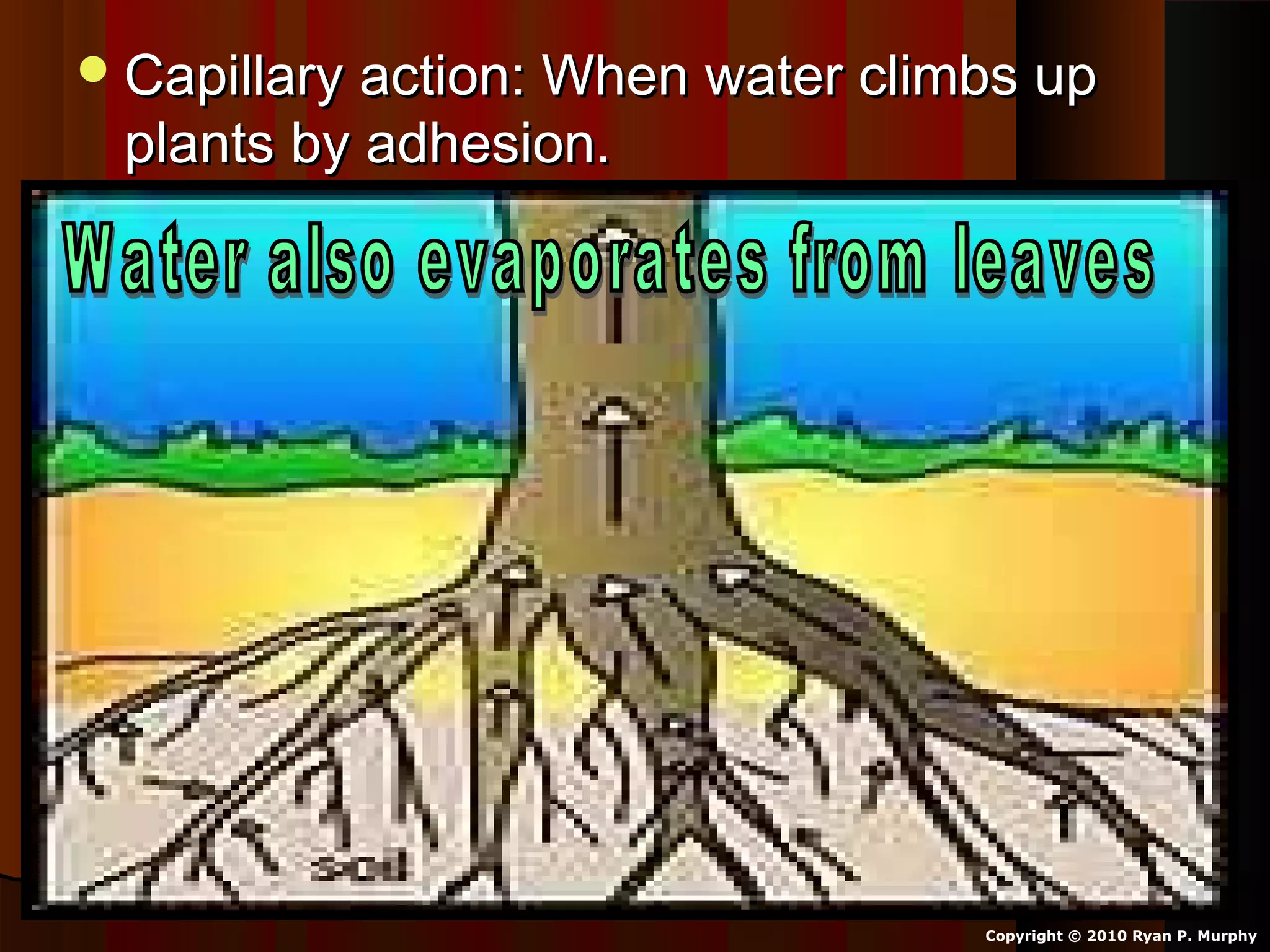
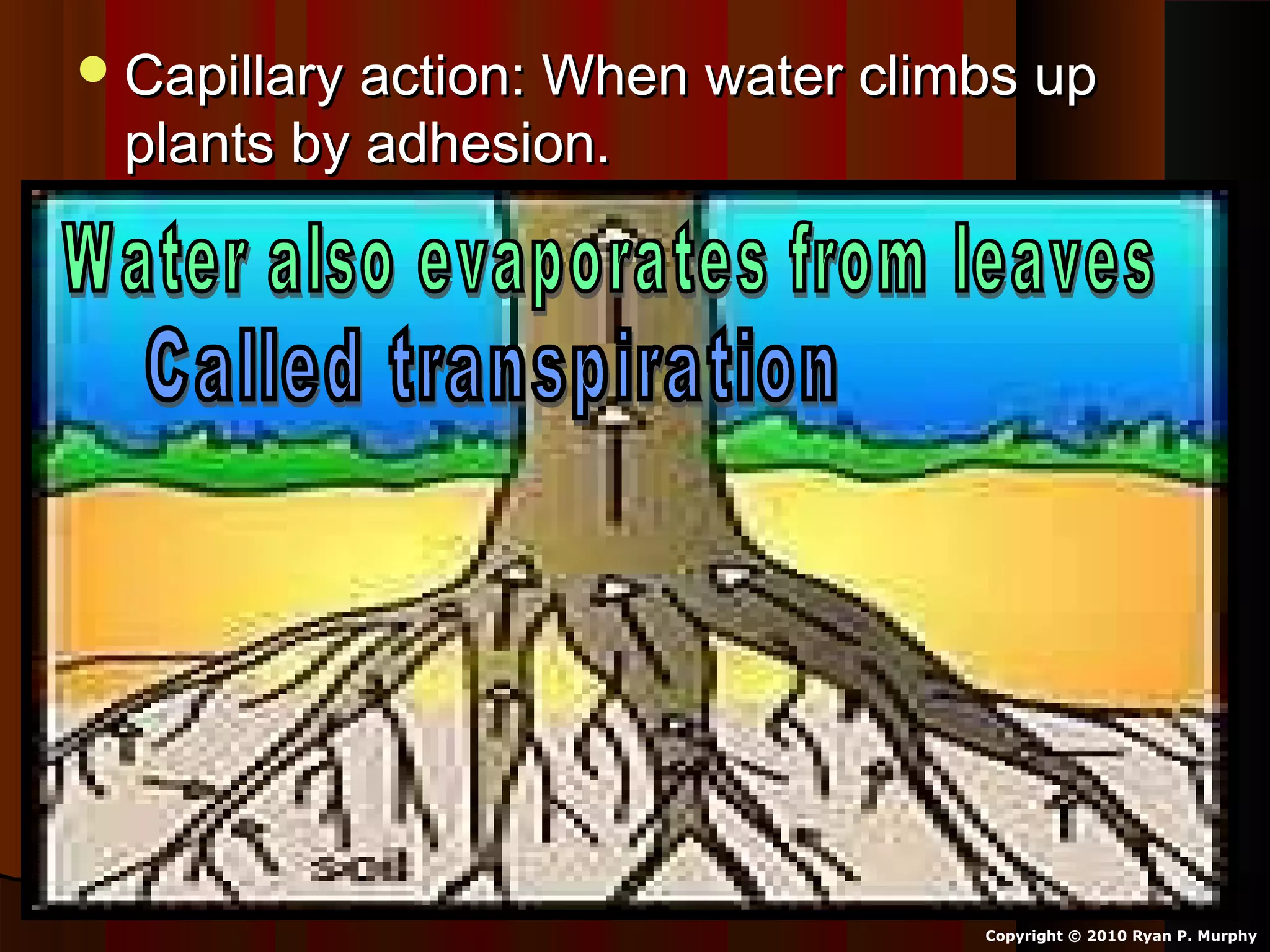
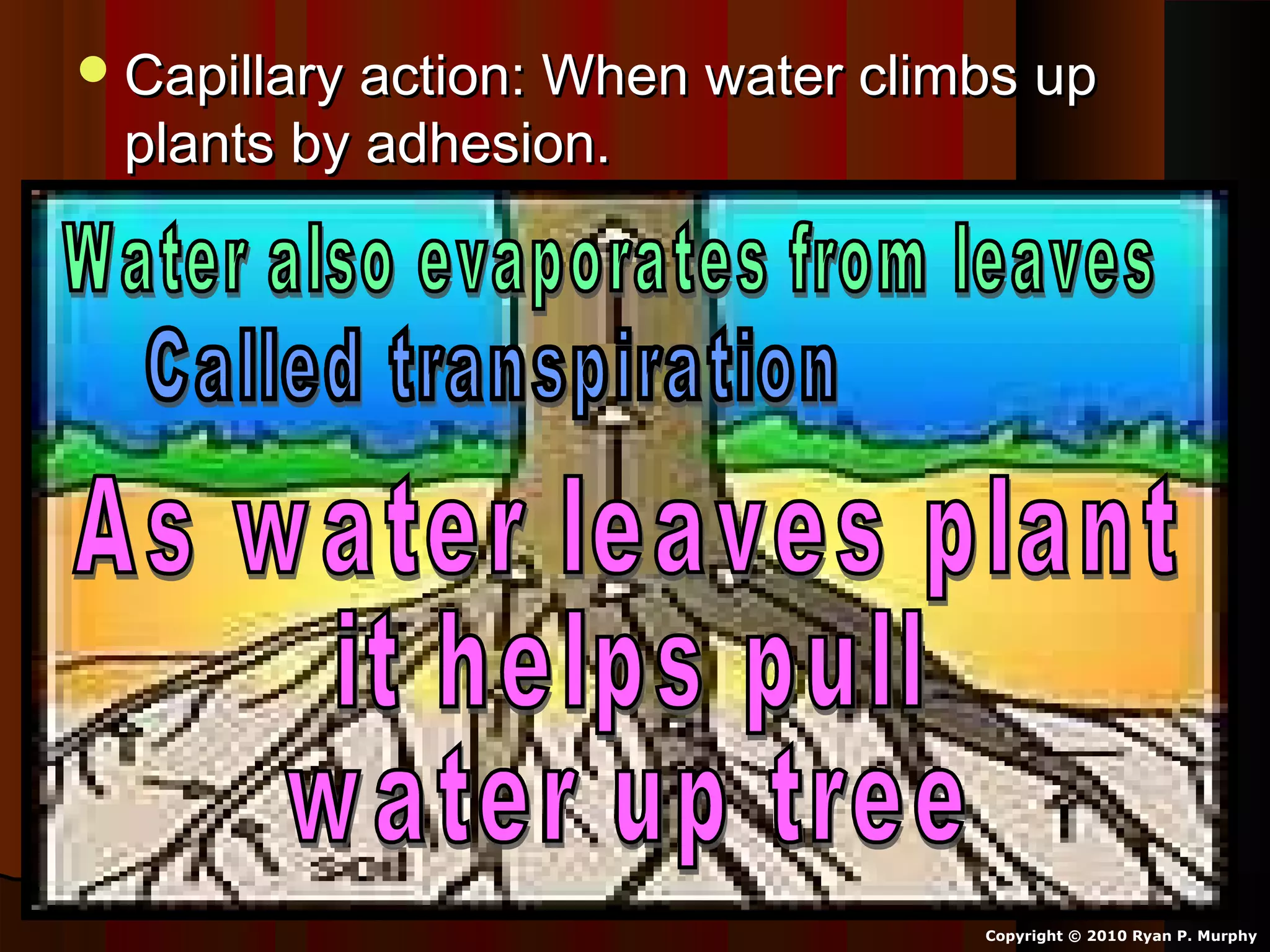
Capillary action: When water climbs upCapillary action: When water climbs up
plants by adhesion.plants by adhesion.
Copyright © 2010 Ryan P. Murphy
Capillary action: When water climbs upCapillary action: When water climbs up
plants by adhesion.plants by adhesion.
Copyright © 2010 Ryan P. Murphy
Capillary action: When water climbs upCapillary action: When water climbs up
plants by adhesion.plants by adhesion.
Copyright © 2010 Ryan P. Murphy
Capillary action: When water climbs upCapillary action: When water climbs up
plants by adhesion.plants by adhesion.
Copyright © 2010 Ryan P. Murphy
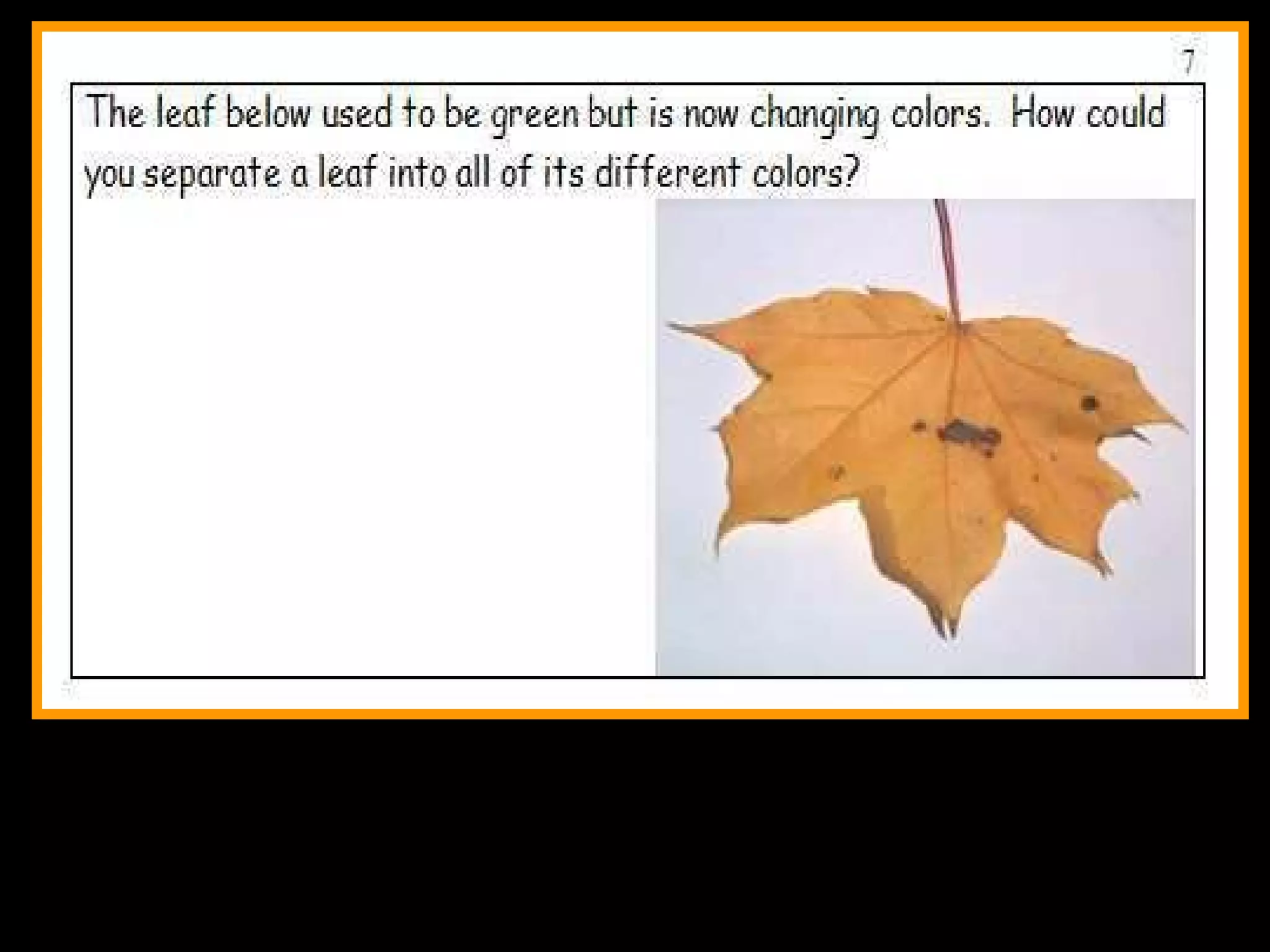
Chromatography: A method used toChromatography: A method used to
separate complex mixtures using adhesion.separate complex mixtures using adhesion.
Copyright © 2010 Ryan P. Murphy
• Available Sheet: Properties of Water.
– Note: This will be due at the end of Part II.
– Bring to class everyday.
• Activity! Dissection!
We are going to dissect
this black dot.
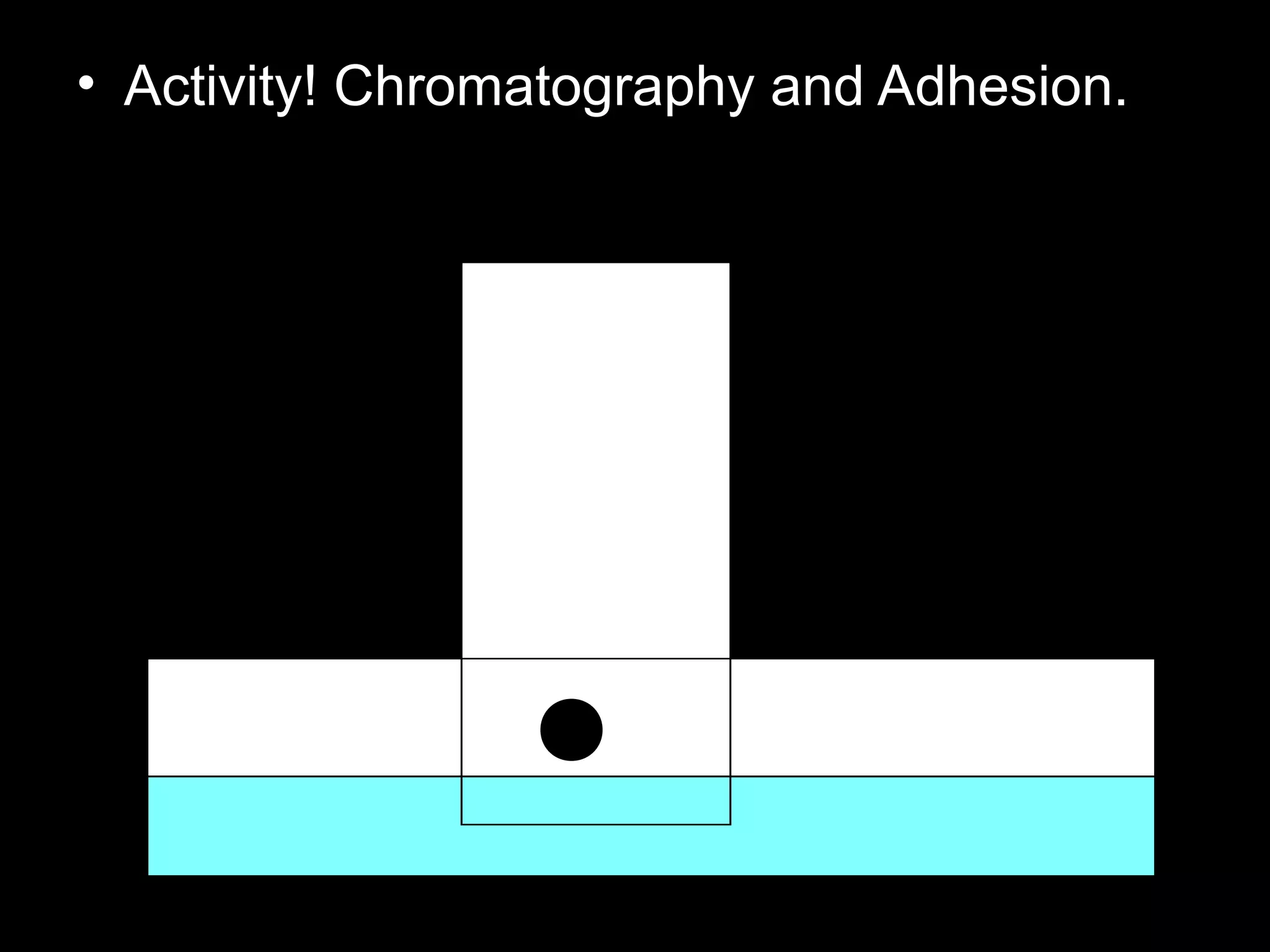
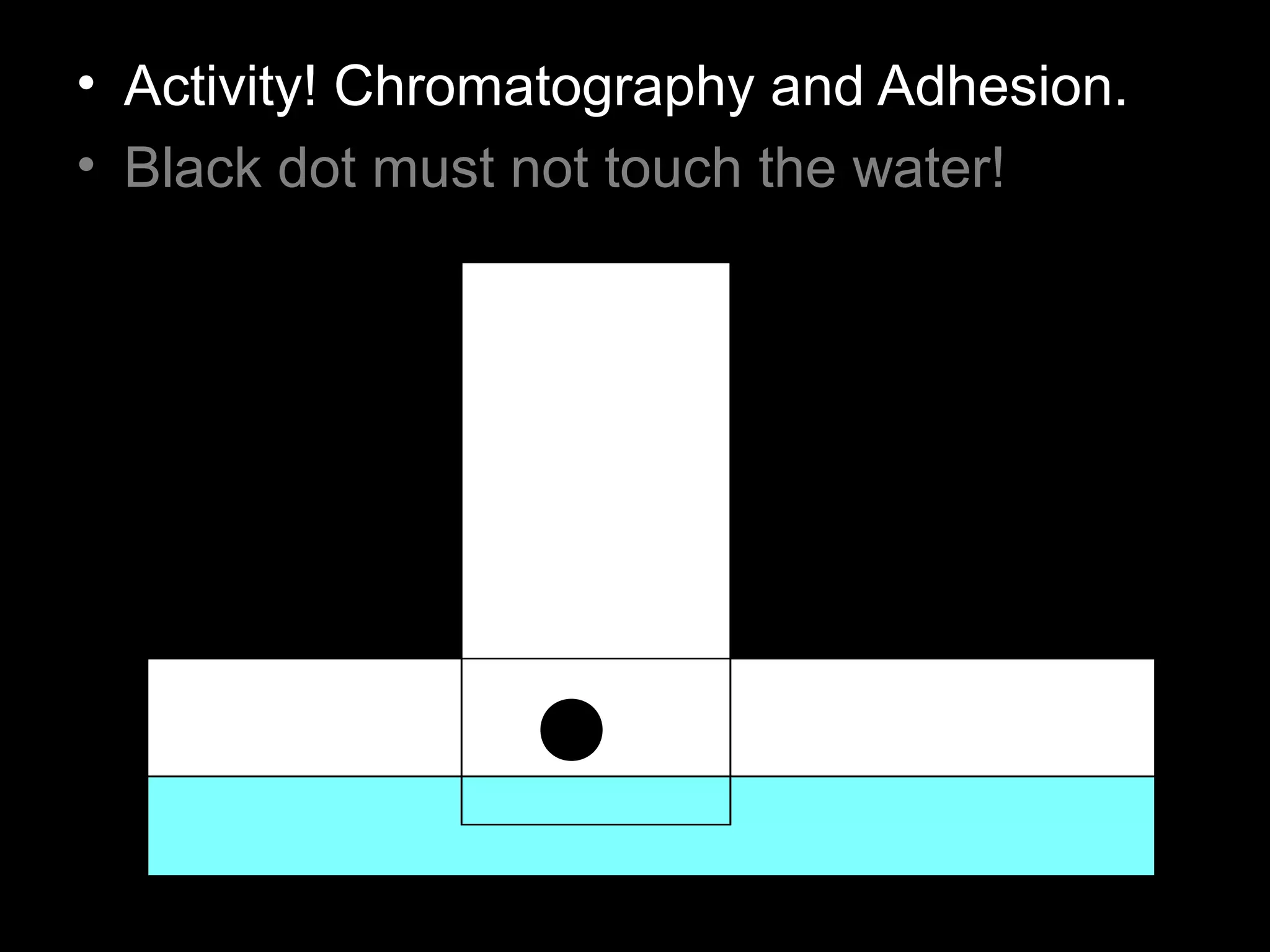
• Activity! Chromatography and Adhesion.
• Black dot must not touch the water!
• Activity! Dissecting a black dot.
– Challenge, Separate all of the colors of a black
dot.
– Procedure: Make a black dot on the bottom of
the coffee filter paper with black vis-à-vis marker
(cut into long rectangles).
– Place bottom of coffee filter in water.
• (Dot needs to stay above water level.)
– Keep the bottom of the coffee filter in the water
for 10 minutes
– Record results in a drawing.
Copyright © 2010 Ryan P. Murphy
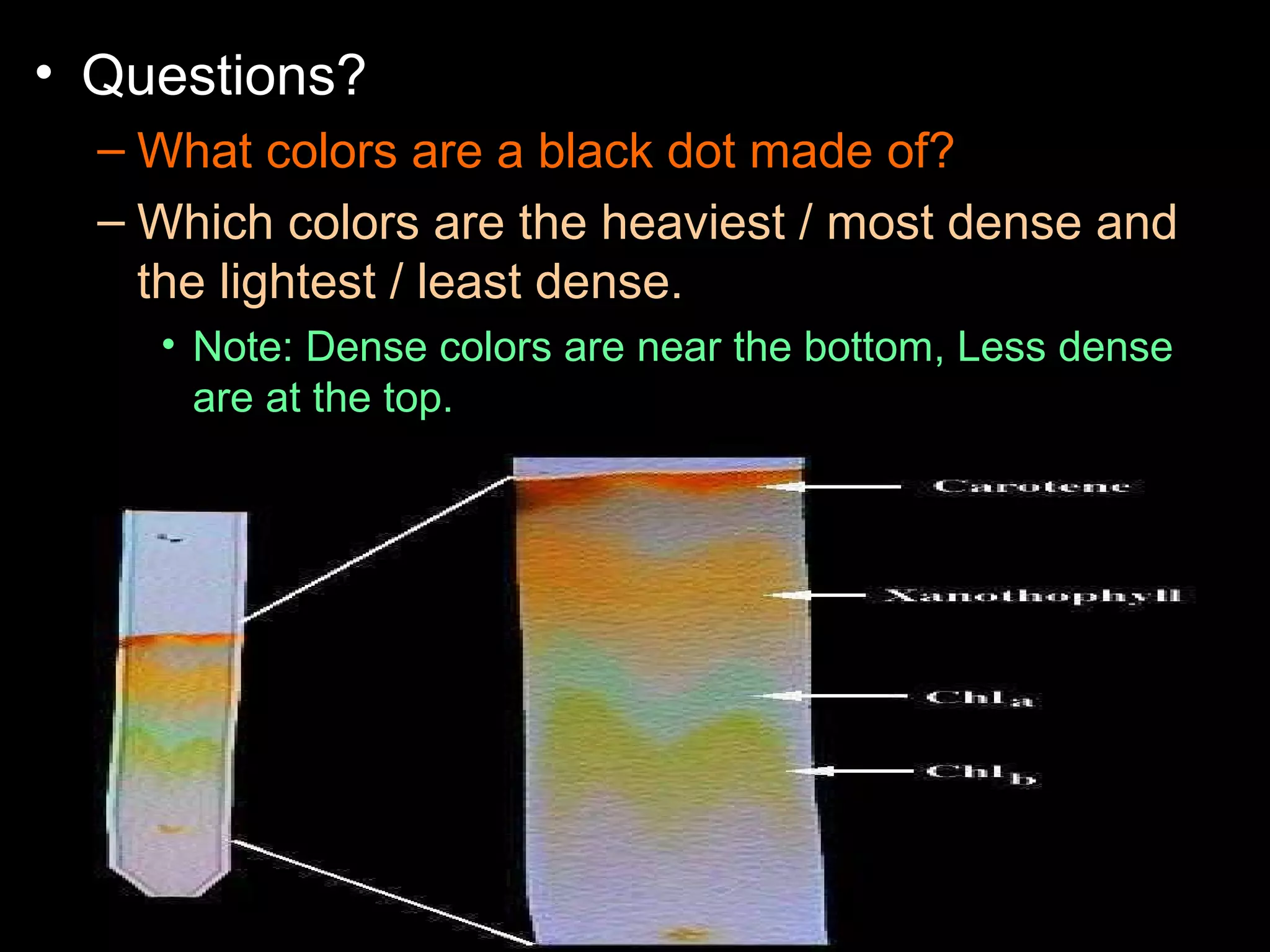
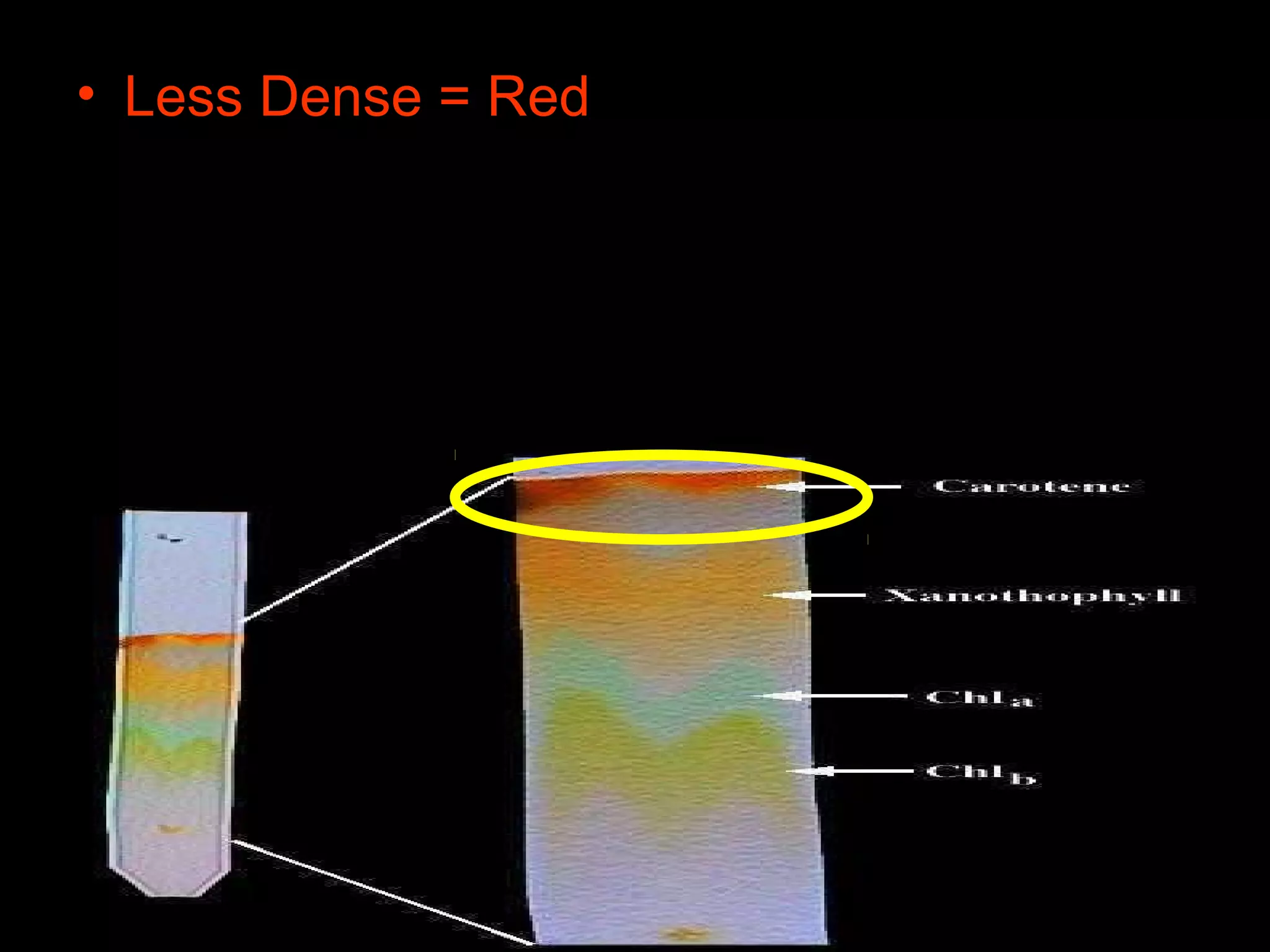
• Questions?
– What colors are a black dot made of?
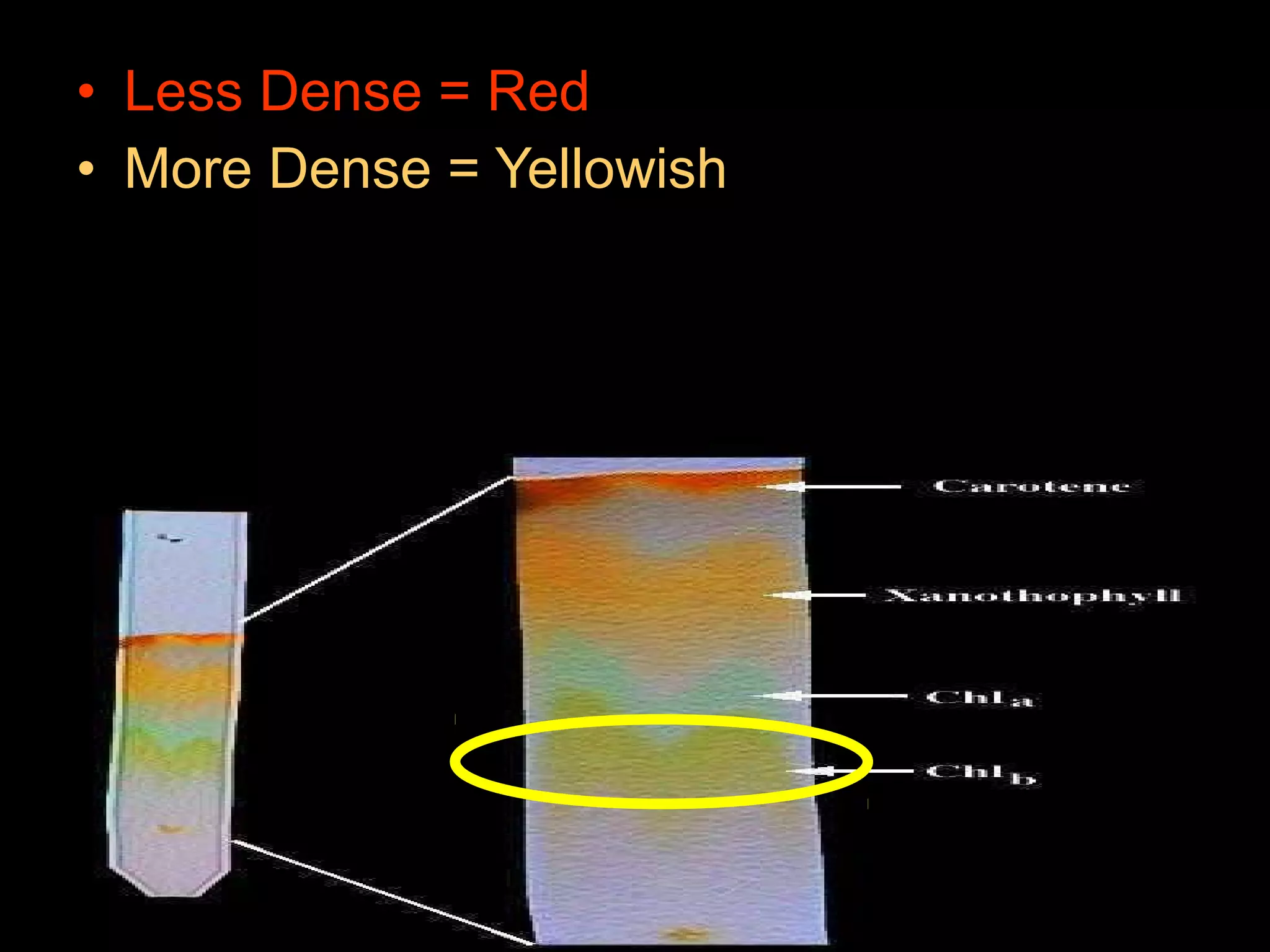
– Which colors are the heaviest / most dense and
the lightest / least dense.
• Note: Dense colors are near the bottom, Less dense
are at the top.
• Less Dense = Red
• Less Dense = Red
• More Dense = Yellowish
• You can now complete this question.
• Raise your hand when you think you
know the picture beneath the boxes.
– You only get one guess.
Copyright © 2010 Ryan P. Murphy
• Raise your hand when you think you
know the picture beneath the boxes.
– You only get one guess.
Copyright © 2010 Ryan P. Murphy
Donkey
Kong.
1.5 g/cm3
Yoshi
1.75 g/cm3
Mario
1.8 g/cm3
Goomba
1.3 g/cm3
Donkey
Kong.
1.5 g/cm3
Yoshi
1.75 g/cm3
Mario
1.8 g/cm3
Goomba
1.3 g/cm3
Donkey
Kong.
1.5 g/cm3
Yoshi
1.75 g/cm3
Mario
1.8 g/cm3
Goomba
1.3 g/cm3
Donkey
Kong.
1.5 g/cm3
Yoshi
1.75 g/cm3
Mario
1.8 g/cm3
Goomba
1.3 g/cm3
Donkey
Kong.
1.5 g/cm3
Yoshi
1.75 g/cm3
Mario
1.8 g/cm3
Goomba
1.3 g/cm3
Donkey
Kong.
1.5 g/cm3
Yoshi
1.75 g/cm3
Mario
1.8 g/cm3
Goomba
1.3 g/cm3
Donkey
Kong.
0.5 g/cm3
Yoshi
1.75 g/cm3
Mario
1.8 g/cm3
Goomba
1.3 g/cm3
Donkey
Kong.
0.5 g/cm3
Yoshi
1.75 g/cm3
Mario
1.8 g/cm3
Goomba
1.3 g/cm3
Donkey
Kong.
0.5 g/cm3
Yoshi
1.75 g/cm3
Mario
1.8 g/cm3
Goomba
1.3 g/cm3
Donkey
Kong.
0.5 g/cm3
Yoshi
1.75 g/cm3
Mario
1.8 g/cm3
Goomba
1.3 g/cm3
Donkey
Kong.
0.5 g/cm3
Yoshi
1.75 g/cm3
Mario
1.8 g/c3
Goomba
1.3 g/cm3
Donkey
Kong.
0.5 g/cm3
Yoshi
1.75 g/cm3
Mario
1.8 g/c3
Goomba
1.3 g/cm3
Donkey
Kong.
0.5 g/cm3
Yoshi
1.75 g/cm3
Mario
1.8 g/c3
Goomba
1.3 g/cm3
• Raise your hand when you think you
know the picture beneath the boxes.
– You only get one guess.
Copyright © 2010 Ryan P. Murphy
• Raise your hand when you think you
know the picture beneath the boxes.
– You only get one guess.
Copyright © 2010 Ryan P. Murphy
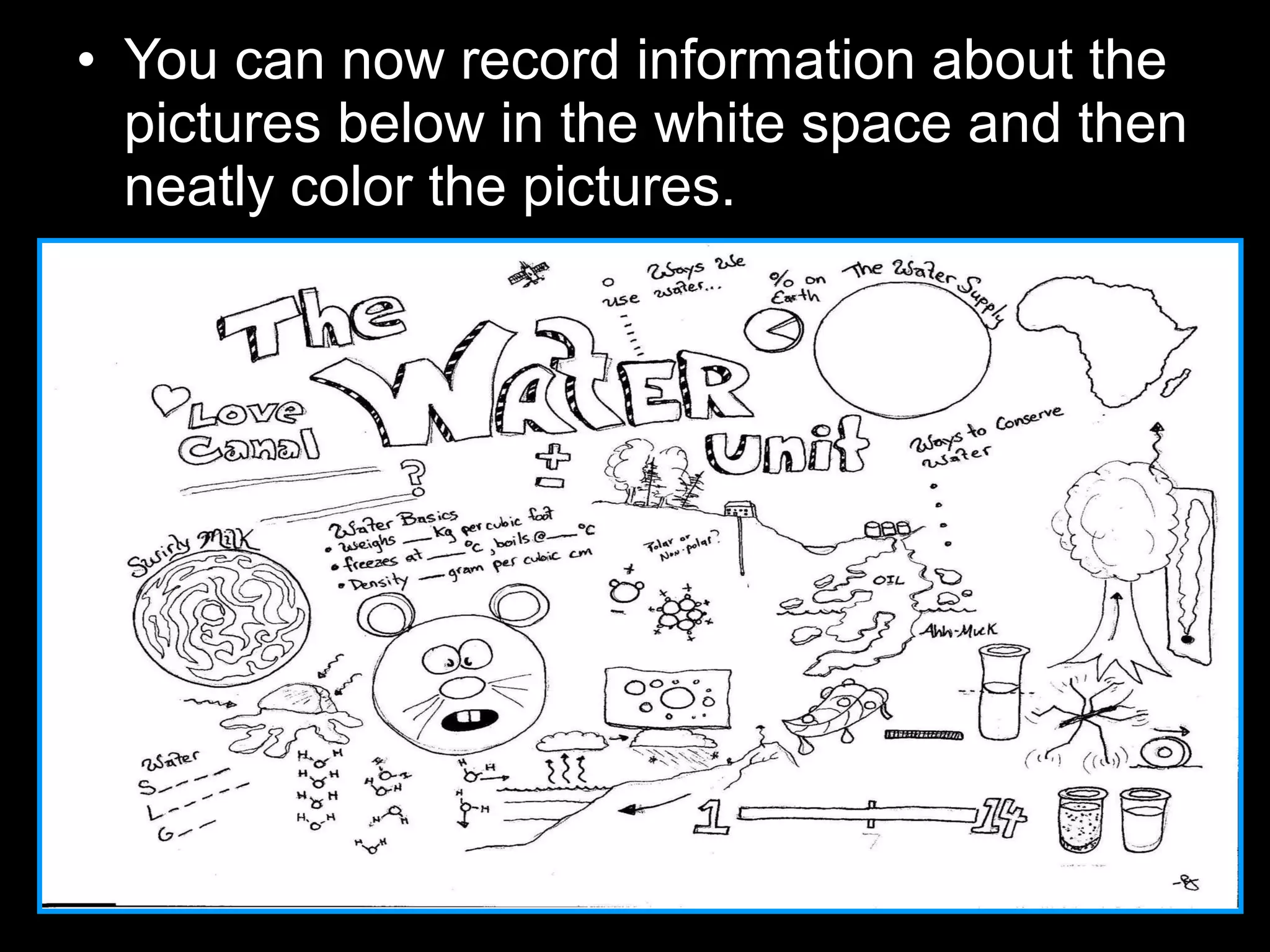
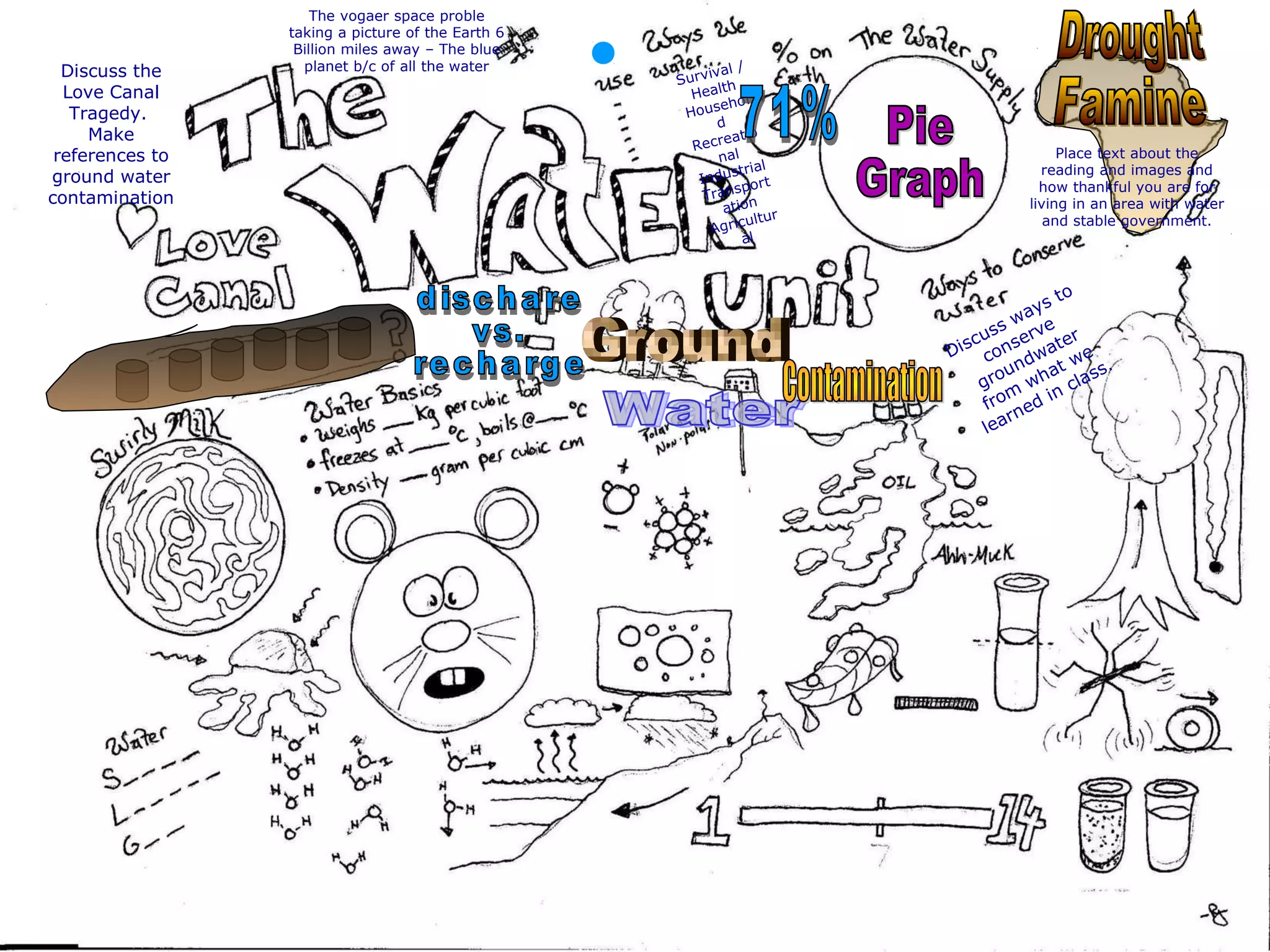
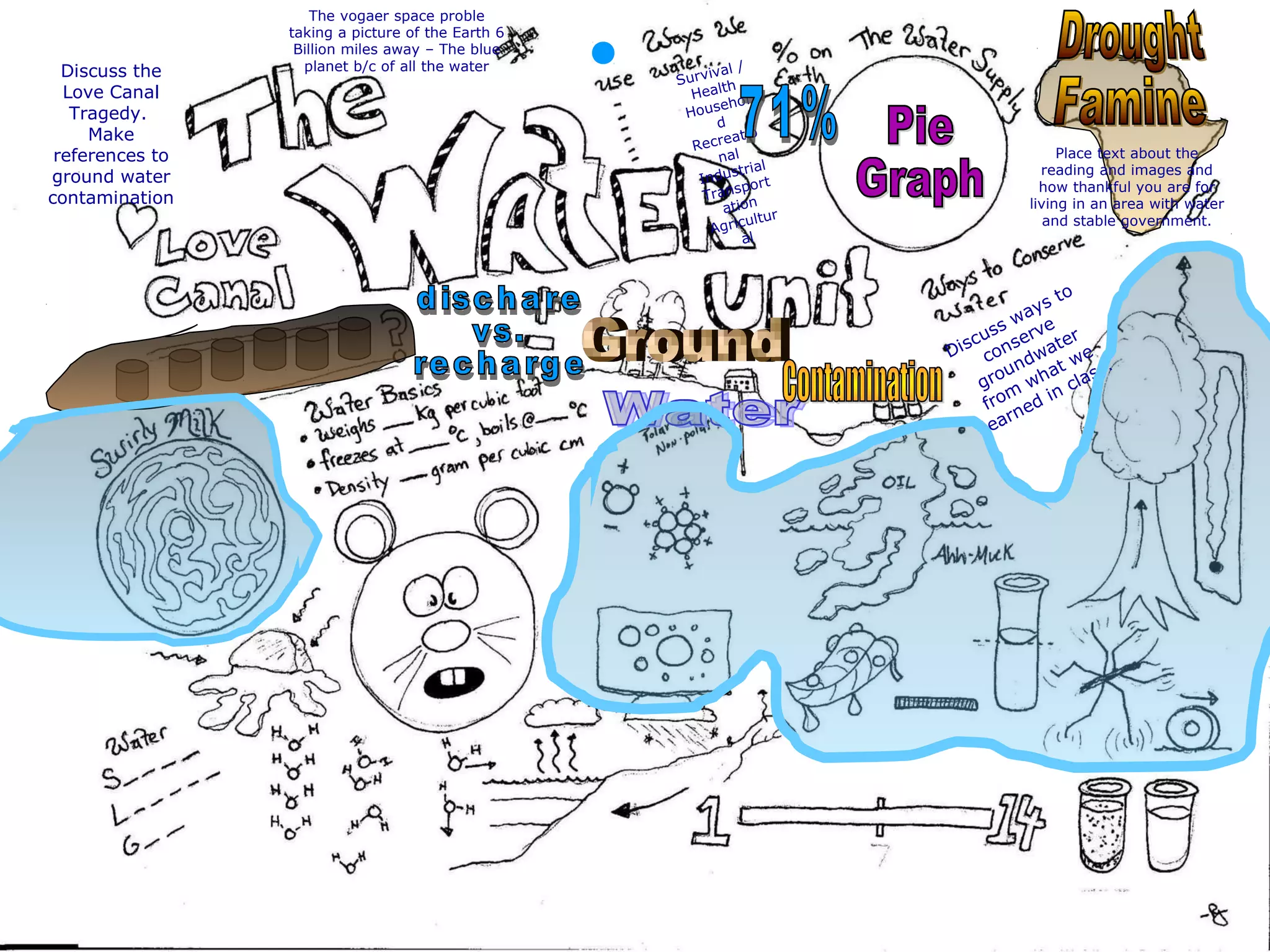
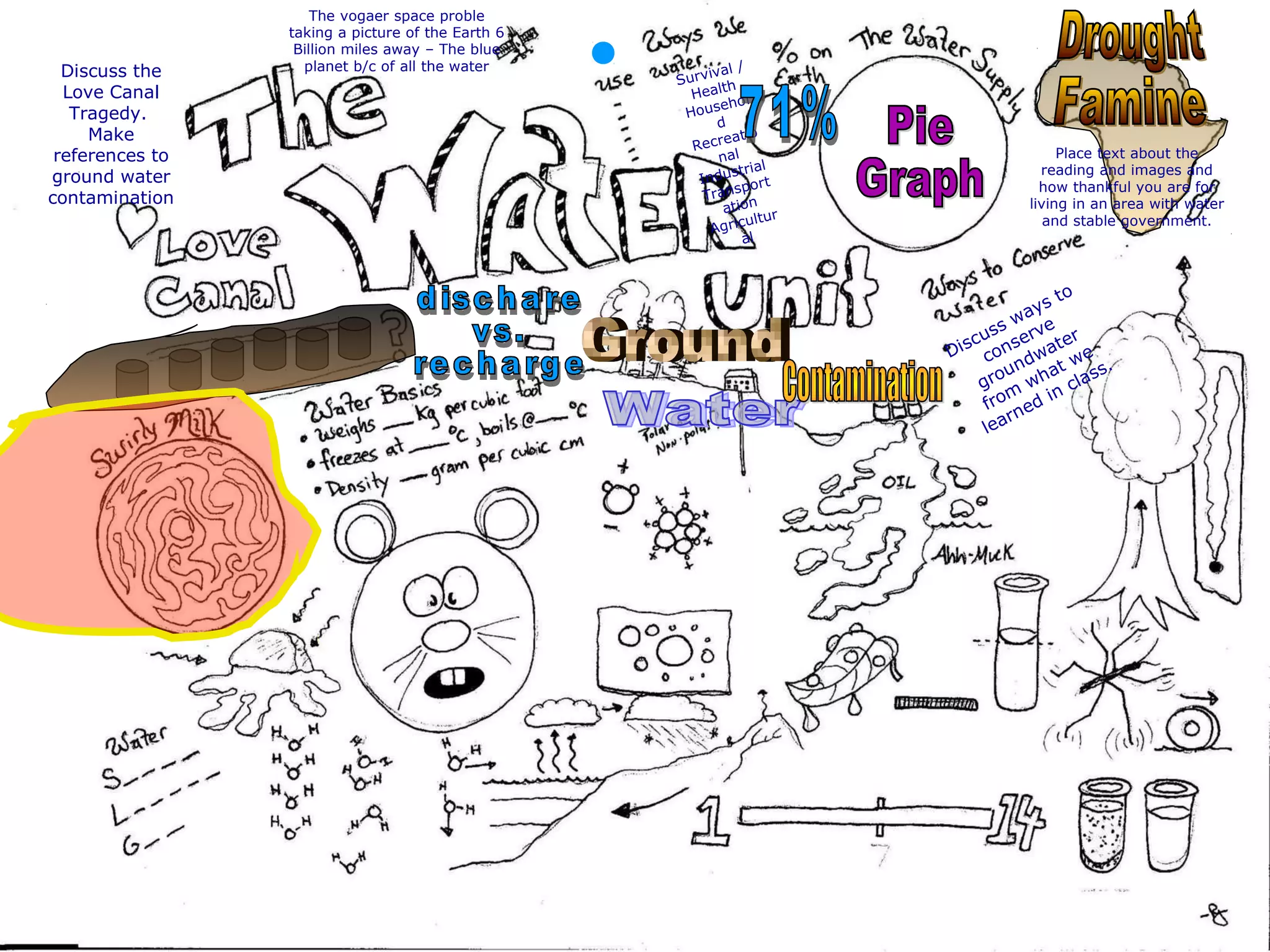
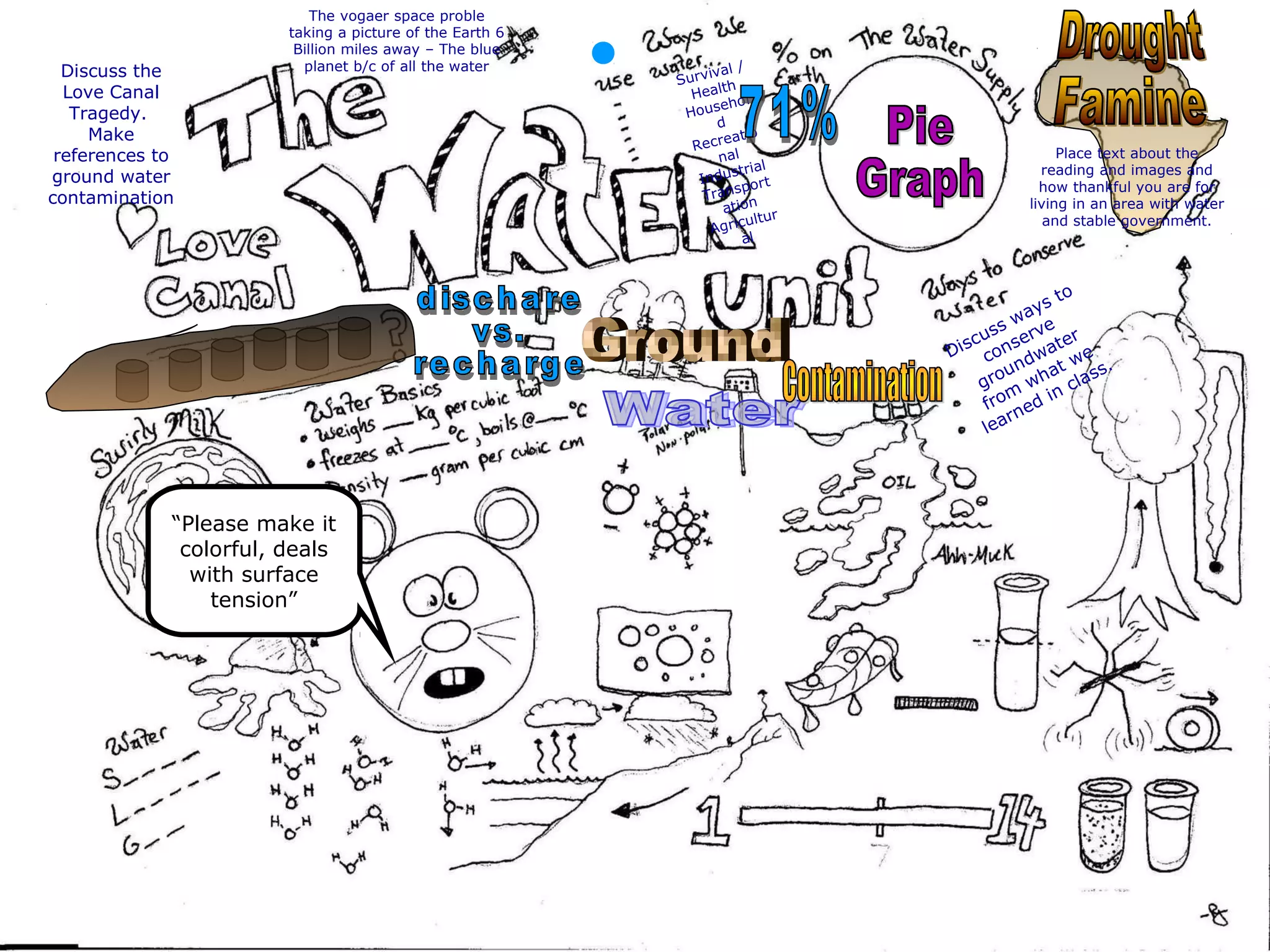
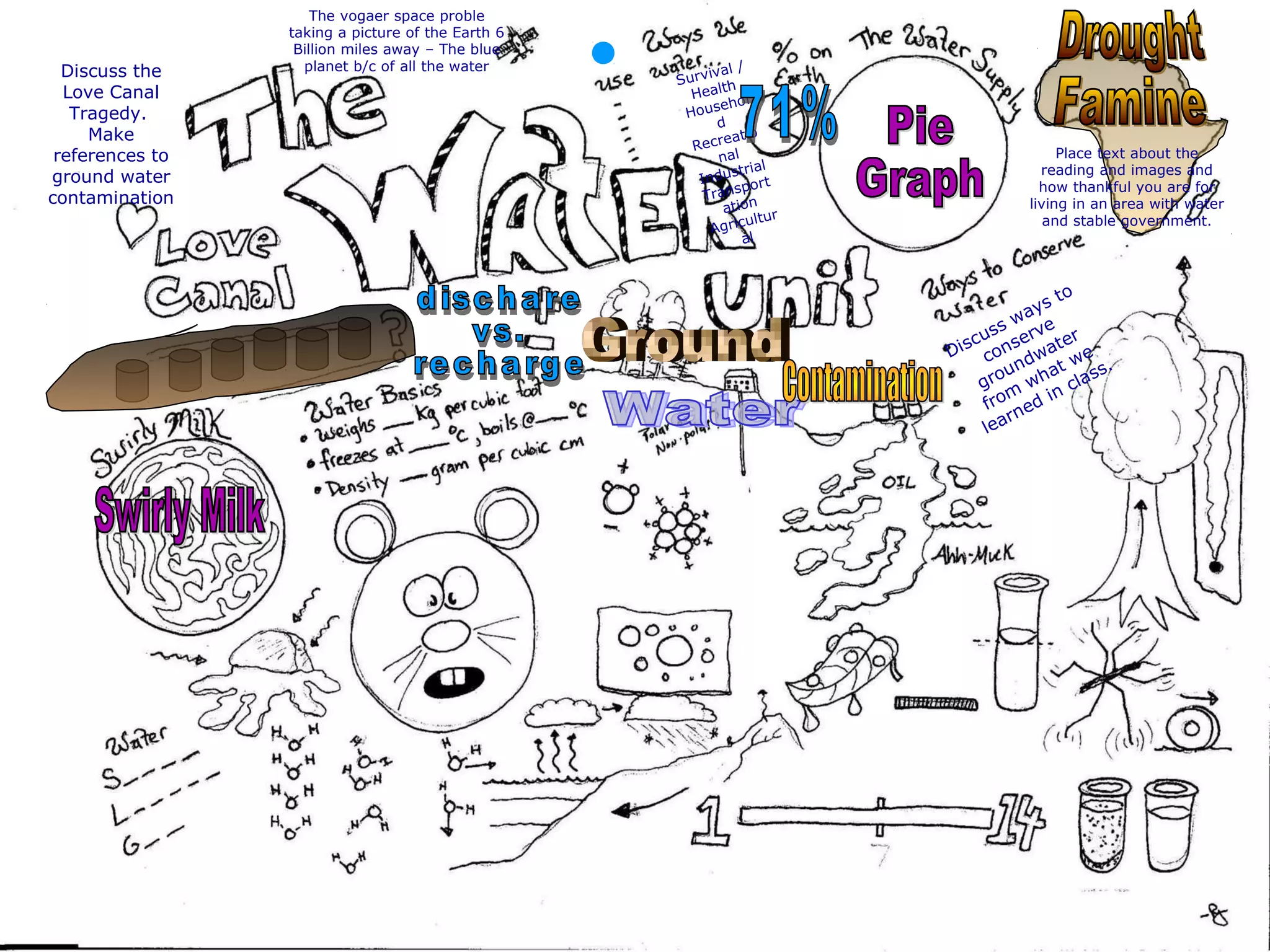
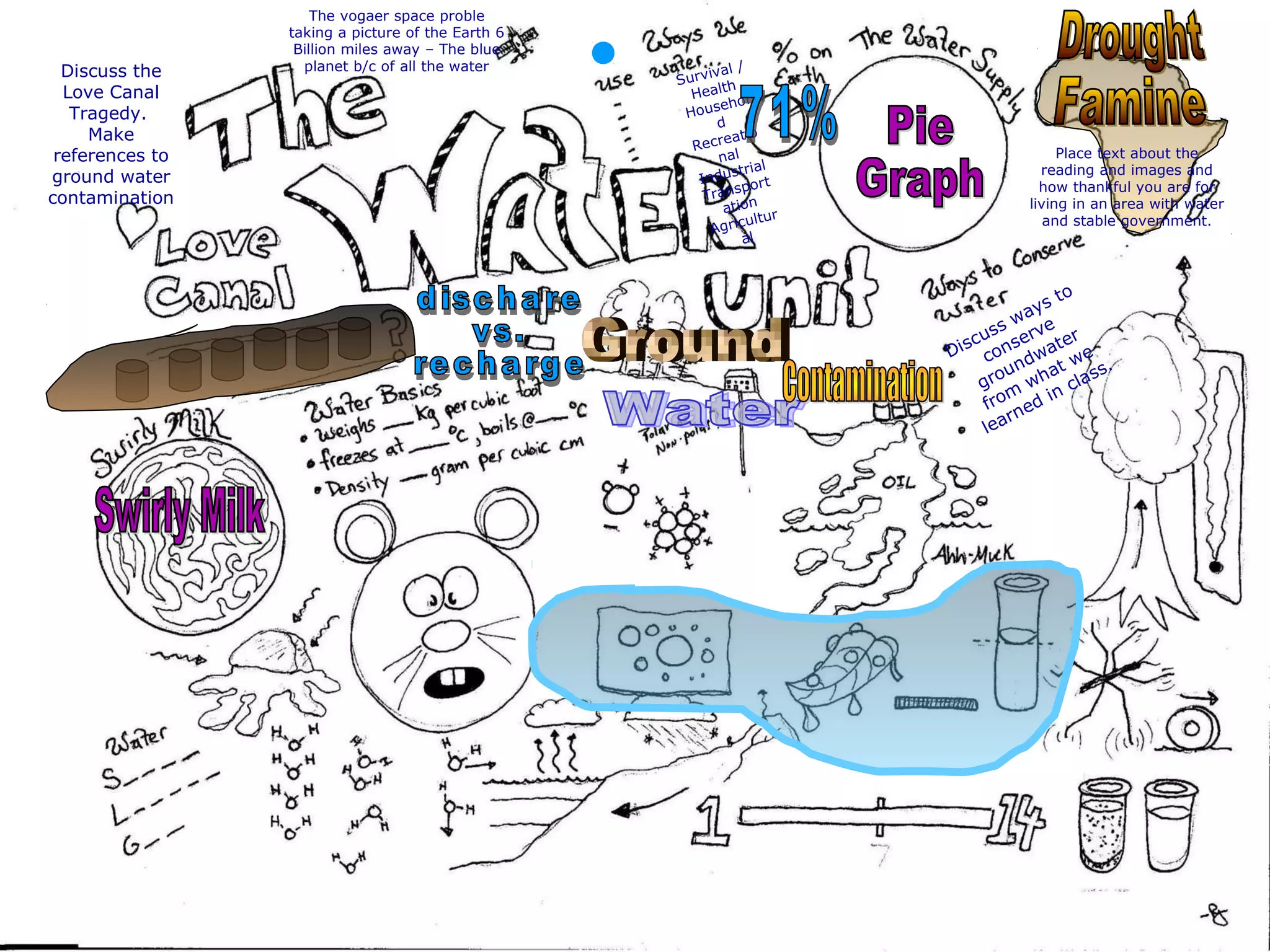
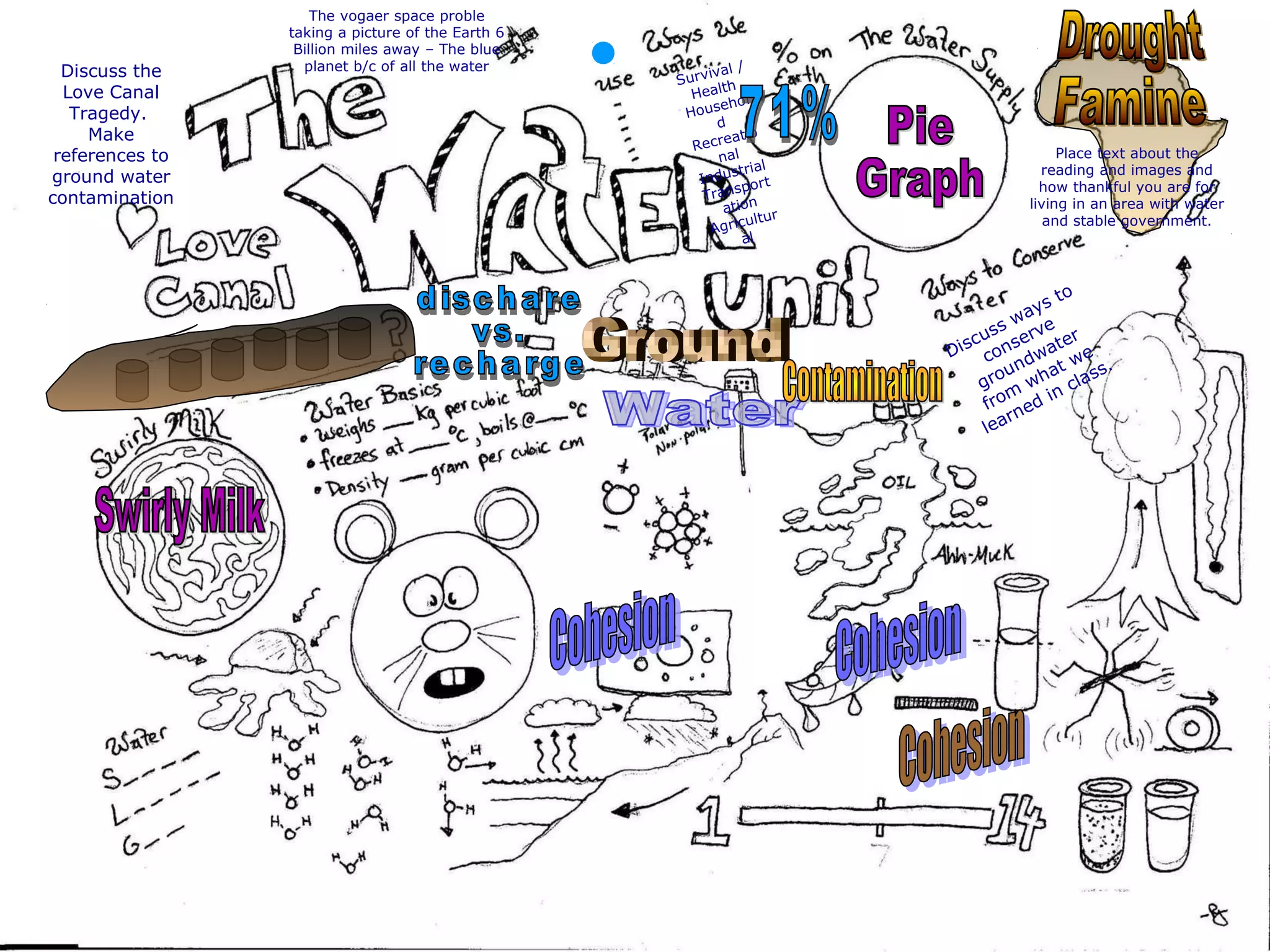
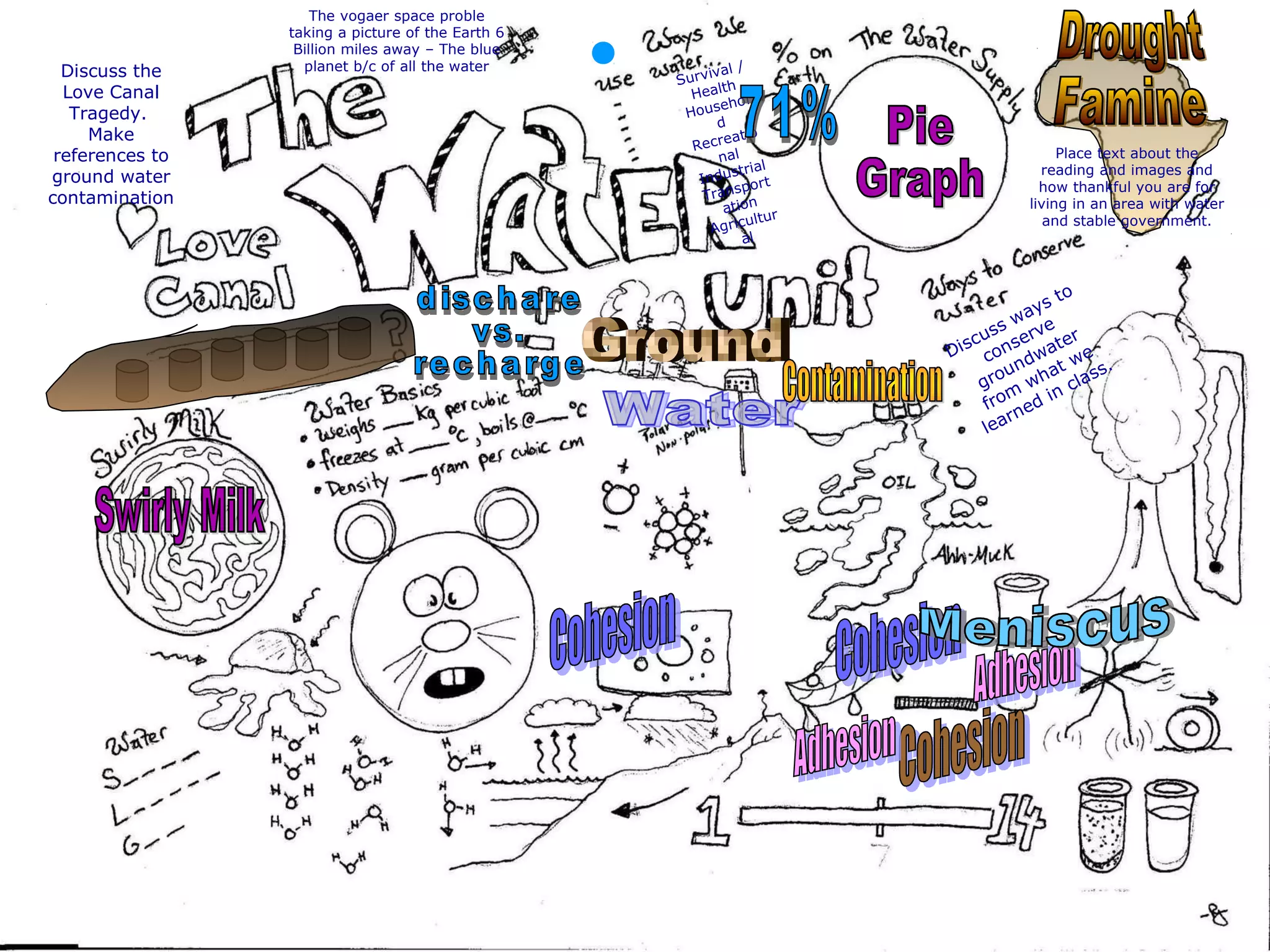
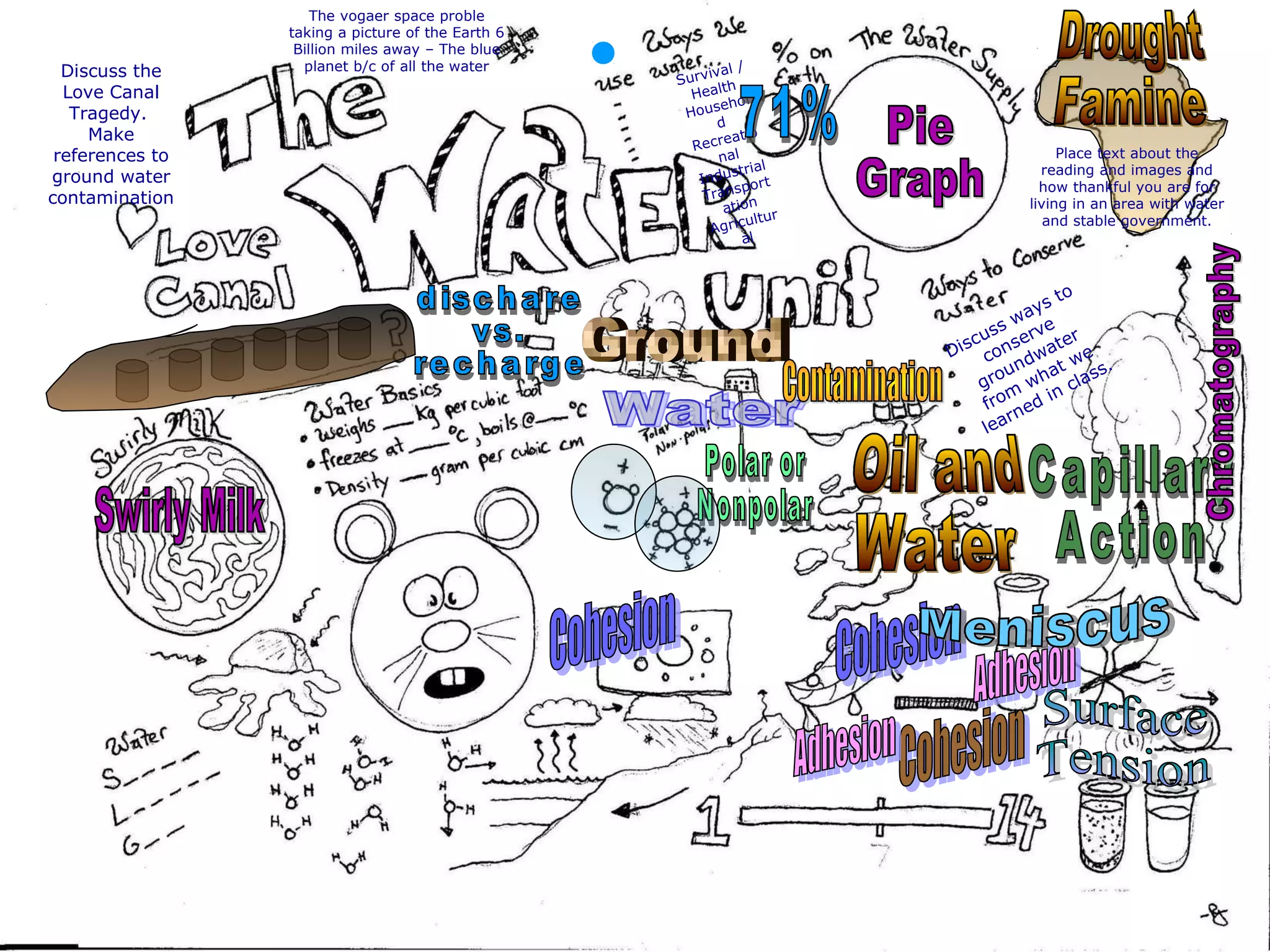
• You can now record information about the
pictures below in the white space and then
neatly color the pictures.
The vogaer space proble
taking a picture of the Earth 6
Billion miles away – The blue
planet b/c of all the water
Survival /
Health
Househol
d
Recreatio
nal
Industrial
Transport
ation
Agricultur
al
Place text about the
reading and images and
how thankful you are for
living in an area with water
and stable government.
Discuss ways to
conserve
groundwater
from
what we
learned in class.
Discuss the
Love Canal
Tragedy.
Make
references to
ground water
contamination
The vogaer space proble
taking a picture of the Earth 6
Billion miles away – The blue
planet b/c of all the water
Survival /
Health
Househol
d
Recreatio
nal
Industrial
Transport
ation
Agricultur
al
Place text about the
reading and images and
how thankful you are for
living in an area with water
and stable government.
Discuss ways to
conserve
groundwater
from
what we
learned in class.
Discuss the
Love Canal
Tragedy.
Make
references to
ground water
contamination
The vogaer space proble
taking a picture of the Earth 6
Billion miles away – The blue
planet b/c of all the water
Survival /
Health
Househol
d
Recreatio
nal
Industrial
Transport
ation
Agricultur
al
Place text about the
reading and images and
how thankful you are for
living in an area with water
and stable government.
Discuss ways to
conserve
groundwater
from
what we
learned in class.
Discuss the
Love Canal
Tragedy.
Make
references to
ground water
contamination
The vogaer space proble
taking a picture of the Earth 6
Billion miles away – The blue
planet b/c of all the water
Survival /
Health
Househol
d
Recreatio
nal
Industrial
Transport
ation
Agricultur
al
Place text about the
reading and images and
how thankful you are for
living in an area with water
and stable government.
Discuss ways to
conserve
groundwater
from
what we
learned in class.
Discuss the
Love Canal
Tragedy.
Make
references to
ground water
contamination
“Please make it
colorful, deals
with surface
tension”
The vogaer space proble
taking a picture of the Earth 6
Billion miles away – The blue
planet b/c of all the water
Survival /
Health
Househol
d
Recreatio
nal
Industrial
Transport
ation
Agricultur
al
Place text about the
reading and images and
how thankful you are for
living in an area with water
and stable government.
Discuss ways to
conserve
groundwater
from
what we
learned in class.
Discuss the
Love Canal
Tragedy.
Make
references to
ground water
contamination
The vogaer space proble
taking a picture of the Earth 6
Billion miles away – The blue
planet b/c of all the water
Survival /
Health
Househol
d
Recreatio
nal
Industrial
Transport
ation
Agricultur
al
Place text about the
reading and images and
how thankful you are for
living in an area with water
and stable government.
Discuss ways to
conserve
groundwater
from
what we
learned in class.
Discuss the
Love Canal
Tragedy.
Make
references to
ground water
contamination
The vogaer space proble
taking a picture of the Earth 6
Billion miles away – The blue
planet b/c of all the water
Survival /
Health
Househol
d
Recreatio
nal
Industrial
Transport
ation
Agricultur
al
Place text about the
reading and images and
how thankful you are for
living in an area with water
and stable government.
Discuss ways to
conserve
groundwater
from
what we
learned in class.
Discuss the
Love Canal
Tragedy.
Make
references to
ground water
contamination
The vogaer space proble
taking a picture of the Earth 6
Billion miles away – The blue
planet b/c of all the water
Survival /
Health
Househol
d
Recreatio
nal
Industrial
Transport
ation
Agricultur
al
Place text about the
reading and images and
how thankful you are for
living in an area with water
and stable government.
Discuss ways to
conserve
groundwater
from
what we
learned in class.
Discuss the
Love Canal
Tragedy.
Make
references to
ground water
contamination
The vogaer space proble
taking a picture of the Earth 6
Billion miles away – The blue
planet b/c of all the water
Survival /
Health
Househol
d
Recreatio
nal
Industrial
Transport
ation
Agricultur
al
Place text about the
reading and images and
how thankful you are for
living in an area with water
and stable government.
Discuss ways to
conserve
groundwater
from
what we
learned in class.
Discuss the
Love Canal
Tragedy.
Make
references to
ground water
contamination
The vogaer space proble
taking a picture of the Earth 6
Billion miles away – The blue
planet b/c of all the water
Survival /
Health
Househol
d
Recreatio
nal
Industrial
Transport
ation
Agricultur
al
Place text about the
reading and images and
how thankful you are for
living in an area with water
and stable government.
Discuss ways to
conserve
groundwater
from
what we
learned in class.
Discuss the
Love Canal
Tragedy.
Make
references to
ground water
contamination
The vogaer space proble
taking a picture of the Earth 6
Billion miles away – The blue
planet b/c of all the water
Survival /
Health
Househol
d
Recreatio
nal
Industrial
Transport
ation
Agricultur
al
Place text about the
reading and images and
how thankful you are for
living in an area with water
and stable government.
Discuss ways to
conserve
groundwater
from
what we
learned in class.
Discuss the
Love Canal
Tragedy.
Make
references to
ground water
contamination
The vogaer space proble
taking a picture of the Earth 6
Billion miles away – The blue
planet b/c of all the water
Survival /
Health
Househol
d
Recreatio
nal
Industrial
Transport
ation
Agricultur
al
Place text about the
reading and images and
how thankful you are for
living in an area with water
and stable government.
Discuss ways to
conserve
groundwater
from
what we
learned in class.
Discuss the
Love Canal
Tragedy.
Make
references to
ground water
contamination
The vogaer space proble
taking a picture of the Earth 6
Billion miles away – The blue
planet b/c of all the water
Survival /
Health
Househol
d
Recreatio
nal
Industrial
Transport
ation
Agricultur
al
Place text about the
reading and images and
how thankful you are for
living in an area with water
and stable government.
Discuss ways to
conserve
groundwater
from
what we
learned in class.
Discuss the
Love Canal
Tragedy.
Make
references to
ground water
contamination
The vogaer space proble
taking a picture of the Earth 6
Billion miles away – The blue
planet b/c of all the water
Survival /
Health
Househol
d
Recreatio
nal
Industrial
Transport
ation
Agricultur
al
Place text about the
reading and images and
how thankful you are for
living in an area with water
and stable government.
Discuss ways to
conserve
groundwater
from
what we
learned in class.
Discuss the
Love Canal
Tragedy.
Make
references to
ground water
contamination
The vogaer space proble
taking a picture of the Earth 6
Billion miles away – The blue
planet b/c of all the water
Survival /
Health
Househol
d
Recreatio
nal
Industrial
Transport
ation
Agricultur
al
Place text about the
reading and images and
how thankful you are for
living in an area with water
and stable government.
Discuss ways to
conserve
groundwater
from
what we
learned in class.
Discuss the
Love Canal
Tragedy.
Make
references to
ground water
contamination
The vogaer space proble
taking a picture of the Earth 6
Billion miles away – The blue
planet b/c of all the water
Survival /
Health
Househol
d
Recreatio
nal
Industrial
Transport
ation
Agricultur
al
Place text about the
reading and images and
how thankful you are for
living in an area with water
and stable government.
Discuss ways to
conserve
groundwater
from
what we
learned in class.
Discuss the
Love Canal
Tragedy.
Make
references to
ground water
contamination
The vogaer space proble
taking a picture of the Earth 6
Billion miles away – The blue
planet b/c of all the water
Survival /
Health
Househol
d
Recreatio
nal
Industrial
Transport
ation
Agricultur
al
Place text about the
reading and images and
how thankful you are for
living in an area with water
and stable government.
Discuss ways to
conserve
groundwater
from
what we
learned in class.
Discuss the
Love Canal
Tragedy.
Make
references to
ground water
contamination
The vogaer space proble
taking a picture of the Earth 6
Billion miles away – The blue
planet b/c of all the water
Survival /
Health
Househol
d
Recreatio
nal
Industrial
Transport
ation
Agricultur
al
Place text about the
reading and images and
how thankful you are for
living in an area with water
and stable government.
Discuss ways to
conserve
groundwater
from
what we
learned in class.
Discuss the
Love Canal
Tragedy.
Make
references to
ground water
contamination
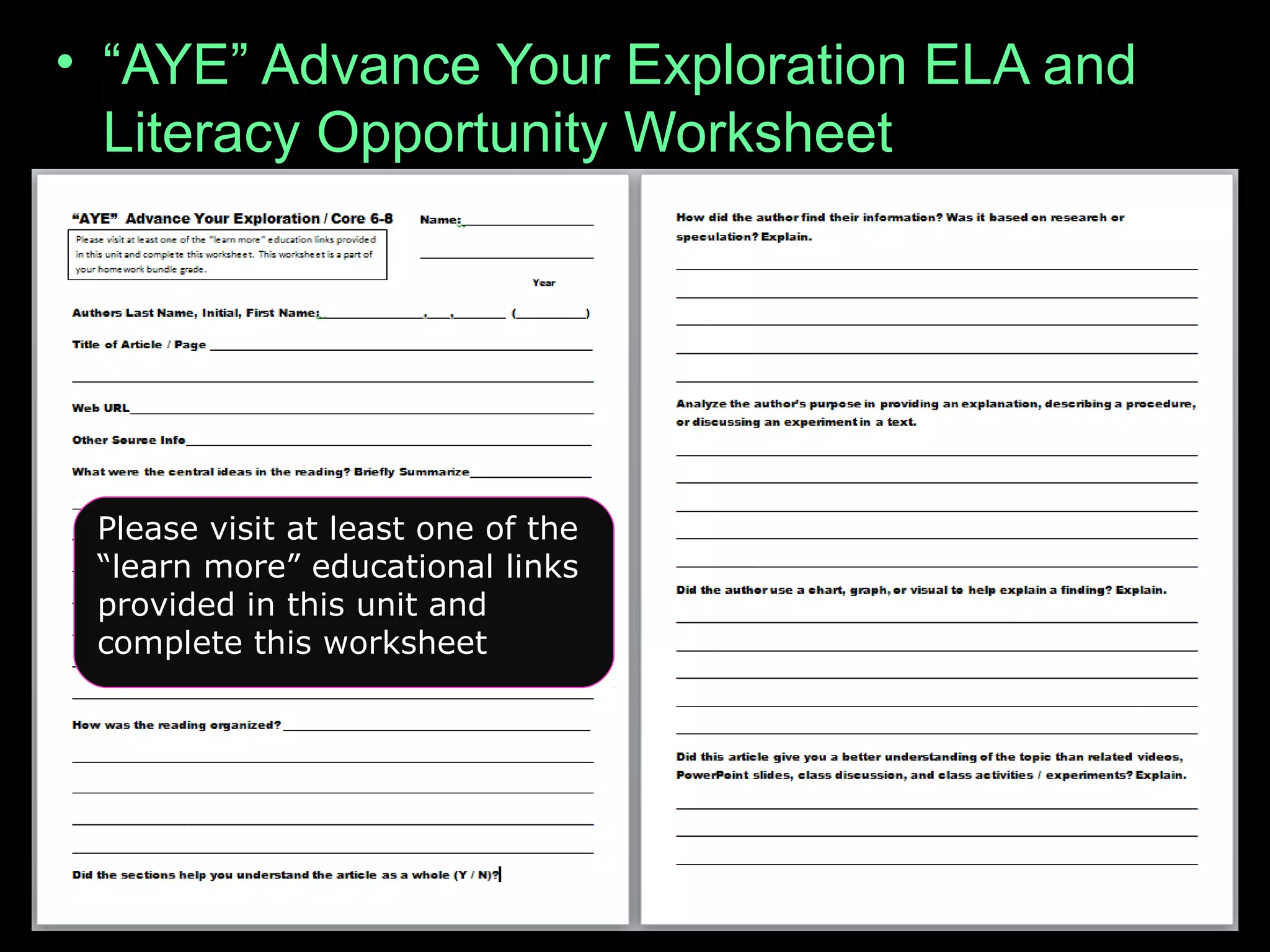
• “AYE” Advance Your Exploration ELA and
Literacy Opportunity Worksheet
– Visit some of the many provided links or..
– Articles can be found at (w/ membership to
NABT and NSTA)
• http://www.nabt.org/websites/institution/index.php?
p=1
• http://learningcenter.nsta.org/browse_journals.aspx?
journal=tst
Please visit at least one of the
“learn more” educational links
provided in this unit and
complete this worksheet
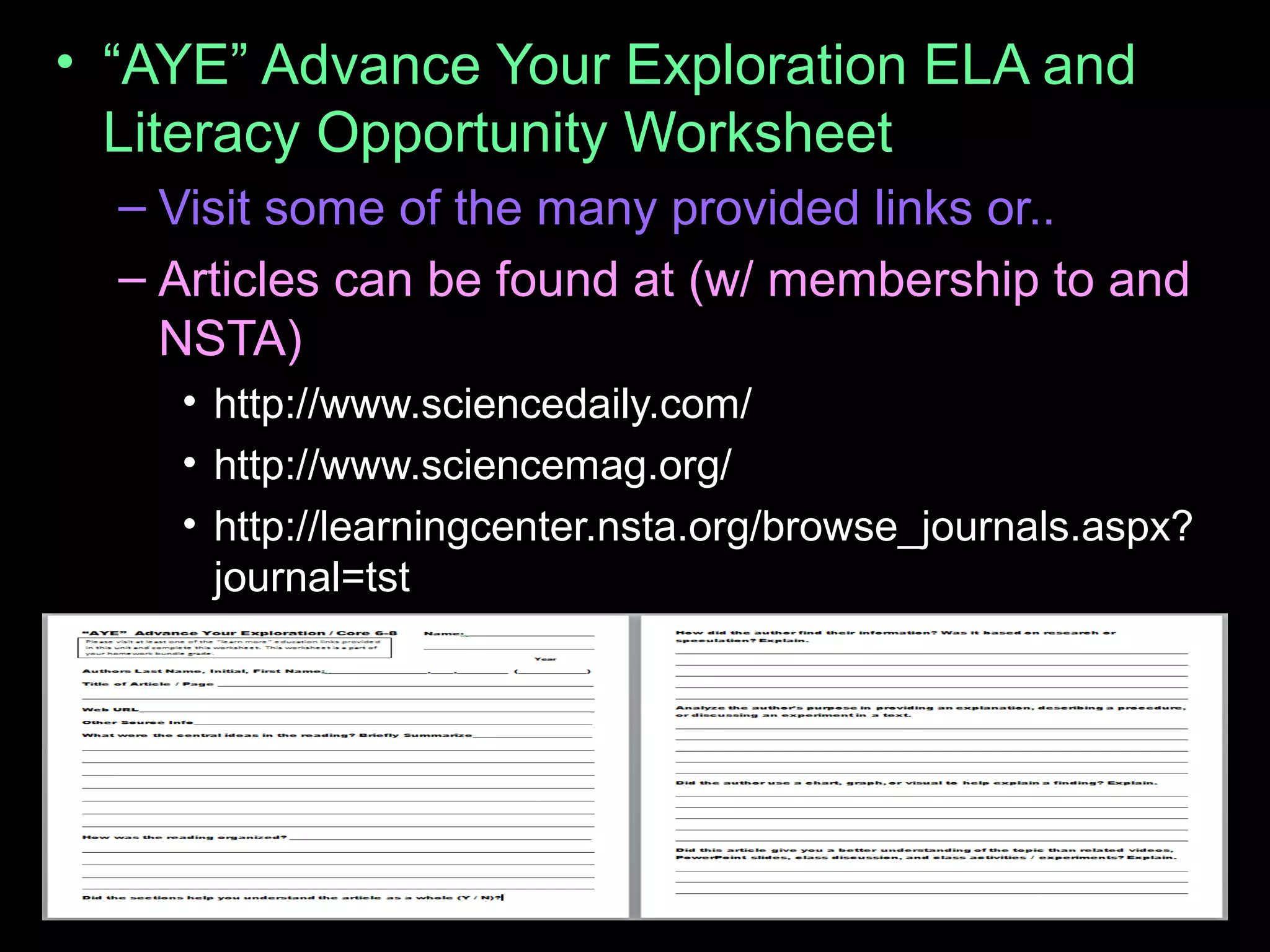
• “AYE” Advance Your Exploration ELA and
Literacy Opportunity Worksheet
– Visit some of the many provided links or..
– Articles can be found at (w/ membership to and
NSTA)
• http://www.sciencedaily.com/
• http://www.sciencemag.org/
• http://learningcenter.nsta.org/browse_journals.aspx?
journal=tst
• http://sciencepowerpoint.com/
Areas of Focus within the Water Molecule Unit:
Locations of Water on the Planet, Importance of Water, Groundwater,
Groundwater Pollution, The Water Molecule, Properties of Water,
Polarity, Cohesion, Adhesion, Capillary Action, High Specific Heat,
Water has a Neutral pH, Lower Density of Ice. Water is the Universal
Solvent, Mixtures
Full unit can be found at…
http://sciencepowerpoint.com/Water_Molecule_Unit.html
http://www.teacherspay
teachers.com/Product/P
hysical-Science-
Curriculum-596485
http://www.teachersp
ayteachers.com/Produ
ct/Life-Science-
Curriculum-601267
http://www.teachersp
ayteachers.com/Produ
ct/Earth-Science-
Curriculum-590950
• Please visit the links below to learn more
about each of the units in this curriculum
– These units take me about four years to complete
with my students in grades 5-10.
Earth Science Units Extended Tour Link and Curriculum Guide
Geology Topics Unit http://sciencepowerpoint.com/Geology_Unit.html
Astronomy Topics Unit http://sciencepowerpoint.com/Astronomy_Unit.html
Weather and Climate Unit http://sciencepowerpoint.com/Weather_Climate_Unit.html
Soil Science, Weathering, More http://sciencepowerpoint.com/Soil_and_Glaciers_Unit.html
Water Unit http://sciencepowerpoint.com/Water_Molecule_Unit.html
Rivers Unit http://sciencepowerpoint.com/River_and_Water_Quality_Unit.html
= Easier = More Difficult = Most Difficult
5th
– 7th
grade 6th
– 8th
grade 8th
– 10th
grade
Physical Science Units Extended Tour Link and Curriculum Guide
Science Skills Unit http://sciencepowerpoint.com/Science_Introduction_Lab_Safety_Metric_Methods.
html
Motion and Machines Unit http://sciencepowerpoint.com/Newtons_Laws_Motion_Machines_Unit.html
Matter, Energy, Envs. Unit http://sciencepowerpoint.com/Energy_Topics_Unit.html
Atoms and Periodic Table Unit http://sciencepowerpoint.com/Atoms_Periodic_Table_of_Elements_Unit.html
Life Science Units Extended Tour Link and Curriculum Guide
Human Body / Health Topics
http://sciencepowerpoint.com/Human_Body_Systems_and_Health_Topics_Unit.html
DNA and Genetics Unit http://sciencepowerpoint.com/DNA_Genetics_Unit.html
Cell Biology Unit http://sciencepowerpoint.com/Cellular_Biology_Unit.html
Infectious Diseases Unit http://sciencepowerpoint.com/Infectious_Diseases_Unit.html
Taxonomy and Classification Unit http://sciencepowerpoint.com/Taxonomy_Classification_Unit.html
Evolution / Natural Selection Unit http://sciencepowerpoint.com/Evolution_Natural_Selection_Unit.html
Botany Topics Unit http://sciencepowerpoint.com/Plant_Botany_Unit.html
Ecology Feeding Levels Unit http://sciencepowerpoint.com/Ecology_Feeding_Levels_Unit.htm
Ecology Interactions Unit http://sciencepowerpoint.com/Ecology_Interactions_Unit.html
Ecology Abiotic Factors Unit http://sciencepowerpoint.com/Ecology_Abiotic_Factors_Unit.html
• The entire four year curriculum can be found
at... http://sciencepowerpoint.com/ Please feel
free to contact me with any questions you may
have. Thank you for your interest in this
curriculum.
Sincerely,
Ryan Murphy M.Ed
• http://sciencepowerpoint.com/

Properties of Water PowerPoint, Adhesion, Cohesion, Surface Tension

  • 1.
    • Adhesion: Whenwater molecules hold to a surface. Copyright © 2010 Ryan P. Murphy
  • 3.
    • RED SLIDE:These are notes that are very important and should be recorded in your science journal. Copyright © 2010 Ryan P. Murphy
  • 4.
    -Nice neat notesthat are legible and use indentations when appropriate. -Example of indent. -Skip a line between topics -Don’t skip pages -Make visuals clear and well drawn.
  • 5.
    • RED SLIDE:These are notes that are very important and should be recorded in your science journal. • BLACK SLIDE: Pay attention, follow directions, complete projects as described and answer required questions neatly. Copyright © 2010 Ryan P. Murphy
  • 7.
    • Activity! Buildingour own Lava Lamps in a few days. – You will need your own plastic bottle. – Bring a 20 oz bottle. If you want a larger 2 liter bottle then bring in your own vegetable oil.
  • 8.
    • Activity! Buildingour own Lava Lamps in a few days. – You will need your own plastic bottle. – Bring a 20 oz bottle. If you want a larger 2 liter bottle then bring in your own vegetable oil.
  • 10.
    • Caution! Wewill be using dihydrogen monoxide shortly. (DHMO) – DHMO (dihydrogen monoxide) causes the following… • Also known as hydroxl acid, and is the major component of acid rain. • Can cause death if inhaled in large quantities. • Industrial solvent and coolant. • Used in nuclear power plants. • Ingestion causes excessive sweating and urination. • Causes severe erosion of our natural landscape. • Used in pesticide production and distribution. • An additive to food products. • and much more…
  • 11.
    • Caution! Wewill be using dihydrogen monoxide shortly. (DHMO) – DHMO (dihydrogen monoxide) causes the following… • Also known as hydroxl acid, and is the major component of acid rain. • Can cause death if inhaled in large quantities. • Industrial solvent and coolant. • Used in nuclear power plants. • Ingestion causes excessive sweating and urination. • Causes severe erosion of our natural landscape. • Used in pesticide production and distribution. • An additive to food products. • and much more…
  • 12.
    • Caution! Wewill be using dihydrogen monoxide shortly. (DHMO) – DHMO (dihydrogen monoxide) causes the following… • Also known as hydroxl acid, and is the major component of acid rain. • Can cause death if inhaled in large quantities. • Industrial solvent and coolant. • Used in nuclear power plants. • Ingestion causes excessive sweating and urination. • Causes severe erosion of our natural landscape. • Used in pesticide production and distribution. • An additive to food products. • and much more…
  • 13.
    • I willplace a sample of dihydrogen monoxide on your table. • Please do not touch it until instructed.
  • 14.
    • Dihydrogen monoxideis known as H2O. – It’s made of one atom of oxygen and two atoms of hydrogen.
  • 15.
    • Dihydrogen monoxideis known as H2O. – It’s made of one atom of oxygen and two atoms of hydrogen.
  • 16.
    • Dihydrogen monoxideis known H2O. – It’s made of one atom of oxygen and two atoms of hydrogen.
  • 17.
    • Without dihydrogenmonoxide life is not possible.
  • 18.
    • Without dihydrogenmonoxide life is not possible. – Earth is the blue planet because of dihydrogen monoxide…
  • 19.
    • Without dihydrogenmonoxide life is not possible. – Earth is the blue planet because of dihydrogen monoxide… aka water.
  • 20.
    Water is HWateris H22O. Two hydrogen atoms, oneO. Two hydrogen atoms, one oxygen.oxygen. Copyright © 2010 Ryan P. Murphy
  • 21.
    • Please createa step by step drawing of the water molecule in your journal.
  • 34.
  • 35.
  • 36.
  • 37.
  • 38.
  • 39.
  • 40.
    The Water Molecule H2O “The Oxygen (head)is much larger than the hydrogen (ears).”
  • 41.
    The Water Molecule H2O “The Oxygen (head)is much larger than the hydrogen (ears).” Structure of H2O at… http://www.johnky rk.com/H2O.html
  • 42.
    • Available Sheet:Properties of Water. – Note: This will be due at the end of Part III. – Bring to class everyday.
  • 43.
    • Available Sheet:Properties of Water. – Note: This will be due at the end of Part III. – Bring to class everyday.
  • 44.
    • Activity! • Drawthe picture below. Use a Petri-Dish to assist you. Label as “Before”.
  • 45.
    • Activity! • Drawthe picture below. Use a Petri-Dish to assist you. Label as “Before”. Swirly Milk. Learn more at… http://chemistry.about.com/od/chemistryhowto guide/a/magicmilk.htm
  • 46.
    • Activity! SwirlyMilk, A fun starting off activity. – Fill the depression of the plate with whole milk. – Add one drop of different food colorings at 12, 3, 6, 9 O’clock of the plate. OR Copyright © 2010 Ryan P. Murphy
  • 47.
    • Swirly MilkContinued. – Draw the plate. – Take a toothpick and dip it into detergent. – Touch detergent (Dawn) on toothpick into the middle of the milk. – Record your findings with a detailed drawing. Copyright © 2010 Ryan P. Murphy This product belongs to Ryan P. Murphy www.sciencepowerpoint.com Copyright 2010
  • 48.
    • Draw a“After” Sketch of the SWIRLY MILK . Use a Petri-dish to assist you.
  • 49.
    • Draw a“After” Sketch of the SWIRLY MILK . Use a Petri-dish to assist you.
  • 50.
    • Questions! SwirlyMilk. – What happened to the milk? Why? Copyright © 2010 Ryan P. Murphy
  • 51.
    • How SwirlyMilk Works – When you introduce detergent to the milk, several things happen at once. • The detergent breaks the surface tension (skin on the top of the water). • Food coloring is now free to flow through the milk. • Detergent reacts with milk…Creates motion. • Detergent also breaks up fat in milk / pushes color around. • Continues for awhile and then stops. Copyright © 2010 Ryan P. Murphy
  • 52.
    • How SwirlyMilk Works – When you introduce detergent to the milk, several things happen at once. • The detergent breaks the surface tension (skin on the top of the water). • Food coloring is now free to flow through the milk. • Detergent reacts with milk…Creates motion. • Detergent also breaks up fat in milk / pushes color around. • Continues for awhile and then stops. Copyright © 2010 Ryan P. Murphy
  • 53.
    • How SwirlyMilk Works – When you introduce detergent to the milk, several things happen at once. • The detergent breaks the surface tension (skin on the top of the water). • Food coloring is now free to flow through the milk. • Detergent reacts with milk…Creates motion. • Detergent also breaks up fat in milk / pushes color around. • Continues for awhile and then stops. Copyright © 2010 Ryan P. Murphy
  • 54.
    • How SwirlyMilk Works – When you introduce detergent to the milk, several things happen at once. • The detergent breaks the surface tension (skin on the top of the water). • Food coloring is now free to flow through the milk. • Detergent reacts with milk…Creates motion. • Detergent also breaks up fat in milk / pushes color around. • Continues for awhile and then stops. Copyright © 2010 Ryan P. Murphy
  • 55.
    • How SwirlyMilk Works – When you introduce detergent to the milk, several things happen at once. • The detergent breaks the surface tension (skin on the top of the water). • Food coloring is now free to flow through the milk. • Detergent reacts with milk…Creates motion. • Detergent also breaks up fat in milk / pushes color around. • Continues for awhile and then stops. Copyright © 2010 Ryan P. Murphy
  • 56.
    • How SwirlyMilk Works – When you introduce detergent to the milk, several things happen at once. • The detergent breaks the surface tension (skin on the top of the water). • Food coloring is now free to flow through the milk. • Detergent reacts with milk…Creates motion. • Detergent also breaks up fat in milk / pushes color around. • Continues for awhile and then stops. Copyright © 2010 Ryan P. Murphy
  • 57.
    • How SwirlyMilk Works – When you introduce detergent to the milk, several things happen at once. • The detergent breaks the surface tension (skin on the top of the water). • Food coloring is now free to flow through the milk. • Detergent reacts with milk…Creates motion. • Detergent also breaks up fat in milk / pushes color around. • Continues for awhile and then stops. Copyright © 2010 Ryan P. Murphy
  • 58.
    • How SwirlyMilk Works – When you introduce detergent to the milk, several things happen at once. • The detergent breaks the surface tension (skin on the top of the water). • Food coloring is now free to flow through the milk. • Detergent reacts with milk…Creates motion. • Detergent also breaks up fat in milk / pushes color around. • Continues for awhile and then stops. Copyright © 2010 Ryan P. Murphy
  • 59.
    • How SwirlyMilk Works – When you introduce detergent to the milk, several things happen at once. • The detergent breaks the surface tension (skin on the top of the water). • Food coloring is now free to flow through the milk. • Detergent reacts with milk…Creates motion. • Detergent also breaks up fat in milk / pushes color around. • Continues for awhile and then stops. Copyright © 2010 Ryan P. Murphy
  • 60.
    • How SwirlyMilk Works – When you introduce detergent to the milk, several things happen at once. • The detergent breaks the surface tension (skin on the top of the water). • Food coloring is now free to flow through the milk. • Detergent reacts with milk…Creates motion. • Detergent also breaks up fat in milk / pushes color around. Copyright © 2010 Ryan P. Murphy
  • 61.
    • How SwirlyMilk Works – When you introduce detergent to the milk, several things happen at once. • The detergent breaks the surface tension (skin on the top of the water). • Food coloring is now free to flow through the milk. • Detergent reacts with milk…Creates motion. • Detergent also breaks up fat in milk / pushes color around. • Continues for awhile and then stops. Copyright © 2010 Ryan P. Murphy
  • 62.
    New Area ofFocus: Properties of Water.New Area of Focus: Properties of Water. Copyright © 2010 Ryan P. Murphy
  • 63.
    Properties of Water:Water has uniqueProperties of Water: Water has unique properties because of it’s lopsided + and –properties because of it’s lopsided + and – ends.ends. - + + Copyright © 2010 Ryan P. Murphy
  • 64.
    Some water basicsSomewater basics -- -- -- Copyright © 2010 Ryan P. Murphy
  • 65.
    Water freezes at0 degrees Celsius, andWater freezes at 0 degrees Celsius, and boils at 100 degrees.boils at 100 degrees. Water freezes at 32 degrees Fahrenheit (F)Water freezes at 32 degrees Fahrenheit (F) and boils at 212 degrees F (Sea-Level)and boils at 212 degrees F (Sea-Level) Copyright © 2010 Ryan P. Murphy
  • 66.
    • Water freezesat 0 degrees Celsius, andWater freezes at 0 degrees Celsius, and boils at 100 degrees.boils at 100 degrees. – Water freezes at 32 degrees Fahrenheit (F)Water freezes at 32 degrees Fahrenheit (F) and boils at 212 degrees F (Sea-Level)and boils at 212 degrees F (Sea-Level) Copyright © 2010 Ryan P. Murphy
  • 67.
    Water weighs 28.3Kilograms per cubicWater weighs 28.3 Kilograms per cubic foot.foot. Weight: 62.416 pounds per cubic foot atWeight: 62.416 pounds per cubic foot at 32°F (It’s heavy).32°F (It’s heavy). Copyright © 2010 Ryan P. Murphy
  • 68.
    Water weighs 28.3Kilograms per cubicWater weighs 28.3 Kilograms per cubic foot.foot. Weight: 62.416 pounds per cubic foot at 32°FWeight: 62.416 pounds per cubic foot at 32°F (It’s heavy).(It’s heavy). Copyright © 2010 Ryan P. Murphy
  • 69.
    • Water fromyour tap weighs the same as this water.
  • 70.
    Density: 1 gramper cubic centimeter.Density: 1 gram per cubic centimeter. More facts about water at…. http://www.scienc ekids.co.nz/scienc efacts/water.html
  • 71.
    • Mini areaof Focus: Volume, Liter, l How is your HW? I Love the Metric System
  • 72.
    • Volume: Thethree-dimensional space an object occupies. Copyright © 2010 Ryan P. Murphy Metric
  • 73.
    • Volume andDensity Available Sheet. – Additional classwork / homework
  • 80.
    • The standardunit of volume in the metric system is the liter. – A liter is 1000 milliliters Copyright © 2010 Ryan P. Murphy
  • 81.
    • Always measurea liquid at the bottom of the curved meniscus. – How many milliliters is this? Copyright © 2010 Ryan P. Murphy
  • 82.
    • Answer: 6.8ml (milliliters) Copyright © 2010 Ryan P. Murphy
  • 83.
    • Answer: 6.8ml (milliliters) Copyright © 2010 Ryan P. Murphy
  • 84.
    • Activity! – Pleasefill a measured container with 100 ml of liquid. Add one drop of food coloring. – Please fill another container with 500 ml of water. Add a different drop. Mix the colors. I hope you are current on your homework. I love the Metric System and Want to Use it.
  • 85.
    • Activity! • Usethe colored liquid to measure 100 ml in a 100 ml graduated cylinder. – Use the cups nearby for the extra fluid. Copyright © 2010 Ryan P. Murphy
  • 86.
    • Volume isalso the space that matter occupies. – Matter is anything that has mass and takes up space. Copyright © 2010 Ryan P. Murphy
  • 87.
    • Volume isalso the space that matter occupies. – Matter is anything that has mass and takes up space. Copyright © 2010 Ryan P. Murphy
  • 88.
    • How doyou find the volume of a cube? – Length x Width x Height - ____cm3 Copyright © 2010 Ryan P. Murphy
  • 89.
    • How doyou find the volume of a cube? – Length x Width x Height = ____cm3 Copyright © 2010 Ryan P. Murphy
  • 90.
    • Activity! Findingthe volume of a cube. – Please measure the length, width and height and multiply L x W x H to get answer. Copyright © 2010 Ryan P. Murphy
  • 91.
    • What isthe volume of this cube? 5 cm 5cm 5 cm Copyright © 2010 Ryan P. Murphy
  • 92.
    • Answer: 53or 5 x 5 x 5 = 5 cm 5cm 5 cm Copyright © 2010 Ryan P. Murphy
  • 93.
    • Answer: 53or 5 x 5 x 5 = 125 cm3 5 cm 5cm 5 cm Copyright © 2010 Ryan P. Murphy
  • 94.
    • What isthe volume of this cube? 40 cm 40 cm 40 cm Copyright © 2010 Ryan P. Murphy
  • 95.
    • Answer! 40x 40 x 40 = 40 cm 40 cm 40 cm Copyright © 2010 Ryan P. Murphy
  • 96.
    • Answer! 40x 40 x 40 = 64,000 cm3 40 cm 40 cm 40 cm Copyright © 2010 Ryan P. Murphy
  • 97.
    • What isthe volume of this rectangle? Copyright © 2010 Ryan P. Murphy
  • 98.
    • Answer! 144cm3 Copyright © 2010 Ryan P. Murphy
  • 99.
    • What isthe volume of this rectangle? Each unit is equal to 1 cm3 Copyright © 2010 Ryan P. Murphy
  • 100.
    • Answer! 5(L) x 4 (W) x 3 (H) = Copyright © 2010 Ryan P. Murphy
  • 101.
    • Answer! 5(L) x 4 (W) x 3 (H) = Copyright © 2010 Ryan P. Murphy
  • 102.
    • Answer! 5(L) x 4 (W) x 3 (H) = Copyright © 2010 Ryan P. Murphy
  • 103.
    • Answer! 5(L) x 4 (W) x 3 (H) = 60 cm3 Copyright © 2010 Ryan P. Murphy
  • 104.
    • Find thevolume of the density cubes? 2.5 cm 2.5 cm 2.5 cm Copyright © 2010 Ryan P. MurphyCopyright © 2010 Ryan P. Murphy
  • 105.
    • Answer! 15.625cm3 2.5 cm 2.5 cm 2.5 cm
  • 106.
    • Answer! 15.625cm3 2.5 cm 2.5 cm 2.5 cm Finding volume. Learn more at… http://www.helpingwithmath.com/by_subject/ geometry/geo_volume.htm
  • 107.
    • Volume ofa cylinder: Where Pi = 3.14 Copyright © 2010 Ryan P. Murphy
  • 108.
    • Volume ofa cylinder: Where Pi = 3.14 Copyright © 2010 Ryan P. Murphy Diamete r
  • 109.
    • Volume ofa cylinder: Where Pi = 3.14 Copyright © 2010 Ryan P. Murphy
  • 110.
    • Activity! Canyou find the volume of the cylinder below using the equation. Copyright © 2010 Ryan P. Murphy
  • 111.
    • Volume =π x r2 x h Copyright © 2010 Ryan P. Murphy
  • 112.
    • Volume =π x r2 x h • Volume to be π(102 )(7) = Copyright © 2010 Ryan P. Murphy
  • 113.
    • Volume =π x r2 x h • Volume to be π(102 )(7) = • PEMDAS – Must do exponents first Copyright © 2010 Ryan P. Murphy
  • 114.
    • Volume =π x r2 x h • Volume to be π(102 )(7) = • PEMDAS – Must do exponents first • Volume to be 3.14 (100 )(7) = Copyright © 2010 Ryan P. Murphy
  • 115.
    • Volume =π x r2 x h • Volume to be π(102 )(7) = • PEMDAS – Must do exponents first • Volume to be 3.14 (100 )(7) = 2,198 cm3 Copyright © 2010 Ryan P. Murphy
  • 116.
    • What isthe volume of this cylinder? • Volume = π x r2 x h r 8 cm Height 20 cm
  • 117.
    • What isthe volume of this cylinder? • Volume = π x r2 x h • Volume = 3.14 (82) (20) r 8 cm Height 20 cm
  • 118.
    • What isthe volume of this cylinder? • Volume = π x r2 x h • Volume = 3.14 (82) (20) • Volume = 3.14 (64) (20) r 8 cm Height 20 cm
  • 119.
    • What isthe volume of this cylinder? • Volume = π x r2 x h • Volume = 3.14 (82) (20) • Volume = 3.14 (64) (20) • Volume = 4019.2 cm3 r 8 cm Height 20 cm
  • 120.
    • What isthe volume of this cylinder? • Volume = π x r2 x h r 60 cm Height 510 cm
  • 121.
    • What isthe volume of this cylinder? • Volume = π x r2 x h • Volume = 3.14 (602) (510) r 60 cm Height 510 cm
  • 122.
    • What isthe volume of this cylinder? • Volume = π x r2 x h • Volume = 3.14 (602) (510) • Volume = 3.14 (3600) (510) r 60 cm Height 510 cm
  • 123.
    • What isthe volume of this cylinder? • Volume = π x r2 x h • Volume = 3.14 (602) (510) • Volume = 3.14 (3600) (510) • Volume = 5,765,040 cm3 r 60 cm Height 510 cm
  • 124.
    • What isthe volume of this cylinder? • Volume = π x r2 x h π = 3.14 r = 175 h = 20
  • 125.
    • What isthe volume of this cylinder? • Volume = π x r2 x h • Volume = 3.14 (1752) (20) π = 3.14 r = 175 h = 20
  • 126.
    • What isthe volume of this cylinder? • Volume = π x r2 x h • Volume = 3.14 (1752) (20) • Volume = 3.14 (30,625) (20) π = 3.14 r = 175 h = 20
  • 127.
    • What isthe volume of this cylinder? • Volume = π x r2 x h • Volume = 3.14 (1752) (20) • Volume = 3.14 (30,625) (20) • Volume = 1,923,250 cm3 π = 3.14 r = 175 h = 20
  • 128.
    • Activity! Assumethe soda can is a perfect cylinder. What is it’s volume.
  • 129.
    • Activity! Assumethe soda can is a perfect cylinder. What is it’s volume. h = 12 cm R = 3 cm
  • 130.
    • Activity! Assumethe soda can is a perfect cylinder. What is it’s volume. h = 12 cm R = 3 cm V = π r2 h
  • 131.
    • Activity! Assumethe soda can is a perfect cylinder. What is it’s volume. h = 12 cm R = 3 cm V = π r2 h V = π 32 h
  • 132.
    • Activity! Assumethe soda can is a perfect cylinder. What is it’s volume. h = 12 cm R = 3 cm V = π r2 h V = π 32 h V = 3.14 (9) (12) =
  • 133.
    • Activity! Assumethe soda can is a perfect cylinder. What is it’s volume. h = 12 cm R = 3 cm V = π r2 h V = π 32 h V = 3.14 (9) (12) = 339.12 cm3
  • 134.
    • How muchis Bowser by water displacement? 1000 ml 1000ml 500 ml 500m l
  • 135.
    • How muchis Bowser by water displacement? 1000 ml 1000ml 500 ml 500m l
  • 136.
    • How muchis Bowser by water displacement? 1000 ml 1000ml 500 ml 500m l
  • 137.
    • How muchis Bowser by water displacement? 1000 ml 1000ml 500 ml 500m l
  • 138.
    • How muchis Bowser by water displacement? 1000 ml 1000ml 500 ml 500m l
  • 139.
    • How muchis Bowser by water displacement? 1000 ml 1000ml 500 ml 500m l
  • 140.
    • How muchis Bowser by water displacement? 1000 ml 1000ml 500 ml 500m l
  • 141.
    • How muchis Bowser by water displacement? 1000 ml 1000ml 500 ml 500m l
  • 142.
    • What isthe volume of Toad? 1000 ml 1000ml 500 ml 500m l
  • 143.
    • What isthe volume of Toad? 1000 ml 1000ml 500 ml 500m l
  • 144.
    • What isthe volume of Toad? 1000 ml 500 ml 500m l 1000ml
  • 145.
    • What isthe volume of Toad? 1000 ml 1000ml 500 ml 500m l
  • 146.
    • What isthe volume of Toad? 1000 ml 1000ml 500 ml 500m l
  • 147.
    • What isthe volume of Toad? 1000 ml 1000ml 500 ml 500m l
  • 148.
    • What isthe volume of Toad? • Answer: 100 ml 1000 ml 1000ml 500 ml 500m l
  • 149.
    • How manymilliliters is the toy scuba diver by using water displacement? Copyright © 2010 Ryan P. Murphy
  • 150.
    • Answer: Copyright ©2010 Ryan P. Murphy
  • 151.
    • Answer: About16 ml. Copyright © 2010 Ryan P. Murphy
  • 152.
    • Activity! Pleasefind the volume of the irregular shaped objects using water displacement. – Draw each object and provide its volume next to the picture (cm3). – Use the graduated cylinders and other measuring containers. – Please don’t make a mess! Copyright © 2010 Ryan P. Murphy
  • 153.
    • Activity Extension. •Blow up a small balloon and use water and a graduated cylinder to determine the volume of air in the balloon.
  • 154.
    • Activity Extension. •Blow up a small balloon and use water and a graduated cylinder to determine the volume of air in the balloon.
  • 155.
    • Density: Howmuch mass is contained in a given volume. We use grams/cm3 – (grams per cubic centimeter) Copyright © 2010 Ryan P. Murphy
  • 156.
    • Density: Howmuch mass is contained in a given volume. We use grams/cm3 – (grams per cubic centimeter) – Density = Mass divided by volume Copyright © 2010 Ryan P. Murphy
  • 157.
    • Density: Howmuch mass is contained in a given volume. We use grams/cm3 – (grams per cubic centimeter) – Density = Mass divided by volume Copyright © 2010 Ryan P. Murphy Mass D = ------------- = grams/cm3 Volume
  • 158.
    • What isthe density of this cube if it weighs 100 grams? 1 cm
  • 159.
    • What isthe density of this cube if it weighs 100 grams? • 33 = 27 cm3 1 cm
  • 160.
    • What isthe density of this cube if it weighs 100 grams? • 33 = 27 cm3 • D = M/V 1 cm
  • 161.
    • What isthe density of this cube if it weighs 100 grams? • 33 = 27 cm3 • D = M/V • Mass = 100g 1 cm
  • 162.
    • What isthe volume of this cube if it weighs 100 grams? • 33 = 27 cm3 • D = M/V • Mass = 100g • 100g/27cm3 1 cm
  • 163.
    • What isthe volume of this cube if it weighs 100 grams? • 33 = 27 cm3 • D = M/V • Mass = 100g • 100g/27cm3 • D = 3.7 g/cm3 1 cm
  • 164.
    • Please determinethe densities of the following characters. Who is most dense? Donkey Kong M = 15 g V = 30 cm3 Yoshi M = 6g V = 8 cm3 Mario M = 8g V = 10cm3 Goomba M = 8g V = 6
  • 165.
    • Please determinethe densities of the following characters. Who is most dense? Donkey Kong M = 15 g V = 30 cm3 Yoshi M = 6g V = 8 cm3 Mario M = 8g V = 10cm3 Goomba M = 8g V = 6
  • 166.
    • Please determinethe densities of the following characters. Who is most dense? Donkey Kong. 5 g/cm3 Yoshi .75 g/cm3 Mario .8 g/cm3 Goomba 1.3 g/cm3
  • 167.
    • Please determinethe densities of the following characters. Who is most dense? Donkey Kong. .5 g/cm3 Yoshi .75 g/cm3 Mario .8 g/cm3 Goomba 1.3 g/cm3
  • 168.
    • Please determinethe densities of the following characters. Who is most dense? Donkey Kong. .5 g/cm3 Yoshi .75 g/cm3 Mario .8 g/cm3 Goomba 1.3 g/cm3
  • 169.
    • Please determinethe densities of the following characters. Who is most dense? Donkey Kong. .5 g/cm3 Yoshi .75 g/cm3 Mario .8 g/cm3 Goomba 1.3 g/cm3
  • 170.
    • Please determinethe densities of the following characters. Who is most dense? Donkey Kong. .5 g/cm3 Yoshi .75 g/cm3 Mario .8 g/cm3 Goomba 1.3 g/cm3
  • 171.
    • Please determinethe densities of the following characters. Who is most dense? Donkey Kong. .5 g/cm3 Yoshi .75 g/cm3 Mario .8 g/cm3 Goomba 1.3 g/cm3
  • 172.
    • Please determinethe densities of the following characters. Who is most dense? Donkey Kong. .5 g/cm3 Yoshi .75 g/cm3 Mario .8 g/cm3 Goomba 1.3 g/cm3
  • 173.
    • Please determinethe densities of the following characters. Who is most dense? Donkey Kong. .5 g/cm3 Yoshi .75 g/cm3 Mario .8 g/cm3 Goomba 1.3 g/cm3
  • 174.
    • Which onewill sink in water? Donkey Kong. .5 g/cm3 Yoshi .75 g/cm3 Mario .8 g/cm3 Goomba 1.3 g/cm3
  • 184.
    What’s the Densityof Wario? His Mass is 200g 1000 ml 500 ml 1000ml 500ml l
  • 185.
    What’s the Densityof Wario? His Mass is 200g 1000 ml 500 ml 1000ml 500ml 1000 ml
  • 186.
    What’s the Densityof Wario? His Mass is 200g 1000 ml 1000ml 500ml 1000 ml 500 ml
  • 187.
    What’s the Densityof Wario? His Mass is 200g 1000 ml 1000ml 500ml500 ml
  • 188.
    What’s the Densityof Wario? His Mass is 200g 1000 ml 1000ml 500ml500 ml
  • 189.
    What’s the Densityof Wario? His Mass is 200g 1000 ml 1000ml 500ml500 ml
  • 190.
    What’s the Densityof Wario? His Mass is 200g 1000 ml 1000ml 500ml500 ml
  • 191.
    What’s the Densityof Wario? His Mass is 200g • Density = 200g / 250cm3 1000 ml 1000ml 500ml500 ml
  • 192.
    What’s the Densityof Wario? His Mass is 200g • Density = 200g / 250cm3 • Density = .8 g/cm3 1000 ml 1000ml 500ml500 ml
  • 193.
    What’s the Densityof Wario? His Mass is 200g • Density = 200g / 250cm3 • Density = .8 g/cm3 1000 ml 1000ml 500ml500 ml
  • 194.
    • An objectwill float in water. – Density of less than one = float. – Density of more than one = sink. Copyright © 2010 Ryan P. Murphy
  • 195.
    • An objectwill float in water. – Density of less than one = float. – Density of more than one = sink. Copyright © 2010 Ryan P. Murphy
  • 196.
    • An objectwill float in water. – Density of less than one = float. – Density of more than one = sink. Copyright © 2010 Ryan P. Murphy
  • 197.
    • Which objectfrom the tank below has a density of more than one g/cm3.
  • 198.
    • Which objectfrom the tank below has a density of more than one g/cm3.
  • 199.
    • Activity (Optional)Finding density. – Go back to the irregular shaped objects, weigh them in grams and determine their density. • Which objects will float, and which will sink? • Remember your answer is in grams / cm3
  • 200.
    • How canwe determine the density of a person? – Measuring the L x W x H is difficult because we aren’t made of boxes.
  • 201.
    • Activity SheetAvailable: Density and Volume
  • 202.
    • Finding theDensity of a student (Optional)
  • 203.
    • Finding theDensity of a student (Optional)
  • 205.
    Cut hole in trashbarrel and wrap Duct tape / seal any leak
  • 206.
    • Activity! Findingthe volume of a person by water displacement. – First we need to find out the volume of a large bucket. – Cut hole in side of plastic garbage can and stick hose in with leak prevention. – Next we need to fill it with some warm water. – Next we need a smaller person to submerge themselves slowly, as we catch all the water. – Measure all of the water displaced, then we will weigh student to find the students density. Copyright © 2010 Ryan P. Murphy
  • 207.
    • Activity! Findingthe volume of a person by water displacement. – First we need to find out the volume of a large bucket. – Cut hole in side of plastic garbage can and stick hose in with leak prevention. – Next we need to fill it with some warm water. – Next we need a smaller person to submerge themselves slowly, as we catch all the water. – Measure all of the water displaced, then we will weigh student to find the students density. Copyright © 2010 Ryan P. Murphy
  • 208.
    • Activity! Findingthe volume of a person by water displacement. – First we need to find out the volume of a large bucket. – Cut hole in side of plastic garbage barrel and stick hose in with leak prevention. – Next we need to fill it with some warm water. – Next we need a smaller person to submerge themselves slowly, as we catch all the water. – Measure all of the water displaced, then we will weigh student to find the students density. Copyright © 2010 Ryan P. Murphy
  • 209.
    • Activity! Findingthe volume of a person by water displacement. – First we need to find out the volume of a large bucket. – Cut hole in side of plastic garbage barrel and stick hose in with leak prevention. – Next we need to fill it with some warm water. – Next we need a smaller person to submerge themselves slowly, as we catch all the water. – Measure all of the water displaced, then we will weigh student to find the students density. Copyright © 2010 Ryan P. Murphy
  • 210.
    • Activity! Findingthe volume of a person by water displacement. – First we need to find out the volume of a large bucket. – Cut hole in side of plastic garbage barrel and stick hose in with leak prevention. – Next we need to fill it with some warm water. – Next we need a smaller person to submerge themselves slowly, as we catch all the water. – Measure all of the water displaced, then we will weigh student to find the students density. Copyright © 2010 Ryan P. Murphy
  • 211.
    • Activity! Findingthe volume of a person by water displacement. – First we need to find out the volume of a large bucket. – Cut hole in side of plastic garbage barrel and stick hose in with leak prevention. – Next we need to fill it with some warm water. – Next we need a smaller person to submerge themselves slowly, as we catch all the water. – Measure all of the water displaced, then we will weigh student to find the students density. Copyright © 2010 Ryan P. Murphy
  • 212.
    • Activity! Findingthe volume of a person by water displacement. – First we need to find out the volume of a large bucket. – Cut hole in side of plastic garbage barrel and stick hose in with leak prevention. – Next we need to fill it with some warm water. – Next we need a smaller person to submerge themselves slowly, as we catch all the water. – Measure all of the water displaced, then we will weigh student to find the students density. D=M/V Copyright © 2010 Ryan P. Murphy
  • 213.
    Fill barrel andlet water spill out until it stops. Cut hole in trash barrel and wrap Duct tape / seal any leak
  • 217.
    Collect Displace d Water Safety of theperson needs to be priority!
  • 218.
  • 219.
    Collect And measure displace d water 10,000 ml Empty bucket at every 10,000 mland keep track. Have 1000 ml container handy to measure What is left at end
  • 220.
    • Please calculatethe density of the student volunteer. • Density = Mass (g) divided by volume (cm3) • Example- 45,000g divided by 40,000cm3 = 1.125 g/cm3
  • 221.
    • Density: Howmuch mass is contained in aDensity: How much mass is contained in a given volume. We use grams/cmgiven volume. We use grams/cm33 – (grams per cubic centimeter)(grams per cubic centimeter) – Density = Mass divided by volumeDensity = Mass divided by volume Copyright © 2010 Ryan P. Murphy Mass D = ------------- = grams/cm3 Volume
  • 222.
    • Density: HowmuchDensity: How much massmass is contained in ais contained in a given volume. We usegiven volume. We use gramsgrams/cm/cm33 – ((gramsgrams per cubic centimeter)per cubic centimeter) – Density = Mass divided by volumeDensity = Mass divided by volume Copyright © 2010 Ryan P. Murphy Mass D = ------------- = grams/cm3 Volume
  • 223.
    • Density: HowmuchDensity: How much massmass is contained in ais contained in a givengiven volumevolume. We use. We use gramsgrams//cmcm33 – ((gramsgrams perper cubic centimetercubic centimeter)) – Density = Mass divided by volumeDensity = Mass divided by volume Copyright © 2010 Ryan P. Murphy Mass D = ------------- = grams/cm3 Volume
  • 224.
    • Layering liquidswith different densities. • Use a clear container and add the following in this order…. – Corn Syrup – Water (food Coloring) – Vegetable Oil
  • 225.
    • Layering liquidswith different densities. • Use a clear container and add the following in this order…. – Corn Syrup – Water (food Coloring) – Vegetable Oil
  • 226.
    • The word“miscibility” describes how well two substances mix. • Oil and water are said to be “immiscible,” because they do not mix. • The oil layer is on top of the water because of the difference in density of the two liquids. – The density of a substance is the ratio of its mass (weight) to its volume. The oil is less dense than the water and so is on top. The corn syrup is the most dense so it is on the bottom.
  • 227.
    • The word“miscibility” describes how well two substances mix. • Oil and water are said to be “immiscible,” because they do not mix. • The oil layer is on top of the water because of the difference in density of the two liquids. – The density of a substance is the ratio of its mass (weight) to its volume. The oil is less dense than the water and so is on top. The corn syrup is the most dense so it is on the bottom.
  • 228.
    • The word“miscibility” describes how well two substances mix. • Oil and water are said to be “immiscible,” because they do not mix. • The oil layer is on top of the water because of the difference in density of the two liquids. – The density of a substance is the ratio of its mass (weight) to its volume. The oil is less dense than the water and so is on top. The corn syrup is the most dense so it is on the bottom.
  • 229.
    • The word“miscibility” describes how well two substances mix. • Oil and water are said to be “immiscible,” because they do not mix. • The oil layer is on top of the water because of the difference in density of the two liquids. – The density of a substance is the ratio of its mass (weight) to its volume. The oil is less dense than the water and so it’s on top. The corn syrup is the most dense so it’s on the bottom.
  • 230.
    • Layering liquidswith different densities. • Use a clear container and add the following in this order…. – Corn Syrup – Water (food Coloring) – Vegetable Oil
  • 231.
    Structure: HStructure: H220(water) One oxygen0 (water) One oxygen bound by two hydrogen.bound by two hydrogen. Oxygen shares one electron with eachOxygen shares one electron with each hydrogen atom.hydrogen atom. Copyright © 2010 Ryan P. Murphy
  • 232.
    Structure: HStructure: H220(water) One oxygen0 (water) One oxygen bound by two hydrogen.bound by two hydrogen. Oxygen shares one electron with eachOxygen shares one electron with each hydrogen atom.hydrogen atom. Copyright © 2010 Ryan P. Murphy Oxygen
  • 233.
    Structure: HStructure: H220(water) One oxygen0 (water) One oxygen bound by two hydrogen.bound by two hydrogen. Oxygen shares one electron with eachOxygen shares one electron with each hydrogen atom.hydrogen atom. Copyright © 2010 Ryan P. Murphy Oxygen HH
  • 234.
    Structure: HStructure: H220(water) One oxygen0 (water) One oxygen bound by two hydrogen.bound by two hydrogen. Oxygen shares one electron with eachOxygen shares one electron with each hydrogen atom.hydrogen atom. Copyright © 2010 Ryan P. Murphy Oxygen HH Hydrogen
  • 235.
    Structure: HStructure: H220(water) One oxygen0 (water) One oxygen bound by two hydrogen.bound by two hydrogen. Oxygen shares one electron with eachOxygen shares one electron with each hydrogen atom.hydrogen atom. Copyright © 2010 Ryan P. Murphy Oxygen HH Hydrogen
  • 236.
    Structure: HStructure: H220(water) One oxygen0 (water) One oxygen bound by two hydrogen.bound by two hydrogen. Oxygen shares one electron with eachOxygen shares one electron with each hydrogen atom.hydrogen atom. Copyright © 2010 Ryan P. Murphy Oxygen HH Hydrogen
  • 238.
  • 239.
  • 240.
  • 241.
  • 242.
  • 243.
  • 245.
    Polar molecule: Oneend of the waterPolar molecule: One end of the water molecule tends to have a positive chargemolecule tends to have a positive charge while the other has a negative charge.while the other has a negative charge. Copyright © 2010 Ryan P. Murphy
  • 246.
  • 247.
  • 248.
    • Which moleculebelow is polar?Which molecule below is polar? Copyright © 2010 Ryan P. Murphy
  • 249.
    • Which moleculebelow is polar?Which molecule below is polar? Copyright © 2010 Ryan P. Murphy
  • 250.
    • Which moleculebelow is polar?Which molecule below is polar? Copyright © 2010 Ryan P. Murphy
  • 251.
    • Which moleculebelow is polar?Which molecule below is polar? Copyright © 2010 Ryan P. Murphy
  • 252.
    • Which moleculebelow is polar?Which molecule below is polar? Copyright © 2010 Ryan P. Murphy
  • 253.
    • Polar molecule:One end of the waterPolar molecule: One end of the water molecule tends to have a positive chargemolecule tends to have a positive charge while the other has a negative charge.while the other has a negative charge. Copyright © 2010 Ryan P. Murphy
  • 254.
    • Video Link(Optional) Water droplet in slow motion, some properties of this polar molecule. – http://www.youtube.com/watch?v=vExvaDnlTSw
  • 255.
    Non-polar (lipids) equalcharge.Non-polar (lipids) equal charge. Copyright © 2010 Ryan P. Murphy
  • 258.
  • 260.
    Learn more aboutpolar and nonpolar molecules at… http://www.school-for- champions.com/chemistry/polar_molecules.htm
  • 261.
    • Layering liquidswith different densities. • Use a clear container and add the following in this order…. – Corn Syrup – Water (food Coloring) – Vegetable Oil
  • 262.
    • Layering liquidswith different densities. • Use a clear container and add the following in this order…. – Corn Syrup – Water (food Coloring) – Vegetable Oil
  • 263.
    • Layering liquidswith different densities. • Use a clear container and add the following in this order…. – Corn Syrup – Water (food Coloring) – Vegetable Oil
  • 264.
    • Layering liquidswith different densities. • Use a clear container and add the following in this order…. – Corn Syrup – Water (food Coloring) – Vegetable Oil
  • 265.
    • Layering liquidswith different densities. • Use a clear container and add the following in this order…. – Corn Syrup – Water (food Coloring) – Vegetable Oil
  • 266.
    • Layering liquidswith different densities. • Use a clear container and add the following in this order…. – Corn Syrup – Water (food Coloring) – Vegetable Oil
  • 267.
    • Layering liquidswith different densities. • Use a clear container and add the following in this order…. – Corn Syrup – Water (food Coloring) – Vegetable Oil
  • 268.
    • Layering liquidswith different densities. • Use a clear container and add the following in this order…. – Corn Syrup – Water (food Coloring) – Vegetable Oil
  • 269.
    • Available Sheet:Properties of Water. – Note: This will be due at the end of Part II. – Bring to class everyday.
  • 270.
    • Activity! Makinga surface tension speed boat. – Break a popsicle stick in half and place a small amount of detergent on the end. – Place on a plate of water. – You only get one shot at this so enjoy. Copyright © 2010 Ryan P. Murphy
  • 271.
    • Questions tospeed boat. – Sketch your boat in your journal and describe it’s journey. – Why do you think the boat moved around? Copyright © 2010 Ryan P. Murphy
  • 272.
    • You cannow complete this question.
  • 273.
    • You cannow complete this question.
  • 275.
    • Available Sheet:Properties of Water. – Note: This will be due at the end of Part II. – Bring to class everyday.
  • 276.
    • Activity! Polarityof water and observing cohesion – Add one drop of water to wax paper and sketch what it does. – Move the drop around. Copyright © 2010 Ryan P. Murphy
  • 277.
    • Which ispolar, and which is non-polar? Wax Paper Water Droplets
  • 278.
    • Which ispolar, and which is non-polar? Wax Paper = Non-Polar Water Droplets Polar
  • 279.
    • Which ispolar, and which is non-polar? Wax Paper = Non-Polar +/+ Water Droplets Polar
  • 280.
    • Which ispolar, and which is non-polar? Wax Paper = Non-Polar -/- Water Droplets Polar
  • 281.
    • Which ispolar, and which is non-polar? Wax Paper = Non-Polar -/- Water Droplets Polar +/-
  • 282.
    • What didthe molecules attach to? Why? Wax Paper Water Droplets
  • 283.
    • What didthe molecules attach to? Why? – Answer: Because the water molecules are polar, they attached to themselves and stayed in a drop. The wax paper is non-polar, so the water did not mix with it. Water Droplets
  • 284.
    • Many productsuse polarity to help waterproof materials.
  • 285.
    • Activity! Buildingour own Lava Lamps.
  • 286.
    • Everyone needsa clear 20 oz bottle + cap. – If you want to create a larger lamp (2 liter) please bring in your own vegetable oil. • Remove wrapper / label. • Fill the bottle about ¾ with vegetable oil. • Fill the rest of the bottle with clean water almost to the very top. • Add many drops of food coloring (15 ish), more if you have a larger bottle. – You can experiment with colors if you wish. • Cap and enjoy. (Anyone have a flashlight)
  • 287.
    • Extension LavaLamp. – Break one Alka-Seltzer into a few pieces and add them. What happens?
  • 289.
    • How doesthe lava lamp work?
  • 290.
    • How doesthe lava lamp work? – Water and oil do not mix. One is non-polar (oil) while the other is polar (water).
  • 291.
    • How doesthe lava lamp work? – Water and oil do not mix. One is non-polar (oil) while the other is polar (water). – Food coloring is also polar and only mixes with the water.
  • 292.
    • How doesthe lava lamp work? – Water and oil do not mix. One is non-polar (oil) while the other is polar (water). – Food coloring is also polar and only mixes with the water. – Oil is less dense than water so it floats on top.
  • 293.
    • What washappened when you added the pieces of Alka-Seltzer? Why?
  • 294.
    • What washappened when you added the pieces of Alka-Seltzer? Why? – The Alka-Seltzer reacted with the water and released carbon dioxide gas.
  • 295.
    • What washappened when you added the pieces of Alka-Seltzer? Why? – The Alka-Seltzer reacted with the water and released carbon dioxide gas. – These CO2 bubbles mix with water and food coloring and float to the top.
  • 296.
    • What washappened when you added the pieces of Alka-Seltzer? Why? – The Alka-Seltzer reacted with the water and released carbon dioxide gas. – These CO2 bubbles mix with water and food coloring and float to the top. When the bubble pops the CO2 leaves at the top and the water and food coloring sink back down (denser).
  • 297.
    • Available Sheet:Properties of Water. – Note: This will be due at the end of Part II. – Bring to class everyday.
  • 298.
    • Activity Demonstration!Oil and Water don’t… ________? – Add a few drops of vegetable oil to a clear Petri- dish using an overhead projector. – Describe what happens? – What happens when two oil bubbles meet? Copyright © 2010 Ryan P. Murphy
  • 299.
    • Answer: Whentwo (Non-polar) oil bubbles meet, they join together to form a large bubble. Copyright © 2010 Ryan P. Murphy
  • 300.
    • Answer: Whentwo (Non-polar) oil bubbles meet, they join together to form a large bubble. Copyright © 2010 Ryan P. Murphy
  • 301.
    • Add afew drops of food coloring to the mix. – How is the reaction different? – Is food coloring polar or non-polar? Copyright © 2010 Ryan P. Murphy
  • 302.
    Copyright © 2010Ryan P. Murphy
  • 303.
    Copyright © 2010Ryan P. Murphy
  • 304.
    Copyright © 2010Ryan P. Murphy
  • 305.
    Copyright © 2010Ryan P. Murphy
  • 306.
    Copyright © 2010Ryan P. Murphy
  • 307.
    • Where havewe seen the picture below? Copyright © 2010 Ryan P. Murphy
  • 309.
    • Oil andwater don’t mix. Copyright © 2010 Ryan P. Murphy
  • 310.
    • Oil andwater don’t mix. An oil spill can cause severe damage to aquatic systems because of this property. Copyright © 2010 Ryan P. Murphy
  • 312.
    Learn more aboutthe Exxon Valdez at… http://www.eoearth.org/article/Exxon_Valdez_oil_spill?topic=58075
  • 320.
    • The BP“Deep Horizon” Oil rig disaster in 2010 in the Gulf of Mexico.
  • 322.
    Gulf Oil Spill.Learn more at… http://en.wikipedia.org/wiki/Deepwater_Horizon_o il_spill
  • 323.
    • The brokenwell was finally capped and estimates are somewhere around 4.9 million barrels of oil were spilt into the gulf ecosystem. – 11 People lost their life in the explosion. – The spill caused extensive damage to marine and wildlife habitats and to the Gulf's fishing and tourism industries.
  • 324.
    • The brokenwell was finally capped and estimates are somewhere around 4.9 million barrels of oil were spilt into the gulf ecosystem. – 11 People lost their life in the explosion. – The spill caused extensive damage to marine and wildlife habitats and to the Gulf's fishing and tourism industries.
  • 325.
    • The brokenwell was finally capped and estimates are somewhere around 4.9 million barrels of oil were spilt into the gulf ecosystem. – 11 People lost their life in the explosion. – The spill caused extensive damage to marine and wildlife habitats and to the Gulf's fishing and tourism industries.
  • 329.
  • 330.
    • Reading! Eachtable group will be assigned one of the questions in bold to answer for the class. – Read the article and prepare a short presentation to answer your question. – http://www.nwf.org/Kids/Ranger-Rick/People-and- Places/Ranger-Rick-on-The-Big-Oil-Spill.aspx
  • 331.
    • Activity! “Ahh-Muck”(Worksheet) – Group will try to clean and contain oil spill. – Use the tools provided (next slide) – Answer Questions after activity. – Learn more at… http://www.nationalgeographic.com/educator- resources/oil-spills/activity/oil-spill-cleanup/ Copyright © 2010 Ryan P. Murphy
  • 332.
    • Let’s learnsome terminology associated with oil spill clean up. – http://images.nationalgeographic.com/wpf/media -content/file/0774_worksheet-oil_marine- environment-cb1284232126.pdf
  • 334.
  • 336.
    • Activity! “Ahh-Muck”Oil Spill Set-up Oil Spill (Vegetable Oil) Oil Containment (Cup) Skimmer (string) CottonDetergent Dropper Sea Creature Tray and Water
  • 337.
    • Follow-up “Ahh-Muck” –How difficult was it to remove all of the oil? • What strategies worked the best? – Why was it difficult to remove the oil? – How much do you think it would cost to clean up a large scale oil spill?
  • 338.
    • Follow-up “Ahh-Muck” –How difficult was it to remove all of the oil?
  • 339.
    • Follow-up “Ahh-Muck” –How difficult was it to remove all of the oil? – Extremely difficult. The waves and surf dispersed the oil into small droplets that covered and stuck to everything. Getting it all was near impossible.
  • 340.
    • Follow-up “Ahh-Muck” –How difficult was it to remove all of the oil? • What strategies worked the best?
  • 341.
    • Follow-up “Ahh-Muck” –What strategies worked the best? • A combination of all of the strategies worked. No matter what was used, it was all a lot of work.
  • 342.
    • Follow-up “Ahh-Muck” –Why was it difficult to remove the oil?
  • 343.
    • Follow-up “Ahh-Muck” –Why was it difficult to remove the oil? – It was difficult to remove the oil because of it’s (Non-polar) physical properties.
  • 344.
    • Follow-up “Ahh-Muck” –How much do you think it would cost to clean up a large scale oil spill? – Cleaning up an oil spill must cost a lot of money. Supplies and labor must cost a lot. I imagine the used oil must also cost to dispose of.
  • 345.
    • Follow-up “Ahh-Muck” –How much do you think it would cost to clean up a large scale oil spill? – Cleaning up an oil spill must cost a lot of money. Supplies and labor must cost a lot. I imagine the used oil must also cost to dispose of.
  • 346.
    • You cannow complete this question.
  • 347.
    • You cannow complete this question.
  • 349.
    • You canalso complete this question.
  • 351.
    Cohesion: When hydrogenbonds holdCohesion: When hydrogen bonds hold water molecules together.water molecules together. Copyright © 2010 Ryan P. Murphy
  • 353.
    • Activity! Tryingto form a water droplet. – Everyone first try and stand inside the Hula-Hoop without holding on to each other. – Make sure area is safe, move all objects that could cause injury away. – Next, hold hands with the person across from you as hydrogen does with oxygen. – Can everyone stand up inside the Hula-Hoop without falling. Copyright © 2010 Ryan P. Murphy
  • 354.
    • Available Sheet:Properties of Water. – Note: This will be due at the end of Part II. – Bring to class everyday.
  • 357.
    • Your labtable should be kept neat and orderly. It should not end up looking like this. Copyright © 2010 Ryan P. Murphy
  • 358.
    • Your labtable should be kept neat and orderly. It should not end up looking like this. – Note: Use eyedropper vertically. Copyright © 2010 Ryan P. Murphy
  • 359.
    • Your labtable should be kept neat and orderly. It should not end up looking like this. – Note: Use eyedropper vertically. Copyright © 2010 Ryan P. Murphy
  • 360.
    • Cohesion ona penny. – How many drops of water can you get on a penny? – Make pictures in your journal at 1, 10, and your last drop.
  • 364.
    • Does theside of the penny make a difference? Heads vs. Tails. Trial 1 2 3 Heads Tails Average Heads = Average Tails =
  • 365.
    • The watermolecules attach to each other which gives the dome of water some strength.
  • 366.
    • The watermolecules attach to each other which gives the large mass of water some strength. Hula-Hoop Activity?
  • 367.
    • The watermolecules attach to each other which gives the large mass of water some strength. Hula-Hoop Activity?
  • 368.
    • Video Link!Optional – Water on a Penny Close-Up – http://www.youtube.com/watch?v=8O8PuMkiimg
  • 369.
    • Activity! Cohesionon a penny prediction. – Smear some detergent on the penny. – Will that increase or decrease the number of drops you can get? Why? Copyright © 2010 Ryan P. Murphy
  • 370.
    • Activity! Cohesionon a penny prediction. – Smear some detergent on the penny. – Will that increase or decrease the number of drops you can get? Why? Copyright © 2010 Ryan P. Murphy
  • 371.
    • Activity! Cohesionon a penny prediction. – Smear some detergent on the penny. – Will that increase or decrease the number of drops you can get? Why? Copyright © 2010 Ryan P. Murphy “What’s the point?”
  • 372.
    • Video! Howdoes water behave in microgravity. – http://www.youtube.com/watch?v=bgC-ocnTTto Copyright © 2010 Ryan P. Murphy
  • 373.
    • Video! Wateron the ISS – http://www.youtube.com/watch?v=s63JXdsL5LU Copyright © 2010 Ryan P. Murphy
  • 374.
    • You cannow complete this question.
  • 376.
    Adhesion: When watermolecules hold to aAdhesion: When water molecules hold to a surface.surface. Copyright © 2010 Ryan P. Murphy
  • 378.
    • Activity! TransportingWater across your table using adhesion. – Tie knots at the end of thick string. – Secure string to the bottom of two clear plastic cups. – Fill one with water and food coloring and hold high in the air. – Keep the other near the table. – Slowly pour the contents down the string to the cup on the table. Adhesion!
  • 379.
    • Activity! TransportingWater across your table using adhesion. – Tie knots at the end of thick string. – Dip string into water. – Secure string to two clear plastic cups. How you do this will determine your success. – Fill one with water and food coloring and hold high in the air and pinch string with finger. – Keep the other near the table / lower. – Slowly pour the contents down the wet string to the cup on the table. Adhesion!
  • 380.
    • Activity! TransportingWater across your table using adhesion. – Tie knots at the end of thick string. – Secure string to the bottom of two clear plastic cups. – Fill one with water and food coloring and hold high in the air. – Keep the other near the table. – Slowly pour the contents down the string to the cup on the table. Adhesion!
  • 381.
    A meniscus isthe curved surface at theA meniscus is the curved surface at the top of a column of liquid caused bytop of a column of liquid caused by adhesion to the glass.adhesion to the glass. Copyright © 2010 Ryan P. Murphy
  • 382.
    A meniscus isthe curved surface at theA meniscus is the curved surface at the top of a column of liquid caused bytop of a column of liquid caused by adhesion to the glass.adhesion to the glass. Copyright © 2010 Ryan P. Murphy
  • 383.
    A meniscus isthe curved surface at theA meniscus is the curved surface at the top of a column of liquid caused bytop of a column of liquid caused by adhesion to the glass.adhesion to the glass. Copyright © 2010 Ryan P. Murphy
  • 384.
    • Always measurea liquid at the bottom of the curved meniscus. – How many milliliters is this? Copyright © 2010 Ryan P. Murphy
  • 385.
    • Answer: 6.8ml (milliliters) Copyright © 2010 Ryan P. Murphy
  • 386.
    • Answer: 6.8ml (milliliters) Copyright © 2010 Ryan P. Murphy
  • 389.
    Learn more aboutadhesion and cohesion of water at… http://ga.water.usgs.gov/edu/adhesion.html
  • 390.
    • Available Sheet:Properties of Water. – Note: This will be due at the end of Part II. – Bring to class everyday.
  • 392.
    • Please tracea glass slide twice into your journal. Label accordingly Before After
  • 393.
    • Activity: Adhesionon a glass slide. Copyright © 2010 Ryan P. Murphy
  • 394.
    • Activity: Adhesionon a glass slide. – Please place 4 drops of water on your table. Copyright © 2010 Ryan P. Murphy
  • 395.
    • Activity! Adhesionfollow-up. – Gently place the glass slide on top of the water droplet. – Record finding in your journal. Copyright © 2010 Ryan P. Murphy
  • 396.
    Copyright © 2010Ryan P. Murphy After
  • 397.
    • Questions: Adhesionon glass slide. – What happened to the water drop? – Why is it hard to lift the slide after the drop smeared? Copyright © 2010 Ryan P. Murphy
  • 398.
    • Questions: Adhesionon glass slide. – What happened to the water drop? Copyright © 2010 Ryan P. Murphy
  • 399.
    • Questions: Adhesionon glass slide. – What happened to the water drop? – Answer: The water spread out between the glass and the table because of adhesion. Copyright © 2010 Ryan P. Murphy
  • 400.
    • Questions: Adhesionon glass slide. – Why is it hard to lift the slide after the drop smeared? Copyright © 2010 Ryan P. Murphy
  • 401.
    • Questions: Adhesionon glass slide. – Why is it hard to lift the slide after the drop smeared? – The water molecules adhered to the table, glass, and other water molecules. Copyright © 2010 Ryan P. Murphy
  • 402.
    • You cannow complete this question.
  • 403.
    • You cannow complete this question.
  • 406.
    • Available Sheet:Properties of Water. – Note: This will be due at the end of Part II. – Bring to class everyday.
  • 407.
    • Activity! Adhesionand Capillary Action. – Please dip one end of the celery into a container with red food coloring. – Record your observations in your journal every few minutes with pictures and text. – Leave the celery in the water for overnight. Copyright © 2010 Ryan P. Murphy
  • 408.
    • Questions: Celeryand Adhesion. – Explain your observations in terms of the water molecules. – How did they climb up the celery? – Why is this important to many plants? Copyright © 2010 Ryan P. Murphy
  • 409.
    • Questions: Celeryand Adhesion. – Explain your observations in terms of the water molecules. – How did they climb up the celery? – Why is this important to many plants? Copyright © 2010 Ryan P. Murphy Learn more about capillary action at… http://ga.water.usgs.gov/edu/capillaryaction.html
  • 410.
    Capillary action: Whenwater climbs upCapillary action: When water climbs up plants by adhesion.plants by adhesion. Copyright © 2010 Ryan P. Murphy
  • 411.
    Capillary action: Whenwater climbs upCapillary action: When water climbs up plants by adhesion.plants by adhesion. Copyright © 2010 Ryan P. Murphy
  • 412.
    Capillary action: Whenwater climbs upCapillary action: When water climbs up plants by adhesion.plants by adhesion. Copyright © 2010 Ryan P. Murphy
  • 413.
    Capillary action: Whenwater climbs upCapillary action: When water climbs up plants by adhesion.plants by adhesion. Copyright © 2010 Ryan P. Murphy
  • 414.
    Chromatography: A methodused toChromatography: A method used to separate complex mixtures using adhesion.separate complex mixtures using adhesion. Copyright © 2010 Ryan P. Murphy
  • 415.
    • Available Sheet:Properties of Water. – Note: This will be due at the end of Part II. – Bring to class everyday.
  • 416.
  • 417.
    • Activity! Dissection! Weare going to dissect this black dot.
  • 418.
  • 419.
    • Activity! Chromatographyand Adhesion. • Black dot must not touch the water!
  • 420.
    • Activity! Dissectinga black dot. – Challenge, Separate all of the colors of a black dot. – Procedure: Make a black dot on the bottom of the coffee filter paper with black vis-à-vis marker (cut into long rectangles). – Place bottom of coffee filter in water. • (Dot needs to stay above water level.) – Keep the bottom of the coffee filter in the water for 10 minutes – Record results in a drawing. Copyright © 2010 Ryan P. Murphy
  • 421.
    • Questions? – Whatcolors are a black dot made of? – Which colors are the heaviest / most dense and the lightest / least dense. • Note: Dense colors are near the bottom, Less dense are at the top.
  • 422.
  • 423.
    • Less Dense= Red • More Dense = Yellowish
  • 424.
    • You cannow complete this question.
  • 428.
    • Raise yourhand when you think you know the picture beneath the boxes. – You only get one guess. Copyright © 2010 Ryan P. Murphy
  • 441.
    • Raise yourhand when you think you know the picture beneath the boxes. – You only get one guess. Copyright © 2010 Ryan P. Murphy
  • 442.
  • 443.
  • 444.
  • 445.
  • 446.
  • 447.
  • 448.
  • 449.
  • 450.
  • 451.
  • 452.
  • 453.
  • 454.
  • 464.
    • Raise yourhand when you think you know the picture beneath the boxes. – You only get one guess. Copyright © 2010 Ryan P. Murphy
  • 477.
    • Raise yourhand when you think you know the picture beneath the boxes. – You only get one guess. Copyright © 2010 Ryan P. Murphy
  • 492.
    • You cannow record information about the pictures below in the white space and then neatly color the pictures.
  • 493.
    The vogaer spaceproble taking a picture of the Earth 6 Billion miles away – The blue planet b/c of all the water Survival / Health Househol d Recreatio nal Industrial Transport ation Agricultur al Place text about the reading and images and how thankful you are for living in an area with water and stable government. Discuss ways to conserve groundwater from what we learned in class. Discuss the Love Canal Tragedy. Make references to ground water contamination
  • 494.
    The vogaer spaceproble taking a picture of the Earth 6 Billion miles away – The blue planet b/c of all the water Survival / Health Househol d Recreatio nal Industrial Transport ation Agricultur al Place text about the reading and images and how thankful you are for living in an area with water and stable government. Discuss ways to conserve groundwater from what we learned in class. Discuss the Love Canal Tragedy. Make references to ground water contamination
  • 495.
    The vogaer spaceproble taking a picture of the Earth 6 Billion miles away – The blue planet b/c of all the water Survival / Health Househol d Recreatio nal Industrial Transport ation Agricultur al Place text about the reading and images and how thankful you are for living in an area with water and stable government. Discuss ways to conserve groundwater from what we learned in class. Discuss the Love Canal Tragedy. Make references to ground water contamination
  • 496.
    The vogaer spaceproble taking a picture of the Earth 6 Billion miles away – The blue planet b/c of all the water Survival / Health Househol d Recreatio nal Industrial Transport ation Agricultur al Place text about the reading and images and how thankful you are for living in an area with water and stable government. Discuss ways to conserve groundwater from what we learned in class. Discuss the Love Canal Tragedy. Make references to ground water contamination “Please make it colorful, deals with surface tension”
  • 497.
    The vogaer spaceproble taking a picture of the Earth 6 Billion miles away – The blue planet b/c of all the water Survival / Health Househol d Recreatio nal Industrial Transport ation Agricultur al Place text about the reading and images and how thankful you are for living in an area with water and stable government. Discuss ways to conserve groundwater from what we learned in class. Discuss the Love Canal Tragedy. Make references to ground water contamination
  • 498.
    The vogaer spaceproble taking a picture of the Earth 6 Billion miles away – The blue planet b/c of all the water Survival / Health Househol d Recreatio nal Industrial Transport ation Agricultur al Place text about the reading and images and how thankful you are for living in an area with water and stable government. Discuss ways to conserve groundwater from what we learned in class. Discuss the Love Canal Tragedy. Make references to ground water contamination
  • 499.
    The vogaer spaceproble taking a picture of the Earth 6 Billion miles away – The blue planet b/c of all the water Survival / Health Househol d Recreatio nal Industrial Transport ation Agricultur al Place text about the reading and images and how thankful you are for living in an area with water and stable government. Discuss ways to conserve groundwater from what we learned in class. Discuss the Love Canal Tragedy. Make references to ground water contamination
  • 500.
    The vogaer spaceproble taking a picture of the Earth 6 Billion miles away – The blue planet b/c of all the water Survival / Health Househol d Recreatio nal Industrial Transport ation Agricultur al Place text about the reading and images and how thankful you are for living in an area with water and stable government. Discuss ways to conserve groundwater from what we learned in class. Discuss the Love Canal Tragedy. Make references to ground water contamination
  • 501.
    The vogaer spaceproble taking a picture of the Earth 6 Billion miles away – The blue planet b/c of all the water Survival / Health Househol d Recreatio nal Industrial Transport ation Agricultur al Place text about the reading and images and how thankful you are for living in an area with water and stable government. Discuss ways to conserve groundwater from what we learned in class. Discuss the Love Canal Tragedy. Make references to ground water contamination
  • 502.
    The vogaer spaceproble taking a picture of the Earth 6 Billion miles away – The blue planet b/c of all the water Survival / Health Househol d Recreatio nal Industrial Transport ation Agricultur al Place text about the reading and images and how thankful you are for living in an area with water and stable government. Discuss ways to conserve groundwater from what we learned in class. Discuss the Love Canal Tragedy. Make references to ground water contamination
  • 503.
    The vogaer spaceproble taking a picture of the Earth 6 Billion miles away – The blue planet b/c of all the water Survival / Health Househol d Recreatio nal Industrial Transport ation Agricultur al Place text about the reading and images and how thankful you are for living in an area with water and stable government. Discuss ways to conserve groundwater from what we learned in class. Discuss the Love Canal Tragedy. Make references to ground water contamination
  • 504.
    The vogaer spaceproble taking a picture of the Earth 6 Billion miles away – The blue planet b/c of all the water Survival / Health Househol d Recreatio nal Industrial Transport ation Agricultur al Place text about the reading and images and how thankful you are for living in an area with water and stable government. Discuss ways to conserve groundwater from what we learned in class. Discuss the Love Canal Tragedy. Make references to ground water contamination
  • 505.
    The vogaer spaceproble taking a picture of the Earth 6 Billion miles away – The blue planet b/c of all the water Survival / Health Househol d Recreatio nal Industrial Transport ation Agricultur al Place text about the reading and images and how thankful you are for living in an area with water and stable government. Discuss ways to conserve groundwater from what we learned in class. Discuss the Love Canal Tragedy. Make references to ground water contamination
  • 506.
    The vogaer spaceproble taking a picture of the Earth 6 Billion miles away – The blue planet b/c of all the water Survival / Health Househol d Recreatio nal Industrial Transport ation Agricultur al Place text about the reading and images and how thankful you are for living in an area with water and stable government. Discuss ways to conserve groundwater from what we learned in class. Discuss the Love Canal Tragedy. Make references to ground water contamination
  • 507.
    The vogaer spaceproble taking a picture of the Earth 6 Billion miles away – The blue planet b/c of all the water Survival / Health Househol d Recreatio nal Industrial Transport ation Agricultur al Place text about the reading and images and how thankful you are for living in an area with water and stable government. Discuss ways to conserve groundwater from what we learned in class. Discuss the Love Canal Tragedy. Make references to ground water contamination
  • 508.
    The vogaer spaceproble taking a picture of the Earth 6 Billion miles away – The blue planet b/c of all the water Survival / Health Househol d Recreatio nal Industrial Transport ation Agricultur al Place text about the reading and images and how thankful you are for living in an area with water and stable government. Discuss ways to conserve groundwater from what we learned in class. Discuss the Love Canal Tragedy. Make references to ground water contamination
  • 509.
    The vogaer spaceproble taking a picture of the Earth 6 Billion miles away – The blue planet b/c of all the water Survival / Health Househol d Recreatio nal Industrial Transport ation Agricultur al Place text about the reading and images and how thankful you are for living in an area with water and stable government. Discuss ways to conserve groundwater from what we learned in class. Discuss the Love Canal Tragedy. Make references to ground water contamination
  • 510.
    The vogaer spaceproble taking a picture of the Earth 6 Billion miles away – The blue planet b/c of all the water Survival / Health Househol d Recreatio nal Industrial Transport ation Agricultur al Place text about the reading and images and how thankful you are for living in an area with water and stable government. Discuss ways to conserve groundwater from what we learned in class. Discuss the Love Canal Tragedy. Make references to ground water contamination
  • 511.
    • “AYE” AdvanceYour Exploration ELA and Literacy Opportunity Worksheet – Visit some of the many provided links or.. – Articles can be found at (w/ membership to NABT and NSTA) • http://www.nabt.org/websites/institution/index.php? p=1 • http://learningcenter.nsta.org/browse_journals.aspx? journal=tst Please visit at least one of the “learn more” educational links provided in this unit and complete this worksheet
  • 512.
    • “AYE” AdvanceYour Exploration ELA and Literacy Opportunity Worksheet – Visit some of the many provided links or.. – Articles can be found at (w/ membership to and NSTA) • http://www.sciencedaily.com/ • http://www.sciencemag.org/ • http://learningcenter.nsta.org/browse_journals.aspx? journal=tst
  • 513.
  • 515.
    Areas of Focuswithin the Water Molecule Unit: Locations of Water on the Planet, Importance of Water, Groundwater, Groundwater Pollution, The Water Molecule, Properties of Water, Polarity, Cohesion, Adhesion, Capillary Action, High Specific Heat, Water has a Neutral pH, Lower Density of Ice. Water is the Universal Solvent, Mixtures Full unit can be found at… http://sciencepowerpoint.com/Water_Molecule_Unit.html
  • 520.
  • 521.
    • Please visitthe links below to learn more about each of the units in this curriculum – These units take me about four years to complete with my students in grades 5-10. Earth Science Units Extended Tour Link and Curriculum Guide Geology Topics Unit http://sciencepowerpoint.com/Geology_Unit.html Astronomy Topics Unit http://sciencepowerpoint.com/Astronomy_Unit.html Weather and Climate Unit http://sciencepowerpoint.com/Weather_Climate_Unit.html Soil Science, Weathering, More http://sciencepowerpoint.com/Soil_and_Glaciers_Unit.html Water Unit http://sciencepowerpoint.com/Water_Molecule_Unit.html Rivers Unit http://sciencepowerpoint.com/River_and_Water_Quality_Unit.html = Easier = More Difficult = Most Difficult 5th – 7th grade 6th – 8th grade 8th – 10th grade
  • 522.
    Physical Science UnitsExtended Tour Link and Curriculum Guide Science Skills Unit http://sciencepowerpoint.com/Science_Introduction_Lab_Safety_Metric_Methods. html Motion and Machines Unit http://sciencepowerpoint.com/Newtons_Laws_Motion_Machines_Unit.html Matter, Energy, Envs. Unit http://sciencepowerpoint.com/Energy_Topics_Unit.html Atoms and Periodic Table Unit http://sciencepowerpoint.com/Atoms_Periodic_Table_of_Elements_Unit.html Life Science Units Extended Tour Link and Curriculum Guide Human Body / Health Topics http://sciencepowerpoint.com/Human_Body_Systems_and_Health_Topics_Unit.html DNA and Genetics Unit http://sciencepowerpoint.com/DNA_Genetics_Unit.html Cell Biology Unit http://sciencepowerpoint.com/Cellular_Biology_Unit.html Infectious Diseases Unit http://sciencepowerpoint.com/Infectious_Diseases_Unit.html Taxonomy and Classification Unit http://sciencepowerpoint.com/Taxonomy_Classification_Unit.html Evolution / Natural Selection Unit http://sciencepowerpoint.com/Evolution_Natural_Selection_Unit.html Botany Topics Unit http://sciencepowerpoint.com/Plant_Botany_Unit.html Ecology Feeding Levels Unit http://sciencepowerpoint.com/Ecology_Feeding_Levels_Unit.htm Ecology Interactions Unit http://sciencepowerpoint.com/Ecology_Interactions_Unit.html Ecology Abiotic Factors Unit http://sciencepowerpoint.com/Ecology_Abiotic_Factors_Unit.html
  • 523.
    • The entirefour year curriculum can be found at... http://sciencepowerpoint.com/ Please feel free to contact me with any questions you may have. Thank you for your interest in this curriculum. Sincerely, Ryan Murphy M.Ed
  • 524.