Elements
the building blocks of all matter
The most important element is
probably carbon. It has
absolutely unique properties in the
fact it can link to itself and form
literally billions of different
chemicals. Some of them have
even become living matter.
Inorganic carbon can exist as a
diamond, both very beautiful and
the hardest material known.
The most beautiful element is
probably Gold. It is unique in the
since it is both metallic and
colorful. Unlike Copper (which
can also be very beautiful), Gold
does not tarnish or corrode. It is
also so soft it can be finely
polished just by rubbing it.
The most fascinating element is probably
Mercury. It is the only metal which is fully liquid
at room temperature. Unfortunately, unlike
Carbon or Gold, Mercury is poisonous. Radium
can also bedazzle people. A concentrated
solution of radium chloride glows with a soft, blue
phosphorescence. Close inspection reveals a
galaxy of tiny stars twinkling throughout the
glowing liquid. However, Radium is far more
dangerous than Mercury because it is so terribly
radioactive. The scientist who discovered it
(Curie) eventually died of leukemia, most likely
due to radiation exposure.
The most useful element is Iron,
of course. It is easy to make and
the properties of the metal can be
fine tuned by alloying it with
carbon and/or other metals. The
creation of the Japanese Samurai
sword is a fascinating study in the
combination of high and low
carbon steel into a remarkably
effective and elegant weapon.
The strangest element might just
be Francium. It is formed by the
radioactive decay of larger atoms,
but Francium itself has a half life
of only about 10 minutes.
Francium exists, but only as single
atoms dispersed throughout the
universe which suddenly appear
like soap bubbles and then
disappear just as quickly.
The most abundant element is
Hydrogen. Most of the universe
is made of this gas. The human
body is mostly water, and because
water is 2/3 hydrogen, humans are
also mostly made of hydrogen as
well.
The Elements
• 116 known elements
• 94 occur naturally
-22 artificially made by nuclear
processes
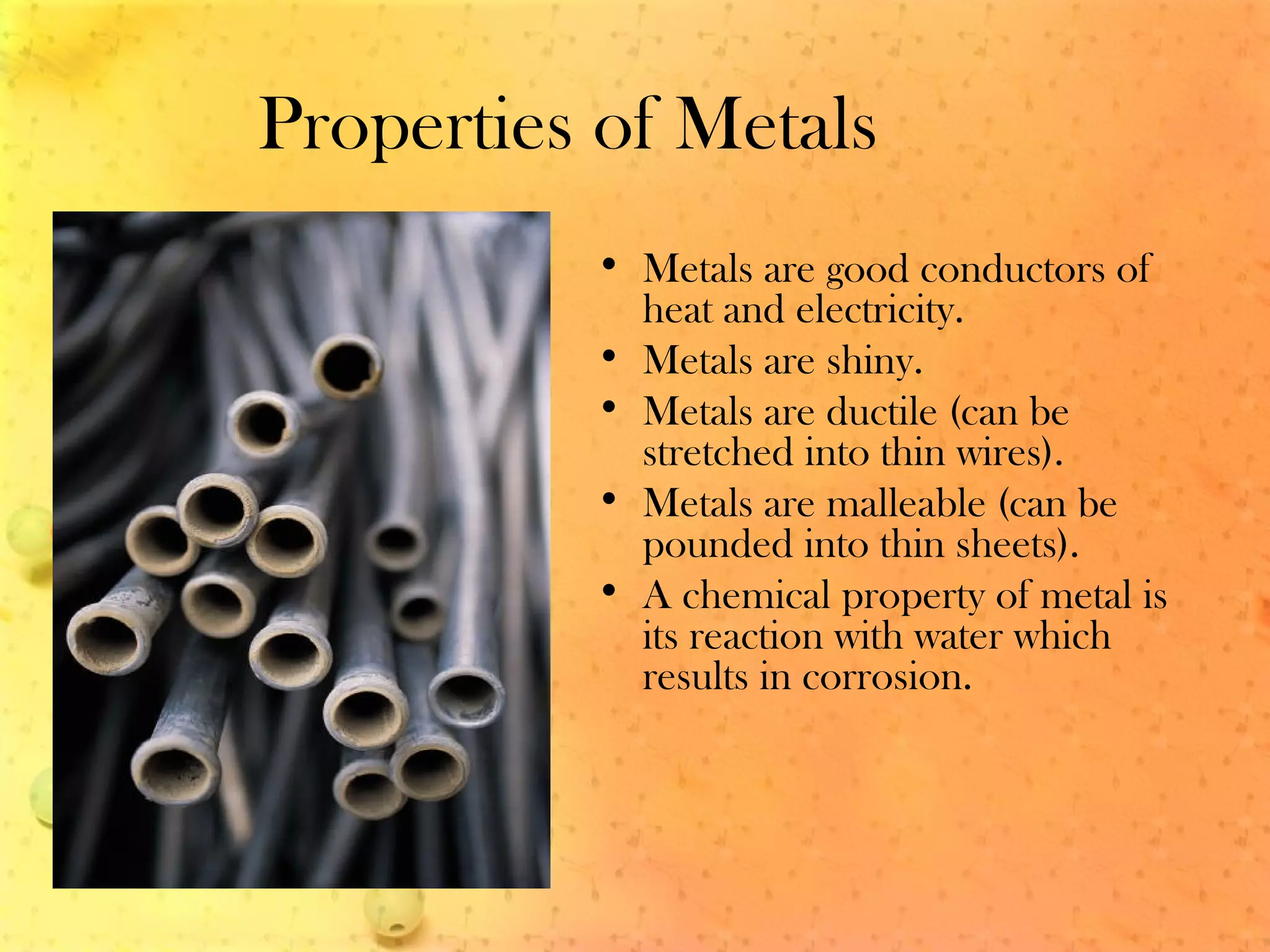
Properties of Metals
• Metals are good conductors of
heat and electricity.
• Metals are shiny.
• Metals are ductile (can be
stretched into thin wires).
• Metals are malleable (can be
pounded into thin sheets).
• A chemical property of metal is
its reaction with water which
results in corrosion.
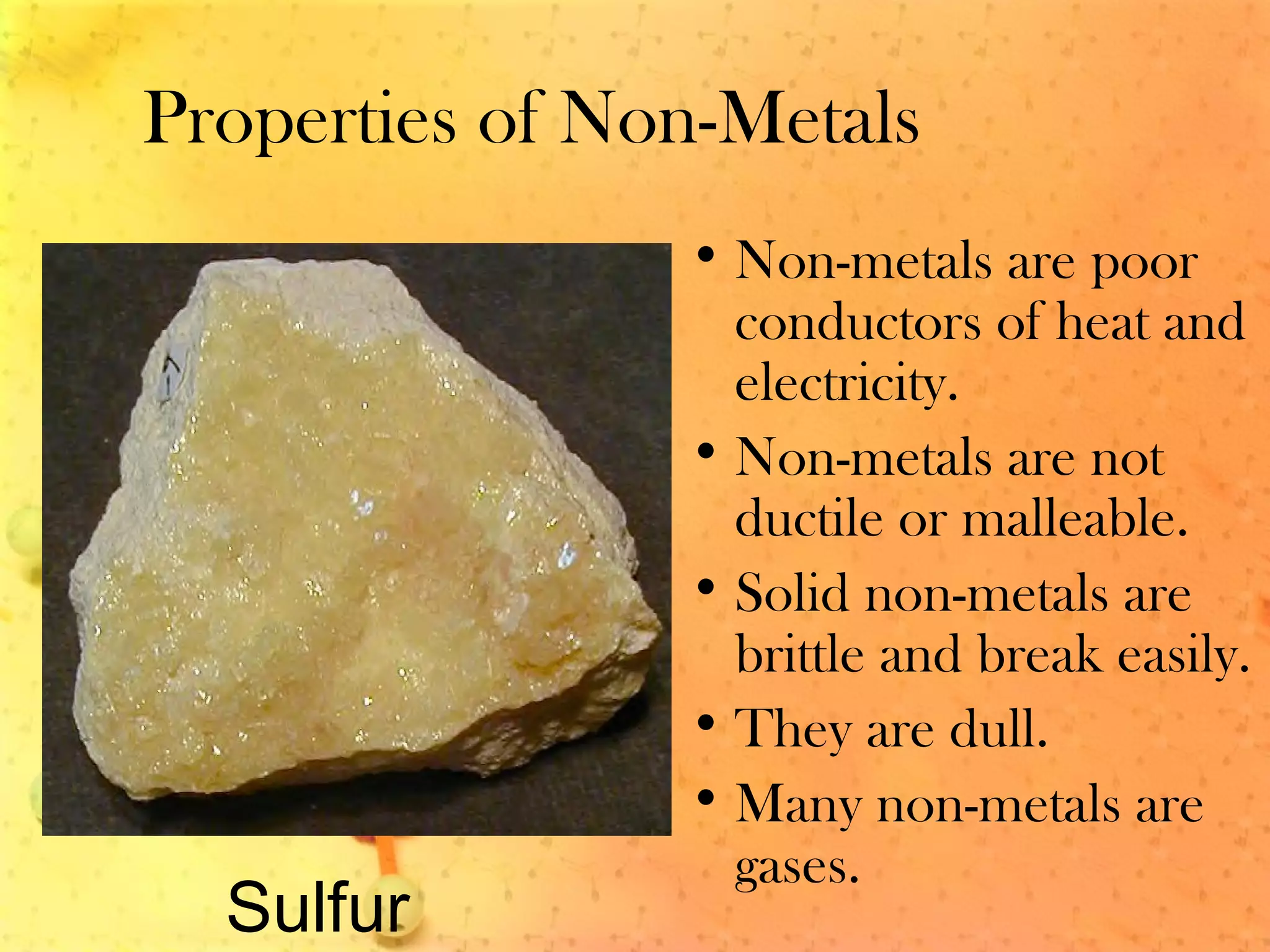
Properties of Non-Metals
• Non-metals are poor
conductors of heat and
electricity.
• Non-metals are not
ductile or malleable.
• Solid non-metals are
brittle and break easily.
• They are dull.
• Many non-metals are
gases.
Sulfur
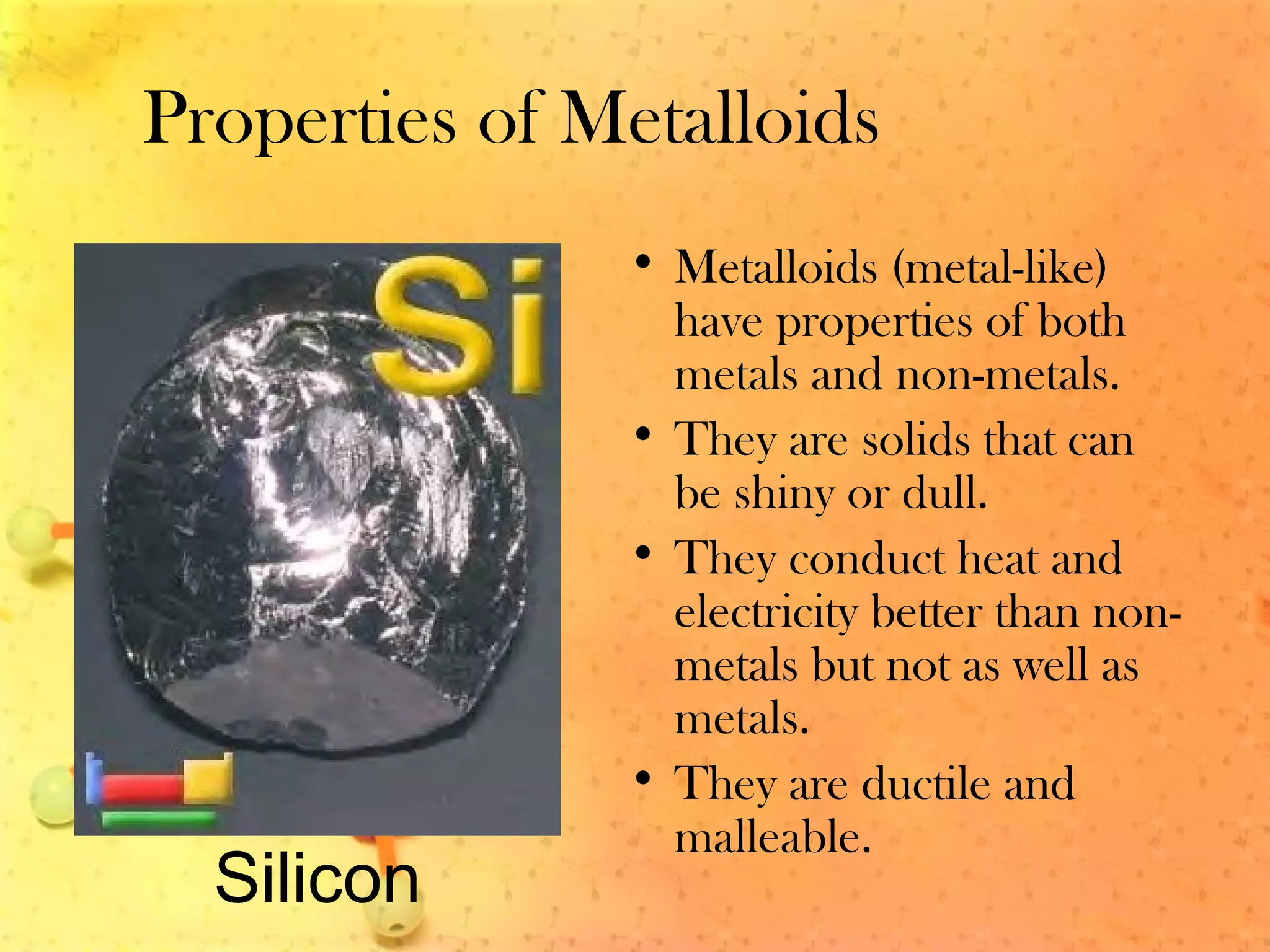
Properties of Metalloids
• Metalloids (metal-like)
have properties of both
metals and non-metals.
• They are solids that can
be shiny or dull.
• They conduct heat and
electricity better than non-
metals but not as well as
metals.
• They are ductile and
malleable.
Silicon
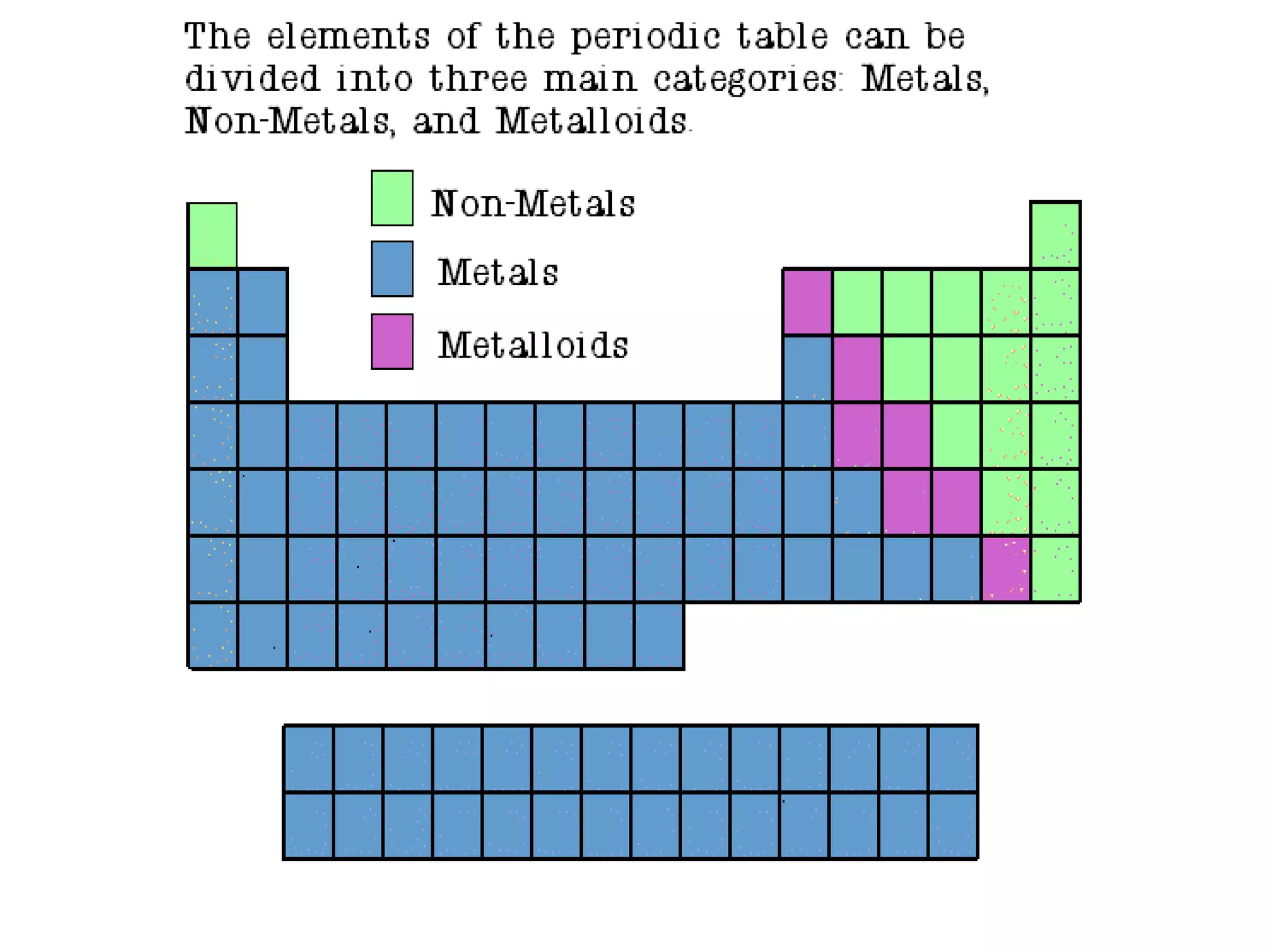
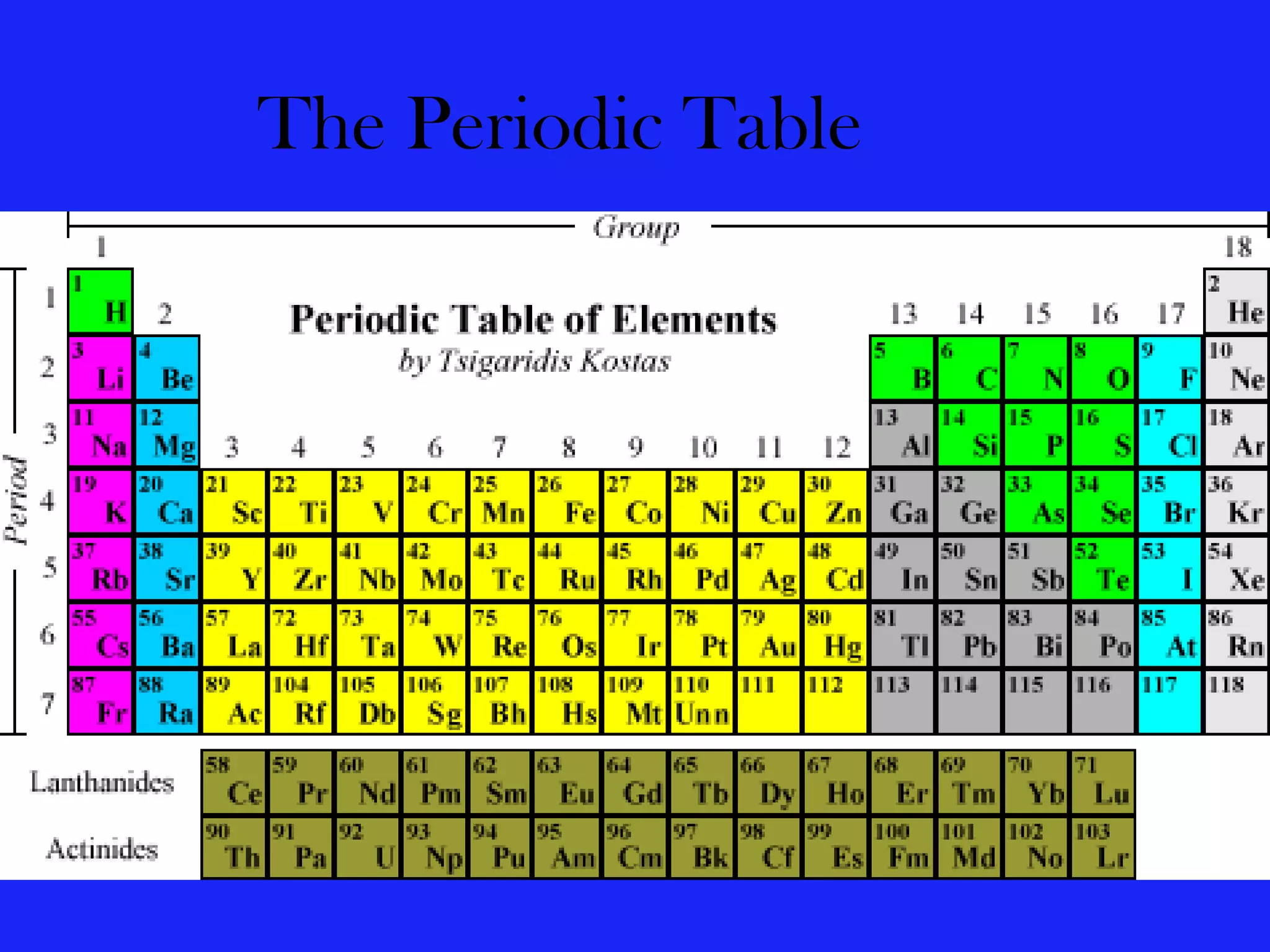
The Periodic Table
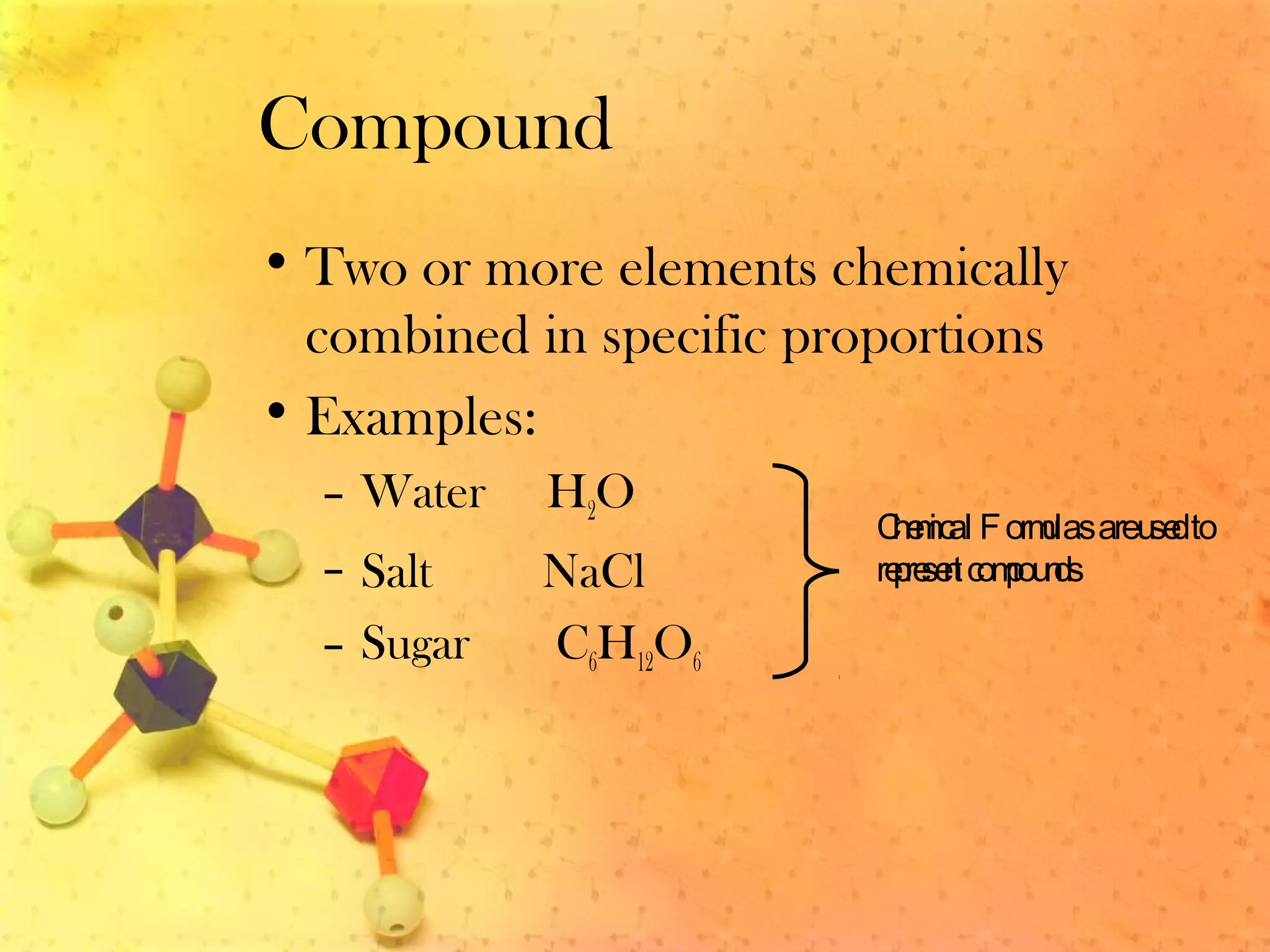
Compound
• Two or more elements chemically
combined in specific proportions
• Examples:
– Water H2O
– Salt NaCl
– Sugar C6H12O6
Chemical Formulasareusedto
representcompounds
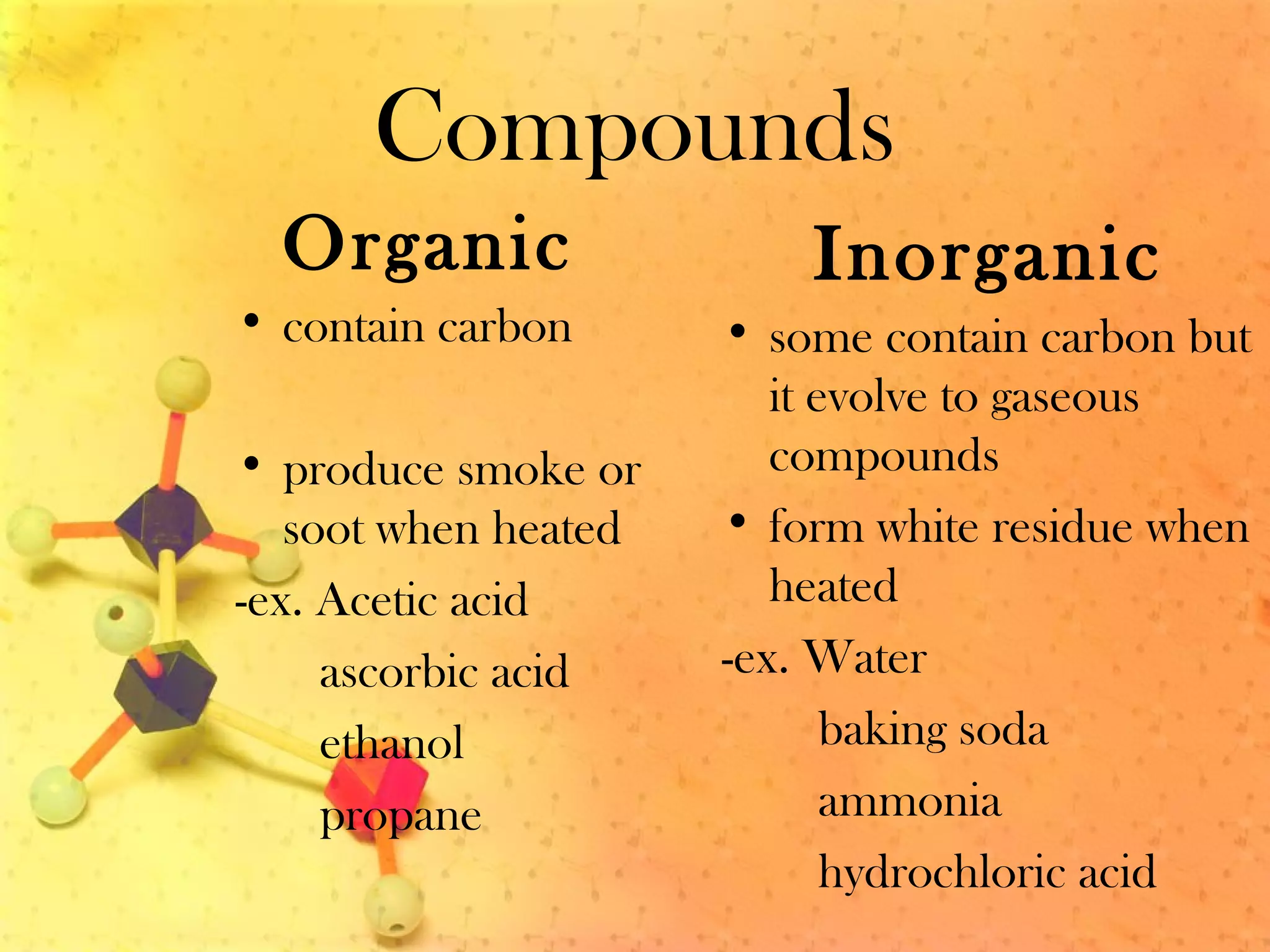
Compounds
Organic
• contain carbon
• produce smoke or
soot when heated
-ex. Acetic acid
ascorbic acid
ethanol
propane
Inorganic
• some contain carbon but
it evolve to gaseous
compounds
• form white residue when
heated
-ex. Water
baking soda
ammonia
hydrochloric acid
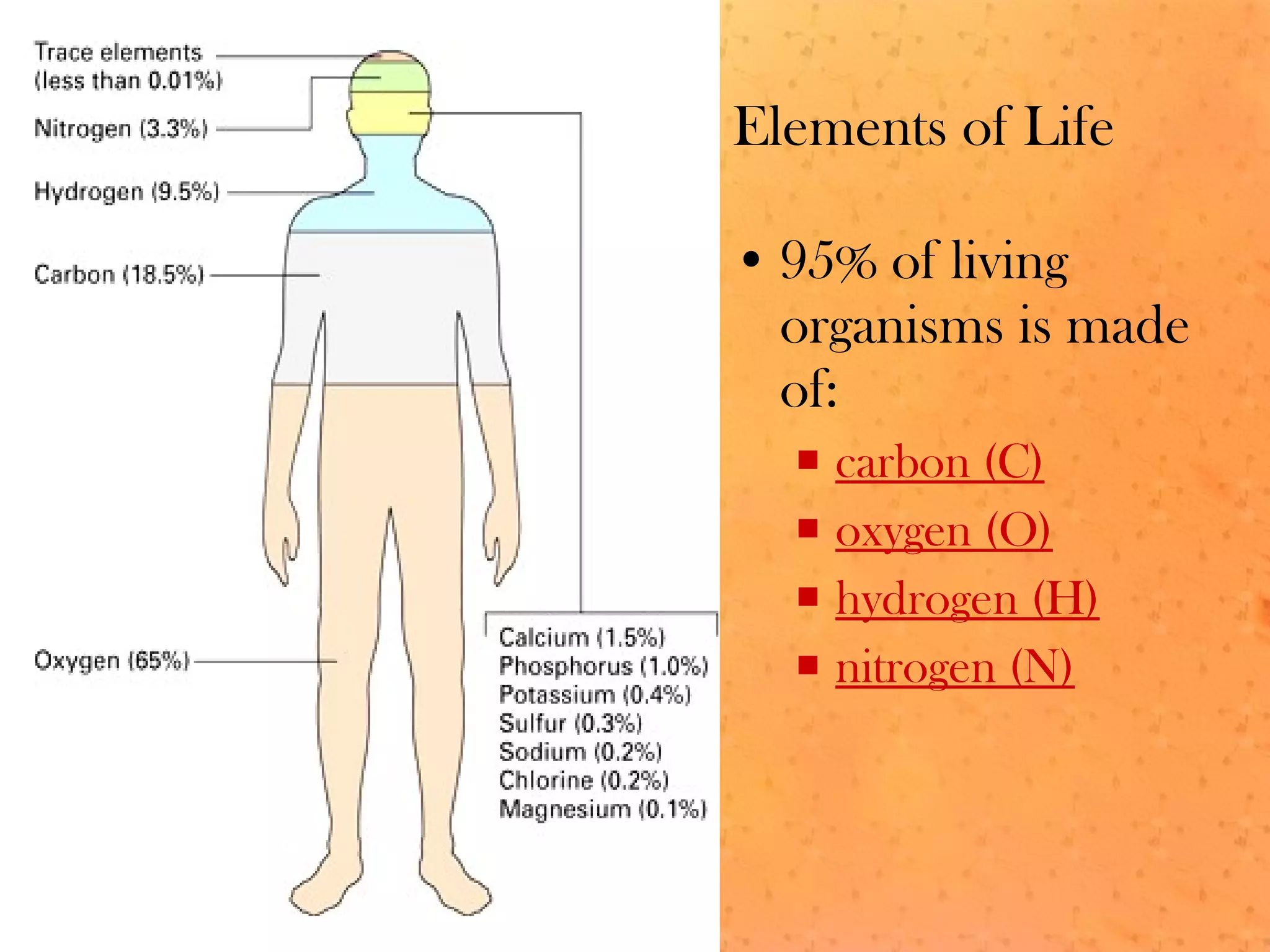
• 95% of living
organisms is made
of:
 carbon (C)
 oxygen (O)
 hydrogen (H)
 nitrogen (N)
Elements of Life
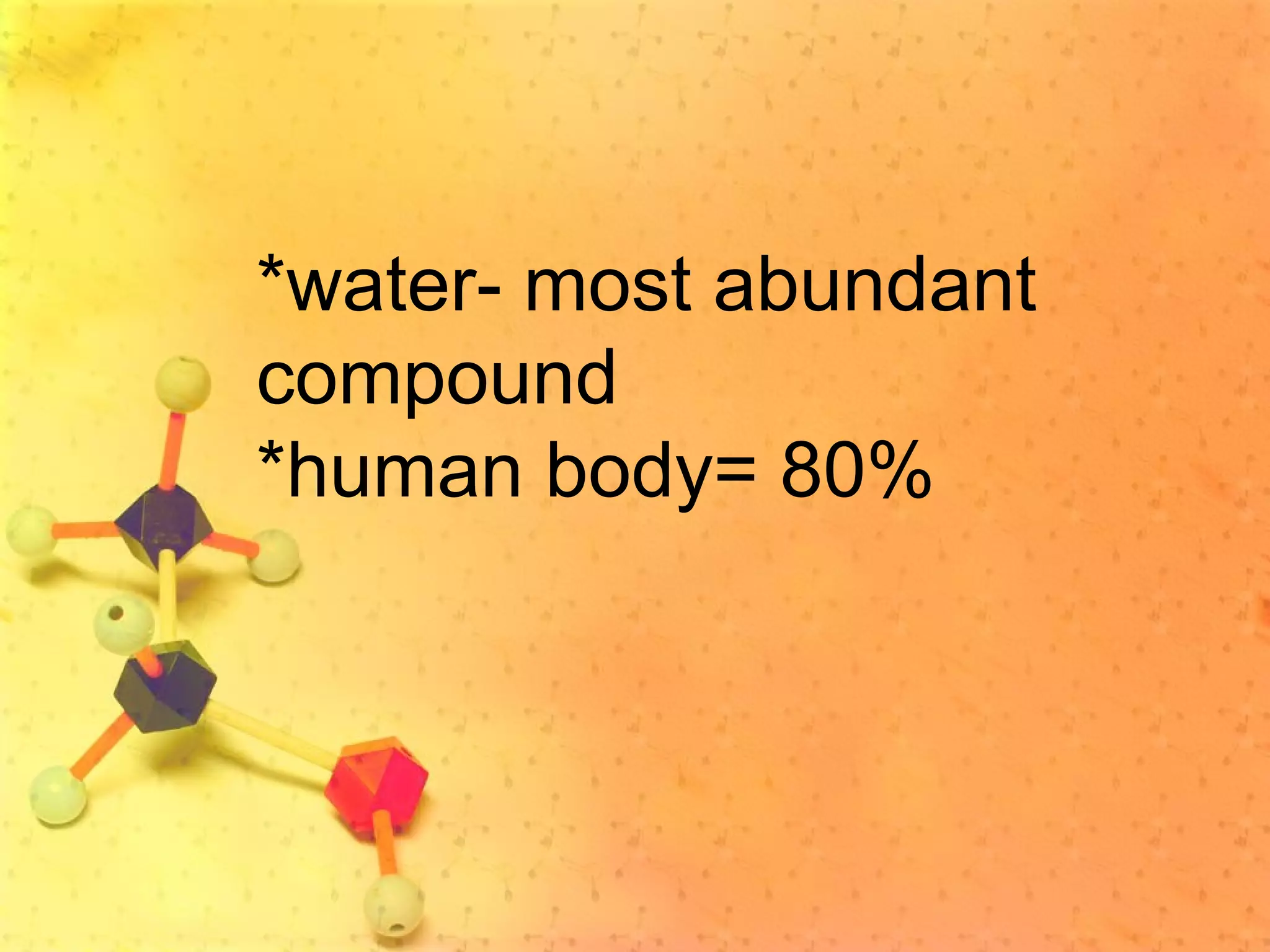
*water- most abundant
compound
*human body= 80%
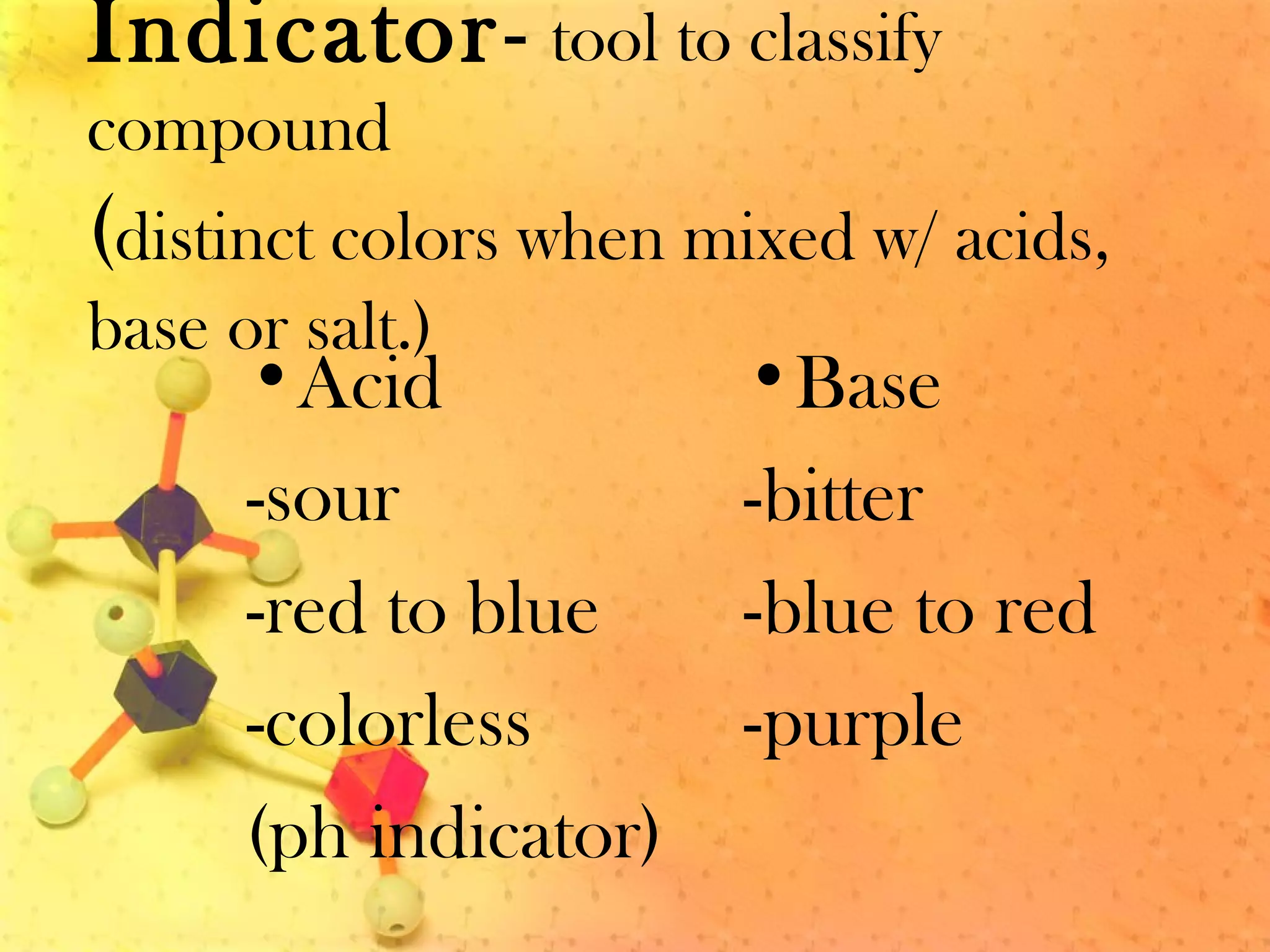
Indicator- tool to classify
compound
(distinct colors when mixed w/ acids,
base or salt.)
•Acid
-sour
-red to blue
-colorless
(ph indicator)
•Base
-bitter
-blue to red
-purple
Classifying mixtures
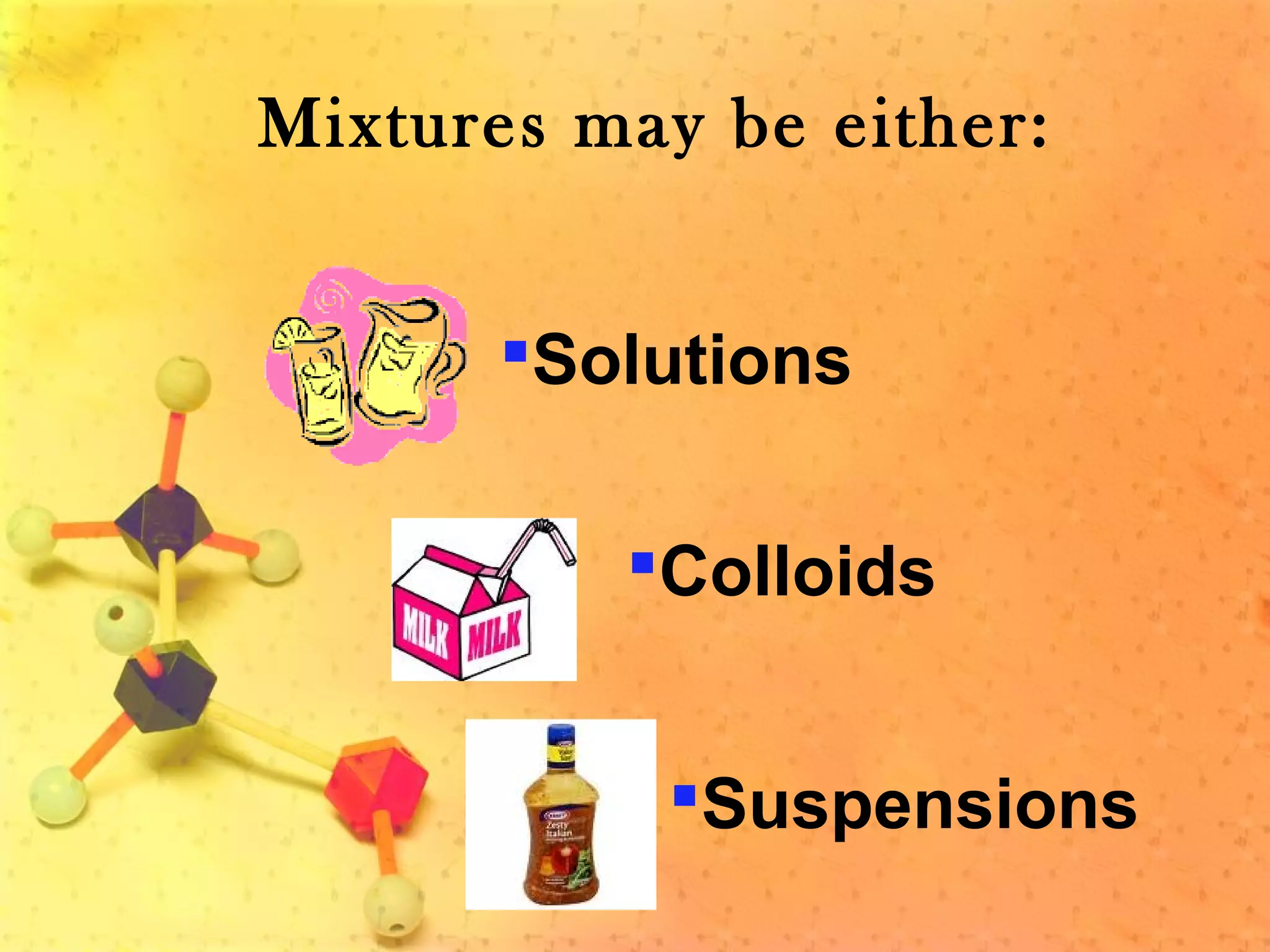
Mixtures may be either:
Solutions
Colloids
Suspensions
Solutions
• Have small particles
• Are transparent (not the same as colorless)
• Do not separate
• Water solutions are very common in
biological systems
– Examples: salt water, kool-aid, air, brass, vinegar
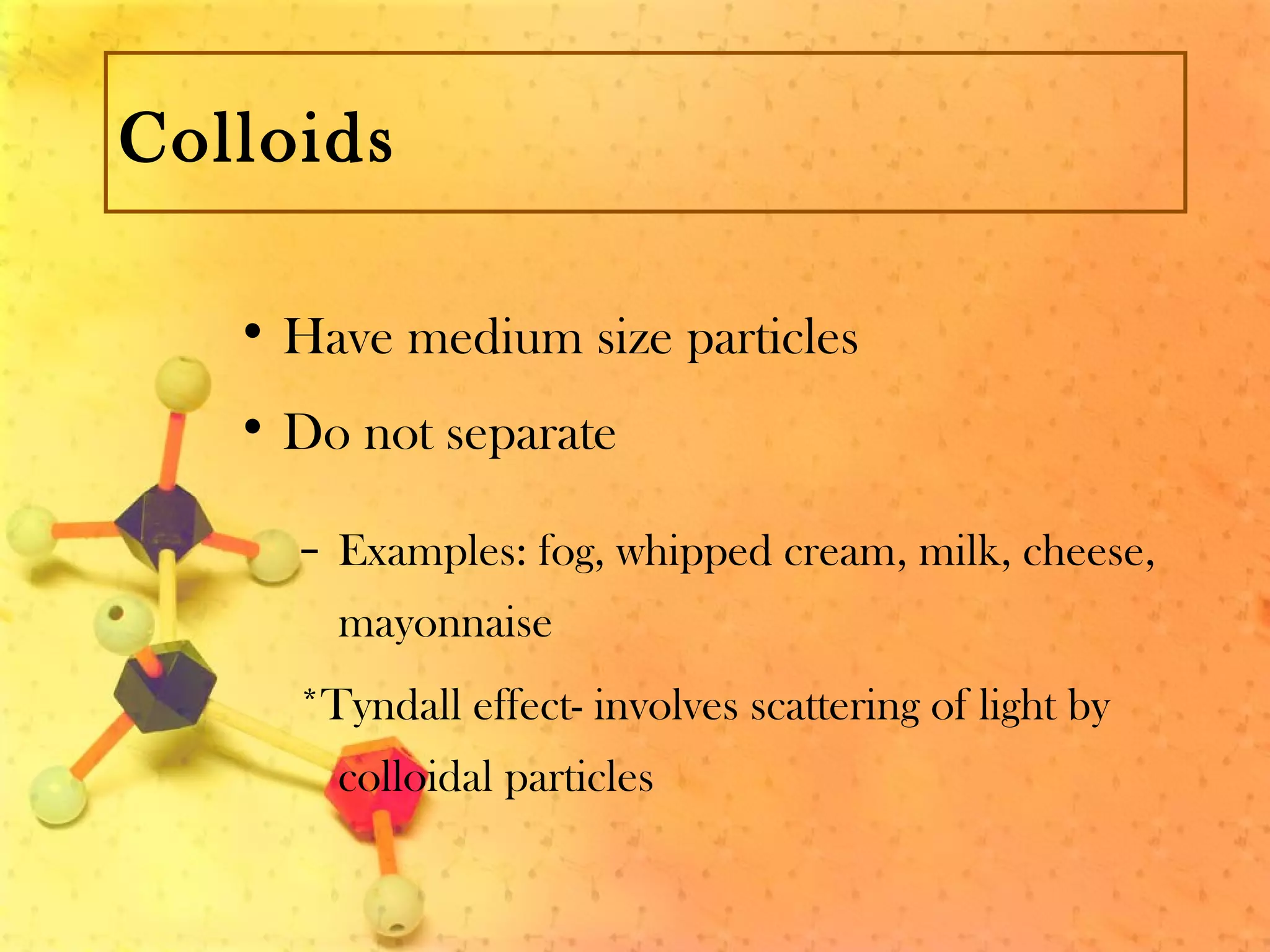
Colloids
• Have medium size particles
• Do not separate
– Examples: fog, whipped cream, milk, cheese,
mayonnaise
*Tyndall effect- involves scattering of light by
colloidal particles
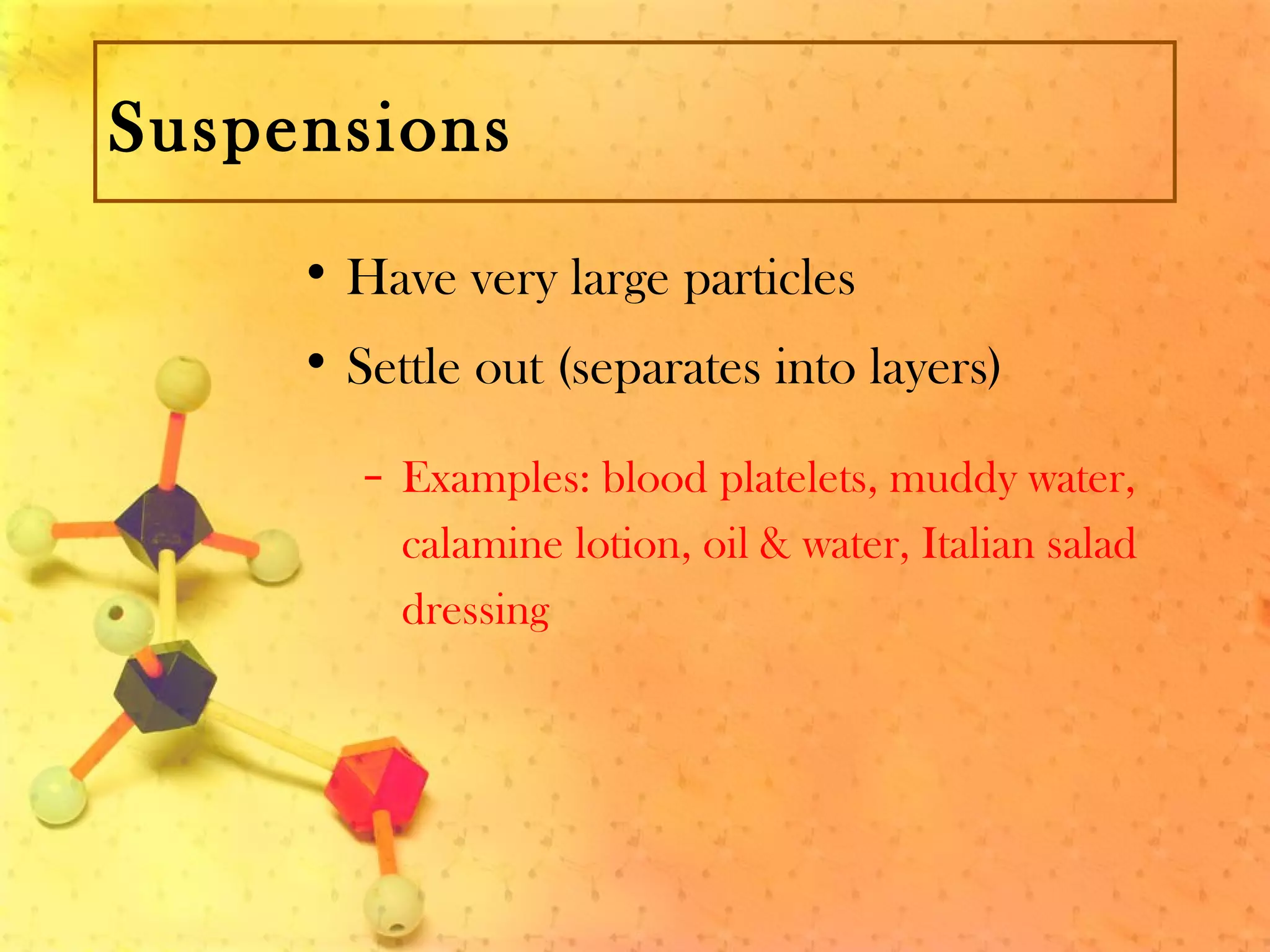
Suspensions
• Have very large particles
• Settle out (separates into layers)
– Examples: blood platelets, muddy water,
calamine lotion, oil & water, Italian salad
dressing
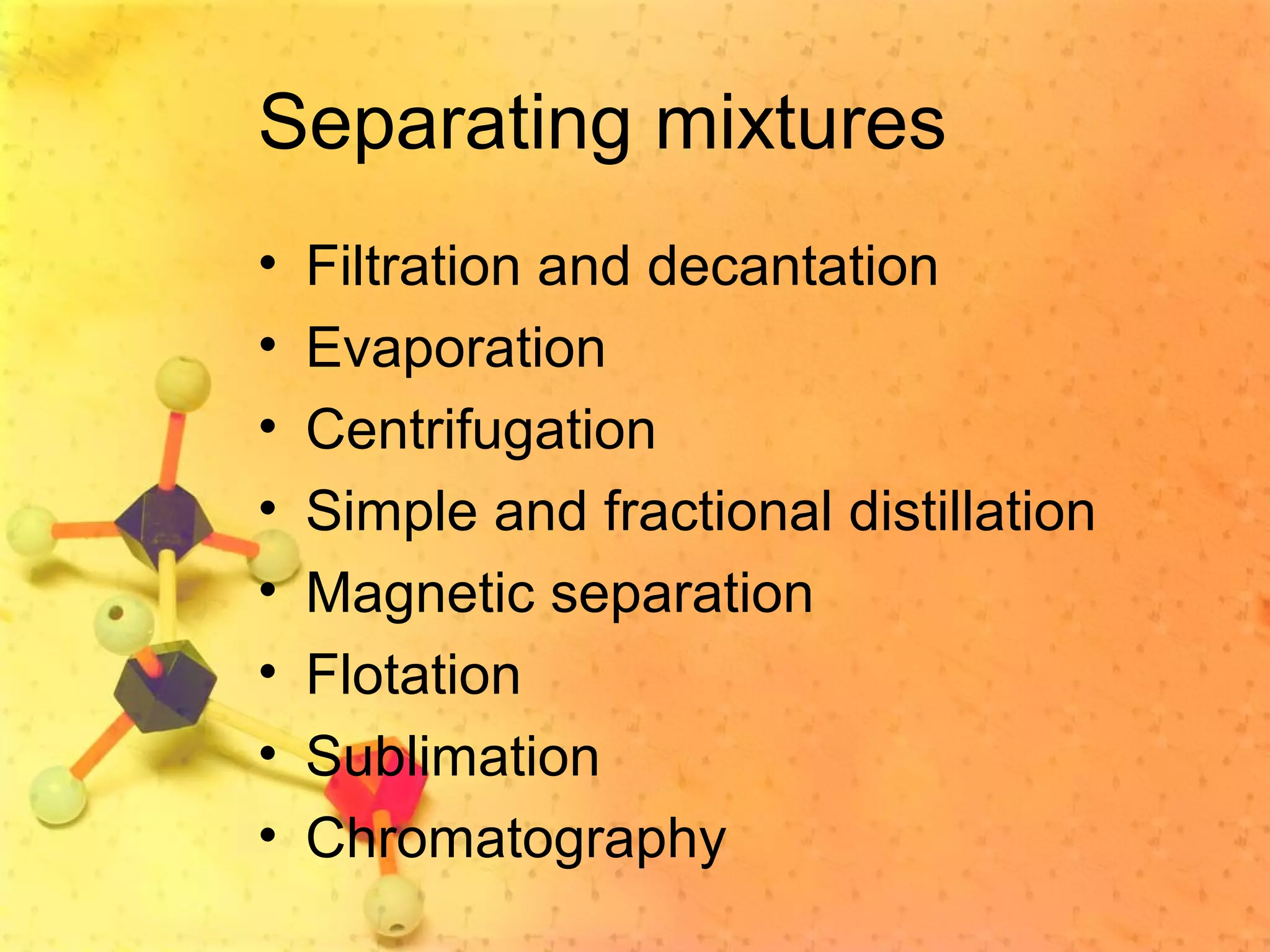
Separating mixtures
• Filtration and decantation
• Evaporation
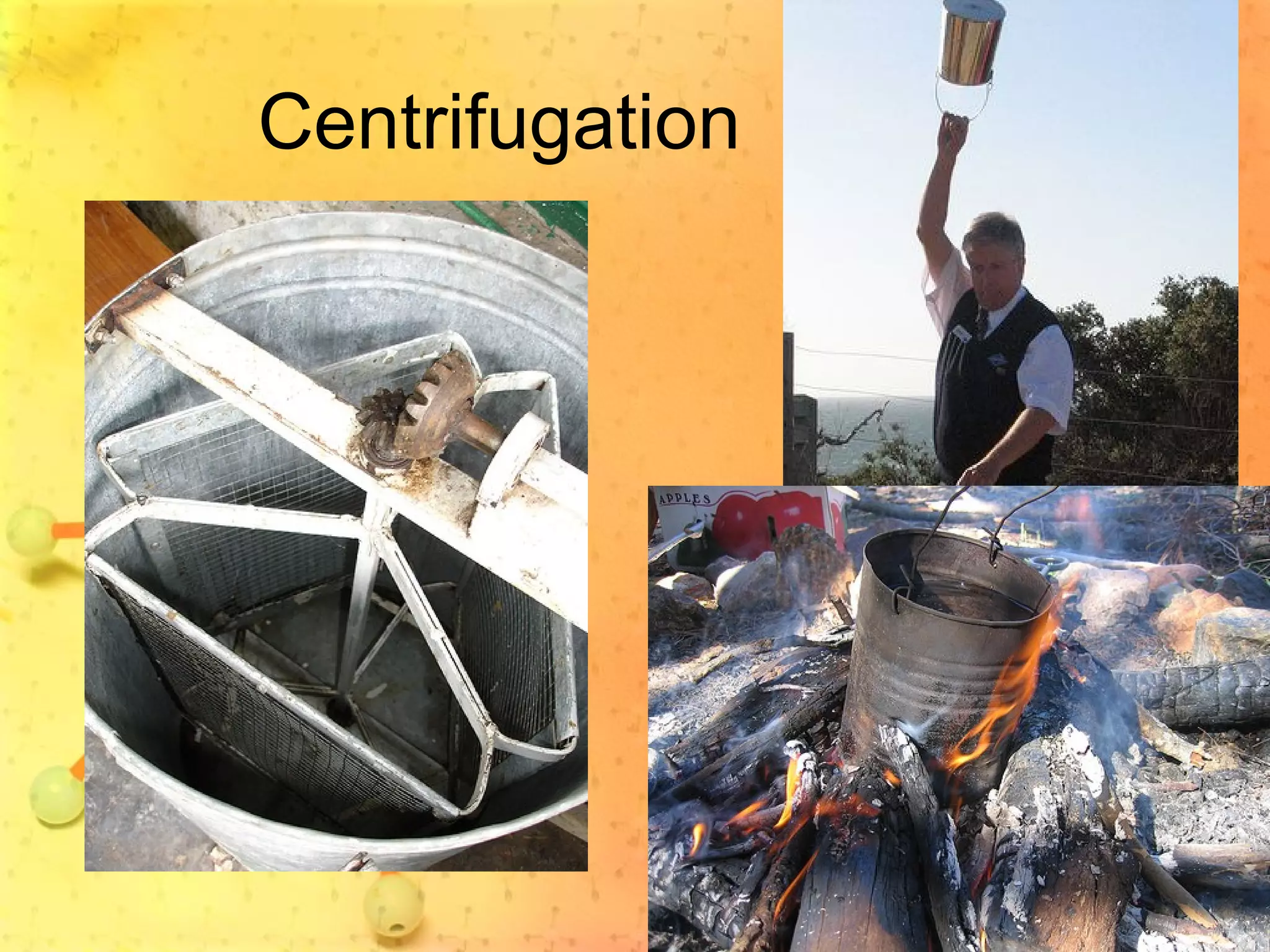
• Centrifugation
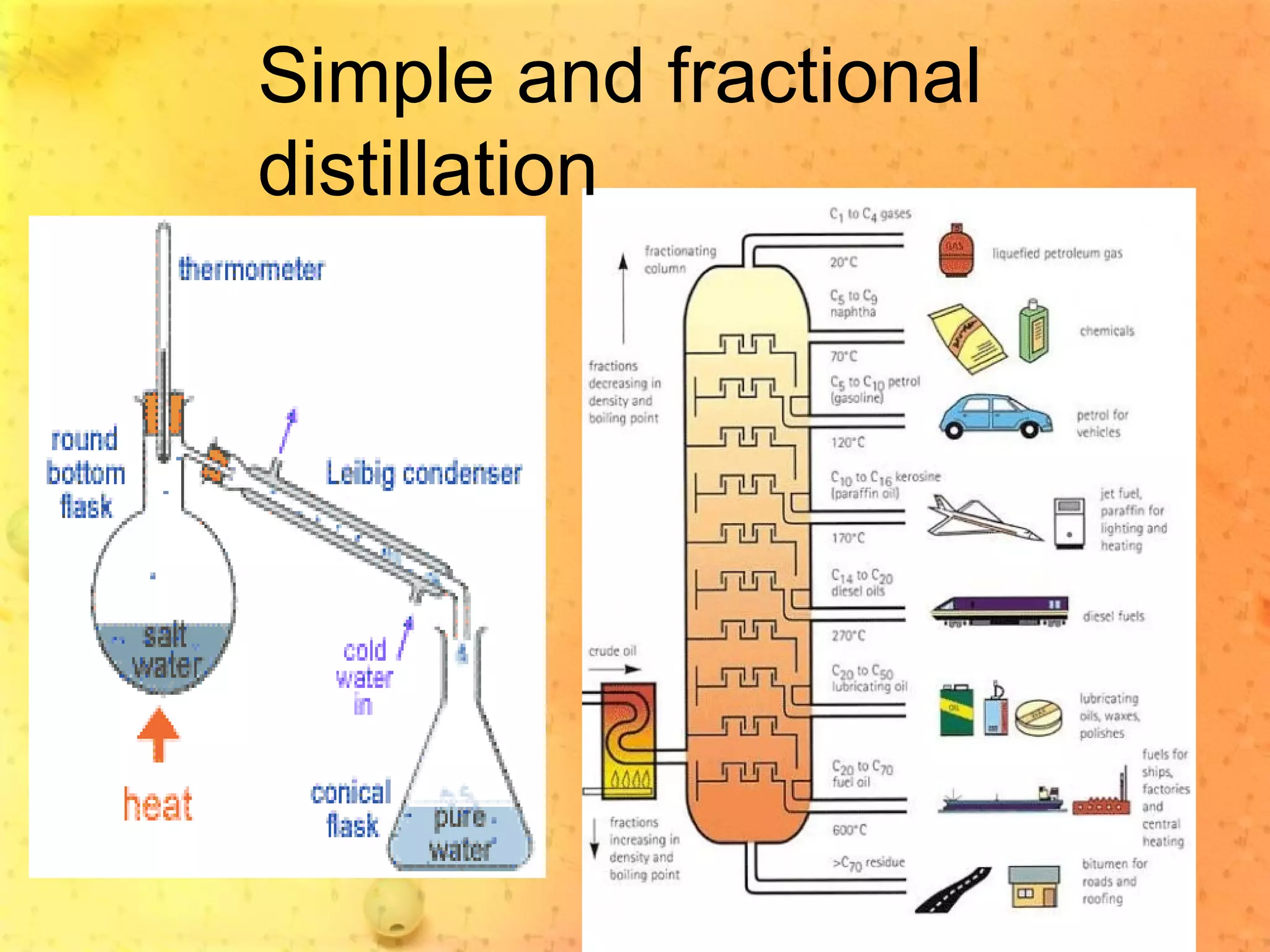
• Simple and fractional distillation
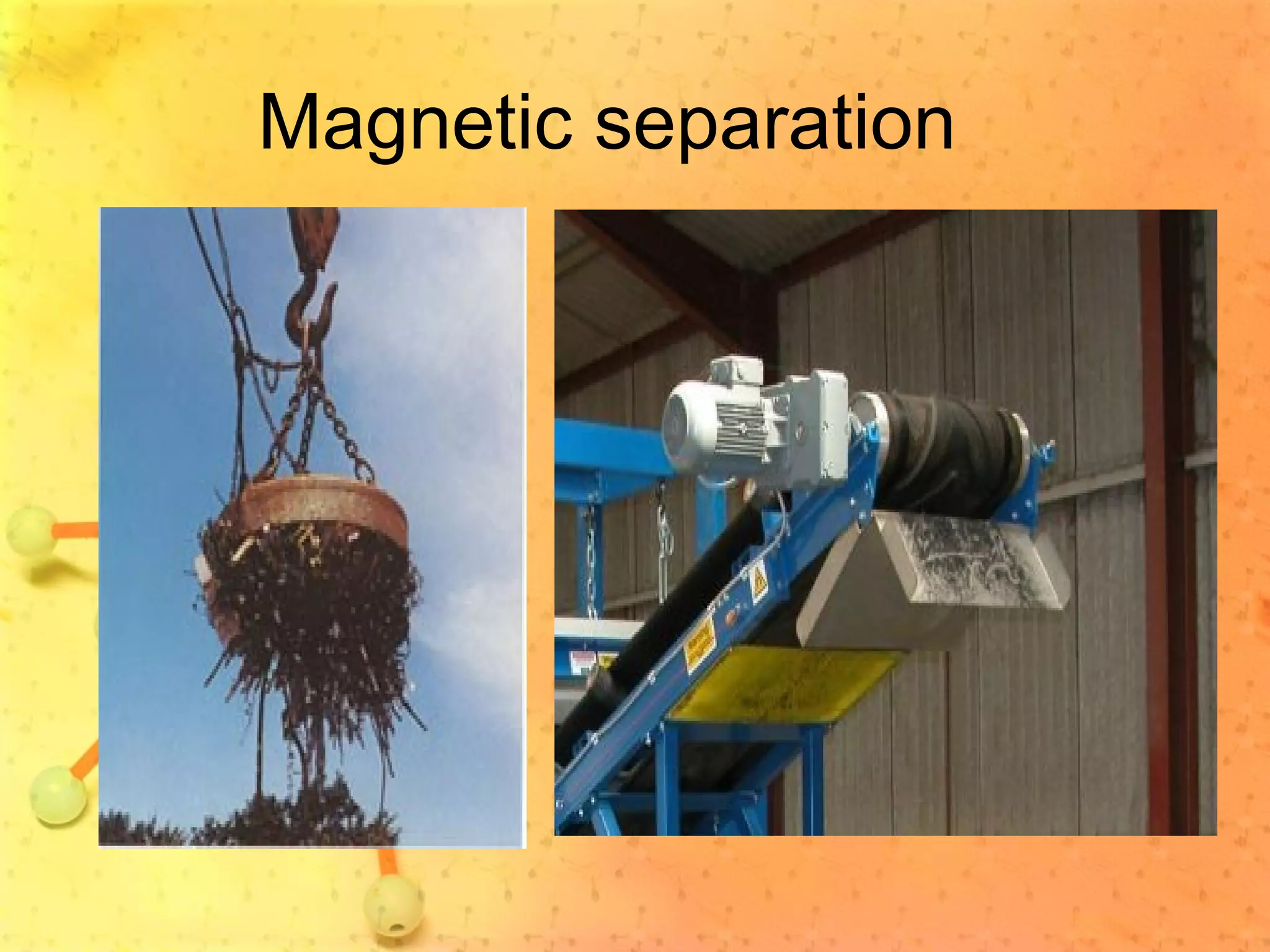
• Magnetic separation
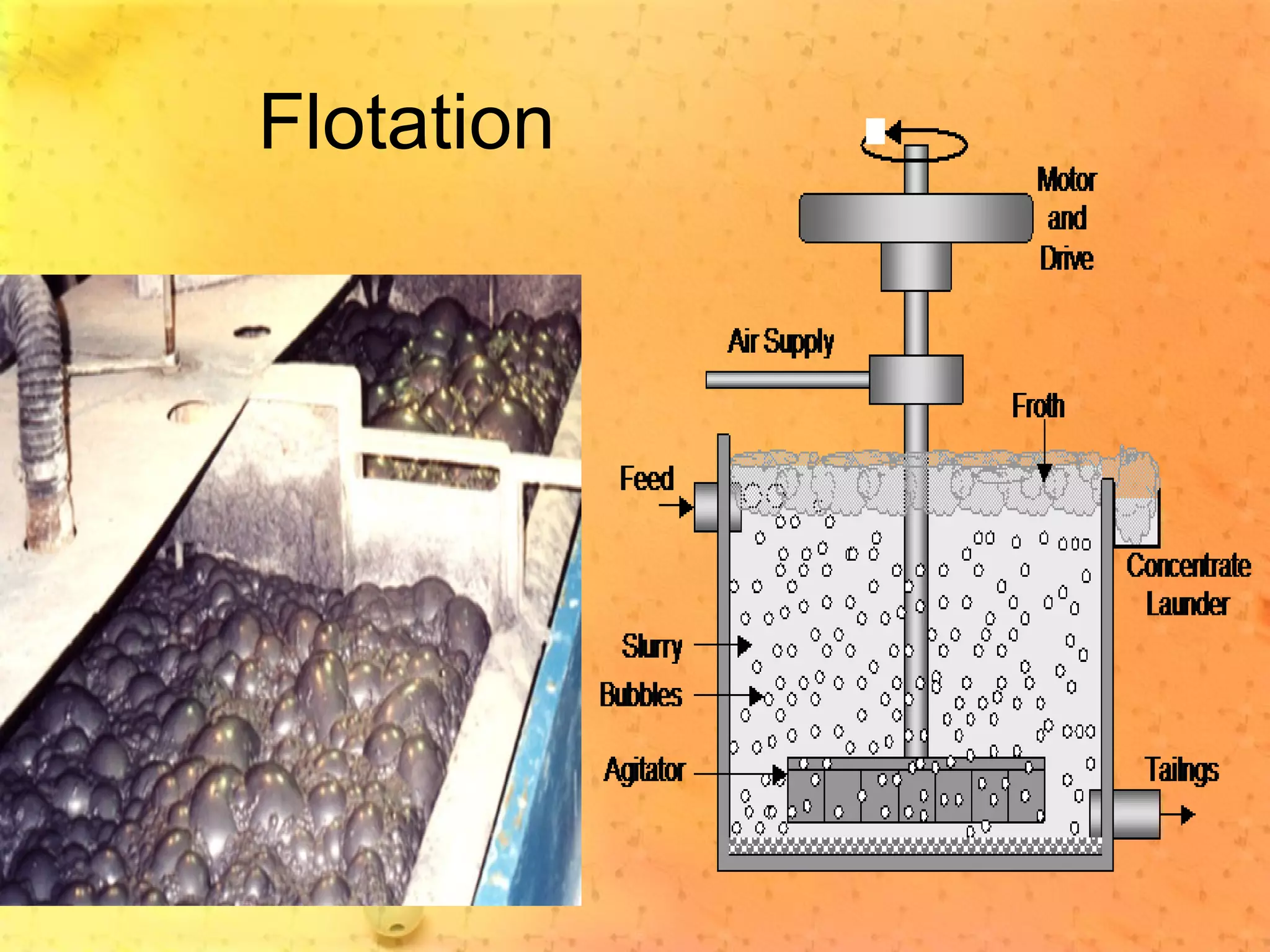
• Flotation
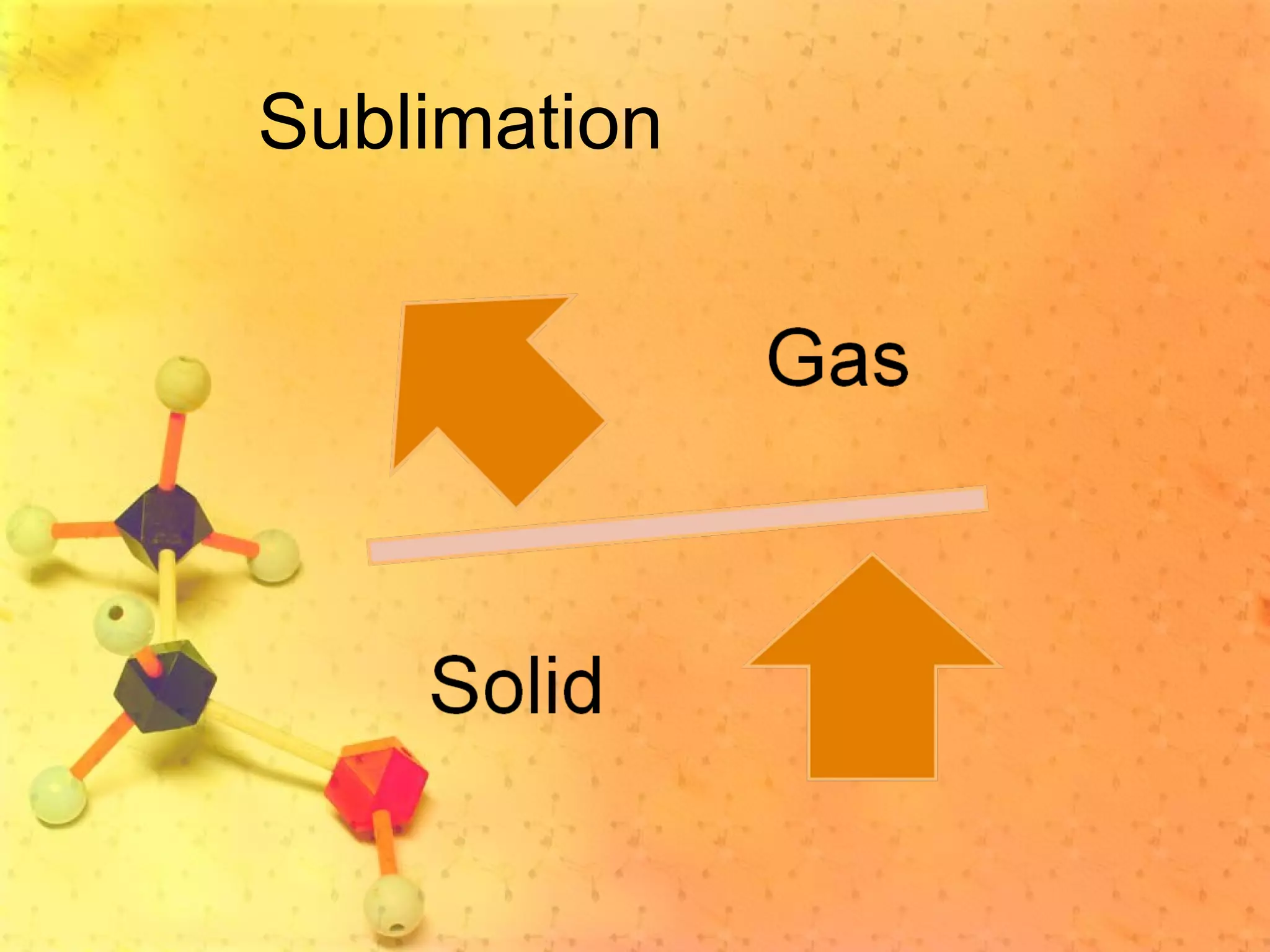
• Sublimation
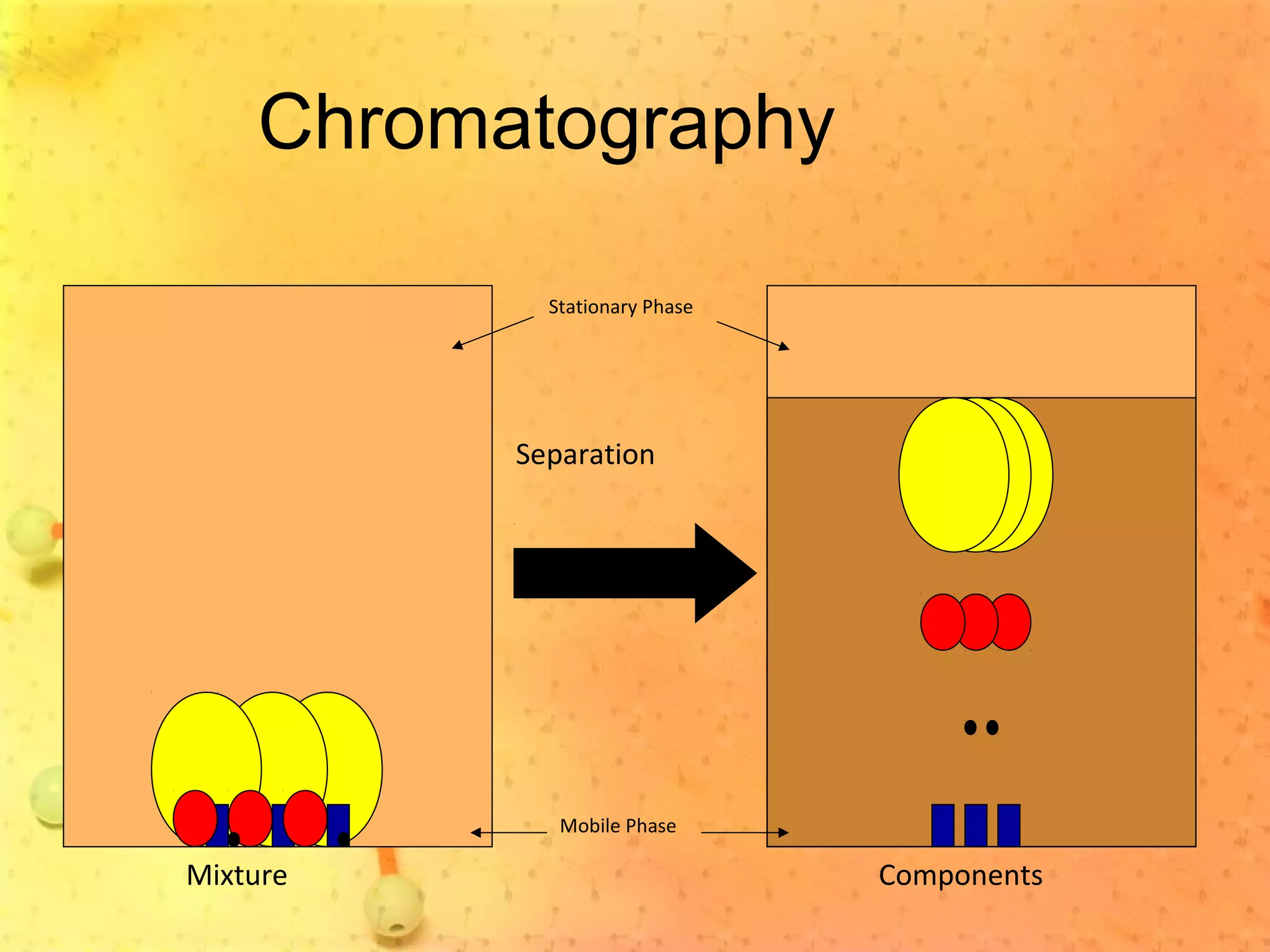
• Chromatography
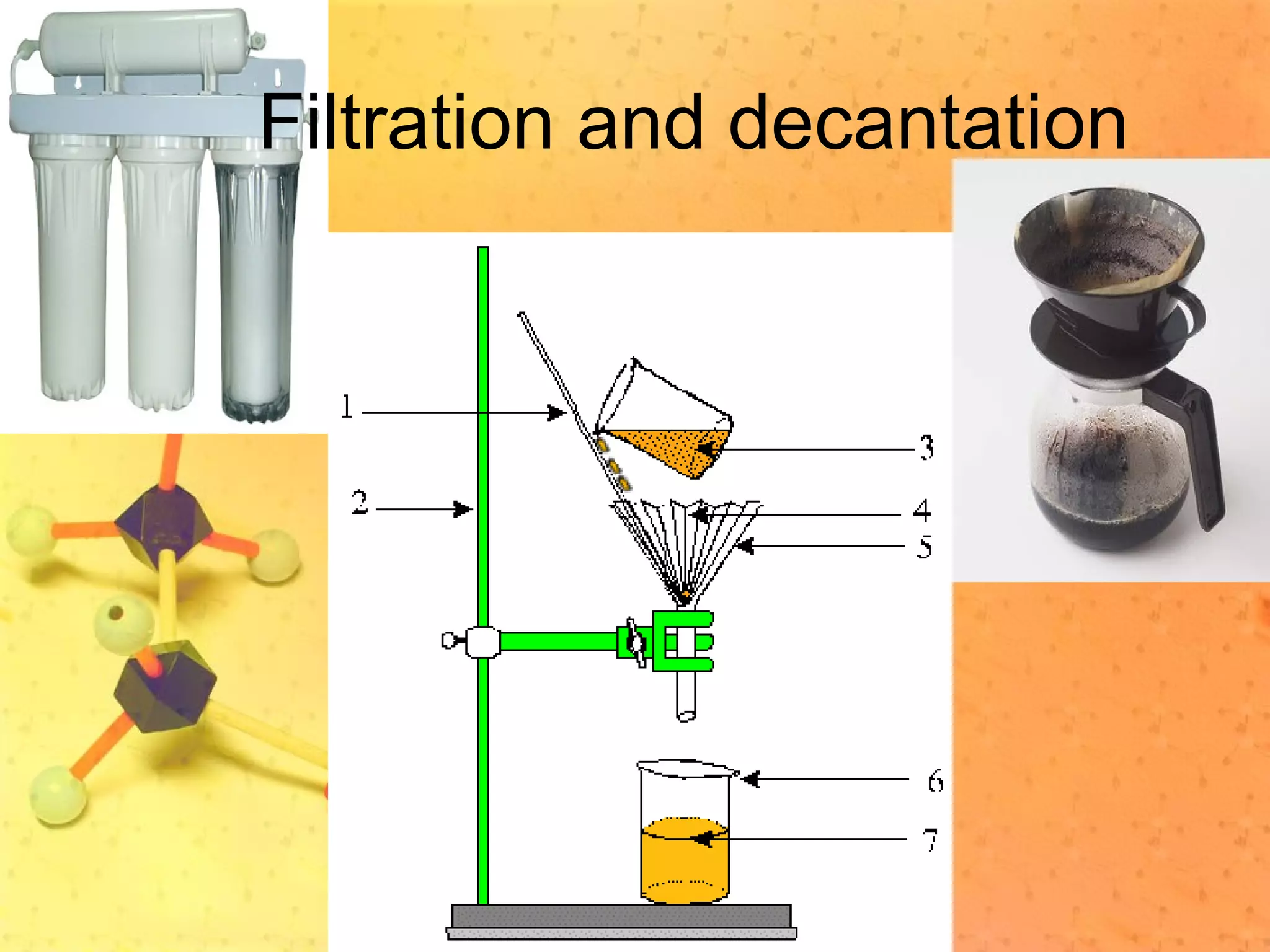
Filtration and decantation
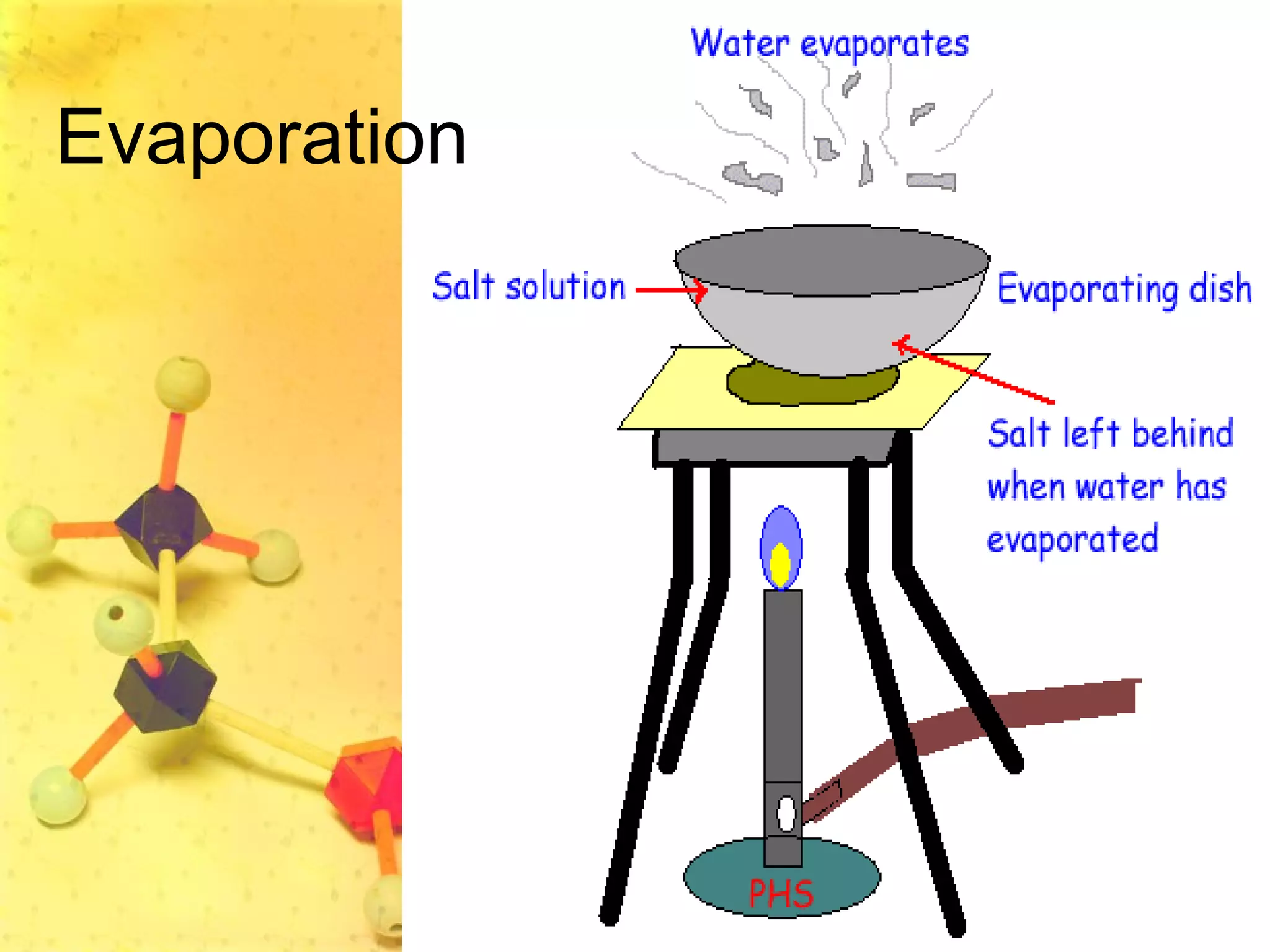
Evaporation
Centrifugation
Simple and fractional
distillation
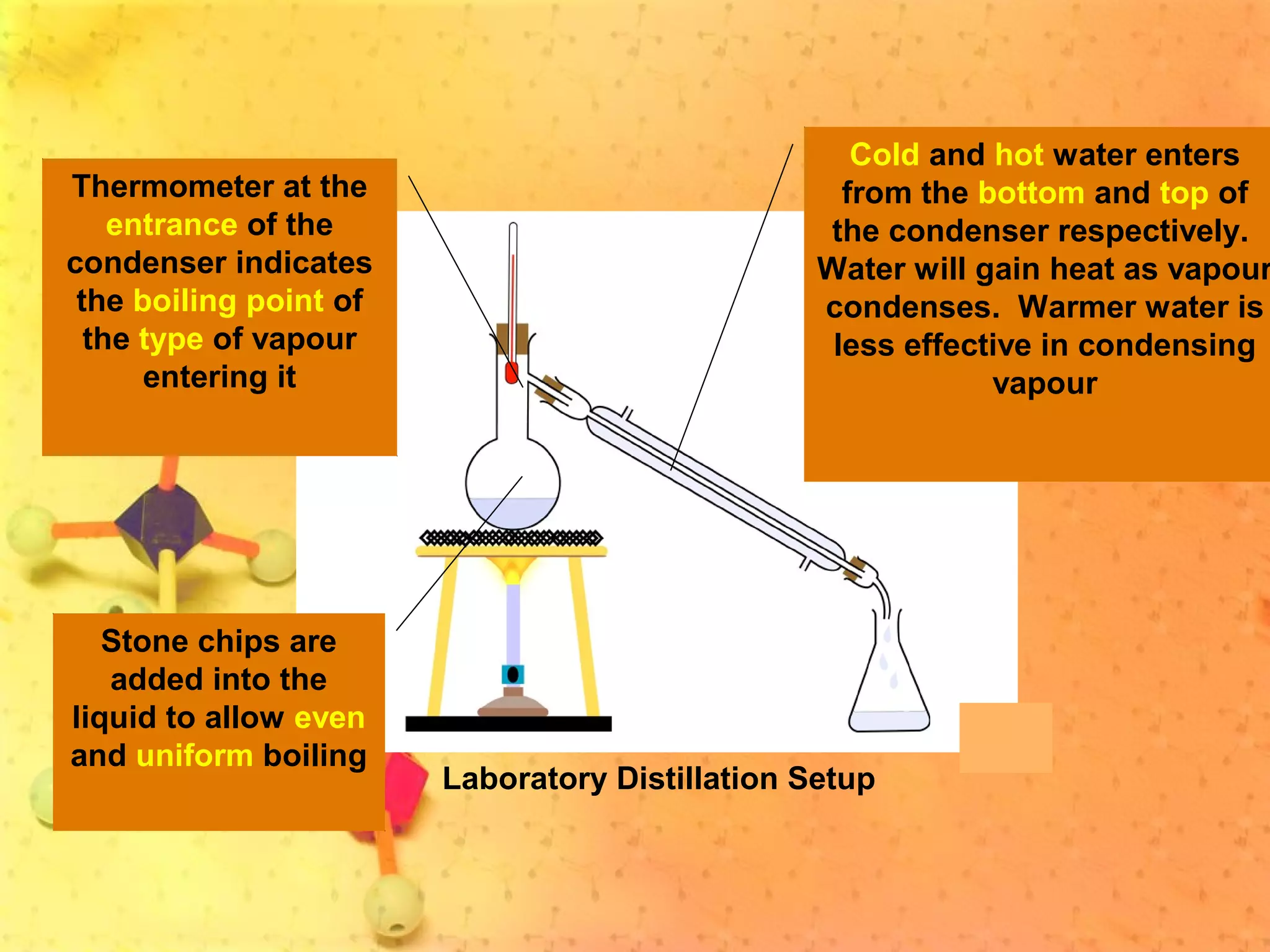
Laboratory Distillation Setup
Stone chips are
added into the
liquid to allow even
and uniform boiling
Cold and hot water enters
from the bottom and top of
the condenser respectively.
Water will gain heat as vapour
condenses. Warmer water is
less effective in condensing
vapour
Thermometer at the
entrance of the
condenser indicates
the boiling point of
the type of vapour
entering it
Magnetic separation
Flotation
Sublimation
Chromatography
Mixture Components
Separation
Stationary Phase
Mobile Phase
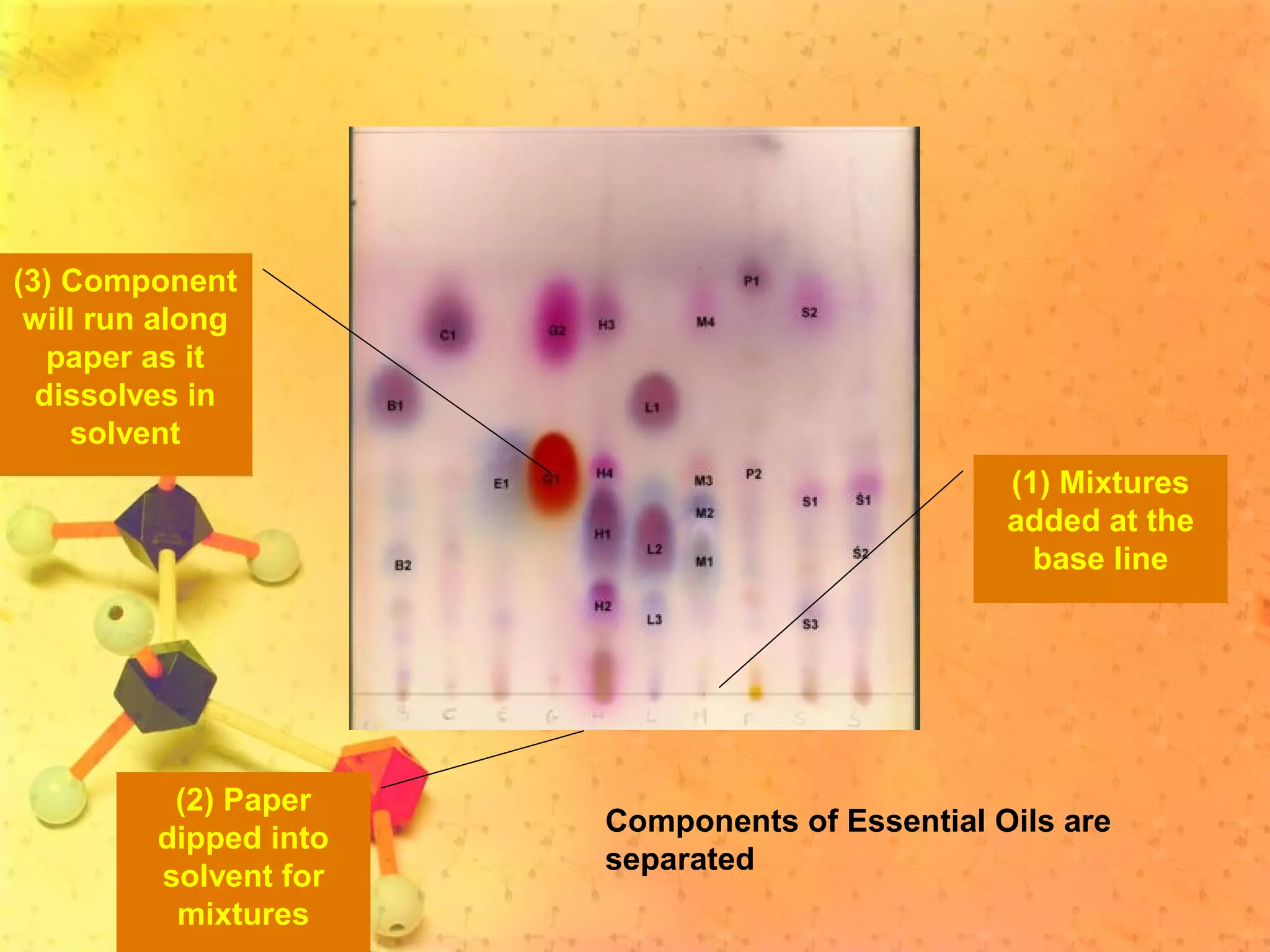
(1) Mixtures
added at the
base line
(2) Paper
dipped into
solvent for
mixtures
(3) Component
will run along
paper as it
dissolves in
solvent
Components of Essential Oils are
separated
Separation of Mixtures
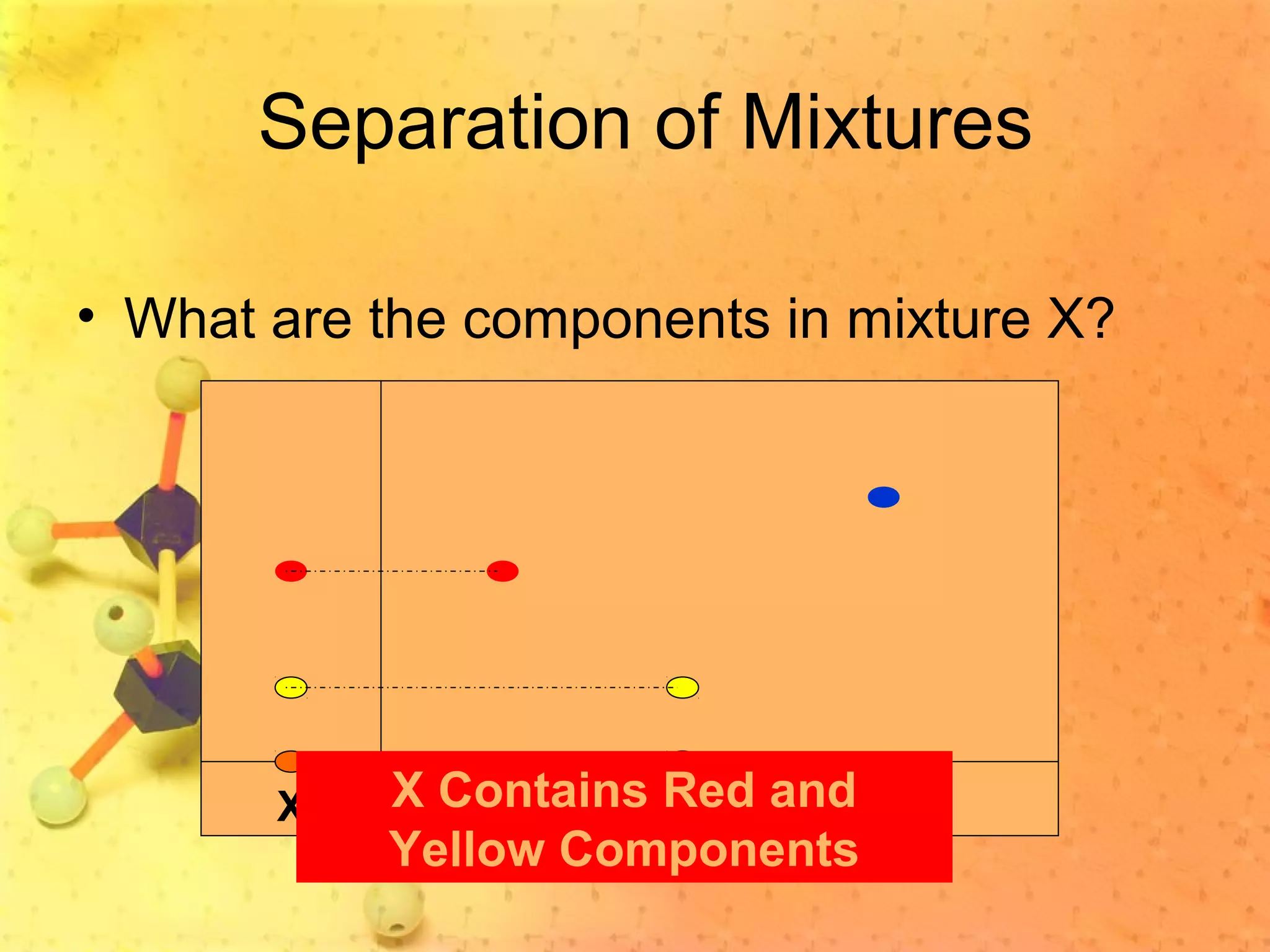
• What are the components in mixture X?
RedX Yellow BlueX Contains Red and
Yellow Components
Separation of Mixtures
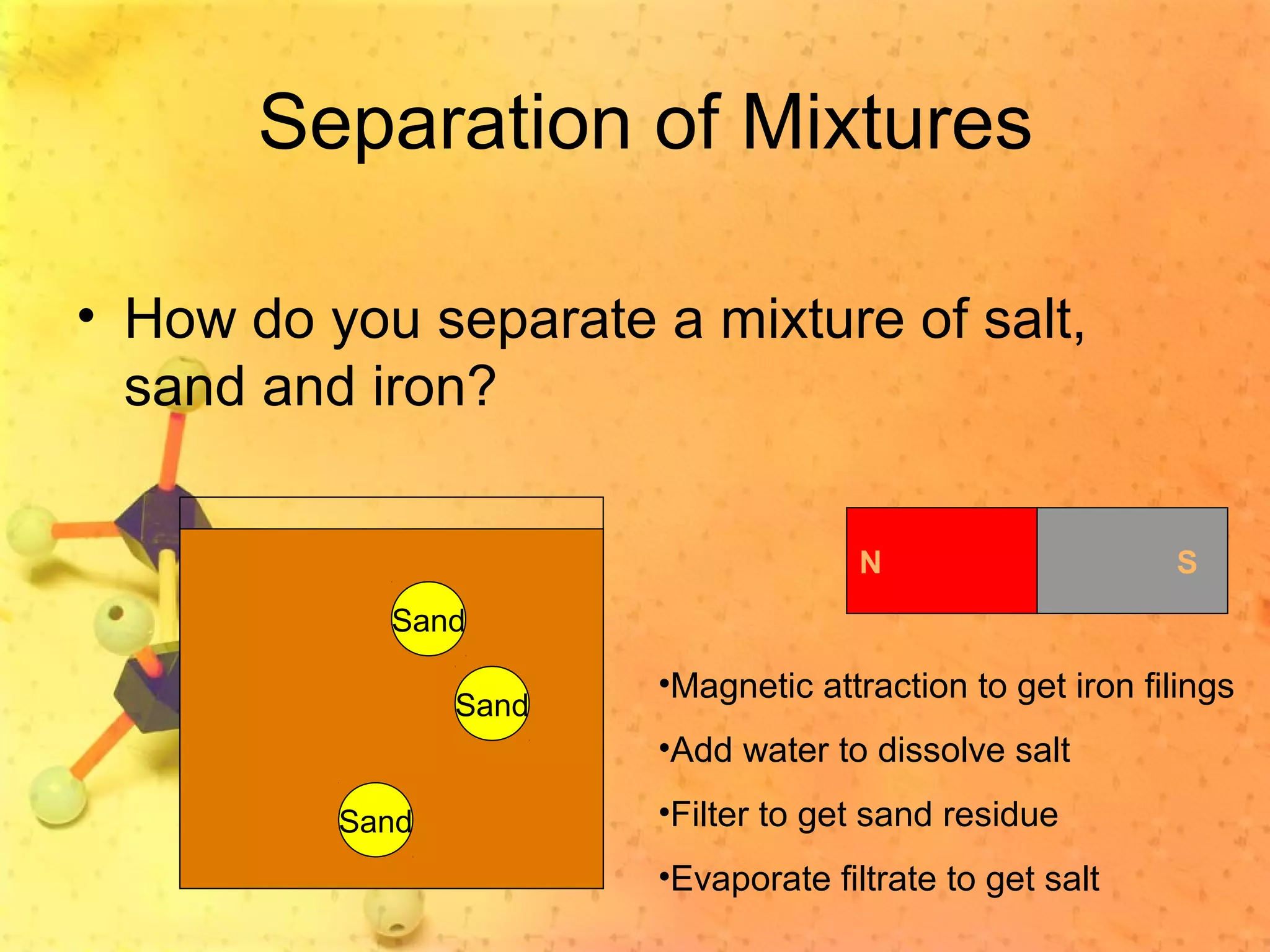
• How do you separate a mixture of salt,
sand and iron?
Salt
Salt
Salt
Iron
IronIron
N S
Sand
Sand
Sand
•Magnetic attraction to get iron filings
•Add water to dissolve salt
•Filter to get sand residue
•Evaporate filtrate to get salt

Matter and elements

  • 1.
  • 2.
    The most importantelement is probably carbon. It has absolutely unique properties in the fact it can link to itself and form literally billions of different chemicals. Some of them have even become living matter. Inorganic carbon can exist as a diamond, both very beautiful and the hardest material known.
  • 3.
    The most beautifulelement is probably Gold. It is unique in the since it is both metallic and colorful. Unlike Copper (which can also be very beautiful), Gold does not tarnish or corrode. It is also so soft it can be finely polished just by rubbing it.
  • 4.
    The most fascinatingelement is probably Mercury. It is the only metal which is fully liquid at room temperature. Unfortunately, unlike Carbon or Gold, Mercury is poisonous. Radium can also bedazzle people. A concentrated solution of radium chloride glows with a soft, blue phosphorescence. Close inspection reveals a galaxy of tiny stars twinkling throughout the glowing liquid. However, Radium is far more dangerous than Mercury because it is so terribly radioactive. The scientist who discovered it (Curie) eventually died of leukemia, most likely due to radiation exposure.
  • 5.
    The most usefulelement is Iron, of course. It is easy to make and the properties of the metal can be fine tuned by alloying it with carbon and/or other metals. The creation of the Japanese Samurai sword is a fascinating study in the combination of high and low carbon steel into a remarkably effective and elegant weapon.
  • 6.
    The strangest elementmight just be Francium. It is formed by the radioactive decay of larger atoms, but Francium itself has a half life of only about 10 minutes. Francium exists, but only as single atoms dispersed throughout the universe which suddenly appear like soap bubbles and then disappear just as quickly.
  • 7.
    The most abundantelement is Hydrogen. Most of the universe is made of this gas. The human body is mostly water, and because water is 2/3 hydrogen, humans are also mostly made of hydrogen as well.
  • 8.
    The Elements • 116known elements • 94 occur naturally -22 artificially made by nuclear processes
  • 10.
    Properties of Metals •Metals are good conductors of heat and electricity. • Metals are shiny. • Metals are ductile (can be stretched into thin wires). • Metals are malleable (can be pounded into thin sheets). • A chemical property of metal is its reaction with water which results in corrosion.
  • 11.
    Properties of Non-Metals •Non-metals are poor conductors of heat and electricity. • Non-metals are not ductile or malleable. • Solid non-metals are brittle and break easily. • They are dull. • Many non-metals are gases. Sulfur
  • 12.
    Properties of Metalloids •Metalloids (metal-like) have properties of both metals and non-metals. • They are solids that can be shiny or dull. • They conduct heat and electricity better than non- metals but not as well as metals. • They are ductile and malleable. Silicon
  • 13.
  • 14.
    Compound • Two ormore elements chemically combined in specific proportions • Examples: – Water H2O – Salt NaCl – Sugar C6H12O6 Chemical Formulasareusedto representcompounds
  • 15.
    Compounds Organic • contain carbon •produce smoke or soot when heated -ex. Acetic acid ascorbic acid ethanol propane Inorganic • some contain carbon but it evolve to gaseous compounds • form white residue when heated -ex. Water baking soda ammonia hydrochloric acid
  • 17.
    • 95% ofliving organisms is made of:  carbon (C)  oxygen (O)  hydrogen (H)  nitrogen (N) Elements of Life
  • 19.
  • 20.
    Indicator- tool toclassify compound (distinct colors when mixed w/ acids, base or salt.) •Acid -sour -red to blue -colorless (ph indicator) •Base -bitter -blue to red -purple
  • 21.
  • 22.
    Mixtures may beeither: Solutions Colloids Suspensions
  • 23.
    Solutions • Have smallparticles • Are transparent (not the same as colorless) • Do not separate • Water solutions are very common in biological systems – Examples: salt water, kool-aid, air, brass, vinegar
  • 24.
    Colloids • Have mediumsize particles • Do not separate – Examples: fog, whipped cream, milk, cheese, mayonnaise *Tyndall effect- involves scattering of light by colloidal particles
  • 25.
    Suspensions • Have verylarge particles • Settle out (separates into layers) – Examples: blood platelets, muddy water, calamine lotion, oil & water, Italian salad dressing
  • 26.
    Separating mixtures • Filtrationand decantation • Evaporation • Centrifugation • Simple and fractional distillation • Magnetic separation • Flotation • Sublimation • Chromatography
  • 27.
  • 28.
  • 29.
  • 30.
  • 31.
    Laboratory Distillation Setup Stonechips are added into the liquid to allow even and uniform boiling Cold and hot water enters from the bottom and top of the condenser respectively. Water will gain heat as vapour condenses. Warmer water is less effective in condensing vapour Thermometer at the entrance of the condenser indicates the boiling point of the type of vapour entering it
  • 32.
  • 33.
  • 34.
  • 35.
  • 36.
    (1) Mixtures added atthe base line (2) Paper dipped into solvent for mixtures (3) Component will run along paper as it dissolves in solvent Components of Essential Oils are separated
  • 37.
    Separation of Mixtures •What are the components in mixture X? RedX Yellow BlueX Contains Red and Yellow Components
  • 38.
    Separation of Mixtures •How do you separate a mixture of salt, sand and iron? Salt Salt Salt Iron IronIron N S Sand Sand Sand •Magnetic attraction to get iron filings •Add water to dissolve salt •Filter to get sand residue •Evaporate filtrate to get salt