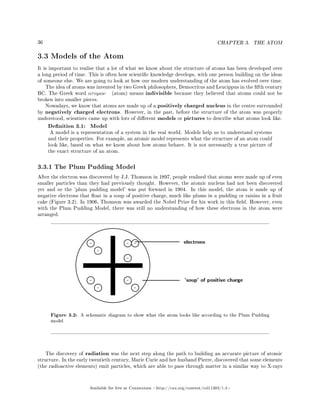
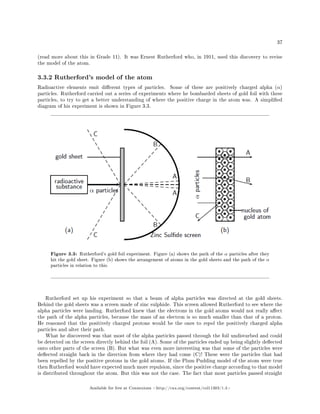
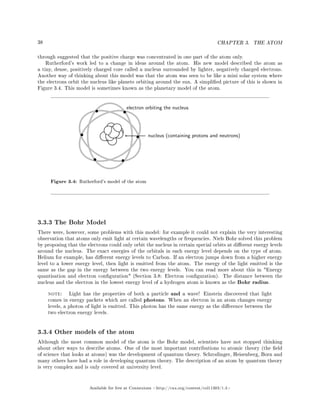
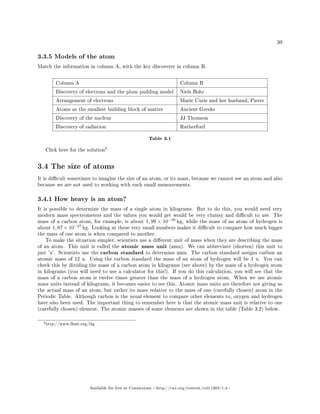
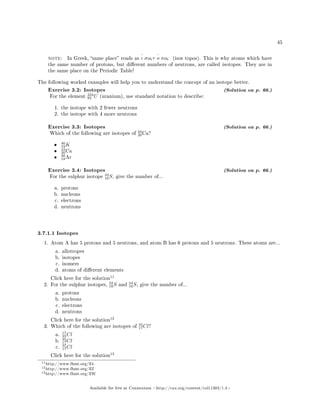
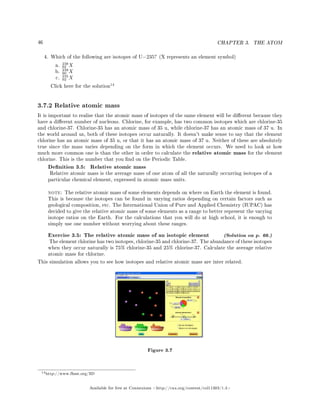
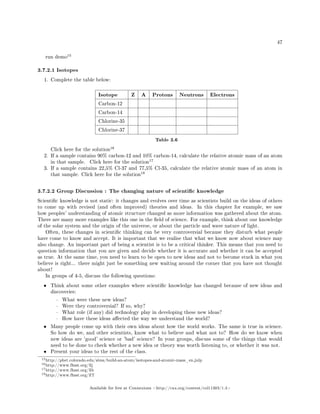
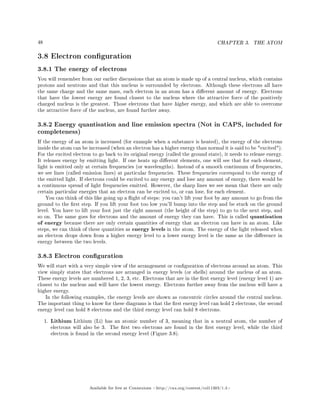
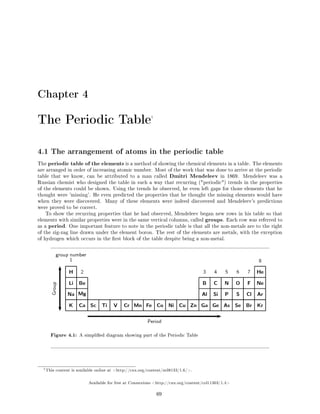
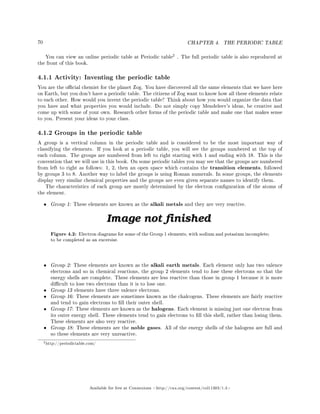
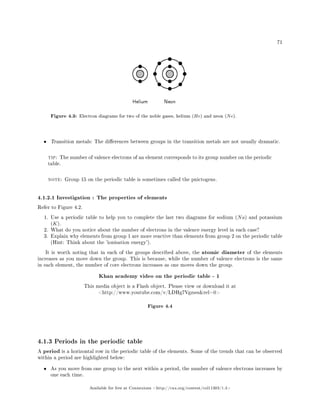
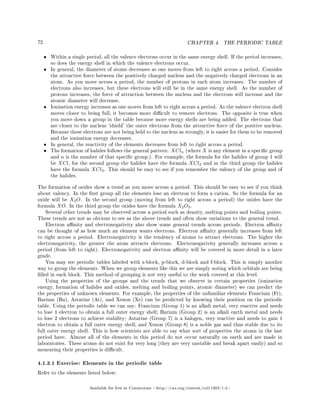
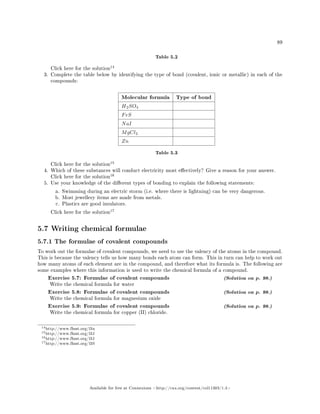
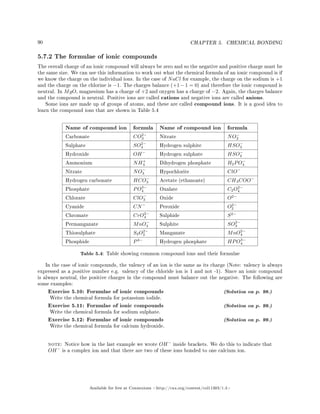
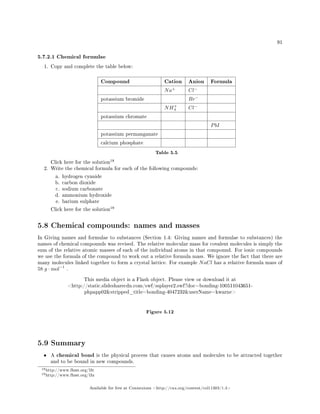
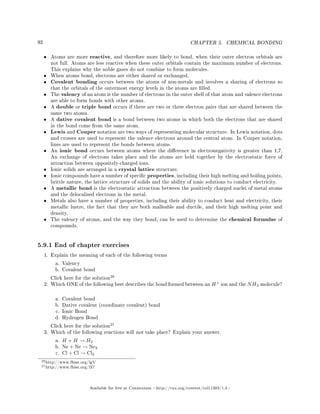
This document is a chemistry textbook for Grade 10 students in South Africa. It covers topics including the classification of matter, states of matter, the atom, the periodic table, chemical bonding, physical and chemical changes, and chemical reactions. The textbook contains 11 chapters and is published by Connexions and the Free High School Science Texts Project under a Creative Commons license.
Chemistry Grade 10[CAPS]
Collection Editor:
Free High School Science Texts Project
3.
Chemistry Grade 10[CAPS]
Collection Editor:
Free High School Science Texts Project
Authors:
Free High School Science Texts Project
Heather Williams
Online:
< http://cnx.org/content/col11303/1.4/ >
CONNEXIONS
Rice University, Houston, Texas
4.
This selection andarrangement of content as a collection is copyrighted by Free High School Science Texts Project.
It is licensed under the Creative Commons Attribution 3.0 license (http://creativecommons.org/licenses/by/3.0/).
Collection structure revised: June 13, 2011
PDF generated: October 29, 2012
For copyright and attribution information for the modules contained in this collection, see p. 185.
iv
Available for free at Connexions http://cnx.org/content/col11303/1.4
7.
Chapter 1
Classication ofMatter 1
1.1 Introduction
All the objects that we see in the world around us, are made of matter. Matter makes up the air we
breathe, the ground we walk on, the food we eat and the animals and plants that live around us. Even our
own human bodies are made of matter!
Dierent objects can be made of dierent types of matter, or materials. For example, a cupboard (an
object) is made of wood, nails and hinges (the materials ). The properties of the materials will aect the
properties of the object. In the example of the cupboard, the strength of the wood and metals make the
cupboard strong and durable. In the same way, the raincoats that you wear during bad weather, are made
of a material that is waterproof. The electrical wires in your home are made of metal because metals are
a type of material that is able to conduct electricity. It is very important to understand the properties of
materials, so that we can use them in our homes, in industry and in other applications. In this chapter, we
will be looking at dierent types of materials and their properties.
Some of the properties of matter that you should know are:
• Materials can be strong and resist bending (e.g. iron rods, cement) or weak (e.g. fabrics)
• Materials that conduct heat (e.g. metals) are called thermal conductors. Materials that conduct
electricity are electrical conductors.
• Brittle materials break easily. Materials that are malleable can be easily formed into dierent shapes.
Ductile materials are able to be formed into long wires.
• Magnetic materials have a magnetic eld.
• Density is the mass per unit volume. An example of a dense material is concrete.
• The boiling and melting points of substance help us to classify substances as solids, liquids or gases at
a specic temperature.
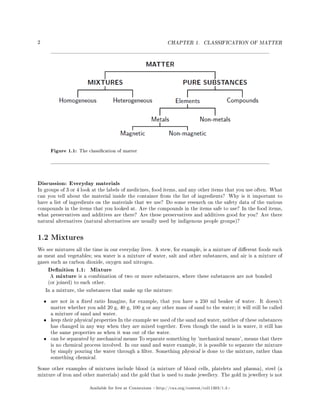
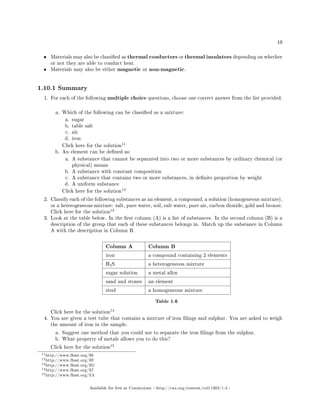
The diagram below shows one way in which matter can be classied (grouped) according to its dierent
properties. As you read further in this chapter, you will see that there are also other ways of classifying
materials, for example according to whether or not they are good electrical conductors.
1 This content is available online at http://cnx.org/content/m38118/1.5/.
Available for free at Connexions http://cnx.org/content/col11303/1.4
1
8.
2 CHAPTER 1. CLASSIFICATION OF MATTER
Figure 1.1: The classication of matter
Discussion: Everyday materials
In groups of 3 or 4 look at the labels of medicines, food items, and any other items that you use often. What
can you tell about the material inside the container from the list of ingredients? Why is it important to
have a list of ingredients on the materials that we use? Do some research on the safety data of the various
compounds in the items that you looked at. Are the compounds in the items safe to use? In the food items,
what preservatives and additives are there? Are these preservatives and additives good for you? Are there
natural alternatives (natural alternatives are usually used by indigenous people groups)?
1.2 Mixtures
We see mixtures all the time in our everyday lives. A stew, for example, is a mixture of dierent foods such
as meat and vegetables; sea water is a mixture of water, salt and other substances, and air is a mixture of
gases such as carbon dioxide, oxygen and nitrogen.
Denition 1.1: Mixture
A mixture is a combination of two or more substances, where these substances are not bonded
(or joined) to each other.
In a mixture, the substances that make up the mixture:
• are not in a xed ratio Imagine, for example, that you have a 250 ml beaker of water. It doesn't
matter whether you add 20 g, 40 g, 100 g or any other mass of sand to the water; it will still be called
a mixture of sand and water.
• keep their physical properties In the example we used of the sand and water, neither of these substances
has changed in any way when they are mixed together. Even though the sand is in water, it still has
the same properties as when it was out of the water.
• can be separated by mechanical means To separate something by 'mechanical means', means that there
is no chemical process involved. In our sand and water example, it is possible to separate the mixture
by simply pouring the water through a lter. Something physical is done to the mixture, rather than
something chemical.
Some other examples of mixtures include blood (a mixture of blood cells, platelets and plasma), steel (a
mixture of iron and other materials) and the gold that is used to make jewellery. The gold in jewellery is not
Available for free at Connexions http://cnx.org/content/col11303/1.4
9.
3
pure gold butis a mixture of metals. The amount of gold in the jewellery is measured in karats (24 karat
would be pure gold, while 18 karat is only 75% gold).
We can group mixtures further by dividing them into those that are heterogeneous and those that are
homogeneous.
1.2.1 Heterogeneous mixtures
A heterogeneous mixture does not have a denite composition. Think of a pizza, that has a topping of
cheese, tomato, mushrooms and peppers (the topping is a mixture). Each slice will probably be slightly
dierent from the next because the toppings (the tomato, cheese, mushrooms and peppers) are not evenly
distributed. Another example would be granite, a type of rock. Granite is made up of lots of dierent mineral
substances including quartz and feldspar. But these minerals are not spread evenly through the rock and so
some parts of the rock may have more quartz than others. Another example is a mixture of oil and water.
Although you may add one substance to the other, they will stay separate in the mixture. We say that these
heterogeneous mixtures are non-uniform, in other words they are not exactly the same throughout.
Denition 1.2: Heterogeneous mixture
A heterogeneous mixture is one that is non-uniform and the dierent components of the mixture
can be seen.
1.2.2 Homogeneous mixtures
A homogeneous mixture has a denite composition, and specic properties. In a homogeneous mixture,
the dierent parts cannot be seen. A solution of salt dissolved in water is an example of a homogeneous
mixture. When the salt dissolves, it will spread evenly through the water so that all parts of the solution
are the same, and you can no longer see the salt as being separate from the water. Think also of a powdered
drink that you mix with water. Provided you give the container a good shake after you have added the
powder to the water, the drink will have the same sweet taste for anyone who drinks it, it won't matter
whether they take a sip from the top or from the bottom. The air we breathe is another example of a
homogeneous mixture since it is made up of dierent gases which are in a constant ratio, and which can't
be distinguished from each other.
Denition 1.3: Homogeneous mixture
A homogeneous mixture is one that is uniform, and where the dierent components of the mixture
cannot be seen.
An alloy is a homogeneous mixture of two or more elements, at least one of which is a metal, where the
resulting material has metallic properties. Alloys are usually made to improve the properties of the elements
that make them up. For example steel is much stronger than iron (which is the main component of steel).
Activity: Classifying materials
Look around your classroom or school. Make a list of all the dierent materials that you see around you. Try
to work out why a particular material was used. Can you classify all the dierent materials used according
to their properties? On your way to school or at home or in the shops, look at the dierent materials that
are used. Why are these materials chosen over other materials?
Activity: Making mixtures
Make mixtures of sand and water, potassium dichromate and water, iodine and ethanol, iodine and water.
Classify these as heterogeneous or homogeneous. Try to make mixtures using other substances. Are the
mixtures that you have made heterogeneous or homogeneous? Give reasons for your choice.
1.2.3 Mixtures
1. Which of the following substances are mixtures ?
a. tap water
Available for free at Connexions http://cnx.org/content/col11303/1.4
10.
4 CHAPTER 1. CLASSIFICATION OF MATTER
b. brass (an alloy of copper and zinc)
c. concrete
d. aluminium
e. Coca cola
f. distilled water
2. In each of the examples above, say whether the mixture is homogeneous or heterogeneous.
Click here for the solution
2
1.3 Pure Substances: Elements and Compounds
Any material that is not a mixture, is called a pure substance. Pure substances include elements and
compounds. It is much more dicult to break down pure substances into their parts, and complex chemical
methods are needed to do this.
One way to determine if a substance is pure is to look at its melting or boiling point. Pure substances will
have a sharply dened melting or boiling point (i.e. the melting or boiling point will be a single temperature
rather than a range of temperatures.) Impure substances have a temperature range over which they melt
or boil. We can also use chromatography to determine if a substance is pure or not. Chromatography is
the process of separating substances into their individual components. If a substance is pure then chro-
matography will only produce one substance at the end of the process. If a substance is impure then several
substances will be seen at the end of the process.
1.3.1 Activity: Smartie Chromatography
You will need lter paper (or chromatography paper), some smarties in dierent colours, water and an eye
dropper.
Place a smartie in the center of a piece of lter paper. Carefully drop a few drops of water onto the
smartie. You should see rings of dierent colour forming around the smartie. Each colour is one of the
individual colours that are used to make up the colour of the smartie.
1.3.2 Elements
An element is a chemical substance that can't be divided or changed into other chemical substances by any
ordinary chemical means. The smallest unit of an element is the atom.
Denition 1.4: Element
An element is a substance that cannot be broken down into other substances through chemical
means.
There are 112 ocially named elements and about 118 known elements. Most of these are natural, but
some are man-made. The elements we know are represented in the Periodic Table of the Elements, where
each element is abbreviated to a chemical symbol. Examples of elements are magnesium (M g ), hydrogen
(H ), oxygen (O ) and carbon (C ). On the Periodic Table you will notice that some of the abbreviations do
not seem to match the elements they represent. The element iron, for example, has the chemical formula
F e. This is because the elements were originally given Latin names. Iron has the abbreviation Fe because
its Latin name is 'ferrum'. In the same way, sodium's Latin name is 'natrium' (N a) and gold's is 'aurum'
(Au).
note: Recently it was agreed that two more elements would be added to the list of ocially named
elements. These are elements number 114 and 116. The proposed name for element 114 is erovium
and for element 116 it is moscovium. This brings the total number of ocially named elements to
114.
2 http://www.fhsst.org/llm
Available for free at Connexions http://cnx.org/content/col11303/1.4
11.
5
1.3.3 Compounds
A compound is a chemical substance that forms when two or more elements combine in a xed ratio.
Water (H 2 O ), for example, is a compound that is made up of two hydrogen atoms for every one oxygen
atom. Sodium chloride (NaCl) is a compound made up of one sodium atom for every chlorine atom. An
important characteristic of a compound is that it has a chemical formula, which describes the ratio in
which the atoms of each element in the compound occur.
Denition 1.5: Compound
A substance made up of two or more elements that are joined together in a xed ratio.
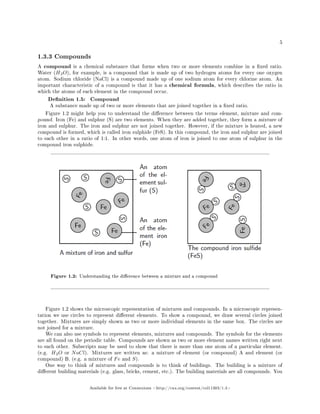
Figure 1.2 might help you to understand the dierence between the terms element, mixture and com-
pound. Iron (Fe) and sulphur (S) are two elements. When they are added together, they form a mixture of
iron and sulphur. The iron and sulphur are not joined together. However, if the mixture is heated, a new
compound is formed, which is called iron sulphide (FeS). In this compound, the iron and sulphur are joined
to each other in a ratio of 1:1. In other words, one atom of iron is joined to one atom of sulphur in the
compound iron sulphide.
Figure 1.2: Understanding the dierence between a mixture and a compound
Figure 1.2 shows the microscopic representation of mixtures and compounds. In a microscopic represen-
tation we use circles to represent dierent elements. To show a compound, we draw several circles joined
together. Mixtures are simply shown as two or more individual elements in the same box. The circles are
not joined for a mixture.
We can also use symbols to represent elements, mixtures and compounds. The symbols for the elements
are all found on the periodic table. Compounds are shown as two or more element names written right next
to each other. Subscripts may be used to show that there is more than one atom of a particular element.
(e.g. H 2O or N aCl). Mixtures are written as: a mixture of element (or compound) A and element (or
compound) B. (e.g. a mixture of Fe and S ).
One way to think of mixtures and compounds is to think of buildings. The building is a mixture of
dierent building materials (e.g. glass, bricks, cement, etc.). The building materials are all compounds. You
Available for free at Connexions http://cnx.org/content/col11303/1.4
12.
6 CHAPTER 1. CLASSIFICATION OF MATTER
can also think of the elements as Lego blocks. Each Lego block can be added to other Lego blocks to make
new structures, in the same way that elements can combine to make compounds.
Activity: Using models to represent substances
Use coloured balls and sticks to represent elements and compounds. Think about the way that we represent
substances microscopically. Would you use just one ball to represent an element or many? Why?
1.3.3.1 Elements, mixtures and compounds
1. In the following table, tick whether each of the substances listed is a mixture or a pure substance. If
it is a mixture, also say whether it is a homogeneous or heterogeneous mixture.
Substance Mixture or pure Homogeneous or heterogeneous mixture
zzy colddrink
steel
oxygen
iron lings
smoke
limestone (CaCO 3 )
Table 1.1
Click here for the solution
3
2. In each of the following cases, say whether the substance is an element, a mixture or a compound.
a. Cu
b. iron and sulphur
c. Al
d. H 2 SO4
e. SO3
Click here for the solution
4
1.4 Giving names and formulae to substances
Think about what you call your friends. Their full name is like the substances name and their nickname is
like the substances formulae. Without these names your friends would have no idea which of them you are
referring to. In the same way scientists like to have a consistent way of naming things and a short way of
describing the thing being named. This helps scientists to communicate eciently.
It is easy to describe elements and mixtures. We simply use the names that we nd on the periodic table
for elements and we use words to describe mixtures. But how are compounds named? In the example of iron
sulphide that was used earlier, which element is named rst, and which 'ending' is given to the compound
name (in this case, the ending is -ide)?
The following are some guidelines for naming compounds:
1. The compound name will always include the names of the elements that are part of it.
• A compound of iron (F e) and sulphur (S ) is iron sulphide (F eS )
• A compound of potassium (K ) and bromine (Br) is potassium bromide (KBr)
• A compound of sodium (N a) and chlorine (Cl) is sodium chlor ide (N aCl)
3 http://www.fhsst.org/lly
4 http://www.fhsst.org/llV
Available for free at Connexions http://cnx.org/content/col11303/1.4
13.
7
2.In a compound, the element that is on the left of the Periodic Table, is used rst when naming the
compound. In the example of N aCl, sodium is a group 1 element on the left hand side of the table,
while chlorine is in group 7 on the right of the table. Sodium therefore comes rst in the compound
name. The same is true for F eS and KBr.
3. The symbols of the elements can be used to represent compounds e.g. F eS , N aCl, KBr and H 2 O.
These are called chemical formulae. In the rst three examples, the ratio of the elements in each
compound is 1:1. So, for F eS , there is one atom of iron for every atom of sulphur in the compound. In
the last example (H 2 O ) there are two atoms of hydrogen for every atom of oxygen in the compound.
4. A compound may contain compound ions. An ion is an atom that has lost (positive ion) or gained
(negative ion) electrons. Some of the more common compound ions and their formulae are given
below.
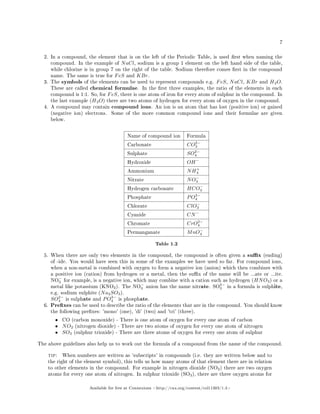
Name of compound ion Formula
Carbonate CO2−
3
Sulphate SO2−
4
Hydroxide OH −
Ammonium N H+
4
Nitrate N O−
3
Hydrogen carbonate HCO−
3
Phosphate P O3−
4
Chlorate ClO−
3
Cyanide CN −
Chromate CrO2−
4
Permanganate M nO−
4
Table 1.2
5. When there are only two elements in the compound, the compound is often given a sux (ending)
of -ide. You would have seen this in some of the examples we have used so far. For compound ions,
when a non-metal is combined with oxygen to form a negative ion (anion) which then combines with
a positive ion (cation) from hydrogen or a metal, then the sux of the name will be ...ate or ...ite.
NO−
3 for example, is a negative ion, which may combine with a cation such as hydrogen (HN O 3 ) or a
metal like potassium (KNO3 ). The NO−
3 anion has the name nitr ate. SO2−
3 in a formula is sulphite,
e.g. sodium sulphite (N a2 SO 3 ).
SO2−
4 is sulph ate and P O3− is phosphate.
4
6. Prexes can be used to describe the ratio of the elements that are in the compound. You should know
the following prexes: 'mono' (one), 'di' (two) and 'tri' (three).
• CO (carbon monoxide) - There is one atom of oxygen for every one atom of carbon
• N O2 (nitrogen dioxide) - There are two atoms of oxygen for every one atom of nitrogen
• SO3 (sulphur trioxide) - There are three atoms of oxygen for every one atom of sulphur
The above guidelines also help us to work out the formula of a compound from the name of the compound.
tip: When numbers are written as 'subscripts' in compounds (i.e. they are written below and to
the right of the element symbol), this tells us how many atoms of that element there are in relation
to other elements in the compound. For example in nitrogen dioxide (NO2 ) there are two oxygen
atoms for every one atom of nitrogen. In sulphur trioxide (SO3 ), there are three oxygen atoms for
Available for free at Connexions http://cnx.org/content/col11303/1.4
14.
8 CHAPTER 1. CLASSIFICATION OF MATTER
every one atom of sulphur in the compound. Later, when we start looking at chemical equations,
you will notice that sometimes there are numbers before the compound name. For example, 2H 2 O
means that there are two molecules of water, and that in each molecule there are two hydrogen
atoms for every one oxygen atom.
We can use these rules to help us name both ionic compounds and covalent compounds (more on these
compounds will be covered in a later chapter). However, covalent compounds are often given other names by
scientists to simplify the name. For example, if we have 2 hydrogen atoms and one oxygen atom the above
naming rules would tell us that the substance is dihydrogen monoxide. But this compound is better known
as water! Or if we had 1 carbon atom and 4 hydrogen atoms then the name would be carbon tetrahydride,
but scientists call this compound methane.
Exercise 1.1: Naming compounds (Solution on p. 21.)
What is the chemical name for
a. KMnO4
b. NH4 Cl
Exercise 1.2 (Solution on p. 21.)
Write the chemical formulae for:
a. sodium sulphate
b. potassium chromate
1.4.1 Naming compounds
1. The formula for calcium carbonate is CaCO3 .
a. Is calcium carbonate a mixture or a compound? Give a reason for your answer.
b. What is the ratio of Ca : C : O atoms in the formula?
Click here for the solution
5
2. Give the name of each of the following substances.
a. KBr
b. HCl
c. KMnO4
d. NO2
e. NH4 OH
f. N a2 SO4
Click here for the solution
6
3. Give the chemical formula for each of the following compounds.
a. potassium nitrate
b. sodium iodide
c. barium sulphate
d. nitrogen dioxide
e. sodium monosulphate
Click here for the solution
7
5 http://www.fhsst.org/llp
6 http://www.fhsst.org/lld
7 http://www.fhsst.org/llv
Available for free at Connexions http://cnx.org/content/col11303/1.4
15.
9
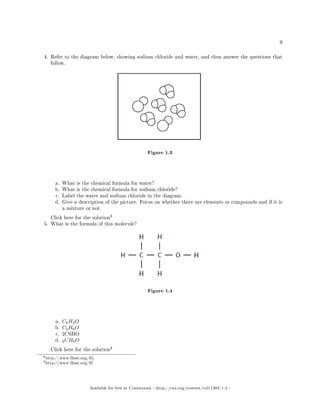
4. Refer tothe diagram below, showing sodium chloride and water, and then answer the questions that
follow.
Figure 1.3
a. What is the chemical formula for water?
b. What is the chemical formula for sodium chloride?
c. Label the water and sodium chloride in the diagram.
d. Give a description of the picture. Focus on whether there are elements or compounds and if it is
a mixture or not.
Click here for the solution
8
5. What is the formula of this molecule?
Figure 1.4
a. C 6 H2 O
b. C 2 H6 O
c. 2C6HO
d. 2 CH6 O
Click here for the solution
9
8 http://www.fhsst.org/llL
9 http://www.fhsst.org/llf
Available for free at Connexions http://cnx.org/content/col11303/1.4
16.
10 CHAPTER 1. CLASSIFICATION OF MATTER
1.5 Metals, Metalloids and Non-metals
The elements in the Periodic Table can also be divided according to whether they are metals, metalloids or
non-metals. On the right hand side of the Periodic Table you can draw a 'zigzag' line (This line starts with
Boron (B ) and goes down to Polonium (P o). This line separates all the elements that are metals from those
that are non-metals. Metals are found on the left of the line, and non-metals are those on the right. Along
the line you nd the metalloids. You should notice that there are more metals then non-metals. Metals,
metalloids and non-metals all have their own specic properties.
1.5.1 Metals
Examples of metals include copper (Cu), zinc (Zn), gold (Au) and silver (Ag ). On the Periodic Table, the
metals are on the left of the zig-zag line. There are a large number of elements that are metals. The following
are some of the properties of metals:
• Thermal conductors Metals are good conductors of heat. This makes them useful in cooking utensils
such as pots and pans.
• Electrical conductors Metals are good conductors of electricity. Metals can be used in electrical con-
ducting wires.
• Shiny metallic lustre Metals have a characteristic shiny appearance and so are often used to make
jewellery.
• Malleable This means that they can be bent into shape without breaking.
• Ductile Metals (such as copper) can be stretched into thin wires, which can then be used to conduct
electricity.
• Melting point Metals usually have a high melting point and can therefore be used to make cooking
pots and other equipment that needs to become very hot, without being damaged.
You can see how the properties of metals make them very useful in certain applications.
1.5.1.1 Group Work : Looking at metals
1. Collect a number of metal items from your home or school. Some examples are listed below:
• hammer
• wire
• cooking pots
• jewellery
• nails
• coins
2. In groups of 3-4, combine your collection of metal objects.
3. What is the function of each of these objects?
4. Discuss why you think metal was used to make each object. You should consider the properties of
metals when you answer this question.
1.5.2 Non-metals
In contrast to metals, non-metals are poor thermal conductors, good electrical insulators (meaning that they
do not conduct electrical charge) and are neither malleable nor ductile. The non-metals are found on the
right hand side of the Periodic Table, and include elements such as sulphur (S ), phosphorus (P ), nitrogen
(N ) and oxygen (O ).
Available for free at Connexions http://cnx.org/content/col11303/1.4
17.
11
1.5.3 Metalloids
Metalloids orsemi-metals have mostly non-metallic properties. One of their distinguishing characteristics
is that their conductivity increases as their temperature increases. This is the opposite of what happens
in metals. The metalloids include elements such as silicon (Si) and germanium (Ge). Notice where these
elements are positioned in the Periodic Table.
You should now be able to take any material and determine whether it is a metal, non-metal or metalloid
simply by using its properties.
1.6 Electrical conductors, semi-conductors and insulators
An electrical conductor is a substance that allows an electrical current to pass through it. Electrical
conductors are usually metals. Copper is one of the best electrical conductors, and this is why it is used to
make conducting wire. In reality, silver actually has an even higher electrical conductivity than copper, but
because silver is so expensive, it is not practical to use it for electrical wiring because such large amounts
are needed. In the overhead power lines that we see above us, aluminium is used. The aluminium usually
surrounds a steel core which adds tensile strength to the metal so that it doesn't break when it is stretched
across distances. Occasionally gold is used to make wire, not because it is a particularly good conductor,
but because it is very resistant to surface corrosion. Corrosion is when a material starts to deteriorate at
the surface because of its reactions with the surroundings, for example oxygen and water in the air.
An insulator is a non-conducting material that does not carry any charge. Examples of insulators
would be plastic and wood. Do you understand now why electrical wires are normally covered with plastic
insulation? Semi-conductors behave like insulators when they are cold, and like conductors when they are
hot. The elements silicon and germanium are examples of semi-conductors.
Denition 1.6: Conductors and insulators
A conductor allows the easy movement or ow of something such as heat or electrical charge
through it. Insulators are the opposite to conductors because they inhibit or reduce the ow of
heat, electrical charge, sound etc through them.
Think about the materials around you. Are they electrical conductors or not? Why are dierent materials
used? Think about the use of semiconductors in electronics? Can you think of why they are used there?
1.6.1 Experiment : Electrical conductivity
Aim:
To investigate the electrical conductivity of a number of substances
Apparatus:
• two or three cells
• light bulb
• crocodile clips
• wire leads
• a selection of test substances (e.g. a piece of plastic, aluminium can, metal pencil sharpener, magnet,
wood, chalk).
Available for free at Connexions http://cnx.org/content/col11303/1.4
18.
12 CHAPTER 1. CLASSIFICATION OF MATTER
Figure 1.5
Method:
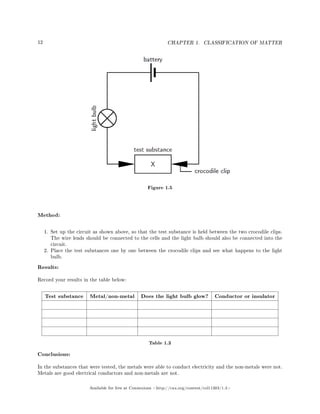
1. Set up the circuit as shown above, so that the test substance is held between the two crocodile clips.
The wire leads should be connected to the cells and the light bulb should also be connected into the
circuit.
2. Place the test substances one by one between the crocodile clips and see what happens to the light
bulb.
Results:
Record your results in the table below:
Test substance Metal/non-metal Does the light bulb glow? Conductor or insulator
Table 1.3
Conclusions:
In the substances that were tested, the metals were able to conduct electricity and the non-metals were not.
Metals are good electrical conductors and non-metals are not.
Available for free at Connexions http://cnx.org/content/col11303/1.4
19.
13
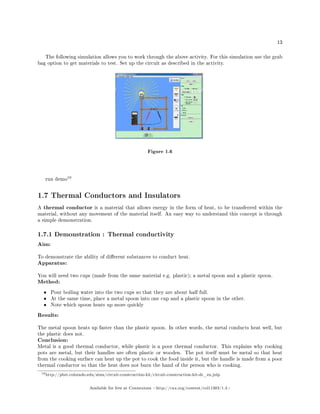
The following simulation allows you to work through the above activity. For this simulation use the grab
bag option to get materials to test. Set up the circuit as described in the activity.
Figure 1.6
run demo
10
1.7 Thermal Conductors and Insulators
A thermal conductor is a material that allows energy in the form of heat, to be transferred within the
material, without any movement of the material itself. An easy way to understand this concept is through
a simple demonstration.
1.7.1 Demonstration : Thermal conductivity
Aim:
To demonstrate the ability of dierent substances to conduct heat.
Apparatus:
You will need two cups (made from the same material e.g. plastic); a metal spoon and a plastic spoon.
Method:
• Pour boiling water into the two cups so that they are about half full.
• At the same time, place a metal spoon into one cup and a plastic spoon in the other.
• Note which spoon heats up more quickly
Results:
The metal spoon heats up faster than the plastic spoon. In other words, the metal conducts heat well, but
the plastic does not.
Conclusion:
Metal is a good thermal conductor, while plastic is a poor thermal conductor. This explains why cooking
pots are metal, but their handles are often plastic or wooden. The pot itself must be metal so that heat
from the cooking surface can heat up the pot to cook the food inside it, but the handle is made from a poor
thermal conductor so that the heat does not burn the hand of the person who is cooking.
10 http://phet.colorado.edu/sims/circuit-construction-kit/circuit-construction-kit-dc_en.jnlp
Available for free at Connexions http://cnx.org/content/col11303/1.4
20.
14 CHAPTER 1. CLASSIFICATION OF MATTER
An insulator is a material that does not allow a transfer of electricity or energy. Materials that are poor
thermal conductors can also be described as being good thermal insulators.
note: Water is a better thermal conductor than air and conducts heat away from the body about
20 times more eciently than air. A person who is not wearing a wetsuit, will lose heat very
quickly to the water around them and can be vulnerable to hypothermia (this is when the body
temperature drops very low). Wetsuits help to preserve body heat by trapping a layer of water
against the skin. This water is then warmed by body heat and acts as an insulator. Wetsuits
are made out of closed-cell, foam neoprene. Neoprene is a synthetic rubber that contains small
bubbles of nitrogen gas when made for use as wetsuit material. Nitrogen gas has very low thermal
conductivity, so it does not allow heat from the body (or the water trapped between the body and
the wetsuit) to be lost to the water outside of the wetsuit. In this way a person in a wetsuit is able
to keep their body temperature much higher than they would otherwise.
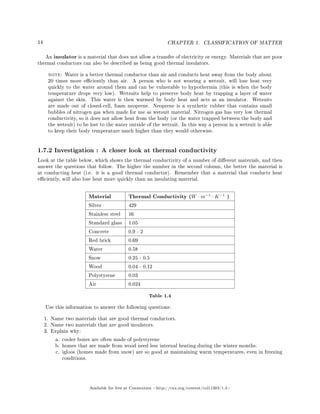
1.7.2 Investigation : A closer look at thermal conductivity
Look at the table below, which shows the thermal conductivity of a number of dierent materials, and then
answer the questions that follow. The higher the number in the second column, the better the material is
at conducting heat (i.e. it is a good thermal conductor). Remember that a material that conducts heat
eciently, will also lose heat more quickly than an insulating material.
Material Thermal Conductivity (W · m−1 · K −1 )
Silver 429
Stainless steel 16
Standard glass 1.05
Concrete 0.9 - 2
Red brick 0.69
Water 0.58
Snow 0.25 - 0.5
Wood 0.04 - 0.12
Polystyrene 0.03
Air 0.024
Table 1.4
Use this information to answer the following questions:
1. Name two materials that are good thermal conductors.
2. Name two materials that are good insulators.
3. Explain why:
a. cooler boxes are often made of polystyrene
b. homes that are made from wood need less internal heating during the winter months.
c. igloos (homes made from snow) are so good at maintaining warm temperatures, even in freezing
conditions.
Available for free at Connexions http://cnx.org/content/col11303/1.4
21.
15
note: It is a known fact that well-insulated buildings need less energy for heating than do buildings
that have no insulation. Two building materials that are being used more and more worldwide, are
mineral wool and polystyrene. Mineral wool is a good insulator because it holds air still in the
matrix of the wool so that heat is not lost. Since air is a poor conductor and a good insulator, this
helps to keep energy within the building. Polystyrene is also a good insulator and is able to keep
cool things cool and hot things hot. It has the added advantage of being resistant to moisture,
mould and mildew.
Remember that concepts such as conductivity and insulation are not only relevant in the building, industrial
and home environments. Think for example of the layer of blubber or fat that is found in some animals. In
very cold environments, fat and blubber not only provide protection, but also act as an insulator to help the
animal keep its body temperature at the right level. This is known as thermoregulation.
1.8 Magnetic and Non-magnetic Materials
We have now looked at a number of ways in which matter can be grouped, such as into metals, semi-metals
and non-metals; electrical conductors and insulators, and thermal conductors and insulators. One way in
which we can further group metals, is to divide them into those that are magnetic and those that are
non-magnetic.
Denition 1.7: Magnetism
Magnetism is one of the phenomena by which materials exert attractive or repulsive forces on other
materials.
A metal is said to be ferromagnetic if it can be magnetised (i.e. made into a magnet). If you hold
a magnet very close to a metal object, it may happen that its own electrical eld will be induced and the
object becomes magnetic. Some metals keep their magnetism for longer than others. Look at iron and steel
for example. Iron loses its magnetism quite quickly if it is taken away from the magnet. Steel on the other
hand will stay magnetic for a longer time. Steel is often used to make permanent magnets that can be used
for a variety of purposes.
Magnets are used to sort the metals in a scrap yard, in compasses to nd direction, in the magnetic
strips of video tapes and ATM cards where information must be stored, in computers and TV's, as well as
in generators and electric motors.
1.8.1 Investigation : Magnetism
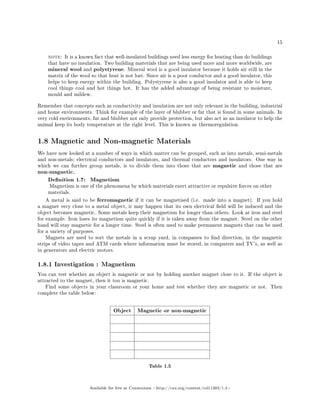
You can test whether an object is magnetic or not by holding another magnet close to it. If the object is
attracted to the magnet, then it too is magnetic.
Find some objects in your classroom or your home and test whether they are magnetic or not. Then
complete the table below:
Object Magnetic or non-magnetic
Table 1.5
Available for free at Connexions http://cnx.org/content/col11303/1.4
22.
16 CHAPTER 1. CLASSIFICATION OF MATTER
1.8.2 Group Discussion : Properties of materials
In groups of 4-5, discuss how our knowledge of the properties of materials has allowed society to:
• develop advanced computer technology
• provide homes with electricity
• nd ways to conserve energy
1.9 Seperating mixtures - Not in CAPS - included for completeness
Sometimes it is important to be able to separate a mixture. There are lots of dierent ways to do this. These
are some examples:
• Filtration A piece of lter paper in a funnel can be used to separate a mixture of sand and water.
• Heating / evaporation Heating a solution causes the liquid (normally water) to evaporate, leaving the
other (solid) part of the mixture behind. You can try this using a salt solution.
• Centrifugation This is a laboratory process which uses the centrifugal force of spinning objects to
separate out the heavier substances from a mixture. This process is used to separate the cells and
plasma in blood. When the test tubes that hold the blood are spun round in the machine, the heavier
cells sink to the bottom of the test tube. Can you think of a reason why it might be important to have
a way of separating blood in this way?
• Dialysis This is an interesting way of separating a mixture because it can be used in some important
applications. Dialysis works using a process called diusion. Diusion takes place when one substance
in a mixture moves from an area where it has a high concentration to an area where its concentration
is lower. When this movement takes place across a semi-permeable membrane it is called osmosis.
A semi-permeable membrane is a barrier that lets some things move across it, but not others. This
process is very important for people whose kidneys are not functioning properly, an illness called renal
failure.
note: Normally, healthy kidneys remove waste products from the blood. When a person has renal
failure, their kidneys cannot do this any more, and this can be life-threatening. Using dialysis, the
blood of the patient ows on one side of a semi-permeable membrane. On the other side there will
be a uid that has no waste products but lots of other important substances such as potassium
+
ions (K ) that the person will need. Waste products from the blood diuse from where their
concentration is high (i.e. in the person's blood) into the 'clean' uid on the other side of the
membrane. The potassium ions will move in the opposite direction from the uid into the blood.
Through this process, waste products are taken out of the blood so that the person stays healthy.
1.9.1 Investigation : The separation of a salt solution
Aim:
To demonstrate that a homogeneous salt solution can be separated using physical methods.
Apparatus:
glass beaker, salt, water, retort stand, bunsen burner.
Method:
1. Pour a small amount of water (about 20 ml) into a beaker.
2. Measure a teaspoon of salt and pour this into the water.
Available for free at Connexions http://cnx.org/content/col11303/1.4
23.
17
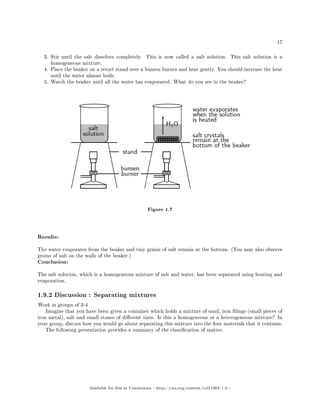
3.Stir until the salt dissolves completely. This is now called a salt solution. This salt solution is a
homogeneous mixture.
4. Place the beaker on a retort stand over a bunsen burner and heat gently. You should increase the heat
until the water almost boils.
5. Watch the beaker until all the water has evaporated. What do you see in the beaker?
Figure 1.7
Results:
The water evaporates from the beaker and tiny grains of salt remain at the bottom. (You may also observe
grains of salt on the walls of the beaker.)
Conclusion:
The salt solution, which is a homogeneous mixture of salt and water, has been separated using heating and
evaporation.
1.9.2 Discussion : Separating mixtures
Work in groups of 3-4
Imagine that you have been given a container which holds a mixture of sand, iron lings (small pieces of
iron metal), salt and small stones of dierent sizes. Is this a homogeneous or a heterogeneous mixture? In
your group, discuss how you would go about separating this mixture into the four materials that it contains.
The following presentation provides a summary of the classication of matter.
Available for free at Connexions http://cnx.org/content/col11303/1.4
24.
18 CHAPTER 1. CLASSIFICATION OF MATTER
This media object is a Flash object. Please view or download it at
http://static.slidesharecdn.com/swf/ssplayer2.swf ?doc=classicationofsubstances-100511050657-
phpapp02stripped_title=classication-of-substances-4047520userName=kwarne
Figure 1.8
1.10 Summary
• All the objects and substances that we see in the world are made of matter.
• This matter can be classied according to whether it is a mixture or a pure substance.
• A mixture is a combination of one or more substances that are not chemically bonded to each other.
Examples of mixtures are air (a mixture of dierent gases) and blood (a mixture of cells, platelets and
plasma).
• The main characteristics of mixtures are that the substances that make them up are not in a xed
ratio, they keep their individual properties and they can be separated from each other using mechanical
means.
• A heterogeneous mixture is non-uniform and the dierent parts of the mixture can be seen. An
example would be a mixture of sand and water.
• A homogeneous mixture is uniform, and the dierent components of the mixture can't be seen. An
example would be a salt solution. A salt solution is a mixture of salt and water. The salt dissolves in
the water, meaning that you can't see the individual salt particles. They are interspersed between the
water molecules. Another example is a metalalloy such as steel.
• Mixtures can be separated using a number of methods such as ltration, heating, evaporation, cen-
trifugation and dialysis.
• Pure substances can be further divided into elements and compounds.
• An element is a substance that can't be broken down into simpler substances through chemical means.
• All the elements are recorded in the Periodic Table of the Elements. Each element has its own
chemical symbol. Examples are iron (F e), sulphur (S ), calcium (Ca), magnesium (M g ) and uorine
(F ).
• A compound is a substance that is made up of two or more elements that are chemically bonded to
each other in a xed ratio. Examples of compounds are sodium chloride (N aCl), iron sulphide (F eS ),
calcium carbonate (CaCO 3 ) and water (H2 O ).
• When naming compounds and writing their chemical formula, it is important to know the elements
that are in the compound, how many atoms of each of these elements will combine in the compound
and where the elements are in the Periodic Table. A number of rules can then be followed to name the
compound.
• Another way of classifying matter is into metals (e.g. iron, gold, copper), semi-metals (e.g. silicon
and germanium) and non-metals (e.g. sulphur, phosphorus and nitrogen).
• Metals are good electrical and thermal conductors, they have a shiny lustre, they are malleable and
ductile, and they have a high melting point. These properties make metals very useful in electrical
wires, cooking utensils, jewellery and many other applications.
• A further way of classifying matter is into electrical conductors, semi-conductors and insulators.
• An electrical conductor allows an electrical current to pass through it. Most metals are good
electrical conductors.
• An electrical insulator is not able to carry an electrical current. Examples are plastic, wood, cotton
material and ceramic.
Available for free at Connexions http://cnx.org/content/col11303/1.4
25.
19
• Materials may also be classied as thermal conductors or thermal insulators depending on whether
or not they are able to conduct heat.
• Materials may also be either magnetic or non-magnetic.
1.10.1 Summary
1. For each of the following multiple choice questions, choose one correct answer from the list provided.
a. Which of the following can be classied as a mixture:
a. sugar
b. table salt
c. air
d. iron
Click here for the solution
11
b. An element can be dened as:
a. A substance that cannot be separated into two or more substances by ordinary chemical (or
physical) means
b. A substance with constant composition
c. A substance that contains two or more substances, in denite proportion by weight
d. A uniform substance
Click here for the solution
12
2. Classify each of the following substances as an element, a compound, a solution (homogeneous mixture),
or a heterogeneous mixture : salt, pure water, soil, salt water, pure air, carbon dioxide, gold and bronze.
Click here for the solution
13
3. Look at the table below. In the rst column (A) is a list of substances. In the second column (B) is a
description of the group that each of these substances belongs in. Match up the substance in Column
A with the description in Column B.
Column A Column B
iron a compound containing 2 elements
H2 S a heterogeneous mixture
sugar solution a metal alloy
sand and stones an element
steel a homogeneous mixture
Table 1.6
Click here for the solution
14
4. You are given a test tube that contains a mixture of iron lings and sulphur. You are asked to weigh
the amount of iron in the sample.
a. Suggest one method that you could use to separate the iron lings from the sulphur.
b. What property of metals allows you to do this?
Click here for the solution
15
11 http://www.fhsst.org/ll6
12 http://www.fhsst.org/llF
13 http://www.fhsst.org/llG
14 http://www.fhsst.org/ll7
15 http://www.fhsst.org/llA
Available for free at Connexions http://cnx.org/content/col11303/1.4
26.
20 CHAPTER 1. CLASSIFICATION OF MATTER
5. Given the following descriptions, write the chemical formula for each of the following substances:
a. silver metal
b. a compound that contains only potassium and bromine
c. a gas that contains the elements carbon and oxygen in a ratio of 1:2
Click here for the solution
16
6. Give the names of each of the following compounds:
a. N aBr
b. BaSO4
c. SO2
Click here for the solution
17
7. For each of the following materials, say what properties of the material make it important in carrying
out its particular function.
a. tar on roads
b. iron burglar bars
c. plastic furniture
d. metal jewellery
e. clay for building
f. cotton clothing
Click here for the solution
18
16 http://www.fhsst.org/llo
17 http://www.fhsst.org/lls
18 http://www.fhsst.org/llH
Available for free at Connexions http://cnx.org/content/col11303/1.4
27.
21
Solutionsto Exercises in Chapter 1
Solution to Exercise 1.1 (p. 8)
Step 1. For a) we have potassium and the permanganate ion. For b) we have the ammonium ion and chlorine.
Step 2. For a) we list the potassium rst and the permanganate ion second. So a) is potassium permanganate.
For b) we list the ammonium ion rst and change the ending of chlorine to -ide. So b) is ammonium
chloride.
Solution to Exercise 1.2 (p. 8)
Step 1. In part a) we have N a+ (sodium) and SO2− (sulphate). In part b) we have K + (potassium) and
4
2−
CrO4 (chromate)
Step 2. In part a) the charge on sodium is +1 and the charge on sulphate is −2, so we must have two sodiums
for every sulphate. In part b) the charge on potassium is +1 and the charge on chromate is −2, so we
must have two potassiums for every chromate.
Step 3. a) is N a2 SO4 and b) is K2 CrO4
Available for free at Connexions http://cnx.org/content/col11303/1.4
28.
22 CHAPTER 1. CLASSIFICATION OF MATTER
Available for free at Connexions http://cnx.org/content/col11303/1.4
29.
Chapter 2
States ofmatter and the kinetic
molecular theory 1
2.1 Introduction
In this chapter we will explore the states of matter and then look at the kinetic molecular theory. Matter
exists in three states: solid, liquid and gas. We will also examine how the kinetic theory of matter helps
explain boiling and melting points as well as other properties of matter.
note: When a gas is heated above a certain temperature the electrons in the atoms start to leave
the atoms. The gas is said to be ionised. When a gas is ionised it is known as a plasma. Plasmas
share many of the properties of gases (they have no xed volume and ll the space they are in).
This is a very high energy state and plasmas often glow. Ionisation is the process of moving from
a gas to a plasma and deionisation is the reverse process. We will not consider plasmas further in
this chapter.
2.2 States of matter
All matter is made up of particles. We can see this when we look at diusion. Diusion is the movement
of particles from a high concentration to a low concentration. Diusion can be seen as a spreading out of
particles resulting in an even distribution of the particles. You can see diusion when you place a drop
of food colouring in water. The colour slowly spreads out through the water. If matter were not made of
particles then we would only see a clump of colour when we put the food colouring in water, as there would
be nothing that could move about and mix in with the water. The composition of matter will be looked at
in What are the objects around us made of ? (Chapter 6).
Diusion is a result of the constant thermal motion of particles. In Section 2.3 (The Kinetic Theory of
Matter) we will talk more about the thermal motion of particles.
In 1828 Robert Brown observed that pollen grains suspended in water moved about in a rapid, irregular
motion. This motion has since become known as Brownian motion. Brownian motion is essentially diusion
of many particles.
Matter exists in one of three states, namely solid, liquid and gas. Matter can change between these states
by either adding heat or removing heat. This is known as a change of state. As we heat an object (e.g.
water) it goes from a solid to a liquid to a gas. As we cool an object it goes from a gas to a liquid to a solid.
The changes of state that you should know are:
• Melting is the process of going from solid to liquid.
1 This content is available online at http://cnx.org/content/m38210/1.7/.
Available for free at Connexions http://cnx.org/content/col11303/1.4
23
30.
24
CHAPTER 2. STATES OF MATTER AND THE KINETIC MOLECULAR
THEORY
• Boiling (or evaporation) is the process of going from liquid to gas.
• Freezing is the process of going from liquid to solid.
• Condensation is the process of going from gas to liquid.
• Occasionally (e.g. for carbon dioxide) we can go directly from solid to gas in a process called sublima-
tion.
A solid has a xed shape and volume. A liquid takes on the shape of the container that it is in. A gas
completely lls the container that it is in. See Section 2.3 (The Kinetic Theory of Matter) for more on
changes of state.
If we know the melting and boiling point of a substance then we can say what state (solid, liquid or gas)
it will be in at any temperature.
2.2.1 Experiment: States of matter
Aim
To investigate the heating and cooling curve of water.
Apparatus
beakers, ice, bunsen burner, thermometer, water.
Method
• Place some ice in a beaker
• Measure the temperature of the ice and record it.
• After 10 s measure the temperature again and record it. Repeat every 10 s, until at least 1 minute
after the ice has melted.
• Heat some water in a beaker until it boils. Measure and record the temperature of the water.
• Remove the water from the heat and measure the temperature every 10 s, until the beaker is cool to
touch
warning: Be careful when handling the beaker of hot water. Do not touch the beaker with your
hands, you will burn yourself.
Results
Record your results in the following table:
Temperature of ice Time (s) Temperature of water Time (s)
Table 2.1: Table of results
Plot a graph of temperature against time for the ice melting and the boiling water cooling.
Discussion and conclusion
Discuss your results with others in your class. What conclusions can you draw? You should nd that the
temperature of the ice increases until the rst drops of liquid appear and then the temperature remains the
same, until all the ice is melted. You should also nd that when you cool water down from boiling, the
temperature remains constant for a while, then starts decreasing.
Available for free at Connexions http://cnx.org/content/col11303/1.4
31.
25
In the above experiment, you investigated the heating and cooling curves of water. We can draw heating
and cooling curves for any substance. A heating curve of a substance gives the changes in temperature as we
move from a solid to a liquid to a gas. A cooling curve gives the changes in temperature as we move from gas
to liquid to solid. An important observation is that as a substance melts or boils, the temperature remains
constant until the substance has changed state. This is because all the heat energy goes into breaking or
forming the forces between the molecules.
The above experiment is one way of demonstrating the changes of state of a substance. Ice melting or
water boiling should be very familiar to you.
2.3 The Kinetic Theory of Matter
The kinetic theory of matter helps us to explain why matter exists in dierent phases (i.e. solid, liquid
and gas), and how matter can change from one phase to the next. The kinetic theory of matter also helps
us to understand other properties of matter. It is important to realise that what we will go on to describe is
only a theory. It cannot be proved beyond doubt, but the fact that it helps us to explain our observations
of changes in phase, and other properties of matter, suggests that it probably is more than just a theory.
Broadly, the Kinetic Theory of Matter says that:
• Matter is made up of particles that are constantly moving.
• All particles have energy, but the energy varies depending on whether the substance is a solid, liquid
or gas. Solid particles have the least amount of energy and gas particles have the greatest amount of
energy.
• The temperature of a substance is a measure of the average kinetic energy of the particles.
• A change in phase may occur when the energy of the particles is changed.
• There are spaces between the particles of matter.
• There are attractive forces between particles and these become stronger as the particles move closer
together. These attractive forces will either be intramolecular forces (if the particles are atoms) or
intermolecular forces (if the particles are molecules). When the particles are extremely close, repulsive
forces start to act.
Table 2.2 summarises the characteristics of the particles that are in each phase of matter.
Property of matter Solid Liquid Gas
Particles Atoms or molecules Atoms or molecules Atoms or molecules
Energy and movement Low energy - particles Particles have less en- Particles have high en-
of particles vibrate around a xed ergy than in the gas ergy and are constantly
point phase moving
Spaces between parti- Very little space be- Smaller spaces than in Large spaces because of
cles tween particles. Parti- gases, but larger spaces high energy
cles are tightly packed than in solids
together
continued on next page
Available for free at Connexions http://cnx.org/content/col11303/1.4
32.
26
CHAPTER 2. STATES OF MATTER AND THE KINETIC MOLECULAR
THEORY
Attractive forces be- Very strong forces. Stronger forces than in Weak forces because of
tween particles Solids have a xed gas. Liquids can be the large distance be-
volume. poured. tween particles
Changes in phase Solids become liquids if A liquid becomes a gas In general a gas be-
their temperature is in- if its temperature is in- comes a liquid when it is
creased. In some cases a creased. It becomes a cooled. (In a few cases
solid may become a gas solid if its temperature a gas becomes a solid
if the temperature is in- decreases. when cooled). Parti-
creased. cles have less energy and
therefore move closer to-
gether so that the at-
tractive forces become
stronger, and the gas
becomes a liquid (or a
solid.)
Table 2.2: Table summarising the general features of solids, liquids and gases.
The following presentation is a brief summary of the above. Try to ll in the blank spaces before clicking
onto the next slide.
This media object is a Flash object. Please view or download it at
http://static.slidesharecdn.com/swf/ssplayer2.swf ?doc=kinetictheory-done-100510040904-
phpapp02stripped_title=kinetic-theory-done
Figure 2.1
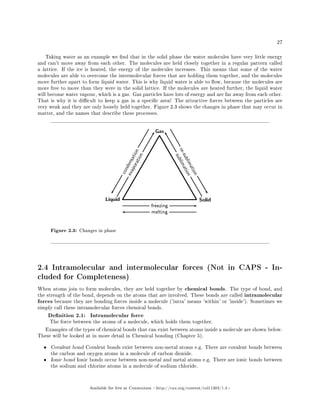
Let's look at an example that involves the three phases of water: ice (solid), water (liquid) and water
vapour (gas). Note that in the Figure 2.2 below the molecules in the solid phase are represented by single
spheres, but they would in reality look like the molecules in the liquid and gas phase. Sometimes we represent
molecules as single spheres in the solid phase to emphasise the small amount of space between them and to
make the drawing simpler.
Figure 2.2: The three phases of matter
Available for free at Connexions http://cnx.org/content/col11303/1.4
33.
27
Taking water as an example we nd that in the solid phase the water molecules have very little energy
and can't move away from each other. The molecules are held closely together in a regular pattern called
a lattice. If the ice is heated, the energy of the molecules increases. This means that some of the water
molecules are able to overcome the intermolecular forces that are holding them together, and the molecules
move further apart to form liquid water. This is why liquid water is able to ow, because the molecules are
more free to move than they were in the solid lattice. If the molecules are heated further, the liquid water
will become water vapour, which is a gas. Gas particles have lots of energy and are far away from each other.
That is why it is dicult to keep a gas in a specic area! The attractive forces between the particles are
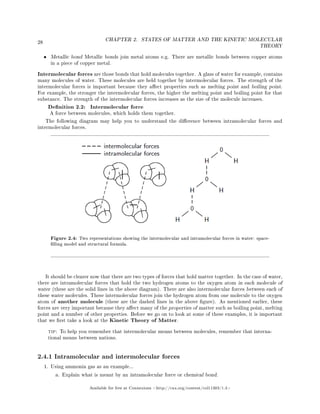
very weak and they are only loosely held together. Figure 2.3 shows the changes in phase that may occur in
matter, and the names that describe these processes.
Figure 2.3: Changes in phase
2.4 Intramolecular and intermolecular forces (Not in CAPS - In-
cluded for Completeness)
When atoms join to form molecules, they are held together by chemical bonds. The type of bond, and
the strength of the bond, depends on the atoms that are involved. These bonds are called intramolecular
forces because they are bonding forces inside a molecule ('intra' means 'within' or 'inside'). Sometimes we
simply call these intramolecular forces chemical bonds.
Denition 2.1: Intramolecular force
The force between the atoms of a molecule, which holds them together.
Examples of the types of chemical bonds that can exist between atoms inside a molecule are shown below.
These will be looked at in more detail in Chemical bonding (Chapter 5).
• Covalent bond Covalent bonds exist between non-metal atoms e.g. There are covalent bonds between
the carbon and oxygen atoms in a molecule of carbon dioxide.
• Ionic bond Ionic bonds occur between non-metal and metal atoms e.g. There are ionic bonds between
the sodium and chlorine atoms in a molecule of sodium chloride.
Available for free at Connexions http://cnx.org/content/col11303/1.4
34.
28
CHAPTER 2. STATES OF MATTER AND THE KINETIC MOLECULAR
THEORY
• Metallic bond Metallic bonds join metal atoms e.g. There are metallic bonds between copper atoms
in a piece of copper metal.
Intermolecular forces are those bonds that hold molecules together. A glass of water for example, contains
many molecules of water. These molecules are held together by intermolecular forces. The strength of the
intermolecular forces is important because they aect properties such as melting point and boiling point.
For example, the stronger the intermolecular forces, the higher the melting point and boiling point for that
substance. The strength of the intermolecular forces increases as the size of the molecule increases.
Denition 2.2: Intermolecular force
A force between molecules, which holds them together.
The following diagram may help you to understand the dierence between intramolecular forces and
intermolecular forces.
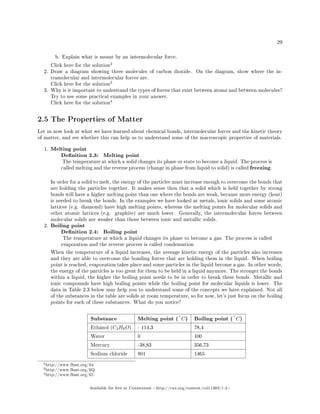
Figure 2.4: Two representations showing the intermolecular and intramolecular forces in water: space-
lling model and structural formula.
It should be clearer now that there are two types of forces that hold matter together. In the case of water,
there are intramolecular forces that hold the two hydrogen atoms to the oxygen atom in each molecule of
water (these are the solid lines in the above diagram). There are also intermolecular forces between each of
these water molecules. These intermolecular forces join the hydrogen atom from one molecule to the oxygen
atom of another molecule (these are the dashed lines in the above gure). As mentioned earlier, these
forces are very important because they aect many of the properties of matter such as boiling point, melting
point and a number of other properties. Before we go on to look at some of these examples, it is important
that we rst take a look at the Kinetic Theory of Matter.
tip: To help you remember that intermolecular means between molecules, remember that interna-
tional means between nations.
2.4.1 Intramolecular and intermolecular forces
1. Using ammonia gas as an example...
a. Explain what is meant by an intramolecular force or chemical bond.
Available for free at Connexions http://cnx.org/content/col11303/1.4
35.
29
b. Explain what is meant by an intermolecular force.
Click here for the solution
2
2. Draw a diagram showing three molecules of carbon dioxide. On the diagram, show where the in-
tramolecular and intermolecular forces are.
Click here for the solution
3
3. Why is it important to understand the types of forces that exist between atoms and between molecules?
Try to use some practical examples in your answer.
Click here for the solution
4
2.5 The Properties of Matter
Let us now look at what we have learned about chemical bonds, intermolecular forces and the kinetic theory
of matter, and see whether this can help us to understand some of the macroscopic properties of materials.
1. Melting point
Denition 2.3: Melting point
The temperature at which a solid changes its phase or state to become a liquid. The process is
called melting and the reverse process (change in phase from liquid to solid) is called freezing.
In order for a solid to melt, the energy of the particles must increase enough to overcome the bonds that
are holding the particles together. It makes sense then that a solid which is held together by strong
bonds will have a higher melting point than one where the bonds are weak, because more energy (heat)
is needed to break the bonds. In the examples we have looked at metals, ionic solids and some atomic
lattices (e.g. diamond) have high melting points, whereas the melting points for molecular solids and
other atomic lattices (e.g. graphite) are much lower. Generally, the intermolecular forces between
molecular solids are weaker than those between ionic and metallic solids.
2. Boiling point
Denition 2.4: Boiling point
The temperature at which a liquid changes its phase to become a gas. The process is called
evaporation and the reverse process is called condensation
When the temperature of a liquid increases, the average kinetic energy of the particles also increases
and they are able to overcome the bonding forces that are holding them in the liquid. When boiling
point is reached, evaporation takes place and some particles in the liquid become a gas. In other words,
the energy of the particles is too great for them to be held in a liquid anymore. The stronger the bonds
within a liquid, the higher the boiling point needs to be in order to break these bonds. Metallic and
ionic compounds have high boiling points while the boiling point for molecular liquids is lower. The
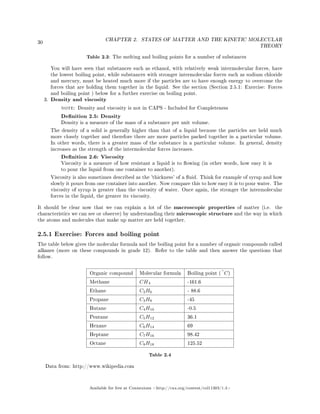
data in Table 2.3 below may help you to understand some of the concepts we have explained. Not all
of the substances in the table are solids at room temperature, so for now, let's just focus on the boiling
points for each of these substances. What do you notice?
Substance Melting point ( ◦
C) Boiling point ( ◦
C)
Ethanol (C2 H6 O ) - 114,3 78,4
Water 0 100
Mercury -38,83 356,73
Sodium chloride 801 1465
2 http://www.fhsst.org/lin
3 http://www.fhsst.org/liQ
4 http://www.fhsst.org/liU
Available for free at Connexions http://cnx.org/content/col11303/1.4
36.
30
CHAPTER 2. STATES OF MATTER AND THE KINETIC MOLECULAR
THEORY
Table 2.3: The melting and boiling points for a number of substances
You will have seen that substances such as ethanol, with relatively weak intermolecular forces, have
the lowest boiling point, while substances with stronger intermolecular forces such as sodium chloride
and mercury, must be heated much more if the particles are to have enough energy to overcome the
forces that are holding them together in the liquid. See the section (Section 2.5.1: Exercise: Forces
and boiling point ) below for a further exercise on boiling point.
3. Density and viscosity
note: Density and viscosity is not in CAPS - Included for Completeness
Denition 2.5: Density
Density is a measure of the mass of a substance per unit volume.
The density of a solid is generally higher than that of a liquid because the particles are held much
more closely together and therefore there are more particles packed together in a particular volume.
In other words, there is a greater mass of the substance in a particular volume. In general, density
increases as the strength of the intermolecular forces increases.
Denition 2.6: Viscosity
Viscosity is a measure of how resistant a liquid is to owing (in other words, how easy it is
to pour the liquid from one container to another).
Viscosity is also sometimes described as the 'thickness' of a uid. Think for example of syrup and how
slowly it pours from one container into another. Now compare this to how easy it is to pour water. The
viscosity of syrup is greater than the viscosity of water. Once again, the stronger the intermolecular
forces in the liquid, the greater its viscosity.
It should be clear now that we can explain a lot of the macroscopic properties of matter (i.e. the
characteristics we can see or observe) by understanding their microscopic structure and the way in which
the atoms and molecules that make up matter are held together.
2.5.1 Exercise: Forces and boiling point
The table below gives the molecular formula and the boiling point for a number of organic compounds called
alkanes (more on these compounds in grade 12). Refer to the table and then answer the questions that
follow.
◦
Organic compound Molecular formula Boiling point ( C)
Methane CH 4 -161.6
Ethane C 2 H6 - 88.6
Propane C 3 H8 -45
Butane C4 H10 -0.5
Pentane C5 H12 36.1
Hexane C6 H14 69
Heptane C7 H16 98.42
Octane C8 H18 125.52
Table 2.4
Data from: http://www.wikipedia.com
Available for free at Connexions http://cnx.org/content/col11303/1.4
37.
31
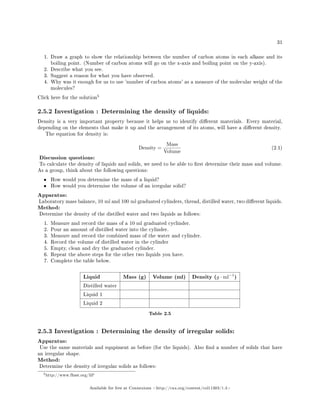
1.Draw a graph to show the relationship between the number of carbon atoms in each alkane and its
boiling point. (Number of carbon atoms will go on the x-axis and boiling point on the y-axis).
2. Describe what you see.
3. Suggest a reason for what you have observed.
4. Why was it enough for us to use 'number of carbon atoms' as a measure of the molecular weight of the
molecules?
Click here for the solution
5
2.5.2 Investigation : Determining the density of liquids:
Density is a very important property because it helps us to identify dierent materials. Every material,
depending on the elements that make it up and the arrangement of its atoms, will have a dierent density.
The equation for density is:
Mass
Density = (2.1)
Volume
Discussion questions:
To calculate the density of liquids and solids, we need to be able to rst determine their mass and volume.
As a group, think about the following questions:
• How would you determine the mass of a liquid?
• How would you determine the volume of an irregular solid?
Apparatus:
Laboratory mass balance, 10 ml and 100 ml graduated cylinders, thread, distilled water, two dierent liquids.
Method:
Determine the density of the distilled water and two liquids as follows:
1. Measure and record the mass of a 10 ml graduated cyclinder.
2. Pour an amount of distilled water into the cylinder.
3. Measure and record the combined mass of the water and cylinder.
4. Record the volume of distilled water in the cylinder
5. Empty, clean and dry the graduated cylinder.
6. Repeat the above steps for the other two liquids you have.
7. Complete the table below.
Liquid Mass (g) Volume (ml) Density (g · ml−1 )
Distilled water
Liquid 1
Liquid 2
Table 2.5
2.5.3 Investigation : Determining the density of irregular solids:
Apparatus:
Use the same materials and equpiment as before (for the liquids). Also nd a number of solids that have
an irregular shape.
Method:
Determine the density of irregular solids as follows:
5 http://www.fhsst.org/liP
Available for free at Connexions http://cnx.org/content/col11303/1.4
38.
32
CHAPTER 2. STATES OF MATTER AND THE KINETIC MOLECULAR
THEORY
1. Measure and record the mass of one of the irregular solids.
2. Tie a piece of thread around the solid.
3. Pour some water into a 100 ml graduated cylinder and record the volume.
4. Gently lower the solid into the water, keeping hold of the thread. Record the combined volume of the
solid and the water.
5. Determine the volume of the solid by subtracting the combined volume from the original volume of
the water only.
6. Repeat these steps for the second object.
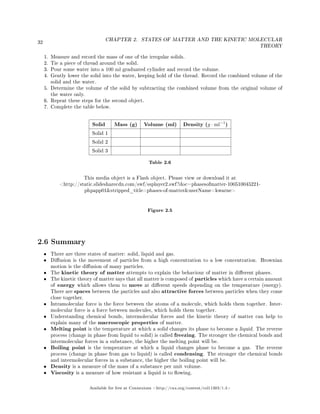
7. Complete the table below.
Solid Mass (g) Volume (ml) Density (g · ml−1 )
Solid 1
Solid 2
Solid 3
Table 2.6
This media object is a Flash object. Please view or download it at
http://static.slidesharecdn.com/swf/ssplayer2.swf ?doc=phasesofmatter-100510045221-
phpapp01stripped_title=phases-of-matteruserName=kwarne
Figure 2.5
2.6 Summary
• There are three states of matter: solid, liquid and gas.
• Diusion is the movement of particles from a high concentration to a low concentration. Brownian
motion is the diusion of many particles.
• The kinetic theory of matter attempts to explain the behaviour of matter in dierent phases.
• particles which have a certain amount
The kinetic theory of matter says that all matter is composed of
of energy which allows them to move at dierent speeds depending on the temperature (energy).
There are spaces between the particles and also attractive forces between particles when they come
close together.
• Intramolecular force is the force between the atoms of a molecule, which holds them together. Inter-
molecular force is a force between molecules, which holds them together.
• Understanding chemical bonds, intermolecular forces and the kinetic theory of matter can help to
explain many of the macroscopic properties of matter.
• Melting point is the temperature at which a solid changes its phase to become a liquid. The reverse
process (change in phase from liquid to solid) is called freezing. The stronger the chemical bonds and
intermolecular forces in a substance, the higher the melting point will be.
• Boiling point is the temperature at which a liquid changes phase to become a gas. The reverse
process (change in phase from gas to liquid) is called condensing. The stronger the chemical bonds
and intermolecular forces in a substance, the higher the boiling point will be.
• Density is a measure of the mass of a substance per unit volume.
• Viscosity is a measure of how resistant a liquid is to owing.
Available for free at Connexions http://cnx.org/content/col11303/1.4
39.
33
2.7 End ofchapter exercises
1. Give one word or term for each of the following descriptions.
a. The property that determines how easily a liquid ows.
b. The change in phase from liquid to gas.
Click here for the solution
6
2. If one substance A has a melting point that is lower than the melting point of substance B, this suggests
that...
a. A will be a liquid at room temperature.
b. The chemical bonds in substance A are weaker than those in substance B.
c. The chemical bonds in substance A are stronger than those in substance B.
d. B will be a gas at room temperature.
Click here for the solution
7
3. Boiling point is an important concept to understand.
a. Dene 'boiling point'.
b. What change in phase takes place when a liquid reaches its boiling point?
c. What is the boiling point of water?
d. Use the kinetic theory of matter and your knowledge of intermolecular forces to explain why water
changes phase at this temperature.
Click here for the solution
8
4. Describe a solid in terms of the kinetic molecular theory.
Click here for the solution
9
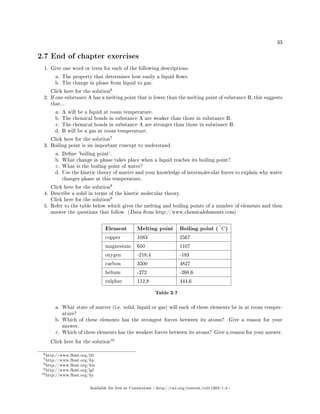
5. Refer to the table below which gives the melting and boiling points of a number of elements and then
answer the questions that follow. ( Data from http://www.chemicalelements.com)
Element Melting point Boiling point ( ◦
C)
copper 1083 2567
magnesium 650 1107
oxygen -218,4 -183
carbon 3500 4827
helium -272 -268,6
sulphur 112,8 444,6
Table 2.7
a. What state of matter (i.e. solid, liquid or gas) will each of these elements be in at room temper-
ature?
b. Which of these elements has the strongest forces between its atoms? Give a reason for your
answer.
c. Which of these elements has the weakest forces between its atoms? Give a reason for your answer.
Click here for the solution
10
6 http://www.fhsst.org/l2t
7 http://www.fhsst.org/lip
8 http://www.fhsst.org/lim
9 http://www.fhsst.org/lgf
10 http://www.fhsst.org/liy
Available for free at Connexions http://cnx.org/content/col11303/1.4
40.
34
CHAPTER 2. STATES OF MATTER AND THE KINETIC MOLECULAR
THEORY
Available for free at Connexions http://cnx.org/content/col11303/1.4
41.
Chapter 3
The Atom 1
3.1 Introduction
The following video covers some of the properties of an atom.
Veritasium video on the atom - 1
This media object is a Flash object. Please view or download it at
http://www.youtube.com/v/SeDaOigLBTU;rel=0
Figure 3.1
We have now looked at many examples of the types of matter and materials that exist around us and
we have investigated some of the ways that materials are classied. But what is it that makes up these
materials? And what makes one material dierent from another? In order to understand this, we need to
take a closer look at the building block of matter - the atom. Atoms are the basis of all the structures
and organisms in the universe. The planets, sun, grass, trees, air we breathe and people are all made up of
dierent combinations of atoms.
3.2 Project: Models of the atom
Our current understanding of the atom came about over a long period of time, with many dierent people
playing a role. Conduct some research into the development of the dierent ideas of the atom and the people
who contributed to it. Some suggested people to look at are: JJ Thomson, Ernest Rutherford, Marie Curie,
JC Maxwell, Max Planck, Albert Einstein, Niels Bohr, Lucretius, LV de Broglie, CJ Davisson, LH Germer,
Chadwick, Werner Heisenberg, Max Born, Erwin Schrodinger, John Dalton, Empedocles, Leucippus, Dem-
ocritus, Epicurus, Zosimos, Maria the Jewess, Geber, Rhazes, Robert Boyle, Henry Cavendish, A Lavoisier
and H Becquerel. You do not need to nd information on all these people, but try to nd information about
as many of them as possible.
Make a list of the key contributions to a model of the atom that each of these people made and then
make a timeline of this information. (You can use an online tool such as Dipity
2 to make a timeline.) Try
to get a feel for how it all eventually t together into the modern understanding of the atom.
1 This content is available online at http://cnx.org/content/m38126/1.5/.
2 http://www.dipity.com/
Available for free at Connexions http://cnx.org/content/col11303/1.4
35
42.
36 CHAPTER 3. THE ATOM
3.3 Models of the Atom
It is important to realise that a lot of what we know about the structure of atoms has been developed over
a long period of time. This is often how scientic knowledge develops, with one person building on the ideas
of someone else. We are going to look at how our modern understanding of the atom has evolved over time.
The idea of atoms was invented by two Greek philosophers, Democritus and Leucippus in the fth century
BC. The Greek word ατ oµoν (atom) means indivisible because they believed that atoms could not be
broken into smaller pieces.
Nowadays, we know that atoms are made up of a positively charged nucleus in the centre surrounded
by negatively charged electrons. However, in the past, before the structure of the atom was properly
understood, scientists came up with lots of dierent models or pictures to describe what atoms look like.
Denition 3.1: Model
A model is a representation of a system in the real world. Models help us to understand systems
and their properties. For example, an atomic model represents what the structure of an atom could
look like, based on what we know about how atoms behave. It is not necessarily a true picture of
the exact structure of an atom.
3.3.1 The Plum Pudding Model
After the electron was discovered by J.J. Thomson in 1897, people realised that atoms were made up of even
smaller particles than they had previously thought. However, the atomic nucleus had not been discovered
yet and so the 'plum pudding model' was put forward in 1904. In this model, the atom is made up of
negative electrons that oat in a soup of positive charge, much like plums in a pudding or raisins in a fruit
cake (Figure 3.2). In 1906, Thomson was awarded the Nobel Prize for his work in this eld. However, even
with the Plum Pudding Model, there was still no understanding of how these electrons in the atom were
arranged.
Figure 3.2: A schematic diagram to show what the atom looks like according to the Plum Pudding
model
The discovery of radiation was the next step along the path to building an accurate picture of atomic
structure. In the early twentieth century, Marie Curie and her husband Pierre, discovered that some elements
(the radioactive elements) emit particles, which are able to pass through matter in a similar way to X-rays
Available for free at Connexions http://cnx.org/content/col11303/1.4
43.
37
(read more aboutthis in Grade 11). It was Ernest Rutherford who, in 1911, used this discovery to revise
the model of the atom.
3.3.2 Rutherford's model of the atom
Radioactive elements emit dierent types of particles. Some of these are positively charged alpha (α)
particles. Rutherford carried out a series of experiments where he bombarded sheets of gold foil with these
particles, to try to get a better understanding of where the positive charge in the atom was. A simplied
diagram of his experiment is shown in Figure 3.3.
Figure 3.3: Rutherford's gold foil experiment. Figure (a) shows the path of the α particles after they
hit the gold sheet. Figure (b) shows the arrangement of atoms in the gold sheets and the path of the α
particles in relation to this.
Rutherford set up his experiment so that a beam of alpha particles was directed at the gold sheets.
Behind the gold sheets was a screen made of zinc sulphide. This screen allowed Rutherford to see where the
alpha particles were landing. Rutherford knew that the electrons in the gold atoms would not really aect
the path of the alpha particles, because the mass of an electron is so much smaller than that of a proton.
He reasoned that the positively charged protons would be the ones to repel the positively charged alpha
particles and alter their path.
What he discovered was that most of the alpha particles passed through the foil undisturbed and could
be detected on the screen directly behind the foil (A). Some of the particles ended up being slightly deected
onto other parts of the screen (B). But what was even more interesting was that some of the particles were
deected straight back in the direction from where they had come (C)! These were the particles that had
been repelled by the positive protons in the gold atoms. If the Plum Pudding model of the atom were true
then Rutherford would have expected much more repulsion, since the positive charge according to that model
is distributed throughout the atom. But this was not the case. The fact that most particles passed straight
Available for free at Connexions http://cnx.org/content/col11303/1.4
44.
38 CHAPTER 3. THE ATOM
through suggested that the positive charge was concentrated in one part of the atom only.
Rutherford's work led to a change in ideas around the atom. His new model described the atom as
a tiny, dense, positively charged core called a nucleus surrounded by lighter, negatively charged electrons.
Another way of thinking about this model was that the atom was seen to be like a mini solar system where
the electrons orbit the nucleus like planets orbiting around the sun. A simplied picture of this is shown in
Figure 3.4. This model is sometimes known as the planetary model of the atom.
electron orbiting the nucleus
nucleus (containing protons and neutrons)
Figure 3.4: Rutherford's model of the atom
3.3.3 The Bohr Model
There were, however, some problems with this model: for example it could not explain the very interesting
observation that atoms only emit light at certain wavelengths or frequencies. Niels Bohr solved this problem
by proposing that the electrons could only orbit the nucleus in certain special orbits at dierent energy levels
around the nucleus. The exact energies of the orbitals in each energy level depends on the type of atom.
Helium for example, has dierent energy levels to Carbon. If an electron jumps down from a higher energy
level to a lower energy level, then light is emitted from the atom. The energy of the light emitted is the
same as the gap in the energy between the two energy levels. You can read more about this in Energy
quantisation and electron conguration (Section 3.8: Electron conguration). The distance between the
nucleus and the electron in the lowest energy level of a hydrogen atom is known as the Bohr radius.
note: Light has the properties of both a particle and a wave! Einstein discovered that light
comes in energy packets which are called photons. When an electron in an atom changes energy
levels, a photon of light is emitted. This photon has the same energy as the dierence between the
two electron energy levels.
3.3.4 Other models of the atom
Although the most common model of the atom is the Bohr model, scientists have not stopped thinking
about other ways to describe atoms. One of the most important contributions to atomic theory (the eld
of science that looks at atoms) was the development of quantum theory. Schrodinger, Heisenberg, Born and
many others have had a role in developing quantum theory. The description of an atom by quantum theory
is very complex and is only covered at university level.
Available for free at Connexions http://cnx.org/content/col11303/1.4
45.
39
3.3.5 Models ofthe atom
Match the information in column A, with the key discoverer in column B.
Column A Column B
Discovery of electrons and the plum pudding model Niels Bohr
Arrangement of electrons Marie Curie and her husband, Pierre
Atoms as the smallest building block of matter Ancient Greeks
Discovery of the nucleus JJ Thomson
Discovery of radiation Rutherford
Table 3.1
Click here for the solution
3
3.4 The size of atoms
It is dicult sometimes to imagine the size of an atom, or its mass, because we cannot see an atom and also
because we are not used to working with such small measurements.
3.4.1 How heavy is an atom?
It is possible to determine the mass of a single atom in kilograms. But to do this, you would need very
modern mass spectrometers and the values you would get would be very clumsy and dicult to use. The
mass of a carbon atom, for example, is about 1, 99 × 10−26 kg, while the mass of an atom of hydrogen is
−27
about 1, 67 × 10 kg. Looking at these very small numbers makes it dicult to compare how much bigger
the mass of one atom is when compared to another.
To make the situation simpler, scientists use a dierent unit of mass when they are describing the mass
of an atom. This unit is called the atomic mass unit (amu). We can abbreviate (shorten) this unit to
just 'u'. Scientists use the carbon standard to determine amu. The carbon standard assigns carbon an
atomic mass of 12 u. Using the carbon standard the mass of an atom of hydrogen will be 1 u. You can
check this by dividing the mass of a carbon atom in kilograms (see above) by the mass of a hydrogen atom
in kilograms (you will need to use a calculator for this!). If you do this calculation, you will see that the
mass of a carbon atom is twelve times greater than the mass of a hydrogen atom. When we use atomic
mass units instead of kilograms, it becomes easier to see this. Atomic mass units are therefore not giving us
the actual mass of an atom, but rather its mass relative to the mass of one (carefully chosen) atom in the
Periodic Table. Although carbon is the usual element to compare other elements to, oxygen and hydrogen
have also been used. The important thing to remember here is that the atomic mass unit is relative to one
(carefully chosen) element. The atomic masses of some elements are shown in the table (Table 3.2) below.
3 http://www.fhsst.org/l4g
Available for free at Connexions http://cnx.org/content/col11303/1.4
46.
40 CHAPTER 3. THE ATOM
Element Atomic mass (u)
Carbon (C ) 12
Nitrogen (N ) 14
Bromine (Br ) 80
Magnesium (M g ) 24
Potassium (K ) 39
Calcium (Ca) 40
Oxygen (O ) 16
Table 3.2: The atomic mass number of some of the elements
The actual value of 1 atomic mass unit is 1, 67 × 10−24 g or 1, 67 × 10−27 kg. This is a very tiny mass!
3.4.2 How big is an atom?
tip: pm stands for picometres. 1 pm = 10−12 m
Atomic radius also varies depending on the element. On average, the radius of an atom ranges from 32 pm
(Helium) to 225 pm 100 pm = 1 Angstrom, and 1 Angstrom = 10−10 m.
(Caesium). Using dierent units,
That is the same as saying that 1 Angstrom = 0, 0000000010 m or that 100 pm = 0, 0000000010 m! In other
words, the diameter of an atom ranges from 0, 0000000010 m to 0, 0000000067 m. This is very small indeed.
The atomic radii given above are for the whole atom (nucleus and electrons). The nucleus itself is even
smaller than this by a factor of about 23 000 in uranium and 145 000 in hydrogen. If the nucleus were the
size of a golf ball, then the nearest electrons would be about one kilometer away! This should give help you
realise that the atom is mostly made up of empty space.
3.5 Atomic structure
As a result of the work done by previous scientists on atomic models (that we discussed in Models of the
Atom (Section 3.3: Models of the Atom)), scientists now have a good idea of what an atom looks like. This
knowledge is important because it helps us to understand why materials have dierent properties and why
some materials bond with others. Let us now take a closer look at the microscopic structure of the atom.
So far, we have discussed that atoms are made up of a positively charged nucleus surrounded by one or
more negatively charged electrons. These electrons orbit the nucleus.
3.5.1 The Electron
The electron is a very light particle. It has a mass of 9, 11 × 10−31 kg. Scientists believe that the electron can
be treated as a point particle or elementary particle meaning that it can't be broken down into anything
The electron also carries one unit of negative electric charge which is the same as 1, 6 × 10
−19
smaller. C
(Coulombs).
The electrons determine the charge on an atom. If the number of electrons is the same as the number
of protons then the atom will be neutral. If the number of electrons is greater than the number of protons
then the atom will be negatively charged. If the number of electrons is less than the number of protons then
the atom will be positively charged. Atoms that are not neutral are called ions. Ions will be covered in more
detail in a later chapter. For now all you need to know is that for each electron you remove from an atom
you loose −1 of charge and for each electron that you add to an atom you gain +1 of charge. For example,
the charge on an atom of sodium after removing one electron is −1.
Available for free at Connexions http://cnx.org/content/col11303/1.4
47.
41
3.5.2 The Nucleus
Unlikethe electron, the nucleus can be broken up into smaller building blocks called protons and neutrons.
Together, the protons and neutrons are called nucleons.
3.5.2.1 The Proton
Each proton carries one unit of positive electric charge. Since we know that atoms are electrically neutral,
i.e. do not carry any extra charge, then the number of protons in an atom has to be the same as the number
of electrons to balance out the positive and negative charge to zero. The total positive charge of a nucleus is
equal to the number of protons in the nucleus. The proton is much heavier than the electron (10 000 times
heavier!) and has a mass of 1, 6726 × 10−27 kg. When we talk about the atomic mass of an atom, we are
mostly referring to the combined mass of the protons and neutrons, i.e. the nucleons.
3.5.2.2 The Neutron
The neutron is electrically neutral i.e. it carries no charge at all. Like the proton, it is much heavier than
the electron and its mass is 1, 6749 × 10−27 kg (slightly heavier than the proton).
note: Rutherford predicted (in 1920) that another kind of particle must be present in the nucleus
along with the proton. He predicted this because if there were only positively charged protons in
the nucleus, then it should break into bits because of the repulsive forces between the like-charged
protons! Also, if protons were the only particles in the nucleus, then a helium nucleus (atomic
number 2) would have two protons and therefore only twice the mass of hydrogen. However, it
is actually four times heavier than hydrogen. This suggested that there must be something else
inside the nucleus as well as the protons. To make sure that the atom stays electrically neutral,
this particle would have to be neutral itself. In 1932 James Chadwick discovered the neutron and
measured its mass.
proton neutron electron
Mass (kg) 1, 6726 × 10 −27 −27
1, 6749 × 10 9, 11 × 10−31
Units of charge +1 0 −1
Charge (C) 1, 6 × 10 −19
0 −1, 6 × 10⁻¹⁹
Table 3.3: Summary of the particles inside the atom
note: Unlike the electron which is thought to be a point particle and unable to be broken up
into smaller pieces, the proton and neutron can be divided. Protons and neutrons are built up of
smaller particles called quarks. The proton and neutron are made up of 3 quarks each.
3.6 Atomic number and atomic mass number
The chemical properties of an element are determined by the charge of its nucleus, i.e. by the number of
protons. This number is called the atomic number and is denoted by the letter Z.
Denition 3.2: Atomic number (Z)
The number of protons in an atom
You can nd the atomic number on the periodic table. The atomic number is an integer and ranges from
1 to about 118.
Available for free at Connexions http://cnx.org/content/col11303/1.4
48.
42 CHAPTER 3. THE ATOM
The mass of an atom depends on how many nucleons its nucleus contains. The number of nucleons, i.e.
the total number of protons plus neutrons, is called the atomic mass number and is denoted by the letter
A.
Denition 3.3: Atomic mass number (A)
The number of protons and neutrons in the nucleus of an atom
Standard notation shows the chemical symbol, the atomic mass number and the atomic number of an
element as follows:
Figure 3.5
note: A nuclide is a distinct kind of atom or nucleus characterized by the number of protons and
neutrons in the atom. To be absolutely correct, when we represent atoms like we do here, then we
should call them nuclides.
For example, the iron nucleus which has 26 protons and 30 neutrons, is denoted as:
56
26 F e (3.1)
where the atomic number is Z = 26 and the mass number A = 56. The number of neutrons is simply the
dierence N = A − Z.
tip: Don't confuse the notation we have used above with the way this information appears on the
Periodic Table. On the Periodic Table, the atomic number usually appears in the top lefthand
corner of the block or immediately above the element's symbol. The number below the element's
symbol is its relative atomic mass. This is not exactly the same as the atomic mass number.
This will be explained in Isotopes (Section 3.7: Isotopes). The example of iron is shown below.
26
Fe
55.85
Figure 3.6
You will notice in the example of iron that the atomic mass number is more or less the same as its atomic
mass. Generally, an atom that contains n nucleons (protons and neutrons), will have a mass approximately
Available for free at Connexions http://cnx.org/content/col11303/1.4
49.
43
equal to nu. For example the mass of a C − 12 atom which has 6 protons, 6 neutrons and 6 electrons is 12u,
where the protons and neutrons have about the same mass and the electron mass is negligible.
Exercise 3.1 (Solution on p. 66.)
Use standard notation to represent sodium and give the number of protons, neutrons and electrons
in the element.
3.6.1 The structure of the atom
1. Explain the meaning of each of the following terms:
a. nucleus
b. electron
c. atomic mass
Click here for the solution
4
2. Complete the following table: (Note: You will see that the atomic masses on the Periodic Table are
not whole numbers. This will be explained later. For now, you can round o to the nearest whole
number.)
Element Atomic Atomic Number of Number of Number of
mass number protons electrons neutrons
Mg 24 12
O 8
17
Ni 28
40 20
Zn
0
C 12 6
Table 3.4
Click here for the solution
5
3. Use standard notation to represent the following elements:
a. potassium
b. copper
c. chlorine
Click here for the solution
6
35
4. For the element 17 Cl, give the number of ...
a. protons
b. neutrons
c. electrons
... in the atom.
Click here for the solution
7
4 http://cnx.org/content/m38126/latest/ http://www.fhsst.org/ll0
5 http://cnx.org/content/m38126/latest/ http://www.fhsst.org/ll8
6 http://cnx.org/content/m38126/latest/ http://www.fhsst.org/ll9
7 http://cnx.org/content/m38126/latest/ http://www.fhsst.org/llX
Available for free at Connexions http://cnx.org/content/col11303/1.4
50.
44 CHAPTER 3. THE ATOM
5. Which of the following atoms has 7 electrons?
5
a. 2 He
13
b. 6 C
7
c. 3 Li
15
d. 7 N
Click here for the solution
8
6. In each of the following cases, give the number or the element symbol represented by 'X'.
40
a. 18 X
x
b. 20 Ca
31
c. x P
Click here for the solution
9
7. Complete the following table:
A Z N
235
92 U
238
92 U
Table 3.5
In these two dierent forms of Uranium...
a. What is the same ?
b. What is dierent?
Uranium can occur in dierent forms, called isotopes. You will learn more about isotopes in Isotopes
(Section 3.7: Isotopes).
Click here for the solution
10
3.7 Isotopes
3.7.1 What is an isotope?
The chemical properties of an element depend on the number of protons and electrons inside the atom. So if
a neutron or two is added or removed from the nucleus, then the chemical properties will not change. This
means that such an atom would remain in the same place in the Periodic Table. For example, no matter
how many neutrons we add or subtract from a nucleus with 6 protons, that element will always be called
carbon and have the element symbol C (see the Table of Elements). Atoms which have the same number of
protons, but a dierent number of neutrons, are called isotopes.
Denition 3.4: Isotope
The isotope of a particular element is made up of atoms which have the same number of protons
as the atoms in the original element, but a dierent number of neutrons.
The dierent isotopes of an element have the same atomic number Z but dierent mass numbers A
because they have a dierent number of neutrons N. The chemical properties of the dierent isotopes of
an element are the same, but they might vary in how stable their nucleus is. Note that we can also write
elements as X − A where the X is the element symbol and the A is the atomic mass of that element. For
example, C−12 has an atomic mass of 12 and Cl−35 has an atomic mass of 35 u, while Cl−37 has an atomic
mass of 37 u.
8 http://cnx.org/content/m38126/latest/ http://www.fhsst.org/llk
9 http://cnx.org/content/m38126/latest/ http://www.fhsst.org/llK
10 http://cnx.org/content/m38126/latest/ http://www.fhsst.org/llB
Available for free at Connexions http://cnx.org/content/col11303/1.4
51.
45
‘ ‘
note: In Greek, same place reads as ι σoςτ o πoς (isos topos). This is why atoms which have
the same number of protons, but dierent numbers of neutrons, are called isotopes. They are in
the same place on the Periodic Table!
The following worked examples will help you to understand the concept of an isotope better.
Exercise 3.2: Isotopes (Solution on p. 66.)
234
For the element 92 U (uranium), use standard notation to describe:
1. the isotope with 2 fewer neutrons
2. the isotope with 4 more neutrons
Exercise 3.3: Isotopes (Solution on p. 66.)
40
Which of the following are isotopes of 20 Ca?
40
• 19 K
42
• 20 Ca
40
• 18 Ar
Exercise 3.4: Isotopes (Solution on p. 66.)
33
For the sulphur isotope 16 S , give the number of...
a. protons
b. nucleons
c. electrons
d. neutrons
3.7.1.1 Isotopes
1. Atom A has 5 protons and 5 neutrons, and atom B has 6 protons and 5 neutrons. These atoms are...
a. allotropes
b. isotopes
c. isomers
d. atoms of dierent elements
Click here for the solution
11
32 34
2. For the sulphur isotopes, 16 S and 16 S , give the number of...
a. protons
b. nucleons
c. electrons
d. neutrons
Click here for the solution
12
35
3. Which of the following are isotopes of 17 Cl?
17
a. 35 Cl
35
b. 17 Cl
37
c. 17 Cl
Click here for the solution
13
11 http://www.fhsst.org/ll4
12 http://www.fhsst.org/llZ
13 http://www.fhsst.org/llW
Available for free at Connexions http://cnx.org/content/col11303/1.4
52.
46 CHAPTER 3. THE ATOM
4. Which of the following are isotopes of U−235? (X represents an element symbol)
238
a. 92 X
238
b. 90 X
235
c. 92 X
Click here for the solution
14
3.7.2 Relative atomic mass
It is important to realise that the atomic mass of isotopes of the same element will be dierent because they
have a dierent number of nucleons. Chlorine, for example, has two common isotopes which are chlorine-35
and chlorine-37. Chlorine-35 has an atomic mass of 35 u, while chlorine-37 has an atomic mass of 37 u. In
the world around us, both of these isotopes occur naturally. It doesn't make sense to say that the element
chlorine has an atomic mass of 35 u, or that it has an atomic mass of 37 u. Neither of these are absolutely
true since the mass varies depending on the form in which the element occurs. We need to look at how
much more common one is than the other in order to calculate the relative atomic mass for the element
chlorine. This is the number that you nd on the Periodic Table.
Denition 3.5: Relative atomic mass
Relative atomic mass is the average mass of one atom of all the naturally occurring isotopes of a
particular chemical element, expressed in atomic mass units.
note: The relative atomic mass of some elements depends on where on Earth the element is found.
This is because the isotopes can be found in varying ratios depending on certain factors such as
geological composition, etc. The International Union of Pure and Applied Chemistry (IUPAC) has
decided to give the relative atomic mass of some elements as a range to better represent the varying
isotope ratios on the Earth. For the calculations that you will do at high school, it is enough to
simply use one number without worrying about these ranges.
Exercise 3.5: The relative atomic mass of an isotopic element (Solution on p. 66.)
The element chlorine has two isotopes, chlorine-35 and chlorine-37. The abundance of these isotopes
when they occur naturally is 75% chlorine-35 and 25% chlorine-37. Calculate the average relative
atomic mass for chlorine.
This simulation allows you to see how isotopes and relative atomic mass are inter related.
Figure 3.7
14 http://www.fhsst.org/llD
Available for free at Connexions http://cnx.org/content/col11303/1.4
53.
47
run demo
15
3.7.2.1 Isotopes
1. Complete the table below:
Isotope Z A Protons Neutrons Electrons
Carbon-12
Carbon-14
Chlorine-35
Chlorine-37
Table 3.6
Click here for the solution
16
2. If a sample contains 90% carbon-12 and 10% carbon-14, calculate the relative atomic mass of an atom
in that sample. Click here for the solution
17
3. If a sample contains 22,5% Cl-37 and 77,5% Cl-35, calculate the relative atomic mass of an atom in
that sample. Click here for the solution
18
3.7.2.2 Group Discussion : The changing nature of scientic knowledge
Scientic knowledge is not static: it changes and evolves over time as scientists build on the ideas of others
to come up with revised (and often improved) theories and ideas. In this chapter for example, we saw
how peoples' understanding of atomic structure changed as more information was gathered about the atom.
There are many more examples like this one in the eld of science. For example, think about our knowledge
of the solar system and the origin of the universe, or about the particle and wave nature of light.
Often, these changes in scientic thinking can be very controversial because they disturb what people
have come to know and accept. It is important that we realise that what we know now about science may
also change. An important part of being a scientist is to be a critical thinker. This means that you need to
question information that you are given and decide whether it is accurate and whether it can be accepted
as true. At the same time, you need to learn to be open to new ideas and not to become stuck in what you
believe is right... there might just be something new waiting around the corner that you have not thought
about!
In groups of 4-5, discuss the following questions:
• Think about some other examples where scientic knowledge has changed because of new ideas and
discoveries:
· What were these new ideas?
· Were they controversial? If so, why?
· What role (if any) did technology play in developing these new ideas?
· How have these ideas aected the way we understand the world?
• Many people come up with their own ideas about how the world works. The same is true in science.
So how do we, and other scientists, know what to believe and what not to? How do we know when
new ideas are 'good' science or 'bad' science? In your groups, discuss some of the things that would
need to be done to check whether a new idea or theory was worth listening to, or whether it was not.
• Present your ideas to the rest of the class.
15 http://phet.colorado.edu/sims/build-an-atom/isotopes-and-atomic-mass_en.jnlp
16 http://www.fhsst.org/llj
17 http://www.fhsst.org/llb
18 http://www.fhsst.org/llT
Available for free at Connexions http://cnx.org/content/col11303/1.4
54.
48 CHAPTER 3. THE ATOM
3.8 Electron conguration
3.8.1 The energy of electrons
You will remember from our earlier discussions that an atom is made up of a central nucleus, which contains
protons and neutrons and that this nucleus is surrounded by electrons. Although these electrons all have
the same charge and the same mass, each electron in an atom has a dierent amount of energy. Electrons
that have the lowest energy are found closest to the nucleus where the attractive force of the positively
charged nucleus is the greatest. Those electrons that have higher energy, and which are able to overcome
the attractive force of the nucleus, are found further away.
3.8.2 Energy quantisation and line emission spectra (Not in CAPS, included for
completeness)
If the energy of an atom is increased (for example when a substance is heated), the energy of the electrons
inside the atom can be increased (when an electron has a higher energy than normal it is said to be excited).
For the excited electron to go back to its original energy (called the ground state), it needs to release energy.
It releases energy by emitting light. If one heats up dierent elements, one will see that for each element,
light is emitted only at certain frequencies (or wavelengths). Instead of a smooth continuum of frequencies,
we see lines (called emission lines) at particular frequencies. These frequencies correspond to the energy of
the emitted light. If electrons could be excited to any energy and lose any amount of energy, there would be
a continuous spread of light frequencies emitted. However, the sharp lines we see mean that there are only
certain particular energies that an electron can be excited to, or can lose, for each element.
You can think of this like going up a ight of steps: you can't lift your foot by any amount to go from the
ground to the rst step. If you lift your foot too low you'll bump into the step and be stuck on the ground
level. You have to lift your foot just the right amount (the height of the step) to go to the next step, and
so on. The same goes for electrons and the amount of energy they can have. This is called quantisation
of energy because there are only certain quantities of energy that an electron can have in an atom. Like
steps, we can think of these quantities as energy levels in the atom. The energy of the light released when
an electron drops down from a higher energy level to a lower energy level is the same as the dierence in
energy between the two levels.
3.8.3 Electron conguration
We will start with a very simple view of the arrangement or conguration of electrons around an atom. This
view simply states that electrons are arranged in energy levels (or shells) around the nucleus of an atom.
These energy levels are numbered 1, 2, 3, etc. Electrons that are in the rst energy level (energy level 1) are
closest to the nucleus and will have the lowest energy. Electrons further away from the nucleus will have a
higher energy.
In the following examples, the energy levels are shown as concentric circles around the central nucleus.
The important thing to know for these diagrams is that the rst energy level can hold 2 electrons, the second
energy level can hold 8 electrons and the third energy level can hold 8 electrons.
1. Lithium Lithium (Li) has an atomic number of 3, meaning that in a neutral atom, the number of
electrons will also be 3. The rst two electrons are found in the rst energy level, while the third
electron is found in the second energy level (Figure 3.8).
Available for free at Connexions http://cnx.org/content/col11303/1.4
55.
49
Figure 3.8: The arrangement of electrons in a lithium atom.
2. Fluorine Fluorine (F ) has an atomic number of 9, meaning that a neutral atom also has 9 electrons.
The rst 2 electrons are found in the rst energy level, while the other 7 are found in the second energy
level (Figure 3.9).
Figure 3.9: The arrangement of electrons in a uorine atom.
3. Argon Argon has an atomic number of 18, meaning that a neutral atom also has 18 electrons. The
rst 2 electrons are found in the rst energy level, the next 8 are found in the second energy level, and
the last 8 are found in the third energy level (Figure 3.10).
Figure 3.10: The arrangement of electrons in an argon atom.
But the situation is slightly more complicated than this. Within each energy level, the electrons move in
orbitals. An orbital denes the spaces or regions where electrons move.
Available for free at Connexions http://cnx.org/content/col11303/1.4
56.
50 CHAPTER 3. THE ATOM
Denition 3.6: Atomic orbital
An atomic orbital is the region in which an electron may be found around a single atom.
There are dierent orbital shapes, but we will be mainly dealing with only two. These are the 's' and 'p'
orbitals (there are also 'd' and 'f ' orbitals). The 's' orbitals are spherical and the 'p' orbitals are dumbbell
shaped.
Figure 3.11: The shapes of orbitals. a) shows an 's' orbital, b) shows a single 'p' orbital and c) shows
the three 'p' orbitals.
The rst energy level contains only one 's' orbital, the second energy level contains one 's' orbital and
three 'p' orbitals and the third energy level contains one 's' orbital and three 'p' orbitals (as well as 5 'd'
orbitals). Within each energy level, the 's' orbital is at a lower energy than the 'p' orbitals. This arrangement
is shown in Figure 3.12.
Available for free at Connexions http://cnx.org/content/col11303/1.4
57.
51
Figure 3.12: The positions of the rst ten orbitals of an atom on an energy diagram. Note that each
block is able to hold two electrons.
This diagram also helps us when we are working out the electron conguration of an element. The
electron conguration of an element is the arrangement of the electrons in the shells and subshells. There
are a few guidelines for working out the electron conguration. These are:
• Each orbital can only hold two electrons. Electrons that occur together in an orbital are called an
electron pair.
Available for free at Connexions http://cnx.org/content/col11303/1.4
58.
52 CHAPTER 3. THE ATOM
• An electron will always try to enter an orbital with the lowest possible energy.
• An electron will occupy an orbital on its own, rather than share an orbital with another electron. An
electron would also rather occupy a lower energy orbital with another electron, before occupying a
higher energy orbital. In other words, within one energy level, electrons will ll an 's' orbital before
starting to ll 'p' orbitals.
• The s subshell can hold 2 electrons
• The p subshell can hold 6 electrons
In the examples you will cover, you will mainly be lling the s and p subshells. Occasionally you may get
an example that has the d subshell. The f subshell is more complex and is not covered at this level.
The way that electrons are arranged in an atom is called its electron conguration.
Denition 3.7: Electron conguration
Electron conguration is the arrangement of electrons in an atom, molecule or other physical
structure.
An element's electron conguration can be represented using Aufbau diagrams or energy level diagrams.
An Aufbau diagram uses arrows to represent electrons. You can use the following steps to help you to draw
an Aufbau diagram:
1. Determine the number of electrons that the atom has.
2. Fill the 's' orbital in the rst energy level (the 1s orbital) with the rst two electrons.
3. Fill the 's' orbital in the second energy level (the 2s orbital) with the second two electrons.
4. Put one electron in each of the three 'p' orbitals in the second energy level (the 2p orbitals) and then
if there are still electrons remaining, go back and place a second electron in each of the 2p orbitals to
complete the electron pairs.
5. Carry on in this way through each of the successive energy levels until all the electrons have been
drawn.
tip: When there are two electrons in an orbital, the electrons are called an electron pair. If
the orbital only has one electron, this electron is said to be an unpaired electron. Electron
pairs are shown with arrows pointing in opposite directions. You may hear people talking of the
Pauli exclusion principle. This principle says that electrons have a property known as spin and two
electrons in an orbital will not spin the same way. This is why we use arrows pointing in opposite
directions. An arrow pointing up denotes an electron spinning one way and an arrow pointing
downwards denotes an electron spinning the other way.
note: Aufbau is the German word for 'building up'. Scientists used this term since this is exactly
what we are doing when we work out electron conguration, we are building up the atoms structure.
Sometimes people refer to Hund's rule for electron conguration. This rule simply says that electrons would
rather be in a subshell on it's own then share a subshell. This is why, when you are lling the subshells you
put one electron in each subshell and only if there are extra electrons do you go back and ll the subshell,
before moving onto the next energy level.
An Aufbau diagram for the element Lithium is shown in Figure 3.13.
Available for free at Connexions http://cnx.org/content/col11303/1.4
59.
53
Figure 3.13: The electron conguration of Lithium, shown on an Aufbau diagram
A special type of notation is used to show an atom's electron conguration. The notation describes the
energy levels, orbitals and the number of electrons in each. For example, the electron conguration of lithium
is 1s2 2s1 . The number and letter describe the energy level and orbital and the number above the orbital
shows how many electrons are in that orbital.
Aufbau diagrams for the elements uorine and argon are shown in Figure 3.14 and Figure 3.15 respectively.
Using standard notation, the electron conguration of uorine is 1s2 2s2 2p5 and the electron conguration
2 2 6
of argon is 1s 2s 2p .
Available for free at Connexions http://cnx.org/content/col11303/1.4
60.
54 CHAPTER 3. THE ATOM
Figure 3.14: An Aufbau diagram showing the electron conguration of uorine
Available for free at Connexions http://cnx.org/content/col11303/1.4
61.
55
Figure 3.15: An Aufbau diagram showing the electron conguration of argon
Available for free at Connexions http://cnx.org/content/col11303/1.4
62.
56 CHAPTER 3. THE ATOM
Exercise 3.6: Aufbau diagrams (Solution on p. 67.)
Give the electron conguration for sodium (N a) and draw an aufbau diagram.
3.8.4 Core and valence electrons
Electrons in the outermost energy level of an atom are called valence electrons. The electrons that are in
the energy shells closer to the nucleus are called core electrons. Core electrons are all the electrons in an
atom, excluding the valence electrons. An element that has its valence energy level full is more stable and
less likely to react than other elements with a valence energy level that is not full.
Denition 3.8: Valence electrons
The electrons in the outer energy level of an atom
Denition 3.9: Core electrons
All the electrons in an atom, excluding the valence electrons
3.8.5 The importance of understanding electron conguration
By this stage, you may well be wondering why it is important for you to understand how electrons are
arranged around the nucleus of an atom. Remember that during chemical reactions, when atoms come into
contact with one another, it is the electrons of these atoms that will interact rst. More specically, it is the
valence electrons of the atoms that will determine how they react with one another.
To take this a step further, an atom is at its most stable (and therefore unreactive ) when all its orbitals
are full. On the other hand, an atom is least stable (and therefore most reactive ) when its valence electron
orbitals are not full. This will make more sense when we go on to look at chemical bonding in a later
chapter. To put it simply, the valence electrons are largely responsible for an element's chemical behaviour
and elements that have the same number of valence electrons often have similar chemical properties.
One nal point to note about electron congurations is stability. Which congurations are stable and
which are not? Very simply, the most stable congurations are the ones that have full energy levels. These
congurations occur in the noble gases. The noble gases are very stable elements that do not react easily (if
at all) with any other elements. This is due to the full energy levels. All elements would like to reach the
most stable electron congurations, i.e. all elements want to be noble gases. This principle of stability is
sometimes referred to as the octet rule. An octet is a set of 8, and the number of electrons in a full energy
level is 8.
3.8.5.1 Experiment: Flame tests
Aim:
To determine what colour a metal cation will cause a ame to be.
Apparatus:
Watch glass, bunsen burner, methanol, bamboo sticks, metal salts (e.g. NaCl, CuCl2 , CaCl2 , KCl, etc. )
and metal powders (e.g. copper, magnesium, zinc, iron, etc.)
Method:
For each salt or powder do the following:
1. Dip a clean bamboo stick into the methanol
2. Dip the stick into the salt or powder
3. Wave the stick through the ame from the bunsen burner. DO NOT hold the stick in the ame, but
rather wave it back and forth through the ame.
Available for free at Connexions http://cnx.org/content/col11303/1.4
63.
57
4.Observe what happens
Results:
Record your results in a table, listing the metal salt and the colour of the ame.
Conclusion:
You should have observed dierent colours for each of the metal salts and powders that you tested.
The above experiment on ame tests relates to the line emission spectra of the metals. These line emission
spectra are a direct result of the arrangement of the electrons in metals.
3.8.5.2 Energy diagrams and electrons
1. Draw Aufbau diagrams to show the electron conguration of each of the following elements:
a. magnesium
b. potassium
c. sulphur
d. neon
e. nitrogen
2. Use the Aufbau diagrams you drew to help you complete the following table:
Element No. of energy No. of core No. of valence Electron con-
levels electrons electrons guration
(standard no-
tation)
Mg
K
S
Ne
N
Table 3.7
3. Rank the elements used above in order of increasing reactivity. Give reasons for the order you give.
Click here for the answer
19
3.8.5.3 Group work : Building a model of an atom
Earlier in this chapter, we talked about dierent 'models' of the atom. In science, one of the uses of models
is that they can help us to understand the structure of something that we can't see. In the case of the atom,
models help us to build a picture in our heads of what the atom looks like.
Models are often simplied. The small toy cars that you may have played with as a child are models.
They give you a good idea of what a real car looks like, but they are much smaller and much simpler. A
model cannot always be absolutely accurate and it is important that we realise this so that we don't build
up a false idea about something.
In groups of 4-5, you are going to build a model of an atom. Before you start, think about these questions:
19 http://www.fhsst.org/ll2
Available for free at Connexions http://cnx.org/content/col11303/1.4
64.
58 CHAPTER 3. THE ATOM
• What information do I know about the structure of the atom? (e.g. what parts make it up? how big
is it?)
• What materials can I use to represent these parts of the atom as accurately as I can?
• How will I put all these dierent parts together in my model?
As a group, share your ideas and then plan how you will build your model. Once you have built your model,
discuss the following questions:
• Does our model give a good idea of what the atom actually looks like?
• In what ways is our model inaccurate ? For example, we know that electrons move around the atom's
nucleus, but in your model, it might not have been possible for you to show this.
• Are there any ways in which our model could be improved?
Now look at what other groups have done. Discuss the same questions for each of the models you see and
record your answers.
The following simulation allows you to build an atom
run demo
20
20 http://phet.colorado.edu/sims/build-an-atom/build-an-atom_en.jnlp
Available for free at Connexions http://cnx.org/content/col11303/1.4
65.
59
Figure 3.16: Build an atom simulation
Available for free at Connexions http://cnx.org/content/col11303/1.4
66.
60 CHAPTER 3. THE ATOM
This is another simulation that allows you to build an atom. This simulation also provides a summary
of what you have learnt so far.
Run demo
21
21 http://scratch.mit.edu/projects/beckerr/867623
Available for free at Connexions http://cnx.org/content/col11303/1.4
67.
61
Figure 3.17: Build an atom simulation 2
Available for free at Connexions http://cnx.org/content/col11303/1.4
68.
62 CHAPTER 3. THE ATOM
3.9 Summary
• Much of what we know today about the atom, has been the result of the work of a number of scientists
who have added to each other's work to give us a good understanding of atomic structure.
• Some of the important scientic contributors include J.J.Thomson (discovery of the electron, which
led to the Plum Pudding Model of the atom), Ernest Rutherford (discovery that positive charge
is concentrated in the centre of the atom) and Niels Bohr (the arrangement of electrons around the
nucleus in energy levels).
• Because of the very small mass of atoms, their mass is measured in atomic mass units (u). 1u =
1, 67 × 10−24 g .
• nucleus (containing protons and neutrons), surrounded by elec-
An atom is made up of a central
trons.
• The atomic number (Z) is the number of protons in an atom.
• The atomic mass number (A) is the number of protons and neutrons in the nucleus of an atom.
The standard notation that is used to write an element, is Z X , where X is the element symbol, A
A
•
is the atomic mass number and Z is the atomic number.
• The isotope of a particular element is made up of atoms which have the same number of protons as
the atoms in the original element, but a dierent number of neutrons. This means that not all atoms
of an element will have the same atomic mass.
• The relative atomic mass of an element is the average mass of one atom of all the naturally occurring
isotopes of a particular chemical element, expressed in atomic mass units. The relative atomic mass is
written under the elements' symbol on the Periodic Table.
• The energy of electrons in an atom is quantised. Electrons occur in specic energy levels around an
atom's nucleus.
• Within each energy level, an electron may move within a particular shape of orbital. An orbital
denes the space in which an electron is most likely to be found. There are dierent orbital shapes,
including s, p, d and f orbitals.
• Energy diagrams such as Aufbau diagrams are used to show the electron conguration of atoms.
• The electrons in the outermost energy level are called valence electrons.
• The electrons that are not valence electrons are called core electrons.
• Atoms whose outermost energy level is full, are less chemically reactive and therefore more stable, than
those atoms whose outer energy level is not full.
This media object is a Flash object. Please view or download it at
http://static.slidesharecdn.com/swf/ssplayer2.swf ?doc=atomictheoryrevision-100512033251-
phpapp01stripped_title=atomic-theory-revision
Figure 3.18
3.9.1 End of chapter exercises
1. Write down only the word/term for each of the following descriptions.
a. The sum of the number of protons and neutrons in an atom
b. The dened space around an atom's nucleus, where an electron is most likely to be found
Click here for the solution
22
22 http://www.fhsst.org/lif
Available for free at Connexions http://cnx.org/content/col11303/1.4
69.
63
2. Foreach of the following, say whether the statement is True or False. If it is False, re-write the
statement correctly.
20 22
a. 10 N e and 10 N e each have 10 protons, 12 electrons and 12 neutrons.
b. The atomic mass of any atom of a particular element is always the same.
c. It is safer to use helium gas rather than hydrogen gas in balloons.
d. Group 1 elements readily form negative ions.
Click here for the solution
23
3. Multiple choice questions: In each of the following, choose the one correct answer.
a. The three basic components of an atom are:
a. protons, neutrons, and ions
b. protons, neutrons, and electrons
c. protons, neutrinos, and ions
d. protium, deuterium, and tritium
Click here for the solution
24
b. The charge of an atom is...
a. positive
b. neutral
c. negative
Click here for the solution
25
c. If Rutherford had used neutrons instead of alpha particles in his scattering experiment, the neu-
trons would...
a. not deect because they have no charge
b. have deected more often
c. have been attracted to the nucleus easily
d. have given the same results
Click here for the solution
26
234
d. Consider the isotope 92 U . Which of the following statements is true ?
234
a. The element is an isotope of 94 P u
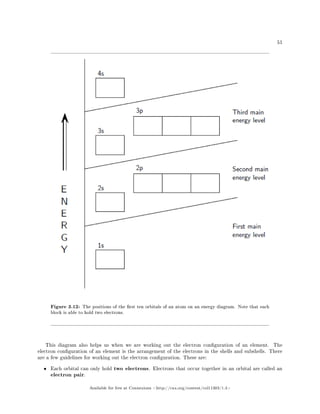
b. The element contains 234 neutrons
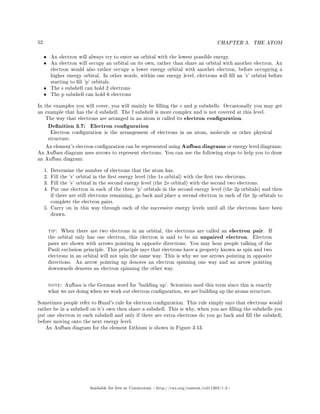
238
c. The element has the same electron conguration as 92 U
d. The element has an atomic mass number of 92
Click here for the solution
27
e. The electron conguration of an atom of chlorine can be represented using the following notation:
a. 1s2 2s8 3s7
b. 1s2 2s2 2p6 3s2 3p5
c. 1s2 2s2 2p6 3s2 3p6
d. 1s2 2s2 2p5
Click here for the solution
28
4. Give the standard notation for the following elements:
a. beryllium
b. carbon-12
c. titanium-48
23 http://www.fhsst.org/liG
24 http://www.fhsst.org/li7
25 http://www.fhsst.org/liA
26 http://www.fhsst.org/lio
27 http://www.fhsst.org/lis
28 http://www.fhsst.org/liH
Available for free at Connexions http://cnx.org/content/col11303/1.4
70.
64 CHAPTER 3. THE ATOM
d. uorine
Click here for the solution
29
5. Give the electron congurations and aufbau diagrams for the following elements:
a. aluminium
b. phosphorus
c. carbon
Click here for the solution
30
6. Use standard notation to represent the following elements:
a. argon
b. calcium
c. silver-107
d. bromine-79
Click here for the solution
31
7. For each of the following elements give the number of protons, neutrons and electrons in the element:
195
a. 78 P t
40
b. 18 Ar
59
c. 27 Co
7
d. 3 Li
11
e. 5 B
Click here for the solution
32
8. For each of the following elements give the element or number represented by 'x':
103
a. 45 X
35
b. x Cl
x
c. 4 Be
Click here for the solution
33
24
9. Which of the following are isotopes of 12 M g :
12
a. 25 M g
26
b. 12 M g
24
c. 13 Al
Click here for the solution
34
10. If a sample contains 69% of copper-63 and 31% of copper-65, calculate the relative atomic mass of an
atom in that sample.
Click here for the solution
35
11. Complete the following table:
29 http://www.fhsst.org/lg7
30 http://www.fhsst.org/lgG
31 http://cnx.org/content/m38126/latest/ http://www.fhsst.org/l44
32 http://cnx.org/content/m38126/latest/ http://www.fhsst.org/l42
33 http://www.fhsst.org/l4T
34 http://www.fhsst.org/l4b
35 http://www.fhsst.org/l4j
Available for free at Connexions http://cnx.org/content/col11303/1.4
71.
65
Element Electron conguration Core electrons Valence electrons
Boron (B)
Calcium (Ca)
Silicon (Si)
Lithium (Li)
Neon (Ne)
Table 3.8
Click here for the solution
36
12. Draw aufbau diagrams for the following elements:
a. beryllium
b. sulphur
c. argon
Click here for the solution
37
36 http://www.fhsst.org/l4D
37 http://www.fhsst.org/lgW
Available for free at Connexions http://cnx.org/content/col11303/1.4
72.
66 CHAPTER 3. THE ATOM
Solutions to Exercises in Chapter 3
Solution to Exercise 3.1 (p. 43)
Step 1. Sodium is given by Na
Step 2. Sodium has 11 protons, so we have: 11 N a
Step 3. Sodium has 12 neutrons.
Step 4. A = N + Z = 12 + 11 = 23
23
Step 5. In standard notation sodium is given by: 11 N a. The number of protons is 11, the number of neutrons
is 12 and the number of electrons is 11.
Solution to Exercise 3.2 (p. 45)
Step 1. We know that isotopes of any element have the same number of protons (same atomic number) in
each atom, which means that they have the same chemical symbol. However, they have a dierent
number of neutrons, and therefore a dierent mass number.
Step 2. Therefore, any isotope of uranium will have the symbol:
U (3.2)
Also, since the number of protons in uranium isotopes is always the same, we can write down the
atomic number:
92 U (3.3)
234
Now, if the isotope we want has 2 fewer neutrons than 92 U, then we take the original mass number
and subtract 2, which gives:
232
92 U (3.4)
Following the steps above, we can write the isotope with 4 more neutrons as:
238
92 U (3.5)
Solution to Exercise 3.3 (p. 45)
Step 1. We know that isotopes have the same atomic number but dierent mass numbers.
Step 2. You need to look for the element that has the same atomic number but a dierent atomic mass number.
42
The only element is 20 Ca. What is dierent is that there are 2 more neutrons than in the original
element.
Solution to Exercise 3.4 (p. 45)
Step 1. Z = 16, therefore the number of protons is 16 (answer to (a)).
Step 2. A = 33, therefore the number of nucleons is 33 (answer to (b)).
Step 3. The atom is neutral, and therefore the number of electrons is the same as the number of protons. The
number of electrons is 16 (answer to (c)).
Step 4.
N = A − Z = 33 − 16 = 17 (3.6)
The number of neutrons is 17 (answer to (d)).
Solution to Exercise 3.5 (p. 46)
75
Step 1. Contribution of Cl−35 = 100 × 35 = 26, 25 u
25
Step 2. Contribution of Cl−37 = 100 × 37 = 9, 25 u
Available for free at Connexions http://cnx.org/content/col11303/1.4
73.
67
Step 3. Relative atomic mass of chlorine = 26, 25 u + 9, 25 u = 35, 5 u
If you look on the periodic table, the average relative atomic mass for chlorine is 35, 5 u. You will
notice that for many elements, the relative atomic mass that is shown is not a whole number. You
should now understand that this number is the average relative atomic mass for those elements that
have naturally occurring isotopes.
Solution to Exercise 3.6 (p. 55)
Step 1. Sodium has 11 electrons.
Step 2. We start by placing two electrons in the 1s orbital: 1s2 . Now we have 9 electrons left to place in
2
orbitals, so we put two in the 2s orbital: 2s . There are now 7 electrons to place in orbitals so we place
6 1
6 of them in the 2p orbital: 2p . The last electron goes into the 3s orbital: 3s .
2 2 6 1
Step 3. The electron conguration is: 1s 2s 2p 3s
Step 4. Using the electron conguration we get the following diagram:
Figure 3.19
Available for free at Connexions http://cnx.org/content/col11303/1.4
74.
68 CHAPTER 3. THE ATOM
Available for free at Connexions http://cnx.org/content/col11303/1.4
75.
Chapter 4
The PeriodicTable 1
4.1 The arrangement of atoms in the periodic table
The periodic table of the elements is a method of showing the chemical elements in a table. The elements
are arranged in order of increasing atomic number. Most of the work that was done to arrive at the periodic
table that we know, can be attributed to a man called Dmitri Mendeleev in 1869. Mendeleev was a
Russian chemist who designed the table in such a way that recurring (periodic) trends in the properties
of the elements could be shown. Using the trends he observed, he even left gaps for those elements that he
thought were 'missing'. He even predicted the properties that he thought the missing elements would have
when they were discovered. Many of these elements were indeed discovered and Mendeleev's predictions
were proved to be correct.
To show the recurring properties that he had observed, Mendeleev began new rows in his table so that
elements with similar properties were in the same vertical columns, called groups. Each row was referred to
as a period. One important feature to note in the periodic table is that all the non-metals are to the right
of the zig-zag line drawn under the element boron. The rest of the elements are metals, with the exception
of hydrogen which occurs in the rst block of the table despite being a non-metal.
Figure 4.1: A simplied diagram showing part of the Periodic Table
1 This content is available online at http://cnx.org/content/m38133/1.6/.
Available for free at Connexions http://cnx.org/content/col11303/1.4
69
76.
70 CHAPTER 4. THE PERIODIC TABLE
You can view an online periodic table at Periodic table
2 . The full periodic table is also reproduced at
the front of this book.
4.1.1 Activity: Inventing the periodic table
You are the ocial chemist for the planet Zog. You have discovered all the same elements that we have here
on Earth, but you don't have a periodic table. The citizens of Zog want to know how all these elements relate
to each other. How would you invent the periodic table? Think about how you would organize the data that
you have and what properties you would include. Do not simply copy Mendeleev's ideas, be creative and
come up with some of your own. Research other forms of the periodic table and make one that makes sense
to you. Present your ideas to your class.
4.1.2 Groups in the periodic table
A group is a vertical column in the periodic table and is considered to be the most important way of
classifying the elements. If you look at a periodic table, you will see the groups numbered at the top of
each column. The groups are numbered from left to right starting with 1 and ending with 18. This is the
convention that we will use in this book. On some periodic tables you may see that the groups are numbered
from left to right as follows: 1, 2, then an open space which contains the transition elements, followed
by groups 3 to 8. Another way to label the groups is using Roman numerals. In some groups, the elements
display very similar chemical properties and the groups are even given separate names to identify them.
The characteristics of each group are mostly determined by the electron conguration of the atoms of
the element.
• Group 1: These elements are known as the alkali metals and they are very reactive.
Figure 4.2: Electron diagrams for some of the Group 1 elements, with sodium and potasium incomplete;
to be completed as an excersise.
• Group 2: These elements are known as the alkali earth metals. Each element only has two valence
electrons and so in chemical reactions, the group 2 elements tend to lose these electrons so that the
energy shells are complete. These elements are less reactive than those in group 1 because it is more
dicult to lose two electrons than it is to lose one.
• Group 13 elements have three valence electrons.
• Group 16: These elements are sometimes known as the chalcogens. These elements are fairly reactive
and tend to gain electrons to ll their outer shell.
• Group 17: These elements are known as the halogens. Each element is missing just one electron from
its outer energy shell. These elements tend to gain electrons to ll this shell, rather than losing them.
These elements are also very reactive.
• Group 18: These elements are the noble gases. All of the energy shells of the halogens are full and
so these elements are very unreactive.
2 http://periodictable.com/
Available for free at Connexions http://cnx.org/content/col11303/1.4
77.
71
Figure 4.3: Electron diagrams for two of the noble gases, helium (He) and neon (N e).
• Transition metals: The dierences between groups in the transition metals are not usually dramatic.
tip: The number of valence electrons of an element corresponds to its group number on the periodic
table.
note: Group 15 on the periodic table is sometimes called the pnictogens.
4.1.2.1 Investigation : The properties of elements
Refer to Figure 4.2.
1. Use a periodic table to help you to complete the last two diagrams for sodium (N a) and potassium
(K ).
2. What do you notice about the number of electrons in the valence energy level in each case?
3. Explain why elements from group 1 are more reactive than elements from group 2 on the periodic table
(Hint: Think about the 'ionisation energy').
It is worth noting that in each of the groups described above, the atomic diameter of the elements
increases as you move down the group. This is because, while the number of valence electrons is the same
in each element, the number of core electrons increases as one moves down the group.
Khan academy video on the periodic table - 1
This media object is a Flash object. Please view or download it at
http://www.youtube.com/v/LDHg7Vgzsesrel=0
Figure 4.4
4.1.3 Periods in the periodic table
A period is a horizontal row in the periodic table of the elements. Some of the trends that can be observed
within a period are highlighted below:
• As you move from one group to the next within a period, the number of valence electrons increases by
one each time.
Available for free at Connexions http://cnx.org/content/col11303/1.4
78.
72 CHAPTER 4. THE PERIODIC TABLE
• Within a single period, all the valence electrons occur in the same energy shell. If the period increases,
so does the energy shell in which the valence electrons occur.
• In general, the diameter of atoms decreases as one moves from left to right across a period. Consider
the attractive force between the positively charged nucleus and the negatively charged electrons in an
atom. As you move across a period, the number of protons in each atom increases. The number of
electrons also increases, but these electrons will still be in the same energy shell. As the number of
protons increases, the force of attraction between the nucleus and the electrons will increase and the
atomic diameter will decrease.
• Ionisation energy increases as one moves from left to right across a period. As the valence electron shell
moves closer to being full, it becomes more dicult to remove electrons. The opposite is true when
you move down a group in the table because more energy shells are being added. The electrons that
are closer to the nucleus 'shield' the outer electrons from the attractive force of the positive nucleus.
Because these electrons are not being held to the nucleus as strongly, it is easier for them to be removed
and the ionisation energy decreases.
• In general, the reactivity of the elements decreases from left to right across a period.
• The formation of halides follows the general pattern: XCln (where X is any element in a specic group
and n is the number of that specic group.). For example, the formula for the halides of group 1 will
be XCl, for the second group the halides have the formula XCl2 and in the third group the halides
have the formula XCl3 . This should be easy to see if you remember the valency of the group and of
the halides.
The formation of oxides show a trend as you move across a period. This should be easy to see if you think
about valency. In the rst group all the elements lose an electron to form a cation. So the formula for an
oxide will be X2 O. In the second group (moving from left to right across a period) the oxides have the
formula XO. In the third group the oxides have the formula X2 O3 .
Several other trends may be observed across a period such as density, melting points and boiling points.
These trends are not as obvious to see as the above trends and often show variations to the general trend.
Electron anity and electronegativity also show some general trends across periods. Electron anity
can be thought of as how much an element wants electrons. Electron anity generally increases from left
to right across a period. Electronegativity is the tendency of atoms to attract electrons. The higher the
electronegativity, the greater the atom attracts electrons. Electronegativity generally increases across a
period (from left to right). Electronegativity and electron anity will be covered in more detail in a later
grade.
You may see periodic tables labeled with s-block, p-block, d-block and f-block. This is simply another
way to group the elements. When we group elements like this we are simply noting which orbitals are being
lled in each block. This method of grouping is not very useful to the work covered at this level.
Using the properties of the groups and the trends that we observe in certain properties (ionization
energy, formation of halides and oxides, melting and boiling points, atomic diameter) we can predict the
the properties of unknown elements. For example, the properties of the unfamiliar elements Francium (Fr),
Barium (Ba), Astatine (At), and Xenon (Xe) can be predicted by knowing their position on the periodic
table. Using the periodic table we can say: Francium (Group 1) is an alkali metal, very reactive and needs
to lose 1 electron to obtain a full outer energy shell; Barium (Group 2) is an alkali earth metal and needs
to lose 2 electrons to achieve stability; Astatine (Group 7) is a halogen, very reactive and needs to gain 1
electron to obtain a full outer energy shell; and Xenon (Group 8) is a noble gas and thus stable due to its
full outer energy shell. This is how scientists are able to say what sort of properties the atoms in the last
period have. Almost all of the elements in this period do not occur naturally on earth and are made in
laboratories. These atoms do not exist for very long (they are very unstable and break apart easily) and so
measuring their properties is dicult.
4.1.3.1 Exercise: Elements in the periodic table
Refer to the elements listed below:
Available for free at Connexions http://cnx.org/content/col11303/1.4
79.
73
• Lithium (Li)
• Chlorine (Cl)
• Magnesium (M g )
• Neon (N e)
• Oxygen (O )
• Calcium (Ca)
• Carbon (C )
Which of the elements listed above:
1. belongs to Group 1
2. is a halogen
3. is a noble gas
4. is an alkali metal
5. has an atomic number of 12
6. has 4 neutrons in the nucleus of its atoms
7. contains electrons in the 4th energy level
8. has only one valence electron
9. has all its energy orbitals full
10. will have chemical properties that are most similar
11. will form positive ions
Click here for the solution
3
4.2 Ionisation Energy and the Periodic Table
4.2.1 Ions
In the previous section, we focused our attention on the electron conguration of neutral atoms. In a neutral
atom, the number of protons is the same as the number of electrons. But what happens if an atom gains or
loses electrons? Does it mean that the atom will still be part of the same element?
A change in the number of electrons of an atom does not change the type of atom that it is. However,
the charge of the atom will change. If electrons are added, then the atom will become more negative. If
electrons are taken away, then the atom will become more positive. The atom that is formed in either of
ion.
these cases is called an Put simply, an ion is a charged atom.
Denition 4.1: Ion
An ion is a charged atom. A positively charged ion is called a cation e.g. N a+ , and a negatively
charged ion is called an anion e.g. F −
. The charge on an ion depends on the number of electrons
that have been lost or gained.
But how do we know how many electrons an atom will gain or lose? Remember what we said about
stability? We said that all atoms are trying to get a full outer shell. For the elements on the left hand side
of the periodic table the easiest way to do this is to lose electrons and for the elements on the right of the
periodic table the easiest way to do this is to gain electrons. So the elements on the left of the periodic table
will form cations and the elements on the right hand side of the periodic table will form anions. By doing
this the elements can be in the most stable electronic conguration and so be as stable as the noble gases.
Look at the following examples. Notice the number of valence electrons in the neutral atom, the number
of electrons that are lost or gained and the nal charge of the ion that is formed.
Lithium
A lithium atom loses one electron to form a positive ion:
3 See the le at http://cnx.org/content/m38133/latest/http://www.fhsst.org/liw
Available for free at Connexions http://cnx.org/content/col11303/1.4
80.
74 CHAPTER 4. THE PERIODIC TABLE
Figure 4.5: The arrangement of electrons in a lithium ion.
In this example, the lithium atom loses an electron to form the cation Li+ .
Fluorine
A uorine atom gains one electron to form a negative ion:
Figure 4.6: The arrangement of electrons in a uorine ion.
You should have noticed in both these examples that each element lost or gained electrons to make a full
outer shell.
4.2.1.1 Investigation : The formation of ions
1. Use the diagram for lithium as a guide and draw similar diagrams to show how each of the following
ions is formed:
a. M g 2+
b. N a+
c. Cl−
d. O2+
2. Do you notice anything interesting about the charge on each of these ions? Hint: Look at the number
of valence electrons in the neutral atom and the charge on the nal ion.
Observations:
Once you have completed the activity, you should notice that:
• In each case the number of electrons that is either gained or lost, is the same as the number of electrons
that are needed for the atoms to achieve a full outer energy level.
Available for free at Connexions http://cnx.org/content/col11303/1.4
81.
75
• If you look at an energy level diagram for sodium (N a), you will see that in a neutral atom, there is
only one valence electron. In order to achieve a full outer energy level, and therefore a more stable
state for the atom, this electron will be lost.
• In the case of oxygen (O ), there are six valence electrons. To achieve a full energy level, it makes more
sense for this atom to gain two electrons. A negative ion is formed.
4.2.1.2 Exercise: The formation of ions
Match the information in column A with the information in column B by writing only the letter (A to I)
next to the question number (1 to 7)
1. A positive ion that has 3 less electrons than its neutral atom A. M g 2+
2. An ion that has 1 more electron than its neutral atom B. Cl−
3. The anion that is formed when bromine gains an electron C. CO2−
3
4. The cation that is formed from a magnesium atom D. Al3+
5. An example of a compound ion E. Br2−
6. A positive ion with the electron conguration of argon F. K+
7. A negative ion with the electron conguration of neon G. M g+
H. O2−
I. Br−
Table 4.1
Click here for the solution
4
4.2.2 Ionisation Energy
Ionisation energy is the energy that is needed to remove one electron from an atom. The ionisation energy
will be dierent for dierent atoms.
The second ionisation energy is the energy that is needed to remove a second electron from an atom, and
so on. As an energy level becomes more full, it becomes more and more dicult to remove an electron and
the ionisation energy increases. On the Periodic Table of the Elements, a group is a vertical column of the
elements, and a period is a horizontal row. In the periodic table, ionisation energy increases across a period,
but decreases as you move down a group. The lower the ionisation energy, the more reactive the element
will be because there is a greater chance of electrons being involved in chemical reactions. We will look at
this in more detail in the next section.
4.2.2.1 Trends in ionisation energy
Refer to the data table below which gives the ionisation energy (in kJ · mol−1 ) and atomic number (Z) for a
number of elements in the periodic table:
4 See the le at http://cnx.org/content/m38133/latest/http://www.fhsst.org/lid
Available for free at Connexions http://cnx.org/content/col11303/1.4
82.
76 CHAPTER 4. THE PERIODIC TABLE
Z Ionisation energy Z Ionisation energy
1 1310 10 2072
2 2360 11 494
3 517 12 734
4 895 13 575
5 797 14 783
6 1087 15 1051
7 1397 16 994
8 1307 17 1250
9 1673 18 1540
Table 4.2
1. Draw a line graph to show the relationship between atomic number (on the x-axis) and ionisation
energy (y-axis).
2. Describe any trends that you observe.
3. Explain why...
a. the ionisation energy for Z=2 is higher than forZ=1
b. the ionisation energy for Z=3 is lower than forZ=2
c. the ionisation energy increases between Z = 5 and Z = 7
Click here for the solution
5
Khan academy video on periodic table - 2
This media object is a Flash object. Please view or download it at
http://www.youtube.com/v/ywqg9PorTAwrel=0
Figure 4.7
By now you should have an appreciation of what the periodic table can tell us. The periodic table does
not just list the elements, but tells chemists what the properties of elements are, how the elements will
combine and many other useful facts. The periodic table is truly an amazing resource. Into one simple table,
chemists have packed so many facts and data that can easily be seen with a glance. The periodic table is a
crucial part of chemistry and you should never go to science class without it.
The following presentation provides a summary of the periodic table
This media object is a Flash object. Please view or download it at
http://static.slidesharecdn.com/swf/ssplayer2.swf ?doc=periodictableintroduction-100510044643-
phpapp01stripped_title=periodic-table-introduction
Figure 4.8
5 See the le at http://cnx.org/content/m38133/latest/http://www.fhsst.org/liv
Available for free at Connexions http://cnx.org/content/col11303/1.4
83.
77
4.3 Summary
• Elements are arranged in periods and groups on the periodic table. The elements are arranged according
to increasing atomic number.
• A group is a column on the periodic table containing elements with similar properties. A period is
a row on the periodic table.
• The groups on the periodic table are labeled from 1 to 8. The rst group is known as the alkali metals,
the second group is known as the alkali earth metals, the seventh group is known as the halogens and
the eighth group is known as the noble gases. Each group has the same properties.
• Several trends such as ionisation energy and atomic diameter can be seen across the periods of the
periodic table
• An ion is a charged atom. A cation is a positively charged ion and an anion is a negatively charged
ion.
• When forming an ion, an atom will lose or gain the number of electrons that will make its valence
energy level full.
• An element's ionisation energy is the energy that is needed to remove one electron from an atom.
• period in the periodic table.
Ionisation energy increases across a
• Ionisation energy decreases down a group in the periodic table.
4.4 End of chapter exercises
1. For the following questions state whether they are true or false. If they are false, correct the statement.
a. The group 1 elements are sometimes known as the alkali earth metals.
b. The group 2 elements tend to lose 2 electrons to form cations.
c. The group 8 elements are known as the noble gases.
d. Group 7 elements are very unreactive.
e. The transition elements are found between groups 3 and 4.
Click here for the solution
6
2. Give one word or term for each of the following:
a. A positive ion
b. The energy that is needed to remove one electron from an atom
c. A horizontal row on the periodic table
d. A very reactive group of elements that is missing just one electron from their outer shells.
Click here for the solution
7
3. For each of the following elements give the ion that will be formed:
a. sodium
b. bromine
c. magnesium
d. oxygen
Click here for the solution
8
4. The following table shows the rst ionisation energies for the elements of period 1 and
2.
6 http://www.fhsst.org/l4Z
7 http://www.fhsst.org/l4K
8 http://cnx.org/content/m38133/latest/ http://www.fhsst.org/l4B
Available for free at Connexions http://cnx.org/content/col11303/1.4
84.
78 CHAPTER 4. THE PERIODIC TABLE
−1
Period Element First ionisation energy (kJ.mol )
1 H 1312
He 2372
Li 520
Be 899
B 801
C 1086
2 N 1402
O 1314
F 1681
Ne 2081
Table 4.3
a. What is the meaning of the term rst ionisation energy ?
b. Identify the pattern of rst ionisation energies in a period.
c. Which TWO elements exert the strongest attractive forces on their electrons? Use the data in
the table to give a reason for your answer.
d. Draw Aufbau diagrams for the TWO elements you listed in the previous question and explain
why these elements are so stable.
e. It is safer to use helium gas than hydrogen gas in balloons. Which property of helium makes it a
safer option?
f. 'Group 1 elements readily form positive ions'. Is this statement correct? Explain your answer by
referring to the table.
Click here for the solution
9
9 See the le at http://cnx.org/content/m38133/latest/http://www.fhsst.org/li6
Available for free at Connexions http://cnx.org/content/col11303/1.4
85.
Chapter 5
Chemical Bonding 1
5.1 Chemical Bonding
When you look at the matter, or physical substances, around you, you will realise that atoms seldom exist on
their own. More often, the things around us are made up of dierent atoms that have been joined together.
This is called chemical bonding. Chemical bonding is one of the most important processes in chemistry
because it allows all sorts of dierent molecules and combinations of atoms to form, which then make up the
objects in the complex world around us.
5.2 What happens when atoms bond?
A chemical bond is formed when atoms are held together by attractive forces. This attraction occurs when
electrons are shared between atoms, or when electrons are exchanged between the atoms that are involved
in the bond. The sharing or exchange of electrons takes place so that the outer energy levels of the atoms
involved are lled and the atoms are more stable. If an electron is shared, it means that it will spend its
time moving in the electron orbitals around both atoms. If an electron is exchanged it means that it is
transferred from one atom to another, in other words one atom gains an electron while the other loses an
electron.
Denition 5.1: Chemical bond
A chemical bond is the physical process that causes atoms and molecules to be attracted to each
other, and held together in more stable chemical compounds.
The type of bond that is formed depends on the elements that are involved. In this chapter, we will be
looking at three types of chemical bonding: covalent, ionic and metallic bonding.
You need to remember that it is the valence electrons that are involved in bonding and that atoms will
try to ll their outer energy levels so that they are more stable (or are more like the noble gases which are
very stable).
5.3 Covalent Bonding
5.3.1 The nature of the covalent bond
Covalent bonding occurs between the atoms of non-metals. The outermost orbitals of the atoms overlap
so that unpaired electrons in each of the bonding atoms can be shared. By overlapping orbitals, the outer
energy shells of all the bonding atoms are lled. The shared electrons move in the orbitals around both
1 This content is available online at http://cnx.org/content/m38131/1.6/.
Available for free at Connexions http://cnx.org/content/col11303/1.4
79
86.
80 CHAPTER 5. CHEMICAL BONDING
atoms. As they move, there is an attraction between these negatively charged electrons and the positively
charged nuclei, and this force holds the atoms together in a covalent bond.
Denition 5.2: Covalent bond
Covalent bonding is a form of chemical bonding where pairs of electrons are shared between atoms.
Below are a few examples. Remember that it is only the valence electrons that are involved in bonding,
and so when diagrams are drawn to show what is happening during bonding, it is only these electrons that
are shown. Circles and crosses are used to represent electrons in dierent atoms.
Exercise 5.1: Covalent bonding (Solution on p. 95.)
How do hydrogen and chlorine atoms bond covalently in a molecule of hydrogen chloride?
Exercise 5.2: Covalent bonding involving multiple bonds (Solution on p. 95.)
How do nitrogen and hydrogen atoms bond to form a molecule of ammonia (N H 3 )?
The above examples all show single covalent bonds, where only one pair of electrons is shared between
the same two atoms. double
If two pairs of electrons are shared between the same two atoms, this is called a
bond. A triple bond is formed if three pairs of electrons are shared.
Exercise 5.3: Covalent bonding involving a double bond (Solution on p. 96.)
How do oxygen atoms bond covalently to form an oxygen molecule?
You will have noticed in the above examples that the number of electrons that are involved in bonding varies
between atoms. We say that the valency of the atoms is dierent.
Denition 5.3: Valency
The number of electrons in the outer shell of an atom which are able to be used to form bonds
with other atoms.
In the rst example, the valency of both hydrogen and chlorine is one, therefore there is a single covalent
bond between these two atoms. In the second example, nitrogen has a valency of three and hydrogen has a
valency of one. This means that three hydrogen atoms will need to bond with a single nitrogen atom. There
are three single covalent bonds in a molecule of ammonia. In the third example, the valency of oxygen is
two. This means that each oxygen atom will form two bonds with another atom. Since there is only one
other atom in a molecule of O2 , a double covalent bond is formed between these two atoms.
tip: There is a relationship between the valency of an element and its position on the Periodic
Table. For the elements in groups 1 to 4, the valency is the same as the group number. For
elements in groups 5 to 7, the valency is calculated by subtracting the group number from 8. For
example, the valency of uorine (group 7) is 8 − 7 = 1, while the valency of calcium (group 2) is
2. Some elements have more than one possible valency, so you always need to be careful when you
are writing a chemical formula. Often, if there is more than one possibility in terms of valency, the
valency will be written in a bracket after the element symbol e.g. carbon (IV) oxide, means that
in this molecule carbon has a valency of 4.
5.3.1.1 Covalent bonding and valency
1. Explain the dierence between the valence electrons and the valency of an element.
Click here for the solution.
2
2. Complete the table below by lling in the number of valence electrons and the valency for each of the
elements shown:
2 http://www.fhsst.org/lOY
Available for free at Connexions http://cnx.org/content/col11303/1.4
87.
81
Element No. of valence electrons No. of electrons needed to ll outer shell Valency
F
Ar
C
N
O
Table 5.1
Click here for the solution.
3
3. Draw simple diagrams to show how electrons are arranged in the following covalent molecules:
a. Water (H 2 O )
b. Chlorine (Cl2 )
Click here for the solution.
4
5.3.2 Properties of covalent compounds
Covalent compounds have several properties that distinguish them from ionic compounds and metals. These
properties are:
1. The melting and boiling points of covalent compounds is generally lower than that for ionic compounds.
2. Covalent compounds are generally more exible than ionic compounds. The molecules in covalent
compounds are able to move around to some extent and can sometimes slide over each other (as is the
case with graphite, this is why the lead in your pencil feels slightly slippery). In ionic compounds all
the ions are tightly held in place.
3. Covalent compounds generally are not very soluble in water.
4. Covalent compounds generally do not conduct electricity when dissolved in water. This is because they
do not dissociate as ionic compounds do.
5.4 Lewis notation and molecular structure
Although we have used diagrams to show the structure of molecules, there are other forms of notation that
can be used, such as Lewis notation and Couper notation. Lewis notation uses dots and crosses to
represent the valence electrons on dierent atoms. The chemical symbol of the element is used to represent
the nucleus and the core electrons of the atom.
So, for example, a hydrogen atom would be represented like this:
Figure 5.1
3 http://www.fhsst.org/lOr
4 http://www.fhsst.org/lO1
Available for free at Connexions http://cnx.org/content/col11303/1.4
88.
82 CHAPTER 5. CHEMICAL BONDING
A chlorine atom would look like this:
Figure 5.2
A molecule of hydrogen chloride would be shown like this:
Figure 5.3
The dot and cross in between the two atoms, represent the pair of electrons that are shared in the covalent
bond.
Exercise 5.4: Lewis notation: Simple molecules (Solution on p. 96.)
Represent the molecule H 2O using Lewis notation
Exercise 5.5: Lewis notation: Molecules with multiple bonds (Solution on p. 97.)
Represent the molecule HCN (hydrogen cyanide) using Lewis notation
Exercise 5.6: Lewis notation: Atoms with variable valencies (Solution on p. 97.)
Represent the molecule H 2S (hydrogen sulphide) using Lewis notation
Another way of representing molecules is using Couper notation. In this case, only the electrons that are
involved in the bond between the atoms are shown. A line is used for each covalent bond. Using Couper
notation, a molecule of water and a molecule of HCN would be represented as shown in gures Figure 5.4
and Figure 5.5 below.
Figure 5.4: A water molecule represented using Couper notation
Available for free at Connexions http://cnx.org/content/col11303/1.4
89.
83
Figure 5.5: A molecule of HCN represented using Couper notation
5.4.1 Atomic bonding and Lewis notation
1. Represent each of the following atoms using Lewis notation:
a. beryllium
b. calcium
c. lithium
Click here for the solution.
5
2. Represent each of the following molecules using Lewis notation:
a. bromine gas (Br 2 )
b. carbon dioxide (CO 2 )
Click here for the solution.
6
3. Which of the two molecules listed above contains a double bond?
Click here for the solution.
7
4. Two chemical reactions are described below.
• nitrogen and hydrogen react to form N H3
• carbon and hydrogen bond to form a molecule of CH 4
For each reaction, give:
a. the valency of each of the atoms involved in the reaction
b. the Lewis structure of the product that is formed
c. the chemical formula of the product
d. the name of the product
Click here for the solution.
8
5. A chemical compound has the following Lewis notation:
Figure 5.6
5 http://www.fhsst.org/lOC
6 http://www.fhsst.org/lOa
7 http://www.fhsst.org/lOa
8 http://www.fhsst.org/lOx
Available for free at Connexions http://cnx.org/content/col11303/1.4
90.
84 CHAPTER 5. CHEMICAL BONDING
a. How many valence electrons does element Y have?
b. What is the valency of element Y?
c. What is the valency of element X?
d. How many covalent bonds are in the molecule?
e. Suggest a name for the elements X and Y.
Click here for the solution.
9
5.5 Ionic Bonding
5.5.1 The nature of the ionic bond
You will remember that when atoms bond, electrons are either shared or they are transferred between the
atoms that are bonding. In covalent bonding, electrons are shared between the atoms. There is another type
of bonding, where electrons are transferred from one atom to another. This is called ionic bonding.
Ionic bonding takes place when the dierence in electronegativity between the two atoms is more than
1,7. This usually happens when a metal atom bonds with a non-metal atom. When the dierence in
electronegativity is large, one atom will attract the shared electron pair much more strongly than the other,
causing electrons to be transferred from one atom to the other.
Denition 5.4: Ionic bond
An ionic bond is a type of chemical bond based on the electrostatic forces between two oppositely-
charged ions. When ionic bonds form, a metal donates one or more electrons, due to having a low
electronegativity, to form a positive ion or cation. The non-metal atom has a high electronegativity,
and therefore readily gains electrons to form a negative ion or anion. The two ions are then attracted
to each other by electrostatic forces.
Example 1:
In the case of N aCl, the dierence in electronegativity is 2,1. Sodium has only one valence electron, while
chlorine has seven. Because the electronegativity of chlorine is higher than the electronegativity of sodium,
chlorine will attract the valence electron of the sodium atom very strongly. This electron from sodium is
transferred to chlorine. Sodium loses an electron and forms an N a+ ion. Chlorine gains an electron and
−
forms an Cl ion. The attractive force between the positive and negative ion holds the molecule together.
The balanced equation for the reaction is:
N a + Cl → N aCl (5.1)
This can be represented using Lewis notation:
Figure 5.7: Ionic bonding in sodium chloride
9 http://www.fhsst.org/lOc
Available for free at Connexions http://cnx.org/content/col11303/1.4
91.
85
Example 2:
Another example of ionic bonding takes place between magnesium (M g ) and oxygen (O ) to form magne-
sium oxide (M gO ). Magnesium has two valence electrons and an electronegativity of 1,2, while oxygen has
six valence electrons and an electronegativity of 3,5. Since oxygen has a higher electronegativity, it attracts
the two valence electrons from the magnesium atom and these electrons are transferred from the magnesium
atom to the oxygen atom. Magnesium loses two electrons to form M g 2+ , and oxygen gains two electrons to
form O2− . The attractive force between the oppositely charged ions is what holds the molecule together.
The balanced equation for the reaction is:
2M g + O2 → 2M gO (5.2)
Because oxygen is a diatomic molecule, two magnesium atoms will be needed to combine with one oxygen
molecule (which has two oxygen atoms) to produce two molecules of magnesium oxide (M gO ).
Figure 5.8: Ionic bonding in magnesium oxide
tip: Notice that the number of electrons that is either lost or gained by an atom during ionic
bonding, is the same as the valency of that element
5.5.1.1 Ionic compounds
1. Explain the dierence between a covalent and an ionic bond.
Click here for the solution
10
2. Magnesium and chlorine react to form magnesium chloride.
a. What is the dierence in electronegativity between these two elements?
b. Give the chemical formula for:
i. a magnesium ion
ii. a chloride ion
iii. the ionic compound that is produced during this reaction
c. Write a balanced chemical equation for the reaction that takes place.
Click here for the solution
11
3. Draw Lewis diagrams to represent the following ionic compounds:
a. sodium iodide (N aI )
b. calcium bromide (CaBr 2 )
c. potassium chloride (KCl)
10 http://www.fhsst.org/lOq
11 See the le at http://cnx.org/content/m38131/latest/http://www.fhsst.org/lOl
Available for free at Connexions http://cnx.org/content/col11303/1.4
92.
86 CHAPTER 5. CHEMICAL BONDING
Click here for the solution
12
5.5.2 The crystal lattice structure of ionic compounds
Ionic substances are actually a combination of lots of ions bonded together into a giant molecule. The
arrangement of ions in a regular, geometric structure is called a crystal lattice. So in fact N aCl does not
contain one N a and one Cl ion, but rather a lot of these two ions arranged in a crystal lattice where the
ratio of Na toCl ions is 1:1. The structure of a crystal lattice is shown in Figure 5.9.
Figure 5.9: The crystal lattice arrangement in an ionic compound (e.g. N aCl)
5.5.3 Properties of Ionic Compounds
Ionic compounds have a number of properties:
• Ions are arranged in a lattice structure
• Ionic solids are crystalline at room temperature
• The ionic bond is a strong electrical attraction. This means that ionic compounds are often hard and
have high melting and boiling points
• Ionic compounds are brittle, and bonds are broken along planes when the compound is stressed
• Solid crystals don't conduct electricity, but ionic solutions do
12 See the le at http://cnx.org/content/m38131/latest/http://www.fhsst.org/lOi
Available for free at Connexions http://cnx.org/content/col11303/1.4
93.
87
5.6 Metallic bonds
5.6.1The nature of the metallic bond
The structure of a metallic bond is quite dierent from covalent and ionic bonds. In a metal bond, the
valence electrons are delocalised, meaning that an atom's electrons do not stay around that one nucleus. In
a metallic bond, the positive atomic nuclei (sometimes called the 'atomic kernels') are surrounded by a sea
of delocalised electrons which are attracted to the nuclei (Figure 5.10).
Denition 5.5: Metallic bond
Metallic bonding is the electrostatic attraction between the positively charged atomic nuclei of
metal atoms and the delocalised electrons in the metal.
Figure 5.10: Positive atomic nuclei (+) surrounded by delocalised electrons (•)
5.6.2 The properties of metals
Metals have several unique properties as a result of this arrangement:
• Thermal conductors Metals are good conductors of heat and are therefore used in cooking utensils such
as pots and pans. Because the electrons are loosely bound and are able to move, they can transport
heat energy from one part of the material to another.
• Electrical conductors Metals are good conductors of electricity, and are therefore used in electrical
conducting wires. The loosely bound electrons are able to move easily and to transfer charge from one
part of the material to another.
• Shiny metallic lustre Metals have a characteristic shiny appearance and are often used to make jewellery.
The loosely bound electrons are able to absorb and reect light at all frequencies, making metals look
polished and shiny.
Available for free at Connexions http://cnx.org/content/col11303/1.4
94.
88 CHAPTER 5. CHEMICAL BONDING
• Malleable and ductile This means that they can be bent into shape without breaking (malleable) and
can be stretched into thin wires (ductile) such as copper, which can then be used to conduct electricity.
Because the bonds are not xed in a particular direction, atoms can slide easily over one another,
making metals easy to shape, mould or draw into threads.
• Melting point Metals usually have a high melting point and can therefore be used to make cooking
pots and other equipment that needs to become very hot, without being damaged. The high melting
point is due to the high strength of metallic bonds.
• Density Metals have a high density because their atoms are packed closely together.
5.6.3 Activity: Building models
Using coloured balls and sticks (or any other suitable materials) build models of each type of bonding.
Think about how to represent each kind of bonding. For example, covalent bonding could be represented by
simply connecting the balls with sticks to represent the molecules, while for ionic bonding you may wish to
construct part of the crystal lattice. Do some research on types of crystal lattices (although the section on
ionic bonding only showed the crystal lattice for sodium chloride, many other types of lattices exist) and try
to build some of these. Share your ndings with your class and compare notes to see what types of crystal
lattices they found. How would you show metallic bonding?
You should spend some time doing this activity as it will really help you to understand how atoms
combine to form molecules and what the dierences are between the types of bonding.
Khan academy video on bonding - 1
This media object is a Flash object. Please view or download it at
http://www.youtube.com/v/CGA8sRwqIFgrel=0
Figure 5.11
5.6.4 Chemical bonding
1. Give two examples of everyday objects that contain..
a. covalent bonds
b. ionic bonds
c. metallic bonds
Click here for the solution
13
2. Complete the table which compares the dierent types of bonding:
Covalent Ionic Metallic
Types of atoms involved
Nature of bond between atoms
Melting Point (high/low)
Conducts electricity? (yes/no)
Other properties
13 http://www.fhsst.org/l3h
Available for free at Connexions http://cnx.org/content/col11303/1.4
95.
89
Table 5.2
Click here for the solution
14
3. Complete the table below by identifying the type of bond (covalent, ionic or metallic) in each of the
compounds:
Molecular formula Type of bond
H 2 SO4
F eS
N aI
M gCl2
Zn
Table 5.3
Click here for the solution
15
4. Which of these substances will conduct electricity most eectively? Give a reason for your answer.
Click here for the solution
16
5. Use your knowledge of the dierent types of bonding to explain the following statements:
a. Swimming during an electric storm (i.e. where there is lightning) can be very dangerous.
b. Most jewellery items are made from metals.
c. Plastics are good insulators.
Click here for the solution
17
5.7 Writing chemical formulae
5.7.1 The formulae of covalent compounds
To work out the formulae of covalent compounds, we need to use the valency of the atoms in the compound.
This is because the valency tells us how many bonds each atom can form. This in turn can help to work out
how many atoms of each element are in the compound, and therefore what its formula is. The following are
some examples where this information is used to write the chemical formula of a compound.
Exercise 5.7: Formulae of covalent compounds (Solution on p. 98.)
Write the chemical formula for water
Exercise 5.8: Formulae of covalent compounds (Solution on p. 98.)
Write the chemical formula for magnesium oxide
Exercise 5.9: Formulae of covalent compounds (Solution on p. 98.)
Write the chemical formula for copper (II) chloride.
14 http://www.fhsst.org/l3u
15 http://www.fhsst.org/l3J
16 http://www.fhsst.org/l3J
17 http://www.fhsst.org/l3S
Available for free at Connexions http://cnx.org/content/col11303/1.4
96.
90 CHAPTER 5. CHEMICAL BONDING
5.7.2 The formulae of ionic compounds
The overall charge of an ionic compound will always be zero and so the negative and positive charge must be
the same size. We can use this information to work out what the chemical formula of an ionic compound is if
we know the charge on the individual ions. In the case of N aCl for example, the charge on the sodium is +1
and the charge on the chlorine is −1. The charges balance (+1 − 1 = 0) and therefore the ionic compound is
neutral. In M gO, magnesium has a charge of +2 and oxygen has a charge of −2. Again, the charges balance
and the compound is neutral. Positive ions are calledcations and negative ions are called anions.
Some ions are made up of groups of atoms, and these are called compound ions. It is a good idea to
learn the compound ions that are shown in Table 5.4
Name of compound ion formula Name of compound ion formula
Carbonate CO2−
3 Nitrate N O−
2
Sulphate SO2−
4 Hydrogen sulphite HSO−
3
Hydroxide OH − Hydrogen sulphate HSO−
4
Ammonium N H+
4 Dihydrogen phosphate H2 P O −
4
Nitrate N O−
3 Hypochlorite ClO−
Hydrogen carbonate HCO−
3 Acetate (ethanoate) CH 3 COO−
Phosphate P O3−
4 Oxalate
2−
C2 O4
Chlorate ClO−
3 Oxide O2−
Cyanide CN − Peroxide
2−
O2
Chromate CrO2−
4 Sulphide S 2−
Permanganate M nO−
4 Sulphite SO2−
3
Thiosulphate
2−
S2 O3 Manganate M nO2−
4
Phosphide P 3− Hydrogen phosphate HP O3−
4
Table 5.4: Table showing common compound ions and their formulae
In the case of ionic compounds, the valency of an ion is the same as its charge (Note: valency is always
expressed as a positive number e.g. valency of the chloride ion is 1 and not -1). Since an ionic compound
is always neutral, the positive charges in the compound must balance out the negative. The following are
some examples:
Exercise 5.10: Formulae of ionic compounds (Solution on p. 98.)
Write the chemical formula for potassium iodide.
Exercise 5.11: Formulae of ionic compounds (Solution on p. 99.)
Write the chemical formula for sodium sulphate.
Exercise 5.12: Formulae of ionic compounds (Solution on p. 99.)
Write the chemical formula for calcium hydroxide.
note: Notice how in the last example we wrote OH − inside brackets. We do this to indicate that
−
OH is a complex ion and that there are two of these ions bonded to one calcium ion.
Available for free at Connexions http://cnx.org/content/col11303/1.4
97.
91
5.7.2.1 Chemical formulae
1. Copy and complete the table below:
Compound Cation Anion Formula
N a+ Cl−
potassium bromide Br−
N H+
4 Cl−
potassium chromate
P bI
potassium permanganate
calcium phosphate
Table 5.5
Click here for the solution
18
2. Write the chemical formula for each of the following compounds:
a. hydrogen cyanide
b. carbon dioxide
c. sodium carbonate
d. ammonium hydroxide
e. barium sulphate
Click here for the solution
19
5.8 Chemical compounds: names and masses
In Giving names and formulae to substances (Section 1.4: Giving names and formulae to substances) the
names of chemical compounds was revised. The relative molecular mass for covalent molecules is simply the
sum of the relative atomic masses of each of the individual atoms in that compound. For ionic compounds
we use the formula of the compound to work out a relative formula mass. We ignore the fact that there are
many molecules linked together to form a crystal lattice. For example N aCl has a relative formula mass of
58 g · mol−1 .
This media object is a Flash object. Please view or download it at
http://static.slidesharecdn.com/swf/ssplayer2.swf ?doc=bonding-100511043651-
phpapp02stripped_title=bonding-4047232userName=kwarne
Figure 5.12
5.9 Summary
• A chemical bond is the physical process that causes atoms and molecules to be attracted together
and to be bound in new compounds.
18 http://www.fhsst.org/l3t
19 http://www.fhsst.org/l3z
Available for free at Connexions http://cnx.org/content/col11303/1.4
98.
92 CHAPTER 5. CHEMICAL BONDING
• Atoms are more reactive, and therefore more likely to bond, when their outer electron orbitals are
not full. Atoms are less reactive when these outer orbitals contain the maximum number of electrons.
This explains why the noble gases do not combine to form molecules.
• When atoms bond, electrons are either shared or exchanged.
• Covalent bonding occurs between the atoms of non-metals and involves a sharing of electrons so
that the orbitals of the outermost energy levels in the atoms are lled.
• The valency of an atom is the number of electrons in the outer shell of that atom and valence electrons
are able to form bonds with other atoms.
• A double or triple bond occurs if there are two or three electron pairs that are shared between the
same two atoms.
• A dative covalent bond is a bond between two atoms in which both the electrons that are shared
in the bond come from the same atom.
• Lewis and Couper notation are two ways of representing molecular structure. In Lewis notation, dots
and crosses are used to represent the valence electrons around the central atom. In Couper notation,
lines are used to represent the bonds between atoms.
• An ionic bond occurs between atoms where the dierence in electronegativity is greater than 1,7.
An exchange of electrons takes place and the atoms are held together by the electrostatic force of
attraction between oppositely-charged ions.
• Ionic solids are arranged in a crystal lattice structure.
• Ionic compounds have a number of specic properties, including their high melting and boiling points,
brittle nature, the lattice structure of solids and the ability of ionic solutions to conduct electricity.
• A metallic bond is the electrostatic attraction between the positively charged nuclei of metal atoms
and the delocalised electrons in the metal.
• Metals also have a number of properties, including their ability to conduct heat and electricity, their
metallic lustre, the fact that they are both malleable and ductile, and their high melting point and
density.
• The valency of atoms, and the way they bond, can be used to determine the chemical formulae of
compounds.
5.9.1 End of chapter exercises
1. Explain the meaning of each of the following terms
a. Valency
b. Covalent bond
Click here for the solution
20
2. Which ONE of the following best describes the bond formed between an H + ion and the N H 3 molecule?
a. Covalent bond
b. Dative covalent (coordinate covalent) bond
c. Ionic Bond
d. Hydrogen Bond
Click here for the solution
21
3. Which of the following reactions will not take place? Explain your answer.
a. H + H → H2
b. Ne + Ne → Ne2
c. Cl + Cl → Cl2
20 http://www.fhsst.org/lgV
21 http://www.fhsst.org/l37
Available for free at Connexions http://cnx.org/content/col11303/1.4
99.
93
Click here for the solution
22
4. Draw the Lewis structure for each of the following:
a. calcium
b. iodine (Hint: Which group is it in? It will be similar to others in that group)
c. hydrogen bromide (HBr )
d. nitrogen dioxide (N O 2 )
Click here for the solution
23
5. Given the following Lewis structure, where X and Y each represent a dierent element...
Figure 5.13
a. What is the valency of X?
b. What is the valency of Y?
c. Which elements could X and Y represent?
Click here for the solution
24
6. A molecule of ethane has the formula C 2H 6. Which of the following diagrams (Couper notation)
accurately represents this molecule?
22 http://www.fhsst.org/l36
23 http://www.fhsst.org/l3H
24 http://www.fhsst.org/l3s
Available for free at Connexions http://cnx.org/content/col11303/1.4
100.
94 CHAPTER 5. CHEMICAL BONDING
Figure 5.14
Click here for the solution
25
7. Potassium dichromate is dissolved in water.
a. Give the name and chemical formula for each of the ions in solution.
b. What is the chemical formula for potassium dichromate?
Click here for the solution
26
25 http://www.fhsst.org/l3o
26 http://www.fhsst.org/l3A
Available for free at Connexions http://cnx.org/content/col11303/1.4