Valance Bond Theory
-------(VBT)-------
1
Valence Bond Theory
Principles of VBT:-
1) Ligand approached the metal atom by
donating the electrons.
2) Ligand and metal form coordinate bond.
3) To accommodate these electrons metal
atom possess require number of vacant
orbitals having equal energy.
4) These orbital obtained by hybridization of
metal orbitals to give sets of equal energy
orbitals.
2
Valence Bond Theory
Principles of VBT(continue..):-
5) Sometimes unpaired electrons in (n-1) d orbitals paired up as
fully as possible prior to hybridization make the required d
orbitals vacant.
6) Central metal atom make available the number of empty
orbitals equal to the coordination number for formation of
coordinate bond with ligand.
7) When ligand approach, metal ligand bond are formed by
overlapping of these orbitals with ligand by donation of electrons
to the empty hybridized orbitals.
8) Thus bond of equal length , strength formed.
3
Valence Bond Theory
4
Valence Bond Theory
5
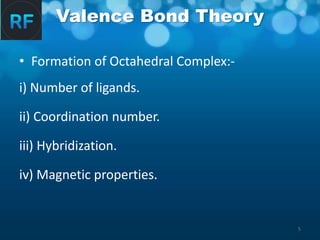
• Formation of Octahedral Complex:-
i) Number of ligands.
ii) Coordination number.
iii) Hybridization.
iv) Magnetic properties.
Valence Bond Theory
6
Valence Bond Theory
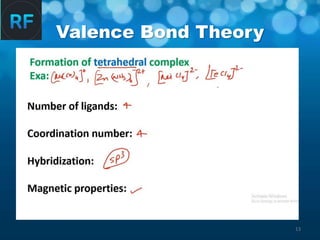
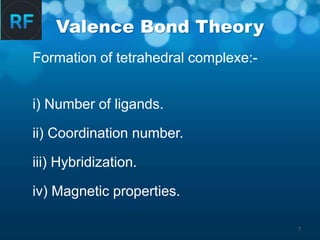
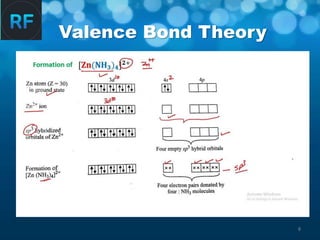
Formation of tetrahedral complexe:-
i) Number of ligands.
ii) Coordination number.
iii) Hybridization.
iv) Magnetic properties.
7
Valence Bond Theory
8
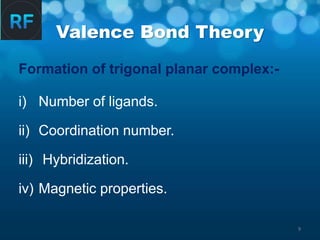
Formation of trigonal planar complex:-
i) Number of ligands.
ii) Coordination number.
iii) Hybridization.
iv) Magnetic properties.
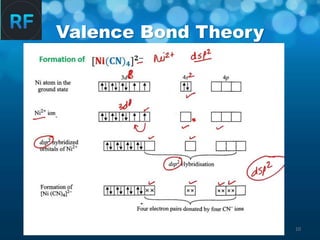
9
Valence Bond Theory
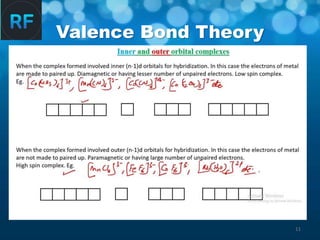
10
Valence Bond Theory
11
Valence Bond Theory
12
Valence Bond Theory
1) Misleading magnetic behavior.
2) Why some complex of same metal in a particular
oxidation state are low spin and high spin. For
example:[Co(NH3)6]3+ and [Co(F)6]3
3) Color of complex cannot explained.
4) Thermodynamic or kinetic stabilities of
complexes.
5) Not explain about weak and strong Ligands.
Limitations of VBT:-
13
Valence Bond Theory
14
Valence Bond Theory
Question No.1
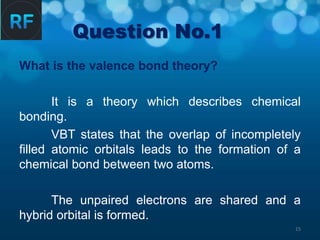
What is the valence bond theory?
It is a theory which describes chemical
bonding.
VBT states that the overlap of incompletely
filled atomic orbitals leads to the formation of a
chemical bond between two atoms.
The unpaired electrons are shared and a
hybrid orbital is formed.
15
Question No.2
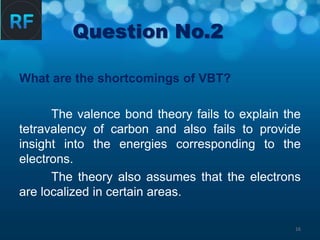
What are the shortcomings of VBT?
The valence bond theory fails to explain the
tetravalency of carbon and also fails to provide
insight into the energies corresponding to the
electrons.
The theory also assumes that the electrons
are localized in certain areas.
16
Question No.3
What are the merits of the valence bond
theory?
The condition of maximum overlap described by the
VBT can be used to explain how covalent bonds are
formed in many molecules.
The theory can also offer insight into the ionic
character of chemical bonds.
17
18

VBT valance bond theory

  • 1.
  • 2.
    Valence Bond Theory Principlesof VBT:- 1) Ligand approached the metal atom by donating the electrons. 2) Ligand and metal form coordinate bond. 3) To accommodate these electrons metal atom possess require number of vacant orbitals having equal energy. 4) These orbital obtained by hybridization of metal orbitals to give sets of equal energy orbitals. 2
  • 3.
    Valence Bond Theory Principlesof VBT(continue..):- 5) Sometimes unpaired electrons in (n-1) d orbitals paired up as fully as possible prior to hybridization make the required d orbitals vacant. 6) Central metal atom make available the number of empty orbitals equal to the coordination number for formation of coordinate bond with ligand. 7) When ligand approach, metal ligand bond are formed by overlapping of these orbitals with ligand by donation of electrons to the empty hybridized orbitals. 8) Thus bond of equal length , strength formed. 3
  • 4.
  • 5.
    Valence Bond Theory 5 •Formation of Octahedral Complex:- i) Number of ligands. ii) Coordination number. iii) Hybridization. iv) Magnetic properties.
  • 6.
  • 7.
    Valence Bond Theory Formationof tetrahedral complexe:- i) Number of ligands. ii) Coordination number. iii) Hybridization. iv) Magnetic properties. 7
  • 8.
  • 9.
    Formation of trigonalplanar complex:- i) Number of ligands. ii) Coordination number. iii) Hybridization. iv) Magnetic properties. 9 Valence Bond Theory
  • 10.
  • 11.
  • 12.
    12 Valence Bond Theory 1)Misleading magnetic behavior. 2) Why some complex of same metal in a particular oxidation state are low spin and high spin. For example:[Co(NH3)6]3+ and [Co(F)6]3 3) Color of complex cannot explained. 4) Thermodynamic or kinetic stabilities of complexes. 5) Not explain about weak and strong Ligands. Limitations of VBT:-
  • 13.
  • 14.
  • 15.
    Question No.1 What isthe valence bond theory? It is a theory which describes chemical bonding. VBT states that the overlap of incompletely filled atomic orbitals leads to the formation of a chemical bond between two atoms. The unpaired electrons are shared and a hybrid orbital is formed. 15
  • 16.
    Question No.2 What arethe shortcomings of VBT? The valence bond theory fails to explain the tetravalency of carbon and also fails to provide insight into the energies corresponding to the electrons. The theory also assumes that the electrons are localized in certain areas. 16
  • 17.
    Question No.3 What arethe merits of the valence bond theory? The condition of maximum overlap described by the VBT can be used to explain how covalent bonds are formed in many molecules. The theory can also offer insight into the ionic character of chemical bonds. 17
  • 18.