1
Crystal Field Theory
(Text : JD Lee; pp.204-222)
•This theory (CFT) largely replaced VB Theory for interpreting
the chemistry of coordination compounds.
•It was proposed by the physicist Hans Bethe in 1929.
•Subsequent modifications were proposed by J. H. Van Vleck
in 1935 to allow for some covalency in the interactions. These
modifications are often referred to as Ligand Field Theory.
•For a review on the evolution of bonding models see:
C. J. Ballhausen, J. Chem. Ed. 1979 56 194-197, 215-218,
357-361.
2
CFT-Assumptions
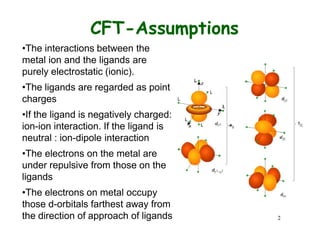
•The interactions between the
metal ion and the ligands are
purely electrostatic (ionic).
•The ligands are regarded as point
charges
•If the ligand is negatively charged:
ion-ion interaction. If the ligand is
neutral : ion-dipole interaction
•The electrons on the metal are
under repulsive from those on the
ligands
•The electrons on metal occupy
those d-orbitals farthest away from
the direction of approach of ligands
3
Symmetric Field
metal ion
in free state
(vacuum)
E
Mn+
metal ion
in a spherical
negative field
spherical
negative field
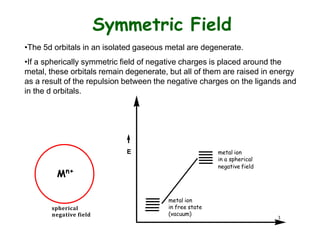
•The 5d orbitals in an isolated gaseous metal are degenerate.
•If a spherically symmetric field of negative charges is placed around the
metal, these orbitals remain degenerate, but all of them are raised in energy
as a result of the repulsion between the negative charges on the ligands and
in the d orbitals.
4
Octahedral Field
E
Mn+ t2g
eg
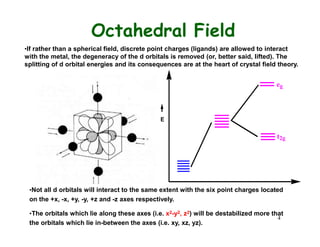
•Not all d orbitals will interact to the same extent with the six point charges located
on the +x, -x, +y, -y, +z and -z axes respectively.
•The orbitals which lie along these axes (i.e. x2-y2, z2) will be destabilized more that
the orbitals which lie in-between the axes (i.e. xy, xz, yz).
•If rather than a spherical field, discrete point charges (ligands) are allowed to interact
with the metal, the degeneracy of the d orbitals is removed (or, better said, lifted). The
splitting of d orbital energies and its consequences are at the heart of crystal field theory.
5
CFT-Octahedral Complexes
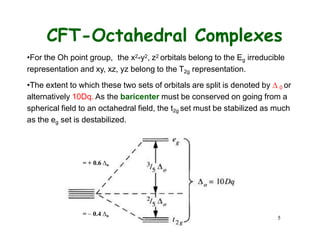
•For the Oh point group, the x2-y2, z2 orbitals belong to the Eg irreducible
representation and xy, xz, yz belong to the T2g representation.
•The extent to which these two sets of orbitals are split is denoted by  0 or
alternatively 10Dq. As the baricenter must be conserved on going from a
spherical field to an octahedral field, the t2g set must be stabilized as much
as the eg set is destabilized.
= + 0.6 o
=  0.4 o
CFT-Octahedral Complexes
CFT-Tetrahedral Complexes
16
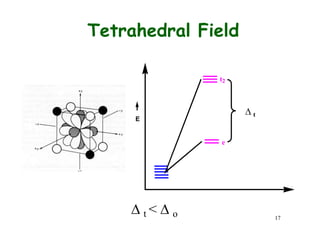
Tetrahedral Field- Considerations
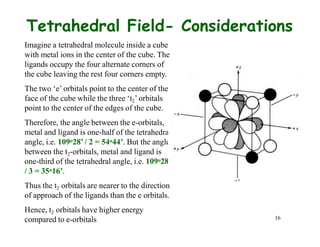
Imagine a tetrahedral molecule inside a cube
with metal ions in the center of the cube. The
ligands occupy the four alternate corners of
the cube leaving the rest four corners empty.
The two ‘e’ orbitals point to the center of the
face of the cube while the three ‘t2’ orbitals
point to the center of the edges of the cube.
Therefore, the angle between the e-orbitals,
metal and ligand is one-half of the tetrahedral
angle, i.e. 109o28’ / 2 = 54o44’. But the angle
between the t2-orbitals, metal and ligand is
one-third of the tetrahedral angle, i.e. 109o28’
/ 3 = 35o16’.
Thus the t2 orbitals are nearer to the direction
of approach of the ligands than the e orbitals.
Hence, t2 orbitals have higher energy
compared to e-orbitals
17
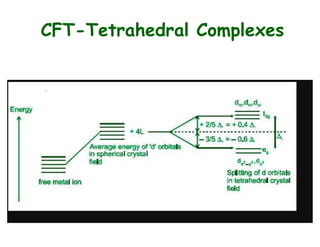
Tetrahedral Field
E
Mn+
t2
e
 t
 t <  o
•Nature of the ligands
•The charge on the metal ion
•Whether the metal is a 3d, 4d, or 5d element
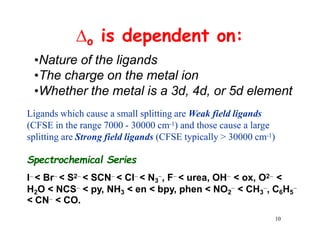
Ligands which cause a small splitting are Weak field ligands
(CFSE in the range 7000 - 30000 cm-1) and those cause a large
splitting are Strong field ligands (CFSE typically > 30000 cm-1)
Spectrochemical Series
I < Br < S2 < SCN < Cl < N3
, F < urea, OH < ox, O2 <
H2O < NCS < py, NH3 < en < bpy, phen < NO2
 < CH3
, C6H5

< CN < CO.
10
o is dependent on:
Illustration of CFSE
[Ti(H2O)6]3+ : a d1 complex and the e occupies the lowest energy
orbital, i.e. one of the three degenerate t2g orbitals. The purple
colour is a result of the absorption of light which results in the
promotion of this t2g electron into the eg level. t2g eg –> t2g eg
1 0 0 1
The UV-Vis absorption
spectrum reveals that this
transition occurs with a
maximum at 20300 cm-1 which
corresponds to o 243 kJ/mol.
(1000 cm-1 = 11.96 kJ/mol or
2.86 kcal/mol or
0.124 eV.)
6
Typical 0 values are of the same order of magnitude as the energy of a chemical bond.
7
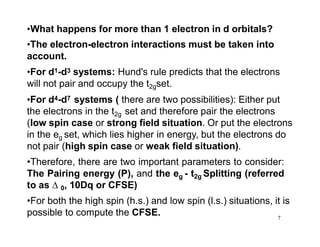
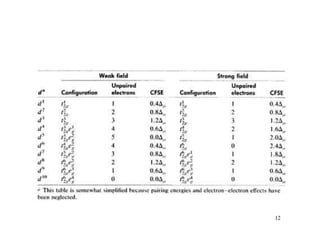
•What happens for more than 1 electron in d orbitals?
•The electron-electron interactions must be taken into
account.
•For d1-d3 systems: Hund's rule predicts that the electrons
will not pair and occupy the t2gset.
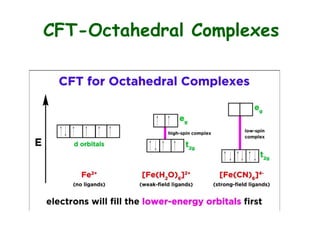
•For d4-d7 systems ( there are two possibilities): Either put
the electrons in the t2g set and therefore pair the electrons
(low spin case or strong field situation. Or put the electrons
in the eg set, which lies higher in energy, but the electrons do
not pair (high spin case or weak field situation).
•Therefore, there are two important parameters to consider:
The Pairing energy (P), and the eg - t2g Splitting (referred
to as  0, 10Dq or CFSE)
•For both the high spin (h.s.) and low spin (l.s.) situations, it is
possible to compute the CFSE.
8
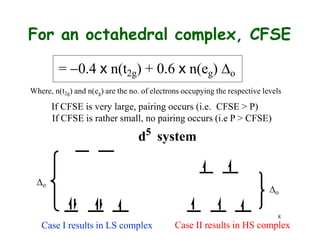
Case II results in HS complex
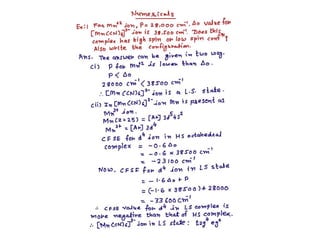
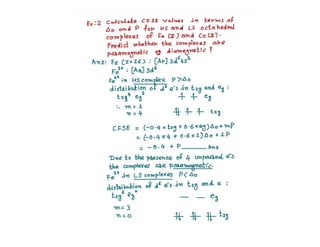
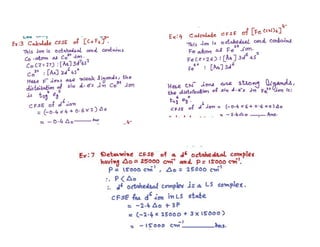
For an octahedral complex, CFSE
= 0.4 x n(t2g) + 0.6 x n(eg) o
Where, n(t2g) and n(eg) are the no. of electrons occupying the respective levels
If CFSE is very large, pairing occurs (i.e. CFSE > P)
If CFSE is rather small, no pairing occurs (i.e P > CFSE)
d5
system
Case I results in LS complex
o
o
9
CFSE vs Pairing Energy
Complex Config.
d6
d6
[Fe(OH2)6]2+
[Fe(CN)6]4
[CoF6]3-
[Co(NH3)6]3-
d7
d7
o, cm 1 P, cm1 spin-state
10,400 17,600 high-spin
32,850 17,600 low-spin
13,000 21,000 high-spin
23,000 21,000 low-spin
11
[CrCl6]3- 13640 cm-1 163 kJ/mol
[Cr(H2O)6]3+ 17830 213
[Cr(NH3)6]3+ 21680 314
[Cr(CN)6]3- 26280 314
[Co(NH3)6]3+
[Rh(NH3)6]3+
[Ir(NH3)6]3+
24800 cm-1
34000
41000
163 kJ/mol
213
314
12
d2 d3 d4 d5 d6 d7 d8 d9 d10
13
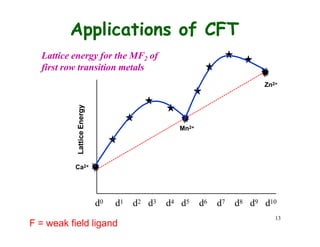
Applications of CFT
Lattice
Energy
Lattice energy for the MF2 of
first row transition metals
d0 d1
F = weak field ligand
Ca2+
Mn2+
Zn2+
14
Applications of CFT
Hydration Enthalpy. Let
us look at the variation of
enthalpy of M2+ ions
M2+(g) + 6 H2O(l) =
[M(O2H)6]2+(aq)
Ca2+, Mn2+, and Zn2+ have
do, d5, and d10, hence
CFSE is 0. Other metal
ions deviate from the
expected line due to extra
CFSE
H2O = weak field ligand
5
1
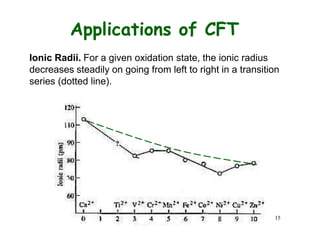
Applications of CFT
Ionic Radii. For a given oxidation state, the ionic radius
decreases steadily on going from left to right in a transition
series (dotted line).
18
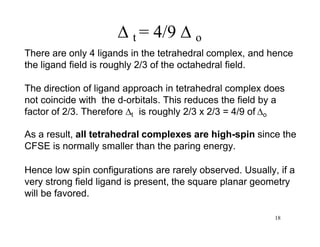
 t = 4/9  o
There are only 4 ligands in the tetrahedral complex, and hence
the ligand field is roughly 2/3 of the octahedral field.
The direction of ligand approach in tetrahedral complex does
not coincide with the d-orbitals. This reduces the field by a
factor of 2/3. Therefore t is roughly 2/3 x 2/3 = 4/9 of o
As a result, all tetrahedral complexes are high-spin since the
CFSE is normally smaller than the paring energy.
Hence low spin configurations are rarely observed. Usually, if a
very strong field ligand is present, the square planar geometry
will be favored.
22
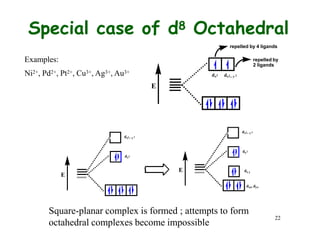
Special case of d8 Octahedral
Examples:
Ni2+, Pd2+, Pt2+, Cu3+, Ag3+, Au3+
E
dz2 dx2
y 2
repelled by 4 ligands
repelled by
2 ligands
E
dz2
dx2
 y 2
E
dz2
dx2
 y2
dx y
dxz, dyz
Square-planar complex is formed ; attempts to form
octahedral complexes become impossible
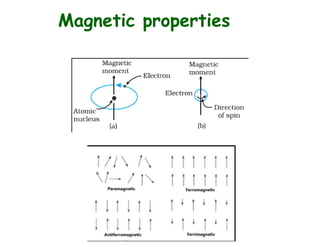
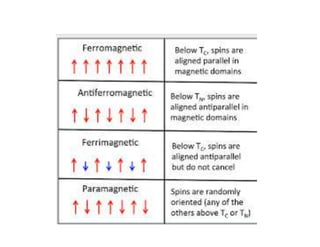
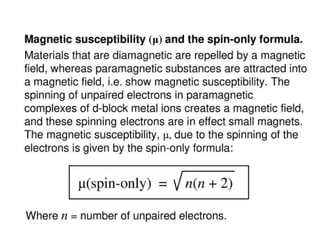
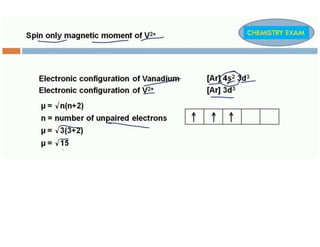
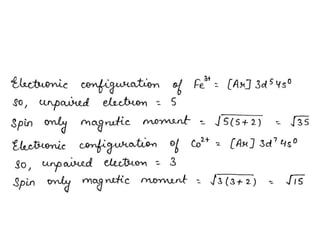
Magnetic properties
CFT 1.pptx
CFT 1.pptx
CFT 1.pptx
CFT 1.pptx

CFT 1.pptx

  • 1.
    1 Crystal Field Theory (Text: JD Lee; pp.204-222) •This theory (CFT) largely replaced VB Theory for interpreting the chemistry of coordination compounds. •It was proposed by the physicist Hans Bethe in 1929. •Subsequent modifications were proposed by J. H. Van Vleck in 1935 to allow for some covalency in the interactions. These modifications are often referred to as Ligand Field Theory. •For a review on the evolution of bonding models see: C. J. Ballhausen, J. Chem. Ed. 1979 56 194-197, 215-218, 357-361.
  • 2.
    2 CFT-Assumptions •The interactions betweenthe metal ion and the ligands are purely electrostatic (ionic). •The ligands are regarded as point charges •If the ligand is negatively charged: ion-ion interaction. If the ligand is neutral : ion-dipole interaction •The electrons on the metal are under repulsive from those on the ligands •The electrons on metal occupy those d-orbitals farthest away from the direction of approach of ligands
  • 3.
    3 Symmetric Field metal ion infree state (vacuum) E Mn+ metal ion in a spherical negative field spherical negative field •The 5d orbitals in an isolated gaseous metal are degenerate. •If a spherically symmetric field of negative charges is placed around the metal, these orbitals remain degenerate, but all of them are raised in energy as a result of the repulsion between the negative charges on the ligands and in the d orbitals.
  • 4.
    4 Octahedral Field E Mn+ t2g eg •Notall d orbitals will interact to the same extent with the six point charges located on the +x, -x, +y, -y, +z and -z axes respectively. •The orbitals which lie along these axes (i.e. x2-y2, z2) will be destabilized more that the orbitals which lie in-between the axes (i.e. xy, xz, yz). •If rather than a spherical field, discrete point charges (ligands) are allowed to interact with the metal, the degeneracy of the d orbitals is removed (or, better said, lifted). The splitting of d orbital energies and its consequences are at the heart of crystal field theory.
  • 5.
    5 CFT-Octahedral Complexes •For theOh point group, the x2-y2, z2 orbitals belong to the Eg irreducible representation and xy, xz, yz belong to the T2g representation. •The extent to which these two sets of orbitals are split is denoted by  0 or alternatively 10Dq. As the baricenter must be conserved on going from a spherical field to an octahedral field, the t2g set must be stabilized as much as the eg set is destabilized. = + 0.6 o =  0.4 o
  • 6.
  • 7.
  • 8.
    16 Tetrahedral Field- Considerations Imaginea tetrahedral molecule inside a cube with metal ions in the center of the cube. The ligands occupy the four alternate corners of the cube leaving the rest four corners empty. The two ‘e’ orbitals point to the center of the face of the cube while the three ‘t2’ orbitals point to the center of the edges of the cube. Therefore, the angle between the e-orbitals, metal and ligand is one-half of the tetrahedral angle, i.e. 109o28’ / 2 = 54o44’. But the angle between the t2-orbitals, metal and ligand is one-third of the tetrahedral angle, i.e. 109o28’ / 3 = 35o16’. Thus the t2 orbitals are nearer to the direction of approach of the ligands than the e orbitals. Hence, t2 orbitals have higher energy compared to e-orbitals
  • 9.
  • 10.
    •Nature of theligands •The charge on the metal ion •Whether the metal is a 3d, 4d, or 5d element Ligands which cause a small splitting are Weak field ligands (CFSE in the range 7000 - 30000 cm-1) and those cause a large splitting are Strong field ligands (CFSE typically > 30000 cm-1) Spectrochemical Series I < Br < S2 < SCN < Cl < N3 , F < urea, OH < ox, O2 < H2O < NCS < py, NH3 < en < bpy, phen < NO2  < CH3 , C6H5  < CN < CO. 10 o is dependent on:
  • 11.
    Illustration of CFSE [Ti(H2O)6]3+: a d1 complex and the e occupies the lowest energy orbital, i.e. one of the three degenerate t2g orbitals. The purple colour is a result of the absorption of light which results in the promotion of this t2g electron into the eg level. t2g eg –> t2g eg 1 0 0 1 The UV-Vis absorption spectrum reveals that this transition occurs with a maximum at 20300 cm-1 which corresponds to o 243 kJ/mol. (1000 cm-1 = 11.96 kJ/mol or 2.86 kcal/mol or 0.124 eV.) 6 Typical 0 values are of the same order of magnitude as the energy of a chemical bond.
  • 12.
    7 •What happens formore than 1 electron in d orbitals? •The electron-electron interactions must be taken into account. •For d1-d3 systems: Hund's rule predicts that the electrons will not pair and occupy the t2gset. •For d4-d7 systems ( there are two possibilities): Either put the electrons in the t2g set and therefore pair the electrons (low spin case or strong field situation. Or put the electrons in the eg set, which lies higher in energy, but the electrons do not pair (high spin case or weak field situation). •Therefore, there are two important parameters to consider: The Pairing energy (P), and the eg - t2g Splitting (referred to as  0, 10Dq or CFSE) •For both the high spin (h.s.) and low spin (l.s.) situations, it is possible to compute the CFSE.
  • 13.
    8 Case II resultsin HS complex For an octahedral complex, CFSE = 0.4 x n(t2g) + 0.6 x n(eg) o Where, n(t2g) and n(eg) are the no. of electrons occupying the respective levels If CFSE is very large, pairing occurs (i.e. CFSE > P) If CFSE is rather small, no pairing occurs (i.e P > CFSE) d5 system Case I results in LS complex o o
  • 14.
    9 CFSE vs PairingEnergy Complex Config. d6 d6 [Fe(OH2)6]2+ [Fe(CN)6]4 [CoF6]3- [Co(NH3)6]3- d7 d7 o, cm 1 P, cm1 spin-state 10,400 17,600 high-spin 32,850 17,600 low-spin 13,000 21,000 high-spin 23,000 21,000 low-spin
  • 15.
    11 [CrCl6]3- 13640 cm-1163 kJ/mol [Cr(H2O)6]3+ 17830 213 [Cr(NH3)6]3+ 21680 314 [Cr(CN)6]3- 26280 314 [Co(NH3)6]3+ [Rh(NH3)6]3+ [Ir(NH3)6]3+ 24800 cm-1 34000 41000 163 kJ/mol 213 314
  • 16.
  • 17.
    d2 d3 d4d5 d6 d7 d8 d9 d10 13 Applications of CFT Lattice Energy Lattice energy for the MF2 of first row transition metals d0 d1 F = weak field ligand Ca2+ Mn2+ Zn2+
  • 18.
    14 Applications of CFT HydrationEnthalpy. Let us look at the variation of enthalpy of M2+ ions M2+(g) + 6 H2O(l) = [M(O2H)6]2+(aq) Ca2+, Mn2+, and Zn2+ have do, d5, and d10, hence CFSE is 0. Other metal ions deviate from the expected line due to extra CFSE H2O = weak field ligand
  • 19.
    5 1 Applications of CFT IonicRadii. For a given oxidation state, the ionic radius decreases steadily on going from left to right in a transition series (dotted line).
  • 20.
    18  t =4/9  o There are only 4 ligands in the tetrahedral complex, and hence the ligand field is roughly 2/3 of the octahedral field. The direction of ligand approach in tetrahedral complex does not coincide with the d-orbitals. This reduces the field by a factor of 2/3. Therefore t is roughly 2/3 x 2/3 = 4/9 of o As a result, all tetrahedral complexes are high-spin since the CFSE is normally smaller than the paring energy. Hence low spin configurations are rarely observed. Usually, if a very strong field ligand is present, the square planar geometry will be favored.
  • 21.
    22 Special case ofd8 Octahedral Examples: Ni2+, Pd2+, Pt2+, Cu3+, Ag3+, Au3+ E dz2 dx2 y 2 repelled by 4 ligands repelled by 2 ligands E dz2 dx2  y 2 E dz2 dx2  y2 dx y dxz, dyz Square-planar complex is formed ; attempts to form octahedral complexes become impossible
  • 25.