CY 101: CRYSTALFIELD THEORY
Course Instructor: Dr. SAMYA BANERJEE
2.
Books to read
Inorganic Chemistry: Principles of Structure and Reactivity,
Pearson, by J. E. Huheey, E. A. Keiter, R. L. Keiter and O. K. Medhi
Concise Inorganic Chemistry: Fifth Edition by J.D. Lee
Shriver and Atkins' Inorganic Chemistry by P. Atkins, C. H.
Langford, D. F Shriver
Introduction to Coordination Chemistry by G. A. Lawrance
Coordination chemistry, by J. R. Gispert
Double Salt andCoordination Complexes
For example: KCl + MgCl2 + 6H2O KCI·MgCl2·6H2O [Carnallite;
KMgCl3·6(H2O)]
K2SO4 + Al2(SO4)3 + 24H2O K2SO4·Al2(SO4)3·24H2O (Potash-alum)
CuSO4 + 4NH3 + H2O CuSO4·4NH3·H2O (tetrammine copper(II)
sulphate monohydrate)
Fe(CN)2 + 4KCN Fe(CN)2·4KCN (potassium ferrocyanide)
Addition compounds are of two types:
I. Those which dissociate (lose their identity) in solution (Double
salts)
2. Those which retain their identity in solution (Complexes)
8.
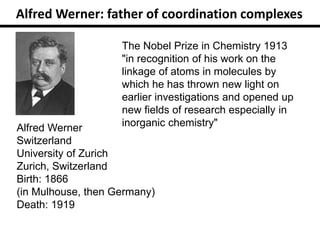
Alfred Werner
Switzerland
University ofZurich
Zurich, Switzerland
Birth: 1866
(in Mulhouse, then Germany)
Death: 1919
The Nobel Prize in Chemistry 1913
"in recognition of his work on the
linkage of atoms in molecules by
which he has thrown new light on
earlier investigations and opened up
new fields of research especially in
inorganic chemistry"
Alfred Werner: father of coordination complexes
9.
9
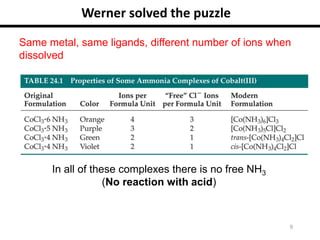
In all ofthese complexes there is no free NH3
(No reaction with acid)
Werner solved the puzzle
Same metal, same ligands, different number of ions when
dissolved
10.
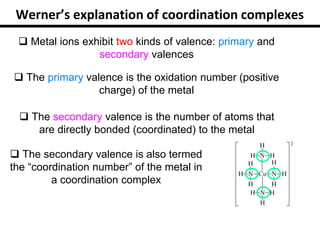
Werner’s explanation ofcoordination complexes
Metal ions exhibit two kinds of valence: primary and
secondary valences
The primary valence is the oxidation number (positive
charge) of the metal
The secondary valence is the number of atoms that
are directly bonded (coordinated) to the metal
The secondary valence is also termed
the “coordination number” of the metal in
a coordination complex
11.
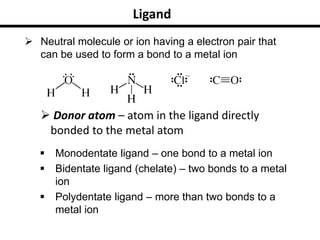
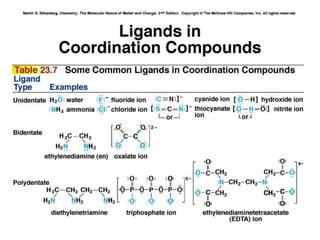
Ligand
Neutral moleculeor ion having a electron pair that
can be used to form a bond to a metal ion
Monodentate ligand – one bond to a metal ion
Bidentate ligand (chelate) – two bonds to a metal
ion
Polydentate ligand – more than two bonds to a
metal ion
Donor atom – atom in the ligand directly
bonded to the metal atom
13.
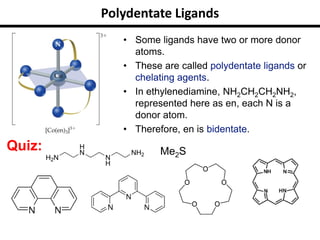
Polydentate Ligands
• Someligands have two or more donor
atoms.
• These are called polydentate ligands or
chelating agents.
• In ethylenediamine, NH2CH2CH2NH2,
represented here as en, each N is a
donor atom.
• Therefore, en is bidentate.
Quiz: Me2S
14.
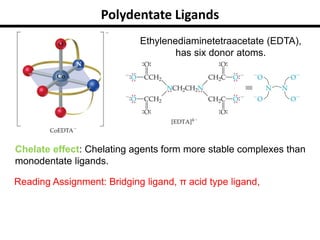
Ethylenediaminetetraacetate (EDTA),
has sixdonor atoms.
Polydentate Ligands
Chelate effect: Chelating agents form more stable complexes than
monodentate ligands.
Reading Assignment: Bridging ligand, π acid type ligand,
15.
Bonding in MetalComplexes
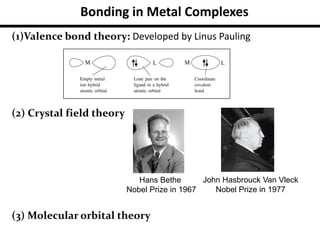
(1)Valence bond theory: Developed by Linus Pauling
(2) Crystal field theory
(3) Molecular orbital theory
Hans Bethe
Nobel Prize in 1967
John Hasbrouck Van Vleck
Nobel Prize in 1977
16.
1. Magnetism
2. Color
3.Distorted geometry of octahedral complexes
Drawbacks of Valence bond theory
17.
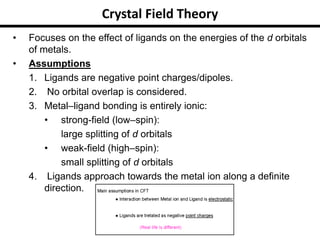
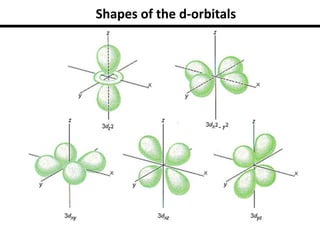
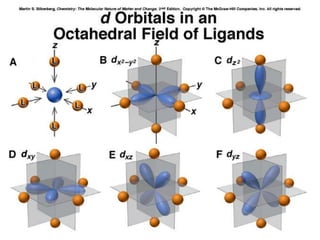
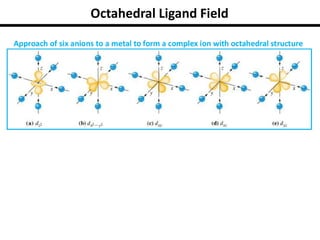
• Focuses onthe effect of ligands on the energies of the d orbitals
of metals.
• Assumptions
1. Ligands are negative point charges/dipoles.
2. No orbital overlap is considered.
3. Metal–ligand bonding is entirely ionic:
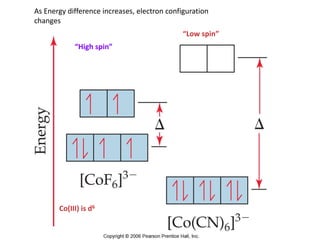
• strong-field (low–spin):
large splitting of d orbitals
• weak-field (high–spin):
small splitting of d orbitals
4. Ligands approach towards the metal ion along a definite
direction.
Crystal Field Theory
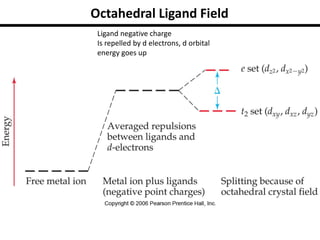
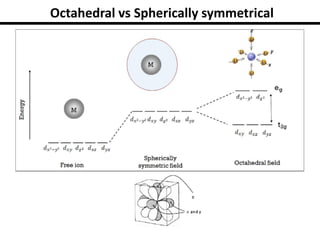
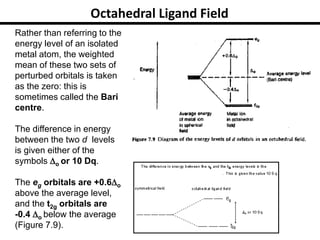
Rather than referringto the
energy level of an isolated
metal atom, the weighted
mean of these two sets of
perturbed orbitals is taken
as the zero: this is
sometimes called the Bari
centre.
The difference in energy
between the two d levels
is given either of the
symbols o or 10 Dq.
The eg orbitals are +0.6o
above the average level,
and the t2g orbitals are
-0.4 o below the average
(Figure 7.9).
Octahedral Ligand Field
25.
Magnitude of o
Thesize of the energy gap o between the t2g and eg levels
can be measured easily by recording the UV-visible spectrum
of the complex.
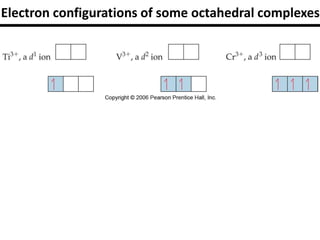
Consider a complex like [Ti(H2O)6]3+. The Ti3+ ion has one d
electron. In the complex this will occupy the orbital with the
lowest energy, that is one of the t2g orbitals.
The complex absorbs light
of the correct wavelength
(energy) to promote the
electron from the t2g level to
the eg level.
26.
Magnitude of o
Theelectronic spectrum for [Ti(H2O)]3+ is given in Figure 7 .11. The steep
part of the curve from 27,000 to 30,000cm-1 (in the UV region) is due to
charge transfer. The d-d transition is the single broad peak with a
maximum at 20,300cm-1 . Since 1 kJmol-1 = 83.7cm-1, the value of o for
[Ti(H2O)]3+ is 20,300/83.7 =
243kJ mol-1 . This is much the same
as the energy of many normal
single bonds.
Solutions containing the hydrated Ti3+
ion are reddish violet coloured.
This is because yellow and green light
are absorbed to excite the electron.
Thus the transmitted light is the
complementary colour red-violet.
27.
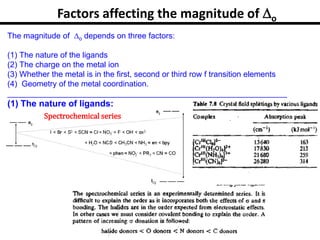
Factors affecting themagnitude of o
The magnitude of o depends on three factors:
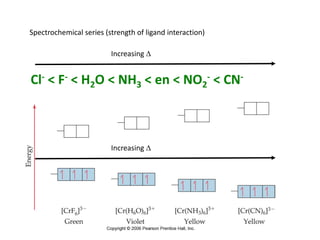
(1) The nature of the ligands
(2) The charge on the metal ion
(3) Whether the metal is in the first, second or third row f transition elements
(4) Geometry of the metal coordination.
_______________________________________________________________
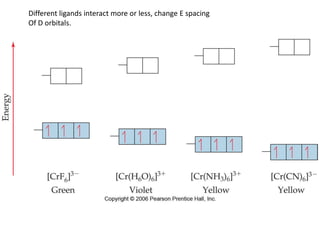
(1) The nature of ligands:
Spectrochemical series
28.
(2) The chargeon the metal ion
(3) Whether the metal is in the first, second or third row f
transition elements
o for [Cr(H2O)6]3+ and [Mo(H2O)6]3+ are 17,400 cm-1 and 26,110 cm-1, respectively.
Factors affecting the magnitude of o
29.
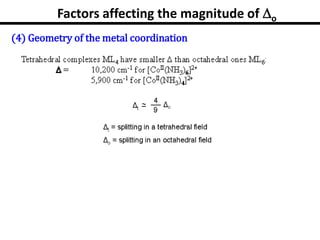
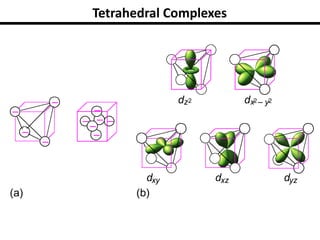
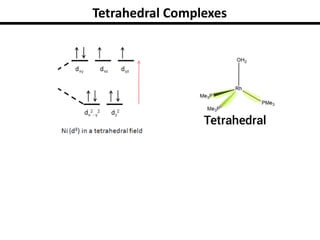
(4) Geometry ofthe metal coordination
Factors affecting the magnitude of o
30.
Crystal Field StabilizationEnergy (CFSE)
Because of the crystal field splitting of d orbitals, the singled electron in
[Ti(H2O)]3+ occupies an energy level 2/5 o below the average energy of
the d orbitals. As a result the complex is more stable. The crystal field
stabilization energy (CFSE) is in this case 2/5 x 243 = 97 kJ mol-1
31.
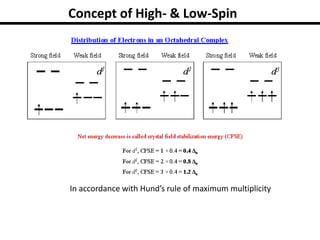
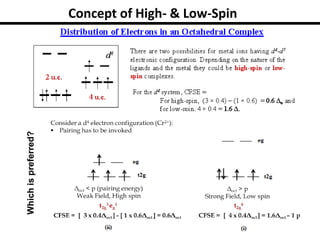
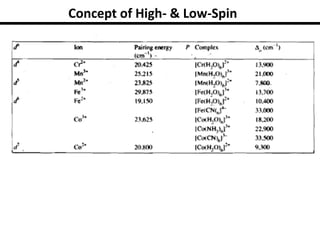
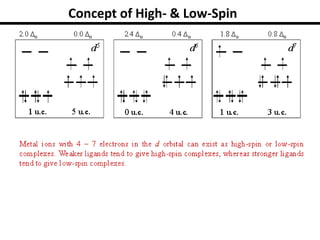
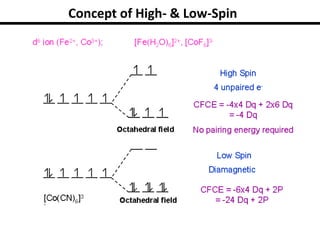
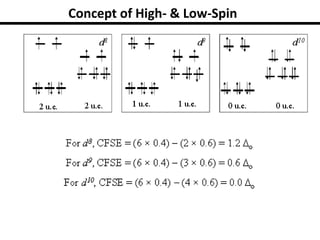
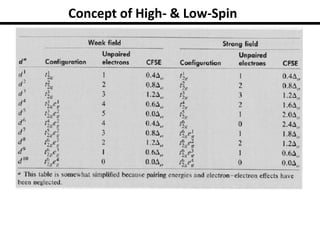
Concept of High-& Low-Spin
In accordance with Hund’s rule of maximum multiplicity
20_461
E
Free metal ionComplex
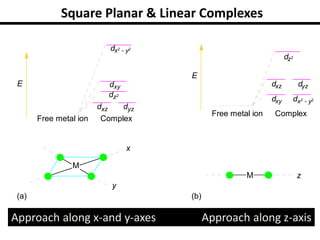
dz2
dxy
dxz dyz
dx2 - y2
M z
(b)
Free metal ion Complex
dx2 - y2
dxy
dz2
dxz dyz
M
(a)
x
y
E
Square Planar & Linear Complexes
Approach along x-and y-axes Approach along z-axis

![Double Salt and Coordination Complexes
For example: KCl + MgCl2 + 6H2O KCI·MgCl2·6H2O [Carnallite;
KMgCl3·6(H2O)]
K2SO4 + Al2(SO4)3 + 24H2O K2SO4·Al2(SO4)3·24H2O (Potash-alum)
CuSO4 + 4NH3 + H2O CuSO4·4NH3·H2O (tetrammine copper(II)
sulphate monohydrate)
Fe(CN)2 + 4KCN Fe(CN)2·4KCN (potassium ferrocyanide)
Addition compounds are of two types:
I. Those which dissociate (lose their identity) in solution (Double
salts)
2. Those which retain their identity in solution (Complexes)](https://image.slidesharecdn.com/coordinationchemistrypart-i-notes-250801152414-663812b9/85/Coordination-Chemistry-Part-I-Notes-pdf-7-320.jpg)
![Magnitude of o
The size of the energy gap o between the t2g and eg levels
can be measured easily by recording the UV-visible spectrum
of the complex.
Consider a complex like [Ti(H2O)6]3+. The Ti3+ ion has one d
electron. In the complex this will occupy the orbital with the
lowest energy, that is one of the t2g orbitals.
The complex absorbs light
of the correct wavelength
(energy) to promote the
electron from the t2g level to
the eg level.](https://image.slidesharecdn.com/coordinationchemistrypart-i-notes-250801152414-663812b9/85/Coordination-Chemistry-Part-I-Notes-pdf-25-320.jpg)
![Magnitude of o
The electronic spectrum for [Ti(H2O)]3+ is given in Figure 7 .11. The steep
part of the curve from 27,000 to 30,000cm-1 (in the UV region) is due to
charge transfer. The d-d transition is the single broad peak with a
maximum at 20,300cm-1 . Since 1 kJmol-1 = 83.7cm-1, the value of o for
[Ti(H2O)]3+ is 20,300/83.7 =
243kJ mol-1 . This is much the same
as the energy of many normal
single bonds.
Solutions containing the hydrated Ti3+
ion are reddish violet coloured.
This is because yellow and green light
are absorbed to excite the electron.
Thus the transmitted light is the
complementary colour red-violet.](https://image.slidesharecdn.com/coordinationchemistrypart-i-notes-250801152414-663812b9/85/Coordination-Chemistry-Part-I-Notes-pdf-26-320.jpg)
![(2) The charge on the metal ion
(3) Whether the metal is in the first, second or third row f
transition elements
o for [Cr(H2O)6]3+ and [Mo(H2O)6]3+ are 17,400 cm-1 and 26,110 cm-1, respectively.
Factors affecting the magnitude of o](https://image.slidesharecdn.com/coordinationchemistrypart-i-notes-250801152414-663812b9/85/Coordination-Chemistry-Part-I-Notes-pdf-28-320.jpg)
![Crystal Field Stabilization Energy (CFSE)
Because of the crystal field splitting of d orbitals, the singled electron in
[Ti(H2O)]3+ occupies an energy level 2/5 o below the average energy of
the d orbitals. As a result the complex is more stable. The crystal field
stabilization energy (CFSE) is in this case 2/5 x 243 = 97 kJ mol-1](https://image.slidesharecdn.com/coordinationchemistrypart-i-notes-250801152414-663812b9/85/Coordination-Chemistry-Part-I-Notes-pdf-30-320.jpg)


![Theory of coordination_compounds[1]](https://cdn.slidesharecdn.com/ss_thumbnails/theoryofcoordinationcompounds1-171130080838-thumbnail.jpg?width=640&height=640&fit=bounds)


![Polymer [ बहुलक ] Chemistry Notes PDF - Irfanullah Mehar - JJ Sir Chemistry.pdf](https://cdn.slidesharecdn.com/ss_thumbnails/polymerchemistrynotespdf-irfanullahmehar-jjsirchemistry-260210172118-3f9b37f7-thumbnail.jpg?width=640&height=640&fit=bounds)


