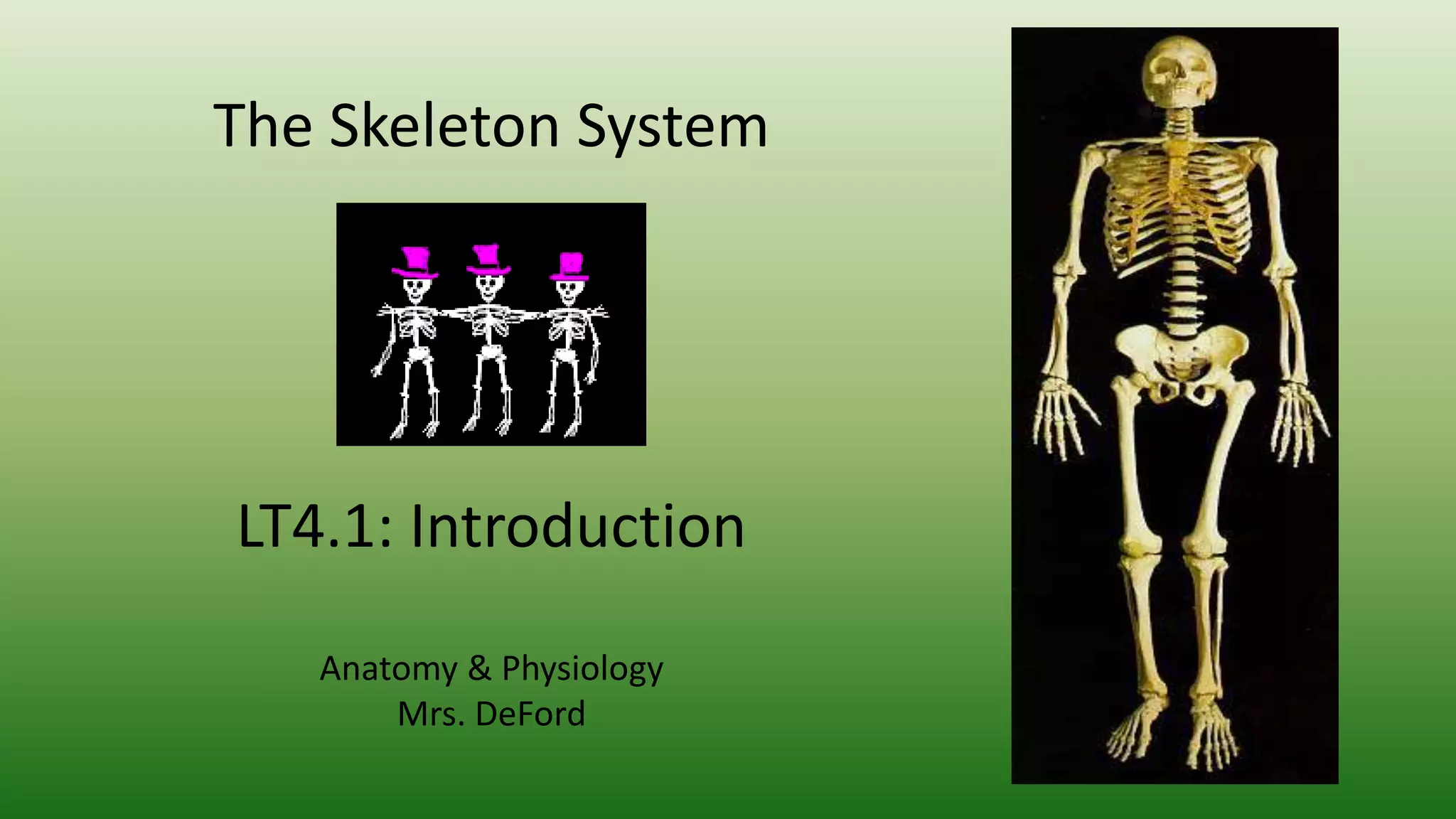
The Skeleton System
LT4.1: Introduction
Anatomy & Physiology
Mrs. DeFord
Skeletal System Functions
1. Support
• Organs and tissues of the body are held in place by the skeleton.
• The bones of the legs, pelvic girdle, and vertebral column support
the weight of the erect body.
• The mandible (jawbone) supports the teeth.
2. Protection
• Provides a rigid surface for protection of vital organs:
– The bones of the skull protect the brain.
– Ribs and sternum (breastbone) protect the lungs and heart.
– Vertebrae protect the spinal cord.
Skeletal System Functions
3. Movement
• Bones provide a base for muscle attachments.
• Skeletal muscles use the bones as levers to move the body.
4. Reservoir for Minerals and Adipose Tissue
• 99% of the body’s calcium is stored in bone.
• 85% of the body’s phosphorous is stored in bone.
• Adipose tissue is found in the marrow of certain bones.
5. Hematopoiesis
• a.k.a. blood cell formation
• All blood cells are made in the marrow of certain bones.
– 2.6 million red blood cells are produced each second.
Skeletal System Introduction
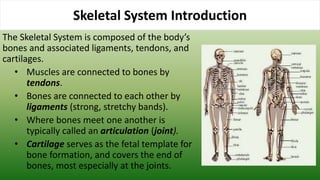
The Skeletal System is composed of the body’s
bones and associated ligaments, tendons, and
cartilages.
• Muscles are connected to bones by
tendons.
• Bones are connected to each other by
ligaments (strong, stretchy bands).
• Where bones meet one another is
typically called an articulation (joint).
• Cartilage serves as the fetal template for
bone formation, and covers the end of
bones, most especially at the joints.
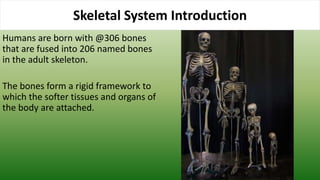
Humans are born with @306 bones
that are fused into 206 named bones
in the adult skeleton.
The bones form a rigid framework to
which the softer tissues and organs of
the body are attached.
Skeletal System Introduction
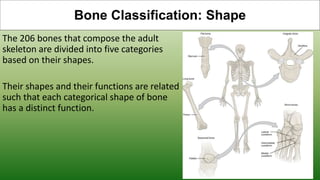
The 206 bones that compose the adult
skeleton are divided into five categories
based on their shapes.
Their shapes and their functions are related
such that each categorical shape of bone
has a distinct function.
Bone Classification: Shape
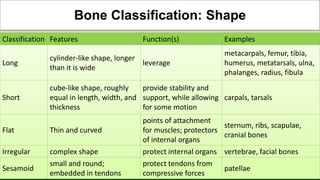
Classification Features Function(s) Examples
Long
cylinder-like shape, longer
than it is wide
leverage
metacarpals, femur, tibia,
humerus, metatarsals, ulna,
phalanges, radius, fibula
Short
cube-like shape, roughly
equal in length, width, and
thickness
provide stability and
support, while allowing
for some motion
carpals, tarsals
Flat Thin and curved
points of attachment
for muscles; protectors
of internal organs
sternum, ribs, scapulae,
cranial bones
Irregular complex shape protect internal organs vertebrae, facial bones
Sesamoid
small and round;
embedded in tendons
protect tendons from
compressive forces
patellae
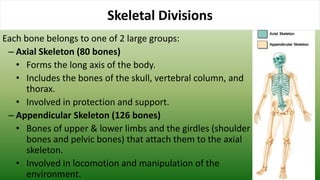
Each bone belongs to one of 2 large groups:
– Axial Skeleton (80 bones)
• Forms the long axis of the body.
• Includes the bones of the skull, vertebral column, and
thorax.
• Involved in protection and support.
– Appendicular Skeleton (126 bones)
• Bones of upper & lower limbs and the girdles (shoulder
bones and pelvic bones) that attach them to the axial
skeleton.
• Involved in locomotion and manipulation of the
environment.
Skeletal Divisions
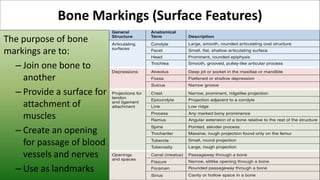
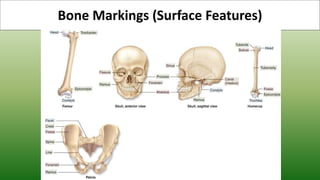
The purpose of bone
markings are to:
– Join one bone to
another
– Provide a surface for
attachment of
muscles
– Create an opening
for passage of blood
vessels and nerves
– Use as landmarks
Bone Markings (Surface Features)

LT4.1 Introduction to the Skeletal System

  • 1.
    The Skeleton System LT4.1:Introduction Anatomy & Physiology Mrs. DeFord
  • 2.
    Skeletal System Functions 1.Support • Organs and tissues of the body are held in place by the skeleton. • The bones of the legs, pelvic girdle, and vertebral column support the weight of the erect body. • The mandible (jawbone) supports the teeth. 2. Protection • Provides a rigid surface for protection of vital organs: – The bones of the skull protect the brain. – Ribs and sternum (breastbone) protect the lungs and heart. – Vertebrae protect the spinal cord.
  • 3.
    Skeletal System Functions 3.Movement • Bones provide a base for muscle attachments. • Skeletal muscles use the bones as levers to move the body. 4. Reservoir for Minerals and Adipose Tissue • 99% of the body’s calcium is stored in bone. • 85% of the body’s phosphorous is stored in bone. • Adipose tissue is found in the marrow of certain bones. 5. Hematopoiesis • a.k.a. blood cell formation • All blood cells are made in the marrow of certain bones. – 2.6 million red blood cells are produced each second.
  • 4.
    Skeletal System Introduction TheSkeletal System is composed of the body’s bones and associated ligaments, tendons, and cartilages. • Muscles are connected to bones by tendons. • Bones are connected to each other by ligaments (strong, stretchy bands). • Where bones meet one another is typically called an articulation (joint). • Cartilage serves as the fetal template for bone formation, and covers the end of bones, most especially at the joints.
  • 5.
    Humans are bornwith @306 bones that are fused into 206 named bones in the adult skeleton. The bones form a rigid framework to which the softer tissues and organs of the body are attached. Skeletal System Introduction
  • 6.
    The 206 bonesthat compose the adult skeleton are divided into five categories based on their shapes. Their shapes and their functions are related such that each categorical shape of bone has a distinct function. Bone Classification: Shape
  • 8.
    Bone Classification: Shape ClassificationFeatures Function(s) Examples Long cylinder-like shape, longer than it is wide leverage metacarpals, femur, tibia, humerus, metatarsals, ulna, phalanges, radius, fibula Short cube-like shape, roughly equal in length, width, and thickness provide stability and support, while allowing for some motion carpals, tarsals Flat Thin and curved points of attachment for muscles; protectors of internal organs sternum, ribs, scapulae, cranial bones Irregular complex shape protect internal organs vertebrae, facial bones Sesamoid small and round; embedded in tendons protect tendons from compressive forces patellae
  • 9.
    Each bone belongsto one of 2 large groups: – Axial Skeleton (80 bones) • Forms the long axis of the body. • Includes the bones of the skull, vertebral column, and thorax. • Involved in protection and support. – Appendicular Skeleton (126 bones) • Bones of upper & lower limbs and the girdles (shoulder bones and pelvic bones) that attach them to the axial skeleton. • Involved in locomotion and manipulation of the environment. Skeletal Divisions
  • 10.
    The purpose ofbone markings are to: – Join one bone to another – Provide a surface for attachment of muscles – Create an opening for passage of blood vessels and nerves – Use as landmarks Bone Markings (Surface Features)
  • 11.

Editor's Notes

  • #2 What would happen if humans didn't have bones? You'd be floppy like a beanbag. Could you stand up? Forget it. Could you walk? No way. Without bones you'd be just a puddle of skin and guts on the floor.
  • #4 4. Bones serve as a storage area for minerals such as calcium and phosphorus. When an excess is present in the blood, buildup will occur within the bones. When the supply of these minerals within the blood is low, it will be withdrawn from the bones to replenish the supply. 5. 2.6 million red blood cells are produced each second to replace those worn out and destroyed by the liver.
  • #5 (cartilage-coated bone end – kept apart by a fluid)
  • #10 Support – carrying other body parts