THE DIGESTIVE SYSTEM
!"#"$%&'(*
STATION 13: homeostatic imbalance ! ulcers
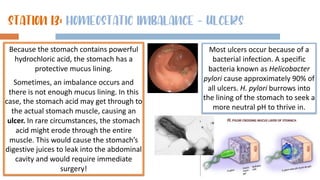
Because the stomach contains powerful
hydrochloric acid, the stomach has a
protective mucus lining.
Sometimes, an imbalance occurs and
there is not enough mucus lining. In this
case, the stomach acid may get through to
the actual stomach muscle, causing an
ulcer. In rare circumstances, the stomach
acid might erode through the entire
muscle. This would cause the stomach’s
digestive juices to leak into the abdominal
cavity and would require immediate
surgery!
Most ulcers occur because of a
bacterial infection. A specific
bacteria known as Helicobacter
pylori cause approximately 90% of
all ulcers. H. pylori burrows into
the lining of the stomach to seek a
more neutral pH to thrive in.
STATION 13: homeostatic imbalance ! heartburn
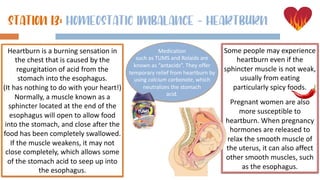
Heartburn is a burning sensation in
the chest that is caused by the
regurgitation of acid from the
stomach into the esophagus.
(It has nothing to do with your heart!)
Normally, a muscle known as a
sphincter located at the end of the
esophagus will open to allow food
into the stomach, and close after the
food has been completely swallowed.
If the muscle weakens, it may not
close completely, which allows some
of the stomach acid to seep up into
the esophagus.
Some people may experience
heartburn even if the
sphincter muscle is not weak,
usually from eating
particularly spicy foods.
Pregnant women are also
more susceptible to
heartburn. When pregnancy
hormones are released to
relax the smooth muscle of
the uterus, it can also affect
other smooth muscles, such
as the esophagus.
Medication
such as TUMS and Rolaids are
known as “antacids”. They offer
temporary relief from heartburn by
using calcium carbonate, which
neutralizes the stomach
acid.

Station 13 digestive system

  • 1.
  • 2.
    STATION 13: homeostaticimbalance ! ulcers Because the stomach contains powerful hydrochloric acid, the stomach has a protective mucus lining. Sometimes, an imbalance occurs and there is not enough mucus lining. In this case, the stomach acid may get through to the actual stomach muscle, causing an ulcer. In rare circumstances, the stomach acid might erode through the entire muscle. This would cause the stomach’s digestive juices to leak into the abdominal cavity and would require immediate surgery! Most ulcers occur because of a bacterial infection. A specific bacteria known as Helicobacter pylori cause approximately 90% of all ulcers. H. pylori burrows into the lining of the stomach to seek a more neutral pH to thrive in.
  • 3.
    STATION 13: homeostaticimbalance ! heartburn Heartburn is a burning sensation in the chest that is caused by the regurgitation of acid from the stomach into the esophagus. (It has nothing to do with your heart!) Normally, a muscle known as a sphincter located at the end of the esophagus will open to allow food into the stomach, and close after the food has been completely swallowed. If the muscle weakens, it may not close completely, which allows some of the stomach acid to seep up into the esophagus. Some people may experience heartburn even if the sphincter muscle is not weak, usually from eating particularly spicy foods. Pregnant women are also more susceptible to heartburn. When pregnancy hormones are released to relax the smooth muscle of the uterus, it can also affect other smooth muscles, such as the esophagus. Medication such as TUMS and Rolaids are known as “antacids”. They offer temporary relief from heartburn by using calcium carbonate, which neutralizes the stomach acid.