Let’s take some guided notes over
Cellular Respiration
LT2.2
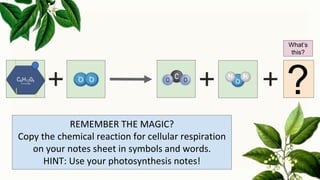
REMEMBER THE MAGIC?
Copy the chemical reaction for cellular respiration
on your notes sheet in symbols and words.
HINT: Use your photosynthesis notes!
?
What’s
this?
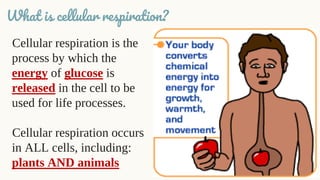
What is cellular respiration?
Cellular respiration is the
process by which the
energy of glucose is
released in the cell to be
used for life processes.
Cellular respiration occurs
in ALL cells, including:
plants AND animals
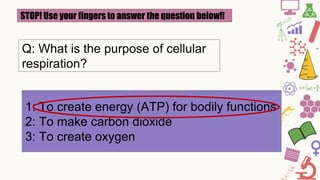
STOP! Use your fingers to answer the question below!!
1: To create energy (ATP) for bodily functions
2: To make carbon dioxide
3: To create oxygen
Q: What is the purpose of cellular
respiration?
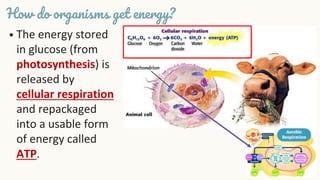
• The energy stored
in glucose (from
photosynthesis) is
released by
cellular respiration
and repackaged
into a usable form
of energy called
ATP.
How do organisms get energy?
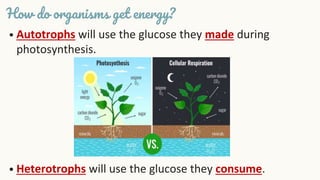
• Autotrophs will use the glucose they made during
photosynthesis.
• Heterotrophs will use the glucose they consume.
How do organisms get energy?
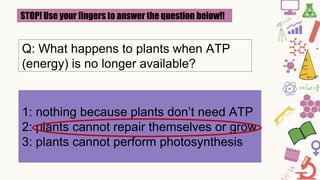
STOP! Use your fingers to answer the question below!!
Q: What happens to plants when ATP
(energy) is no longer available?
1: nothing because plants don’t need ATP
2: plants cannot repair themselves or grow
3: plants cannot perform photosynthesis
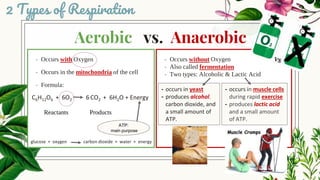
Aerobic vs. Anaerobic
- Occurs with Oxygen
- Occurs in the mitochondria of the cell
- Formula:
- Occurs without Oxygen
- Also called fermentation
- Two types: Alcoholic & Lactic Acid
2 Types of Respiration
C6H12O6 + 6O2 6CO2 + 6H2O + Energy
Reactants Products
ATP:
main purpose
glucose + oxygen carbon dioxide + water + energy
- occurs in yeast
- produces alcohol,
carbon dioxide, and
a small amount of
ATP.
- occurs in muscle cells
during rapid exercise
- produces lactic acid
and a small amount
of ATP.
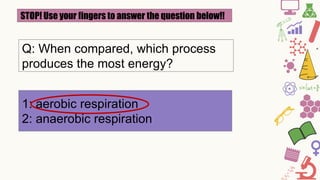
STOP! Use your fingers to answer the question below!!
Q: When compared, which process
produces the most energy?
1: aerobic respiration
2: anaerobic respiration
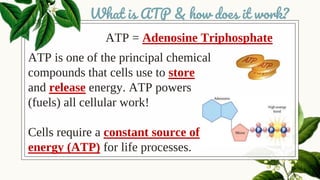
ATP is one of the principal chemical
compounds that cells use to store
and release energy. ATP powers
(fuels) all cellular work!
Cells require a constant source of
energy (ATP) for life processes.
What is ATP & how does it work?
ATP = Adenosine Triphosphate
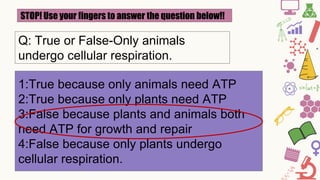
STOP! Use your fingers to answer the question below!!
1:True because only animals need ATP
2:True because only plants need ATP
3:False because plants and animals both
need ATP for growth and repair
4:False because only plants undergo
cellular respiration.
Q: True or False-Only animals
undergo cellular respiration.
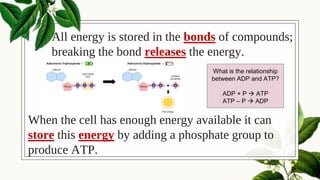
When the cell has enough energy available it can
store this energy by adding a phosphate group to
produce ATP.
All energy is stored in the bonds of compounds;
breaking the bond releases the energy.
What is the relationship
between ADP and ATP?
ADP + P  ATP
ATP – P  ADP
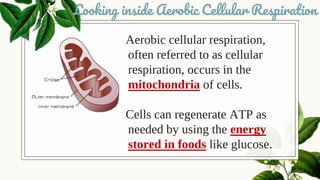
Aerobic cellular respiration,
often referred to as cellular
respiration, occurs in the
mitochondria of cells.
Cells can regenerate ATP as
needed by using the energy
stored in foods like glucose.
Looking inside Aerobic Cellular Respiration
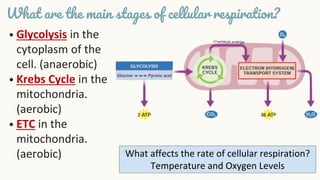
• Glycolysis in the
cytoplasm of the
cell. (anaerobic)
• Krebs Cycle in the
mitochondria.
(aerobic)
• ETC in the
mitochondria.
(aerobic)
What are the main stages of cellular respiration?
What affects the rate of cellular respiration?
Temperature and Oxygen Levels
STOP!
Q: Use a graph to show how the
amount of cellular respiration you do
changes throughout the day.
Let’s take some guided notes over
ENERGY CYCLE
LT2.3
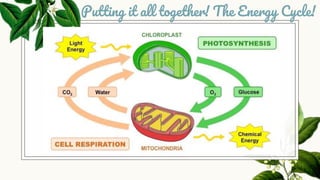
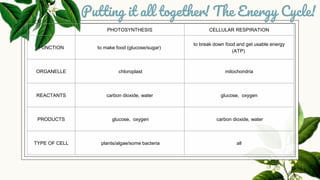
Putting it all together! The Energy Cycle!
PHOTOSYNTHESIS CELLULAR RESPIRATION
FUNCTION to make food (glucose/sugar)
to break down food and get usable energy
(ATP)
ORGANELLE chloroplast mitochondria
REACTANTS carbon dioxide, water glucose, oxygen
PRODUCTS glucose, oxygen carbon dioxide, water
TYPE OF CELL plants/algae/some bacteria all
Complete the LT2.2 Section of the Study Guide.
Study Guide Time

LT2.2 Cellular Respiration PowerPoint Notes

  • 1.
    Let’s take someguided notes over Cellular Respiration LT2.2
  • 2.
    REMEMBER THE MAGIC? Copythe chemical reaction for cellular respiration on your notes sheet in symbols and words. HINT: Use your photosynthesis notes! ? What’s this?
  • 3.
    What is cellularrespiration? Cellular respiration is the process by which the energy of glucose is released in the cell to be used for life processes. Cellular respiration occurs in ALL cells, including: plants AND animals
  • 4.
    STOP! Use yourfingers to answer the question below!! 1: To create energy (ATP) for bodily functions 2: To make carbon dioxide 3: To create oxygen Q: What is the purpose of cellular respiration?
  • 5.
    • The energystored in glucose (from photosynthesis) is released by cellular respiration and repackaged into a usable form of energy called ATP. How do organisms get energy?
  • 6.
    • Autotrophs willuse the glucose they made during photosynthesis. • Heterotrophs will use the glucose they consume. How do organisms get energy?
  • 7.
    STOP! Use yourfingers to answer the question below!! Q: What happens to plants when ATP (energy) is no longer available? 1: nothing because plants don’t need ATP 2: plants cannot repair themselves or grow 3: plants cannot perform photosynthesis
  • 8.
    Aerobic vs. Anaerobic -Occurs with Oxygen - Occurs in the mitochondria of the cell - Formula: - Occurs without Oxygen - Also called fermentation - Two types: Alcoholic & Lactic Acid 2 Types of Respiration C6H12O6 + 6O2 6CO2 + 6H2O + Energy Reactants Products ATP: main purpose glucose + oxygen carbon dioxide + water + energy - occurs in yeast - produces alcohol, carbon dioxide, and a small amount of ATP. - occurs in muscle cells during rapid exercise - produces lactic acid and a small amount of ATP.
  • 9.
    STOP! Use yourfingers to answer the question below!! Q: When compared, which process produces the most energy? 1: aerobic respiration 2: anaerobic respiration
  • 10.
    ATP is oneof the principal chemical compounds that cells use to store and release energy. ATP powers (fuels) all cellular work! Cells require a constant source of energy (ATP) for life processes. What is ATP & how does it work? ATP = Adenosine Triphosphate
  • 11.
    STOP! Use yourfingers to answer the question below!! 1:True because only animals need ATP 2:True because only plants need ATP 3:False because plants and animals both need ATP for growth and repair 4:False because only plants undergo cellular respiration. Q: True or False-Only animals undergo cellular respiration.
  • 12.
    When the cellhas enough energy available it can store this energy by adding a phosphate group to produce ATP. All energy is stored in the bonds of compounds; breaking the bond releases the energy. What is the relationship between ADP and ATP? ADP + P  ATP ATP – P  ADP
  • 13.
    Aerobic cellular respiration, oftenreferred to as cellular respiration, occurs in the mitochondria of cells. Cells can regenerate ATP as needed by using the energy stored in foods like glucose. Looking inside Aerobic Cellular Respiration
  • 14.
    • Glycolysis inthe cytoplasm of the cell. (anaerobic) • Krebs Cycle in the mitochondria. (aerobic) • ETC in the mitochondria. (aerobic) What are the main stages of cellular respiration? What affects the rate of cellular respiration? Temperature and Oxygen Levels
  • 15.
    STOP! Q: Use agraph to show how the amount of cellular respiration you do changes throughout the day.
  • 16.
    Let’s take someguided notes over ENERGY CYCLE LT2.3
  • 17.
    Putting it alltogether! The Energy Cycle!
  • 18.
    Putting it alltogether! The Energy Cycle! PHOTOSYNTHESIS CELLULAR RESPIRATION FUNCTION to make food (glucose/sugar) to break down food and get usable energy (ATP) ORGANELLE chloroplast mitochondria REACTANTS carbon dioxide, water glucose, oxygen PRODUCTS glucose, oxygen carbon dioxide, water TYPE OF CELL plants/algae/some bacteria all
  • 19.
    Complete the LT2.2Section of the Study Guide. Study Guide Time