
WHAT IS UNIVERSAL DESIGN?
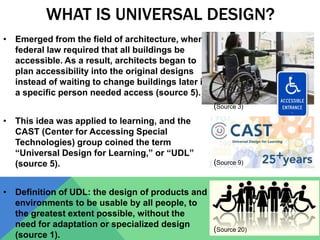
• Emerged from the field of architecture, when
federal law required that all buildings be
accessible. As a result, architects began to
plan accessibility into the original designs
instead of waiting to change buildings later if
a specific person needed access (source 5).
• This idea was applied to learning, and the
CAST (Center for Accessing Special
Technologies) group coined the term
“Universal Design for Learning,” or “UDL”
(source 5).
• Definition of UDL: the design of products and
environments to be usable by all people, to
the greatest extent possible, without the
need for adaptation or specialized design
(source 1).
(Source 3)
(Source 9)
(Source 20)
A CHANGE IN MINDSET
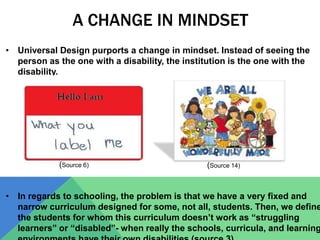
• Universal Design purports a change in mindset. Instead of seeing the
person as the one with a disability, the institution is the one with the
disability.
• In regards to schooling, the problem is that we have a very fixed and
narrow curriculum designed for some, not all, students. Then, we define
the students for whom this curriculum doesn’t work as “struggling
learners” or “disabled”- when really the schools, curricula, and learning
(Source 14)(Source 6)
HOW THIS MINDSET CHANGE AFFECTS TEACHING
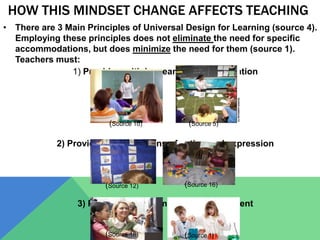
• There are 3 Main Principles of Universal Design for Learning (source 4).
Employing these principles does not eliminate the need for specific
accommodations, but does minimize the need for them (source 1).
Teachers must:
1) Provide multiple means of representation
2) Provide multiple means of action and expression
3) Provide multiple means of engagement
(Source 1o) (Source 5)
(Source 12) (Source 16)
(Source 18) (Source 1)
UDL IN THE CURRICULUM
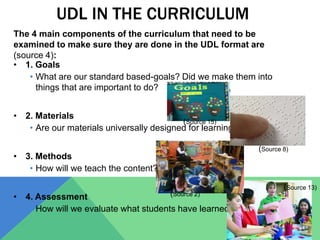
• 1. Goals
• What are our standard based-goals? Did we make them into
things that are important to do?
• 2. Materials
• Are our materials universally designed for learning?
• 3. Methods
• How will we teach the content?
• 4. Assessment
• How will we evaluate what students have learned?
The 4 main components of the curriculum that need to be
examined to make sure they are done in the UDL format are
(source 4):
(Source 15)
(Source 8)
(Source 2)
(Source 13)
ADHD SPOTLIGHT
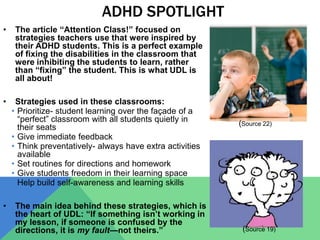
• The article “Attention Class!” focused on
strategies teachers use that were inspired by
their ADHD students. This is a perfect example
of fixing the disabilities in the classroom that
were inhibiting the students to learn, rather
than “fixing” the student. This is what UDL is
all about!
• Strategies used in these classrooms:
• Prioritize- student learning over the façade of a
“perfect” classroom with all students quietly in
their seats
• Give immediate feedback
• Think preventatively- always have extra activities
available
• Set routines for directions and homework
• Give students freedom in their learning space
• Help build self-awareness and learning skills
• The main idea behind these strategies, which is
the heart of UDL: “If something isn’t working in
my lesson, if someone is confused by the
directions, it is my fault—not theirs.”
(Source 22)
(Source 19)
UDL IS BENEFICIAL TO ALL
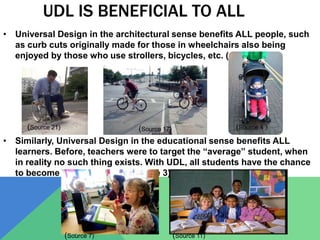
• Universal Design in the architectural sense benefits ALL people, such
as curb cuts originally made for those in wheelchairs also being
enjoyed by those who use strollers, bicycles, etc. (source 1).
• Similarly, Universal Design in the educational sense benefits ALL
learners. Before, teachers were to target the “average” student, when
in reality no such thing exists. With UDL, all students have the chance
to become expert learners (source 3).
(Source 4 )(Source 17)(Source 21)
(Source 7) (Source 11)
VIDEO AND ARTICLE SOURCES
1. Burgstahler, Sheryl. Universal Design of Instruction (UDI):
Definition, Principles, Guidelines, and Examples. Rep. University of
Washington, n.d. Web. 24 Sept. 2013.
2. Pappano, Laura. Attention Class! Rep. Harvard Graduate School of
Education, n.d. Web. 24 Sept. 2013.
3. UDL: Principals and Practice. YouTube. UDL Center, n.d. Web. 24 Sept. 2013.
4. The UDL Guidelines. YouTube. UDL Center, n.d. Web. 24 Sept. 2013.
5. Universal Design for Learning (UDL): Reaching All, Teaching All. Rep. ERIC
document reproduction service no. ED485470. Delaware State Dept. of
Education, Dover., n.d. Web. 24 Sept. 2013.
PICTURES SOURCES
1. 25 Free or Nearly Free Summer Activites. N.d. Photograph.
Web. <Discovergold.wordpress.com>.
2. 100 Reasons to Be a Teacher. N.d. Photograph. Web.
<www.sites.google.com>.
3. ADA Accesible Entrance Signs. N.d. Photograph. Web.
<Myparkingsign.com>.
4. The Adventure of Parenthood. N.d. Photograph. Web.
<www.themummyadventure.com>.
5. All Together Now, Education Next. N.d. Photograph. Web.
<educationnext.org>.
6. The Anti-Label. N.d. Photograph. Web.
<www.katienovakudl.com>.
7. Boulder Valley. N.d. Photograph. Web.
<www.dailycamera.com>.
8. Braille. N.d. Photograph. Web. <www.en.wikipedia.org>.
9. CAST. N.d. Photograph. Web. <www.cast.org>.
10. Classroom Displine Teacher. N.d. Photograph. Web.
<www.classroom-teacher-resources.com>.
11. Favorites. N.d. Photograph. Web. <www.migdale.com>.
12. Free Printable Emergent Readers. N.d. Photograph.
Web. <Themeasuredmom.com>.
13. How ADHD Children Learn. N.d. Photograph. Web.
<www.attitudemag.com>.
14. Information. N.d. Photograph. Web.
<www.walton.k12.ga.us>.
15. K Teacher Tagget. N.d. Photograph. Web.
<www.kteachertaggert.blogspot.com>.
16. Math with Manipulatives. N.d. Photograph. Web.
<www.pennydouglas.com>.
17. Pat Dudley. N.d. Photograph. Web.
<www.bikexprt.com>
18. Play Attention. N.d. Photograph. Web.
<www.edebetictac.com>.
19. Procrastintion and Adult ADHD. N.d. Photograph. Web.
<www.psycologytoday .com>
20. Universal Design for Learning. N.d. Photograph. Web.
<Ajhidt.wordpress.com>.
21. Using the Curb Cut Principle. N.d. Photograph. Web.
<www.asyourworldchanges.wordpress.com>.
22. What Causes ADHD? N.d. Photograph. Web.
<www.health.com>.

EDP 279 2.3: Universal Design

  • 2.
    WHAT IS UNIVERSALDESIGN? • Emerged from the field of architecture, when federal law required that all buildings be accessible. As a result, architects began to plan accessibility into the original designs instead of waiting to change buildings later if a specific person needed access (source 5). • This idea was applied to learning, and the CAST (Center for Accessing Special Technologies) group coined the term “Universal Design for Learning,” or “UDL” (source 5). • Definition of UDL: the design of products and environments to be usable by all people, to the greatest extent possible, without the need for adaptation or specialized design (source 1). (Source 3) (Source 9) (Source 20)
  • 3.
    A CHANGE INMINDSET • Universal Design purports a change in mindset. Instead of seeing the person as the one with a disability, the institution is the one with the disability. • In regards to schooling, the problem is that we have a very fixed and narrow curriculum designed for some, not all, students. Then, we define the students for whom this curriculum doesn’t work as “struggling learners” or “disabled”- when really the schools, curricula, and learning (Source 14)(Source 6)
  • 4.
    HOW THIS MINDSETCHANGE AFFECTS TEACHING • There are 3 Main Principles of Universal Design for Learning (source 4). Employing these principles does not eliminate the need for specific accommodations, but does minimize the need for them (source 1). Teachers must: 1) Provide multiple means of representation 2) Provide multiple means of action and expression 3) Provide multiple means of engagement (Source 1o) (Source 5) (Source 12) (Source 16) (Source 18) (Source 1)
  • 5.
    UDL IN THECURRICULUM • 1. Goals • What are our standard based-goals? Did we make them into things that are important to do? • 2. Materials • Are our materials universally designed for learning? • 3. Methods • How will we teach the content? • 4. Assessment • How will we evaluate what students have learned? The 4 main components of the curriculum that need to be examined to make sure they are done in the UDL format are (source 4): (Source 15) (Source 8) (Source 2) (Source 13)
  • 6.
    ADHD SPOTLIGHT • Thearticle “Attention Class!” focused on strategies teachers use that were inspired by their ADHD students. This is a perfect example of fixing the disabilities in the classroom that were inhibiting the students to learn, rather than “fixing” the student. This is what UDL is all about! • Strategies used in these classrooms: • Prioritize- student learning over the façade of a “perfect” classroom with all students quietly in their seats • Give immediate feedback • Think preventatively- always have extra activities available • Set routines for directions and homework • Give students freedom in their learning space • Help build self-awareness and learning skills • The main idea behind these strategies, which is the heart of UDL: “If something isn’t working in my lesson, if someone is confused by the directions, it is my fault—not theirs.” (Source 22) (Source 19)
  • 7.
    UDL IS BENEFICIALTO ALL • Universal Design in the architectural sense benefits ALL people, such as curb cuts originally made for those in wheelchairs also being enjoyed by those who use strollers, bicycles, etc. (source 1). • Similarly, Universal Design in the educational sense benefits ALL learners. Before, teachers were to target the “average” student, when in reality no such thing exists. With UDL, all students have the chance to become expert learners (source 3). (Source 4 )(Source 17)(Source 21) (Source 7) (Source 11)
  • 8.
    VIDEO AND ARTICLESOURCES 1. Burgstahler, Sheryl. Universal Design of Instruction (UDI): Definition, Principles, Guidelines, and Examples. Rep. University of Washington, n.d. Web. 24 Sept. 2013. 2. Pappano, Laura. Attention Class! Rep. Harvard Graduate School of Education, n.d. Web. 24 Sept. 2013. 3. UDL: Principals and Practice. YouTube. UDL Center, n.d. Web. 24 Sept. 2013. 4. The UDL Guidelines. YouTube. UDL Center, n.d. Web. 24 Sept. 2013. 5. Universal Design for Learning (UDL): Reaching All, Teaching All. Rep. ERIC document reproduction service no. ED485470. Delaware State Dept. of Education, Dover., n.d. Web. 24 Sept. 2013.
  • 9.
    PICTURES SOURCES 1. 25Free or Nearly Free Summer Activites. N.d. Photograph. Web. <Discovergold.wordpress.com>. 2. 100 Reasons to Be a Teacher. N.d. Photograph. Web. <www.sites.google.com>. 3. ADA Accesible Entrance Signs. N.d. Photograph. Web. <Myparkingsign.com>. 4. The Adventure of Parenthood. N.d. Photograph. Web. <www.themummyadventure.com>. 5. All Together Now, Education Next. N.d. Photograph. Web. <educationnext.org>. 6. The Anti-Label. N.d. Photograph. Web. <www.katienovakudl.com>. 7. Boulder Valley. N.d. Photograph. Web. <www.dailycamera.com>. 8. Braille. N.d. Photograph. Web. <www.en.wikipedia.org>. 9. CAST. N.d. Photograph. Web. <www.cast.org>. 10. Classroom Displine Teacher. N.d. Photograph. Web. <www.classroom-teacher-resources.com>. 11. Favorites. N.d. Photograph. Web. <www.migdale.com>. 12. Free Printable Emergent Readers. N.d. Photograph. Web. <Themeasuredmom.com>. 13. How ADHD Children Learn. N.d. Photograph. Web. <www.attitudemag.com>. 14. Information. N.d. Photograph. Web. <www.walton.k12.ga.us>. 15. K Teacher Tagget. N.d. Photograph. Web. <www.kteachertaggert.blogspot.com>. 16. Math with Manipulatives. N.d. Photograph. Web. <www.pennydouglas.com>. 17. Pat Dudley. N.d. Photograph. Web. <www.bikexprt.com> 18. Play Attention. N.d. Photograph. Web. <www.edebetictac.com>. 19. Procrastintion and Adult ADHD. N.d. Photograph. Web. <www.psycologytoday .com> 20. Universal Design for Learning. N.d. Photograph. Web. <Ajhidt.wordpress.com>. 21. Using the Curb Cut Principle. N.d. Photograph. Web. <www.asyourworldchanges.wordpress.com>. 22. What Causes ADHD? N.d. Photograph. Web. <www.health.com>.