What is udl?
•UniversalDesign for Learning, or
UDL, is an instructional approach that
opens opportunities for all students by
using digital media and flexible
instructional to help students meet
their educational goals.
3.
UNIVERSAL DESIGN FORLEARNING
UDL has its basis in
neuroscience, the three
principles correlate with
the three networks in the
brain which must be
simultaneously engaged
for optimal learning to
occur.
UDL provides equal access
to learning, not simply
equal access to
information.
Universal Design allows
the student to control
the method accessing
information while the
teacher monitors the
learning environment.
4.
UN Convention onthe Rights of
Persons with Disabilities
•“The designs of products, equipment, programs
and services that can be used by everyone, to
the greatest extent possible, without the need
for adjustments or special designs.’’
5.
Universal Design History
Universal Design History
began as an architectural
movement in the USA. Curbs
cuts, automatic doors and
ramps were added to buildings
during the design process rather
than as an after-thought.
The concept of universal design
has also been applied to web
page designs which enable
users with special needs to
access the internet.
More recently universal designs
has been applied to education.
UDL has entered the educational
world at this point in time because
the technology is more available
making UDL possible.
6.
Who
Benefits?
Students who speakEnglish as a second
language
International students
Students with Disabilities
Students with Different learning styles
Students with varying academic abilities
Students with complex medical needs
7.
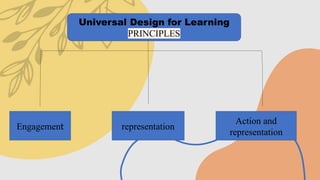
Universal Design forLearning
PRINCIPLES
Engagement representation
Action and
representation
8.
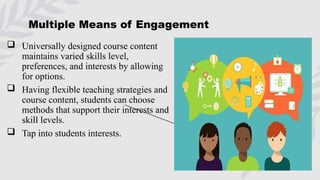
Multiple Means ofEngagement
Universally designed course content
maintains varied skills level,
preferences, and interests by allowing
for options.
Having flexible teaching strategies and
course content, students can choose
methods that support their interests and
skill levels.
Tap into students interests.
9.
Multiple Means ofRepresentation
Universally designed
course content provides
alternative presentations
of essential concepts.
Various methods of
presentation can allow
the student to learn the
information in their
preferred method.
10.
Multiple Means of
Expression
•Universally designed
course content allows for
alternate methods of
expression.
• Allows students multiple
means of demonstrating
mastery of the material.
Let’s Learn More…
Indifferentiating instruction,
consider the learner's readiness,
interests and learning profile. The
learners' readiness affects their way
and extent of learning because
teacher cannot force them to learn if,
they are not yet prepared for the
learning situation or topic.
CONTENT
Questions to Consider:
a.What do the learners need to learn?
b. What ways and means can be utilized to vary access
to information?
Example of differentiating Content:
a. Presenting Video clips to supplement teacher's
explanation and discussions of the topic.
b. Use of varied audio-visual materials to enrich the
classroom discussions
c.Use of computer generated materials.
15.
PROCESS
These are variedActivities that teachers provide to their
learners to make sense of content
Example of differentiating process:
a. Provide learning centers in the classroom where children
can freely explore
b. b. Provide manipulatives where learners can have hands-
on experience.
c. Provides varied by interesting worksheets where
learners were able to learn
16.
PRODUCTS
•These are theconcrete and actual evidences of what the
students or learners we able to learn
•Things to consider:
•a. They may be in the form of projects or performance based
evidence of learning
•b. Rubrics should be used
•c. Some products may be done by individual or group.
•d. Teacher can give freedom to the learners plan their
product.
17.
LEARNING ENVIRONMENT
Teachers shouldbe able to established a conducive learning
environment for all types of learners
Things to consider:
a. Provide to learners to do their activities
b. Provide varied materials in the classroom
c. Develop schedule where children and learners can work
together
d. Classroom ambiance should manifest respect in diversity.
18.
Differentiated Instruction issupported by the
principles of Universal Design for Learning
(UDL). Universal Design for Leaning is a set of
principle for curriculum development that give all
individuals equal opportunities to learn (National
Center for Universal Design for Learning, 2014)
19.
General Guidelines forthe
Universal Design for Learning
Provide Multiple Means of Representation
This pertains to WHAT of Learning.
Provide Multiple Means for Action and Expression
This pertains to HOW of learning
Provide Multiple Means for Engagement
This pertains to the WHY of Learning