IMPROVING SOCIAL SKILLS OF
ASPERGER’S SYNDROME TEENAGERS IN
THE INCLUSIVE CLASSROOM
F R E D G A M B L E J R .
E D G R 5 3 5 - T H E O R I E S O F T E A C H I N G A N D
L E A R N I N G
WHAT IS ASPERGER’S SYNDROME?
The Mayo Clinic (2012) defines Asperger's syndrome as a
developmental disorder that affects a person's ability to socialize and
communicate effectively with others. Children with Asperger's
syndrome typically exhibit social awkwardness and an all-absorbing
interest in specific topics.
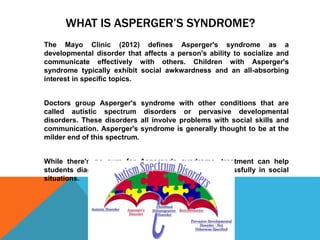
Doctors group Asperger's syndrome with other conditions that are
called autistic spectrum disorders or pervasive developmental
disorders. These disorders all involve problems with social skills and
communication. Asperger's syndrome is generally thought to be at the
milder end of this spectrum.
While there's no cure for Asperger's syndrome, treatment can help
students diagnosed learn how to interact more successfully in social
situations.
WHAT IS AN INCLUSIVE CLASSROOM?
SOCIAL ISSUES OF TEENS WITH ASPERGER’S
SYNDROME
 Social Isolation- “Aspies” often have odd mannerisms and many are too
anxious to initiate social contact.
 Inability to "Be a Teen“-An Aspie typically does not care about teen fads
and clothing styles, may neglect their hygiene, and wear the same haircut
for years.
 Sexual Issues-Aspie teens are not privy to street knowledge of sex and
dating behaviors that others in their peer group pick up naturally.
 Criminal Activity-Pain, loneliness, and despair can lead to problems with
drugs, sex, and alcohol. Others from peer group may use an Aspie to hold
liquor and drugs for their group
 School Failures-Aspies with their distractibility and difficulty organizing
materials face academic failures in dealing with various teachers, different
classroom environments, and different sets of expectations.
 Depression and Acting Out-Because teenage years are more emotional,
Aspie teens become emotionally overwhelmed, attacking peers/teachers,
suicide is a concern as well as drug abuse.
WHAT ARE SOME WAYS TO IMPROVE SOCIAL ISSUES?
 Encourage initiation of contact with others in peer groups
 Elicit other peers to help in choosing clothing which is
appropriate for age group
 Be specific in talking about sex with an Aspie and acceptable
social behaviors while around others
 Emphasize that drugs and alcohol are illegal because of the
risk of adverse effects of prescriptions which an Aspie may
take
 Suggest Summer Camps which are designed for Aspie teens
HOW CAN CLASSROOM ENVIRONMENTS BE
ENHANCED FOR STUDENTS WITH ASPERGER’S
SYNDROME?
Regular and organized daily routines
Pictures and Charts to prepare for
changes
Utilizing Social Stories for students
and unique situations in the
classroom
Teach Non-Verbal Body Language and
Non-Verbal Social Messages
Positive feedback for even the
LANGUAGE COMPREHENSION/AUDITORY
PROCESSING DIFFICULTIES
Children with Asperger's Syndrome generally interpret auditory
information literally and concretely. They can have difficulty
understanding figurative language, jokes/riddles, multiple meaning
words, teasing and implied meanings.
It is also important to note that delays in processing information
auditorily may be present in children with Asperger's Syndrome. Even
though they may be able to comprehend the auditory information given,
it may take them additional time to process this information prior to
responding. They may also have difficulty following multi-step auditory
directions (e.g., "Go back to your desk and take out your journals, and
then write about your weekend.").
LANGUAGE COMPREHENSION/AUDITORY
PROCESSING - INTERVENTION STRATEGIES
• Auditory information/prompting should be kept to a minimum, as it can be
too overwhelming for some children. Visual cues should be used to assist
the child to more readily comprehend directions, questions, rules,
figurative language, etc.
• Give the child with Asperger's Syndrome enough time to respond, in order
to allow for possible auditory processing difficulties, before
repeating/rephrasing the question/directive. The child can be taught
appropriate phrases to indicate he needs additional processing time, (e.g.,
"Give me a minute, I'm thinking").
• Written rules can help the child understand what is expected of him at all
times. Reference to the rules can be used rather than verbally telling him
what to do, or what not to do.
• Auditory directions can be written on a dry erase board for the child with
Asperger's Syndrome, greatly increasing his ability to independently
complete tasks/activities.
• The adults in the child's environment should be aware of the child's
concrete/literal interpretation of figurative language, and should provide
concrete explanations if necessary. Focus should also be given to
increasing the child's comprehension of figurative language skills, such as
idioms, multi-meaning words, jokes, teasing, etc., through the use of visual
supports.
EMOTIONAL VULNERABILITY
Children with Asperger's Syndrome often have the intellectual ability to
successfully participate in the regular education curriculum. However,
they may lack the social/emotional abilities to cope with the demands of
the regular education environment, such as regular class room, recess,
and lunch. As a result, these children may exhibit a low self-esteem,
may be self-critical and may be unable to tolerate making mistakes
(perfectionist). Thus they can become easily overwhelmed, stressed
and frustrated, resulting in behavioral outbursts due to poor coping
strategies/self-regulation. These children can appear quite anxious for
most of their waking day as they continually attempt to manage an ever-
changing, sensory stimulating, social world. As stated by Tony Attwood,
children with Asperger's Syndrome "are emotionally confused, not
emotionally disturbed".
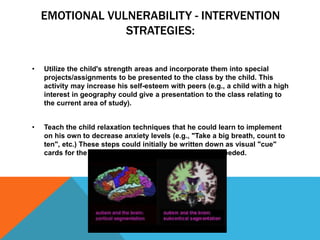
EMOTIONAL VULNERABILITY - INTERVENTION
STRATEGIES:
• Utilize the child's strength areas and incorporate them into special
projects/assignments to be presented to the class by the child. This
activity may increase his self-esteem with peers (e.g., a child with a high
interest in geography could give a presentation to the class relating to
the current area of study).
• Teach the child relaxation techniques that he could learn to implement
on his own to decrease anxiety levels (e.g., "Take a big breath, count to
ten", etc.) These steps could initially be written down as visual "cue"
cards for the child to carry with him, and refer to as needed.
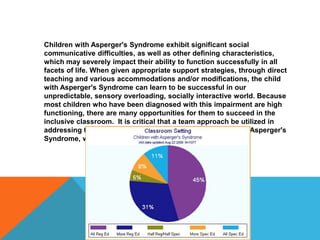
Children with Asperger's Syndrome exhibit significant social
communicative difficulties, as well as other defining characteristics,
which may severely impact their ability to function successfully in all
facets of life. When given appropriate support strategies, through direct
teaching and various accommodations and/or modifications, the child
with Asperger's Syndrome can learn to be successful in our
unpredictable, sensory overloading, socially interactive world. Because
most children who have been diagnosed with this impairment are high
functioning, there are many opportunities for them to succeed in the
inclusive classroom. It is critical that a team approach be utilized in
addressing the unique and challenging needs of a child with Asperger's
Syndrome, with parents being vital members of this team.
REFERENCES
Mayo Clinic (2011). Retrieved February 12, 2012 from
http://www.mayoclinic.com/health/aspergers-syndrome/DS00551
McCullagh, S. (Creator) (2008, August 15). “The Inclusive Classroom” (Short version)
[Video]
Retrieved from http://www.youtube.com/watch?v=o5WCX-998vs
Michigan State University (2003). Retrieved February 14, 2012 from
www.msu.edu/user/swigerja/Asperger's%20Syndrome.doc
Special Education Services (2012). Retrieved February 14, 2012 from
http://www.specialed.us/autism/asper/asper12.html
Your Little Professor (2012). Retrieved February 12, 2012 from
http://www.yourlittleprofessor.com/teen.html

Teenagers with Asperger's Syndrome in the Inclusive Classroom, Fred Gamble, Jr.

  • 1.
    IMPROVING SOCIAL SKILLSOF ASPERGER’S SYNDROME TEENAGERS IN THE INCLUSIVE CLASSROOM F R E D G A M B L E J R . E D G R 5 3 5 - T H E O R I E S O F T E A C H I N G A N D L E A R N I N G
  • 2.
    WHAT IS ASPERGER’SSYNDROME? The Mayo Clinic (2012) defines Asperger's syndrome as a developmental disorder that affects a person's ability to socialize and communicate effectively with others. Children with Asperger's syndrome typically exhibit social awkwardness and an all-absorbing interest in specific topics. Doctors group Asperger's syndrome with other conditions that are called autistic spectrum disorders or pervasive developmental disorders. These disorders all involve problems with social skills and communication. Asperger's syndrome is generally thought to be at the milder end of this spectrum. While there's no cure for Asperger's syndrome, treatment can help students diagnosed learn how to interact more successfully in social situations.
  • 3.
    WHAT IS ANINCLUSIVE CLASSROOM?
  • 4.
    SOCIAL ISSUES OFTEENS WITH ASPERGER’S SYNDROME  Social Isolation- “Aspies” often have odd mannerisms and many are too anxious to initiate social contact.  Inability to "Be a Teen“-An Aspie typically does not care about teen fads and clothing styles, may neglect their hygiene, and wear the same haircut for years.  Sexual Issues-Aspie teens are not privy to street knowledge of sex and dating behaviors that others in their peer group pick up naturally.  Criminal Activity-Pain, loneliness, and despair can lead to problems with drugs, sex, and alcohol. Others from peer group may use an Aspie to hold liquor and drugs for their group  School Failures-Aspies with their distractibility and difficulty organizing materials face academic failures in dealing with various teachers, different classroom environments, and different sets of expectations.  Depression and Acting Out-Because teenage years are more emotional, Aspie teens become emotionally overwhelmed, attacking peers/teachers, suicide is a concern as well as drug abuse.
  • 5.
    WHAT ARE SOMEWAYS TO IMPROVE SOCIAL ISSUES?  Encourage initiation of contact with others in peer groups  Elicit other peers to help in choosing clothing which is appropriate for age group  Be specific in talking about sex with an Aspie and acceptable social behaviors while around others  Emphasize that drugs and alcohol are illegal because of the risk of adverse effects of prescriptions which an Aspie may take  Suggest Summer Camps which are designed for Aspie teens
  • 6.
    HOW CAN CLASSROOMENVIRONMENTS BE ENHANCED FOR STUDENTS WITH ASPERGER’S SYNDROME? Regular and organized daily routines Pictures and Charts to prepare for changes Utilizing Social Stories for students and unique situations in the classroom Teach Non-Verbal Body Language and Non-Verbal Social Messages Positive feedback for even the
  • 7.
    LANGUAGE COMPREHENSION/AUDITORY PROCESSING DIFFICULTIES Childrenwith Asperger's Syndrome generally interpret auditory information literally and concretely. They can have difficulty understanding figurative language, jokes/riddles, multiple meaning words, teasing and implied meanings. It is also important to note that delays in processing information auditorily may be present in children with Asperger's Syndrome. Even though they may be able to comprehend the auditory information given, it may take them additional time to process this information prior to responding. They may also have difficulty following multi-step auditory directions (e.g., "Go back to your desk and take out your journals, and then write about your weekend.").
  • 8.
    LANGUAGE COMPREHENSION/AUDITORY PROCESSING -INTERVENTION STRATEGIES • Auditory information/prompting should be kept to a minimum, as it can be too overwhelming for some children. Visual cues should be used to assist the child to more readily comprehend directions, questions, rules, figurative language, etc. • Give the child with Asperger's Syndrome enough time to respond, in order to allow for possible auditory processing difficulties, before repeating/rephrasing the question/directive. The child can be taught appropriate phrases to indicate he needs additional processing time, (e.g., "Give me a minute, I'm thinking"). • Written rules can help the child understand what is expected of him at all times. Reference to the rules can be used rather than verbally telling him what to do, or what not to do. • Auditory directions can be written on a dry erase board for the child with Asperger's Syndrome, greatly increasing his ability to independently complete tasks/activities. • The adults in the child's environment should be aware of the child's concrete/literal interpretation of figurative language, and should provide concrete explanations if necessary. Focus should also be given to increasing the child's comprehension of figurative language skills, such as idioms, multi-meaning words, jokes, teasing, etc., through the use of visual supports.
  • 9.
    EMOTIONAL VULNERABILITY Children withAsperger's Syndrome often have the intellectual ability to successfully participate in the regular education curriculum. However, they may lack the social/emotional abilities to cope with the demands of the regular education environment, such as regular class room, recess, and lunch. As a result, these children may exhibit a low self-esteem, may be self-critical and may be unable to tolerate making mistakes (perfectionist). Thus they can become easily overwhelmed, stressed and frustrated, resulting in behavioral outbursts due to poor coping strategies/self-regulation. These children can appear quite anxious for most of their waking day as they continually attempt to manage an ever- changing, sensory stimulating, social world. As stated by Tony Attwood, children with Asperger's Syndrome "are emotionally confused, not emotionally disturbed".
  • 10.
    EMOTIONAL VULNERABILITY -INTERVENTION STRATEGIES: • Utilize the child's strength areas and incorporate them into special projects/assignments to be presented to the class by the child. This activity may increase his self-esteem with peers (e.g., a child with a high interest in geography could give a presentation to the class relating to the current area of study). • Teach the child relaxation techniques that he could learn to implement on his own to decrease anxiety levels (e.g., "Take a big breath, count to ten", etc.) These steps could initially be written down as visual "cue" cards for the child to carry with him, and refer to as needed.
  • 11.
    Children with Asperger'sSyndrome exhibit significant social communicative difficulties, as well as other defining characteristics, which may severely impact their ability to function successfully in all facets of life. When given appropriate support strategies, through direct teaching and various accommodations and/or modifications, the child with Asperger's Syndrome can learn to be successful in our unpredictable, sensory overloading, socially interactive world. Because most children who have been diagnosed with this impairment are high functioning, there are many opportunities for them to succeed in the inclusive classroom. It is critical that a team approach be utilized in addressing the unique and challenging needs of a child with Asperger's Syndrome, with parents being vital members of this team.
  • 12.
    REFERENCES Mayo Clinic (2011).Retrieved February 12, 2012 from http://www.mayoclinic.com/health/aspergers-syndrome/DS00551 McCullagh, S. (Creator) (2008, August 15). “The Inclusive Classroom” (Short version) [Video] Retrieved from http://www.youtube.com/watch?v=o5WCX-998vs Michigan State University (2003). Retrieved February 14, 2012 from www.msu.edu/user/swigerja/Asperger's%20Syndrome.doc Special Education Services (2012). Retrieved February 14, 2012 from http://www.specialed.us/autism/asper/asper12.html Your Little Professor (2012). Retrieved February 12, 2012 from http://www.yourlittleprofessor.com/teen.html

Editor's Notes

  • #4 http://www.youtube.com/watch?v=o5WCX-998vs