presentation title 2
Introduction
UniversalDesign for Learning (UDL) :
Educational framework that aims to make learning accessible to all individuals,
regardless of their diverse abilities, backgrounds, or learning styles ( Bray, Devitt,
Banks, Sanchez Fuentes, Sandoval, Riviou & Terrenzio, 2024)
Promotes the creation of flexible learning environments and materials that can be
customized to meet the needs of a wide range of learners.
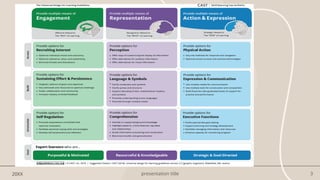
is based on three main principles:
Multiple Means of Engagement (MME)
Multiple Means of Representation (MMR)
Multiple Means of Action and Expression (MMAE)
20XX
presentation title 4
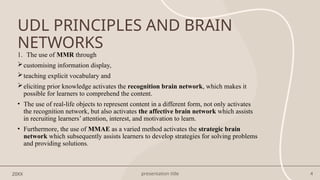
UDLPRINCIPLES AND BRAIN
NETWORKS
1. The use of MMR through
customising information display,
teaching explicit vocabulary and
eliciting prior knowledge activates the recognition brain network, which makes it
possible for learners to comprehend the content.
• The use of real-life objects to represent content in a different form, not only activates
the recognition network, but also activates the affective brain network which assists
in recruiting learners’ attention, interest, and motivation to learn.
• Furthermore, the use of MMAE as a varied method activates the strategic brain
network which subsequently assists learners to develop strategies for solving problems
and providing solutions.
20XX
5.
presentation title 5
UDL- Historical background
20XX
The term "universal design" initially emerged in the field of architecture
and environmental design
Architects such as Ronald Mace began promoting the idea of designing buildings
and spaces that are accessible to everyone, regardless of their physical abilities.
Ronald Mace laid the foundation for the application of universal design principles
beyond the physical environment and into other areas, including education.
Scholars and educators began exploring ways to apply universal design
principles to curriculum and instructional practices to address the diverse needs
of learners, hence Universal Design for Learning (UDL)
6.
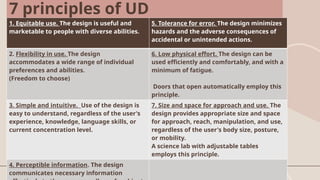
7 principles ofUD
1. Equitable use. The design is useful and
marketable to people with diverse abilities.
5. Tolerance for error. The design minimizes
hazards and the adverse consequences of
accidental or unintended actions.
2. Flexibility in use. The design
accommodates a wide range of individual
preferences and abilities.
(Freedom to choose)
6. Low physical effort. The design can be
used efficiently and comfortably, and with a
minimum of fatigue.
Doors that open automatically employ this
principle.
3. Simple and intuitive. Use of the design is
easy to understand, regardless of the user's
experience, knowledge, language skills, or
current concentration level.
7. Size and space for approach and use. The
design provides appropriate size and space
for approach, reach, manipulation, and use,
regardless of the user's body size, posture,
or mobility.
A science lab with adjustable tables
employs this principle.
4. Perceptible information. The design
communicates necessary information
7.
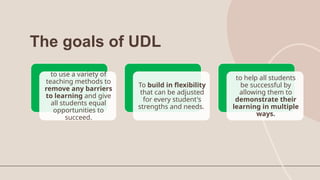
The goals ofUDL
to use a variety of
teaching methods to
remove any barriers
to learning and give
all students equal
opportunities to
succeed.
To build in flexibility
that can be adjusted
for every student's
strengths and needs.
to help all students
be successful by
allowing them to
demonstrate their
learning in multiple
ways.
8.
SIGNIFICANCE OF CREATINGINCLUSIVE AND ACCESSIBLE LEARNING
ENVIRONMENT
ensure that individuals with diverse backgrounds, abilities, and learning styles have
equal opportunities to participate and succeed in educational activities.
accommodate different learning styles and abilities, students are more likely to excel
academically.
they are more likely to engage in the learning process, collaborate with others, and
develop positive social skills.
By providing accommodations such as assistive technologies, adapted materials, or
flexible learning formats, educational institutions can ensure that every student has
the tools they need to succeed.
Teachers and educators benefit from an inclusive and accessible environment by
developing more flexible and effective teaching practices. This encourages educators
to adapt their methods to meet the diverse needs of students, resulting in improved
teaching and learning outcomes
9.
In summary, creatinginclusive and
accessible learning environments
is crucial for
fostering equality,
embracing diversity,
promoting academic success and
preparing individuals for active
participation in a diverse and
interconnected world.
presentation title 11
LESSONPLAN
20XX
A detailed lesson guiding tool;
Outlines lesson objectives, content,
teaching strategies and assessment
activities.
A roadmap for teachers;
Provides clear structure and sequencing of
activities to ensure effective teaching and
learning (Glatthorn, Boschee and
Whitehead, 2018)
12.
20XX presentation title12
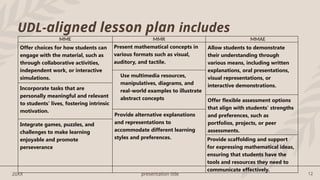
UDL-aligned lesson plan includes
MME MMR MMAE
Offer choices for how students can
engage with the material, such as
through collaborative activities,
independent work, or interactive
simulations.
Present mathematical concepts in
various formats such as visual,
auditory, and tactile.
Allow students to demonstrate
their understanding through
various means, including written
explanations, oral presentations,
visual representations, or
interactive demonstrations.
Use multimedia resources,
manipulatives, diagrams, and
real-world examples to illustrate
abstract concepts
Incorporate tasks that are
personally meaningful and relevant
to students' lives, fostering intrinsic
motivation.
Offer flexible assessment options
that align with students' strengths
and preferences, such as
portfolios, projects, or peer
assessments.
Provide alternative explanations
and representations to
accommodate different learning
styles and preferences.
Integrate games, puzzles, and
challenges to make learning
enjoyable and promote
perseverance
Provide scaffolding and support
for expressing mathematical ideas,
ensuring that students have the
tools and resources they need to
communicate effectively.





![Universal design for learning [Autosaved].pptx](https://cdn.slidesharecdn.com/ss_thumbnails/universaldesignforlearningautosaved-250311092345-e855ac97-thumbnail.jpg?width=640&height=640&fit=bounds)


