PRESENTATIONON
"PROLONGED LABOR"
SUBJECT:- OBSTETRICS& GYNECOLOGY
SUBMITTEDTO:-
Mrs.SNEHLATA PARASHAR
SUBMITTED BY:-
Ms.NARESH KANWAR
B.SCNURSING 4TH YEAR
(2016-17)
M.SC LECTURER(OBG& GYN)
SUBMISSION DATE:-
CONTENTS
:-
 INTRODUCTION
DEFINITION
PHASES
CAUSES
DIAGNOSIS
DANGERSOFPROLONGED LAB
OR
MANAGEMENT
PROLONGED LABOR
INTRODUCTION:
PROLONGED LABOR IS THE INABILITY OF A WOMAN
TO PROCEED WITH CHILDBIRTH UPON GOING INTO
LABOR. PROLONGED LABOR TYPICALLY LASTS OVER
20HRS.FOR FIRST TIME MOTHERS, AND OVER 14HRS.
FOR WOMEN THAT HAVE ALREADY HAD CHILDREN.
FAILURE TO PROGRESS CAN TAKE PLACE DURING
TWO DIFFERENT PHASES; THE LATENT PHASE AND
ACTIVE PHASE OF LABOR.
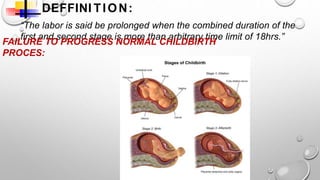
DEFFINI TION:
“The labor is said be prolonged when the combined duration of the
first and second stage is more than arbitrary time limit of 18hrs.”
FAILURE TO PROGRESS NORMAL CHILDBIRTH
PROCES:
1. FIRST STAGE OF LABOR:
1. Latent phase:-
•Latent phase is preparatory phase of the cervix before the actual
onset of labor.
•Normal latent phase is about 8 hours in primigravidae or 4 hours
multigravidae.
•The prolonged latent phase exceeds 20hrs.in primigravidae and
14hrs.in multigravidae is abnormal.
(b) Active phase:-
•In active phase cervical dilatation of 3cm-10cm with rotation and
descent of presenting part along with moderate contractions takes
place.
•The progress is assessed from the 2hrly vaginal examination that
reveals the presentation, position and station, degree of caput or
moulding.
•In prolonged active phase the progress of labor is slow, vaginal and
abdominal examination findings are not in consonance with the
progress of normal labor.
2. SECOND STAGE OF LABOR:
The second stage of labor considered prolonged if it takes
more than two hours in primigravidae and one hour in a
multigravidae. The presenting part descends sluggishly, in spite of
full dilatation of the OS, Maudling inadequacy and invariability in
CAUSES OF PROLONGED LABOR:
1. First stage:-
(a) Fault in power: -
Abnormal uterine contraction such as uterine inertia or in-
coordinate uterine contraction.
(b) Fault in passage:-
Contracted pelvis, cervical dystocia, pelvic
tumor, or even full bladder.
(c) Fault in passenger: -
Malposition (op) and mal-presentation (face, brow),
congenital anomalies of the fetus (hydrocephalus).
(d) Others: -
Injudicious (early) administration of sedatives and
analgesics before the active labor begins.
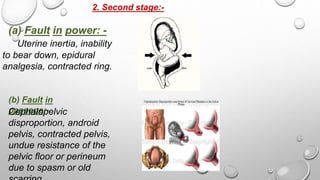
2. Second stage:-
(a) Fault in power: -
Uterine inertia, inability
to bear down, epidural
analgesia, contracted ring.
(b) Fault in
passage:-Cephalopelvic
disproportion, android
pelvis, contracted pelvis,
undue resistance of the
pelvic floor or perineum
due to spasm or old
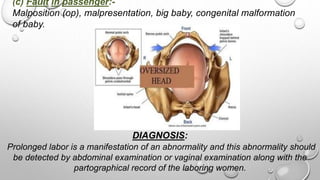
(c) Fault in passenger:-
Malposition (op), malpresentation, big baby, congenital malformation
of baby.
DIAGNOSIS:
Prolonged labor is a manifestation of an abnormality and this abnormality should
be detected by abdominal examination or vaginal examination along with the
partographical record of the laboring women.
First stage of labor :
First stage of labor is considered
prolonged when the duration is more
than 12hrs. The rate of cervical dilatation
is <1cm/hr in primi and <1.5cm/hr in
multi. The rate of descent if the
presenting part is <1cm/hr in primi and
<2cm/hr in multi.
•Second stage:-
The 2nd stage is considered prolonged
if it is lasts for more than 2hrs in primi and 1hr in
multi.
• DANGER:
• FETAL :
1.Hypoxia
2. Intra uterine infections
3. Intra cranial stress or Hemorrhage.
•MATERNAL:
1. Postpartum hemorrhage
2. Distress
3. Trauma to genital tract
4. Increased operative delivery
5. Puerperal sepsis
MANAGMENT:
•PREVENTION :
•Antenatal or early intranatal detection of the factors likely to produce prolonged
labor.
•Use of partograph.
•Selective and injudicious augmentation
Change of posture in labor
•ACTUAL MANAGEMENT: Careful evaluation is to be done.
•Cause of prolonged labor
•Effect on the mother
•Effect on the fetus
•In nulliparous women: Inadequate uterine activity, primary dysfunctional labor.
•In multiparous women : CPD
•PRELIMINERIES : -
Correction of keto-acidosis should be done urgently by rapid intravenous
infusion of Ringer’s solution.
•DEFFINITIVE TREATMENT:-
•First stage delay:
If only uterine activity is
suboptimal,
•Amniotomy/oxytocin infusion
•Effective pain relief
•Careful use of oxytocin
Cesarean section delivery
•Second stage delay:
•Short period of expectant management is reasonable provided the FHR is
reassuring and vaginal delivery is eminent.
Otherwise, appropriate assisted delivery, vaginal or abdominal should be done.
•Difficult instrumental delivery should be avoided
Prolonged labour...

Prolonged labour...

  • 1.
    PRESENTATIONON "PROLONGED LABOR" SUBJECT:- OBSTETRICS&GYNECOLOGY SUBMITTEDTO:- Mrs.SNEHLATA PARASHAR SUBMITTED BY:- Ms.NARESH KANWAR B.SCNURSING 4TH YEAR (2016-17) M.SC LECTURER(OBG& GYN) SUBMISSION DATE:-
  • 2.
  • 3.
    PROLONGED LABOR INTRODUCTION: PROLONGED LABORIS THE INABILITY OF A WOMAN TO PROCEED WITH CHILDBIRTH UPON GOING INTO LABOR. PROLONGED LABOR TYPICALLY LASTS OVER 20HRS.FOR FIRST TIME MOTHERS, AND OVER 14HRS. FOR WOMEN THAT HAVE ALREADY HAD CHILDREN. FAILURE TO PROGRESS CAN TAKE PLACE DURING TWO DIFFERENT PHASES; THE LATENT PHASE AND ACTIVE PHASE OF LABOR.
  • 4.
    DEFFINI TION: “The laboris said be prolonged when the combined duration of the first and second stage is more than arbitrary time limit of 18hrs.” FAILURE TO PROGRESS NORMAL CHILDBIRTH PROCES:
  • 5.
    1. FIRST STAGEOF LABOR: 1. Latent phase:- •Latent phase is preparatory phase of the cervix before the actual onset of labor. •Normal latent phase is about 8 hours in primigravidae or 4 hours multigravidae. •The prolonged latent phase exceeds 20hrs.in primigravidae and 14hrs.in multigravidae is abnormal. (b) Active phase:- •In active phase cervical dilatation of 3cm-10cm with rotation and descent of presenting part along with moderate contractions takes place.
  • 6.
    •The progress isassessed from the 2hrly vaginal examination that reveals the presentation, position and station, degree of caput or moulding. •In prolonged active phase the progress of labor is slow, vaginal and abdominal examination findings are not in consonance with the progress of normal labor. 2. SECOND STAGE OF LABOR: The second stage of labor considered prolonged if it takes more than two hours in primigravidae and one hour in a multigravidae. The presenting part descends sluggishly, in spite of full dilatation of the OS, Maudling inadequacy and invariability in
  • 7.
    CAUSES OF PROLONGEDLABOR: 1. First stage:- (a) Fault in power: - Abnormal uterine contraction such as uterine inertia or in- coordinate uterine contraction. (b) Fault in passage:- Contracted pelvis, cervical dystocia, pelvic tumor, or even full bladder. (c) Fault in passenger: - Malposition (op) and mal-presentation (face, brow), congenital anomalies of the fetus (hydrocephalus). (d) Others: - Injudicious (early) administration of sedatives and analgesics before the active labor begins.
  • 8.
    2. Second stage:- (a)Fault in power: - Uterine inertia, inability to bear down, epidural analgesia, contracted ring. (b) Fault in passage:-Cephalopelvic disproportion, android pelvis, contracted pelvis, undue resistance of the pelvic floor or perineum due to spasm or old
  • 9.
    (c) Fault inpassenger:- Malposition (op), malpresentation, big baby, congenital malformation of baby. DIAGNOSIS: Prolonged labor is a manifestation of an abnormality and this abnormality should be detected by abdominal examination or vaginal examination along with the partographical record of the laboring women.
  • 10.
    First stage oflabor : First stage of labor is considered prolonged when the duration is more than 12hrs. The rate of cervical dilatation is <1cm/hr in primi and <1.5cm/hr in multi. The rate of descent if the presenting part is <1cm/hr in primi and <2cm/hr in multi. •Second stage:- The 2nd stage is considered prolonged if it is lasts for more than 2hrs in primi and 1hr in multi.
  • 11.
    • DANGER: • FETAL: 1.Hypoxia 2. Intra uterine infections 3. Intra cranial stress or Hemorrhage.
  • 12.
    •MATERNAL: 1. Postpartum hemorrhage 2.Distress 3. Trauma to genital tract 4. Increased operative delivery 5. Puerperal sepsis
  • 13.
    MANAGMENT: •PREVENTION : •Antenatal orearly intranatal detection of the factors likely to produce prolonged labor. •Use of partograph. •Selective and injudicious augmentation Change of posture in labor •ACTUAL MANAGEMENT: Careful evaluation is to be done. •Cause of prolonged labor •Effect on the mother •Effect on the fetus •In nulliparous women: Inadequate uterine activity, primary dysfunctional labor. •In multiparous women : CPD •PRELIMINERIES : - Correction of keto-acidosis should be done urgently by rapid intravenous infusion of Ringer’s solution.
  • 14.
    •DEFFINITIVE TREATMENT:- •First stagedelay: If only uterine activity is suboptimal, •Amniotomy/oxytocin infusion •Effective pain relief •Careful use of oxytocin Cesarean section delivery •Second stage delay: •Short period of expectant management is reasonable provided the FHR is reassuring and vaginal delivery is eminent. Otherwise, appropriate assisted delivery, vaginal or abdominal should be done. •Difficult instrumental delivery should be avoided