Malpresentation and
Malpostion
NURS306
Malpresentation and Malpostion
Mal-presentation - A presentation other than vertex
Eg. Shoulder, face, brow and breech.
Mal-position and mal-presentations: have ill fitting presenting
parts compared to a well flexed vertex presentations in a
normal pelvis.
Causes
• - polyhydraminous
• Abnormality of pelvis
• Abnormal shape of uterus
• Laxcity of uterine muscles
• Multiple pregnancy
Breech Presentation
• Definition: When the fetus lies with his buttock in the
• lower pole of the uterus.
• It occurs in 1: 40 cases of labor after 34 week
Types of breech Presentation
1. frank breech- in this type of
breech the thighs are flexed and the legs are extended
along the fetal abdomen. It is the common one.
2. Complete breech the fetus lies in a flexed attitude and the
legs are flexed on the abdomen. The presenting part is
bulky and consists of buttocks external genitalia and both
feet.
3. Footling- one or both feet present because neither hips
nor knees are fully flexed.
4. Knee presentation. On this case both the hips are
extended with the knees flexed.
Example
Example
Lie-Longitudinal
Attitude-complete flexion
Presentation- Breech
Position- Left sacro Anterior
Donominotor- Sacrum
Presenting part- is anterior buttock
Causes:
• often no cause is identified but the following
circumstances favor breech presentation:
-Poly hydromnios
- Prematurity
- Multiple pregnancy
- Placenta preveia
- Contracted pelvis
- Uterine abnormalities
- Hydrocephalus
- Extended legs
Diagnosis of Breech
• On palpation
• Lie is longitudinal
The fundus contains a firm, smooth and rounded mass
which dependently moves with the back.
On auscultation
The fetal heart beat is heard above the umbilicus if the breech
is not engaged below the umbilicus if it is engaged.
ultrasound scan or Xray: may confirmed the presentation
Diagnosis of Breech
• Vaginal examination
• No sutures and fontanels are felt. When the membrane are
ruptured meconeum can seen on the examining finger.
Management of Breech in labor
Management in labor
The method of delivery is chosen depend on
1. Parity of the mother if she is preimigravida
2. Size of the baby
3. Other obstetrical complication
The Principles of Management
- Intelligent observation
- Avoidance of unnecessary interference
- Prompt action carried out with manual dexterity when
assistance is needed
- Avoidance of fetal injury and hypoxia
Dangers of breech presentation
1. Delay of the after coming head
2. Cerebral damage due to hypoxia
3. Asphyxia (fetal or neonatal), prolapsed of cord or
pressure on cord.
4. Prematurity
5. Intracranial hemorrhage due to trauma
6. Injuries to liver spleen adrenal glands or kidney
7. Erb’s palsy due to damage of the brachial plexus
8. Facial nerve paralysis due to the twisting of the neck
Dangers of breech presentation
• 9. Fracture to femur, tibia, humorous or clavicle
• 10. Damage to spinal cord due to wrong handling
• 11. Pneumonia due to premature inspiration
Brow Presentation
Definition:- When the sinciput or the area between the face
and vertex is in the lower pole of the uterus.
Attitude – Between flexion and extension (mid way) engaging
diameter mentovertical 13:5cm. It occurs 1 in 1000 deliveries.
Causes
• 1. Lax uterus, multiple pregnancy, hydraminous
• 2. Deflexed fetal head
• - Thyroid tumor
• 3. Anencephaly
• 4. Abnormal shape of pelvis
Diagnosis
• On palpation: the head is big and high & does not enter the
• Pelvis
On vaginal examination
- It is difficult to touch the presenting part
- A smooth hair less area is felt, with part of the Bergman at
one side
- The orbital ridges may be felt.
- ultrasound scan or Xray: can confirmed the presentation
Management of Brow Presentation
If brow presentation is diagnosed early in labour, it may be
converted to a face presentation by fully extension or it may
be flexed to a vertex presentation, however, brow
presentation will lead to obstructed labor.
- Cesearian section is the management for alive baby
- Craniotomy if baby is dead.
Shoulder Presentation
Definition- When the shoulder of the fetus lies in the lower
pole of the uterus in labor. A transverse lie becomes a
shoulder presentation in labor.
Incidence-Occurse once in 250-300 deliveries.
Causes of Shoulder Presentation
• - Laxity of uterus
• - Placenta previea, hydraminous,
• - Multiple pregnancy
• - Uterine abnormality
• - Preterm pregnancy
Diagnosis
The uterus appear broad and the funds height is less than
expected for the period of gestation
- Easily seen on abdominal examination. When labour
progresses, the hand can be felt or the ribs on V.E.
- Arm may prolapsed when membrane rupture
- ultrasound scan or Xray: can confirmed the presentation
Management of Shoulder Presentation
• - When diagnosed at antenatal clinic after 36 weeks
external version will be attempted.
• - In labor caesarian section is method of choice when
attempt of external version have failed.
Complications Shoulder Presentation
• Maternal Fetal
Obstructed labour - Fetal death (cord prolapsed)
- Uterine rupture - Prematurity
- Death - Malformation
- Puerperal sepsis - Arm prolapse
- PPH
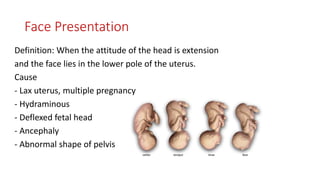
Face Presentation
Definition: When the attitude of the head is extension
and the face lies in the lower pole of the uterus.
Cause
- Lax uterus, multiple pregnancy
- Hydraminous
- Deflexed fetal head
- Ancephaly
- Abnormal shape of pelvis
Diagnosis Face Presentation
Abdominal examination
Inspection- irregular abdomen and the shape of the fetal
spine is that of an” S.”
Palpation
- prominent occiput is felt on one the same side as the
sinceput which is lower than the occiput.
Diagnosis Face Presentation
Vaginal examination
- The presenting part is high
- A soft irregular mass is felt, the gums are felt and the
fetus may examining finger
Management in labor Face Presentation
• - Encourage and perhaps sedate because she will have
• extra discomfort.
• - When membranes ruptures do vaginal examination to
• 189
• make sure no cord prolapsed and to note the position
• - Rotation occurs below the level of spines
Management in labor Face Presentation
-If the chin is anterior let labor continue, if transverse,
watch that it rotates anteriorly. When the face distends the
perineum, perform an episiotomy, then hold back the
sinceput and allow the chin to be born, when the chin is
born flex the head and allow the occupt to be born.
- Always be careful not to damage the baby’s eyes with
fingers or antiseptic
Complications Face Presentation
- Obstructed labour
- Cord prolapse
- Facial bruising
- Cerebral haemorrhage & Maternal trauma
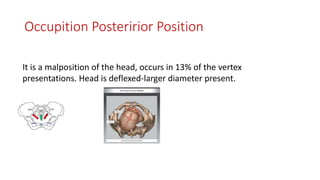
Occupition Posteririor Position
It is a malposition of the head, occurs in 13% of the vertex
presentations. Head is deflexed-larger diameter present.
Causes Occupition Posteririor Position
Direct cause is unknown but associated with
- Pendulous abdomen
- Abnormal pelvis, Androld, Anthropoid, flat sacrum
- The placenta is in anterior wall
Diagnosis Occupition Posteririor Position
Inspection
Deep hollow between head and lower limbs
Palpation
The fetal head is found on one side
The limbs are infront and give hollowing above the head.
There is a saucer like depression around the umbilicus.
Auscultation
• Fetal Heart is heard in the flanks and descends down
Vaginal examination
- Membranes may rupture early
- If infant may protrude through cervix as a finger like fore
water or fill up the upper vagina
- Due to deflection, anterior fontanel is felt in the anterior
part of the pelvis near ileo pectineal eminence
MAL-POSITION AND MALPRESENTATION PPT.pptx

MAL-POSITION AND MALPRESENTATION PPT.pptx

  • 1.
  • 2.
    Malpresentation and Malpostion Mal-presentation- A presentation other than vertex Eg. Shoulder, face, brow and breech. Mal-position and mal-presentations: have ill fitting presenting parts compared to a well flexed vertex presentations in a normal pelvis.
  • 3.
    Causes • - polyhydraminous •Abnormality of pelvis • Abnormal shape of uterus • Laxcity of uterine muscles • Multiple pregnancy
  • 4.
    Breech Presentation • Definition:When the fetus lies with his buttock in the • lower pole of the uterus. • It occurs in 1: 40 cases of labor after 34 week
  • 5.
    Types of breechPresentation 1. frank breech- in this type of breech the thighs are flexed and the legs are extended along the fetal abdomen. It is the common one. 2. Complete breech the fetus lies in a flexed attitude and the legs are flexed on the abdomen. The presenting part is bulky and consists of buttocks external genitalia and both feet. 3. Footling- one or both feet present because neither hips nor knees are fully flexed. 4. Knee presentation. On this case both the hips are extended with the knees flexed.
  • 6.
    Example Example Lie-Longitudinal Attitude-complete flexion Presentation- Breech Position-Left sacro Anterior Donominotor- Sacrum Presenting part- is anterior buttock
  • 7.
    Causes: • often nocause is identified but the following circumstances favor breech presentation: -Poly hydromnios - Prematurity - Multiple pregnancy - Placenta preveia - Contracted pelvis - Uterine abnormalities - Hydrocephalus - Extended legs
  • 8.
    Diagnosis of Breech •On palpation • Lie is longitudinal The fundus contains a firm, smooth and rounded mass which dependently moves with the back. On auscultation The fetal heart beat is heard above the umbilicus if the breech is not engaged below the umbilicus if it is engaged. ultrasound scan or Xray: may confirmed the presentation
  • 9.
    Diagnosis of Breech •Vaginal examination • No sutures and fontanels are felt. When the membrane are ruptured meconeum can seen on the examining finger.
  • 10.
    Management of Breechin labor Management in labor The method of delivery is chosen depend on 1. Parity of the mother if she is preimigravida 2. Size of the baby 3. Other obstetrical complication
  • 11.
    The Principles ofManagement - Intelligent observation - Avoidance of unnecessary interference - Prompt action carried out with manual dexterity when assistance is needed - Avoidance of fetal injury and hypoxia
  • 12.
    Dangers of breechpresentation 1. Delay of the after coming head 2. Cerebral damage due to hypoxia 3. Asphyxia (fetal or neonatal), prolapsed of cord or pressure on cord. 4. Prematurity 5. Intracranial hemorrhage due to trauma 6. Injuries to liver spleen adrenal glands or kidney 7. Erb’s palsy due to damage of the brachial plexus 8. Facial nerve paralysis due to the twisting of the neck
  • 13.
    Dangers of breechpresentation • 9. Fracture to femur, tibia, humorous or clavicle • 10. Damage to spinal cord due to wrong handling • 11. Pneumonia due to premature inspiration
  • 14.
    Brow Presentation Definition:- Whenthe sinciput or the area between the face and vertex is in the lower pole of the uterus. Attitude – Between flexion and extension (mid way) engaging diameter mentovertical 13:5cm. It occurs 1 in 1000 deliveries.
  • 15.
    Causes • 1. Laxuterus, multiple pregnancy, hydraminous • 2. Deflexed fetal head • - Thyroid tumor • 3. Anencephaly • 4. Abnormal shape of pelvis
  • 16.
    Diagnosis • On palpation:the head is big and high & does not enter the • Pelvis On vaginal examination - It is difficult to touch the presenting part - A smooth hair less area is felt, with part of the Bergman at one side - The orbital ridges may be felt. - ultrasound scan or Xray: can confirmed the presentation
  • 17.
    Management of BrowPresentation If brow presentation is diagnosed early in labour, it may be converted to a face presentation by fully extension or it may be flexed to a vertex presentation, however, brow presentation will lead to obstructed labor. - Cesearian section is the management for alive baby - Craniotomy if baby is dead.
  • 18.
    Shoulder Presentation Definition- Whenthe shoulder of the fetus lies in the lower pole of the uterus in labor. A transverse lie becomes a shoulder presentation in labor. Incidence-Occurse once in 250-300 deliveries.
  • 19.
    Causes of ShoulderPresentation • - Laxity of uterus • - Placenta previea, hydraminous, • - Multiple pregnancy • - Uterine abnormality • - Preterm pregnancy
  • 20.
    Diagnosis The uterus appearbroad and the funds height is less than expected for the period of gestation - Easily seen on abdominal examination. When labour progresses, the hand can be felt or the ribs on V.E. - Arm may prolapsed when membrane rupture - ultrasound scan or Xray: can confirmed the presentation
  • 21.
    Management of ShoulderPresentation • - When diagnosed at antenatal clinic after 36 weeks external version will be attempted. • - In labor caesarian section is method of choice when attempt of external version have failed.
  • 22.
    Complications Shoulder Presentation •Maternal Fetal Obstructed labour - Fetal death (cord prolapsed) - Uterine rupture - Prematurity - Death - Malformation - Puerperal sepsis - Arm prolapse - PPH
  • 23.
    Face Presentation Definition: Whenthe attitude of the head is extension and the face lies in the lower pole of the uterus. Cause - Lax uterus, multiple pregnancy - Hydraminous - Deflexed fetal head - Ancephaly - Abnormal shape of pelvis
  • 24.
    Diagnosis Face Presentation Abdominalexamination Inspection- irregular abdomen and the shape of the fetal spine is that of an” S.” Palpation - prominent occiput is felt on one the same side as the sinceput which is lower than the occiput.
  • 25.
    Diagnosis Face Presentation Vaginalexamination - The presenting part is high - A soft irregular mass is felt, the gums are felt and the fetus may examining finger
  • 26.
    Management in laborFace Presentation • - Encourage and perhaps sedate because she will have • extra discomfort. • - When membranes ruptures do vaginal examination to • 189 • make sure no cord prolapsed and to note the position • - Rotation occurs below the level of spines
  • 27.
    Management in laborFace Presentation -If the chin is anterior let labor continue, if transverse, watch that it rotates anteriorly. When the face distends the perineum, perform an episiotomy, then hold back the sinceput and allow the chin to be born, when the chin is born flex the head and allow the occupt to be born. - Always be careful not to damage the baby’s eyes with fingers or antiseptic
  • 28.
    Complications Face Presentation -Obstructed labour - Cord prolapse - Facial bruising - Cerebral haemorrhage & Maternal trauma
  • 29.
    Occupition Posteririor Position Itis a malposition of the head, occurs in 13% of the vertex presentations. Head is deflexed-larger diameter present.
  • 30.
    Causes Occupition PosteririorPosition Direct cause is unknown but associated with - Pendulous abdomen - Abnormal pelvis, Androld, Anthropoid, flat sacrum - The placenta is in anterior wall
  • 31.
    Diagnosis Occupition PosteririorPosition Inspection Deep hollow between head and lower limbs Palpation The fetal head is found on one side The limbs are infront and give hollowing above the head. There is a saucer like depression around the umbilicus.
  • 32.
    Auscultation • Fetal Heartis heard in the flanks and descends down Vaginal examination - Membranes may rupture early - If infant may protrude through cervix as a finger like fore water or fill up the upper vagina - Due to deflection, anterior fontanel is felt in the anterior part of the pelvis near ileo pectineal eminence