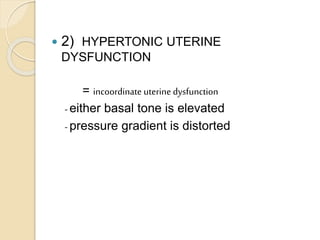
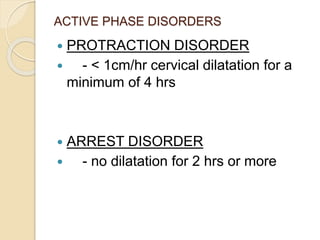
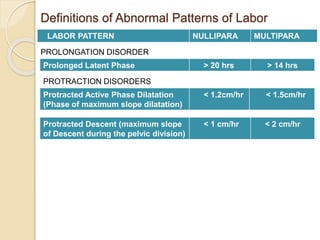
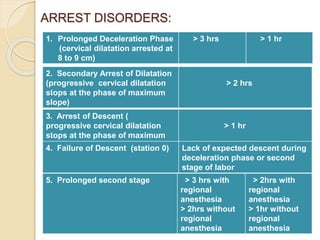
Dystocia refers to difficult or slow labor progress that may be caused by abnormalities of the passageway (mother's pelvis), passenger (baby), or powers (uterine contractions). There are two main types of uterine dysfunction that can cause dystocia: hypotonic dysfunction where contractions are insufficient and hypertonic dysfunction where contractions are incoordinated. Labor patterns are considered abnormal if the active phase of dilation progresses less than 1 cm/hr for nulliparous women or 1.5 cm/hr for multiparous women. Arrest disorders occur when dilation or descent stops progressing for over 2 hours. Precipitous labor is extremely rapid labor and delivery caused by abnormally low resistance in the birth canal