

DR. BICKEY KHADGI
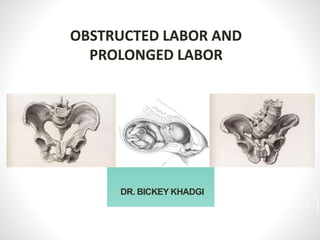
OBSTRUCTED LABOR AND
PROLONGED LABOR
1
PROLONGED LABOR
• The labor is said to be prolonged when the combined
duration of the first and second stage is more than the
arbitrary time limit of 18 hours.
• Labor is considered prolonged when the
• cervical dilatation rate is less than 1 cm/hr and
• descent of the presenting part is < 1 cm/hr for a period of
minimum 4 hours observation (WHO-1994).
2
Stages of labour
•First stage:
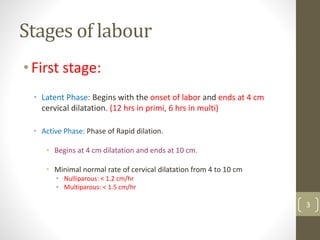
• Latent Phase: Begins with the onset of labor and ends at 4 cm
cervical dilatation. (12 hrs in primi, 6 hrs in multi)
• Active Phase: Phase of Rapid dilation.
• Begins at 4 cm dilatation and ends at 10 cm.
• Minimal normal rate of cervical dilatation from 4 to 10 cm
• Nulliparous: < 1.2 cm/hr
• Multiparous: < 1.5 cm/hr
3
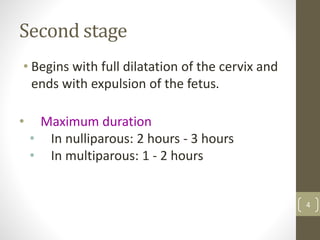
Second stage
• Begins with full dilatation of the cervix and
ends with expulsion of the fetus.
• Maximum duration
• In nulliparous: 2 hours - 3 hours
• In multiparous: 1 - 2 hours
4
Third stage
• Begins immediately after the delivery of
the fetus and ends with the delivery of the
placenta and membranes.
• Duration: Usually < 10 minutes.
• considered prolonged if > 30 minutes.
5
Fourth Stage
Stage of observation upto 1 hour after delivery
Regular monitoring of:
• Vital signs
• Pallor
• Uterine contraction
• p/v bleeding
• Episiotomy/perineal tear sutures
6
PROLONGED LATENT PHASE
• Mean duration of latent phase is about
• 8 hours in a primigravida and
• 4 hours in a multiparous
• A latent phase that exceeds
• 20 hours in primigravidae or
• 14 hours in multiparous is abnormal.
• The causes include—
• (1) unripe cervix
• (2) malposition and malpresentation
• (3) cephalopelvic disproportion and
• (4) premature rupture of the membranes
7
Management
• Conservative management is usually done unless there is any
indication.
• Rest and analgesic are usually given.
• When augmentation is decided, medical methods (oxytocin or
prostaglandins ) are preferred.
8
CAUSES OF PROLONGED LABOR
• Remember the three “Ps”
• That affect the duration of the active phase of
labor:
• Power (strength and frequency of contractions
• Passenger (size of the baby)
• Pelvis (size and shape of mother’s pelvis)
9
Prolonged Second stage
• Sluggish or non-descent of the presenting part in
the second stage is due to:
• Fault in the power
• Fault in the passage
• Fault in the passenger:
• (1) Malposition (occipito-posterior)
• (2) Malpresentation
• (3) Big baby
10
DIAGNOSIS
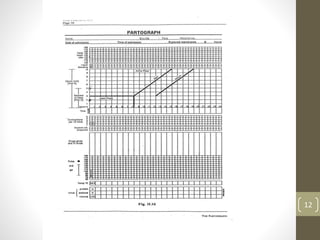
•Partograph can diagnose any
dysfunctional labor early and help to
initiate correct management.
11
12
DANGERS
Fetal
(1) Hypoxia
(2) Intrauterine infection
(3) Intracranial stress or hemorrhage
(4) Increased operative delivery.
13
Maternal
1) Distress
2) Postpartum hemorrhage
3) Trauma
4) Increased operative delivery
5) Puerperal sepsis
6) Subinvolution.
14
TREATMENT/PREVENTION
• Antenatal or early intranatal detection of the factors likely to
produce prolonged labor
• big baby,
• small women,
• malpresentation or position.
• Use of partograph helps early detection.
• Augmentation of labor by low rupture of the membranes followed by
oxytocin drip
• Change of posture in labor other than supine to increase uterine
contractions.
• Avoidance of dehydration in labor and use of adequate analgesia for
pain relief.
15
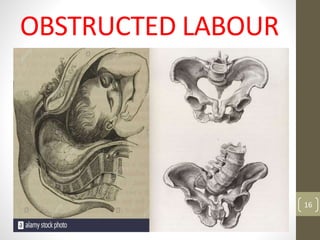
OBSTRUCTED LABOUR
16
• “Obstructed labour is one where inspite of good uterine
contractions, the progressive descent of the presenting part is
arrested due to mechanical obstruction.”
• Thismay result either due to factors in the fetus or in the birth canal
or both, so that further progress is almost impossible without
assistance.
Defintion
17
• In the developing countries, the prevalence is
about 1-2 % in the referral hospitals.
INCIDENCE
18
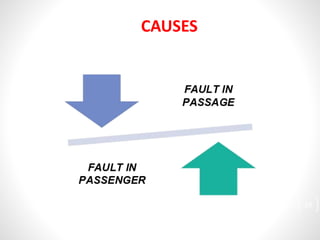
CAUSES
19
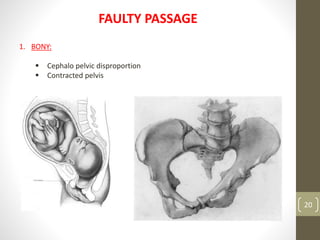
FAULTY PASSAGE
1. BONY:
 Cephalo pelvic disproportion
 Contracted pelvis
20
2. SOFT TISSUE OBSTRUCTION
 Cervical dystocia :
 Failure of cervix to dilate within a reasonable time
in spite of good regular uterine contraction
 Difficult labor and delivery caused by
mechanical obstruction at the cervix.
 Dystocia comes from the Greek "dys" meaning
"difficult, painful, disordered, abnormal”+ "tokos"
meaning "birth."
21
FAULT IN PASSENGER
• Transverse lie
• Brow presentation
• Congenital malformations of the fetus:
hydrocephalus (commonest), fetal ascites.
• Big baby, occipito-posterior position
22
IMMEDIATE:
• Exhaustion
• Dehydration
• Genital sepsis
• Injuryto the genital tract includes rupture of the uterus
• Postpartum hemorrhage and shock
• The death are due to rupture of uterus, shock and sepsis with metabolic
changes.
Effect On Mother
23
REMOTE:
• If patient survives they may present with
complication.
1.Genito-urinary fistula or rectovaginal fistula
2.Variable degree of vaginal atresia
3.Secondary amenorrhoea
24
• Asphyxia
• Acidosis (due to fetal hypoxia)
• Intracranial hemorrhage
• Infection
Effect on Fetus
25
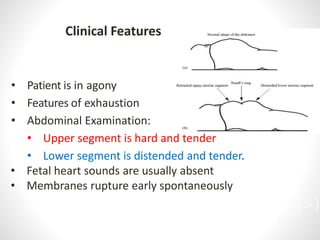
• Patient is in agony
• Features of exhaustion
• Abdominal Examination:
• Upper segment is hard and tender
• Lower segment is distended and tender.
• Fetal heart sounds are usually absent
• Membranes rupture early spontaneously
Clinical Features
26
• Antenataldetectionoffactorproducingprolongedlabor.
• Bigbaby,
• Smallwomen
• Malpresentationand position
• Perinatal: Continuous monitor, use of partograph , to detect prolonged
labour.And useinterventionaccordingly.
• Failure in progress of labour inspite of good uterine
contraction for a reasonable period (2-4 hours ) is an
impending sign of obstructed labour.
Prevention
27
• Theunderlying principles are
1. To relieve the obstruction at the earliest by a safe
delivery procedure.
2.To combat dehydration and ketoacidosis
3. To control sepsis
Treatment
28
PRELIMINARIES
1. Fluid electrolyte balance and correction of dehydration
and ketoacidosis.
2.A vaginal swab tissue culture and sensitivity test
3.Blood examination
4.Antibiotic: 1g cefriaxone IV
5.Metronidazole for IV for anaerobic infection
29
• Rule out rupture of uterus.
• Decision should be made to relieve the obstruction.
Obstetric Examination
30
• There is no place of “wait and
watch”, neither is any scope
of using oxytocin to stimulate
uterine contraction.
31
• Lower segment Caesarean section (LSCS):
• If the case is detected early with good fetal
condition, caesarean section gives the best
result.
• But in late or neglected cases, even if the fetal
heart sound is audible, desperate attempt to do
a casearean section to save moribund baby
more often leads to disastrous consequences.
Definitive management
32
Thank-YOU
33

Obstructed labour and Prolonged Labour

  • 1.
    DR. BICKEY KHADGI OBSTRUCTEDLABOR AND PROLONGED LABOR 1
  • 2.
    PROLONGED LABOR • Thelabor is said to be prolonged when the combined duration of the first and second stage is more than the arbitrary time limit of 18 hours. • Labor is considered prolonged when the • cervical dilatation rate is less than 1 cm/hr and • descent of the presenting part is < 1 cm/hr for a period of minimum 4 hours observation (WHO-1994). 2
  • 3.
    Stages of labour •Firststage: • Latent Phase: Begins with the onset of labor and ends at 4 cm cervical dilatation. (12 hrs in primi, 6 hrs in multi) • Active Phase: Phase of Rapid dilation. • Begins at 4 cm dilatation and ends at 10 cm. • Minimal normal rate of cervical dilatation from 4 to 10 cm • Nulliparous: < 1.2 cm/hr • Multiparous: < 1.5 cm/hr 3
  • 4.
    Second stage • Beginswith full dilatation of the cervix and ends with expulsion of the fetus. • Maximum duration • In nulliparous: 2 hours - 3 hours • In multiparous: 1 - 2 hours 4
  • 5.
    Third stage • Beginsimmediately after the delivery of the fetus and ends with the delivery of the placenta and membranes. • Duration: Usually < 10 minutes. • considered prolonged if > 30 minutes. 5
  • 6.
    Fourth Stage Stage ofobservation upto 1 hour after delivery Regular monitoring of: • Vital signs • Pallor • Uterine contraction • p/v bleeding • Episiotomy/perineal tear sutures 6
  • 7.
    PROLONGED LATENT PHASE •Mean duration of latent phase is about • 8 hours in a primigravida and • 4 hours in a multiparous • A latent phase that exceeds • 20 hours in primigravidae or • 14 hours in multiparous is abnormal. • The causes include— • (1) unripe cervix • (2) malposition and malpresentation • (3) cephalopelvic disproportion and • (4) premature rupture of the membranes 7
  • 8.
    Management • Conservative managementis usually done unless there is any indication. • Rest and analgesic are usually given. • When augmentation is decided, medical methods (oxytocin or prostaglandins ) are preferred. 8
  • 9.
    CAUSES OF PROLONGEDLABOR • Remember the three “Ps” • That affect the duration of the active phase of labor: • Power (strength and frequency of contractions • Passenger (size of the baby) • Pelvis (size and shape of mother’s pelvis) 9
  • 10.
    Prolonged Second stage •Sluggish or non-descent of the presenting part in the second stage is due to: • Fault in the power • Fault in the passage • Fault in the passenger: • (1) Malposition (occipito-posterior) • (2) Malpresentation • (3) Big baby 10
  • 11.
    DIAGNOSIS •Partograph can diagnoseany dysfunctional labor early and help to initiate correct management. 11
  • 12.
  • 13.
    DANGERS Fetal (1) Hypoxia (2) Intrauterineinfection (3) Intracranial stress or hemorrhage (4) Increased operative delivery. 13
  • 14.
    Maternal 1) Distress 2) Postpartumhemorrhage 3) Trauma 4) Increased operative delivery 5) Puerperal sepsis 6) Subinvolution. 14
  • 15.
    TREATMENT/PREVENTION • Antenatal orearly intranatal detection of the factors likely to produce prolonged labor • big baby, • small women, • malpresentation or position. • Use of partograph helps early detection. • Augmentation of labor by low rupture of the membranes followed by oxytocin drip • Change of posture in labor other than supine to increase uterine contractions. • Avoidance of dehydration in labor and use of adequate analgesia for pain relief. 15
  • 16.
  • 17.
    • “Obstructed labouris one where inspite of good uterine contractions, the progressive descent of the presenting part is arrested due to mechanical obstruction.” • Thismay result either due to factors in the fetus or in the birth canal or both, so that further progress is almost impossible without assistance. Defintion 17
  • 18.
    • In thedeveloping countries, the prevalence is about 1-2 % in the referral hospitals. INCIDENCE 18
  • 19.
  • 20.
    FAULTY PASSAGE 1. BONY: Cephalo pelvic disproportion  Contracted pelvis 20
  • 21.
    2. SOFT TISSUEOBSTRUCTION  Cervical dystocia :  Failure of cervix to dilate within a reasonable time in spite of good regular uterine contraction  Difficult labor and delivery caused by mechanical obstruction at the cervix.  Dystocia comes from the Greek "dys" meaning "difficult, painful, disordered, abnormal”+ "tokos" meaning "birth." 21
  • 22.
    FAULT IN PASSENGER •Transverse lie • Brow presentation • Congenital malformations of the fetus: hydrocephalus (commonest), fetal ascites. • Big baby, occipito-posterior position 22
  • 23.
    IMMEDIATE: • Exhaustion • Dehydration •Genital sepsis • Injuryto the genital tract includes rupture of the uterus • Postpartum hemorrhage and shock • The death are due to rupture of uterus, shock and sepsis with metabolic changes. Effect On Mother 23
  • 24.
    REMOTE: • If patientsurvives they may present with complication. 1.Genito-urinary fistula or rectovaginal fistula 2.Variable degree of vaginal atresia 3.Secondary amenorrhoea 24
  • 25.
    • Asphyxia • Acidosis(due to fetal hypoxia) • Intracranial hemorrhage • Infection Effect on Fetus 25
  • 26.
    • Patient isin agony • Features of exhaustion • Abdominal Examination: • Upper segment is hard and tender • Lower segment is distended and tender. • Fetal heart sounds are usually absent • Membranes rupture early spontaneously Clinical Features 26
  • 27.
    • Antenataldetectionoffactorproducingprolongedlabor. • Bigbaby, •Smallwomen • Malpresentationand position • Perinatal: Continuous monitor, use of partograph , to detect prolonged labour.And useinterventionaccordingly. • Failure in progress of labour inspite of good uterine contraction for a reasonable period (2-4 hours ) is an impending sign of obstructed labour. Prevention 27
  • 28.
    • Theunderlying principlesare 1. To relieve the obstruction at the earliest by a safe delivery procedure. 2.To combat dehydration and ketoacidosis 3. To control sepsis Treatment 28
  • 29.
    PRELIMINARIES 1. Fluid electrolytebalance and correction of dehydration and ketoacidosis. 2.A vaginal swab tissue culture and sensitivity test 3.Blood examination 4.Antibiotic: 1g cefriaxone IV 5.Metronidazole for IV for anaerobic infection 29
  • 30.
    • Rule outrupture of uterus. • Decision should be made to relieve the obstruction. Obstetric Examination 30
  • 31.
    • There isno place of “wait and watch”, neither is any scope of using oxytocin to stimulate uterine contraction. 31
  • 32.
    • Lower segmentCaesarean section (LSCS): • If the case is detected early with good fetal condition, caesarean section gives the best result. • But in late or neglected cases, even if the fetal heart sound is audible, desperate attempt to do a casearean section to save moribund baby more often leads to disastrous consequences. Definitive management 32
  • 33.